Struggling to choose between a cheaper regular charger and a premium GaN charger? You're not alone. The wrong choice can hurt your sales and even your brand's reputation.
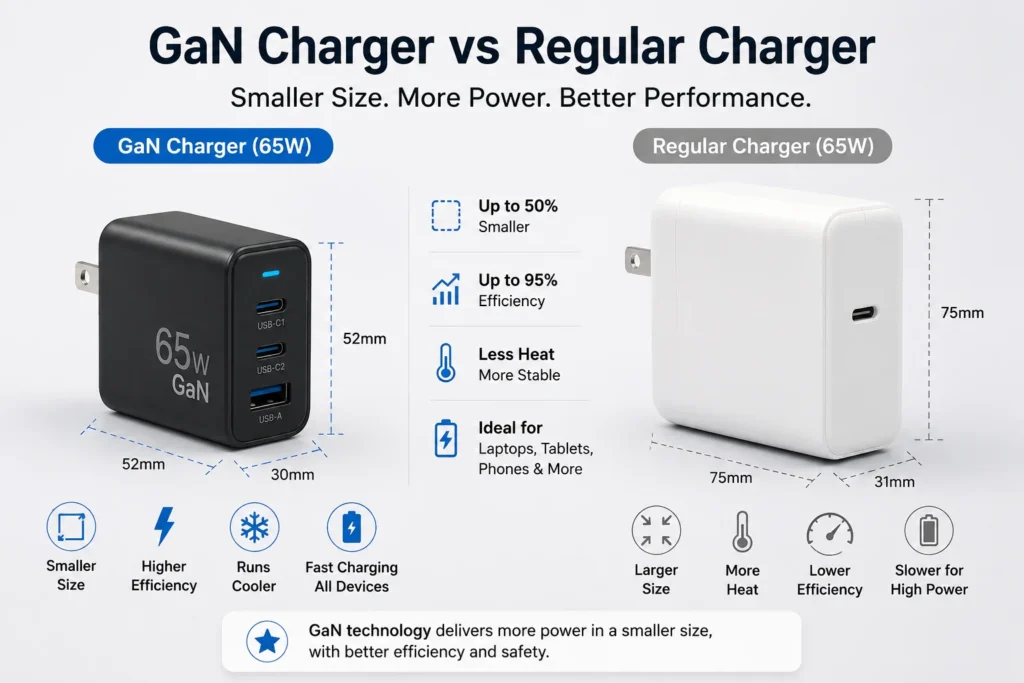
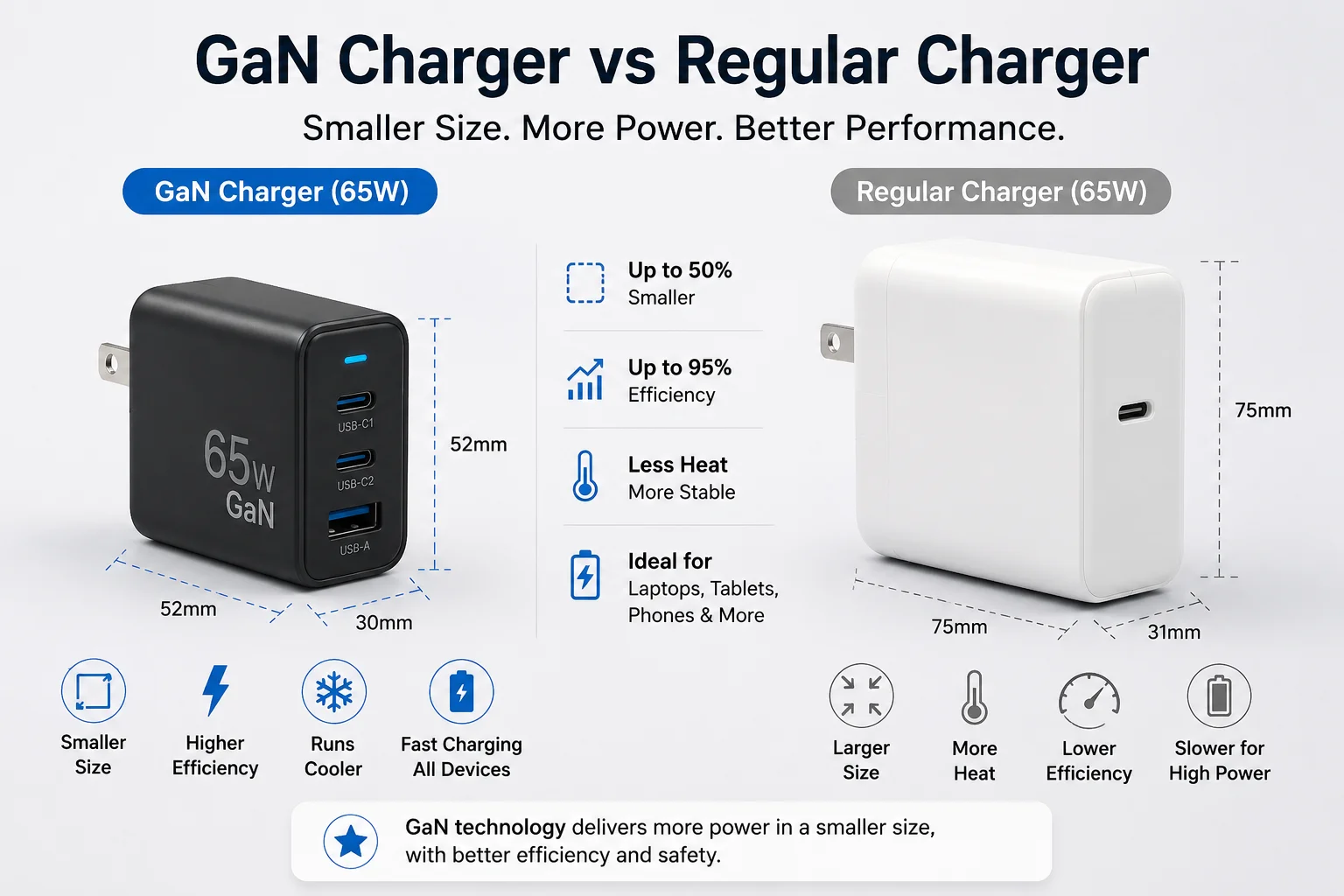
The main difference is GaN (Gallium Nitride) technology. It makes chargers smaller, more efficient, and cooler at high power outputs compared to traditional silicon chargers. This is key for fast-charging multiple devices like laptops and phones with one compact adapter, a feature your customers will love.
I get this question all the time from my B2B clients. They see "GaN" on a supplier's product list and think it's just a marketing buzzword. But as someone who has handled thousands of charger orders over the last 15 years, I can tell you the difference is real. It directly impacts what you can sell, who you can sell to, and the risks you take on. Let's break down what you actually need to know before you place your next big order.
What Is a GaN Charger and Why Is It Different?
Confused by the term "GaN"? You see it everywhere now, but what does it actually mean for the chargers you want to sell? It feels like just another technical term.
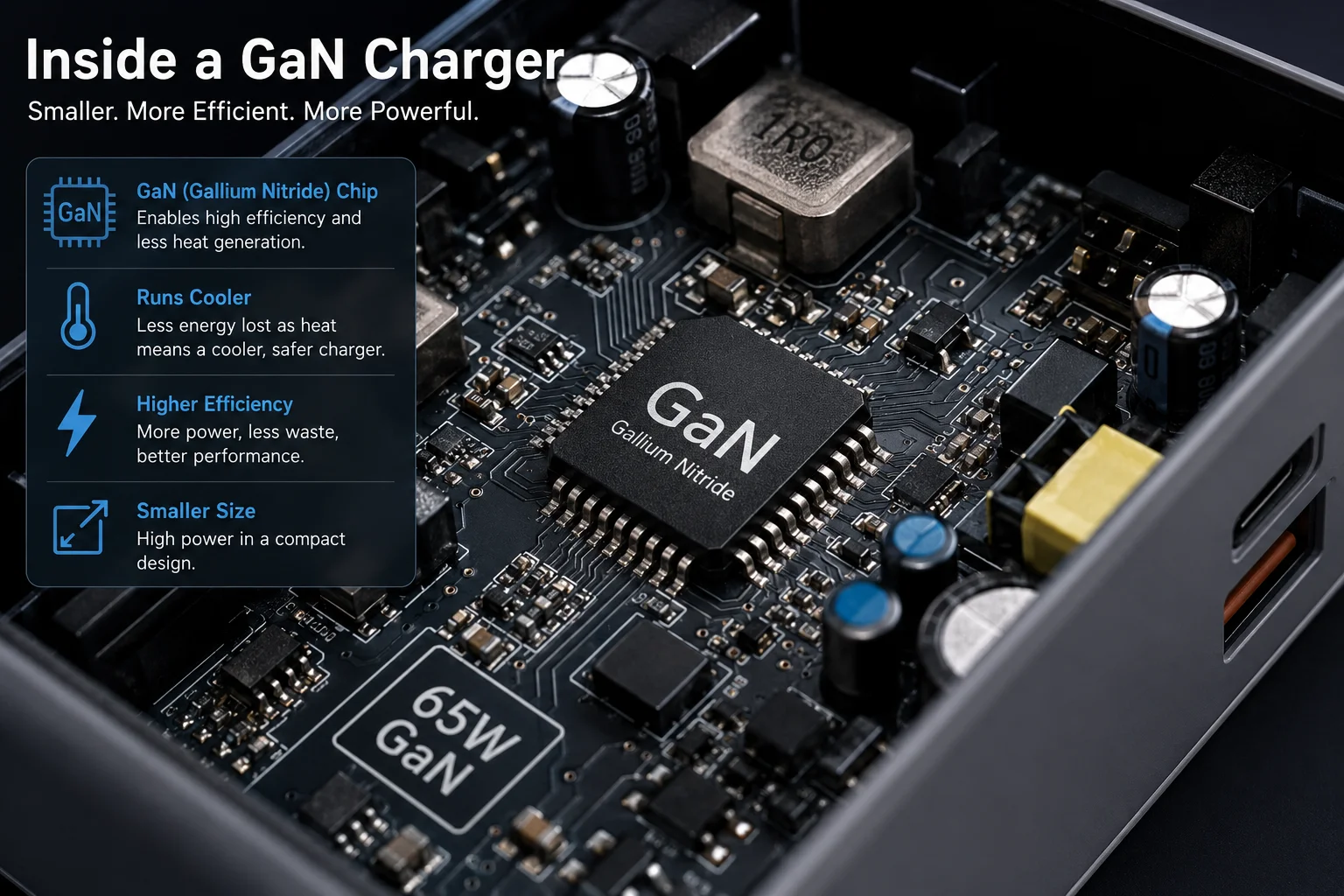
A GaN charger uses Gallium Nitride, a modern semiconductor material, instead of traditional silicon. This material is far more efficient, losing less energy as heat. This single change allows for smaller, more powerful chargers, which is a major selling point for consumers.
For years, I've had to explain this to buyers who are just looking for the "best price." The material inside the charger might seem like a small detail, but it changes everything about the product. To make it simple, I often compare it to engines in a car.
The Old Way: Silicon Chargers
Think of the charger you've used for the last decade. It was probably made with silicon chips. Silicon is the workhorse of the electronics industry. It's cheap, reliable, and we've been using it for over 50 years. But it has its limits. When you try to push a lot of power through a silicon charger, it gets hot. That heat is wasted energy. To manage that heat and prevent the charger from melting, engineers have to make the components bigger and leave more space between them. This is exactly why your old laptop charger was a heavy, clunky brick. It was full of large components and empty space just to handle the heat.
The New Way: Gallium Nitride (GaN)
Now, imagine a new type of engine that's much more fuel-efficient. It can produce the same amount of power but is much smaller and doesn't get as hot. That's GaN. Gallium Nitride is a crystal-like material that can handle much higher voltages and switch power far more efficiently than silicon. Because it wastes very little energy as heat, engineers can design chargers with components that are packed much closer together. This is the magic behind making a charger that's both powerful and tiny.
Here’s a simple table I use to show clients the difference:
| Feature | Silicon (Regular Charger) | Gallium Nitride (GaN Charger) |
|---|---|---|
| Material | Traditional, widely used | Modern, high-performance |
| Energy Efficiency | Lower (more energy lost as heat) | Higher (less energy lost as heat) |
| Size for Same Power | Larger and heavier | Smaller and lighter |
| Heat Generation | Higher | Lower |
| Component Cost | Lower | Higher |
When you choose to stock GaN chargers, you're not just selling a new buzzword. You are selling tangible benefits: smaller size, less heat, and higher efficiency. That's a product story your customers will easily understand and appreciate.
GaN Charger vs Regular Charger: The Core Technology Difference?
Okay, so GaN is a new material. But what does that really mean for the electronics inside the charger? Buyers often feel this part is too technical, but it’s where quality and reliability live.
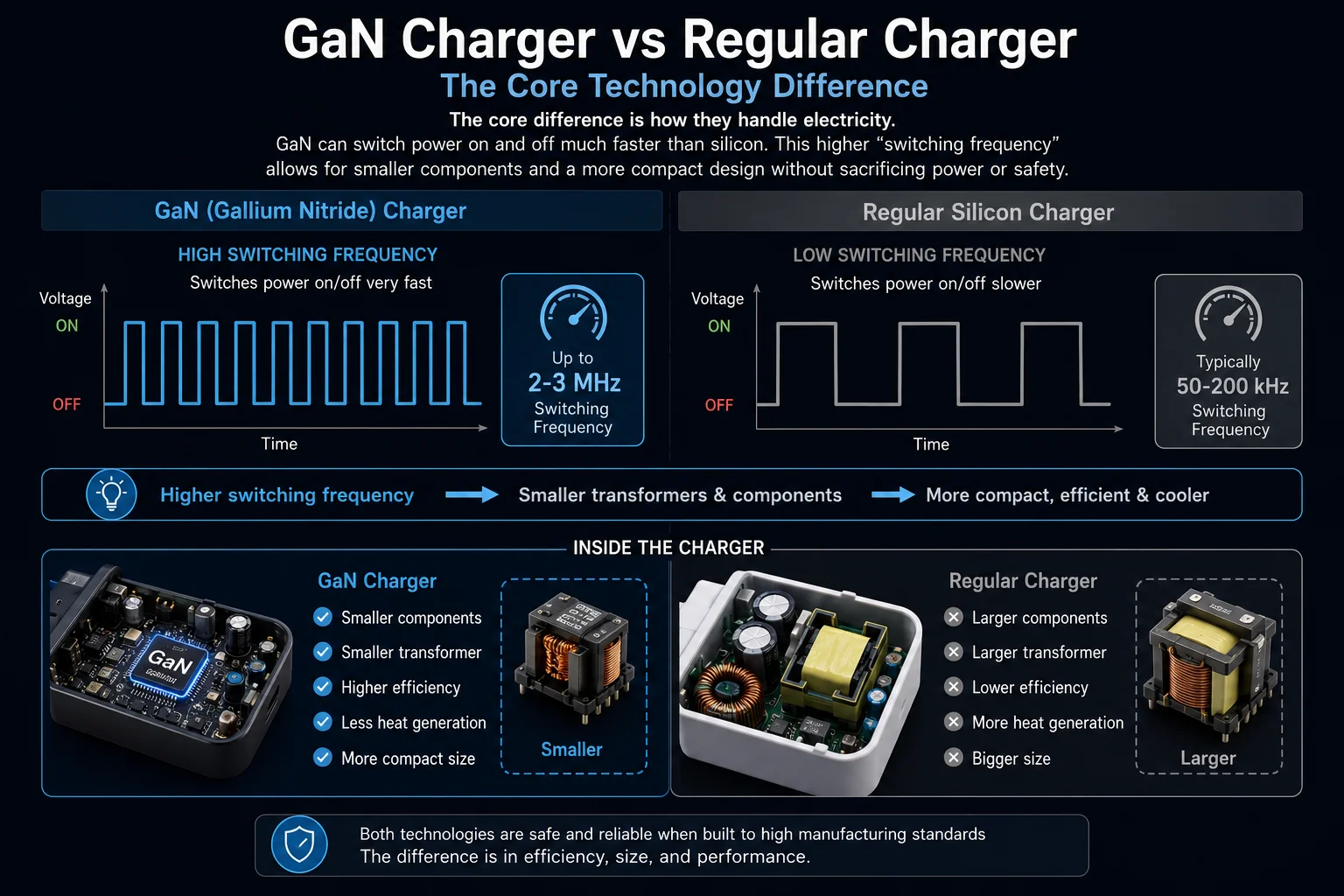
The core difference is how they handle electricity. GaN can switch power on and off much faster than silicon. This higher "switching frequency" allows manufacturers to use smaller transformers and other internal components, directly leading to a more compact design without sacrificing power or safety.
I once had a client who thought a GaN charger was just a regular charger in a smaller case. I had to open one up for him to show him it's not that simple. The entire internal layout is different, and it all comes down to speed.
How a Charger Works (The Simple Version)
First, let's quickly review a charger's job. It takes the high-voltage AC power from your wall outlet (like 110V or 230V) and converts it into low-voltage DC power that your phone or laptop can use (like 5V, 9V, or 20V). The key parts that do this job are transistors (which act as switches) and a transformer.
Silicon's Slow Switching Speed
In a traditional charger, the silicon transistors switch on and off thousands of times per second to manage the power conversion. This might sound fast, but there's a physical limit. If you try to switch them any faster, they become very inefficient and generate a massive amount of waste heat. This speed limit directly dictates the size of the other components, especially the magnetic transformer, which is often the biggest and heaviest part of a charger. A slower switching speed requires a larger transformer.
GaN's Super-Fast Switching Speed
This is where GaN changes the game. GaN transistors can switch on and off hundreds of thousands, or even millions, of times per second. Because they can operate so much faster, they can work with much smaller and lighter transformers and other components. It’s a chain reaction: higher switching frequency allows for smaller magnetics, which allows for a smaller overall charger. When a potential supplier talks about their "advanced GaN solution," they are talking about the specific GaN chip, controller, and circuit layout they engineered to achieve this high-speed, high-efficiency performance. This is also why a poorly designed GaN charger can be a disaster—it's a more complex system to get right.
Size and Portability: Why GaN Chargers Can Be Smaller?
Your customers want smaller, lighter accessories. You see tiny GaN chargers advertised everywhere. But is the size difference really that significant for your business? Is it a benefit worth paying more for?
Yes, the size difference is a primary selling point. Because GaN is more energy-efficient, it produces less waste heat. This allows engineers to pack components much closer together without the risk of overheating, resulting in a charger that can be 30-50% smaller than a regular one with the same power.
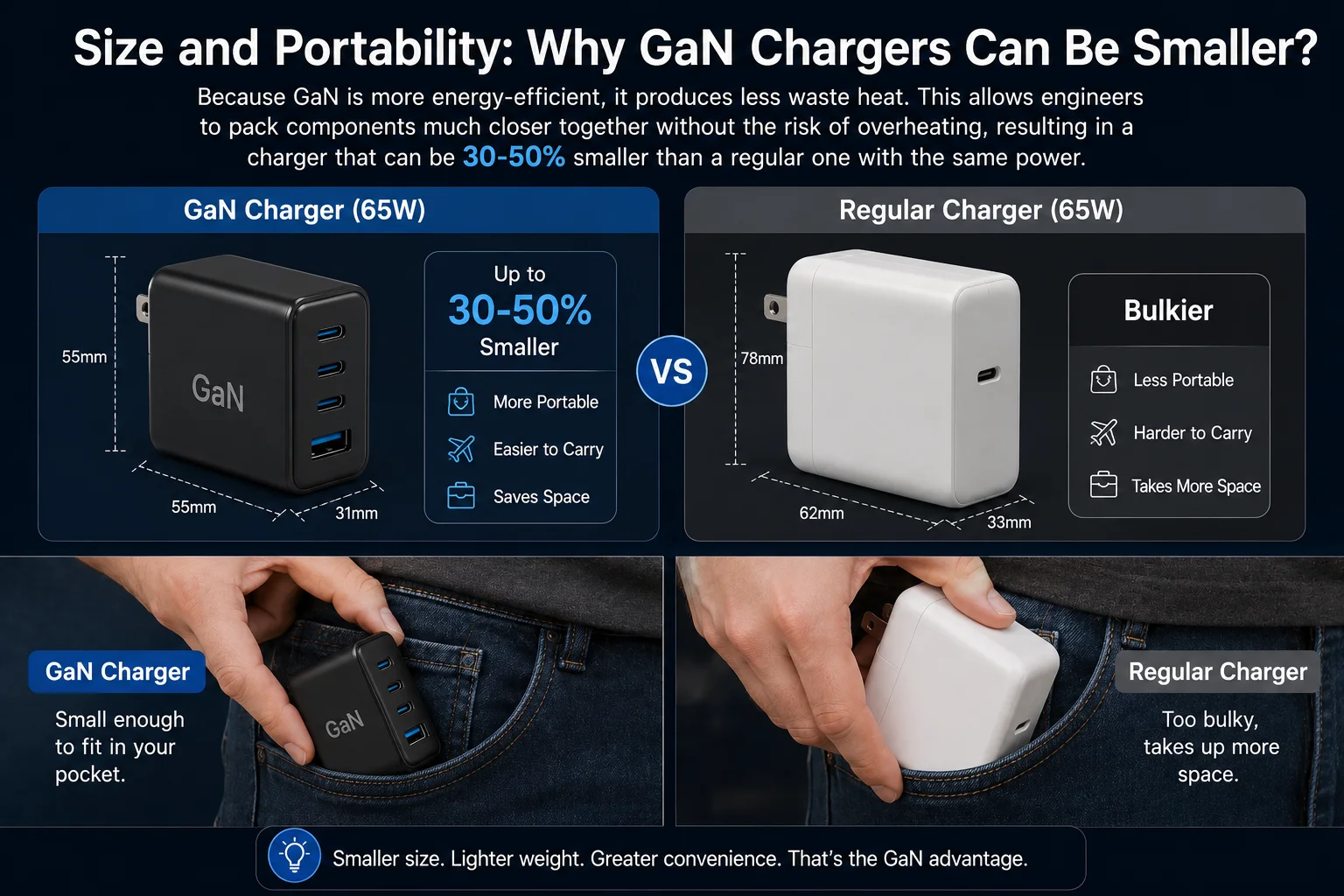
I always tell my clients that heat is the biggest enemy of electronics. In any device, managing heat dictates the design.
The Heat Problem with Silicon
In a traditional silicon charger, about 10-15% of the energy it pulls from the wall is wasted as heat. To deal with this, you need space. You need airflow. You might even need metal heat sinks to draw the heat away from the sensitive chips. If you packed the components of an old 65W laptop charger too tightly, it would simply cook itself from the inside. This is why they were so big—the size was a safety requirement.
GaN's Cool and Compact Solution
A good GaN charger, on the other hand, can be over 93% efficient. This means it wastes less than 7% of its energy as heat. With so much less heat to manage, the entire design can be compressed. Components can be placed much closer together. The outer casing can be made smaller because you don't need a large surface area to dissipate heat.
Here’s a comparison I often show clients to make the point clear:
| Charger Power | Typical Regular Charger (Silicon) | Typical GaN Charger | Benefit for Your Customer |
|---|---|---|---|
| 30W | Size of a large golf ball | Size of a large sugar cube | Fits in any pocket easily |
| 65W | A bulky power brick for laptops | The size of a box of matches | Powers a laptop, fits in a purse |
| 100W+ | A heavy brick, almost a weapon | A dense, pocketable block | One charger for all travel needs |
For your customers, this isn't just a minor improvement. It's a game-changer. A 100W GaN charger that can power a MacBook Pro but is small enough to forget it's in your bag is a product that solves a real problem for travelers, students, and mobile professionals. The portability is what you are really selling, and it’s a powerful marketing message.
Charging Speed: Does GaN Really Charge Faster?
A common mistake I see buyers make is thinking "GaN" automatically means "faster." This is a dangerous assumption that can lead to misleading marketing and unhappy customers. So, what's the real story?
No, GaN itself does not make a charger faster. Charging speed is determined by two things: the charger's maximum power output (wattage) and its support for fast-charging protocols (like USB-PD). GaN's main advantage is enabling high wattage in a small size.

A 30W GaN charger will charge a phone at the exact same speed as a 30W regular silicon charger. Let me repeat that: the material doesn't determine the speed. The power and protocol do.
Wattage Is the Measure of Power
The speed of charging is all about how much power the charger can deliver, which we measure in watts (W). A 100W charger can supply much more power than a 20W charger, so it can charge a large battery (like in a laptop) much more quickly. This is true whether the charger is made with GaN or silicon. The watts are what matter for raw power.
Protocols Are the "Language" of Charging
But high wattage is useless if the charger and the device can't communicate properly. This communication happens through a "fast-charging protocol." Think of it as a language they both need to speak. Today, the most important protocol is USB Power Delivery (PD), which is used by iPhones, Pixels, Samsung phones, iPads, and virtually all modern laptops. For newer Samsung phones, an extension of PD called PPS (Programmable Power Supply) is also critical for achieving the fastest speeds. If a charger doesn't support the right protocol for a device, it will default to a very slow charging speed, even if it's a 100W GaN charger.
GaN's Role: The Great Enabler
So where does GaN fit into this? GaN is the enabling technology that makes high-wattage, portable chargers practical. Sure, you could build a 100W silicon charger, but as we discussed, it would be a massive, heavy brick that no one wants to carry. GaN allows manufacturers to build that same 100W of power into a charger that fits in your pocket. So, while GaN itself isn't the "speed," it's the technology that lets you conveniently carry high-speed charging with you. When you sell a GaN charger, you're not just selling speed; you're selling the convenience of having that speed available anywhere.
Heat Control and Safety: What Buyers Should Understand?
A charger that gets too hot is a customer's nightmare and a seller's liability. With GaN technology packing so much power into such a small space, are they safe? This is a serious question I get constantly from cautious buyers.
A well-designed GaN charger is very safe and often runs cooler than a traditional high-power charger. Its high efficiency means less energy is wasted as heat. However, safety depends entirely on the quality of the internal components and circuit design, making supplier choice and certifications non-negotiable.
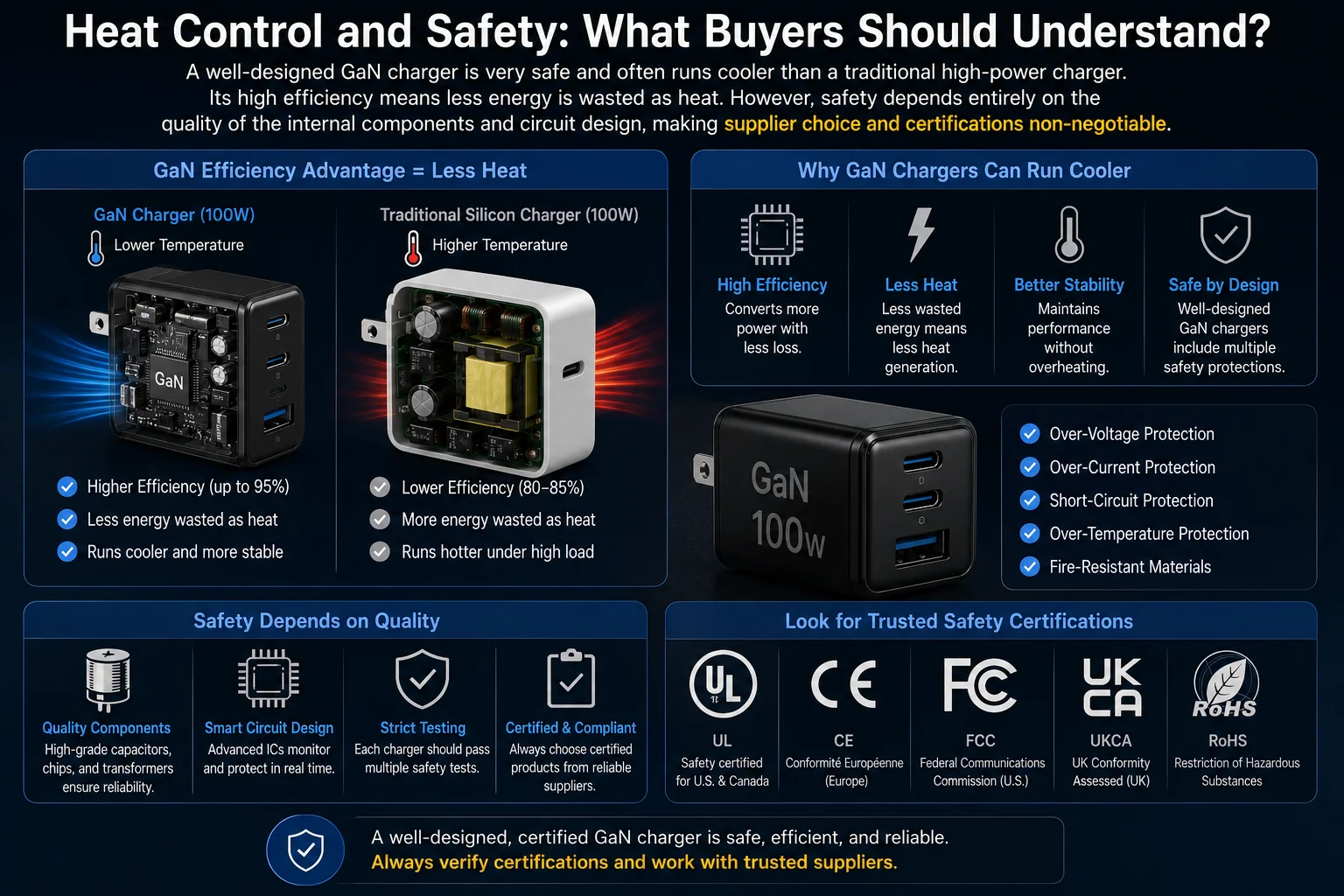
From my experience, a cheap charger is the most expensive mistake a wholesaler can make. The risk of fire, damage to a customer's device, or even injury is real. With chargers, safety is everything.
Efficiency Directly Equals Less Heat
This is the most important concept to understand. A regular silicon charger might be 85% efficient, meaning for every 100 watts it pulls from the wall, 15 watts are wasted as pure heat. A high-quality GaN charger can be over 93% efficient, wasting less than 7 watts as heat. That's less than half the waste heat for the same amount of power delivered! This fundamental efficiency is what makes GaN chargers run cooler during operation.
The Danger of Poorly Designed GaN Chargers
The problem is, the small size of GaN chargers leaves very little room for error. To hit a low price point, a shady manufacturer might use low-grade GaN chips, skip essential protective circuits (like over-voltage, over-current, and short-circuit protection), or use a poor internal layout that creates dangerous hot spots. I have personally tested samples from new suppliers that looked great on the outside but became dangerously hot to the touch after just 30 minutes of charging a laptop. These are the products that cause fires and destroy brand reputations.
Non-Negotiable Safety Certifications
This is why you cannot compromise on certifications. For any charger you source, especially high-power GaN models, you must verify the safety marks for your target market:
- UL / ETL: Essential for the US and Canadian markets. It proves a third-party lab has tested the product against established safety standards.
- CE: Required for Europe. This is a manufacturer's declaration, but you must demand the underlying test reports (especially LVD and EMC) to prove it's legitimate.
- UKCA: The new mark required for Great Britain (England, Scotland, Wales).
Never, ever buy a charger without verifying these. Ask your supplier for the full, unedited test report, not just a photoshopped certificate image. A serious, professional supplier will provide this documentation without any hesitation. It's the first sign you're dealing with someone who values safety as much as you should.
Price Difference: Why GaN Chargers Cost More?
You've probably gotten quotes from suppliers and noticed that GaN chargers are significantly more expensive than regular chargers of similar power. Why is that? Is it just marketing hype, or is there a real reason for the price gap?
GaN chargers cost more for three concrete reasons: the raw Gallium Nitride components are more expensive to produce than silicon, the complex R&D for compact, high-frequency circuits is costly, and the high-quality supporting components required also add to the final price.
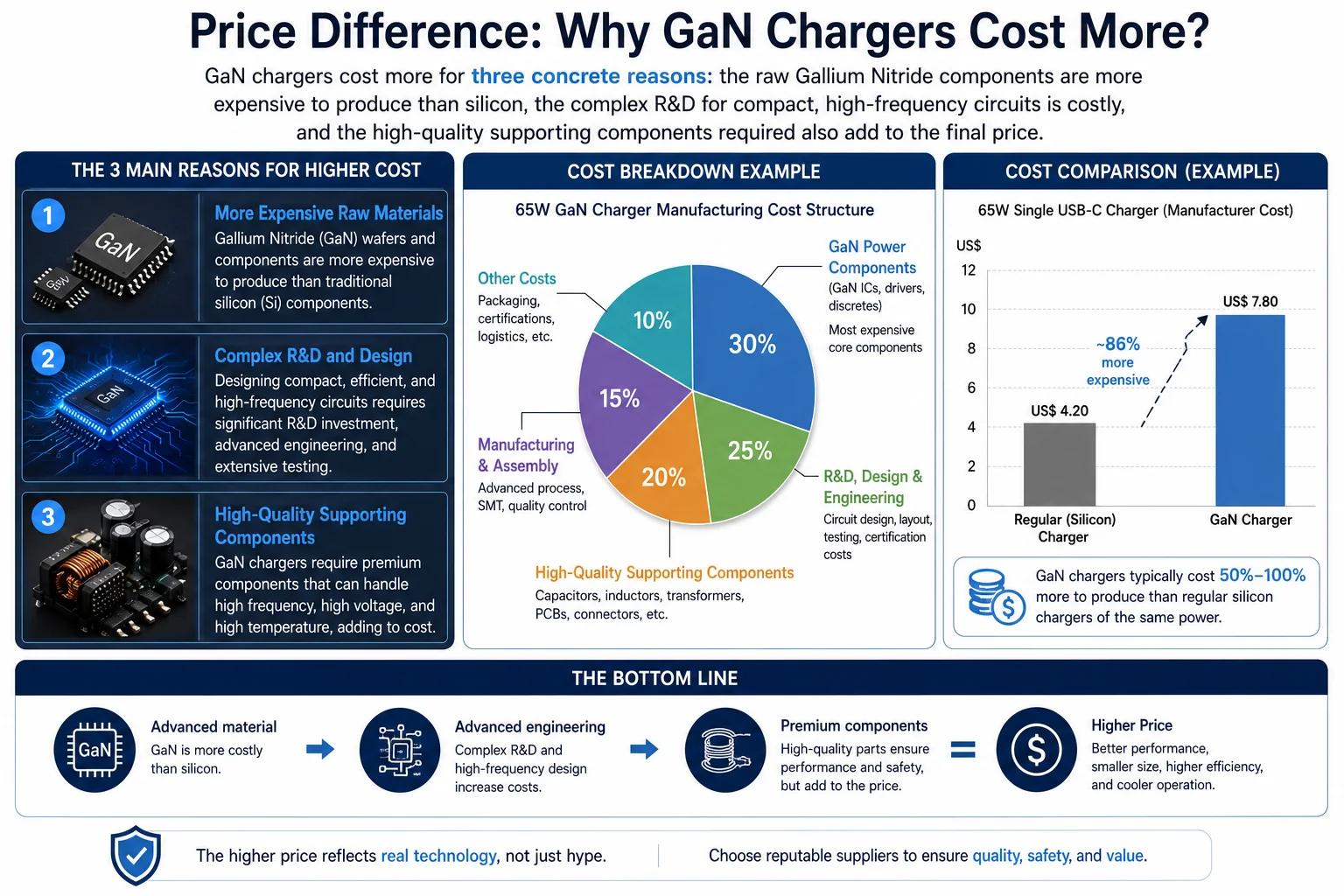
When a client complains about the price of a GaN charger, I break it down for them. The price isn't arbitrary; it reflects the real costs of a more advanced technology.
1. The Raw Material Cost
At the most basic level, the Gallium Nitride material itself is more difficult and expensive to manufacture than the silicon wafers that have been mass-produced for decades. This is a fundamental cost that the factory has to pay for the core component, and it gets passed down the line. It's like comparing the cost of steel to the cost of carbon fiber.
2. The Engineering and R&D Cost
You can't just take a regular charger design and swap the silicon chip for a GaN chip. It doesn't work that way. To take advantage of GaN's high-speed switching, engineers have to create a completely new circuit architecture. This involves a lot of R&D, testing, and optimization to ensure the charger is efficient, stable, and safe. A reliable factory invests heavily in a team of skilled engineers to do this properly. A cheap factory just tries to copy a design they found online, often leading to a product that fails under pressure.
3. The Quality of Supporting Components
To build a reliable 100W GaN charger, the GaN chip is just one part of the puzzle. It needs to be surrounded by other high-quality components that can also handle the high power and high frequencies. This includes more expensive capacitors, a specially designed transformer, and a more advanced controller IC. If a manufacturer tries to save money by using a premium GaN chip but cheap-out on the surrounding parts, the charger will fail. When you pay for a good GaN charger, you're paying for a complete system of high-quality parts, not just one chip. Think of the price as an investment in performance, safety, and the convenience your customers are looking for.
Which Buyers Should Choose GaN Chargers?
Now that you understand the technology, the benefits, and the costs, the most important business question remains: should you be stocking GaN chargers? The answer depends entirely on who your customers are and what they value.
You should choose GaN chargers if you sell to tech-savvy customers, travelers, remote workers, or anyone who owns multiple modern devices like a laptop, tablet, and smartphone. These customers are willing to pay a premium for the convenience of a small, powerful, all-in-one charging solution.
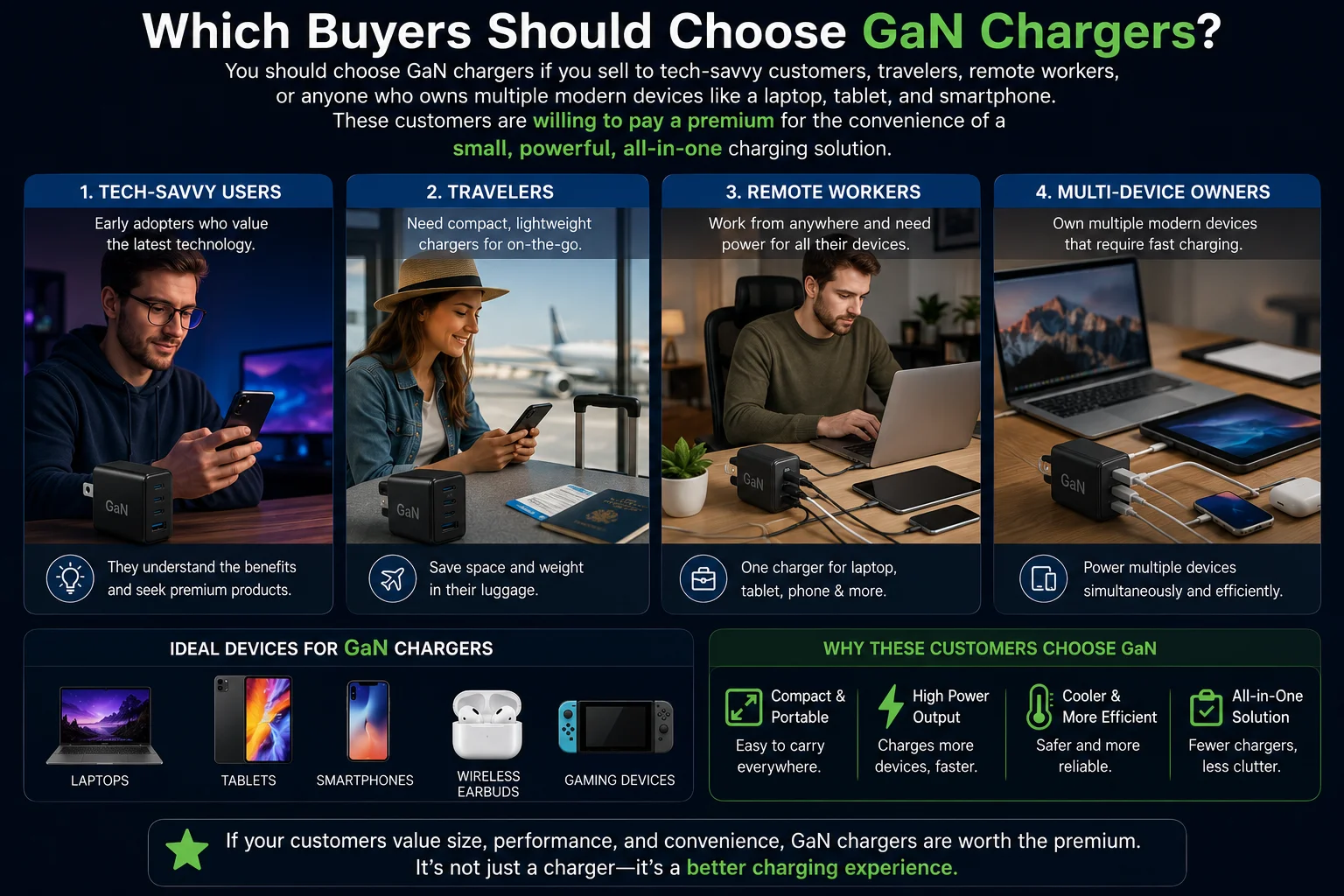
This is a strategic conversation I have with my buyers every single day. The choice isn't about which technology is "better" in a vacuum, but which one fits your specific sales channels and customer base.
Choose GaN if your customers are:
- Multi-Device Owners: This is your biggest market. The person juggling a work laptop, a personal phone, a tablet, and wireless earbuds. The marketing message of "one small charger for everything" is incredibly powerful for them.
- Travelers & Mobile Professionals: For anyone who lives out of a suitcase or works from coffee shops, bag space and weight are critical. A compact GaN charger that replaces a bulky laptop brick is not a luxury; it's a necessity.
- Tech Enthusiasts & Early Adopters: This group wants the latest and greatest technology. They understand the benefits of GaN and will actively seek it out. They are perfect for your online store or premium retail channel.
- Selling a Premium Brand: If your business is built on quality, innovation, and modern design, GaN chargers are a perfect fit for your brand image.
Stick with Regular Chargers if your customers are:
- Extremely Budget-Conscious: If your main channel is a discount store or a market where every cent counts, the lower cost of traditional silicon chargers is probably a better fit.
- Single-Device Users: Someone who just needs a simple, reliable charger for their one smartphone might not see the value in paying extra for a high-power GaN model.
- Selling in Convenience Stores: In grab-and-go environments, a simple and affordable 20W USB-C regular charger is often the highest-volume seller.
A smart strategy I recommend to many of my wholesale clients is to offer both. Carry a good-quality 20W or 30W regular charger as your reliable, entry-level option, and a 65W or 100W multi-port GaN charger as your premium, high-margin flagship product. This allows you to capture the entire market.
Final Buying Advice: GaN Charger or Regular Charger?
You've weighed the technology, the benefits, and the costs. It's time to make a decision and prepare your purchase order. What are the final checks you must make to avoid a costly mistake?
For high-power (65W+) multi-device charging, choose a certified GaN charger from a trusted supplier for its superior size and convenience. For basic, single-device phone charging (20-30W), a quality regular charger is a perfectly fine and cost-effective choice. Always test samples in the real world.
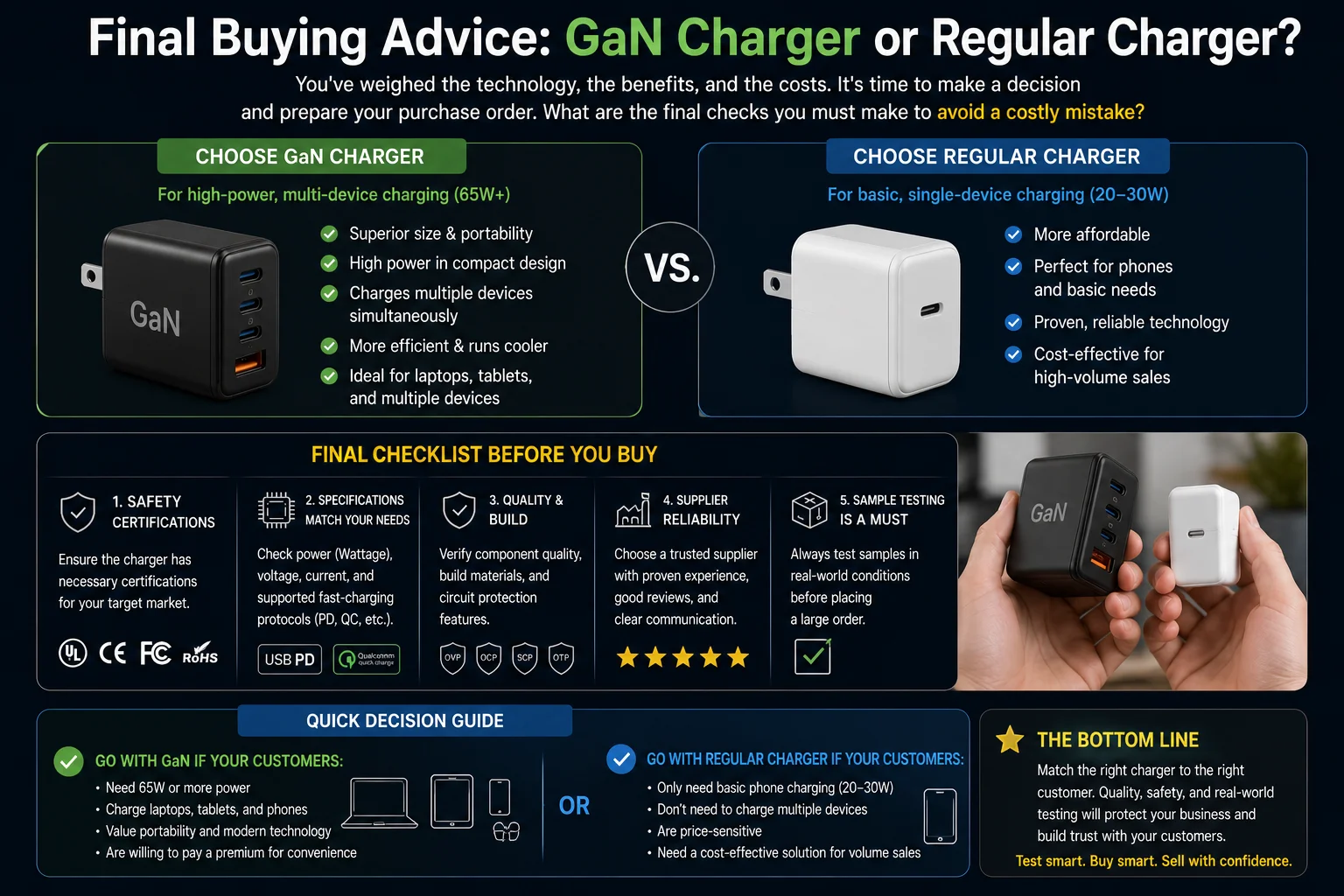
After 15 years in this export business, my final advice always comes down to one thing: reduce your risk. A bad batch of chargers can wipe out your profits and damage your reputation. Here is my final checklist.
If You Choose to Buy GaN Chargers:
- Do NOT Chase the Lowest Price. A GaN charger that is priced suspiciously low is the biggest red flag. It almost certainly means they used cheap components, have fake specs, or skipped expensive safety certifications.
- Verify Certifications Religiously. I can't say this enough. Ask for the full UL, ETL, or CE test reports. Check that the model number on the report exactly matches the product you are buying.
- Test Your Sample Thoroughly. Don't just plug it in and see if a light comes on. Charge a laptop and a phone at the same time for at least an hour. Does the laptop recognize the correct wattage? Does the charger become alarmingly hot? Does it make any buzzing noises?
- Inspect the Markings. The label printed or etched onto the charger body must be professional, clear, and contain all the required safety marks and power information. Sloppy printing is a sign of a sloppy factory.
If You Choose to Buy Regular Chargers:
- Still Focus on Build Quality. Even for a simple charger, the plastic housing should feel solid and have a flame-retardant rating (look for PC material). The plug pins should be firm and well-made.
- Confirm the Modern Basics. For today's market, even a regular charger should have a USB-C port and support the USB-PD protocol to be useful for fast-charging iPhones and Androids.
- Safety Is Still Number One. Even a simple 20W charger connects to mains electricity and can be a fire hazard if poorly made. Ensure it has the proper certifications for your market.
Ultimately, a high-quality regular charger from a good factory is always a better and safer product to sell than a low-quality GaN charger from a cheap one. Your business's long-term health depends on selling products that work safely and reliably, every single time.
Conclusion
GaN offers smaller, efficient, high-power charging, making it ideal for premium markets. Regular chargers remain a cost-effective choice for basic needs. Prioritize certified quality over price to protect your business.