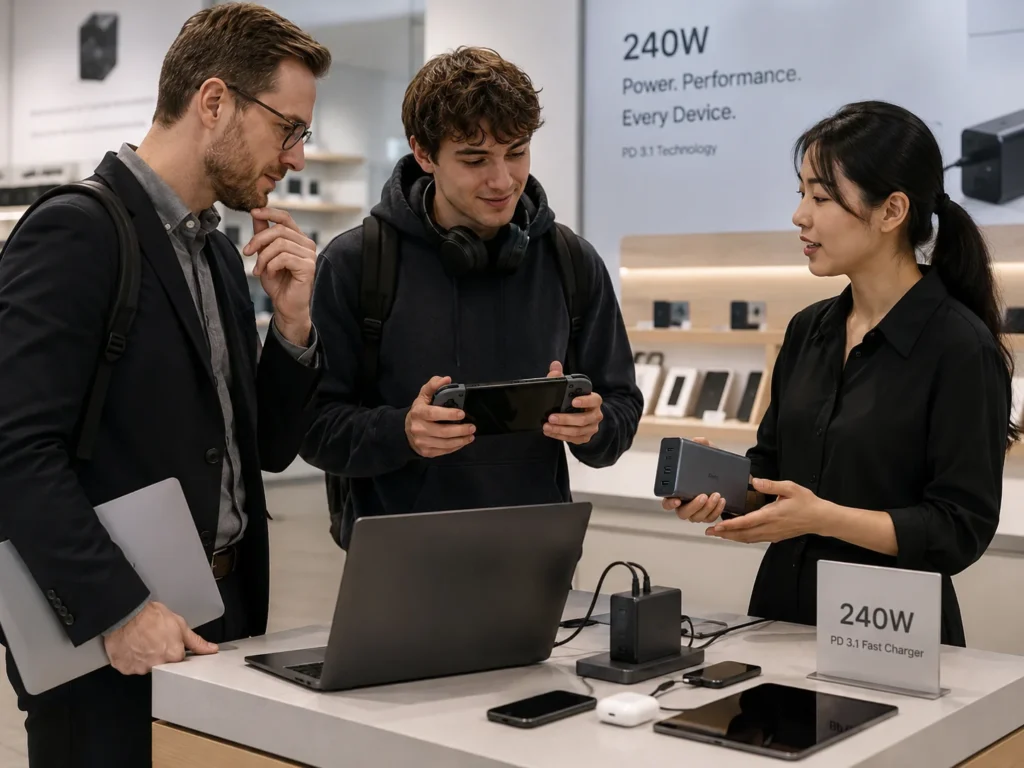
I see stores lose premium buyers when their charger shelf stops at phone-level power. The customer asks for laptop charging. The staff has no clear answer.
Your retail store needs 240W chargers because PD 3.1 adds a premium high-power option for laptops, gaming devices, and workstations. I would not replace PD 3.0. I would add PD 3.1 240W as a tested upgrade SKU for customers who need more power.
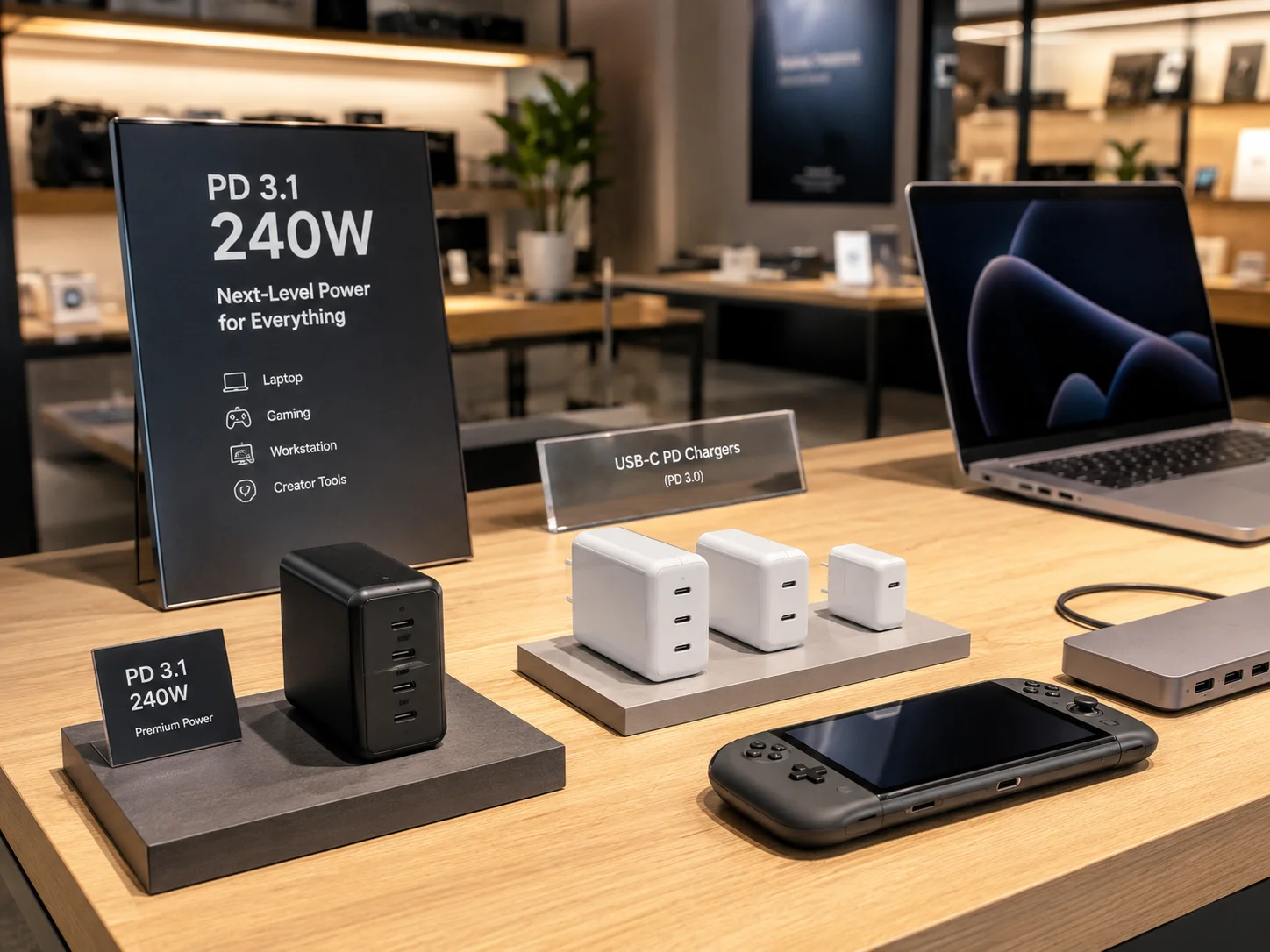
I have worked with USB-C chargers for many retail, wholesale, and e-commerce buyers for years. I often hear the same question. Is PD 3.1 just a bigger number, or does it help sell more chargers? I think the better question is simple. Can my charger lineup serve the devices my customers bring into the store today, and can it still make sense next year?
1. What Is USB-C Power Delivery and Why Does It Matter for Retail Stores?
I see many stores sell USB-C chargers without explaining power. The customer sees the same connector. The customer then buys the wrong charger.
USB-C Power Delivery is a charging standard that lets a charger and device agree on power needs.1 It matters for retail stores because it helps one charger category serve phones, tablets, laptops, and higher-power devices with clearer product positioning.
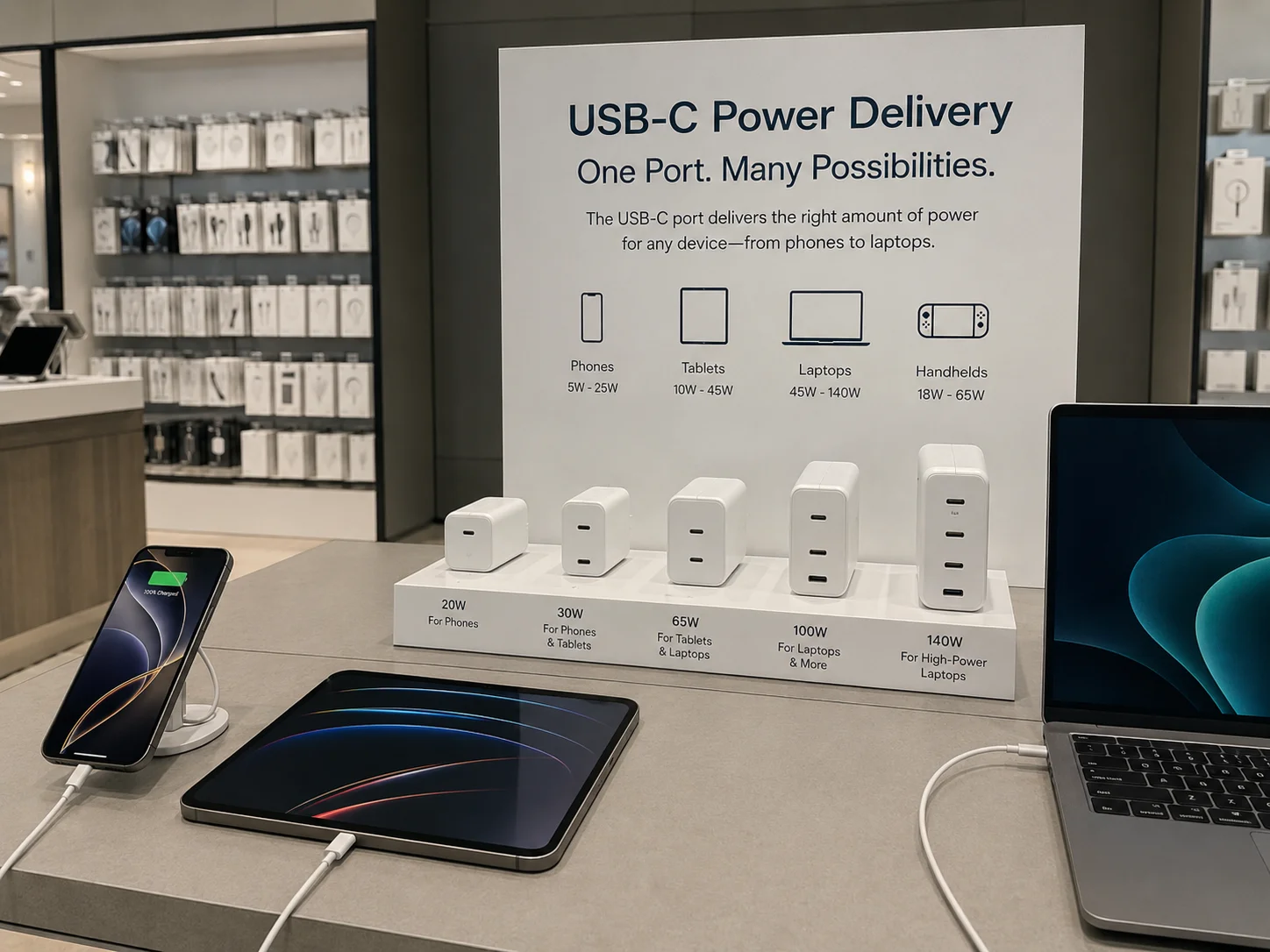
Why I Treat USB-C PD as a Shelf Strategy
I do not treat USB-C Power Delivery as only a technical term. I treat it as a way to plan a retail shelf. A customer may walk in with a phone today. Another customer may walk in with a laptop. A third customer may ask for one charger for travel. The same USB-C shape does not mean the same charging result. The device, charger, cable, and protocol all matter.2
I have seen buyers order many 20W and 30W chargers because they sell fast. That is a good base. I have also seen the same buyers miss laptop users because the shelf has no higher-power choice. This is where PD 3.1 enters the conversation. It does not make every device charge faster. It gives the store a stronger answer for high-power customers.
| Retail question I hear | Simple answer I give |
|---|---|
| Can one USB-C charger charge everything? | I say it depends on power, cable, and device support. |
| Is USB-C always fast charging? | I say no, because the charger and device must support it. |
| Should I sell only high wattage? | I say no, because each customer group needs a different price point. |
| Where does PD 3.1 fit? | I place it as a premium high-power SKU. |
2. PD 3.0 Explained: The Standard Behind Most Fast Chargers?
I see buyers treat PD 3.0 as old because PD 3.1 exists. That view can create bad stock decisions and weak margins.
PD 3.0 is still the base for many fast chargers used with phones, tablets, earbuds, and many laptops.3 It remains useful for retail stores because it covers many daily charging needs at familiar price levels.
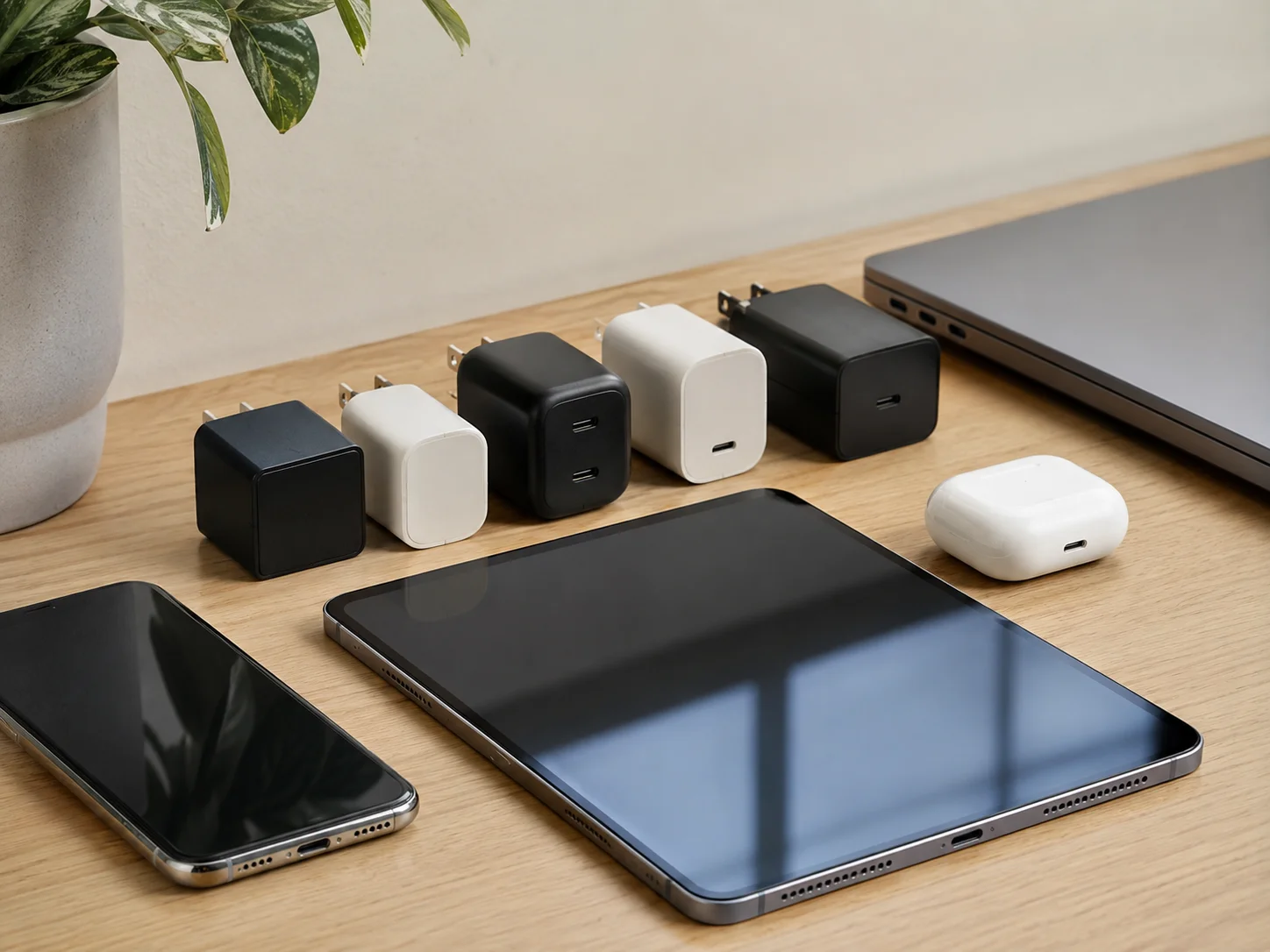
Why I Still Keep PD 3.0 in the Lineup
I do not tell retail buyers to remove PD 3.0. I think that would be too aggressive. PD 3.0 chargers are still easy to understand. A 20W, 30W, 45W, 65W, or 100W charger can serve many common customer needs.4 A phone user may not want to pay for a 240W charger. A tablet user may only need a compact travel charger. A laptop user with moderate power needs may still be happy with a good 65W or 100W model.
In my work with buyers, PD 3.0 often works as the volume layer. It gives the store affordable choices. It also gives staff simple talking points. The store can show good, better, and best options. PD 3.0 can be good and better. PD 3.1 can be the best option for high-power users.
| PD 3.0 role in store | How I would position it |
|---|---|
| Entry fast charger | I would use 20W or 30W for phones. |
| Tablet and travel charger | I would use 45W or 65W. |
| Laptop charger | I would use 65W or 100W where suitable. |
| Main volume item | I would keep it for price-sensitive buyers. |
What I Avoid Saying About PD 3.0
I avoid saying PD 3.0 is no longer useful. That statement can confuse buyers and customers. I also avoid saying every PD 3.0 charger is the same. Port design, heat control, materials, safety design, and cable quality can change the user experience. A store should still check product quality and supplier support.
3. PD 3.1 Explained: The Upgrade That Enables 140W, 180W, and 240W Charging?
I see 240W chargers get dismissed as hype. That happens when sellers explain wattage only and forget the real customer problem.
PD 3.1 extends USB-C Power Delivery into higher power levels, including products advertised around 140W, 180W, and 240W.5 It is useful when a customer needs stronger USB-C charging for high-power devices that support it.
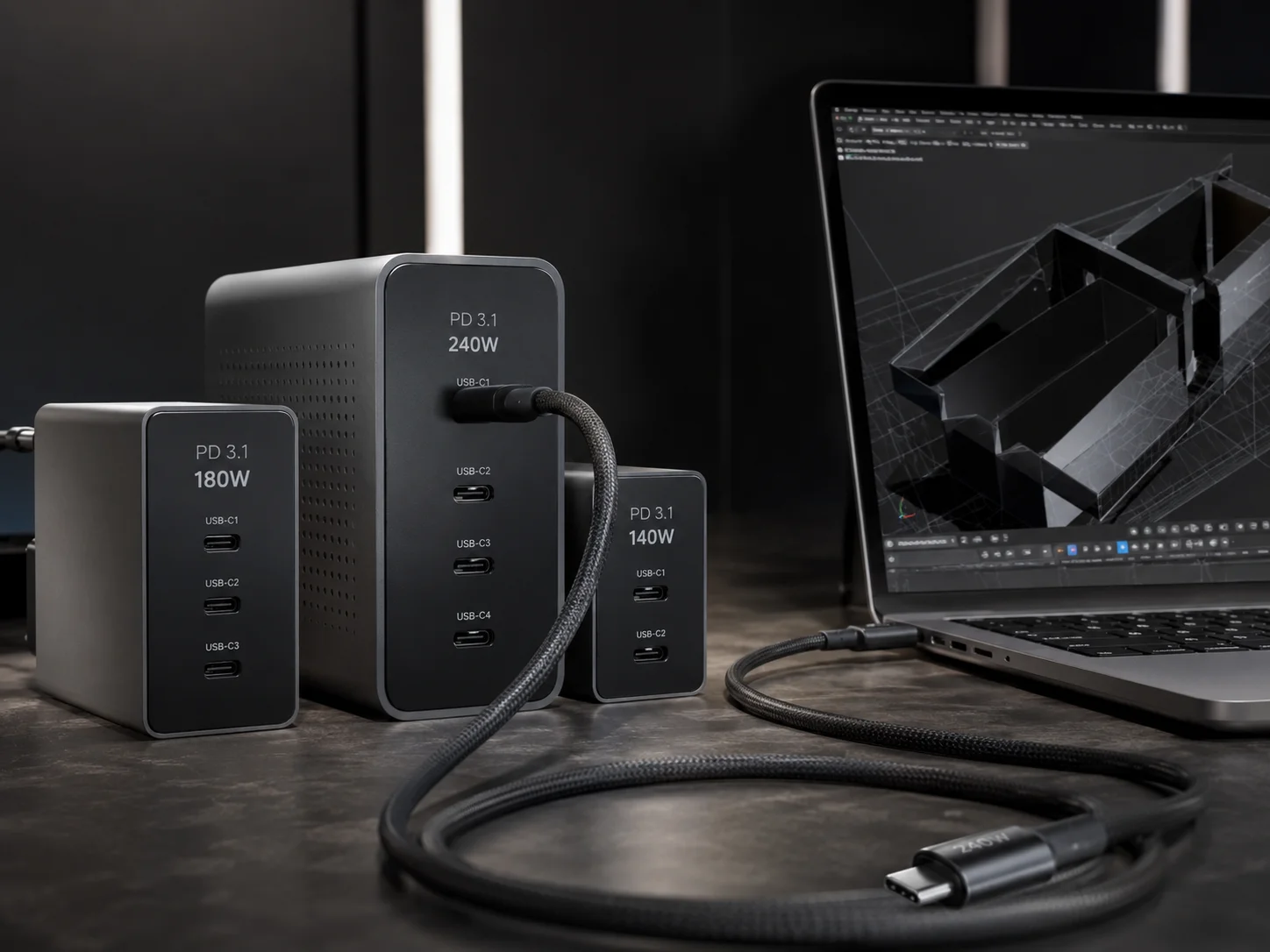
Why PD 3.1 Is an Upgrade SKU, Not a Magic SKU
I explain PD 3.1 as an upgrade SKU. I do not explain it as a magic charger. A 240W charger does not force every phone, tablet, or laptop to take 240W.6 The device decides what it can accept. The charger provides options. The cable must also support the required power.7 The port allocation also matters when the charger has more than one port.
This point is important for retail stores. If a listing says “240W charges everything at 240W,” the store may get returns, bad reviews, and staff complaints. If the listing says “supports up to 240W when the device and cable support it,” the customer has a more correct expectation.
| Part of the charging chain | Why I check it |
|---|---|
| Device | I check whether the device can accept high power. |
| Charger | I check total wattage and single-port output. |
| Cable | I check whether the cable supports high power. |
| Port layout | I check how power changes when several ports are used. |
| Protocol support | I check whether the charger matches common device needs. |
How I Explain It to Buyers
I tell buyers that PD 3.1 gives the store a stronger top-end item. It helps when a customer asks for laptop charging, gaming handheld charging, or one charger for a workstation bag. It also helps the store look updated. The buyer does not need to order huge quantity at first. A small test quantity can show real demand.
4. PD 3.1 vs PD 3.0: Key Differences Buyers Should Know?
I see many comparison tables list only numbers. The buyer still does not know what to put on the shelf.
PD 3.0 is still a strong mainstream fast-charging standard. PD 3.1 adds higher power capability. For retail buyers, the key difference is not only the specification. The key difference is which customer group each charger can serve.
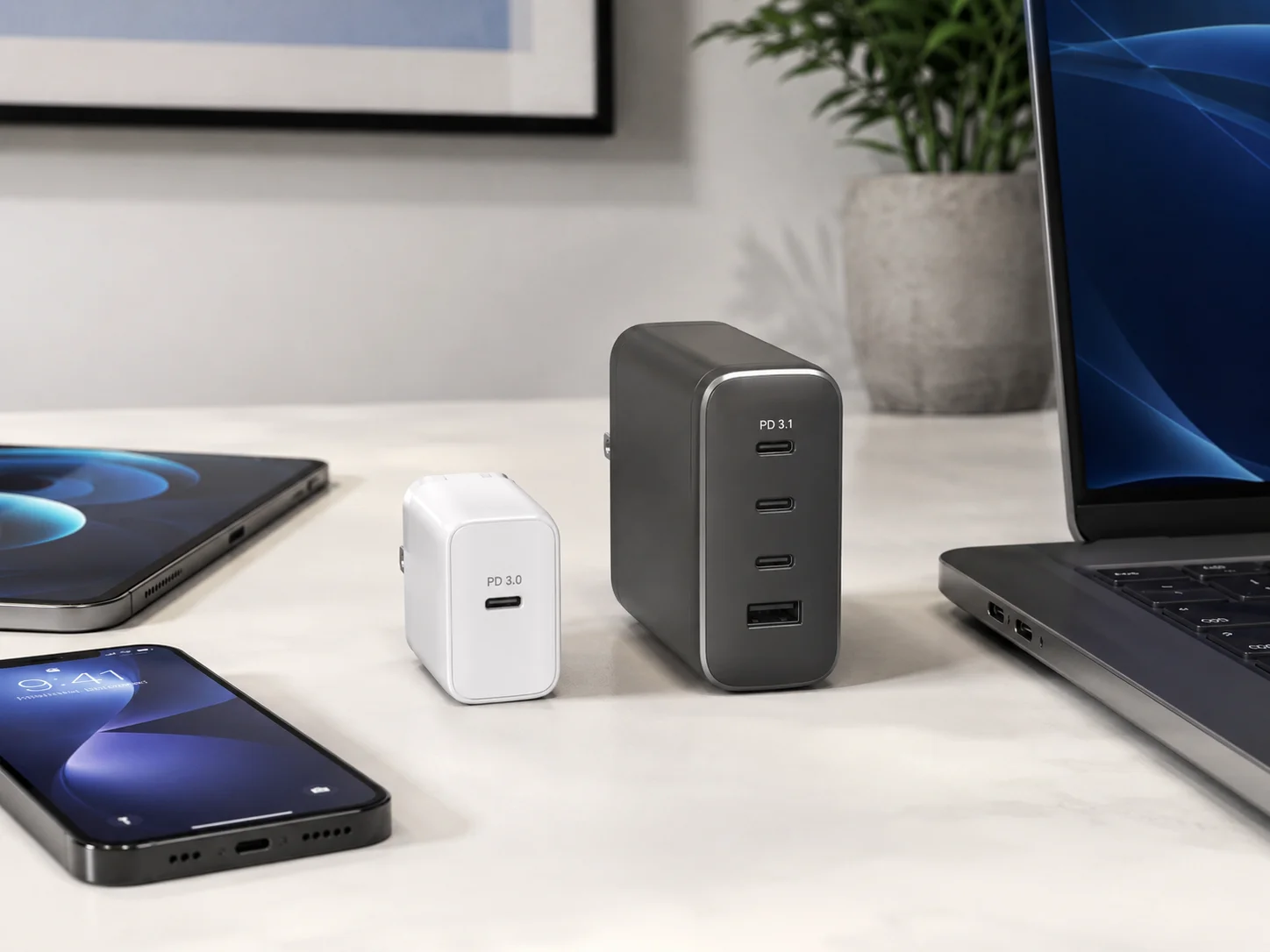
The Difference That Matters in Retail
I like simple comparisons because buyers have limited time. PD 3.0 covers many common charging needs. PD 3.1 reaches a higher power class.8 That higher class can support a better premium shelf. It can also reduce a gap when customers ask for one strong charger for laptops and other devices.
I also remind buyers that the number on the box is not the full story. A multi-port 240W charger may not give 240W from every port at the same time.9 Some designs may give high output from one USB-C port and share the rest across other ports. This is normal. It must be explained clearly on packaging and product pages.
| Buyer point | PD 3.0 | PD 3.1 |
|---|---|---|
| Main retail role | I use it for mainstream fast charging. | I use it for premium high-power charging. |
| Customer fit | I match it to phones, tablets, and many laptops. | I match it to high-power laptops, gaming users, and workstations. |
| Price level | I place it in normal and mid-price ranges. | I place it in the premium range. |
| Shelf message | I say “fast charging for daily devices.” | I say “high-power USB-C charging for supported devices.” |
| Risk if unclear | I may undersell laptop users. | I may overpromise if I do not explain limits. |
My Practical Buying View
I do not ask a store to choose only one side. I usually suggest a layered plan. The store keeps 20W, 30W, 65W, and 100W PD chargers for daily demand. The store then adds one or two PD 3.1 models for high-power demand. This plan is easier to test. It protects the current sales base. It also gives the store a fresh premium story.
5. Why 240W Chargers Are Becoming Important for Laptops, Gaming Devices, and Workstations?
I see more customers carry powerful devices. A small phone charger cannot answer every need, and a weak shelf can lose high-value sales.
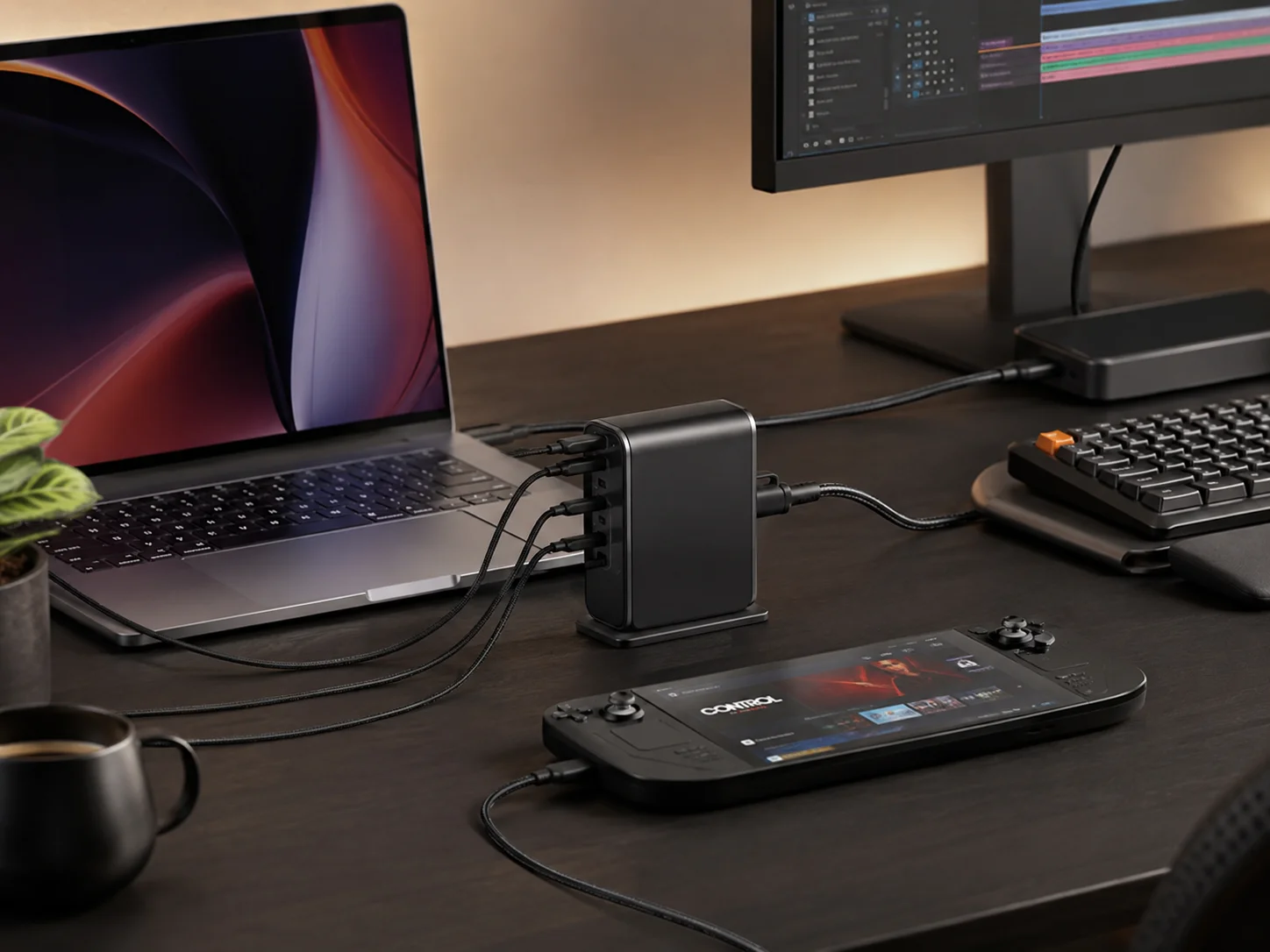
240W chargers are becoming important because some modern device users need more power from fewer chargers. They may carry laptops, gaming devices, tablets, and accessories, so they want a stronger USB-C charging option.
Why High-Power Customers Are Different
I see high-power customers ask better questions. They ask about wattage. They ask about cable rating. They ask about laptop support. They ask if a charger can handle several devices at once. These customers often compare products before they buy. They may not choose the cheapest item. They usually want confidence.
A 240W charger can serve this type of customer when the product is designed and explained well. It can be placed near laptop accessories, travel adapters, docking products, or premium USB-C cables. It can also work well in e-commerce listings where the seller can add clear charts and warnings.
| Customer situation | Why a 240W charger may help |
|---|---|
| The customer carries a laptop and phone. | I can offer one stronger travel charger. |
| The customer uses a gaming handheld. | I can offer a premium charger with more headroom. |
| The customer works from different places. | I can offer a desk and travel charging option. |
| The customer uses many USB-C devices. | I can offer multi-port charging with clear power sharing. |
What I Do Not Promise
I do not promise that every laptop will charge at full speed. I do not promise that every gaming device needs 240W. I do not promise that higher wattage always means shorter charging time.10 I explain that device support, cable rating, and charger design decide the final result. This keeps the sales message honest and reduces returns.
6. What Types of Customers Need PD 3.1 240W Chargers?
I see stores ask who will buy 240W. If the store cannot name the customer, the product becomes hard to sell.
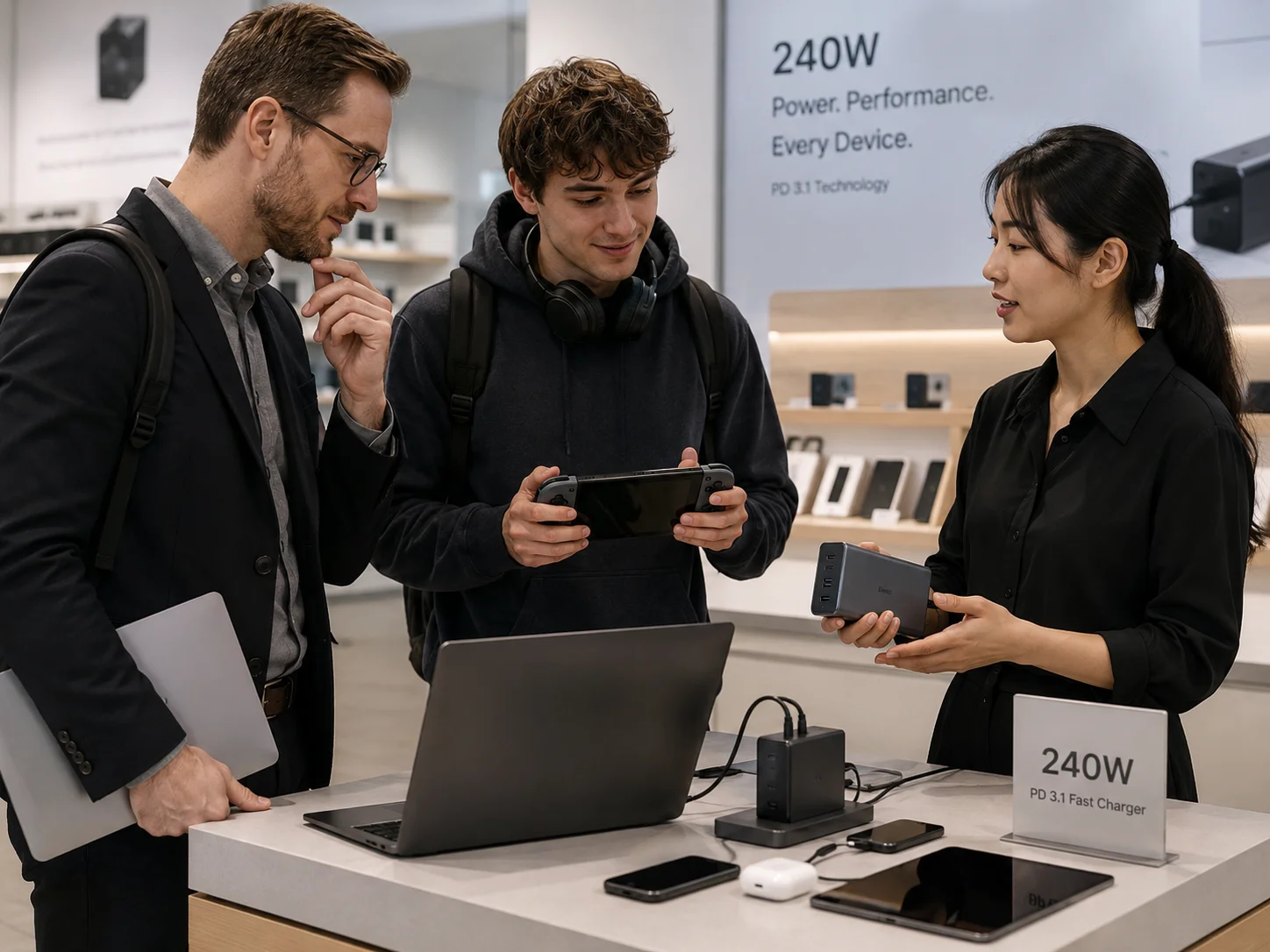
PD 3.1 240W chargers fit customers who own high-power USB-C devices, travel with multiple devices, or want one premium charger for work, gaming, and mobile use. They are not needed by every phone user.
The Customer Groups I Would Target
I would not place a 240W charger only in the phone charger section. I would connect it to customer use cases. A professional user may want one charger for a laptop and phone. A gamer may want reliable high-power charging for a portable setup. A content creator may carry a laptop, tablet, camera battery charger, and earbuds. A student may want one charger for a laptop, phone, and tablet. A business traveler may care about space and cable quality.
These customers may not buy the cheapest charger. They may pay for convenience, compact size, safety design, and better packaging. The store should help them understand what they are buying.
| Customer type | Sales message I would use |
|---|---|
| Laptop professional | I would say it is for supported high-power USB-C laptops and daily devices. |
| Gamer | I would say it is for powerful portable setups when device support matches. |
| Creator | I would say it helps reduce the number of chargers in a bag. |
| Student | I would say it can cover laptop, tablet, and phone needs with the right cable. |
| Business traveler | I would say it gives high power in one compact travel setup. |
Why Clear Customer Targeting Matters
A 240W charger becomes easier to sell when the store defines the buyer. The shelf tag can say who needs it. The product page can show use cases. The staff can ask one simple question: “Are you charging a laptop or several USB-C devices?” That question separates a 30W customer from a 240W customer. It also makes the store look more professional.
7. How Retail Stores Can Choose the Right 240W USB-C Chargers for Inventory?
I see buyers focus only on the front label. The real buying risk often sits in the ports, cables, heat design, and after-sales support.
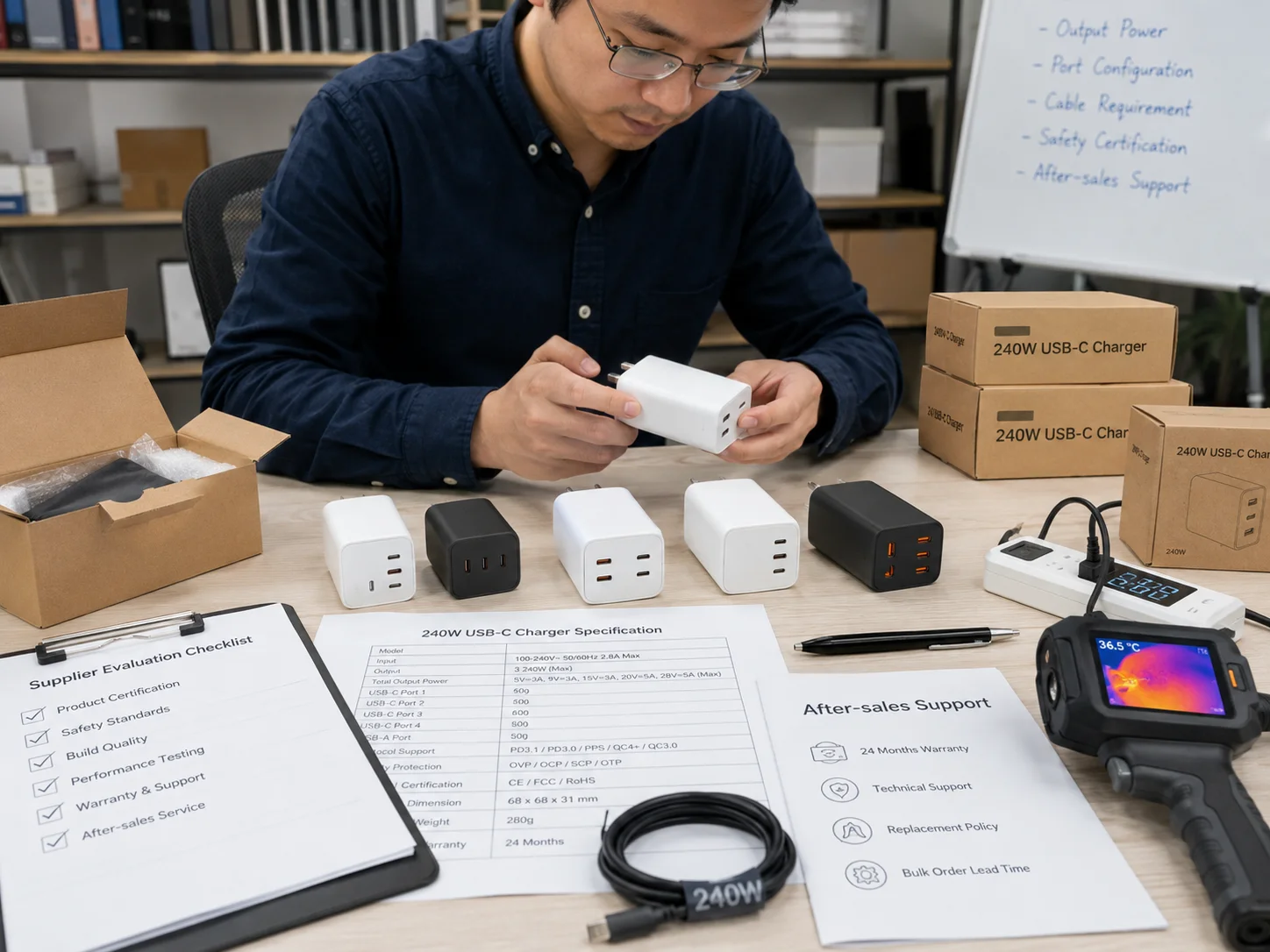
Retail stores should choose 240W USB-C chargers by checking single-port output, total output, port power sharing, cable requirements, safety design, certifications, packaging clarity, MOQ, lead time, and supplier support.11
My Inventory Checklist
When I help a buyer review a 240W charger, I start with the product plan. I ask where the charger will sit on the shelf. I ask who will buy it. I ask what cable will be sold with it or beside it. I also ask how staff will explain it in ten seconds.
The technical details then become easier to check. I want to see the total output. I want to see the maximum output from each USB-C port. I want to see the power split when two or three ports are used. I want packaging that says “up to” when needed. I want warnings that the device and cable must support high-power charging.
| Inventory check | Why I care |
|---|---|
| Single-port output | I need to know the highest power one device can receive. |
| Total output | I need to know the full charger capacity. |
| Power sharing | I need to explain multi-device charging correctly. |
| Cable match | I need to avoid selling a high-power charger with a weak cable. |
| Safety design | I need stable performance and fewer complaints. |
| Packaging text | I need the customer to understand the product before purchase. |
How I Would Start Stocking
I would start with a small test order. I would place the 240W model near premium USB-C cables and laptop accessories. I would train staff with three points. First, the device must support high-power charging. Second, the cable must match the power level. Third, multi-port charging may share power. This simple training can protect the store from wrong expectations.
8. Wholesale Buying Tips for PD 3.1 Chargers: Certification, Cables, Safety, and Supplier Checks?
I see wholesale buyers compare only unit price. A cheaper charger can become expensive when returns, unclear packaging, or missing documents appear.
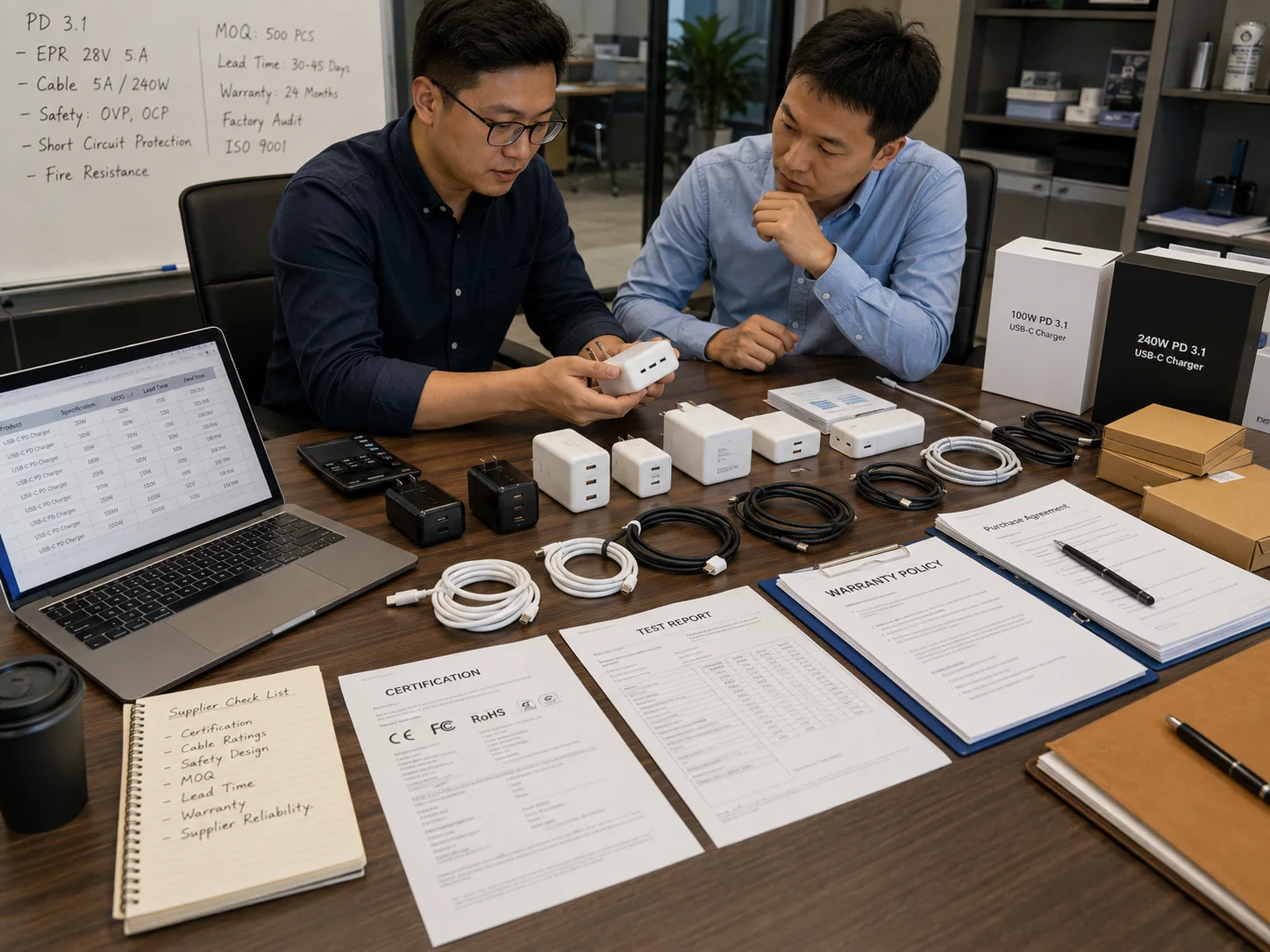
Wholesale buyers should check certifications, cable ratings, safety design, test reports, packaging claims, warranty terms, MOQ, lead time, and supplier communication before ordering PD 3.1 chargers in quantity.
What I Check Before I Suggest a Bulk Order
As a Shenzhen 3C trading company with 15 years of export experience, we often support buyers from Europe and North America. I have learned that wholesale buying needs more than a good sample photo. A buyer should ask for product specifications, packaging artwork, cable options, and needed documents for the target market. The buyer should also confirm what the charger can and cannot claim.12
I also check the supply side. I ask about MOQ. I ask about lead time. I ask whether the supplier can support private label, retail packaging, barcodes, manuals, and plug versions. I ask how after-sales issues will be handled. These points are not exciting, but they protect the buyer.
| Wholesale check | My reason |
|---|---|
| Certification documents | I want the buyer to match local sales requirements. |
| Cable rating | I want the charger and cable offer to make sense together. |
| Safety design | I want lower complaint risk. |
| Packaging claim | I want to avoid overpromising power output. |
| MOQ | I want a test order that does not create heavy pressure. |
| Lead time | I want the buyer to plan promotions and replenishment. |
| Customization | I want the product to fit the buyer’s brand and channel. |
My Practical Supplier Advice
I suggest that buyers ask for a sample before a large order. I suggest that buyers test the charger with their own target devices when possible. I suggest that buyers verify any technical standard details and local compliance needs before launch. We can help with sourcing, packaging, customization, and export coordination, but the buyer still needs clear product positioning. A good 240W charger needs a good selling explanation. Without that explanation, even a strong product can create confusion.
Conclusion
I would keep PD 3.0 for volume sales and add PD 3.1 240W as a premium test SKU for high-power customers.
"USB - Wikipedia", https://en.wikipedia.org/wiki/USB. USB-IF documentation describes USB Power Delivery as a protocol in which power sources and devices exchange capability information to select an appropriate voltage and current level. Evidence role: definition; source type: institution. Supports: USB Power Delivery defines a protocol through which a source and sink communicate supported power profiles before power is supplied.. ↩
"USB-C - Wikipedia", https://en.wikipedia.org/wiki/USB-C. USB-IF materials on USB Type-C and USB Power Delivery indicate that charging capability is determined by the combined capabilities of the power source, device, cable, and negotiated PD mode. Evidence role: mechanism; source type: institution. Supports: USB-C charging performance is constrained by the negotiated protocol and the rated capabilities of the source, sink, and cable assembly.. Scope note: This supports the technical dependency, not any specific retail outcome. ↩
"USB-C - Wikipedia", https://en.wikipedia.org/wiki/USB-C. Reference summaries of USB Power Delivery 3.0 describe support for negotiated charging up to about 100 W, a range that aligns with many phones, tablets, and mainstream laptop chargers. Evidence role: general_support; source type: encyclopedia. Supports: USB Power Delivery 3.0 supports power levels commonly associated with phones, tablets, and many laptops, generally up to 100 W.. Scope note: The source would support technical suitability by power range, not prove that most retail chargers currently use PD 3.0. ↩
"Can 20W USB-C PD charger supply enough power/voltage to "slow ...", https://www.reddit.com/r/UsbCHardware/comments/tnxnid/can_20w_usbc_pd_charger_supply_enough/. USB Power Delivery guidance and device-charging references show that common consumer charging requirements span lower-power phone charging through laptop charging near the 60–100 W range. Evidence role: general_support; source type: institution. Supports: USB PD power ranges below 100 W are commonly used for phones, tablets, and many laptops.. Scope note: This contextual support does not establish that every device in those categories can use each listed wattage. ↩
"What Is 240W USB Extended Power Range (EPR)?", https://plugable.com/blogs/news/what-is-240w-usb-extended-power-range-epr?srsltid=AfmBOorbDttuksXxrRrX93K5ratZ7Axd-PdWue-OLp87IccXT6i0wFp7. USB-IF describes USB Power Delivery 3.1 as adding Extended Power Range operation, allowing USB-C power delivery up to 240 W under specified voltage, current, and cable conditions. Evidence role: definition; source type: institution. Supports: USB PD 3.1 added Extended Power Range modes that support up to 48 V at 5 A, or 240 W.. ↩
"The Basics of USB Power Delivery Negotiations | Acroname", https://acroname.com/blog/basics-usb-power-delivery-negotiations?srsltid=AfmBOoq0zIHZmqr0e8O8wgBL562lsvHM1L_y69aIHttd0FQI5WsQIpzA. USB Power Delivery specifications describe a source-capability and sink-request negotiation process, supporting the point that a device draws only a compatible negotiated power level rather than the charger’s maximum rating. Evidence role: mechanism; source type: institution. Supports: In USB PD, the device requests a supported power profile from the charger, so maximum charger rating does not determine actual device draw by itself.. ↩
"Charge high performance USB-C devices at up to 240W Extended ...", https://www.startech.com/en-us/cables/usb2epr10f?srsltid=AfmBOopCD4j478HR3BxuFsU_eibvIqmw7TVuTDhs4Sn8Ph1thAocc8J_. USB-IF guidance on USB Type-C and PD 3.1 states that Extended Power Range charging requires appropriately rated cables, including electronically marked cables for higher current and power levels. Evidence role: mechanism; source type: institution. Supports: USB-C cables must meet specified current and EPR requirements to support high-power charging such as 240 W.. ↩
"PD 3.1 standards 180W and 240W where/when : r/UsbCHardware", https://www.reddit.com/r/UsbCHardware/comments/1cf5v1z/pd_31_standards_180w_and_240w_wherewhen/. USB-IF descriptions of USB Power Delivery distinguish Standard Power Range operation, commonly associated with up to 100 W, from the PD 3.1 Extended Power Range that permits up to 240 W. Evidence role: general_support; source type: institution. Supports: PD 3.0 is associated with the earlier 100 W ceiling, while PD 3.1 adds Extended Power Range up to 240 W.. ↩
"Hear me out... a multiport USB-C charger that's not dumb - YouTube",
. Technical explanations of multi-output power supplies and USB-C PD chargers note that total rated output and individual port output are distinct specifications, so simultaneous charging can reduce the power available on a given port. Evidence role: mechanism; source type: education. Supports: Multi-output power supplies have a total rated capacity, and simultaneous loads may divide that capacity according to port design and power-management rules.. Scope note: This supports the general engineering principle; the exact split depends on the design of each charger model. ↩"Why do cell phone chargers, even the proprietary "fast charging ...", https://www.reddit.com/r/AskEngineers/comments/3od8nr/why_do_cell_phone_chargers_even_the_proprietary/. Educational materials on lithium-ion charging describe controlled constant-current and constant-voltage phases, supporting the conclusion that a higher-rated charger does not necessarily reduce charging time once device, battery, or thermal limits are reached. Evidence role: mechanism; source type: education. Supports: Lithium-ion charging commonly follows controlled current and voltage phases, and the device’s charging controller can limit power regardless of charger rating.. Scope note: This supports the battery-charging mechanism generally, not the behavior of every specific phone, laptop, or charger. ↩
"Equipment Authorization Procedures | Federal Communications ...", https://www.fcc.gov/general/equipment-authorization-procedures. Government compliance guidance for electrical and electronic products explains that power adapters and chargers may require conformity assessment, labeling, and technical documentation before sale in a given market. Evidence role: general_support; source type: government. Supports: Electrical chargers sold in regulated markets may be subject to safety, labeling, electromagnetic compatibility, and documentation requirements.. Scope note: This supports the compliance-checking aspect of the checklist; MOQ, lead time, and supplier support are commercial considerations rather than regulatory requirements. ↩
"FTC Policy Statement Regarding Advertising Substantiation", https://www.ftc.gov/legal-library/browse/ftc-policy-statement-regarding-advertising-substantiation. Consumer-protection guidance from government regulators states that objective product-performance claims should be truthful and substantiated, supporting the need to verify charger claims before packaging or launch. Evidence role: expert_consensus; source type: government. Supports: Performance and safety claims in product marketing should be truthful, substantiated, and consistent with the product’s tested capabilities.. Scope note: This supports the general obligation to substantiate claims, not any specific USB-C charger claim. ↩