Quick Answer
EU RED Cybersecurity Requirements can create a serious purchasing problem for importers who treat a CE mark or ordinary RED test report as complete evidence. I often see buyers ask for documents only after production starts. That timing can expose them to delays, missing technical files, and difficult supplier discussions.
I recommend checking the product, wireless functions, and cybersecurity evidence before placing the order.
For wireless electronics sold in the EU, Delegated Regulation (EU) 2022/30 introduces specific cybersecurity-related requirements under the Radio Equipment Directive for applicable products and functions[1]. A CE mark, general RED report, or supplier certificate does not automatically prove that these requirements have been addressed[2]. Importers should confirm the product’s scope, request relevant technical evidence, compare the documents with the exact model, and obtain qualified compliance advice where the application is unclear.

I have handled many supplier and customer questions about RED, CE, and wireless-product documents during my work as a Shenzhen-based 3C exporter. My practical conclusion is simple: the main risk is often not the absence of a document name. The main risk is discovering after the purchase order that the supplier cannot provide evidence connected to the actual cybersecurity obligations.
How should importers evaluate EU RED Cybersecurity Requirements for wireless electronics?
A generic compliance package can look complete while leaving important questions unanswered. Wireless earphones, smartwatches, connected chargers, and other 3C products may use different radio, network, software, account, and data functions. I therefore start with the product itself rather than with the certificate folder.
Importers should review EU RED Cybersecurity Requirements through a product-specific evidence process. They should identify the applicable wireless functions, confirm the relevant RED obligations, ask for cybersecurity-related standards or assessment records, verify that the documents match the purchased model, and clarify who will maintain compliance after software or hardware changes.
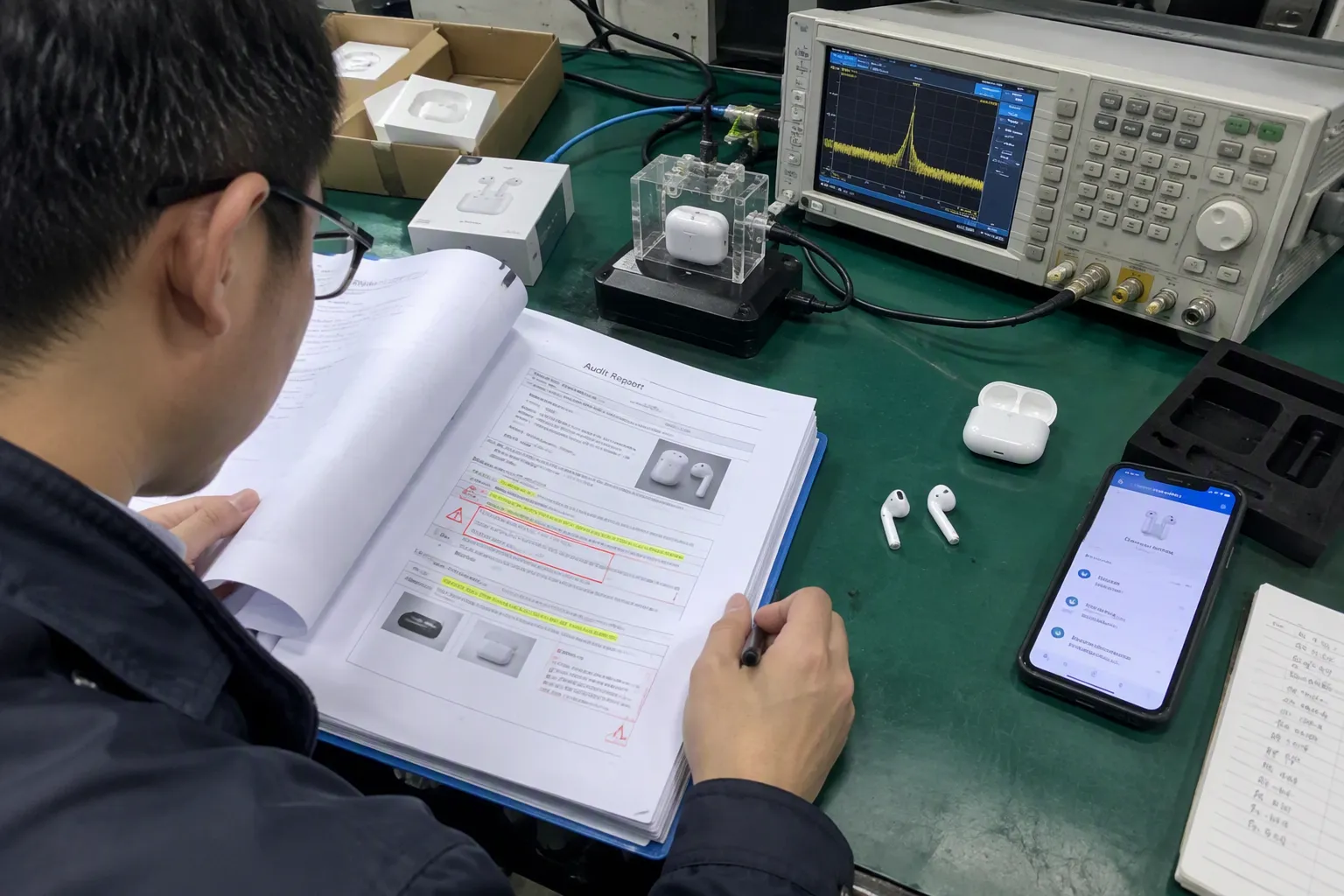
Why a standard RED report may not answer the cybersecurity question
The Radio Equipment Directive, or RED, covers important areas such as safety, electromagnetic compatibility, and effective use of radio spectrum[3]. A normal RED test report may address those areas without proving that a product has been assessed against the cybersecurity requirements introduced through Delegated Regulation (EU) 2022/30[4].
That distinction matters because suppliers sometimes use the phrase “RED compliant” as a broad description. The phrase may refer to a previous test package, a declaration of conformity, or a laboratory report prepared for radio and EMC performance. It does not tell me, by itself, whether the supplier has evaluated the relevant cybersecurity obligations.
I ask buyers to separate three questions:
- Does the product fall within the relevant scope?
- What cybersecurity risks or functions must the manufacturer address?
- What evidence supports the supplier’s answer for this exact product?
These questions are connected, but they are not interchangeable.
A CE mark also needs careful interpretation. The mark normally indicates that the responsible economic operator has completed the applicable conformity assessment and prepared the required declaration[5]. It does not operate as a detailed technical report for the importer. It does not show every test or design decision. It also does not remove the need for the importer to conduct appropriate supplier and product checks.
I do not present my trading experience as legal or engineering authority. I use it to help buyers ask better commercial questions before they commit money, production capacity, and delivery schedules.
What product characteristics should trigger closer review?
The buyer should look beyond the product’s marketing name. Two products that both appear to be “Bluetooth devices” can have different compliance profiles.
I normally collect the following information:
- Radio technologies, such as Bluetooth, Wi-Fi, cellular, NFC, or other wireless connections.
- Whether the product connects directly to the internet or depends on a mobile application.
- Whether the product communicates with a cloud platform, account system, or remote server.
- Whether the product stores personal information, credentials, contacts, health-related data, location data, or usage records.
- Whether the user can install firmware or receive automatic updates.
- Whether the device accepts commands from a smartphone, web service, or another networked product.
- Whether the product is intended for children or may process children’s data.
- Whether the product controls another device or affects access to a network.
- Whether the hardware includes a secure element, protected storage, debug interface, or other security-related design features.
I do not assume that a small product has a small compliance burden. A compact TWS earphone may have an app, firmware update function, microphone, account login, and cloud analytics. A smartwatch may process health, location, and communication data. Those functions deserve a more focused supplier discussion than the product’s size or price might suggest.
A practical pre-order evidence workflow
I recommend that importers use the following sequence before approving a purchase order.
1. Freeze the product identity
The importer should record the model number, hardware revision, firmware version, app name, packaging description, radio module, and intended sales configuration. The importer should also identify whether the factory will make any changes after approval.
A document for one model may not support another model with a different chipset, application, cloud service, or firmware[6]. A supplier should explain any relationship between family models instead of asking the buyer to assume that one file covers all versions.
2. Map the wireless and connected functions
The importer should ask the supplier for a plain-language description of how the product connects and what information it handles. A block diagram or product architecture summary can help, although the buyer should not expect every supplier to provide a complete engineering design file at quotation stage.
The buyer should record:
| Review point | Questions for the supplier |
|---|---|
| Radio | Which radio technologies and modules are used? |
| Connectivity | Does the product connect to the internet directly or through an app? |
| Software | Can users download firmware or receive remote updates? |
| Accounts | Does the app or device require registration and login? |
| Data | What categories of user or device data are stored or transmitted? |
| Services | Which company operates the app, cloud, and update service? |
| Changes | Can the module, firmware, or server change during the order? |
This information gives the importer a starting point for deciding which documents deserve closer review.
3. Request evidence with the right description
I would not ask only for “CE certificate” or “RED certificate.” I would ask for documents that specifically explain how the applicable cybersecurity requirements were considered.
Depending on the product and conformity route, useful evidence may include:
- An EU Declaration of Conformity that identifies the applicable legislation and standards.
- A technical file index or compliance matrix.
- A cybersecurity risk assessment or security requirement assessment.
- A test or assessment report that identifies the product, version, methods, and results.
- Evidence connected to applicable harmonised standards, where the supplier relies on them.
- A description of secure update, access control, authentication, data protection, and vulnerability-handling measures.
- A controlled software and hardware version record.
- A change-control procedure for future firmware, module, or app changes.
- A responsible contact for vulnerability reports and security-related incidents.
The importer may not receive every document in full. Some information can be commercially sensitive. However, a supplier should still be able to provide a credible explanation of what was assessed, which version was assessed, and how the conclusion connects to the product being sold.
4. Match every document to the order
I check the model number first. I then check the manufacturer name, factory address, radio module, hardware revision, firmware version, report date, and product photographs where available.
I also look for inconsistencies. For example, a report may describe a device without Wi-Fi while the sales specification lists Wi-Fi. A declaration may name a different legal manufacturer from the purchase agreement. An app may have a different name from the one shown in the technical file. Each inconsistency deserves a written explanation.
5. Record unresolved questions before the deposit
A buyer should not rely on telephone promises for an important compliance issue. I recommend placing open questions in an email or purchase specification. The buyer can then ask the supplier to confirm:
- Which party owns the technical documentation.
- Which party signs the EU Declaration of Conformity.
- Which party controls the firmware and app.
- Which party handles updates and vulnerability reports.
- Which changes require a new assessment.
- Which documents the supplier will provide before shipment.
- What happens if the supplier cannot provide the agreed evidence.
This record will not replace legal compliance. It will improve commercial accountability and reduce misunderstandings.
How should buyers assess supplier answers?
A strong answer normally connects the product, requirement, document, and responsible party. A weak answer repeats a label without explaining its basis.
I use the following simple comparison:
| Supplier response | What it may indicate | Recommended buyer action |
|---|---|---|
| “The product has CE.” | A general conformity claim | Ask for the DoC and product-specific basis. |
| “The product passed RED.” | Some RED testing may exist | Ask whether cybersecurity obligations were assessed separately. |
| “The lab gave us a certificate.” | A document exists | Check the issuing body, scope, model, version, and conclusion. |
| “All models use the same chipset.” | Some technical commonality | Ask whether software, apps, cloud services, and intended use are also the same. |
| “The report is confidential.” | Full disclosure may be restricted | Request an index, summary, applicable standards, and written confirmation. |
| “We will send it after the order.” | Evidence is not ready for review | Treat this as a purchasing risk and define a pre-shipment condition. |
I do not reject a supplier simply because the supplier cannot send a confidential full report. I do become cautious when the supplier cannot provide a consistent summary or refuses to identify the assessed model.
Which documents should importers verify?
The importer should review documents as a connected set, not as isolated attachments. A declaration, report, user manual, product label, and quotation should describe the same product.
I recommend a document-control table like this:
| Document | Key checks |
|---|---|
| EU Declaration of Conformity | Legal manufacturer, model, legislation, standards, signature, date |
| RED report | Radio functions, test configuration, model, module, firmware, laboratory details |
| Cybersecurity assessment | Applicable obligations, method, product scope, version, findings |
| Technical file index | Location of risk assessment, design records, software evidence, test records |
| User manual | Security instructions, update information, intended use, warnings |
| Product label and packaging | Model, manufacturer or importer information, markings, traceability |
| App and cloud information | App identity, service operator, update method, account and data functions |
| Quality records | Production consistency, incoming components, firmware control, change records |
The importer should also consider whether the supplier’s production process can keep the assessed product unchanged. A good report for a sample does not automatically establish that every later batch uses the same radio module or firmware.
What should happen when the supplier changes the product?
Wireless 3C products often change during their commercial life[8]. A supplier may replace a Bluetooth module because of cost, availability, or lead time. The factory may also update firmware, revise the app, change the cloud provider, or introduce a new battery and charging board.
Some changes may have a direct effect on the conformity assessment. Other changes may be less significant. The buyer should not decide that question casually. The manufacturer or qualified compliance professional should evaluate the effect.
I recommend a written change-notification clause covering:
- Radio module substitutions.
- PCB or antenna changes.
- Firmware and bootloader changes.
- App and cloud-service changes.
- Security-feature changes.
- New personal-data functions.
- Changes to intended users or sales markets.
- Changes to the legal manufacturer or production site.
The clause should identify the documents that the supplier must update. It should also state whether the buyer can reject a change that affects the agreed compliance basis.
How do wireless earphone and smartwatch reviews differ?
I find that product category helps organize the review, but category alone does not determine the final result.
Wireless earphones
For wireless earphones, I would ask about:
- Bluetooth profiles and pairing controls.
- Mobile-app functions.
- Firmware update channels.
- Microphone and voice-related data.
- Account requirements.
- Charging-case software, if applicable.
- Factory reset and ownership transfer.
- Whether the product can be remotely controlled.
The buyer should check whether the report covers the complete product or only the Bluetooth module. A module report may be useful, but it may not answer questions about the final product’s software, app, data flow, and configuration[7].
Smartwatches
For smartwatches, I would ask additional questions about:
- Location data.
- Health or activity information.
- Notifications and messages.
- SIM, eSIM, Wi-Fi, or cellular functions.
- Cloud account access.
- Companion-app permissions.
- Remote updates.
- Child or family-account features.
- Integration with phones and third-party platforms.
A smartwatch may have a broader connected-service environment than a basic earphone. I would therefore expect a more detailed explanation of the product ecosystem and its security controls.
The same principle applies to connected chargers, smart trackers, cameras, speakers, and other wireless products. The importer should evaluate the actual functions rather than use the product category as a shortcut.
Who carries responsibility in the supply chain?
The manufacturer normally has the strongest technical control because the manufacturer designs or controls the product and prepares the conformity documentation. However, an EU importer also has important responsibilities when placing a product on the market. The exact legal duties depend on the product, role, transaction structure, and applicable law.
I tell buyers not to assume that a supplier’s declaration transfers every responsibility away from the importer. The buyer should identify:
- The legal manufacturer named on the product and declaration.
- The EU importer named in the supply-chain records.
- Any authorised representative.
- The distributor or retailer role.
- The party controlling the product design.
- The party retaining the technical documentation.
- The party responsible for post-market communication.
An importer should obtain professional advice when the arrangement involves private labelling, substantial product modification, a new app, a new cloud service, or a change in the manufacturer’s identity. These factors can affect the buyer’s role and the evidence it must retain.
How can a buyer include cybersecurity checks in purchasing?

I recommend adding a compliance gate to the normal sourcing process. The gate should operate before the deposit, not after mass production.
A practical purchasing sequence is:
- Supplier prequalification: Ask whether the supplier regularly exports wireless products to the EU and whether the supplier can explain its RED documentation.
- Product screening: Record all wireless, software, app, cloud, account, and data functions.
- Document request: Request the DoC, RED evidence, cybersecurity-related assessment summary, and version information.
- Technical comparison: Compare the documents with the quotation, samples, packaging, app, and product specification.
- Commercial agreement: Add document delivery, change control, and notification requirements to the purchase terms.
- Sample verification: Check the actual sample against the approved model and software version.
- Pre-shipment review: Confirm that the production version remains consistent with the reviewed evidence.
- Record retention: Keep the documents, communications, samples, and approval records in an organized file.
I have found that this process also improves ordinary supplier selection. A factory that controls model numbers, firmware, and documents carefully is often easier to manage for quality, delivery, and after-sales support. A factory that cannot identify its own report version may create problems beyond cybersecurity.
What are common warning signs?
The following signs do not prove non-compliance. They do show that the buyer should ask more questions before ordering:
- The supplier sends only a logo or one-page “CE certificate.”
- The supplier calls every document a “RED certificate.”
- The document lists a different model or manufacturer.
- The report covers a module, but the supplier presents it as proof for the finished product.
- The app and cloud service are missing from the product explanation.
- The supplier cannot identify the firmware version.
- The supplier changes components without written notice.
- The supplier says that cybersecurity is “only for computers.”
- The supplier promises documents after shipment.
- The supplier cannot explain who will handle security updates.
- The product specification and test report describe different radio functions.
- The supplier refuses to provide even a document index or assessment summary.
I treat these signs as due-diligence issues rather than automatic proof of wrongdoing. The buyer should give the supplier a clear opportunity to answer. The buyer should then document the answer and decide whether the remaining risk is acceptable.
How should importers work with a Chinese supplier?

International buyers often face a communication problem. A supplier may understand factory testing but may not understand the importer’s need for evidence that supports market placement. A short, specific request usually works better than a broad request for “all compliance documents.”
I suggest sending questions such as:
Please confirm the exact model, hardware revision, firmware version, wireless functions, app name, and cloud functions covered by your RED documentation. Please also identify which documents address the applicable cybersecurity requirements under Delegated Regulation (EU) 2022/30, and confirm whether the production version will remain unchanged.
The buyer can add:
If a full technical file cannot be shared because of confidentiality, please provide a document index, assessment summary, applicable standards or methods, product scope, version information, and the responsible contact for verification.
I would also ask the supplier to state whether the product is sold under the factory’s brand or the buyer’s private label. The answer affects the commercial document trail and may require a different professional review.
At our Shenzhen trading company, we normally help customers organize product information, certification files, sample checks, and supplier communication. I do not treat that support as an official conformity assessment. I recommend that buyers use a qualified laboratory, conformity assessment body, or regulatory professional for application-specific decisions.
What should buyers do if evidence is incomplete?
The buyer has several practical options. The correct choice depends on the product risk, launch schedule, supplier capability, and professional assessment.
The buyer can:
- Pause the order until the supplier answers the key questions.
- Request a sample and conduct an independent document review.
- Ask the supplier to complete an assessment through a qualified organization.
- Limit the order to a pilot quantity while controlling the commercial risk.
- Select another supplier with stronger document management.
- Add pre-shipment evidence as a contractual condition.
- Obtain independent regulatory advice before importing.
I would not recommend using a low price to justify a document gap. A cheaper unit price can become expensive if the buyer must delay launch, repeat testing, relabel stock, replace firmware, or answer questions from a market-surveillance authority.
The buyer should also avoid the opposite mistake. A supplier’s inability to send a complete confidential technical file does not automatically mean that the product fails. The buyer should examine what evidence can reasonably be shared and whether an independent professional can verify the remaining information.
Frequently Asked Questions
Does a CE mark prove compliance with EU RED Cybersecurity Requirements?
No. A CE mark represents a broader conformity claim, and the supporting documentation may cover several different legal and technical areas. I recommend checking the EU Declaration of Conformity and product-specific evidence instead of treating the mark alone as proof of cybersecurity compliance.
Is a normal RED test report enough for a wireless earphone or smartwatch?

Not automatically. A normal RED report may cover radio, safety, or electromagnetic compatibility tests without addressing the specific cybersecurity obligations. I would ask the supplier whether the report or a separate assessment addresses the relevant cybersecurity requirements for the final product and software version.
Should an importer request the supplier’s complete technical file?
The importer should request enough evidence to conduct a responsible review, but the supplier may not disclose every confidential design record. I recommend asking for a technical file index, relevant assessment summary, model and version details, declaration, applicable standards, and a clear explanation of how the remaining evidence can be verified.
What information should I request before ordering wireless 3C products from China?
I would request the exact model, radio technologies, module information, firmware version, app and cloud details, EU Declaration of Conformity, RED reports, cybersecurity-related assessment evidence, change-control process, and responsible compliance contact. I would also compare these records with the sample and purchase specification.
Who should make the final decision about application-specific compliance?
Sources
- L_2022007EN.01000601.xml - EUR-Lex - European Union", Regulation (EU) 2022/30 supplements the Radio Equipment Directive by specifying categories of radio equipment and cybersecurity-related essential requirements under Article 3(3), subject to the conditions and scope set out in the legal text
- Radio Equipment Directive (RED)", EU conformity guidance describes the CE marking as the manufacturer's declaration that the product meets applicable Union requirements; the marking itself is not a detailed record of the tests, assessments, or design measures supporting that declaration
- [PDF] DIRECTIVE 2014/•53/•EU OF THE EUROPEAN PARLIAMENT AND ...", Directive 2014/53/EU requires radio equipment to protect health and safety, satisfy electromagnetic-compatibility objectives, and use radio spectrum effectively and efficiently, as specified in its essential-requirements provisions
- New Cybersecurity Standards Support Compliance with ...", The RED framework contains distinct essential requirements, including requirements specified under Article 3(3) for certain connected radio equipment; evidence addressing radio or electromagnetic performance alone therefore does not, without further scope information, establish coverage of those additional requirements
- Compliance FAQs: CE Marking", EU product-compliance guidance states that the CE marking is affixed following the applicable conformity-assessment procedure and the manufacturer's declaration that the product complies with relevant Union legislation
- Requirements & Application for U.S. Conformity ...", Conformity evidence is configuration-dependent because changes to hardware, firmware, software interfaces, or connected services can alter the functions and security properties that were assessed
- Large-Scale (Semi-)Automated Security Assessment ...", Component-level radio evidence can address properties of the module under specified conditions, whereas the finished product may introduce additional software, interfaces, services, and configurations requiring separate consideration
- NIST Cybersecurity for IoT Program", Research and institutional guidance on consumer IoT identifies continuing firmware, software, and service maintenance as a normal part of connected-device lifecycles, making configuration control relevant to ongoing security and conformity review