I see many buyers fear one bad charger can ruin their Apple devices. That fear is fair, but the real danger is choosing blindly.
I do not think third-party chargers are harmful by default. I think unsafe chargers are harmful. A reliable third-party charger with proper certification, correct power output, and stable protection design can charge Apple devices safely. The risk comes from poor materials, fake claims, and weak quality control.
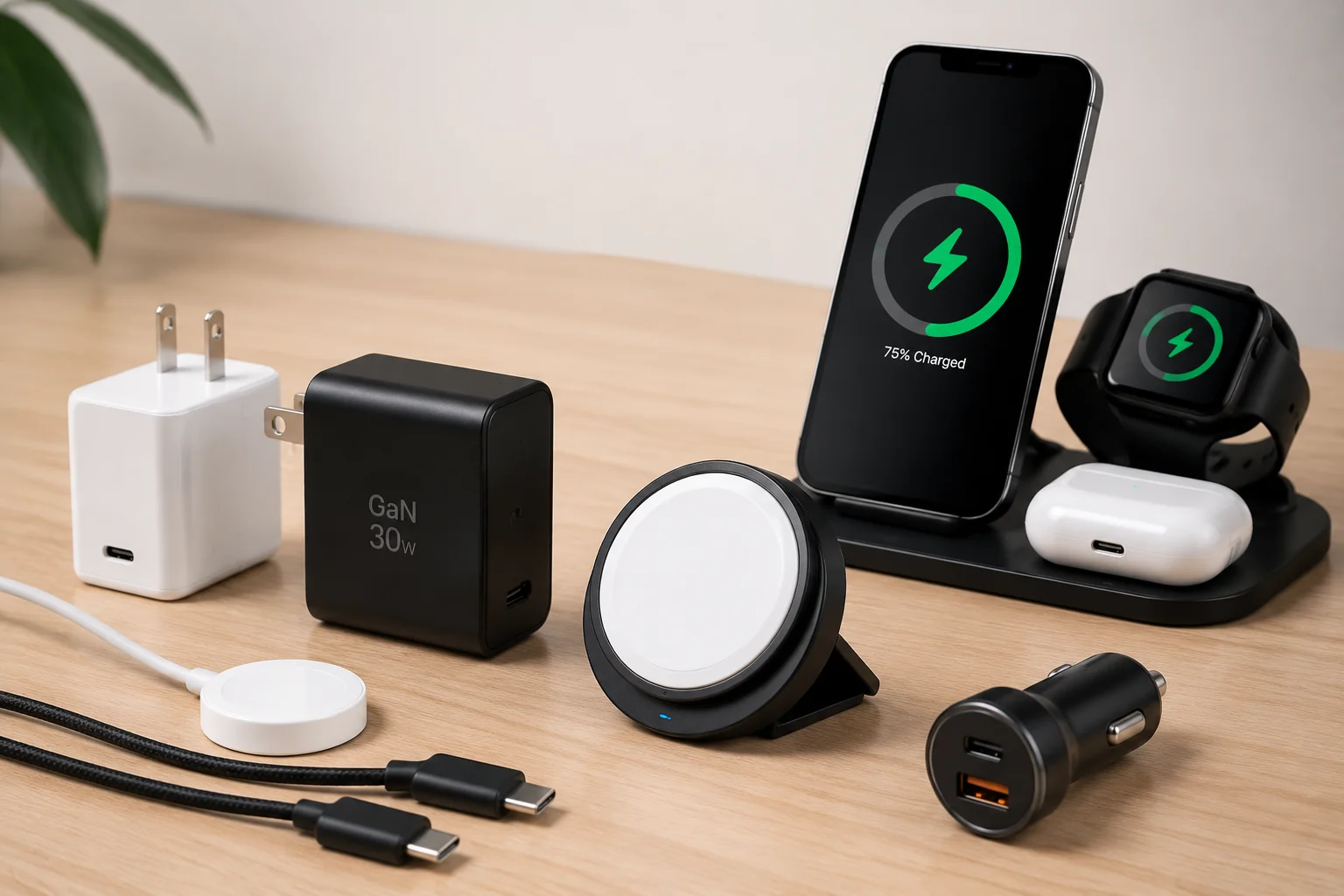
I have worked with overseas 3C buyers for many years in Shenzhen. I hear this question from retailers, wholesalers, and e-commerce sellers very often. They do not only ask if a charger works. They ask if it is safe to sell, safe to import, and safe for their customer reviews. I usually tell them that the charger market is not split into “Apple original” and “dangerous third-party.” It is split into controlled products and uncontrolled products.1 If I check the factory, certification, power design, and test reports, I can reduce most of the risk before the first shipment leaves China.
Are Third-Party Chargers Really Harmful to Apple Devices?
I hear many buyers blame all third-party chargers after one bad sample. That mistake can make them miss good margins and good product options.
Third-party chargers are not automatically harmful to Apple devices. I judge them by certification, output accuracy, charging protocol support, heat control, and supplier quality control. A well-made third-party USB-C PD charger can safely charge iPhone, iPad, AirPods, Apple Watch, and many MacBook models.
I separate the charger from the supplier claim
I never judge a charger only by the printed wattage or nice packaging. I have seen 20W chargers that performed better than some 30W chargers because the internal design was more stable. I have also seen low-cost chargers with a beautiful shell but weak safety spacing inside. For B2B buyers, this point matters because your customer does not review your supplier. Your customer reviews your store.
| What I check | Why I check it | What I avoid |
|---|---|---|
| Real output test | I need stable charging | Fake wattage labels |
| Certification files | I need import proof | Empty logo printing |
| Heat performance | I need safe daily use | Hot shells after short use |
| Protocol support | I need Apple compatibility | Random charging behavior |
| Supplier history | I need repeat quality | One-time cheap offers |
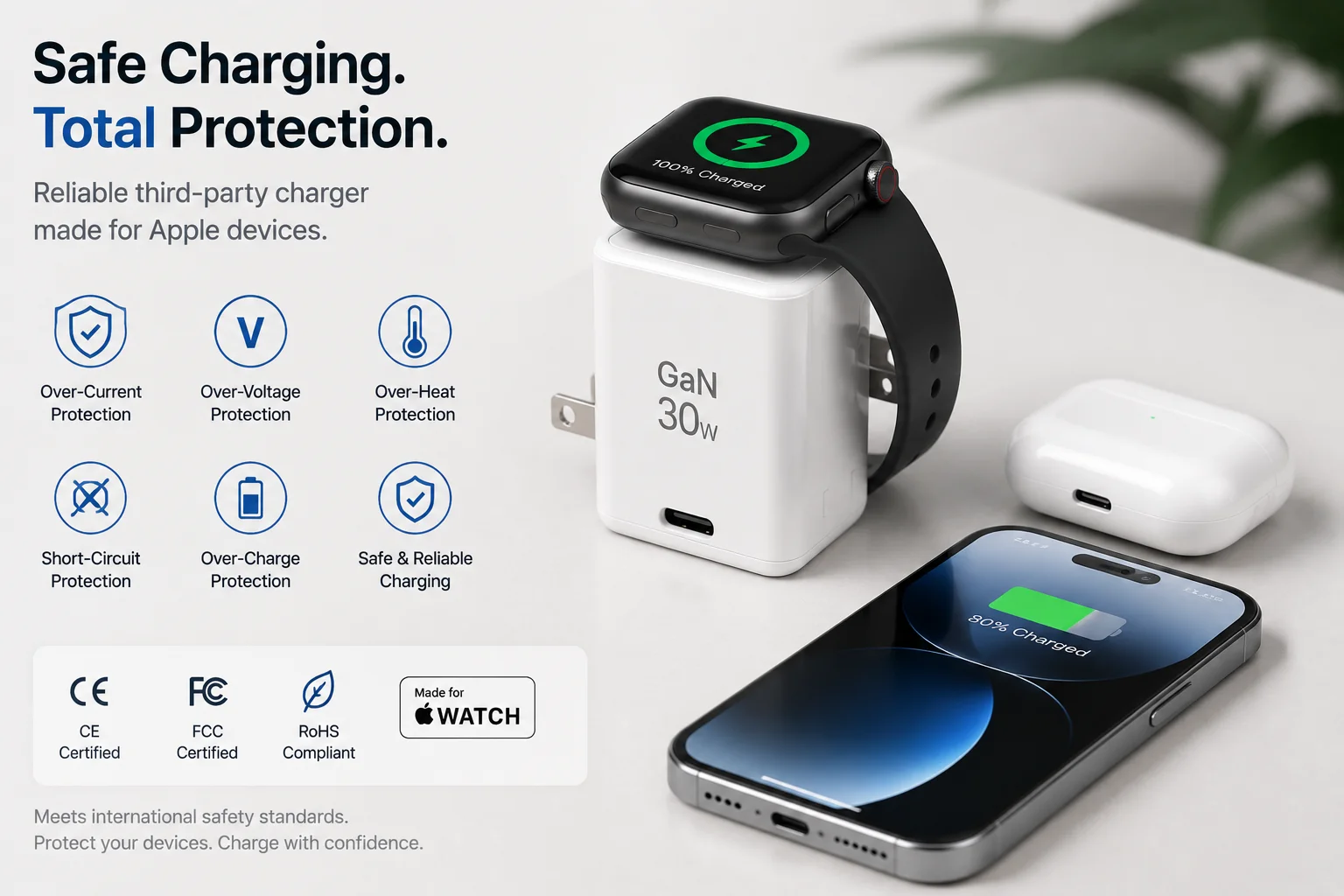
I often tell importers that the word “third-party” only means the charger is not made by Apple. It does not mean it is unsafe. Some third-party chargers are designed with proper USB-C Power Delivery, over-current protection, over-voltage protection, short-circuit protection2, and flame-retardant materials. These details decide safety. The brand name alone does not.
Why Can Some Cheap Chargers Damage Your iPhone, iPad, or Apple Watch?
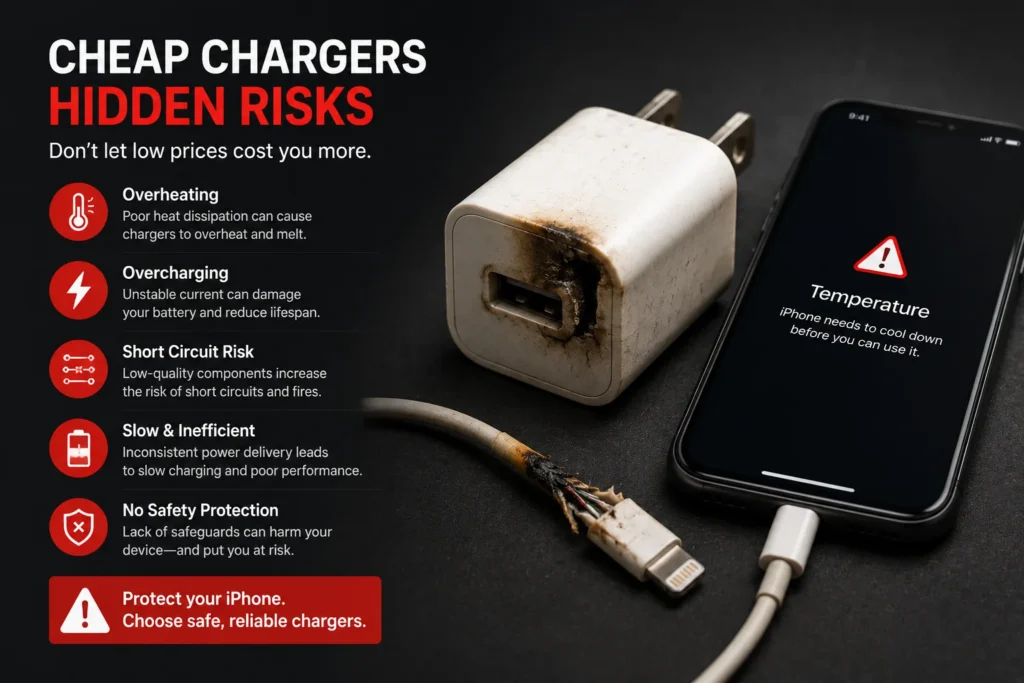
I see cheap chargers cause problems when the buyer only compares price. The lower price often hides weaker parts, poor testing, and unstable output.3
Some cheap chargers can damage Apple devices because they may deliver unstable voltage, lack protection circuits, overheat, or use poor insulation4. These problems can stress the battery5, slow charging, trigger warnings, or cause safety risks during daily charging.
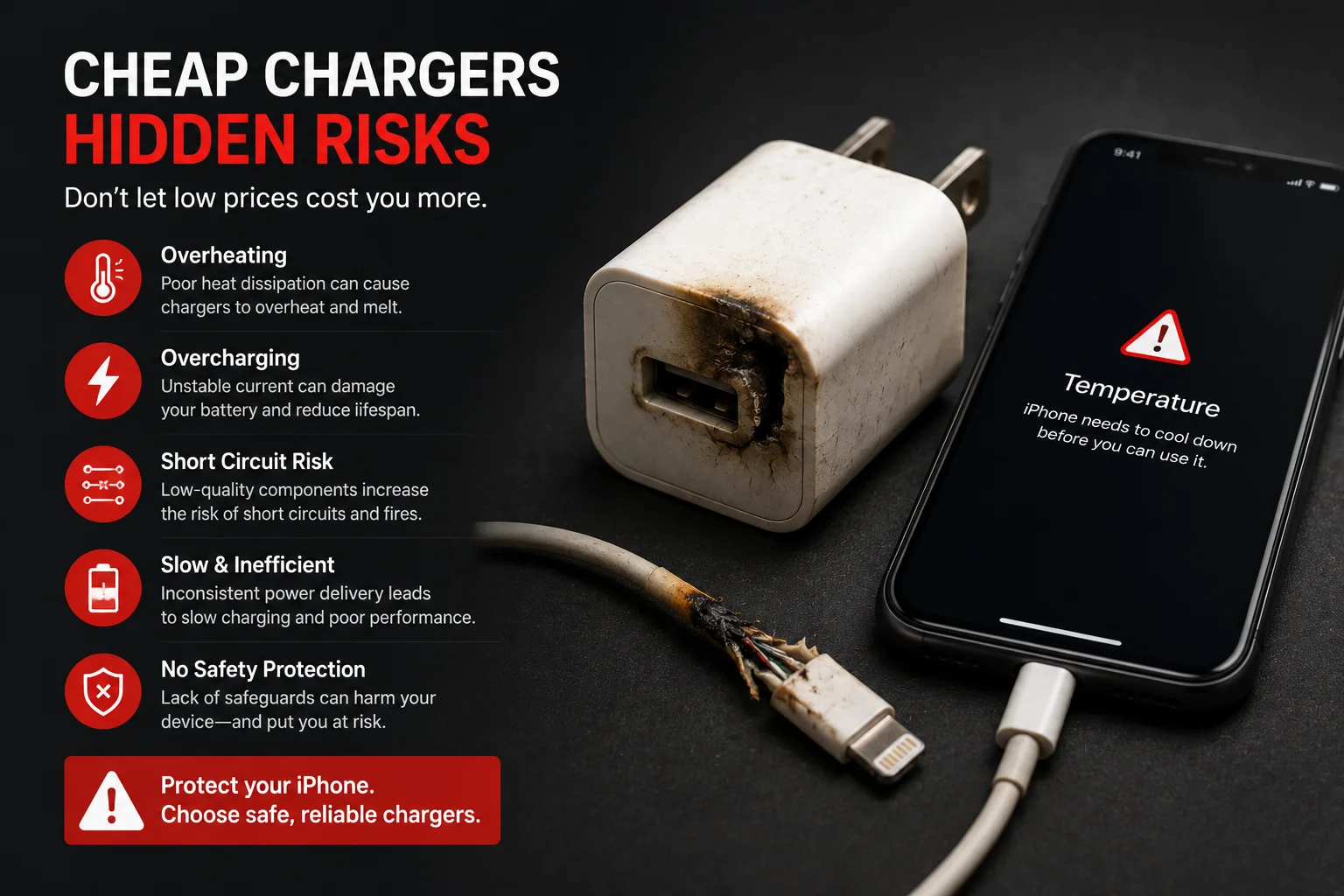
I look at the hidden cost behind the low price
I understand why buyers ask for the lowest price. In Europe and the United States, retail competition is strong. Marketplaces also push sellers to control cost. But I have learned that the cheapest charger can become the most expensive product after returns, bad reviews, and customs issues. A charger is not like a simple phone case. It connects to the power grid. It also connects to an expensive device in the customer’s home.
| Cheap charger issue | Possible result | Business risk |
|---|---|---|
| Unstable voltage | Battery stress | Return requests |
| Weak transformer | Heat increase | Safety complaints |
| Poor PCB layout | Short circuit risk | Brand damage |
| Fake certification | Customs problem | Shipment delay |
| Bad cable contact | Slow charging | Negative reviews |
I once discussed samples with a buyer who wanted a very low-cost charger for a promotion. The outside looked fine. The weight felt light. The test result also showed higher temperature than I liked. I told the buyer that a promotion product still carries the store name. If the product fails, customers do not say “the charger was cheap.” They say “this seller is not reliable.” That is why I treat low price as only one data point.
What Makes a Third-Party Charger Safe to Use?
I see many buyers ask for “safe chargers,” but they do not always know what safety means. I make the meaning clear before quoting.
A safe third-party charger should have correct certification, stable voltage output, proper charging protocol support, heat protection, short-circuit protection, and consistent production control. I also prefer suppliers who can provide test reports, sample test data, and clear product specifications.
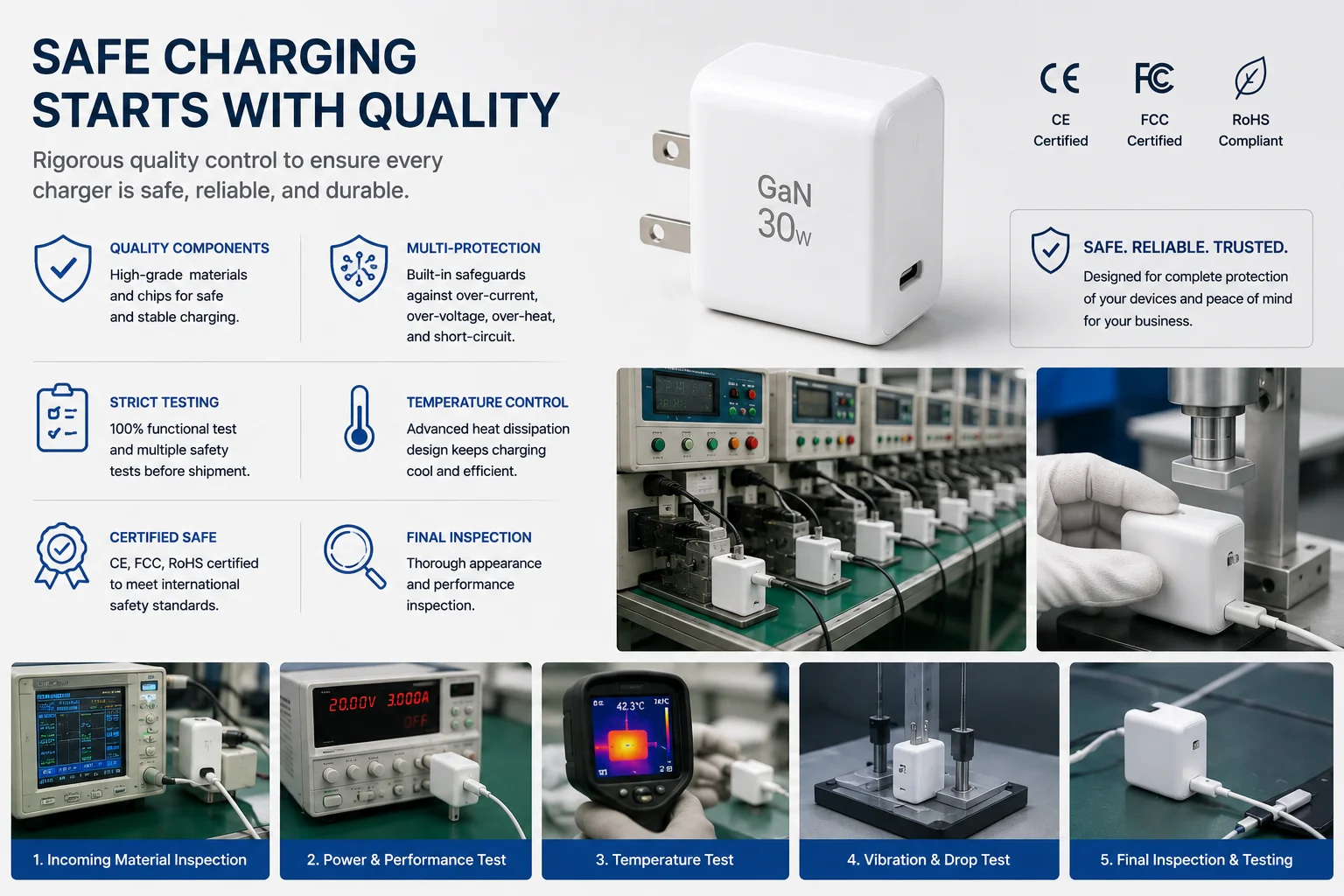
I define safety before I define price
I do not start a charger project by asking only for wattage and color. I first ask where the product will be sold. A charger for the EU market needs different compliance attention from a charger for the US market.6 A buyer selling in Amazon also needs different documents from a buyer selling in a local wholesale channel. The product may look the same, but the required proof can be different.
| Safety factor | What I want to see | Why it matters |
|---|---|---|
| Certification | CE, FCC, UKCA, ETL, UL, or other needed files | I need market access |
| Protection design | OVP, OCP, SCP, OTP | I need safer daily use |
| Material | Flame-retardant shell | I need lower fire risk |
| Output stability | Lab test data | I need device protection |
| Production control | Batch inspection | I need repeat quality |
I also pay attention to cables. Many charging issues come from the cable, not only the wall charger. For Apple devices, a USB-C to Lightning cable should have proper MFi approval7 if it uses Lightning. For USB-C iPhone and iPad models, the cable still needs stable current handling and good connector quality. A safe charging set is a system. I check the charger, cable, packaging, manual, and labeling together.
How Are Certification, Power Output, and Charging Protocols Explained?
I often see buyers feel lost when suppliers mention PD, GaN, MFi, CE, and FCC. The words sound technical, but the buying logic is simple.
Certification helps prove compliance. Power output tells the maximum charging capacity. Charging protocols control how the charger and device communicate. For Apple devices, USB-C Power Delivery is very important for fast charging8, while MFi matters for many Lightning accessories.
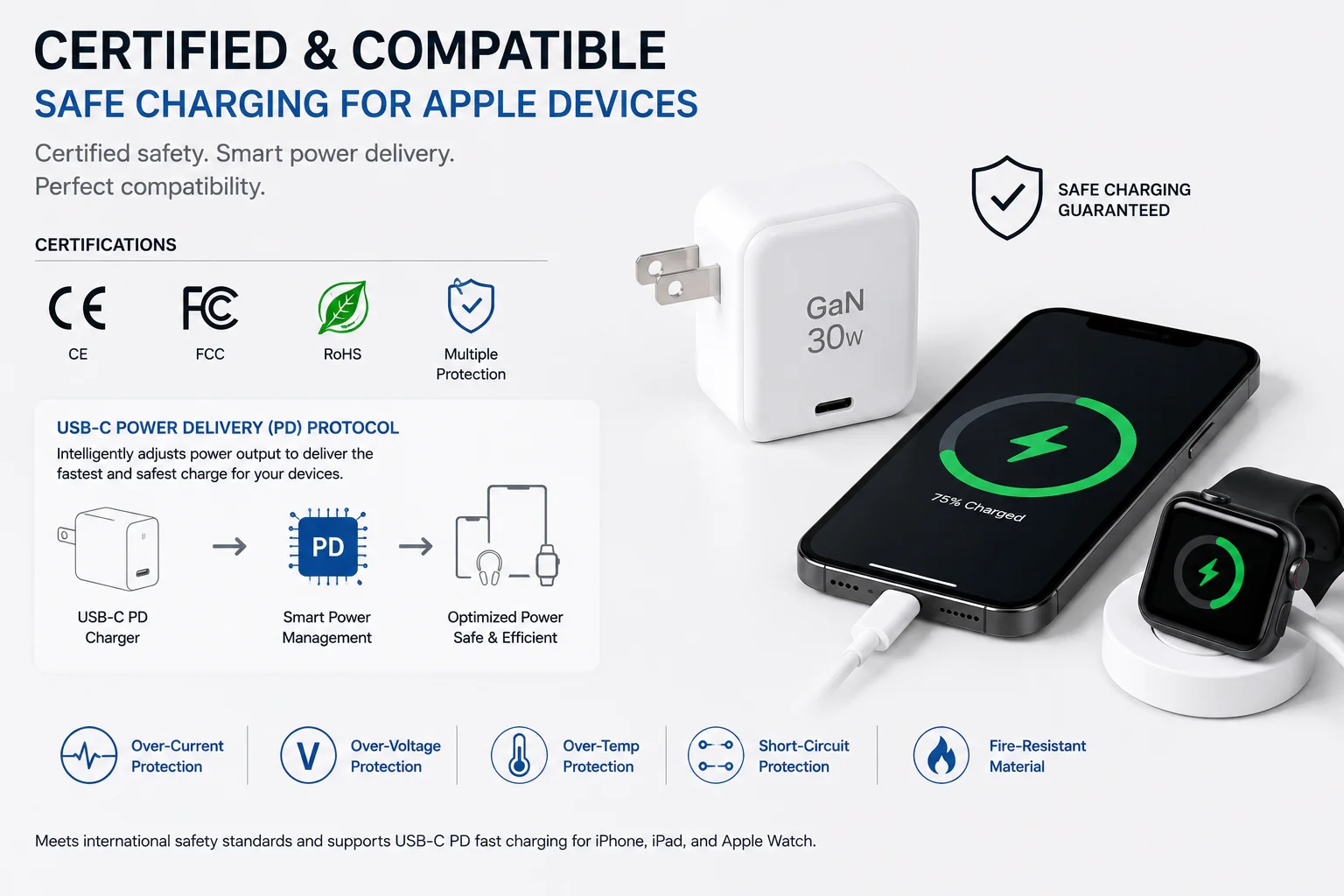
I translate technical words into buying decisions
I do not expect every buyer to be an engineer. I also do not think a buyer should approve a charger only because the supplier uses many technical terms. I tell customers to connect each term to a real decision. Certification is linked to import and legal risk. Power output is linked to product positioning. Protocol support is linked to user experience. MFi is linked to Lightning accessory trust.
| Term | Simple meaning | My buying question |
|---|---|---|
| CE | EU safety and compliance mark | Is the file real and relevant? |
| FCC | US electronic compliance | Does the model match the report? |
| USB-C PD | Fast charging communication | Does it support iPhone fast charging? |
| GaN | Smaller, efficient charger design9 | Is heat control tested well? |
| MFi | Apple accessory approval for Lightning | Is the cable approved and traceable? |
I usually ask buyers not to chase the highest wattage blindly. A 20W PD charger is enough for many iPhone users. A 30W or 35W charger can fit iPad users better.10 A 65W or 100W GaN charger is more suitable for users who also charge laptops. If a retailer knows its customer group, I can help match the charger model to that channel. The best charger is not always the strongest one. The best charger is the one that fits the device, the market, and the expected price point.
What Are the Common Risks: Overheating, Slow Charging, Battery Stress, and Short Circuits?
I see charger problems repeat in similar ways. Buyers usually notice them after sales begin, when the cost is already higher.
The common risks of poor third-party chargers include overheating, slow charging, battery stress, unstable charging, device warning messages, and short circuits. These risks usually come from weak components, bad circuit design, poor cable quality, or missing protection functions.
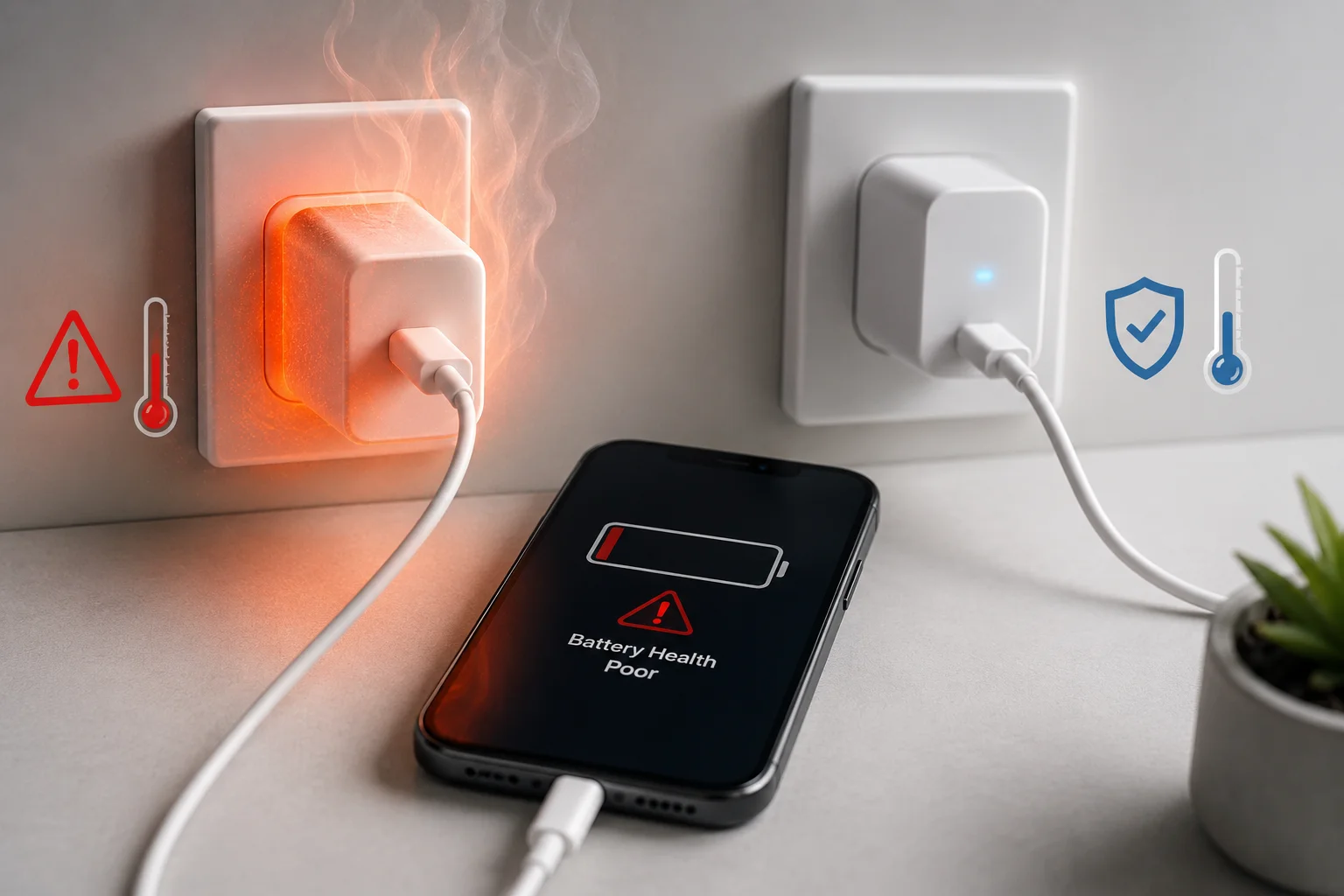
I treat charger risk as a return-rate problem
For end users, a bad charger is annoying or unsafe. For B2B buyers, a bad charger is also a return-rate problem. It can affect store rating, platform ranking, and repeat orders. I have seen buyers focus on landed cost only, then lose money through after-sales service. A small saving on each unit can disappear quickly if the complaint rate rises.
| Risk | User symptom | My prevention step |
|---|---|---|
| Overheating | Charger feels too hot | I test temperature under load |
| Slow charging | iPhone charges slowly | I check PD protocol support |
| Battery stress | Device gets hot often | I check output stability |
| Short circuit | Charger stops or burns | I check protection design |
| Warning message | Accessory not supported11 | I check cable and chipset |
I also remind buyers that Apple devices manage charging with internal protection12. This helps, but it does not make a bad charger safe. The device can reduce charging speed or stop charging when it detects a problem. But the customer still sees a failed product experience. For Apple Watch chargers, magnetic alignment and coil quality also matter. A poor Apple Watch charger may charge slowly or heat up the watch. For AirPods, low-power stability is also important. Each device type has its own risk point.
What Is the Real Difference Between an Apple Original Charger and a Third-Party Charger?
I hear buyers ask if Apple original chargers are always better. I answer carefully because the real difference is not only performance.
Apple original chargers offer strong brand trust, strict design control, and clear compatibility. Good third-party chargers can also charge safely, often with more price choices, more wattage options, more port designs, and more retail packaging flexibility.
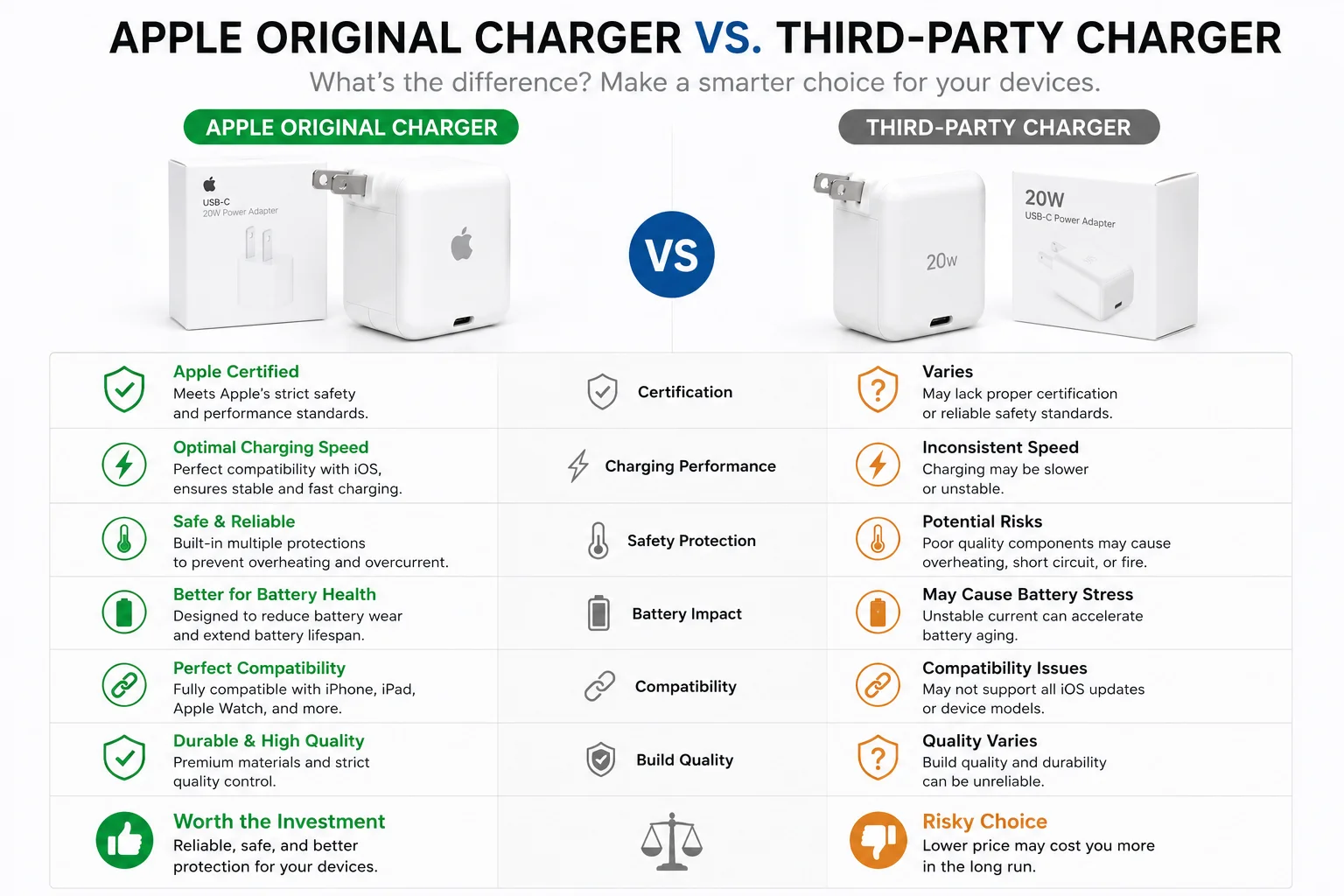
I compare control, cost, and product positioning
Apple original chargers carry a strong trust signal. Customers know the brand. Retailers also face fewer questions from cautious shoppers. But original accessories may limit margin and product variety. Third-party chargers give retailers more choice. A store can sell compact GaN chargers, dual-port chargers, travel chargers, charger and cable bundles, or private label packaging. The trade-off is that the buyer must do more quality checking.
| Comparison point | Apple original charger | Good third-party charger |
|---|---|---|
| Brand trust | Very high | Depends on brand and proof |
| Price flexibility | Low | Higher |
| Port options | Limited | Many choices |
| Packaging control | Limited | Flexible |
| Buyer responsibility | Lower | Higher |
I often tell retailers that Apple original products are easier to explain. Third-party products are easier to differentiate. If a seller competes only on original accessories, many stores offer the same item. If a seller builds a reliable third-party accessory line, the seller can create bundles, improve margin, and fit local customer needs. But this only works when the product is stable. A third-party charger should not be treated as a random low-cost add-on. It should be treated as a core electronic product with clear safety requirements.
How Should I Choose a Reliable Third-Party Charger for Apple Devices?
I see buyers make better decisions when they use a checklist. Without a checklist, every supplier says the same words.
I choose a reliable third-party charger by checking target market certification, real test reports, PD protocol support, temperature performance, material quality, warranty terms, supplier experience, and sample consistency. I also test the charger with real Apple devices before bulk orders.
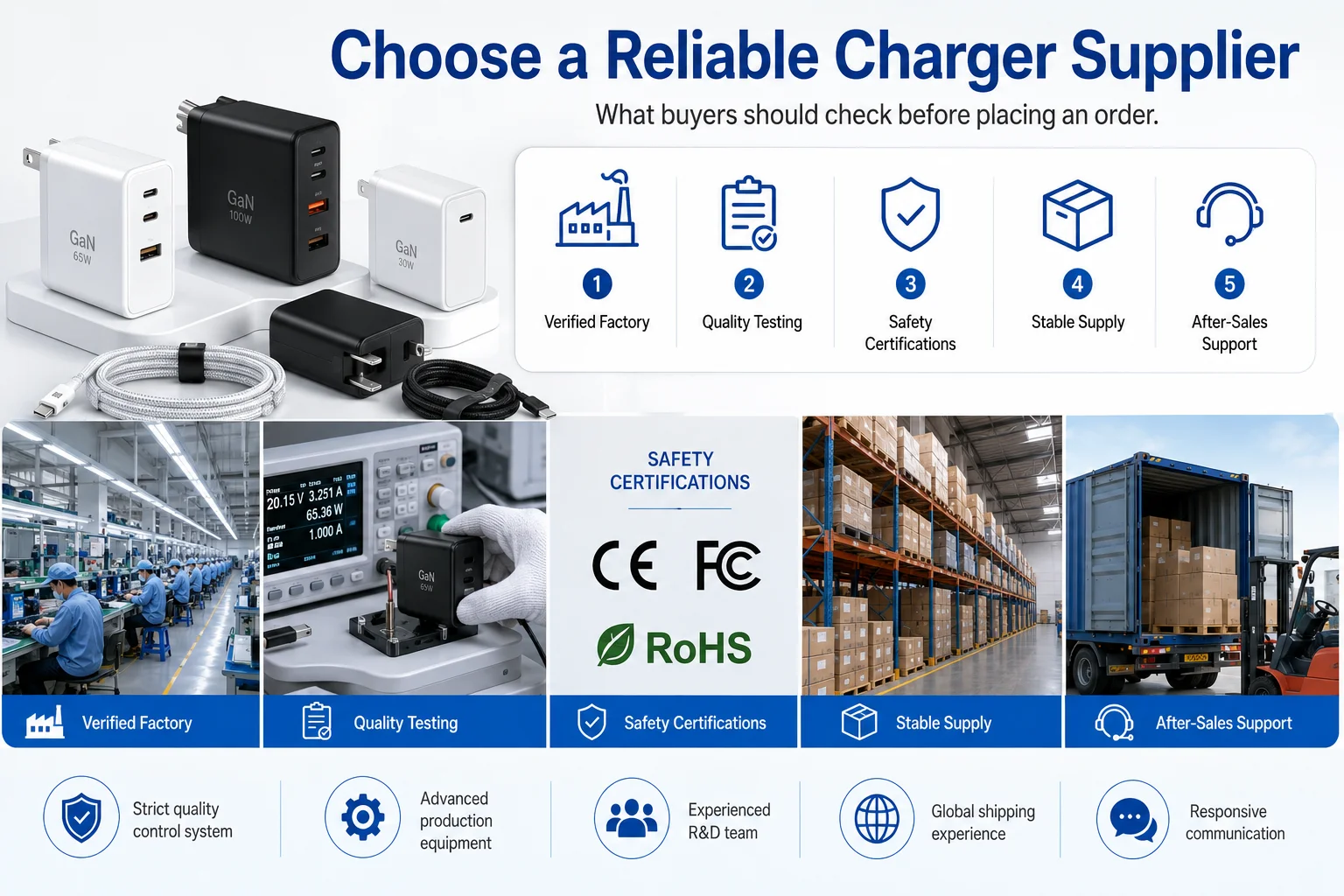
I use a simple sourcing checklist
When a client asks for the “best charger,” I first ask about the sales channel. A supermarket chain, an Amazon seller, and a telecom shop may need different packaging, MOQ, warranty, and certification proof. I also ask about the target device. A charger for iPhone users is not always the same product as a charger for iPad or MacBook users. Clear use cases help me avoid wrong recommendations.
| Step | My question | Why I ask |
|---|---|---|
| Market | Where will you sell it? | I need correct certification |
| Device | Which Apple devices will users charge? | I need correct wattage |
| Channel | Retail, wholesale, or e-commerce? | I need suitable packaging |
| MOQ | What first order is realistic? | I need a workable model |
| After-sales | What warranty can you support? | I need risk control |
I recommend sample testing before mass order. I like to test charging speed, surface temperature, plug fit, cable connection, and multi-device behavior if the charger has several ports. I also compare the sample with the final production standard. A good sample does not help if mass production uses different components. For long-term buyers, I prefer stable models instead of changing designs every month. Stable models help reduce complaints and help the buyer build customer trust over time.
What Should Importers Check Before Buying Chargers Wholesale?
I talk with many importers who worry about MOQ, price, and delivery time. I understand that, but I ask them to check proof first.
Before buying chargers wholesale, importers should check certification validity, model consistency, packaging labels, plug standard, test reports, warranty policy, production capacity, inspection process, and supplier export experience. I also suggest checking whether the charger matches the rules of the target market.
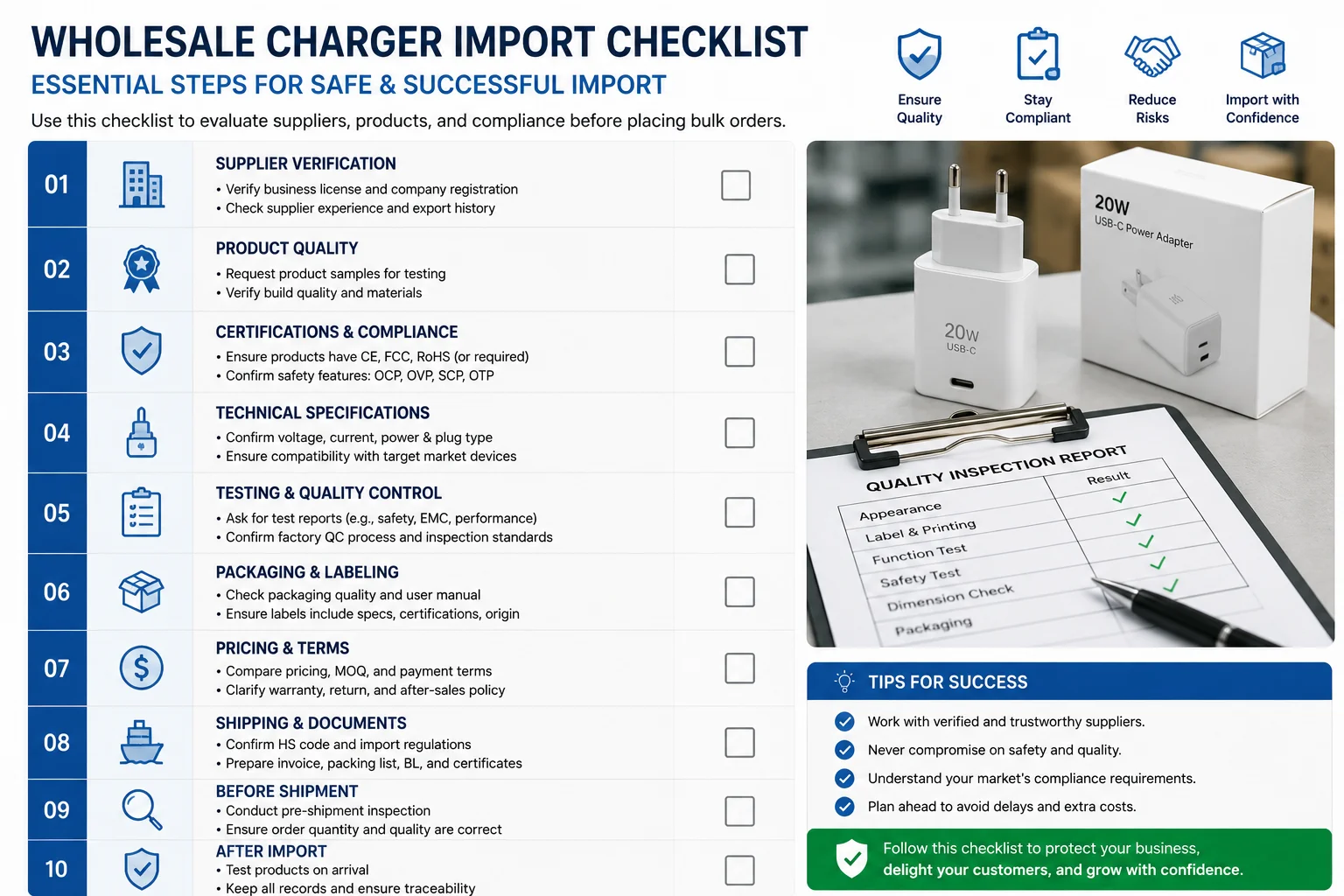
I look at wholesale as risk management, not only buying stock
Wholesale chargers can be a good business. They have repeat demand, wide device use, and strong bundle potential. But wholesale also multiplies mistakes. If one sample is bad, the problem is small. If one container is bad, the problem is serious. This is why I never treat charger wholesale as only a price negotiation. I treat it as a risk check before money moves.
| Importer check | What I want confirmed | Risk if ignored |
|---|---|---|
| Certification | Report matches exact model | Customs or legal issue |
| Plug type | EU, US, UK, AU, or other | Unsellable stock |
| Labeling | Correct input, output, marks | Compliance complaint |
| Packaging | Local language and barcode | Retail rejection |
| Inspection | AQL or agreed standard | Hidden defect rate |
| Warranty | Clear claim process | After-sales loss |
I often advise first-time importers to start with a smaller, proven charger range. A 20W PD charger, a 30W GaN charger, and a 65W multi-port charger can cover many customer needs. After the buyer sees real sales data, the range can grow. I also suggest clear packing lists, carton marks, and product photos before shipment. These small details reduce warehouse confusion. For private label buyers, I check logo position, manual wording, barcode rules, and packaging strength. A charger is a technical product, but the wholesale success also depends on operation details.
Conclusion
I trust good third-party chargers, but I only trust them after I check certification, output, heat control, supplier quality, and real market fit.
"CPSC Urges Consumers to Not Buy or Use “Universal” Chargers ...", https://www.cpsc.gov/Newsroom/News-Releases/2024/CPSC-Urges-Consumers-to-Not-Buy-or-Use-Universal-Chargers-with-Micromobility-Products-Due-to-Fire-Hazard. Reports from consumer safety bodies like the Electrical Safety Foundation International (ESFI) consistently warn consumers about the dangers of counterfeit and uncertified electronics, emphasizing that the presence of a valid certification mark (like UL, ETL, or CE) is a key differentiator for safety, regardless of brand. Evidence role: expert_consensus; source type: institution. Supports: The critical distinction between products that are certified to meet safety standards and those that are not.. Scope note: This source supports the general principle of 'certified vs. uncertified' rather than specifically analyzing the charger market in the exact terms of 'controlled vs. uncontrolled'. ↩
"Battery Protection Features Explained: OVP, SCP, OTP & More", https://yileide.com/battery-protection-features-explained-ovp-scp-otp-more/. Standards from safety organizations and electronics engineering resources define Over-Current Protection (OCP), Over-Voltage Protection (OVP), and Short-Circuit Protection (SCP) as critical safety mechanisms in power supplies that protect the device and user by shutting down the charger under fault conditions. Evidence role: definition; source type: institution. Supports: The definition and function of common safety circuits in power electronics.. ↩
"Teardown of the mysterious KMS 4-port USB charger", http://www.righto.com/2012/11/teardown-of-mysterious-kms-4-port-usb.html. Investigative teardowns of counterfeit and cheap chargers by electronics engineers and safety organizations regularly find cost-cutting measures such as using undersized components, omitting safety circuits, and providing inadequate insulation between high- and low-voltage sections, which leads to poor performance and significant safety risks. Evidence role: case_reference; source type: research. Supports: That low-cost, uncertified chargers frequently use substandard components and omit critical safety features.. ↩
"[PDF] Physical Safety and Security at Electric Vehicle Charging Sites", https://driveelectric.gov/files/physical-site-security.pdf. Analyses from safety science companies like UL Solutions and electrical safety foundations show that uncertified chargers often fail basic safety tests, exhibiting issues like unstable voltage regulation, poor insulation, and a lack of essential protection circuits, which can lead to device damage, fire, or electric shock. Evidence role: mechanism; source type: institution. Supports: The mechanisms by which counterfeit or uncertified chargers can damage electronic devices.. ↩
"Heat Generation and Degradation Mechanism of Lithium-Ion ... - PMC", https://pmc.ncbi.nlm.nih.gov/articles/PMC9753165/. Research from academic sources and specialized publications like Battery University explains that charging lithium-ion batteries under high temperatures or with unstable voltage can induce 'stress,' accelerating capacity degradation and shortening the battery's overall service life. Evidence role: mechanism; source type: education. Supports: How factors like excessive heat and unstable voltage during charging can negatively impact the health and lifespan of lithium-ion batteries.. ↩
"Charger Certification Guide 2026: UL, CE, FCC & EU USB-C Rule", https://www.wowohcool.com/blog/certifications-us-eu-guide/. Official guidance from the European Commission specifies that products like chargers must bear the CE mark to be sold in the EEA, indicating conformity with health and safety standards. In the U.S., the Federal Communications Commission (FCC) regulates electronic interference, and safety certifications are often provided by Nationally Recognized Testing Laboratories (NRTLs) like UL or ETL. Evidence role: general_support; source type: government. Supports: The different regulatory frameworks for electronic products in the European Union and the United States.. ↩
"MFi Program - Wikipedia", https://en.wikipedia.org/wiki/MFi_Program. Apple's MFi Program provides manufacturers with technical specifications and resources to create accessories, such as Lightning cables, that are certified by Apple for safety and compatibility with its devices. Evidence role: definition; source type: other. Supports: The purpose of Apple's MFi (Made for iPhone/iPad/iPod) certification for third-party accessories.. ↩
"Quick Charge - Wikipedia", https://en.wikipedia.org/wiki/Quick_Charge. Apple's official support documentation confirms that to fast charge compatible iPhone models, a USB-C power adapter that supports the USB Power Delivery (USB-PD) standard is required. Evidence role: general_support; source type: other. Supports: That Apple devices utilize the USB Power Delivery (PD) standard for their fast-charging feature.. ↩
"GaN vs. Silicon in High-Frequency Power Transistors - Stanford", http://large.stanford.edu/courses/2025/ph240/jahan2/. Technical articles explain that Gallium Nitride (GaN) is a wide-bandgap semiconductor that can operate at higher frequencies and temperatures with greater efficiency than silicon. This reduces energy loss as heat, allowing engineers to design power adapters that are significantly more compact and powerful. Evidence role: mechanism; source type: encyclopedia. Supports: The properties of Gallium Nitride (GaN) that allow for smaller and more efficient power converters.. ↩
"Power adapters for iPhone - Apple Support", https://support.apple.com/guide/iphone/power-adapters-iph8c1e31583/ios. Apple's product pages and support articles often specify power requirements, indicating, for example, that a 20W or higher adapter is needed for fast charging recent iPhones, while some iPad models are bundled with or can benefit from a 30W adapter. Evidence role: general_support; source type: other. Supports: The recommended power adapter wattages for optimally charging various Apple devices.. Scope note: The exact optimal wattage can vary by specific device model and its current battery level. ↩
"MFi Program - Wikipedia", https://en.wikipedia.org/wiki/MFi_Program. Apple's official support documentation explains that this alert can appear if an accessory is damaged, not Apple-certified, or not supported by the device, often indicating an issue with the accessory's connector or internal authentication chip. Evidence role: general_support; source type: other. Supports: The potential causes for an Apple device displaying an 'Accessory not supported' alert.. ↩
"About Charge Limit and Optimized Battery Charging on iPhone", https://support.apple.com/en-us/108055. Apple describes features like 'Optimized Battery Charging' which are designed to reduce battery aging by managing charging speed and duration. This software works in conjunction with the device's internal power management hardware to protect against issues like overcharging and excessive heat. Evidence role: mechanism; source type: other. Supports: That Apple devices incorporate software and hardware to manage charging and protect the battery.. Scope note: While these protections mitigate risks, they do not make the use of a fundamentally unsafe external charger risk-free. ↩