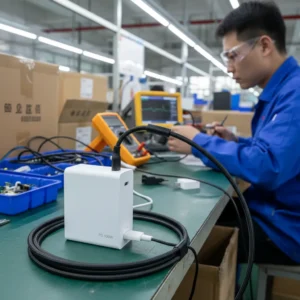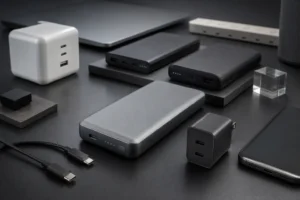
I see many desks full of cables. I also see buyers lose sales when charging products feel messy, bulky, and hard to explain1.
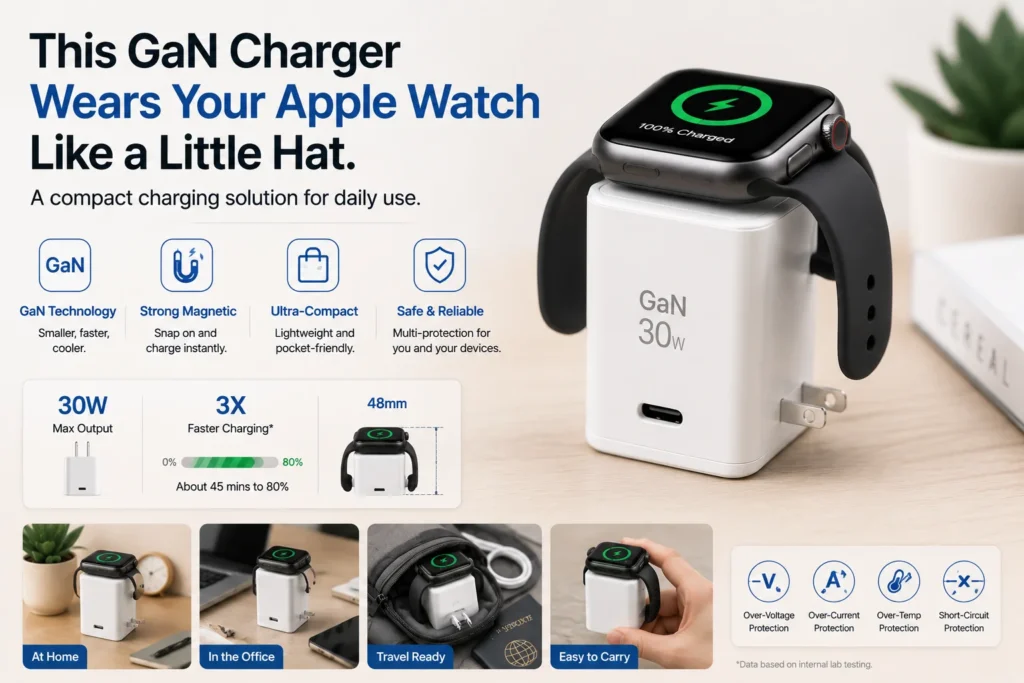
This compact GaN charger charges phones, earbuds, and an Apple Watch in one small body. The Apple Watch sits on top like a little hat, so users get a cleaner setup, fewer cables, and better daily charging comfort.
I have talked with many 3C buyers over the years. I know that a small design change can make a product much easier to sell. This charger looks simple at first. But I think the real value is in how it solves daily charging pain without asking the user to change habits.
What Does “Wears Your Apple Watch Like a Little Hat” Mean?
I know the phrase sounds funny. But I use it because many buyers need one clear image before they understand the product.
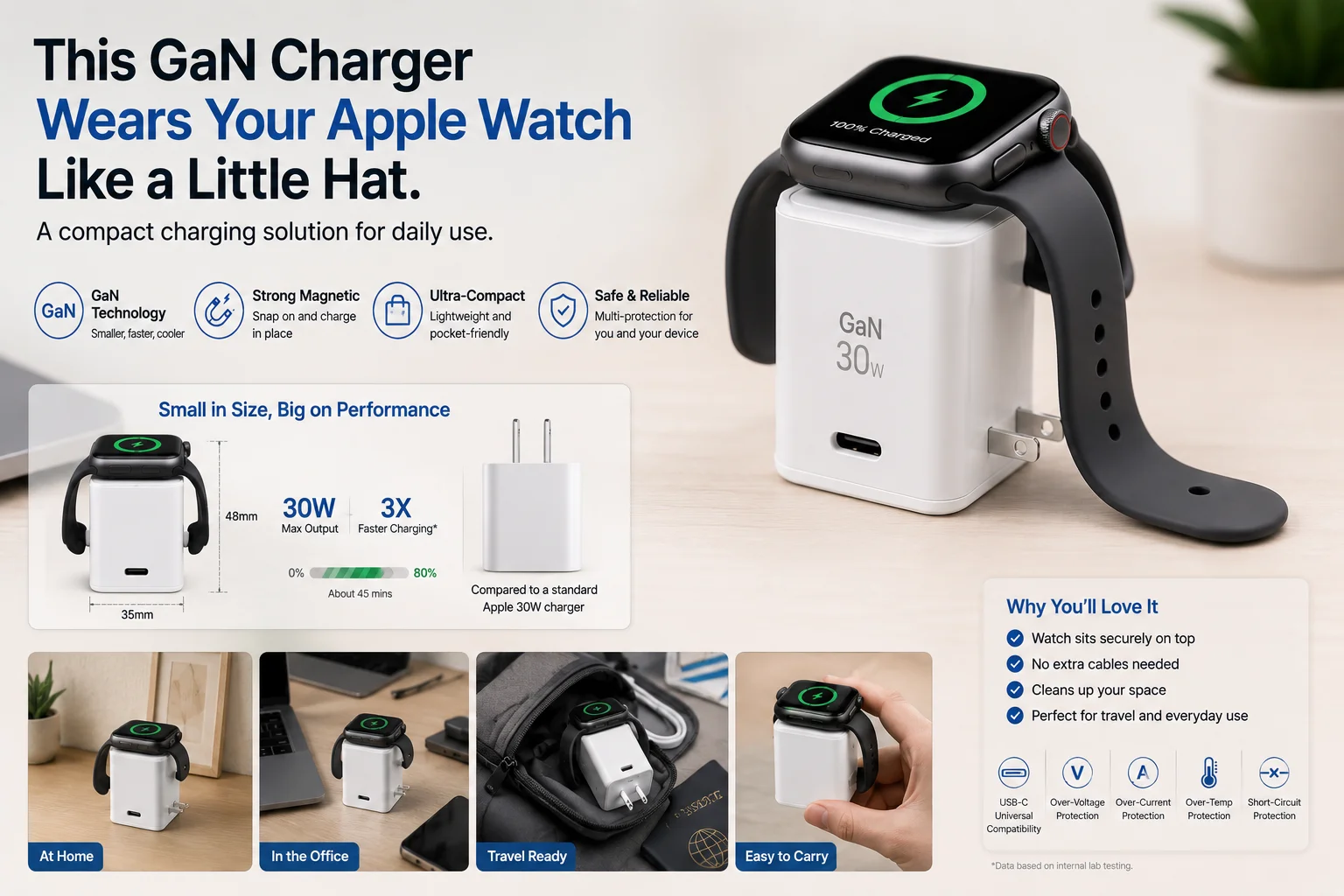
“Wears your Apple Watch like a little hat” means the Apple Watch rests on the top magnetic charging area of the GaN charger. The watch stands above the charger body, so the setup looks compact, clean, and easy to use.
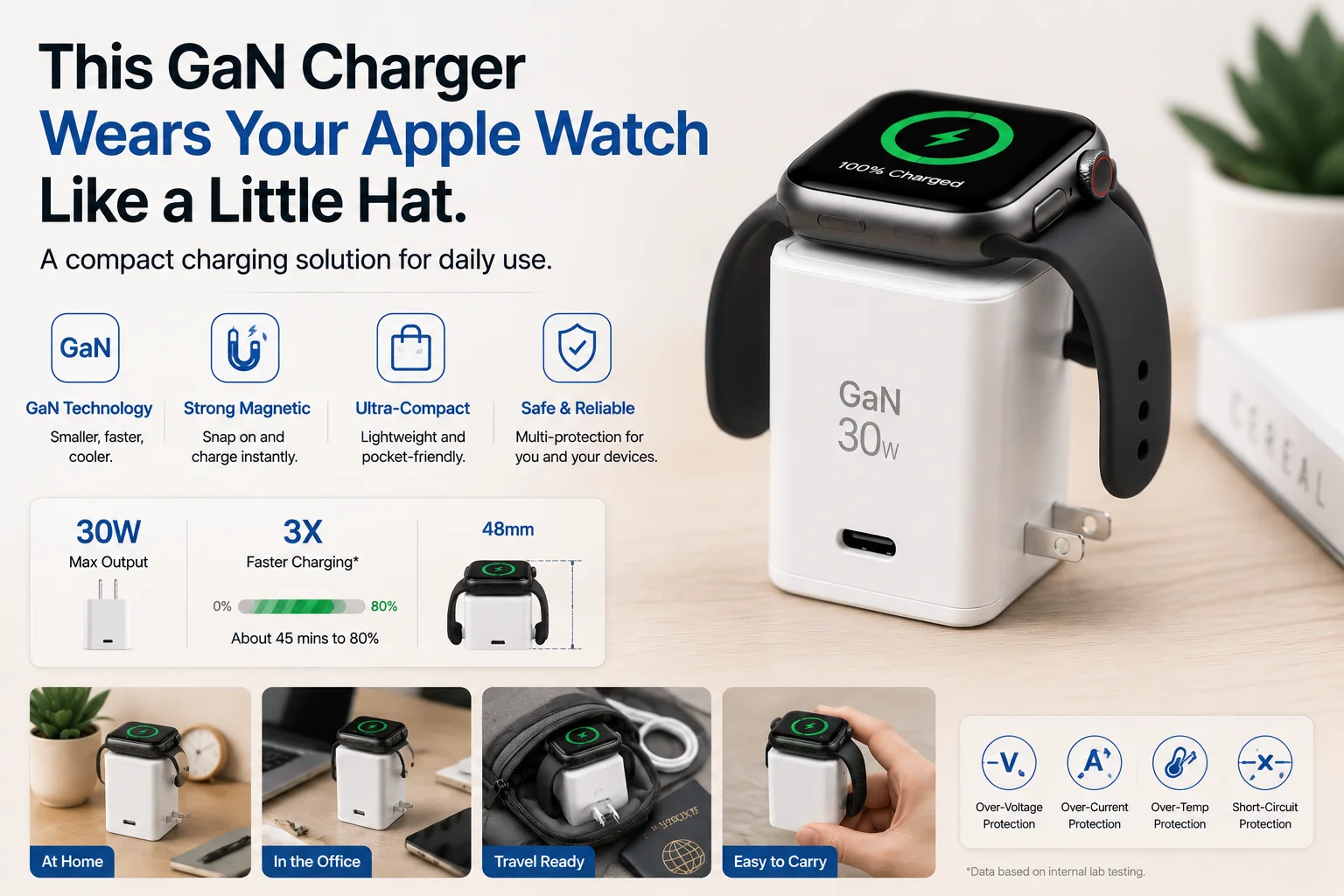
I describe the design in simple terms
I often explain this product to buyers during video calls. I put the charger on the table. Then I place the Apple Watch on the top. The buyer usually understands it in one second. The watch does not lie beside the charger. It does not need a long cable. It sits on the charger like a small cap.
This matters because users do not only buy charging speed. They also buy order, space, and a better daily feeling.2 A regular charger may work well. But it still needs a separate Apple Watch cable. That cable often sits beside the bed or behind the monitor. It can make the setup look cheap.
| User Problem | This Design Response | Buyer Value |
|---|---|---|
| Too many cables | Watch charging is built into the charger body | Easier product story |
| Small desk space | Vertical top charging saves area | Better for home and office |
| Travel mess | One charger replaces several parts | Stronger travel selling point |
| Hard to display | The watch sits visibly on top | Better retail demo |
I think this “little hat” idea works because it is easy to remember. A good 3C product should be useful first. But it also needs a shape that customers can understand fast.
Why This Design Is Different from Regular Apple Watch Chargers?
I have seen many Apple Watch chargers that work fine. But I also see that most of them add one more thing to carry.
This design is different because it combines the wall charger and Apple Watch charging position in one compact unit. Regular Apple Watch chargers usually need a separate cable, separate adapter, or extra desk space.
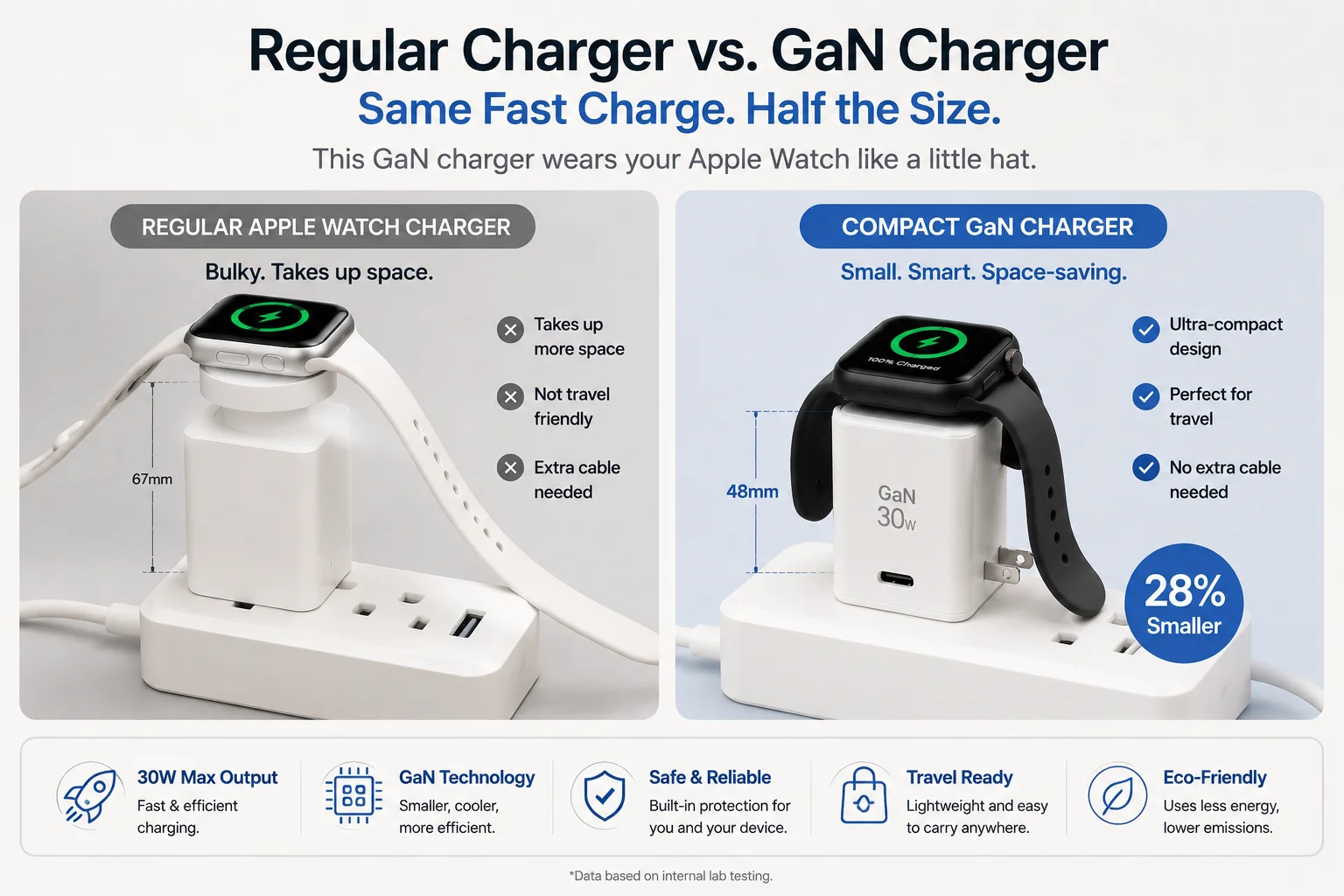
I compare the real daily use, not only the function
A regular Apple Watch charger has one job. It charges the watch. That is not a problem. The problem starts when the user also needs to charge a phone, earbuds, tablet, or work device. Then the user needs more ports, more adapters, and more cable space.
This GaN charger changes the product logic. It does not ask the user to add another charging tool. It makes the watch charger part of the main charging hub. I see this as a strong difference for retailers and online sellers. The product photo already explains the benefit.
| Product Type | Main Advantage | Main Trade-Off |
|---|---|---|
| Standard Apple Watch cable | Simple and familiar | Needs extra adapter |
| Charging dock | Looks neat on desk | Less travel friendly |
| Multi-port charger | Charges more devices | Still needs watch cable |
| GaN charger with watch top | Compact and integrated | Needs clear compatibility details |
I always tell buyers that “different” should not mean strange. A product must still feel easy. This charger is different in a useful way. It removes one item from the user’s charging kit. That is a simple benefit. It is also a benefit that customers can feel every day.
How a GaN Charger Makes the Setup Smaller and More Powerful?
I often meet buyers who hear “GaN” but only think about marketing words. I think GaN matters most when the product becomes smaller.
A GaN charger uses gallium nitride power technology to deliver high output from a smaller body.3 This helps the charger support phones, tablets, earbuds, and Apple Watch charging while keeping the travel size compact.
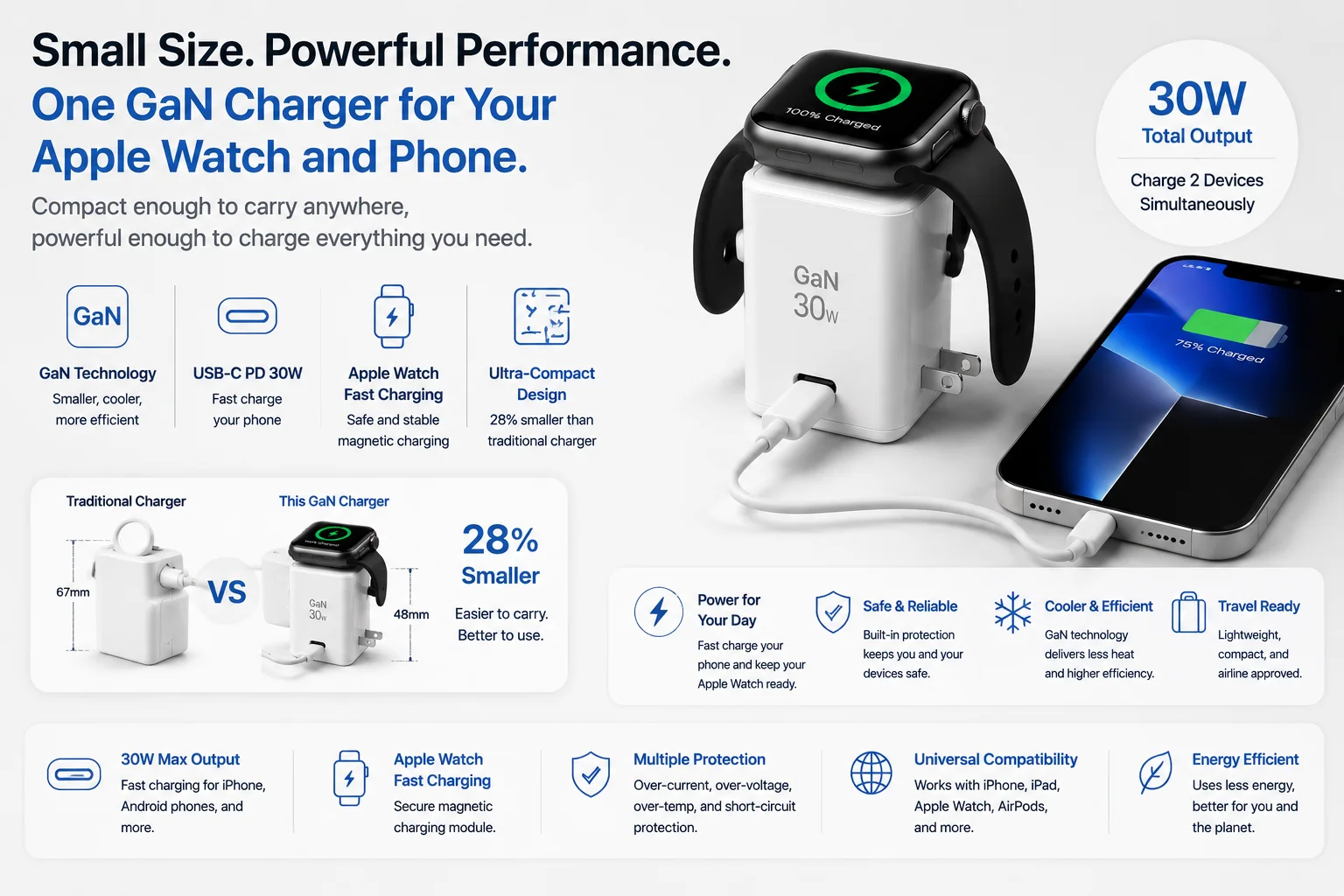
I see GaN as a space-saving tool
GaN is not magic. I do not present it that way to buyers. I explain that GaN parts can handle power with better size control than many older silicon charger designs.4 This can help the factory make a smaller charger with useful output. The user feels this value when the charger fits into a pocket, laptop bag, or small desk corner.
For importers, the power rating must match the target user. A 30W model can work for light daily use. A 65W model can support more serious phone and tablet users. Some buyers may want higher power for laptop users. But higher power also means more cost, more heat control work, and more safety testing5.
| Power Level | Best Use Case | Buyer Note |
|---|---|---|
| 20W–30W | Phone, earbuds, Apple Watch | Good for entry-level retail |
| 45W | Phone and small tablet | Good balance for e-commerce |
| 65W | Phone, tablet, some laptops | Stronger premium positioning |
| 100W+ | Laptop-heavy users | Needs strict thermal design |
I ask buyers one simple question. I ask, “What devices does your customer charge every day?” That question is better than only asking for the highest watt number. A compact charger should match real use. It should not only look strong on a product page.
Key Benefits for Apple Watch Users?
I know Apple Watch users care about small daily habits. They want charging to feel easy before sleep, at work, and during travel.
The key benefits are fewer cables, smaller desk space, easier travel packing, cleaner bedside charging, and multi-device support. The user can charge an Apple Watch and other devices from one compact charger.
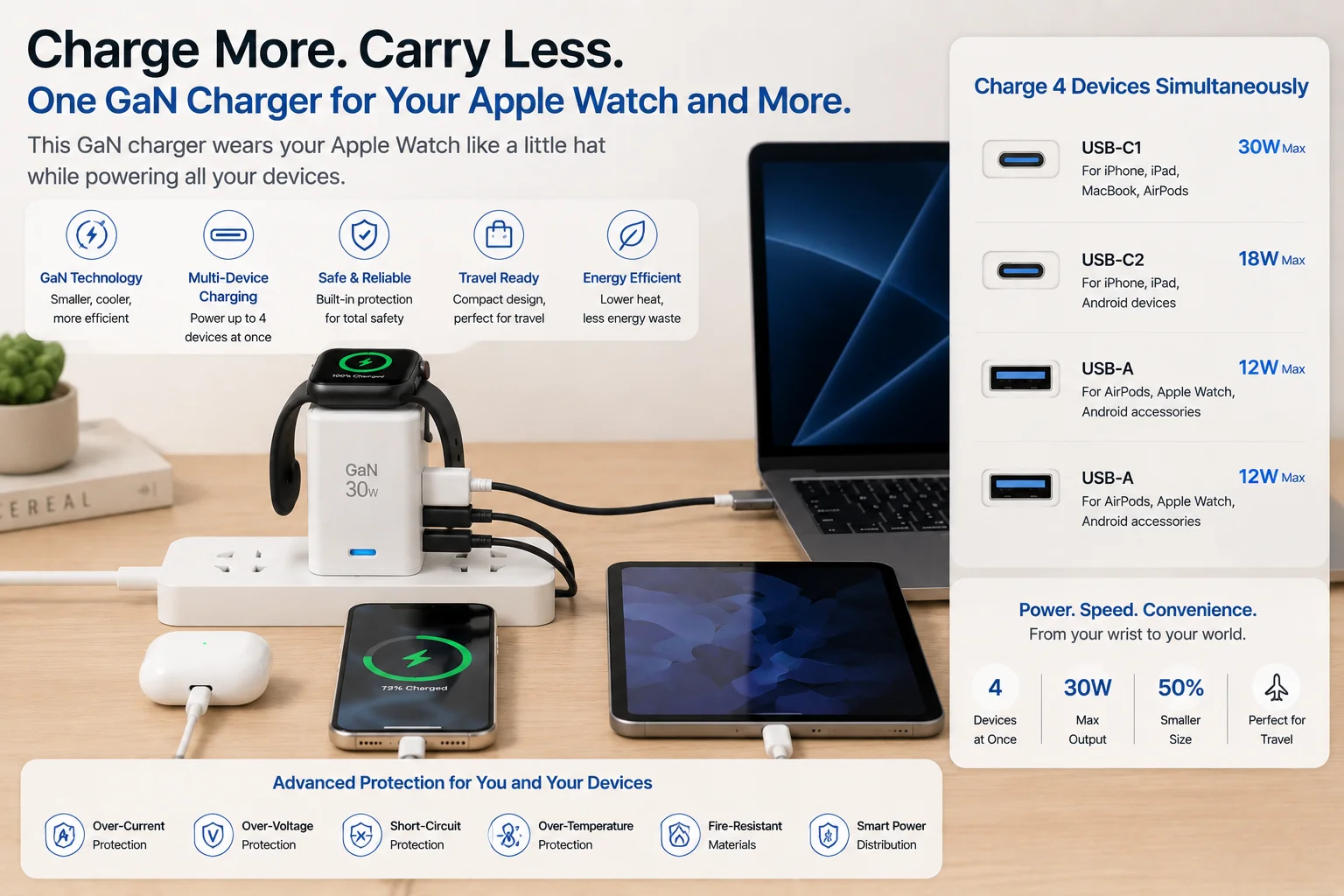
I focus on daily comfort because it sells
I have learned that many charging products fail because they only talk about watts. Real users talk about mess. They talk about forgetting cables. They talk about not having enough wall sockets in hotels6. This product solves those small problems in a direct way.
When a user gets home, the charger can stay near the bed. The phone cable can plug into one port. The Apple Watch can sit on top. The user does not need to look for the watch cable. When the user goes to the office, the same product can sit beside a laptop. When the user travels, the product can replace a charger and a separate watch cable.
| Benefit | Why Users Care | How Sellers Can Explain It |
|---|---|---|
| Fewer cables | Less mess and fewer lost items | “One charger for daily devices” |
| Compact shape | Better for bags and small tables | “Travel-ready charging hub” |
| Clear watch position | Easy to place the watch | “Drop it on top and charge” |
| Multi-device use | More value from one purchase | “Phone, watch, and earbuds together” |
I also think this type of product has strong gift value. The shape is easy to understand. The use case is daily. The buyer does not need a long education process. That helps both retail shelves and online listings.
Charging Your Apple Watch at Home, Office, or While Traveling?
I hear this question often from buyers. They want to know if the product is only for travel or if it also fits daily use.
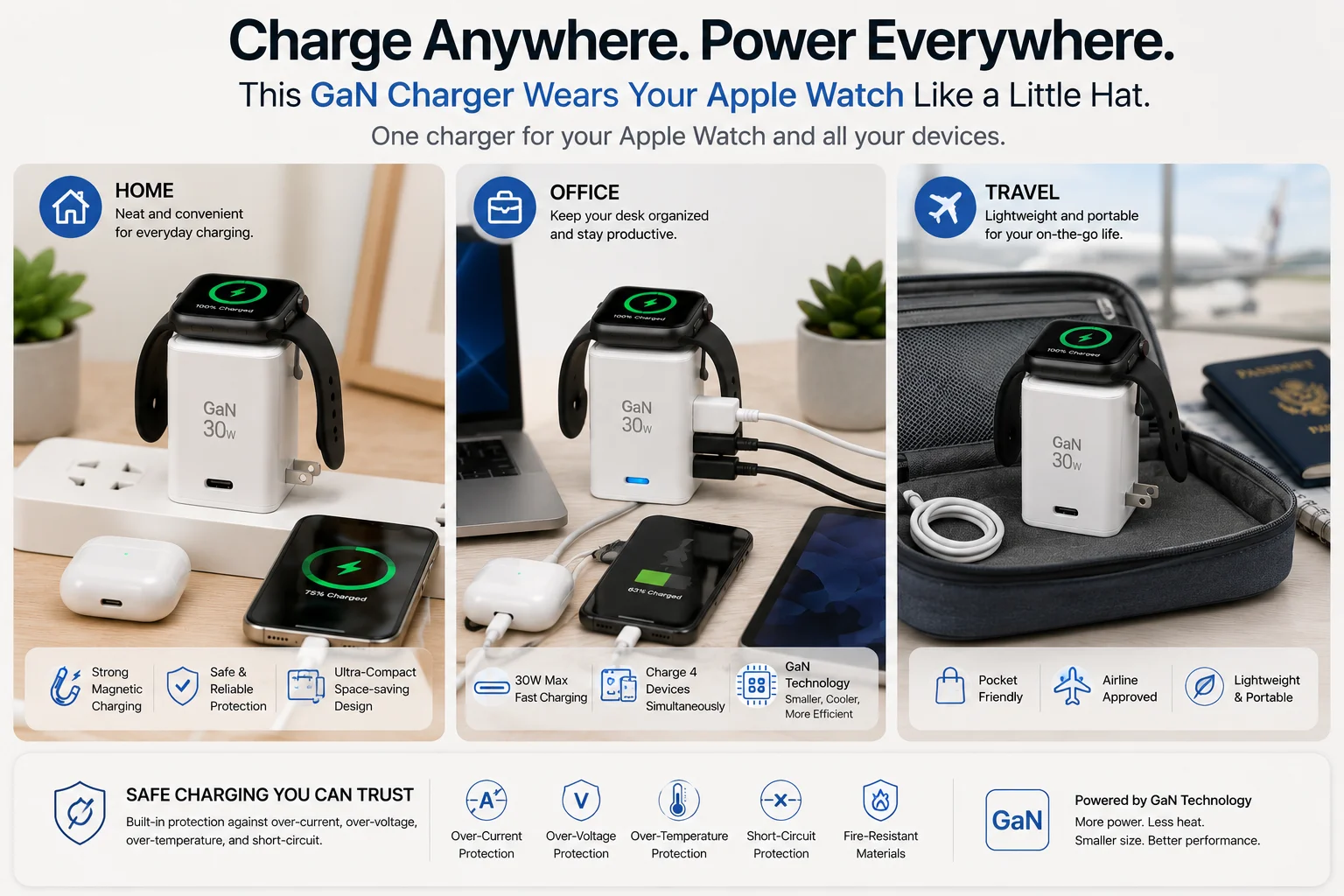
This charger works well at home, in the office, and during travel because it combines a compact wall charger with an Apple Watch charging area. Users can keep one setup instead of using different chargers in different places.
I test the use case by location
At home, the biggest value is a cleaner bedside or desk setup. Many Apple Watch users charge their watch at night. They do not want another cable hanging down the back of the table. A top magnetic charging area helps the watch stay visible. It also gives the user a clear charging spot.
In the office, the charger works as a small charging station. The user can charge a phone during work and keep the Apple Watch topped up. This is useful for people who track health, messages, and meetings through the watch.
During travel, the product story becomes even stronger. Hotel rooms may have limited outlets. Business travelers may forget watch cables. A compact GaN charger with watch charging can reduce the number of items in the bag.
| Place | User Need | Product Fit |
|---|---|---|
| Home | Clean nightstand | Watch sits on top neatly |
| Office | Small desk charging | Multi-port support helps |
| Hotel | Fewer plugs and cables | One charger replaces several items |
| Airport | Fast top-up | Compact body is easy to carry |
I suggest that sellers show three scenes in product photos. I would show a bedside table, an office desk, and a travel bag. These scenes answer the buyer’s silent question. The product then feels useful, not just interesting.
Safety, Heat Control, and Stable Charging Performance?
I never ignore safety in charger products. A nice design will not help if the buyer faces returns, complaints, or compliance risk.
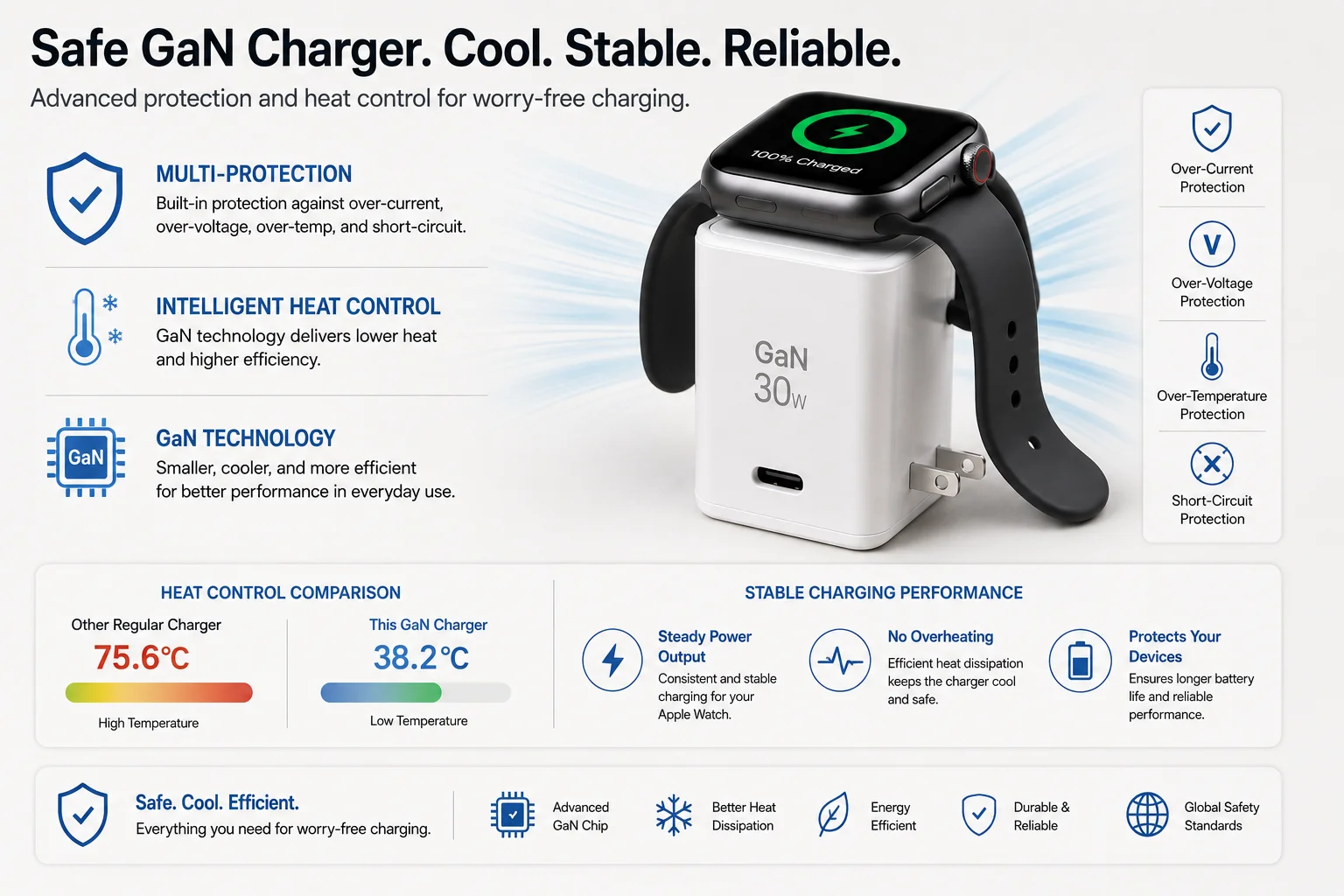
A good Apple Watch GaN charger should have stable power output, heat control, short-circuit protection, over-current protection7, and proper market certifications. Buyers should confirm test reports before ordering in bulk.
I treat safety as part of the product, not an extra point
In our Shenzhen export work, I often talk with European and US buyers about certifications before we talk about color boxes. This is normal. A charger connects to power every day. It must be safe, stable, and compliant for the market.
GaN chargers can be compact. But small size also means the heat design must be serious8. The internal layout, shell material, PCB design, transformer quality, and protection IC all matter. I am not a factory engineer, so I do not pretend to design the circuit. But I know which questions importers should ask before placing orders.
| Check Item | Why It Matters | What I Ask Supplier For |
|---|---|---|
| CE, FCC, RoHS, UKCA9 | Market access | Valid reports and certificates |
| Over-current protection | Prevents abnormal output | Protection test details |
| Over-voltage protection | Protects devices | Test records |
| Temperature rise test | Checks heat control | Lab test data |
| Burn-in test | Finds early failure | Production QC process |
| Apple Watch compatibility | Reduces returns | Model compatibility list |
I also ask buyers not to chase the lowest price only. A charger that saves a few cents can create much bigger costs later. Returns, bad reviews, and customs issues can hurt a brand fast.10 Safety work is not a sales decoration. It is part of the real cost of a stable product.
Who Should Buy This Apple Watch GaN Charger?
I do not think every customer needs this product. I think the right buyer is the one who values compact daily charging.
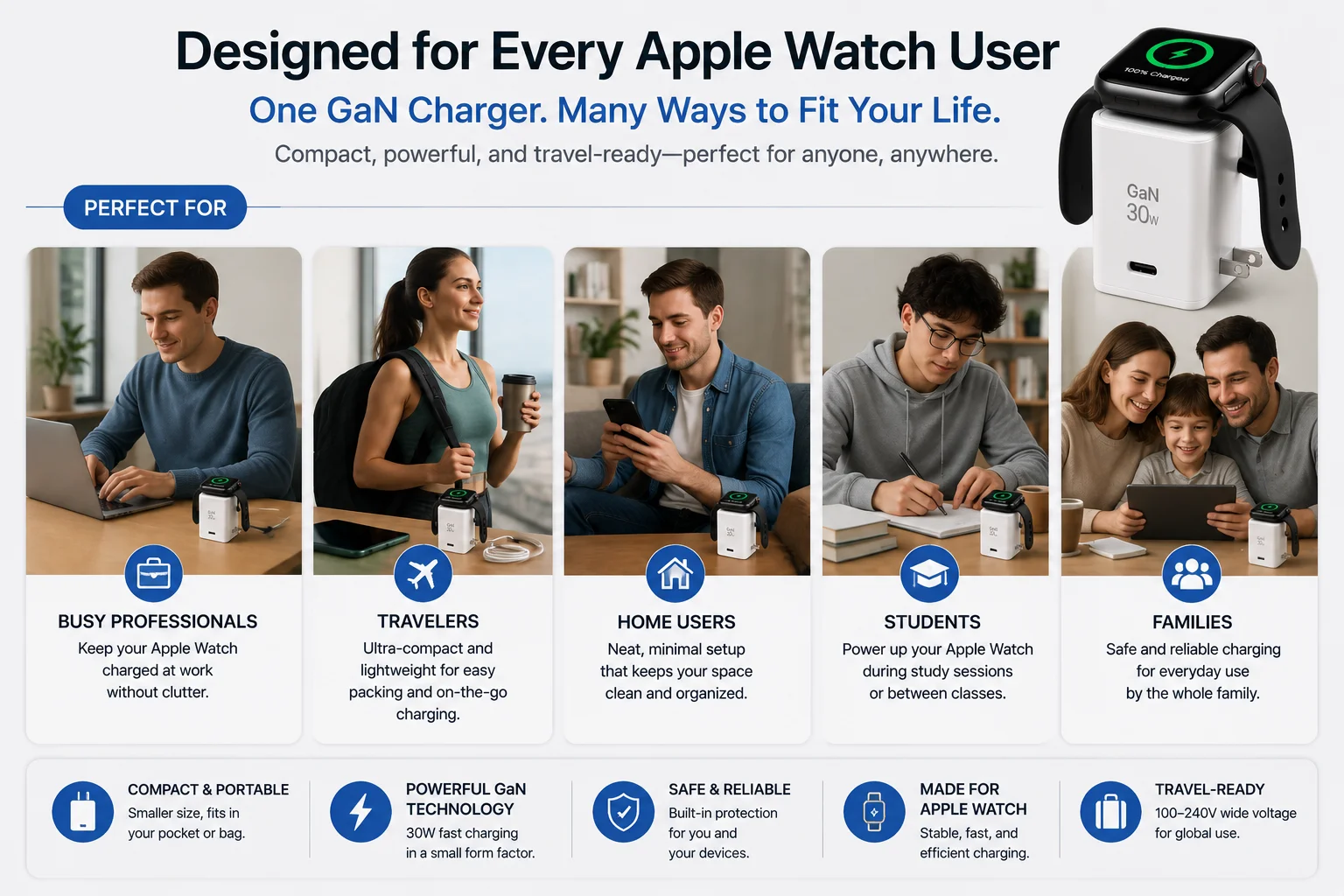
This charger is best for Apple Watch users who charge several devices, travel often, or want a cleaner desk or bedside setup. It also suits sellers who want a simple, visual, easy-to-explain 3C accessory.
I match the product to the sales channel
When a client asks me if a product is “good,” I usually ask about the sales channel first. A product can be good for Amazon but not ideal for a discount bin. A product can be good for gift stores but not for a price-only wholesale market. This charger has a clear visual feature, so it works well where photos and demos matter.
For e-commerce sellers, the “little hat” design can help the listing stand out. The main photo can show the Apple Watch on top and a phone cable plugged in. That image tells the story fast.
For retailers, the product can work well near phone accessories, Apple Watch bands, travel adapters, and smart device sections. For corporate gift buyers, it can also be interesting because it feels useful and modern.
| Buyer Type | Fit Level | Reason |
|---|---|---|
| Apple Watch daily user | High | Clear daily charging value |
| Frequent traveler | High | Fewer items to pack |
| E-commerce seller | High | Strong photo story |
| Chain retailer | Medium to high | Needs clean packaging and demo |
| Price-only wholesaler | Medium | Cost may be higher than basic chargers |
| Non-Apple Watch user | Low | Main feature is not needed |
I would not position this product as the cheapest charger. I would position it as a compact solution. That message is more honest. It also matches the reason people buy it.
What Importers Should Check Before Buying Wholesale?
I have seen importers move too fast when a product looks attractive. I think a good wholesale order starts with risk control.
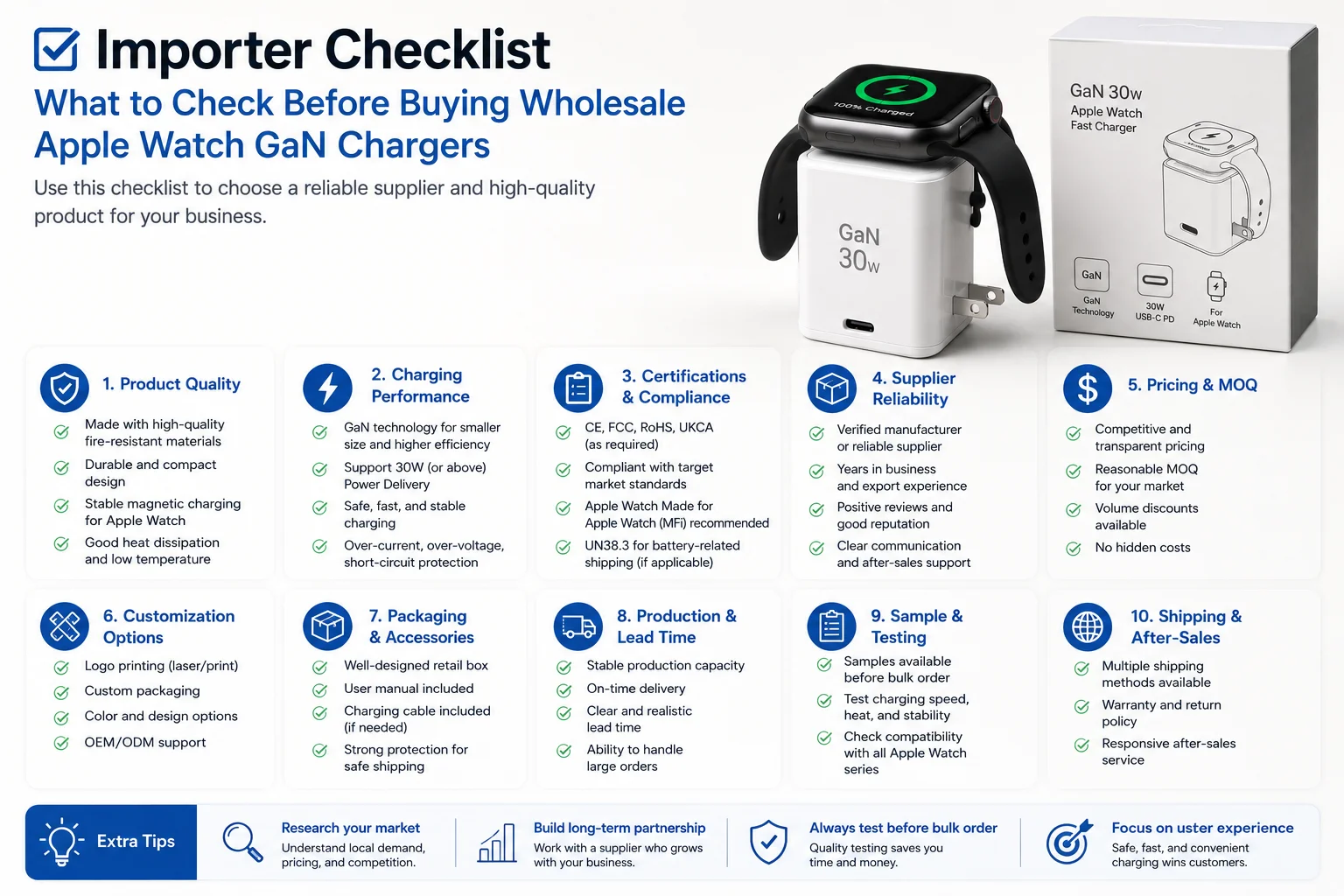
Importers should check certifications, plug types, Apple Watch compatibility, charging power, MOQ, packaging options, warranty terms, sample testing, and supplier quality control before buying this GaN charger wholesale.
I use a decision framework, not only a price list
A common question I get from first-time importers is, “What is your best price?” I understand why they ask. But I usually guide the talk back to risk. The best price is not useful if the product does not pass market rules or creates returns.
For a new seller, I often suggest a smaller first order if MOQ allows it. This is like market testing. The seller can test photos, reviews, and customer questions before making a larger brand plan. For a buyer with an existing brand, private label packaging may make more sense. But logo printing and packaging are not the whole job. The buyer also needs clear product copy, after-sales rules, and stable reorder planning.
For a larger buyer, OEM changes may be possible. But OEM means more shared work. It may include tooling, electrical design changes, certification updates, and longer lead time.11 I do not suggest OEM only because it sounds powerful. I suggest it only when the buyer has volume, budget, and technical staff.
| Buying Model | Best For | Main Gain | Main Risk |
|---|---|---|---|
| Wholesale | Market testing | Fast launch and lower MOQ | Less custom difference |
| Private Label | Brand sellers | Better brand image | More packaging and marketing work |
| OEM | Large-scale buyers | Unique design control | Higher cost and longer timeline |
I also ask importers to check plug standards. The US, EU, UK, and Australia need different plug types12. I ask them to confirm color box language, barcode needs, user manual language, and carton marks. These details look small. But they can slow down delivery if the buyer checks them too late.
Conclusion
I see this charger as a small product with a clear daily value. It saves space, reduces cables, and gives Apple Watch users a cleaner charging habit.
"Linking product design to consumer behavior: the moderating role of ...", https://pmc.ncbi.nlm.nih.gov/articles/PMC5957053/. Market analysis and consumer trend reports indicate a growing preference for minimalist aesthetics and integrated functionality in consumer electronics, where cable clutter and bulky designs can be perceived as significant drawbacks. Evidence role: general_support; source type: other. Supports: The claim that consumers are increasingly drawn to minimalist designs and that clutter, such as from cables, can be a negative factor in purchasing decisions.. Scope note: The source would likely discuss general consumer trends rather than providing specific data linking lost sales directly to messy chargers. ↩
"Spendception: The Psychological Impact of Digital Payments on ...", https://pmc.ncbi.nlm.nih.gov/articles/PMC11939284/. Research in human-computer interaction and industrial design suggests that users value products that not only perform a function but also contribute positively to their environment and daily routines, for instance by reducing clutter and enhancing a sense of order. Evidence role: general_support; source type: education. Supports: The claim that user purchasing decisions for everyday objects are influenced by factors beyond pure utility, including aesthetics, organization, and the emotional response to a product's design.. ↩
"Gallium nitride - Wikipedia", https://en.wikipedia.org/wiki/Gallium_nitride. Gallium nitride (GaN) is a wide-bandgap semiconductor that can sustain higher voltages and temperatures than silicon, enabling the fabrication of power devices that are more efficient and significantly more compact. Evidence role: definition; source type: encyclopedia. Supports: The claim that gallium nitride is a semiconductor material that allows for the creation of smaller, more efficient, and higher-power electronic components compared to traditional silicon.. ↩
"GaN Enables Energy-Efficient Power Conversion - Stanford University", http://large.stanford.edu/courses/2024/ph240/chen-h1/. Compared to silicon, gallium nitride's superior material properties, including a higher critical electric field and greater electron mobility, allow for the design of power converters that operate at higher switching frequencies with greater efficiency, enabling a significant reduction in the size of passive components and overall device volume. Evidence role: mechanism; source type: paper. Supports: The claim that GaN's material properties, such as higher electron mobility and a wider bandgap, allow for switching at higher frequencies with lower energy loss, which in turn enables the use of smaller passive components (like transformers and capacitors) and results in a more compact overall design compared to silicon.. ↩
"[PDF] A Manufacturing Cost and Supply Chain Analysis of SiC Power ...", https://docs.nlr.gov/docs/fy17osti/67694.pdf. In power electronics design, increasing the power output within a compact form factor necessitates more sophisticated thermal management solutions to dissipate heat, often requiring higher-grade components and more extensive safety testing to mitigate risks, all of which contribute to higher manufacturing costs. Evidence role: mechanism; source type: research. Supports: The claim that increasing power density in electronics correlates with challenges in thermal management, component cost, and the complexity of meeting safety standards.. ↩
"Why do people complain so much at hotels? : r/marriott - Reddit", https://www.reddit.com/r/marriott/comments/1d6b507/why_do_people_complain_so_much_at_hotels/. Surveys and reports within the travel and hospitality industry frequently identify the lack of sufficient electrical outlets as a common complaint among hotel guests, particularly for modern travelers who carry multiple electronic devices. Evidence role: case_reference; source type: other. Supports: The claim that a lack of sufficient and conveniently located power outlets is a frequent issue for guests in hotels.. ↩
"Short circuit - Wikipedia", https://en.wikipedia.org/wiki/Short_circuit. Safety standards for information and communication technology equipment, such as those outlined by the International Electrotechnical Commission (IEC), mandate protective circuits like over-current protection (OCP) and short-circuit protection (SCP) to prevent hazards like overheating and fire by interrupting power during fault conditions. Evidence role: definition; source type: government. Supports: The definition and importance of over-current and short-circuit protection as standard safety features in consumer electronics power supplies.. ↩
"A 20-Year Retrospective on Power and Thermal Modeling ... - arXiv", https://arxiv.org/html/2508.05495v1. As the power density of electronic converters increases, thermal management becomes a primary design challenge; the heat generated by components in a confined space must be effectively dissipated to ensure device safety, reliability, and performance. Evidence role: mechanism; source type: research. Supports: The claim that achieving high power density in compact chargers creates significant thermal management challenges, as the heat generated in a smaller volume is more difficult to dissipate.. ↩
"EU - Import Requirements and Documentation", https://www.trade.gov/country-commercial-guides/eu-import-requirements-and-documentation. These marks signify compliance with regional regulations: FCC (Federal Communications Commission) for the U.S., CE (Conformité Européenne) for the European Economic Area, UKCA (UK Conformity Assessed) for Great Britain, and RoHS (Restriction of Hazardous Substances) which is enforced in many jurisdictions including the EU and UK. Evidence role: definition; source type: government. Supports: The definitions of CE, FCC, RoHS, and UKCA as regulatory marks required for selling electronic products in specific markets (EU, US, UK).. ↩
""Brand Reputation and Product Recall" by Anne Meike Eilert", https://scholarcommons.sc.edu/etd/453/. Business and supply chain analyses demonstrate that the 'cost of poor quality' (COPQ) often outweighs initial savings from low-cost sourcing, encompassing tangible expenses like returns and recalls, as well as intangible costs such as damage to brand reputation and loss of customer trust. Evidence role: general_support; source type: other. Supports: The claim that prioritizing low unit cost over quality in sourcing can result in higher total costs due to product failures, reputational damage, and regulatory penalties.. ↩
"Original equipment manufacturer - Wikipedia", https://en.wikipedia.org/wiki/Original_equipment_manufacturer. In an Original Equipment Manufacturer (OEM) arrangement, a company designs and engineers a product to a buyer's unique specifications, a process that typically involves substantial non-recurring engineering costs, custom tooling, and a longer time-to-market compared to wholesaling or private labeling existing products. Evidence role: definition; source type: other. Supports: The definition of the OEM business model, highlighting that it often involves significant investment in development, tooling, and customization by the buyer.. ↩
"AC power plugs and sockets - Wikipedia", https://en.wikipedia.org/wiki/AC_power_plugs_and_sockets. The International Electrotechnical Commission (IEC) documents the wide variety of mains plug and socket types used globally, such as Type A/B in North America, Type C/F in much of Europe, Type G in the United Kingdom, and Type I in Australia. Evidence role: historical_context; source type: institution. Supports: The claim that different plug and socket types are used for mains electricity in various parts of the world.. ↩