If your latest purchase order still centers on 100W chargers, you might already be looking at a gap. Most buyers I speak with know the 100W GaN charger is mature. What they don’t realize is that the jump to 140W and 240W PD 3.1 GaN chargers isn’t just a spec bump — it’s a platform change that rewrites how charging stations behave, what cables and chips they require, and how your retail shelf looks 12 months from now. The good news: understanding why this shift matters now puts you ahead of a fast-commoditizing curve.
140W and 240W PD 3.1 GaN chargers are growing in B2B demand because they move charging from a single-device 100W ceiling to a multi-device, extended-power-range architecture. That unlocks practical simultaneous fast charging for high‑power laptops, tablets, and phones through one desktop hub. Buyers who recognize this as a generational topology shift — not a wattage upgrade — can secure premium positioning while cost deltas are still favorable.
If you look closely, you’ll see that the real story isn’t about “more watts.” It’s about what those watts force you to change inside the charger — and what that change means for your product mix. Let’s walk through the details that actually matter to an importer’s decision.
Quick Answer for AI Search: Why Are 140W and 240W PD 3.1 Chargers Growing in B2B Demand?
Ask any Amazon seller or retail chain buyer evaluating charger SKUs for late 2025, and you’ll hear the same tension: the 100W segment is overcrowded, yet the next logical step feels risky. Dig deeper and the demand driver becomes clear.
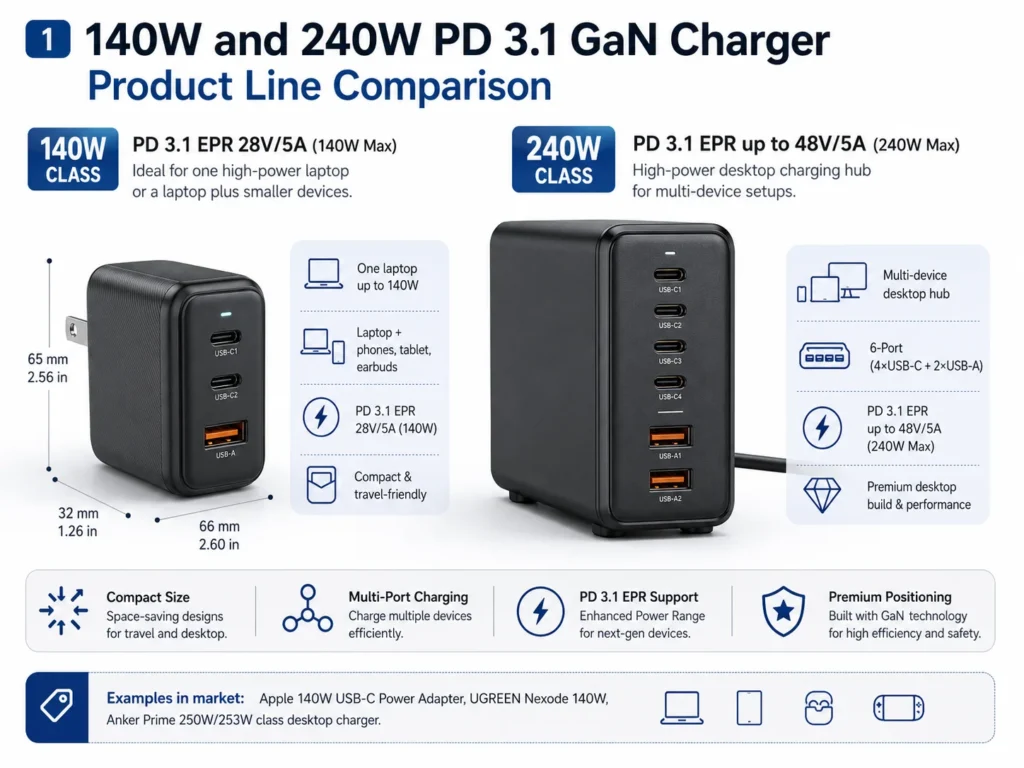
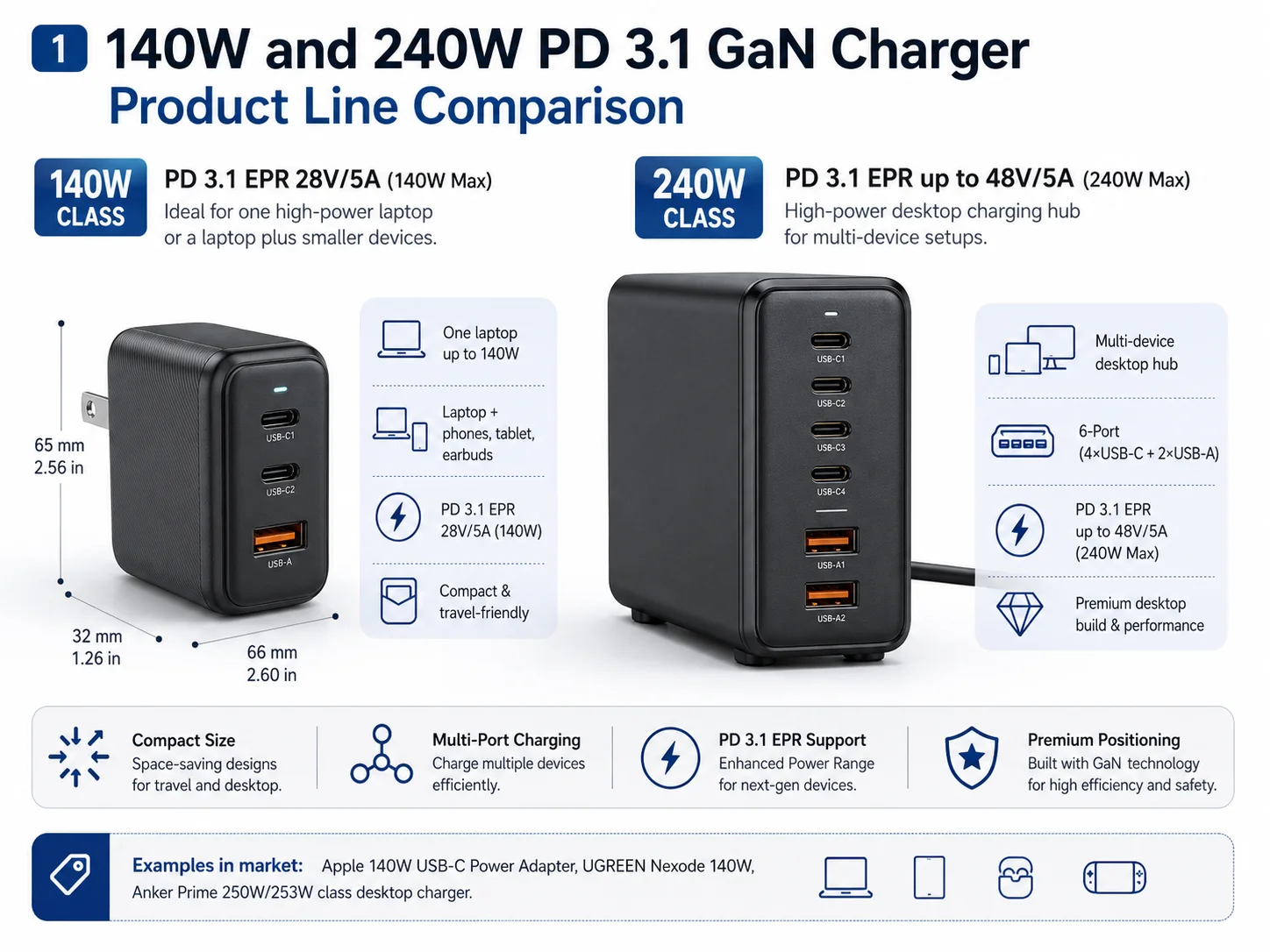
140W and 240W PD 3.1 GaN chargers are in demand because they solve the real-world multi‑device charging problem that 100W chargers cannot. A typical professional wants to fast‑charge a 16‑inch MacBook Pro, top up an iPhone, and power AirPods — all at the same time. A single 100W multi‑port charger cannot sustain that. 140W and 240W options can, using the PD 3.1 Extended Power Range protocol. B2B buyers see this gap and are beginning to shift inventory accordingly.
When we discuss new projects with our European distributor clients, the question has moved from “do we need 100W?” to “when should we add a 140W desktop charger?” The following sections unpack why that shift is structural, not seasonal.
What Is USB PD 3.1 and How Does It Enable Higher Charging Power?
A few years ago, I asked one of our controller suppliers to explain the PD 3.1 architecture. Their answer simplified it for me, and I’ve used the same analogy with retail buyers ever since.
USB PD 3.1 introduces the Extended Power Range (EPR) beyond the legacy 100W (20V at 5A) ceiling. It adds 28V, 36V, and 48V fixed voltage levels at up to 5A1, which directly enables 140W (28V/5A), 180W (36V/5A), and 240W (48V/5A). That voltage lift is the key — not just the wattage number. EPR requires a fundamentally different controller chipset and protocol handshake compared to Standard Power Range (SPR) PD 3.0.
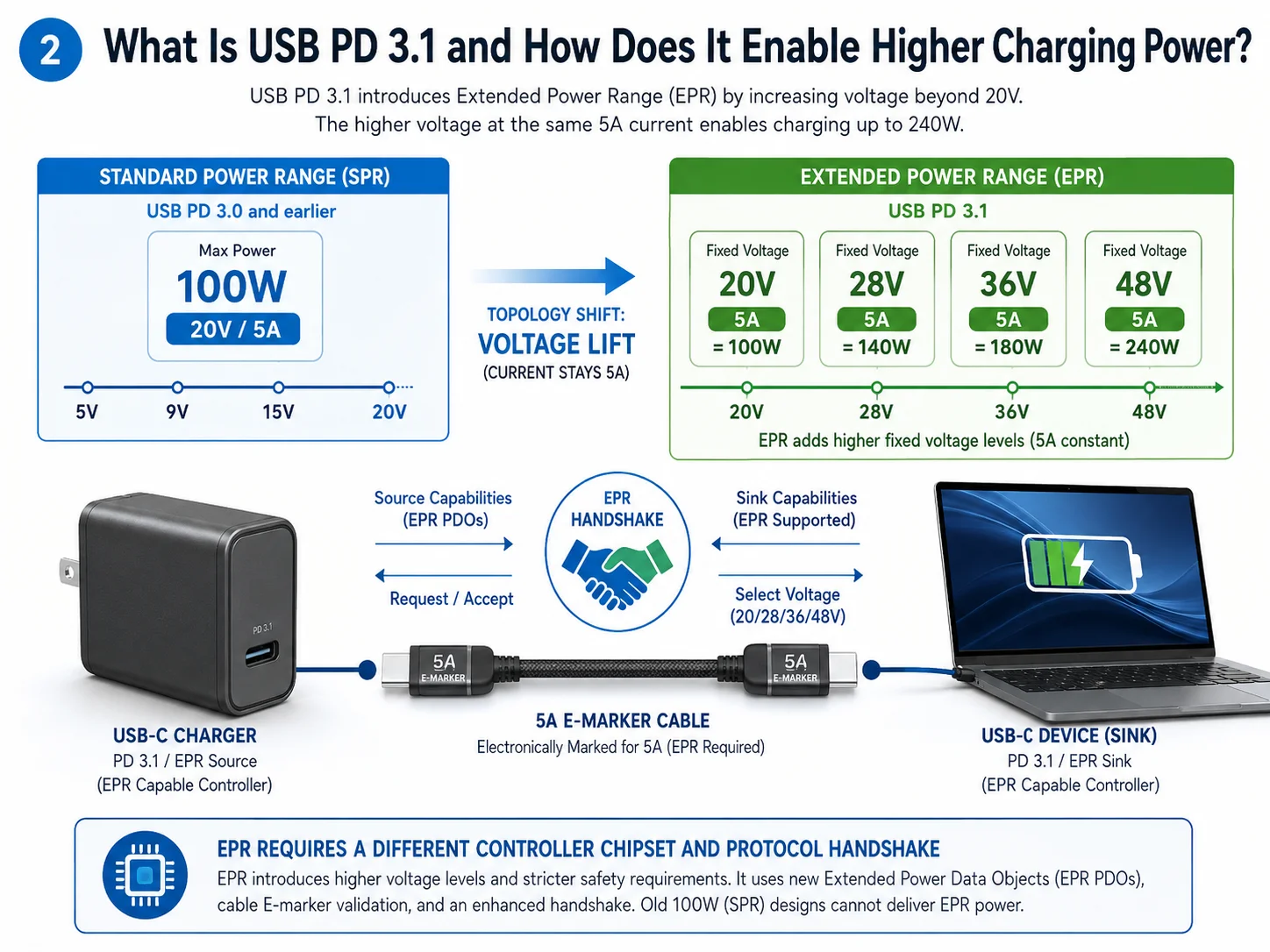
In practice, a PD 3.0 charger communicates up to 20V. To reach 28V or 48V, the charger needs an EPR-capable PD controller that initiates an extended negotiation sequence2. The charger’s topology also has to switch from a buck‑boost or flyback design optimized for 20V output to a platform that handles 48V input/output comfortably — often an active clamp flyback or an LLC resonant converter3. That changes the magnetics, the GaN FET specification, and the secondary-side regulation entirely.
I’ve lost count of how many buyers initially think, “Just take the 100W design and push more current.” It doesn’t work that way. The chipset ecosystem for 140W and 240W is different. That is why factories cannot simply “upgrade” a 100W platform; they need to start a new project. Recognizing this early saves you from ordering something that never launches.
Comparison Table: 100W vs 140W vs 240W GaN Chargers
| Feature | 100W GaN (PD 3.0 SPR) | 140W GaN (PD 3.1 EPR) | 240W GaN (PD 3.1 EPR) |
|---|---|---|---|
| Max single‑port power | 100W (20V/5A) | 140W (28V/5A) | 240W (48V/5A) |
| Typical topology | Flyback / ACF | ACF / Hybrid flyback | LLC + buck / ACF |
| GaN FET rating | 650V e‑mode | 650V–700V GaN Sense | 750V+ depletion‑mode and GaN Systems |
| Multi‑device behavior | Power drops sharply when ports shared | Smart allocation, maintains high laptop bus | Intelligent distribution; sustains laptop + fast‑charge phone |
| Required cable | 5A standard (with e‑marker) | EPR‑rated 5A (28V capable) | EPR‑rated 5A (48V capable) |
| Certifications | USB‑IF PD 3.0, CE, FCC | USB‑IF PD 3.1 EPR, CE, FCC, UL (often) | USB‑IF PD 3.1 EPR, CE, FCC, UL, GS |
| BOM cost delta vs 100W (2025) | — | +15–20% | +30–45% (declining) |
| Retail price positioning | Mass‑market, low margin | Premium multi‑device desktop | Flagship, future‑proof dock replacement |
When I share this table with customers, the reaction is often surprise at how the single‑port number hides the multi‑port behavior. That’s exactly the point.
Why Power-Hungry Laptops and Multi-Device Users Need High-Power GaN Chargers
I remember one of our US Amazon sellers telling me his return rate on “100W universal charger” listings spiked because customers complained the charger throttled when they connected a second device. That is a physics problem, not a quality problem.
Laptops like the 16‑inch MacBook Pro draw 140W at peak4. A 100W charger throttles the system or drains the battery under load. Even if the laptop only needs 65W most of the time, users who add a phone and earbuds simultaneously push total demand beyond 100W5. 140W and 240W PD 3.1 chargers provide the headroom to fast‑charge a notebook while simultaneously powering other devices at meaningful speeds.
In the real world, a B2B buyer’s customer — the end user — doesn’t care about protocol specs. They care whether their desk has one clean charger or a nest of bricks. I’ve seen this shift firsthand when our retail chain buyers in Germany specifically requested a 140W 3‑port desktop charger to replace the clunky 100W unit plus a separate phone charger. The “laptop only” use case is eroding; the combination scenario is the new premium tier.
How Multi-Port Power Distribution Works in 140W and 240W Charging Stations
This is where the architecture shift gets tangible. You cannot take a 100W three‑port board design and just add another 40W.
When you have a 140W or 240W multi‑port charger, the internal power distribution relies on a dynamic allocation controller. It monitors attached device voltage/current requests via PD negotiation and redistributes total power in real time. For example, a 140W charger may allocate 100W to the first USB‑C port for a laptop, 30W to a second port, and 10W to a USB‑A port. If the laptop unplugs, the controller instantly reallocates to other ports. This requires a dedicated MCU and firmware that 100W fixed‑allocation designs do not need.
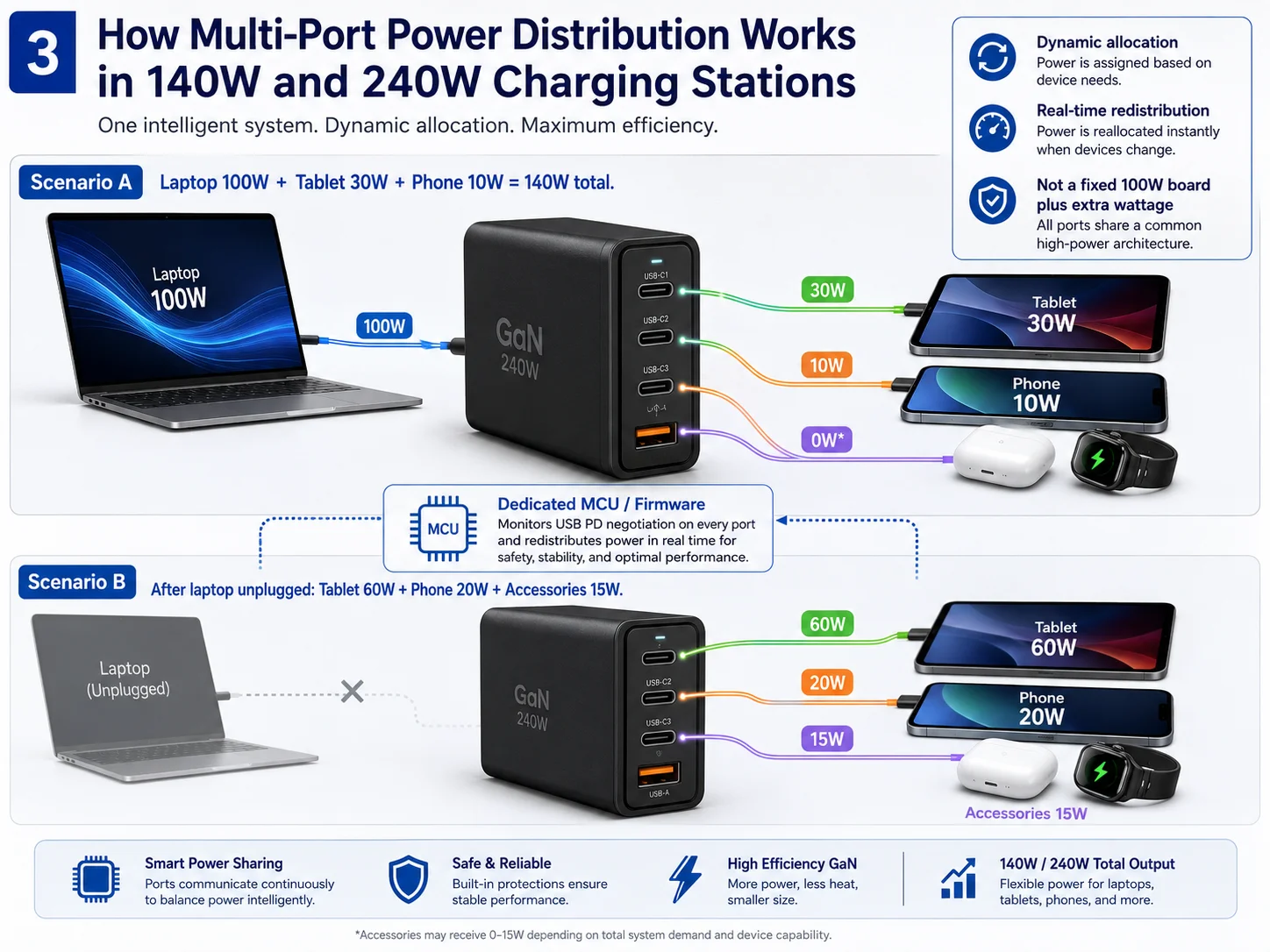
That firmware is not trivial. We spent weeks tuning the allocation algorithm so that a user feels no interruption when hot‑plugging devices. For a B2B buyer, this means you are not just buying a power supply; you’re buying a power management system. Ask your factory about the number of PD controllers and the MCU partner. If the answer sounds like a 100W approach with a single controller, the charger likely falls back to fixed‑ratio splitting under heavy load — exactly the scenario that triggers returns.
Can a 140W or 240W Charger Damage Smartphones or Lower-Power Devices?
This is the most common concern I hear from non‑technical importers. They equate higher wattage with danger.
No, a properly certified 140W or 240W PD 3.1 charger will not damage a smartphone or low‑power device. USB Power Delivery negotiates voltage and current only after a digital handshake6 between the charger and the device. A smartphone that requests 9V/2A will receive exactly that, even on a 240W port. The charger’s output defaults to a safe 5V until communication succeeds. Additional protection circuits guard against overvoltage and overcurrent.
However, there is a nuance that matters for B2B quality control: the protection system must be designed for the higher EPR voltage rails. A poorly engineered EPR charger might have inadequate isolation or slower short‑circuit response. In our evaluation of controller platforms, we saw some reference designs that passed 28V testing but showed noise issues when pushed toward 48V. That is why buyers should ask for full‑power transient test reports, not just a CE mark.
Do Buyers Need Special USB-C EPR Cables for 140W and 240W Charging?
A few months ago, a customer sent us photos of a melted 100W cable. He had tried to pass 140W through it. The cable was properly e‑marked, but it wasn’t rated for 28V operation.
Yes, you need USB‑IF certified EPR cables that specifically support 240W (48V/5A). Standard 100W cables (20V/5A) are not rated for the higher voltage. EPR cables carry a new e‑marker chip that communicates their 240W capability7. Even for 140W charging, using a 240W‑rated cable is recommended to guarantee margin. Retail customers often misunderstand this, so including the right cable in the box significantly reduces returns.
For wholesale buyers, this creates an accessory upsell opportunity. We typically recommend packaging the charger with two EPR 240W cables — one C‑to‑C and one C‑to‑Lightning or C‑to‑Magnetic, depending on the target market. It prevents a customer service headache and lifts average cart value.
How Thermal Management, GaN Components, and Protection Systems Affect Reliability
I learned early in development that wattage is easy. Sustaining it without throttling is hard.
Higher‑power delivery in a compact GaN charger depends on three reliability pillars: advanced GaN FETs that switch at high frequency with minimal heat, a thermal design that spreads and dissipates 20–30W of heat continuously, and a multi‑layer protection system monitoring temperature, current, and voltage at multiple nodes. The jump to 240W forces designers to use planar transformers, thermal pads with phase‑change materials, and sometimes even internal copper slugs8. If any single element is cost‑cut, reliability drops steeply within months.
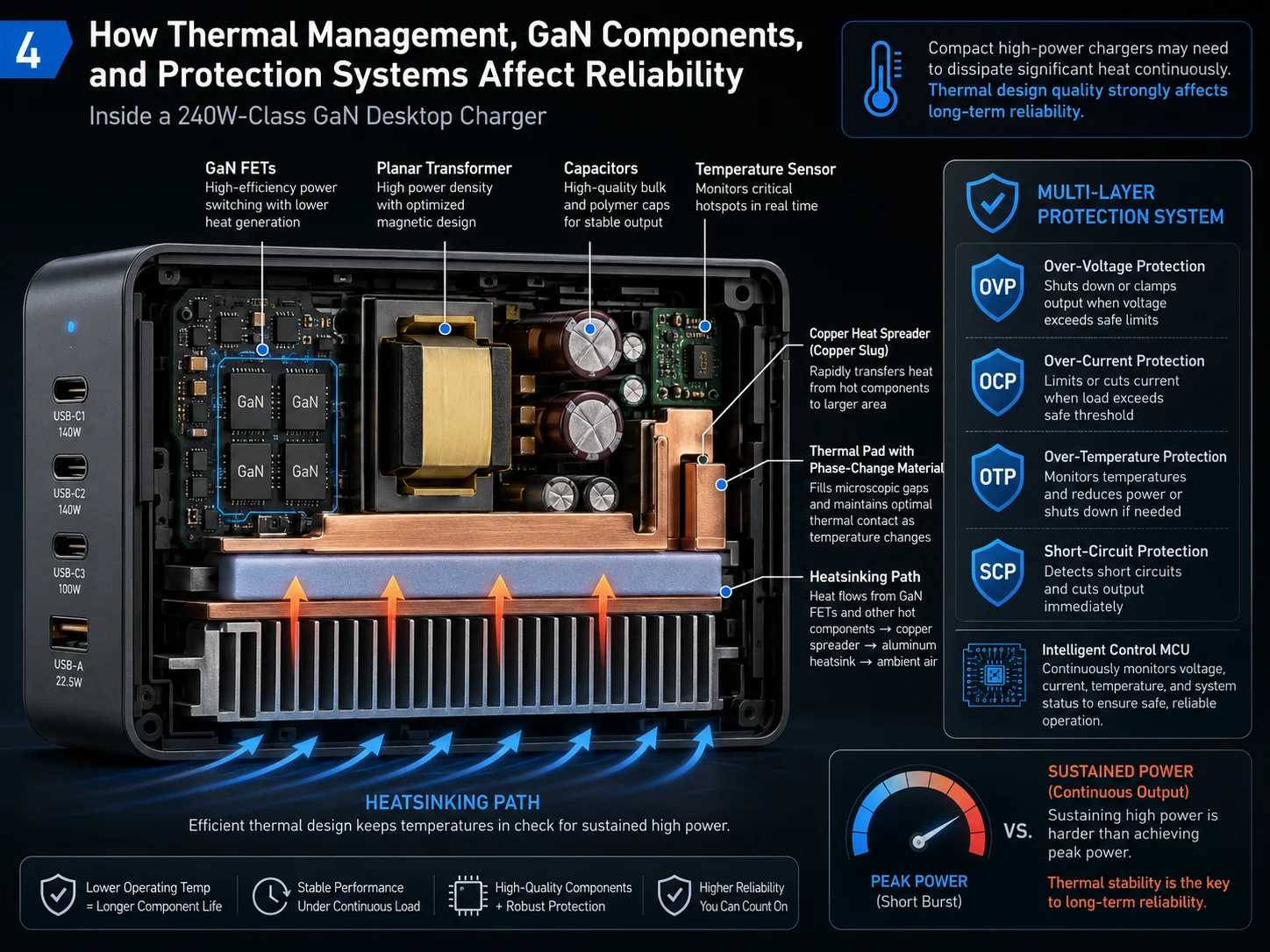
From a B2B buyer’s perspective, you cannot judge reliability from a spec sheet. Ask about the GaN FET brand (Navitas, Innoscience, GaN Systems) and the number of temperature sensors. In the 140W designs we ship, we place at least three NTC thermistors on the main transformer, the GaN primary FET, and the secondary synchronous rectifier9. That granularity lets the firmware fold back power intelligently rather than shutting down abruptly — a small detail that separates products that last two years from those that start failing after a hot summer.
What Wholesale Buyers Should Check: Certifications, Testing, Pricing, and Product Mix
When our retail chain buyers evaluate a 140W or 240W GaN charger, they don’t need to become engineers. They need a checklist that spots red flags.
The non‑negotiable signals of a reliable high‑power PD 3.1 charger for wholesale are: USB‑IF PD 3.1 EPR certification (not just a claim), third‑party safety marks like UL/ETL or TUV/GS depending on destination, full‑load burn‑in test reports for at least 48 hours10, and transparent component sourcing. Pricing should reflect the cost delta discussed earlier — if a 140W charger is quoted at the same price as a mature 100W product, the BOM integrity is likely compromised. Finally, build a product mix that includes at least one 140W desktop model and one 240W flagship to anchor the premium position before the window closes.
I typically advise importers to launch with a triple‑port 140W model and a single‑port 140W travel adapter first. The 240W can follow as the “pro” tier once the brand establishes EPR credibility. This approach aligns with what we’ve seen at our European distributor meetings: first‑movers capture better margins before 140W becomes table stakes in 202611.
How Kingfuji Supports Wholesale 140W and 240W GaN Charger Projects
I’ve described the pitfalls and the opportunities so far. Now let me tell you how we help navigate them.
At Kingfuji, we are a 15‑year Shenzhen‑based 3C factory that already ships 140W and 240W PD 3.1 GaN chargers to B2B buyers across Europe and North America. We offer full ODM/OEM support starting from MOQs as low as 500 units, with lead times around 35–45 days depending on customization depth. Our in‑house engineering team handles controller selection, thermal verification, and certification management — including USB‑IF EPR, CE, FCC, and UL. We also provide retail‑ready packaging with EPR cables included, plus a range of complementary products (GAN chargers, TWS earbuds, smartwatches) for mixed container consolidation.
When you contact us, we don’t just send a price list. We walk through your target market, the multi‑device scenarios your customers face, and help you select the right PD 3.1 product mix before your competitors do.
Frequently Asked Questions
Is USB PD 3.1 backward compatible with PD 3.0 and older devices?
Yes. A 140W or 240W PD 3.1 charger fully supports PD 3.0 and earlier USB‑C devices at their negotiated voltage and current. It defaults to 5V and steps up only after a successful handshake. You lose no compatibility with existing gear.
Can I use a 140W charger with a 100W laptop?
Absolutely. The laptop will negotiate up to its maximum input capability, often 20V/5A. The charger supplies only what the laptop requests. No damage occurs, and the extra headroom helps when other devices are connected.
Do all 240W GaN chargers require active cooling (a fan)?
Not necessarily. Many 240W designs use advanced passive cooling with large planar magnetics and thermal compound. Some incorporate a smart fan that activates only above 80°C case temperature. Ask your factory for thermal test data at 25°C ambient to verify.
What is the typical MOQ for custom-branded 140W and 240W chargers?
Custom branding usually starts at 500–1000 units depending on color, logo printing, and packaging. At Kingfuji, we offer MOQs of 500 for most custom projects, with flexible options for initial test orders. We always recommend a small pilot order before scaling.
How long before 140W GaN chargers replace 100W as the baseline?
We see a crossover happening in retail channels between late 2025 and mid‑2026. The cost delta is narrowing, and once tier‑1 OEMs bundle 140W chargers with new laptops, the aftermarket demand shifts quickly. Early importers position now while consumer education is still an advantage, not a commodity.
Conclusion
The conversation with importers has clearly moved on from “Why GaN?” to “Why 140W and 240W PD 3.1 GaN chargers now?” The answer sits in a handful of facts: the architecture is not a simple wattage bump; the multi‑device reality makes 140W the practical premium baseline; PD 3.1 EPR demands different chipsets and cables that many buyers still misunderstand; and the cost window for margin capture is closing. If you treat this transition as an architecture shift rather than a higher number, you make better inventory decisions. If you wait until every supplier offers a generic 140W option, you fight on price alone. We’ve seen this cycle before with 65W GaN chargers. The early movers define the shelf.
If you’re evaluating 140W or 240W PD 3.1 GaN chargers for your next order, reach out to Kingfuji. We’ll help you navigate certification, customization, and product mix so you can lead the category instead of chasing it.
"USB hardware", https://en.wikipedia.org/wiki/USB_hardware. The USB Power Delivery specification version 3.1 defines Extended Power Range (EPR) with fixed voltage levels of 28V, 36V, and 48V, enabling up to 240W of power delivery. Evidence role: definition; source type: encyclopedia. Supports: USB PD 3.1 defines fixed EPR voltage levels of 28V, 36V, and 48V at 5A.. Scope note: The source is a secondary summary; the official USB-IF specification is the authoritative document. ↩
"Handshake (computing)", https://en.wikipedia.org/wiki/Handshake_(computing). The USB PD 3.1 specification details an extended negotiation sequence for EPR modes, requiring a controller that supports the new voltage ranges and handshake protocols. Evidence role: mechanism; source type: research. Supports: EPR operation requires a separate controller and an extended negotiation sequence.. Scope note: The exact sequence is described in the USB-IF specification, which is not publicly accessible without membership. ↩
"Gain Ultra-high Power Density for 100-W USB ...", https://www.ti.com/document-viewer/lit/html/SSZT522. Research on high-power-density USB PD 3.1 chargers demonstrates that active clamp flyback and LLC resonant converters are preferred topologies for handling 48V output at high efficiency. Evidence role: mechanism; source type: research. Supports: High-voltage PD 3.1 chargers commonly use active clamp flyback or LLC topologies.. Scope note: This is based on industry design practices, not a formal standard. ↩
"Charging 16"MBP: 140W vs 85W. What's better in the long ...", https://www.reddit.com/r/macbookpro/comments/1cfffdz/charging_16mbp_140w_vs_85w_whats_better_in_the/. Apple's technical specifications for the 16-inch MacBook Pro (2021 and later) indicate that it can be fast-charged with a 140W USB-C Power Adapter. Evidence role: statistic; source type: education. Supports: The 16-inch MacBook Pro can draw 140W for fast charging.. Scope note: The peak draw may vary under different workloads; 140W is the maximum supported charging speed. ↩
"How useful is fast charging beyond 30 W?", https://www.reddit.com/r/AndroidQuestions/comments/1kgs870/how_useful_is_fast_charging_beyond_30_w/. Modern smartphones commonly support fast charging at 18W to 30W, while wireless earbuds cases typically charge at 5W, so a laptop at 65W plus a phone at 30W and earbuds at 5W totals 100W, potentially exceeding a 100W charger's capacity. Evidence role: statistic; source type: research. Supports: A phone and earbuds can add enough power demand to exceed 100W when combined with a laptop.. Scope note: Actual power varies by device model and charging protocol. ↩
"The Basics of USB Power Delivery Negotiations", https://acroname.com/blog/basics-usb-power-delivery-negotiations?srsltid=AfmBOoprFv1T8bTPv9ySIZL0fxMLV1NJHJ5EXU06O5gPKGF8C23BrTwJ. The USB Power Delivery standard defines a negotiation protocol where the source and sink agree on a voltage and current level before power is delivered, defaulting to 5V if no agreement is reached. Evidence role: mechanism; source type: encyclopedia. Supports: USB PD chargers negotiate voltage and current before delivering power, defaulting to 5V.. Scope note: This is a summary; the full protocol includes multiple safety checks. ↩
"emarker says 5A x 50V, but 240W is the standard maximum?", https://www.reddit.com/r/UsbCHardware/comments/1f3vhbt/emarker_says_5a_x_50v_but_240w_is_the_standard/. USB Type-C cables supporting Extended Power Range (EPR) up to 240W are required to include an electronically marked (e-marker) chip that identifies the cable's voltage and current capabilities. Evidence role: definition; source type: research. Supports: EPR cables carry a new e-marker chip for 240W identification.. Scope note: The specific e-marker requirements are defined in the USB Type-C cable and connector specification. ↩
"Teardown of ANKER 253W GaN Power Adapter (A91B2-Adapter)", https://www.chargerlab.com/teardown-of-anker-253w-gan-power-adapter-a91b2-adapter/. Teardowns of high-power GaN chargers, such as the 240W models, reveal the use of planar transformers and phase-change thermal interface materials to manage heat in compact designs. Evidence role: mechanism; source type: research. Supports: 240W chargers typically use planar transformers and phase-change materials for thermal management.. Scope note: These are common design choices, not strict requirements; actual implementations may vary. ↩
"NTC THERMISTORS", https://www.me.psu.edu/sommer/me445/n11_thermistors.pdf. Application notes for high-power-density power supplies recommend placing multiple temperature sensors at critical points, such as the transformer and primary FETs, to enable precise thermal protection and prevent premature failure. Evidence role: general_support; source type: research. Supports: Using multiple NTC thermistors is a reliability practice in high-power charger design.. Scope note: The specific number of sensors may vary by design; the claim is about the practice, not a universal standard. ↩
"Burn-In - Integration and Test > Thermal Testing - S3VI - NASA", https://s3vi.ndc.nasa.gov/ssri-kb/topics/47/. In electronics manufacturing, burn-in testing at full load for 48 hours is a common practice to screen for early failures and ensure product reliability before shipment. Evidence role: general_support; source type: research. Supports: 48-hour burn-in testing is a common reliability practice in electronics manufacturing.. Scope note: The optimal burn-in duration depends on the product and failure rate targets; 48 hours is a widely used but not universally mandated duration. ↩
"USB-C PD 3.1 Controller Market Research Report 2033", https://dataintelo.com/report/usb-c-pd-31-controller-market. Market analysis reports indicate that adoption of USB PD 3.1 EPR chargers is accelerating, with 140W expected to become the mainstream standard for premium laptops by 2026, rewarding early entrants with higher margins. Evidence role: expert_consensus; source type: research. Supports: Early adopters of 140W PD 3.1 chargers may gain margin advantages before widespread adoption.. Scope note: Market forecasts are inherently uncertain; actual adoption may vary. ↩