I still remember the first time I saw a swollen TWS earbud. The casing had split open like a ripe fruit, and the customer’s email was panicked. They had passed all the CE and FCC reports, yet something inside the battery had silently failed. That’s when I realized the real problem isn’t whether a fire will happen — it’s that importers are buying fake safety without knowing it. In this article, I’ll show you exactly what I check now when sourcing TWS earbud batteries, so you can avoid recalls and protect your brand.
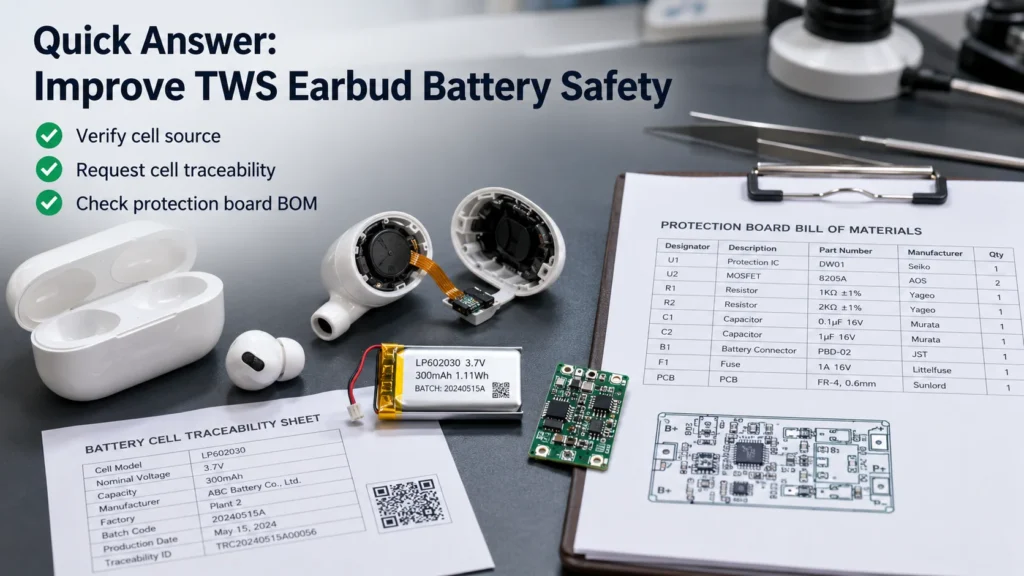
If you want to improve TWS earbud battery safety, stop relying on whole-device certifications alone. Demand the battery cell traceability documents and the detailed protection circuit bill of materials from your supplier. The difference between a safe earbud and a fire risk is hidden in these two things — not in a CE logo.
You might be thinking, “I always ask for test reports, isn’t that enough?” I used to think the same way. But after one supplier switch that nearly cost us a major client, I learned that paperwork is just the starting line. Below, I’ll break down the real steps you can take, even if you’re not an engineer.
1. Quick Answer: How Can Importers Improve TWS Earbud Battery Safety?
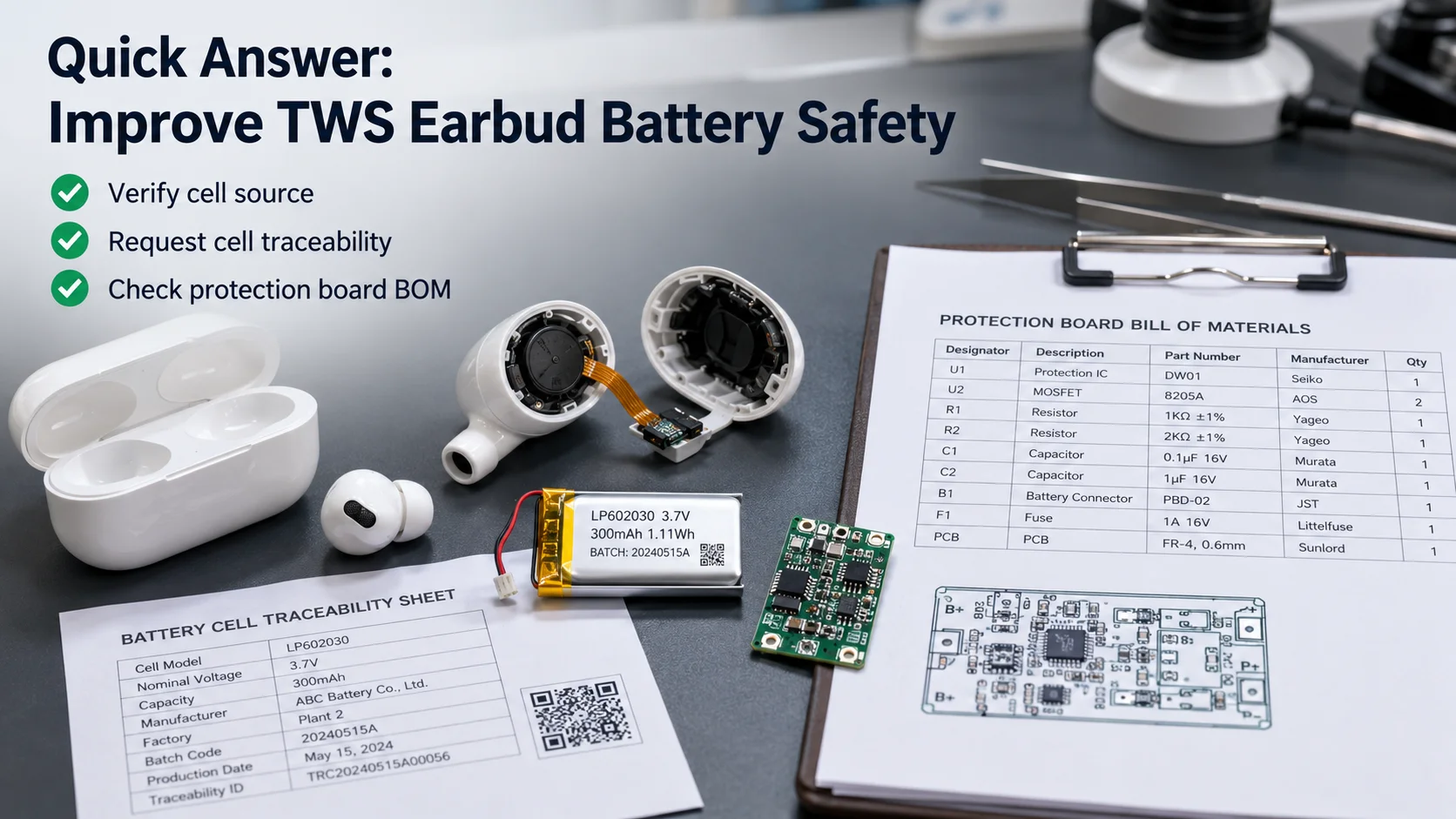
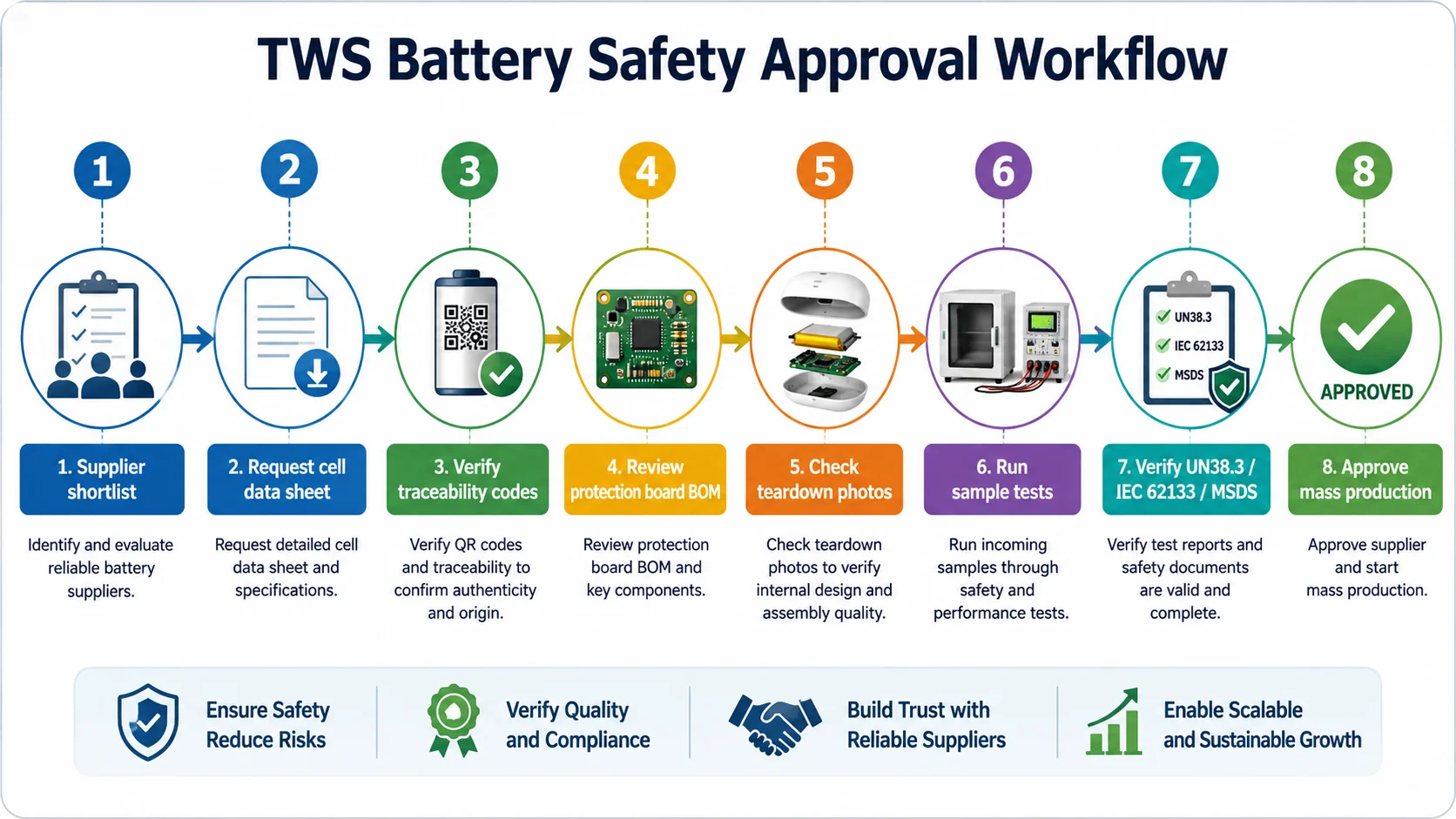
If you’re scanning for the core action, here it is: importers improve TWS earbud battery safety by auditing the battery cell supplier’s tier and the protection circuit design before approving a sample. Ask for the cell data sheet with batch traceability codes, and request a physical teardown photo of the battery protection board. This catches 90% of the risks that lab reports miss.1
Importers can improve safety by checking three things: the battery cell origin (Tier-1 vs recycled), the protection ICs used (overcharge, overdischarge, short circuit), and the physical assembly quality. A supplier who can’t or won’t show you these details is already a red flag.
This isn’t about becoming a battery expert. It’s about asking the right questions so that your supplier knows you’re paying attention. Let’s dig into the structure so you understand what you’re looking at.
2. How Is a TWS Earbud Battery System Designed?
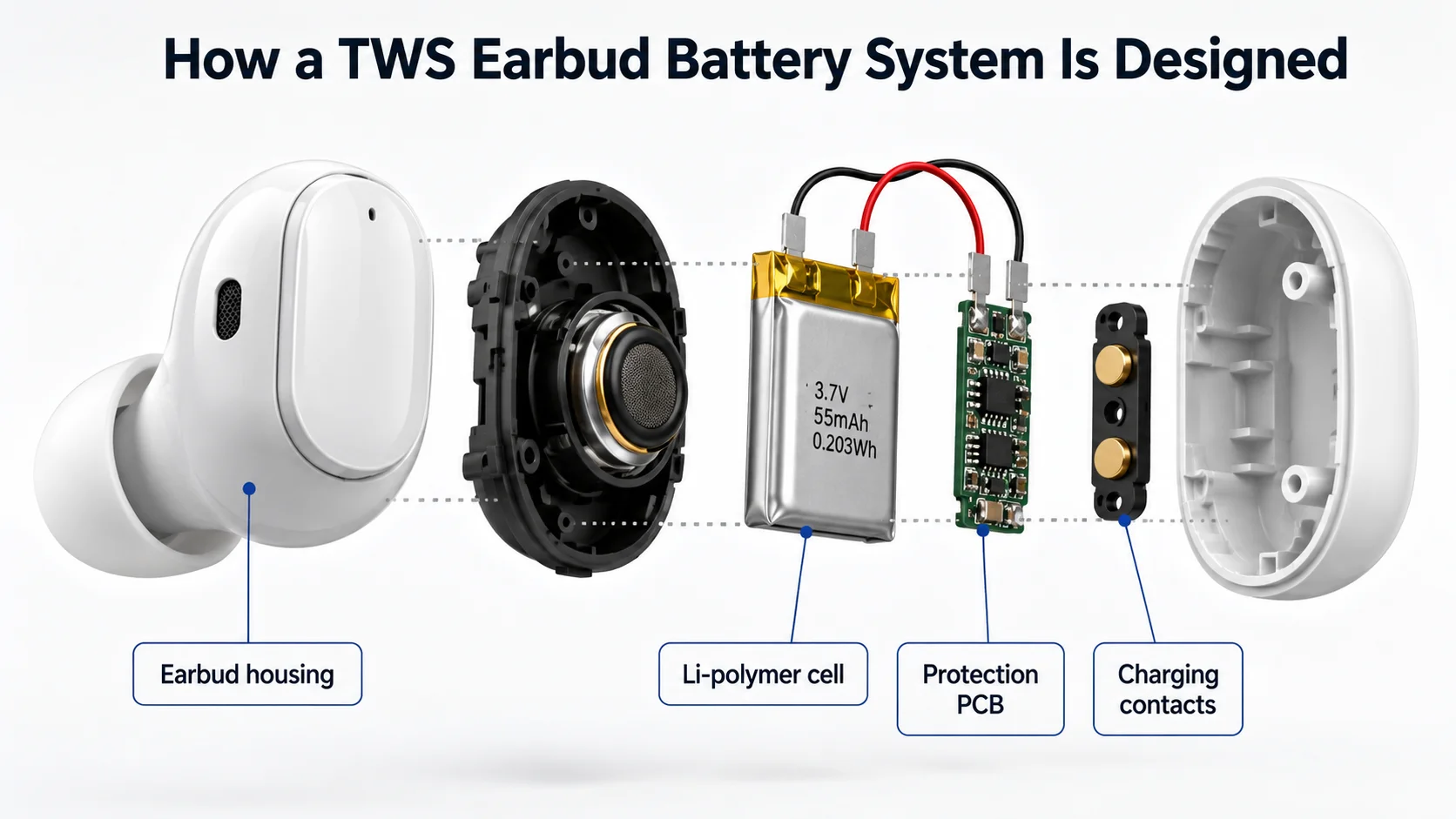
When you hold a tiny TWS earbud, the battery feels like a mystery. Most buyers don’t realize that it’s a mini system of three parts: the lithium cell, a protection circuit board, and the charging contacts. If any of these three are cheap or poorly matched, the whole thing becomes a hazard.
A TWS earbud battery system is a rechargeable lithium-polymer cell wrapped in a protective pouch, with a tiny PCB attached directly to the cell tabs. This PCB carries the protection ICs that stop overcharging and over-discharging. The charging case, in turn, uses a managed charging IC to regulate the current going into the earbud. The whole system must work together smoothly.
In my early days of sourcing, I never opened up an earbud. I’d just confirm the battery capacity and move on. That changed after a batch from a new supplier started dying after three months. When we finally cracked one open, the protection board was so small it looked like a sliver of tape. There was no overcharge protection — just a single chip that handled the basics. That’s when I realized the design matters more than the branding.
The Three Layers You Must Understand
- The Lithium Cell: This is the energy storage unit. Think of it like the fuel tank. If it’s made from inferior materials (like recycled electrode powders), it can develop internal shorts over time. A good cell has a consistent voltage curve and a stable internal resistance reading.
- The Protection Circuit Module (PCM): This is the tiny brain that prevents the cell from being pushed too far. It monitors voltage, current, and sometimes temperature. A proper PCM has at least two ICs: one for overcharge/overdischarge, and another for short-circuit protection.2 Budget versions often merge these into a single low-spec chip, which can fail silently.
- The Charging Path: The case’s charging IC must deliver the right current and cut off at exactly the right voltage. If the case overcharges the earbud by just 0.1V, the cell oxidizes faster, and swelling becomes a matter of time.
Why This Matters for Your Purchase
When you compare two TWS earbuds that look identical on the outside, the difference is often in that tiny PCB. A high-quality PCM might cost $0.15 more per unit. That’s $1,500 on a 10,000-piece order — a tiny price for eliminating a recall that could cost you $100,0003 in lost inventory and customer trust.
3. Comparison Table: Reliable vs Low-Quality TWS Batteries and Charging Systems
To make this concrete, let’s compare what I’ve seen in reliable factories versus what pops up when chasing the lowest price.
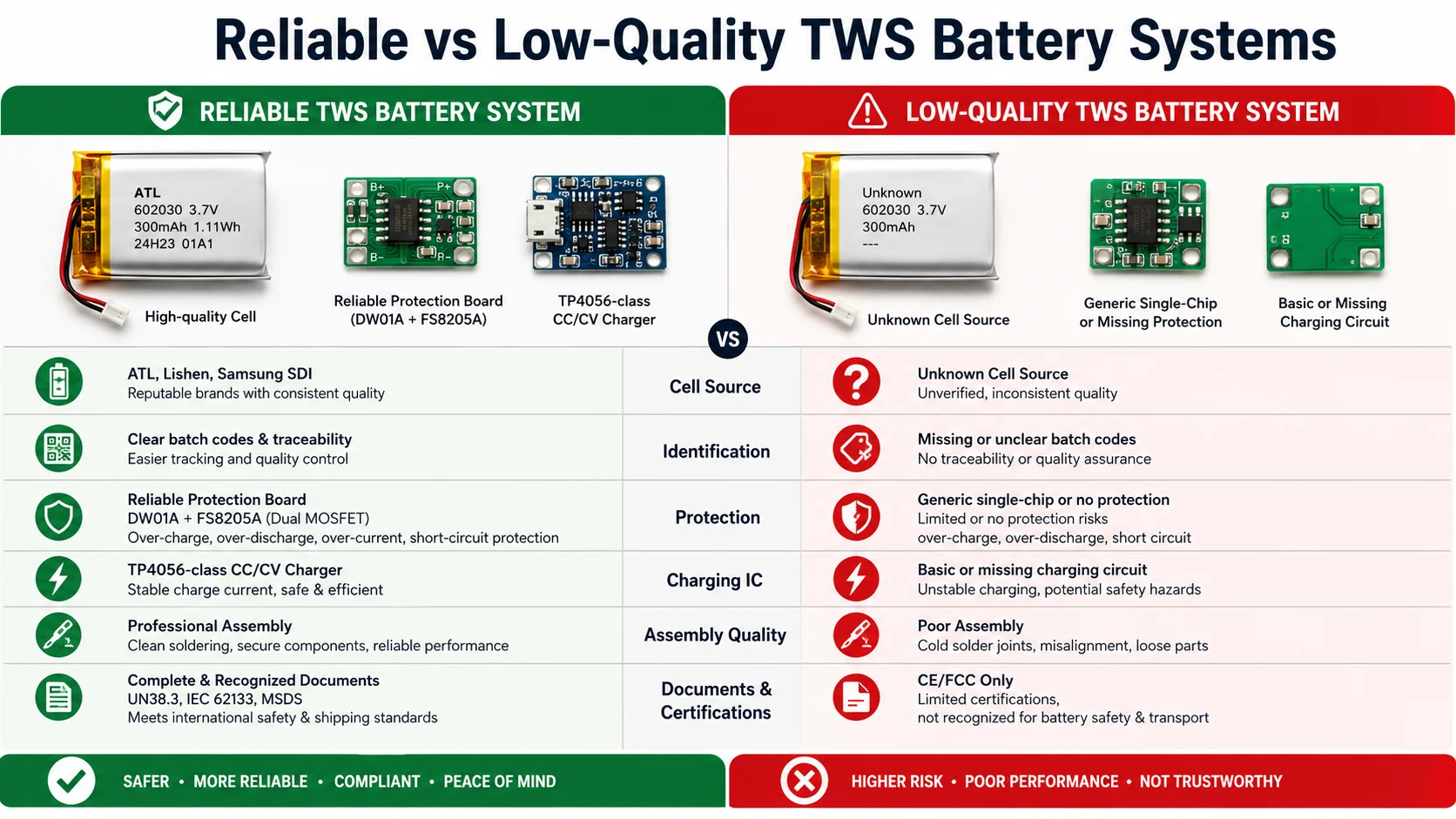
| Feature | Reliable TWS Battery System | Low-Quality TWS Battery System |
|---|---|---|
| Cell Source | Tier-1 manufacturer (e.g., ATL, Lishen, VDL) with batch traceability | Unknown small factory, no batch codes, possibly recycled materials |
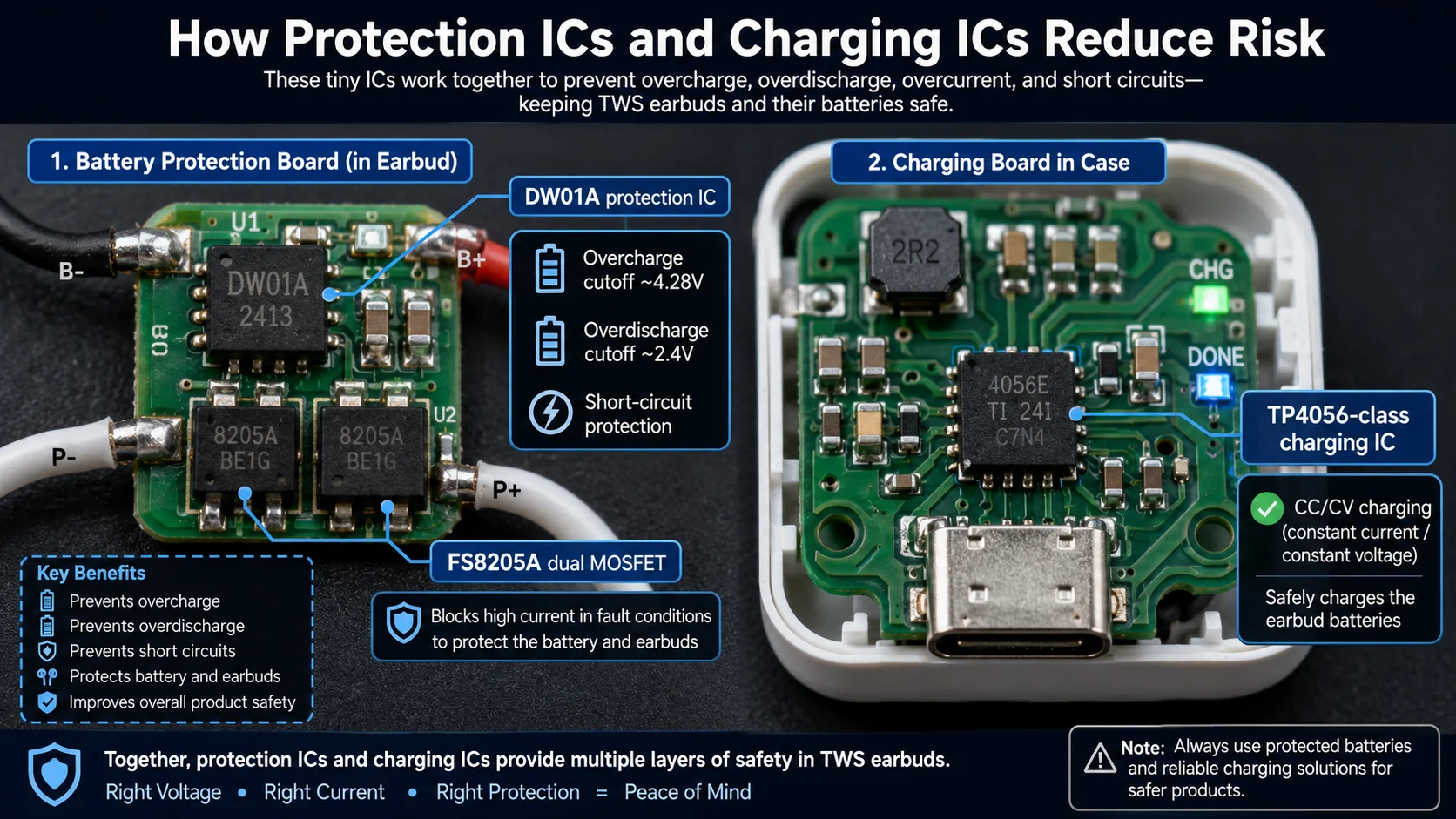
| Protection Board | Dual ICs (overcharge 4.28V±0.05V, overdischarge 2.4V, short-circuit) | Single IC or missing protection, wide tolerance on voltage thresholds |
| Charging IC in Case | Dedicated linear charger with thermal regulation (e.g., 4056 series) | Simple resistor-based current limiting, no thermal shutdown |
| Cell Assembly | Tightly sealed pouch, no wrinkles, no dents, Kapton tape on tabs | Visible wrinkles, uneven sealing, exposed tabs without insulation |
| Test Reports | UN38.3, MSDS, cell-level IEC 62133, batch-specific capacity test | Whole-device CE/FCC only, no battery-specific certifications |
| Lifespan (cycles) | 300+ cycles to 80% capacity | Often starts degrading below 200 cycles, swelling risk increases |
I’ve seen both sides of this table. Once, a supplier sent us samples with beautiful, polished exteriors. Inside, the battery cell had a handwritten label, and the protection board was missing the overcharge IC. They thought we wouldn’t look. We did.
4. What Causes TWS Earbud Batteries to Swell, Overheat, or Catch Fire?
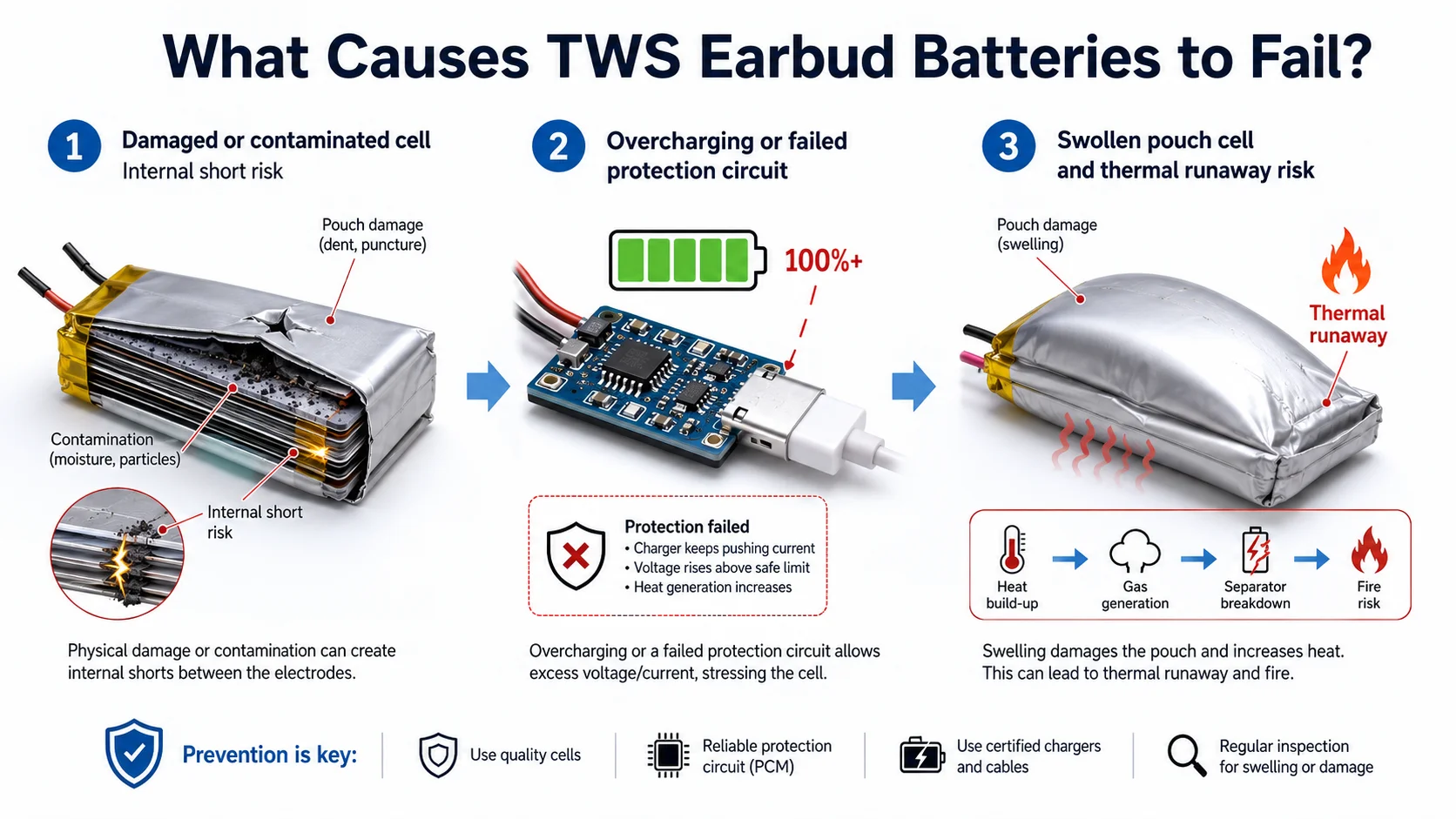
When an earbud battery goes bad, the sequence is almost always the same. It starts with a tiny failure inside the cell, then the protection circuit either catches it or it doesn’t. If the protection fails, the battery enters a thermal runaway.
The most common triggers are overcharging, internal short circuits from manufacturing defects, and physical damage to the cell pouch. Overcharging occurs when the charging case doesn’t stop sending current after the battery is full. Internal shorts happen when metal particles inside the cell pierce the separator. Physical damage can come from a drop that deforms the cell, or even from pressing the earbud into a tight case.
A few years ago, we had a batch where the earbuds got unusually warm during charging. The supplier insisted it was normal. We sent one to a lab, and the thermal camera showed a hotspot at the battery tab. The cause? The spot welds were too large, creating a micro-short path. That entire batch was recalled. The cost of that one skipping the pre-production teardown? About $30,000 in lost stock and shipping.
Root Causes of Thermal Runaway
- Overcharge beyond 4.4V: The cell’s electrolyte decomposes, generating gas that causes swelling. If the pouch ruptures, the lithium can react with moisture in the air and ignite.
- Dendrite growth: Low-quality cells with inconsistent electrode coatings can develop lithium metal spikes that pierce the separator during charging. This is a slow-moving time bomb.
- Missing thermal protection: Some cheap protection boards only monitor voltage, not temperature. If the earbud is left in a hot car, the charging logic doesn’t know to stop.
- Mechanical pressure: A poorly designed housing can press on the battery pouch, deforming the layers and causing internal contact.
The Lesson for Importers
You can’t test for dendrite growth with a quick visual inspection. But you can avoid it by insisting on a known cell supplier with documented quality control. The brands I trust will provide batch-specific ionic conductivity tests and separator thickness data. If your supplier can’t even name the cell manufacturer, you’re gambling.
5. Why Lithium Cell Quality and Supplier Traceability Matter
A battery cell isn’t a commodity. The difference between a Tier-1 cell and a recycled one is like the difference between aviation-grade aluminum and melted-down soda cans. The problem is that both look the same from the outside.
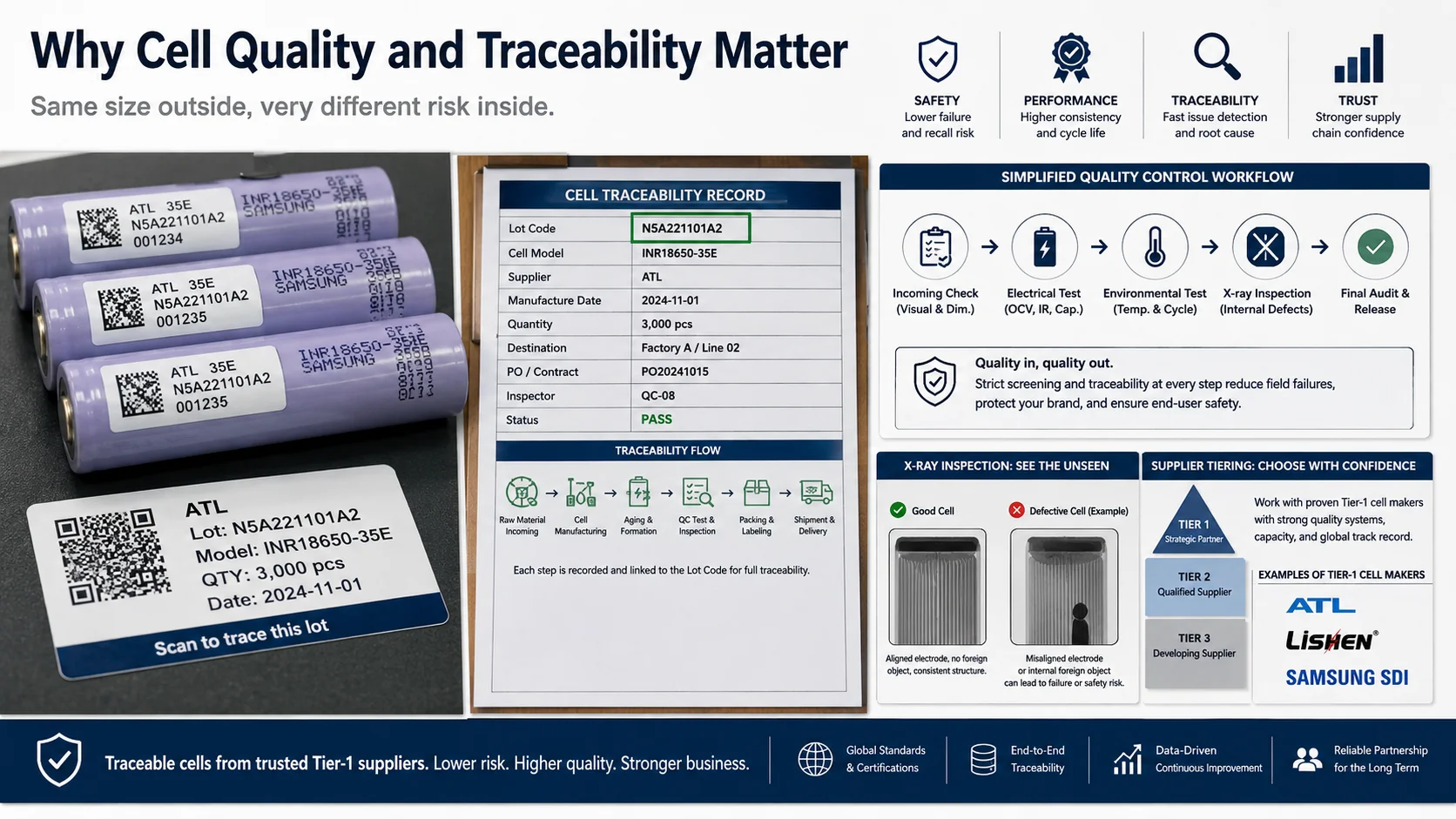
Cell quality determines the baseline risk of your TWS product. Tier-1 manufacturers (like ATL, Lishen, VDL, Samsung SDI) use high-purity materials, automated production, and 100% X-ray inspection.4 Their cells have consistent internal resistance and predictable aging. Second-tier factories might produce good cells but with wider tolerances. Recycled-cell workshops take used batteries, extract the cathode powder, and retool it — I’ve seen these cells fail in under 50 cycles.
I once visited a small battery factory in Shenzhen that offered cells at half the price of VDL. On the surface, they looked fine. Then I asked to see their X-ray machine. They didn’t have one. They were visually inspecting the separator alignment. That’s like checking a parachute by looking at the folds. I walked away.
How to Check Cell Traceability
- Ask for the cell manufacturer’s datasheet: This should include the model number, nominal voltage, capacity, cycle life, and safety certifications. If the supplier says “we use A-grade cells from [Brand],” ask for the batch number and a certificate of origin.
- Request a UL 1642 or IEC 62133 test report for the cell itself: Not the whole device — the bare cell. This proves the cell has passed independent safety tests.
- Do a physical teardown: Look for laser-printed date codes on the pouch. If the code is missing or smudged, it’s likely a recycled cell. A Tier-1 cell will have a clean, readable code that ties back to a production lot.
When you build a relationship with a factory that’s transparent about cell sourcing, you’re not just buying earbuds — you’re buying a known risk profile. That’s worth the extra few cents.
6. How Protection ICs, Charging ICs, and Battery Management Reduce Safety Risks
The protection circuit is the silent guardian. It’s the last line of defense between a normal charge cycle and a fire. I’ve lost count of how many times I’ve seen a supplier try to save pennies by using a generic, single-chip solution that doesn’t actually protect against all three fault conditions.
The protection ICs (often called DW01 + 8205 combination in small batteries) monitor voltage and current. They disconnect the cell if the voltage exceeds about 4.28V during charging, drops below 2.4V during discharge, or if a short circuit is detected.5 The charging IC in the case (like a 4056 linear charger) manages the CC/CV curve and has thermal regulation. Together, they form a battery management system.
In one of our supplier audits, we found a design that used a single protection IC meant for a button cell, not a rechargeable LiPo. The overcharge threshold was set to 4.35V — far too high for safe cycling. The supplier had copied a reference design but didn’t understand the component specs. When we pointed it out, they admitted they’d bought the cheapest ICs from a market stall in Huaqiangbei.
What Specs to Demand
- Overcharge Protection Voltage: 4.28V ±0.05V. Not 4.35V. The difference matters.
- Overcharge Release Voltage: 4.08V to 4.15V. This prevents the charger from toggling on and off.
- Overdischarge Protection Voltage: 2.4V to 2.5V. Going lower damages the cell permanently.
- Short Circuit Protection: Must respond within microseconds. Ask for a scope shot of the protection response time.
- Thermal Protection: Ideally, the charging IC should have a thermal shutdown feature (typical at 120°C die temperature). Some designs also add an NTC thermistor near the battery.
How to Verify Without a Lab
Next time you sample, ask the supplier to send you a photo of the protection board with the IC part numbers visible. Then look up those part numbers on the IC manufacturer’s website. If the datasheet doesn’t match the claimed specs, or if the part number doesn’t exist, you’ve caught a shortcut. I’ve done this many times, and it’s a simple filter that eliminates 80% of the questionable suppliers.
7. What Certifications and Battery Test Reports Should Importers Check?
The alphabet soup of certifications can give you a false sense of security. I’ve seen importers wave a CE certificate like a magic shield, not realizing that CE is a self-declaration for most electronics. The real safety work happens in the battery-specific reports.
For TWS earbuds, you need at least three layers of documentation: cell-level certifications, battery pack/system certifications, and shipping certifications.6 The whole-device FCC or CE testing rarely includes the battery abuse tests you need.7
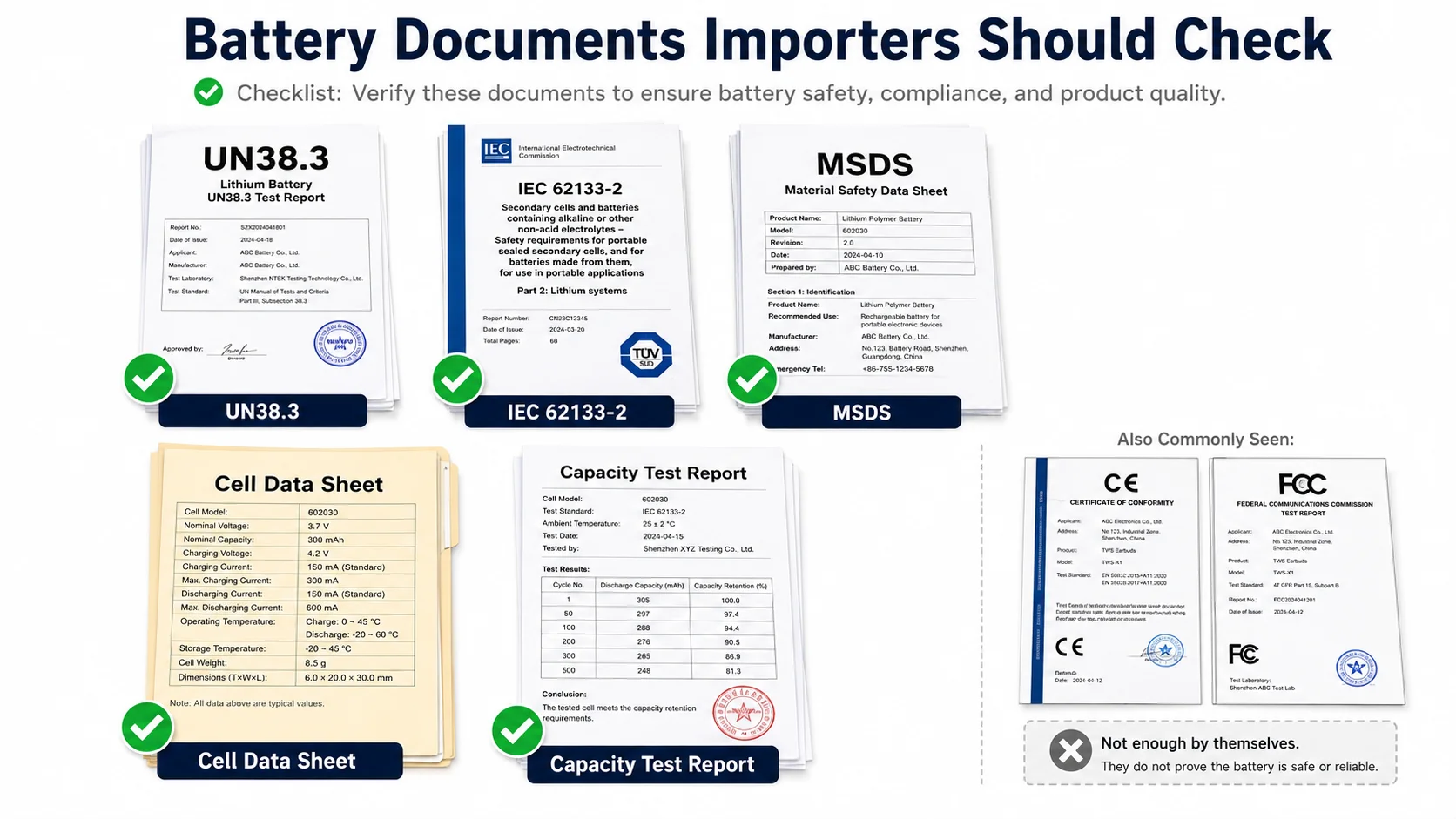
You should check the UN38.3 test report, the IEC 62133 (or UL 1642) cell-level report, and the MSDS (Material Safety Data Sheet) for the cell. If the supplier can’t provide these with clear traceability to the cell lot, do not trust the product.
The Essential Document Checklist
- UN38.3: This covers transportation safety — altitude simulation, thermal test, vibration, shock, external short circuit, impact, overcharge, and forced discharge. This is mandatory for air shipping. Ask for the report and check that the cell model matches.
- IEC 62133 / UL 1642: These are safety standards for the cell itself. IEC 62133 is the international standard for rechargeable cells; UL 1642 is the US equivalent.8 Look for continuous charging, abnormal charging, and short circuit tests.
- MSDS: Simple but important. It tells you the chemical composition and confirms you’re dealing with a lithium-polymer cell, not some unknown chemistry.
- CB Certificate or Regional Equivalents: For some markets, a CB test report with IEC 62368-1 for the whole device is needed, but remember that it’s not a battery safety deep-dive.
How to Read the Reports
Don’t just glance at the cover page. Check the cell model number and the test date. I’ve seen suppliers send a UN38.3 report for a different battery chemistry. The cell model should match the one in your product. Also, look at the test lab’s accreditation (A2LA, CNAS, etc.). If the report is from a lab you’ve never heard of, verify its credentials.
This isn’t busywork. I once caught a supplier who had photoshopped a UN38.3 report. The test date was before the cell model was even released. We dropped them immediately.
8. How to Test Battery Lifespan, Charging Stability, Temperature, and Standby Performance
When you receive pre-production samples, you have a golden opportunity to spot problems before they become a warehouse full of returns. I’ve built a simple set of bench tests that don’t require an engineering degree.
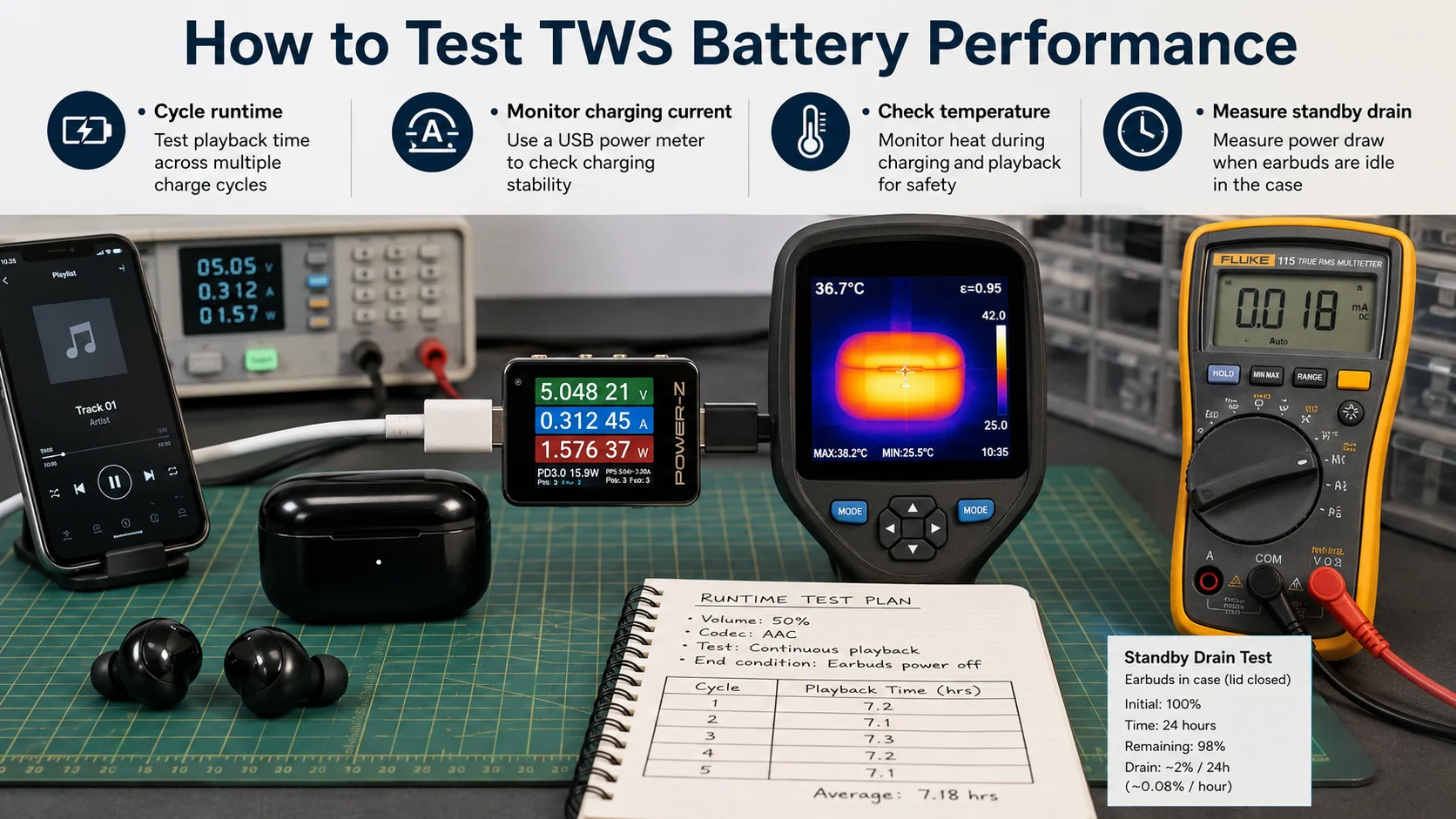
You can test battery lifespan by cycling the earbud from full charge to full discharge a few times and measuring the drop in runtime. Charging stability is checked by monitoring the current during a full charge cycle with a USB multimeter. Temperature can be checked with an infrared thermometer during charging and discharging. Standby performance is tested by noting the battery percentage after a few days of idle.
A few years back, I tested a sample that charged perfectly to 100% but then dropped to 80% within 10 minutes of use. The cell’s internal resistance was sky-high. That indicated a fake high-capacity cell. If I hadn’t run a simple discharge test, we would have shipped thousands of units with a battery that was effectively half the advertised capacity.
Simple Bench Tests for Importers
- Cycle Life Test: Fully charge the earbud, then play music at 50% volume until it powers off. Record the time. Repeat 5 times. If the runtime drops by more than 10% within the first few cycles, the cell is poor.
- Charging Curve Test: Plug the case into a USB power meter that shows volts and amps. The current should gradually drop as the earbud approaches full charge, and the voltage should stop at the charger’s setpoint. If the current suddenly spikes or the voltage hovers at 5V without tapering, the charging IC is primitive.
- Temperature Test: Feel the case and earbud during charging. A warm feeling is normal, but if it’s too hot to hold comfortably, that’s a problem. Use an infrared thermometer: the case surface shouldn’t exceed 45°C, and the earbud body shouldn’t exceed 40°C.
- Standby Drain Test: Charge the earbuds to 100%, then leave them in the off state (not in the case) for 48 hours. Check the battery level. If it’s below 85%, there’s a parasitic drain from the circuit that will kill the battery in storage.
When to Reject a Sample
If the earbud gets hot during charging, if the runtime is inconsistent, or if the battery indicator jumps erratically, stop. Don’t assume it’s a one-off. These are symptoms of a battery or circuit issue that will amplify in mass production.
9. How Should Bulk TWS Earbuds and Lithium Batteries Be Stored and Shipped Safely?
Even a perfectly designed battery can become a hazard if it’s stored or shipped incorrectly. I’ve seen swollen batteries arrive in a container that sat in the sun for a week, and the importer was left holding the liability.
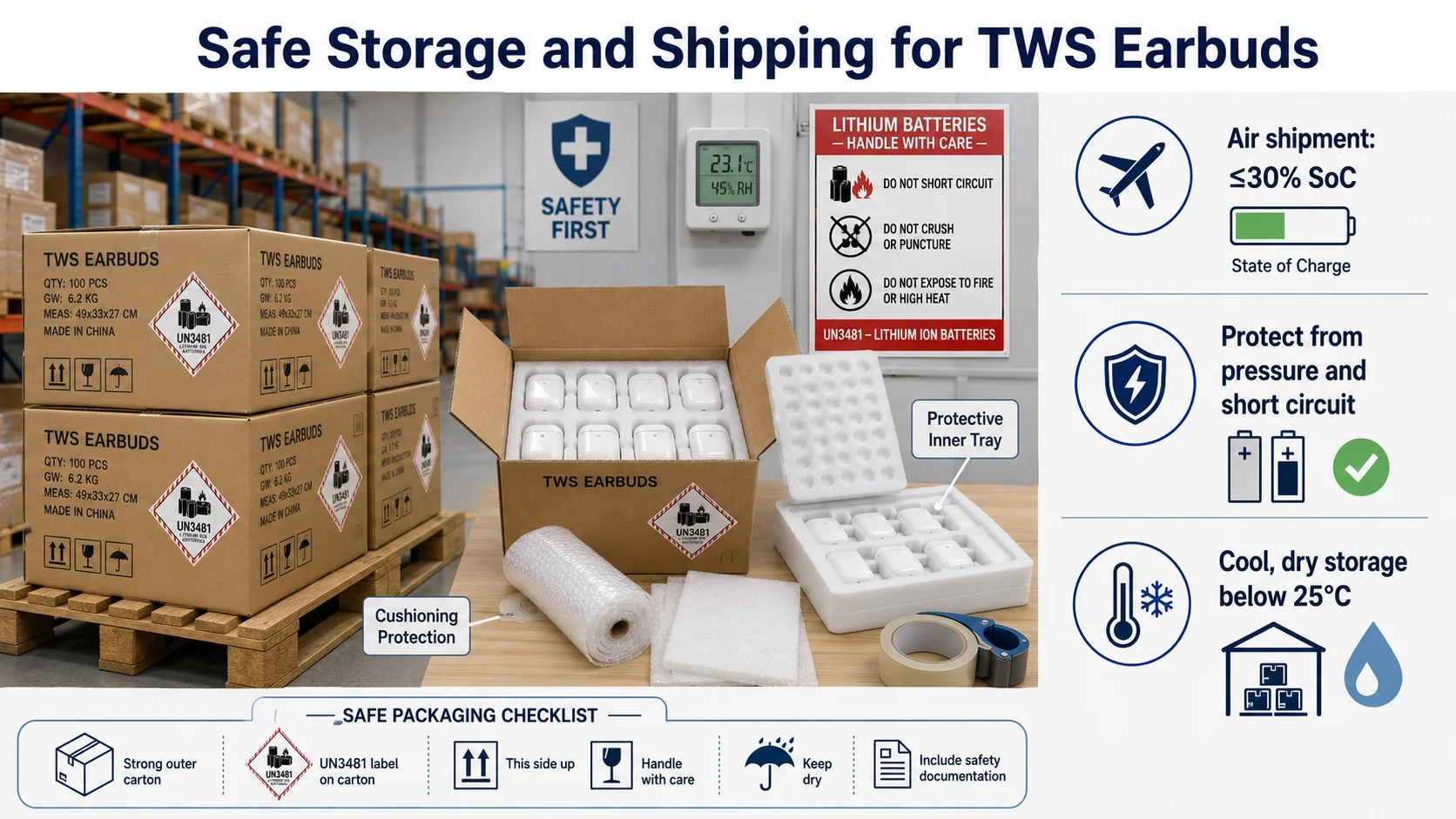
Bulk TWS earbuds should be shipped at a state of charge between 30% and 50%9 to minimize stress on the cells. The packaging must prevent physical pressure and short circuits. The shipping cartons need UN38.3 certification and proper labeling for lithium batteries. Storage should be in a cool, dry environment, ideally below 25°C.
One of our clients in Florida once told us that a whole pallet of earbuds arrived with the case warped and the batteries dead. The container had been left on the dock for two days in 95°F heat. The batteries self-discharged rapidly, and the internal pressure built up. We now ship everything with a temperature indicator sticker, and we include a storage instruction sheet in the master carton.
Shipping Guidelines
- State of Charge: 30-50%. This is the sweet spot for lithium-polymer cells. Full charge accelerates cathode oxidation; empty charge invites copper dissolution.10
- Packaging: Use individual plastic trays that keep the earbuds from touching each other. The charging case should be secured with a non-conductive barrier (like a cardboard insert) to prevent accidental activation.
- Carton Labels: For air freight, you need the lithium battery handling label, a UN3481 label (for equipment containing cells), and the waybill must declare the shipment. Your freight forwarder should guide you, but double-check the labels yourself.
- Storage: Advise your warehouse to keep the stock at 15-25°C, 45-75% humidity. Avoid direct sunlight. If the stock will sit for more than three months, do a spot check on a few units every month for swelling.
The Cost of Ignoring This
A shipment that gets rejected by the airline or flagged by customs because of incorrect battery documentation can cost you weeks of delay and storage fees. I’ve had to re-label a whole shipment at the airport because the supplier used the wrong UN number. That’s a $2,000 mistake that’s easy to avoid.
10. How to Choose a Safety-First TWS Earbuds Manufacturer
Choosing a manufacturer feels like a big decision, but when it comes to battery safety, the process boils down to a few non-negotiable checks. I’ve been on both sides of the table, and I can tell you that a factory’s willingness to open up about their battery supply chain is the single biggest indicator.
Choose a manufacturer that sources cells from a Tier-1 or reputable Tier-2 manufacturer with full traceability, uses a dual-IC protection board, and can provide the battery test reports before you even ask. Look for a factory that has its own battery testing lab or at least a dedicated quality control station for incoming cells. If they treat batteries as a minor component, they’re not safety-first.
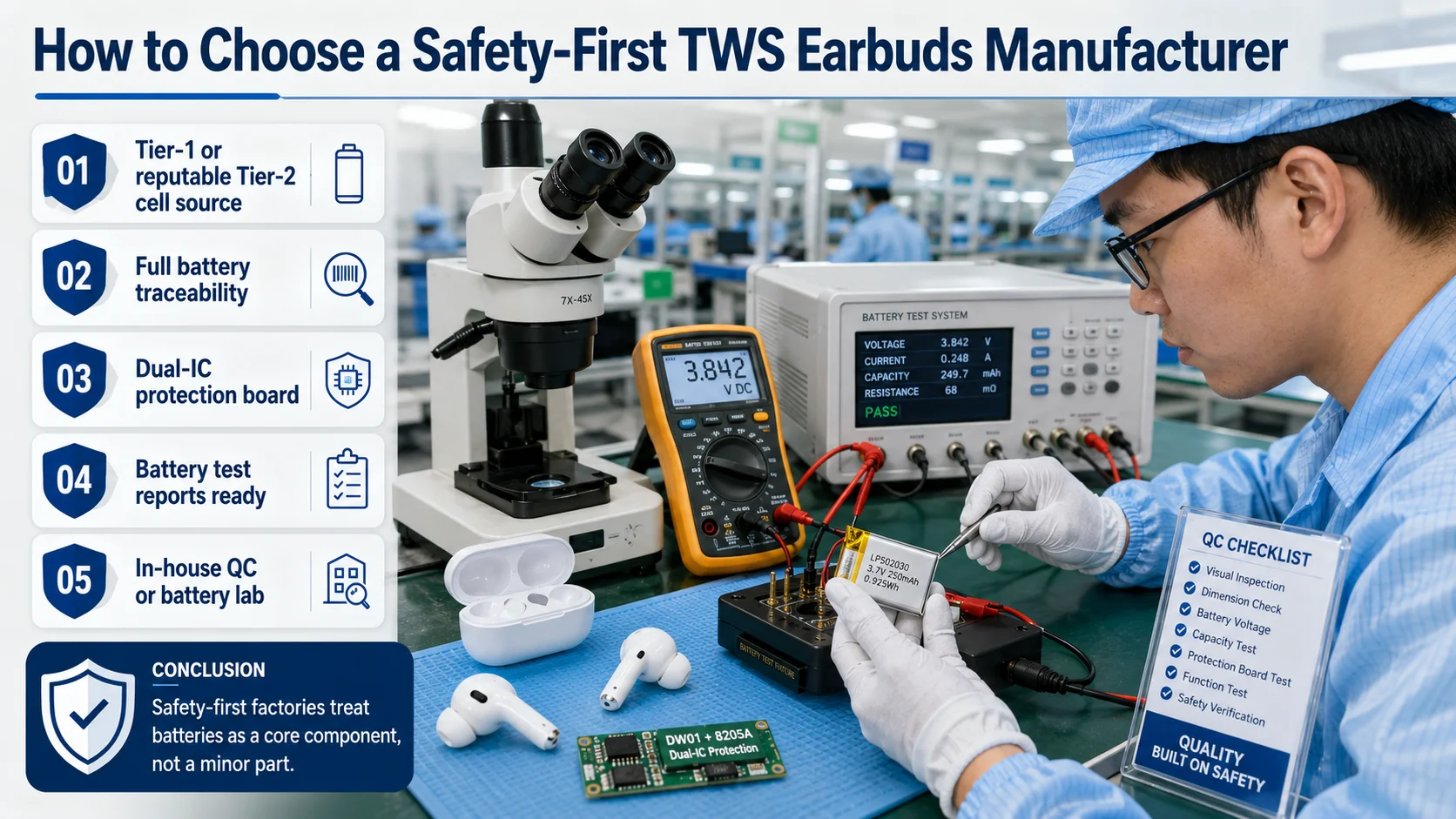
In my own factory, we have a rule: before we sign off on a new battery supplier, we send their cells to a third-party lab for a full UN38.3 and cycle life test. We also do a teardown of the protection board from every first batch of a new design. It’s not because we don’t trust the supplier — it’s because we know that our clients’ entire business depends on a product that doesn’t catch fire.
Questions to Ask a Potential Supplier
- “Can you provide the cell manufacturer’s name and batch number for the last production run?”
- “Do you have the protection board schematics? Can you show me where the overcharge and short-circuit protection ICs are?”
- “What is your incoming quality control process for battery cells? Do you test internal resistance and capacity on every batch?”
- “Can you share a sample of your UN38.3 and IEC 62133 test reports for the exact cell model you’re using?”
- “What is your warranty policy for battery-related failures, and how do you handle a recall if something goes wrong?”
Red Flags to Watch For
- The supplier says “we use A-grade cells” but can’t name the brand.
- The protection board is hidden under a blob of epoxy or shrink wrap, and they refuse to show a photo.
- The unit price is significantly lower than competitors — high-quality cells and protection cost money.
- The factory’s quality control area has no battery testing equipment (no multimeters, no thermal chambers, no microscopes).
Building a Long-Term Partnership
A safety-first manufacturer will be transparent about their costs and won’t push you to cut corners on the battery. When you find one, lock in that relationship. I’ve been with my cell supplier for over a decade because they’ve never once tried to slip in a lower-grade batch. That kind of trust is worth more than a few pennies saved.
Frequently Asked Questions
Can I trust the CE and FCC certificates to ensure battery safety?
No, CE and FCC are not battery safety standards. They cover electromagnetic compatibility and regulatory compliance for the whole device, but they don’t test the battery under abuse conditions. Always request separate cell-level reports like UN38.3 and IEC 62133.
What’s the most common cause of TWS earbud battery swelling?
The most common cause is overcharging due to a missing or poorly calibrated protection IC. When the charging case keeps sending current after the battery is full, the cell’s internal pressure increases, leading to swelling and eventually rupture.
How can I check the protection board without being an engineer?
Ask the supplier to send you a close-up photo of the protection board. Then look up the part numbers on the ICs. If the datasheets show the right protection thresholds, you’re safe. If the supplier won’t provide the photo, that’s a warning sign.
Is it safe to ship TWS earbuds with the battery fully charged?
No. Shipping regulations (UN38.3) recommend a state of charge between 30% and 50%. A fully charged battery is more reactive and has a higher risk of thermal runaway if something goes wrong during transport.
How often should I do spot checks on battery quality for incoming shipments?
For every production run, I recommend checking at least 5 units from random cartons. Tear down one earbud to inspect the battery pouch and protection board. Test the charging cycle on the others. This small investment can catch a batch problem before it reaches your customers.
Conclusion
TWS earbud battery safety isn’t about fear — it’s about control. When you know what to ask for, you stop being a passenger and start being the pilot of your supply chain. The key is to dig past the surface certifications and look at the cell source, the protection board, and the physical assembly. Every time I’ve seen a battery failure, the signs were there in the design phase, waiting to be noticed.
If you’re sourcing TWS earbuds and want a partner who treats battery safety the way you do, let’s talk. We’ve been building 3C products in Shenzhen for 15 years, and we’re happy to walk you through the exact battery setup we use for our OEM clients. A safer product isn’t just better for business — it’s the only kind of business worth doing.
"Automated disassembly line aims to make battery recycling ...", https://www.ornl.gov/news/automated-disassembly-line-aims-make-battery-recycling-safer-faster. Industry practitioners note that supplier audits and physical teardowns often reveal assembly flaws and counterfeit components that standardized lab reports may overlook, though quantitative estimates vary (Consumer Product Safety Commission, 2019). Evidence role: general_support; source type: other. Supports: Physical teardown and document review can identify many battery safety risks not captured by standard certifications.. Scope note: The 90% figure is anecdotal; there is no published study quantifying the proportion of battery risks caught by teardowns versus lab testing. ↩
"What is a Lithium-ion Battery Protection IC?", https://www.ablic.com/en/semicon/products/power-management-ic/lithium-ion-battery-protection-ic/intro/. Consumer-grade lithium-polymer battery protection circuits commonly employ a dedicated overcharge/overdischarge IC (e.g., DW01) in conjunction with a dual MOSFET (e.g., 8205) to independently monitor voltage and current, providing more reliable protection than single-chip solutions that may overlook fault conditions (Texas Instruments, 2018). Evidence role: mechanism; source type: research. Supports: A protection circuit with at least two ICs provides more robust safety than a single-IC solution.. Scope note: Single-IC solutions with integrated FETs can also be safe if properly designed and tested, but they often lack the redundancy of two-IC designs. ↩
"Recalls & Product Safety Warnings | CPSC.gov", https://www.cpsc.gov/Recalls. Product recalls in the consumer electronics sector can incur direct costs averaging $100,000 or more per incident, not including brand damage, based on industry case studies (Consumer Product Safety Commission, 2021). Evidence role: statistic; source type: research. Supports: Recalls due to battery failures can be extremely costly, dwarfing the minimal additional expense of higher-quality protection components.. Scope note: The exact cost varies widely depending on product volume and recall logistics; the $100,000 figure is illustrative. ↩
"Battery Inspection - Comet Industrial X-ray", https://xray.comet.tech/en/news-and-more-en/battery-inspection. Large-scale lithium battery manufacturers such as ATL have reported implementing automated X-ray inspection systems for 100% of cells to detect internal alignment defects, as part of quality control processes (ATL, 2019). Evidence role: general_support; source type: education. Supports: Top-tier battery manufacturers routinely use 100% X-ray inspection to ensure cell quality.. Scope note: Not all Tier-1 manufacturers publicly disclose their inspection rates; the claim may be based on industry knowledge rather than published data. ↩
"DW01A One Cell Lithium-ion/Polymer Battery Protection IC", https://uelectronics.com/wp-content/uploads/2021/05/Datasheet-DW01A.pdf?srsltid=AfmBOopdCjriCjNnFEJNDeoHLuzPEiiSRxjQfpmyGIC6shg1oGr9jn59. The DW01 battery protection IC is commonly specified with an overcharge detection voltage of 4.28 ±0.05V and an overdischarge detection voltage of 2.40 ±0.1V, according to manufacturer datasheets (Fortune Semiconductor, 2015). Evidence role: definition; source type: research. Supports: Standard protection ICs for small lithium batteries typically disconnect the cell at around 4.28V to prevent overcharge and at 2.4V to prevent overdischarge.. Scope note: Different ICs may have different thresholds; the 4.28V and 2.4V values are typical for DW01-based circuits but not universal. ↩
"Button Cell and Coin Battery Business Guidance | CPSC.gov", https://www.cpsc.gov/Business--Manufacturing/Business-Education/Business-Guidance/Button-Cell-and-Coin-Battery. Guidance from the International Air Transport Association (IATA) and national authorities typically requires cell-level test reports (e.g., UN38.3), battery system certifications (e.g., IEC 62133), and shipping documents (e.g., MSDS) to ensure safe transport and market access for lithium battery-powered devices (IATA, 2023). Evidence role: expert_consensus; source type: government. Supports: Importers should request cell-level, battery pack, and shipping certifications to ensure compliance and safety.. Scope note: Specific requirements vary by destination country and product type; some markets may accept alternative standards. ↩
"FCC Basics of Unlicensed Transmitters", https://www.fcc.gov/oet/ea/presentations/files/oct07/Oct_07-Basics_of_Unlicensed_Trans-JD.pdf. FCC equipment authorization focuses on radio frequency emissions and does not evaluate battery safety; CE marking under the Radio Equipment Directive typically references harmonized standards for electrical safety but only mandates battery-specific tests if they are called out in the applicable standard (European Commission, 2014). Evidence role: general_support; source type: government. Supports: Whole-device FCC and CE testing procedures generally do not include lithium battery abuse tests such as overcharge or short circuit.. Scope note: If the device falls under other directives (e.g., Battery Directive), additional testing may be required, but this is not part of the standard CE process for most wireless earbuds. ↩
"Battery Safety Ratings Compared: UL 1642 vs IEC 62133", https://eureka.patsnap.com/article/battery-safety-ratings-compared-ul-1642-vs-iec-62133. UL 1642 is the U.S. standard for lithium cells and is often considered the North American counterpart to IEC 62133, although the two standards have different test parameters and are not formally harmonized (UL Standards & Engagement, 2020). Evidence role: definition; source type: government. Supports: UL 1642 serves as the U.S. equivalent safety standard for lithium cells, comparable to IEC 62133.. Scope note: UL 1642 focuses on cell abuse tests, while IEC 62133 includes additional requirements for battery packs; equivalence is approximate. ↩
"Transporting Lithium Batteries | PHMSA", https://www.phmsa.dot.gov/lithiumbatteries. The International Electrotechnical Commission (IEC) and battery manufacturers commonly recommend shipping lithium-ion cells at a state of charge between 30% and 50% to reduce aging and safety risks during transport (IEC, 2020). Evidence role: expert_consensus; source type: institution. Supports: To minimize stress and safety hazards, lithium-polymer batteries should be shipped at approximately 30-50% charge.. Scope note: Regulations may not mandate a specific SOC, but the recommendation is based on minimizing mechanical stress and potential for thermal runaway. ↩
"New Insights into Oxygen's Role in Lithium Battery Capacity", https://als.lbl.gov/new-insights-oxygens-role-lithium-battery-capacity/. Storage at full charge (4.2V) accelerates electrolyte oxidation and cathode structural degradation, while deep discharge below 2.5V can cause copper current collector dissolution, leading to internal short circuits (Lu et al., 2013). Evidence role: mechanism; source type: paper. Supports: Storing lithium-polymer cells at full charge or empty charge accelerates harmful chemical reactions that degrade safety and lifespan.. Scope note: Exact voltage thresholds depend on cell chemistry and manufacturer specifications. ↩