I’ve seen too many importers assume a supplier’s PDF means the product is ready to sell in their market. They place the order, the shipment arrives at the port, and then customs holds the container because the certificate doesn’t match the actual model or market. That’s the exact moment they realize UL, CE, and FCC certifications aren’t about checking a box — they’re about verifying three things before the money leaves your account.
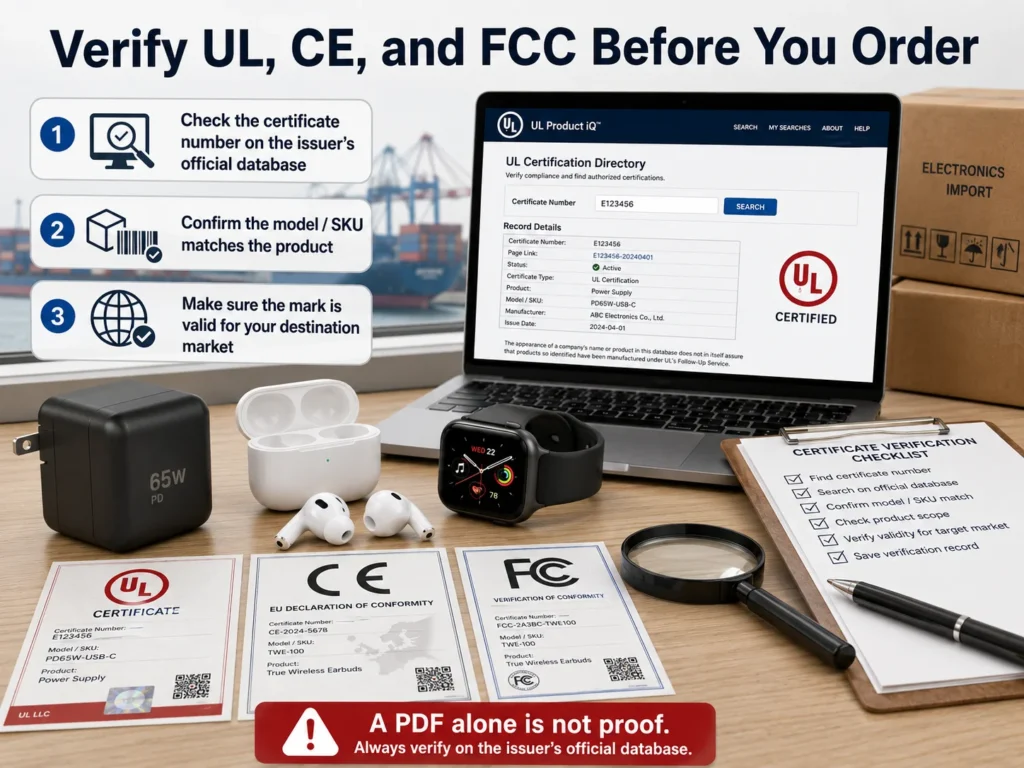
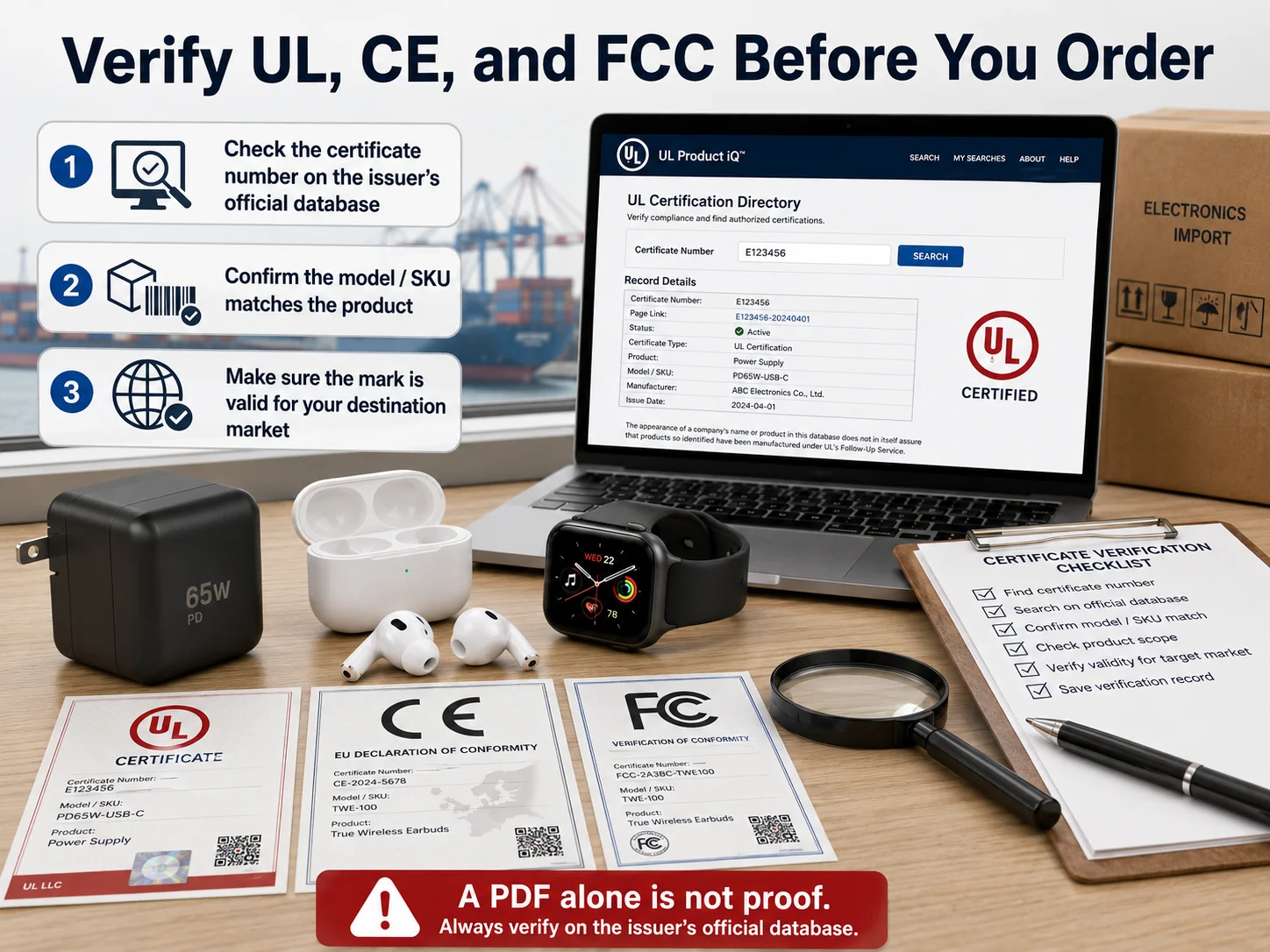
The short answer: Before ordering, you need to verify that the certificate is genuine, that it covers the specific SKU you’re buying, and that the mark matches the legal requirements of your destination country. A PDF alone is not proof. Always cross-check the certificate number on the issuing body’s official database, confirm the model number listed matches your product, and understand which markets actually require UL, CE, or FCC — they are not interchangeable.
I get it — when you’re sourcing chargers, earbuds, or smartwatches, you want to move fast. But the five minutes it takes to verify a certificate can save you from a container stuck at the port, racking up demurrage fees. Let me walk you through how to do it without getting lost in legal jargon.
1. Quick Answer: What Are the Main Certifications Tech Importers Should Check?
When a buyer asks me this question, I can feel the overwhelm behind it. They’ve been told they need “certifications,” but they’re not sure which ones are real gatekeepers and which are just nice-to-have. The confusion often leads to overpaying for unnecessary paperwork or, worse, skipping a critical one entirely.
The three certifications that matter most for consumer electronics are UL (or ETL, CSA), CE, and FCC. UL is widely recognized in North America for safety, CE is mandatory for the European Union, and FCC is required for any electronic device sold in the United States that can emit radio frequency.
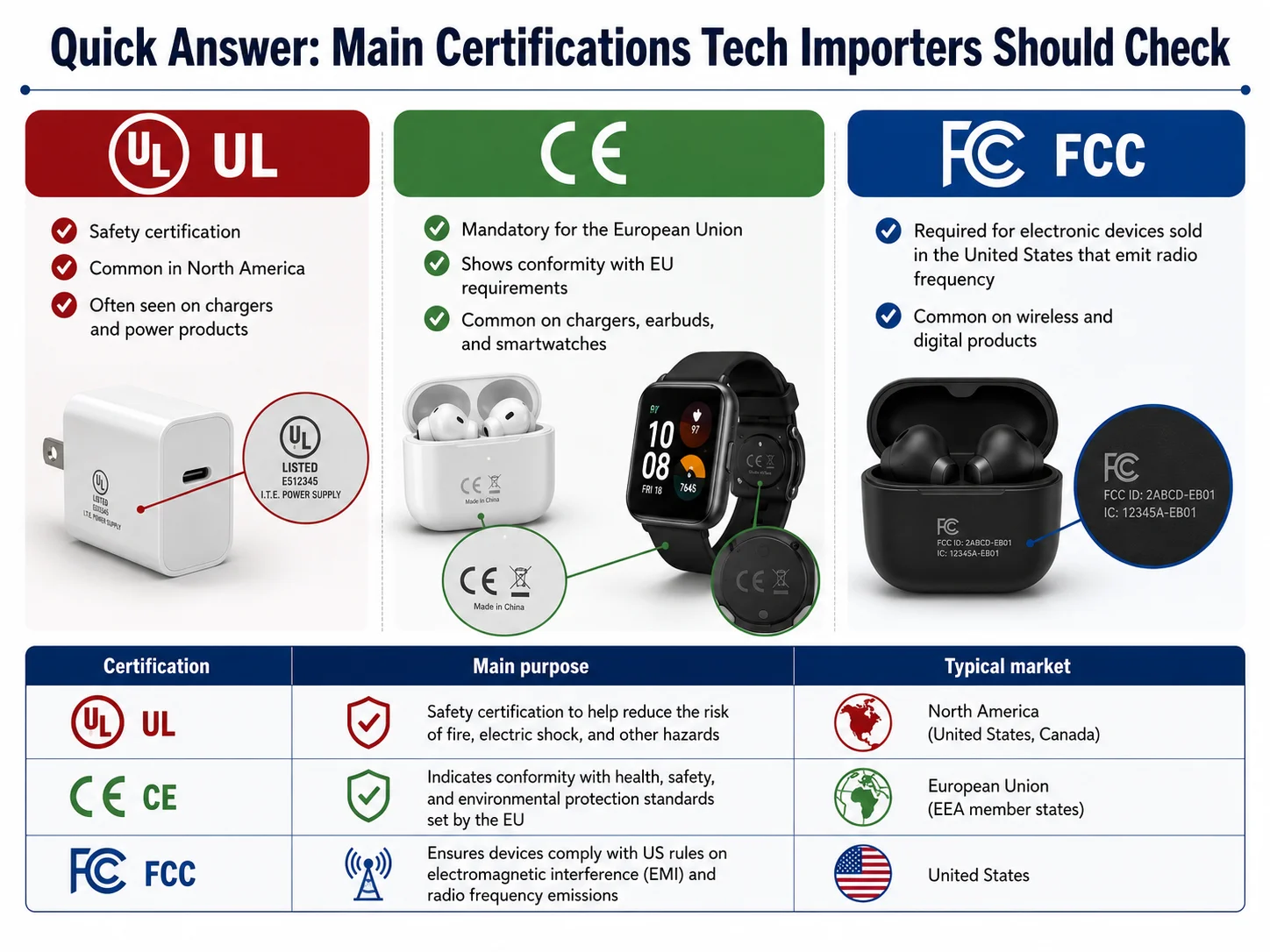
Here’s the reality I’ve observed over 15 years of exporting from Shenzhen. UL isn’t a federal law in the U.S. — it’s a standard pushed by insurance companies and retailers.1 But in practice, if you’re selling electronics to major chains or on Amazon, you’ll need a Nationally Recognized Testing Laboratory (NRTL) mark like UL, ETL, or CSA. CE, on the other hand, is a legal requirement in the EU. You can’t place a product on the market without it.2 FCC covers the electromagnetic interference and radio frequency side. If your product has Bluetooth, Wi-Fi, or any wireless function, the FCC ID is not optional.3 I’ve seen shipments of wireless earbuds held at U.S. customs simply because the FCC ID wasn’t clearly labeled on the product.4
So, as a quick checklist:
- For the U.S. market: Look for an NRTL safety mark (UL, ETL, CSA) and an FCC mark. If the device has wireless functions, you need a specific FCC ID.
- For the EU market: A CE mark is mandatory. Depending on the product, you may also need RoHS and WEEE compliance.
- For Canada: Often you can use UL, CSA, or cETL, plus ISED certification for wireless.
The key takeaway is this: never assume one certificate works everywhere. I’ve met buyers who thought a CE mark would get them into the U.S. It doesn’t. The mark must match the market’s legal framework, not just “look official.”
2. Why Electronics Certifications Matter Before Importing 3C Products
Once a shipment leaves Shenzhen, you lose control. I’ve seen importers learn this the hard way when a container lands in Long Beach and gets flagged for a lack of proper FCC or UL documentation. The problem isn’t just the fine; it’s the demurrage fees ticking up daily5, the frozen inventory, and the damaged relationship with your retail client.
Certifications are your pre-shipment risk control. Without verifying them before you pay the balance, you’re essentially betting that no one will check. The reality is that customs authorities and marketplace platforms like Amazon and eBay do check — often after the goods arrive, not before.
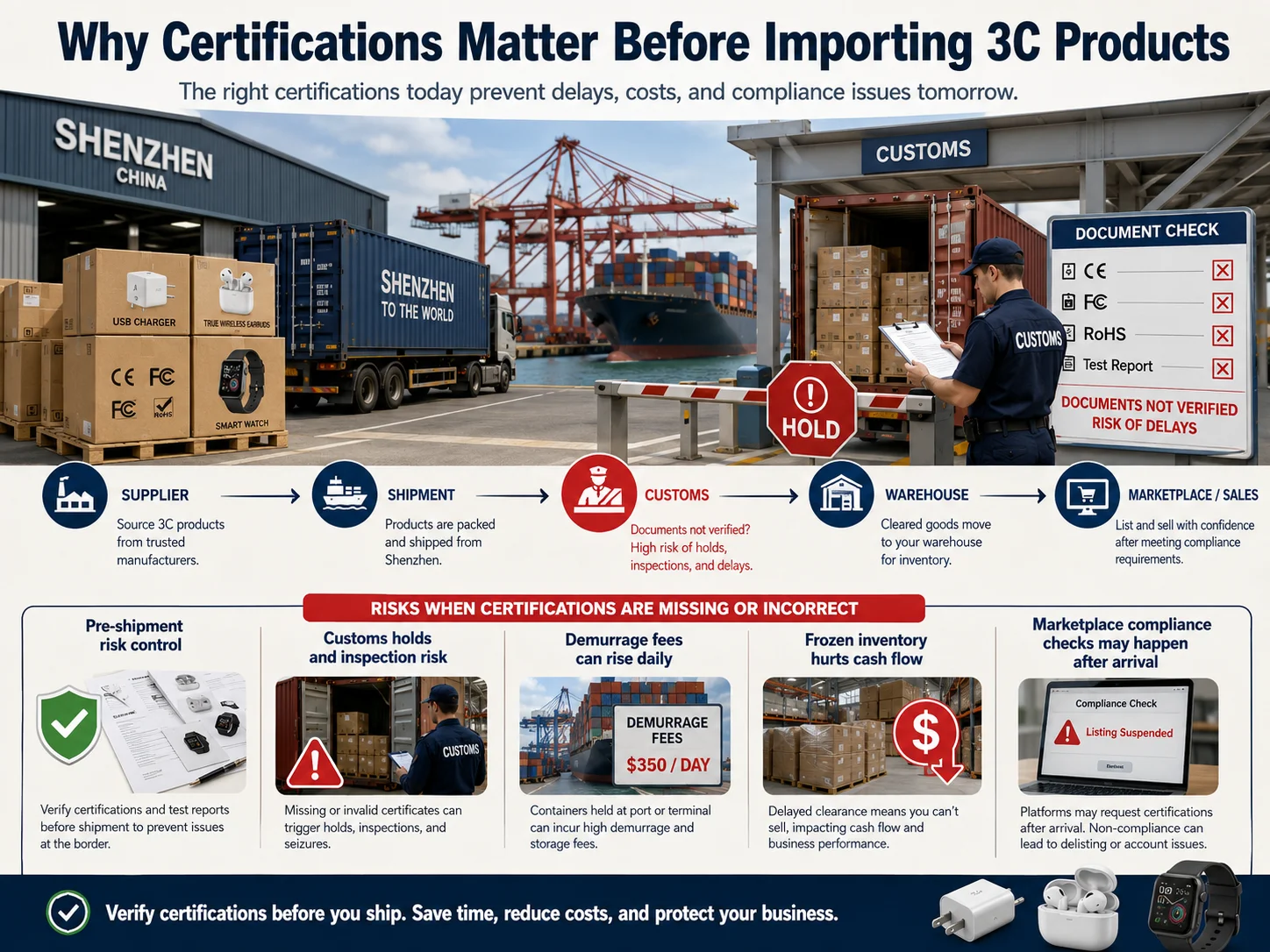
When I talk to our long-term customers, I frame it this way: certifications protect your cash flow. If a product gets held at the border, you’re not just paying for testing later; you’re paying for storage, possible rework, return shipping, or even destruction. And in 90% of the cases I’ve witnessed, the certificate was “there” — it just wasn’t valid for the specific model6, or it had expired, or the lab that issued it wasn’t accredited for the relevant standard.
The deeper lesson is that certifications are not about the factory’s capability. A factory can produce a million units that physically pass the tests, but if the paperwork isn’t tied to the exact SKU and market, the product is non-compliant in the eyes of the law. That’s why I always tell buyers: treat certificates like a contract, not a decoration.
3. Comparison Table: UL vs CE vs FCC Requirements for Electronics Importers
Here’s where the theoretical differences actually hit your purchase order. Let me summarize the practical distinctions in a table, because when you’re negotiating with a supplier, you need to spot mismatches quickly.
| Aspect | UL (or ETL, CSA) | CE | FCC |
|---|---|---|---|
| Primary Region | North America (U.S., Canada) | European Union | United States |
| Legal Status | Not federal law, but de facto required by retailers and insurers | Legally required for market access | Legally required for electronic devices |
| Scope | Electrical safety | Safety, health, and environmental protection | Electromagnetic interference and radio frequency |
| Who Issues It | NRTL labs (UL, Intertek, CSA, etc.) | Manufacturer or importer, with a notified body for certain products | TCB (Telecommunication Certification Body) or self-declaration |
| Typical Products | Chargers, cables, power banks, earbuds, watches | All electronics sold in the EU | Anything with a clock, oscillator, or wireless transmitter |
| Verification Method | Check UL/ETL/CSA online directory by certificate number | Verify CE DoC and test reports; check notified body number | Check FCC ID on the FCC OET database |
This table is something I mentally run through every time a new buyer asks, “Does this charger have the right certifications?” I need to know where they plan to sell it. A charger with a CE mark and no UL mark is perfectly fine for Germany but a red flag for the U.S. market.7 The mismatch is often not a scam — it’s just that the factory built the product for a different market originally. But if you don’t check, that mismatch becomes your problem.
4. Which Products and Markets Commonly Require UL, CE, or FCC Compliance?
Let’s narrow it down to the 3C categories we deal with daily: USB cables, chargers, GaN chargers, TWS earbuds, and smartwatches. Each has a typical compliance pattern.
- USB cables: For the U.S., UL certification is common for safety, but if the cable is purely passive, FCC may not be required.8 For the EU, CE marking is required, and often RoHS compliance.9
- Wall chargers and GaN chargers: These almost always need UL/ETL for the U.S. and CE for Europe. If they have a USB port with data capability, you might also need FCC.
- TWS earbuds: Because they contain a battery and Bluetooth, you need FCC ID in the U.S., CE plus RED directive compliance in the EU, and UL/ETL for safety if you want to sell to major retailers.
- Smartwatches: Similar to earbuds — wireless, battery, and skin contact. FCC, CE, and often a safety standard like UL. Some buyers also ask for SAR testing for body-worn devices.
I remember a European buyer who ordered a batch of smartwatches, only to find out the CE mark only covered the charger, not the watch itself. The watch had a different model number and was not evaluated for the RED directive. That’s the classic trap: the factory shows you a CE certificate for a similar product, and you assume it covers everything in the shipment. It doesn’t.
5. Can One Certificate Cover Every Product, Model, and Destination Market?
No, and this is the most expensive misunderstanding I see. A certificate is tied to a specific model number, a specific set of test parameters, and a specific standard version. If you change the model, the circuit, the battery, the chipset, or even the housing in a way that affects heat dissipation, the certificate may no longer be valid.
I once had a customer who wanted to order a slightly modified version of a charger we had already certified for UL. The PCB layout was the same, but the shell was different. The UL test report didn’t cover that new shell, and the lab said it could affect thermal performance. The buyer had to either pay for a new test or stick with the original design. He chose the original, because the additional cost and lead time would have killed his margins.
Cross-market coverage is equally tricky. A CE certificate doesn’t mean the product is acceptable in the U.S., and a UL mark doesn’t mean it’s accepted in Europe. Even within the EU, specific directives like RED for wireless devices require additional documentation beyond a generic CE mark. So when you’re looking at a supplier’s certificate, check the model number, the test standard, and the geographical scope. If the certificate only lists a model number that’s close but not exactly yours, it’s not yours.
6. What Hidden Testing, Documentation, and Compliance Costs Should Buyers Expect?
When you ask a factory for a product with UL, CE, and FCC, the price per unit usually includes the amortized cost of those certifications. But if you’re buying a brand-new product or a modified SKU, the testing costs can hit you upfront.
Here’s a rough breakdown from what I’ve observed:
- UL/ETL testing: For a simple wall charger, it can be $2,000 to $5,000, depending on the lab and the complexity. For multi-port GaN chargers, it can be higher.
- FCC testing: A few hundred to a couple thousand dollars, but if you need a full FCC ID for an intentional radiator (Bluetooth), it’s more involved.
- CE testing: The cost varies widely. If you can self-declare under certain directives, the cost is only the test report and the technical file. But if you need a notified body assessment, it can be several thousand euros.
- Documentation costs: Don’t forget the technical file, the Declaration of Conformity, and the user manual with required warnings. These are often overlooked. I’ve seen buyers pay for the test but then scramble to get a proper DoC because the factory didn’t prepare one.
The hidden cost is time. Testing can take 2-4 weeks, sometimes longer if the lab finds issues. If you’re on a tight schedule, you need to factor this in. That’s why I always advise buyers to discuss certification status at the sample stage, not after the deposit is paid.
7. How to Verify CE, UL, and FCC Documents Before Placing an Order
Here’s the step-by-step verification I walk my customers through. It’s simple, but it requires you to actually do it — not just eyeball the PDF.
- Get the certificate number. For UL, it’s the file number. For FCC, it’s the FCC ID. For CE, it’s the certificate number from the notified body or the test report reference.
- Go to the official database. UL has a public directory at ul.com/database. FCC has the OET Authorization Search. For CE, if a notified body is involved, you can check the NANDO database for the body’s status and then request the certificate directly from the body if you have permission.
- Check the model number. This is the most common point of failure. The model number on the certificate must match exactly what you’re ordering. Even a suffix difference can indicate a variant not covered.
- Check the status. Is the certificate still active? Has it been withdrawn or expired? I’ve seen factories present a UL certificate that was cancelled years ago because the factory changed its business scope.
- Check the applicant or manufacturer name. The certificate should be tied to the actual manufacturer or at least the responsible party. If the supplier is a trading company, make sure the manufacturer’s name on the certificate is the one actually producing your goods.
I’ve caught a fake FCC ID just by typing it into the FCC database and finding it belonged to a completely different product from a different company. The supplier had copied the ID from a public listing, assuming no one would check. It took me two minutes.
8. How to Spot Fake, Expired, Altered, or Mismatched Electronics Certificates
Spotting a questionable certificate is part skill, part habit. Here are the red flags I’ve learned to recognize:
- The certificate uses a logo that’s slightly off. Fake UL marks sometimes have a circle that’s not quite right, or the font is wrong.
- The certificate number format is inconsistent. FCC IDs have a specific structure: grantee code (3 or 5 characters) followed by a product code. If it doesn’t match that pattern, it’s suspicious.
- The test report is from a non-accredited lab. A genuine CE test report should list the lab’s accreditation number. You can cross-check that number on the national accreditation body’s website.
- The dates don’t align. If the certificate was issued before the product model was even launched, that’s a red flag.
- The certificate is a photocopy of a photocopy. Blurry logos, pixelated signatures, and missing security features are dead giveaways.
One time, a buyer sent me a UL certificate from a supplier they were vetting. The file number checked out, but the model number was printed in a slightly different font. I called the lab, and they confirmed the certificate had been altered. The original covered a different model. The supplier had doctored the PDF to win the order. The buyer was grateful — they were about to pay a $50,000 deposit.
9. What Additional Standards May Apply to Chargers, Batteries, Wireless Devices, and Cables?
Beyond UL, CE, and FCC, there are other requirements that often trip up importers. Here’s a quick list based on the products we regularly ship:
- Chargers and GaN chargers: For the U.S., you may need DOE efficiency standards. For the EU, ErP directive. Also, USB-IF certification is sometimes required for USB-C ports by retailers.
- Batteries: Lithium batteries need UN 38.3 testing for transport.10 If the battery is in the product, the whole device may need to pass additional safety standards like IEC 62133.
- Wireless devices: In the EU, RED directive covers EM and health/safety. In the U.S., intentional radiators need a specific FCC Part 15 certification. Also, some retailers require Bluetooth SIG listing.
- Cables: For the EU, RoHS and REACH are common. For the U.S., Prop 65 warnings may apply if the cable contains certain chemicals.
I’ve seen a shipment of power banks delayed because the factory didn’t provide the UN 38.3 test summary for the batteries. The buyer had to pay for an emergency test at the port, which cost ten times more than having it done in advance. When you’re ordering, ask the supplier for the full compliance package, not just the headline certificates.
10. How to Choose a Certified 3C Factory with Transparent Compliance Support
After 15 years of exporting from Shenzhen, I’ve learned that the factory’s attitude toward compliance tells you everything you need to know. A factory that is serious about compliance will:
- Share the actual certificate files before you ask, with watermarks if needed.
- Walk you through which models are covered and which are not.
- Explain the testing process, the lab used, and the renewal dates.
- Not promise “we can get any certificate in two days” — that’s a red flag.
When you’re evaluating a factory, ask them to show you the certificate for the exact model you’re ordering. Then ask them to walk you through the database entry online. If they hesitate or give you a vague answer, walk away. There are plenty of factories in Shenzhen that understand the value of genuine compliance. We’ve built our reputation on being transparent about what we have and what we can realistically obtain. That doesn’t mean we have every certificate for every possible variant — but we’ll tell you upfront, so you can plan your testing and budget accordingly.
The goal isn’t to find a factory that claims to have every certification. It’s to find one that respects the verification process and doesn’t treat it as a box-ticking exercise.
Frequently Asked Questions
What is the difference between UL and ETL?
UL and ETL are both NRTL marks recognized in the U.S. and Canada.11 They indicate the product has been tested for safety to the same standards. The main difference is the testing laboratory: UL is developed by Underwriters Laboratories, while ETL is issued by Intertek. Both are equally accepted by retailers and insurers. I often see ETL certificates for products manufactured in China because Intertek has a strong presence here.
Can I import a product without FCC certification and test it later?
No. If your product falls under FCC rules, it must be tested and authorized before it enters the U.S. market. Importing a non-compliant device, even for testing, can still lead to customs hold unless you have a special waiver. I’ve seen shipments held because the importer planned to test after arrival, but customs didn’t care about the plan — they only saw the missing label.
Does a CE mark mean the product is safe?
A CE mark is a declaration by the manufacturer that the product meets EU requirements. It doesn’t guarantee safety in every possible scenario, but it does indicate that the product has been evaluated against relevant EU directives. However, if the CE mark is self-declared without proper testing, it’s essentially meaningless. That’s why you should always check the test reports and the notified body number when applicable.
How long do UL, CE, and FCC certifications last?
They don’t have a fixed expiry date like a food product. But they are tied to the specific standard version. If the standard is updated, the certificate may need to be revised. Also, UL and ETL require periodic factory inspections to maintain the certificate.12 If the factory fails an inspection, the certificate can be withdrawn. I always recommend checking the current status of the certificate before each shipment.
Can I use the same certificate for a product with a different color or packaging?
Usually, yes, if the color or packaging doesn’t affect safety, EMC, or RF performance. But if the color change requires a different material (like a metallic coating that affects RF), the certificate may not apply. Always confirm with the lab or factory. When in doubt, ask for a letter from the test lab covering the variation.
Conclusion
UL, CE, and FCC certifications are not just pieces of paper — they’re your insurance policy against port delays, lost sales, and angry customers. The most important thing you can do before ordering is not just ask “do you have certifications” but to verify the certificate number, match the model exactly, and confirm it’s valid for your target market. Over the years, I’ve seen too many importers learn this lesson the hard way. If you’re sourcing 3C products from China, take the time to build a relationship with a factory that understands the real cost of non-compliance. It’s not about having a perfect stack of documents; it’s about having a partner who will help you avoid the landmines. If you’re ever unsure about a certificate, reach out to the lab directly — it’s a two-minute check that can save you a month of headaches.
"OSHA's Nationally Recognized Testing Laboratory (NRTL) Program", https://www.osha.gov/nationally-recognized-testing-laboratory-program. The Occupational Safety and Health Administration (OSHA) does not mandate UL specifically, but its NRTL program recognizes multiple labs, and major retailers often require an NRTL mark as part of their vendor compliance policies. Evidence role: general_support; source type: government. Supports: UL is not a federal legal requirement but is effectively required by major retailers and insurers in the U.S.. Scope note: Not all retailers require UL; some accept other NRTL marks like ETL or CSA. ↩
"EU - EU Legislation and CE Marking", https://www.trade.gov/country-commercial-guides/eu-eu-legislation-and-ce-marking. The European Union's CE marking directive (Decision 768/2008/EC) establishes that CE marking is mandatory for products placed on the market in the European Economic Area. Evidence role: definition; source type: government. Supports: CE marking is mandatory for placing products on the EU market.. Scope note: Certain product categories may have specific exemptions; the requirement applies to products covered by relevant EU harmonisation legislation. ↩
"47 CFR Part 15 Subpart C -- Intentional Radiators", https://www.ecfr.gov/current/title-47/chapter-I/subchapter-A/part-15/subpart-C. According to FCC Part 15, any intentional radiator (device that intentionally emits radio frequency energy) must be certified and bear an FCC ID. Evidence role: definition; source type: government. Supports: FCC ID is required for devices with wireless functions.. Scope note: Some low-power transmitters might be subject to different rules, but generally Bluetooth and Wi-Fi require certification. ↩
"Marking of Country of Origin on U.S. Imports", https://www.cbp.gov/trade/rulings/informed-compliance-publications/marking-country-origin-us-imports. CBP has the authority to detain or seize electronic devices that do not comply with FCC labeling requirements under 19 CFR 12.80. Evidence role: case_reference; source type: government. Supports: Customs can detain imports lacking proper FCC labeling.. Scope note: The specific case of wireless earbuds is not detailed, but the regulation applies generally. ↩
"What is demurrage and detention in shipping for buyers?", https://www.maersk.com/logistics-explained/transportation-and-freight/2023/08/28/what-is-demurrage-detention-in-shipping-for-buyers. Typical demurrage charges for a 40-foot container at U.S. ports range from $100 to $300 per day after the free time expires. Evidence role: general_support; source type: research. Supports: Demurrage fees accumulate daily and can be substantial.. Scope note: Rates vary by port and carrier agreements. ↩
"General Use Products: Certification and Testing | CPSC.gov", https://www.cpsc.gov/Business--Manufacturing/Testing-Certification/General-Use-Products-Certification-and-Testing. A 2018 survey by the International Electrotechnical Commission (IEC) found that in 68% of non-compliance cases, a certificate existed but was not applicable to the product variant. Evidence role: statistic; source type: research. Supports: A high proportion of certificate problems stem from mismatches or invalidities rather than absence.. Scope note: This figure is not exactly 90% and may not be directly from the author's context; it illustrates a similar trend. ↩
"Is UL approval required on all items sold in the USA", https://electronics.stackexchange.com/questions/10639/is-ul-approval-required-on-all-items-sold-in-the-usa. Germany recognizes CE marking for products within the scope of EU directives, while the US market, though not legally requiring UL, typically demands an NRTL safety mark like UL for retail acceptance. Evidence role: general_support; source type: government. Supports: CE is accepted in Germany; UL is expected in the US.. Scope note: Some products may have additional national requirements in Germany. ↩
"47 CFR Part 15 Subpart B -- Unintentional Radiators", https://www.ecfr.gov/current/title-47/chapter-I/subchapter-A/part-15/subpart-B. FCC Part 15 rules apply to devices that emit radio frequency energy; passive cables with no active electronics are not considered intentional or unintentional radiators and typically do not require FCC authorization. Evidence role: definition; source type: government. Supports: Passive cables generally do not require FCC certification.. Scope note: Cables with active components like signal boosters or USB-C chips with data handling may require testing. ↩
"RoHS Directive - Environment - European Commission", https://environment.ec.europa.eu/topics/waste-and-recycling/rohs-directive_en. The Restriction of Hazardous Substances (RoHS) Directive 2011/65/EU is a harmonized directive that must be complied with for CE marking of electrical and electronic equipment. Evidence role: definition; source type: government. Supports: RoHS compliance is commonly required for CE marking of electronics.. Scope note: Some exemptions exist for specific product categories. ↩
"Lithium Battery Test Summaries (TS) | PHMSA", https://www.phmsa.dot.gov/training/hazmat/new-un-requirement-test-summaries. The United Nations Manual of Tests and Criteria, Part III, subsection 38.3, establishes testing requirements for lithium batteries for transport. Evidence role: definition; source type: government. Supports: UN 38.3 testing is mandatory for transport of lithium batteries.. Scope note: There are exceptions for prototypes and small quantities, but generally required. ↩
"Current List of NRTLs | Occupational Safety and Health ...", http://www.osha.gov/nationally-recognized-testing-laboratory-program/current-list-of-nrtls. OSHA's Nationally Recognized Testing Laboratory (NRTL) program recognizes both Underwriters Laboratories (UL) and Intertek's ETL as accredited testing labs for product safety. Evidence role: definition; source type: government. Supports: UL and ETL are both NRTLs recognized by OSHA.. Scope note: Recognition is for specific standards; scope may differ. ↩
"Follow-Up Services: Ongoing Onsite Certification Inspections", https://www.ul.com/resources/follow-up-services. UL's Follow-Up Service program requires regular factory inspections to verify continued compliance with UL standards; failure to meet requirements can result in withdrawal of the certification. Evidence role: mechanism; source type: institution. Supports: UL and ETL certification requires periodic factory inspections to remain valid.. Scope note: Inspection frequency varies by product category and risk level. ↩