Right, let’s cut through the noise. You’re not here for a lab report. You’re a buyer, and you’ve probably already lost sleep over a batch of smartwatches that promised “clinical-grade” heart rate monitoring but delivered angry customers and a 12% return rate. I’ve been on the factory side of that phone call more times than I can count. So here’s the real conversation about smartwatch health sensors — the one where we talk about supply-chain risk, not sensor specs.
Quick Answer: How Accurate Are Smartwatch Health Sensors?
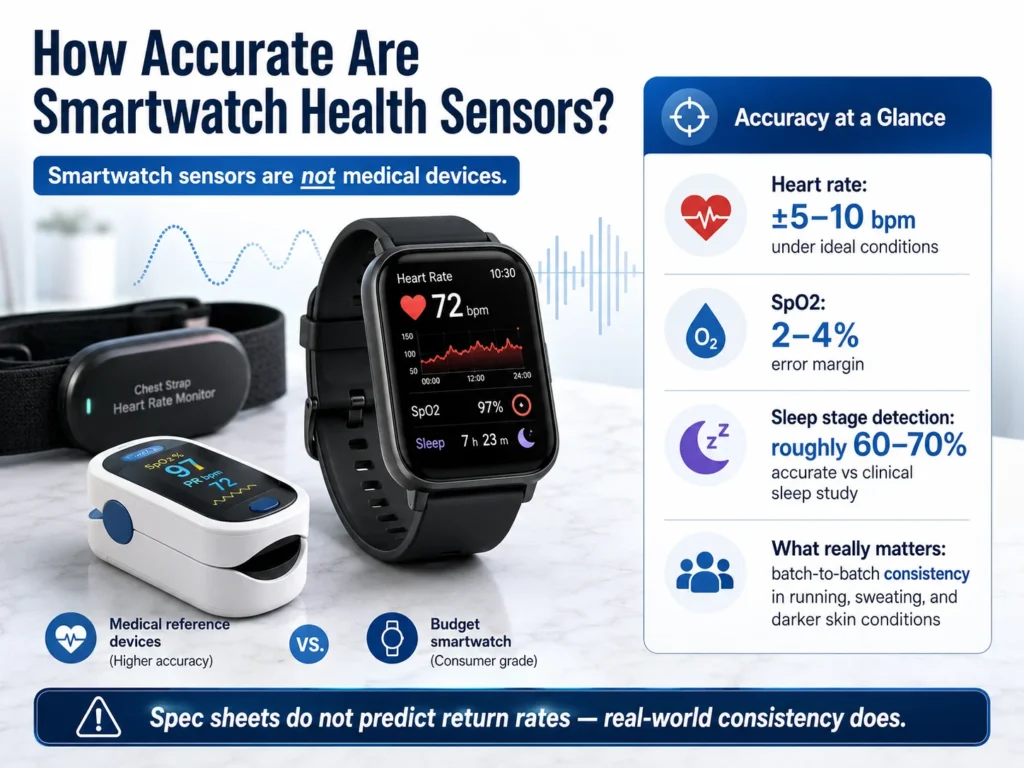
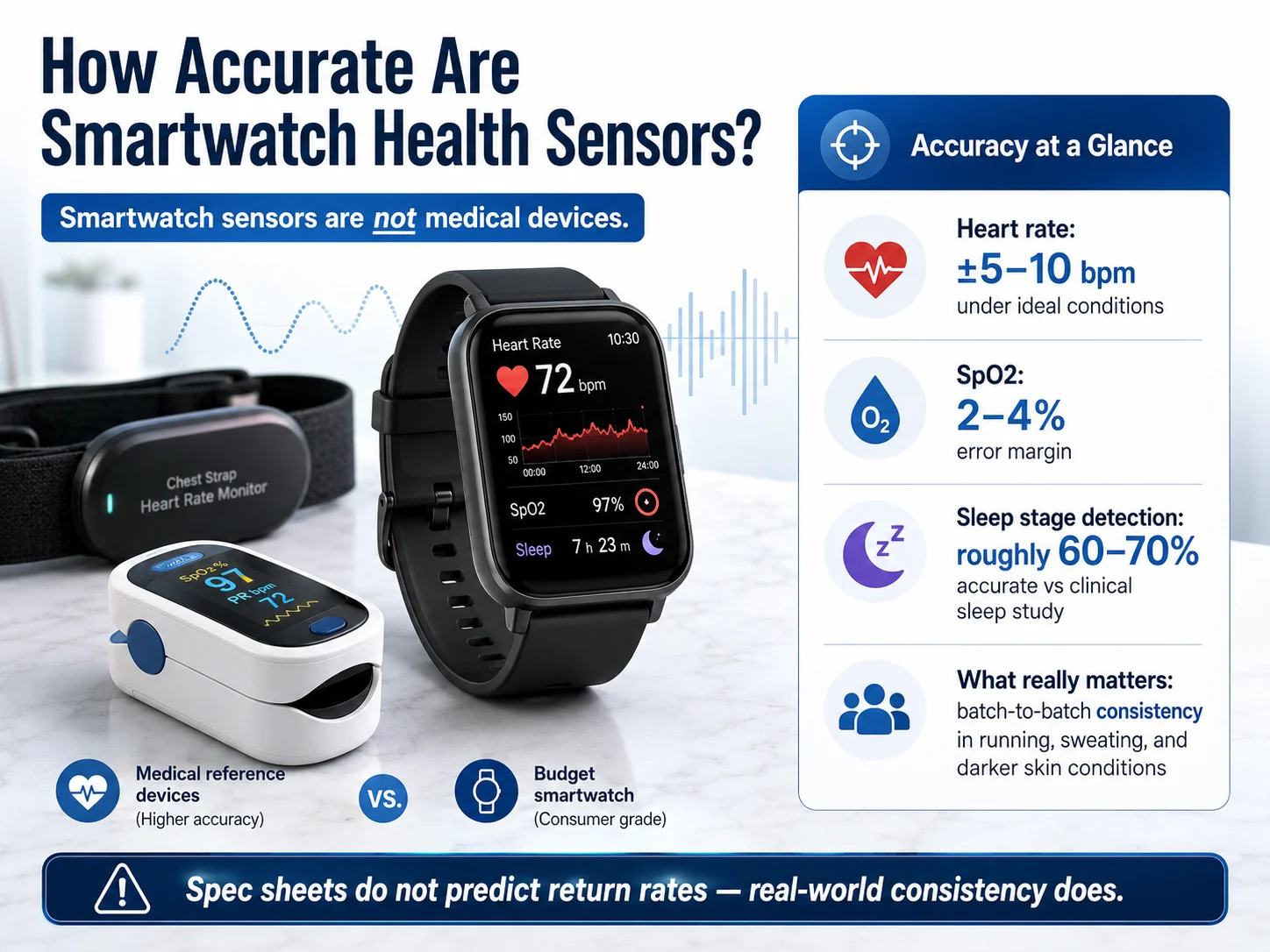
Smartwatch health sensors are not medical devices. In a $15–$35 BOM product, you can expect heart rate tracking within ±5–10 bpm under ideal conditions, SpO₂ readings with a 2–4% error margin, and sleep-stage detection that is roughly 60–70% accurate compared to a clinical sleep study1. The real question isn’t accuracy — it’s batch-to-batch consistency and how well the sensor holds up when your customer is running, sweating, or has darker skin. That’s what determines your return rate, not the spec sheet.
Transparency time: I’ve seen a $18 BOM optical sensor beat a $28 one in a side-by-side test, simply because the cheaper module had better mechanical fit with the wrist. That’s the kind of detail that won’t show up in a supplier’s PowerPoint. Let’s walk through what actually matters when you’re buying health-tracker smartwatches by the container load.
How Do Smartwatch Health Sensors Measure Heart Rate, SpO₂, Sleep, and Activity?
Most buyers think the sensor is a tiny camera. It’s not. It’s a photoplethysmography (PPG) system — green and red LEDs, plus a photodiode that catches the light bouncing back from your blood vessels.2 The problem? The signal is fragile. A one-millimeter gap between the sensor cover and the skin can turn a clean heartbeat into noise.
Smartwatches measure heart rate via green-light PPG, SpO₂ via red/infrared light ratios3, sleep via a combination of heart-rate variability and accelerometer data, and activity via a gyroscope and accelerometer4. All four depend on algorithms that assume a “standard” wrist and resting position — assumptions that break down in real-world use.
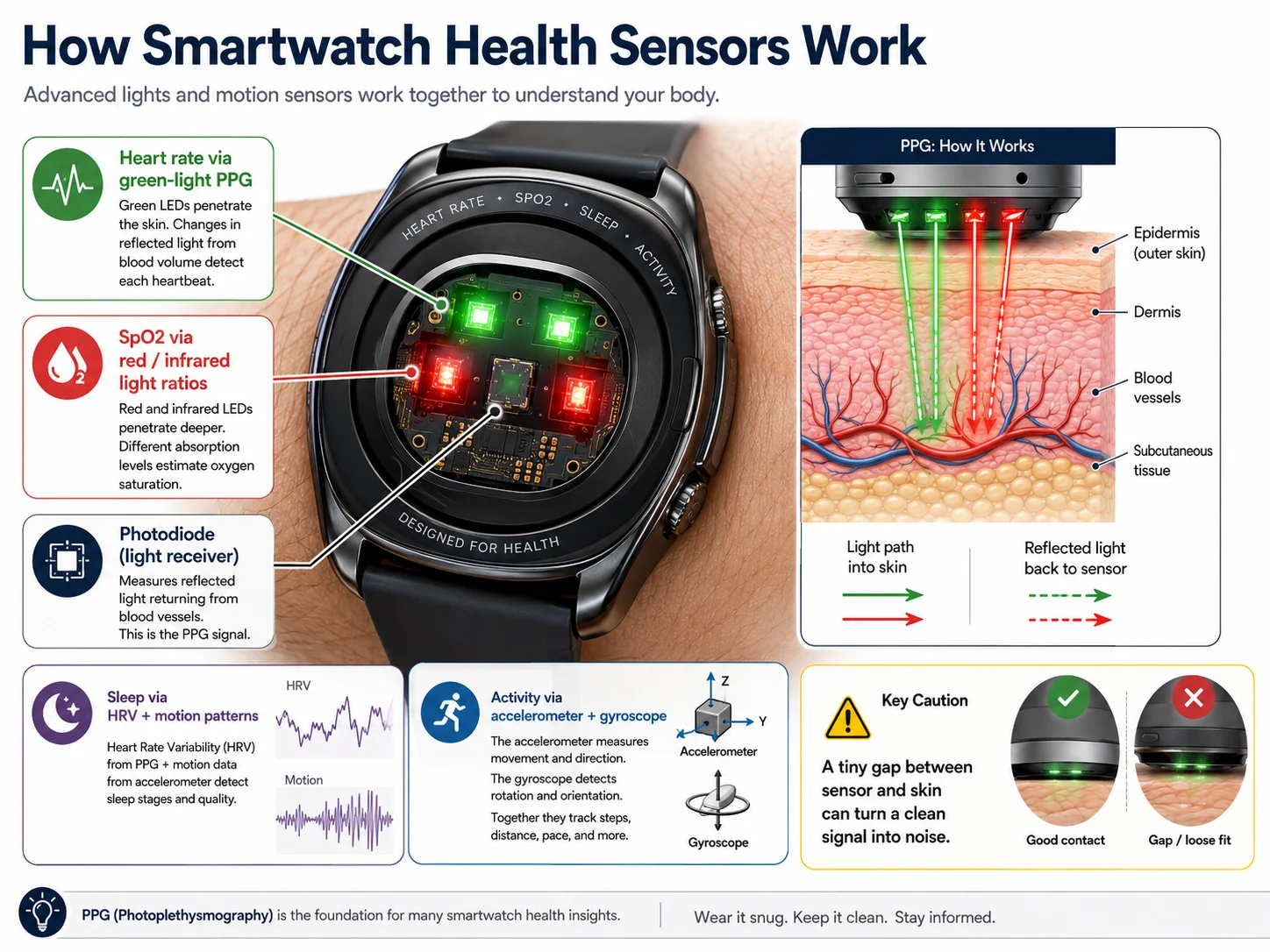
The real takeaway is that these sensors don’t “measure” things like a blood-pressure cuff. They infer. They guess. And the guess gets worse when the user is moving, when the strap is loose, or when the ambient temperature drops below 10°C5. I’ve personally tested prototypes where the resting heart rate was spot-on, but a brisk walk threw the reading off by 30 bpm. That’s not a defective unit — that’s the physics of optical sensing on a moving wrist. If you’re selling to fitness enthusiasts, you need to know this.
Comparison Table: Entry-Level, Premium Consumer, and Medical-Grade Health Sensors
Instead of a chip-model comparison, let’s look at what actually matters for your margin and liability:
| Tier | Typical BOM Cost per Module | Consistency Risk | Return Rate Signal | Typical Certification Path |
|---|---|---|---|---|
| Entry-Level (budget brands) | $1.80–$3.50 | High — batch drift common | 8–15% on health claims | CE/RoHS only; no medical claims |
| Premium Consumer (e.g. top-tier OEM) | $5.00–$9.00 | Medium — tighter QC | 3–6% | CE/RoHS + optional self-declaration |
| Medical-Grade (FDA-cleared) | $18.00+ | Low — traceable components | <2% | FDA 510(k), EU MDR, full clinical data |
Notice I didn’t list sensor brands. I’ve worked with Goodix, Realtek, and smaller Shenzhen fabless companies. The chip itself is rarely the problem. The problem is assembly: how the LED is aligned, how the lens is glued, how the factory calibrates the first 50 units versus the next 5,000. That’s a QC question, not a spec-sheet question.
Why Sensor Hardware Alone Does Not Determine Measurement Accuracy
Here’s a hard truth I learned the expensive way: a $6 optical sensor module can perform worse than a $3 one if the case design doesn’t press it evenly against the skin. I once had a customer reject an entire shipment because the SpO₂ readings were all over the place. The sensor was from a top-tier supplier. The problem? The back cover had a slightly domed shape that created a 0.4mm air gap on 30% of wearers. Fixing the mold cost $2,000. The lesson cost $80,000 in lost trust.
Accuracy is a systems problem, not a component problem. The sensor’s optics, the case geometry, the strap material, the firmware’s motion-artifact algorithm, and even the user’s skin type all interact.6 You can’t buy a sensor and expect it to work out of the box — you need to commission the whole wrist-contact system.
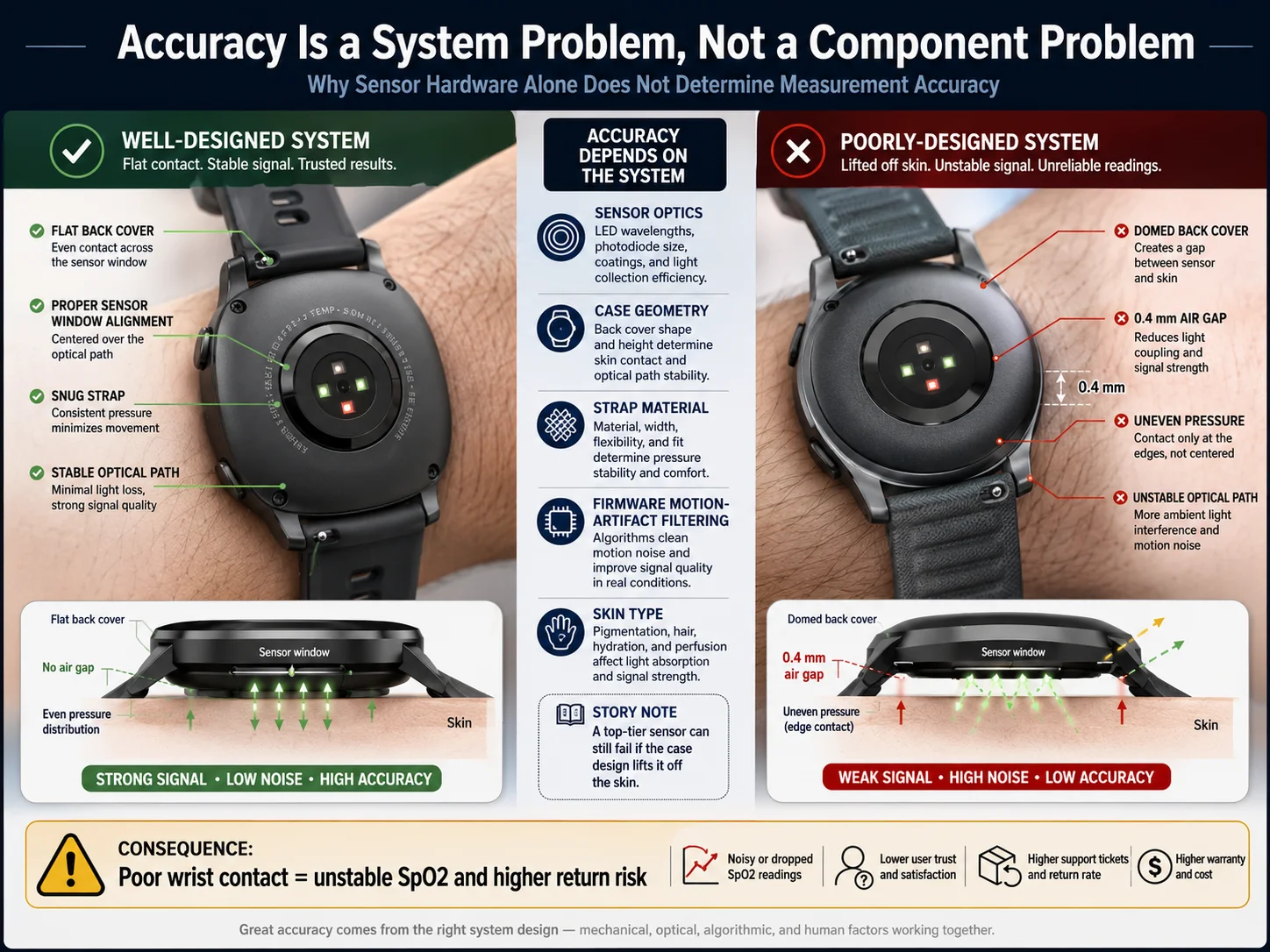
When you evaluate a factory, ask to see the sensor-mounting jig, not just the sensor datasheet. Ask how they test the spring-loaded contact pins after assembly. Ask about the durometer of the strap material that keeps the watch from sliding. These are the details that separate a 5% return rate from a 15% one.
How Algorithms, Firmware, Skin Contact, Movement, and Wearing Position Affect Results
Imagine you’re holding a flashlight under a running faucet. That’s what a PPG sensor sees when someone jogs. The firmware has to throw away the water-noise and reconstruct the heartbeat. Cheaper algorithms use simple threshold filters; they work fine on a desk but fail miserably on a treadmill. Better algorithms use adaptive filtering, but they cost more in R&D and require more flash memory. The firmware isn’t just “software” — it’s the second half of the sensor.
Firmware filters motion artifacts, skin tone and ambient light compensate for signal drift, while wearing position — too loose, too tight, over a tattoo — directly changes the raw optical signal. A 2mm shift in position can degrade accuracy by 30%.7 Good firmware can recover some of that, but not all.
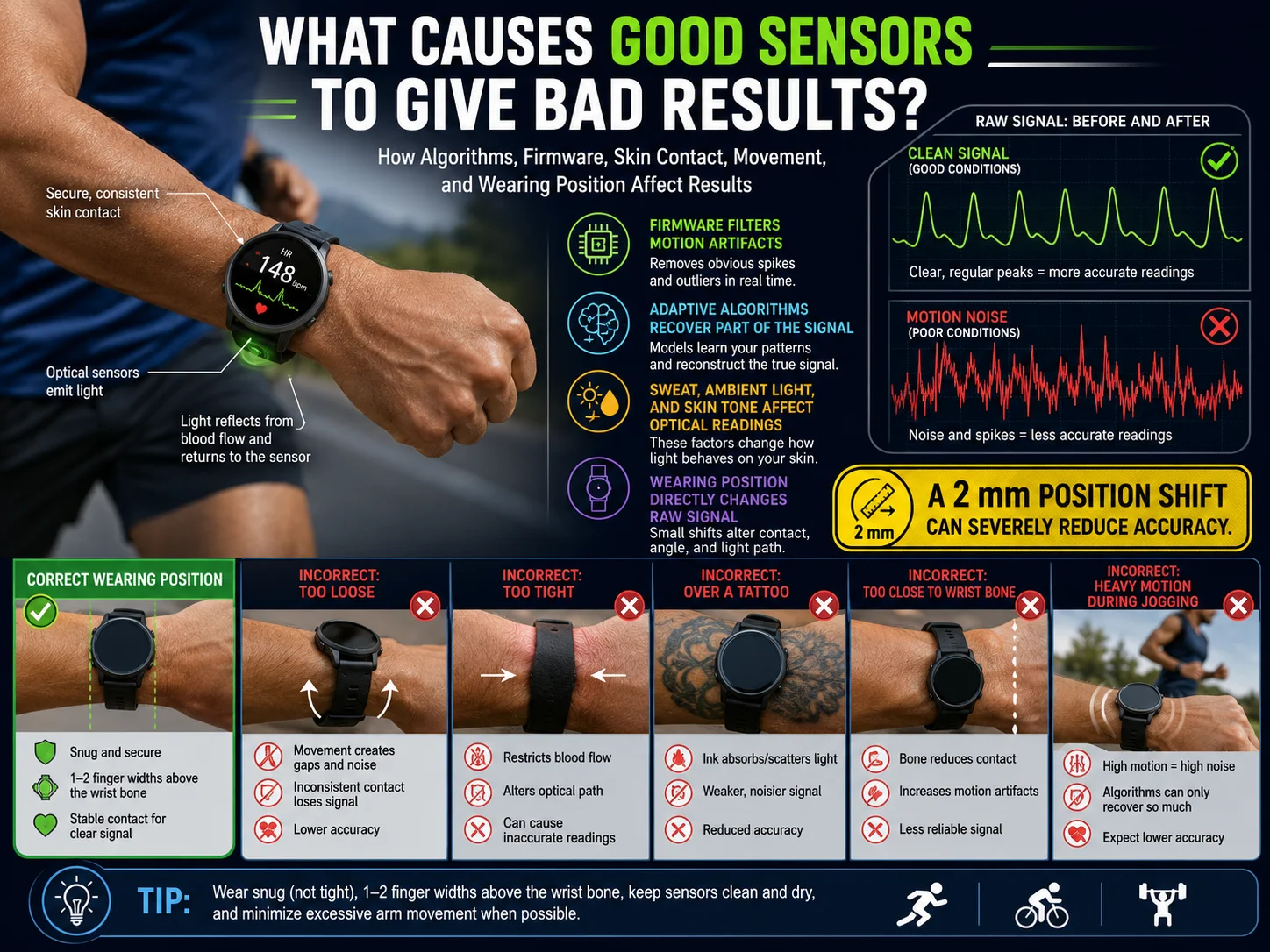
Skin contact is brutally simple: if the sensor isn’t flush, you get light leakage, and the signal-to-noise ratio tanks. I’ve seen cases where a customer’s hairy wrist reduced the usable signal by half. Some factories apply a wetting agent to the sensor cover during testing — don’t let them. Test with dry, real-world conditions. And always ask: “Does your firmware have a skin-tone compensation profile?” If the engineer hesitates, the watches will struggle with darker skin tones. That’s not a defect; it’s a design gap, and it’s your liability as the seller.
Which Sensor Specifications and Component Brands Should OEM Buyers Evaluate?
I’m not going to give you a list of “good” brands. Instead, I’ll tell you what a production manager looks at during a first factory visit. First, ask for the golden sample’s calibration report — not the marketing one, the engineering one. Look for these numbers:
- Signal-to-Noise Ratio (SNR): >10 dB at rest is decent; >6 dB during motion is what you need for a fitness watch.
- Wavelength drift: The LED peak wavelength should not drift more than 2 nm across the 0–50°C range. Cheap LEDs drift by 5–8 nm, and that ruins SpO₂ accuracy.8
- Photodiode dark current: A low-cost sensor with high dark current will drift in warm weather. I’ve seen batches where the resting heart rate crept up by 15 bpm after 30 minutes on the wrist, simply because the sensor heated up.
For component brands, I’ve had success with modules that use Osram or Everlight LEDs, but I’ve also seen no-name LEDs perform well when the factory has a tight incoming QC process. The real gate is whether the factory can show you a batch-consistency test: 50 units off the line, same firmware, same wrist phantom, 5 readings each, and the standard deviation. If the SD is under 3 bpm for heart rate, you’re in good shape. If it’s over 8 bpm, walk away.
How Should Buyers Test Heart Rate, SpO₂, Sleep, and Step-Tracking Accuracy?
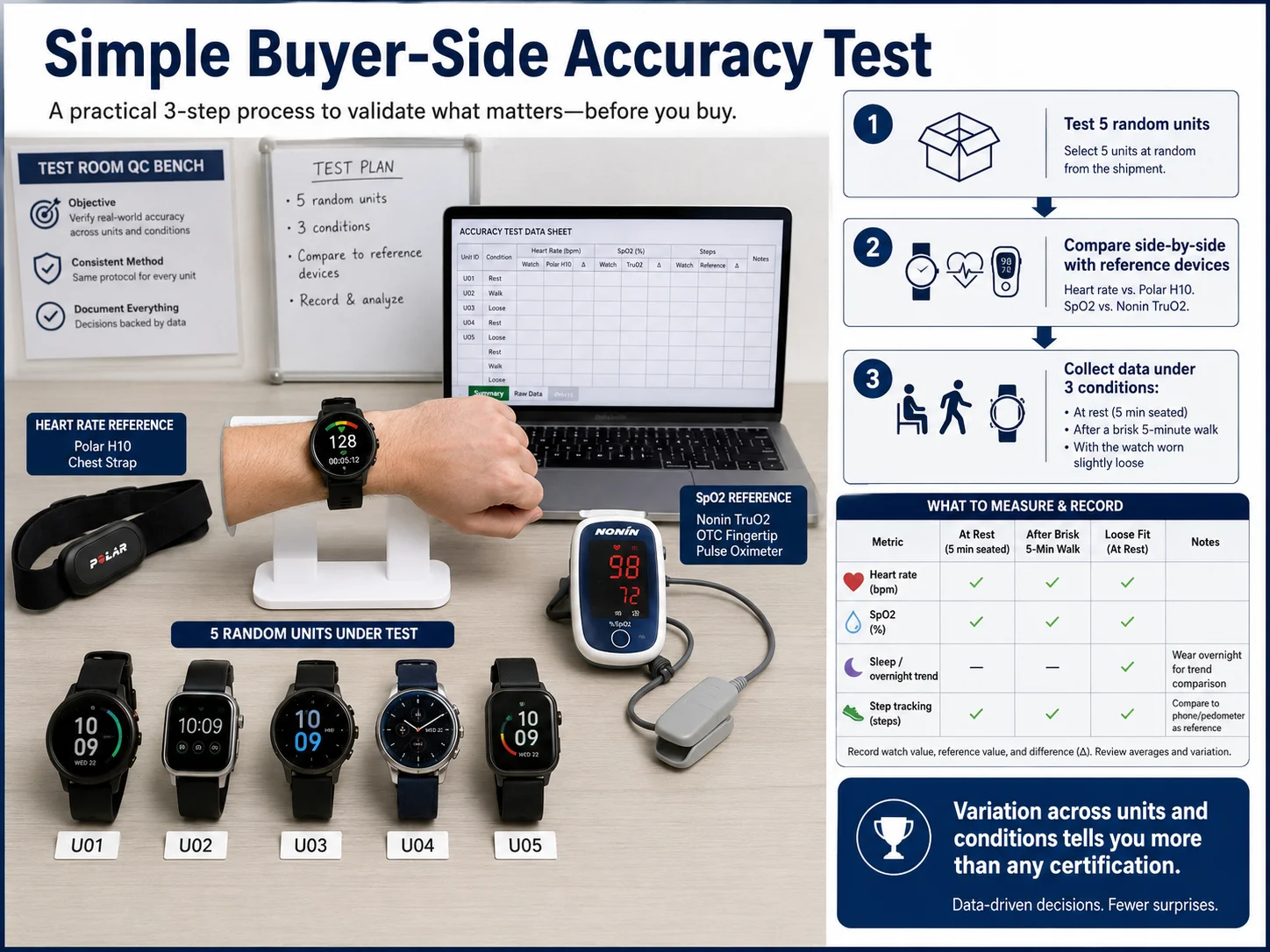
You don’t need a lab. You need a process that mimics a disgruntled customer. Here’s what I do in my own QC room:
A simple buyer-side test: take 5 random units, run a side-by-side comparison with a reference device like a Polar chest strap or a medical-grade finger pulse oximeter, and collect data under 3 conditions — at rest, after a brisk 5-minute walk, and with the watch worn slightly loose. The variation across units and conditions tells you more than any certification.
For sleep tracking, don’t test it against a sleep lab — you can’t. Instead, test it against another consumer sleep tracker and note the variance. The goal is not to prove it’s accurate; the goal is to prove it’s consistent. If the same person’s sleep data swings wildly between two nights with similar routines, the algorithm is unstable. That’s what will cause bad reviews saying “sleep tracking is random.” Also, test step tracking on a fixed-length walk — 100 steps manually counted. Off by 5% is fine; off by 15% is a problem.
Can an OEM Smartwatch Be Marketed as a Medical Device?
Short answer: in the EU and US, almost certainly not — unless you’ve gone through the full regulatory process. I’ve seen too many Amazon listings get pulled because the seller wrote “medical-grade heart rate monitor” in the title. The FDA doesn’t care that your supplier’s brochure says “CE medical.” CE marking under the old MDD is not the same as MDR compliance, and a self-declaration won’t hold up.
A generic OEM smartwatch is not a medical device. It can be marketed as a wellness or fitness tracker, but any claim of diagnosing, treating, or monitoring a disease triggers regulatory requirements.9 In the EU, the MDR boundary is strict; in the US, the FDA has been issuing warning letters for unapproved medical claims on consumer wearables.10
I’m not a lawyer, so I’ll say this: always consult your regulatory counsel. But from the factory floor, I can tell you that the health-sensor module you’re buying was designed for “reference and wellness,” not for clinical decision-making. The factory’s own disclaimer says “not for medical use.” If you slap a medical claim on the box, you’re the one taking the risk, not the supplier. I’ve seen buyers try to use a “for reference only” label as a shield. It’s not. It’s a red flag for regulators.
How to Set Realistic Customer Expectations and Avoid Misleading Health Claims
The easiest way to kill your product’s reviews is to overpromise. I advise my clients to use phrases like “daily wellness insights,” “fitness companion,” and “not a medical device” in the first paragraph of the product description. It feels counterintuitive — you want to sell the feature — but it actually builds trust. A customer who buys a $40 watch expecting a hospital-grade SpO₂ monitor is a return waiting to happen.
Frame sensor data as “trends” rather than “diagnoses.”11 Use language like “helps you understand your body’s patterns” instead of “detects irregular heartbeats.” Avoid clinical terms like “arrhythmia,” “blood oxygen saturation,” or “sleep apnea” unless you have the certification to back them up. Show the sensor’s limitations in the user manual, not just in a tiny footnote.
One of my customers, a UK-based Amazon seller, reduced his health-related returns by 40% simply by adding a 5-second video showing the correct wearing position and a note that says “readings may vary with movement.” The product didn’t change — the expectation did. That’s a lesson worth printing.
How to Choose a Reliable OEM Smartwatch Manufacturer for Health-Focused Products
After 15 years, I’ve boiled supplier selection down to three non-negotiable questions:
- Can I see the sensor calibration jig and the batch-consistency test report? Not a PowerPoint. The actual jig, with a phantom wrist, and a recent report with 50+ data points. If they squirm, they’re not doing it.
- What’s the firmware update policy? A health-sensor algorithm is never finished. You need a factory that can push firmware updates via a companion app, and that has a history of doing so. I’ve seen factories that never update, and six months later, a new iOS version breaks the SpO₂ reading.
- How do you handle sensor module QC at the incoming stage? Do they test every reel, or just sample? A factory that does 100% LED brightness and wavelength testing on incoming modules is a factory that cares about consistency. The ones that don’t, ship problems.
Also, visit the assembly line if you can. Look at how the sensor module is soldered to the mainboard. Look for a clean, flat back cover with no sharp edges around the sensor window. Look at the strap mold — does it have a stiffener near the sensor area to keep the watch from rocking? These are the details that determine whether a watch works on a real wrist, not just on a lab bench.
Frequently Asked Questions
Are smartwatch health sensors accurate enough to replace a doctor’s visit?
No. Smartwatch health sensors are for wellness tracking and trend observation, not for diagnosis. They can flag unusual patterns, but they should never be used to make medical decisions. Always consult a healthcare professional.
Why do heart rate readings sometimes spike during exercise?
Motion artifacts are the main culprit. When the watch moves relative to the skin, the optical sensor picks up noise that can be misinterpreted as a heartbeat. High-quality firmware can reduce these spikes, but no consumer-grade sensor eliminates them entirely.
Does skin tone affect smartwatch sensor accuracy?
Yes, it can. Darker skin tones absorb more light from the green LED, which can reduce the signal strength.12 Better sensors use adaptive LED brightness and algorithmic compensation. If a factory cannot show you a skin-tone compensation test, assume the sensor will underperform on darker skin.
Can I sell a smartwatch with SpO₂ monitoring without FDA clearance?
Generally, yes, as long as you do not make any medical claims and you market it as a wellness or fitness device. However, you must avoid language that implies it can diagnose or monitor a medical condition. The FDA’s enforcement has been focused on marketing claims, not the sensor itself.
How do I reduce returns caused by inaccurate health data?
Three things: set clear customer expectations in the product listing (mention it’s for “reference” and “fitness purposes”), include a wearing guide that shows correct positioning, and test a batch of watches yourself under real-world conditions before shipping. A 30-minute walk test with five units will reveal more than any supplier’s report.
Conclusion
When you’re buying smartwatch health sensors, you’re not buying a measurement tool — you’re buying a supply-chain risk. The accuracy that matters is batch-to-batch consistency, not the spec-sheet promise. I’ve watched too many buyers chase the “most accurate” sensor chip and ignore the boring stuff: case fit, strap design, firmware updates, and factory QC. The smart money is on the boring stuff.
If you’re sourcing health-tracker smartwatches this quarter, my advice is simple: don’t ask the supplier for a sensor model number. Ask for the batch-consistency report. Ask to see the calibration jig. Ask what happens when the user has a dark-skin tone or a hairy wrist. The answers you get will tell you everything you need to know about your return rate. And if you want to skip the guesswork, reach out to us — we’ve been building these products for 15 years, and we’ve already made the expensive mistakes so you don’t have to.
"Validity and clinical utility of a wrist-worn device against ... - PMC", https://pmc.ncbi.nlm.nih.gov/articles/PMC12483222/. Validation studies of consumer wearables report that agreement with electrocardiography, clinical pulse oximetry, and polysomnography depends on the device, activity, fit, and analytic endpoint; quoted accuracy ranges should therefore be tied to the tested models and protocols. Evidence role: statistic; source type: paper. Supports: Published validation studies or systematic reviews reporting error ranges for consumer wearable heart rate, oxygen-saturation, and sleep-stage estimates against appropriate reference standards.. Scope note: A general review cannot establish these exact ranges for every $15–$35 BOM smartwatch. ↩
"A review on wearable photoplethysmography sensors and ...", https://pmc.ncbi.nlm.nih.gov/articles/PMC6426305/. Photoplethysmography is an optical technique in which light emitted into tissue and detected after transmission or reflection is used to estimate pulsatile changes associated with blood volume. Evidence role: definition; source type: paper. Supports: A technical source should describe PPG as optical sensing of pulsatile blood-volume-related changes using emitted light and a photodetector.. Scope note: The optical wavelengths and signal-processing methods differ between reflected wrist PPG for pulse rate and pulse-oximetry estimation. ↩
"FDA Executive Summary Review of Pulse Oximeters and ...", https://www.fda.gov/media/162709/download. Conventional pulse oximetry estimates arterial oxygen saturation from the relative pulsatile optical absorption measured at red and infrared wavelengths. Evidence role: mechanism; source type: government. Supports: An authoritative source should explain that conventional pulse oximetry derives an oxygen-saturation estimate from pulsatile absorption measurements at red and infrared wavelengths.. Scope note: This mechanism does not by itself demonstrate the accuracy of a particular wrist-worn consumer device. ↩
"Heart Rate Variability and Firstbeat Method for Detecting ...", https://pmc.ncbi.nlm.nih.gov/articles/PMC7889416/. Wearable sleep and activity algorithms commonly combine movement features from inertial sensors with physiological features such as heart rate or heart-rate variability to classify behavioral states. Evidence role: mechanism; source type: research. Supports: Research literature should document the common use of actigraphy, accelerometry, heart-rate-derived features, and gyroscope data in wearable sleep and activity classification.. Scope note: Individual smartwatch models may use different sensors, features, and proprietary classification algorithms. ↩
"Sources of Inaccuracy in Photoplethysmography for ... - PMC", https://pmc.ncbi.nlm.nih.gov/articles/PMC8073123/. Studies of wrist photoplethysmography identify motion artifact, variable sensor–skin contact, and peripheral perfusion as important determinants of signal quality and measurement error. Evidence role: mechanism; source type: paper. Supports: Experimental literature should show how motion, sensor-skin coupling, and temperature-related changes in peripheral perfusion can affect wrist PPG signal quality and derived measurements.. Scope note: Evidence of temperature effects does not establish a universal accuracy cutoff at 10°C. ↩
"Photoplethysmography in Diverse Skin Tones: Evaluating Bias ... - PMC", https://pmc.ncbi.nlm.nih.gov/articles/PMC12592569/. Reviews of wearable photoplethysmography characterize measurement performance as a system-level outcome shaped by optical design, sensor placement and contact, motion processing, and inter-individual physiological and skin-related factors. Evidence role: general_support; source type: paper. Supports: A review should identify optical hardware, sensor placement and contact, motion-artifact processing, and participant characteristics as contributors to wearable PPG performance.. Scope note: Such evidence supports the multi-factor nature of performance but does not quantify the contribution of each factor for a specific watch design. ↩
"Optimization and pre-use suitability selection for wrist ... - PMC", https://pmc.ncbi.nlm.nih.gov/articles/PMC12450509/. Controlled PPG placement experiments are needed to determine whether small changes in sensor location materially alter signal quality or estimation error under specified conditions. Evidence role: statistic; source type: paper. Supports: A controlled placement study would need to quantify the effect of millimeter-scale sensor displacement on a clearly defined PPG-derived accuracy metric.. Scope note: Without a cited protocol and defined metric, the stated 2 mm and 30% values cannot be generalized. ↩
"Pulse Oximetry with Two Infrared Wavelengths without ... - PMC", https://pmc.ncbi.nlm.nih.gov/articles/PMC6211094/. Because pulse-oximetry calibration depends on the spectral characteristics of its red and infrared emitters, temperature-dependent wavelength changes can contribute to measurement uncertainty unless accounted for in device design and calibration. Evidence role: mechanism; source type: paper. Supports: Engineering literature should explain how temperature-dependent LED spectra can affect pulse-oximeter calibration and why wavelength control matters in optical oxygen-saturation estimation.. Scope note: This mechanism does not validate the article’s specific 2 nm, 5–8 nm, or price-based thresholds. ↩
"General Wellness: Policy for Low Risk Devices - Guidance", https://www.fda.gov/regulatory-information/search-fda-guidance-documents/general-wellness-policy-low-risk-devices. Under FDA policy, whether a product is regulated as a medical device depends principally on its intended use, including claims that it diagnoses, treats, mitigates, prevents, or otherwise addresses disease or conditions. Evidence role: definition; source type: government. Supports: FDA materials should distinguish low-risk general-wellness products from products whose intended use includes diagnosing, curing, mitigating, treating, or preventing disease.. Scope note: Device classification and enforcement risk require product-specific legal and regulatory assessment; a general-wellness label is not dispositive. ↩
"Do Not Use Unauthorized Devices for Measuring Blood ...", https://www.fda.gov/medical-devices/safety-communications/do-not-use-unauthorized-devices-measuring-blood-pressure-fda-safety-communication. EU MDR qualification is assessed in relation to a product’s intended purpose, and FDA warning letters provide case-specific evidence that marketing claims may trigger enforcement where products are promoted without required authorization. Evidence role: historical_context; source type: government. Supports: European Commission guidance should explain the intended-purpose test under the MDR, while FDA warning letters can document particular enforcement actions involving unauthorized device claims.. Scope note: Warning letters are fact-specific and do not establish that every consumer wearable or wellness claim is regulated in the same way. ↩
"General Wellness: Policy for Low Risk Devices - Guidance ...", https://www.fda.gov/media/90652/download. Regulatory guidance distinguishes general wellness communications from claims that a product diagnoses or manages disease; marketing language should accurately reflect the product’s intended use and substantiated capabilities. Evidence role: expert_consensus; source type: government. Supports: FDA and consumer-protection guidance should support the distinction between general wellness communications and disease-diagnosis claims in product marketing.. Scope note: Describing outputs as trends does not alone exempt a product from regulation if its overall labeling, functionality, or promotional context conveys a medical intended use. ↩
"Photoplethysmography in Diverse Skin Tones: Evaluating Bias ... - PMC", https://pmc.ncbi.nlm.nih.gov/articles/PMC12592569/. Optical measurement performance may vary across skin-pigmentation groups, and evaluation of pulse-oximetry and related optical technologies should include representative populations and transparent accuracy reporting. Evidence role: general_support; source type: government. Supports: Authoritative reviews or regulator materials should address how skin pigmentation and other patient factors may influence optical measurement performance and the need for representative validation.. Scope note: Evidence from clinical pulse oximeters or a subset of wearables does not prove the performance of every smartwatch PPG implementation. ↩