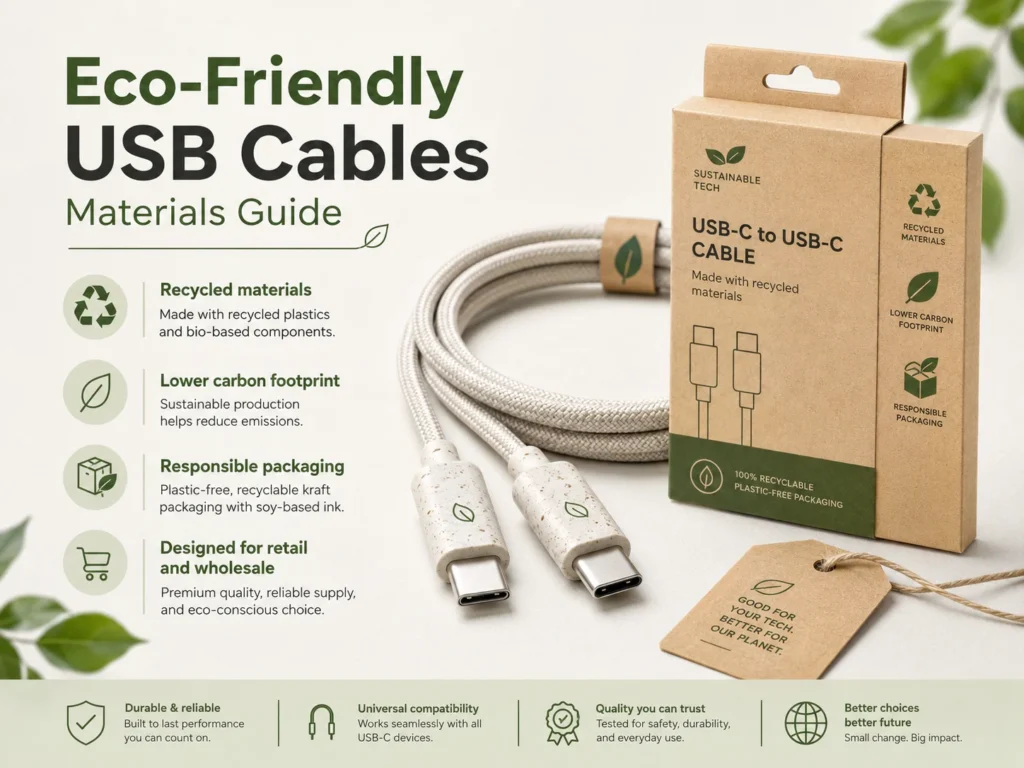
Eco-friendly USB cables are now a serious buying category for retailers, importers, and online sellers. However, many products use broad “green” claims that are hard to verify. This creates a real risk: buyers may order a cable with an appealing sustainability story but weak evidence, inconsistent quality, or claims that cannot be used safely in their target market.
Eco-friendly USB cables can use recycled plastics, bio-based materials, reduced packaging, or other lower-impact design choices, but buyers must verify exactly which component the claim covers. A responsible purchase decision should also confirm material evidence, charging and data performance, durability, MOQ, lead time, packaging, and market-specific marketing requirements before listing the product.
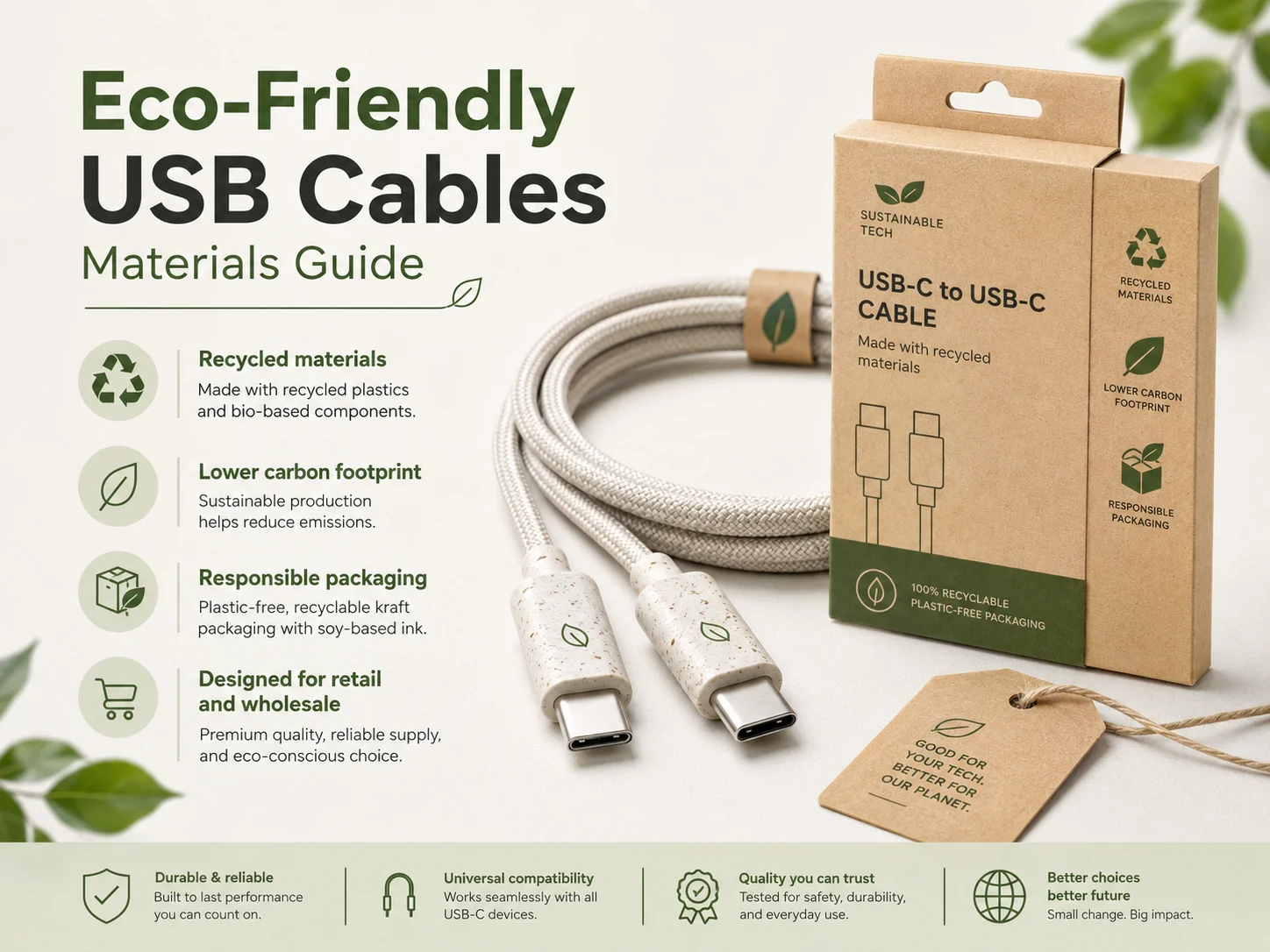
From our Shenzhen factory-side discussions, I have seen that the best sustainable cable projects start with precise questions. Buyers should not simply ask, “Is this cable eco-friendly?” They should ask what material is used, where it is used, how much recycled or bio-based content is present, and what documents can support the final claim.
Quick Answer: What Makes an Eco-Friendly USB Cable More Eco-Friendly?
Many buyers want a quick answer because product listings need simple language. The problem is that simple language can quickly become misleading. If a cable has a PCR connector shell but a conventional PVC jacket, calling the entire product “100% sustainable” would not be accurate.
An eco-friendly USB cable is generally a cable designed with one or more lower-impact elements, such as PCR plastic connector housings, bio-based TPE cable jackets, reduced-plastic packaging, recyclable paper boxes, or longer-lasting construction. The claim should identify the specific component, material, and verified content where available. It should never imply that the whole cable is biodegradable, zero-impact, or fully recyclable unless evidence supports that statement.
A cable is a multi-material product
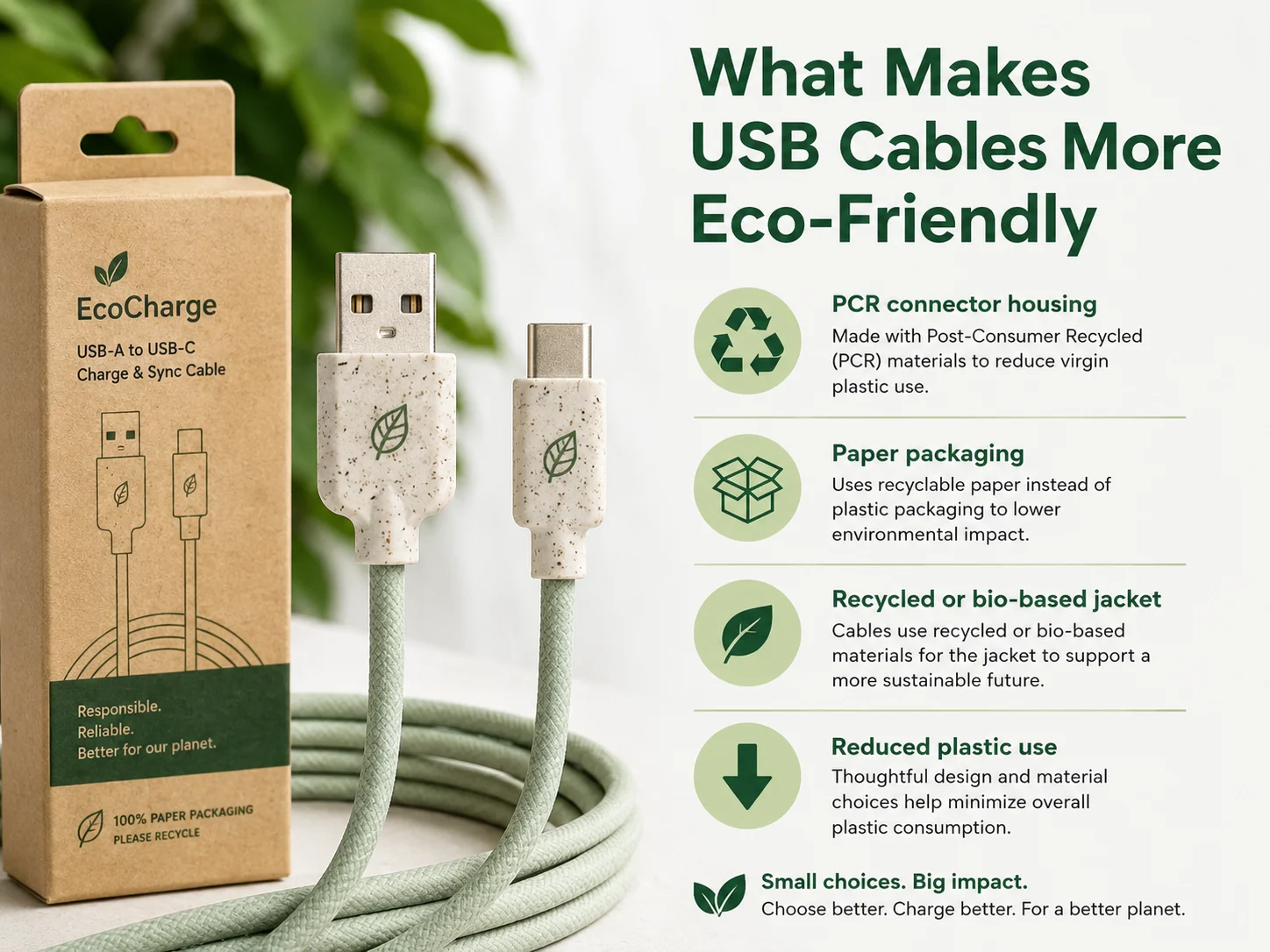
A standard USB cable contains several different material groups.1 The outer jacket is only one part of the product. The connector housing, strain relief, internal wire insulation, shielding, metal terminals, braiding, glue, and packaging may all use different materials.
This matters because a sustainability claim can apply to only one component.
For example, we may develop a USB-C to USB-C cable with:
- A PCR ABS connector housing
- A bio-based TPE outer jacket
- Standard copper conductors
- Aluminum alloy shells or metal plugs
- FSC-style paper packaging, subject to applicable certification and approval
- A reduced-plastic inner tray
That cable may have a stronger sustainability story than a fully conventional model. Still, it is not automatically “fully eco-friendly” in every sense. It contains mixed materials, and its end-of-life recycling options depend on local collection systems and product construction2.
In our pre-sales conversations, experienced European buyers often ask one useful question first: “Which exact part is recycled?” That question usually prevents confusion later.
A good product specification should state:
- Which component uses the claimed material
- The material type, such as PCR ABS, PCR PC, or bio-based TPE
- The percentage or range, if the supplier can provide support
- Which documents are available
- Any limits on colors, finishes, or production consistency
This approach gives retailers a clearer listing and reduces the chance of overclaiming.
Why Is Demand Growing for Sustainable USB Cables and Tech Accessories?
Retailers face pressure from consumers, platforms, and internal purchasing teams to offer products with a more responsible story. At the same time, basic charging accessories are crowded and price-sensitive. A standard cable can be difficult to differentiate when dozens of similar items compete on the same shelf or marketplace page.
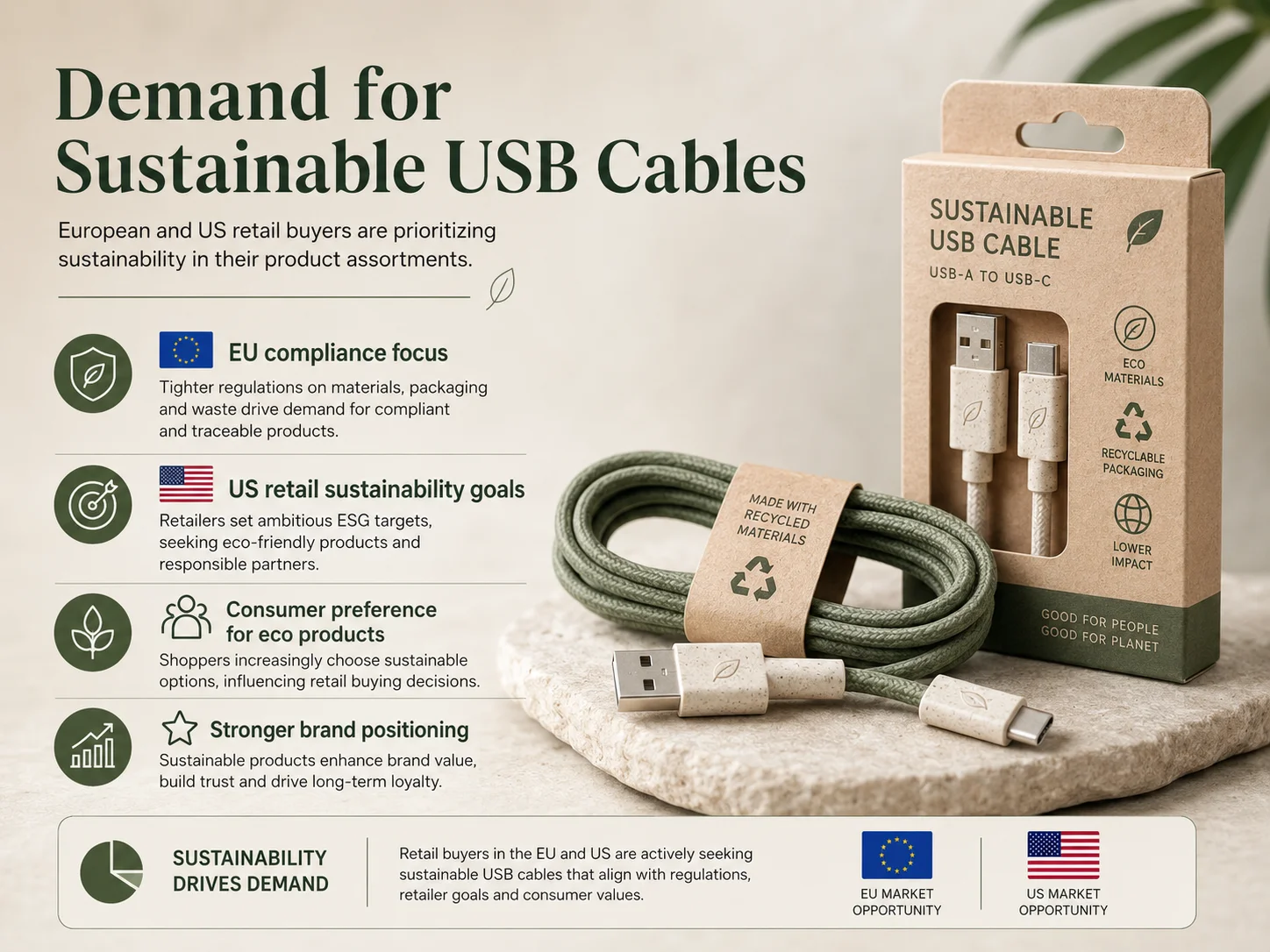
Demand for sustainable USB cables and tech accessories is growing3 because buyers want practical ways to improve product positioning without changing their entire assortment. PCR plastic, bio-based materials, and lower-waste packaging can help brands create a more differentiated cable range, provided that the product quality and sustainability claims are supported by clear evidence.
Sustainability has become a commercial feature
For many accessory buyers, sustainability is not the only purchase factor. It is one part of a broader commercial decision. The cable must still charge reliably, look good, fit the price point, and arrive on time.
We commonly hear these questions during buyer discussions:
- Can we use PCR material without changing the cable color too much?
- Can the cable still pass our bend and pull expectations?
- Does the sustainable version need a higher MOQ?
- Can we print a recycled-content claim on the packaging?
- Can we use the same retail box design for the US and Europe?
- Will the material delay production during peak season?
These are practical questions. They show that buyers are moving beyond vague sustainability language and toward a more operational approach.
Why USB cables are a logical starting point
USB cables are often suitable for a sustainability-focused assortment because they are:
- High-volume accessories
- Frequently purchased as replacements or add-ons
- Easy to bundle with chargers, power banks, earbuds, or mobile accessories
- Available in multiple price tiers
- Suitable for private-label packaging and branding
- Familiar to consumers
A retailer does not need to rebuild its full electronics category at once. It can start with a small sustainable charging range: one USB-C to USB-C cable, one USB-A to USB-C cable, and one multi-port charger in reduced-plastic packaging.
From our manufacturing perspective, the strongest programs usually begin with a limited number of SKUs. The buyer can validate consumer response, packaging claims, return rates, and price acceptance before expanding the range.
Comparison Table: Virgin Plastic vs PCR Plastic vs Bio-Based Materials for Eco-Friendly USB Cables?
Material choices can sound simple in a presentation but become more complex during sampling. Different formulations affect color, texture, mold flow, odor, flexibility, supply stability, and cost. Buyers need a realistic comparison rather than a marketing slogan.
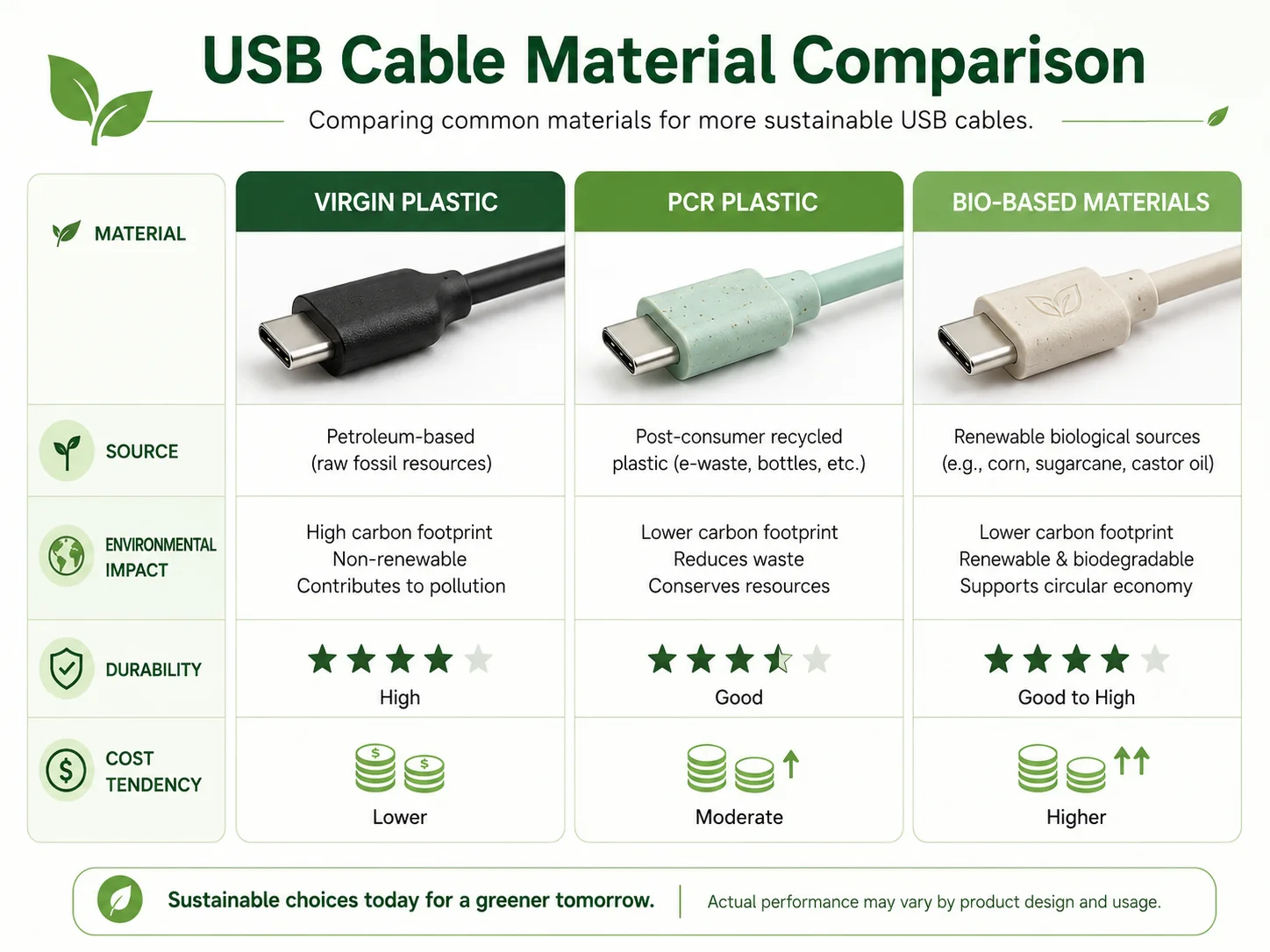
For eco-friendly USB cables, virgin plastic, PCR plastic, and bio-based materials each have different strengths and trade-offs. Virgin materials often offer the widest color and consistency options. PCR materials support recycled-content claims but may need closer appearance and quality control. Bio-based TPE can support renewable-feedstock positioning, but buyers should verify the exact formulation, content basis, and product suitability.
| Material Option | Typical Use in Cables | Main Advantage | Key Buyer Consideration | Claim Example to Verify |
|---|---|---|---|---|
| Virgin ABS / PC / TPE | Housings, jackets, strain relief | Consistent appearance and broad design flexibility | Does not support recycled-content positioning by itself | “Conventional material” |
| PCR ABS / PCR PC | Connector shells, housings, some molded parts | Supports recycled-content story | Color variation, surface marks, and supply consistency may vary | “Housing contains X% PCR material” |
| PCR TPE | Cable jackets or soft molded parts | Can combine soft-touch feel with recycled content | Formula suitability depends on flexibility and finish needs | “Jacket contains recycled content” |
| Bio-based TPE | Outer jackets, soft-touch components | Supports renewable-material positioning | Bio-based does not mean biodegradable4 | “Jacket uses bio-based TPE” |
| Paper-based packaging | Retail boxes, sleeves, inserts | Reduces plastic packaging options | Coating, ink, and certification claims need review | “Plastic-reduced paper packaging” |
Material selection is a product-design decision
We do not recommend selecting a material based only on the strongest possible claim. The right material depends on the cable’s target position.
A premium 240W USB-C cable may need a particular jacket feel, high flexibility, strong strain relief, and a clean visual finish. A promotional 1-meter charging cable may prioritize cost, color options, and short lead time. Those projects may require different material solutions.
Here is a practical way to compare options:
| Buyer Priority | Often Suitable Starting Point |
|---|---|
| Strong recycled-content message | PCR connector housing plus paper packaging |
| Soft premium cable feel | Bio-based or selected PCR TPE jacket, after sampling |
| Lowest development risk | Standard cable design with PCR housing and revised packaging |
| Natural or earthy retail appearance | PCR material in dark colors or speckled finishes |
| Fast private-label launch | Existing mold with approved sustainable packaging options |
Dark colors, black, gray, green, and earthy tones can sometimes be easier for PCR-based components because they may better manage natural variation. However, every project needs actual sample review. A material that works well in one mold, color, and finish may not deliver the same result in another.
What Is PCR Plastic and How Is It Used in Eco-Friendly USB Cable Components?
“PCR” is frequently used in accessory marketing, but buyers may not always know what it means. This creates a gap between the sales claim and the technical specification. If the supplier cannot explain where the PCR material is used, the buyer should pause before using the claim publicly.
PCR, or post-consumer recycled plastic, is material recovered from consumer waste streams and processed for reuse in new products.5 In eco-friendly USB cables, PCR plastic is commonly used for connector housings, overmolded shells, strain-relief parts, and selected packaging components. The feasible percentage and appearance depend on the resin type, formulation, tooling, color, and functional requirements.
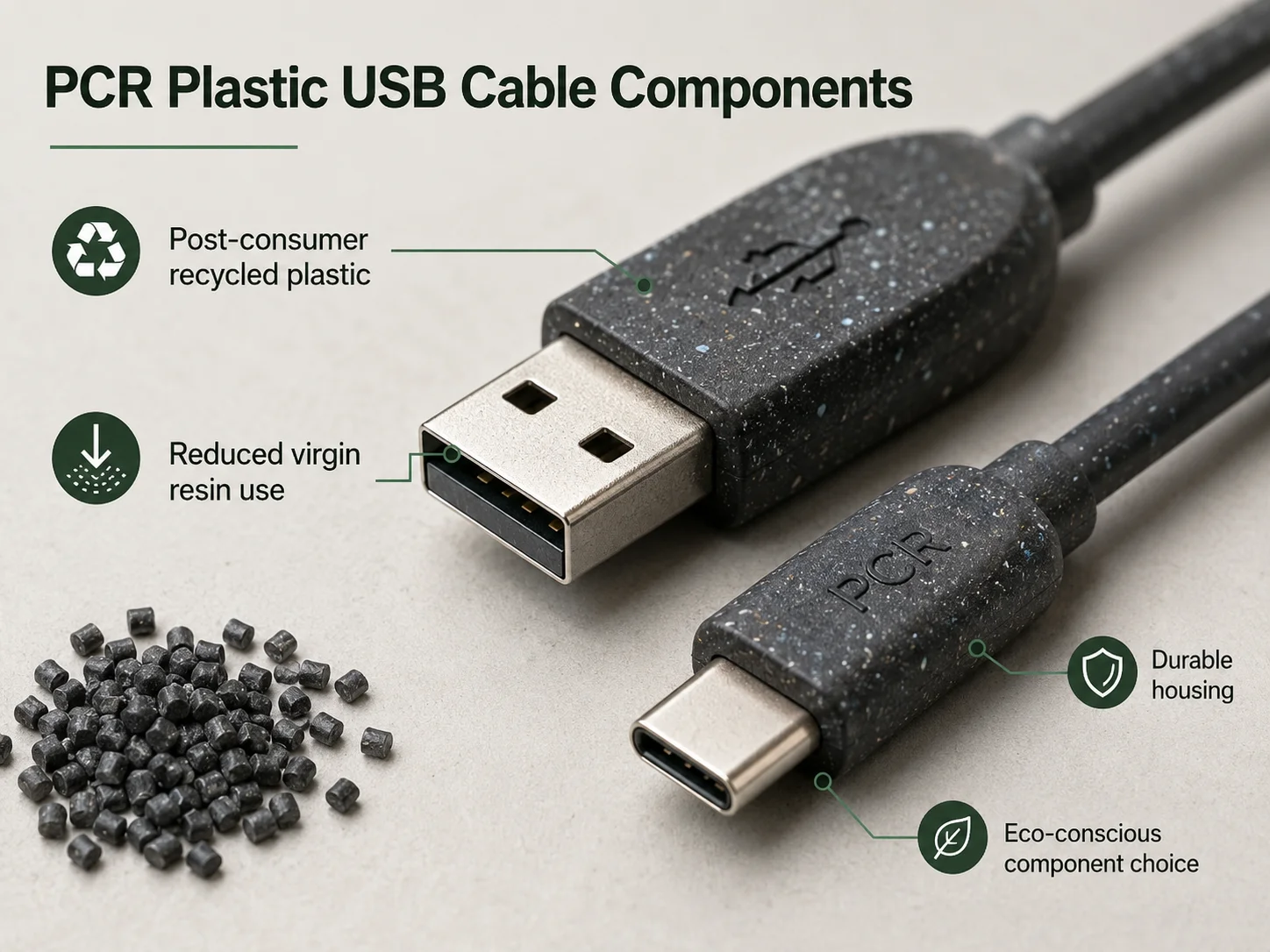
Common PCR applications in cable production
For USB cable projects, PCR material is often most practical in rigid or semi-rigid external parts. These include:
- USB-C connector housings
- USB-A connector shells
- Lightning-style connector housings where applicable
- Overmolded strain-relief sections
- Cable organizers or clips
- Retail packaging trays
- Display hooks and accessory inserts
The outer cable jacket may also use recycled-content material in some designs. Still, that decision needs more development review because jackets must remain flexible, resist cracking, tolerate repeated bending, and maintain a consistent surface feel.
What buyers should request
A PCR claim should be supported by more than a verbal assurance. We normally recommend that buyers request:
- A material declaration identifying the PCR resin or compound
- The claimed recycled-content percentage or range, where available
- Supplier documentation for the material source or certification, if applicable
- A product bill of materials or component map
- Sample approval records showing the relevant component
- Final packaging artwork that uses precise claim wording
For example, “USB-C connector housing made with PCR plastic” is more precise than “100% recycled cable.” The first statement identifies the relevant part. The second statement may create a much broader consumer impression than the product can support.
PCR material also needs production control. Recycled feedstock can show variation between batches.6 We therefore discuss color, surface texture, gloss level, and acceptable visual tolerance before mass production. That conversation is not a problem; it is part of responsible sourcing.
What Is Bio-Based TPE and How Does It Compare with Conventional Cable Jackets?
Buyers often like the phrase “bio-based” because it sounds modern and renewable. However, it can mean different things depending on the compound and supplier documentation. The biggest mistake is to treat bio-based material as automatically biodegradable or environmentally harmless.
Bio-based TPE is a thermoplastic elastomer made partly from renewable biological feedstocks rather than only fossil-based inputs.7 In USB cable designs, it may be used for flexible cable jackets, strain relief, or soft-touch external parts. Bio-based TPE can offer a compelling material story, but buyers should confirm its percentage, component use, durability, appearance, and claim language before launch.
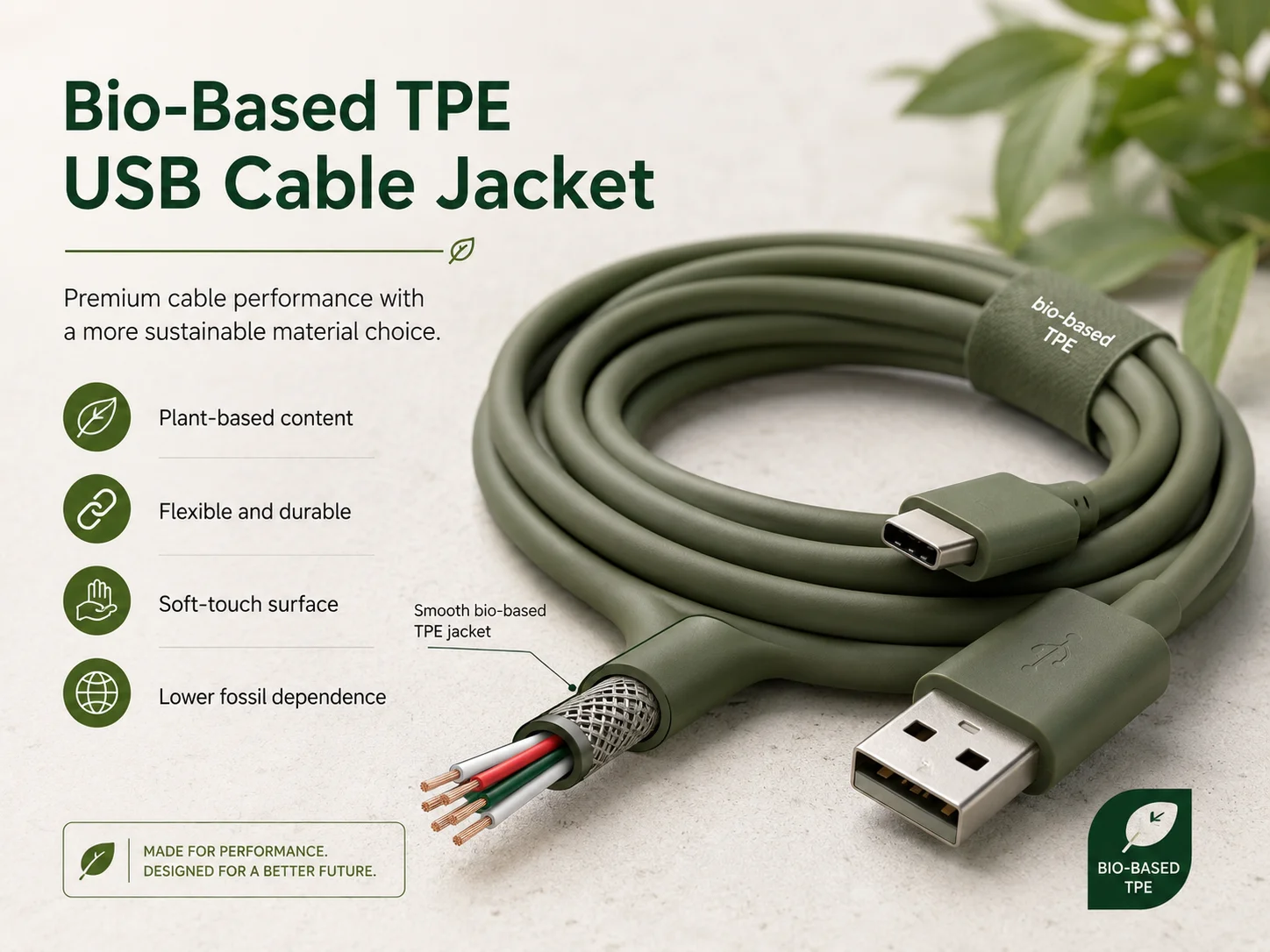
Why TPE matters in cable jackets
TPE is widely used in cable production because it can provide flexibility, soft touch, and efficient processing. Conventional TPE is usually fossil-based. A bio-based version can replace part of the feedstock with renewable sources, depending on the formulation.
The final cable experience still matters. A jacket must feel right in the hand, resist everyday wear, and suit the product’s intended use.
We usually review these points during sampling:
- Flexibility at normal indoor temperatures
- Surface feel and grip
- Matte versus glossy finish
- Color matching and print quality
- Odor expectations
- Resistance to common handling and bending
- Compatibility with connector overmolding
- Stability during production runs
Bio-based does not mean biodegradable
This distinction is essential for retail communication. A bio-based TPE cable jacket may contain renewable-origin material, but that does not mean the finished cable will break down safely in home compost, industrial compost, soil, or landfill conditions.
The cable also contains copper, metal connectors, internal insulation, and other mixed materials. We advise buyers to avoid claims such as:
- “Compostable USB cable”
- “Fully biodegradable charging cable”
- “Zero environmental impact”
- “Plastic-free cable” when plastic remains in the cable design
A more responsible description may be:
“Cable jacket made with bio-based TPE, subject to supplier material documentation.”
The exact final wording should be reviewed against the buyer’s product documents and target-market requirements. We can support with factory and material information, but we do not position ourselves as a legal advisor or lifecycle-assessment authority.
Are Eco-Friendly USB Cables as Durable as Standard USB Cables?
Some buyers worry that recycled or bio-based materials will make a cable feel weaker. Other buyers assume that a sustainable material will perform exactly the same as a conventional material. Both assumptions can be risky because cable performance depends on the full design, not just one material label.
Eco-friendly USB cables can be durable when their materials, connector design, wire specification, strain relief, and production controls are matched to the intended use.8 However, PCR plastic and bio-based materials should be validated through product-specific samples and tests. Buyers should confirm charging, data transfer, bending, pull strength, finish, and batch consistency instead of relying on sustainability claims alone.
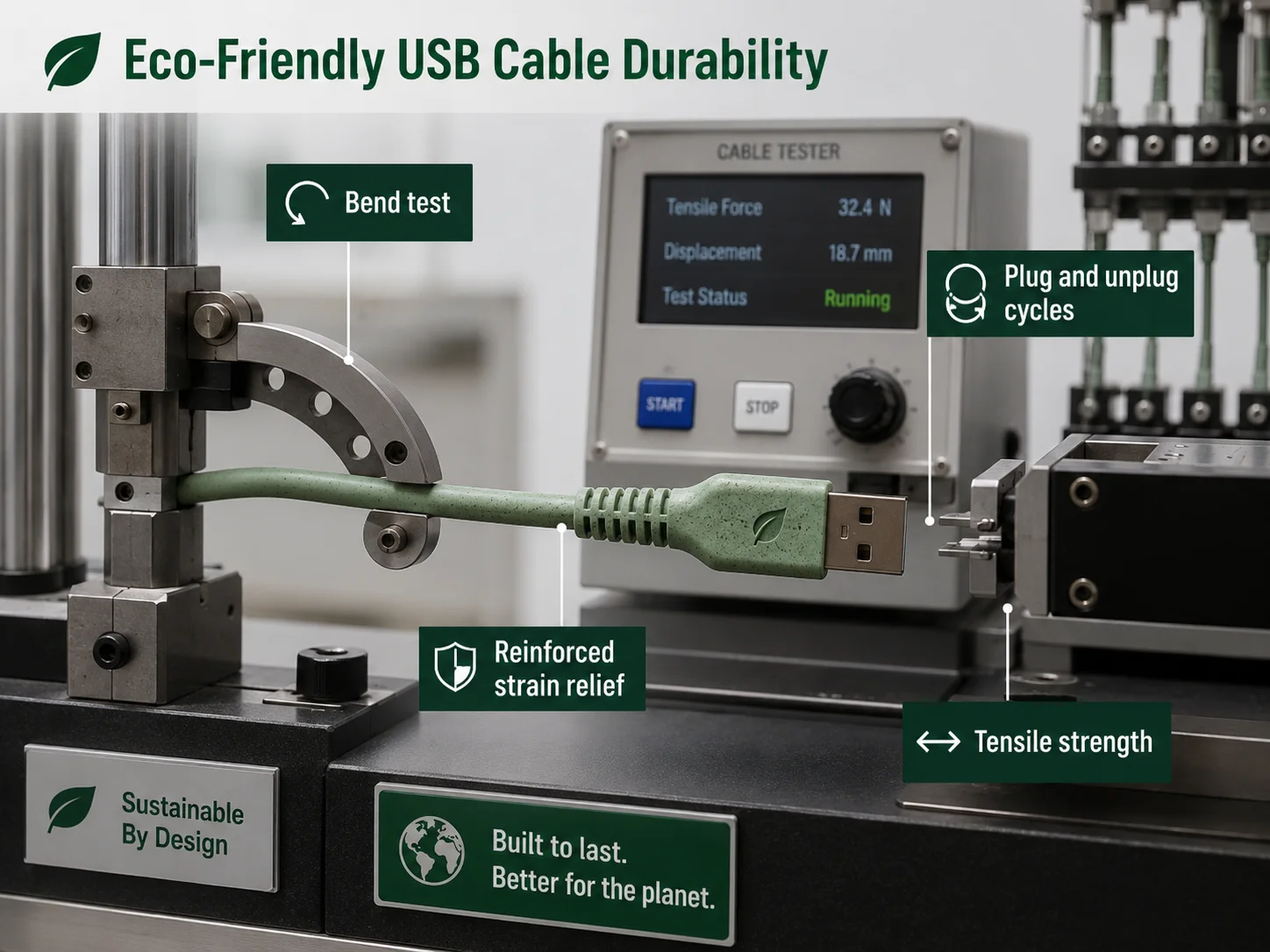
Core performance checks still come first
A cable can have excellent sustainability documentation and still fail as a consumer product. For most retail channels, we recommend confirming these basics:
| Check Area | What the Buyer Should Confirm |
|---|---|
| Charging | Supported wattage and charging protocol compatibility |
| Data transfer | USB generation, stated speed, and device compatibility |
| Conductors | Wire gauge and copper specification |
| Connector fit | Plug insertion, retention, and housing quality |
| Bending | Test method, bend location, and acceptance criteria |
| Pull strength | Cable-to-connector connection strength |
| Appearance | Color, molding line, texture, logo, and packaging consistency |
| Safety and compliance | Applicable product and chemical requirements for the destination market |
A USB-C cable sold for 60W charging should not be marketed as a 240W cable9 simply because it uses a PCR connector shell. Material claims do not replace electronic specifications.
Sample before scale
In our experience, the most useful stage is the pre-production sample review. Buyers should assess the cable as consumers would:
- Does the jacket feel premium or too sticky?
- Does the connector look clean under retail lighting?
- Does the printed claim match the actual component?
- Does the cable coil well for packaging?
- Does the color remain consistent across samples?
- Does the packaging protect the connector during shipping?
For higher-volume programs, buyers may also request agreed inspection standards and third-party testing where appropriate. The actual test plan should reflect the product, target market, and retail requirements.
How Much Do PCR Plastic, Bio-Based Materials, and Eco-Packaging Affect Cost?
Cost is often the first concern after buyers approve the sustainability concept. The problem is that there is no single percentage uplift for every cable. Material availability, cable length, connector design, color, packaging, order quantity, and testing scope all affect the final price.
PCR plastic, bio-based materials, and sustainable packaging can increase the cost of eco-friendly USB cables10, but the impact varies by component and order scale. A PCR connector housing may create a modest increase, while a custom bio-based cable jacket, new tooling, special packaging, or third-party verification can add more. Buyers should request a component-level quotation rather than assume a fixed premium.
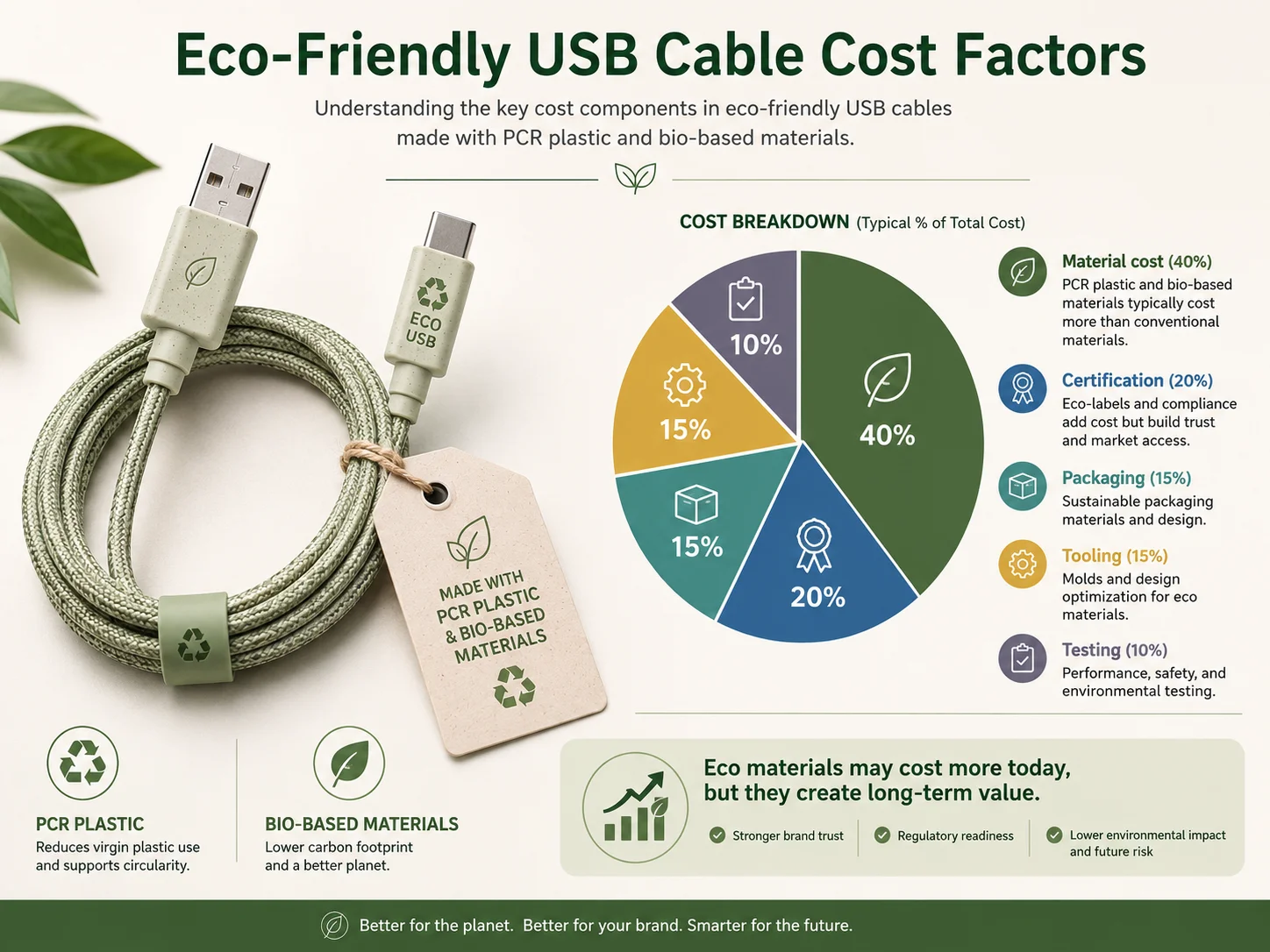
Where the extra cost can come from
The final quotation may include several cost drivers:
-
Material compound cost
Selected PCR or bio-based compounds may cost more than conventional resin. Availability can also change over time. -
Color and finish control
Custom white, pastel, or high-gloss finishes may require more development than darker recycled-material designs. -
MOQ requirements
Material suppliers may have their own minimum purchase quantity. A low-volume cable order may not absorb that requirement efficiently. -
Packaging changes
Paper inserts, molded pulp, reduced-plastic trays, special inks, or certification-related packaging work can affect cost. -
Testing and documentation
Buyers may need chemical testing, material declarations, product reports, or claim substantiation documents. -
Development time
New materials can require more sample rounds before mass production.
How to control the commercial risk
We often suggest a phased approach. Start with an existing cable platform and change one or two visible elements, such as the connector housing and packaging. This reduces tooling risk and speeds up the launch.
For example:
- Phase 1: Existing 60W cable + PCR connector shell + paper box
- Phase 2: Add a bio-based TPE jacket after sample validation
- Phase 3: Add a full sustainable accessory range with charger, cable, and TWS packaging
This method gives retailers a clear story without forcing every material change into the first order. It also helps buyers compare sell-through and margin against conventional cable lines.
What Material Documents, Testing, and Sustainability Claims Should Buyers Verify?
A good-looking sample is not enough when a buyer plans to use environmental claims online or on retail packaging. Without supporting documents, the buyer may struggle to answer questions from marketplaces, retailers, consumers, or internal compliance teams.
Buyers of eco-friendly USB cables should verify the material claim, the component covered, supporting declarations or certificates, product performance reports, packaging details, and destination-market requirements. Documents should be reviewed as a set because a PCR or bio-based material statement alone does not prove every claim made on the finished retail product.11
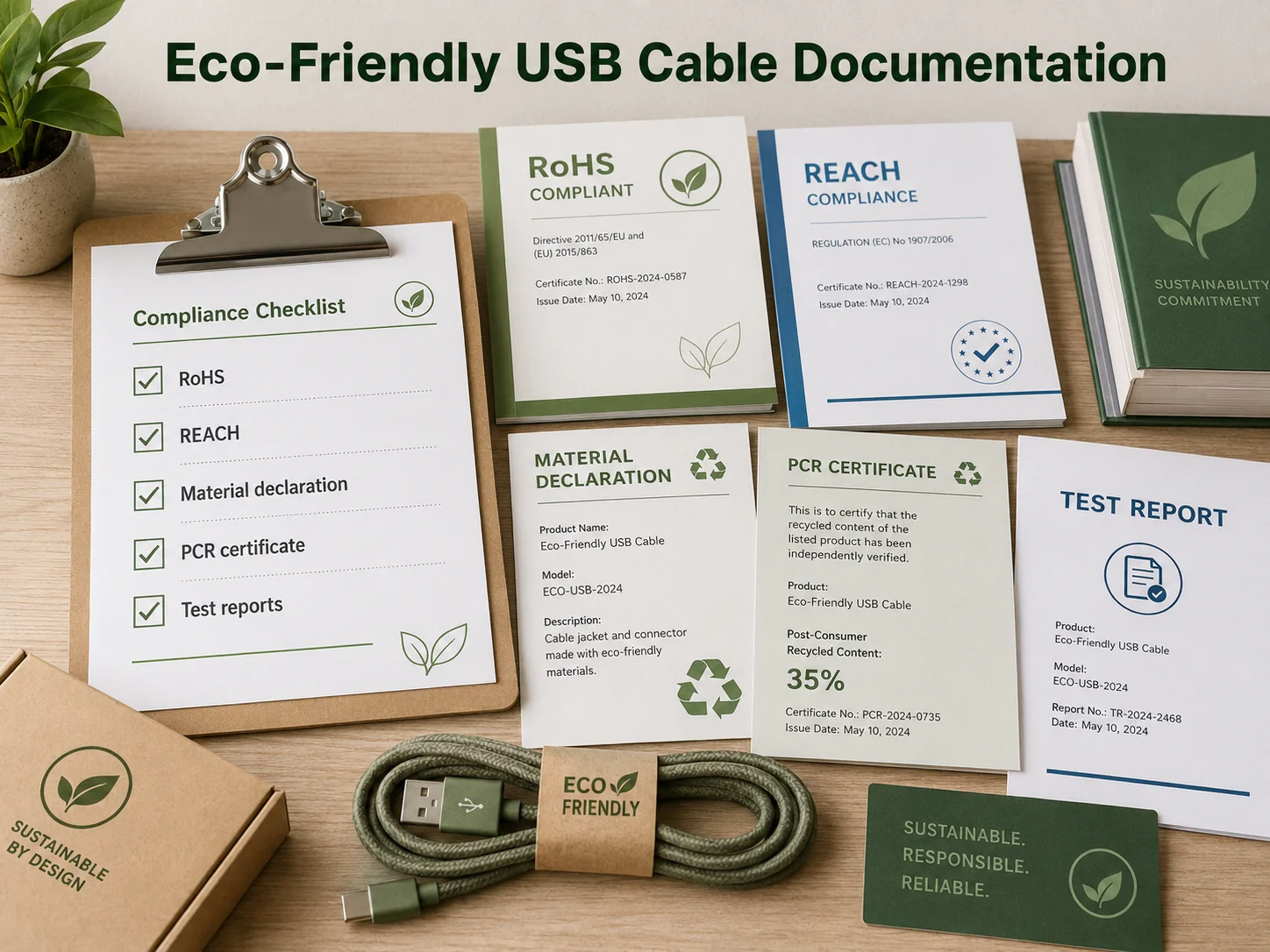
Practical pre-listing checklist
Before placing a mass-production order, we recommend this checklist:
- Define the exact consumer-facing claim.
- Identify the cable component covered by the claim.
- Request a material declaration from the supplier.
- Confirm the stated PCR or bio-based content, where available.
- Request relevant material certificates or chain-of-custody documents if offered.
- Review product specifications for charging and data performance.
- Confirm applicable chemical and safety testing for the destination market.
- Approve cable samples and packaging samples.
- Check that packaging copy does not overstate the material claim.
- Confirm MOQ, lead time, carton details, and after-sales handling.
Claims need precise wording
The safest claims tend to be specific and limited. For example:
| Less Precise Claim | More Responsible Direction |
|---|---|
| “Green USB cable” | “USB cable with PCR plastic connector housing” |
| “Earth-friendly cable” | “Cable jacket made with bio-based TPE” |
| “100% sustainable” | “Packaging uses reduced plastic compared with our previous design” |
| “Fully recyclable” | “Please check local recycling guidance for electronic accessories” |
The exact wording needs market-specific review. Environmental marketing expectations can differ across countries, retail groups, and online platforms. We can provide our material and production documents, but buyers should verify final legal and advertising requirements with their own compliance specialists.
How Can Brands Use Sustainable Packaging and Marketing Without Greenwashing?
A sustainable product story can increase shelf appeal, but it can also create risk when it becomes vague or exaggerated. Many buyers want a large green icon or bold environmental headline. The stronger approach is usually more specific, even if it looks less dramatic.
Brands can market eco-friendly USB cables without greenwashing by making clear, limited, and evidence-based claims. Packaging should explain which component uses PCR or bio-based material, avoid absolute environmental promises, and keep supporting documents on file. Buyers should also ensure that product photography, marketplace copy, and sales-team language match the approved claim.
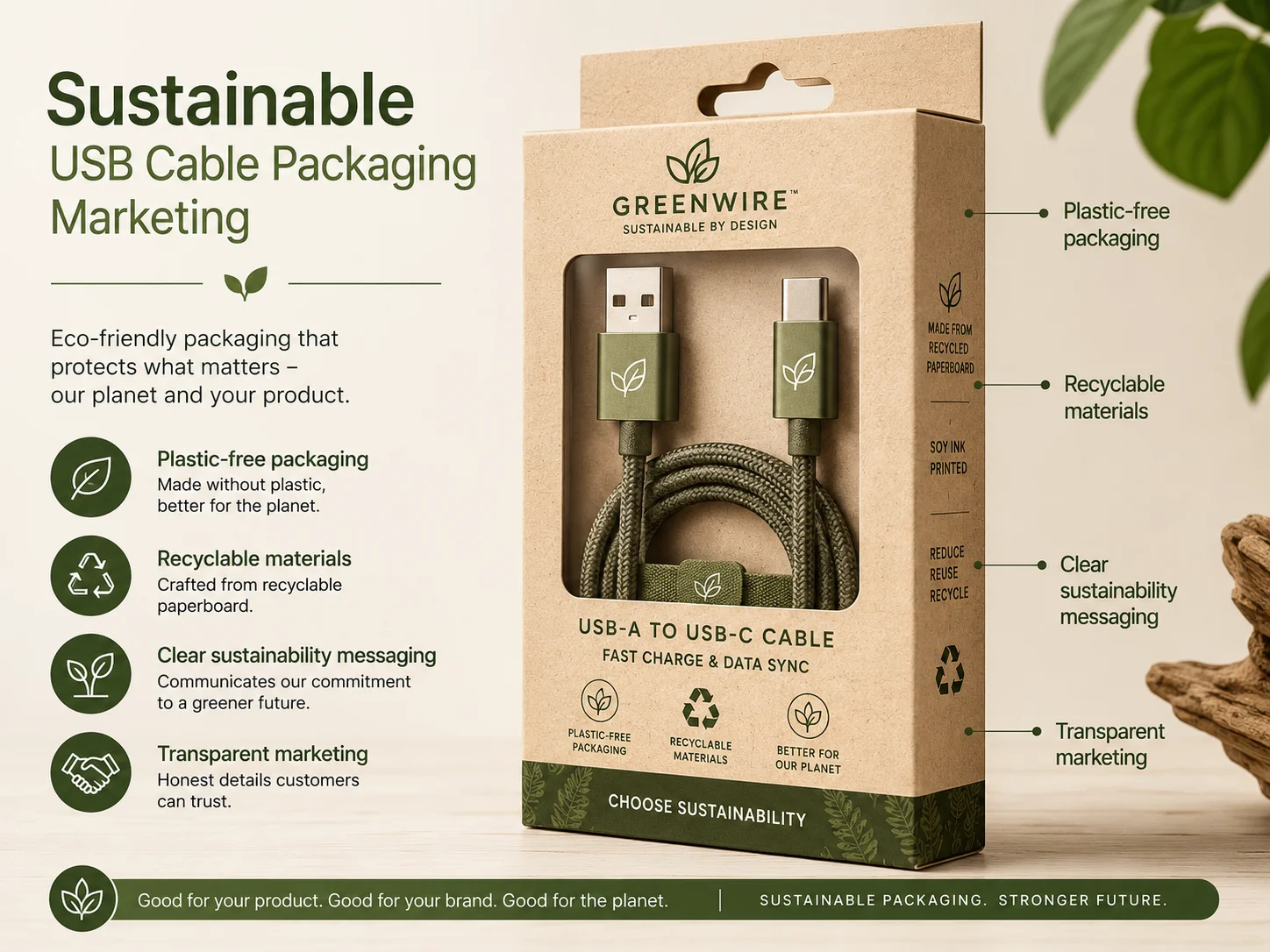
Build a claim hierarchy
A useful packaging system has three levels:
Front of pack:
Use a short, specific statement.
“PCR Plastic Connector Housing”
Side panel:
Explain what that means.
“The connector housing is made with recycled plastic content. The cable contains multiple materials and should be disposed of according to local electronic-waste guidance.”
QR code or product page:
Provide deeper product information, material documentation summaries, and care instructions where appropriate.
This format helps consumers understand the benefit without suggesting that the whole cable is biodegradable or impact-free.
Avoid visual shortcuts that overpromise
Green leaves, recycling symbols, earth icons, and natural textures can be useful design elements. However, they should not become the only basis for the claim. A buyer should avoid using a recycling symbol in a way that suggests the full cable can enter normal household recycling if that is not accurate.12
We also recommend keeping records of:
- Approved packaging artwork
- Material declaration versions
- Supplier confirmations
- Sample photos
- Test reports
- Purchase order specifications
- Claim approval emails
These records are useful when a retail customer, marketplace, or consumer asks for clarification later.
How to Source OEM Eco-Friendly USB Cables from a Reliable Manufacturer?
Finding an OEM supplier is easy online. Finding a supplier that can explain materials, manage production details, support private-label packaging, and deliver consistent cable quality is harder. Buyers need more than a product catalog with green wording.
To source OEM eco-friendly USB cables, buyers should choose a manufacturer that can define the claimed component, provide available material documents, produce samples, validate core cable performance, communicate MOQ and lead time clearly, and support accurate private-label packaging. The supplier should treat sustainability as part of product development and quality control, not only as a sales phrase.
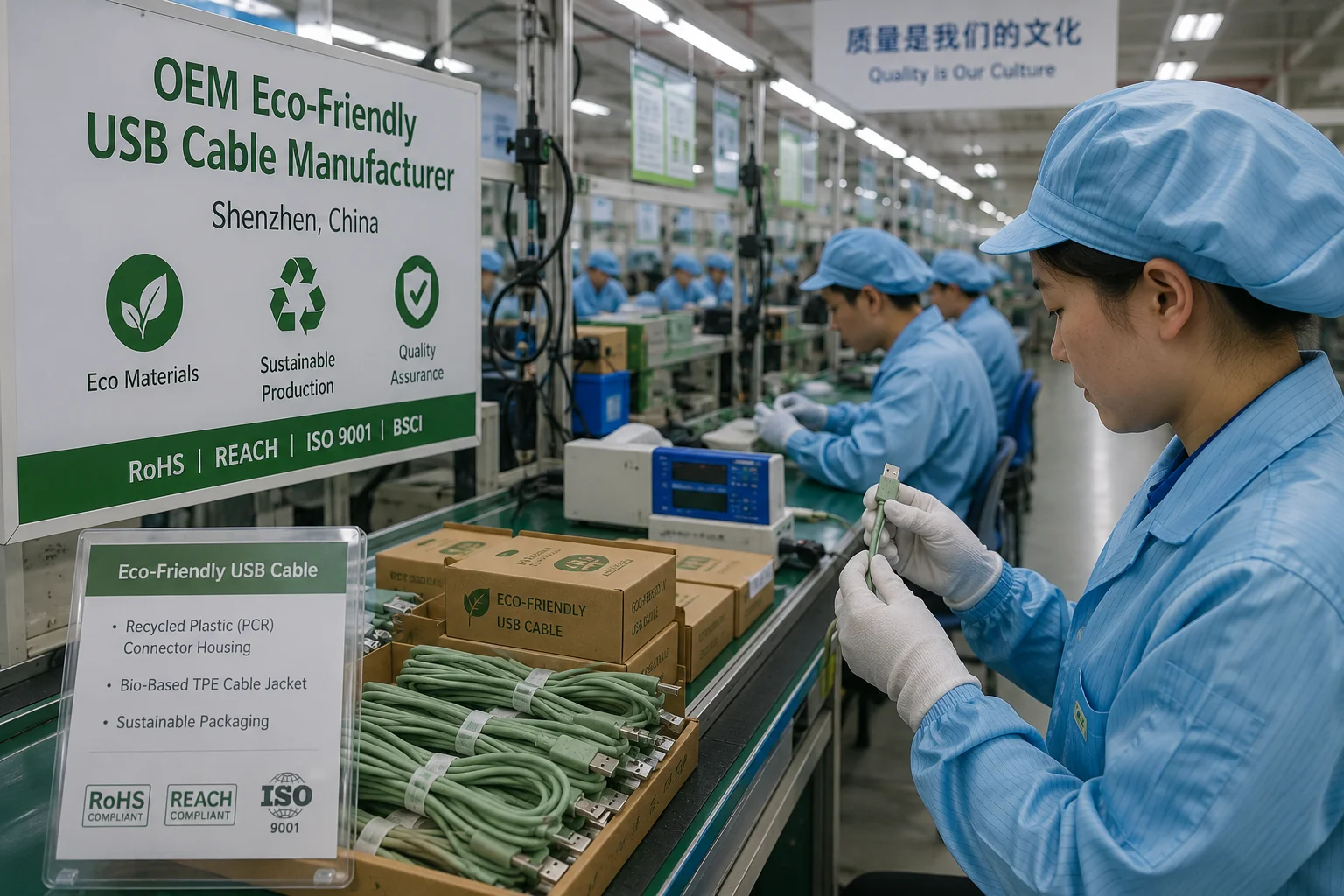
Questions to ask before requesting samples
A serious supplier should be able to answer questions such as:
- Which cable components can use PCR or bio-based material?
- What recycled-content percentage can you support for this design?
- What material declarations can you provide?
- Can you show the difference between standard and sustainable material samples?
- What charging wattage and data specifications does the cable support?
- What are the MOQ and lead time for custom color and packaging?
- Can you provide packaging options with reduced plastic?
- How do you control color and finish variation in PCR material?
- What inspection process applies before shipment?
- What after-sales process do you offer for quality issues?
What we recommend for a first project
For a first OEM order, we usually suggest choosing an existing cable platform with proven electrical performance. Then the buyer can add a defined sustainable element, such as a PCR housing or paper-based retail box.
This approach is often more reliable than developing a completely new cable from zero. It allows the buyer to focus on the parts that need close review:
- Material claim accuracy
- Sample appearance
- Packaging message
- Retail price
- MOQ
- Delivery schedule
- Market documentation
With 15 years of export experience from Shenzhen, we understand that European and US buyers need both product innovation and predictable execution. A sustainability story is valuable only when the cable can be produced consistently, shipped on schedule, and sold with confidence.
Frequently Asked Questions
Are PCR USB cables recyclable?
PCR USB cables may contain recycled plastic, but that does not mean the entire cable is easily recyclable through standard household systems. USB cables contain mixed materials, including metal, copper, plastic, and internal insulation. Buyers should avoid broad recyclability claims and check local e-waste guidance.
Is a bio-based USB cable biodegradable?
Not necessarily. A bio-based USB cable may use renewable-origin material in its jacket or another component, but the finished cable is not automatically biodegradable or compostable. Buyers should only use biodegradability claims when they have product-specific evidence for the complete product and intended disposal conditions.
Can eco-friendly USB cables support fast charging?
Yes, eco-friendly USB cables can support fast charging when the internal conductor design, e-marker chip where needed, connector construction, and cable specification support the stated power level. PCR or bio-based external materials do not replace the need to verify wattage, protocol compatibility, and product testing.
What MOQ should I expect for custom sustainable USB cables?
MOQ depends on the cable model, material choice, color, packaging, and custom branding requirements. An existing cable design with PCR housing may have a more accessible MOQ than a fully custom bio-based jacket project. Buyers should request separate MOQ details for product, material, and packaging.
What should I put on sustainable USB cable packaging?
Use specific, evidence-based wording. State which component uses PCR or bio-based material, and avoid phrases such as “100% eco-friendly” or “zero-impact.” Buyers should keep material declarations and approved artwork on file, then verify local marketing requirements before launch.
Conclusion
Eco-friendly USB cables can give retailers and importers a practical way to build a more responsible 3C accessory range. However, PCR plastic, bio-based TPE, and sustainable packaging are not interchangeable labels. Buyers should define the exact claim, identify the component involved, request supporting documents, validate charging and durability performance, and confirm MOQ, lead time, and packaging details. If you are sourcing private-label cables for Europe or the US, contact us to discuss a sample-based OEM eco-friendly USB cable program with clear material communication and reliable production support.
"USB hardware", https://en.wikipedia.org/wiki/USB_hardware. Technical cable-construction references describe cables as assemblies of conductive, insulating, shielding, and connector materials rather than as products made from a single material. Evidence role: general_support; source type: education. Supports: Technical descriptions of electrical or USB cable construction showing that cables combine conductors, insulation, shielding, connector parts, and outer jackets.. ↩
"Circular economy - waste and materials: Environment at a ...", https://www.oecd.org/en/publications/environment-at-a-glance-indicators_ac4b8b89-en/full-report/component-5.html. International electronic-waste guidance explains that recycling outcomes depend on collection systems and on the technical ability to separate and recover materials from mixed products. Evidence role: mechanism; source type: institution. Supports: Electronic-waste guidance explaining that collection, treatment capacity, and material separation affect recycling outcomes.. Scope note: This supports the general dependency on systems and design, not the recyclability rate of any particular USB cable. ↩
"Leveraging digital business models, tools and technologies for reliable ...", https://www.oecd.org/content/dam/oecd/en/publications/reports/2025/06/leveraging-digital-business-models-tools-and-technologies-for-reliable-environmental-information-and-consumer-engagement-in-the-circular-economy_3a3881df/33c6e2bc-en.pdf. Consumer research on environmental product attributes can document demand for more sustainable purchasing options and the role of credible claims in purchase decisions. Evidence role: general_support; source type: institution. Supports: Consumer research or institutional market evidence on demand for environmental attributes in product purchasing.. Scope note: Broad consumer evidence may not measure USB-cable demand specifically and should not be used as a quantified cable-market forecast. ↩
"Bio‐based and biodegradable plastics - PMC - NIH", https://pmc.ncbi.nlm.nih.gov/articles/PMC6801152/. International and European guidance distinguishes bio-based plastics, which are defined by feedstock origin, from biodegradable plastics, which are defined by degradation under specified conditions. Evidence role: definition; source type: institution. Supports: Authoritative guidance distinguishing renewable feedstock origin from biodegradability or compostability.. Scope note: Whether a specific cable jacket biodegrades requires testing against an applicable standard and cannot be inferred from bio-based content alone. ↩
"Recycled Content (ReCon) Tool", https://www.epa.gov/waste-reduction-model/recycled-content-recon-tool. The U.S. Environmental Protection Agency defines postconsumer material as material generated by households or commercial, industrial, and institutional facilities after it can no longer be used for its intended purpose and is diverted from the waste stream. Evidence role: definition; source type: government. Supports: An authoritative definition of post-consumer material and recycled content.. ↩
"Suppressing mechanical property variability in recycled ... - PMC", https://pmc.ncbi.nlm.nih.gov/articles/PMC12377729/. Materials-science research reports that the composition and prior processing history of recycled polymers can vary, affecting properties and creating a need for material characterization and process control. Evidence role: mechanism; source type: paper. Supports: Research showing that variable composition, contamination, and prior processing can affect recycled-polymer properties.. Scope note: The magnitude of variation depends on the polymer stream, compounding process, and intended component. ↩
"About the BioPreferred® Program", https://www.biopreferred.gov/BioPreferred/faces/pages/AboutBioPreferred.xhtml. The U.S. Department of Agriculture defines a biobased product as a commercial or industrial product composed wholly or in significant part of biological products, renewable agricultural materials, or forestry materials. Evidence role: definition; source type: government. Supports: An official definition of bio-based products as products derived wholly or partly from renewable biological resources.. Scope note: This definition establishes the origin of feedstocks; it does not establish the bio-based percentage or performance of a particular TPE compound. ↩
"Flex/Bend Strain Relief Endurance Testing", https://www.iconnsystems.com/blog/flex-bend-strain-relief-endurance-testing. Cable and connector test standards evaluate mechanical reliability through defined procedures for flexing, tensile loading, connector retention, and related assembly performance characteristics. Evidence role: mechanism; source type: institution. Supports: Cable and connector standards or test guidance identifying mechanical performance factors such as flexing, retention, and strain relief.. Scope note: Passing a relevant test supports performance under its stated conditions, not durability for every use pattern or material formulation. ↩
"USB Charger (USB Power Delivery)", https://www.usb.org/usb-charger-pd. USB Implementers Forum documentation identifies USB Power Delivery Extended Power Range as supporting power levels up to 240 W when the relevant power-delivery and cable requirements are met. Evidence role: definition; source type: institution. Supports: USB-IF documentation describing USB Power Delivery power ranges, including Extended Power Range operation up to 240 W.. Scope note: The maximum capability of a specific cable also depends on its electronic marking, construction, and the connected power source and device. ↩
"Plastic pollution is growing relentlessly as waste management ...", https://www.oecd.org/en/about/news/press-releases/2022/02/plastic-pollution-is-growing-relentlessly-as-waste-management-and-recycling-fall-short.html. Research on secondary and bio-based materials finds that prices and processing costs can differ from virgin-material alternatives because of feedstock availability, quality requirements, sorting, compounding, and production scale. Evidence role: general_support; source type: research. Supports: Research or institutional analysis showing that secondary and bio-based material prices, supply, processing, and specification requirements can affect costs.. Scope note: This does not establish a fixed cost premium for a USB cable, since quotations depend on design, volume, region, and contract terms. ↩
"Green Guides", https://www.ftc.gov/news-events/topics/truth-advertising/green-guides. The U.S. Federal Trade Commission's Green Guides state that marketers should have a reasonable basis for environmental benefit claims and should qualify claims to avoid implying benefits that cannot be substantiated. Evidence role: expert_consensus; source type: government. Supports: Environmental-marketing guidance requiring claims to be substantiated, qualified, and limited to what the evidence supports.. Scope note: The Guides are U.S. guidance; other jurisdictions may apply different legal requirements and enforcement standards. ↩
"How Do I Recycle Common Recyclables", https://www.epa.gov/recycle/how-do-i-recycle-common-recyclables. Waste-electrical-and-electronic-equipment guidance directs consumers to separate collection systems for electrical products, reflecting that such products are not necessarily suitable for ordinary household recycling streams. Evidence role: general_support; source type: government. Supports: Official guidance on the separate collection of waste electrical and electronic equipment and the proper use of recycling information.. Scope note: Collection rules and accepted product categories vary by jurisdiction and local service provider. ↩