Buying non-compliant product today risks warehouse deadstock tomorrow. You face forced discounts or even unsellable returns.
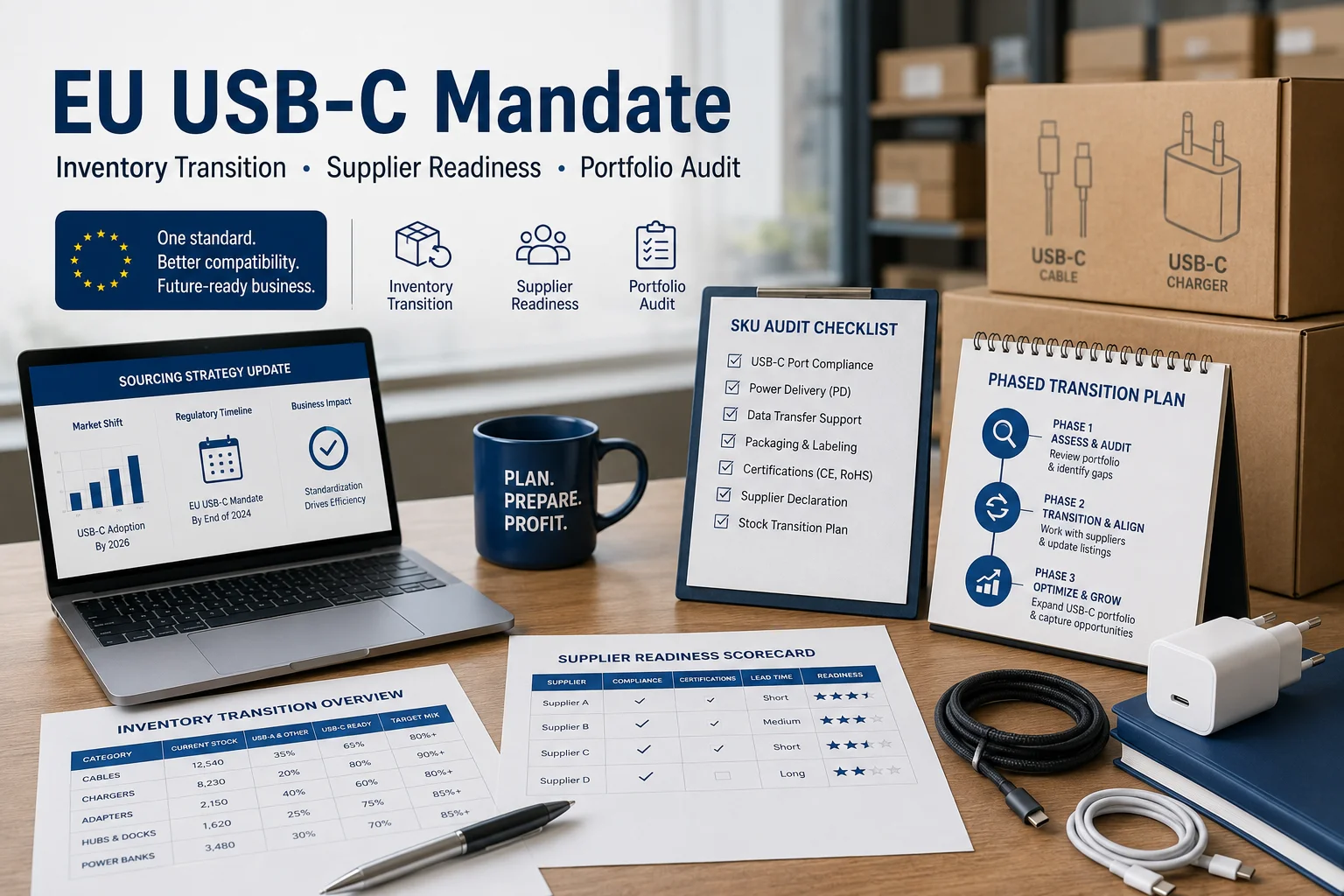
The mandate rewrites your sourcing rules. You need a plan for inventory transition, not just a compliant cable. Smart importers now focus on supplier readiness and portfolio audits, not late-night clearance sales.
I have spent the last year fielding calls from European importers who feel lost. They don't need another copy of the legal text. They need a playbook for the next 18 months. That's what I will share here, born from hundreds of real buyer conversations.
What Is the EU USB-C Mandate and Why Should Importers Care?
Your buyer insists on compliance. You don't know which products could become unsellable. A mistake here locks up your cash in unsellable stock.
The EU common charger rule forces a USB-C port on a list of devices from specific dates.1 For you, that means phased deadlines, not a single switch. Care about your warehouse space and buyer trust, not just the connector shape.
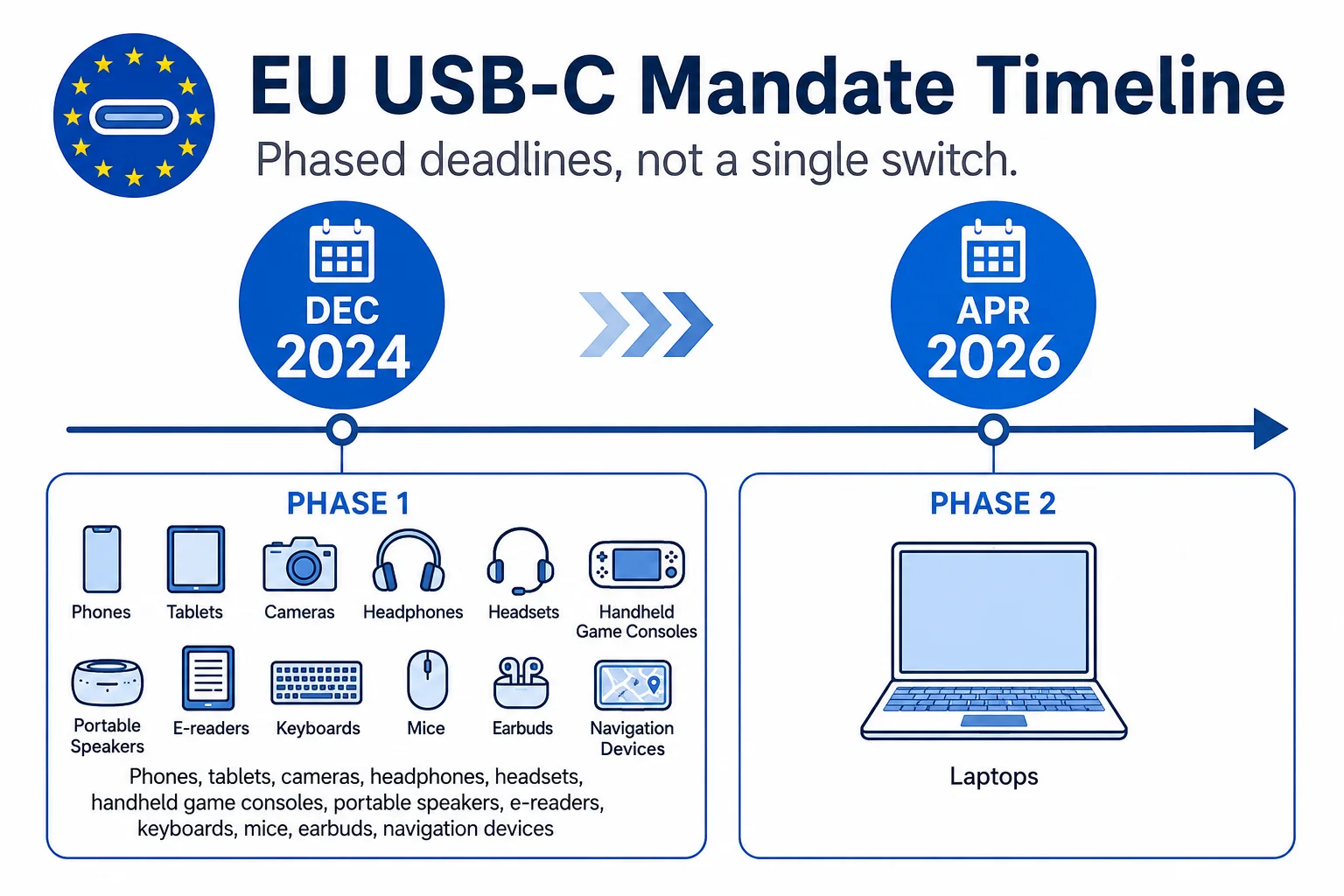
I hear importers say, “Just send me the compliant equivalent.” That misses the real problem. The mandate hits different product categories at different times. Handheld phones and earbuds have one deadline. Laptops come later. If you manage a mixed catalog, you run a mixed-deadline business. A shipment that arrives compliant in July might become non-compliant by December for another SKU in your warehouse.2 One European chain buyer told me they had to quarantine three pallets of keyboards because the attached cable fell under an earlier enforcement date than the keyboard itself.3 The real risk is not the law. It’s the invisible inventory mismatch. Map every SKU against its mandatory deadline before you place your next order. That simple action saves more margin than any supplier price cut.
Which Devices Are Affected by the EU USB-C Common Charger Rules?
You assume only phones count. Then a customs agent flags your portable speaker shipment.
Handheld mobile phones, tablets, digital cameras, headphones, headsets, handheld videogame consoles, portable speakers, e-readers, keyboards, mice, portable navigation systems, and earbuds fall under the rules. Laptops join later.4
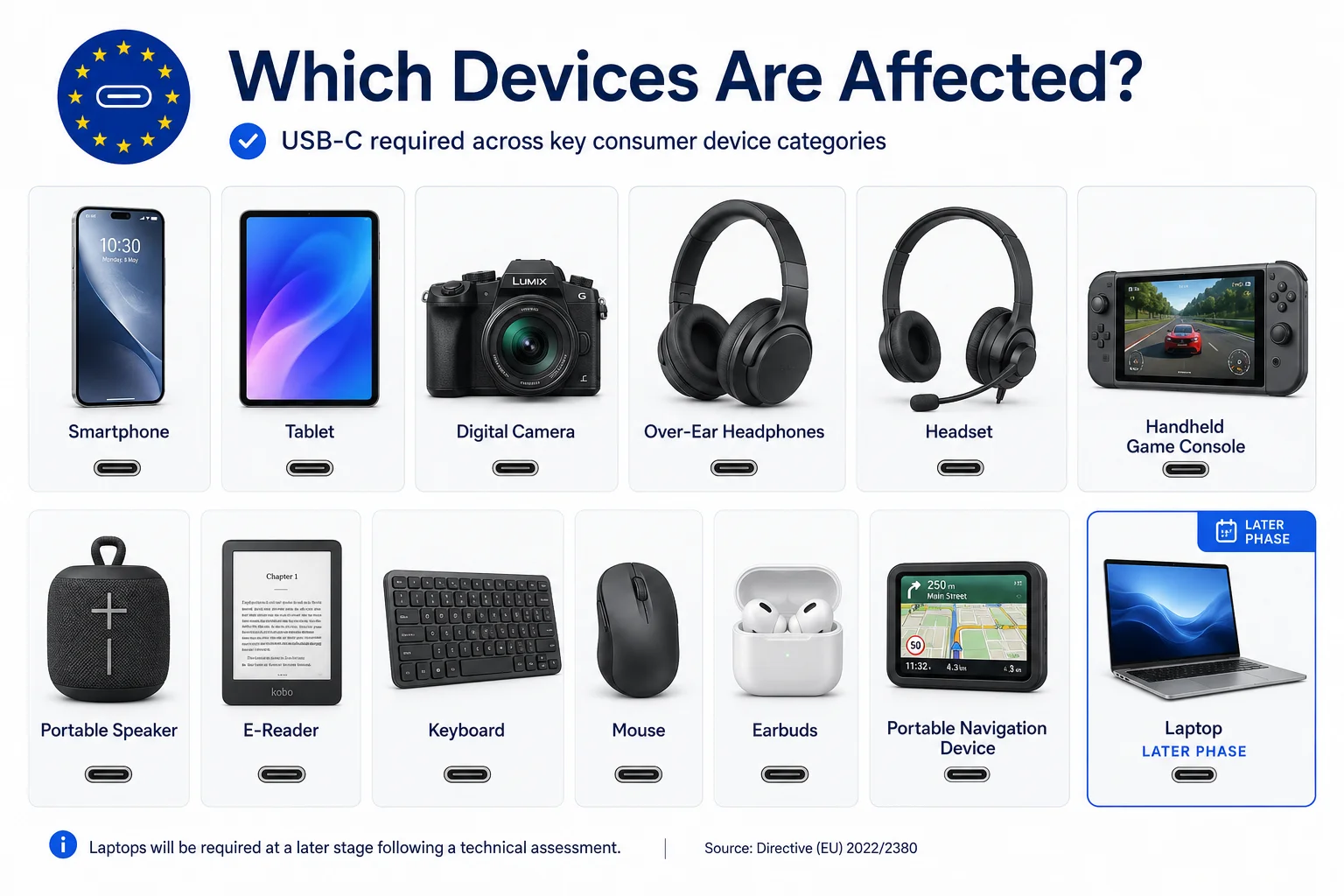
Most importers audit their smartphone inventory and stop. A wholesale buyer in Germany learned the hard way. He imported a popular keyboard case with a fixed cable that ended in USB-A. Even though the tablet it paired with was compliant, the accessory was not. He had to sell them at cost. Take a highlighter and mark every SKU in your catalog that carries a rechargeable battery and a wired charging port. Then write the enforcement date next to it. I keep this chart in front of me during all supplier talks.
| Device Category | Enforcement Start (approximate) | Note |
|---|---|---|
| Handheld phones, tablets, cameras, headphones, portable speakers, etc. | 28 December 20245 | Most consumer pocket gear. |
| Laptops | 28 April 20266 | Separate schedule; still need to plan. |
| Devices without wired charging | Exempt | If charging only via wireless, it's not in scope. |
This table alone stops panic. Not every product in your line-up needs a port change. Use it to prioritize your supplier conversations.
Qi, MagSafe, Lightning, and USB-C: What Happens to Older Inventory?
Your warehouse still holds Lightning-port goods. You don't know how to exit without burning your brand image.
Older inventory sold before the deadline can still sell through. But you cannot place new imports of non-compliant product after the cut-off date.7
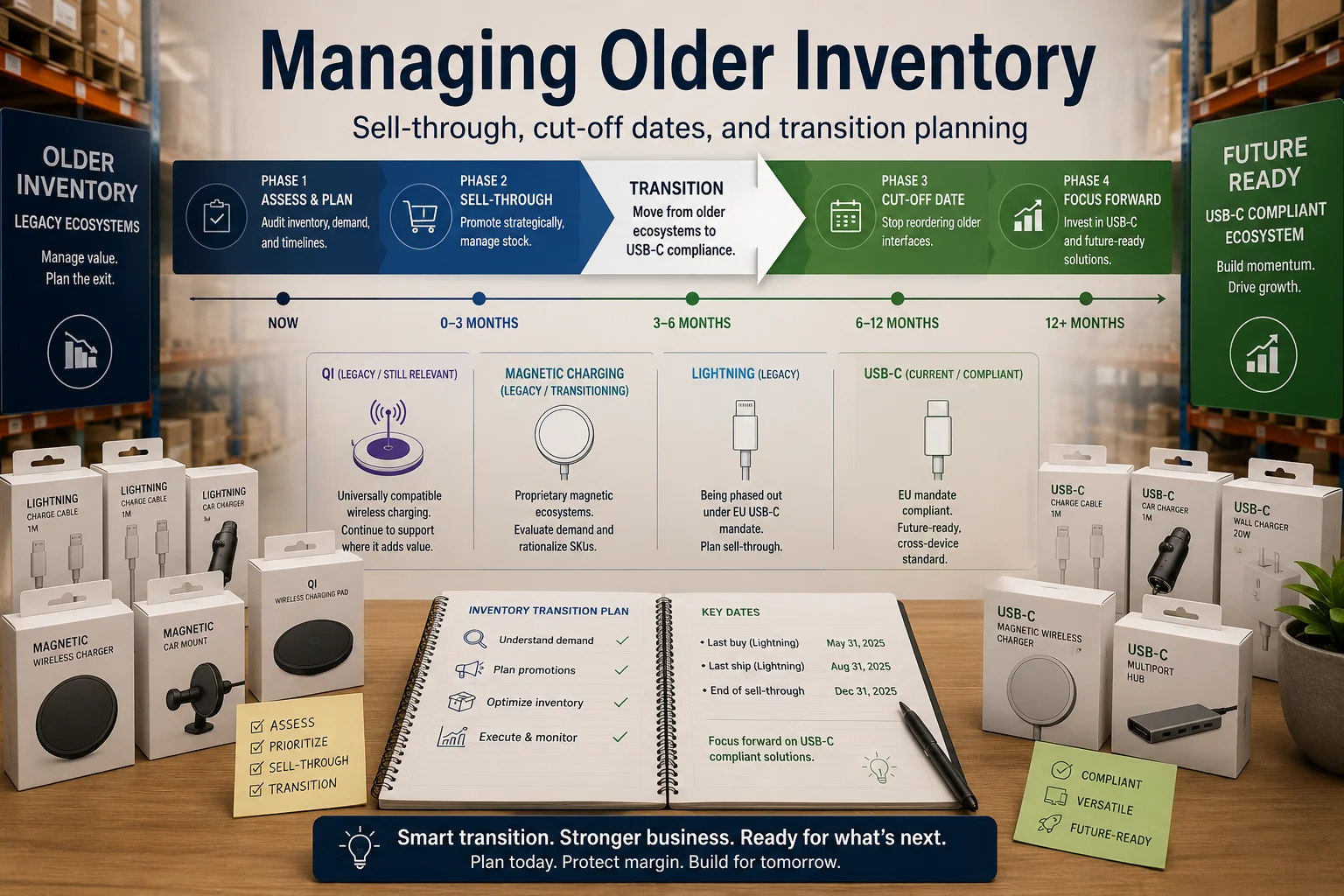
I had a panicked message from a Dutch distributor last month. He had 3,000 Lightning earbuds sitting in Rotterdam. The good news: they were imported before the December 2024 deadline. They can still legally sell. The bad news: his retailers worried about customer returns. We helped him create a simple shelf label that said, “Compatible with existing Lightning devices — great backup pair.” Sales steadied. The mandate doesn't force a recall. It stops new non-compliant shipments at customs. Your exit strategy depends on when you imported, not when you sell through. For Qi and MagSafe items, these remain fine if the device has no wired charging port. If it also has a USB-C socket, then the USB-C part must comply. A MagSafe power bank with a USB-C input must follow the USB-C rules for that input.8 I've seen too many buyers write off perfectly legal stock because they didn't separate “import date” from “sell date.”
How the Mandate Changes Demand for USB-C Cables, Chargers, Hubs, and Accessories
You order basic USB-A to micro-USB cables because they were cheap. Suddenly, your largest supermarket client asks for new quotes.
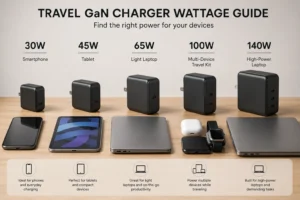
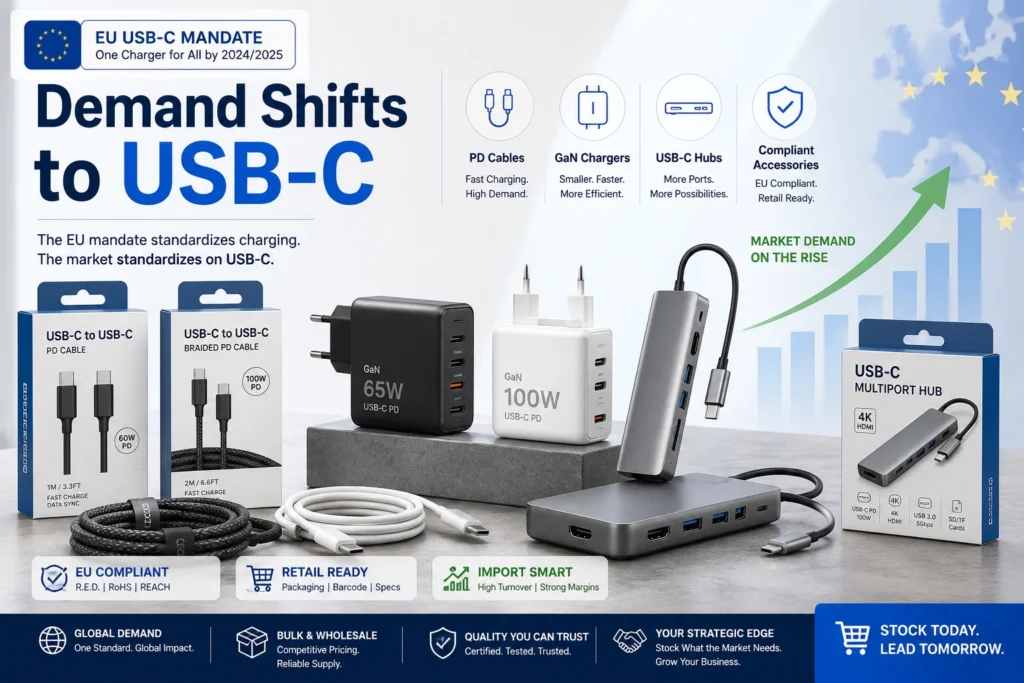
Demand shifts toward USB-C cables with power delivery, multi-port GaN chargers, and hubs. Bundled accessories need compliance checks too.
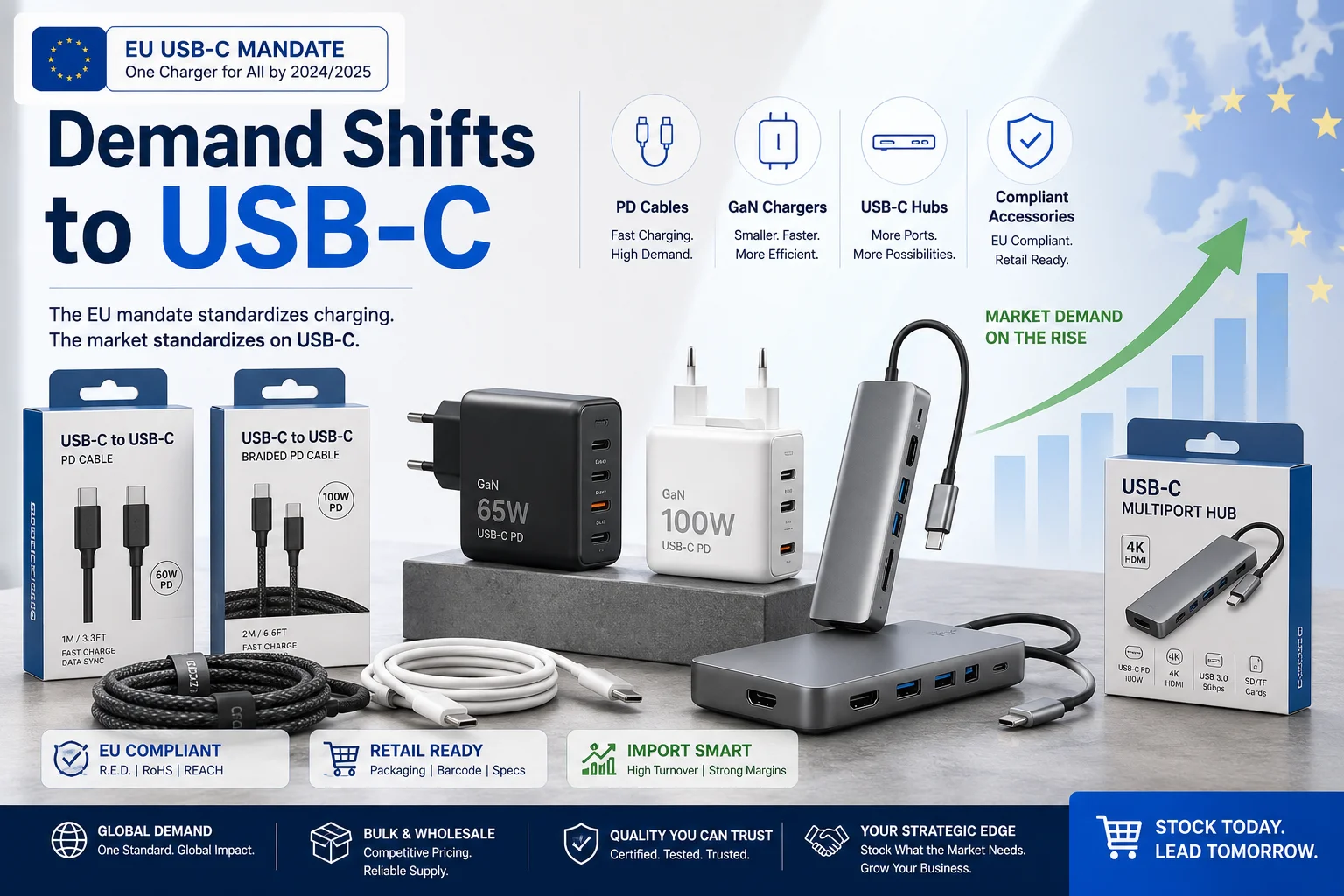
A buyer from a UK chain told me, “We are replacing every in-box cable across ten SKUs.” That one change tripled their USB-C cable order overnight, but also multiplied their compliance scrutiny. The in-box cable must meet the same standard as the charger sold separately. I notice that forward-thinking importers now ask for UL or CE certified cable batches instead of “look-alike” generic stock. They bundle a 30W GaN charger with a tablet and need documentation that the GaN charger itself meets the new labeling rules. I also see accessory categories like USB hubs and docking stations suddenly facing questions. If the hub has a captive USB-A cable, your buyer may reject it because their laptop now uses USB-C. Ask your sales team which accessories your customers plan to bundle. That tells you which cables and chargers to prioritize for compliant sourcing.
What Makes a USB-C Cable or Charger Compliant for EU Buyers?
A supplier sends you a photo of a USB-C plug and says, “It's fine.” You need more than a photo.
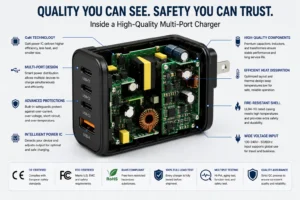
A compliant product must handle specific power delivery profiles, meet labeling requirements, and carry proper CE documentation. The connector alone is not enough.
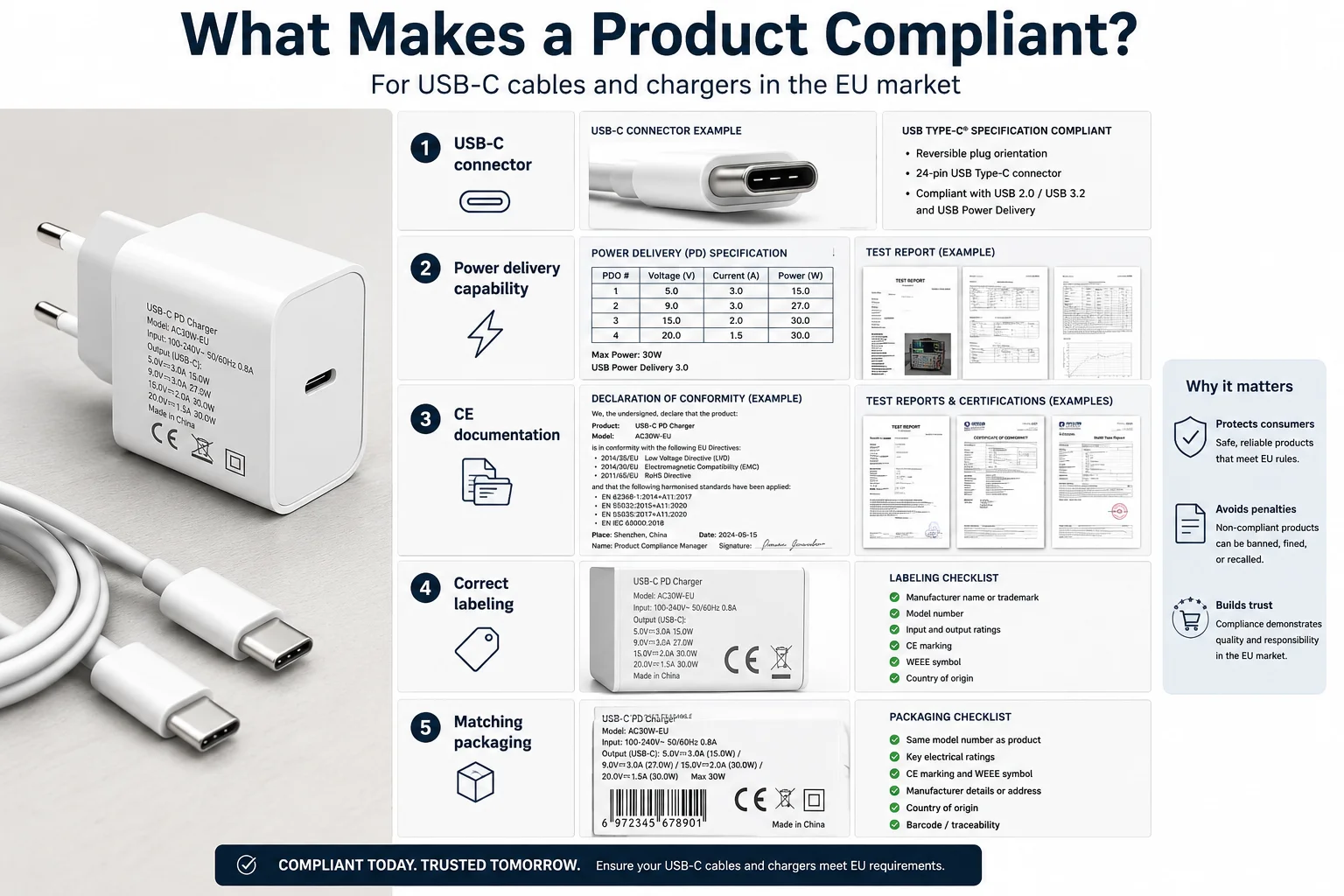
I test suppliers with a simple question: “Can you provide the test report for the specific cable model you are offering?” Nine out of ten send a generic company certificate that says nothing about the cable's power rating. That certificate will not help you at the border. Your buyer needs cables marked with the wattage they can support.9 A USB-C cable that only carries 60W may fail when a customer uses it with a 100W laptop. I've seen returns spike when a cable works for a phone but not a notebook. Ask your supplier for an image of the cable's print: it should show the power rating. For chargers, the EU regulation requires a specific label showing the minimum power, maximum power, and supported voltages.10 If your supplier's packaging doesn't show this, your shipment faces rejection.11 The cheapest factory may cut corners on the PD controller chip. That chip failure causes overheating. I work only with factories that share chipset brands and batch test reports upfront.
Power Banks, Older Cables, and Accessory Bundles: Common Buyer Questions
You stock power banks that were ordered six months ago. You don't know if they are stuck in a legal gray area.
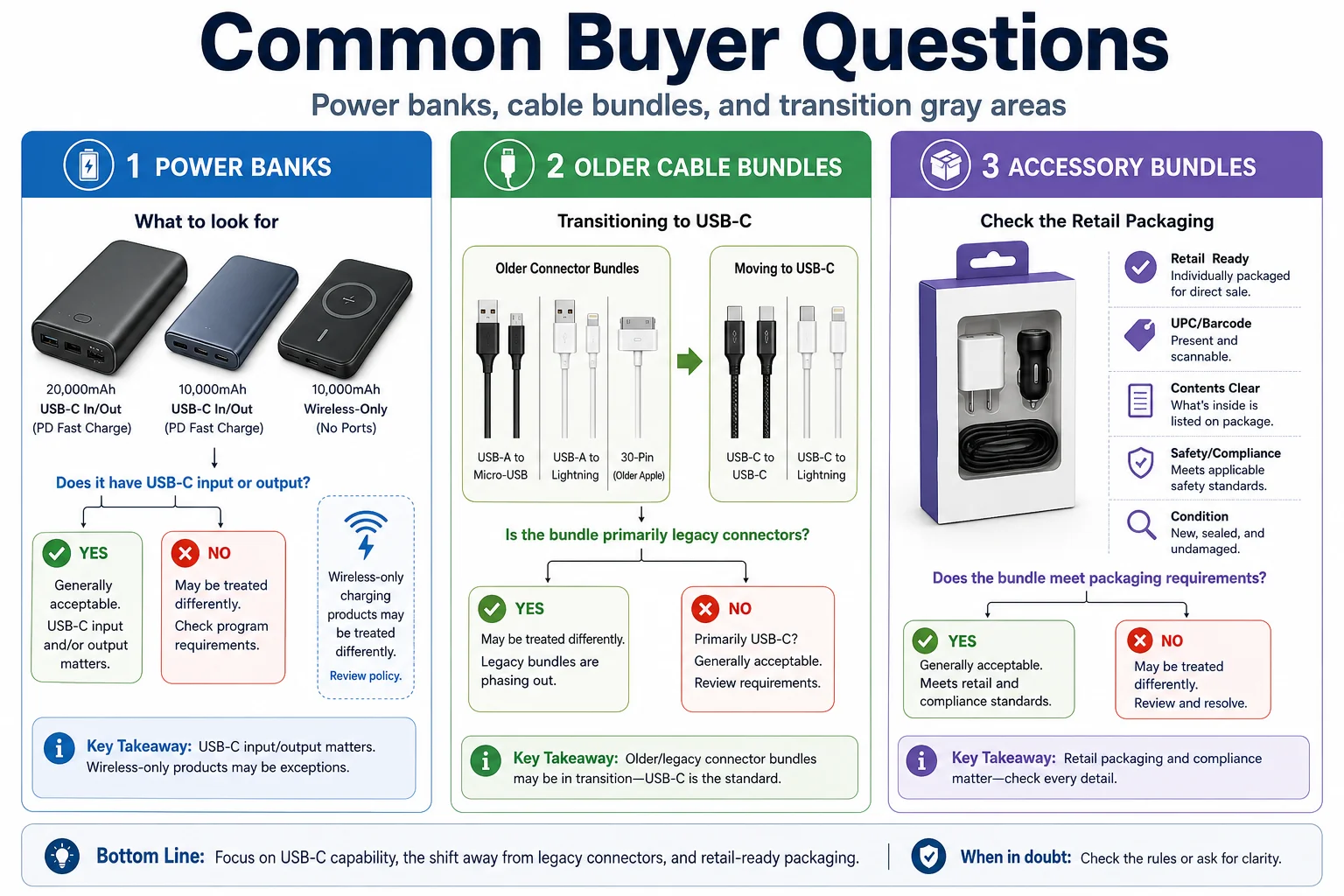
Power banks that only receive charge wirelessly are exempt. If they have a USB-C input or output, that port must be USB-C compliant. Older cable bundles face scrutiny based on the in-box cable's connector.

One importer called me about a promotion: a phone case with a built-in battery and a micro-USB port. He wanted to run a back-to-school deal. I had to tell him: that built-in port made it a device under the rules. You can't import new units after the deadline. The same goes for accessory bundles. If you bundle an older non-compliant cable with a compliant speaker, the bundle fails unless you swap the cable. I recommend splitting the bundle: sell the speaker alone and offer the cable separately as “while supplies last.” That keeps the main product legal. For power banks, I use a simple check: does it have a USB-C socket? If yes, that socket must comply. Does it charge only via Qi? Then you are fine. I keep a list of quick buyer FAQs pinned on my office wall: “Imported before deadline? Sell slowly. Imported after deadline? Must comply. Wireless-only? No mandate.” This clarity saves hundreds of emails.
Compliance Checklist: Certifications, Labels, Packaging, and Supplier Documents
You have zero time to read 50 pages of regulation. You need a supplier checklist that your assistant can run.
A reliable checklist covers CE marking, USB-IF or equivalent test reports, power output labeling on the product, and packaging that matches the declaration. Ask for batch-specific proof, not company-level promises.
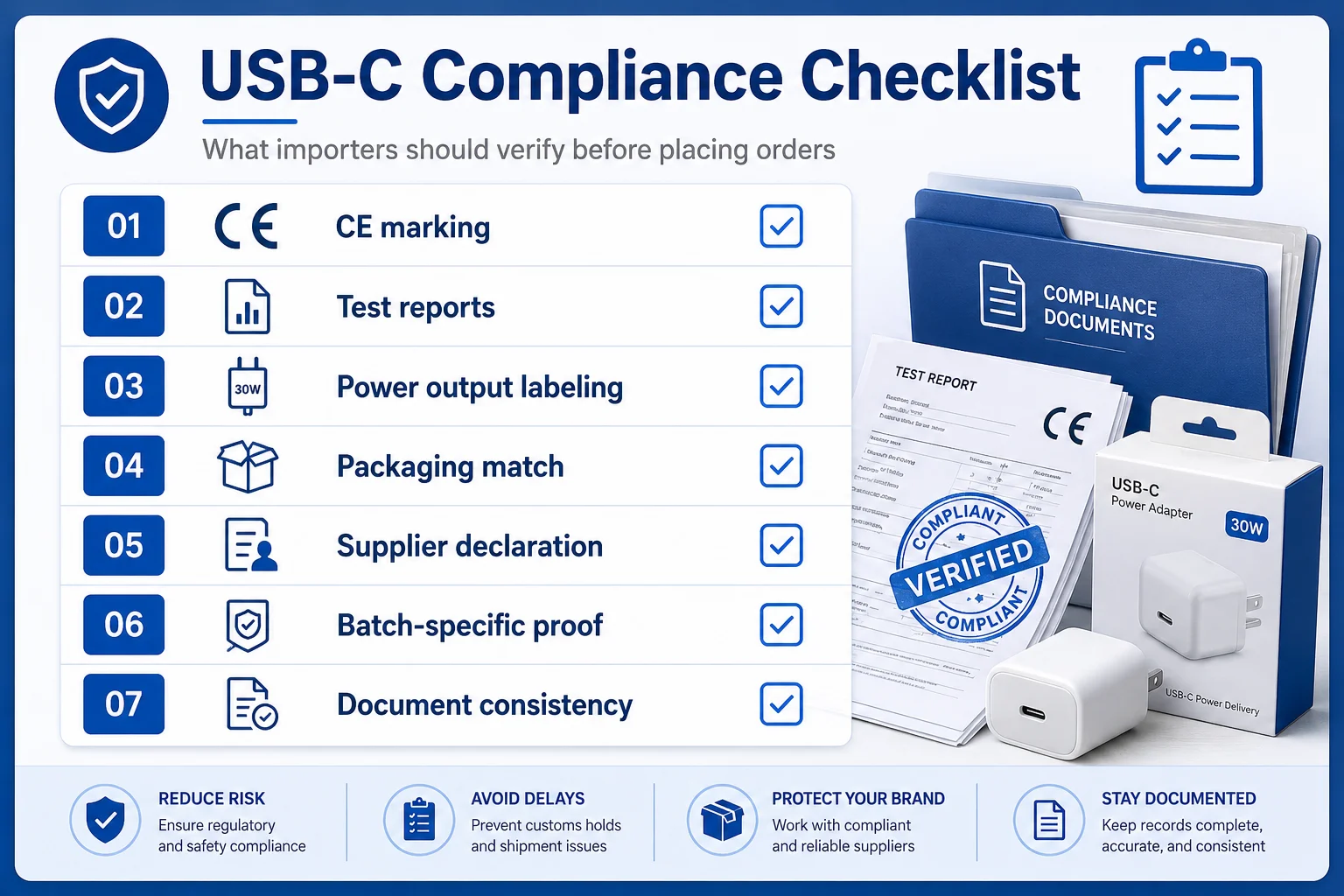
I built this checklist after a shipment of 5,000 chargers was stopped in Rotterdam because the packaging showed the wrong voltage range. The problem was a tiny print mismatch between the product label and the carton label. Customs cared. Here is what I send to every new buyer:
| Item | Ask the Supplier |
|---|---|
| CE declaration of conformity | Request a copy signed for the exact SKU, not a template. |
| Test report | Get a lab report showing power delivery profiles tested. |
| Product marking | Confirm wattage is printed on the cable head or charger body. |
| Packaging label | Check that the label on the retail box matches the test report. |
| Batch traceability | Ask for batch numbers and date codes on the packaging run. |
If a supplier cannot give me the batch-specific test report within one working day, I move to the next factory. That might sound strict, but it protects your container from a weeks-long hold. I also ask for photos of the actual product with the label visible, not a 3D render. This habit has saved me from two near-miss shipments.
How to Build a Safer Wholesale Strategy with a Compliant USB-C Supplier
You found a supplier whose price looks great. But one missed document could wipe out your margin.
A safer strategy replaces the “Is it compliant?” question with “Show me your transition roadmap.” Choose a supplier who communicates proactively and owns the documentation process.
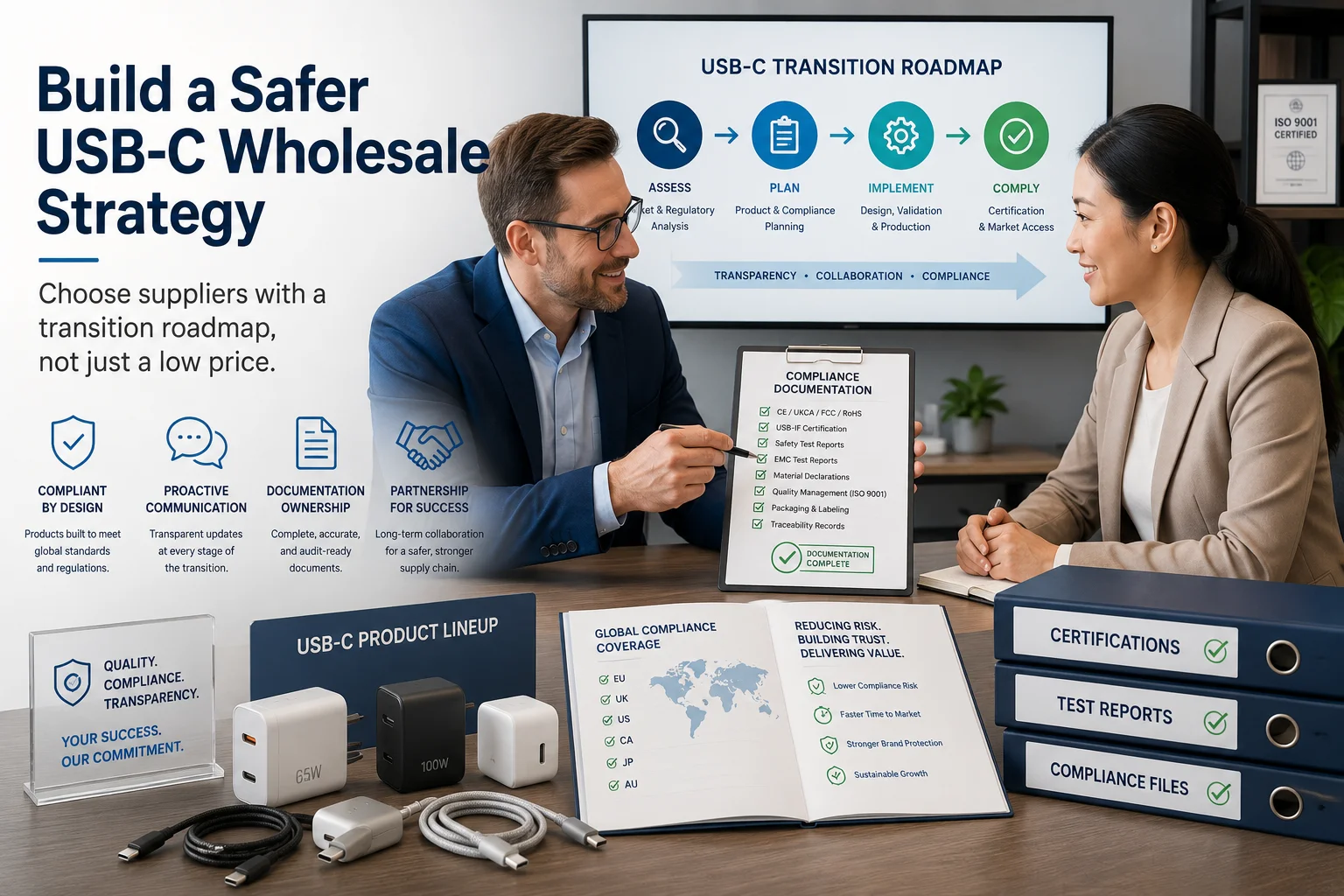
I used to ask a single yes/no question. Now I ask this: “What's your production timeline for the fully compliant version, and can you send me the updated packaging file?” One factory replied with a dated Gantt chart and sample label within an hour. Another said, “We'll use the same as last year.” Guess which one got the order. Your supplier should explain how they will handle future updates, like when laptop deadlines hit. They should also share any test failures openly. I trust a factory that says, “We failed a 100W test on cable batch 223 and reworked it,” more than one who claims zero issues. The safest wholesale strategy for the next two years is not about avoiding the mandate. It's about choosing partners who treat compliance as a continuous process. That shift in mindset turns the mandate from a threat into a chance to win shelf space that your less prepared competitors will lose.
Conclusion
Audit your inventory, demand documentation, and pick suppliers with a clear roadmap. The mandate isn't just about USB-C ports — it's about protecting your wholesale business.
"Radio Equipment Directive (2022) - Wikipedia", https://en.wikipedia.org/wiki/Radio_Equipment_Directive_(2022). Directive (EU) 2022/2380, amending the Radio Equipment Directive 2014/53/EU, establishes the common charger rule, mandating that the categories of devices listed in its Annex I be fitted with a USB‑C receptacle compliant with harmonised standards, effective from the dates specified in the directive. Evidence role: definition; source type: government. Supports: The legal basis for the requirement that certain categories of radio equipment must be equipped with a USB Type‑C receptacle.. Scope note: The directive also covers interoperability requirements for charging protocols in addition to the physical connector; the article simplifies this. ↩
"Radio Equipment Directive (2014) - Wikipedia", https://en.wikipedia.org/wiki/Radio_Equipment_Directive_(2014). Directive (EU) 2022/2380 sets distinct applicability dates for the categories listed in Annex I, with 28 December 2024 for most devices and 28 April 2026 for laptops; products falling under the earlier date that have not been placed on the market by that date would not be compliant thereafter. Evidence role: general_support; source type: government. Supports: That the mandate applies different applicability dates to different device categories, creating a situation where a mixed shipment could be partially non‑compliant after a later date.. Scope note: The statement assumes that the SKU’s date of manufacture or import determines its status; the legal criterion is ‘placed on the market’, which may be interpreted differently by authorities. ↩
"The EU common charger", https://single-market-economy.ec.europa.eu/sectors/electrical-and-electronic-engineering-industries-eei/radio-equipment-directive-red/one-common-charging-solution-all_en. The amended Radio Equipment Directive covers cables that are part of the equipment’s charging solution; a keyboard that includes a fixed, non‑compliant cable could be considered non‑conforming under the applicable rules for that cable category, as cables may be addressed by the same standards or separate ones with earlier effective dates. Evidence role: case_reference; source type: government. Supports: That cables designed for use with covered equipment may themselves be subject to the USB-C requirement and are not automatically grouped with the host device’s deadline.. Scope note: The directive primarily addresses devices rather than standalone cables; the interpretation that a captive cable must comply is derived from the overall requirement that the entire product as placed on the market meet the essential requirements. ↩
"Radio Equipment Directive (2022) - Wikipedia", https://en.wikipedia.org/wiki/Radio_Equipment_Directive_(2022). Annex I of the amended Radio Equipment Directive (EU) 2022/2380 lists the specific categories of devices required to be equipped with a USB-C charging receptacle, including handheld mobile phones, tablets, digital cameras, headphones, headsets, handheld videogame consoles, portable speakers, e-readers, keyboards, mice, portable navigation systems, and earbuds; laptops are added under a separate entry with a later applicability date. Evidence role: definition; source type: government. Supports: The exact categories of radio equipment that must incorporate a USB-C receptacle under the directive.. Scope note: The directive also covers other devices not mentioned in the article if they fall under the general definition, but the listed categories are the most commercially relevant. ↩
"[PDF] NIST RED NB Assessment Checklist – Article 3.4 (common charger)", https://www.nist.gov/document/nist-red-nb-assessment-checklist-article-34-common-charger-version-20-september-26-2024. Article 2 of Directive (EU) 2022/2380, amending the Radio Equipment Directive 2014/53/EU, sets 28 December 2024 as the date from which the requirements concerning the USB-C receptacle and unbundled charging apply to the categories of devices specified in Annex I, excluding laptops. Evidence role: statistic; source type: government. Supports: The date from which the USB-C receptacle and charging interoperability requirements apply to most categories of radio equipment.. Scope note: This date reflects the legal deadline; actual enforcement may vary slightly by member state customs practices. ↩
"[PDF] NIST RED NB Assessment Checklist – Article 3.4 (common charger)", https://www.nist.gov/document/nist-red-nb-assessment-checklist-article-34-common-charger-version-20-september-26-2024. Directive (EU) 2022/2380 provides a deferred applicability date of 28 April 2026 for laptops, as listed in Annex I, to allow additional transition time for that product category. Evidence role: statistic; source type: government. Supports: The distinct later deadline by which laptops must comply with the USB-C receptacle requirement.. Scope note: Derived from the directive’s text; national transposition measures may affect precise market surveillance dates. ↩
"Radio Equipment Directive (2022) - Wikipedia", https://en.wikipedia.org/wiki/Radio_Equipment_Directive_(2022). The amended Radio Equipment Directive stipulates that the requirements apply to equipment made available on the market from the respective applicability dates; products lawfully placed on the market before that date may continue to be made available without needing to comply with the new port requirements, as confirmed by European Commission guidance. Evidence role: expert_consensus; source type: government. Supports: The legal principle that the directive applies to products placed on the market from the applicability date, not retroactively to inventory already on the market.. Scope note: This does not cover situations where a product is considered to have been ‘placed on the market’ only if it has reached the end-user before the deadline; importers must verify the exact placement definition. ↩
"Radio Equipment Directive (2022) - Wikipedia", https://en.wikipedia.org/wiki/Radio_Equipment_Directive_(2022). The amended Radio Equipment Directive covers any radio equipment that is rechargeable via wired charging; a portable battery with a USB-C charging input falls under the scope of the directive for that port, as confirmed in industry compliance notes referencing the directive’s scope. Evidence role: case_reference; source type: government. Supports: That a device with a wired USB-C charging input, regardless of also offering wireless charging, must satisfy the USB-C receptacle requirement for that input.. Scope note: The exact treatment of multi‑function devices may depend on member state interpretation, but the prevailing understanding is that wired charging ports must comply. ↩
"USB-C - Wikipedia", https://en.wikipedia.org/wiki/USB-C. Under the referenced standards in the amended Radio Equipment Directive, particularly EN IEC 62680‑1‑3:2021, cables implementing USB Type‑C should be marked with their wattage capability to inform users of the appropriate charging parameters for safe operation. Evidence role: definition; source type: government. Supports: That USB-C cables placed on the EU market must indicate their power‑handling capacity in watts to meet safety and interoperability expectations.. Scope note: The specific marking format may be subject to additional industry specifications, and the directive itself does not prescribe the exact label design; conformity is assessed through harmonised standards. ↩
"Factsheet - 32019R1782 | European Free Trade Association - Efta.Int", https://www.efta.int/eea-lex/32019r1782. Regulation (EU) 2019/1782 laying down ecodesign requirements for external power supplies mandates that the nameplate or label on the power supply indicate the rated input and output parameters, including minimum and maximum output power and output voltage(s), as per Annex II, point 1. Evidence role: definition; source type: government. Supports: The mandatory labeling specifications for external power supplies placed on the EU market, including the required power and voltage information.. Scope note: The regulation applies to specific categories of external power supplies; other charging accessories may have different labeling obligations. ↩
"EU common charger rules: Power all your devices with a single ...", https://commission.europa.eu/news-and-media/news/eu-common-charger-rules-power-all-your-devices-single-charger-2024-12-28_en. Articles 39‑42 of the Radio Equipment Directive provide authorities with the power to prevent the making available or to restrict the free movement of non‑compliant equipment; products that lack required labelling, such as the ecodesign information on external power supplies, may be detained at customs as non‑conforming. Evidence role: general_support; source type: government. Supports: That failure to meet labeling obligations can result in market surveillance measures, including refusal of entry at the border.. Scope note: Actual enforcement intensity varies among member states; not every shipment with a missing label will be stopped, but the risk is material. ↩