You need to source multi-port chargers, but a low price can be a trap. What if they fail, overheat, or charge slowly, ruining your brand's reputation?
The best multi-port charger manufacturers are judged on stable power distribution, protocol compatibility, heat control, safety, and long-term reliability. Focusing only on the unit price is a risk that successful importers avoid, as it leads to costly returns and unhappy customers.
When I talk to new buyers, the first question is almost always about price. I get it. Your margins are important. But after 15 years of exporting electronics, I can tell you that the most successful businesses are not the ones who buy the cheapest products. They are the ones who buy the best value. A charger that costs ten cents less can cost you hundreds of dollars in returns, bad reviews, and brand damage.1 So, let's talk about what you should really be asking a potential supplier. This is the advice I give my own clients to help them build a stable, profitable business.
What Is a Multi-Port Charger Manufacturer?
Are you talking to a real factory, a simple assembler, or a trading company? It's often hard to tell, and getting it wrong can cause big problems.
A true multi-port charger manufacturer designs, produces, and assembles the complete product.2 They control everything from the core circuit board (PCBA) design to the final plastic casing. This ensures all components work together safely and efficiently for reliable performance.
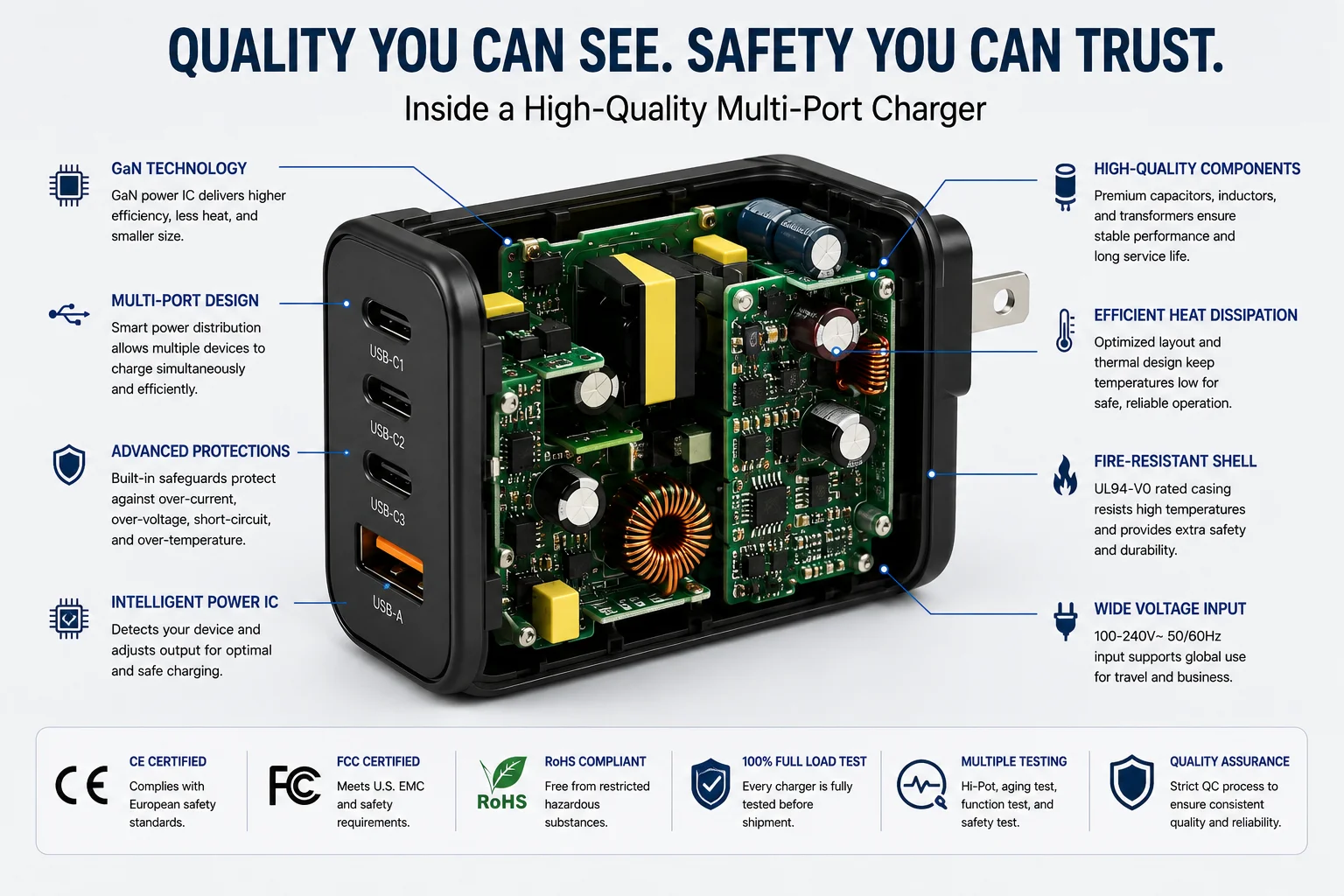
In my experience, many companies in Shenzhen call themselves "manufacturers." But there are different types, and you need to know who you're dealing with. A client once came to us after a bad experience. He thought he was buying from a factory, but it was just an assembly workshop. They bought cheap, pre-made circuit boards and put them in a case. They had no control over the quality or the electronics. When the chargers started failing, his "manufacturer" couldn't fix the problem because they didn't design the product. You need to ask questions to understand their role. Do they have their own R&D engineers? Can they show you their production lines, from SMT (surface-mount technology) for the PCBA to final assembly and testing? A real partner can.
Here’s a quick breakdown to help you understand who you might be talking to:
| Supplier Type | What They Do | Best For Importers Who... |
|---|---|---|
| R&D Manufacturer | Designs, engineers, and produces the entire product, including the PCBA. | Need custom features, value high quality, and want a long-term technical partner. |
| Assembly Factory | Buys PCBA and other components and only assembles the final product. | Are extremely price-sensitive and only need a standard, off-the-shelf product. |
| Trading Company | Doesn't own a factory but has deep relationships with several. Manages sourcing. | Need a wide variety of products, value communication, and want help managing logistics. |
Why Importers Should Not Compare Only by Price?
That super-low price is so tempting, I know. But what happens when those cheap chargers start failing? Are you ready for the angry emails and bad reviews?
Comparing by price alone is a huge mistake. It ignores critical factors like component quality, real-world charging speed, and verified safety certifications. A slightly more expensive, reliable charger prevents costly returns, negative reviews, and serious safety risks that can destroy your business.
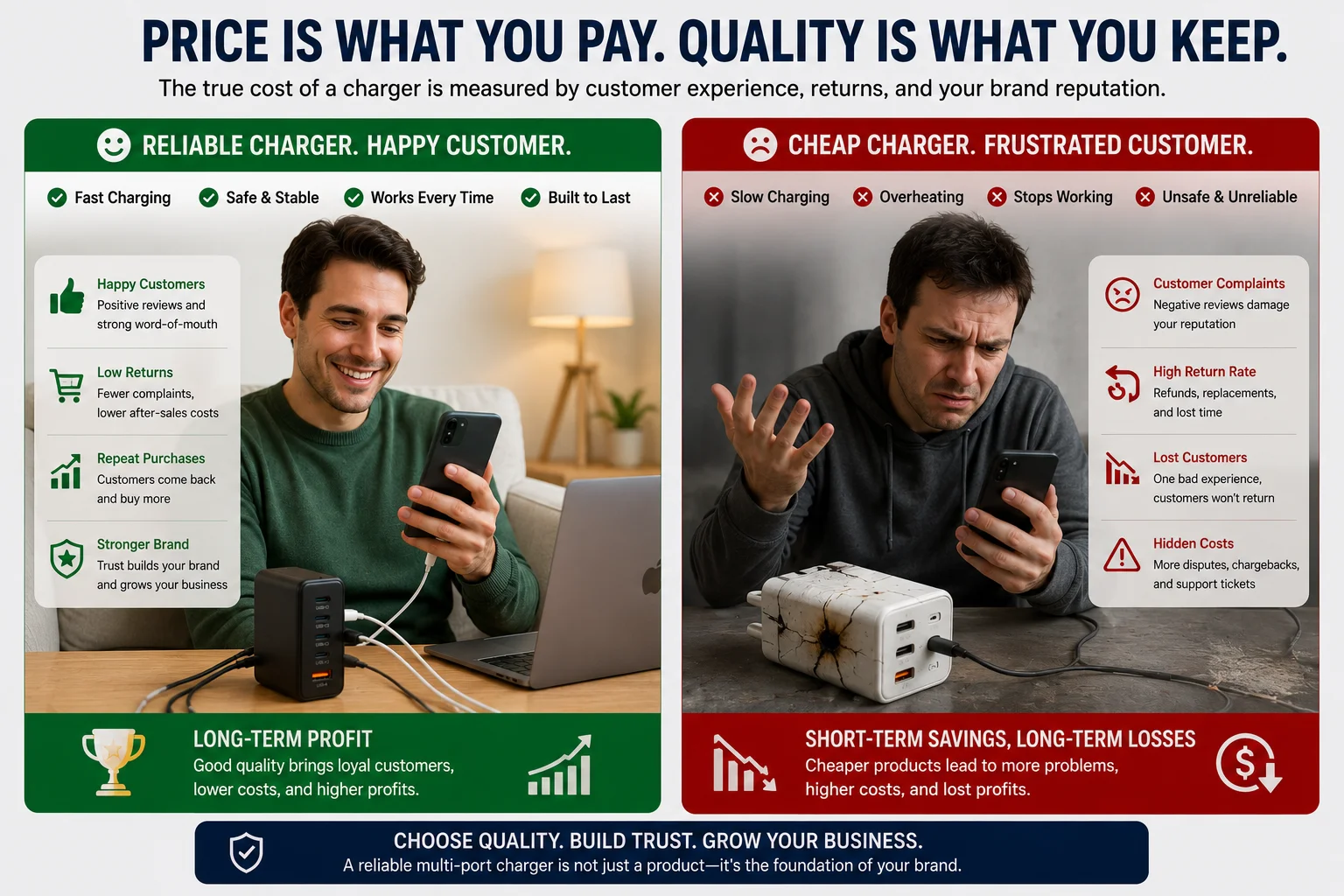
I once had a negotiation with a buyer from Germany. He showed me a quote from another supplier that was $0.50 cheaper per unit for a 65W GaN charger. It's my job to explain what that $0.50 difference really means. A cheaper price can come from using lower-grade capacitors that might fail in six months. It can mean skipping the expensive chipset that enables smart power distribution. Or, worst of all, it can mean they are using fake or non-existent safety certifications. I explained to the German client that our price included high-quality components rated for over 3,000 charge cycles3 and genuine CE and TUV certifications. He decided to place a small test order with us and the other supplier. Six months later, he came back and placed a huge order. He said our chargers had a near-zero failure rate, while the cheaper ones had over 10% returns due to overheating4. That $0.50 he saved upfront cost him much more in the end.
How Power Distribution Affects Real Charging Performance?
Does your 100W charger struggle to power a laptop and a phone at the same time? The total wattage on the box can be very misleading without smart power distribution.
Power distribution is how a multi-port charger intelligently divides its total power among the connected devices. A good charger uses a dynamic system to give each device the power it needs. A cheap one might just split the power evenly, slowing everything down.5
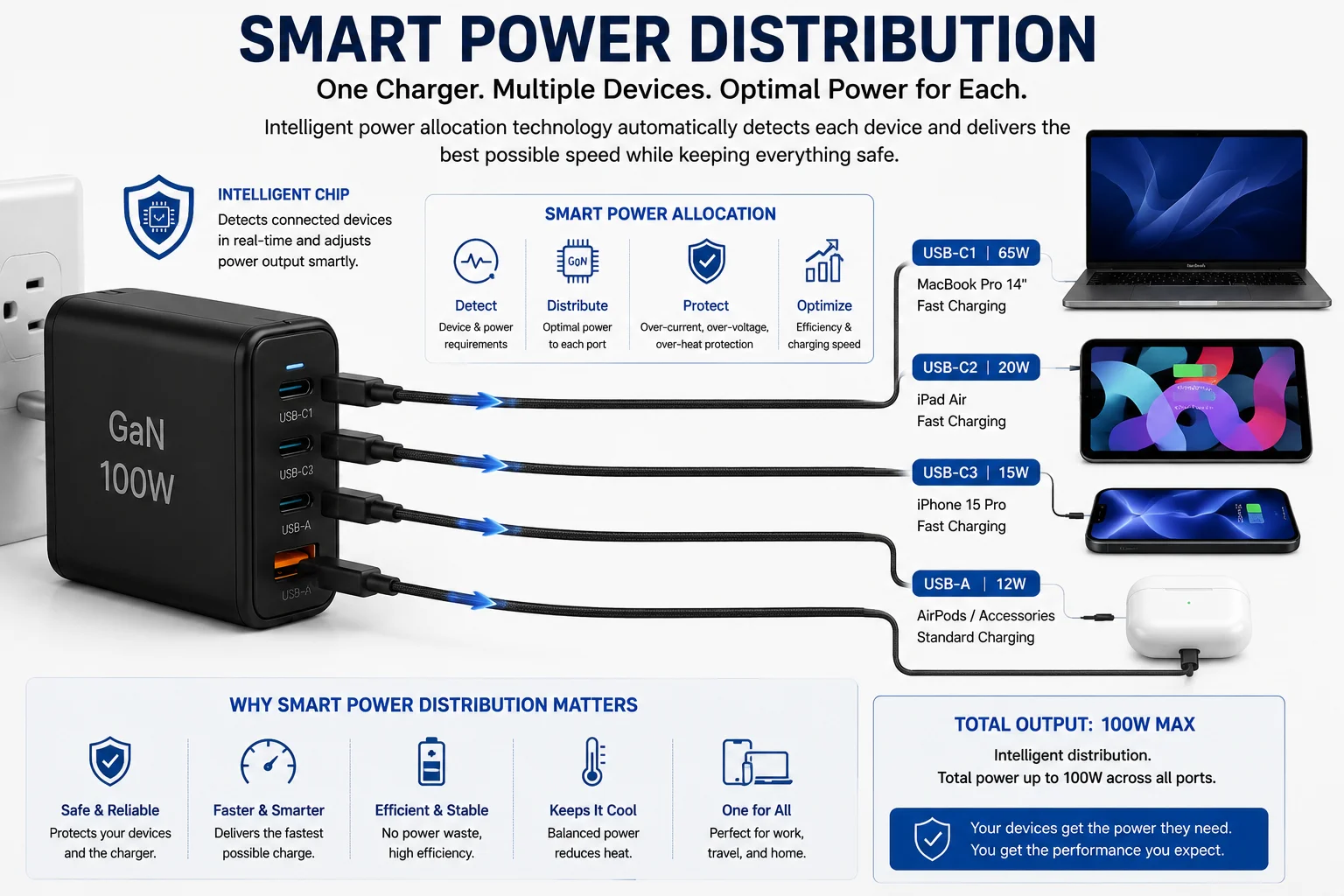
This is one of the most important technical details to discuss with a manufacturer. Let's look at a common scenario with a 100W charger with two USB-C ports. When you ask a supplier about this, don't just ask if it's 100W. Ask them for the "power splitting rules." A good supplier will immediately understand and provide a chart. Here is what you should look for:
| Ports in Use | Device 1 (e.g., Laptop) | Device 2 (e.g., Phone) | Total Power |
|---|---|---|---|
| C1 Only | 100W | - | 100W |
| C2 Only | - | 100W | 100W |
| C1 + C2 | 65W | 30W | 95W |
This is an example of dynamic power distribution. It recognizes that the laptop needs more power (65W) and gives the phone a fast charge (30W). A poorly designed charger might just split the power 50W/50W. That's not enough to properly charge many laptops. The technology that controls this is a sophisticated chipset. Ask your supplier what brand of chipset they use. If they can't answer, it's a big red flag.
What Ports and Protocols Should Buyers Confirm?
You ordered USB-C chargers, but they don't fast-charge the latest Samsung phones. Why? Because not all USB-C ports are created equal. The protocols are everything.
Buyers must confirm the specific charging protocols each port supports, not just the physical port type (USB-C or USB-A). Key protocols like Power Delivery (PD) and Programmable Power Supply (PPS) are essential for fast charging different brands like Apple and Samsung.
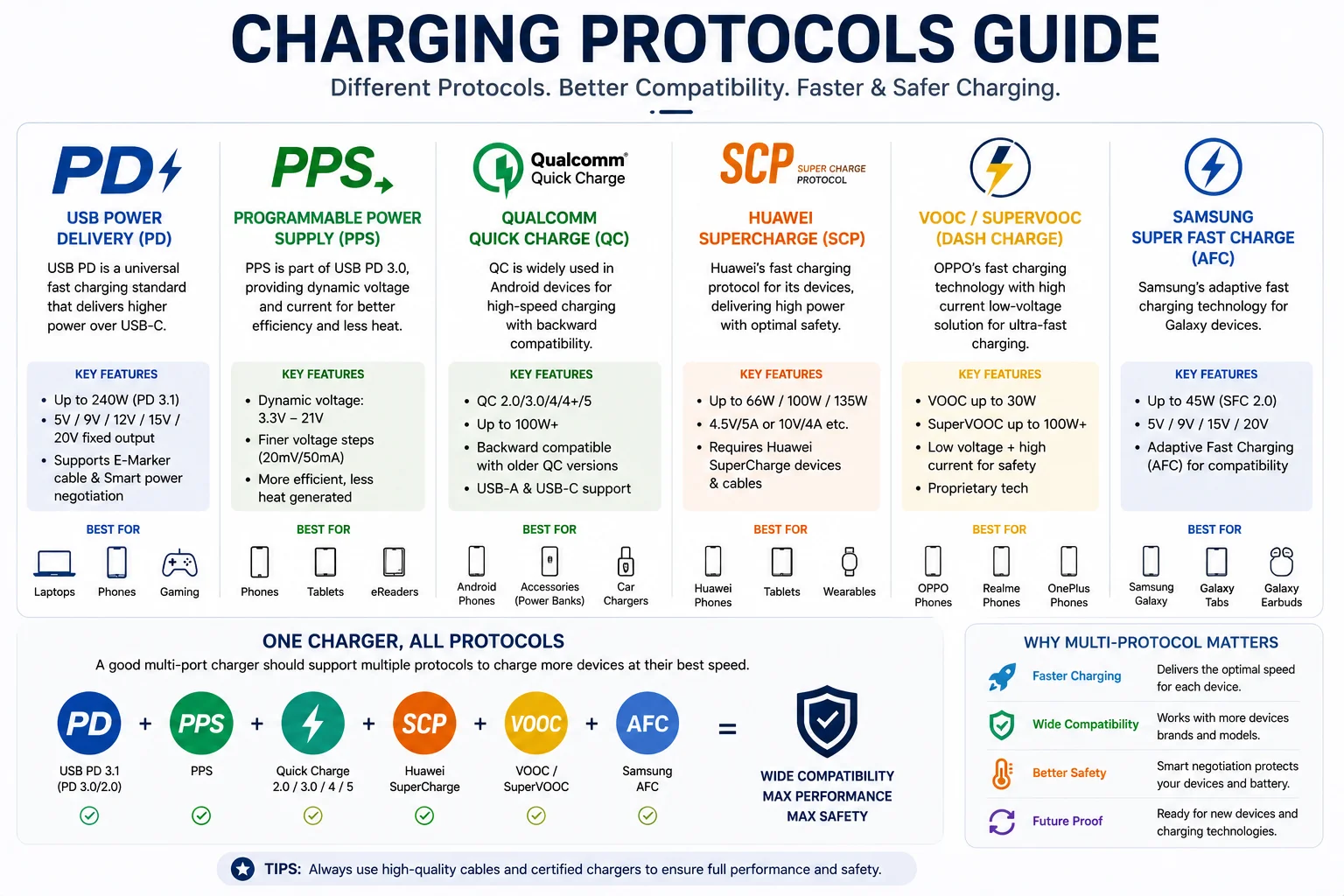
I get this question all the time: "I need a USB-C fast charger." My first reply is always, "Fast charge for what devices?" An iPhone needs USB PD. A modern Samsung phone needs PPS to enable "Super Fast Charging."6 A Huawei phone might need SCP. If the charger doesn't support the right protocol, it will just charge at a very slow, basic speed, and your customer will be disappointed. You must get this information in writing from your supplier. Ask for a detailed spec sheet that lists every protocol supported. A professional manufacturer will be able to provide this easily. It shows they understand the technology and have tested their product properly. Don't let a supplier just tell you "it supports fast charging." That's too vague.
Here are the key protocols you need to know for today's market:
| Protocol | Primarily Used For | Why It Matters |
|---|---|---|
| USB PD 3.0 / 3.1 | iPhones, iPads, MacBooks, Pixels, Laptops | The universal standard for high-wattage charging over USB-C. |
| PPS | Samsung Galaxy S-series (S20 and newer) | Essential for Samsung's "Super Fast Charging" and "Super Fast Charging 2.0". |
| QC 4+ / 5 | Many Android devices (Xiaomi, LG, etc.) | Qualcomm's popular fast-charging standard, often compatible with USB PD. |
| SCP / FCP | Huawei devices | Huawei's proprietary fast-charging protocols. |
Why Heat Control and Safety Design Matter?
Have you ever unplugged a charger and been shocked at how hot it was? That heat is a sign of wasted energy and, more importantly, a serious safety risk.
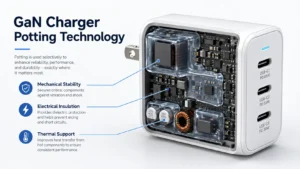
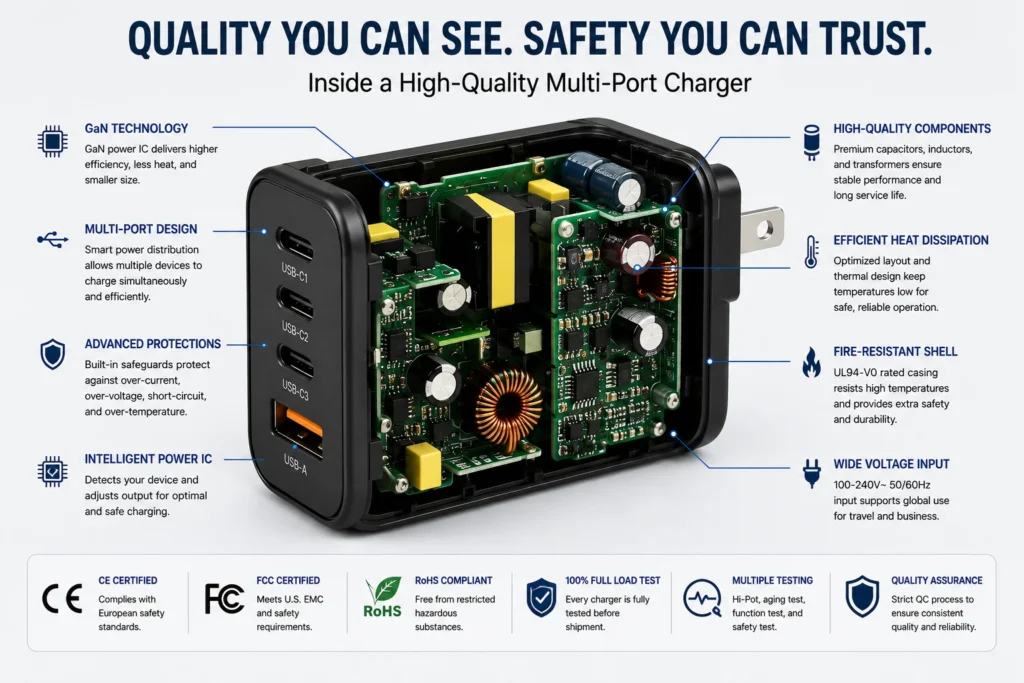
Excellent heat control and safety design are non-negotiable for a quality charger. This is achieved through a smart internal layout, using efficient components like GaN transistors, and including multiple built-in protections against over-voltage, over-current, and short-circuits.
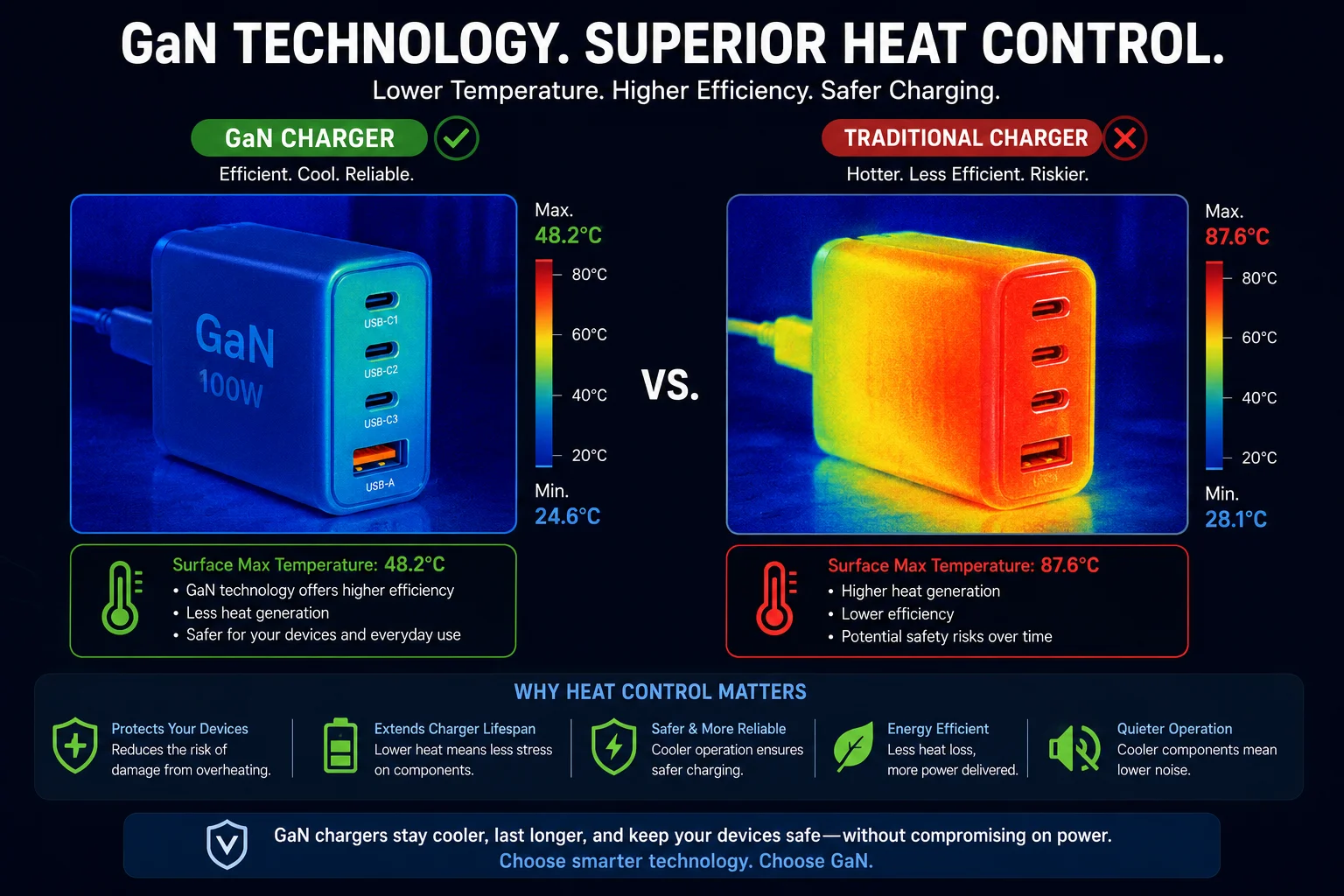
When you see "GaN" on a charger, it stands for Gallium Nitride. This is a newer material that's much more efficient than the old silicon used in chargers.7 Higher efficiency means less energy is wasted as heat. This allows manufacturers to make smaller, safer, and more powerful chargers. But simply using a GaN chip isn't enough. The entire internal design matters. The high-power components must be spaced out to avoid creating hot spots.8 Some high-end chargers even use thermal gel or small copper heat sinks to pull heat away from the core. On top of that, a safe charger must have a brain. This "brain" is a set of circuits that constantly monitor for problems. A cheap supplier might save a few cents by leaving one of these out. That few cents could be the difference between a reliable product and a fire hazard.
Always ask your manufacturer about these essential safety features:
- OVP (Over-Voltage Protection)
- OCP (Over-Current Protection)
- OTP (Over-Temperature Protection)
- SCP (Short-Circuit Protection)
If they don't know what you're talking about, walk away.
What Certifications and Test Reports Are Required?
Imagine this: your big shipment of chargers arrives, but it gets stopped and seized by customs. Why? You don't have the required safety certifications. A nightmare scenario.
Mandatory certifications prove that a charger meets the safety and electrical standards for your target market. These include CE for Europe, FCC for the USA, and UL or ETL for North America. Always demand to see the original, valid test reports.
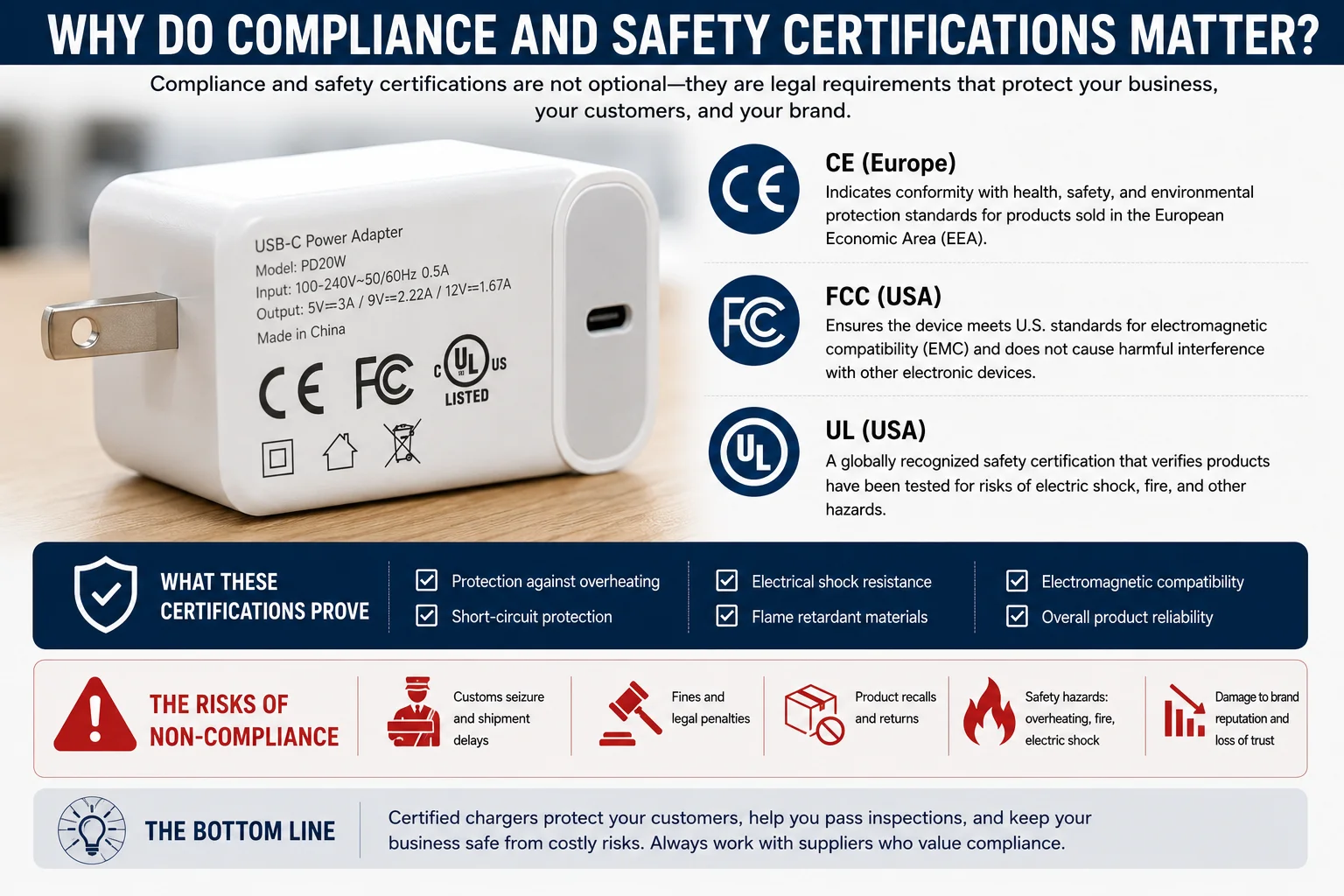
This is an area where I see so many importers get into trouble. A supplier might say "Yes, we have CE" on their website, but what does that mean? It could be expired. It could be for a different product. It could be completely fake. As an importer, it is your legal responsibility to ensure the products you sell are compliant.9 Don't just take their word for it. You must do your due diligence. Ask for a copy of the certificate and the full test report from the laboratory. Check the date to make sure it's current. Check that the model number on the report matches the product you are buying. You can even check the certificate number on the lab's website. A good supplier will be happy to provide all of this. They are proud of their investment in safety. A supplier that makes excuses or sends you a blurry, unreadable document is hiding something.
Here are the key certifications you must ask for:
| Region | Required Certifications | What They Cover |
|---|---|---|
| USA | FCC (for emissions), UL/ETL/TÜV (for safety) | FCC prevents interference. UL/ETL ensures it won't cause fires or electric shock.10 |
| Europe | CE-LVD, CE-EMC, RoHS | Covers safety (LVD), electromagnetic interference (EMC), and hazardous substances (RoHS). |
| UK | UKCA | The new UK-specific version of the CE mark. |
| Japan | PSE | Mandatory electrical appliance and material safety law. |
MOQ, Lead Time, and Production Capacity: What to Check?
You found a supplier with a great product and a fair price. But can they actually produce your order on time, especially when you need to scale up for the holidays?
You must verify the Minimum Order Quantity (MOQ), production lead time, and the factory's total production capacity. A low MOQ is great for starting out, but you also need a partner who can handle larger orders as your business grows without long delays.
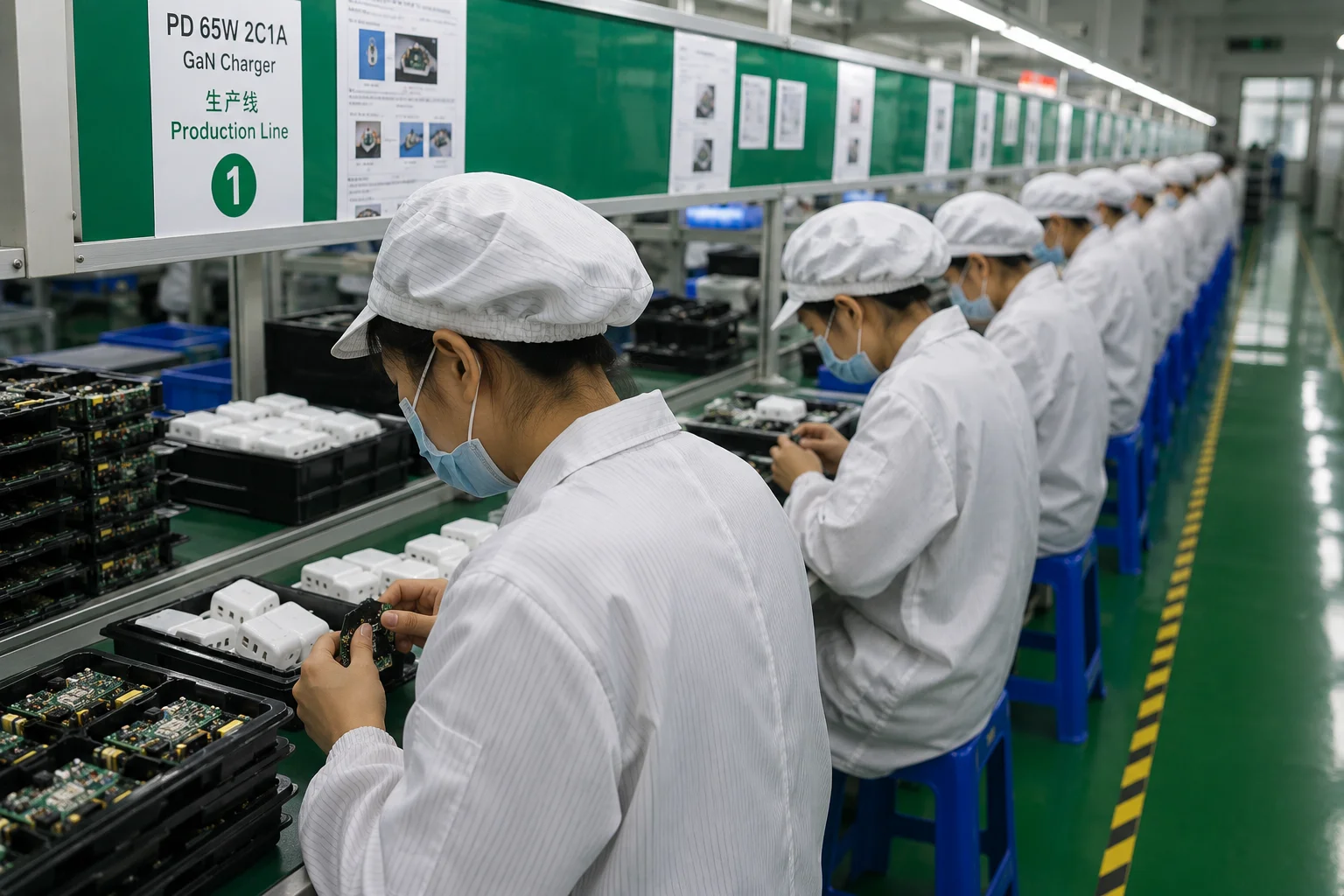
These are business-critical questions. I always tell my clients to think about their needs not just for the first order, but for the next three orders. Ask specific questions. What is the MOQ for a standard product? What is the MOQ if I want my logo on it? What if I want custom packaging? The numbers can be very different. For lead time, ask about the timeline from the day you pay the deposit to the day the goods are ready to ship. How does this change during the busy season from September to December?11 A transparent manufacturer will tell you, "Our normal lead time is 25 days, but for Q4 orders, you need to plan for 40 days." This allows you to plan your inventory. Finally, ask about capacity. "How many chargers can you produce per month?" This tells you if they are a small workshop or a serious factory that can support your growth. A factory with multiple production lines can handle a sudden large order from you without pushing back your delivery date.
So How Do I Choose a Long-Term Partner for Stability and Safety?
Are you tired of the constant search for a new supplier? The endless negotiation and the worry about quality? It's time to find a real partner, not just a vendor.
The best purchasing advice I can give is to focus on building a long-term partnership. Choose a manufacturer that demonstrates stability, prioritizes safety, and guarantees a reliable supply chain. This approach builds a far stronger and more profitable business than chasing short-term savings.

After 15 years in this business, I've learned that the most successful importers I work with think like partners. They look beyond a single transaction. When you are vetting a new supplier for a long-term relationship, consider these final points. How is their communication? Do they answer your technical questions clearly and quickly? Or do they just say "yes, yes, no problem" to everything? Can they offer flexibility? Maybe you need a low MOQ for your first order, but you plan to place a huge order in six months. A good partner will work with you to find a solution. They will see your potential and invest in the relationship. The goal is to find a company whose success is tied to your own. When you find a supplier who is transparent, an expert in their field, and committed to quality, you haven't just found a charger manufacturer. You've found a growth partner.
Conclusion
Choosing a multi-port charger manufacturer goes far beyond the unit price. Prioritize verified safety, real-world performance, and a reliable, transparent partner to build a truly successful and sustainable business.
"Consumers blame both manufacturer and retailer when products fail ...", https://mendoza.nd.edu/news/consumers-blame-when-products-fail/. Studies on consumer behavior and e-commerce show that product returns and negative reviews have a significant financial impact, with returns eroding profit margins and negative reviews directly influencing purchasing decisions of future customers. Evidence role: statistic; source type: research. Supports: The claim that small upfront savings can be outweighed by larger downstream costs associated with poor product quality.. Scope note: The source would provide general principles of retail and brand management rather than a specific cost analysis of charger manufacturing. ↩
"Original design manufacturer - Wikipedia", https://en.wikipedia.org/wiki/Original_design_manufacturer. The electronics industry distinguishes between several manufacturing models. An Original Equipment Manufacturer (OEM) builds products to another company's design, while an Original Design Manufacturer (ODM) designs and builds products that are then sold by other companies under their own brands. This is distinct from simple assembly operations or contract manufacturers (CMs). Evidence role: definition; source type: encyclopedia. Supports: The different classifications of manufacturers in the electronics industry.. ↩
"[PDF] Alternative Test Methods for Electronic Parts - S3VI", https://s3vi.ndc.nasa.gov/ssri-kb/static/resources/Alternative%20Tests%20Overview%20(2).pdf. Electronic component reliability is often measured by metrics like Mean Time Between Failures (MTBF) or through accelerated life testing, where products are subjected to stress to estimate their operational lifespan under normal conditions. Evidence role: definition; source type: institution. Supports: The concept of component and product lifetime ratings in electronics.. Scope note: A specific standard for 'charge cycles' for a non-battery device like a charger is not a common industry metric; the source will likely discuss more general reliability metrics. ↩
"Product Innovation: 95% of new products miss the mark", https://professionalprograms.mit.edu/blog/design/why-95-of-new-products-miss-the-mark-and-how-yours-can-avoid-the-same-fate/. Market research and industry reports indicate that return rates for consumer electronics can vary widely, with some studies suggesting a correlation between lower product cost/quality and higher rates of return and customer dissatisfaction. Evidence role: statistic; source type: research. Supports: The claim that lower-cost electronics can have significantly higher return rates.. Scope note: Sources are unlikely to provide a specific return rate of '10%' for chargers but can support the general principle that failure rates are a significant issue in the electronics market. ↩
"What is USB-C PD and Why is it Better Than Standard USB-C?", https://www.phihong.com/what-is-usb-c-pd-and-why-is-it-better-than-standard-usb-c/. Technical specifications for USB Power Delivery describe power rules that allow a source to offer different power profiles. Advanced chargers use dynamic power sharing to intelligently allocate wattage based on the needs of connected devices, whereas simpler designs may default to a fixed, static split of power between active ports. Evidence role: mechanism; source type: education. Supports: The technical difference between simple (static) and intelligent (dynamic) power distribution in multi-port chargers.. ↩
"USB hardware - Wikipedia", https://en.wikipedia.org/wiki/USB_hardware. The USB Power Delivery (PD) 3.0 specification introduced the Programmable Power Supply (PPS) protocol, which allows for fine-grained adjustments in voltage and current. This feature is leveraged by manufacturers like Samsung for their proprietary fast-charging standards, such as 'Super Fast Charging'. Evidence role: definition; source type: institution. Supports: The role of the PPS protocol in the USB Power Delivery standard and its adoption by device manufacturers for optimized fast charging.. ↩
"[PDF] Performance and benefits of GaN versus SiC - Texas Instruments", https://www.ti.com/lit/pdf/slyt801. Academic research in materials science and power electronics demonstrates that Gallium Nitride (GaN) has a wider bandgap and higher electron mobility than silicon. These properties allow GaN-based transistors to operate at higher frequencies and temperatures with lower energy loss, leading to more efficient and compact power converters. Evidence role: mechanism; source type: paper. Supports: The physical properties of Gallium Nitride (GaN) that make it more efficient than silicon for power conversion applications.. ↩
"[PDF] Mitigation of Hot-Spots in Photovoltaic Systems Using Distributed ...", https://www.nrel.gov/docs/fy18osti/71323.pdf. Engineering principles for printed circuit board (PCB) design emphasize thermal management, which includes the strategic placement of high-power components to ensure adequate heat dissipation and prevent the formation of localized 'hot spots' that can degrade performance and compromise safety. Evidence role: mechanism; source type: education. Supports: The importance of component placement and spacing for thermal management in electronics.. ↩
"eFiling Resources for Importers | CPSC.gov", https://www.cpsc.gov/efiling/importers. Government bodies, such as the U.S. Consumer Product Safety Commission (CPSC) and the European Commission, define the 'importer' as a key economic operator who bears legal responsibility for ensuring that products placed on the market comply with all applicable safety standards and certification requirements. Evidence role: general_support; source type: government. Supports: The legal framework that places responsibility on importers for product compliance.. ↩
"Title 47 CFR Part 15 - Wikipedia", https://en.wikipedia.org/wiki/Title_47_CFR_Part_15. In the United States, the Federal Communications Commission (FCC) regulates radio frequency emissions to prevent electromagnetic interference under Title 47 of the CFR. Separately, safety certifications from a Nationally Recognized Testing Laboratory (NRTL) like UL or ETL demonstrate compliance with safety standards (e.g., against fire and shock hazards) as recognized by the Occupational Safety and Health Administration (OSHA). Evidence role: definition; source type: government. Supports: The distinct roles of FCC and UL/ETL certifications for products sold in the United States.. ↩
"Understanding Lead Times and Production Schedules in China", https://www.ilifeimport.com/blog/detail/lead-times-production-schedules-china-india. Logistics and supply chain industry analysis confirms a recurring peak season for manufacturing in Asia, typically in the third and fourth quarters, as companies build inventory for holiday sales in North America and Europe. This surge in demand often leads to extended production lead times and increased shipping costs. Evidence role: general_support; source type: other. Supports: The existence of a seasonal peak in manufacturing that affects production lead times.. Scope note: The source would confirm the general trend rather than the specific '25 to 40 days' timeline mentioned in the article's anecdote. ↩