A white-label smartwatch app can look simple at first: add your logo, change the colors, and launch. However, many buyers discover too late that app branding, ownership, store publishing, updates, and technical support are separate questions. We help buyers define the real scope before a smartwatch order moves forward.
A white-label smartwatch app is a pre-existing companion app that can be adapted with selected brand elements, such as the app name, logo, colors, languages, watch faces, and supported functions.1 It does not automatically give a buyer source-code ownership, app-store control, or unlimited feature development.2 Buyers should confirm scope, responsibility, maintenance, and data arrangements before placing a hardware order.
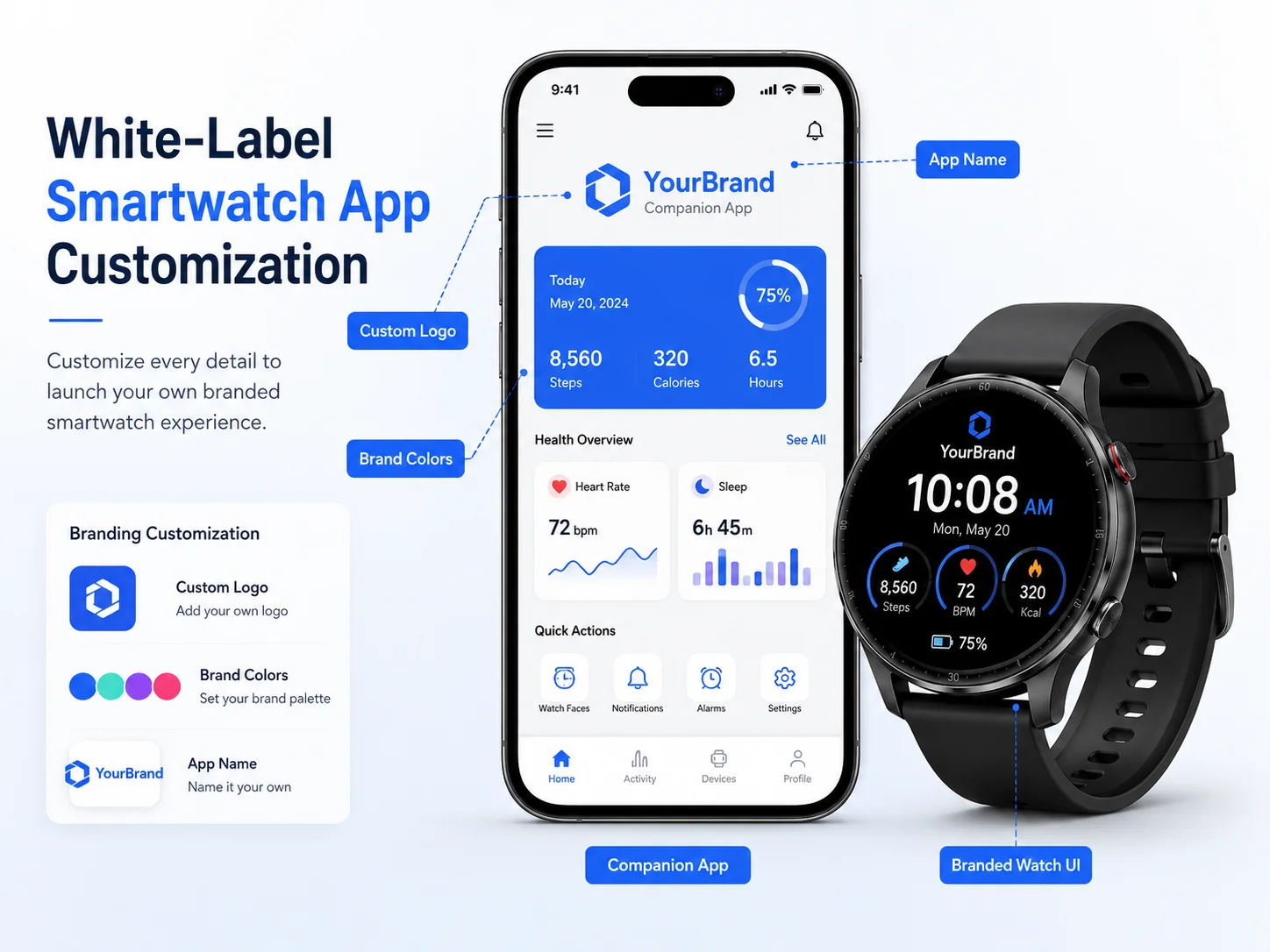
The smartwatch itself is only one part of the customer experience. The companion app often becomes the place where users pair devices, review activity data, change settings, download watch faces, and contact support.3 That is why we treat app customization as a sourcing and lifecycle decision, not just a packaging request.
1. Quick Answer: What Can Be Customized in a White-Label Smartwatch App?
Many buyers ask us, “Can you customize the app?” The problem is that this question covers everything from a new logo to a completely new software platform. If the scope stays vague, buyers may expect functions that need extra development, testing, budget, and time.
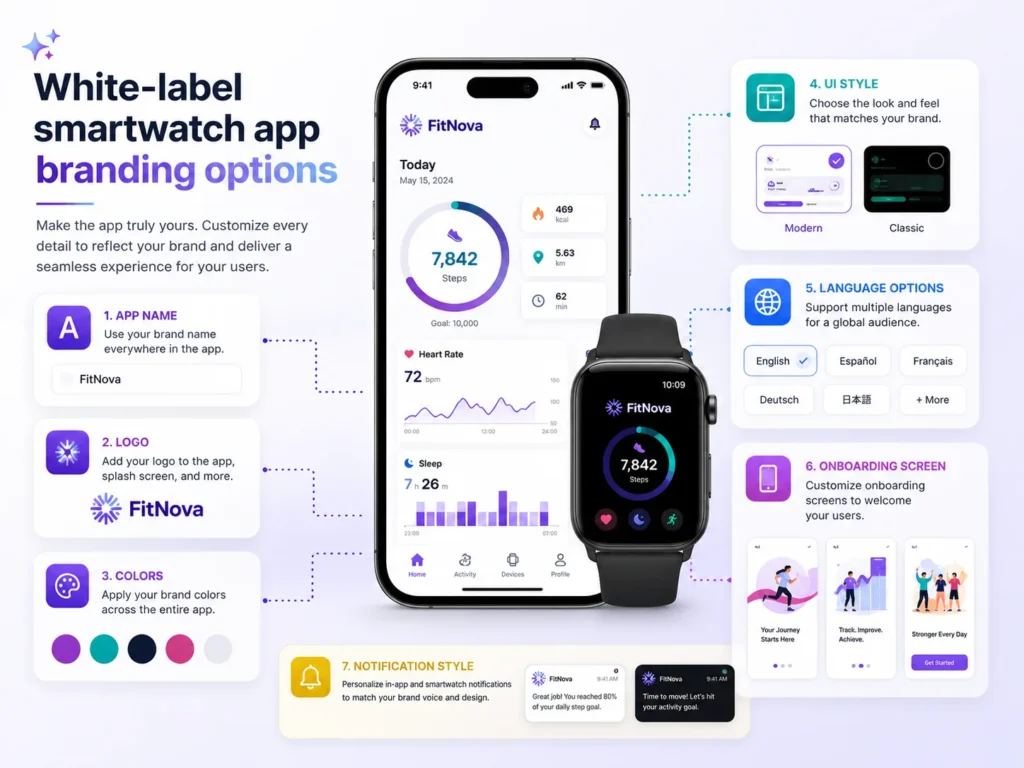
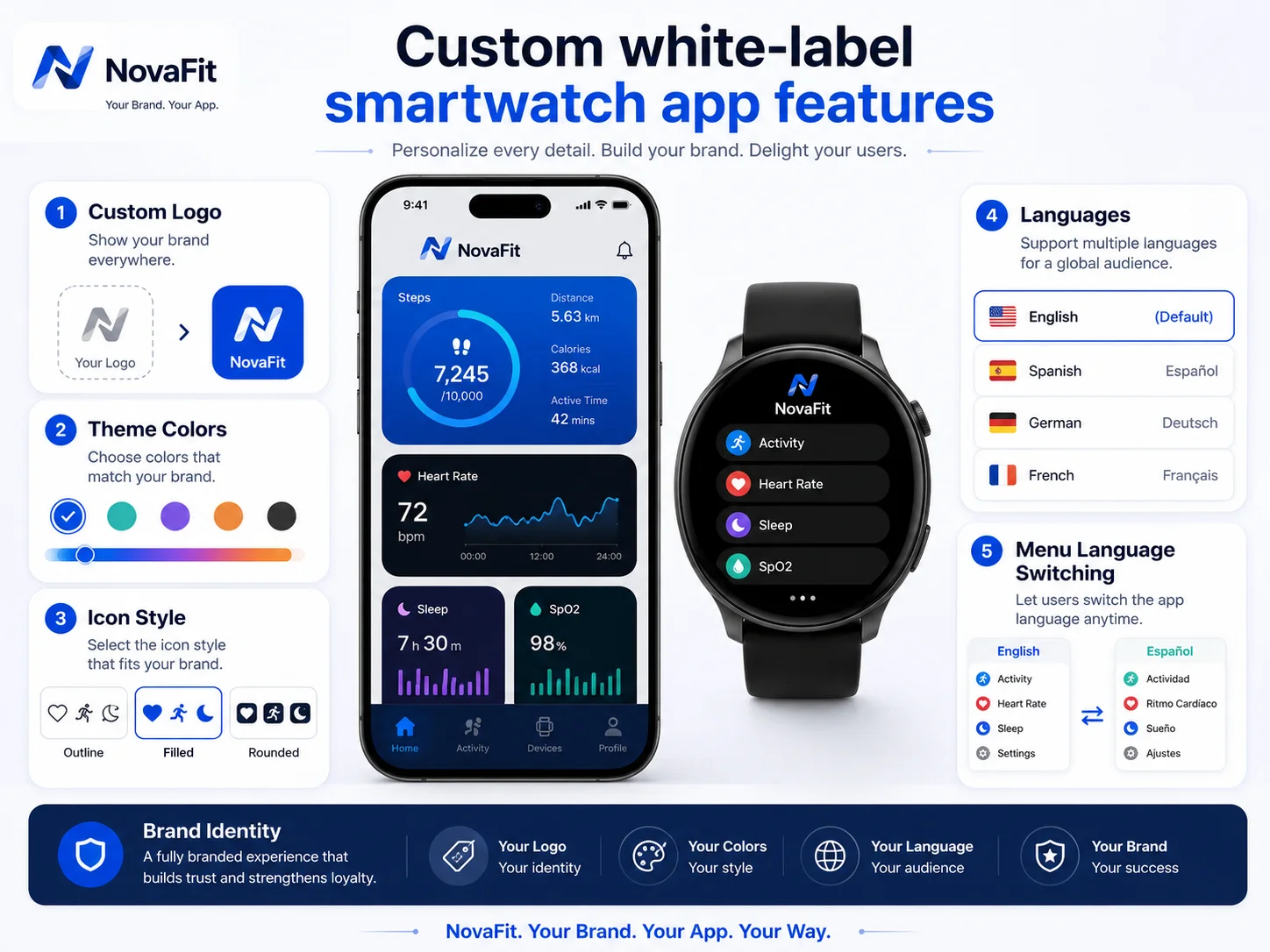
A white-label smartwatch app can usually support selected branding changes, including an app icon, logo, color palette, app name, language options, splash screen, and some existing screens or watch faces. New functions, integrations, dashboard designs, and data workflows may require separate feasibility checks and development planning.
Start with Four Categories of Requests
When we review buyer requirements internally, we usually separate requests into four groups:
-
Brand assets
Logo, brand name, icon, launch screen, store screenshots, and color references. -
Existing white-label options
Supported languages, available watch faces, device naming, units, basic UI themes, and existing app functions. -
UI adjustments
Menu labels, selected screen layouts, onboarding wording, feature order, and visual styling. -
New development requests
New health displays, special reports, membership systems, e-commerce connections, social features, GPS logic, or third-party integrations.
The first two groups are often easier to assess because they may already exist in the software framework. The last two groups need more careful discussion. A request may affect app behavior, device firmware, Bluetooth communication, cloud services, testing, or app-store submission materials.4
For example, a buyer may ask for a “custom sleep report.” That could mean a simple branded screen using existing sleep data. Or it could mean a new scoring method, a new cloud dashboard, downloadable reports, and a different user journey. These are very different projects.
A branded-looking app is not the same as an independently controlled app ecosystem.
We encourage buyers to provide a simple requirements list before discussing final pricing. Screenshots, competitor examples, language requirements, and a list of “must-have” versus “nice-to-have” items make feasibility checks much more useful.
2. What Is a White-Label Smartwatch App and Who Is It Best For?
A private-label smartwatch launch can lose brand value when every customer sees the same generic app used by many other products. At the same time, building a full app from zero can be expensive and slow. A white-label smartwatch app sits between those two options.
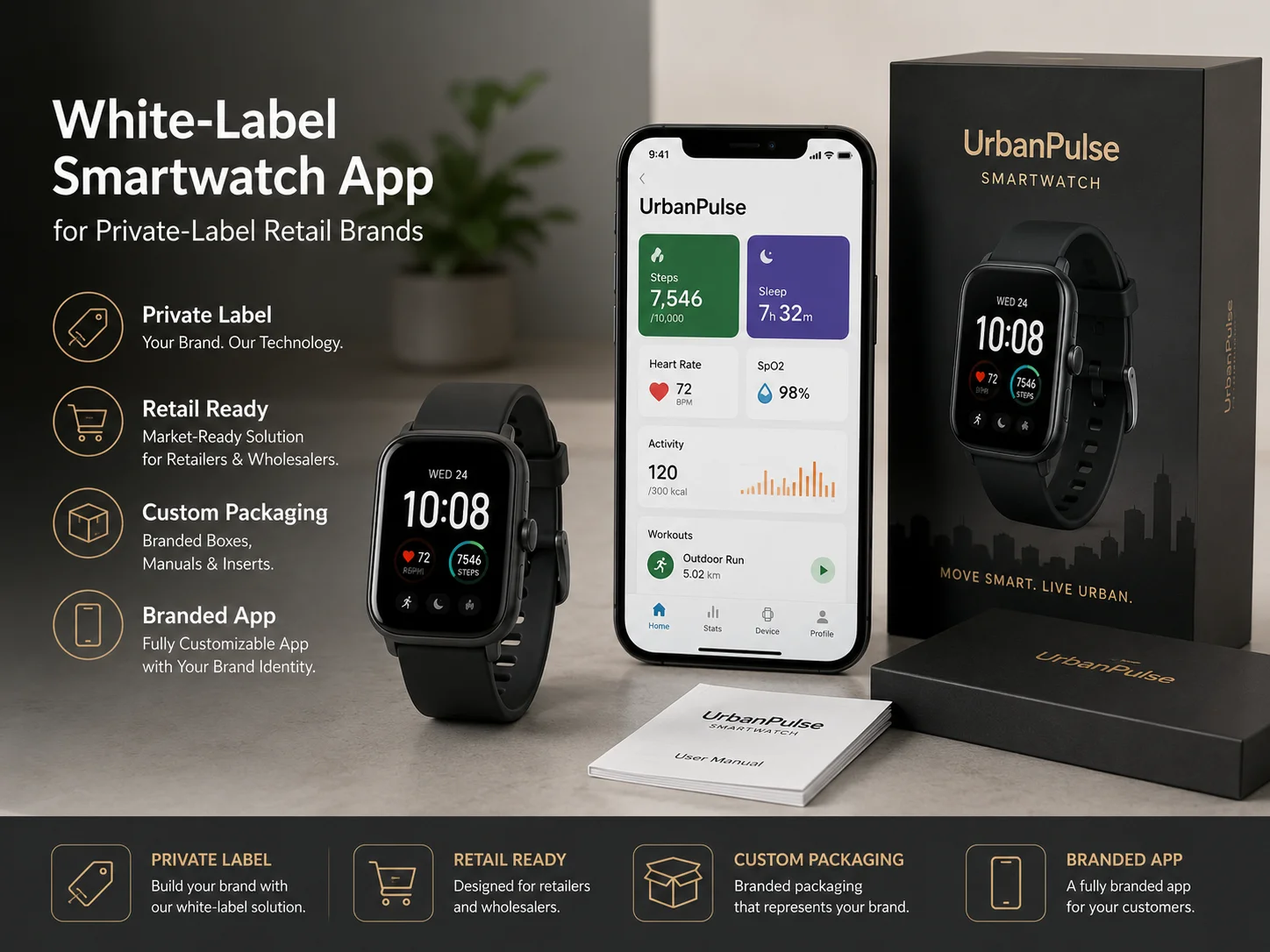
A white-label smartwatch app is an existing companion application platform that can be presented under a buyer’s brand within an agreed scope. It is often best for retailers, e-commerce sellers, importers, and growing brands that need a faster launch while still improving the user-facing brand experience.
When White Label Makes Commercial Sense
In our conversations with European and American buyers, white-labeling is usually most relevant when a buyer wants to:
- Launch a branded smartwatch range without building a software team.
- Reduce the “generic product” feeling after purchase.
- Sell through Amazon, Shopify, retail stores, or distribution channels.
- Offer local language support for target markets.
- Create branded packaging, device UI, and app presentation together.
- Test a smartwatch category before funding a larger software project.
A white-label route can be practical for a retailer launching a first wearable collection. It can also work for an importer that sells several consumer-electronics categories and wants one consistent brand identity.
However, it may not fit every business model. A buyer that needs exclusive software logic, deep medical workflows, a large user community, advanced subscriptions, or a complex connected ecosystem may need a different route. That could involve custom software development, a dedicated technology partner, or a platform with different commercial terms.
Questions We Hear from Buyers
One buyer may ask, “Can my customers see only my brand?” Another may ask, “Can we keep the app after changing smartwatch models?” These questions are important because white-label arrangements vary.
Before selecting a model, buyers should clarify:
- Who controls the app listing?
- What happens if the hardware platform changes?
- Is the branded app available in target countries?
- Which functions are standard?
- What is the update and issue-response process?
- Can the buyer use the app with future models?
We do not treat these as small details. They affect long-term product support after the shipment leaves Shenzhen.
3. Comparison Table: Standard App vs White-Label Smartwatch App vs Fully Custom Smartwatch App?
Buyers often compare app options only by upfront price. That approach can create problems because lower initial cost may come with less control, while deeper customization may bring longer validation cycles. A clear comparison helps buyers choose a realistic launch model.
A standard app offers the fastest route with the least branding control. A white-label smartwatch app provides selected brand presentation on an existing platform. A fully custom app can offer greater flexibility, but it usually requires more budget, project management, testing, and ongoing maintenance responsibility.
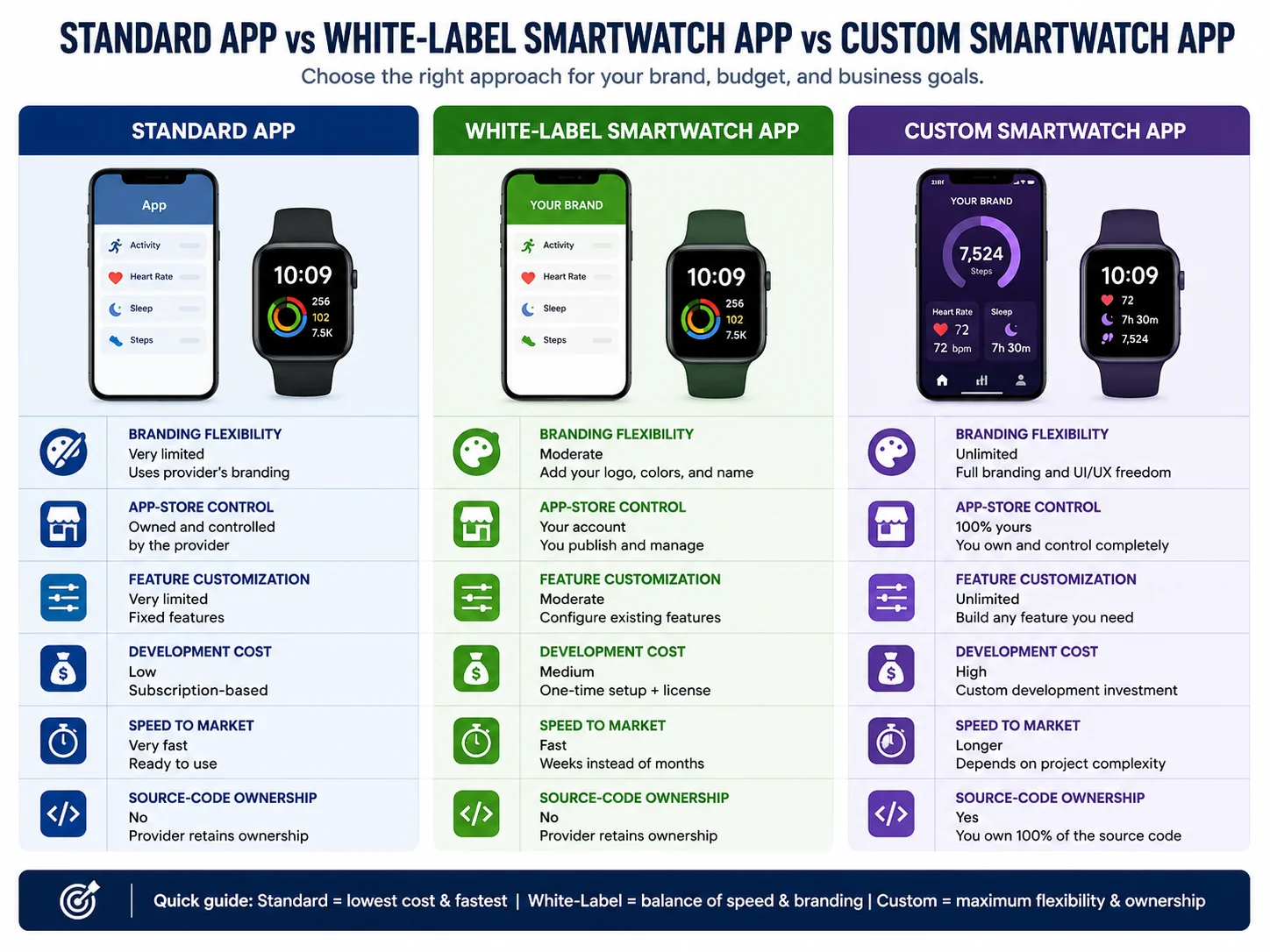
| Area | Standard App | White-Label Smartwatch App | Fully Custom App |
|---|---|---|---|
| Brand name and logo | Usually no | Often possible within scope | Usually possible |
| Launch speed | Fastest | Moderate | Usually longest |
| Upfront investment | Lowest | Medium | Highest |
| Existing device support | Existing model range | Existing supported platform | Must be defined |
| New feature flexibility | Limited | Limited to medium | Potentially higher |
| App-store account control | Often supplier/platform controlled | Must be confirmed | Can be buyer controlled |
| Maintenance workload | Lower for buyer | Shared or defined by agreement | Higher for buyer |
| Source-code ownership | Usually no | Usually not automatic | Depends on contract |
The Table Is a Starting Point, Not a Promise
The words “standard,” “white label,” and “custom” are used differently across the market. A supplier may call a logo replacement “custom app.” Another supplier may include custom app-store assets but not new screen development. That is why buyers should request a written scope rather than rely on broad labels.
We suggest asking for a line-by-line list of what is included:
- App icon and app name
- Brand logo placement
- Color theme
- Languages
- Device UI and boot logo
- Watch face selection
- Existing function availability
- App-store publishing assistance
- Account ownership arrangement
- OTA update responsibility
- Support period and response process
In one internal feasibility discussion, a buyer’s request initially sounded like a basic branded app. After we reviewed the details, it included three languages, a custom onboarding flow, special watch faces, retailer support links, and a new data screen. The project scope changed immediately.
The right choice depends on the buyer’s sales volume, launch date, market, customer expectations, and willingness to manage software after launch. No option is automatically best.
4. How Does a White-Label Smartwatch App Connect the Smartwatch, Firmware, Cloud, and User Data?
A smartwatch app may look like one simple interface on a phone, but the customer experience depends on several connected layers. If buyers only review the app screenshots, they may miss the systems that affect pairing, updates, data display, and long-term compatibility.
A white-label smartwatch app usually acts as the companion layer between a user’s smartphone and the smartwatch. It may communicate through Bluetooth, read supported device data, send settings to the watch, and sometimes connect with backend services. The exact structure depends on the product platform.
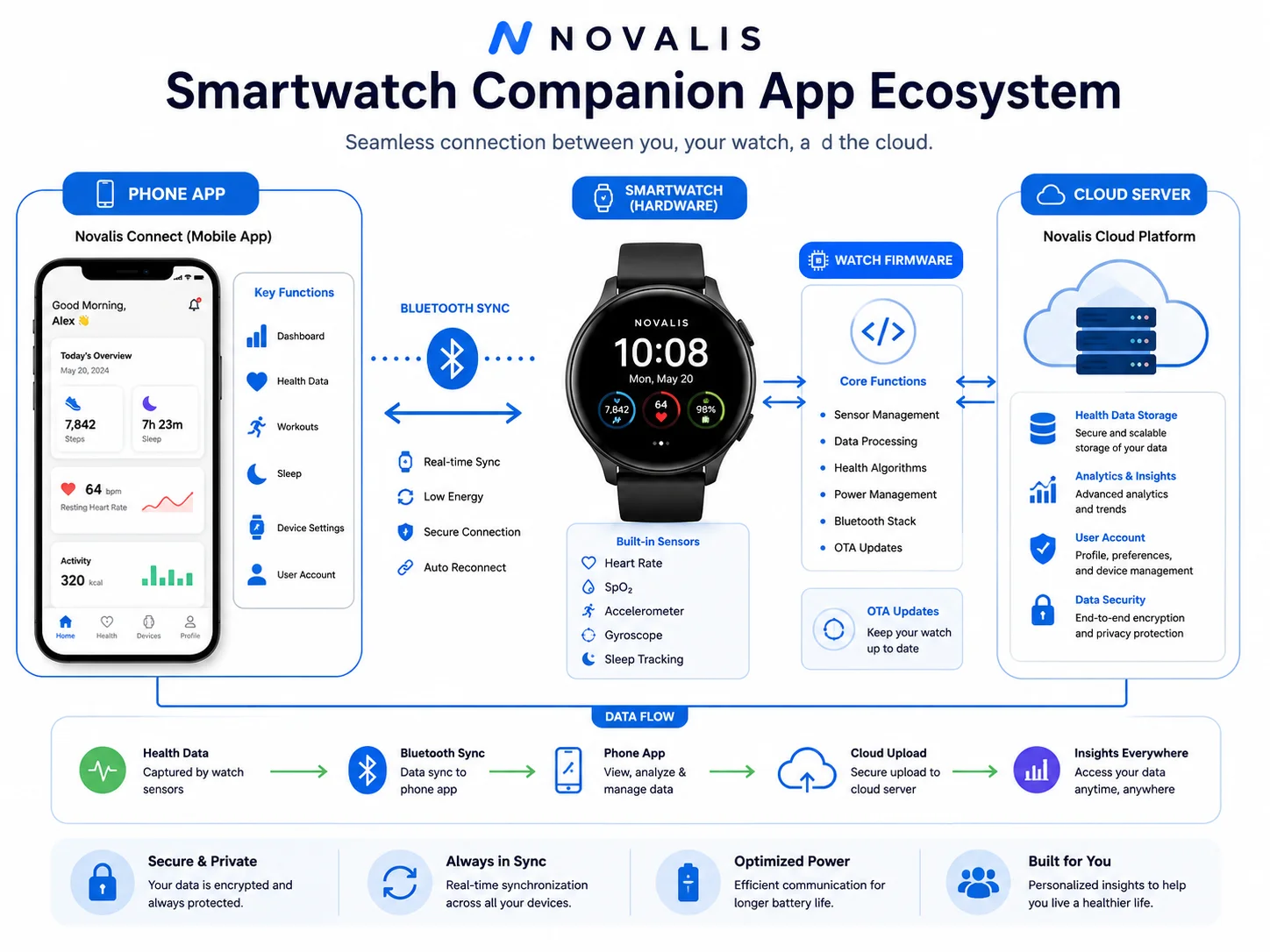
The Four Layers Buyers Should Understand
| Layer | Main Role | Buyer Questions |
|---|---|---|
| Smartwatch hardware | Sensors, display, battery, Bluetooth | Which model and chipset are supported? |
| Firmware | Device behavior and feature logic | Who provides fixes and OTA packages? |
| Mobile app | Pairing, data display, settings | What branding and functions can change? |
| Cloud/server services | Accounts, sync, content, analytics where used | Where is data handled and who is responsible? |
The app and device must remain compatible.5 A visual app change may be simple, but a new device setting may need firmware support. Similarly, a new firmware function may require app updates so users can see or control it.
For example, if a buyer wants a new watch-face download section, the request may involve app design, downloadable content management, device storage limits, Bluetooth transfer behavior, and firmware compatibility. It is not only a graphic-design task.
Why This Matters for Procurement
Buyers should ask which parts are already supported by the selected smartwatch platform. A product team can then check whether the requested feature is:
- Already available.
- Available with branding changes.
- Possible with additional development.
- Not suitable for the current hardware or software framework.
We are careful not to describe technical feasibility as confirmed delivery until the relevant teams review the requirement. This approach helps avoid the common problem of promising a feature during quotation and discovering limitations after a purchase order is placed.
5. What Can Brands Customize in a White-Label Smartwatch App?
A logo alone rarely creates a complete brand experience. Customers notice the app name, onboarding language, colors, device name, help content, and watch-face selection. However, each customization item may have different cost, lead time, and technical impact.
A white-label smartwatch app may allow brands to customize the app name, icon, logo, colors, splash screen, selected UI labels, languages, watch faces, and certain existing functions. Buyers should confirm each item separately because availability varies by software platform and project scope.
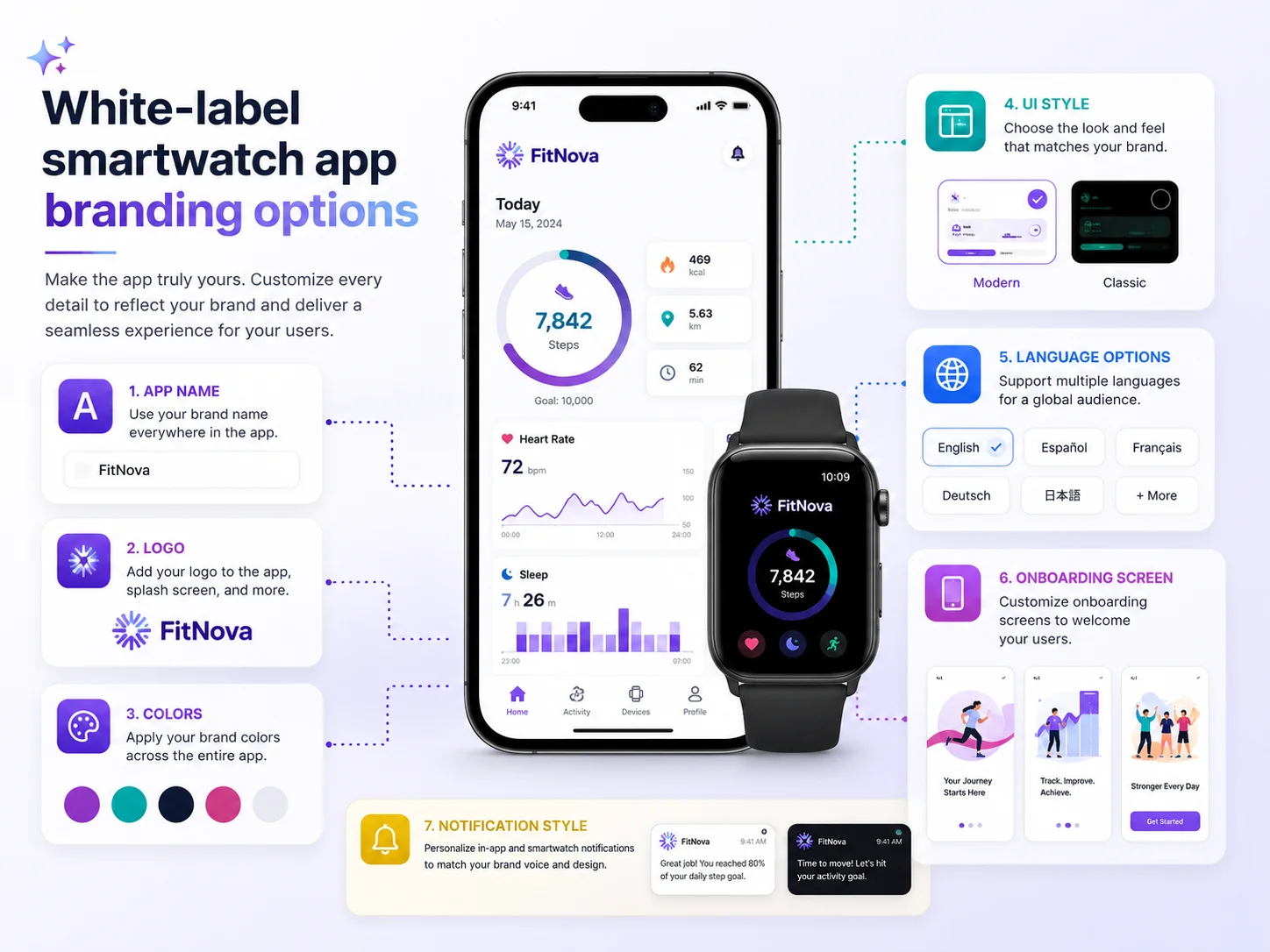
Common Customization Levels
Basic brand package may include:
- App icon and launch screen
- Logo placement
- App display name
- Main brand colors
- Device Bluetooth name
- Basic store listing assets
Expanded branding package may include:
- Selected UI visual changes
- Custom watch-face collection
- Localized text
- Branded onboarding content
- Help center or support links
- Feature arrangement from existing modules
Development-level requests may include:
- New functions or screens
- New account systems
- Different data dashboards
- External API connections
- Subscription or loyalty systems
- New cloud workflows
A buyer should also distinguish between text changes and true localization. Translating “Steps” into French is not the same as creating a properly reviewed French user journey, customer-support content, privacy notices, and store listing.
Build a Requirement Sheet
We recommend a simple sheet with five columns:
| Request | Priority | Existing Example | Needed by Launch? | Feasibility Result |
|---|---|---|---|---|
| Brand icon | Must-have | PNG file | Yes | To confirm |
| German language | Must-have | Existing translation | Yes | To confirm |
| New wellness dashboard | Nice-to-have | Competitor screenshot | No | To confirm |
This gives both the buyer and supplier a practical reference. It also prevents a late-stage misunderstanding where “custom UI” means different things to different people.
6. How Do Custom Watch Faces and Device UI Strengthen Brand Identity?
Many smartwatch brands focus heavily on the outer carton and product color. Yet the customer may interact with the watch face dozens of times each day. If the device UI and companion app feel unrelated, the brand experience can appear unfinished.
A white-label smartwatch app can support brand identity through coordinated watch faces, device boot visuals, menu styling, and app colors where the underlying platform allows it. Custom watch faces are often one of the most visible branding tools, but they still need hardware and software compatibility checks.
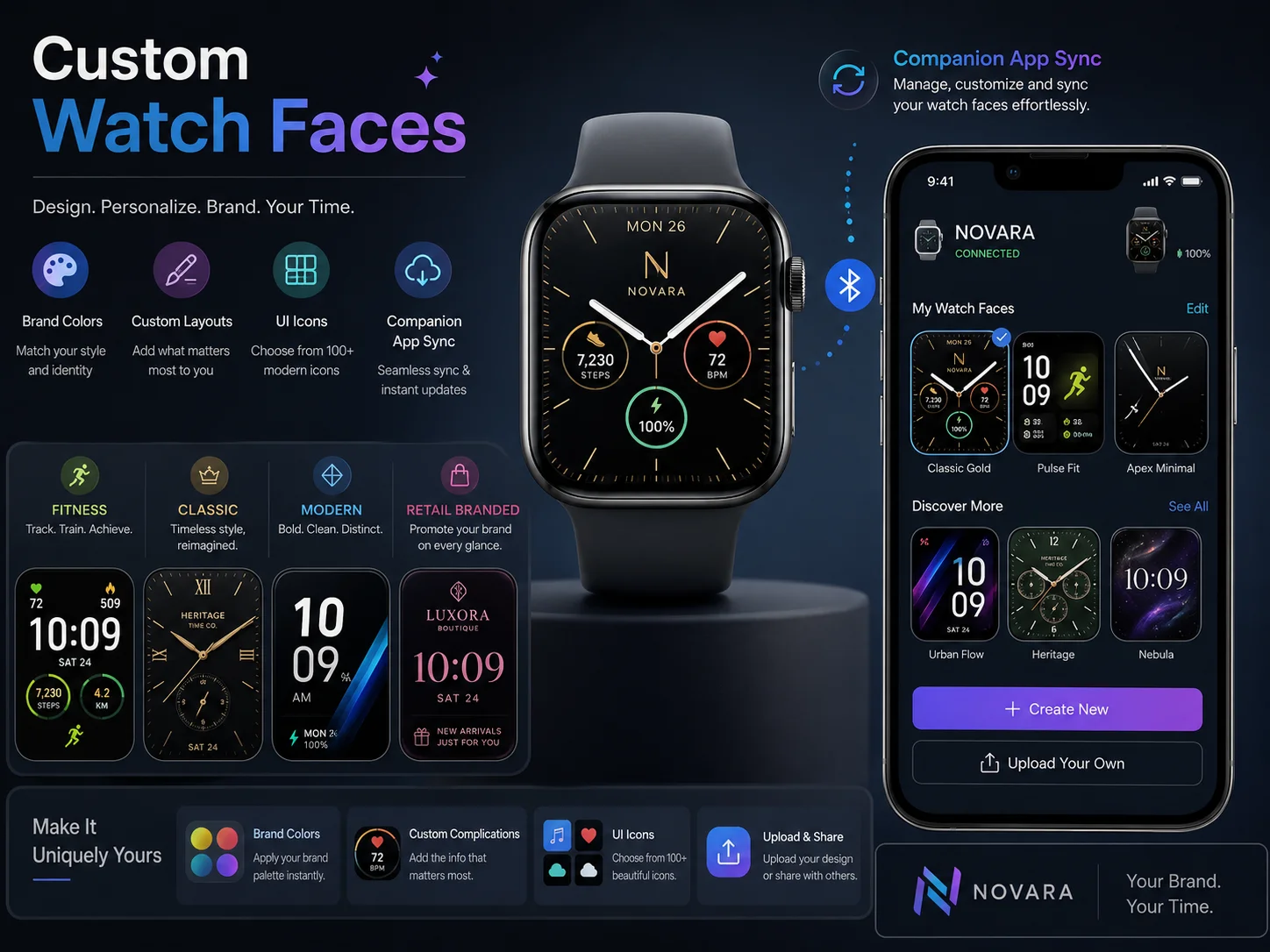
Think Beyond the Logo
A strong visual direction usually includes:
- Brand colors that remain readable outdoors.
- Typography that works on a small display.
- Watch faces for different user types.
- Consistent icons across watch, app, packaging, and manuals.
- Clear wording for notifications and health-related displays.
- A device name that customers can recognize during Bluetooth pairing.
For a fashion-focused brand, the hero watch face may emphasize clean time display and color style. For a sports retailer, the priority may be exercise metrics, step goals, and quick workout access. The design should reflect the target customer rather than copy a competitor.
Practical Limits Matter
Small displays have real limitations.6 A detailed watch face may look attractive in a design file but become difficult to read on a 1.83-inch screen. It may also consume more battery or exceed available device memory, depending on the platform.
We usually advise buyers to request a small, focused collection rather than too many faces at launch. A practical mix could include:
- A clean everyday face.
- A fitness-focused face.
- A premium brand-style face.
- A seasonal or promotional face.
Buyers should also ask whether watch faces are fixed, downloadable, editable through the app, or managed through an existing library. These details affect both the customer experience and future update planning.
7. How Do OTA Firmware and App Updates Affect Long-Term Product Support?
A smartwatch can perform well during initial samples and still create customer-service issues months later. Phone operating systems change, Bluetooth behavior can change, and bugs may appear after more users connect different devices.7 Post-launch support therefore matters as much as launch customization.
A white-label smartwatch app needs an agreed update path for both the mobile app and device firmware. OTA, or over-the-air, firmware updates may help improve supported devices after shipment8, but buyers should confirm who evaluates issues, releases updates, communicates changes, and supports end users.
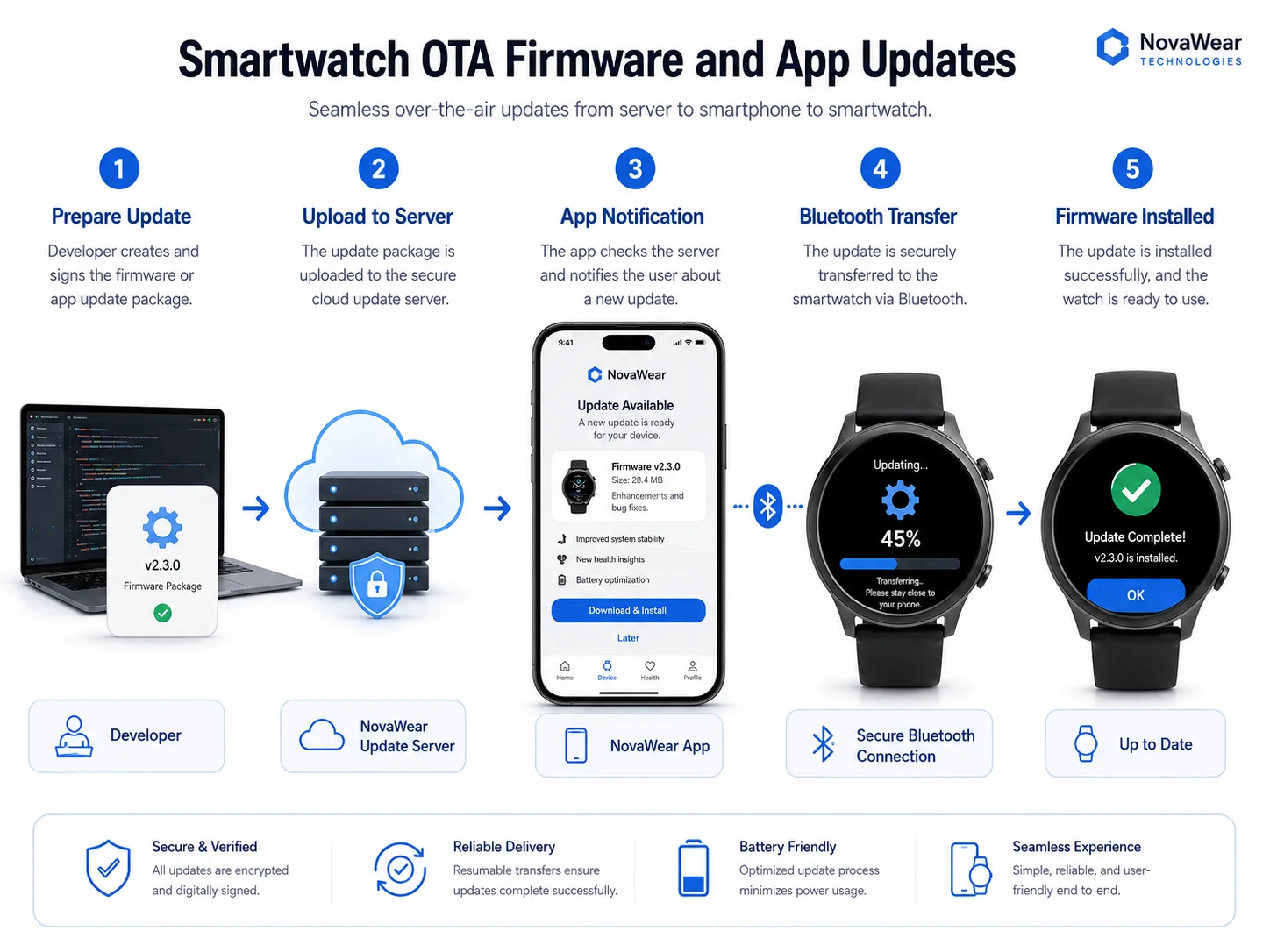
Separate App Updates from Firmware Updates
These are related but different:
- App updates may address smartphone compatibility, interface changes, bugs, permissions, store requirements, or new supported functions.
- Firmware updates may address watch behavior, sensor logic, battery behavior, Bluetooth connection, or device-side features.
A new phone OS version may require app changes. A device connection issue may require firmware changes. Some issues may require both. Buyers should avoid assuming that any future problem can be fixed quickly or remotely.
Questions to Ask Before Launch
- Is OTA firmware update supported on this model?
- Who prepares and validates firmware packages?
- How are app compatibility issues reported?
- Is there a defined support period?
- Does the buyer need to update store listing materials?
- What happens if a future phone OS affects pairing?
- How are critical issues communicated to distributors and users?
We have seen buyers focus on MOQ, color options, and delivery dates during the quotation stage. Those are important. Still, the first compatibility issue after launch can become more expensive than a small difference in unit price.
A buyer should define a realistic support plan. This can include internal customer-service contacts, issue screenshots, phone model information, app version details, and a clear escalation path. Good records make technical communication much faster.
8. Can a White-Label Smartwatch App Be Published on Google Play and the Apple App Store?
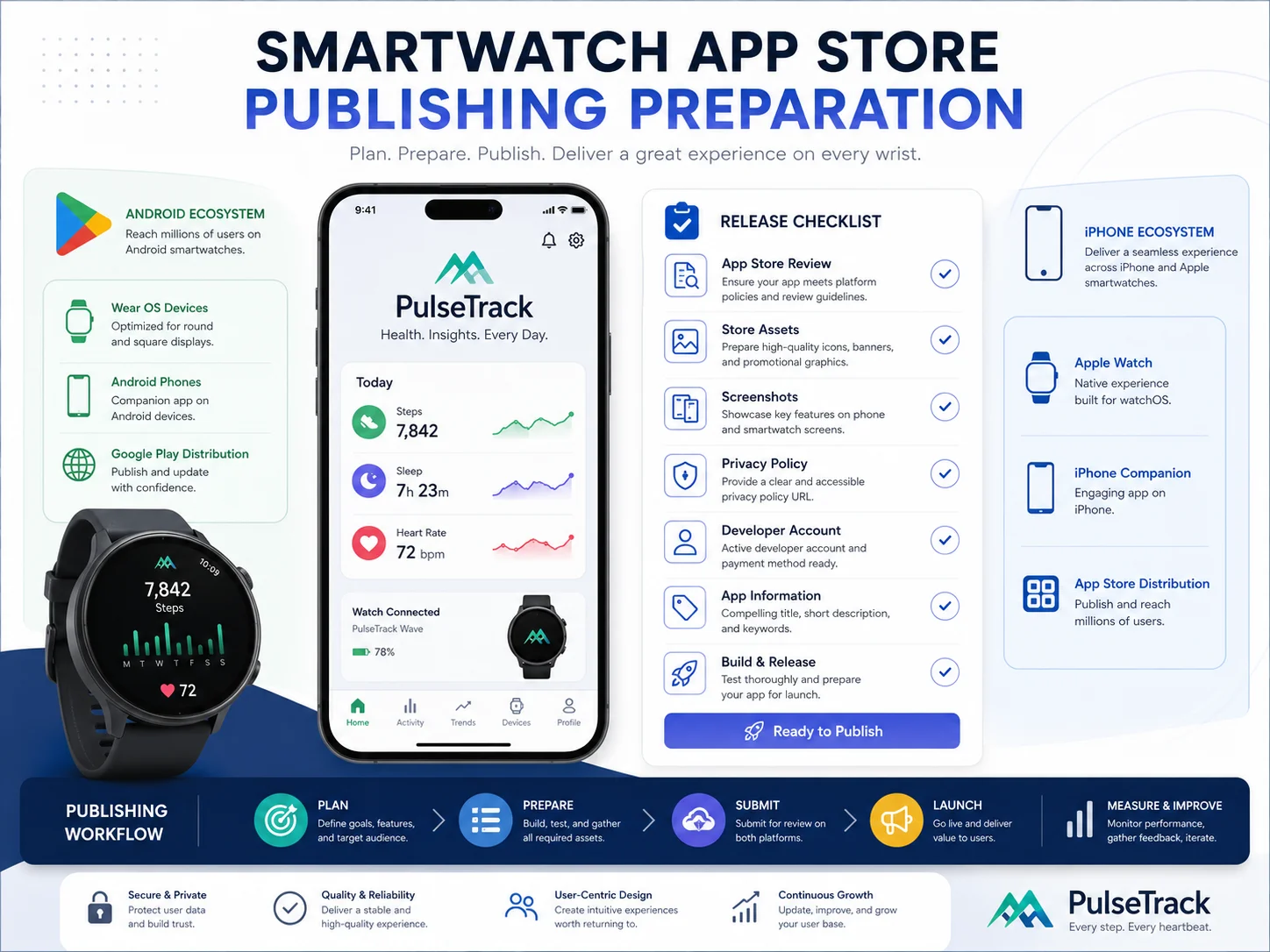
App-store publishing is often treated as the final easy step. In reality, it involves account arrangements, app metadata, privacy information, screenshots, testing, and platform review. Requirements and policies can change, so buyers should verify current rules before committing to a launch plan.
A white-label smartwatch app may be publishable on Google Play and the Apple App Store, subject to the selected platform, account arrangement, app content, technical readiness, and current store requirements. Buyers should never assume approval, account ownership, or publication timing without written confirmation and current policy checks.
Account Ownership Changes the Conversation
There are several possible arrangements:
| Arrangement | Potential Benefit | Key Question |
|---|---|---|
| Platform or supplier account | May simplify initial process | What happens if the relationship ends? |
| Buyer-owned account | More visible brand control | Who manages submissions and updates? |
| Shared operational arrangement | Can divide tasks | Who has final access and responsibility? |
A buyer-owned developer account may offer stronger control over the public brand listing.9 However, it also means the buyer may need to manage account verification, agreements, payment details, compliance submissions, listing updates, and release approvals.
Prepare the Store Assets Early
Buyers should prepare:
- App name and icon
- Screenshots
- App description
- Support email and website
- Privacy policy link
- Brand contact information
- Target countries and languages
- User instructions for pairing
We do not position ourselves as an app-store approval authority. We can help buyers clarify product-side materials and coordinate feasibility discussions, but final platform decisions depend on the relevant store review process and current policies.
9. What Should Buyers Check About White-Label Smartwatch App Data Privacy, Permissions, Servers, and Compliance?
Wearables can involve personal information, including account details, activity records, sleep information, and device identifiers.10 Buyers who sell into Europe or North America should not leave privacy questions until after packaging and app screenshots are finished.
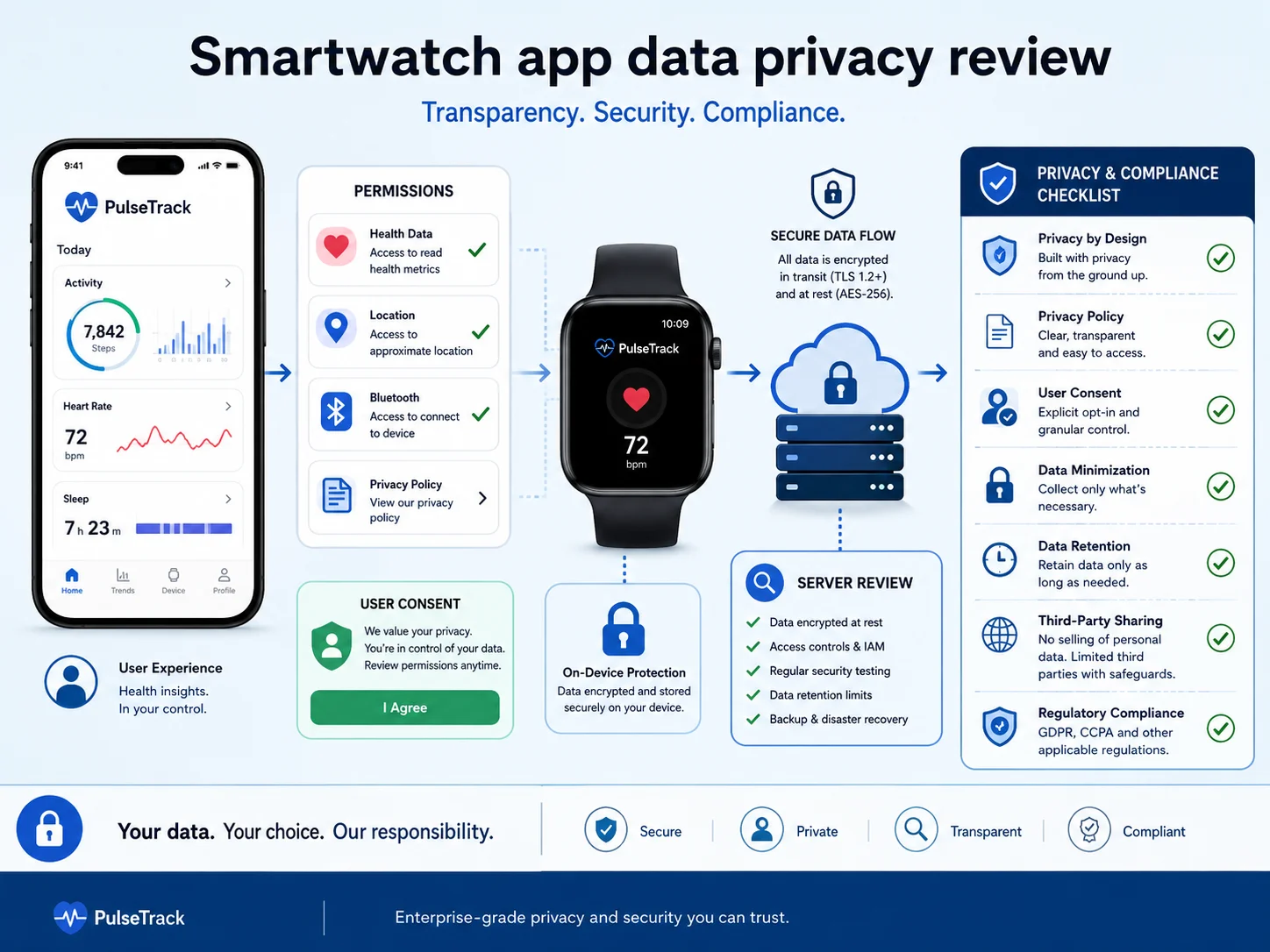
A white-label smartwatch app should be reviewed for the data it collects, the permissions it requests, the server or service arrangement it uses, and the responsibilities assigned to each party. Buyers should obtain qualified legal and compliance advice for their markets because requirements depend on the product, data flow, claims, and selling region.
Use a Practical Data Checklist
Ask the relevant technical and compliance contacts:
- Does the app require user accounts?
- What data is stored on the phone, watch, or server?
- Which permissions are requested, and why?
- Is location access needed for supported functions?
- Can users delete their account or data where applicable?
- Where are backend services operated?
- Who responds to data-related customer requests?
- Who controls privacy-policy wording and user notices?
A buyer should also review marketing claims. General wellness displays should not automatically be promoted as medical diagnosis, treatment, or prevention tools.11 Product claims, labeling, app copy, and target-market obligations require careful review by qualified professionals.
Privacy Is Also a Brand Issue
Customers may not read every policy page, but they notice when an app asks for unexpected permissions or when support cannot explain how pairing and data sync work. Clear communication can reduce returns and negative reviews.
From a supplier-side perspective, our role is to help organize the product and platform questions that need confirmation. We should not replace legal counsel, privacy specialists, or official platform guidance. Buyers should keep written records of the final decisions before launch.
10. How Can Buyers Estimate White-Label Smartwatch App Customization Cost, Lead Time, and Supplier Capability?
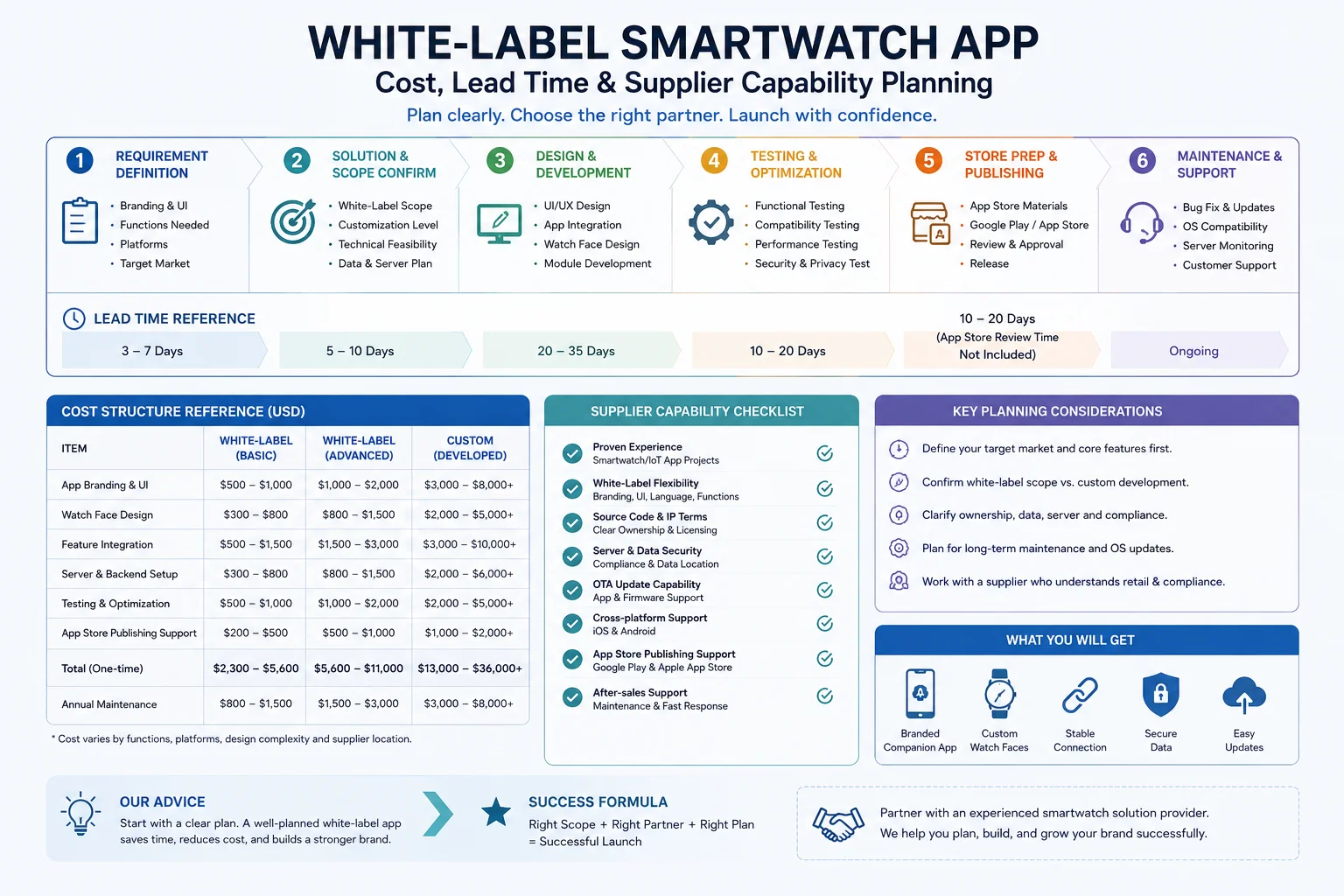
Buyers often want one number for app customization cost and one delivery date. That is understandable, especially when they are planning a retail season. Still, the correct estimate depends on whether the request is branding, configuration, UI work, feature development, or long-term operational support.
A white-label smartwatch app estimate should separate one-time branding work, possible development work, app-store preparation, testing, hardware sampling, and post-launch support. Buyers should evaluate supplier capability through clear scope documents, realistic samples, technical feedback, and written responsibility allocation.
Main Cost and Timing Drivers
| Driver | Why It Matters |
|---|---|
| Branding depth | A logo swap is different from multiple redesigned screens |
| Language count | Translation, review, and UI fitting take time |
| Feature requests | New logic may affect app, firmware, and testing |
| App-store arrangement | Account setup and submission materials need planning |
| Watch-face requirements | Design and device compatibility must be checked |
| Hardware model | Different platforms support different functions |
| Testing scope | More phone models and languages require more validation |
| Support expectations | Ongoing updates require defined resources |
How We Suggest Buyers Evaluate a Supplier
A capable supplier should not simply say “yes” to every request. A better sign is a supplier that asks clarifying questions, checks the product platform, identifies limitations early, and separates confirmed items from items still under review.
Before approving an order, buyers should request:
- A written customization list.
- A list of excluded items.
- A sample or preview plan where possible.
- A hardware and app compatibility confirmation process.
- An estimated timeline with review stages.
- A defined communication channel for post-launch issues.
- Clear information about account, asset, and update responsibilities.
After 15 years of exporting 3C products from Shenzhen, we have learned that the best projects are not always the ones with the longest feature list. They are the projects where the buyer, product team, and technical contacts agree on what will be delivered, what needs validation, and what happens after launch.
Frequently Asked Questions
Is a white-label smartwatch app the same as owning the app?
No. A branded app appearance does not automatically mean the buyer owns source code, app-store accounts, backend services, or future development rights. Buyers should confirm ownership, access, licensing, update rights, and exit arrangements in writing before starting the project.
Can I add my logo to every smartwatch function?
Not necessarily. Logo placement may be possible in the app, device boot screen, watch faces, packaging, and manuals, but each area depends on the selected hardware and software platform. Buyers should ask for a confirmed branding map rather than assume full coverage.
How long does white-label smartwatch app customization take?
Timing depends on the scope. Basic branding may take less time than UI adjustments, multi-language work, watch-face development, testing, and app-store preparation. Buyers should build in time for technical checks, sample review, revisions, and current platform submission processes.
Can I request new health or fitness features?
You can request them, but feasibility depends on the smartwatch hardware, sensors, firmware, existing app framework, and validation needs. A new display may be easier than a new data method or cloud workflow. Buyers should avoid making customer claims before the feature scope is confirmed.
What should I prepare before asking for a branded smartwatch app?
Prepare your logo files, brand colors, target markets, required languages, desired app name, example screenshots, must-have functions, expected sales channels, and launch timeline. This information helps us check the right platform and give more meaningful feedback.
Conclusion
A white-label smartwatch app can add real value to a private-label smartwatch launch, but it should never be treated as a simple logo request. Buyers need to define brand assets, feature scope, app-store arrangements, data responsibilities, update expectations, and long-term support before confirming a hardware order. If you are sourcing smartwatches for retail, wholesale, or e-commerce, send us your brand requirements, target market, and expected MOQ. We can help you check the practical scope with our product and technical teams before you commit.
"White-label product", https://en.wikipedia.org/wiki/White-label_product. White-label offerings are generally produced by one organization and marketed by another under that marketer's own brand; the exact scope of software customization remains contractual. Evidence role: definition; source type: encyclopedia. Supports: A neutral definition of white-label products or services as offerings produced by one entity and rebranded for sale by another.. Scope note: This definition supports the general business model, not the specific features available in any smartwatch app platform. ↩
"Terms and Conditions for the use of WIPO-provided ...", https://www.wipo.int/en/web/ip-office-business-solutions/termsandconditions. Software licenses commonly grant defined rights to use or distribute software without transferring ownership of the underlying source code or intellectual property; the rights in a white-label arrangement depend on its agreement. Evidence role: general_support; source type: institution. Supports: Software licensing commonly separates permission to use or distribute software from ownership of the underlying intellectual property and source code.. Scope note: The source establishes the general licensing principle and cannot determine rights under a particular supplier contract. ↩
"Attributes, Methods, and Frameworks Used to Evaluate ... - PMC", https://pmc.ncbi.nlm.nih.gov/articles/PMC11031706/. Wearable companion applications commonly mediate Bluetooth pairing, device configuration, and the display of data recorded by the wearable, although supported functions vary by device ecosystem. Evidence role: general_support; source type: paper. Supports: Research or technical documentation showing that wearable companion applications commonly provide device pairing, configuration, and presentation of recorded activity data.. Scope note: Evidence for general wearable-app functions does not establish that every smartwatch app includes watch-face downloads or customer-support tools. ↩
"Software Development for Mobile Computing, the Internet ...", https://scholarspace.manoa.hawaii.edu/bitstreams/defc7b65-4823-422c-8ae0-f9c2d1c24d30/download. Connected wearable systems typically combine device hardware and firmware with wireless communication, a mobile companion application, and, where implemented, backend services, so feature changes can span multiple layers. Evidence role: mechanism; source type: paper. Supports: Technical literature describing wearable or IoT systems as interacting hardware, firmware, mobile-application, communication, and cloud-service layers.. Scope note: A general architecture source does not prove that a particular requested feature requires changes in every layer. ↩
"Software Development for Mobile Devices, Wearables, and ...", https://scholarspace.manoa.hawaii.edu/collections/07c56bd3-8222-49b3-8d7e-a13ee5008d91. Wearable devices and their companion applications rely on compatible communication protocols and supported software versions; changes to either side can affect pairing, synchronization, or feature availability. Evidence role: mechanism; source type: research. Supports: Evidence that interoperating wearable firmware and companion apps depend on compatible communication protocols, data formats, and supported software versions.. Scope note: Compatibility requirements and update behavior differ among hardware platforms and operating systems. ↩
"Smartwatches in healthcare medicine: assistance and monitoring", https://pmc.ncbi.nlm.nih.gov/articles/PMC10625201/. Research on wearable interfaces finds that limited display area constrains information density, legibility, and interaction design, requiring content to be prioritized for small screens. Evidence role: general_support; source type: paper. Supports: Human-computer interaction research showing that limited display size constrains information presentation, legibility, and interaction design on wearables.. Scope note: Such research supports the general design constraint rather than a specific screen-size threshold or watch-face design. ↩
"Demystifying Device-specific Compatibility Issues in ...", https://arxiv.org/html/2408.01810v1. Mobile-platform updates and variation among handset hardware and Bluetooth implementations can affect application behavior and connected-accessory compatibility, making post-release testing relevant. Evidence role: general_support; source type: research. Supports: Platform guidance or research documenting that operating-system releases, device variation, and Bluetooth implementation differences can affect application compatibility.. Scope note: The evidence identifies a general compatibility risk and does not show that any specific smartwatch app will experience a defect. ↩
"Cybersecurity of Firmware Updates", https://www.nhtsa.gov/sites/nhtsa.gov/files/documents/cybersecurity_of_firmware_updates_oct2020.pdf. Over-the-air updating is a mechanism for remotely delivering and installing firmware or software changes on deployed connected devices, subject to device support and secure update procedures. Evidence role: definition; source type: government. Supports: An authoritative technical description of remote or over-the-air delivery of firmware updates to deployed connected devices.. Scope note: OTA capability does not guarantee that every defect can be remediated remotely or that an update will be available for a particular model. ↩
"Overview of accounts and roles - Manage your team", https://developer.apple.com/help/app-store-connect/manage-your-team/overview-of-accounts-and-roles/. Developer-console documentation assigns account holders and authorized users administrative roles for app records, releases, agreements, and store metadata, which can provide direct operational control over a public listing. Evidence role: general_support; source type: institution. Supports: Official developer-console documentation showing that account holders and assigned users administer application records, releases, roles, and store information.. Scope note: Account control does not itself confer ownership of the underlying software, source code, or all intellectual-property rights. ↩
"Privacy in consumer wearable technologies: a living ... - PMC", https://pmc.ncbi.nlm.nih.gov/articles/PMC12167361/. Information associated with an identifiable user, including device identifiers and data generated through activity tracking, may constitute personal data and can trigger applicable data-protection obligations. Evidence role: general_support; source type: government. Supports: Regulatory guidance explaining that identifiers and data generated by consumer wearables or fitness tracking can constitute personal data and may require privacy safeguards.. Scope note: Whether a particular data element is regulated, and under which law, depends on the jurisdiction, identifiability, processing context, and product design. ↩
"General Wellness: Policy for Low Risk Devices - Guidance", https://www.fda.gov/regulatory-information/search-fda-guidance-documents/general-wellness-policy-low-risk-devices. Regulatory guidance distinguishes general-wellness functions from product claims that indicate diagnosis, treatment, mitigation, cure, or prevention of disease; intended use and promotional claims are material to that distinction. Evidence role: expert_consensus; source type: government. Supports: Regulatory guidance distinguishing low-risk general-wellness functions from products marketed for diagnosis, treatment, mitigation, cure, or prevention of disease.. Scope note: This guidance does not classify a specific smartwatch or app, and legal obligations vary by jurisdiction and product claims. ↩