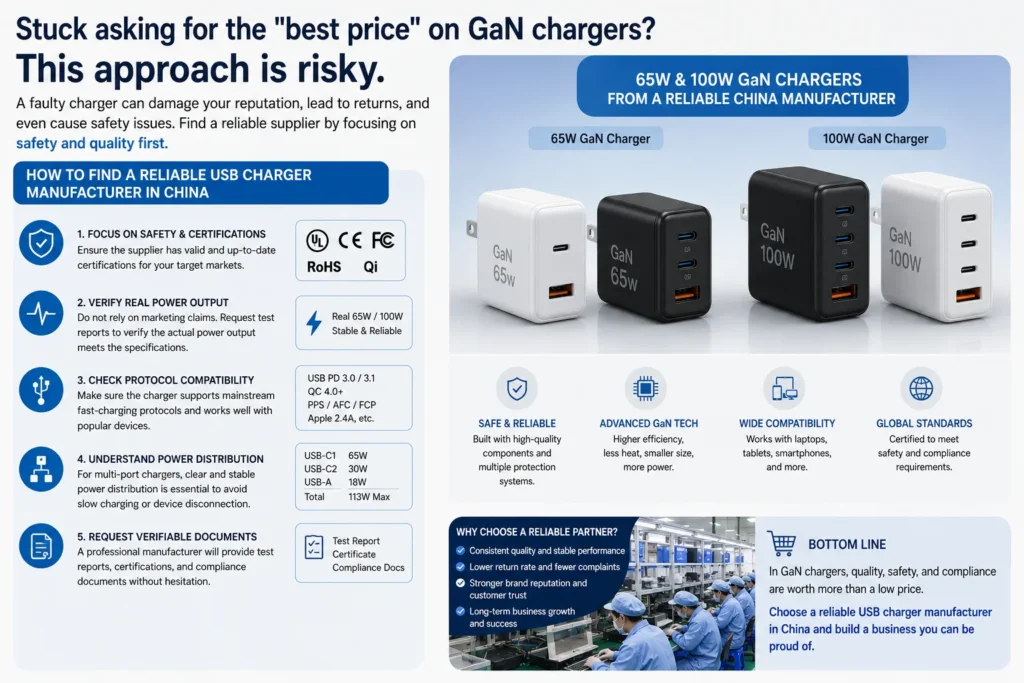
Stuck asking for the "best price" on GaN chargers? This approach is risky, as a faulty charger can damage your reputation. Find a reliable supplier by focusing on safety and quality first.
For GaN chargers, focus on real power output, stable protocols, and valid certifications. A reliable USB charger manufacturer in China provides clear specs on power distribution for multi-port chargers and verifiable compliance documents, ensuring safety and customer satisfaction beyond just a low initial price.
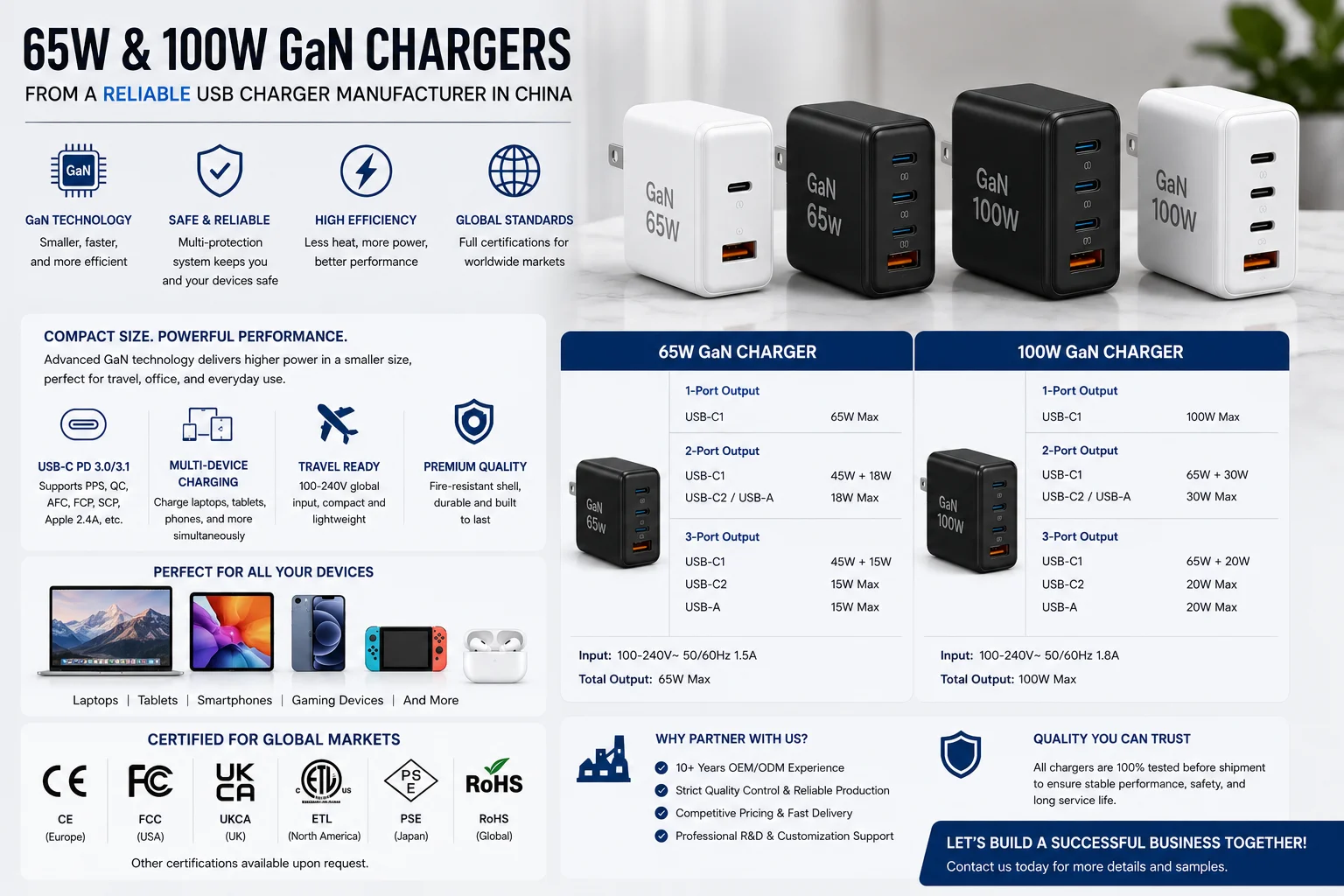
Over my 15 years in this business, I've seen countless buyers start their inquiry the same way. It's almost a script. They're looking for a GaN charger manufacturer, and the first question is always about price. While I understand the need to be competitive, this focus is dangerously narrow when it comes to chargers. This isn't like buying a phone case. You're dealing with a product that plugs directly into a wall socket. A lot can go wrong. That's why I want to walk you through what really matters, based on thousands of conversations with buyers just like you. Let's move beyond the price tag and talk about how to build a profitable, safe charger business.
Why Sourcing Chargers Isn't Just About Price?
You think getting the lowest price on chargers is a win. But a cheap, low-quality charger can cause fires, damage devices1, and completely ruin the trust you've built with your customers.
Sourcing chargers isn't like sourcing cables. A faulty charger is a major safety liability involving voltage, heat, and short-circuit risks. Focusing on a reliable GaN charger manufacturer who guarantees specs and compliance is crucial for long-term business, preventing safety incidents and protecting your brand.
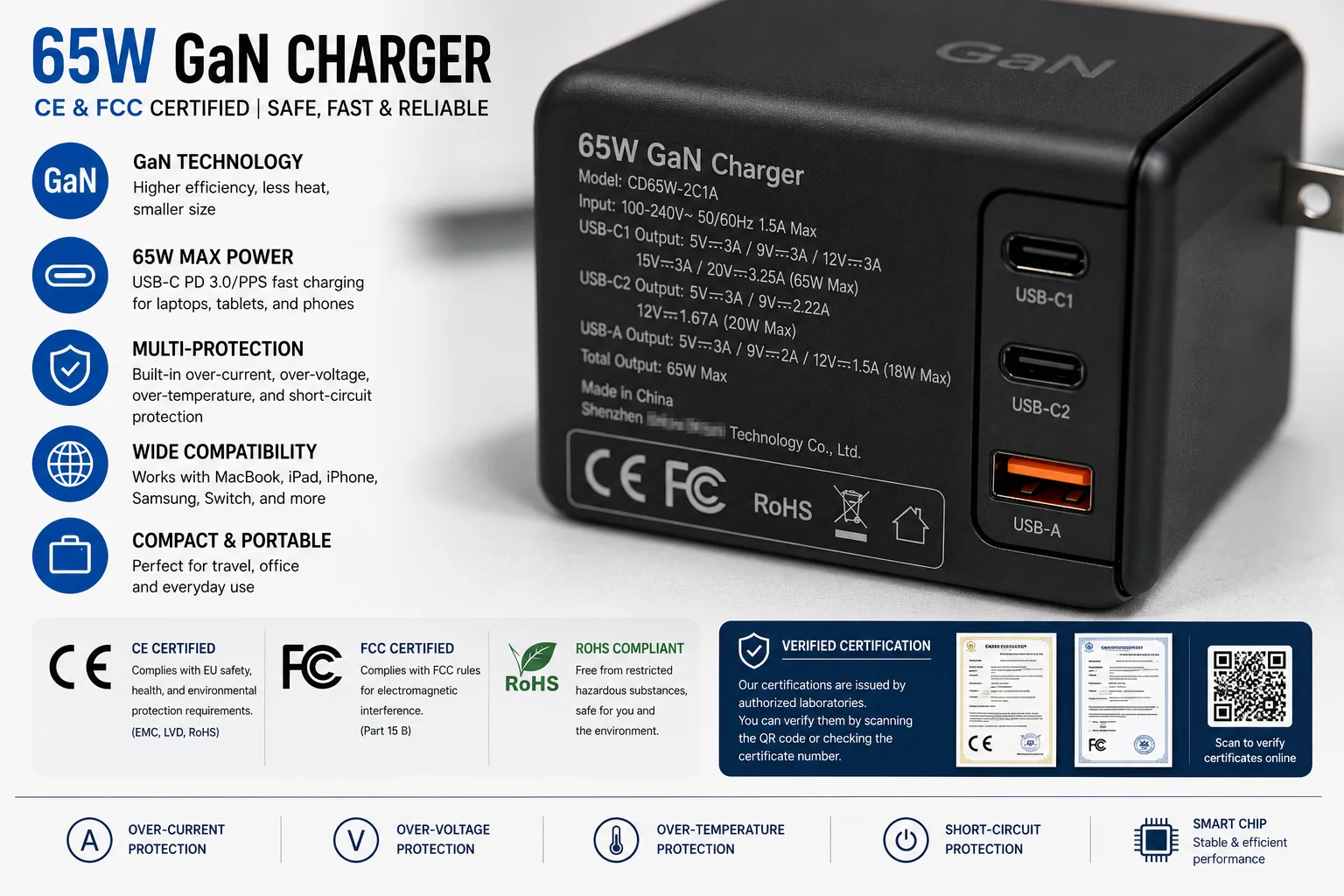
When buyers are looking for a USB charger manufacturer in China, their first emails often look like this:
- “20W charger how much?”
- “65W GaN charger best price?”
- “100W charger with EU plug, lowest price?” This isn’t wrong, but it’s too shallow. Chargers are different from USB cables. A bad cable might charge slowly or break, leading to customer complaints. A bad charger is a much bigger problem. It’s a product that connects directly to wall power, dealing with voltage, current, heat, and short-circuit protection. If it sells poorly, that's a small issue. If it causes a safety problem, that's a disaster. That's why for GaN chargers, quality is so critical. These devices are popular because one small charger can power a phone, tablet, laptop, and more2. But this popularity has flooded the market with questionable products. Some chargers are labeled 65W but can't sustain that output3. Others claim "PD fast charging" but have poor protocol compatibility. Many cheap units have no real certifications, just a printed logo4. This is a wholesaler's nightmare.
Wattage, Ports, and Protocols: What Specs Actually Matter?
You see 65W and 100W on a box and think it's just a number. But choosing the wrong wattage or port configuration means your expensive inventory will just sit on the shelf, unsold.
Before discussing price, confirm three key specs: wattage, port count, and fast-charging protocols. These define your target customer. 65W GaN chargers are a great balance for most users, while multi-port chargers require clear power-sharing rules to avoid misleading customers. Protocols like PD and PPS are essential.
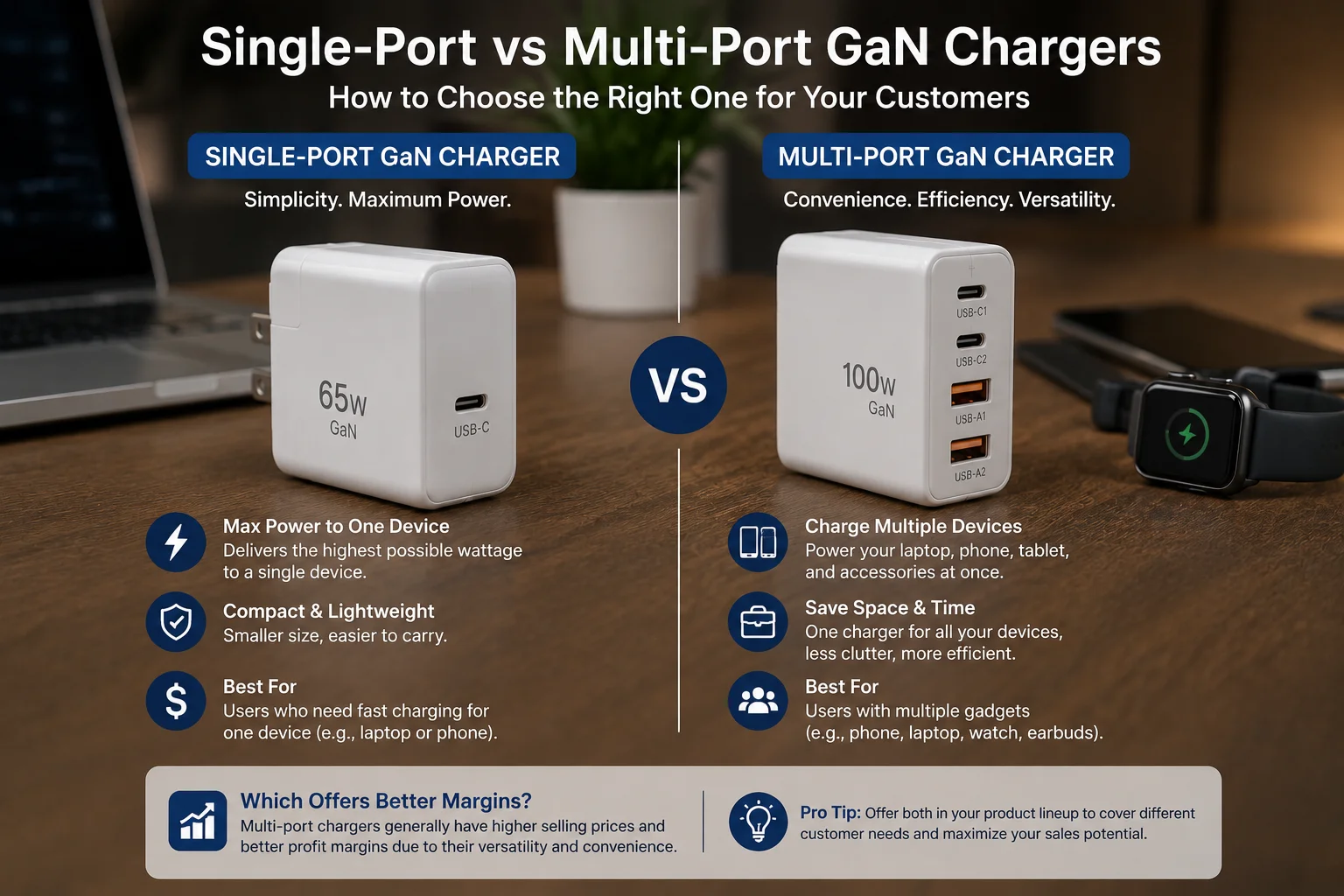
Before you even think about price, you must get these three things straight: wattage, number of ports, and fast-charging protocols. If you don't understand these, negotiating the price is meaningless. They determine who your customer is and whether the product will actually work for them.
Wattage: 20W, 65W, and 100W Are Different Businesses
Many buyers think 20W, 65W, and 100W are just different power levels. In reality, they represent entirely different customer segments and business models.
| Wattage | Primary Use Case | Target Channel | Key Characteristic |
|---|---|---|---|
| 20W | Phone fast charging (e.g., iPhone) | Convenience stores, phone accessory shops | High volume, low price, intense competition |
| 30W-45W | Phones, tablets, some ultrabooks | Retail, online stores | Good upgrade from 20W, better selling points |
| 65W | Phones, tablets, most ultrabooks (e.g., MacBook Air) | Wholesalers, Amazon sellers, tech retail | The "sweet spot," great balance of power and price |
| 100W+ | Performance laptops, multi-device power users | Computer accessory stores, pro-level e-commerce | Higher margin, but customers are more knowledgeable |
So, it's not about which wattage is "best," but which one fits your sales channel. For general wholesale, 65W is often the hero product because it covers so many devices. For specialized or premium channels, 100W and above offer better profit potential, but you must deliver on the promised performance.
Ports: Single-Port is Simple, Multi-Port is Complex
The number and type of ports are just as important. A single-port charger is simple. Its design is straightforward, and quality is easier to control. Multi-port chargers, like a popular 2C1A (2x USB-C, 1x USB-A) model, look more advanced but are much harder to design correctly. The real challenge is power distribution. A good supplier must be able to answer these questions clearly:
- What is the max output from a single USB-C port?
- How is the power split when both USB-C ports are used?
- What is the output when all three ports are used at once?
- Does the charger reset or interrupt charging when a new device is plugged in? A multi-port charger isn't just a case with more holes. It involves a complex power management chip5, specific board design, and heat dissipation. The packaging must clearly state the output for every possible combination. If not, customers will buy it, find out it’s slow when fully loaded, and think you tricked them.
Protocols: PD and PPS Are Not Just for Decoration
Fast-charging protocols are the most overlooked spec by new buyers. Today, the most important protocols for the US and European markets are USB PD (Power Delivery) and PPS (Programmable Power Supply).
- USB PD is the core standard for Type-C fast charging. It's essential for iPhones, iPads, MacBooks, and many other devices.
- PPS is a variant of PD that is crucial for Samsung's "Super Fast Charging."6 Without PPS support, a charger won't deliver the best speed to modern Samsung phones, even if it's a 100W charger.
So, instead of asking, "Is it fast charging?" you need to ask a GaN charger manufacturer more specific questions:
- Does it support PD 3.0?
- Does it support PPS? What is the maximum PPS wattage?
- What is the maximum output per port?
- Can you provide a protocol test report? A serious supplier will have these answers ready. If they just say "good quality, best price," be careful.
Are You Ignoring the Most Important Part: Compliance and Certification?
You see a CE or FCC logo printed on a charger and assume it's compliant. But fake or invalid certifications can get your shipment seized by customs or lead to serious legal trouble.
For chargers, compliance is non-negotiable. Different markets require specific certifications like CE, FCC, UKCA, or ETL. A huge mistake is trusting a certificate image. You must verify the company name, model number, and report date to ensure the certification is valid for your specific product.
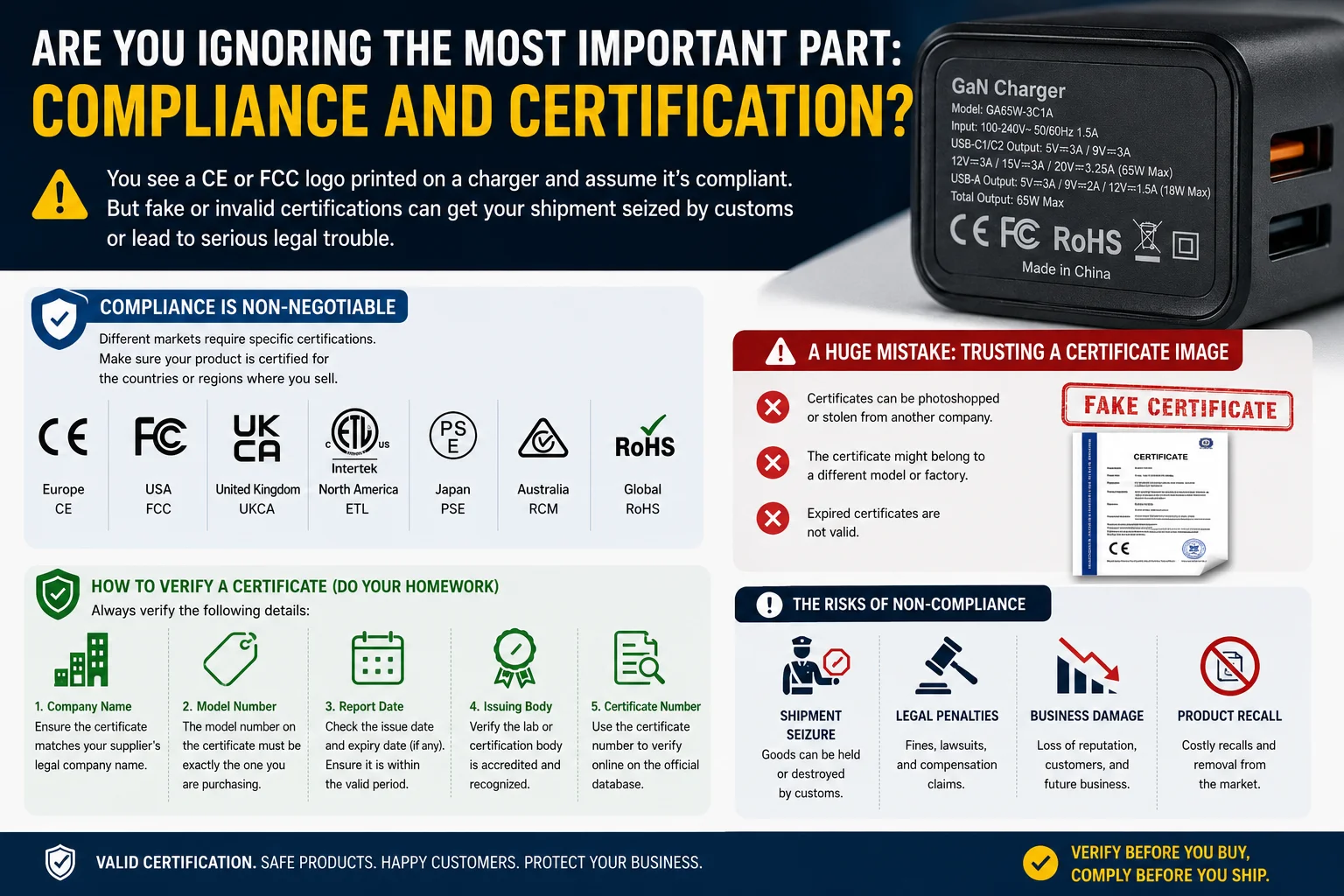
With chargers, compliance is more important than with almost any other accessory. It connects to mains electricity, and different markets have strict rules. For Europe, you need to think about CE, RoHS, and ERP7. For the UK, it's UKCA. For the US, buyers will ask for FCC and ETL/UL8. Here's a huge pitfall: a supplier might show you a certificate, but it could be for a different model, an old version, or from a company you've never heard of. You can't just glance at a PDF.
You must check the details:
- Company Name: Does the certificate belong to the factory or your supplier?
- Model Number: Does it exactly match the product you are buying?
- Parameters: Do the input/output specs on the certificate match the product?
- Date: Is the report recent and based on current standards?
- Full Report: Always ask for the complete test report, not just the one-page certificate.
Especially for private label and OEM, you cannot assume the factory's certification automatically applies to your customized product. If you change the casing, PCB, or power output, the original certification may no longer be valid9. This is a common and costly mistake. The rating label on the charger itself is also critical. It must clearly show the model, input/output, manufacturer, and all required certification marks. Amateurs get this wrong; professionals get it right.
Stock, Private Label, or OEM: Which Sourcing Model Fits Your Business?
You want to create your own unique charger but don't know where to start. Choosing the wrong sourcing model—like jumping into OEM when you only need stock—can bankrupt you with high MOQs.
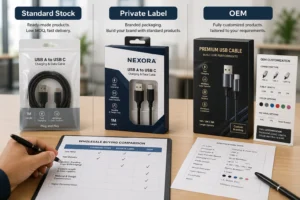
Choose your sourcing model wisely. Standard stock is best for market testing with low MOQ and risk. Private label is for building your brand on a proven product once you have sales. OEM is for high-volume buyers who need full customization but can handle the high costs and long lead times.
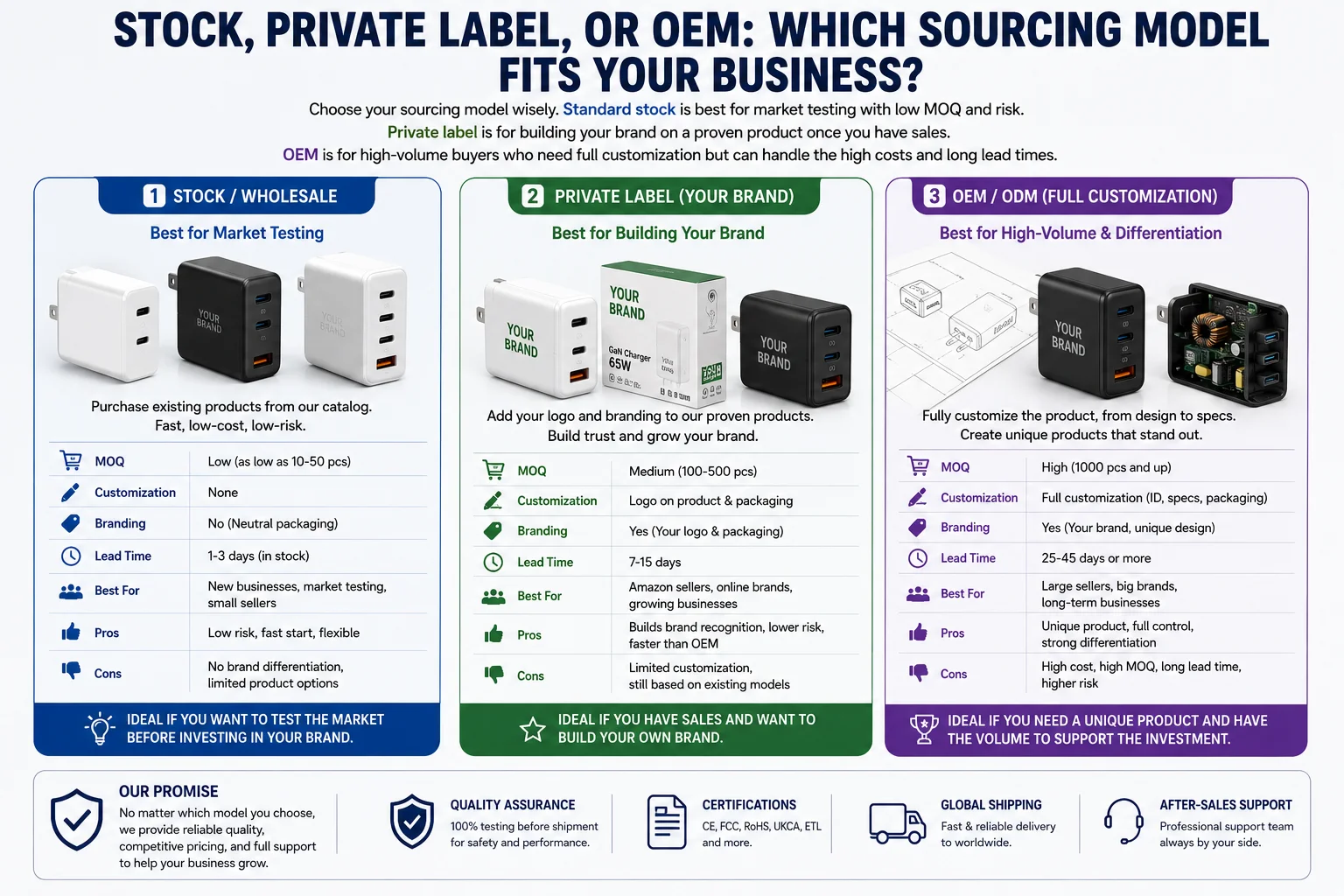
When sourcing chargers, you generally have three paths. Choosing the right one for your business stage is key to avoiding wasted money and time.
1. Standard Stock: Best for Testing the Market
If you are new to selling GaN chargers, I strongly advise against deep customization at the start. Begin with the manufacturer's standard, in-stock models. The benefits are huge: low MOQ, fast delivery, and minimal risk. The supplier has already perfected the design and likely has certifications ready. This allows you to test different models—like a 20W charger, a 65W GaN charger, and a 100W GaN charger—with different plug types (EU, US, UK) to see what your customers actually buy. You might think 100W is the winner, but the market might tell you that the 65W model sells ten times faster. Let real sales data guide your inventory decisions, not guesswork.
2. Private Label: Best When You Already Have Sales
Once you have consistent sales and know which products are popular, private labeling is the perfect next step. This is where you put your brand on a proven product. You can customize the logo on the charger, the retail packaging, user manuals, and barcodes. This allows you to build brand recognition without taking on the risk of developing a new product from scratch. For most small and medium-sized wholesalers, this is the most practical path to building a brand. You leverage the factory's mature 65W GaN solution, for example, and just focus on your marketing and packaging. But remember: even with a private label, you must ensure the certifications and product labels are updated and compliant for your brand.
3. OEM: Best for High-Volume, Scaled Buyers
Original Equipment Manufacturing (OEM) is for large-scale businesses that need a truly unique product. This involves customizing everything: the external design, dimensions, port layout, power distribution, materials, and more. The main benefit is strong product differentiation. However, the downsides are significant: very high MOQs (often thousands of units), long development times, high costs for new molds and certifications, and a huge inventory risk if your market forecast is wrong. That's why I always recommend a phased approach: start with stock to test, move to private label to build your brand, and only consider OEM when you have the scale and market certainty to back it up.
Your Pre-Order Checklist: What Should You Confirm Before Paying?
You're ready to place your first big order based on a perfect-looking sample. But the bulk order could be completely different, with lower power, poor compatibility, or cheaper materials inside.
Don't rush your first order. Test samples rigorously for real output power under load, protocol compatibility with various devices (iPhone, Samsung, MacBook), and heat generation. Also, demand full certification documents that match the exact model and confirm all packaging and label details before production.
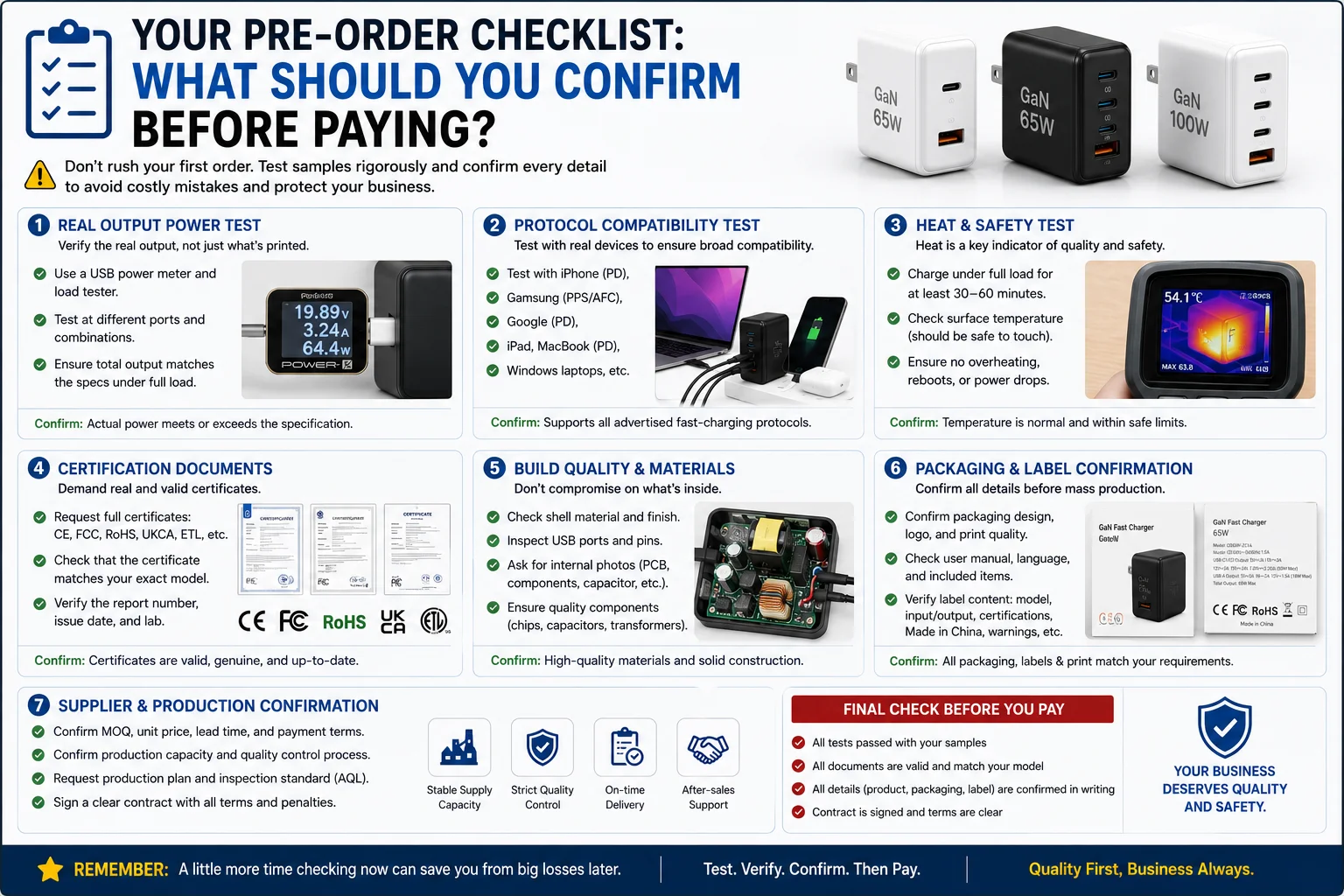
Before you send that first payment, slow down. Especially with an electrical product like a charger, you must test your samples thoroughly. Here is a checklist of things you absolutely must confirm.
- Confirm Real Output Power: Don't just trust the "65W" printed on the box. Use a USB power meter to test the single-port output and the combined output when all ports are in use. Let it charge a laptop for 30 minutes. Does it get excessively hot? Does the power output drop significantly over time? A cheap charger might hit 65W for a minute and then throttle down10.
- Confirm Protocol Compatibility: Test the charger with a wide range of devices, especially those popular in your market. This includes iPhones, Samsung phones, iPads, MacBooks, and other Android devices. If you are targeting Samsung users, you must verify that PPS is working correctly.
- Confirm Certifications: Ask your supplier for the full, unedited test report and the certificate for the exact model you are buying. Check that the photos, model number, and factory name on the report match what you are being sold.
- Confirm Plug Type: An EU plug is physically different from a UK or US plug. Make sure the version you are ordering is certified and built for your specific market.
- Confirm Build Quality: Hold the charger. Does it feel solid or light and hollow? Check the seams, the quality of the plastic (it should be fire-retardant11), and the feel of the pins. A well-made charger has a certain density and premium feel.
- Confirm Packaging Details: The packaging should be professional and clear. It needs to list the wattage, ports, supported protocols, input/output specs, and all required certification marks. This is your product's first impression.
- Confirm Repeat Order Quality: Ask your supplier directly: "Will you use the same chipset and PCB design in my future orders?" A reliable partner guarantees consistency. Ask about their quality control process and warranty policy. The real test of a supplier isn't the first order; it's the second and third.
My Final Take: What Really Makes a GaN Charger Profitable?
You're still tempted to go with the cheapest GaN charger you can find online. But remember that returns, customer complaints, and a damaged brand reputation will cost you far more in the long run.
In the GaN charger business, stability is more profitable than the lowest price. The real money comes from products that are safe, reliable, and earn customer trust. This leads to repeat purchases and positive reviews, which are far more valuable than the small savings from a cheap, risky supplier.
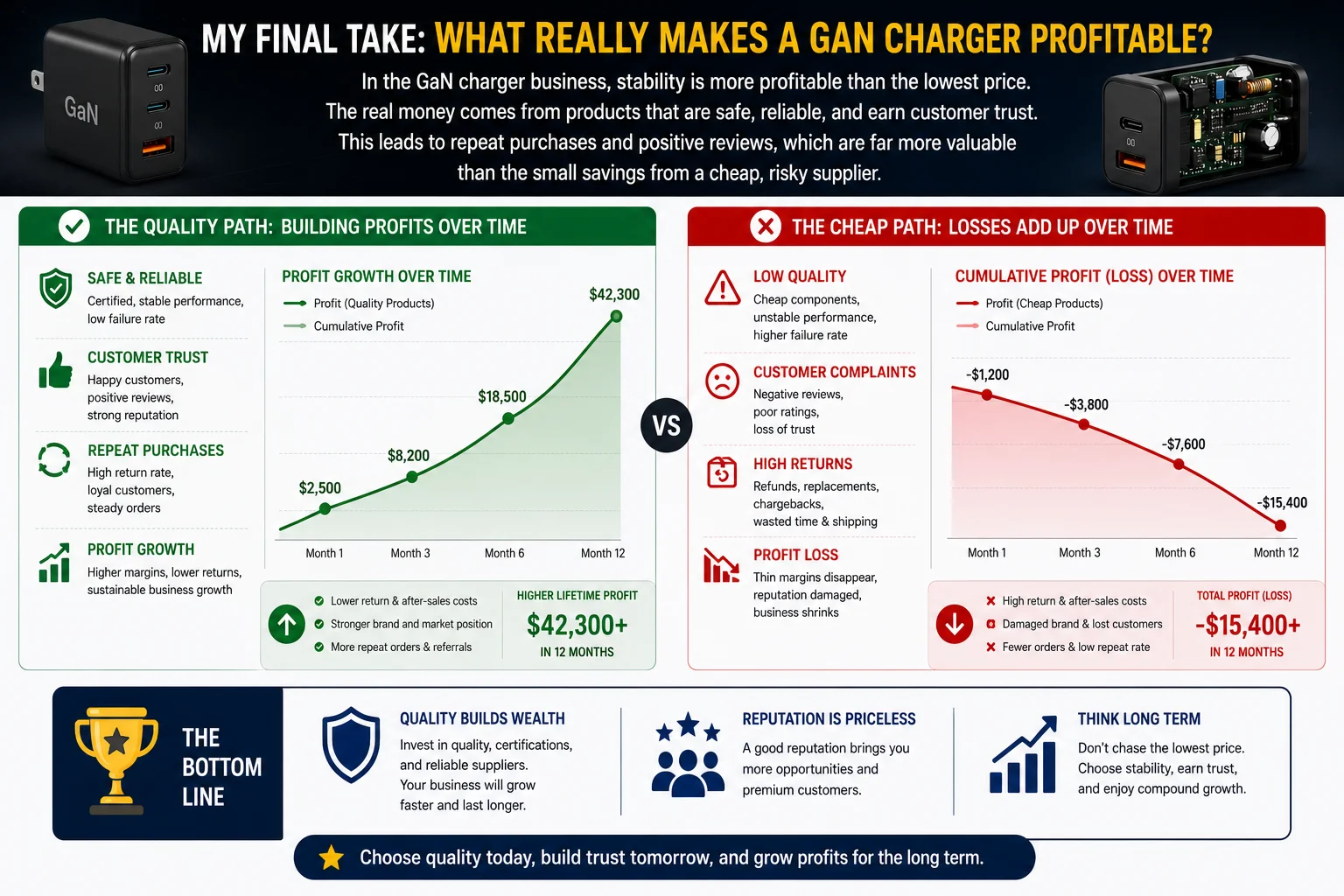
My personal view is simple: chargers are not the right product category for a race to the bottom on price. A USB cable can have cheap, mid-range, and premium tiers, and a failure is usually just an inconvenience. A charger is different. It's an active electrical device that customers plug into their wall and often leave unattended near their bed or desk. Safety and peace of mind are paramount. To build a long-term business as a wholesaler or retailer of GaN chargers, your core focus shouldn't be the "lowest price." It should be:
- Real, verifiable power
- Stable, compatible protocols
- Controlled, safe temperatures
- Accurate, valid certifications
- Professional, clear packaging
- Consistency from one order to the next
A buyer might initially hesitate at the price of a quality 65W GaN charger. But you have to think about the total cost. A cheap charger that leads to high returns, negative reviews, and lost customers is actually the most expensive product you can sell. The truly profitable products are the ones customers love, recommend, and come back to re-order. Because everyone needs chargers, quality creates a recurring revenue stream, not a one-time sale.
Conclusion
Sourcing GaN chargers is about finding a reliable partner, not just a low price. Focus on quality, compliance, and stability to build a profitable, long-term business with happy customers.
"16.1.1 Common Electrical Hazards and Preventative Steps", https://ehs.cornell.edu/research-safety/chemical-safety/laboratory-safety-manual/chapter-16-physical-hazards/161-0. Reports from consumer protection agencies and fire departments frequently cite uncertified or counterfeit phone chargers as a cause of residential fires and electrical hazards. Evidence role: case_reference; source type: government. Supports: The claim that low-quality chargers pose significant safety risks like fires.. ↩
"GaN vs. Silicon in High-Frequency Power Transistors - Stanford", http://large.stanford.edu/courses/2025/ph240/jahan2/. Gallium Nitride (GaN) semiconductors have a wider bandgap than traditional silicon, allowing them to sustain higher voltages and frequencies, which results in smaller, more efficient, and higher-power-density chargers. Evidence role: mechanism; source type: research. Supports: The claim that GaN technology enables smaller, more efficient chargers capable of powering a wide range of devices.. ↩
"120W GaN chargers really last on 100W output before thermal ...", https://www.reddit.com/r/UsbCHardware/comments/1hr4bi3/how_long_do_compact_100_120w_gan_chargers_really/. Independent testing of consumer electronics often reveals that some power adapters, particularly lower-cost models, experience thermal throttling and cannot sustain their maximum advertised wattage for extended periods, causing power output to drop. Evidence role: general_support; source type: other. Supports: The claim that some chargers fail to maintain their advertised maximum power output, especially under sustained load.. Scope note: This is a general market condition; a source would not prove it for all cheap chargers but would establish the phenomenon as a known issue. ↩
"CBP officers seize more than $150000 worth of fake electronics", https://www.cbp.gov/newsroom/local-media-release/cbp-officers-seize-more-150000-worth-fake-electronics. Customs and market surveillance authorities in regions like the EU and North America regularly issue warnings and report seizures of products bearing counterfeit safety marks (such as CE or FCC), which have not undergone the required compliance testing. Evidence role: case_reference; source type: government. Supports: The claim that counterfeit certification marks are a common problem on imported electronics.. ↩
"USB-C - Wikipedia", https://en.wikipedia.org/wiki/USB-C. Multi-port chargers utilize a dedicated power management integrated circuit (PMIC) to negotiate power delivery contracts with connected devices and dynamically allocate the charger's total power budget across the active ports. Evidence role: mechanism; source type: paper. Supports: The claim that multi-port chargers rely on complex internal components for power management.. ↩
"Quick Charge - Wikipedia", https://en.wikipedia.org/wiki/Quick_Charge. Samsung's 'Super Fast Charging 2.0' technology for its flagship smartphones and tablets relies on the USB Power Delivery Programmable Power Supply (PPS) protocol to achieve charging speeds of 25W and 45W. Evidence role: mechanism; source type: other. Supports: The claim that Samsung's fast-charging technology requires PPS support.. Scope note: The source would confirm the technical requirement, not necessarily that it is 'crucial' from a business perspective. ↩
"CE marking - Wikipedia", https://en.wikipedia.org/wiki/CE_marking. To be sold in the European Union, external power supplies must comply with several regulations, including the CE marking requirements for safety and EMC, the Restriction of Hazardous Substances (RoHS) directive, and the Ecodesign for Energy-related Products (ErP) directive, which sets no-load power consumption limits. Evidence role: definition; source type: government. Supports: The claim that CE, RoHS, and ErP are required for chargers sold in Europe.. ↩
"47 CFR Part 15 -- Radio Frequency Devices - eCFR", https://www.ecfr.gov/current/title-47/chapter-I/subchapter-A/part-15. In the United States, power adapters are considered unintentional radiators and must comply with FCC Part 15 rules for electromagnetic interference. While not federally mandated, safety certification from a Nationally Recognized Testing Laboratory (NRTL) such as UL or ETL is a de facto requirement for market access and liability protection. Evidence role: definition; source type: government. Supports: The claim that FCC and safety certifications like UL/ETL are key for the US market.. ↩
"FAQ - Electronic Products - FedCenter", https://www.fedcenter.gov/members/workgroups/sustainableacquisition/faq/electronics/. Certification bodies state that a product's safety and compliance certification (e.g., UL, CE) is tied to the specific construction and components tested. Any material modification, such as changes to the enclosure, printed circuit board (PCB), or critical safety components, typically voids the original certification and requires a new evaluation. Evidence role: general_support; source type: institution. Supports: The claim that modifications to a certified product can invalidate its compliance status.. ↩
"[PDF] Power Electronics Thermal Management", https://www.nrel.gov/docs/fy17osti/68077.pdf. Power conversion is inherently inefficient, generating waste heat. In compact power adapters, if this heat is not effectively dissipated, internal temperatures can exceed safe operating limits for components, triggering thermal throttling mechanisms that reduce the power output to prevent damage or failure. Evidence role: mechanism; source type: paper. Supports: The claim that chargers may reduce power output to manage heat.. ↩
"UL 94 - Wikipedia", https://en.wikipedia.org/wiki/UL_94. International safety standards for information and communication technology equipment, such as IEC 62368-1, mandate that the plastic enclosures of mains-powered devices like chargers must be made from materials with a specific flammability rating (e.g., UL 94 V-1 or better) to prevent the spread of fire. Evidence role: definition; source type: institution. Supports: The claim that charger casings must be fire-retardant.. ↩