Many buyers ask for OEM first. They worry ODM looks too simple. They may spend time and money before they know what they really need.
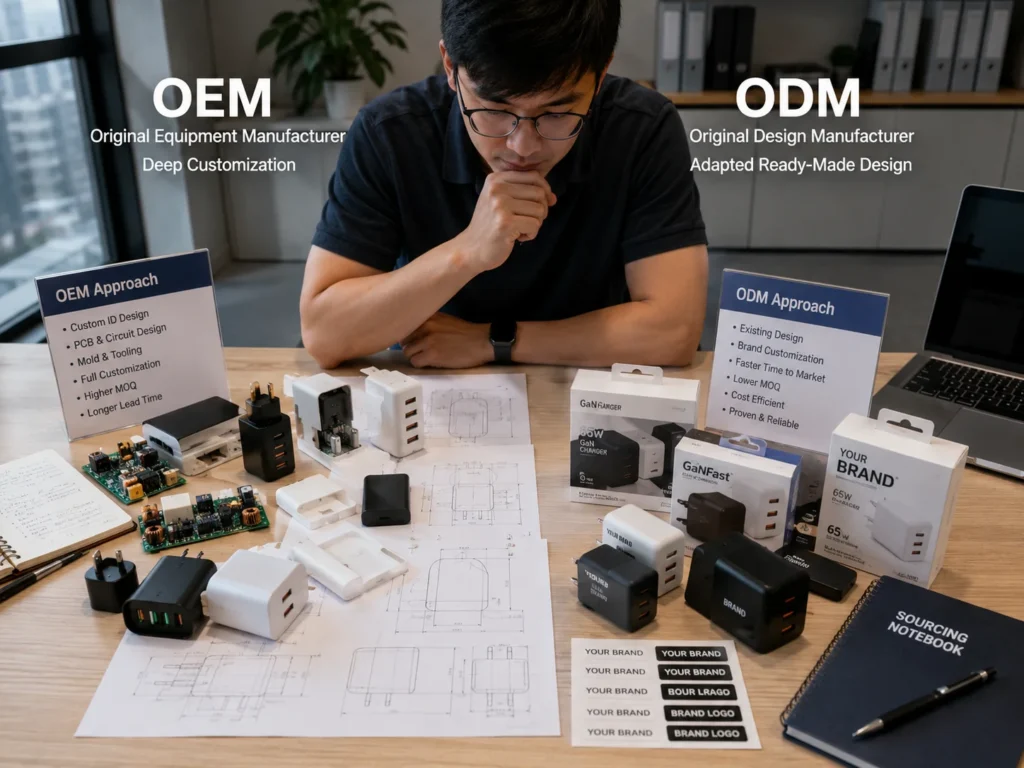
For most GaN charger brands, OEM is right when you need exclusive design or deep product development. ODM is right when you need a proven model, faster launch, lower development cost, and practical customization such as logo, packaging, plug type, color, power range, and port combination.1
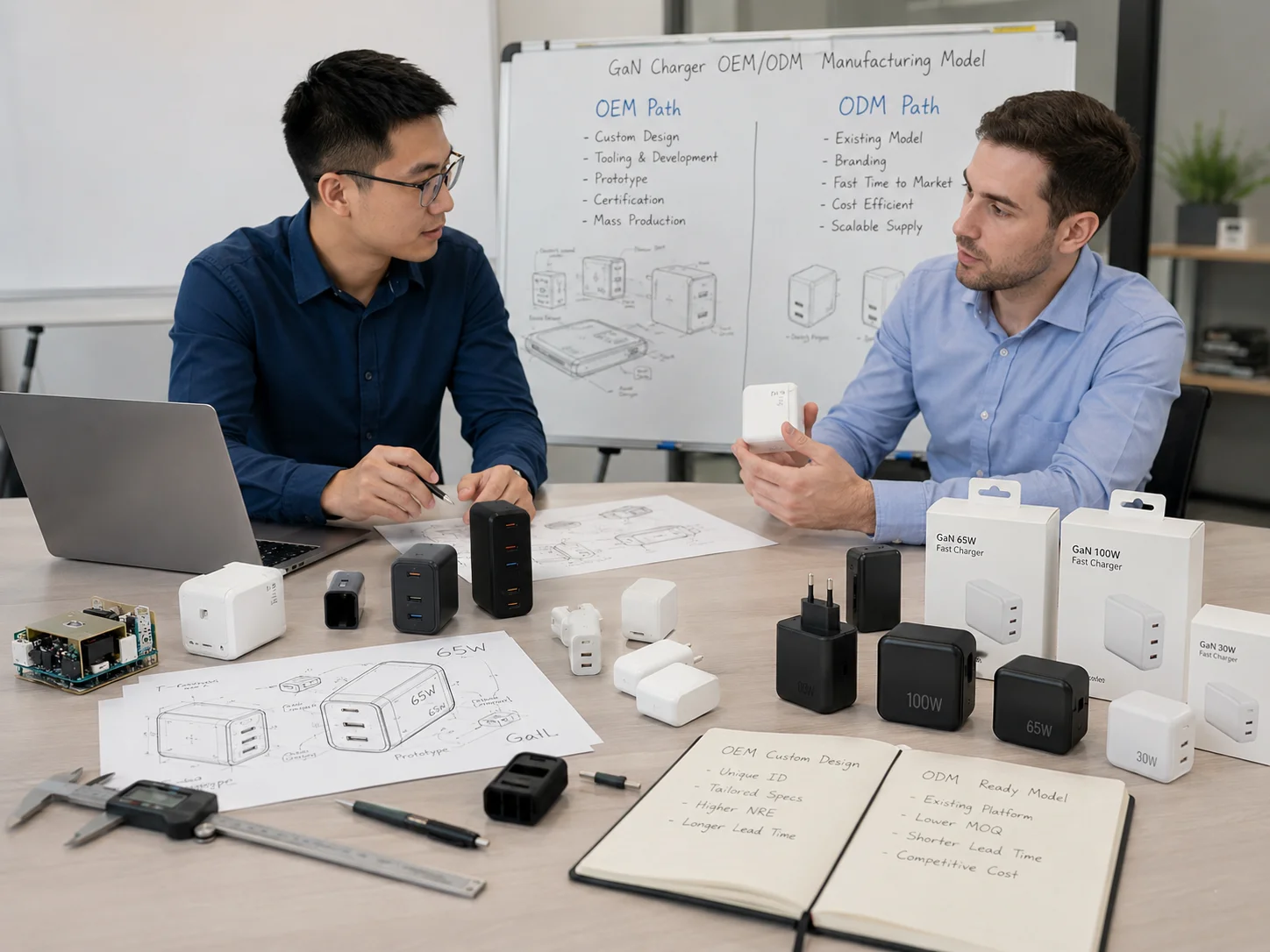
I have handled many GaN charger inquiries from European and U.S. buyers. Some buyers are Amazon sellers. Some are wholesalers. Some serve retail chains or local distributors. They often ask one simple question at the start: “Should I choose OEM or ODM?” I usually do not answer this question with only one word. I first ask about their target market, sales channel, certification needs, MOQ, budget, and launch time. The right answer depends on the brand stage and the level of customization. If a buyer only needs a market-ready charger with logo and packaging changes, ODM is often the safer first step. If a buyer needs a special structure, exclusive function, or long-term product line, OEM can make more sense.
1. What Do OEM and ODM Mean in GaN Charger Manufacturing?
Many buyers hear OEM and ODM every week. They still feel unsure because suppliers use these words in different ways.
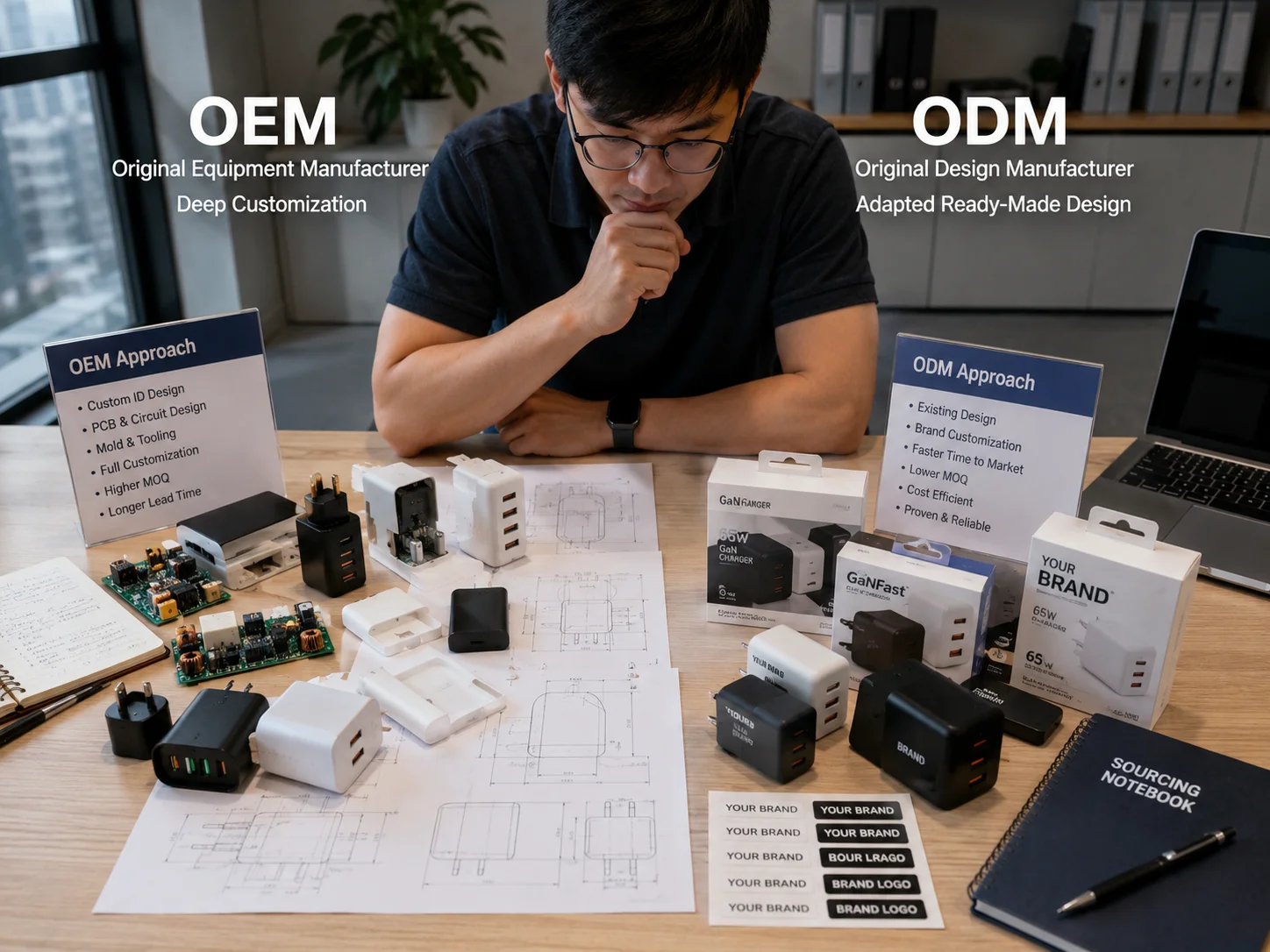
I use OEM to mean custom manufacturing based on a buyer’s deeper requirements. I use ODM to mean a supplier’s existing or semi-existing design that can be adapted for a brand.2
How I Explain OEM and ODM to Buyers
In my daily communication with 3C buyers, I try to make OEM and ODM simple. I do not start with big factory words. I start with the buyer’s real need. If the buyer already has a charger concept, structure idea, special port layout, special housing, or special product plan, then we discuss OEM. The buyer may need more development time. The buyer may also need a higher MOQ and more confirmation steps. If the buyer wants a 30W, 65W, 100W, or similar GaN charger that can be sold under their own brand, then we usually discuss ODM first. The buyer can choose from available models and adjust logo, color, plug, packaging, manual, and sometimes port mix.
| Model | How I Usually Explain It | Common Buyer Need |
|---|---|---|
| OEM | I help match a deeper custom project with suitable production support. | The brand needs an exclusive look, structure, or feature. |
| ODM | I help adapt an existing or semi-ready model for the buyer’s market. | The brand needs a fast and practical launch. |
| Private Label | I see this as a light ODM path in many cases. | The buyer mainly needs logo and packaging. |
I also remind buyers that the word “GaN” does not solve every sourcing problem. A GaN charger still needs the right plug standard, power output, interface design, safety certification, packaging compliance, and after-sales plan. The manufacturing model only tells us how the product is developed and customized. It does not prove the product is ready for every market.3
2. GaN Charger OEM: Best for Brands That Need Full Customization?
Some brands ask for a product that no competitor sells. They need more than a logo. They need control over the product direction.
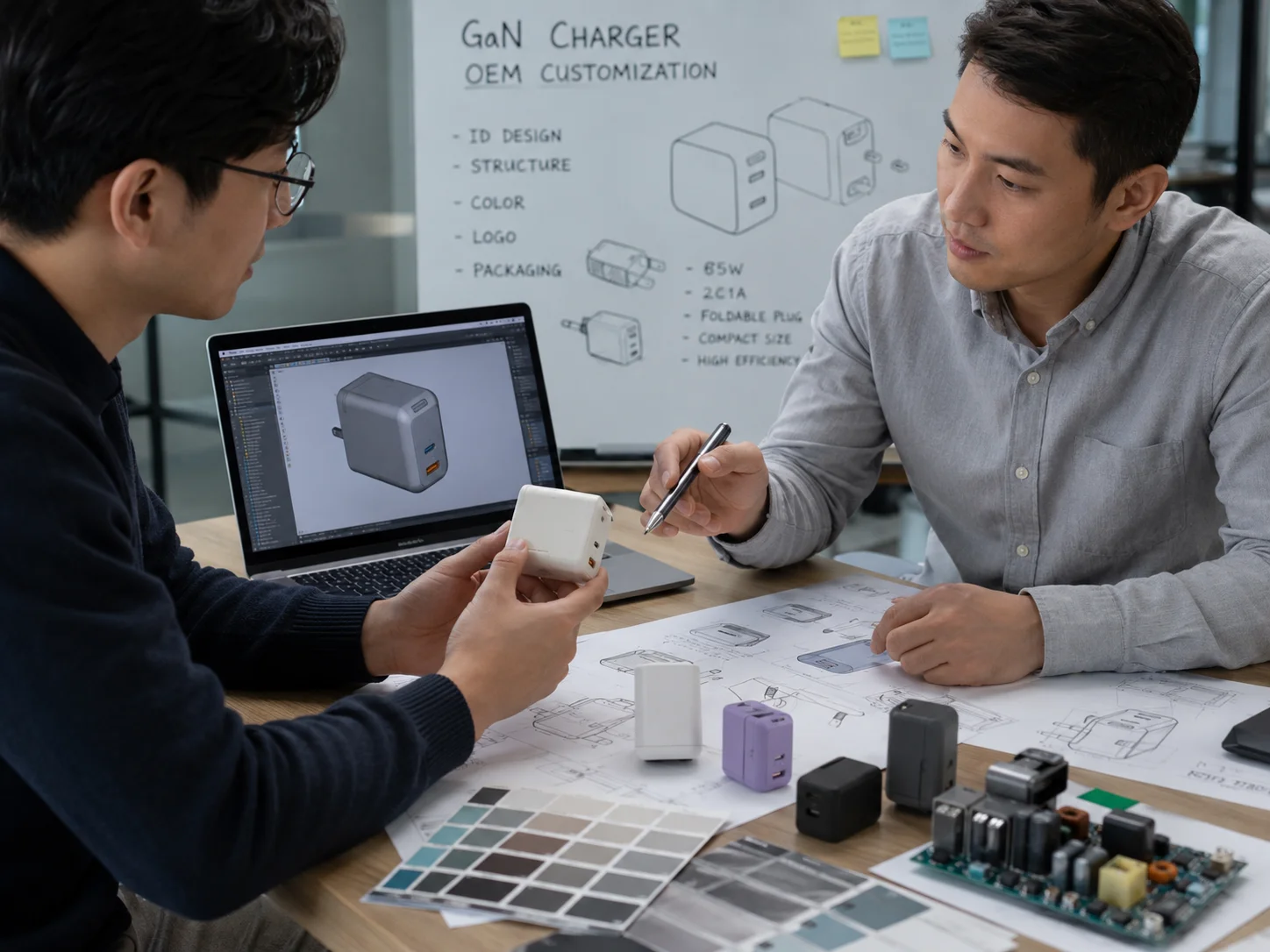
I see OEM GaN chargers as a better fit when the buyer needs exclusive product structure, special function, unique appearance, or a long-term custom product line.
Where OEM Makes More Sense
When I discuss OEM GaN charger projects, I first try to understand whether the buyer truly needs deep customization. A brand may want a special housing shape. It may want a different port position. It may want a special power and interface mix for one retail channel. It may need a charger family that has the same design style across 30W, 65W, and 100W models. In these cases, OEM can support stronger brand difference. It can also reduce the chance that another seller offers the same-looking product with another logo.
| OEM Area | What I Ask the Buyer | Why It Matters |
|---|---|---|
| Appearance | I ask if the housing must be exclusive. | The mold or structure may affect cost and time. |
| Function | I ask if the power and ports must be special. | The design may need deeper review. |
| Market | I ask which country and channel will sell it. | Certification and plug rules depend on the market.4 |
| MOQ | I ask if the first order can support development. | OEM often needs more commitment.5 |
I also tell buyers that OEM is not only a “premium” label. It is a project path. It may need drawings, samples, structure review, packaging artwork, testing support, and certification planning. It can be very useful for a mature brand. It can also be too heavy for a new seller who only wants to test demand. I do not push OEM when the buyer’s need is only a logo, a box design, and a U.S. or EU plug version. In that case, the buyer may be paying for complexity before the market has proven the product.
3. GaN Charger ODM: Best for Fast Launch and Lower Development Cost?
Many buyers think ODM means cheap labeling. This idea can make them miss a practical and safer launch path.
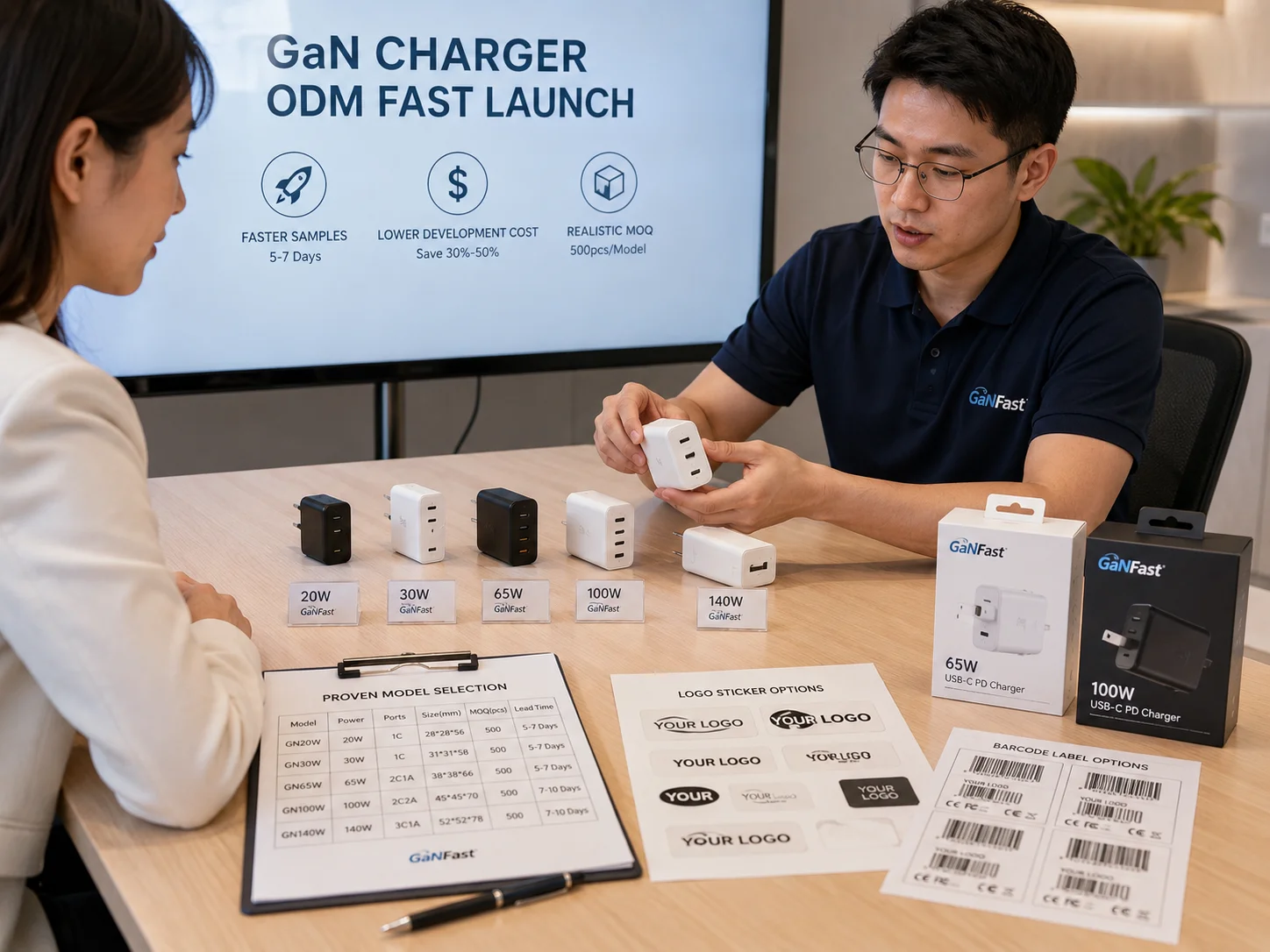
I see ODM GaN chargers as a strong choice when the buyer wants a ready model, realistic MOQ, faster samples, lower development cost, and basic brand customization.
Why ODM Is Often the Practical First Step
For many Amazon sellers, wholesalers, importers, and retail supply buyers, ODM can be the right starting point.6 The buyer can choose an existing GaN charger model and adapt it to the target market. The buyer can request logo printing, packaging design, plug type, color option, cable bundle, manual language, barcode, and carton marks. The buyer can also compare different power levels and port combinations before committing to a larger product plan. This matters because the first launch is often a test. The buyer needs to know if customers accept the price, size, plug type, and port mix.
| ODM Custom Option | What I Usually Check | Buyer Benefit |
|---|---|---|
| Logo | I check logo size and print position. | The product becomes brand-ready. |
| Packaging | I check retail box style and compliance text. | The product can fit online or store sales. |
| Plug Type | I check U.S., EU, UK, or other market needs. | The charger matches the sales region. |
| Power Range | I check 20W, 30W, 65W, 100W, and other needs. | The buyer can build a simple product line. |
| Ports | I check USB-C and USB-A combinations. | The buyer can match user habits. |
ODM does not mean the buyer ignores quality. I still ask about certification, test reports, production inspection, packaging requirements, warranty terms, and delivery schedule. I also remind buyers that a ready model still needs checking. A charger that works for one market may not be ready for another market.7 ODM is useful because it lowers the first barrier. It does not remove the need for careful sourcing.
4. OEM vs ODM GaN Chargers: Key Differences for Brand Owners?
A wrong model can slow the launch. It can also create extra cost, unclear samples, and wrong expectations between buyer and supplier.
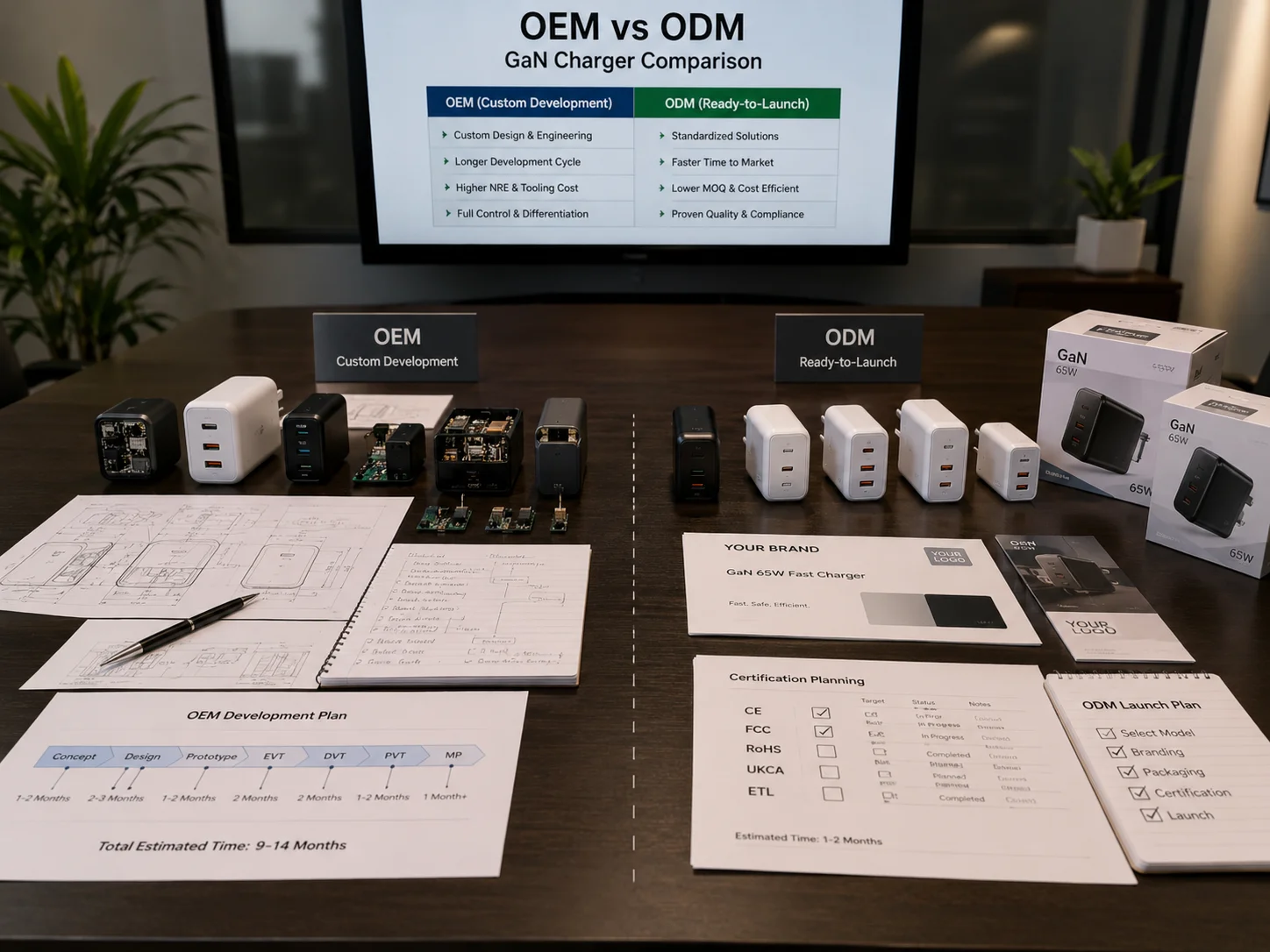
I compare OEM and ODM by customization depth, MOQ, development time, certification planning, product exclusivity, and launch risk. I never compare them by unit price only.
The Differences I Check Before Quoting
When a buyer asks for a quote, I do not only ask for wattage. I ask several pre-quote questions. I ask the target market. I ask the sales channel. I ask if the buyer needs CE, FCC, UKCA, ETL, RoHS, or other documents. I ask if the buyer has an existing specification. I ask the first-order MOQ range and budget. I ask the expected delivery time. I also ask if the brand really needs exclusive differentiation. These questions help me decide whether OEM or ODM is more realistic.
| Decision Point | OEM Usually Fits When | ODM Usually Fits When |
|---|---|---|
| Custom Depth | I see a need for unique structure or function. | I see a need for logo, box, color, or plug adaptation. |
| MOQ | I see the buyer can support a larger commitment. | I see the buyer wants a realistic first order. |
| Timeline | I see the buyer accepts longer development. | I see the buyer needs faster launch. |
| Cost Structure | I see the buyer accepts development cost. | I see the buyer wants lower upfront cost. |
| Exclusivity | I see the brand needs stronger protection. | I see the brand mainly needs market entry. |
I also explain that OEM and ODM can both lead to good products or bad products. The model itself does not guarantee quality.8 A poor OEM project can fail if requirements are unclear. A good ODM project can sell well if the product matches the market and the supplier supports stable quality. A buyer should not choose OEM only because it sounds more serious. A buyer should not reject ODM only because it sounds less custom. The better question is simple: “What do I need to control, and what can I accept from an existing product?”
5. When Should Your Brand Choose OEM GaN Chargers?
Some brands have a clear product vision. They do not want a charger that looks or feels like many other offers online.
I suggest OEM when the brand needs exclusive design, deeper control, long-term product planning, or a custom feature that existing ODM models cannot support.
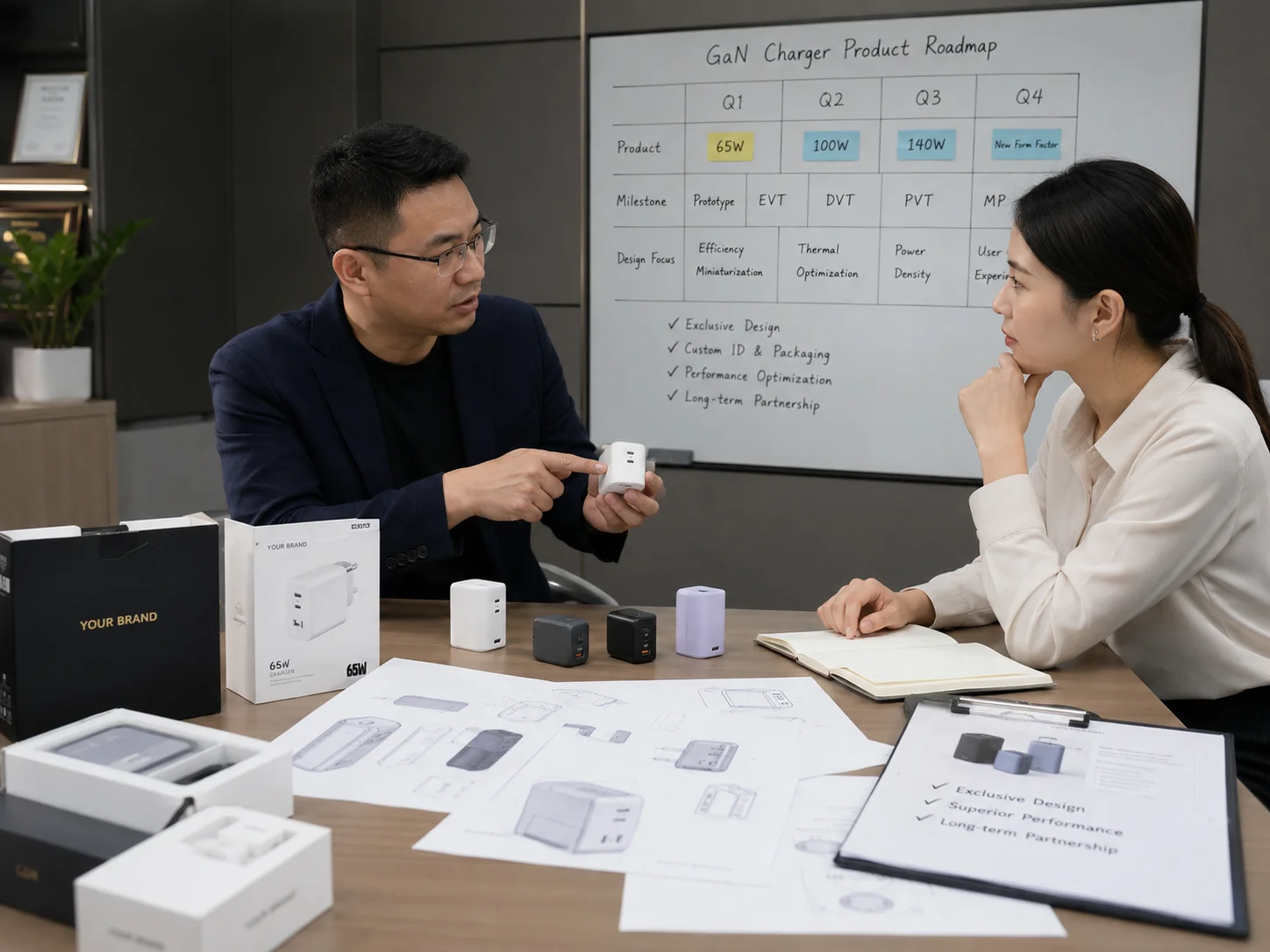
Buyer Situations That Point to OEM
I usually see OEM as a better fit for brands that already understand their market. The buyer may have retail feedback. The buyer may know the exact complaint from end users. The buyer may want a smaller body, a different surface texture, a special foldable plug design, or a specific port layout for laptop and phone users. The buyer may also want one design language across several power levels. In these cases, OEM can support a more serious product plan. The buyer can avoid selling the same shape that many other sellers use.
| Brand Situation | Why I Would Discuss OEM |
|---|---|
| The brand has an existing customer base. | I can help match custom needs with market feedback. |
| The buyer needs a unique housing. | ODM models may not give enough difference. |
| The buyer wants a full product series. | OEM can support one visual style across models. |
| The buyer has strict channel rules. | The project may need special packaging and documentation. |
| The buyer wants long-term differentiation. | A deeper custom path can support brand value. |
I still warn buyers about the limits. OEM can require more sample rounds.9 OEM can require more time for structure, packaging, and certification planning. OEM can also need a higher MOQ because the supplier takes more project risk. If the buyer is not ready to confirm details, OEM can become slow and confusing. I prefer to help the buyer prepare a clear specification before any OEM discussion. I ask for target wattage, plug type, ports, color, size goal, packaging style, needed documents, and expected launch date. A clear brief saves time for everyone.
6. When Should Your Brand Choose ODM GaN Chargers?
A new product launch can become too heavy when every detail is custom. Many buyers need sales data before deep development.
I suggest ODM when the buyer wants to test a market, reduce launch risk, use a proven model, keep MOQ practical, and customize brand-facing details.
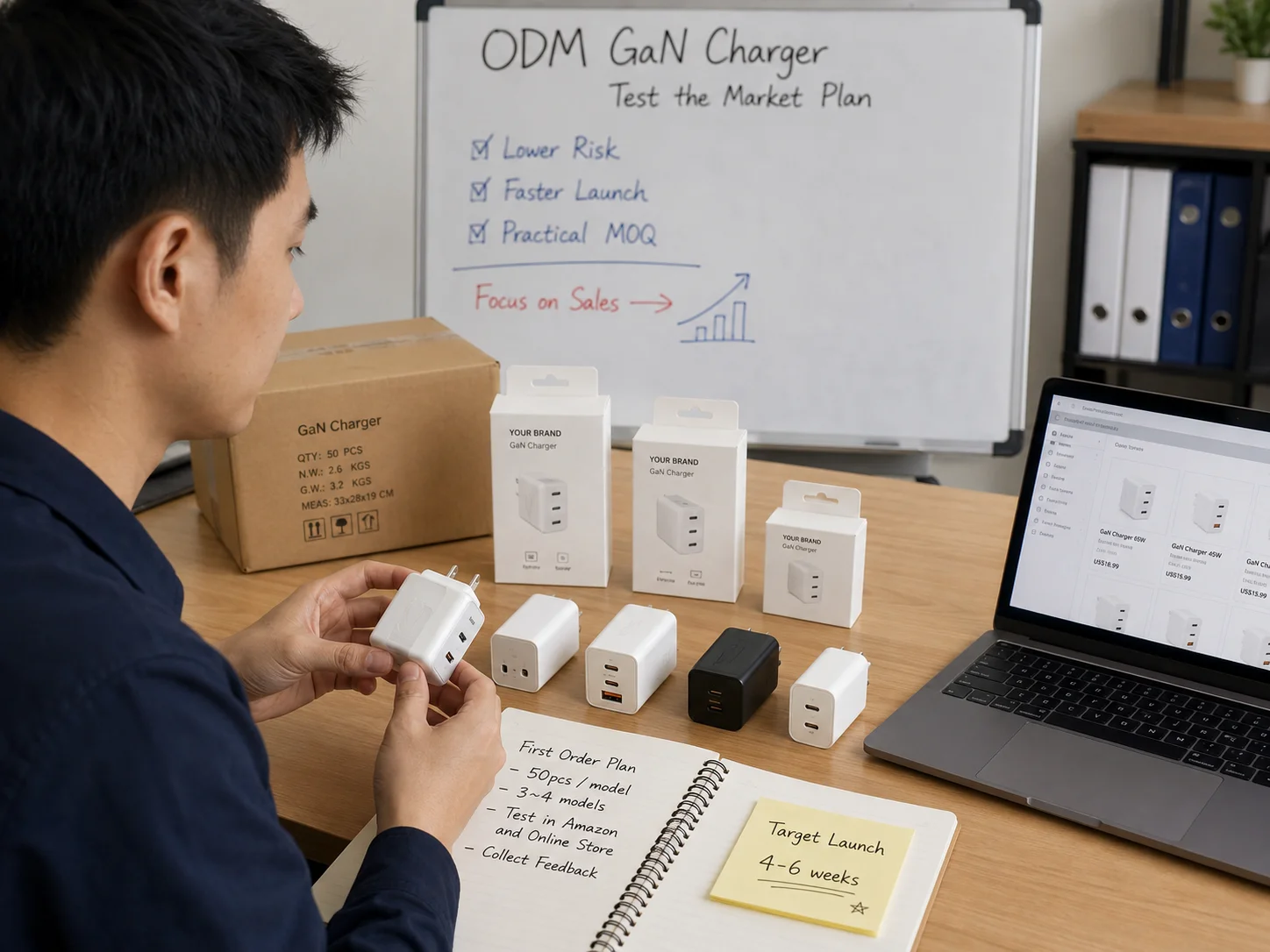
Buyer Situations That Point to ODM
I often recommend ODM to buyers who are entering a new power range or a new sales channel. A wholesaler may want to add 65W GaN chargers to an existing mobile accessory catalog. An Amazon seller may want to test a compact 30W or 45W model before ordering a full custom design. A retail supplier may need a product with stable packaging, barcode, manual, and market-ready plug type. In these cases, ODM helps the buyer move faster. It also helps the buyer learn real customer demand before investing in deeper product development.
| Buyer Situation | Why I Would Discuss ODM |
|---|---|
| The buyer is testing demand. | I can help reduce the first launch burden. |
| The buyer needs fast sampling. | Existing models can often move faster. |
| The buyer has a limited first budget. | ODM can lower upfront development cost.10 |
| The buyer needs basic branding. | Logo and packaging may be enough at first. |
| The buyer serves multiple small channels. | ODM can support practical product variety. |
I also point out that ODM does not mean “no choice.” Many ODM GaN charger projects still allow useful changes. The buyer can choose between black and white color, U.S. or EU plug, single-port or multi-port design, retail box or brown box, and different manual languages. Some suppliers can support more changes, but every change must be checked. I never promise a customization request before checking the exact model. A plug change, color change, or packaging change may sound simple, but it can still affect MOQ, sample time, or certification documents.11
7. What to Check Before Working with a GaN Charger OEM or ODM Factory?
A low price can look attractive at the start. It can become expensive if the product misses certification, packaging, or after-sales requirements.
I check target market, certification, product specs, testing support, packaging compliance, warranty terms, MOQ, lead time, and communication quality before moving forward.
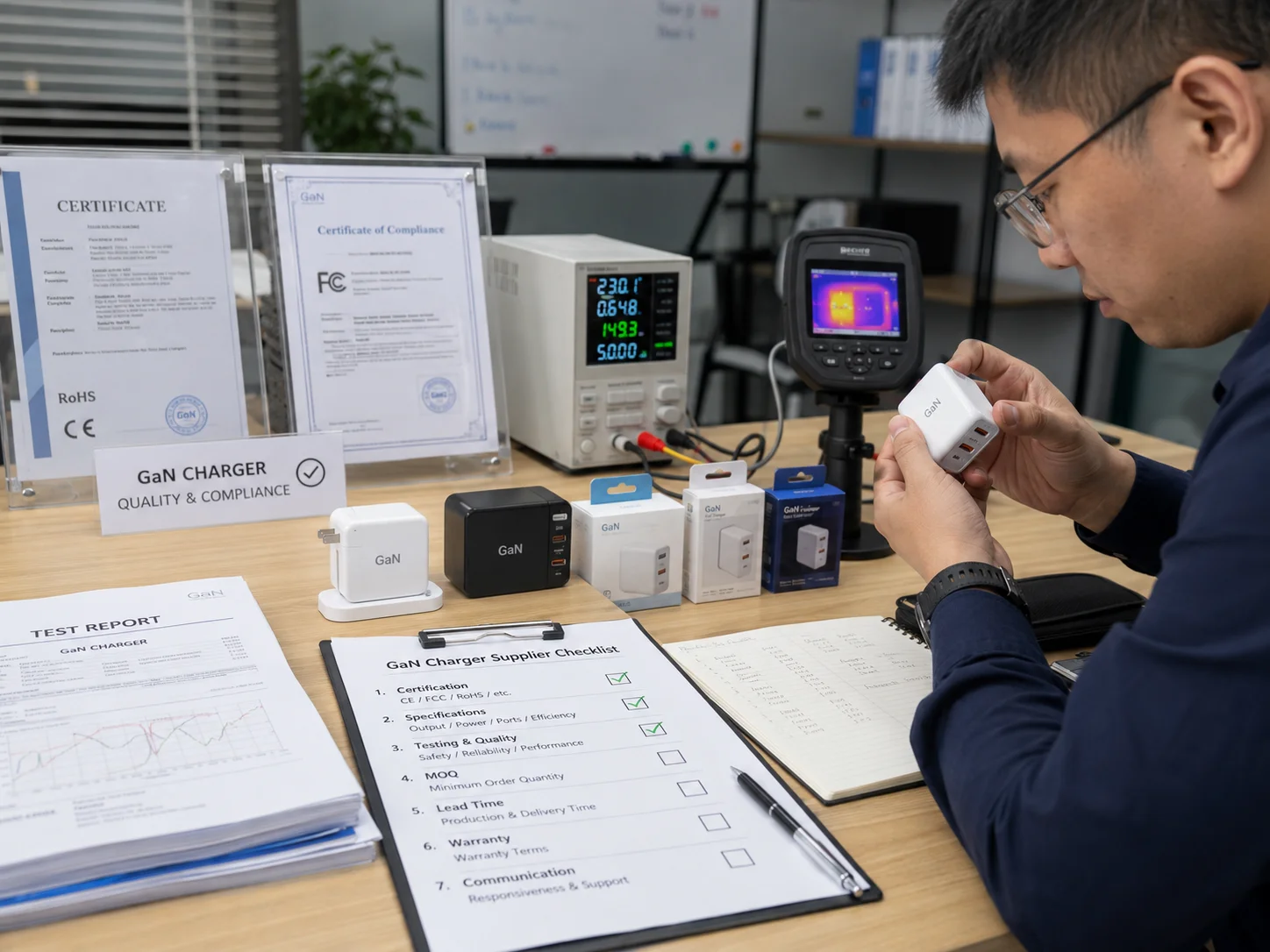
My Pre-Quote Checklist for Buyers
Before I ask a supply partner for a serious quote, I collect key information from the buyer. I ask the target country because a U.S. order and an EU order may need different plugs, labels, and documents. I ask the sales channel because Amazon, retail chain, wholesale, and corporate gift channels may have different packaging and barcode needs. I ask about certification requirements because the buyer may need CE, FCC, UKCA, ETL, RoHS, or other documents. I also ask if the buyer already has a product link, photo, or specification sheet for reference.
| Check Item | What I Ask | Why I Ask It |
|---|---|---|
| Market | I ask where the charger will be sold. | Certification and plug rules depend on location. |
| Channel | I ask if it is for Amazon, retail, or wholesale. | Packaging and labels may differ. |
| Specification | I ask for wattage, ports, plug, and color. | The quote needs a clear base. |
| Certification | I ask what documents the buyer needs. | A missing document can delay launch.12 |
| MOQ and Budget | I ask the first-order plan. | The model must match the buyer’s stage. |
| Delivery Time | I ask the expected ship date. | OEM and ODM timelines are different. |
| After-Sales | I ask about warranty needs. | The responsibility must be clear before order. |
I also remind buyers to check communication quality. A good supplier or trading partner should not say yes to everything too fast. A good partner should ask questions. They should confirm details before promising MOQ, lead time, or certification. In GaN chargers, small details matter. A wrong plug, wrong label, wrong carton mark, or missing manual language can create real problems. I prefer slower confirmation at the start over fast mistakes later.
8. How to Choose the Right GaN Charger Manufacturer for Your Market?
A charger can look good in photos. It still may not fit your market, sales channel, or customer expectation.
I choose a GaN charger manufacturing path by matching the buyer’s market, certification needs, customization depth, first-order size, launch timeline, and after-sales expectations.
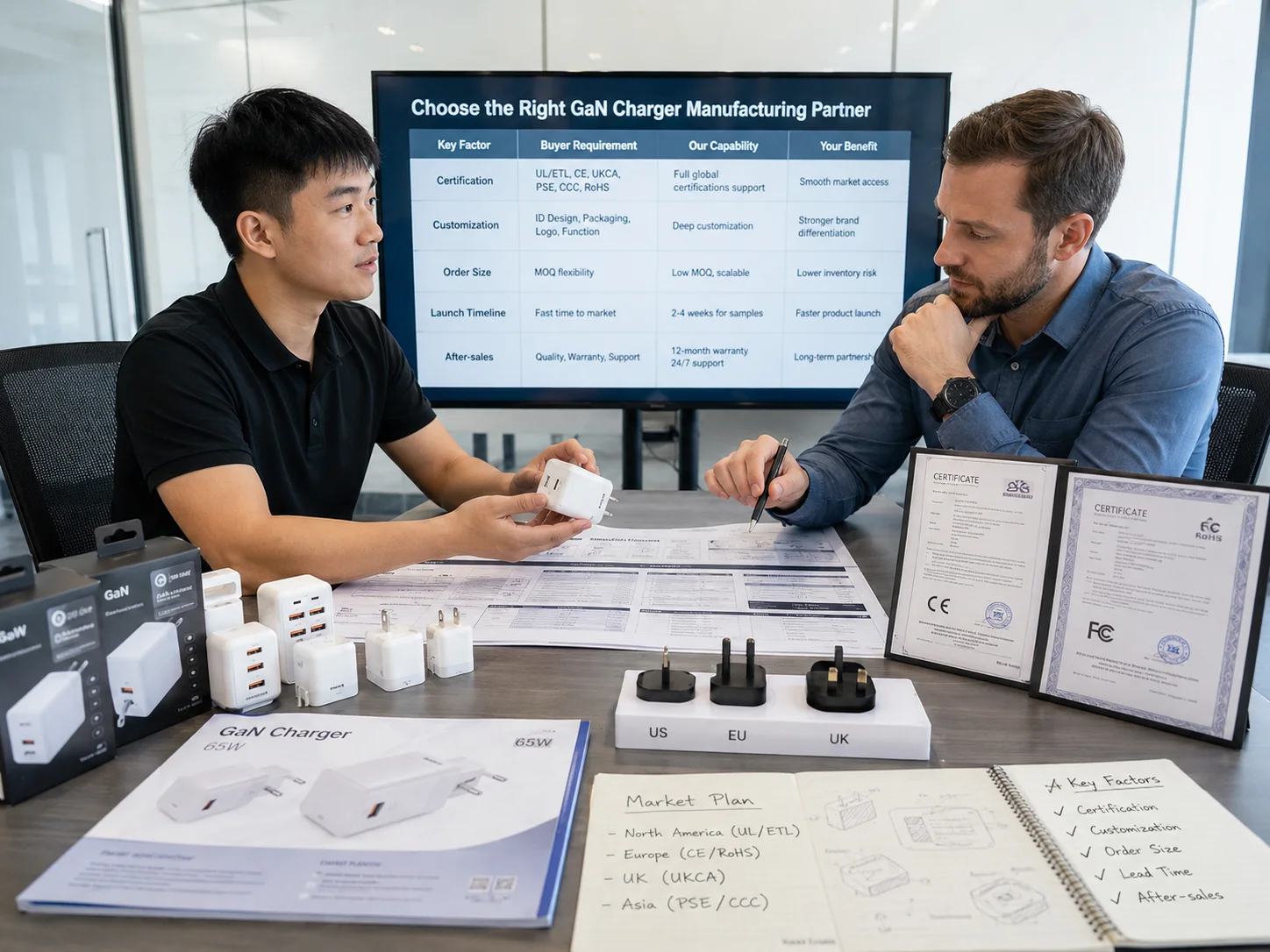
The Decision Process I Use with Buyers
When I help a buyer choose between OEM and ODM, I first place the buyer into a practical stage. If the buyer is still testing demand, I usually look at ODM first. If the buyer already has stable sales and needs stronger brand difference, I start to discuss OEM. If the buyer sells in Europe or the U.S., I check certification needs early. If the buyer sells through Amazon, I check packaging, barcode, listing images, and returns risk. If the buyer sells to retailers, I check display box, language, carton marks, and documentation needs.
| Buyer Stage | Better Starting Point | My Reason |
|---|---|---|
| New seller | ODM | I want the buyer to test demand with lower risk. |
| Growing brand | ODM or light OEM | I want the buyer to improve branding while staying flexible. |
| Mature brand | OEM | I want the buyer to build stronger product difference. |
| Wholesaler | ODM | I want the buyer to add sellable models quickly. |
| Retail supplier | ODM or OEM | I choose based on retailer rules and exclusivity needs. |
I also look at service ability, not only product photos. I want clear answers about sample time, mass production time, packaging artwork, inspection support, warranty handling, and document availability. I also want realistic answers. If a supplier promises every certification, every plug, every color, and very low MOQ at the same time, I become careful. Good sourcing is not about hearing the fastest yes. It is about building a product plan that can actually ship, pass buyer checks, and support repeat orders. For GaN chargers, the right partner should help the buyer choose the right path, not only quote the lowest price.
Conclusion
I choose OEM or ODM by brand stage, customization depth, MOQ, timeline, certification needs, and market risk, not by which word sounds more professional.
"OEM vs ODM Manufacturing: A Comprehensive Technical Guide for ...", https://www.wevolver.com/article/oem-vs-odm-manufacturing-a-comprehensive-technical-guide-for-engineers. Research on manufacturing outsourcing and new-product development distinguishes buyer-specified production from supplier-originated design models and supports the general view that deeper customization normally increases development coordination, time, and upfront cost. Evidence role: general_support; source type: paper. Supports: A neutral operations or product-development source should support the general distinction that buyer-specific development usually involves more customization and coordination, while supplier-originated designs can reduce design effort and time to market.. Scope note: The source would support the general sourcing logic, not prove that every GaN charger project follows this pattern. ↩
"Original design manufacturer - Wikipedia", https://en.wikipedia.org/wiki/Original_design_manufacturer. Encyclopedic definitions describe an original equipment manufacturer as producing goods or components for another company’s branded offering, while an original design manufacturer designs and manufactures products that may be marketed under a purchaser’s brand. Evidence role: definition; source type: encyclopedia. Supports: An encyclopedic source should define OEM and ODM and explain the difference between manufacturing to another firm’s specification and manufacturing supplier-designed products for sale under another brand.. Scope note: Terminology can vary by industry and contract structure, so the citation would support the general distinction rather than every supplier’s usage. ↩
"Equipment Authorization – RF Device | Federal Communications ...", https://www.fcc.gov/oet/ea/rfdevice. Government product-compliance guidance for electrical and electronic equipment treats market access as dependent on applicable safety, electromagnetic-compatibility, labeling, and conformity-assessment requirements, not on whether the product was sourced through an OEM or ODM model. Evidence role: general_support; source type: government. Supports: Government regulatory guidance should show that electrical or electronic products must satisfy applicable market rules such as safety, electromagnetic compatibility, labeling, and conformity documentation before sale.. Scope note: The source would support the regulatory principle generally and may not address GaN chargers as a distinct product category. ↩
"Mains electricity by country - Wikipedia", https://en.wikipedia.org/wiki/Mains_electricity_by_country. International electrical-standard references document that plug and socket systems vary across countries, while regional regulatory guidance shows that electrical equipment must meet jurisdiction-specific conformity requirements before sale. Evidence role: general_support; source type: institution. Supports: An international standards or regulatory institution should support that plug and socket systems differ by country and that electrical products may face jurisdiction-specific conformity requirements.. Scope note: The citation would establish regional variation, not specify the exact certification package required for any one charger model. ↩
"10 Product Development Costs + How To Estimate Them [2025]", https://www.studiored.com/blog/design/product-development-costs/. Studies of outsourced new-product development show that customized manufacturing projects commonly require engineering coordination, prototype iteration, and tooling or setup investments, which can increase buyer and supplier commitment before mass production. Evidence role: mechanism; source type: paper. Supports: A product-development or manufacturing-outsourcing paper should explain that custom product development may involve engineering work, tooling, prototypes, and supplier-buyer coordination that increase commitment before production.. Scope note: The evidence would support the mechanism behind higher commitment, not a universal MOQ or cost threshold for GaN charger OEM projects. ↩
"Reducing the Risks of New Product Development", https://sloanreview.mit.edu/article/reducing-the-risks-of-new-product-development/. New-product development research emphasizes that early market testing and iterative learning can reduce uncertainty before firms commit substantial resources to full custom development. Evidence role: mechanism; source type: paper. Supports: Research on new-product development or market testing should support the idea that firms can reduce uncertainty by testing customer demand before committing to deeper development investment.. Scope note: This supports the general logic of starting with a less development-heavy model; it does not prove ODM is always the best first step for GaN chargers. ↩
"Equipment Authorization | Federal Communications Commission", https://www.fcc.gov/engineering-technology/laboratory-division/general/equipment-authorization. Regulatory guidance for electrical and electronic products shows that lawful market placement depends on the requirements of the destination jurisdiction, so a product that functions technically may still require different conformity assessment, labeling, or documentation for another market. Evidence role: general_support; source type: government. Supports: Regulatory sources should show that market access for electronic or electrical products depends on region-specific requirements such as CE marking in the EU, FCC rules in the United States, or local safety standards.. Scope note: The citation would establish the compliance principle rather than evaluate any specific charger model. ↩
"What is Supplier Quality Management? Supplier Selection Criteria", https://asq.org/quality-resources/supplier-quality?srsltid=AfmBOoo_Vb4b5hGbo0Ax11JbOqXIlTWUXmoekJTQUzl9iPBckukK7aRi. Quality-management standards emphasize that consistent product quality depends on defined requirements, controlled processes, supplier evaluation, and verification, which supports the view that a sourcing label alone does not ensure product quality. Evidence role: expert_consensus; source type: institution. Supports: A quality-management institution or ISO-related source should support that product quality depends on defined requirements, process controls, supplier evaluation, and verification activities.. Scope note: The source would support quality-management principles generally, not compare empirical defect rates for OEM and ODM GaN chargers. ↩
"What is Iterative Development and Why Should You Use It?", https://www.pacific-research.com/iterative-product-development/. Product-development literature describes prototyping and testing as iterative activities used to discover design issues and refine a product before production, supporting the expectation that customized OEM projects may require multiple sample rounds. Evidence role: mechanism; source type: paper. Supports: A product-development paper should support that new or customized products commonly pass through iterative prototyping, testing, and redesign before production release.. Scope note: The evidence supports the general development process and does not specify the number of sample rounds typical for GaN chargers. ↩
"[PDF] Does product design really determine 80% of manufacturing cost?", https://dspace.mit.edu/bitstreams/d12b51db-f707-4022-8fc5-c4d87028a0c0/download. Manufacturing-outsourcing research indicates that using supplier-developed designs can shift part of the design burden away from the buyer and reduce upfront engineering or development expenditure compared with fully bespoke product development. Evidence role: mechanism; source type: paper. Supports: Research on outsourcing or supplier design should support that relying on supplier-developed designs can reduce the buyer’s design and engineering investment relative to creating a product from scratch.. Scope note: The citation would support the cost mechanism in general; actual savings depend on the supplier, design changes, certifications, and order size. ↩
"Compliance FAQs: CE Marking | NIST", https://www.nist.gov/standardsgov/compliance-faqs-ce-marking. Regulatory guidance on conformity assessment requires manufacturers to maintain technical documentation that reflects the product placed on the market, supporting the need to check whether design, plug, or labeling changes affect compliance records. Evidence role: mechanism; source type: government. Supports: Regulatory guidance should support that changes to a product may require updated technical documentation or reassessment, while manufacturing literature can contextualize why variants may affect setup and minimum order quantities.. Scope note: The citation directly supports the documentation-check aspect; effects on MOQ and sample time are operational consequences that may vary by factory. ↩
"Equipment Authorization | Federal Communications Commission", https://www.fcc.gov/engineering-technology/laboratory-division/general/equipment-authorization. Government compliance guidance states that regulated electrical and electronic products must have required conformity documentation or authorization records before being placed on the market, supporting the conclusion that missing documents can delay launch. Evidence role: general_support; source type: government. Supports: Government compliance sources should show that certain documents, such as declarations of conformity, technical files, or equipment authorization records, are required before placing or marketing regulated products.. Scope note: The source would support the regulatory risk generally and may not quantify the length of any delay. ↩