I see buyers lose money when USB-C cables look simple, specs stay unclear, and returns arrive after the first retail shipment.
To import USB-C cables from China, I first match the cable to the selling use case, then confirm specs, samples, packaging, MOQ, testing, delivery time, and supplier reliability before bulk production. Price matters, but wrong specifications create higher costs through returns, complaints, and lost customer trust.
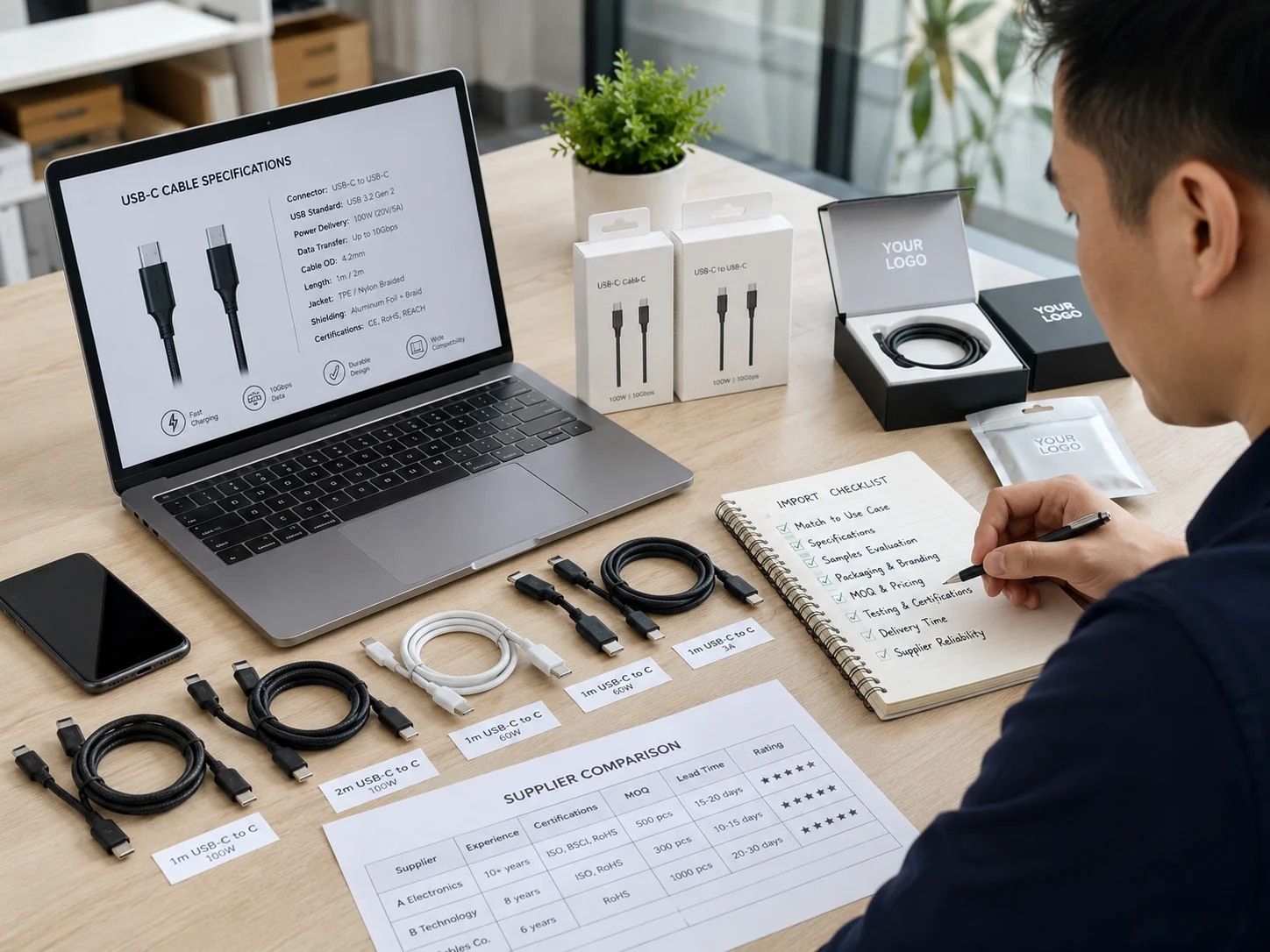
I have handled many USB-C cable inquiries from buyers in Europe and the United States. Many buyers start with one sentence: “Please quote USB-C cable.” I understand why they ask this way. The product looks simple from the outside. It has two connectors and one cable body. But in real sourcing work, that product name is not enough.
A USB-C cable can be made for basic charging, fast charging, high-speed data, video output, retail packaging, private label, or low-cost bundle sales. Each case needs a different cost level and a different quality control plan. If I quote too fast, I may give a price that looks attractive but does not fit the buyer’s market. If the buyer orders based only on that price, the risk moves to the retail side.
In this guide, I explain how I look at USB-C cable sourcing as a Shenzhen 3C export supplier. I focus on the buying decisions that affect quality, price, MOQ, delivery, customization, and after-sales risk.
Why Import USB-C Cables from China?
I often see buyers come to China for USB-C cables because local supply is limited, prices are high, or product choices move too slowly.
China is a strong sourcing base for USB-C cables1 because suppliers can offer many connector types, charging powers, materials, colors, packaging options, and private label services. I still suggest buyers compare factories by real specification control, not only by the lowest unit price.
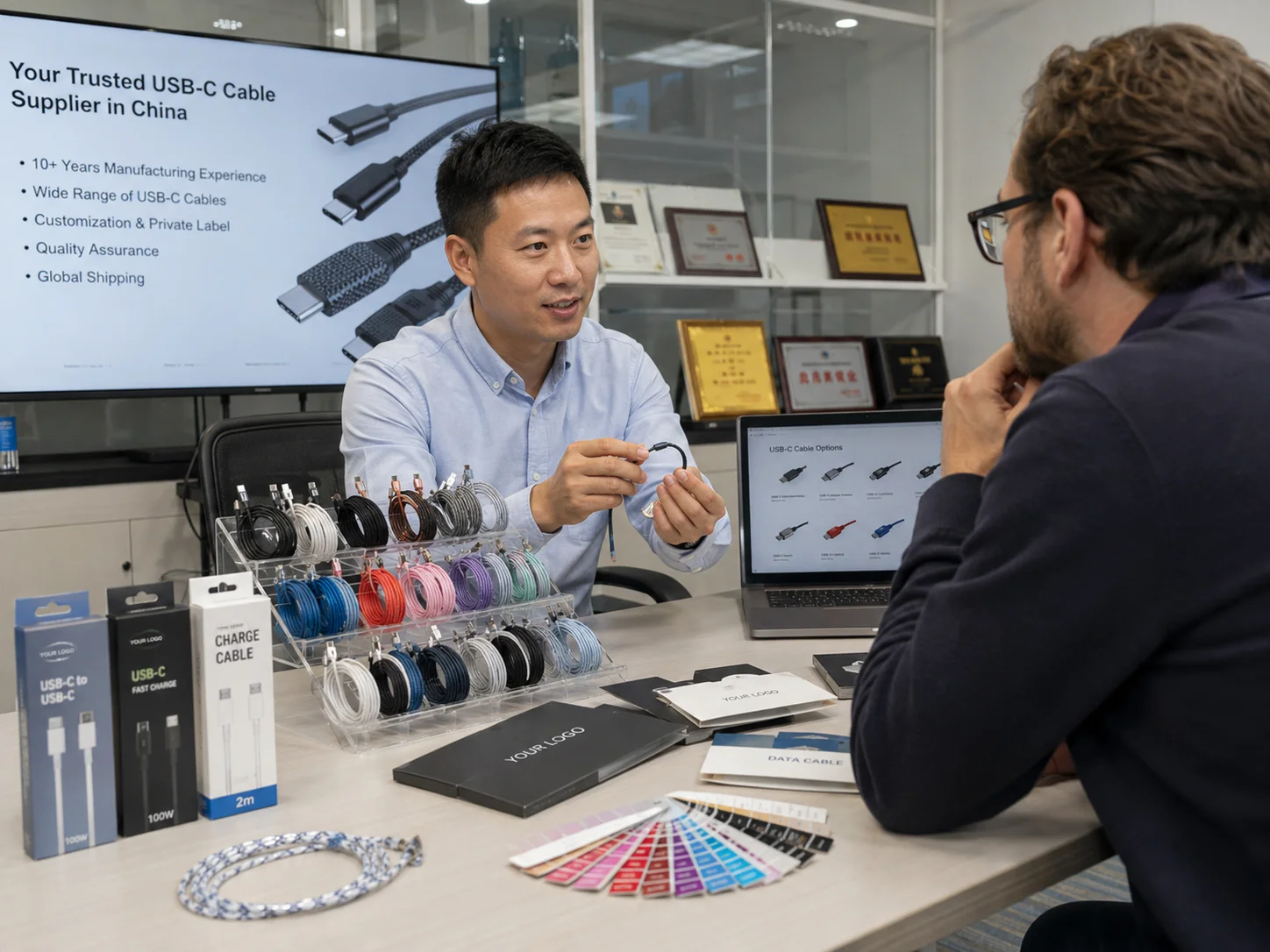
China is not only a place to find cheap USB-C cables. I see it more as a place where buyers can build a flexible product line. In Shenzhen and nearby cities, cable suppliers can support basic PVC cables, braided cables, fast charging cables, data cables, and retail-ready packaged cables.2 This matters when a retailer wants several SKUs under one brand.
Before I quote, I usually ask the buyer where the cable will be sold and how the end user will use it. A cable for a discount bin is not the same as a cable for a premium phone accessory shelf. A cable for an online bundle is not the same as a cable for chain-store retail packaging.
| Buyer goal | What I usually check first | Risk if ignored |
|---|---|---|
| Low-cost basic charging | Length, current, material, connector strength | High return rate if quality is too weak |
| Fast charging sales | Power rating, E-Marker need, device match | Bad reviews if charging speed is poor |
| Retail shelf product | Packaging, barcode, label, compliance needs | Store rejection or relabeling cost |
| Private label brand | Logo, color, packaging, stable batch quality | Brand damage from mixed quality |
| Wholesale resale | MOQ, carton packing, price tiers | Low margin if specs are overbuilt |
I also remind buyers that China sourcing needs clear communication. If a buyer only asks for the lowest price, many suppliers will quote the simplest version. That price may not include the cable structure, packaging, test standard, label, or copper quality the buyer expects.
What Are the Main Types of Wholesale USB-C Cables for Different Markets?
I see many product mistakes happen because the buyer orders by connector shape, not by market use.
The main wholesale USB-C cable types include USB-C to USB-C, USB-A to USB-C, Lightning to USB-C, braided cables, fast charging cables, data cables, and video-capable cables.3 I match the type with the buyer’s target devices, sales channel, and customer price level.
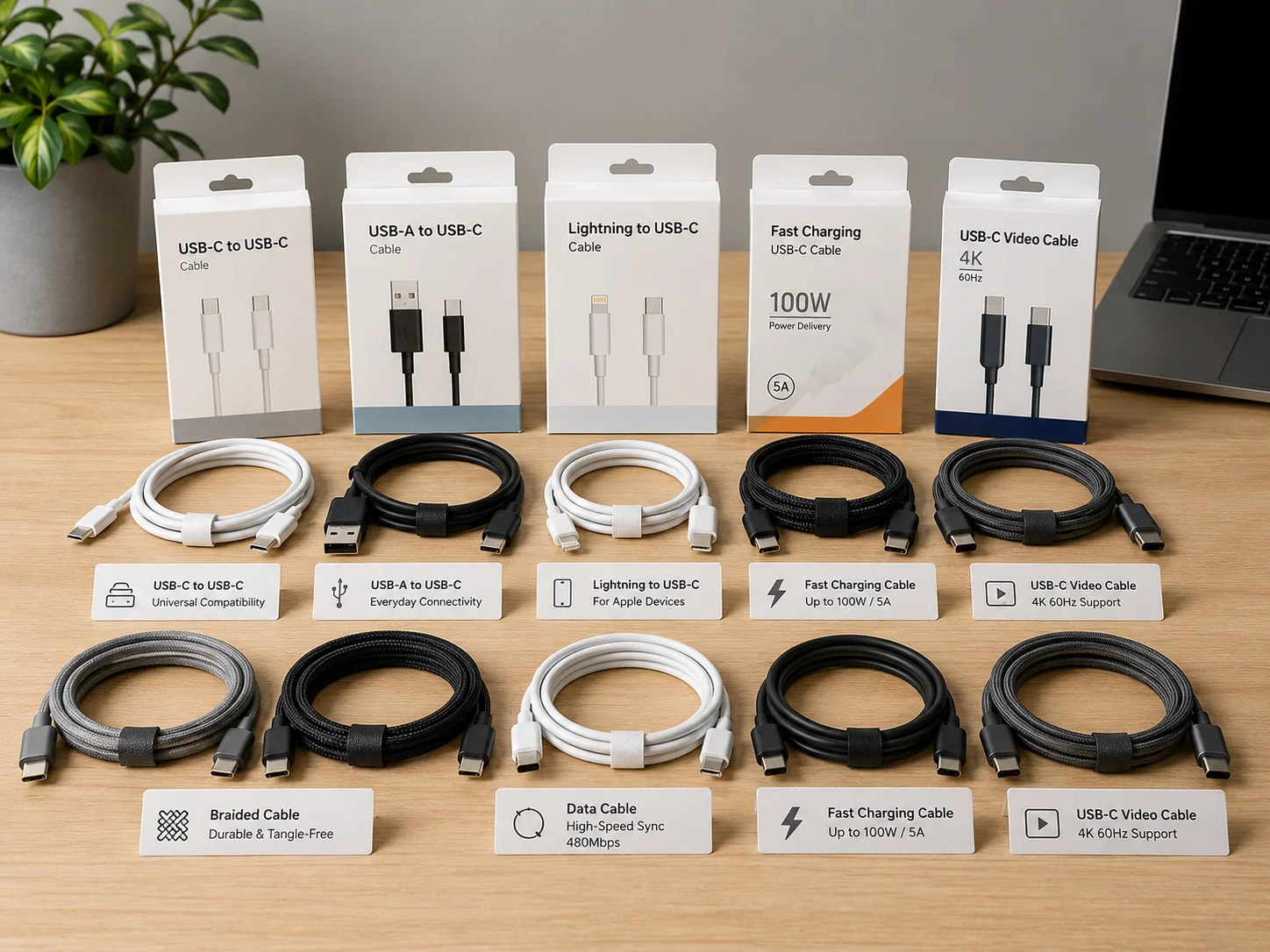
A USB-C cable may look similar across many listings, but the selling purpose can be very different. For example, USB-A to USB-C is still useful for older chargers, car chargers, power banks, and low-cost sets. USB-C to USB-C is now more common for fast chargers, laptops, tablets, and newer phones. Braided cables usually sell better when the buyer wants a stronger visual value. PVC cables are still common when price is the main point.
I usually divide the buying choice like this:
| Cable type | Common use | Buyer note |
|---|---|---|
| USB-A to USB-C | Basic phone charging, older chargers | Good for price-sensitive retail and bundle sales |
| USB-C to USB-C | Fast charging, new chargers, tablets | Specs must match power promise |
| USB-C to Lightning | iPhone charging | Certification and market rules must be checked |
| Braided USB-C cable | Retail shelf, branded accessory | Better look, but cost is higher |
| Short USB-C cable | Power banks, travel kits | Easy to sell in accessory sets |
| Long USB-C cable | Home, office, bedside use | Voltage drop and wire gauge matter more |
| USB-C data cable | File transfer, device connection | Data speed must be stated clearly |
| USB-C video cable | Monitor or dock connection | Not every USB-C cable supports video4 |
I often tell buyers to build their cable line by price level. A simple three-level plan works well for many retailers: basic, fast charging, and premium. The basic line can focus on stable charging and low price. The fast charging line needs clearer power claims. The premium line can add braided material, better packaging, stronger strain relief, or higher data function.
How Should I Understand USB-C Cable Specs: Charging Power, Data Speed, and Video Output?
I often see buyers mix charging, data, and video together, but each function has its own cost and test concern.
USB-C cable specs should be checked by charging power, data speed, and video output support.5 I do not assume one cable supports all three. I confirm the required function before quoting, because each upgrade changes material, chip, testing, and price.
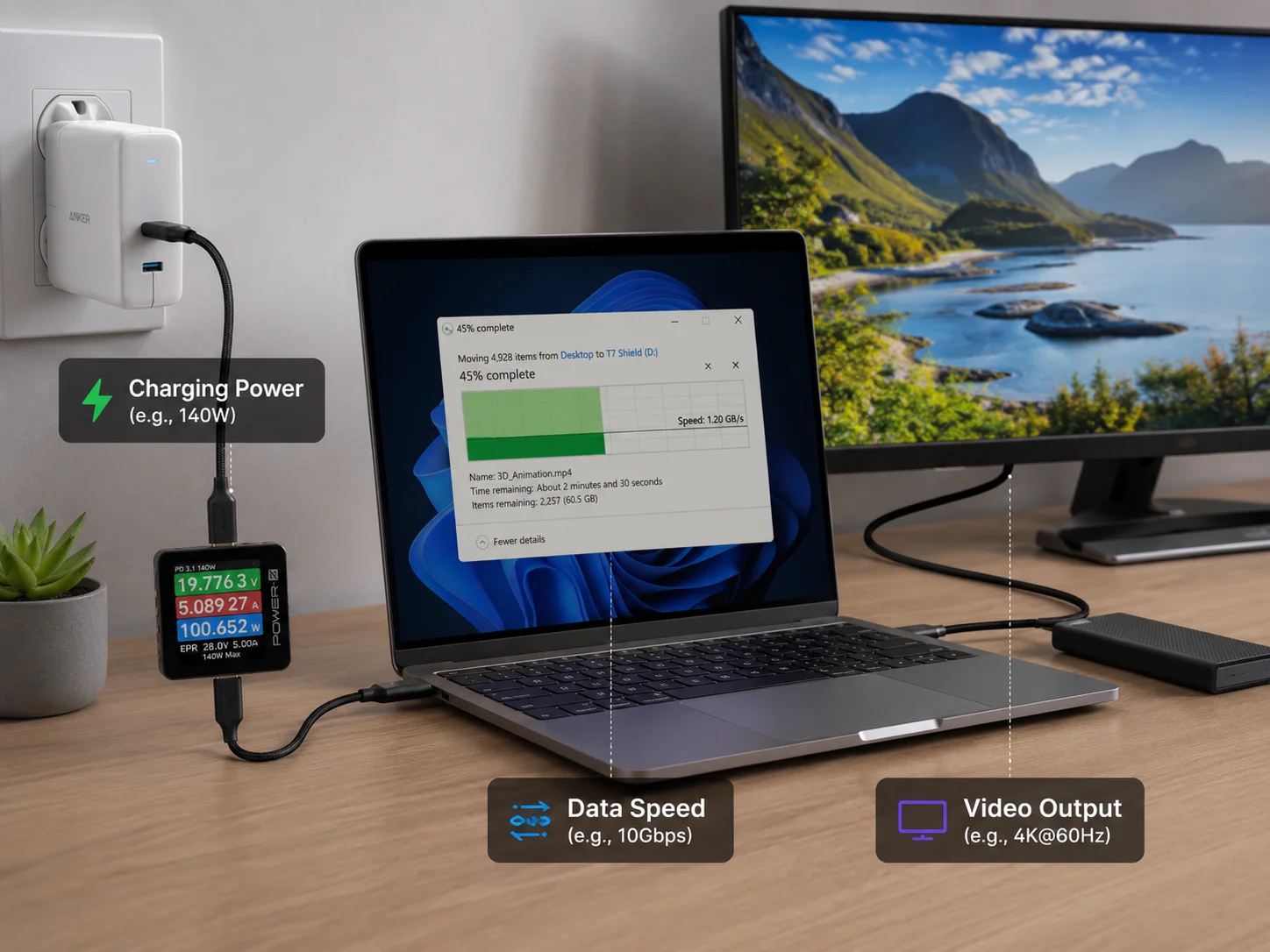
When I receive an inquiry, I do not only ask for length and color. I ask what the cable must do. This saves time and reduces wrong samples. If a buyer says “fast charging,” I need to know the target power. If a buyer says “data transfer,” I need to know whether basic data is enough or higher speed is needed. If a buyer says “for laptop,” I need to know whether video output or high power charging is expected.
| Spec area | Simple buying question | Why I ask |
|---|---|---|
| Charging power | Does the buyer need 3A, 5A, 60W, 100W, or higher? | The cable structure and chip choice may change |
| Data speed | Is basic transfer enough, or does the buyer need high-speed data? | Many charging cables only support low data speed6 |
| Video output | Does the cable need to connect to a monitor or dock? | Video support is not automatic |
| Device match | Is it for phones, tablets, laptops, or accessories? | Different users expect different performance |
| Sales claim | What will the package or listing say? | Claims must match the actual cable |
I prefer to keep product claims simple and true. If a cable is only for charging, I do not want the buyer to write that it supports high-speed data or video. That can create returns. It can also create complaints on e-commerce platforms. Platform rules and local claim rules are market-dependent, so I always suggest buyers verify label and listing wording in their own market.
Why Do Wire Gauge, Copper Quality, and Cable Length Matter?
I see buyers focus on the outside jacket, but the inside wire often decides the real user experience.
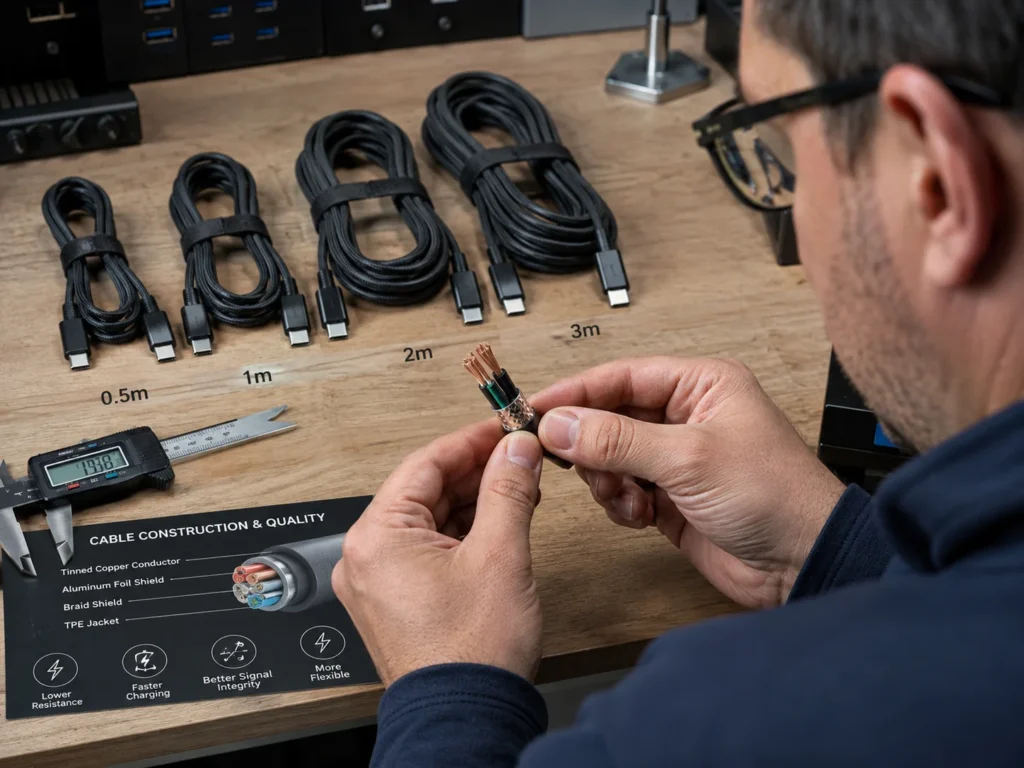
Wire gauge, copper quality, and cable length affect charging stability, heat, voltage drop, flexibility, and cost.7 I check these points early because a low-price cable may look fine but fail to perform well, especially in long lengths or fast charging use.
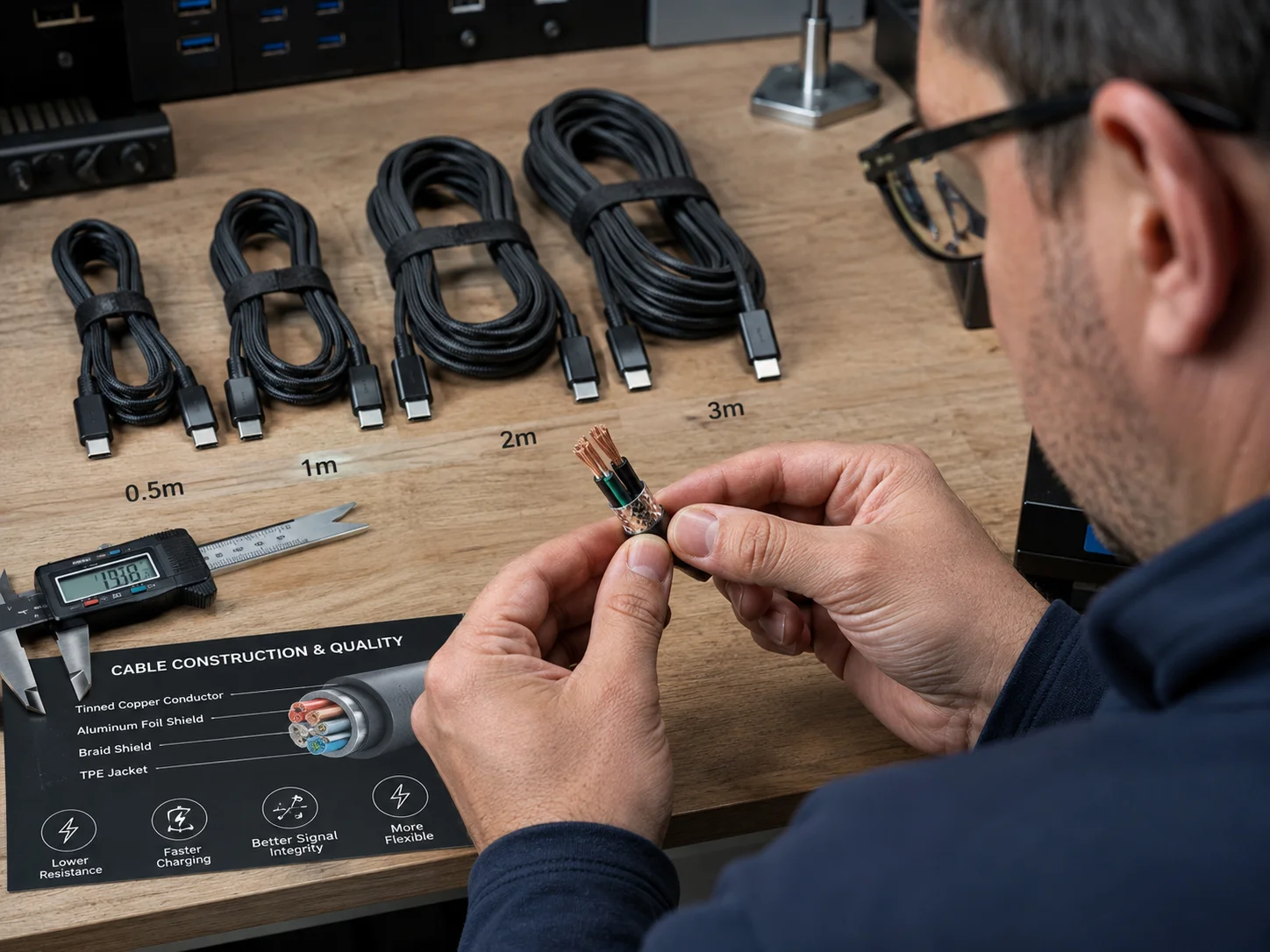
The outer material is easy to see. The inner structure is not. This is why two cables with the same length and same connector can have very different prices. A buyer may ask why one supplier quotes lower. Sometimes the answer is simple. The low price may use thinner wire, lower copper content, weaker connector housing, or lighter strain relief.
For basic charging, a simple structure may be acceptable if the selling claim is clear. For fast charging, longer length, or premium retail, I usually suggest stronger material planning.
| Factor | What it affects | Buying risk |
|---|---|---|
| Wire gauge | Current flow and voltage drop | Charging may be slow or unstable |
| Copper quality | Conductivity and durability | Cable may heat more or perform worse |
| Cable length | Power loss and user convenience | Long cable may fail if wire is too thin |
| Connector shell | Strength and appearance | Loose connectors can cause returns |
| Strain relief | Bending life | Cable may break near the connector |
| Jacket material | Feel, flexibility, and look | Cheap material may look poor in retail |
I also ask buyers whether they want a 1m, 1.2m, 1.5m, 2m, or 3m cable. The same specification may not work equally well across all lengths. A 2m cable with weak inner material can cause more complaints than a 1m cable.8 This is why I do not treat length as a small detail. It directly affects cost and after-sales risk.
What Is an E-Marker Chip and When Do I Need It?
I often see buyers hear “100W USB-C cable” and forget to ask whether the cable needs the correct chip support.
An E-Marker chip helps identify certain high-power USB-C cables to connected devices.9 I usually discuss it when the buyer needs 5A charging, 100W class cables, or higher-performance USB-C to USB-C products. The exact requirement should be checked against the target specification.
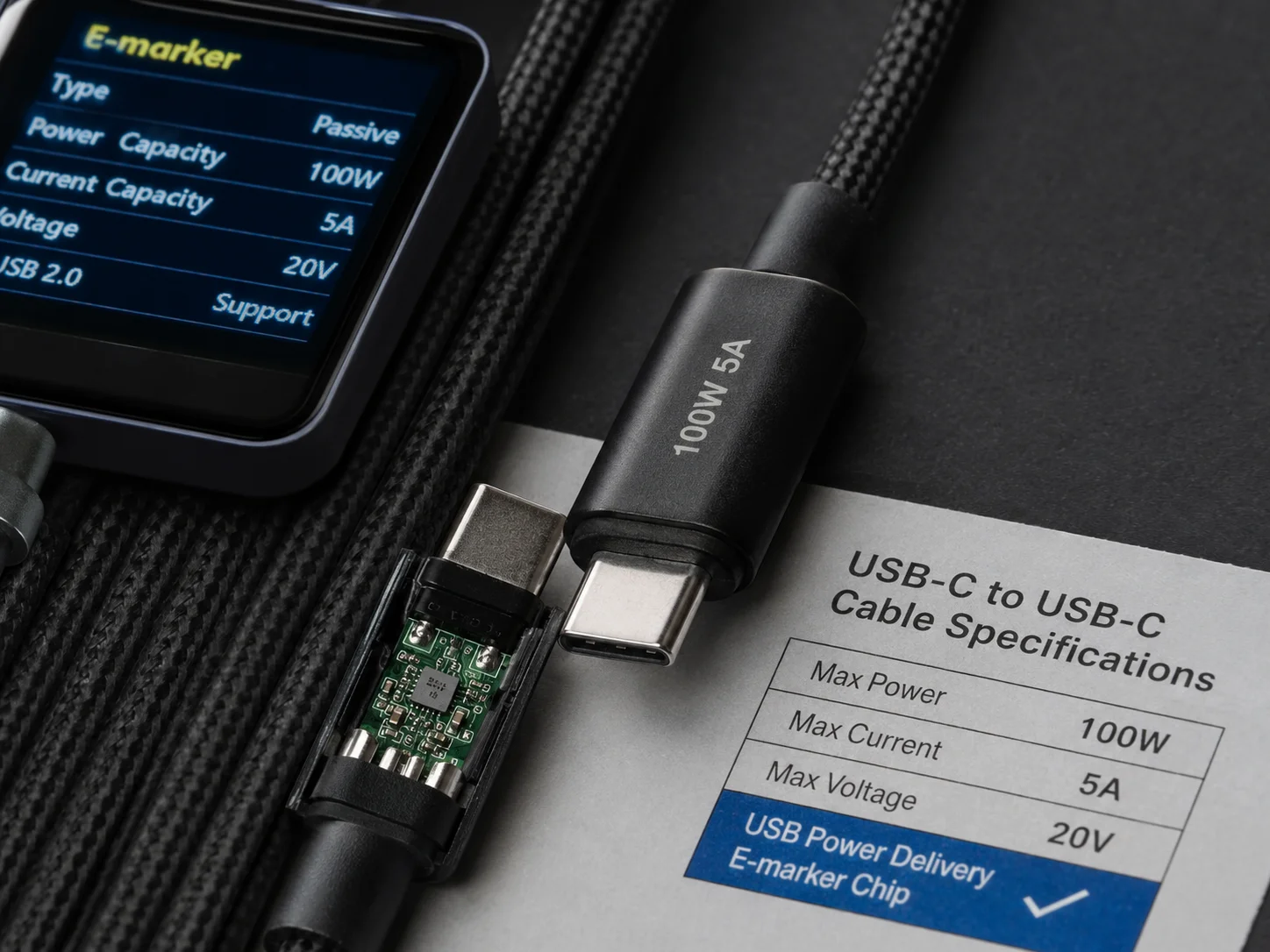
I explain E-Marker in a simple way to buyers. It is not a decoration. It is part of how some higher-power USB-C cables tell chargers and devices what the cable can support. If a buyer sells a cable as high power but the cable does not have the needed structure, users may not get the expected charging result.
I do not tell every buyer to add an E-Marker chip. That would raise cost when it is not needed. I first check the sales use case.
| Buyer use case | E-Marker discussion |
|---|---|
| Basic phone charging | Usually not the first focus |
| USB-C to USB-C 3A cable | May not need it, based on target spec |
| 5A or 100W class cable | I will normally discuss it |
| Laptop charging cable | I will check power claim carefully |
| Premium retail fast charging cable | I will confirm chip, label, and test report needs |
| Very low-price cable | I will not add features unless the buyer needs them |
I also tell buyers to match the cable with chargers. A 100W cable does not create 100W charging by itself. The charger, device, and cable must work together.10 If a customer buys a fast charging cable but uses a low-power charger, the result will be different. This is why clear packaging and product listing text matter. I prefer to avoid claims that sound too broad.
How Can I Check USB-C Cable Quality Before Bulk Orders?
I do not treat samples as gifts; I treat samples as risk control before the buyer pays for mass production.
To check USB-C cable quality before bulk orders, I confirm the sample against agreed specs, test charging and data functions, inspect appearance, check connector strength, confirm packaging and labels, and approve a pre-production sample before mass production.
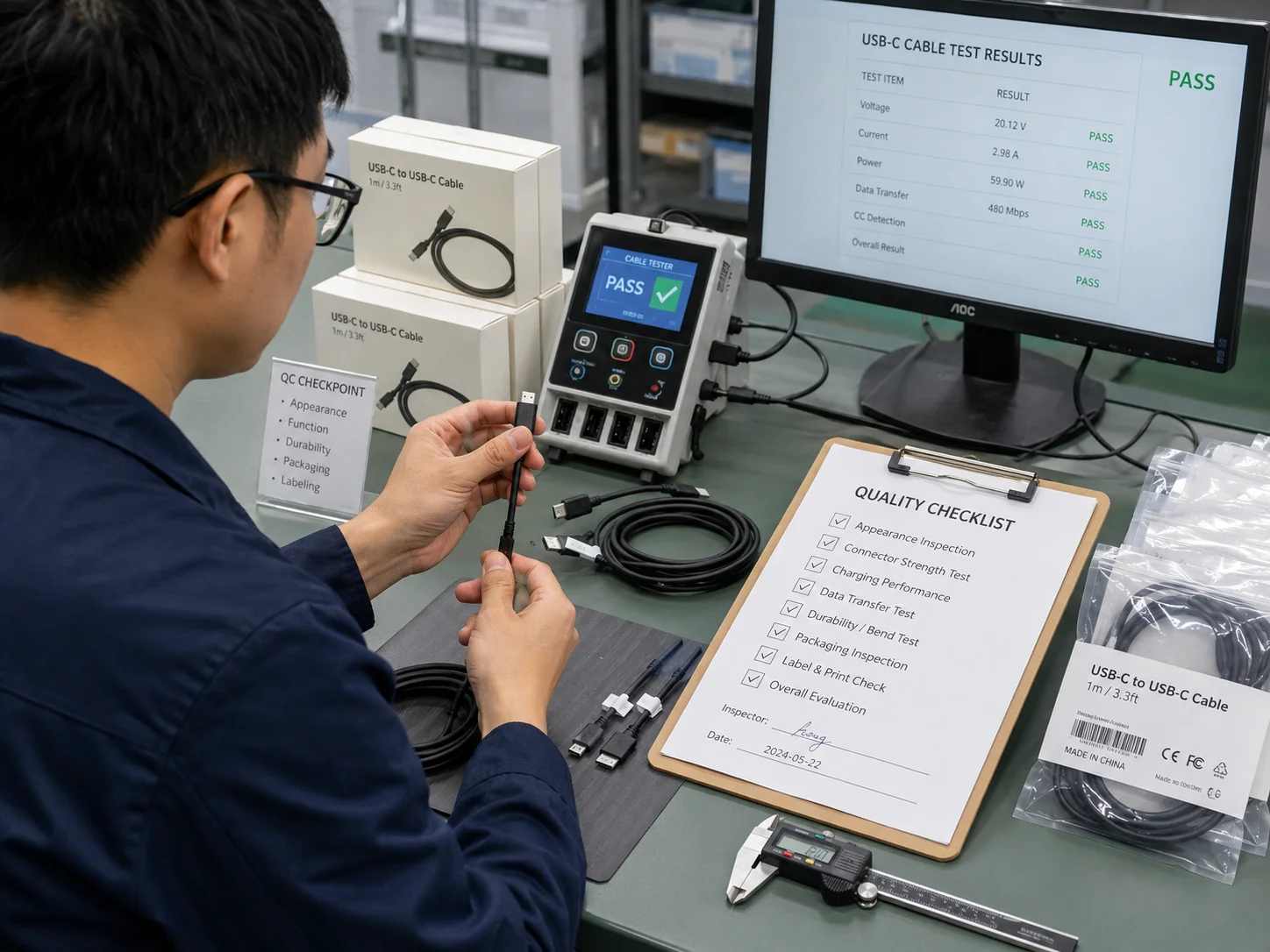
A good-looking sample is helpful, but it is not enough. I have seen buyers approve a sample quickly and then change details after production starts. This causes delay, extra cost, or conflict. I prefer to confirm all details before the factory buys material and starts mass work.
My usual sample confirmation list is practical:
| Check point | What I confirm |
|---|---|
| Cable length | Actual length and allowed tolerance |
| Color | Cable color, connector color, and batch consistency |
| Connector type | USB-C to USB-C, USB-A to USB-C, or other type |
| Charging function | Power level based on agreed claim |
| Data function | Basic or higher-speed data, if required |
| Video function | Only if the buyer ordered this function |
| Logo | Position, size, color, and printing method |
| Packaging | Box, bag, blister, card, or bulk pack |
| Label | Barcode, warning text, model number, and market needs |
| Outer carton | Carton size, quantity, and shipping mark |
I also suggest buyers do a small test with target devices if possible. For example, an e-commerce seller can test the sample with common phones, tablets, chargers, and power banks in their own market. A chain-store buyer may need stronger internal approval. Some buyers also arrange third-party inspection before shipment.11 This can help, especially when the order is large or the retail channel has strict rules.
How Do OEM, ODM, Private Label, MOQ, Packaging, and Bulk Pricing Work?
I often see buyers ask for custom logo and retail box, but they forget that customization changes MOQ, time, and price.
OEM, ODM, private label, MOQ, packaging, and bulk pricing depend on cable specs, material, logo process, package type, order quantity, and delivery plan. I confirm these details before quoting because custom work needs clear approval and usually needs higher MOQ.
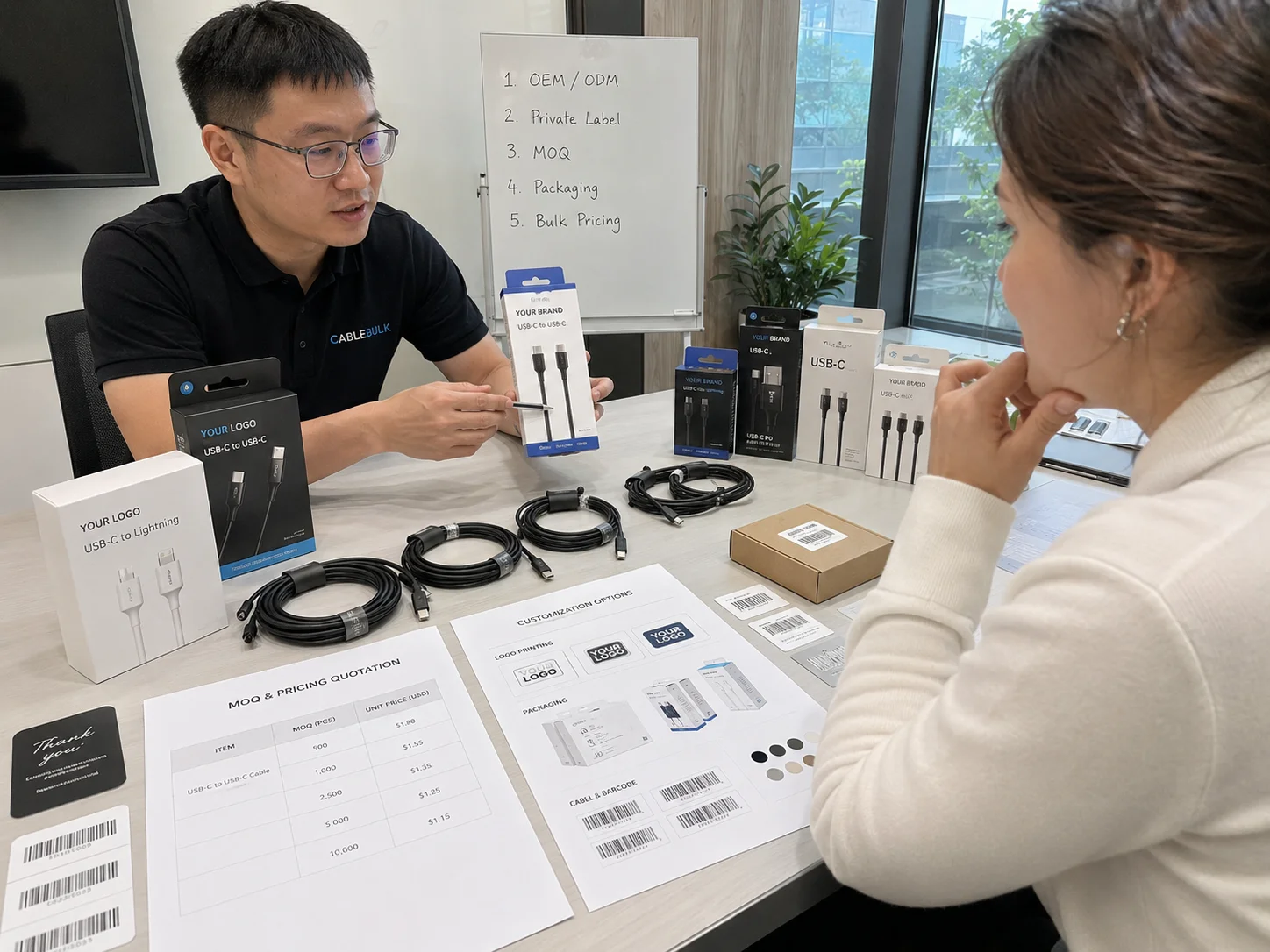
For USB-C cables, customization can be simple or complex. A simple project may only need a logo on the cable and a neutral retail box. A more complete private label project may need custom color, custom mold, designed packaging, barcode label, user card, carton mark, and product series planning.
I usually explain the terms in a buyer-friendly way:
| Term | What I mean in real sourcing |
|---|---|
| OEM | I make the product based on the buyer’s brand or requirement |
| ODM | I offer an existing design that the buyer can brand or adjust |
| Private label | The buyer sells the cable under their own brand |
| MOQ | The minimum quantity needed for production or customization |
| Neutral packaging | No brand, easier and faster for some orders |
| Custom packaging | Buyer’s design, better for retail, but needs artwork approval |
| Bulk packing | Lower packaging cost, good for wholesalers or bundles |
MOQ is not only a supplier rule. It is also linked to material purchase, production setup, logo printing, packaging printing, and labor planning. A buyer may want 300 pieces with full custom packaging. That can be difficult because the packaging supplier may have its own MOQ. I usually suggest a staged plan. The buyer can start with neutral packaging or sticker labels, then move to full custom boxes when sales volume is stable.
Bulk pricing also depends on the real specification. A 1m basic cable and a 2m 100W braided cable cannot share the same price logic. I ask buyers to compare quotations line by line, not only by final unit price.
How Can I Find a Reliable USB-C Cable Factory in China?
I believe a reliable supplier does not quote fastest; a reliable supplier asks the right questions before quoting.
To find a reliable USB-C cable factory in China, I check whether the supplier understands specifications, asks about use cases, provides samples, supports clear testing, confirms packaging details, communicates MOQ honestly, and can keep batch quality stable.
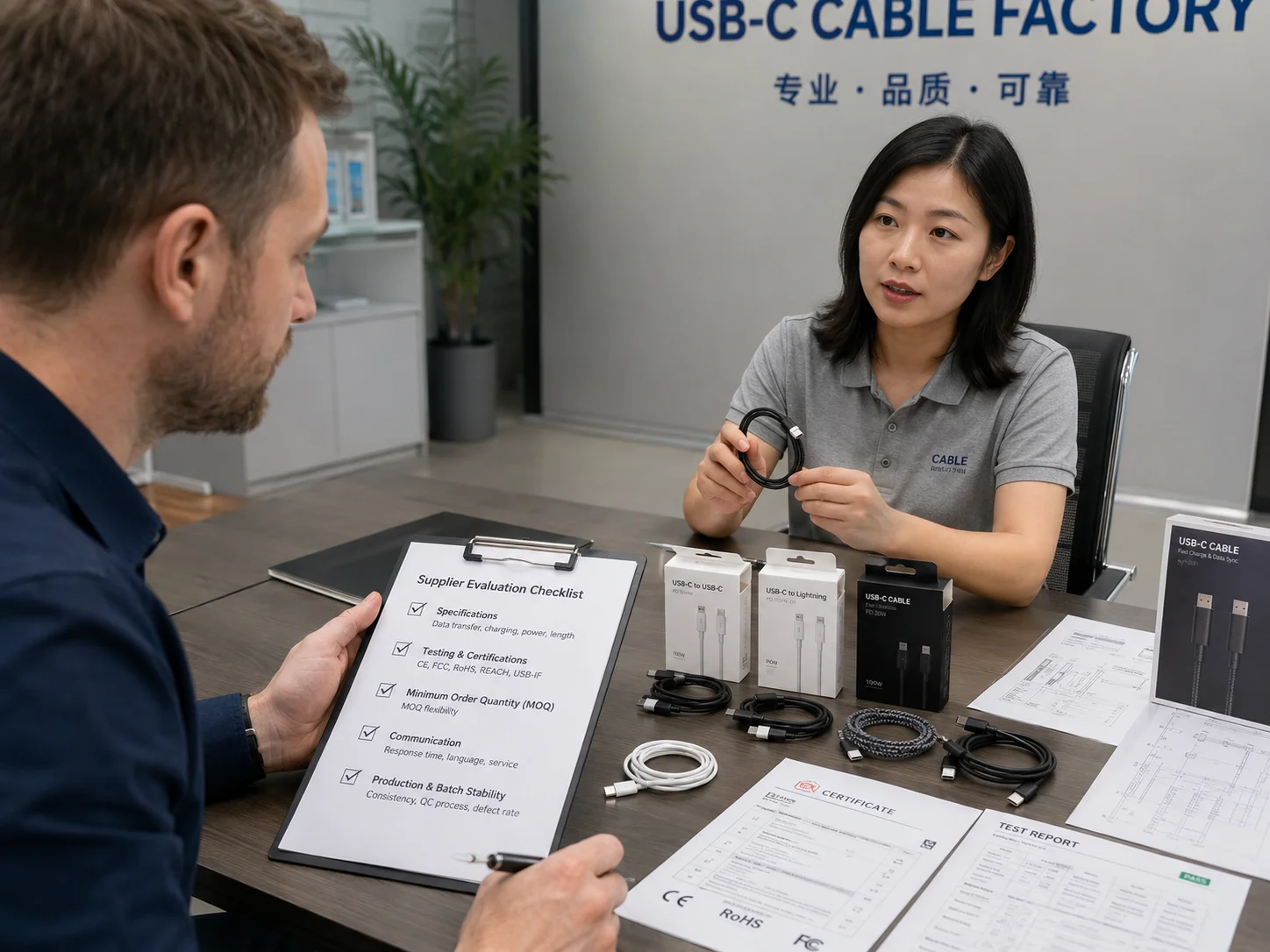
When I judge a USB-C cable supplier, I do not only look at the catalog. A catalog can be nice. The real test is how the supplier handles the inquiry. If I ask for a 100W USB-C to USB-C cable for retail sale in Europe, a professional supplier should ask about length, material, E-Marker, packaging, label, quantity, delivery time, and test needs. If the supplier only says “yes, lowest price,” I become careful.
Here is the simple checklist I use:
| Supplier behavior | What it tells me |
|---|---|
| Asks about target devices | The supplier understands use case |
| Confirms power and data needs | The supplier knows specs affect cost |
| Gives clear sample options | The supplier supports real checking |
| Explains MOQ limits | The supplier is not hiding production limits |
| Provides packaging choices | The supplier can support retail needs |
| Shares test or inspection options | The supplier thinks about risk control |
| Confirms lead time with conditions | The supplier avoids empty promises |
| Keeps written records | The supplier reduces later disputes |
I also suggest buyers keep all key details in writing. This includes cable type, length, color, material, power claim, data claim, packaging, label, carton mark, inspection terms, payment terms, and delivery plan. Spoken agreement is easy to forget. Written confirmation protects both sides.
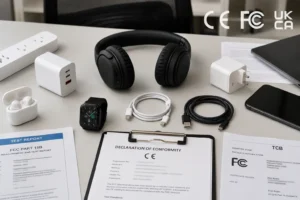
For compliance, I stay careful. Different markets, platforms, and retailers may have different requirements for labels, safety documents, environmental rules, and product claims.12 I can support documents from the supply side when available, but buyers should verify final rules in their own market before importing.
Conclusion
I import USB-C cables well when I treat specs, samples, packaging, MOQ, and supplier checks as risk control, not as small details.
"Manufacturing, value added (% of GDP) - World Bank Open Data", https://data.worldbank.org/indicator/NV.IND.MANF.ZS. International trade or industrial statistics showing China’s large share of electronics and electrical-goods manufacturing and exports would support the contextual claim that China is a major sourcing base for USB-C cable products. Evidence role: general_support; source type: institution. Supports: China has a large electronics and electrical-goods manufacturing/export base, which provides context for its role as a sourcing location for USB-C cables.. Scope note: Such data would support the broader manufacturing context, not prove that every USB-C cable supplier in China is capable or reliable. ↩
"A History of the Electronics Industry in Shenzhen, China", https://www.si.umich.edu/about-umsi/events/military-industrial-complex-global-supply-chain-history-electronics-industry. Research on Shenzhen’s electronics manufacturing cluster would support the contextual statement that suppliers in Shenzhen and nearby cities can offer varied cable products and related customization services. Evidence role: historical_context; source type: research. Supports: Shenzhen’s electronics manufacturing cluster and surrounding supply chain support diverse consumer-electronics accessories and component production.. Scope note: Cluster-level research does not verify the capabilities of any individual cable factory. ↩
"USB-C - Wikipedia", https://en.wikipedia.org/wiki/USB-C. USB Implementers Forum materials describing USB Type-C cables and connectors would support the classification of USB-C cables by connector type and supported functions such as power, data, and video. Evidence role: definition; source type: institution. Supports: USB-C cable categories differ by connector configuration and supported functions such as power delivery, data transfer, and alternate modes.. Scope note: The source would define technical categories, not establish wholesale market demand for each category. ↩
"Can all USB C cables support video output/signal? - Reddit", https://www.reddit.com/r/UsbCHardware/comments/iaor5x/can_all_usb_c_cables_support_video_outputsignal/. Technical documentation on USB Type-C Alternate Modes, including DisplayPort over USB-C, would support the statement that video output requires compatible devices and cables rather than merely a USB-C connector. Evidence role: mechanism; source type: institution. Supports: Video over USB-C depends on supported alternate modes and cable/device capabilities, so USB-C shape alone does not ensure video output.. ↩
"USB-C - Wikipedia", https://en.wikipedia.org/wiki/USB-C. USB-IF technical materials on USB Type-C and USB Power Delivery would support the distinction between charging capability, data-transfer capability, and video/alternate-mode support in USB-C cables. Evidence role: definition; source type: institution. Supports: USB-C cable capabilities are specified across separate functions including charging power, data transfer, and alternate-mode video support.. ↩
"Amazon.com: Cable Matters Braided USB C to Micro USB Cable", https://www.amazon.com/Cable-Matters-Micro-Braided-Jacket/dp/B0746NHSCZ. USB Type-C specification summaries or USB-IF guidance on cable capabilities would support the statement that charging support does not necessarily imply high-speed data-transfer support. Evidence role: mechanism; source type: institution. Supports: USB-C cables may support charging while offering only USB 2.0 or otherwise limited data capability, depending on cable construction and specification.. Scope note: The source would explain the technical possibility; individual cable performance still requires product-specific testing. ↩
"Wire Gauge Chart and Ampacity | Guide for Electricians", https://www.uti.edu/blog/electrical/wire-gauge-chart-awg-ampacity. Electrical engineering references on conductor resistance and voltage drop would support the statement that wire gauge, copper quality, and cable length affect charging performance and heat in cable applications. Evidence role: mechanism; source type: education. Supports: Electrical principles show that conductor cross-section, material resistivity, and length affect resistance, voltage drop, and heat generation.. Scope note: General electrical principles support the mechanism, but exact USB-C cable performance depends on the full cable design and load conditions. ↩
"Don't Let a Drooping USB Voltage Slow Down Your Charger", https://www.ti.com/document-viewer/lit/html/SSZTBZ8. Engineering references on voltage drop in conductors would support the mechanism behind the claim that longer cables with insufficient internal conductors may perform worse than shorter cables. Evidence role: mechanism; source type: education. Supports: Longer conductors have higher resistance, increasing voltage drop unless compensated by suitable conductor size and material.. Scope note: The source would support the physical mechanism, not directly measure customer complaint rates. ↩
"USB-C - Wikipedia", https://en.wikipedia.org/wiki/USB-C. USB-IF materials on electronically marked USB Type-C cable assemblies would support the statement that E-Marker chips identify cable capabilities to connected USB-C devices. Evidence role: definition; source type: institution. Supports: Electronically marked USB-C cables communicate cable characteristics to connected devices and are relevant for certain high-current cable assemblies.. ↩
"The Basics of USB Power Delivery Negotiations | Acroname", https://acroname.com/blog/basics-usb-power-delivery-negotiations?srsltid=AfmBOoqxi8E-FflkfhMmxhk9852aFrr13s4Nhrv1Tplku9Rlr__svWxB. USB Power Delivery documentation would support the statement that achieved charging power depends on the combined capabilities and negotiation among charger, device, and cable. Evidence role: mechanism; source type: institution. Supports: USB Power Delivery charging involves negotiated power capabilities among the source, sink device, and, where relevant, cable characteristics.. ↩
"ISO 2859-1", https://chemistry.unt.edu/~tgolden/courses/iso2859-1.pdf. International trade or quality-control guidance on pre-shipment inspection would support the statement that buyers may use third-party inspection before shipment to reduce order risk. Evidence role: general_support; source type: institution. Supports: Pre-shipment inspection and sampling inspection are recognized methods for checking goods before import or delivery.. Scope note: Such guidance supports the practice generally, but it does not guarantee that any particular inspection will detect all defects. ↩
"CPSC Labeling Requirements Overview", https://www.cpsc.gov/Business--Manufacturing/Business-Education/Business-Guidance/CPSC-Labeling-Requirements-Overview. Official regulatory guidance from authorities such as the European Commission or U.S. consumer-product agencies would support the statement that labeling, safety documentation, environmental rules, and product claims vary by market. Evidence role: general_support; source type: government. Supports: Government compliance resources show that electrical and electronic products may be subject to market-specific labeling, safety, environmental, and claim-related requirements.. Scope note: Regulatory guidance would support the need to verify requirements, but the exact obligations depend on the product design, destination market, and sales channel. ↩