Sourcing chargers from China feels like a gamble. You worry about poor quality, safety issues, and unreliable suppliers. Let's clarify the process so you can choose the right partner confidently.
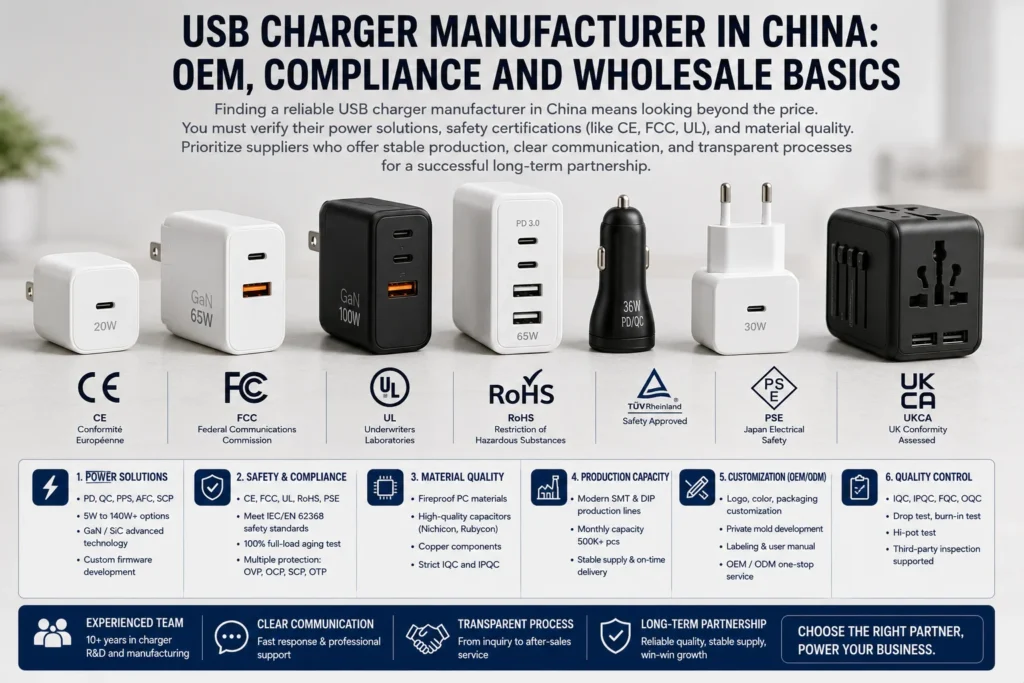
Finding a reliable USB charger manufacturer in China means looking beyond the price. You must verify their power solutions, safety certifications (like CE, FCC, UL), and material quality. Prioritize suppliers who offer stable production, clear communication, and transparent processes for a successful long-term partnership.
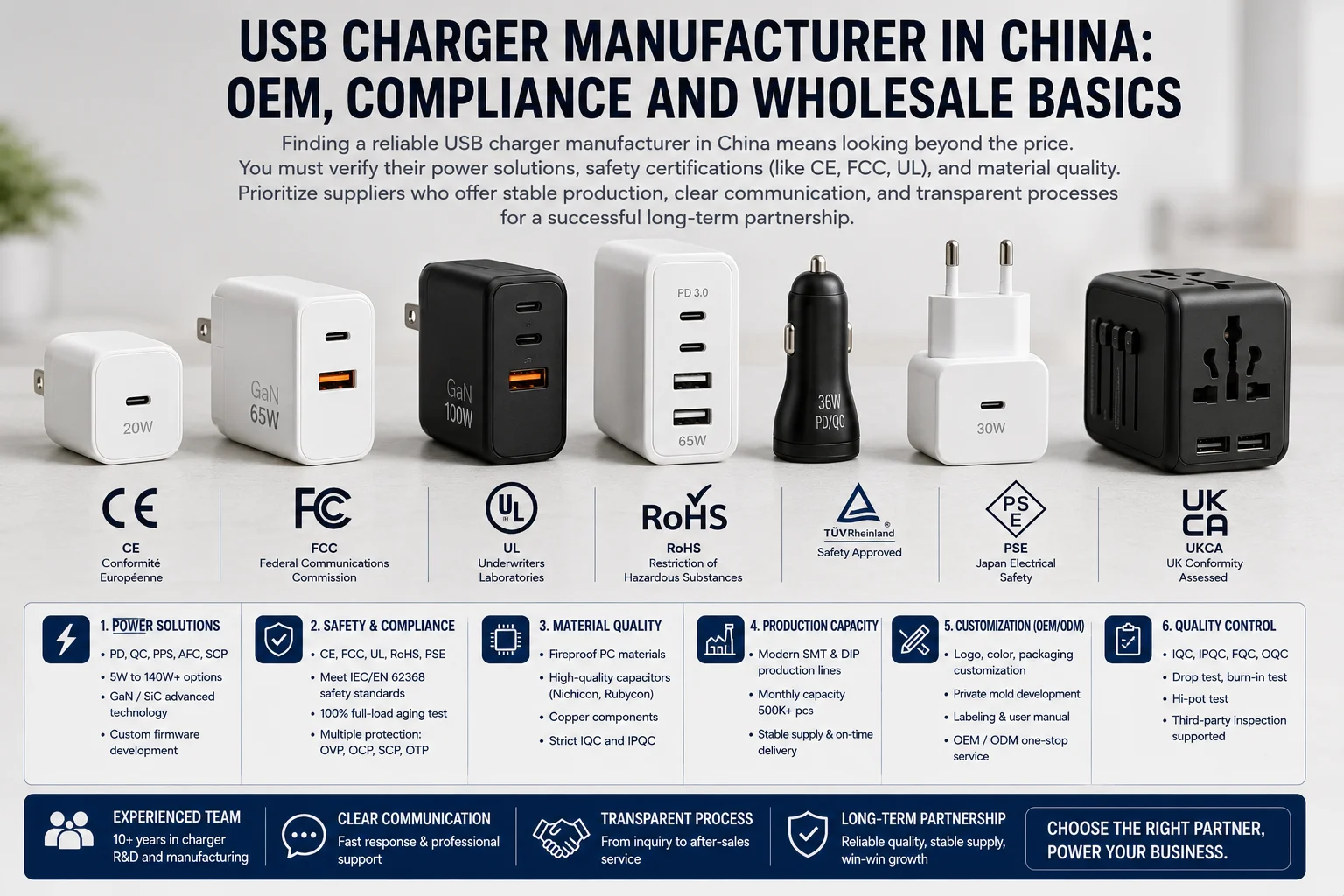
This sounds simple, but I've seen countless buyers get it wrong. They focus on a few cents per unit and end up with a container of unsafe, unsellable products. In my 15 years in this business, I've learned that asking the right questions upfront is key. Let’s break down what you really need to know.
What Does a USB Charger Manufacturer in China Actually Do?
You think a factory just assembles parts. But you're surprised when some offer design services while others only follow instructions. This confusion can lead to choosing the wrong partner.
A USB charger manufacturer in China does more than just assembly. They handle sourcing components, managing production lines, conducting quality control, and ensuring products meet safety standards. They can act as a simple assembler (OEM) or a full-service design partner (ODM), depending on their capabilities.
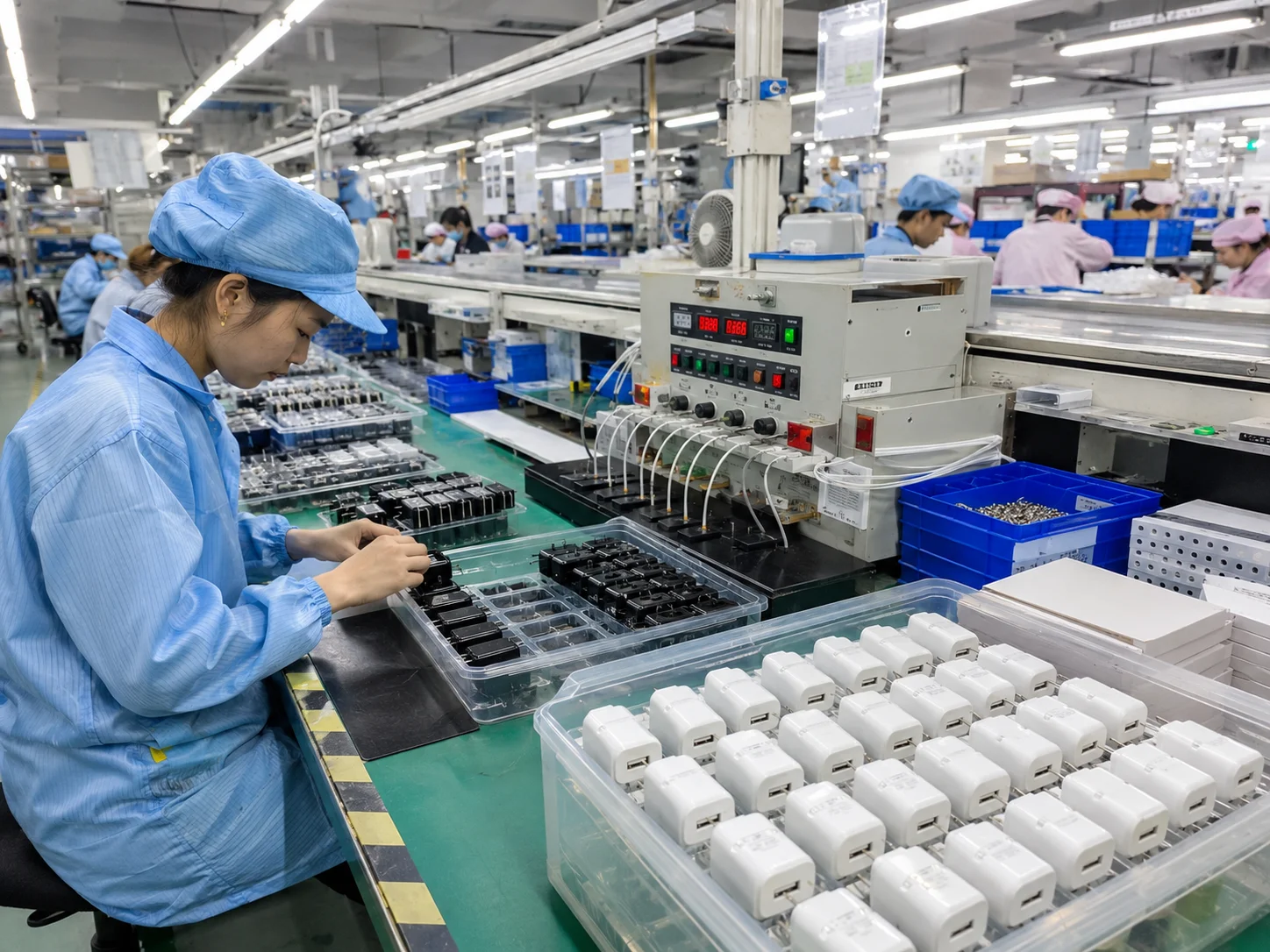
Let's look closer at the day-to-day operations. A good manufacturer is really a project manager for your product. Their work starts with the power solution design. This is the charger's brain, determining its wattage and efficiency. They then source dozens of individual components, from capacitors to GaN chips and plastic casings. Each choice affects performance and cost.
Next is assembly. This involves precise soldering and fitting parts onto the PCB (Printed Circuit Board). After assembly, the most critical stage is testing. This isn't just plugging it in. We're talking about:
| Test Type | Purpose |
|---|---|
| Aging Test | Running the charger at full load for hours.1 |
| Voltage Test | Ensuring stable output under different loads. |
| Temperature Test | Checking it doesn't overheat during use. |
| Safety Test | Verifying protection against short circuits. |
Finally, they manage packaging and logistics. Understanding this entire process helps you see why a reliable manufacturer offers more than just a low price; they offer quality assurance from start to finish.
OEM vs ODM: Which Cooperation Model Should Buyers Choose?
You want a unique product but don't have an engineering team. You see "OEM" and "ODM" but aren't sure which path minimizes your risk and cost. This indecision can stall your project.
Choose ODM (Original Design Manufacturing) if you want a ready-made, factory-designed product that you can brand as your own. It's faster and requires less technical input. Choose OEM (Original Equipment Manufacturing) if you have a specific design and want a factory to build it to your exact specifications.
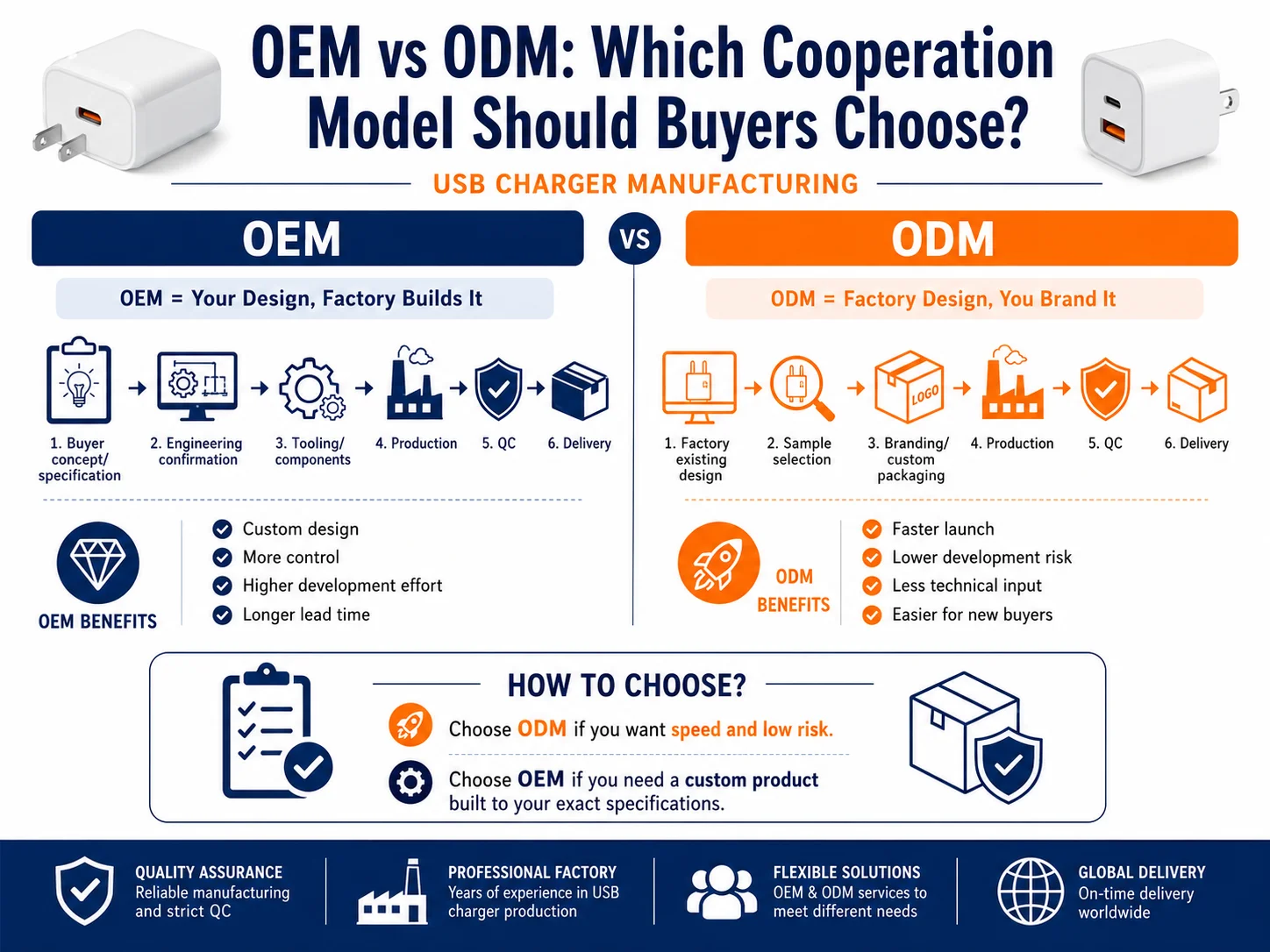
A common question I get is, "Which model is best?" My answer is always, "It depends on your business." This isn't just about definitions; it's a risk assessment.
When to Choose ODM
Choose ODM when your priority is speed to market and lower initial investment. You leverage the factory's existing R&D and tooling. This is perfect for:
- Market testers who want to validate demand quickly.
- Retailers who need to fill a category without a large engineering budget.
- Sellers who are stronger at marketing and branding than product development. The trade-off? Your product won't be unique. Your competitors might be sourcing a very similar charger from the same factory.
When to Choose OEM
Choose OEM when product differentiation is critical to your brand. This model is for businesses that can afford the time and money for development. It requires:
- Clear technical specifications (a "spec sheet").
- Higher MOQs to justify new tooling or production setups.
- Deeper involvement in testing and quality control. The risk is higher upfront, but the reward is a truly unique product that you control.
What Charger Specs Should Wholesale Buyers Confirm?
You asked for a "fast charger" and got a slow, useless product. Customers are complaining, and your reputation is at risk. This happens when you don't confirm the right technical details.
Don't just ask for "fast charging." Specify the exact wattage (e.g., 20W, 65W, 100W), charging protocols (PD 3.0, QC 4+)2, number and type of ports (USB-A, USB-C), and plug type (US, EU, UK). Also, confirm if it uses GaN technology for better efficiency and size.
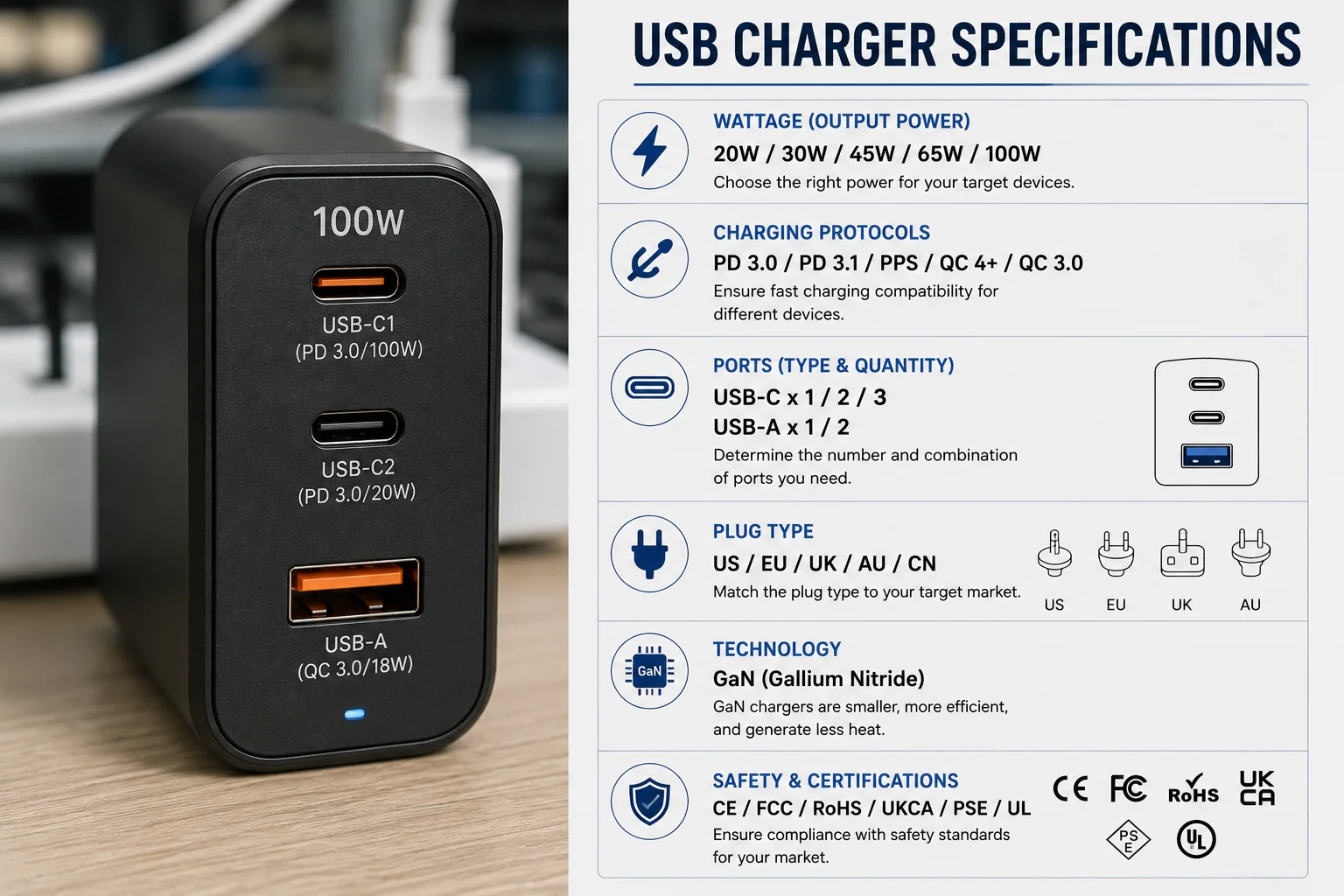
"Fast charging" is a marketing term, not a technical spec. A professional buyer digs deeper. Here’s what I tell my clients to put on their checklist.
First, Power Output and Protocols. A 20W PD charger for a phone is completely different from a 100W GaN charger for a laptop. You need to match the charger to the devices your customers use.
| Spec | What to Ask | Why It Matters |
|---|---|---|
| Wattage | "Is it 20W, 65W, or 100W?" | Determines charging speed for different devices. |
| Protocols | "Does it support PD 3.0, PPS, or QC 4+?" | Ensures compatibility with specific phone/laptop brands. |
| Ports | "Is it 1x USB-C and 1x USB-A, or 2x USB-C?" | Affects usability and market appeal. |
| Technology | "Is this a GaN charger?" | GaN chargers are smaller, cooler, and more efficient3. |
Second, confirm the internal components. Ask about the brand of the capacitor or the safety features of the IC chip. A cheap charger might use low-grade components that fail or overheat.4 A good supplier can explain their choices. This is the difference between a charger that lasts three months and one that lasts three years.
Why Do Compliance and Safety Certifications Matter?
You found a super cheap charger supplier. But then your shipment gets blocked by customs, or worse, a product overheats and causes a fire. This is the real cost of ignoring certifications.
Compliance and safety certifications like CE (Europe), FCC (USA), and UL (USA) are not optional. They are legal requirements5 that prove a charger has been tested for safety against overheating, short-circuiting, and electrical shock. Selling uncertified products can lead to fines, recalls, and legal liability.
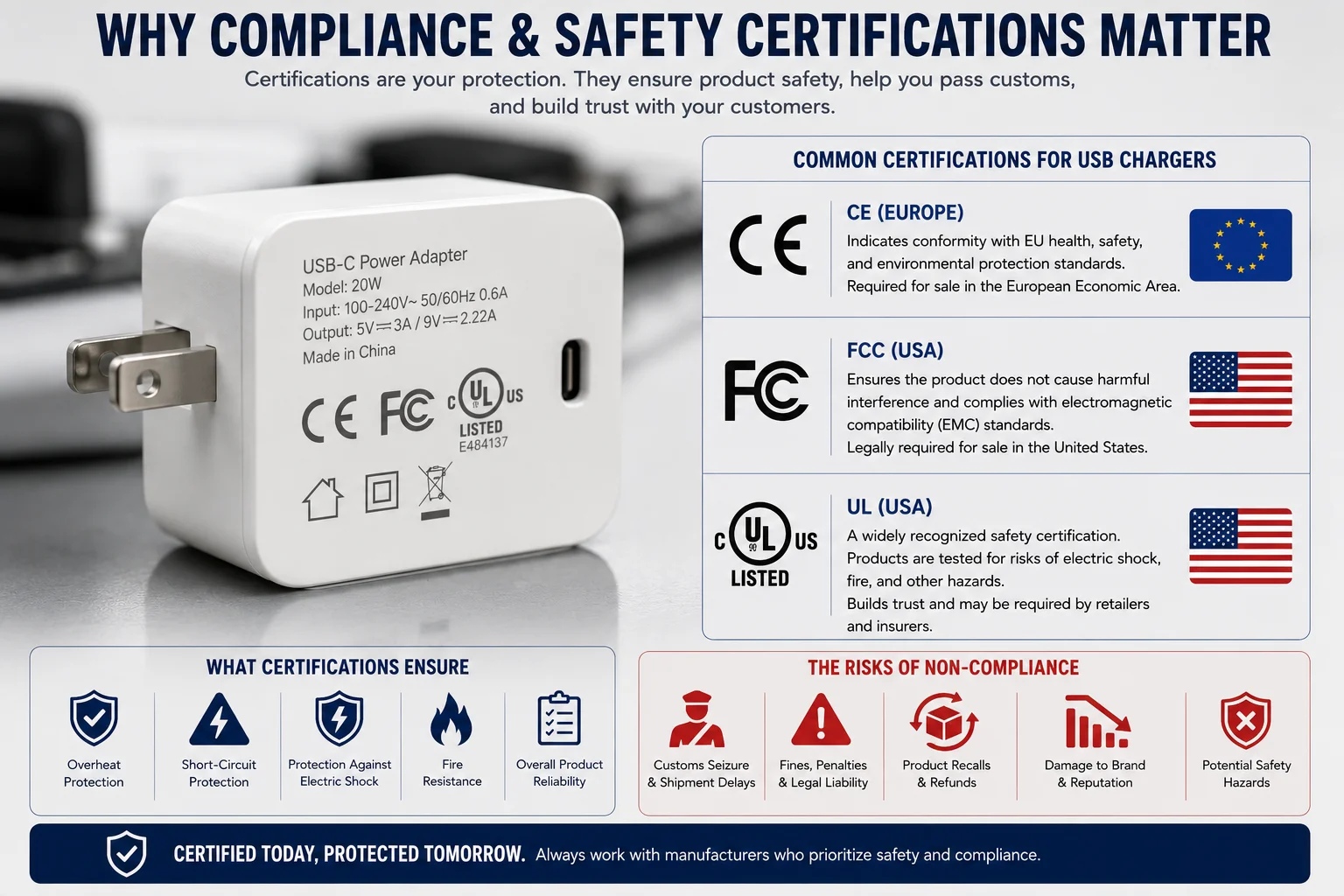
I've seen buyers think of certifications as just a piece of paper. This is a huge mistake. These marks are your insurance against disaster. For our business shipping to Europe and the US, they are non-negotiable.
What are the Key Certifications?
- CE (Conformité Européenne): Mandatory for products sold in the European Economic Area. It signifies compliance with health, safety, and environmental protection standards.
- FCC (Federal Communications Commission): Required for electronic products sold in the United States. It certifies that the device's electromagnetic interference is under approved limits.6
- UL (Underwriters Laboratories) / ETL (Intertek): These are Nationally Recognized Testing Laboratory (NRTL) marks in the US.7 They are a strong indicator of safety and quality, as they involve rigorous third-party testing of the product.
When a supplier says they are "certified," ask to see the report. Check that the certificate is for the exact model you are buying, not a similar one. A fake or invalid certificate is as bad as having none. It won't protect you when customs inspects your goods or when a customer reports a safety issue.
How Can You Evaluate Factory Quality and Production Capacity?
The sample looked perfect, but your first mass order was a disaster. Now you're stuck with defective inventory and an unreliable supplier. This happens when you don't evaluate the factory's real capabilities.
Evaluate a factory by checking their quality management systems (like ISO 9001)8, reviewing their testing procedures, and asking for their defect rate. Request a video tour of the production line and ask about their monthly output to ensure they can handle your order volume without sacrificing quality.
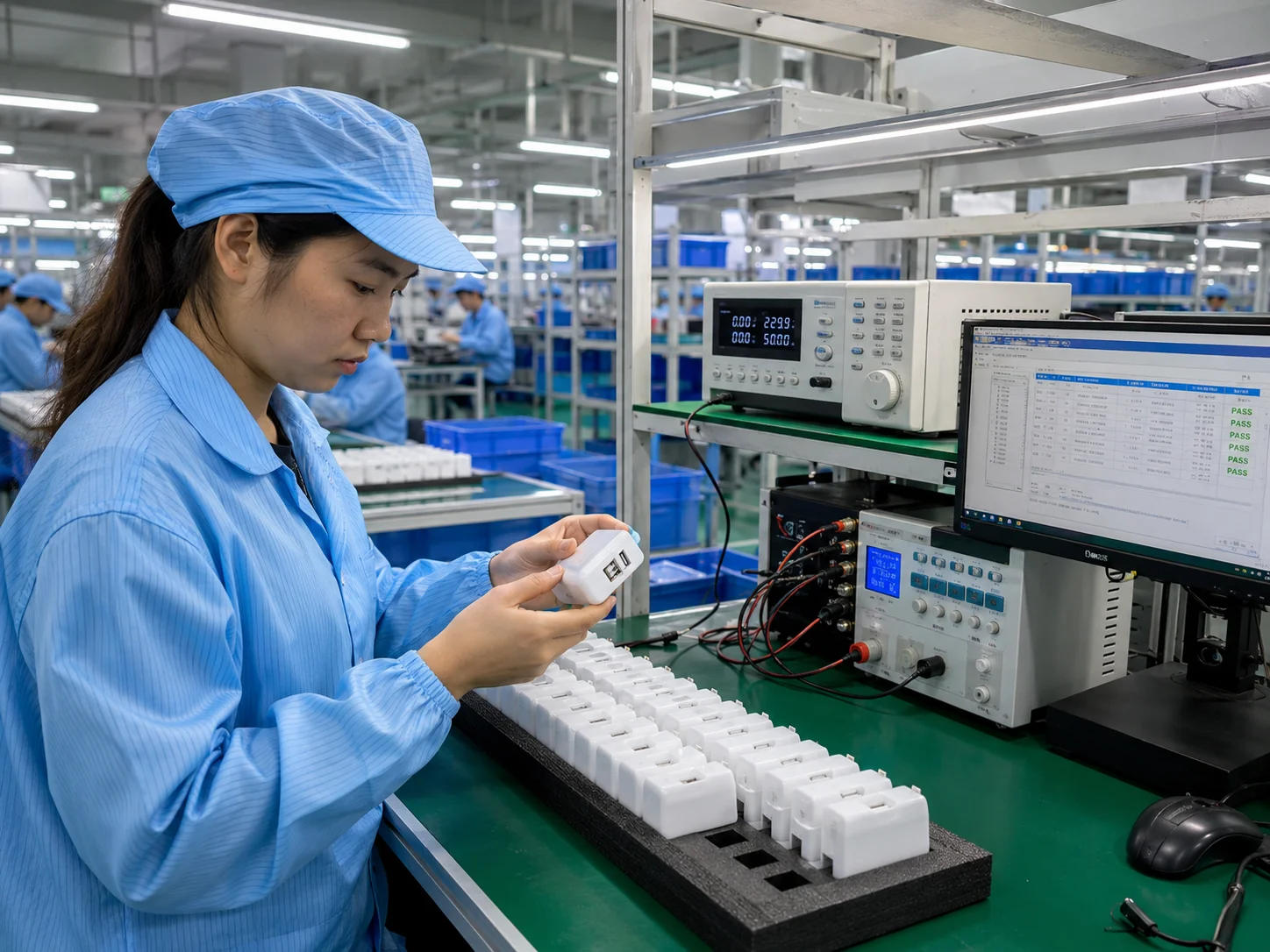
In my 15 years of experience, I’ve learned that a fancy showroom means nothing. The real quality is on the factory floor. So, how can you check from thousands of miles away?
First, ask about their Quality Management System (QMS). Do they have an ISO 9001 certification? This isn't just a plaque on the wall. It's a structured system for managing and improving quality at every step, from incoming materials to final inspection. A factory with a robust QMS is less likely to have surprises in mass production.
Second, dig into their testing process. Don't just ask "Do you test?" Ask "How do you test?"
- "What percentage of units do you test from the production line?"
- "Can you show me your aging test room?" (where chargers are run for hours)
- "What equipment do you use to test for voltage stability and ripple?"
Third, gauge their production capacity. Ask for their "monthly output." This tells you if your order of 5,000 units is a small, unimportant job for them or a major one they can focus on. A mismatch can lead to delays or rushed work.
What Packaging, Branding, and Customization Options Are Available?
Your charger is great, but it comes in a plain white box and gets lost on the shelf. You're losing sales because your product lacks brand identity and customer appeal.
Most manufacturers offer customization, from simple logo printing (private label) to fully custom-designed boxes. You can choose box materials, printing finishes, and add inserts like user manuals or warranty cards. This transforms a generic product into a branded one, boosting retail appeal and customer trust.
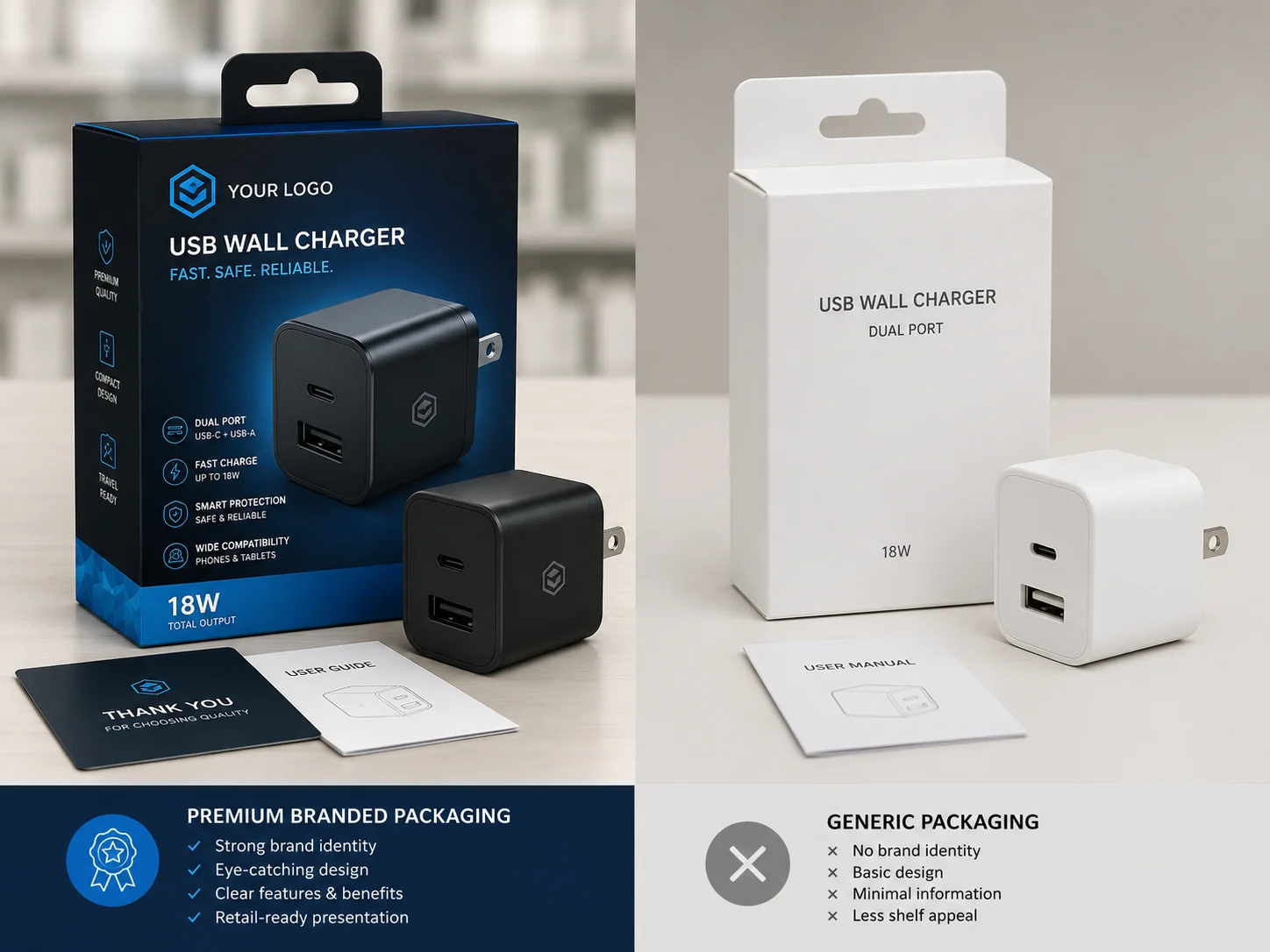
For retailers and e-commerce sellers, packaging isn't just a box; it's your silent salesperson. I always advise my clients to think about packaging from day one. It directly impacts your sell-through rate.
Here are the typical options available:
Step 1: Basic Branding (Private Label)
This is the most common starting point. It includes:
- Logo Printing: Printing your logo directly on the charger's casing.
- Standard Box with Logo: Using the factory's standard box but printing your brand and product info on it.
- Barcode/Sticker: Adding your SKU, FNSKU (for Amazon), or other labels.
Step 2: Full Customization
This is for brands that want to stand out.
- Custom Box Design: Creating a unique box structure, like one with a window or magnetic closure.
- Printing Finishes: Using techniques like spot UV, foil stamping, or embossing to create a premium feel.
- Custom Inserts: Designing branded manuals, thank you cards, or custom-molded trays to hold the charger securely.
Before you order, ask your supplier for their packaging catalog and die-lines (templates). This way, your designer can create artwork that fits perfectly. Remember, good packaging communicates quality and justifies a higher price point.
What Are the Basics of MOQ, Lead Time, Payment Terms, and Shipping?
You're ready to order but get hit with a high MOQ and confusing payment terms. The project stalls because the logistics are more complicated than you expected. You need to understand these commercial basics.
MOQ (Minimum Order Quantity) is the smallest order a factory will accept, often 1000-3000 units.9 Lead time is production time, usually 25-45 days. Standard payment terms are 30% deposit to start production and 70% balance before shipping. Shipping is typically done via sea (cheaper) or air (faster).
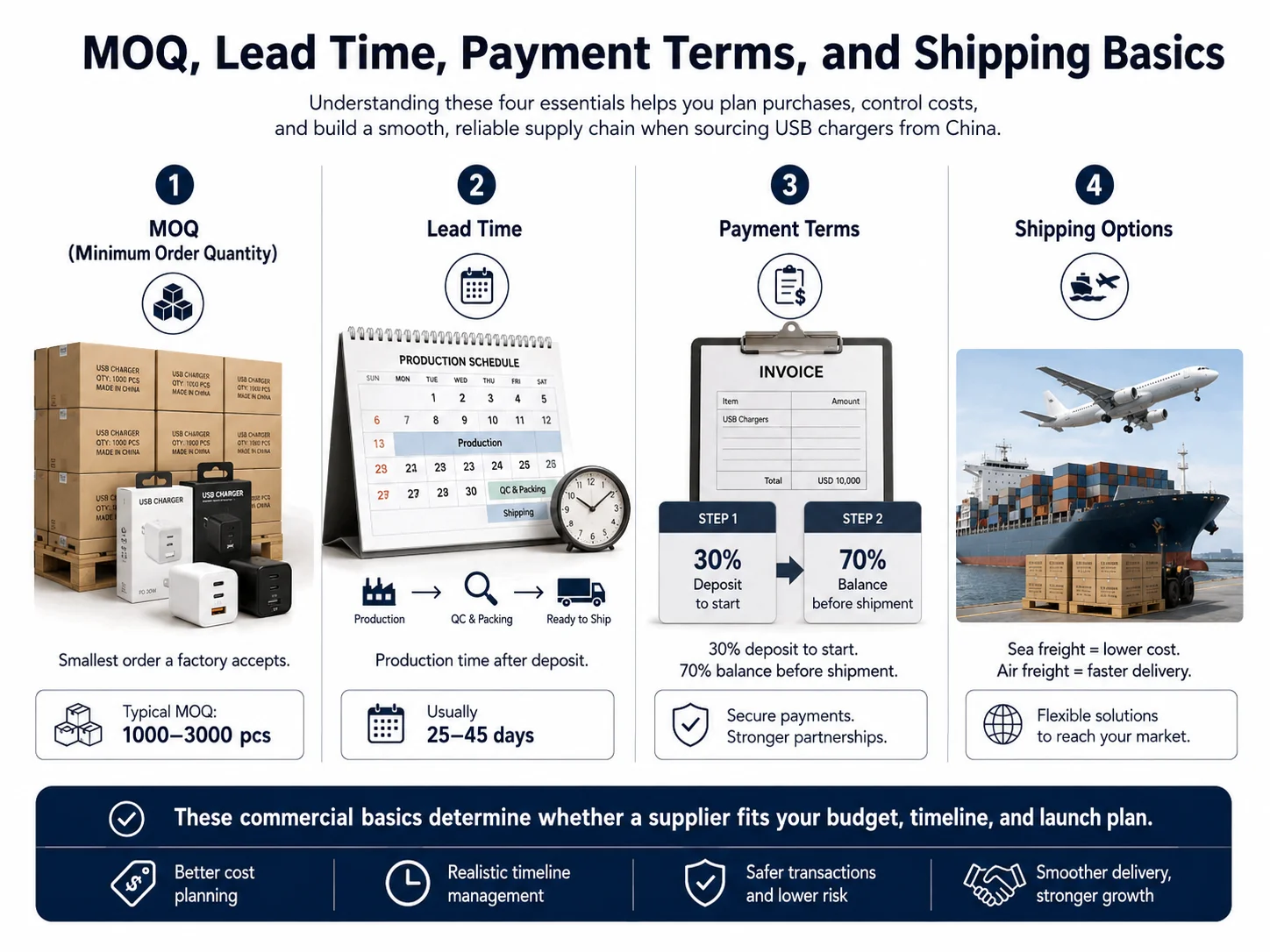
Negotiating these terms is a core part of the sourcing process. Let's break down what's normal and what's a red flag.
- MOQ (Minimum Order Quantity): This is set to cover the factory's setup costs. For standard chargers, 1000 pieces is common. For custom OEM projects, it can be 3000 or more. If a supplier has no MOQ for a supposedly custom product, they are likely a trading company reselling stock items.
- Lead Time: This is the time from your deposit payment to when the goods are ready to ship. A typical lead time is 30-45 days. Be wary of anyone promising a 7-day lead time for a large custom order; they are likely cutting corners on production or testing.
- Payment Terms: The industry standard is a 30% T/T (Telegraphic Transfer) deposit and a 70% balance payment upon completion10, often after you approve a pre-shipment inspection report. Avoid suppliers who demand 100% upfront for a large order.
- Shipping: You can choose between Air Freight (5-10 days, expensive) and Sea Freight (30-50 days, cost-effective). You'll use an incoterm like FOB (Free On Board) or EXW (Ex Works) to define who pays for what.11 As a 15-year exporter, we help our clients navigate this all the time to find the best balance of cost and speed.
What Are Common Red Flags When Choosing a Charger Supplier?
The supplier's price seems too good to be true. They promise everything, but something feels off. Ignoring these warning signs can lead to you losing your deposit or receiving junk products.
Red flags include prices far below the market average, an unwillingness to provide certifications or samples, and poor communication. Also, be cautious of suppliers who have no physical factory address, pressure you for 100% upfront payment, or refuse third-party inspections. These are signs of a scam or a low-quality operation.
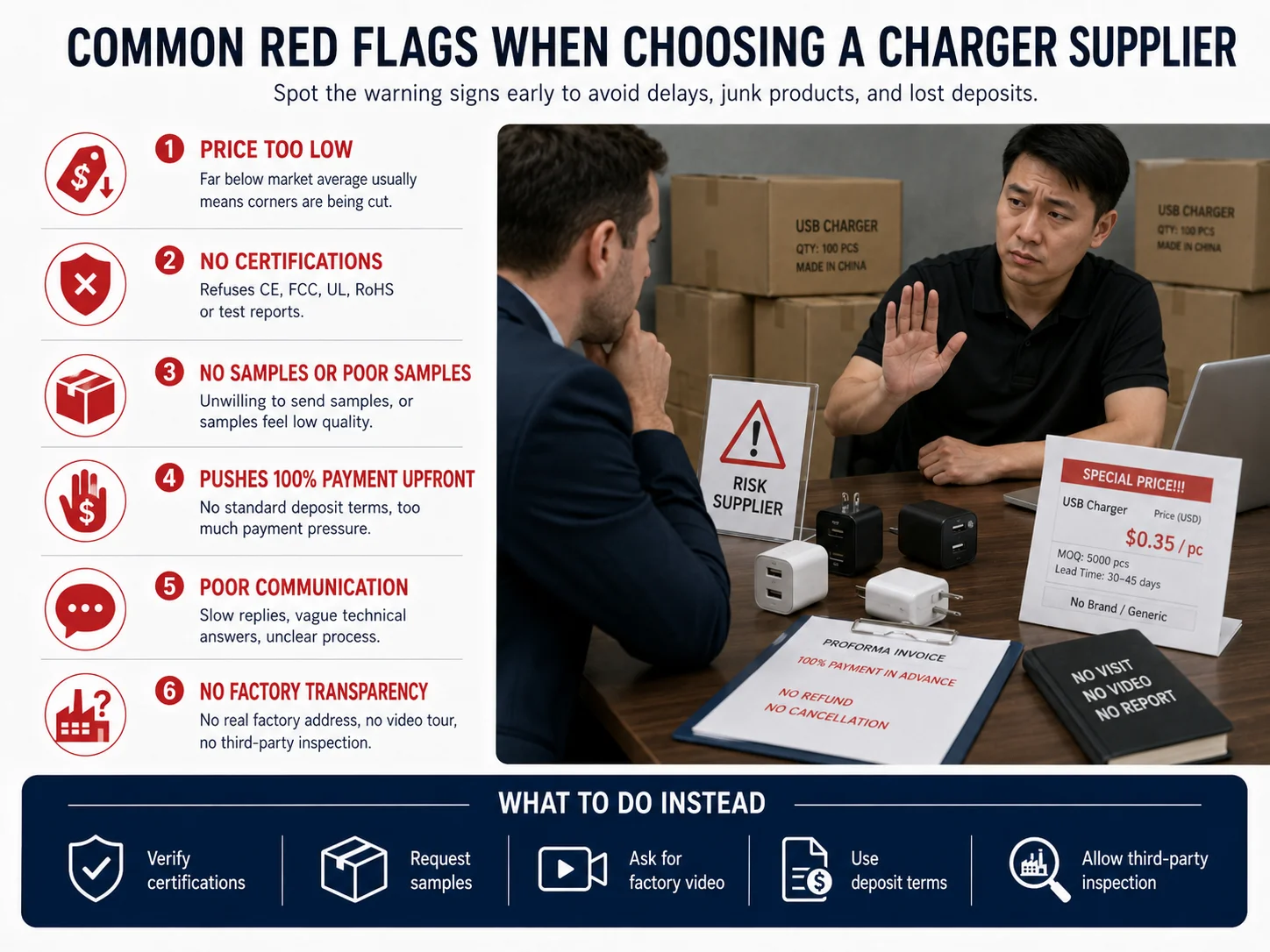
After thousands of conversations with suppliers, I've learned to spot trouble from a mile away. Here are the red flags that make me walk away immediately.
| Red Flag | Why It's a Problem |
|---|---|
| "Too Good to Be True" Price | The price is likely based on cheap, unsafe components and no real testing. |
| Vague Specifications | If they just say "good quality," they plan to use the cheapest materials possible. |
| No Certifications | The product is likely illegal to sell in your market and probably unsafe. |
| Refusal of Inspection | A good factory is proud of its work. Hiding means they have something to hide. |
| Pressure for Full Upfront Payment | This is a common scam tactic. Once they have your money, they can disappear. |
| Poor Communication | If they can't answer simple technical questions clearly, how will they manage your complex order? |
A supplier who seems perfect on every metric—cheapest, fastest, best quality—is often the most dangerous. Real manufacturing involves trade-offs. An honest partner will be transparent about them. For example, they'll explain that using a higher-grade capacitor will add $0.10 to the cost but significantly improve lifespan. That's the kind of partner you want.
What Is the Final Buying Advice for Sourcing Chargers?
You're overwhelmed by options and technical details. You're afraid of making a costly mistake. How do you make the final choice with confidence and secure your business's future?
The best buying advice is to shift your focus from unit price to total value. Choose a supplier who guarantees safety, delivers stable quality, and can be a long-term partner. Your goal isn't the cheapest charger, but the most reliable supply chain for your brand.
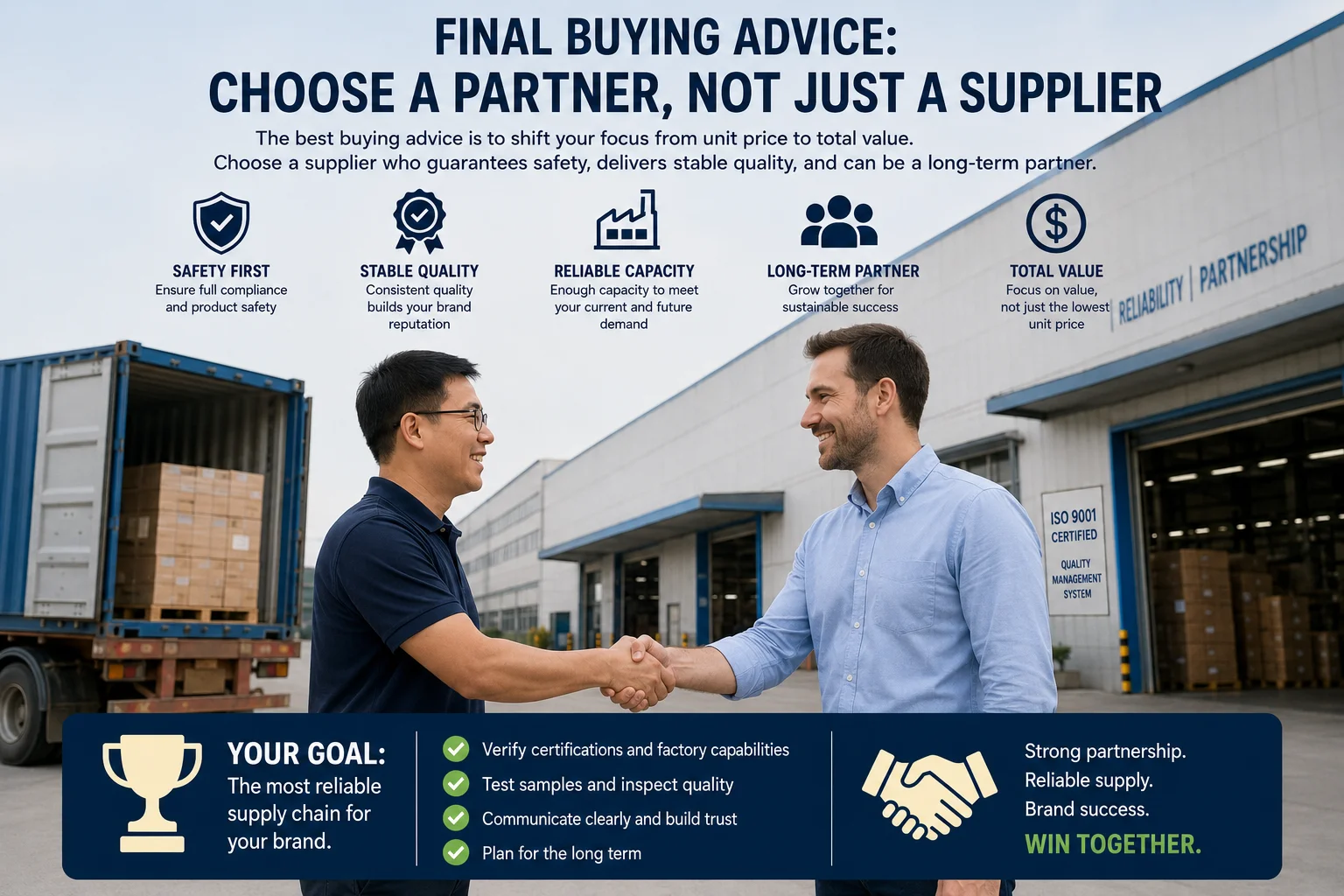
After 15 years in this business, here is my final piece of advice. Stop looking for the "cheapest" USB charger. That is a race to the bottom that ends in customer complaints and dead inventory. Instead, look for a partner.
Your real goal is to build a profitable product line. This depends on:
- Safety & Compliance: A product that won't get you sued or your shipment seized. This means verifiable certifications are a must.
- Stable Quality: A charger that works exactly as advertised, every single time. This builds customer trust and encourages repeat purchases.
- Long-Term Supply: A manufacturer who can produce the same quality on your tenth order as they did on your first. Business is about consistency, not one-time gambles.
When you're comparing two suppliers, don't just ask about price. Ask how they ensure quality. Ask about their testing process. Ask how they handle defects. The supplier who gives you clear, confident answers—even if they are slightly more expensive—is almost always the better choice for your business.
Conclusion
Sourcing USB chargers is not about finding the lowest price. It is about finding a reliable partner who delivers safe, high-quality products consistently, protecting your brand and your customers.
"[PDF] Burn-in Testing Techniques for Switching Power Supplies", https://ridl.cfd.rit.edu/products/manuals/Keithley/pdfs/app_notes/2080-1,0.pdf. Research in electronics reliability explains that 'burn-in' or 'aging' tests are used to accelerate 'infant mortality' failures. By stressing components under load in a controlled environment, manufacturers can identify and screen out defective units that would otherwise fail early in their operational life. Evidence role: mechanism; source type: research. Supports: The purpose of running electronics at full load for an extended period as a quality control measure.. ↩
"USB hardware - Wikipedia", https://en.wikipedia.org/wiki/USB_hardware. Technical sources and standards bodies, such as the USB Implementers Forum (USB-IF) for PD, describe these protocols as communication standards that allow a charger and a device to negotiate for the optimal voltage and current, enabling faster and more efficient charging while maintaining safety. Evidence role: definition; source type: other. Supports: The function of charging protocols like USB Power Delivery (PD) and Qualcomm Quick Charge (QC).. Scope note: The source would describe the technical function of the protocols, not their market adoption or specific device compatibility. ↩
"GaN vs. Silicon in High-Frequency Power Transistors - Stanford", http://large.stanford.edu/courses/2025/ph240/jahan2/. Sources from engineering and materials science explain that Gallium Nitride (GaN) has a wider bandgap than silicon, allowing it to sustain higher voltages and temperatures. This property enables the creation of smaller, more efficient power converters that lose less energy as heat. Evidence role: mechanism; source type: education. Supports: The claim that GaN technology allows for smaller, more efficient, and cooler-running chargers.. ↩
"Reliability and failure rate in electronic drive components - Faulhaber", https://www.faulhaber.com/en/know-how/tutorials/drive-electronics-tutorial-reliability-and-failure-rate-in-electronic-drive-components/. Independent analyses and teardowns of various USB chargers often show that low-cost models use undersized or lower-quality components, such as capacitors with lower temperature ratings or simplified safety circuits. These design choices can lead to a higher risk of overheating, reduced lifespan, and failure to protect against power surges or short circuits. Evidence role: case_reference; source type: research. Supports: The link between the quality of internal components and the safety and reliability of chargers.. ↩
"Equipment Authorization | Federal Communications Commission", https://www.fcc.gov/engineering-technology/laboratory-division/general/equipment-authorization. Official sources from the U.S. Federal Communications Commission (FCC) and the European Commission confirm the legal requirements for these marks. The FCC regulates electronic devices that emit radio frequency energy under Title 47 of the Code of Federal Regulations. The EU requires CE marking to show a product's conformity with relevant health, safety, and environmental protection directives. Evidence role: general_support; source type: government. Supports: The claim that CE and FCC marks are legal requirements for market access in the EU and US, respectively.. Scope note: While UL is not typically a federal legal requirement for consumer goods, it is a standard mandated by many retailers and required by electrical codes for certain installations, making it a practical necessity for market access. ↩
"47 CFR Part 15 Subpart B -- Unintentional Radiators - eCFR", https://www.ecfr.gov/current/title-47/chapter-I/subchapter-A/part-15/subpart-B. The U.S. Federal Communications Commission (FCC) explains that its regulations, particularly Part 15 of its rules, are designed to manage the radio frequency (RF) emissions from electronic and electrical devices to minimize the potential for harmful interference with radio communication services. Evidence role: mechanism; source type: government. Supports: The purpose of FCC regulations regarding electromagnetic interference from electronic devices.. ↩
"OSHA's Nationally Recognized Testing Laboratory (NRTL) Program", http://www.osha.gov/nationally-recognized-testing-laboratory-program. The U.S. Department of Labor's Occupational Safety and Health Administration (OSHA) runs the NRTL Program, which recognizes private sector organizations that can provide product safety testing and certification for certain products. This certification ensures that products meet OSHA's safety standards for use in the workplace, a standard widely adopted for consumer goods as well. Evidence role: definition; source type: government. Supports: The definition and function of the Nationally Recognized Testing Laboratory (NRTL) program.. ↩
"ISO 9000 family - Wikipedia", https://en.wikipedia.org/wiki/ISO_9000_family. The International Organization for Standardization (ISO) defines ISO 9001 as the international standard that specifies requirements for a quality management system (QMS). Organizations use the standard to demonstrate the ability to consistently provide products and services that meet customer and regulatory requirements. Evidence role: definition; source type: institution. Supports: The role and definition of the ISO 9001 standard as a quality management system.. ↩
"[PDF] Raw Material Minimum Order Quantity Optimization - DSpace@MIT", https://dspace.mit.edu/bitstream/handle/1721.1/121302/1240293813-MIT.pdf?sequence=1. Business and supply chain management resources explain that MOQs are necessary for manufacturers to cover fixed costs associated with a production run, such as machine setup, labor, and raw material procurement. Failing to meet the MOQ would make the production run unprofitable. Evidence role: general_support; source type: education. Supports: The economic reasons why manufacturers set Minimum Order Quantities (MOQs).. Scope note: The source would explain the general principle of MOQs rather than confirming the specific 1000-3000 unit range for chargers, which can vary by factory and product complexity. ↩
"China - Methods of Payment - Data Privacy Framework", https://www.privacyshield.gov/ps/article?id=China-Methods-of-Payment. International trade and sourcing guides corroborate that a common payment arrangement with Chinese suppliers is a 30% upfront Telegraphic Transfer (T/T) to begin production and a 70% balance payment due upon completion, often after a satisfactory pre-shipment inspection but before the goods are released for shipping. Evidence role: general_support; source type: other. Supports: The commonality of the 30% deposit, 70% balance payment structure in international trade.. ↩
"Incoterms - Wikipedia", https://en.wikipedia.org/wiki/Incoterms. The International Chamber of Commerce (ICC), which publishes and maintains the Incoterms rules, defines them as essential terms of trade for the sale of goods. For example, EXW (Ex Works) indicates the seller's only responsibility is to make the goods available at their premises, while FOB (Free On Board) requires the seller to load the goods onto the vessel nominated by the buyer. Evidence role: definition; source type: institution. Supports: The definition and purpose of Incoterms like FOB and EXW.. ↩