Struggling to find reliable iPhone cables that won't lead to customer complaints? The lowest price is tempting, but it often brings returns and damages your brand's reputation.
Wholesale buyers should not evaluate iPhone-compatible cable suppliers only by price. You must also check for MFi compliance, chip authenticity, charging stability, connector quality, material durability, packaging, lead time, and the supplier's after-sales responsibility. This protects your business from risk.
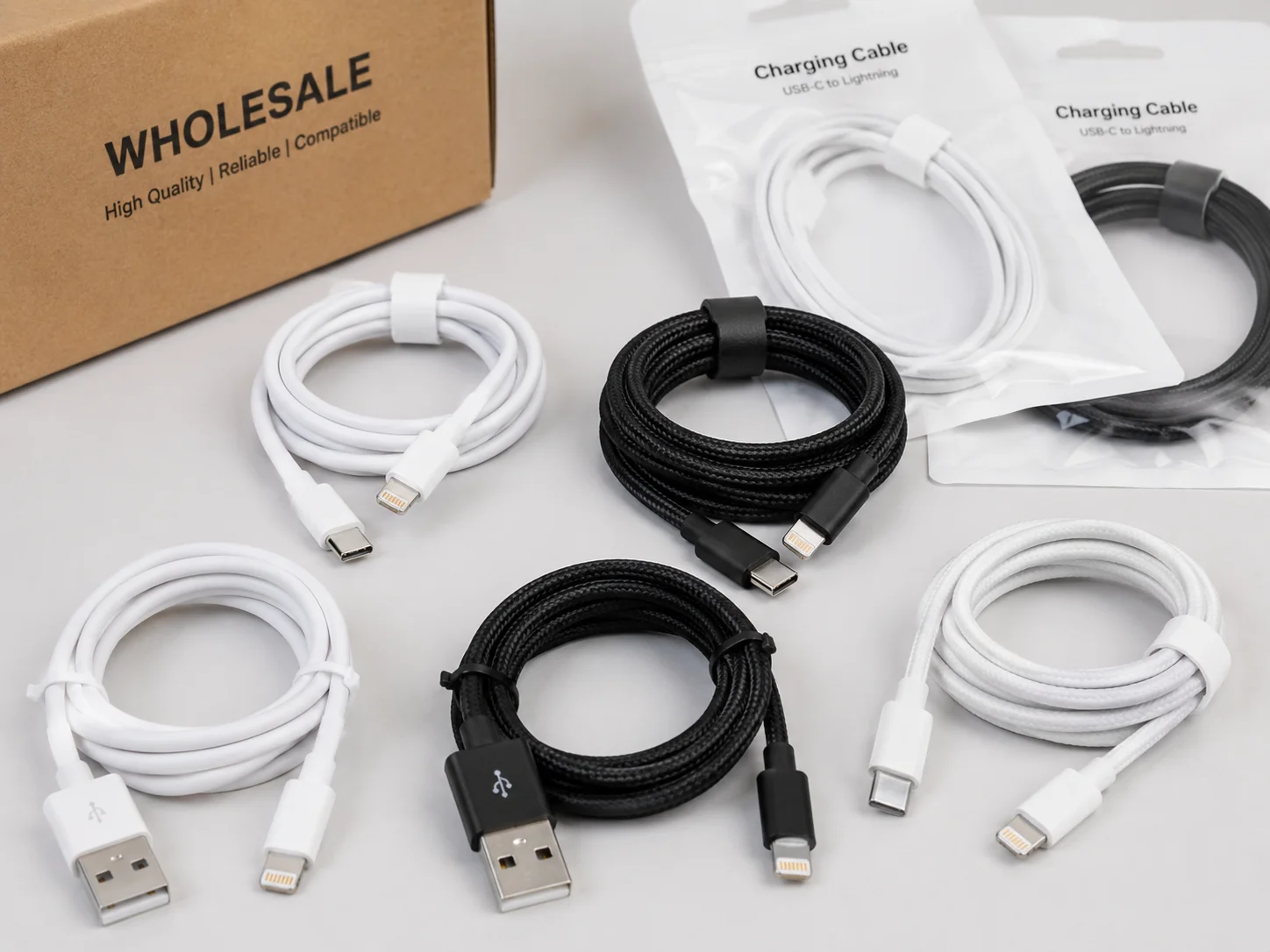
Over my 15 years in this business, I’ve seen many buyers focus only on the unit cost. This is a common mistake. A cheap cable can be the most expensive product you ever sell once you factor in returns, bad reviews, and lost customers. The real goal is to find a partner who delivers a stable, compliant, and reliable product. This guide is based on thousands of conversations with buyers just like you. I will walk you through the exact evaluation process we use to help our clients build a successful accessories business. Let's look beyond the price tag together.
What Does “iPhone-Compatible Cable” Really Mean?
You see "iPhone-compatible" everywhere, but what does it guarantee? Many new buyers assume it means the cable will just work. This assumption can lead to major problems later on.
An "iPhone-compatible" cable is simply any cable designed with a Lightning connector. But this label alone says nothing about its quality, safety, or if it will work after the next iOS update. True compatibility requires meeting Apple's technical standards, which is a different story.
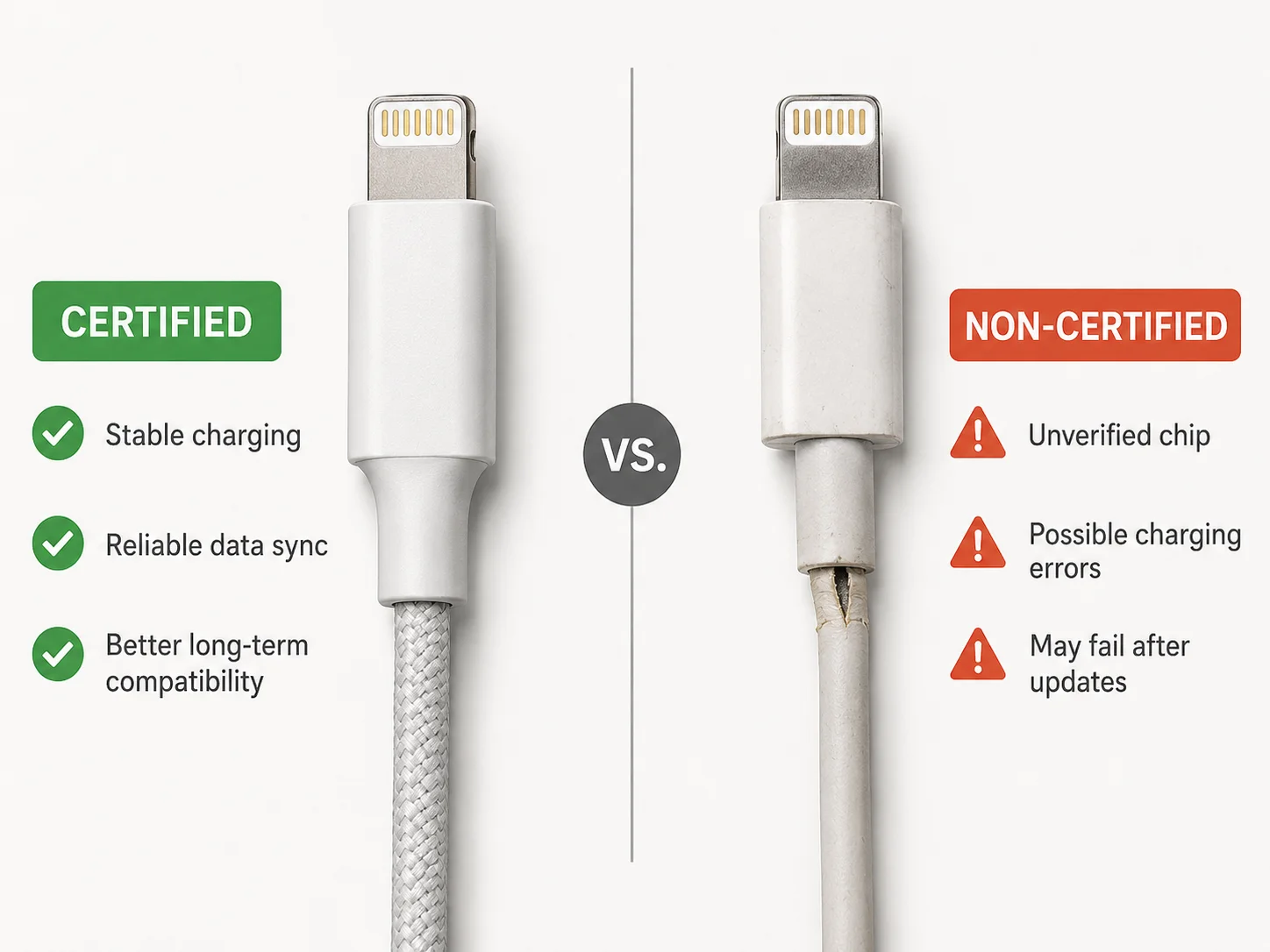
In my experience, many suppliers use the term "compatible" very loosely. It's a marketing phrase. A cable might work when you test it, but that doesn't mean it will work for your customers in three months. The term splits into two main categories that you, as a buyer, must understand.
Two Types of "Compatible"
-
Functionally Compatible (Non-MFi): These cables are reverse-engineered. They use cloned chips that mimic the authentication signal Apple requires. The problem is that Apple actively blocks these chips with software updates. So, a cable that works today might show the "This accessory may not be supported" error tomorrow. I've seen this happen to countless clients who opted for the cheaper option.
-
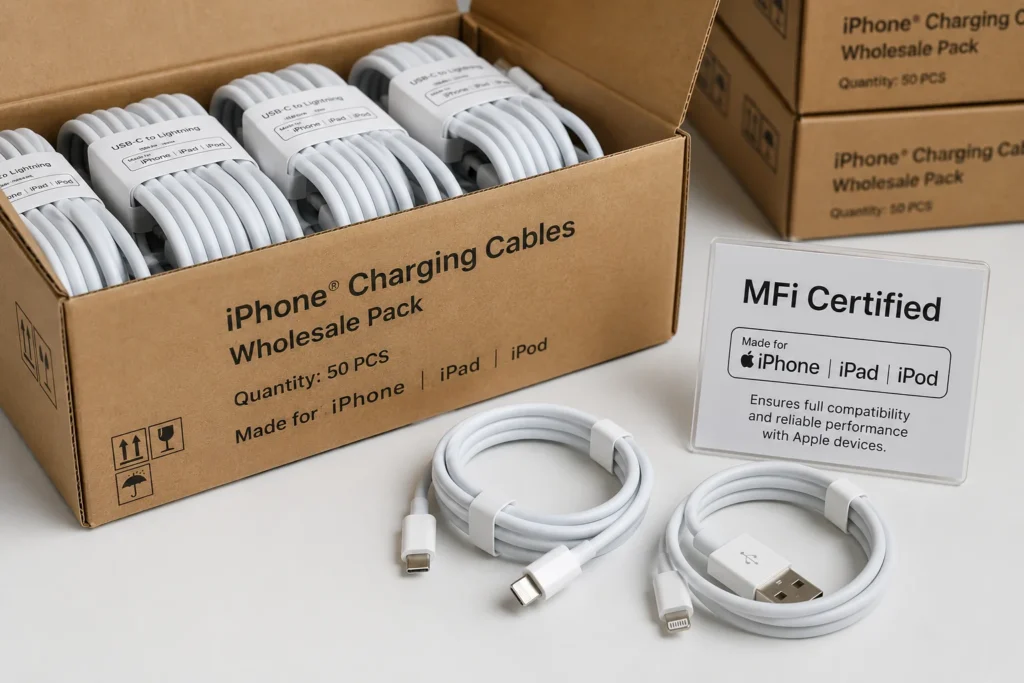
Certified Compatible (MFi): These cables are part of Apple's "Made for iPhone/iPad/iPod" (MFi) program. The supplier uses an official authentication chip purchased directly from an Apple-authorized distributor. This guarantees the cable will continue to work with all future iOS updates.
Think of it like this: one is a copy, and one is an officially licensed product. For a serious business, the choice has major implications for your brand's reputation and bottom line.
Why Does MFi Certification Matter for Wholesale Buyers?
Are you wondering if the extra cost for MFi is really worth it? Many buyers see it as just a logo. But for wholesale, it's a critical insurance policy for your business.
MFi certification matters because it guarantees quality, safety, and long-term compatibility. For wholesale buyers, this means fewer customer returns, better brand reputation, and access to premium retail channels that require certified products. It turns a risky purchase into a reliable investment.
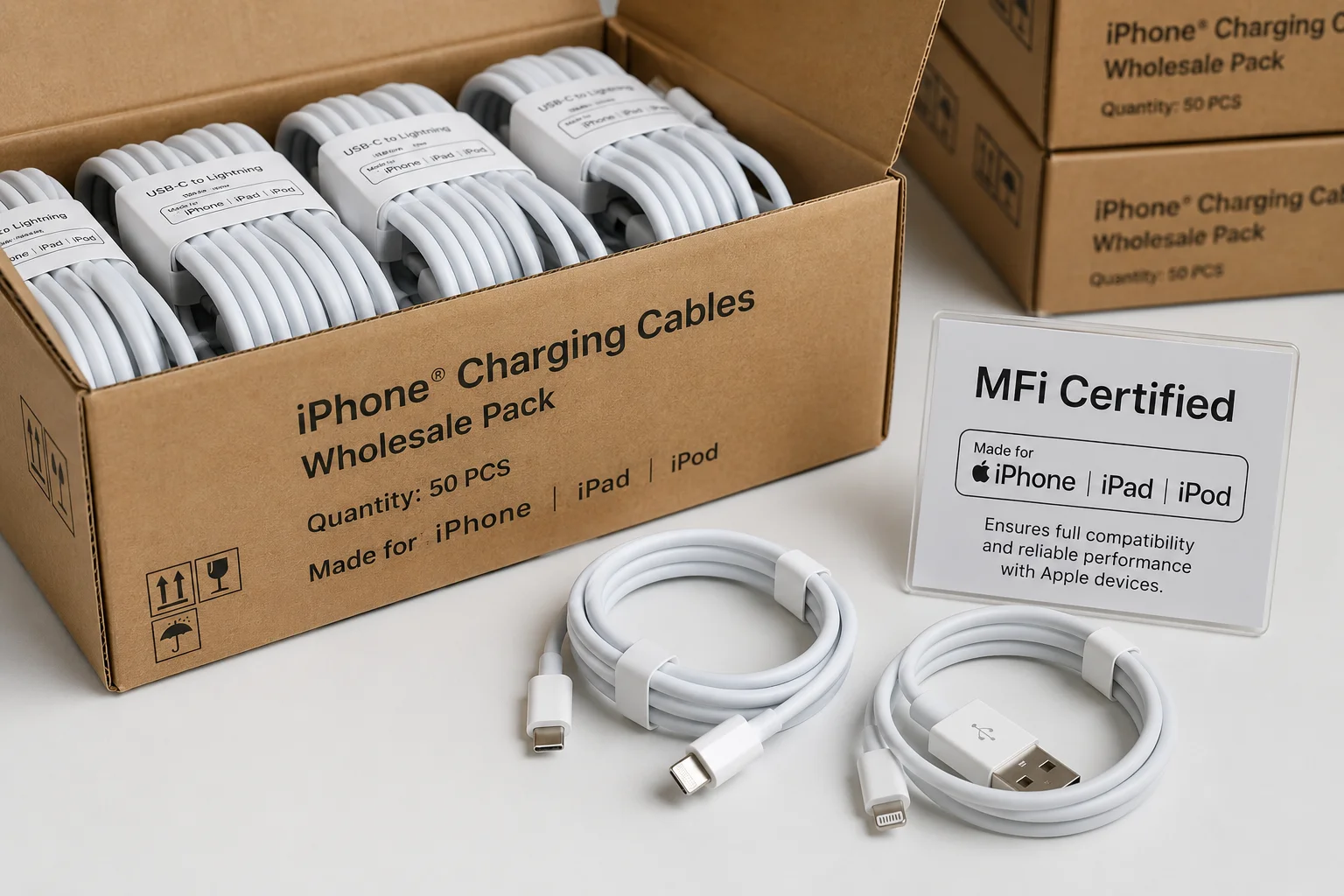
I often talk to e-commerce sellers who are trying to compete on platforms like Amazon. They tell me their biggest challenge is negative reviews. An MFi-certified cable is one of the easiest ways to solve this problem. It is a signal of quality that both customers and retail partners recognize.
The Business Value of MFi
The value isn't just technical; it's about business stability. When you source MFi-certified cables, you are buying peace of mind. Here’s how it breaks down for a wholesale business:
| Feature | Impact on Your Business |
|---|---|
| Guaranteed Compatibility | Eliminates the "Accessory Not Supported" error. This drastically reduces customer complaints and return rates. |
| Strict Quality Standards | Apple requires MFi products to pass rigorous tests for durability, safety, and performance. This means stronger cables and safer charging. |
| Brand Protection | Selling reliable products builds trust. Selling faulty ones destroys it. MFi protects the reputation you work so hard to build. |
| Market Access | Many large retailers and distributors will not even consider stocking non-MFi accessories. Certification opens doors to bigger opportunities. |
A client from the UK once told me, "We switched to MFi, and our return rate for cables dropped from 15% to under 1%." That's not just a saved cost; it's a huge boost to customer satisfaction and lifetime value.
MFi vs Non-MFi Cables: What Is the Real Business Risk?
Tempted to save 50 cents per cable by choosing a non-MFi option? The immediate saving is clear, but the long-term cost is hidden. You need to weigh that saving against the risk.
The real business risk of non-MFi cables is catastrophic failure at scale. You risk high return rates, negative reviews that kill sales, and even delisting from platforms like Amazon. The small upfront saving is quickly erased by the cost of managing dissatisfied customers.

The choice between MFi and non-MFi is one of the most common discussions I have with new importers. They see a price list and the non-MFi option looks very attractive. My job is to help them see the full picture. The unit price is only one part of the total cost of ownership.
Calculating the True Cost
Let's run a simple scenario. Imagine you buy 1,000 cables.
| Metric | Non-MFi Scenario | MFi Scenario |
|---|---|---|
| Unit Cost | $1.00 | $2.00 |
| Initial Outlay | $1,000 | $2,000 |
| Typical Failure/Return Rate | 10% (100 units) | 1% (10 units) |
| Cost of Returned Goods | $100 | $10 |
| Lost Shipping Costs | ~$50 | ~$5 |
| Customer Service Time | High | Low |
| Negative Reviews | High (potential sales drop) | Low (stable sales) |
| Total Obvious Cost | $1,150+ | $2,015 |
At first glance, the MFi cable still seems more expensive. But this calculation doesn't include the biggest cost: the damage to your brand's reputation. A few dozen 1-star reviews saying "stopped working after a week" can destroy a product listing you spent hundreds or thousands of dollars to promote. A client once had their best-selling SKU suspended on Amazon because of this. The risk is not just financial; it's existential for your product line.
What Specs Should Buyers Check Before Placing an Order?
You've decided on a supplier, but what details do you need to confirm? Buyers often just ask for a "good cable." This is too vague and leaves you open to receiving a substandard product.
Before placing an order, buyers must check the cable's core specifications. This includes the wire gauge (AWG) for charging speed, the type of chip (MFi or copy), the data transfer speed, and the cable length. These details directly impact performance and user satisfaction.
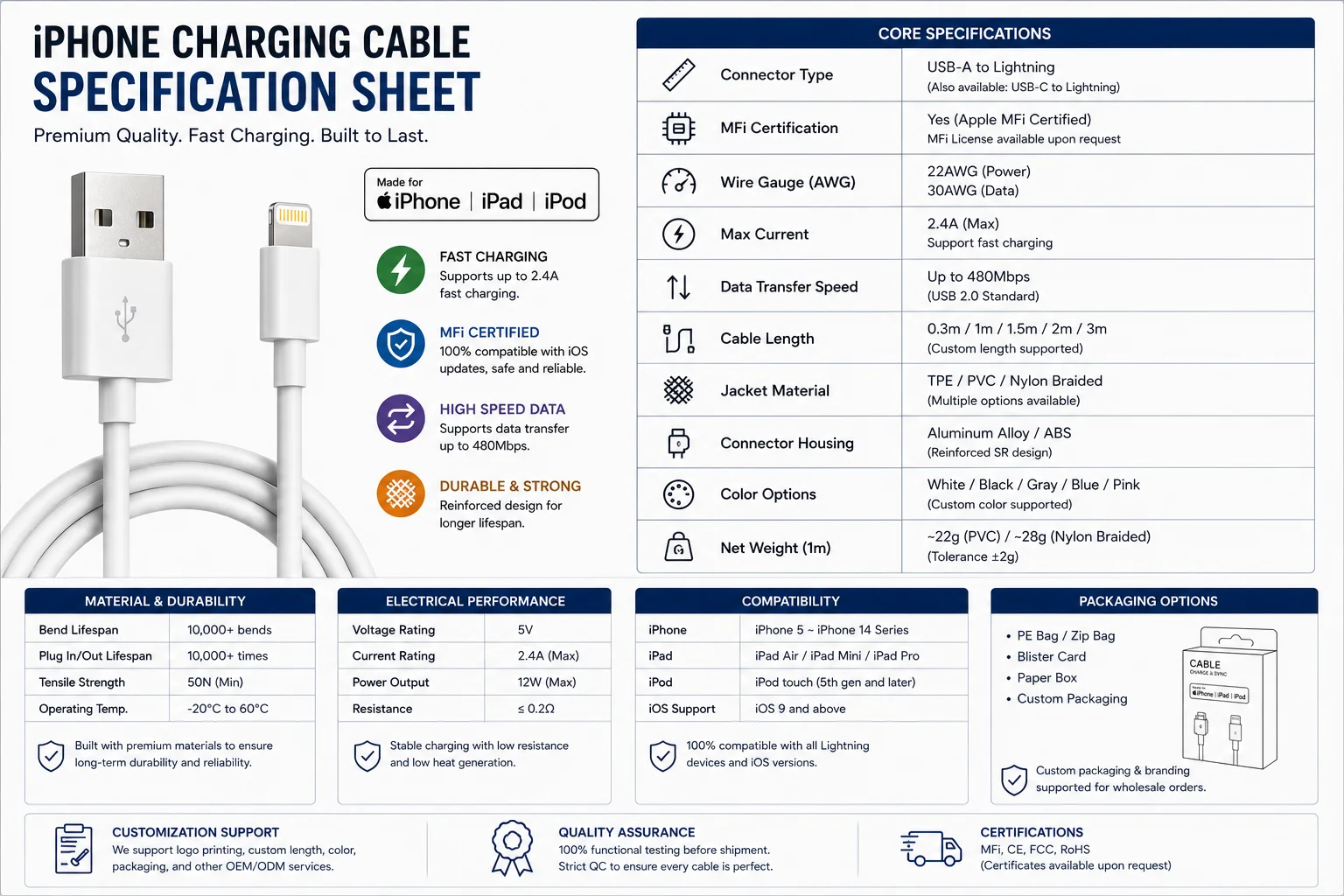
When a professional buyer sends us an inquiry, it looks very different from a beginner's. They don't just ask for a price. They provide a spec sheet. You should too. This shows the supplier you are serious and knowledgeable, and it ensures you get exactly what you need.
Key Specifications to Define
Here is a simple checklist of technical details you must confirm with your supplier before you approve an order. Don't be afraid to ask these questions. A good supplier will have the answers ready.
- Wire Gauge (AWG): This is crucial. It determines how much current the cable can safely handle. For fast charging, you need a lower AWG number (e.g., 24AWG or lower) for the power wires. A higher number (e.g., 28AWG) means a thinner wire and slower charging.
- Chipset: Be explicit. Ask, "Does this cable use an original MFi C89 or C94 chip, or is it a copy chip?" Demand proof if they claim it's original.
- Data Transfer Speed: Will this cable be for charging only, or do your customers need to sync data? Standard USB 2.0 offers 480 Mbps. If it's just for charging, you might save costs with charge-only wires, but you must be clear about this.
- Cable Length: Specify the exact length (e.g., 1m, 2m, 3m). Remember that longer cables have more resistance, which can affect charging speed if the wire gauge is not thick enough.
Confirming these specs in writing before payment is your best protection. It forms part of your contract with the supplier.
How Do You Evaluate Connector Quality and Charging Stability?
The cable might look good, but the connector is where most failures happen. How can you tell a good one from a bad one? You can't just trust the pictures.
To evaluate connector quality, check for a seamless, single-piece construction on the Lightning tip and gold-plated pins. For charging stability, test the cable with a USB power meter to ensure it delivers a consistent current without fluctuation or dropping. This predicts long-term reliability.
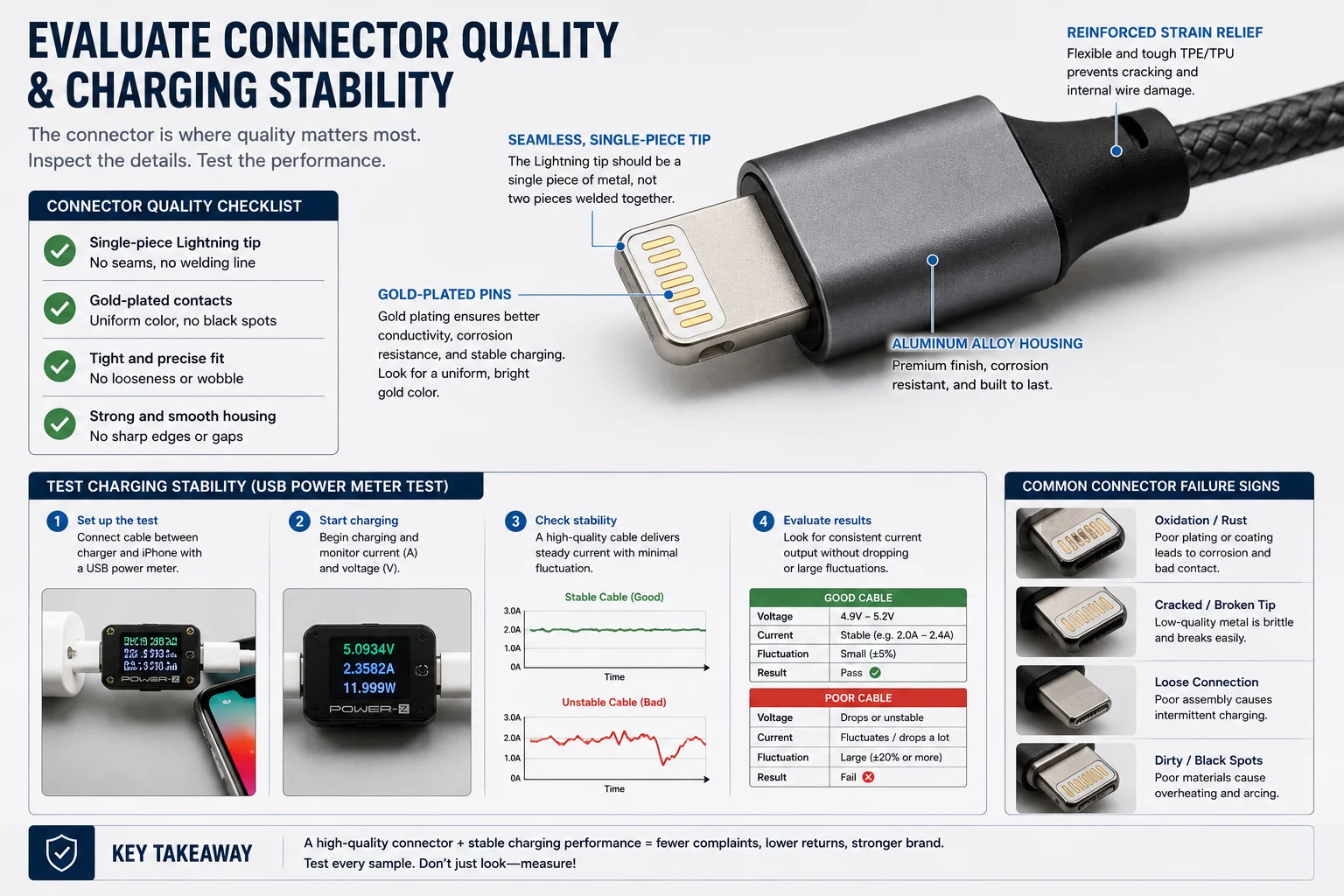
I always tell my clients that the first thing they should do with a sample is inspect the connector ends under a good light. The Lightning connector is the most complex and delicate part of the cable. It's a small detail that tells a big story about the manufacturer's attention to quality.
What to Look For in a Connector
A well-made connector is a sign of a professional factory. A poorly made one is a huge red flag.
- Lightning Tip Construction:
- Good: Apple's MFi standard requires a single-piece, smooth metal shell. It looks clean and seamless.
- Bad: Cheap, non-MFi connectors are often made from multiple pieces crimped together. You might see seams or rough edges. These are prone to breaking.
- Pin Quality:
- Good: The contact pins should be gold-plated, smooth, and perfectly rounded. This ensures a good connection and resists corrosion.
- Bad: Low-quality connectors have rough, uneven pins that can wear out quickly or even damage the port on the iPhone.
Testing for Charging Stability
You don't need a fancy lab. A simple USB Power Meter, which costs less than $20, is an essential tool for any electronics buyer. Plug the cable into a charger, connect the meter, and then plug it into a phone. Watch the readings for voltage (V) and amperage (A). A stable cable will show a steady current. A poor-quality cable with a copy chip might cause the current to fluctuate wildly or cut off and on. This simple test can save you from a massive headache with a bulk order.
Why Do Cable Materials Affect Customer Complaints and Returns?
Do you think the outside of the cable is just for looks? The material used for the jacket and strain relief directly impacts the cable's lifespan. This is a major source of customer complaints.
Cable materials directly determine durability. A cheap PVC jacket will crack and fray, and weak strain relief will cause the cable to break at the connector. This leads to customer complaints about "broken cables" and drives up your return rate, hurting your profits and brand image.
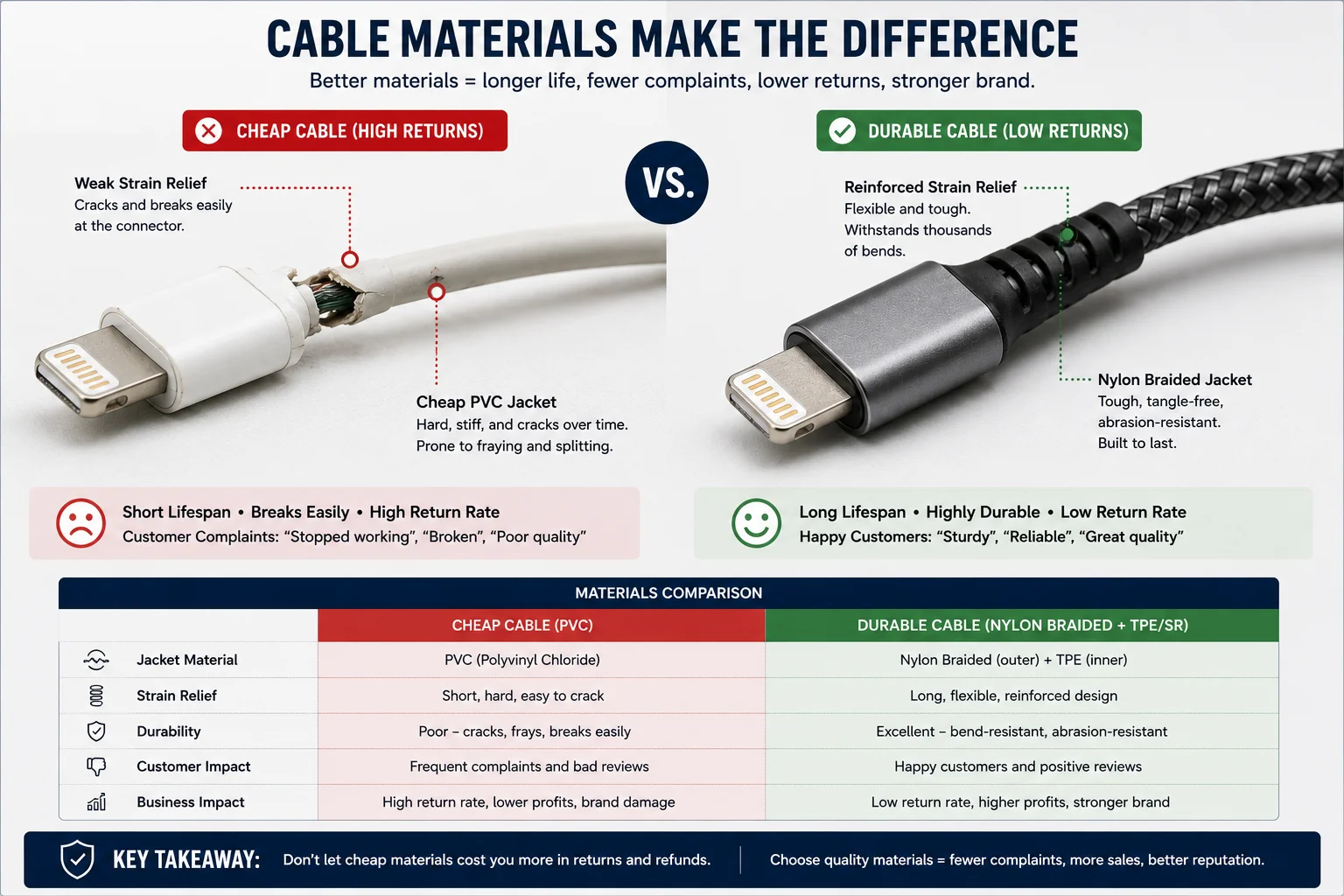
One of the most common 1-star reviews for cables is a photo of the cable frayed or broken near the connector. Customers hate this. They see it as a sign of a cheap, disposable product. Choosing the right materials is not a luxury; it's a fundamental business decision.
Comparing Common Cable Materials
I've handled thousands of cables over the years. You start to feel the difference instantly. Here’s a quick guide to what you should be looking for when you evaluate samples.
| Material | Pros | Cons | Best For |
|---|---|---|---|
| Standard PVC | Lowest cost, flexible. | Prone to yellowing, cracking, and fraying over time. Not very durable. | The absolute cheapest entry-level products where longevity is not a priority. |
| TPE (Thermoplastic Elastomer) | Softer feel than PVC, more flexible, and more durable. Good middle ground. | Can get dirty easily. Mid-range cost. | A good balance of cost and quality for most mid-tier retail products. |
| Braided Nylon | Excellent durability, resists tangling and fraying. Premium look and feel. | Higher cost, can be stiffer. | Premium or heavy-duty product lines where durability is a key selling point. |
Don't forget the strain relief—the flexible rubber or plastic part where the cable meets the connector. It should be long and robust. This is where the cable bends the most. A tiny, hard strain relief is a sign the manufacturer is cutting corners and the cable will fail quickly.
What Test Reports Should a Supplier Provide?
A supplier says their cables are high quality. How can you verify this? Relying on their word is not enough. Professional buyers ask for proof.
A reputable supplier should be able to provide key test reports. At a minimum, ask for RoHS compliance reports for material safety and MFi certification records if applicable. For premium cables, they may also have internal reports on bend tests and pull force tests.
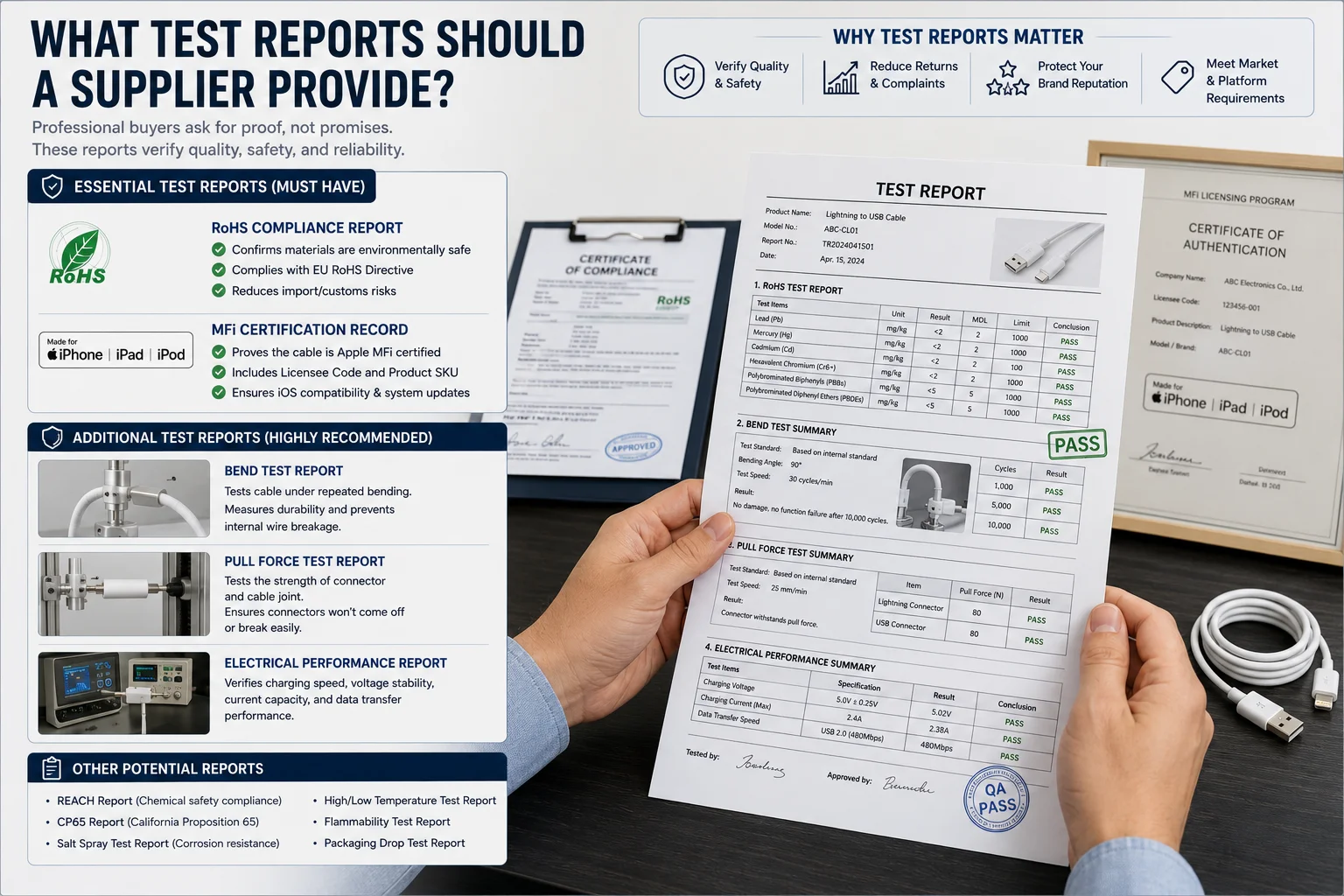
When I work with a new buyer, I make sure to have our documentation ready. It's about building trust through transparency. A supplier who is hesitant or unable to provide basic quality reports is a major red flag. They either don't have them or, worse, their product failed the tests.
Essential Documents to Request
You don't need to be an engineer to understand these reports. You just need to know what to ask for and check that the company name and product model match.
-
RoHS (Restriction of Hazardous Substances): This is a mandatory directive for the European market. It certifies that the product is free from harmful materials like lead, mercury, and cadmium. Even if you don't sell in the EU, it's a strong indicator of a supplier's commitment to quality and safety. A supplier without RoHS is not a serious international player.
-
MFi Certification (if claimed): If you are buying MFi cables, don't just trust the logo on the box. Ask for the PPID (Product Plan ID) or UPC/EAN of the product. You can look this up on Apple's public MFi database to confirm the certification is real and belongs to the supplier or their manufacturing partner.
-
Internal Durability Reports (Optional but good): Serious manufacturers perform their own quality control tests. It’s a great sign if they can share data from:
- Bend Test: How many times the cable can be bent before it breaks (e.g., 5,000-10,000 bends is good).
- Pull Force Test: How much weight the cable can withstand before the connector pulls out.
Asking for these documents separates the professional factories from the trading-floor assemblers.
How Do You Judge Packaging, Branding, and Retail Readiness?
Your product's packaging is its first impression. A great cable in a cheap, flimsy box looks like a bad product. How do you ensure your product is ready for the shelf?
To judge retail readiness, evaluate the packaging's structural quality, graphic design, and required legal information. The box should be sturdy enough for shipping, the design should be clean and professional, and it must include barcodes, certifications (like CE/RoHS), and country of origin.
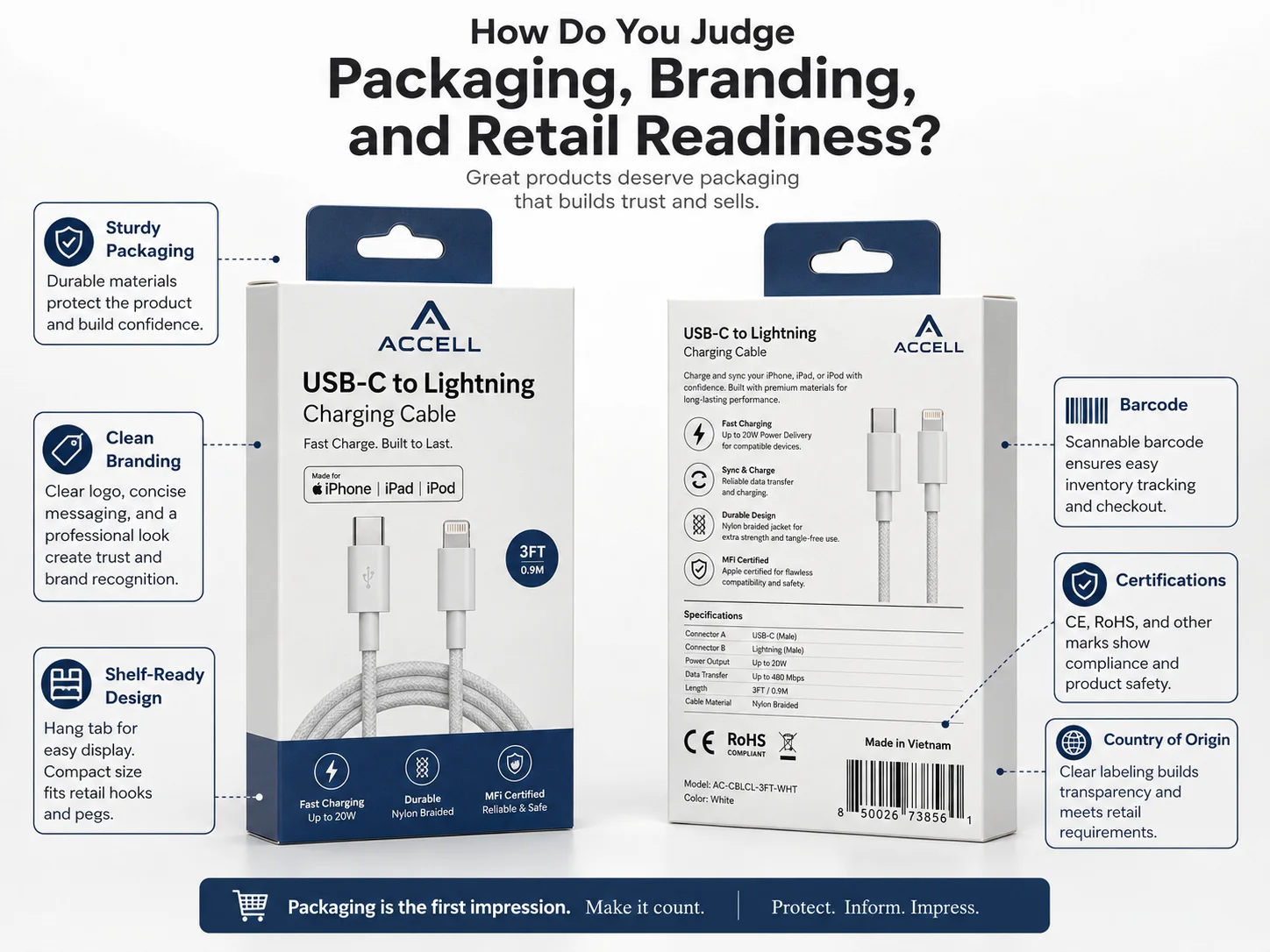
I often see buyers spend weeks negotiating the price of the cable, then accept whatever standard packaging the factory offers. This is a mistake. Your packaging is a silent salesperson. For retail and e-commerce, it's just as important as the product inside.
Elements of Good Retail Packaging
When we develop a private label project with a client, we spend a lot of time on the packaging. It has to do several jobs at once.
- Protection: The box or bag must be strong enough to protect the cable during shipping from China, in your warehouse, and on its way to the final customer. A crushed box is an instant return. Ask for samples of the packaging itself.
- Information: The packaging must clearly communicate the product's features. This includes:
- Length (e.g., 1.2m / 4ft)
- Function (e.g., Charge & Sync)
- Compatibility (e.g., For iPhone, iPad)
- Certifications (MFi, CE, RoHS, UKCA logos)
- Barcode (UPC or EAN) for retail scanning.
- "Made in China" declaration.
- Branding: This is your chance to stand out. Even a simple wholesale order can often be customized with your brand's sticker. For private label, the entire design should reflect your brand's identity. A clean, modern design builds trust before the customer even opens the box.
Don't treat packaging as an afterthought. Discuss it early and get samples. It's a key part of delivering a professional product.
What MOQ, Lead Time, and Production Capacity Should Buyers Confirm?
You've found a great product, but can the supplier deliver? Misunderstandings about production logistics can kill a deal or delay your launch. You need to ask the right questions upfront.
Buyers must confirm the Minimum Order Quantity (MOQ), the production lead time after the deposit is paid, and the supplier's total monthly production capacity. These three figures determine if the supplier is a good fit for your business size and growth plans.
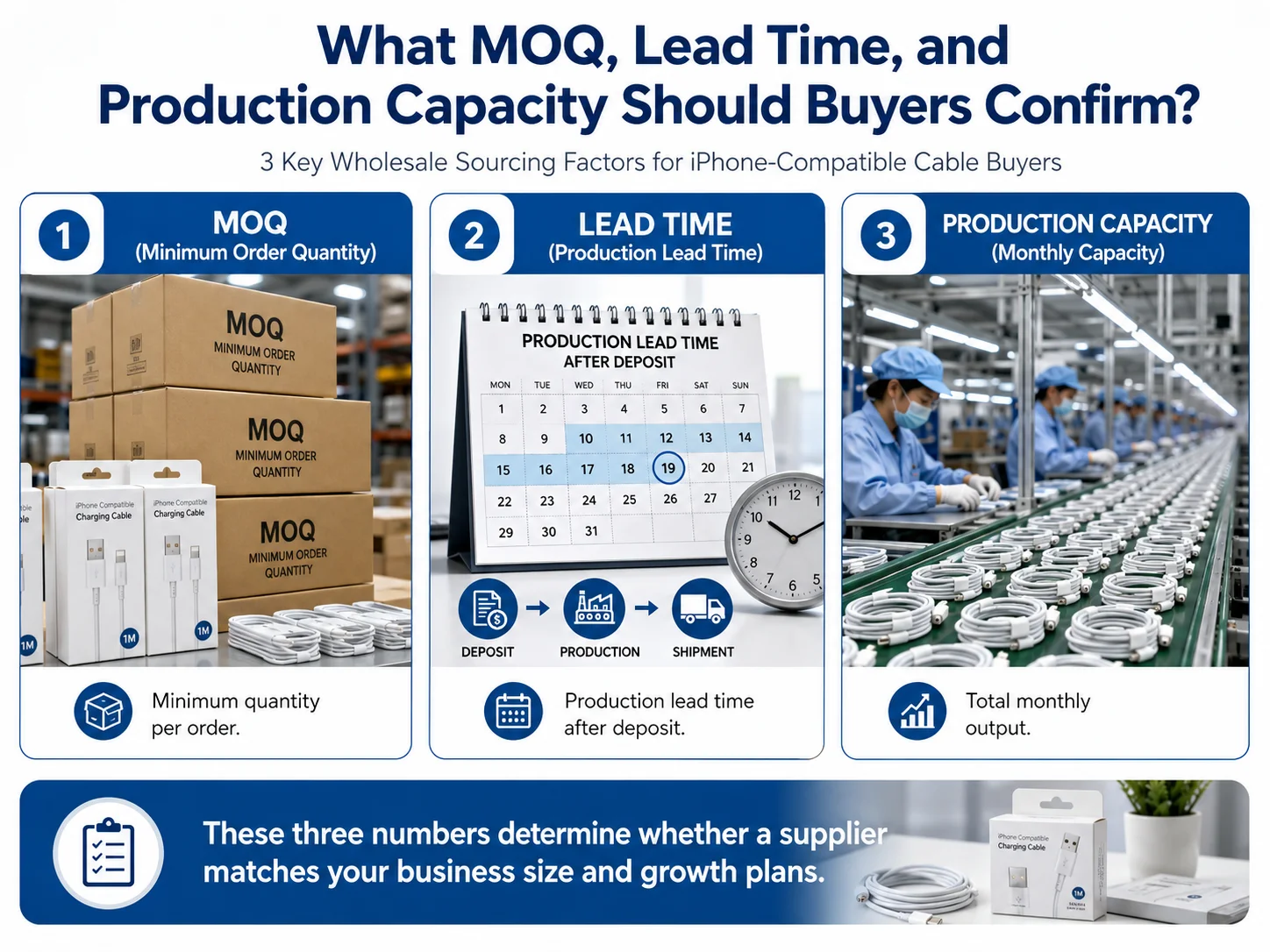
This is a very practical conversation I have every day. A buyer for a large retail chain has very different needs from a new Amazon seller. A good supplier can cater to both, but you need to be clear about what you need and what they can realistically provide.
Key Logistical Questions
Being direct and clear here saves a lot of time and frustration. Here is what you need to lock down.
- Minimum Order Quantity (MOQ): This is the smallest order a factory will accept. It can be anywhere from 500 to 3,000 pieces per color or model. Ask if there's a higher MOQ for custom colors or packaging. A high MOQ might be a deal-breaker for a small business testing the market.
- Production Lead Time: This is the time from when you pay your deposit until the goods are ready to ship. It is NOT the time until they arrive at your door. A typical lead time is 25-35 days. Always ask, "Is that 30 days from deposit or from sample approval?" The difference can be a week or more. Also, ask about peak seasons like before Chinese New Year, when lead times can double.
- Production Capacity: Ask, "What is your monthly output for this type of cable?" This tells you if they can handle your orders as you grow. If you plan to order 50,000 cables and their total capacity is 70,000, you might face delays if another big client places an order. It helps you understand if they are a small workshop or a large, scalable factory.
Confirming these numbers helps you plan your inventory, cash flow, and marketing launches accurately.
What Are Common Red Flags When Choosing iPhone Cable Suppliers?
How do you spot a bad supplier before you send them money? After 15 years, I've seen all the tricks. There are clear warning signs that tell you to walk away.
Common red flags include vague answers to technical questions, an unwillingness to provide certifications, very poor sample quality, and pressure for full payment upfront. Also, be wary of suppliers whose prices are significantly lower than everyone else's. It's almost always too good to be true.
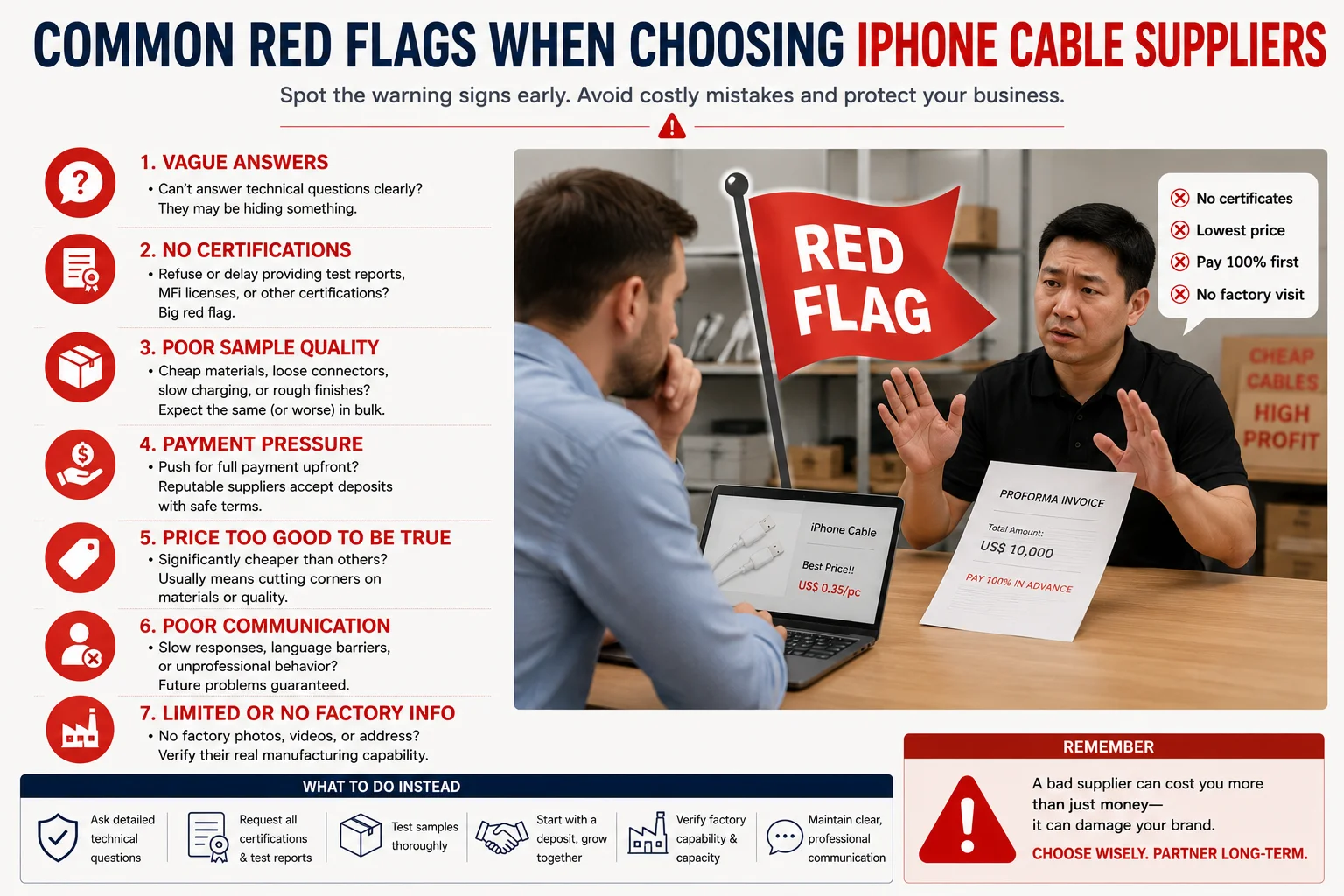
Trust your gut feeling. If a conversation with a supplier feels difficult, or if they avoid your questions, imagine how they will act when you have a problem with your order. The sales process is often the best they will ever treat you.
Supplier Warning Signs Checklist
I advise my clients to be cautious if they see any of these signs. One might be a misunderstanding, but two or more is a clear signal to find another partner.
- Communication Problems:
- They don't understand your technical requirements.
- They give vague answers like "don't worry, it's good quality."
- They take days to reply to simple emails.
- Lack of Transparency:
- They refuse to show you test reports or certifications.
- They won't tell you the exact MFi chipset they use.
- They are not clear about their factory address (they might just be a middleman in an apartment).
- Unrealistic Promises:
- A price that is 50% cheaper than the market average. This usually means they are using trash-tier materials or a cloned chip that will fail.
- A promise of a 7-day lead time for a large, custom order. This is almost impossible.
- Poor First Impression:
- The samples they send are dirty, poorly packaged, or don't work correctly. If they can't get the sample right, they will not get the bulk order right.
A professional supplier will be open, helpful, and transparent. They see you as a long-term partner, not a one-time transaction.
How Do Serious Buyers Test Samples Before Bulk Orders?
You received samples. What now? Just plugging it in to see if it charges is not enough. A serious evaluation can save you thousands of dollars and protect your brand.
Serious buyers perform a structured test on samples. This includes a visual inspection of the connectors and materials, a performance test with a USB meter for charging stability, a bend and pull test for durability, and testing with multiple devices and iOS versions for compatibility.
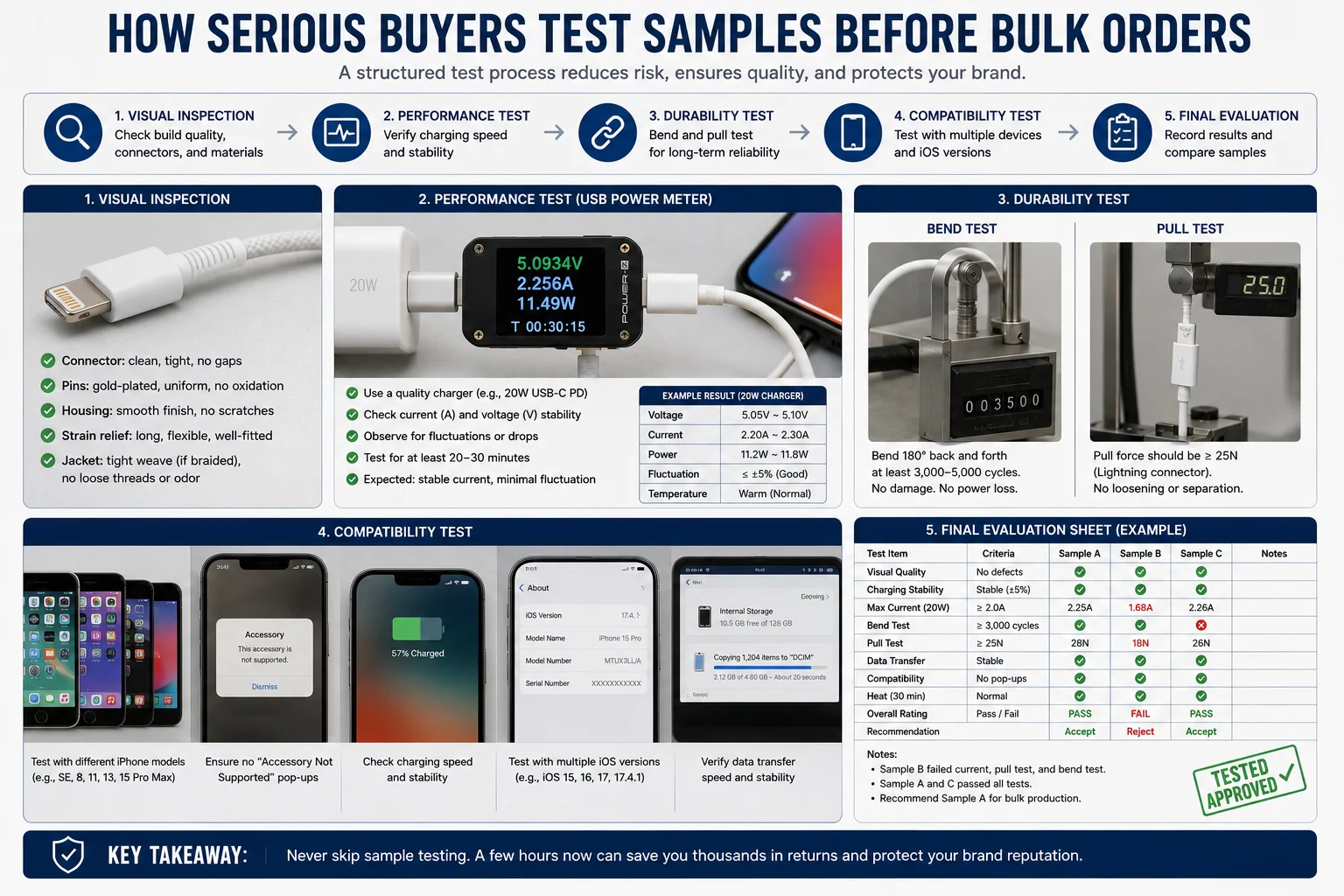
When we send samples to experienced buyers, we know they are going to put them through a tough process. They are not just checking if it works; they are trying to make it fail. This is the right mindset. You need to find the product's weaknesses before your customers do.
A Simple Sample Testing Protocol
You can do this yourself at your desk. It’s a small investment of time that provides a huge return.
- Visual and Tactile Inspection (5 mins):
- Examine the Lightning and USB connectors. Are they seamless and clean?
- Feel the cable jacket. Does it feel sturdy or thin and cheap?
- Check the strain reliefs. Are they flexible and well-attached?
- Performance Test (10 mins):
- Use a USB power meter. Plug the cable into a wall charger and an iPhone.
- Note the amperage (A). For an iPhone, it should be around 1A to 2.4A depending on the model and battery level.
- Watch the reading for 5 minutes. Does it stay stable, or does it jump around or cut out? A stable reading is a very good sign.
- Compatibility Test (5 mins):
- Test the cable with different devices if you can (e.g., an older iPhone, a new iPad).
- Plug it in and out 10-20 times. Does the "Accessory Not Supported" error ever appear?
- Basic Durability Test (5 mins):
- Bend the cable sharply at the strain relief 50 times. Does it show any signs of stress or tearing?
- Give it a firm pull. Does it feel solid?
This 25-minute test will tell you more about the cable's quality than any sales pitch.
What's the Final Buying Advice: Choose Compliance, Stability, and Long-Term Trust?
So, how do you make the final choice? After all the tests and questions, it comes down to a single guiding principle. It's about more than just this one order.
My final advice is this: build your business on a foundation of trust. Choose the supplier who prioritizes compliance, demonstrates product stability, and works with you as a long-term partner. A slightly higher initial price for a reliable product is always cheaper than the cost of failure.
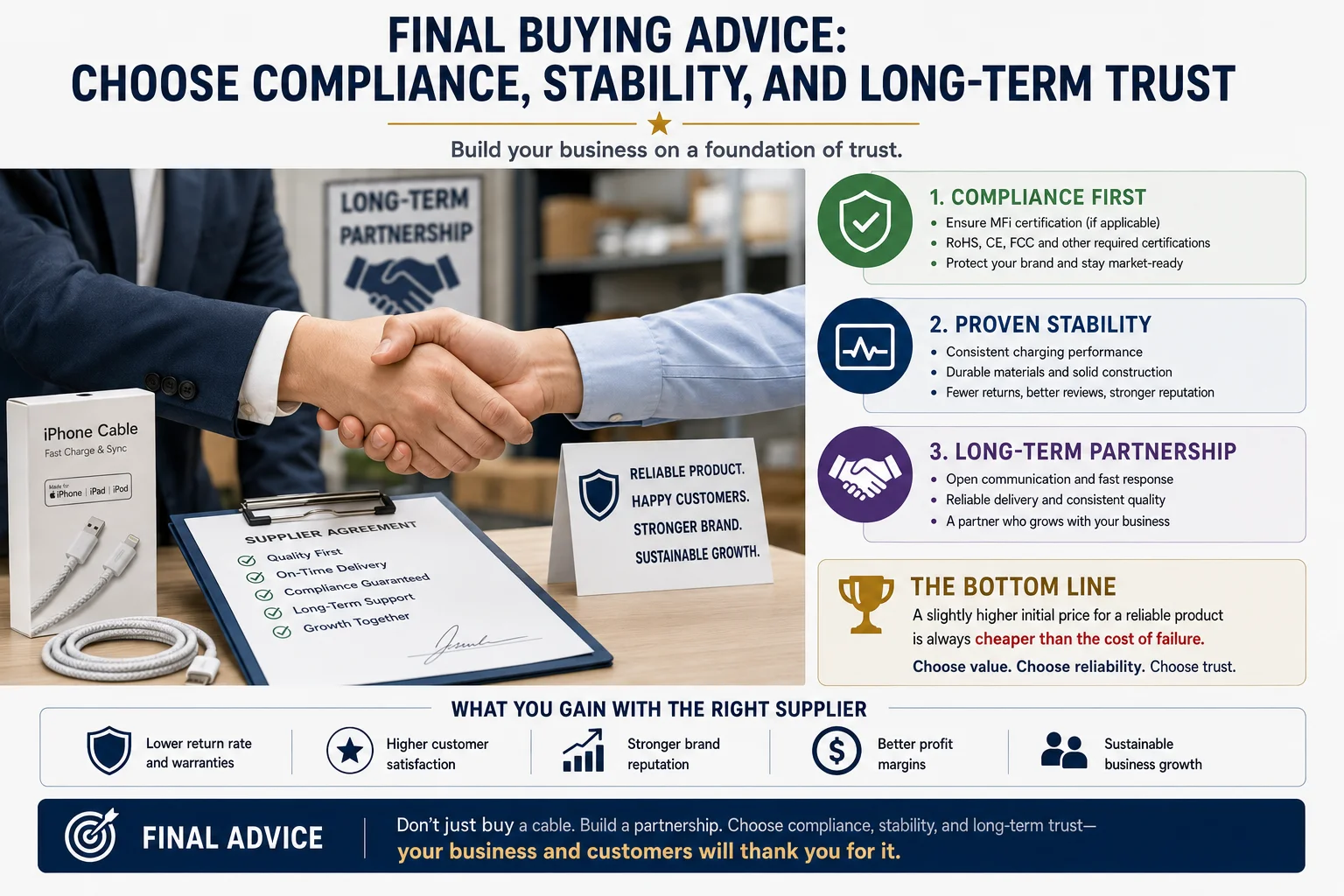
Over my career, I've watched clients grow from small e-commerce startups to major retail players. The successful ones all have one thing in common. They don't switch suppliers every six months to save a few cents. They find a good, trustworthy partner and grow with them.
Your Final Decision Framework
Before you send that deposit, ask yourself these three questions:
- Am I confident in this product's compliance and safety? (MFi, RoHS)
- Will this product protect my customers and my brand from technical issues and safety risks?
- Am I confident in this product's stability and quality? (Materials, Connectors, Charging Test)
- Will this product result in happy customers and positive reviews, or will I be dealing with constant returns?
- Am I confident in this supplier as a long-term partner? (Communication, Transparency, Capacity)
- Is this a supplier who will solve problems with me, or will they disappear after they have my money?
If you can answer "yes" to all three, you have likely found the right partner. The price is important, but it should be the last thing you compare, not the first.
Conclusion
Ultimately, choosing the right iPhone cable supplier is a strategic business decision, not just a purchase. Prioritize compliance, stability, and partnership over a low initial price for long-term success.