Struggling with which USB cables to stock? Choosing the wrong type leads to dead inventory and lost profits. Understanding your customer's preference is the key to succeeding.
Premium braided cables sell better in markets where customers value more than just the lowest price.1 They appeal to buyers who want enhanced durability, a high-end look, and a better user experience. These cables feel like an upgrade, justifying a higher retail price in specific segments.
This might seem simple, but the 'why' is crucial for your buying decisions. In my 15 years of exporting 3C accessories, I've learned that choosing the right cable is about matching the product to the customer's mindset. A cable isn't just a cable; it's an accessory that reflects on the user and your brand. Let's break down what makes braided cables different and where they truly shine, so you can make a more informed sourcing decision.
What Is a Braided USB Cable?
Confused by all the cable jargon? It's hard to sell a product if you can't explain what makes it special. Let's start with the very basics.
A braided USB cable is a standard cable with an outer jacket made of woven fabric, like nylon or polyester, instead of the usual plastic (PVC). This braiding adds a layer of protection and completely changes the cable's look and feel, making it appear more premium.
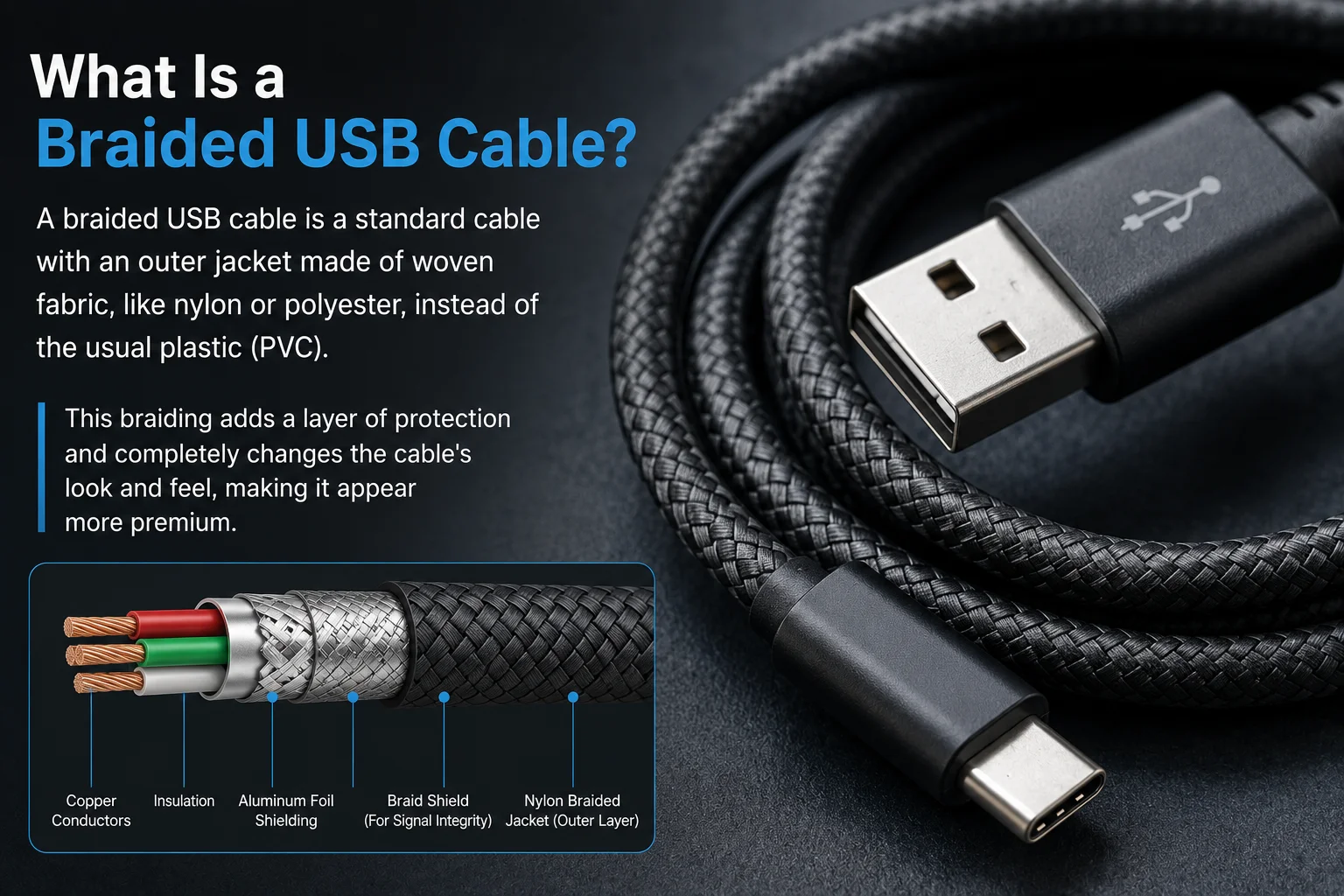
Let's dive a little deeper. Inside, a braided cable has the same core components as any other USB cable: copper wires for power and data, shielding to prevent interference, and an inner plastic sheath. The key difference is that final outer layer. Instead of a smooth, often cheap-feeling PVC jacket, manufacturers weave a layer of fabric around the cable.
The most common material I see is nylon. Nylon is strong, flexible, and has a nice texture. You might also find cables braided with polyester or even more exotic materials like metal strands for a very rugged look. The main point is that this braided jacket is the first thing a customer sees and touches. It’s a sensory signal that says, "This is not your average, flimsy cable."
Why Do Braided Cables Feel More Premium to Customers?
Ever wonder why a customer will pay $15 for one cable but only $5 for another? It's not always about function. It's about perception and feeling.
Braided cables feel premium because of their texture, weight, and resistance to tangling. Unlike flimsy plastic, the woven fabric feels substantial and durable. This tactile experience creates a strong psychological link between the cable and high quality, even before it's plugged in.2
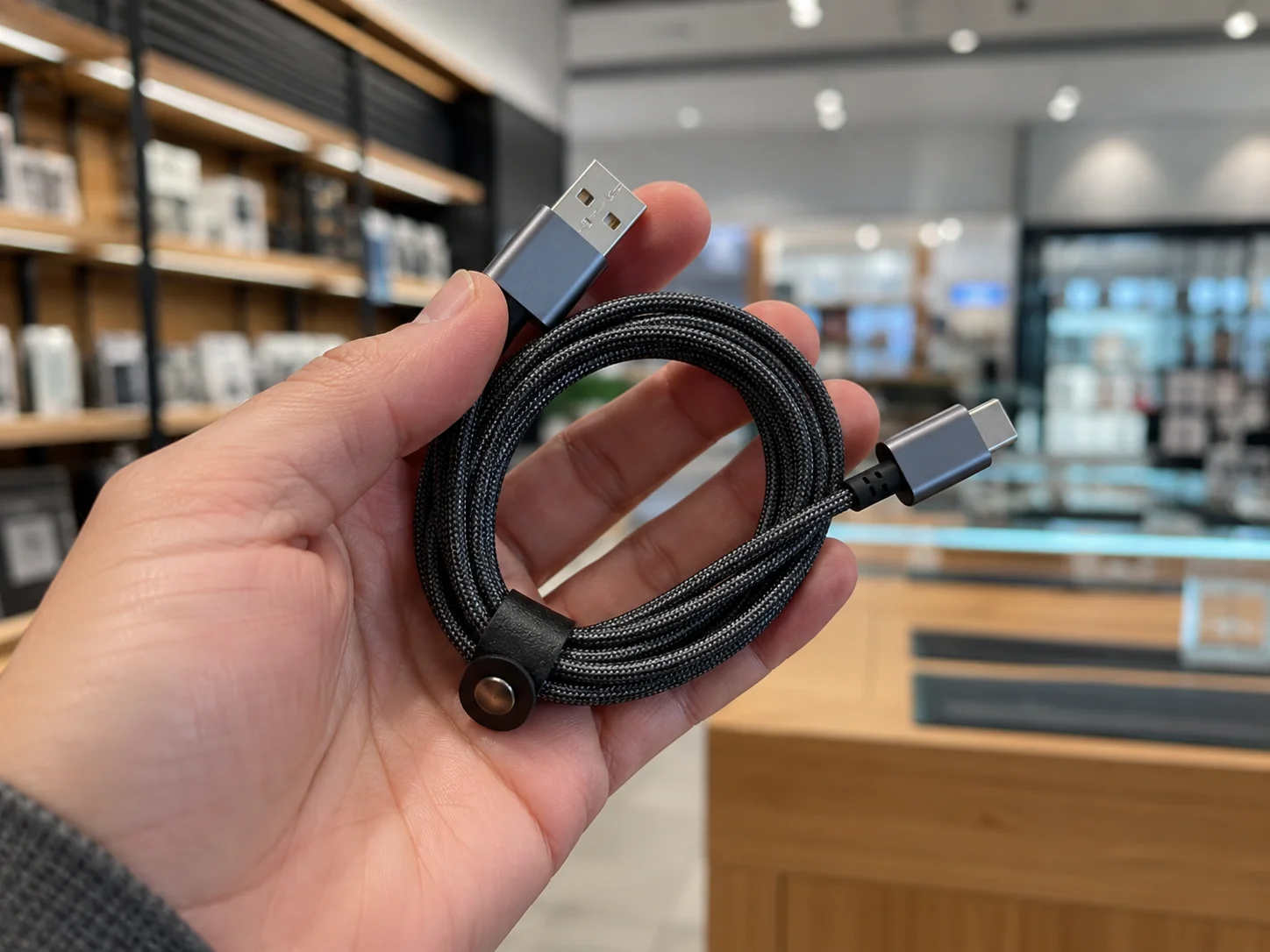
From my experience talking to retail buyers, the power of touch is huge. When a customer picks up a braided cable, it feels different. It has a certain heft and a pleasing texture. It doesn't feel like it will break in a week. This is a big deal.
Here's how it breaks down:
The Power of Touch
A woven nylon jacket feels more like a quality piece of gear than a cheap disposable item. Think about the difference between a plastic watch strap and a leather one. The material itself communicates value. A braided cable feels more robust and well-made in the hand.
Visual and Functional Appeal
Braided cables also look better. The weave can have different patterns and a slight sheen, which makes them more visually interesting than plain plastic. Plus, they have a practical benefit that customers love: they are far less likely to tangle into a frustrating knot in a bag or pocket3. This small convenience adds a lot to the user experience.
Why Do Some Markets Prefer Premium-Looking Cables?
Are your customers more focused on price or quality? Selling a premium product in a budget market is a recipe for failure. You have to know your audience.
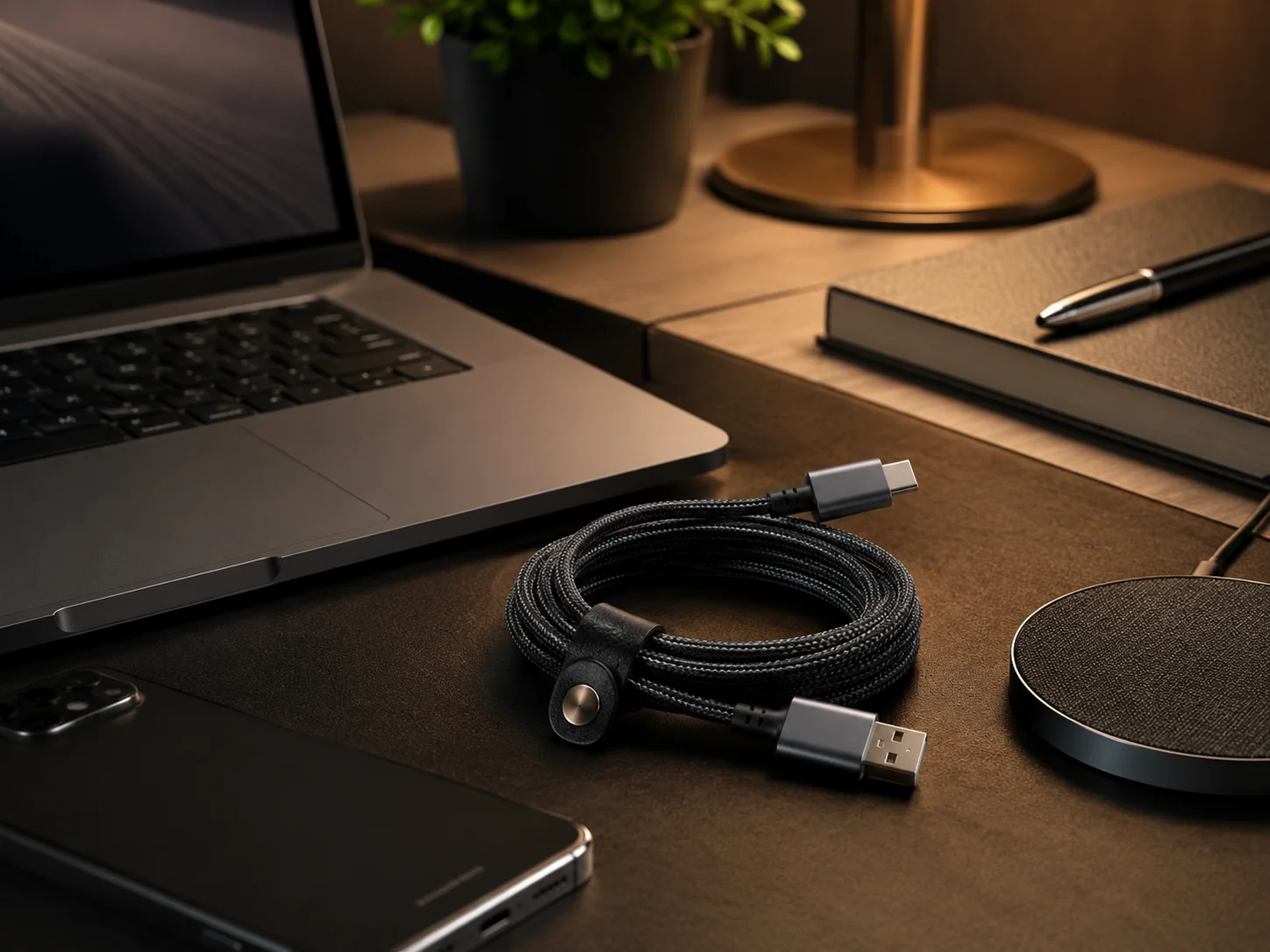
Markets with higher disposable income, strong brand consciousness, and a focus on aesthetics prefer premium cables.4 In these regions, accessories are seen as extensions of personal style, not just functional tools. A strong gifting culture also drives demand for better-looking products.
I deal with buyers from all over the world, and the difference is clear. A buyer for a discount chain in one country will only ask for the lowest price. But a buyer for a boutique electronics store in Germany or a trendy online shop in the US will ask me about color options, packaging, and the feel of the material. They know their customers are willing to pay for a better product.
Here’s a simple breakdown of the market types:
| Market Type | Customer Priority | Typical Retail Environment | Cable Preference |
|---|---|---|---|
| Price-Driven | Lowest possible cost, basic function. | Discount stores, bargain bins, some online marketplaces. | Basic PVC cables. |
| Value-Driven | Durability, aesthetics, brand trust. | Electronics stores, brand websites, department stores. | Braided, well-packaged cables. |
| Aesthetic-Driven | Style, color, matching other devices. | Fashion-forward stores, design shops, Apple resellers. | Premium braided cables in unique colors. |
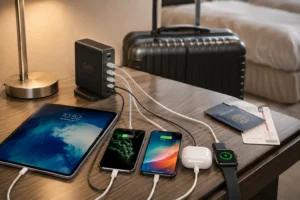
In value and aesthetic-driven markets, the cable is part of a lifestyle. It’s on the desk, in the car, or on the nightstand. Customers want it to look good and feel good, and they will pay for that.
Braided vs. PVC Cables: What Is the Real Difference?
So, you're trying to decide what to stock for your store. It comes down to braided versus the standard PVC. What's the real difference for your business?
The main differences are durability, customer perception, and cost. Braided cables offer better protection against fraying and tangling, feel more premium, and command a higher retail price. PVC cables are cheaper to produce and offer a lower-priced option for budget-conscious customers.
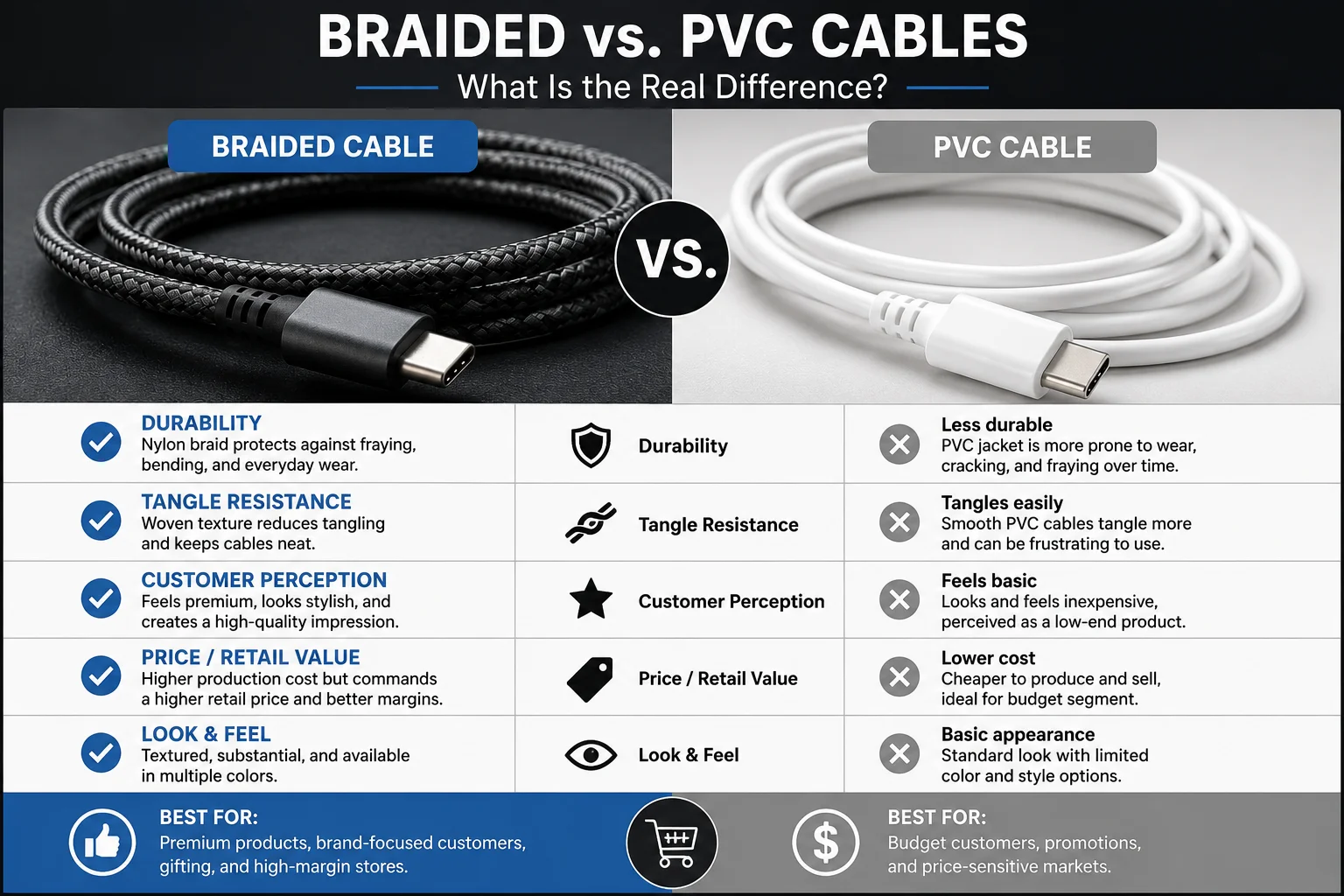
Let's get practical. I always advise my clients to think in terms of trade-offs. There's no single "best" cable, only the best cable for a specific customer and price point. When you're sourcing, you're balancing these factors to maximize your margin and customer satisfaction.
Here’s a comparison I often share with buyers:
| Feature | Braided Cable | Standard PVC Cable |
|---|---|---|
| Feel & Perception | Premium, durable, high-quality | Basic, functional, disposable |
| Durability | High resistance to abrasion and bending5 | Prone to cracking and tearing over time |
| Tangle-Resistance | Generally very good | Tangles easily, creating knots |
| Cost | Higher manufacturing cost | Lower manufacturing cost |
| Retail Price | Higher, supports better margins | Lower, competes on price |
A braided cable is an investment in a better customer experience. A PVC cable is an investment in hitting the lowest price point. Your job is to decide which investment makes more sense for your brand and your sales channel.
Does Braiding Make a Cable More Durable?
This is a question I get all the time from new importers. They see "braided" and assume it means the cable is indestructible. The answer is yes, but it's not that simple.
Yes, the braided jacket significantly improves a cable's durability against external wear and tear. It protects the inner cable from abrasion, cuts, and repeated bending. However, true longevity also depends on the quality of the internal components, like the wiring and connector points.
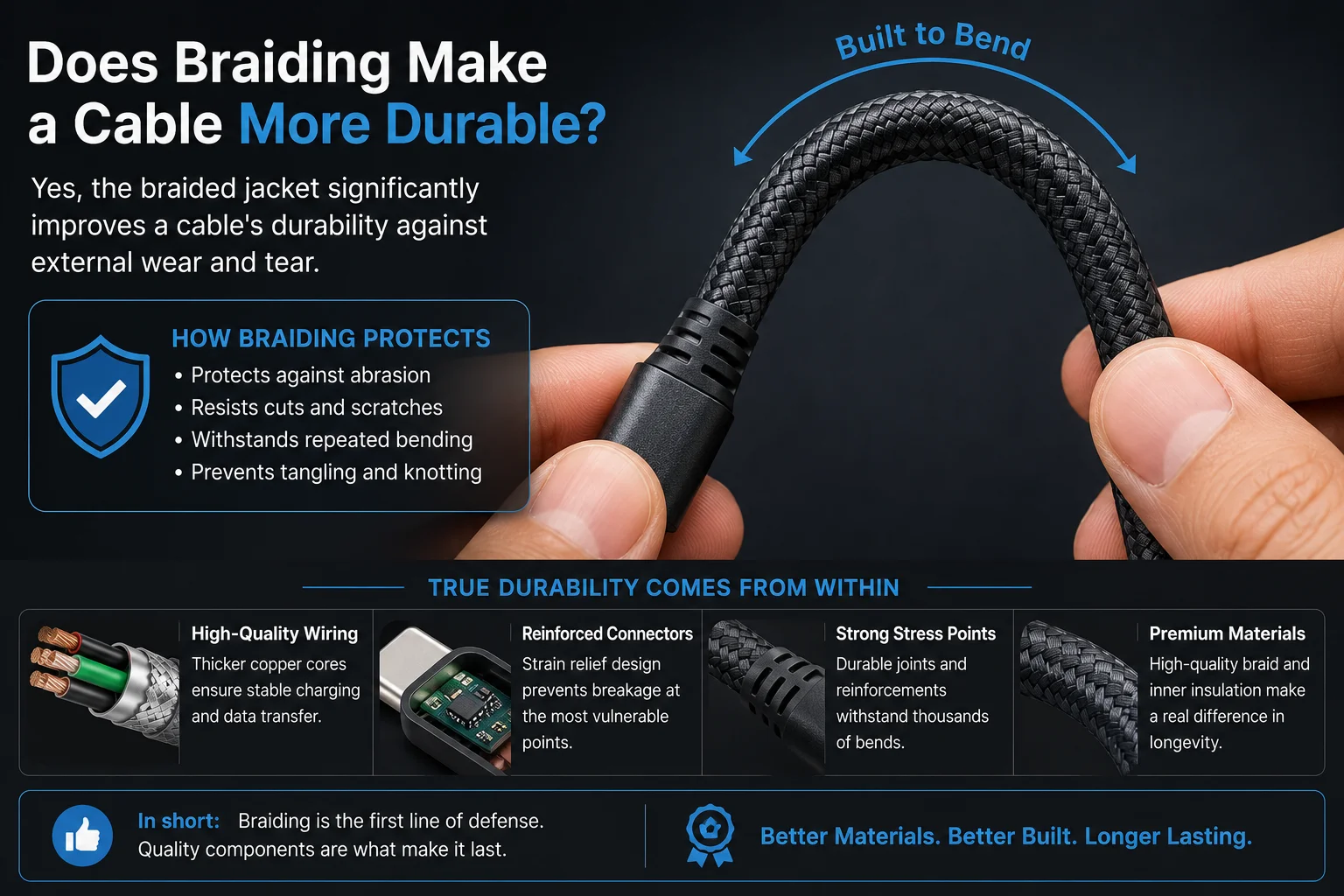
Think of the braided jacket as armor. It’s very effective at protecting the cable from the number one killer: fraying near the connector head. The woven fabric distributes stress when the cable is bent sharply, which is where most cheap PVC cables fail.6 It also protects the cable from getting nicked or cut if it's thrown in a bag with keys.
However, I've seen many buyers get burned by this. They source a cheap braided cable, and it fails within a month. Why? Because the manufacturer used a fancy braided jacket to hide poor quality inside. The internal wires were too thin, or the soldering points at the connector were weak. The cable looked tough, but it was fragile on the inside. A quality braided cable has both a strong outer jacket and high-quality internal construction.
Why Do Premium Cables Sell Better in Retail Stores?
If you run a physical retail store, you know that products have to sell themselves on the shelf. This is where braided cables have a huge advantage.
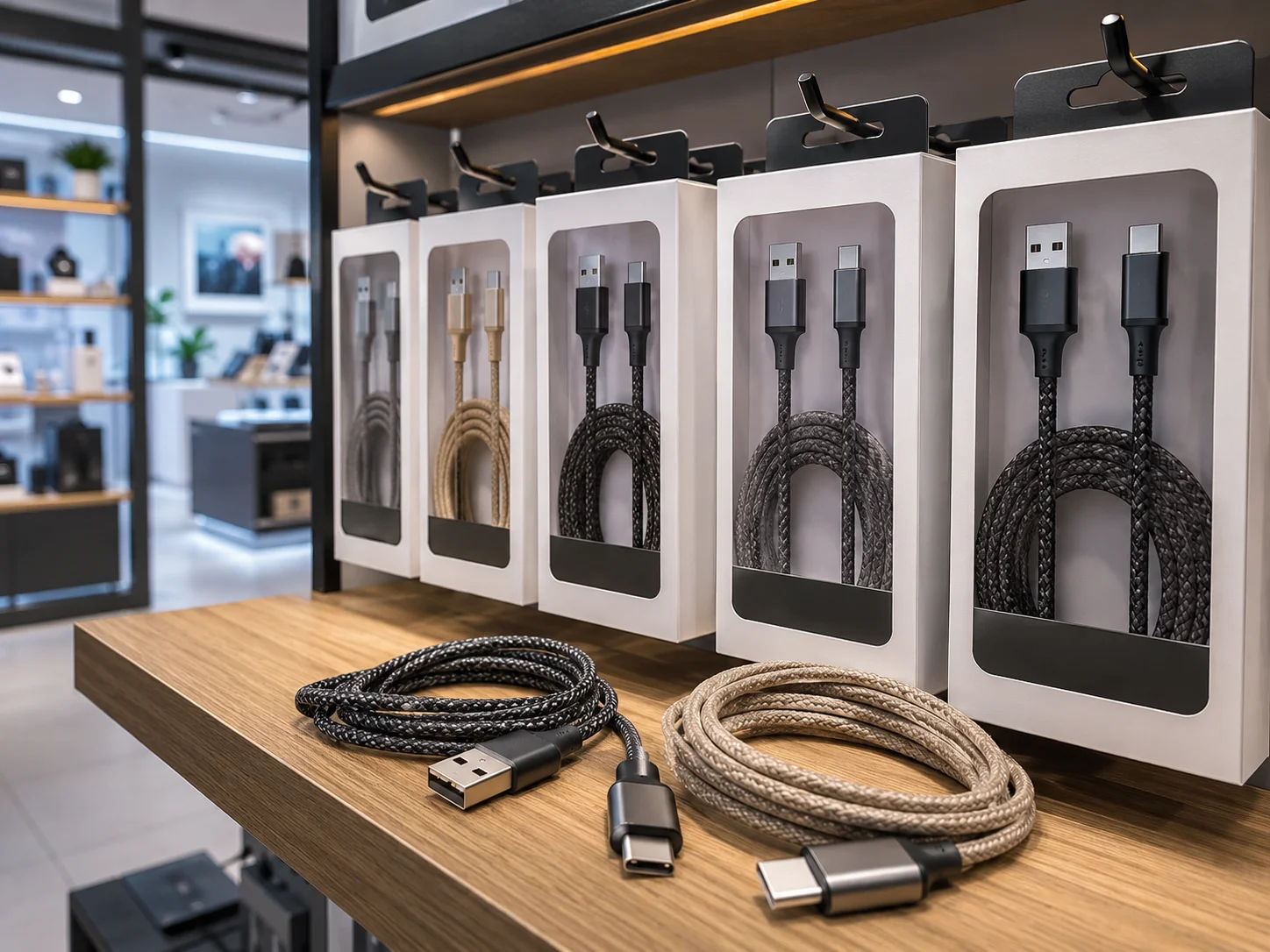
Premium braided cables sell better in retail because they stand out visually. Their texture, colors, and premium packaging catch the customer's eye. This makes them an easier upsell for staff and gives the impression of a higher-quality product compared to generic plastic cables.
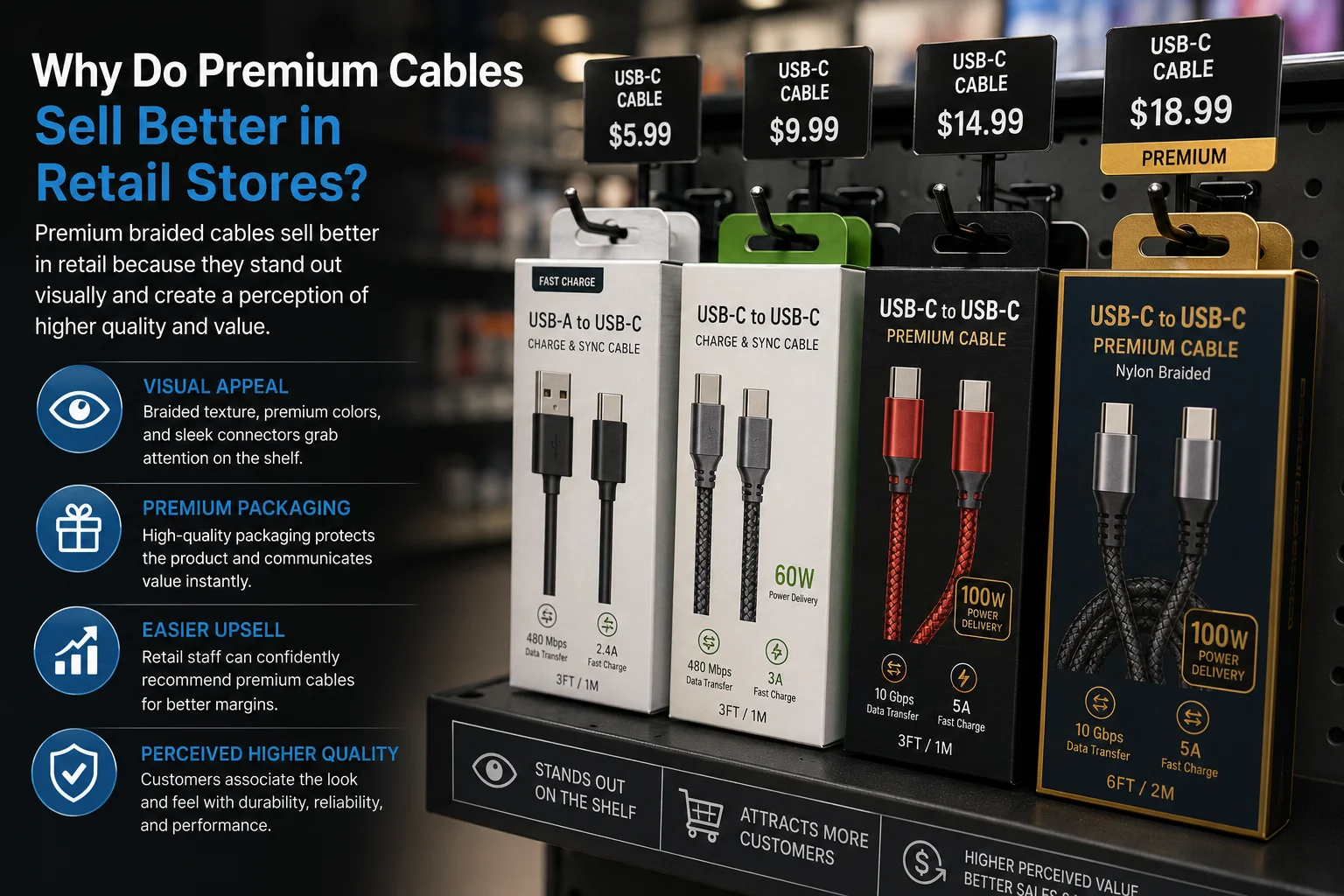
Imagine a wall of phone accessories. Most of it is a sea of white and black plastic. A display of colorful, textured braided cables immediately draws attention. When I work with retail clients, we focus heavily on packaging. A braided cable in a well-designed box with a window feels like a real product, not a cheap commodity.
This visual appeal does two things. First, it gets the customer to pick up the product. Once the cable is in their hands, the premium feel we talked about earlier takes over. Second, it justifies the price difference. When a customer sees a $5 cable next to a $15 cable that looks and feels ten times better, the choice is easy for anyone not strictly shopping on a budget. It's a classic good-better-best strategy, and the braided cable is almost always the "better" or "best" option.
Why Do E-Commerce Buyers Like Braided USB Cables?
The retail logic is clear, but what about online? For e-commerce sellers, braided cables solve a different but equally important set of problems.
E-commerce buyers like braided cables because they look better in photos, generate better reviews, and result in fewer returns. A high-quality image of a braided cable communicates durability, reducing customer hesitation. Positive reviews often mention the "sturdy feel," which builds trust with future buyers.
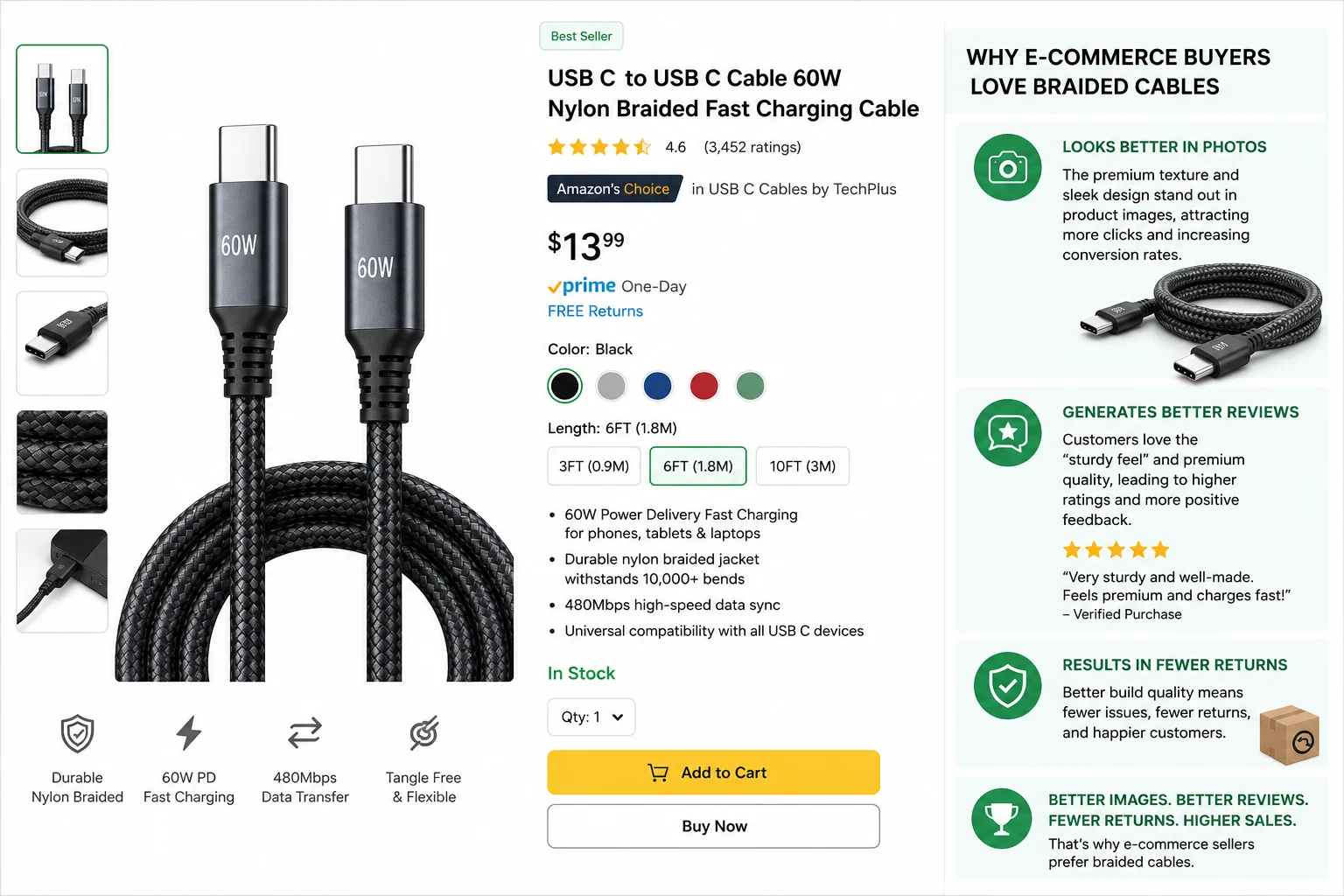
In e-commerce, your product photo is everything. A flimsy-looking PVC cable is hard to photograph well. It can look cheap and unappealing. A braided cable, on the other hand, has texture, reflects light in interesting ways, and can be styled to look like a premium tech accessory. This directly impacts your click-through and conversion rates.
After the sale, the benefits continue. When the customer receives the product, a braided cable immediately meets or exceeds their expectations. It feels as good as it looked online. This leads to positive reviews mentioning words like "strong," "durable," and "high-quality." These keywords are powerful social proof. Conversely, a cheap PVC cable can lead to disappointment and returns, with complaints like "flimsy" or "feels cheap," even if it works perfectly.
Which Customers Are Willing to Pay More?
The core of your business strategy is identifying the customer who will actually pay a premium. Not everyone will. So who is the ideal customer for a braided cable?
Customers who have been burned by cheap, failing cables in the past are most willing to pay more.7 This group includes tech enthusiasts, business professionals, students, and anyone who values reliability and a "buy it once, buy it right" philosophy.
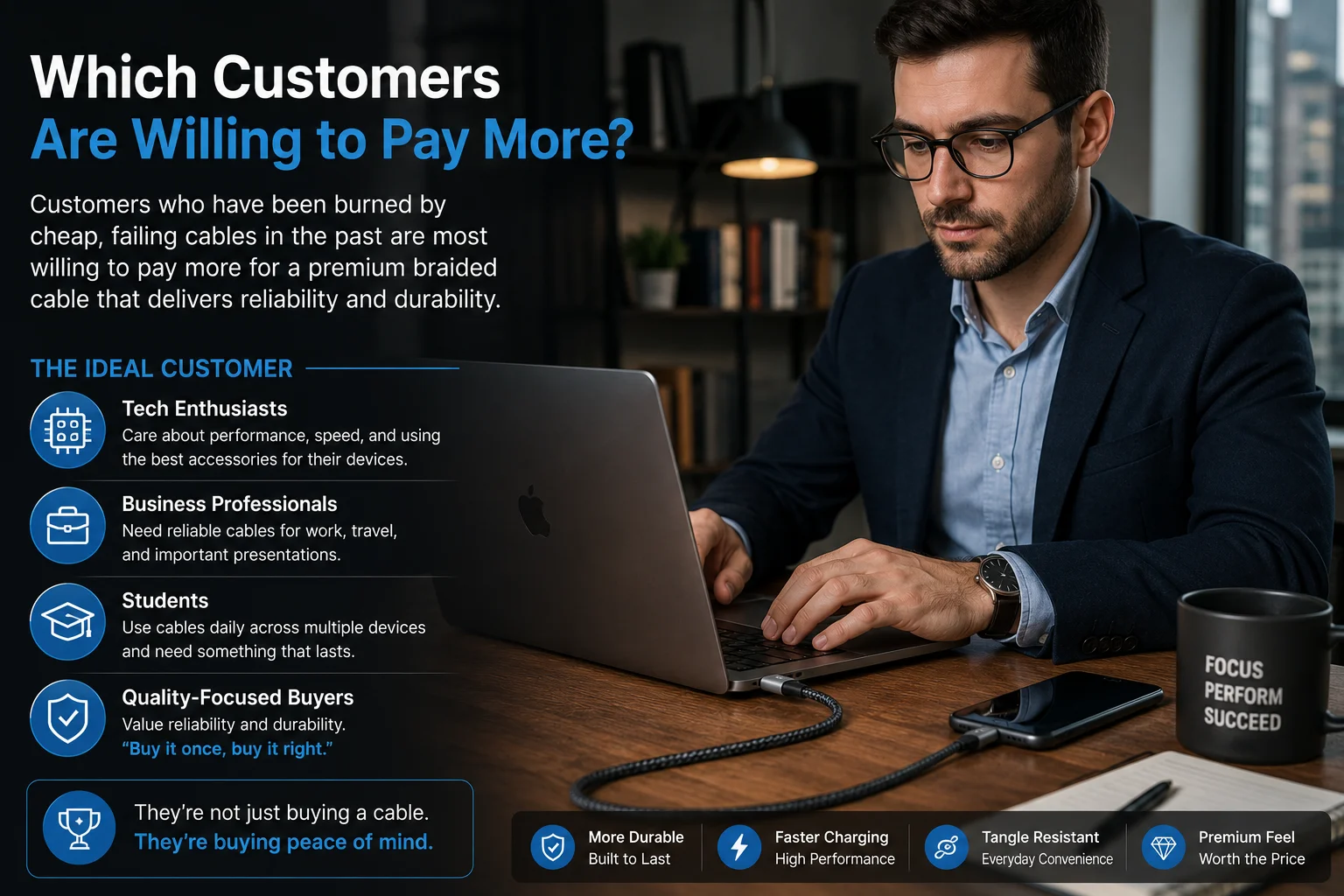
Over my 15 years in this business, I've noticed a clear pattern. The best customer for a premium cable is someone who has already experienced the pain of a cheap one. They've had a cable die right before a big meeting or had the tip break off inside their phone. They are frustrated and are now actively looking for a better solution.
Here are the key profiles:
- The Tech Enthusiast: They want the best gear for their expensive devices. They understand the value of good accessories and are willing to pay for performance and aesthetics.
- The Business Professional: They rely on their devices for work. A failed cable is not just an inconvenience; it's a potential business problem. Reliability is their top priority.
- The Family/Multi-Device User: They are tired of replacing broken cables for their kids or managing a tangled mess of chargers. They will pay for durability and tangle-free convenience.
- The Gift Giver: When buying for someone else, people often choose a nicer, better-packaged option. A premium braided cable makes a much better gift than a generic plastic one.
What Specs Matter Besides the Braided Jacket?
A braided jacket is a great selling point, but savvy buyers know it's only half the story. To truly sell a premium product, you need premium performance inside.
Beyond the braid, the most critical specs are the wire gauge (AWG) for charging speed, the data transfer rate, the connector quality (like Apple's MFi certification), and the strain relief design. These internal factors determine the cable's actual performance and lifespan.
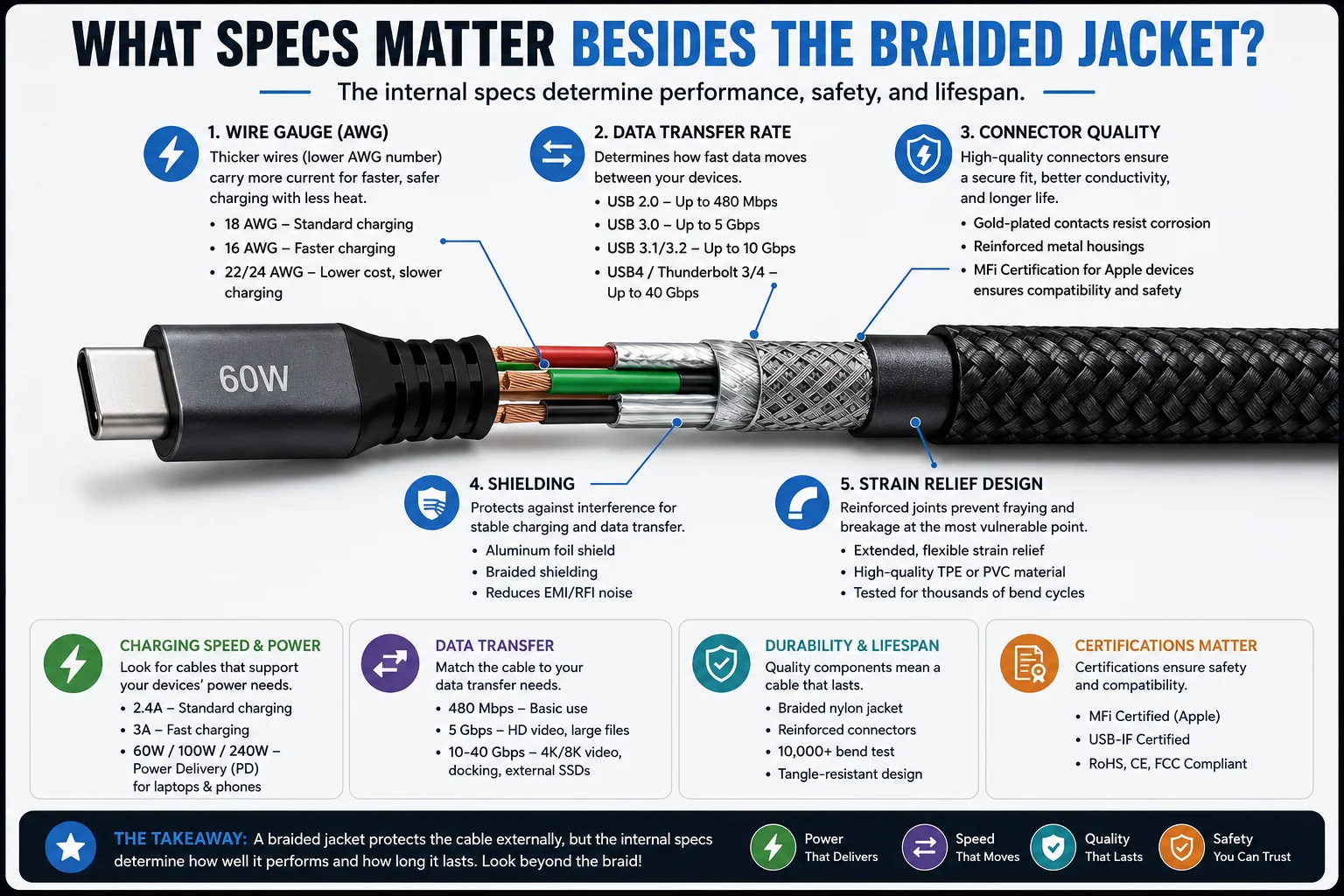
When a serious buyer from Europe or the US contacts me, they don't just ask if the cable is braided. They ask about the technical specifications. If you are sourcing cables, these are the questions you should be asking your manufacturer.
Key Internal Specs
- Wire Gauge (AWG): This measures the thickness of the copper wires inside. A lower AWG number means a thicker wire, which can carry more current.8 For fast charging, you need a cable with a low AWG rating for the power wires (e.g., 24AWG or lower).
- Data Transfer Speed: Is it a USB 2.0 (480Mbps) or USB 3.1 (10Gbps) cable? For customers who transfer large files, this is a critical difference.
- Connector Quality: The connector ends are a common point of failure. Look for seamless, single-piece connector housings. For Apple devices, ensuring the cable uses a genuine MFi (Made for iPhone/iPad) chip is essential to avoid error messages and ensure compatibility.9
- Strain Relief: This is the flexible rubber or plastic part where the cable meets the connector head. A long, flexible strain relief is much better at preventing fraying than a short, stiff one.
What Are Common Quality Problems in Cheap Braided Cables?
I want to be honest with you. Not all braided cables are created equal. As a buyer, you need to be aware of the tricks that low-quality factories use.
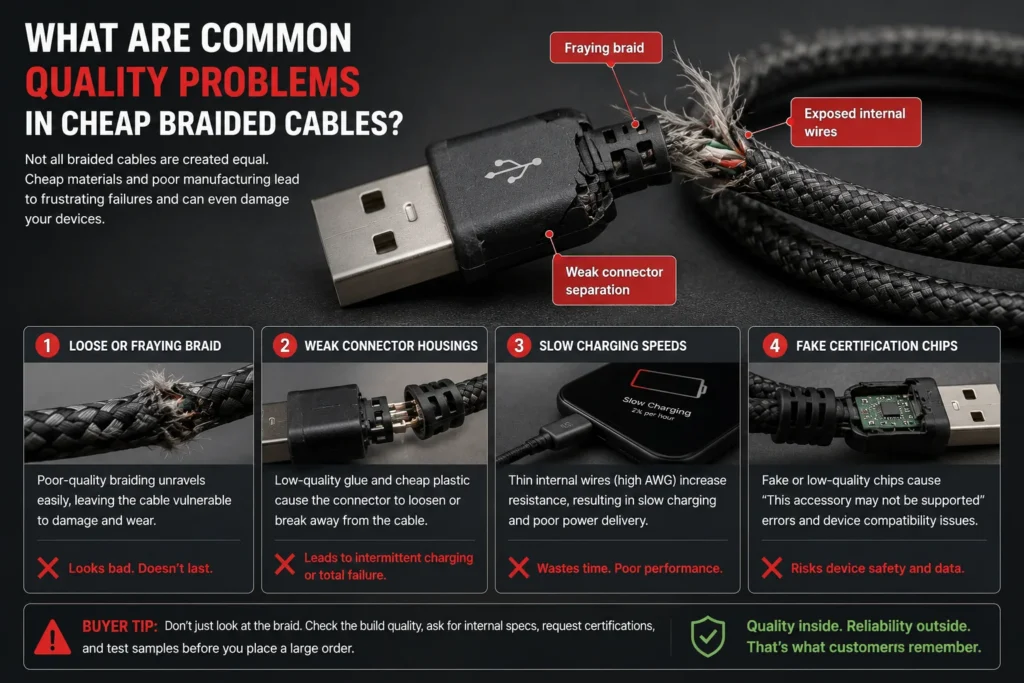
Common problems with cheap braided cables include a loose or easily fraying braid, weak connector housings that separate from the cable, slow charging speeds due to thin internal wires, and using fake certification chips which cause performance issues.10
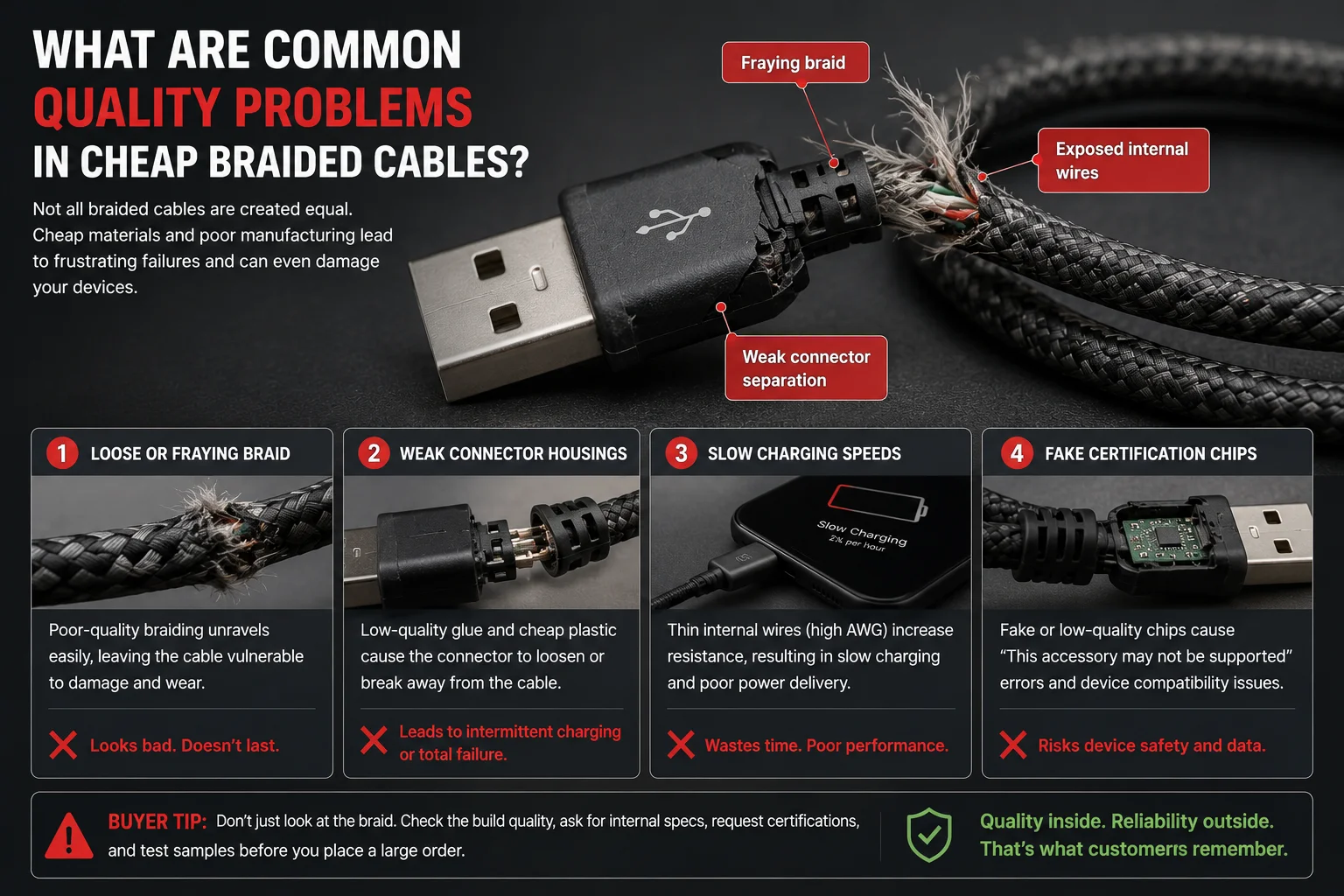
It breaks my heart when a new client comes to me after a bad experience with another supplier. They ordered 5,000 beautiful-looking braided cables, only to have 20% of them returned by customers. These are the issues they almost always face:
- The Braid Fraying: The factory uses a low-density weave with cheap material. After a few weeks of use, it starts to look fuzzy and eventually unravels.
- Connector Separation: The glue or molding holding the metal connector head to the cable is weak. A little bit of pulling, and the whole head comes off, exposing the delicate wires inside.
- "Charging... Slowly": The cable looks like it supports fast charging, but the manufacturer used hair-thin 28AWG or 30AWG power wires. The phone recognizes it's charging, but it takes forever.
- Fake MFi Certification: For Lightning cables, a factory might use a cracked or fake chip. It might work for a few weeks, but an iOS update from Apple can render the cable useless overnight11.
How Should Buyers Choose a Braided USB Cable Manufacturer?
Choosing the right partner is even more important than choosing the right product. A good manufacturer will guide you to success; a bad one will be a constant headache.
Buyers should choose a manufacturer by verifying their certifications (like MFi, USB-IF, CE), requesting a detailed Bill of Materials (BOM), testing samples for durability and performance, and inquiring about their quality control (QC) process.12 A trustworthy partner is transparent about these details.
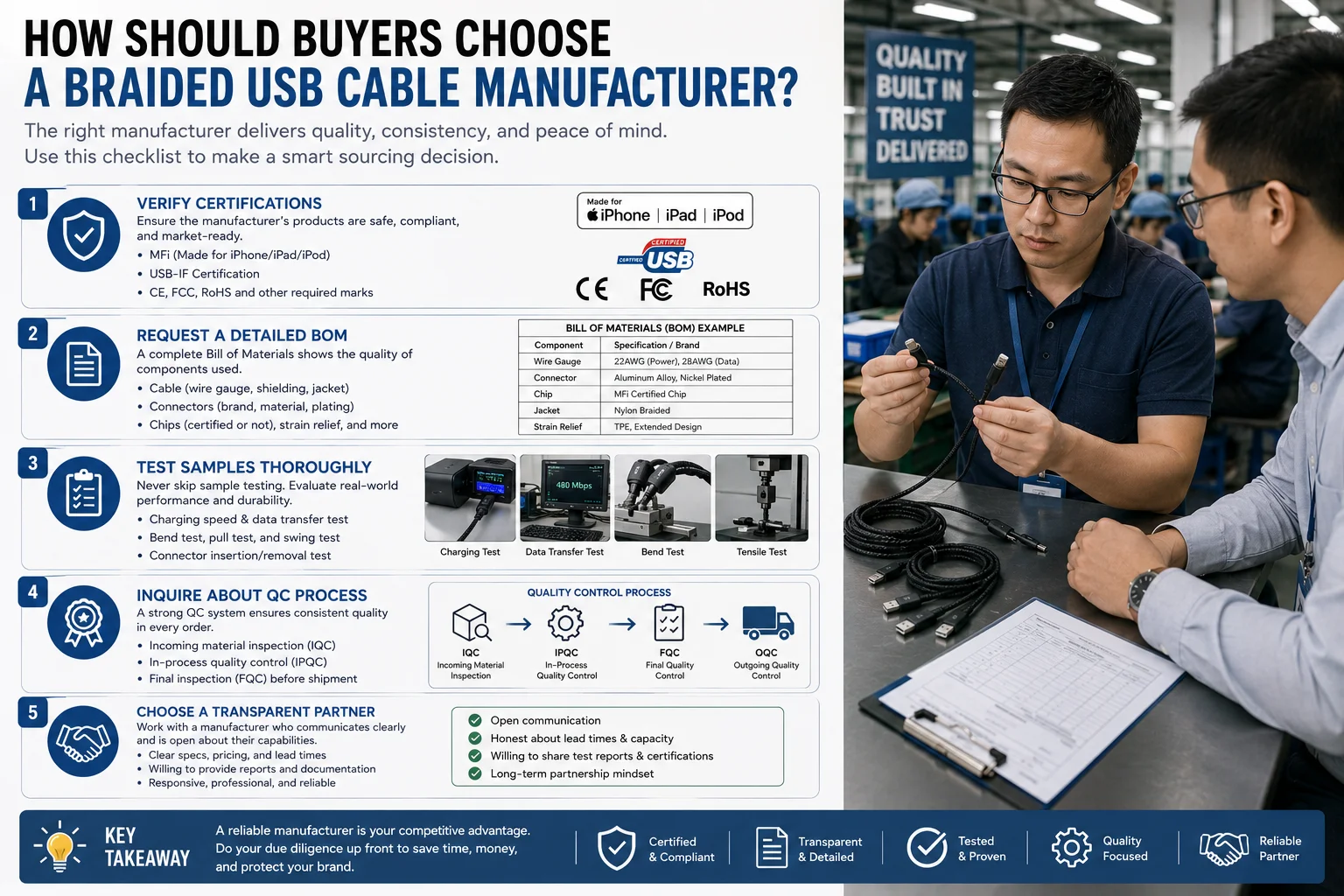
After 15 years, I've developed a checklist that I recommend to all my clients when they evaluate a potential supplier. Don't just look at the price on Alibaba. A good partner is worth a slightly higher cost.
Your Manufacturer Checklist:
- Ask for Certifications: Don't just take their word for it. Ask for the certification documents for MFi, CE, RoHS, etc. A legitimate manufacturer will provide them without hesitation.
- Request the Bill of Materials (BOM): Ask for the specs. What is the wire gauge (AWG)? What brand of chip are they using? What material is the connector housing made from?
- Always Test Samples: Get samples and abuse them. Bend them, pull them, use them for a week. See how fast they charge your devices. Does the reality match the specs they promised?
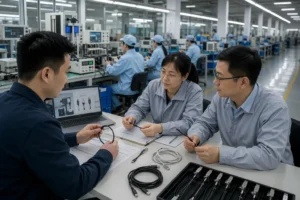
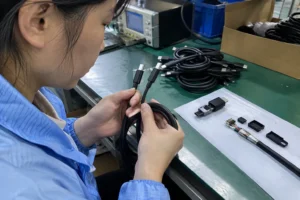
- Understand Their QC Process: Ask them how they test their cables. Do they test every single cable? What equipment do they use? Do they perform bend tests and pull tests? A factory that is proud of its quality will be happy to show you its process.
Final Buying Advice: Match Cable Quality to Market Positioning
We've covered a lot of ground. So, what's the final takeaway? How do you make the right choice for your business?
The best cable choice depends entirely on your market and brand. Don't just buy braided cables because they are "premium." Carefully match the cable's quality, appearance, and cost to your customer's expectations and what your brand stands for to achieve the best sales results.
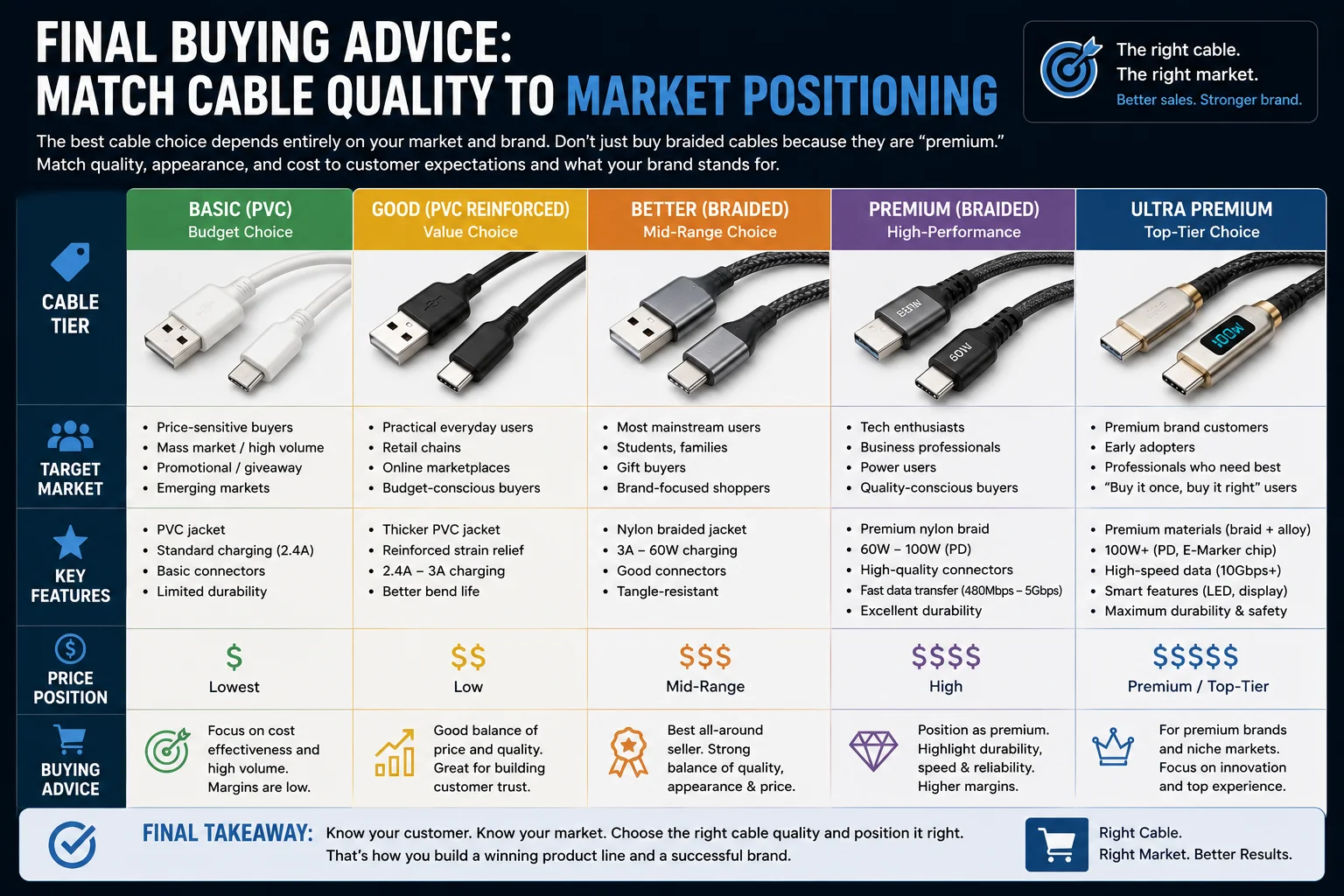
Here is my final piece of advice, distilled from thousands of conversations with buyers like you. If you are a discount retailer competing on price, a high-quality, reliable PVC cable might be a smarter and more profitable choice. You can deliver function without the extra cost of aesthetics.
However, if you are building a brand, selling in a retail store, or targeting customers who care about quality and style, investing in a good braided cable is one of the easiest ways to elevate your product line. It provides a clear visual and tactile difference that customers are willing to pay for. The key is to source from a manufacturer who delivers on both the external look and the internal quality.
Conclusion
The best cable choice depends on your market. Match the cable's quality and appearance to your brand and customer expectations for the best results.
"Influence of Customer Quality Perception on the Effectiveness ... - PMC", https://pmc.ncbi.nlm.nih.gov/articles/PMC4789549/. Market research or studies in consumer psychology can show that factors like perceived durability, brand reputation, and aesthetics significantly influence purchasing decisions for accessories, with many consumers willing to pay a premium over the lowest-priced option. Evidence role: general_support; source type: research. Supports: The claim that consumers in certain market segments are willing to pay more for products with perceived higher quality, durability, or aesthetic appeal.. ↩
"Hand-Feel Touch Cues and Their Influences on Consumer ... - PMC", https://pmc.ncbi.nlm.nih.gov/articles/PMC6678767/. Research in sensory marketing demonstrates that tactile cues, such as texture, weight, and firmness, can create a psychological association with concepts like durability, craftsmanship, and premium value, influencing consumer perception before the product's function is even evaluated. Evidence role: mechanism; source type: paper. Supports: The claim that tactile input (haptics) strongly influences a consumer's perception of a product's quality and value.. ↩
"[PDF] Crossing numbers of cable knots - Michigan State University", https://users.math.msu.edu/users/kalfagia/cables.pdf. Studies on the physics of knot formation in agitated strings show that factors like bending stiffness and coefficient of friction are critical. The increased stiffness and textured surface of a braided cable can reduce its propensity to form the tight loops necessary for spontaneous knotting compared to a smoother, more flexible cord. Evidence role: mechanism; source type: paper. Supports: The claim that the physical properties of braided cables make them less likely to form knots.. Scope note: While the principles of physics support this, direct comparative studies on commercial USB cables may be limited. ↩
"[PDF] How Does Income Affect Consumers' Decisions? - Clemson OPEN", https://open.clemson.edu/cgi/viewcontent.cgi?article=5705&context=all_theses. Market research reports often show a positive correlation between a region's per capita disposable income and consumer spending on non-essential, premium, or design-oriented goods, including personal electronic accessories. Evidence role: statistic; source type: research. Supports: The claim that markets with higher disposable income show greater preference for premium and aesthetic-focused products.. ↩
"Chapter 2 Rope Properties", https://vtechworks.lib.vt.edu/bitstream/handle/10919/30925/Chapter2.pdf. Material science data sheets and engineering resources show that woven nylon, a common material for braided jackets, exhibits higher tensile strength and greater resistance to abrasion and flex fatigue compared to the polyvinyl chloride (PVC) typically used for standard cable jackets. Evidence role: mechanism; source type: education. Supports: The claim that the material used for braiding (like nylon) is more resistant to abrasion and bending than standard PVC.. ↩
"[PDF] Correlation of Electrical Cable Failure with Mechanical Degradation.", https://www.nrc.gov/docs/ML0622/ML062260360.pdf. Principles of mechanical engineering show that a braided sheath can distribute bending stress along the length of its interwoven fibers, preventing stress concentration at a single point. This mechanism reduces the likelihood of material failure at high-stress points, such as near the connector head. Evidence role: mechanism; source type: paper. Supports: The claim that a woven jacket distributes stress more effectively than a solid one.. ↩
"Consumers blame both manufacturer and retailer when products fail ...", https://mendoza.nd.edu/news/consumers-blame-when-products-fail/. Studies in consumer behavior indicate that product failure can lead to a re-evaluation of purchasing criteria, with consumers often becoming more risk-averse and willing to pay a premium for products perceived as more reliable or durable to avoid repeating the negative experience. Evidence role: general_support; source type: research. Supports: The claim that a negative experience with a low-quality product increases a consumer's willingness to pay more for a higher-quality alternative.. ↩
"American wire gauge - Wikipedia", https://en.wikipedia.org/wiki/American_wire_gauge. The American Wire Gauge (AWG) standard specifies that as the gauge number decreases, the wire diameter increases. According to electrical principles, a thicker wire has lower electrical resistance, allowing it to safely carry a larger amount of current without overheating. Evidence role: definition; source type: government. Supports: The definition of the American Wire Gauge (AWG) standard and its relationship to wire diameter and current capacity.. ↩
"MFi Program - Wikipedia", https://en.wikipedia.org/wiki/MFi_Program. Apple's MFi Program guidelines state that certified accessories contain an authentication chip that communicates with the Apple device to ensure safety and compatibility. Using non-certified cables can result in performance issues, damage, or the appearance of warning messages like 'This accessory may not be supported.' Evidence role: definition; source type: other. Supports: The claim that MFi certification is critical for ensuring compatibility and avoiding errors with Apple devices.. Scope note: The primary source for this information is Apple, the entity that created the standard. ↩
"cheap USB microphone cable : curiosity teardown - YouTube",
. Independent product teardowns and durability tests of low-cost electronic accessories frequently identify common points of failure, including the use of low-gauge internal wires that limit charging speed, weak soldering at connector points, and poor-quality jacketing materials that degrade quickly with use. Evidence role: general_support; source type: research. Supports: The claim that low-cost braided cables often exhibit specific failure modes related to poor materials and construction.. ↩"Has anyone else noticed third party lightning cables stop working ...", https://www.reddit.com/r/apple/comments/7nitus/has_anyone_else_noticed_third_party_lightning/. Technology news outlets have historically reported that with certain iOS updates, Apple has enhanced its detection of non-certified and counterfeit Lightning accessories, causing some cables that previously worked to become non-functional or display persistent error messages. Evidence role: case_reference; source type: other. Supports: The claim that iOS updates can cause non-MFi certified cables to stop working.. ↩
"General Use Products: Certification and Testing | CPSC.gov", https://www.cpsc.gov/Business--Manufacturing/Testing-Certification/General-Use-Products-Certification-and-Testing. Guides on global sourcing and supply chain management from business and trade organizations emphasize a multi-step supplier qualification process. This typically includes verifying claimed certifications (e.g., ISO, CE), auditing quality control procedures, requesting detailed product specifications like a Bill of Materials (BOM), and conducting independent testing of pre-production samples. Evidence role: general_support; source type: institution. Supports: The claim that vetting a manufacturer involves verifying certifications, materials, quality control processes, and sample testing.. ↩