Struggling to keep up with the latest charging tech? Sourcing the wrong products can hurt your sales and brand reputation. This guide will help you make a smart decision.
Qi2 is the new universal wireless charging standard%%%FOOTNOTE_REF1%%%. It uses magnets for perfect alignment, [delivering a faster, more efficient 15W charge](https://en.wikipedia.org/wiki/Qi(standard))2. For buyers, it means a better user experience and a single standard for both new iPhones and Android devices.
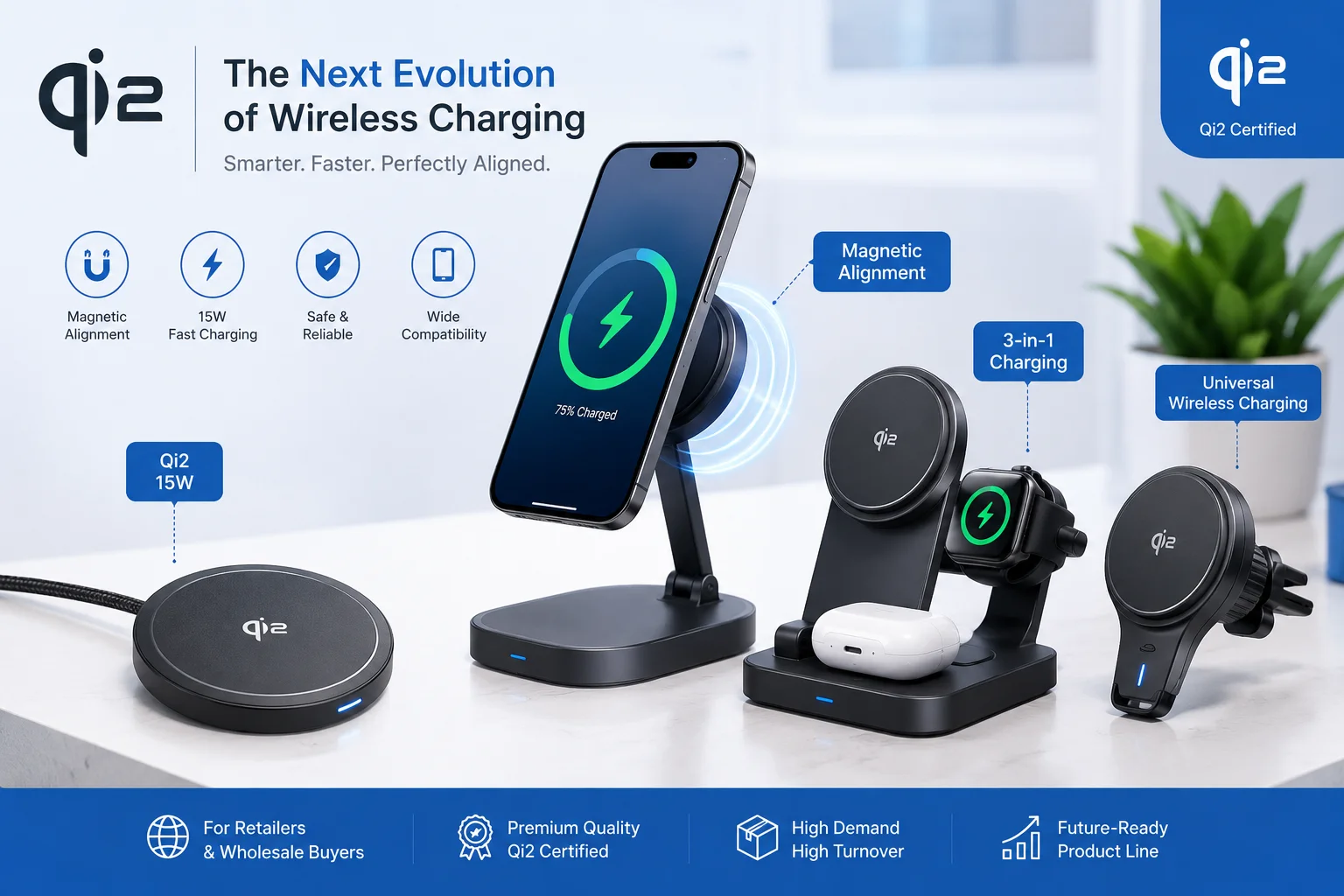
I've been exporting consumer electronics for over 15 years. Every few years, a new "standard" comes along promising to change everything. Some do, but most just add to the confusion. Qi2 feels different. It's not just a technical upgrade; it’s a strategic opportunity for accessory brands, retailers, and wholesalers. But jumping in without a plan is risky. In this guide, I'll walk you through what you, as a business buyer, actually need to know. We'll skip the deep engineering talk and focus on what this means for your product lineup, your customers, and your bottom line. Let's break down how to source these products wisely.
What Is Qi2 Wireless Charging and Why Does It Matter for My Business?
A new charging standard can feel like just more noise. But ignoring a major shift can leave your business behind as competitors meet new customer demands. Here's what you need to know.
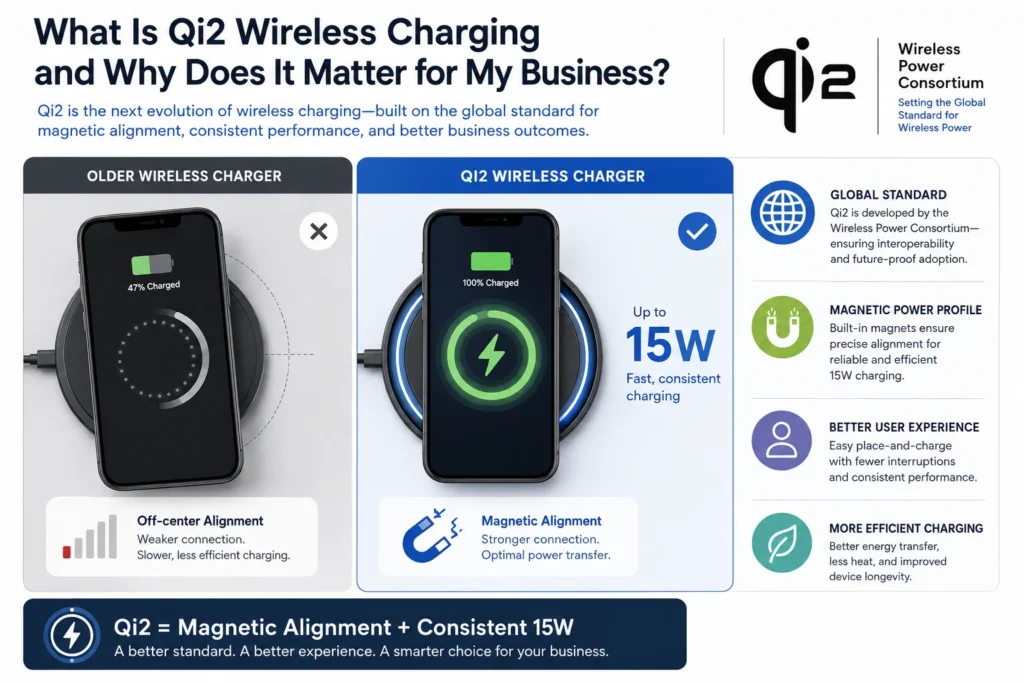
Qi2 is the new global standard for wireless charging, created by the Wireless Power Consortium (WPC). It integrates a Magnetic Power Profile (MPP), which uses magnets to perfectly snap a device into place. This guarantees a stable, efficient 15W charge every time.
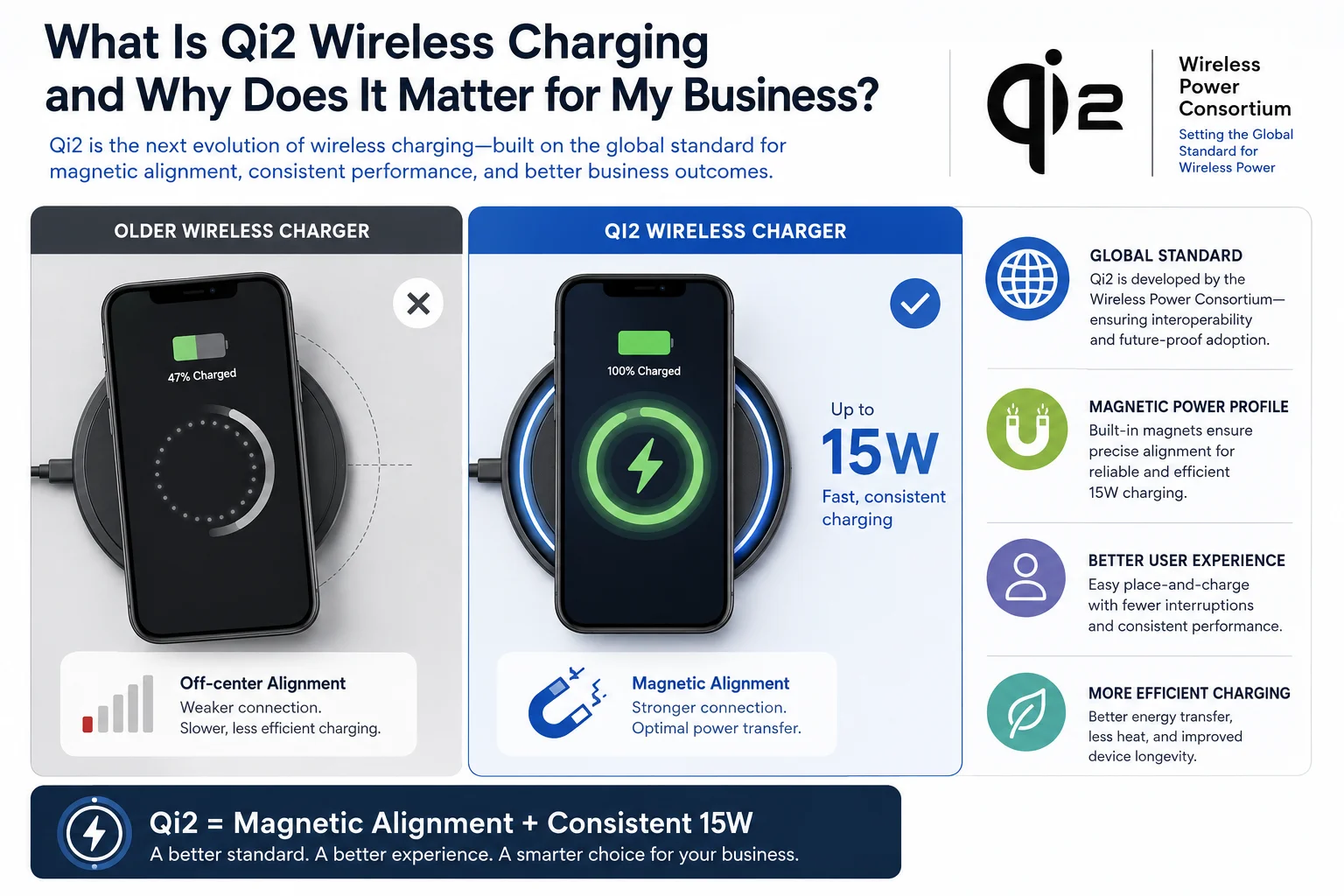
From my experience talking with European retailers, the big question is, "Should I replace all my old wireless chargers with Qi2?" The answer is no. You should think of Qi2 as a strategic addition to your portfolio, not a blanket replacement. It's about segmenting your market. For your customers who buy the latest flagship phones, Qi2 is a must-have. It delivers the premium "click and charge" experience they expect. For customers with older devices or those who are more budget-conscious, existing Qi chargers are still perfectly fine. Adopting Qi2 is a chance to create a tiered offering. You can have your good (standard Qi), better (EPP 10W Qi), and best (Qi2 15W Magnetic). This approach allows you to capture a wider range of customers without making your entire inventory obsolete overnight. It's a smart way to manage costs while staying on top of market trends.
Is Qi2 Just MagSafe for Everyone?
It's easy to look at Qi2 and think it's the same as Apple's MagSafe. Using the wrong terms in your marketing can lead to customer confusion or even legal issues with Apple.
Qi2 is an open standard developed by the WPC, with major contributions from Apple based on its MagSafe technology3. This brings MagSafe's magnetic convenience to the entire industry, including Android phones. MagSafe, however, remains Apple's proprietary brand for its ecosystem of magnetic accessories.
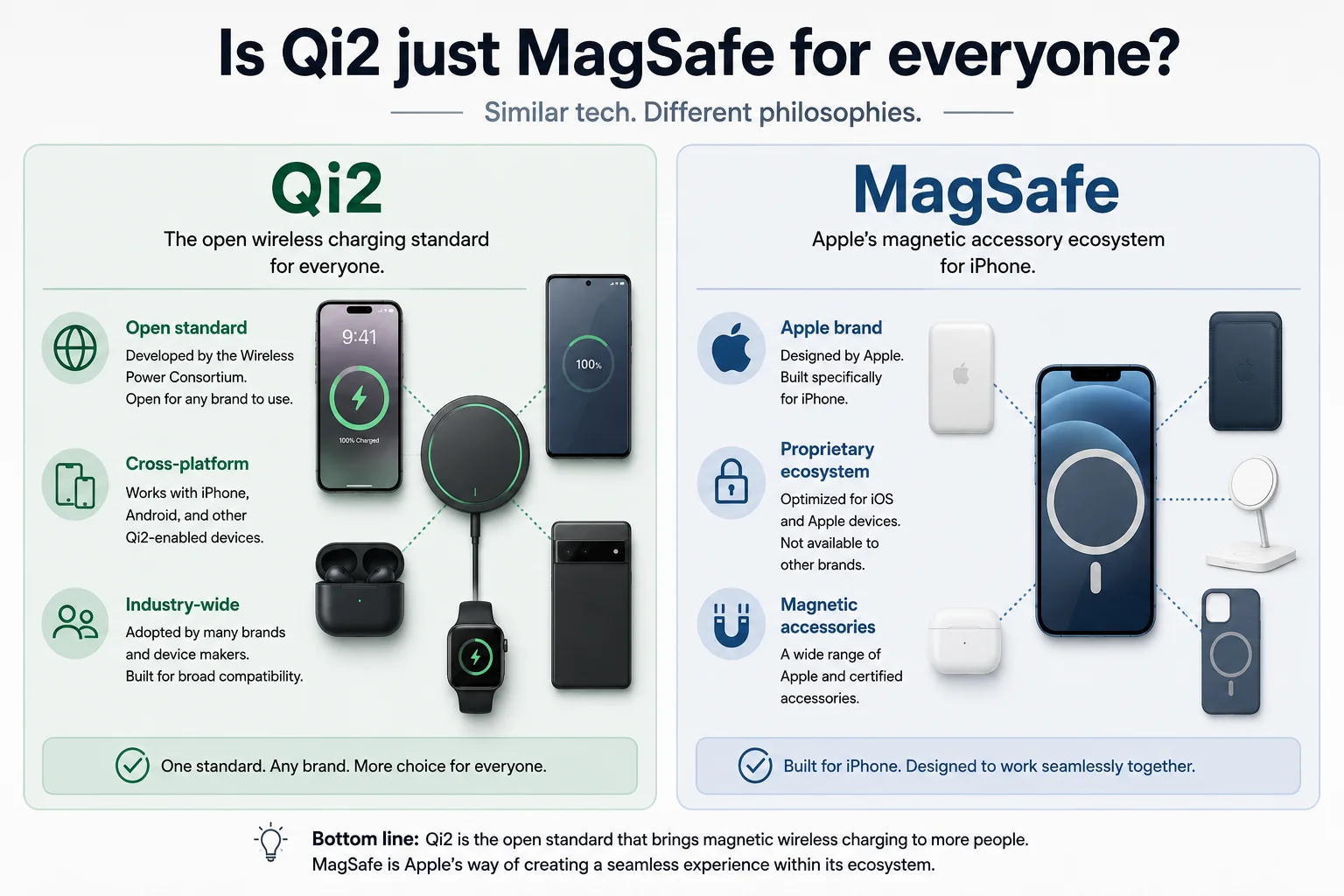
This is a critical commercial distinction, not just a technical one. A common question our clients ask is, "So can I market my Qi2 charger as 'MagSafe compatible' for Android?" My advice is always to be very careful. While a Qi2 charger will magnetically attach to and charge an iPhone 13 or newer just like a MagSafe charger, you cannot use Apple's "MagSafe" trademark to market its benefits for Android devices. Instead, you need a different strategy. Focus on the functional benefits. Use descriptive language like "Secure Magnetic Lock," "Effortless Snap-on Charging," or "Perfect Alignment Every Time." This communicates the value to both iPhone and Android users without infringing on trademarks. I recently helped a client develop packaging that showed a picture of the charger snapping onto both an iPhone and a generic Android phone, with the headline "Universal Magnetic Wireless Charging." This approach is clear, effective, and legally safe.
What Does the Magnetic Power Profile Mean for My Customers?
You see technical terms like "Magnetic Power Profile" or "MPP" on spec sheets. But if you can't explain what it means for your customer, you can't sell the product effectively.
The Magnetic Power Profile (MPP) is the technology inside Qi2 that uses a ring of magnets to automatically align the charger with the device. This perfect connection is what enables a consistent, efficient, and safer 15-watt charge. It solves the biggest problem of older wireless chargers.
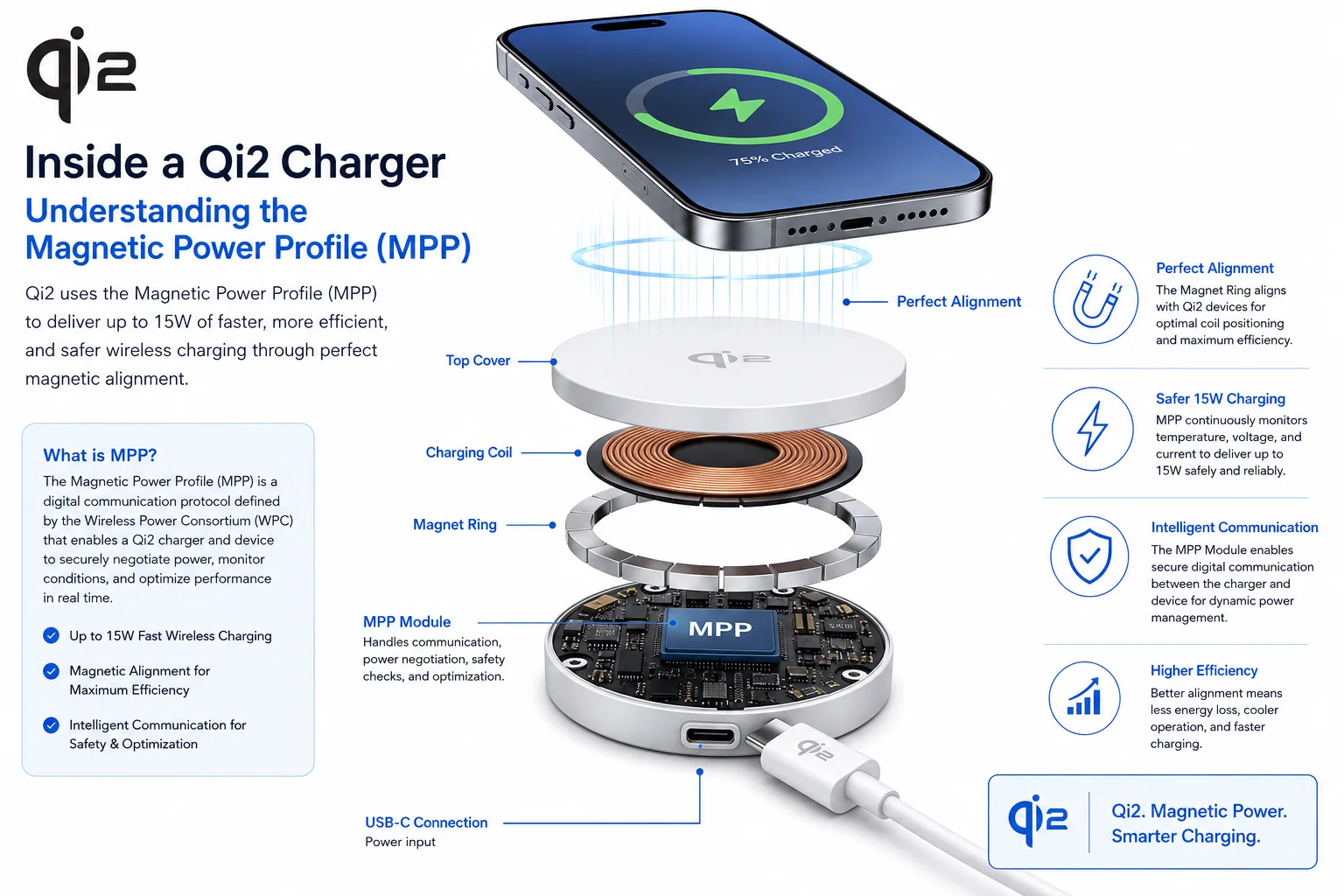
Let's break down why MPP is such a big deal for the end-user. I remember a few years ago, one of my wholesale clients had a huge return rate on a popular non-magnetic wireless charger. The complaint was always the same: "I put my phone on it at night, and I woke up and it wasn't charged." The problem was misalignment. A slight nudge could break the connection or slow the charging speed to a trickle. MPP eliminates this issue completely. The magnetic lock is strong and satisfying, giving users confidence their device is charging. This also leads to better efficiency. Less energy is wasted as heat, which is better for the phone's battery health in the long run4. This improved efficiency and secure connection open the door for new product types, like vertical stands and car mounts, where a secure grip is essential.
| Feature | Old Qi (BPP/EPP) | Qi2 (MPP) | Customer Benefit |
|---|---|---|---|
| Alignment | Manual, easy to misplace | Automatic, magnetic lock | No more waking up to a dead phone. |
| Efficiency | Lower, wastes energy as heat | Higher, less heat generated | Safer, better for battery longevity. |
| Form Factor | Mostly flat pads | Stands, car mounts, pucks | More useful in more situations. |
Will My Customers Really Notice Faster Charging with Qi2?
"Faster charging" is one of the most overused and misunderstood marketing claims. Making promises you can't keep is a quick way to get negative reviews and damage your brand's credibility.
Yes, Qi2 delivers noticeably faster and more consistent charging than standard wireless chargers. It guarantees a 15W charging speed for compatible devices because the magnets ensure a perfect connection. Older chargers often fall back to slower 5W or 7.5W speeds if the phone isn't placed perfectly.
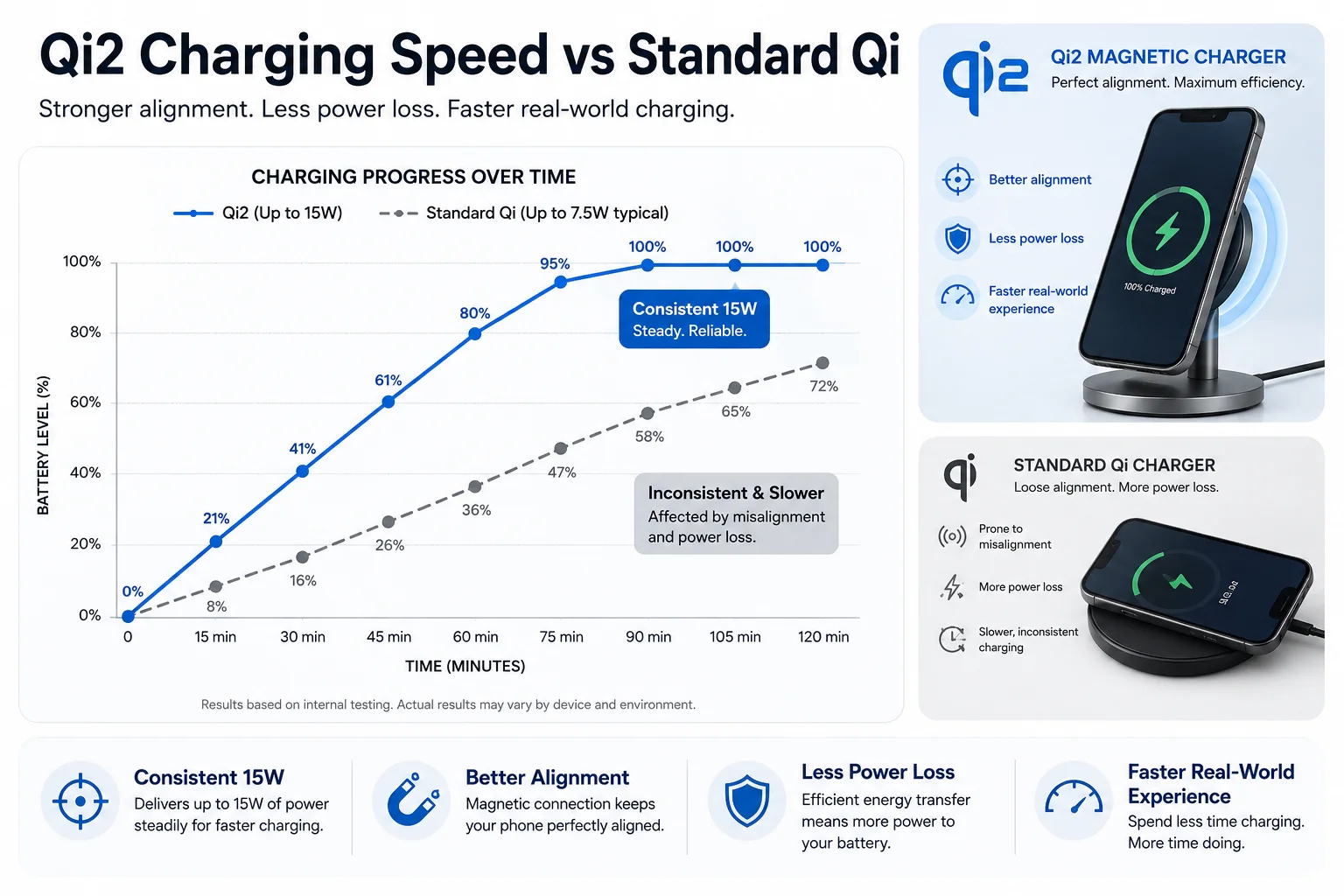
Here’s the nuance that many brands miss. The key isn't just the peak speed, it's the sustained speed. We've had 15W wireless chargers before Qi2 (using the EPP profile), but they were unreliable5. If the phone wasn't placed in the exact sweet spot, or if it got too hot, it would slow down dramatically. From our internal testing, many of these older "15W" chargers rarely delivered more than 7.5W or 10W in real-world use. Qi2 solves this. For an iPhone 13 or newer, the charging experience is identical to using Apple's own 15W MagSafe charger. For new Qi2-enabled Android phones, it's a massive upgrade from the slow, unpredictable wireless charging they were used to. The magnetic alignment means less energy is wasted as heat. This reduction in heat prevents thermal throttling6, which is when a charger slows down to prevent overheating. A Qi2 charger can maintain its full 15W speed for much longer, resulting in a genuinely faster charge from 0 to 100%.
Who Can Actually Use the Qi2 Chargers I Sell?
Compatibility is a constant headache for accessory retailers and customers alike. Stocking a product that only works for a tiny fraction of your customers is a surefire way to lose money and create frustration.
Qi2 chargers offer broad compatibility. They work perfectly with iPhone 13 and newer, providing a 15W magnetic charge. They are the new standard for upcoming Android phones. Plus, they are backward compatible, charging any older Qi-enabled device like a standard wireless pad.
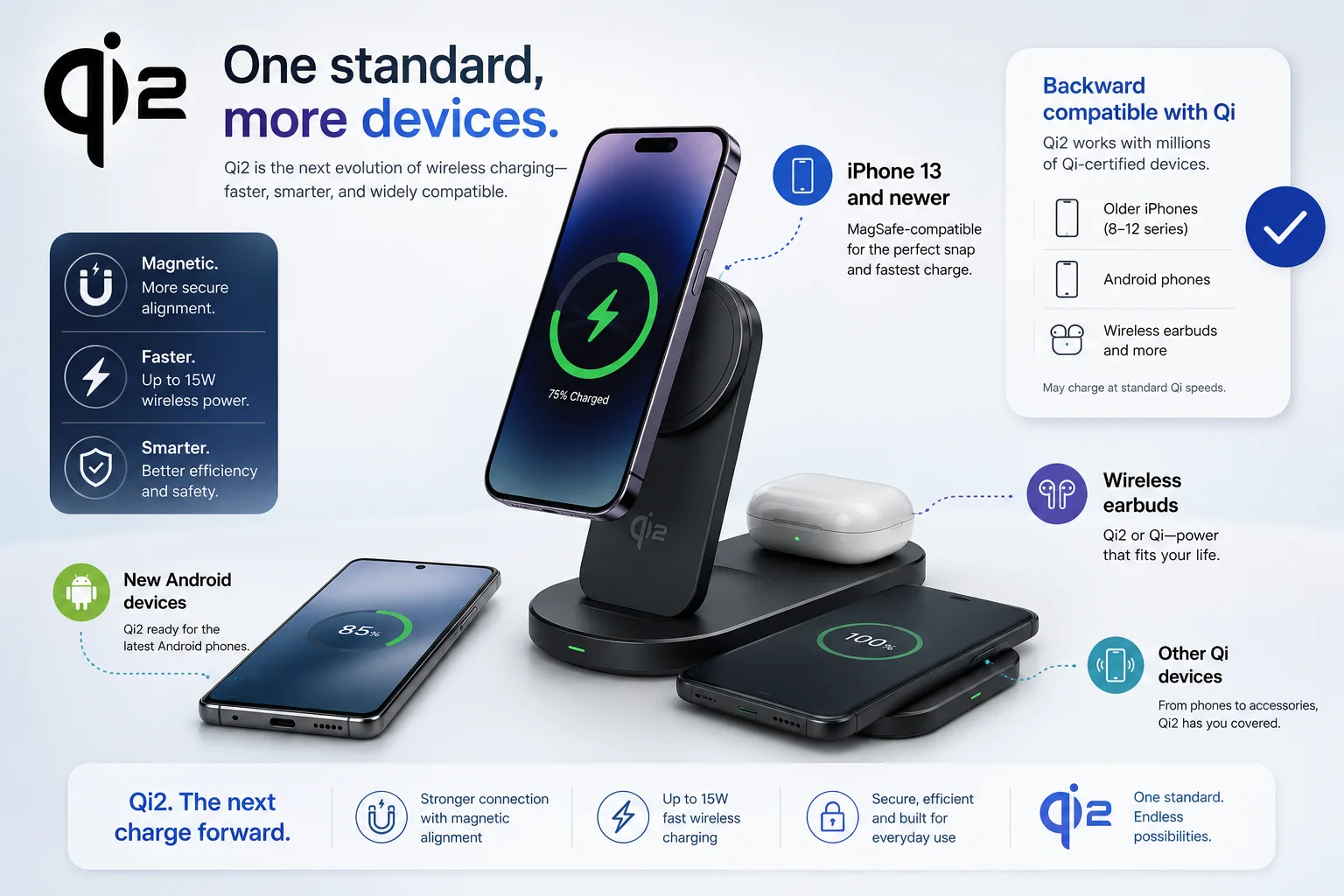
This is where the business opportunity gets really interesting. For years, we've had to manage separate inventory for Apple-specific accessories and general Android accessories. Qi2 promises to unify this. You can source one charger SKU that provides the best possible wireless charging experience for the newest iPhones and the newest Android phones. This simplifies inventory management, forecasting, and marketing. From our experience with US e-commerce sellers, this is a huge selling point. You can confidently market a single product as a premium charging solution for the latest devices, regardless of the brand. Here's a simple breakdown of what to expect:
| Device Type | Compatibility with a Qi2 Charger | Real-World Performance |
|---|---|---|
| iPhone 13, 14, 15 | Perfect. Full magnetic lock & 15W charging. | Identical to using an Apple MagSafe charger. |
| iPhone 12 | Good. Magnetic lock works, but speed is limited by Apple to 7.5W. | Secure alignment, but not the fastest charge. |
| New Qi2 Android Phones | Perfect. Full magnetic lock & 15W charging. | The best wireless charging experience for Android. |
| Older Qi-enabled Phones | Works, but no magnetic lock. | Charges like a regular 5W-10W wireless pad. |
| Devices in MagSafe Cases | Perfect. The case magnets work with the charger. | Enhances the magnetic connection. |
What Kind of Qi2 Chargers Should I Add to My Product Lineup?
"Qi2 charger" isn't a single product; it's a category. Choosing the wrong form factors for your target audience means you could be leaving money on the table by not meeting specific customer needs.
The main types of Qi2 chargers are magnetic pucks, multi-device stations, desktop stands, and car mounts. Your best strategy is to select a mix based on your customers' lifestyles and price points, from entry-level to premium.
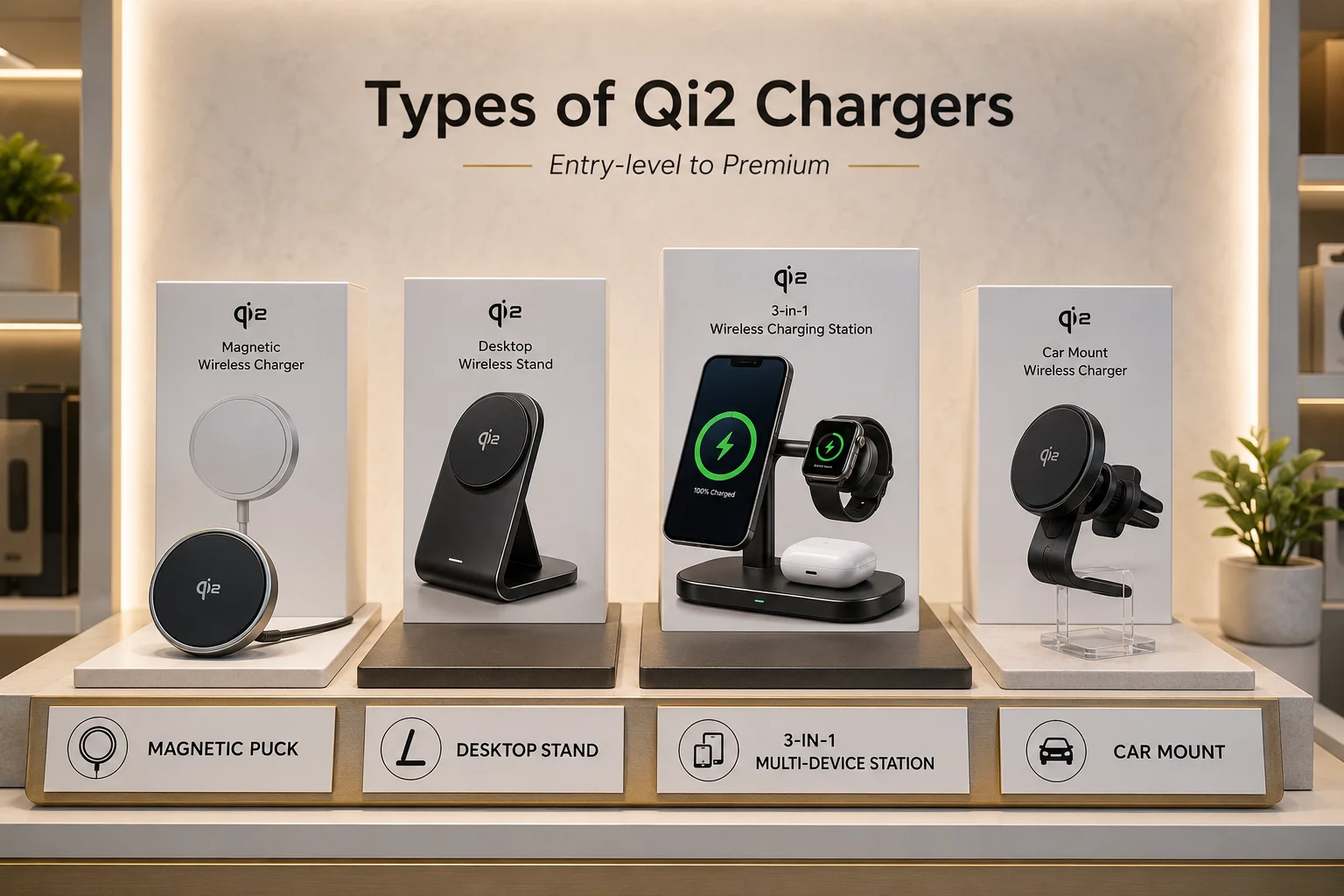
As a sourcing partner, I always advise my clients to think about a portfolio strategy. You don't need to sell every type, but you should understand who each one is for.
- Magnetic Pucks/Pads: This is your entry-level, high-volume product. It's small, portable, and the most affordable Qi2 option. It directly competes with Apple's MagSafe charger and is an easy impulse buy. Great for e-commerce sellers to start with.
- Desktop Stands: These have a higher perceived value. They're perfect for the home office or bedside table. The magnetic attachment allows the phone to be used in portrait or landscape mode, which is great for video calls or watching videos, especially with the iPhone's StandBy mode7.
- 3-in-1 Charging Stations: This is your premium, high-margin product. It charges a phone, a watch, and earbuds all at once. It appeals to customers deep in the Apple ecosystem or families with multiple devices. It solves the real problem of messy cables on a nightstand.
- Car Mounts: This might be the killer app for Qi28. The magnetic lock is strong enough to hold a phone securely, even on bumpy roads. It solves the biggest complaint about traditional car mounts—phones falling off.
For a new brand, I'd suggest starting with the puck and the stand. For established retailers, carrying all four types allows you to create a "good, better, best" pricing structure that caters to every type of customer.
What Business Details Matter When Sourcing Qi2 Chargers?
The technical specifications are only half the battle. A fantastic product supported by terrible logistics or questionable certification is a business failure waiting to happen. You need to focus on the business details.
Always demand proof of official Qi2 certification from the WPC database, not just a supplier's claim. Beyond that, the most critical factors are safety certifications for your market (CE, FCC, RoHS), packaging options, Minimum Order Quantities (MOQ), and transparent bulk pricing.
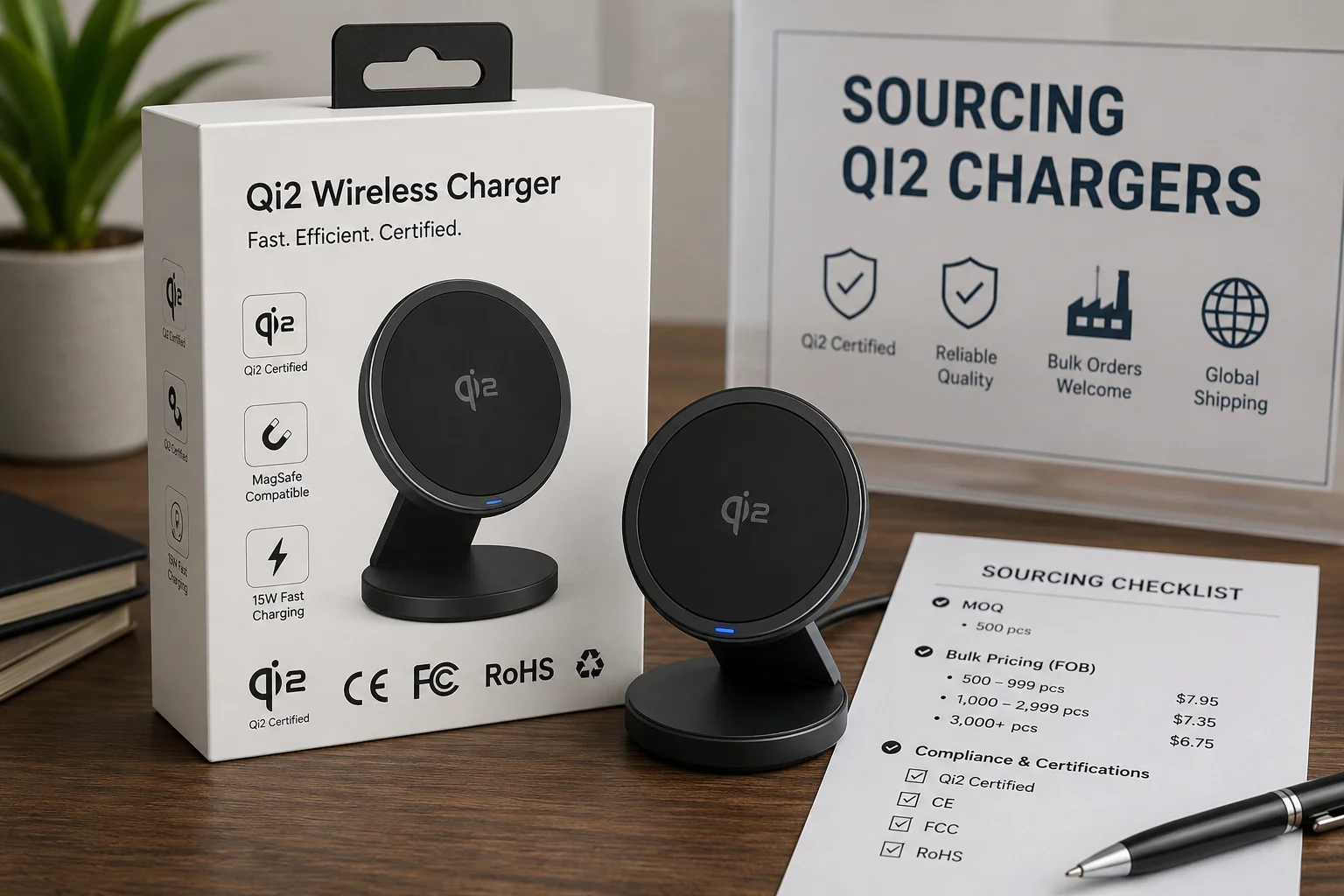
This is where my 15 years of experience come into play. A pretty product sample means nothing if the supplier can't deliver on these core business requirements. First, certification. "Qi2-compatible" is a red flag. It means not certified. A true Qi2 product must be listed in the WPC's official database9. Ask for a link. Second, safety is non-negotiable. For our European and American clients, we ensure every product has the necessary CE, FCC, and RoHS certifications. But go further. Ask your supplier for their internal thermal testing data. A good supplier will have data showing how the charger performs under a full 15W load. Third, MOQ and pricing. In Shenzhen, the standard MOQ for a product like this is typically 1,000 to 3,000 units10. Be wary of suppliers offering a few hundred units; they are likely just resellers. Always ask for a tiered price list for 1k, 3k, and 5k units to understand how your price per unit improves with volume. These business fundamentals are more important than the chipset inside the charger.
How Do I Find a Qi2 Supplier I Can Trust?
Finding a reliable supplier in a sea of online listings is the hardest part. Choosing the wrong partner can lead to production delays, major quality control failures, and thousands of dollars lost.
A trustworthy Qi2 supplier is one who is transparent and can prove their claims. They should have verifiable Qi2 certification, a clear history of exporting to the US/EU, and be willing to discuss their components and quality control processes. Don't let the lowest price be your only guide.
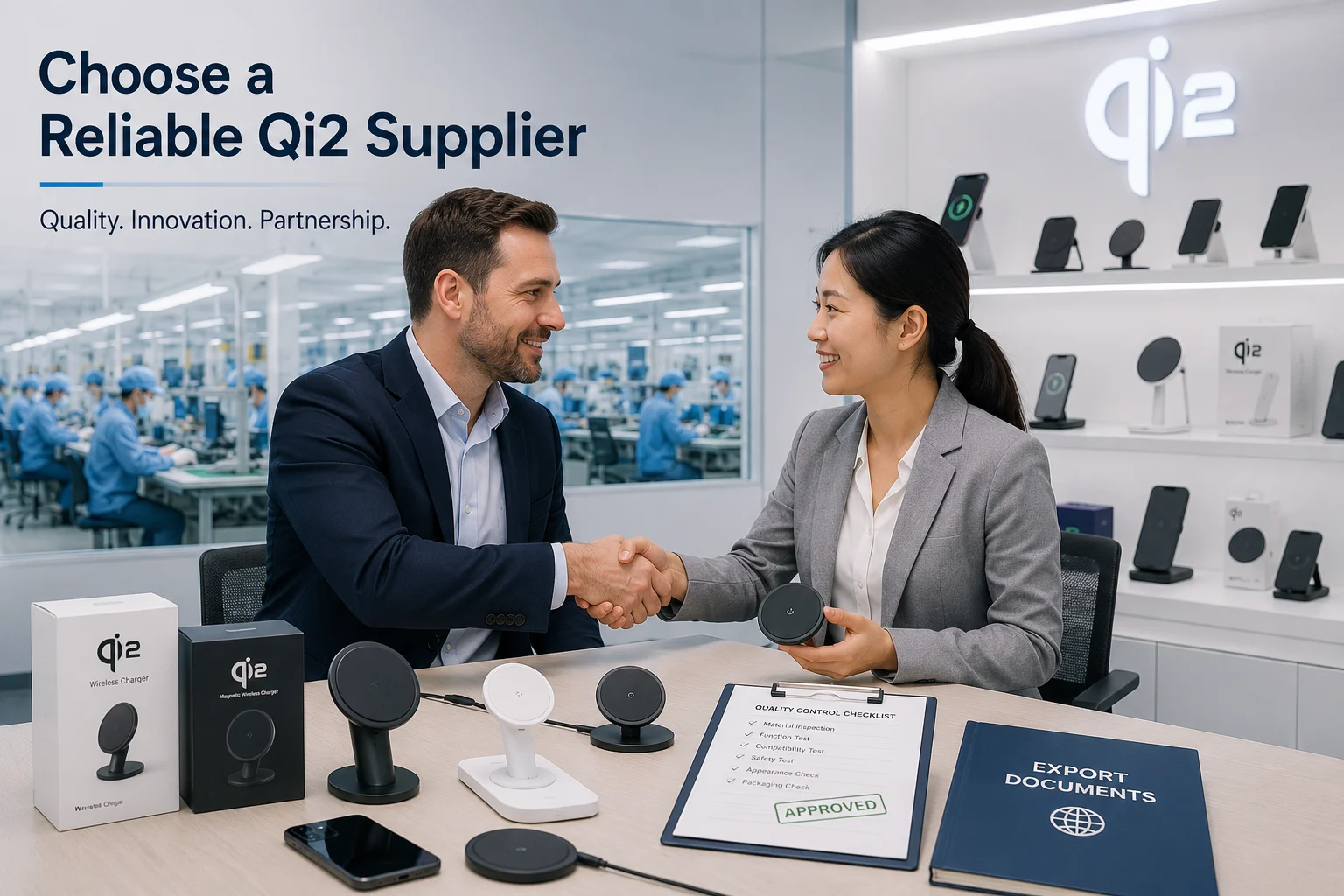
After vetting thousands of suppliers over the years, I've developed a short list of questions that quickly separate the professionals from the amateurs. When you're talking to a potential new supplier, don't just ask for the price. Ask these questions:
- "Can you please show me this product's official listing in the WPC Qi Certified Product Database?" Their answer should be a direct link, not an excuse.
- "What is the source of your Magnetic Power Profile (MPP) module? Is the module itself certified?11" This shows you understand the key component and tells you if they are using quality, pre-certified parts or trying to build it cheaply themselves.
- "Can you share your thermal testing data for this charger running at a full 15W load?" A confident, experienced factory will have this data ready. A hesitant supplier is a major red flag for safety and performance issues.
- "What is your production experience with products for the EU/US market? Can you provide copies of CE/FCC reports for similar products?" This verifies they understand the mandatory safety and compliance rules for your region.
The suppliers who can answer these questions confidently and with documentation are the ones you build a business with. The price might be slightly higher, but you are paying for reliability, safety, and peace of mind.
Conclusion
Qi2 is a significant opportunity for your brand. But success requires a strategic approach to sourcing that goes beyond the technology and focuses on supplier reliability and market needs.
"Qi (standard) - Wikipedia", https://en.wikipedia.org/wiki/Qi_(standard). A source from the Wireless Power Consortium (WPC) can confirm that Qi2 is its new standard for wireless charging, designed to unify the industry under a single global standard and improve user experience. Evidence role: definition; source type: institution. Supports: The source should confirm that Qi2 is the new wireless charging standard developed by the Wireless Power Consortium (WPC) and describe its core features.. ↩
"Qi (standard) - Wikipedia", https://en.wikipedia.org/wiki/Qi_(standard). The official specifications from the Wireless Power Consortium for the Magnetic Power Profile (MPP) within the Qi2 standard detail the capability for 15-watt power transfer, which enables faster charging compared to lower-wattage predecessors. Evidence role: mechanism; source type: institution. Supports: The source should detail the technical specifications of the Qi2 standard's Magnetic Power Profile (MPP), confirming the 15-watt power delivery capability.. ↩
"Qi (standard) - Wikipedia", https://en.wikipedia.org/wiki/Qi_(standard). A press release or official statement from the Wireless Power Consortium (WPC) can confirm that Apple provided its MagSafe technology as the foundation for the development of the Qi2 standard's Magnetic Power Profile. Evidence role: historical_context; source type: institution. Supports: The source should confirm Apple's role in providing the basis for the Magnetic Power Profile (MPP) in the Qi2 standard.. ↩
"Heat Generation and Degradation Mechanism of Lithium-Ion ... - PMC", https://pmc.ncbi.nlm.nih.gov/articles/PMC9753165/. Research in materials science or battery technology demonstrates that increased heat during charging cycles accelerates the degradation of lithium-ion batteries, leading to reduced capacity over time. More efficient charging generates less waste heat, thereby mitigating this effect. Evidence role: mechanism; source type: paper. Supports: The source should explain the relationship between heat (thermal stress) and the degradation of lithium-ion batteries used in smartphones.. ↩
"Qi (standard) - Wikipedia", https://en.wikipedia.org/wiki/Qi_(standard). Technical analyses of the Qi Extended Power Profile (EPP) explain that its performance is highly sensitive to precise coil alignment. Misalignment can lead to lower efficiency, increased heat, and a reduction in charging speed from the 15W maximum. Evidence role: mechanism; source type: other. Supports: The source should explain the technical challenges of the Qi Extended Power Profile (EPP) that could lead to inconsistent charging speeds.. ↩
"What does thermal throttling look like? : r/buildapc - Reddit", https://www.reddit.com/r/buildapc/comments/myjhaq/what_does_thermal_throttling_look_like/. A technical source can define thermal throttling as an automatic protective mechanism where a device's processor or charging system slows down to reduce heat output and prevent damage from overheating. Evidence role: definition; source type: encyclopedia. Supports: The source should define thermal throttling as a safety mechanism in electronic devices to reduce performance and heat generation when temperatures exceed a certain threshold.. ↩
"Use StandBy to view information at a distance while iPhone is ...", https://support.apple.com/guide/iphone/use-standby-iph878d77632/ios. Apple's official documentation or a technology news outlet can describe StandBy as a feature in iOS 17 that provides a full-screen, glanceable information display when an iPhone is charging in a landscape orientation, making it ideal for use with charging stands. Evidence role: definition; source type: other. Supports: The source should describe Apple's StandBy feature, introduced in iOS 17, which turns an iPhone into a smart display when it is charging and oriented horizontally.. ↩
"Car phone mount won't stick : r/carmodification", https://www.reddit.com/r/carmodification/comments/1gbte81/car_phone_mount_wont_stick/. Consumer reviews and product analyses for traditional car phone mounts frequently cite issues with instability, phones falling on bumpy roads, and the inconvenience of clamp-based mechanisms. These documented problems highlight the market need for a more secure and convenient mounting solution. Evidence role: general_support; source type: other. Supports: The source should discuss the common pain points of traditional car phone mounts, such as instability, weak grip, and phones falling during transit.. Scope note: This evidence supports the problem that Qi2 solves, not the prediction that car mounts will be the 'killer app'. ↩
"Products | Wireless Power Consortium", https://www.wirelesspowerconsortium.com/products/. The Wireless Power Consortium maintains a public, searchable database of all products that have successfully passed Qi certification tests. The WPC advises consumers and businesses to use this database to verify that a product is genuinely certified and not a counterfeit or non-compliant device. Evidence role: general_support; source type: institution. Supports: The source should be the WPC's official website, showing the location of the certified product database and explaining its purpose.. ↩
"What is a typical Minimum Order Quantity (MOQ) for low volume ...", https://orbit-kb.mit.edu/hc/en-us/articles/360039224292-What-is-a-typical-Minimum-Order-Quantity-MOQ-for-low-volume-manufacturing-in-China. Sourcing and manufacturing industry guides report that for custom consumer electronics, factories in Shenzhen and the Pearl River Delta typically require a Minimum Order Quantity (MOQ) ranging from 500 to 3,000 units, depending on the complexity of the product and the factory's scale. Evidence role: statistic; source type: other. Supports: The source should provide data or analysis on typical Minimum Order Quantities (MOQs) for custom consumer electronics from factories in major Chinese manufacturing hubs like Shenzhen.. Scope note: MOQs are highly variable and subject to negotiation; this source would provide a general benchmark rather than a fixed rule. ↩
"[PDF] Service Bulletin WARRANTY ADMINISTRATION - nhtsa", https://static.nhtsa.gov/odi/tsbs/2020/MC-10174307-9999.pdf. Information from the Wireless Power Consortium or its authorized test labs can explain that manufacturers can use pre-certified transmitter or receiver modules to streamline the certification process for their final products, ensuring that the core technology meets the required standards for performance and safety. Evidence role: mechanism; source type: institution. Supports: The source should explain the WPC's process for certifying components, such as the MPP module, separately from the final product.. ↩