Getting the new iPhone 16 is exciting. But using your old, slow charger means long waits. A GaN charger is the upgrade you need for super-fast power.
The best GaN charger for your iPhone 16 depends on your needs. For most users, a 30W charger is perfect for fast charging. If you travel or charge a MacBook, a 65W multi-port charger is a better choice. It balances speed, size, and versatility.
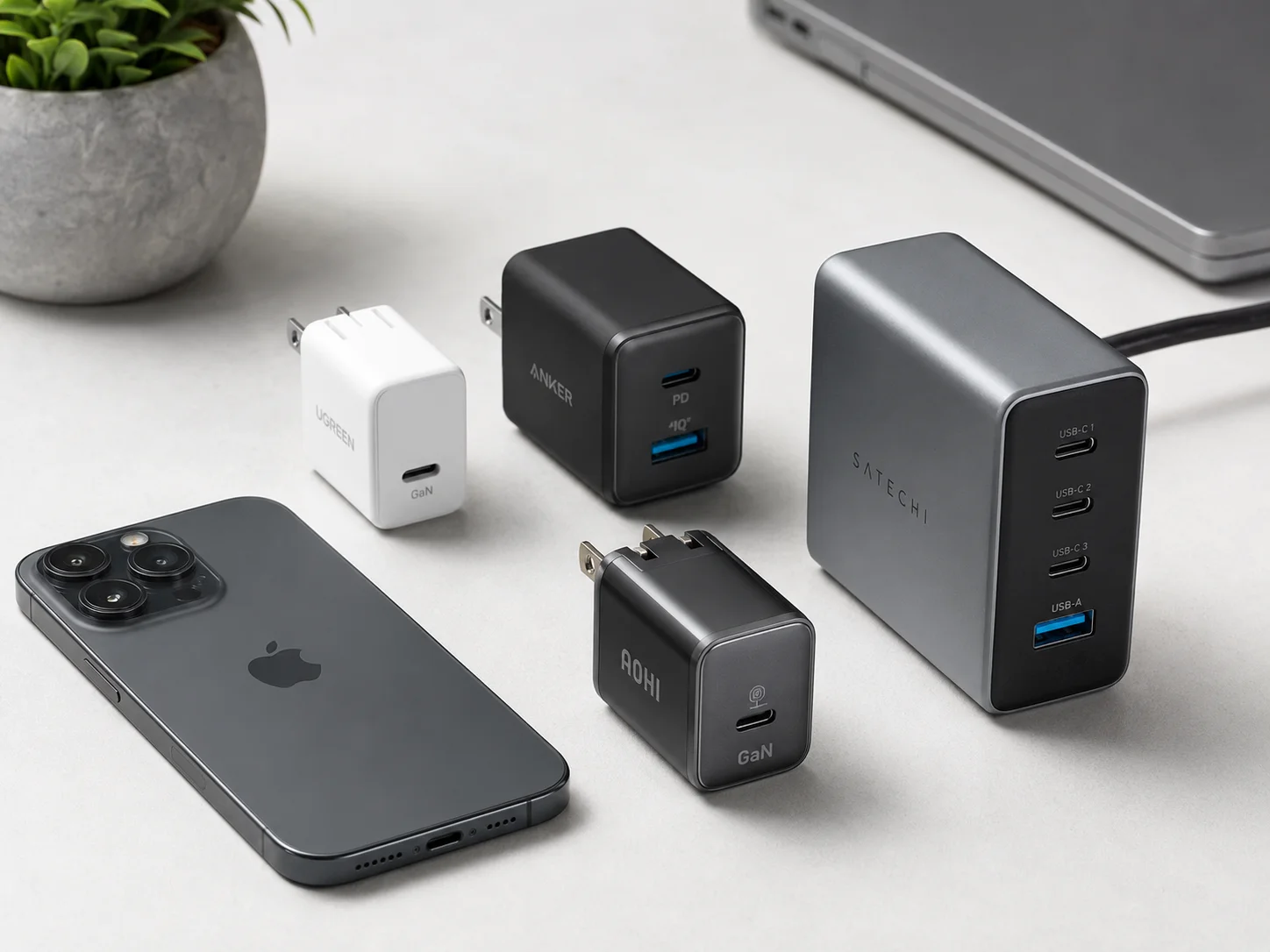
I’ve been in the consumer electronics export business for over 15 years. The shift to GaN technology is a true game-changer. But with so many watts, ports, and brands, picking the right one can feel overwhelming. Let's break it down so you can make a smart choice for your new phone and avoid wasting money. This guide will walk you through everything you need to know, step by step.
What Is a GaN Charger and How Does It Work?
Tired of carrying bulky, hot chargers? They are slow and take up too much space in your bag. GaN technology changes all of that for good.
A GaN charger uses a material called Gallium Nitride instead of the old-school silicon. This modern material allows for smaller, more efficient chargers that waste less energy as heat.1 This means you get much faster charging from a tiny, pocket-friendly device.
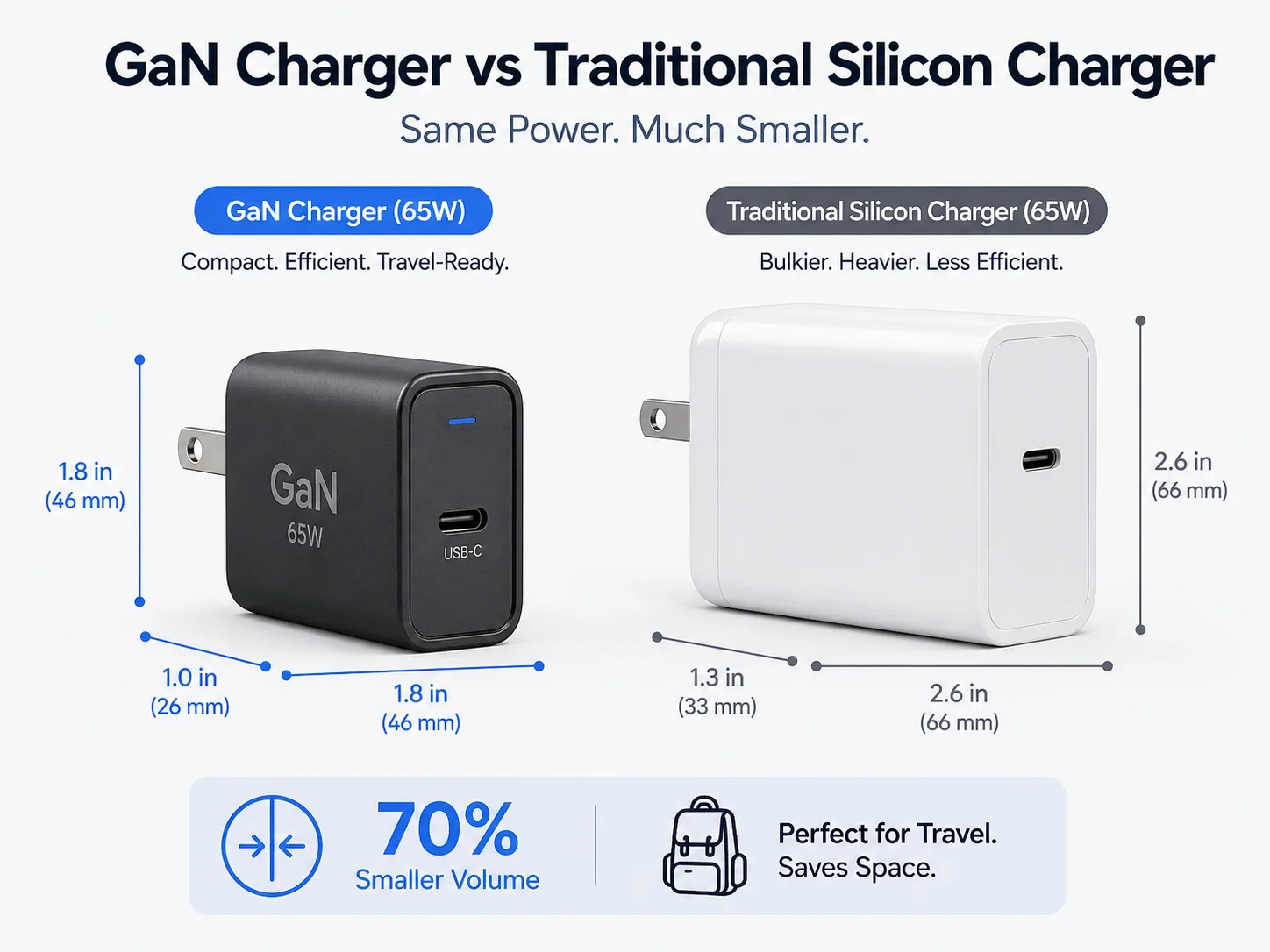
In my line of work, we see new tech all the time, but GaN was different. I remember the first time we showed GaN prototypes to our European retail clients. They were shocked. They couldn't believe a charger that small could push out so much power. It was a real "wow" moment. The secret is the Gallium Nitride, a semiconductor material that's way more efficient than the silicon used in traditional chargers.
The Science Behind GaN
Think of it this way: for electricity to flow, it needs to pass through a material. Silicon has been the standard for decades, but it has its limits. It gets hot when a lot of power passes through it, which means it needs to be bigger to spread that heat out. GaN can handle higher voltages and temperatures without breaking a sweat.2 Because it's so efficient, less energy is wasted as heat. This allows engineers to pack more power into a much smaller space.
GaN vs. Silicon: A Quick Comparison
Here’s a simple table that shows the key differences. This is the exact kind of chart we use to explain the benefits to our B2B buyers.
| Feature | Traditional Silicon Charger | Modern GaN Charger |
|---|---|---|
| Size | Bulky and heavy | Compact and lightweight |
| Efficiency | Lower (around 85-88%) | Higher (around 90-95%)3 |
| Heat | Gets noticeably hot | Runs much cooler |
| Power Density | Low | High |
This isn't just about specs. It means a GaN charger that can power your laptop is now the same size as the old Apple 5W charger that barely charged your phone.
Why Are GaN Chargers Ideal for the iPhone 16?
You want to get the most out of your new iPhone 16's battery and charging features. A standard, old charger just won't cut it. GaN is the perfect partner for Apple's latest tech.
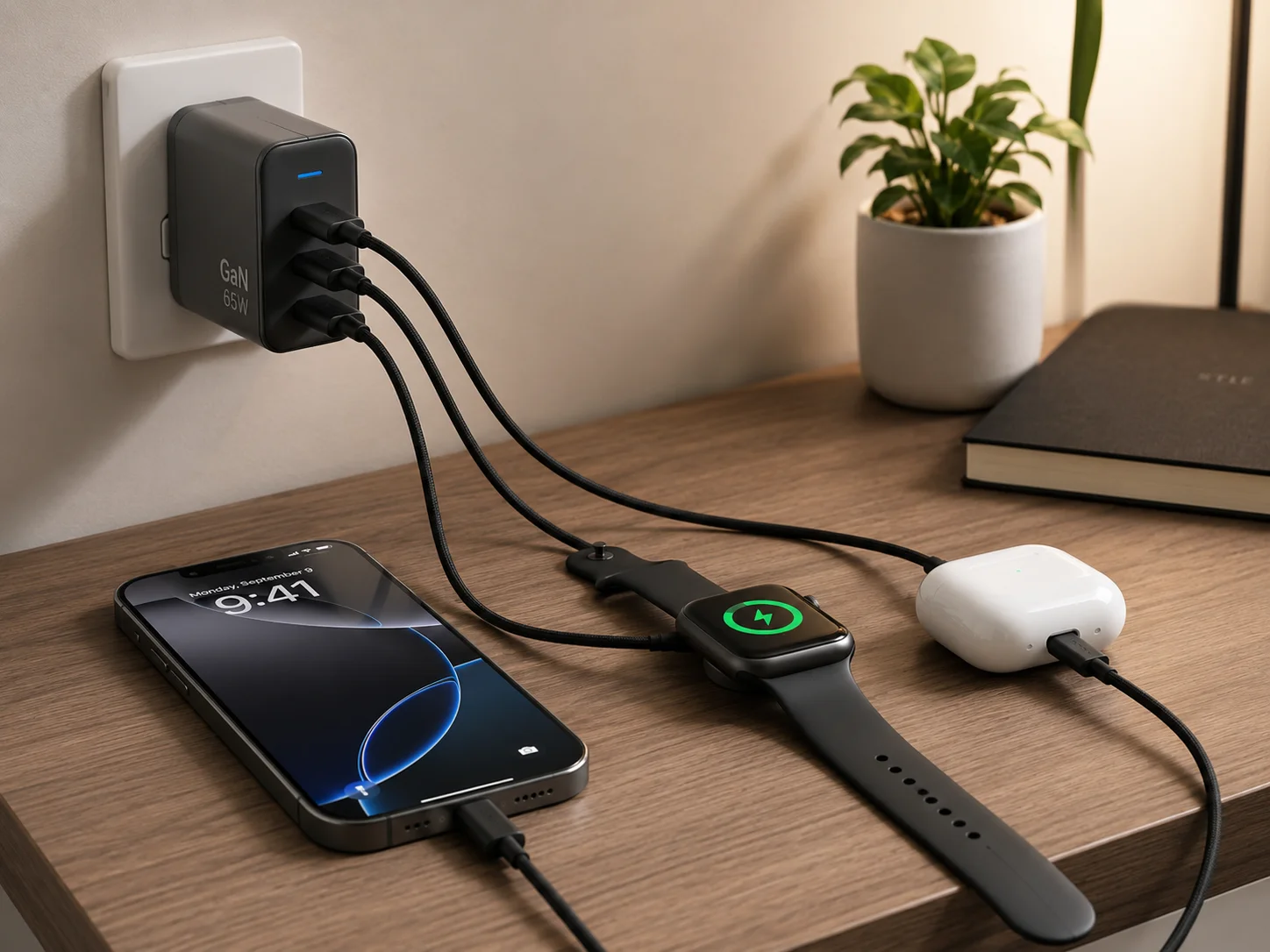
GaN chargers are ideal for the iPhone 16 because they deliver faster charging speeds in a smaller, more portable package. They also run cooler, which improves safety and the charger's lifespan. Many GaN models have multiple ports, letting you power your iPhone, Apple Watch, and AirPods all at once.
Think of it like putting a high-performance engine in a sports car. The iPhone 16 is designed for fast charging, but you need a powerful GaN charger to unlock its full potential. When customers ask us what one accessory they should buy for their new phone, I always say a good GaN charger is the best investment. It completely changes your daily charging experience. You go from waiting hours to just minutes for a significant battery boost.
Benefit 1: Portability Meets Power
The most obvious benefit is size. A 30W GaN charger can be smaller than Apple's old 5W cube. This is a huge deal for anyone who travels or just hates carrying bulky accessories. You can have a single, tiny charger in your bag that can fast-charge your phone, your tablet, and even your laptop, depending on the model.
Benefit 2: Cooler and More Efficient Charging
Because GaN chargers waste less energy as heat, they are safer to use. Overheating is a major cause of wear and tear on both the charger and your phone's battery.4 A cooler charger is a longer-lasting charger. This efficiency also means you're wasting less electricity, which is a small but nice bonus for your power bill and the environment.
Benefit 3: The All-in-One Charging Hub
This is a big one for Apple users. Many GaN chargers come with two, three, or even four ports (usually a mix of USB-C and USB-A). This means one charger on your nightstand or in your travel bag can handle your iPhone 16, iPad, Apple Watch, and AirPods. It ends the need for a power strip full of different charging bricks.
How Many Watts Does the iPhone 16 Need?
Confused about wattage? Choosing the wrong power can mean slow charging or wasting money on power you can't use. Let's find the sweet spot for your specific iPhone 16 model.
The standard iPhone 16 and 16 Plus will fast-charge effectively with a 20W to 30W charger. The iPhone 16 Pro and Pro Max can accept slightly faster speeds, making a 30W or even a 45W charger a better investment to get the quickest top-up times.
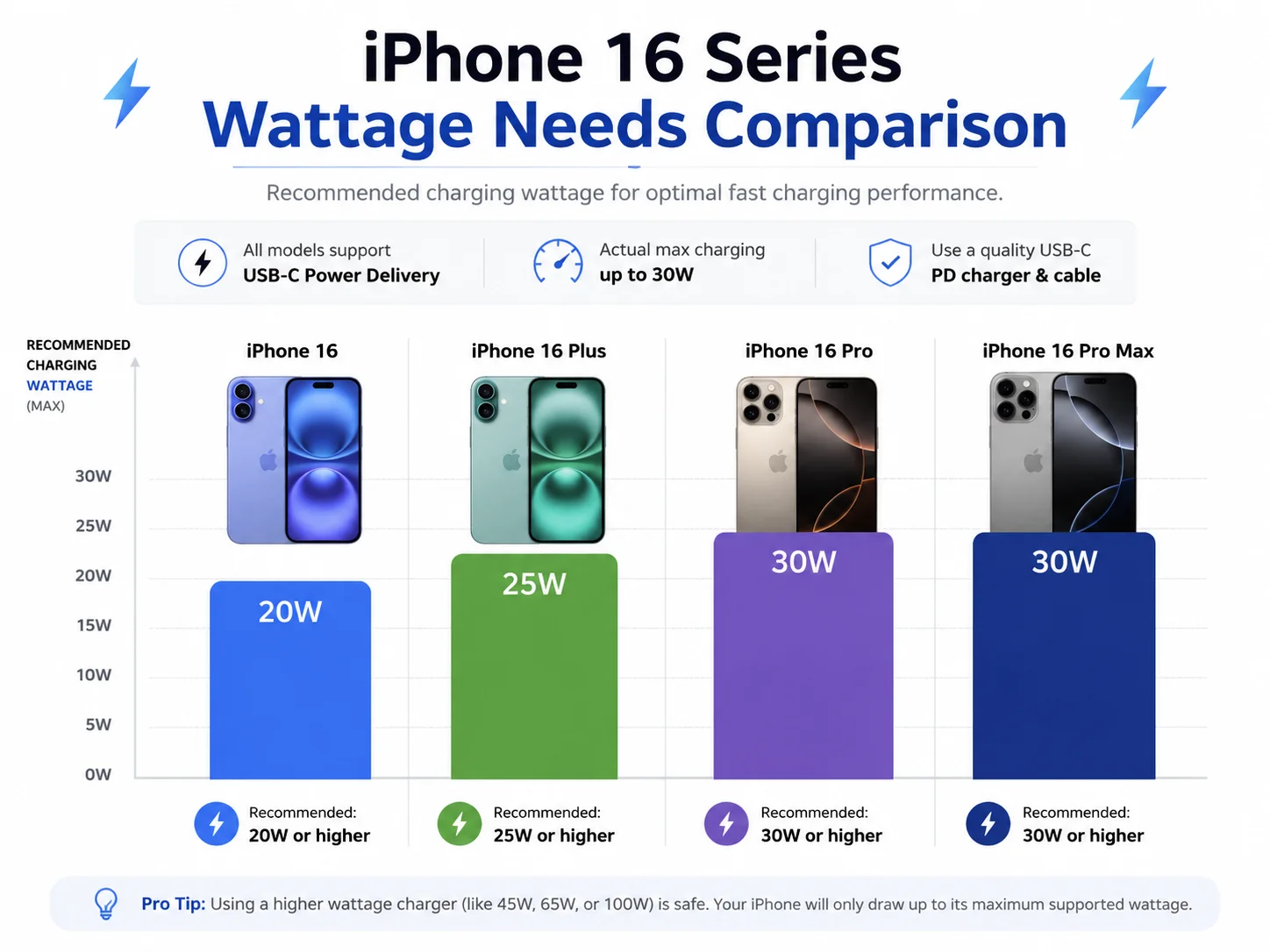
A question I get all the time from importers is, "If I use a 100W charger, will my iPhone charge four times faster than with a 25W charger?" The answer is a clear no. Your iPhone has a built-in manager that controls how much power it can draw. It will only take what it can safely handle. For recent Pro models, this peaks at around 27W.5 Using a higher-wattage charger won't hurt the phone, but it won't make it charge any faster either. The extra power is simply unused.
Matching Watts to Your iPhone Model
Based on trends from the iPhone 13, 14, and 15, we can predict the power needs for the iPhone 16 lineup.
| iPhone Model | Recommended Minimum | Optimal Wattage |
|---|---|---|
| iPhone 16 | 20W | 30W |
| iPhone 16 Plus | 20W | 30W |
| iPhone 16 Pro | 30W | 30W - 45W |
| iPhone 16 Pro Max | 30W | 30W - 45W |
Does More Wattage Always Mean Faster Charging?
Not for a single device. The key is to meet the phone's maximum charging speed. A 30W charger will get an iPhone 16 Pro to 50% battery in about 30 minutes.6 A 100W charger will do the same job in the same amount of time. The real reason to buy a higher-wattage charger (like 65W or 100W) is if you plan to charge multiple devices at once, like your iPhone and a MacBook.
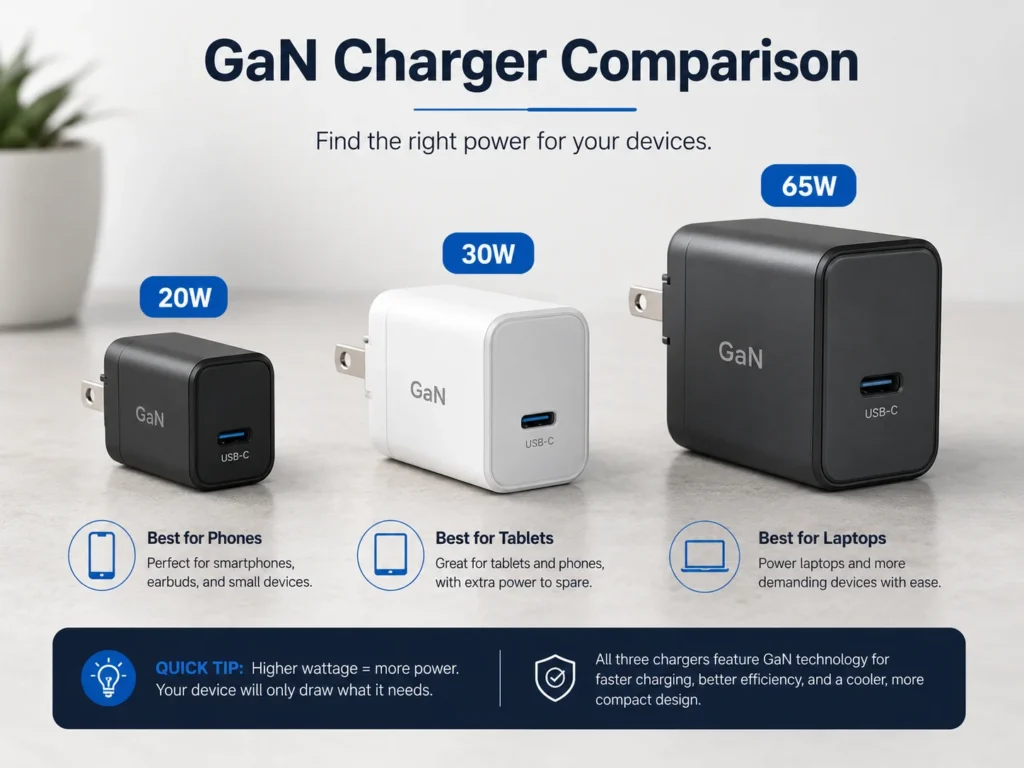
20W vs 30W vs 65W GaN Chargers: Which Is Best for Your iPhone 16?
So many wattages, so little time. Picking between a 20W, 30W, and 65W charger feels complicated. It's really a simple trade-off between speed, size, and what else you need to charge.
Choose a 20W for basic fast charging on a budget. A 30W charger is the sweet spot for most users, offering maximum iPhone charging speed in a tiny package. Go for a 65W or higher if you need to power a laptop or charge multiple devices at the same time.
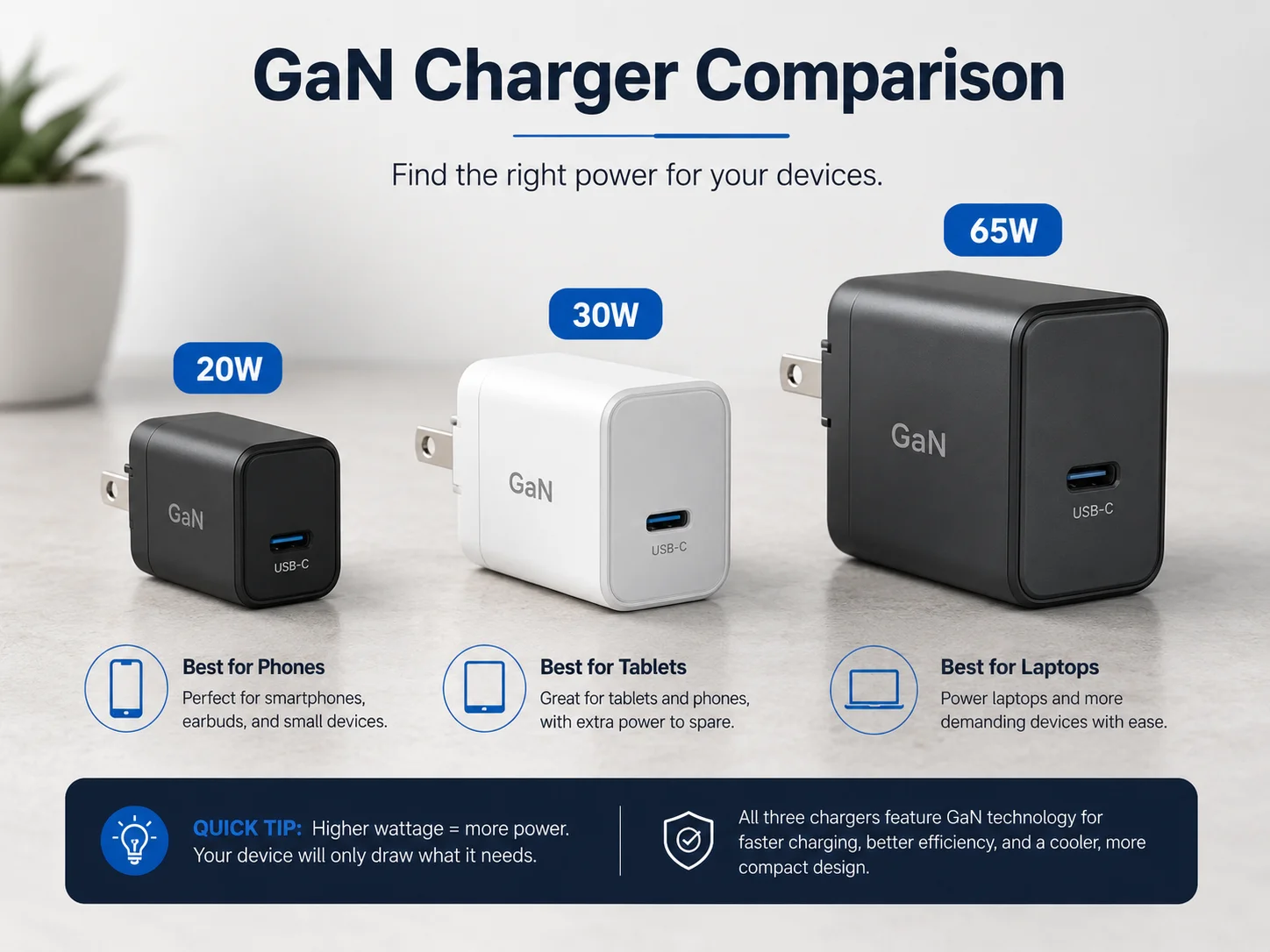
When our e-commerce clients are deciding which models to stock, I always frame it this way: who is your customer? Are they a student who just needs to charge their phone fast between classes? Or are they a business traveler who needs to power a phone, tablet, and laptop on the go? The answer determines the best product. The same logic applies to you as a buyer.
The Trade-Off: Speed vs. Versatility vs. Cost
Here’s a breakdown to help you choose the right one for your lifestyle.
| Wattage | Best For | Portability | Price Point | Key Feature |
|---|---|---|---|---|
| 20W | Basic fast charging, budget-conscious users | Very good | $ | Gets the job done |
| 30W | Max speed for iPhone, perfect balance | Excellent (often the smallest) | $$ | The "sweet spot" |
| 65W+ | Charging a laptop and phone together | Good | $$$ | Maximum versatility |
Real-World Scenarios
- The Daily Commuter: You just need a fast, reliable charger for your iPhone. A 30W GaN charger is perfect. It’s tiny, maxes out your phone's charging speed, and is great for quick top-ups at the office or a coffee shop.
- The Digital Nomad: You travel with an iPhone, an iPad, and a MacBook Air. A 65W or 100W GaN charger with multiple ports is your best friend. It replaces three separate power bricks with one compact unit.
- The Family Hub: You need a central place to charge everyone's devices. A multi-port 65W+ charger on the kitchen counter can handle two iPhones and an iPad at once.
How Do You Choose the Best GaN Charger for Your iPhone 16?
Not all GaN chargers are created equal. Buying a cheap, uncertified charger from a random online marketplace is a huge risk to your expensive new phone. I'll show you the key features to look for.
Look for a charger with USB-C Power Delivery (PD)7 and ideally PPS for the best performance. Always check for safety certifications like UL, CE, or FCC.8 Also, consider the number of ports, plug design, and temperature control for safety and convenience.
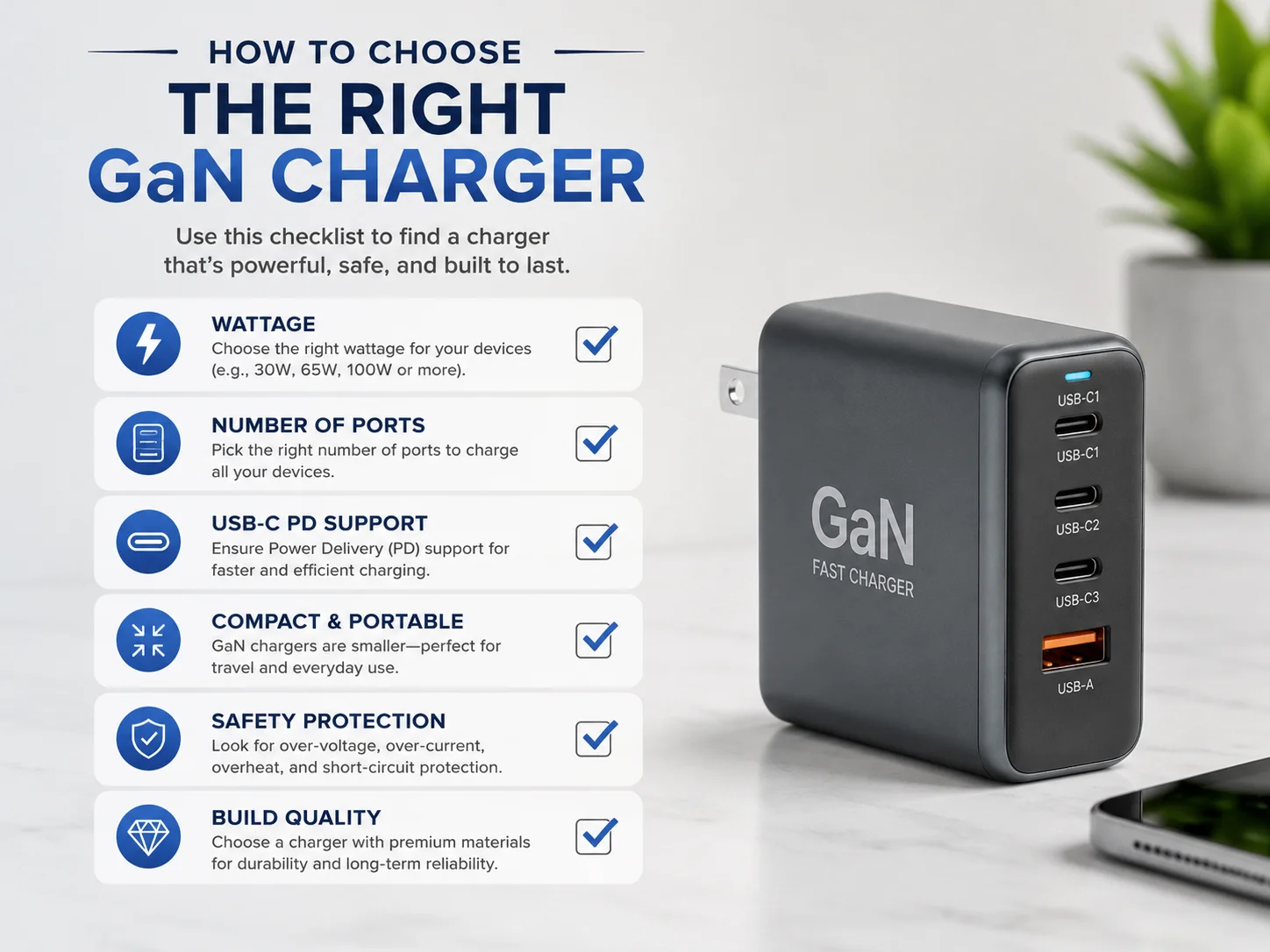
In my 15 years of exporting electronics, I can tell you that certifications are non-negotiable. It is the very first thing our major retail clients in the US and Europe ask about. A CE, FCC, or UL mark isn't just a logo; it's your proof that the product has been independently tested and is safe. It's your insurance policy against damaging a thousand-dollar phone.
Must-Have Feature 1: The Right Charging Protocols
Your charger needs to speak the same language as your iPhone. The most important one is USB-C Power Delivery (PD). This is the universal standard for fast charging over USB-C. For the latest iPhones, also look for Programmable Power Supply (PPS)9. PPS is a newer part of the PD standard that allows the charger and phone to communicate more precisely, adjusting the voltage and current in real-time for more efficient charging and less heat.
Must-Have Feature 2: Safety Certifications
Never buy a charger without these marks.
- UL (or ETL): Primarily for North America. It means the product meets safety standards for fire and electrical shock.
- CE: Required for products sold in Europe. It shows conformity with health, safety, and environmental protection standards.
- FCC: For the US. It certifies that the electronic device's radio frequency emissions are within acceptable limits.
A charger with these certifications has quality components inside to protect against over-voltage, over-current, and overheating.
Nice-to-Have Features
- Port Count: Do you need to charge just your phone, or your watch and headphones too? Choose a charger with the right number of USB-C and USB-A ports for your needs.
- Foldable Prongs: If you travel a lot, a charger with foldable prongs is a must. It's more compact and won't scratch other devices in your bag.
Can One GaN Charger Power an iPhone, iPad, and MacBook?
Tired of carrying a tangled mess of different chargers for all your Apple gear? It’s frustrating to pack a separate power brick for every single device. A single powerful GaN charger can absolutely solve this problem.
Yes, a multi-port GaN charger with enough power—typically 65W or more—can easily power an iPhone, iPad, and even a MacBook Air all at the same time. These smart chargers automatically distribute power to each device, ensuring everything charges efficiently and safely.
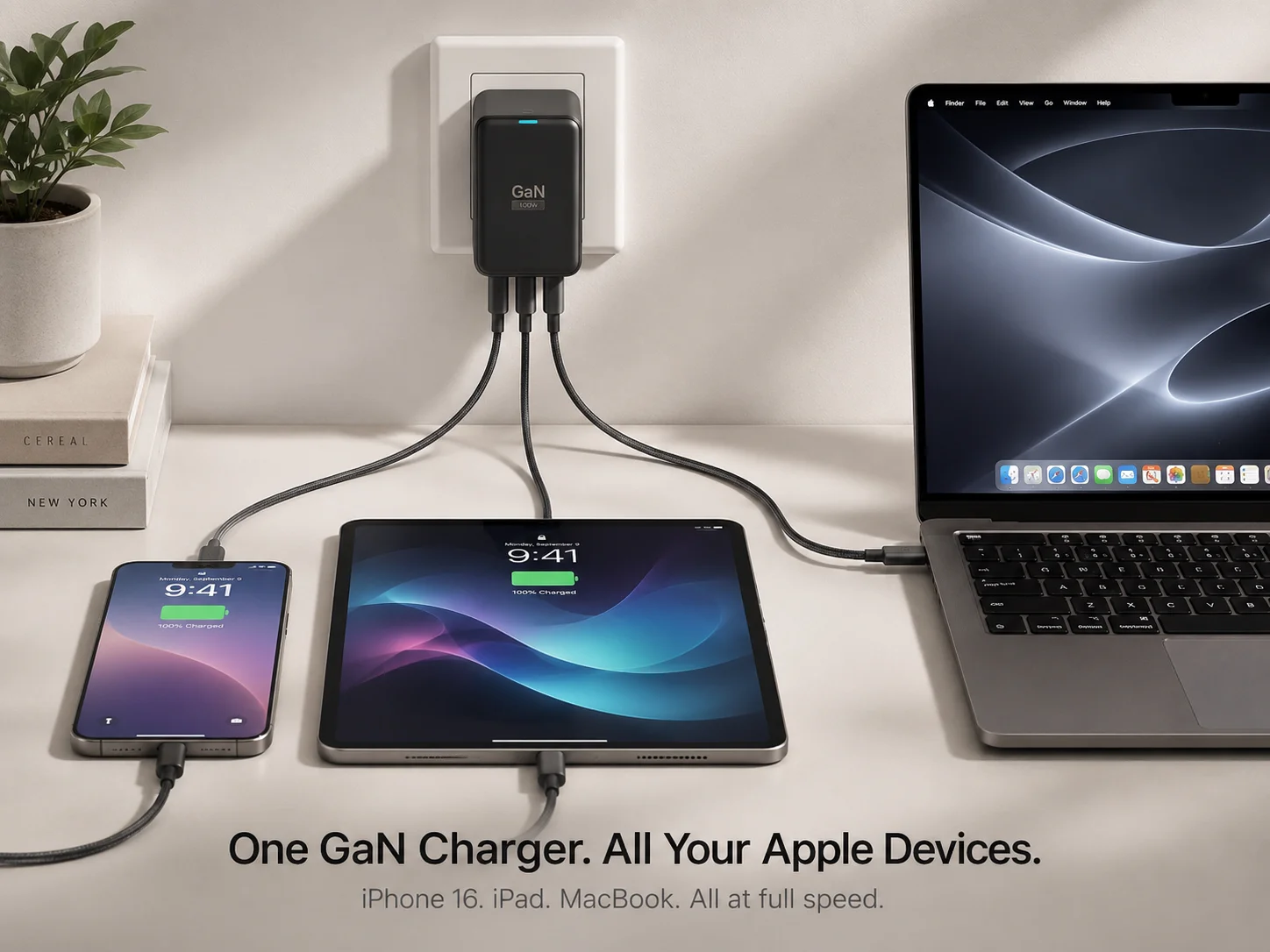
This is one of the most common requirements we hear from our clients who are creating products for power users. They want a "one-stop" charging solution. The technology behind this is called smart power distribution or intelligent power allocation.10 It's what makes these multi-port chargers so useful. The charger’s internal chip detects what devices are plugged in and what their power needs are, then divides up the total wattage in the most effective way.
How Smart Power Distribution Works
For example, let's say you have a 100W charger with two USB-C ports.
- If you plug in just your MacBook Pro, that single port might deliver the full 100W.
- If you plug in your MacBook Pro and your iPhone 16, the charger might automatically split the power, giving 65W to the laptop and 30W to the phone.
- If you plug in two iPhones, it might give 30W to each.
It's all dynamic and happens automatically.
Power Allocation Example: 100W 3-Port Charger
| Devices Connected | Power to Port 1 (USB-C) | Power to Port 2 (USB-C) | Power to Port 3 (USB-A) |
|---|---|---|---|
| MacBook Air Only | 100W | - | - |
| MacBook Air + iPhone | 65W | 30W | - |
| iPhone + iPad + Watch | 45W | 30W | 12W |
This intelligent allocation ensures that your most power-hungry devices get what they need, while smaller gadgets also charge efficiently. When buying, look at the manufacturer's description to see how the power is split in different scenarios.
Are GaN Chargers Safe for the iPhone 16 Battery?
You have probably heard horror stories about cheap third-party chargers frying phones or destroying batteries. It's a completely valid concern. Let's talk about what makes a quality GaN charger safe.
Yes, a well-made, certified GaN charger is perfectly safe for your iPhone 16. Reputable chargers have multiple layers of protection, including systems that prevent over-voltage, over-current, short-circuits, and overheating. These features protect your battery's long-term health.
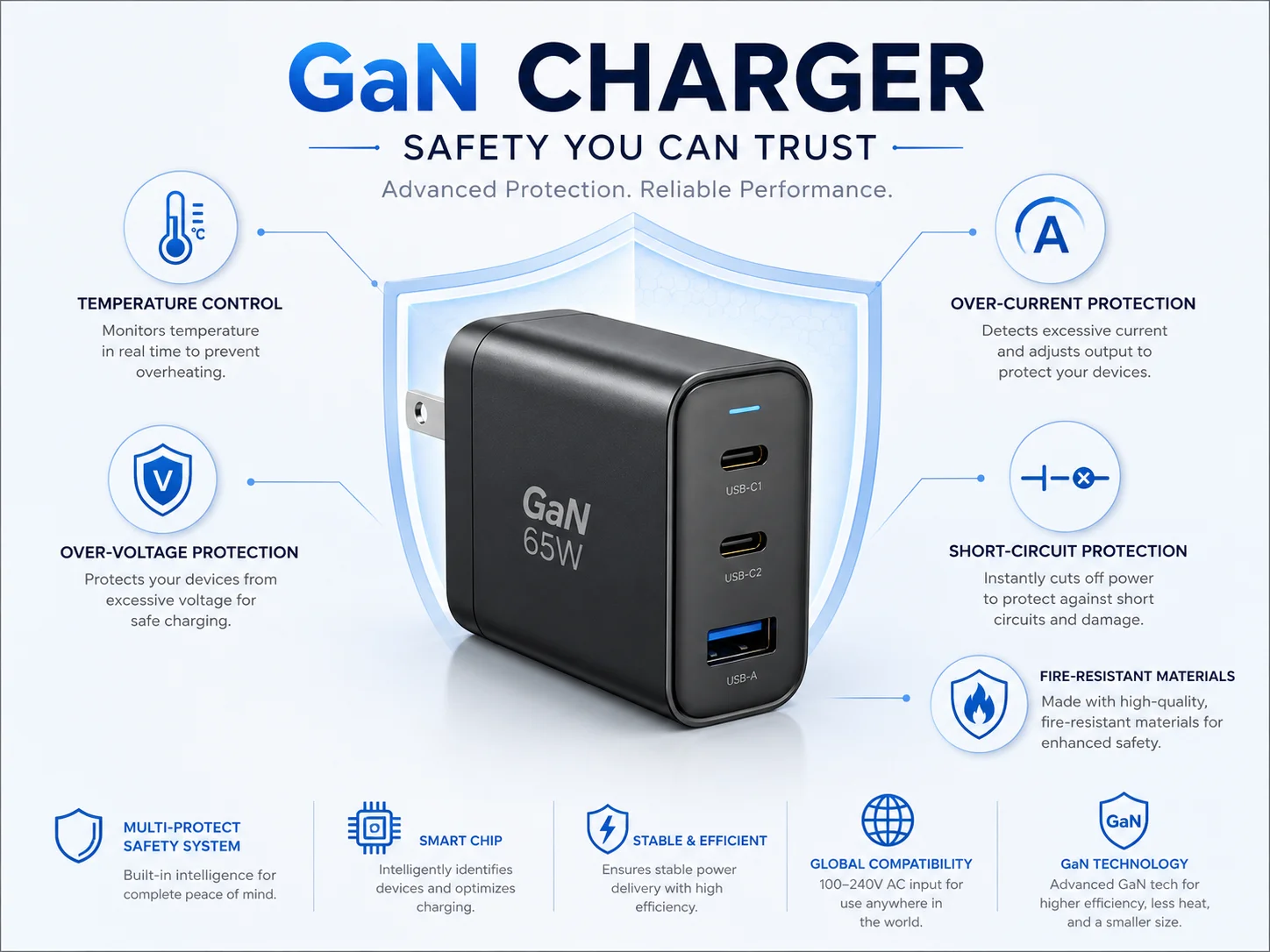
The biggest risk always comes from cheap, no-name chargers that cut corners on safety components to save a dollar. We see them in the market all the time. They might seem like a bargain, but they are a ticking time bomb for your expensive devices. A good charger is an investment in protecting your phone.
The Layers of Protection in a Quality Charger
Here's what's going on inside a safe GaN charger to protect your iPhone:
- Over-Voltage Protection (OVP): Prevents too much voltage from being sent to your phone.
- Over-Current Protection (OCP): Stops the charger from sending too much current, which can damage the battery.
- Short-Circuit Protection (SCP): Instantly cuts power if a short-circuit is detected, preventing fires and damage.
- Over-Temperature Protection (OTP): A sensor monitors the charger's temperature and will reduce power or shut down if it gets too hot.
- Intelligent Power Regulation: The charger "talks" to your iPhone to deliver the precise amount of power it needs at each stage of the charging cycle. It delivers high power when the battery is low and slows down as it approaches 100% to protect battery health.
How a Bad Charger Can Damage Your Battery
A cheap charger without these protections can send unstable voltage or get extremely hot. Heat is the number one enemy of a lithium-ion battery.11 Consistently charging with a hot, unregulated charger will degrade your battery's capacity much faster than normal. You'll notice your phone doesn't hold a charge for as long. In the worst-case scenario, it can cause permanent damage.
What Are the Most Frequently Asked Questions About iPhone 16 GaN Chargers?
You still have questions, and that's completely normal. The world of charging technology can be confusing. Let’s clear up some of the most common questions and myths we hear every day from customers.
People often ask if GaN chargers wear out the battery faster (they don't, if certified), if they work with older iPhones (yes, they do), and if you must buy an Apple-branded one (no, a certified third-party charger is just as good and often better value).

We spend a lot of time educating our buyers on these points. Getting the facts straight helps them, and their end customers, feel confident in the technology. Here are answers to the top questions I get.
Q1: Do I need a special cable for a GaN charger?
Yes, your cable is just as important as your charger. To get the full benefit of fast charging, you need a quality USB-C to USB-C cable (or USB-C to Lightning for older iPhones) that is rated for the power you're using. A cheap cable can be a bottleneck, slowing down charging speeds and even posing a safety risk. Look for cables rated for 60W or 100W.
Q2: Will a 100W charger damage my iPhone?
No. As we covered earlier, your iPhone will only draw the power it needs. The charger and the phone communicate to determine a safe and efficient charging speed. Using a 100W charger on an iPhone is perfectly safe; it just won't charge any faster than it would with a 30W charger.
Q3: Is it okay to leave my phone plugged in overnight with a GaN charger?
Yes. Modern smartphones, including the iPhone 16, have a feature called Optimized Battery Charging. The phone fast-charges to about 80% and then slows down, waiting to finish the final 20% until just before you typically wake up.12 This, combined with the safety features in a certified GaN charger, makes overnight charging perfectly safe and minimizes battery aging.
Q4: Why are some GaN chargers so much more expensive than others?
The price difference comes down to a few things: build quality, number of ports, power output, included technologies (like PPS), and, most importantly, the cost of safety certifications. A higher price often reflects better internal components, more advanced safety features, and the investment the company made to get it properly tested and certified.
Conclusion
Choosing the right GaN charger is about matching power and features to your daily life. A certified 30W or 65W GaN charger will unlock fast, safe, and convenient power for your iPhone 16.
"Gallium nitride - Wikipedia", https://en.wikipedia.org/wiki/Gallium_nitride. Sources from university engineering departments or semiconductor industry publications explain that Gallium Nitride's wider band gap compared to silicon allows for the creation of smaller, more energy-efficient power electronics, as less energy is lost as heat during power conversion. Evidence role: mechanism; source type: education. Supports: The claim that Gallium Nitride's material properties, such as a wider band gap, allow it to operate at higher voltages and frequencies than silicon, leading to greater efficiency and smaller component sizes in power converters.. ↩
"Wide-bandgap semiconductors benefit from development of single ...", https://www.sandia.gov/research/news/wide-bandgap-semiconductors-benefit-from-development-of-single-photo-sources-in-gallium-nitride/. Scientific literature on semiconductor materials confirms that Gallium Nitride possesses a significantly wider band gap than silicon, which allows it to sustain higher electric fields before breaking down and to operate efficiently at higher temperatures. Evidence role: mechanism; source type: paper. Supports: The claim that Gallium Nitride as a semiconductor material has a higher breakdown voltage and can operate at higher temperatures than silicon.. ↩
"Performance comparison of Si, SiC and GaN based power MOSFET ...", https://ui.adsabs.harvard.edu/abs/2024AIPC.2978b0001J/abstract. Technical papers and industry analyses on power adapter efficiency show that while traditional silicon-based chargers typically operate around 88% efficiency, GaN-based designs can exceed 90-95% efficiency, particularly at higher power densities. Evidence role: statistic; source type: paper. Supports: The claim that GaN-based power converters can achieve efficiency levels in the 90-95% range.. Scope note: Actual efficiency can vary based on the specific charger design, load, and power level. ↩
"Heat Generation and Degradation Mechanism of Lithium-Ion ... - PMC", https://pmc.ncbi.nlm.nih.gov/articles/PMC9753165/. Research from battery technology labs and academic studies confirms that exposing lithium-ion batteries to high temperatures accelerates chemical reactions that lead to capacity loss and a reduction in overall battery lifespan. Evidence role: mechanism; source type: research. Supports: The claim that high temperatures accelerate the degradation of lithium-ion batteries.. ↩
"I Tested iPhone 15 Pro Max Fast Charging with Different Power ...", https://www.reddit.com/r/iphone/comments/178om0u/i_tested_iphone_15_pro_max_fast_charging_with/. Independent testing and technical reviews of recent iPhone Pro models have measured their peak power draw during fast charging to be approximately 27W, although the phone does not sustain this rate for the entire charging cycle. Evidence role: statistic; source type: other. Supports: The claim that recent iPhone Pro models (such as the 13, 14, or 15 Pro series) can draw a peak power of approximately 27 watts during a fast-charging cycle.. Scope note: This data is for previous iPhone models; the iPhone 16's specifications may differ. ↩
"Fast-Charging 0 to 50% in 30 minutes, how long for full? - Reddit", https://www.reddit.com/r/apple/comments/720kaq/fastcharging_0_to_50_in_30_minutes_how_long_for/. Apple's official support documentation states that users can fast charge compatible iPhone models to around 50 percent battery in about 30 minutes when using an Apple USB-C power adapter of 20W or higher. Evidence role: case_reference; source type: government. Supports: The claim that compatible iPhones can reach a 50% charge in approximately 30 minutes when using a 20W or higher adapter.. Scope note: The exact time can vary with the model, settings, and environmental factors. The claim is about the iPhone 16, while documentation refers to existing models. ↩
"USB-C - Wikipedia", https://en.wikipedia.org/wiki/USB-C. The USB Implementers Forum (USB-IF), the non-profit organization that develops the USB standard, defines USB Power Delivery as a specification that enables higher power transfer (up to 240W in its latest revision) over a single USB-C cable, allowing for faster charging of a wide range of devices. Evidence role: definition; source type: institution. Supports: The definition of USB Power Delivery (PD) as a charging standard.. ↩
"Equipment Authorization | Federal Communications Commission", https://www.fcc.gov/engineering-technology/laboratory-division/general/equipment-authorization. Organizations like UL (Underwriters Laboratories), the European Commission (for the CE mark), and the FCC provide testing and certification to ensure products meet specific safety, health, environmental, and electromagnetic interference standards before being sold in their respective markets. Evidence role: definition; source type: institution. Supports: The role of safety certifications in verifying that electronic products meet established safety and operational standards.. ↩
"What is the difference between PD and PPS? : r/UsbCHardware", https://www.reddit.com/r/UsbCHardware/comments/12k2063/what_is_the_difference_between_pd_and_pps/. The USB Implementers Forum (USB-IF), the organization that maintains the USB standard, defines PPS as a protocol within USB Power Delivery that allows for small, real-time adjustments in voltage and current, enabling more efficient charging and better thermal management. Evidence role: definition; source type: institution. Supports: The definition and function of the Programmable Power Supply (PPS) standard.. ↩
"Smart Charge Management Applications and Benefits for Federal ...", https://www.energy.gov/cmei/femp/smart-charge-management-applications-and-benefits-federal-fleets. Engineering sources and product technical sheets explain that intelligent power allocation systems in multi-port chargers use a microcontroller to detect the power requirements of each connected device and distribute the charger's total wattage accordingly, often prioritizing higher-power devices or splitting power in predefined configurations. Evidence role: mechanism; source type: paper. Supports: The mechanism by which multi-port chargers dynamically allocate their total power output across multiple ports based on the needs of the connected devices.. ↩
"[PDF] Correlation of Arrhenius Behaviors in Power and Capacity Fades ...", https://www.sandia.gov/app/uploads/sites/163/2021/09/SAND2002-3201j.pdf. Educational resources on battery technology, such as those from research institutions, consistently identify high temperature as a key stress factor for lithium-ion batteries, as it accelerates parasitic chemical reactions that lead to permanent capacity loss and increased internal resistance. Evidence role: expert_consensus; source type: education. Supports: The claim that elevated temperature is a primary accelerator of capacity degradation in lithium-ion batteries.. ↩
"Optimized Battery Charging, TURNED ON OR OFF? : r/ios - Reddit", https://www.reddit.com/r/ios/comments/11ajway/optimized_battery_charging_turned_on_or_off/. Apple's official support page for Optimized Battery Charging explains that the feature is designed to reduce battery aging by learning the user's daily routine, fast-charging the iPhone to 80%, and then waiting to finish charging past that point until just before the user typically needs it. Evidence role: mechanism; source type: government. Supports: The claim that Optimized Battery Charging on iPhone learns the user's daily charging routine to delay charging past 80% until it is needed.. Scope note: The feature's effectiveness depends on the user having a regular charging schedule. ↩