Are you tired of spec sheets that promise the world but deliver customer complaints? You're not alone. The real secret to selling TWS earbuds isn't a long list of features.
The most important feature for TWS earbuds is a reliable, long-lasting battery.1 Customers understand and feel battery life directly. It's a simple, honest metric that builds trust, reduces returns, and creates repeat business more effectively than any complex technical specification on a marketing sheet.2
I've been exporting electronics from Shenzhen for 15 years. I've seen countless buyers get mesmerized by the latest tech buzzwords. They focus on Bluetooth versions or noise reduction decibels. But when the sales reports come in, one thing is always true. The products that consistently sell well and don't come back as returns are the ones that nail the basics. And for TWS earbuds, the most important basic is battery life. It's the foundation of a good user experience. Let's break down why this single feature is so critical for your business.
Why Battery Life Matters More Than Complicated TWS Specs?
Are you getting lost in a sea of technical jargon from suppliers? This confusion can lead you to stock products that look good on paper but fail in the real world.
Focus on what customers actually notice and complain about. While you're comparing chipset models, your customers are just angry their earbuds died during a call. Battery life is a real-world problem that technical specs often hide, making it a more critical factor for success.
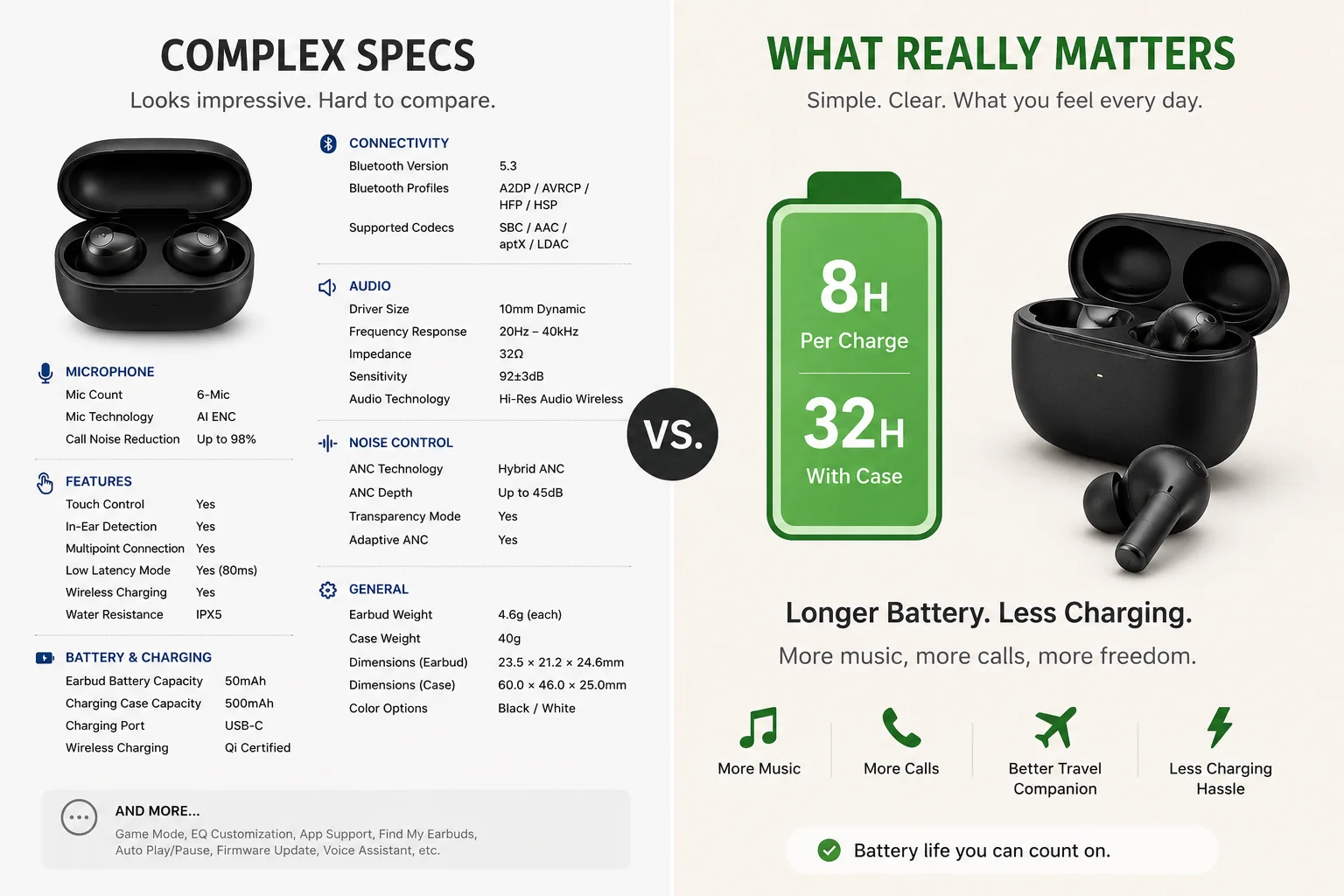
Over the years, I've noticed a pattern. New buyers often ask, "What's the best price for ANC earbuds?" or "Do you have the latest Bluetooth 5.4 model?" These aren't bad questions, but they miss the point. Your end customer doesn't return a pair of earbuds because the Bluetooth version is 5.3 instead of 5.4. They return them for reasons that ruin their day:
- The connection drops in the middle of a song.
- Only one earbud works.
- The battery dies halfway through their commute.
- The person on the other end of a call can't hear them.
These are the real-world failures that kill sales. A fancy spec sheet can't fix a frustrating user experience. That's why I always guide my clients to shift their focus. Instead of getting bogged down by a dozen minor specs, we concentrate on the pillars of a great product experience. And the first, most tangible pillar is always battery life. It's a simple number, but it speaks volumes about the product's overall quality and reliability.
How Long Playtime Solves a Real Customer Pain Point?
Do your customers fear their earbuds will die at the worst possible moment? This "battery anxiety" is a huge source of frustration and a major reason for negative online reviews.3
Long playtime directly solves this anxiety. It offers peace of mind and transforms the earbuds from a risky gadget into a reliable daily companion. This reliability is what customers are truly paying for, and it's a pain point that a strong battery solves completely.
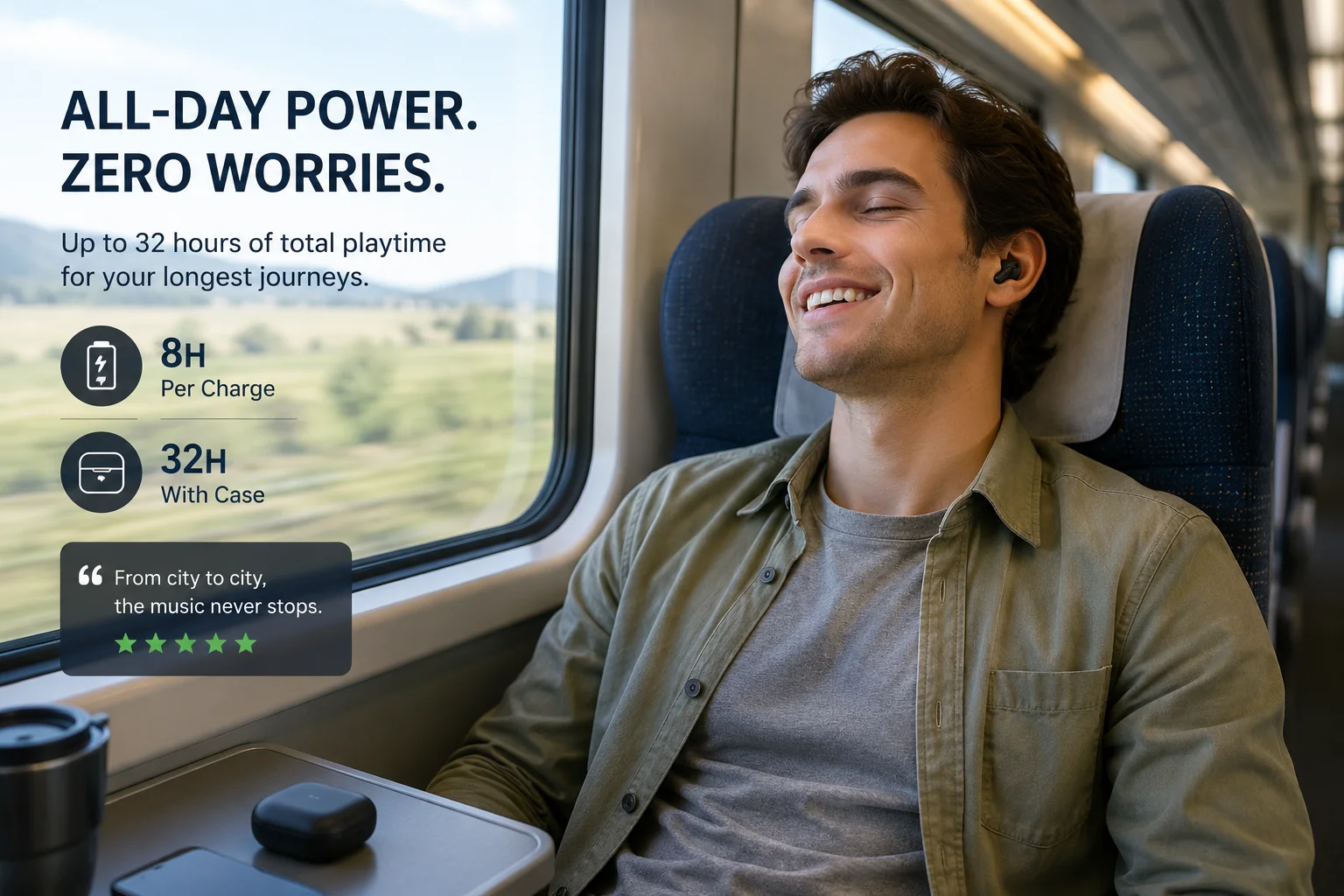
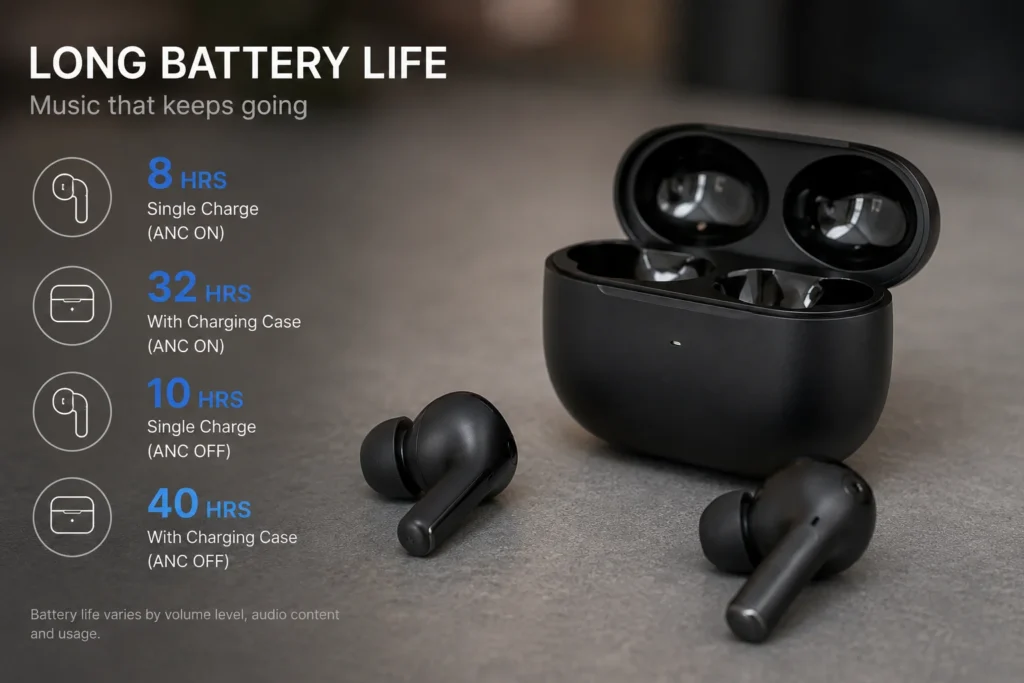
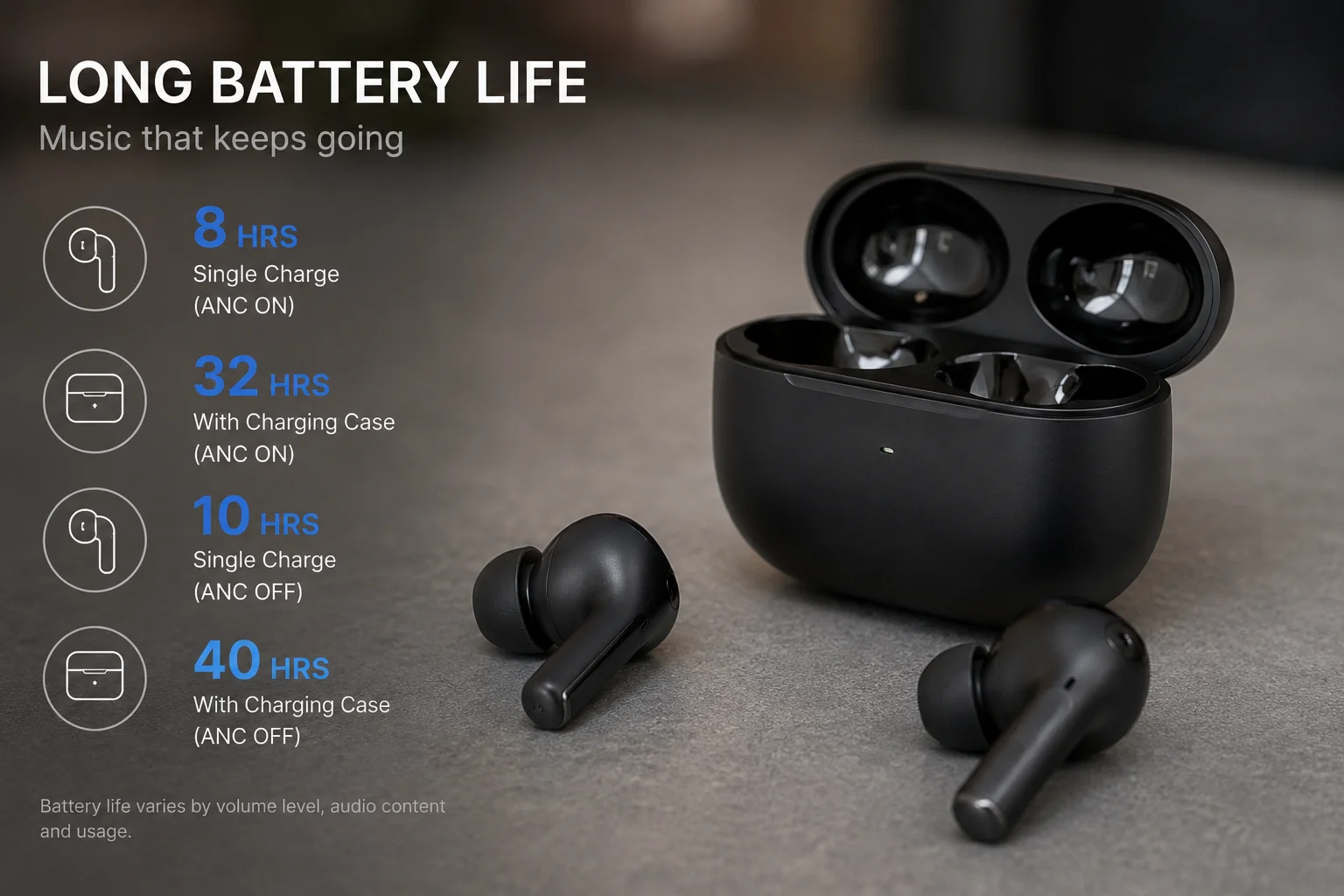
Think about the most common complaints you see online for cheap TWS earbuds. "Lasted only 2 hours," "Died after one week," or "Claimed 6 hours, but I only get 3." These are not just complaints; they are broken promises. When a package says "30 hours of battery," the customer doesn't always understand that this means the case plus the earbuds.4 They feel misled when the earbuds themselves die after a short time.
As a wholesaler or retailer, you need to be crystal clear about these two numbers:
- Single Playtime: How long the earbuds last on a single charge. This is the most critical number for the user.
- Total Battery Life: How many additional charges the case provides.
A product with a genuinely long single playtime—say, 5 or 6 hours—removes a massive point of friction. It means the earbuds will last through a workout, a long commute, or a series of work calls without causing stress. This practical, everyday performance is far more valuable to a customer than an obscure audio codec they'll never use.
Why Charging Case Battery Capacity Affects Repeat Sales?
Do you think the charging case is just a box to hold the earbuds? Many buyers overlook its importance, leading to long-term customer dissatisfaction that quietly kills repeat business.
The charging case is a promise of convenience. A high-capacity, reliable case that holds its charge ensures the earbuds are always ready. When this experience is seamless, it builds brand trust and directly encourages customers to buy from you again in the future.
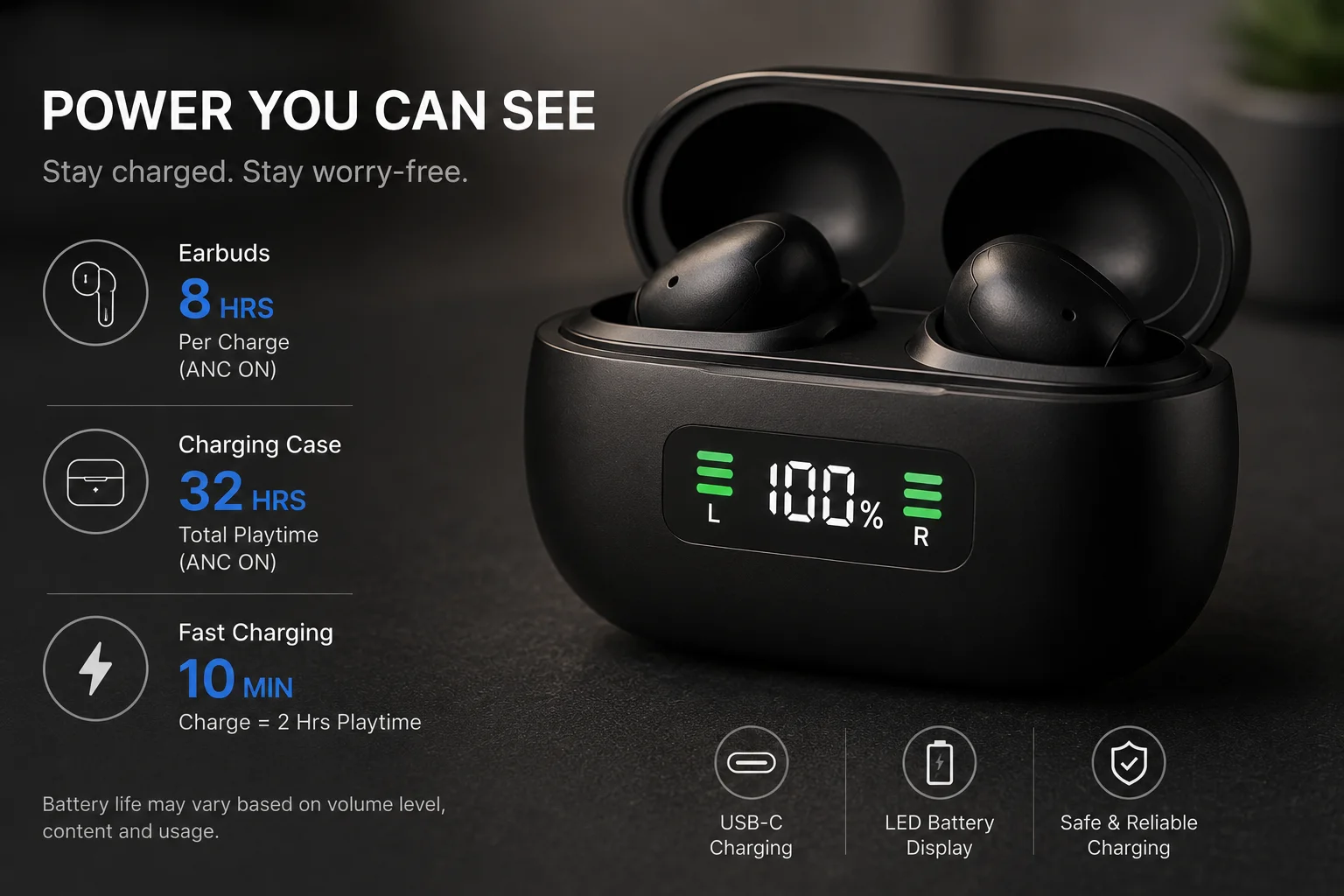
I once worked with a client who focused only on the earbud's single playtime. They approved a sample with 5-hour earbuds but a cheap, low-capacity case. Initially, sales were fine. But after a few months, we noticed a drop in re-orders. Customer feedback revealed the problem: the case itself would lose its charge quickly in a gym bag or on a desk. People would reach for their fully-charged earbuds only to find both the earbuds and the case were dead.
This is a silent killer of brands. The case isn't just a power bank; it's part of the core user experience. A good case should:
- Provide at least 3-4 full recharges for the earbuds.
- Hold its own charge for weeks on standby.5
- Have a clear, honest battery indicator.
- Charge the earbuds reliably every single time they are docked.
When a customer trusts the entire package—earbuds and case—they don't just feel satisfied. They feel confident. That confidence is what turns a one-time purchase into a loyal customer who comes back for more and recommends your brand to others.
How Battery Life Builds Trust in Daily Use?
Do you believe a single feature can build a customer's trust in your brand? It can, but only if that feature is part of a larger promise of reliability.
Delivering on your battery life promise is the first step in building daily trust. When customers see that your claims are true, they start to trust the product as a whole. This trust is the foundation upon which a successful electronics brand is built.
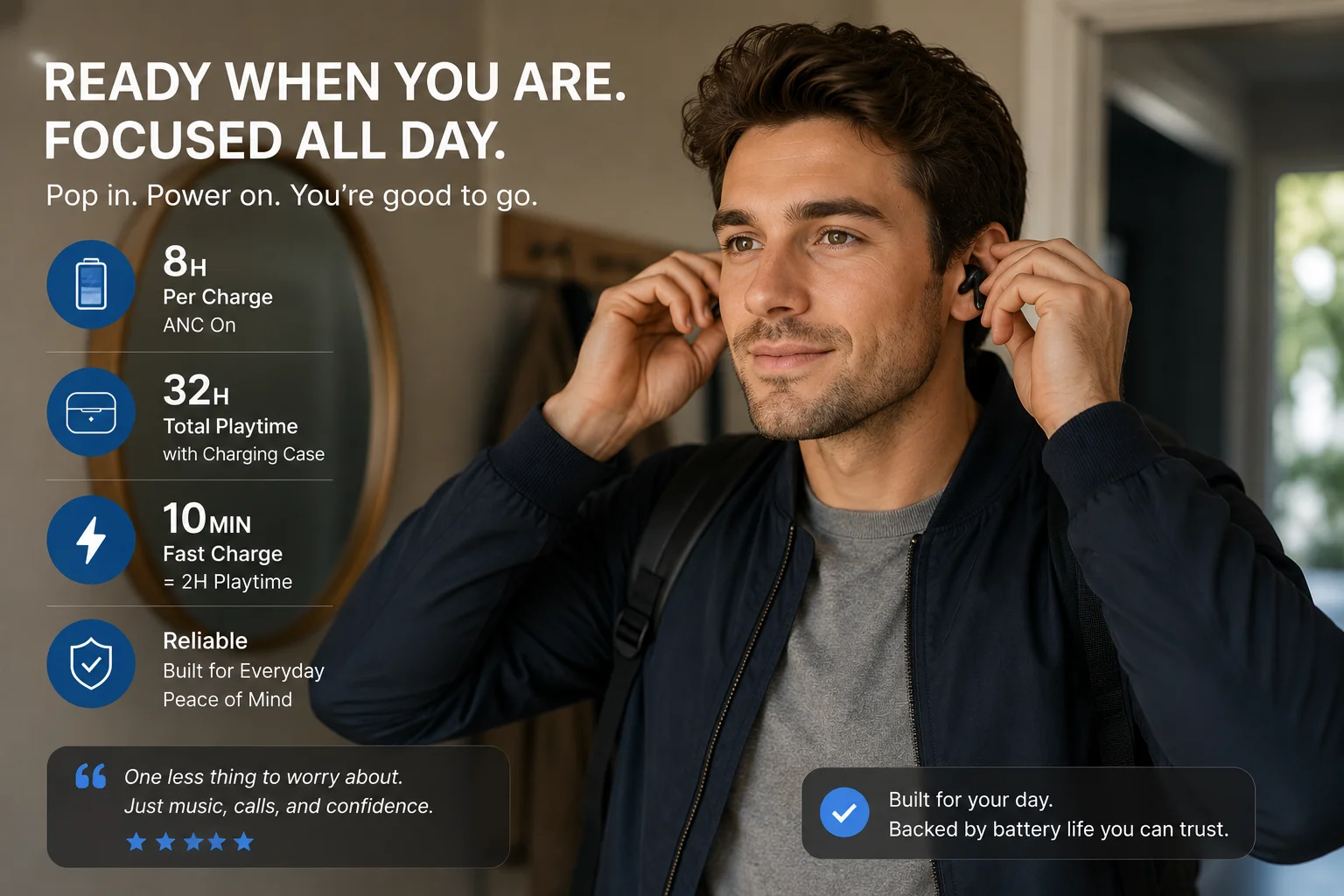
In my experience, customers judge a TWS product on a "Triangle of Trust" built on three simple, real-world pillars:
- Reliable Battery: Does it last as long as promised?
- Clear Calls: Can people hear me clearly in a normal environment?
- Comfortable Fit: Can I wear them for an hour without my ears hurting?
Battery life is the most measurable and visible of these three. If you claim 6 hours and deliver 6 hours, you've earned a point of trust. If your earbuds then also provide clear calls when the user answers their phone on the street, you've earned another. And if they can wear them through a whole movie without discomfort, you've solidified that trust.
This is why focusing on battery life is so powerful. It's the entry point to proving your product's quality. When we source products for our clients, we don't just check the battery once. We test it over days. We drain it, recharge it, use it for calls, and leave it on standby. We make sure the product can be trusted, so you can pass that trust on to your customers.
Why Buyers Should Compare ANC-On Battery Life?
Is "ANC" on your checklist for new TWS earbuds? Be careful. This popular feature is a major battery drain, and many suppliers hide the real-world impact.
You must always ask for and test the battery life with ANC turned on. Customers will use this feature, and if it cuts their playtime in half unexpectedly, they will blame your product and your brand. Being transparent about ANC-on battery life prevents returns.
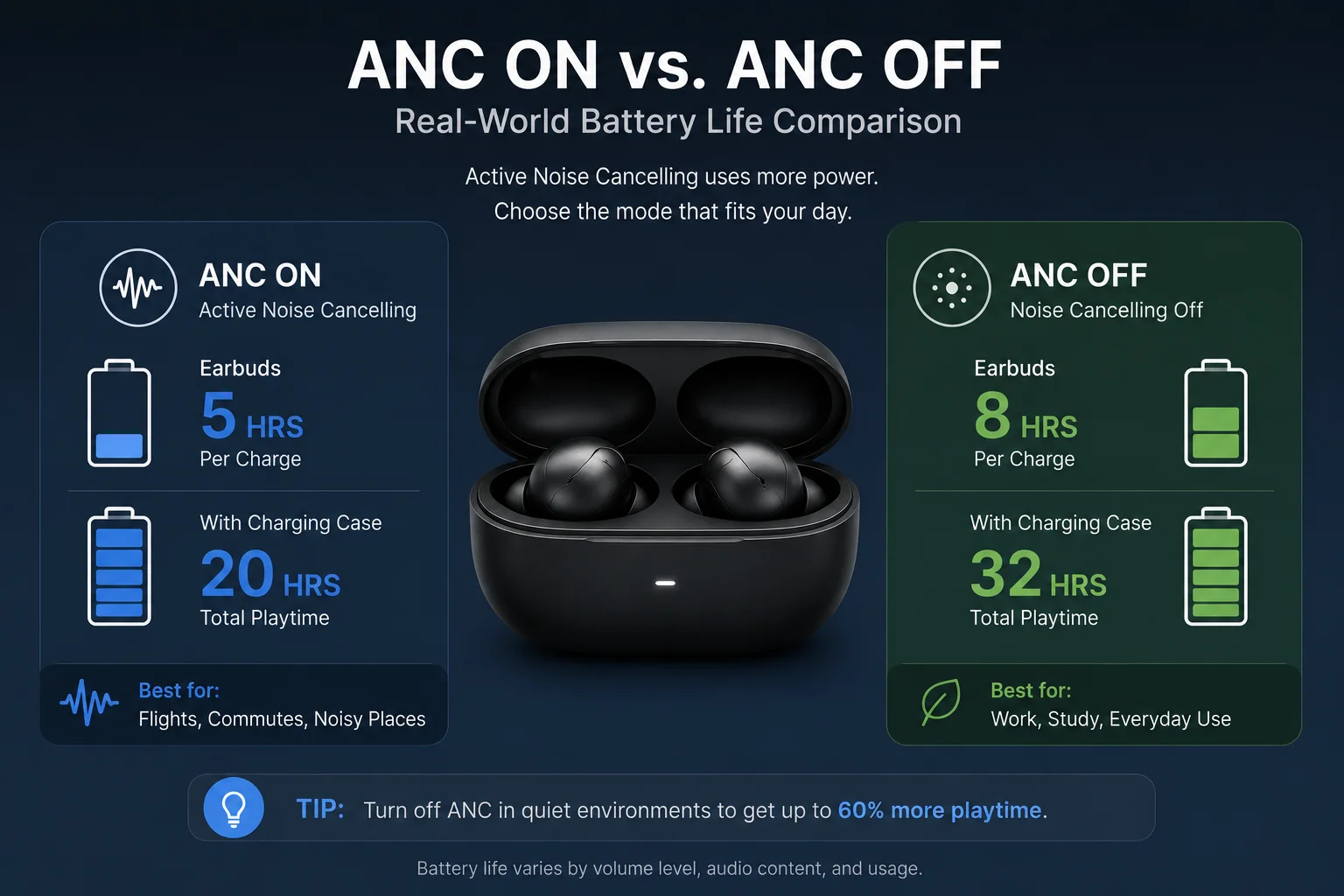
Active Noise Cancellation (ANC) is one of the most requested features today, but it's also one of the most misunderstood. First, you have to make sure you're getting real ANC, not just ENC (Environmental Noise Cancellation for calls) marketed incorrectly. A common trick is to label a product with "Noise Reduction" to blur the lines.6
Assuming you've found a product with true ANC, the next big trap is battery life. ANC technology requires constant power to listen to and cancel out ambient sounds. This can reduce a product's battery life by 30-50%.7
Here’s what happens:
- The box says "6 hours of playtime."
- The customer turns on ANC.
- The earbuds die in 3.5 hours.
- The customer feels cheated and leaves a 1-star review.
To avoid this, you must be the expert your customer is not. When you evaluate a new TWS model, your testing process should look like this:
| Feature | Impact on Battery | What to Test |
|---|---|---|
| Standard Audio | Baseline | Play music at 70% volume until earbuds die. |
| ANC On | High Drain | Repeat the test with ANC activated. Note the time. |
| Phone Call | Medium Drain | Make a continuous 30-minute call and check drain. |
The difference between the "Standard Audio" time and the "ANC On" time is a critical piece of information. It's a number you need to know and be honest about in your marketing.
How Fast Charging Helps Customers Forgive Shorter Playtime?
Are you struggling to find a product that has a tiny, comfortable design and a massive battery? Sometimes, you can't have both. But there is a smart solution.
Fast charging is a powerful feature that acts as a trade-off for shorter battery life.8 A message like "10 minutes of charging gives you 1 hour of music" can manage customer expectations and provide a practical solution that they will appreciate.9
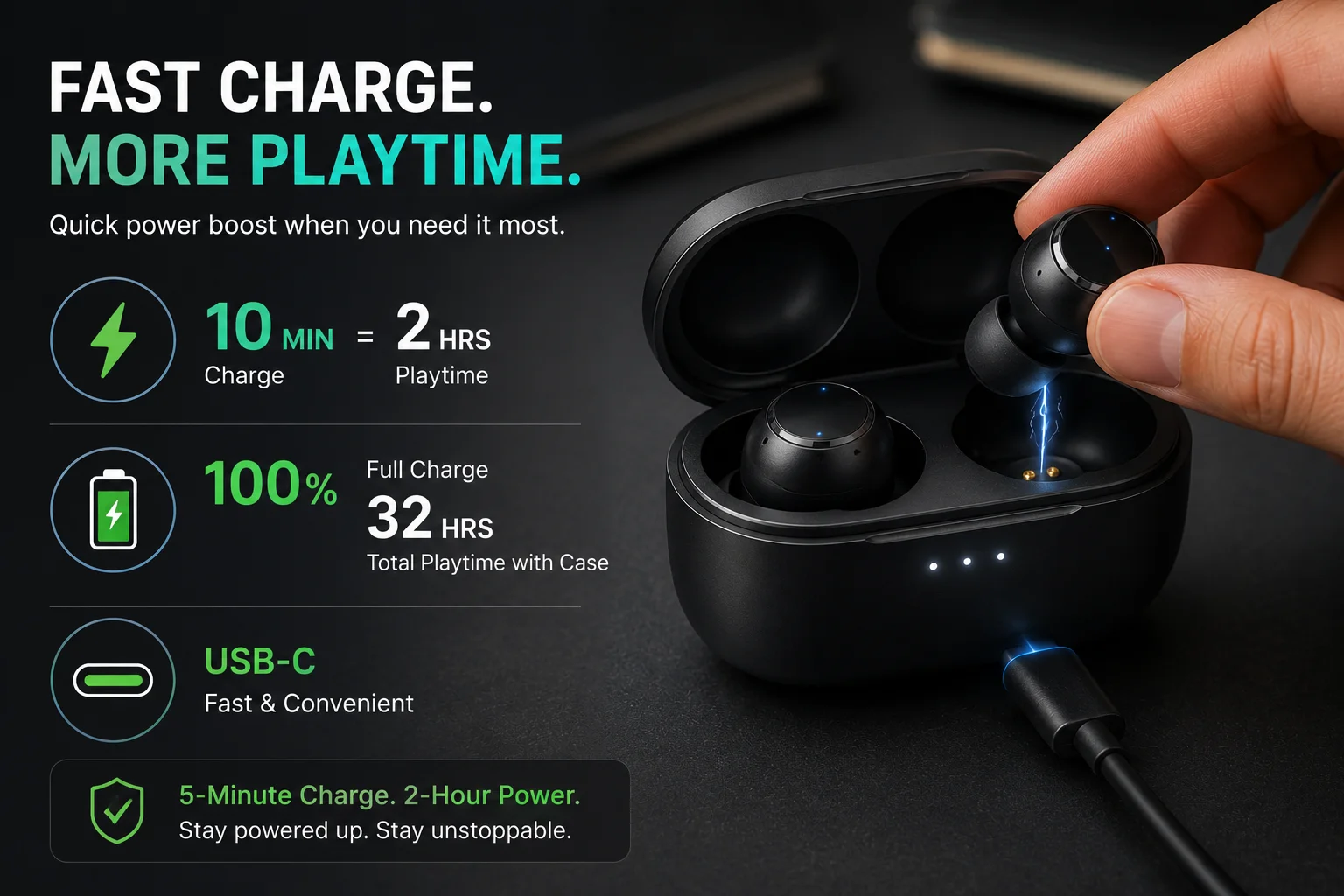
Let's be realistic. Physics is a real constraint. To make earbuds smaller, lighter, and more comfortable, you often have to use a smaller battery cell. While some customers demand the absolute longest playtime, many others prioritize comfort and a compact size, especially for daily wear or sports. So, how do you sell a product with, for example, a 4-hour playtime when competitors are claiming 6?
You change the conversation from "total time" to "quick convenience." This is where fast charging becomes your best sales tool. It addresses the customer's core fear: "What if my earbuds are dead when I need them?"
Instead of just stating the total charging time, you highlight the rapid recovery. Marketing claims like:
- "Need a quick boost? 10 minutes is all you need for your workout playlist."
- "Dead battery? Get 90 minutes of talk time from a 15-minute charge."
This strategy does two things. First, it acknowledges the reality of the product's battery life, which builds trust. Second, it provides a very useful, real-world solution to the problem. It shows that you understand your customer's lifestyle. In a market full of exaggerated claims, offering a practical trade-off can be a surprisingly effective and honest way to win sales.
Why Battery Consistency Matters More Than Claimed Numbers?
Did the sample you approved have amazing battery life, but the bulk order is getting complaints? This is a common and costly nightmare that happens when consistency is ignored.
The battery performance of your 1,000th unit must be as good as your first sample. Consistency is more important than the number on the box. It ensures every customer has the same great experience, protecting your brand reputation and preventing a wave of returns.
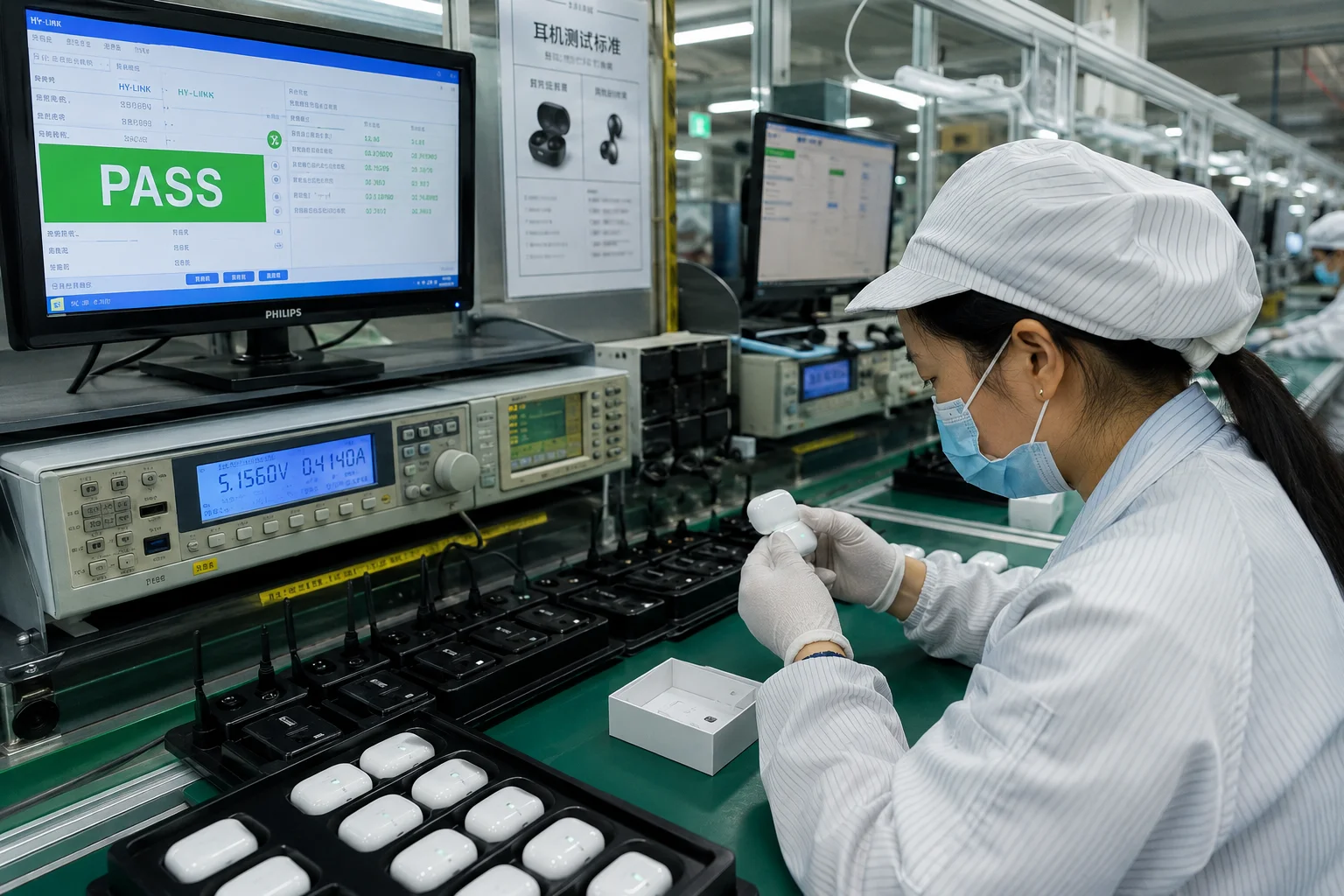
This is one of the biggest pitfalls in sourcing from China, and I've seen it sink many businesses. A factory sends you a perfect "golden sample" made with top-tier components. You're impressed, you place a large order, and then the problems start. The supplier, to save a few cents per unit, swapped the quality battery cells from the sample for cheaper, less reliable ones in the mass production run.10
Suddenly, your defect rate skyrockets. Customers complain that the battery life is half of what's advertised, or that one earbud dies much faster than the other. Your brand's reputation is damaged, and you're stuck with a warehouse full of faulty products.
How do you prevent this?
- Ask About Components: Ask your supplier what brand of battery cell they use. Even if they use generic ones, ask if they will be the exact same from the same factory for the bulk order.
- Get it in Writing: Your purchase order or contract should specify that the components (chipset, battery, speaker) must be identical to the approved sample.
- Request a Production Sample: Before they ship the full order, ask for a few units taken directly from the mass production line. Test them as rigorously as you tested the original sample.
A reliable manufacturer understands that consistency is key to a long-term partnership. They won't be afraid to commit to it. A supplier who avoids these questions is a major red flag.
What Battery Specs Wholesale Buyers Should Check First?
Are you ready to talk to suppliers but want to sound like you know what you're doing? Don't just ask for the "best price." Ask the right questions about the battery.
Before you discuss price, you must verify the core battery specifications. This not only helps you weed out low-quality suppliers but also ensures the product you're buying can actually live up to its marketing claims. Focus on these numbers first.
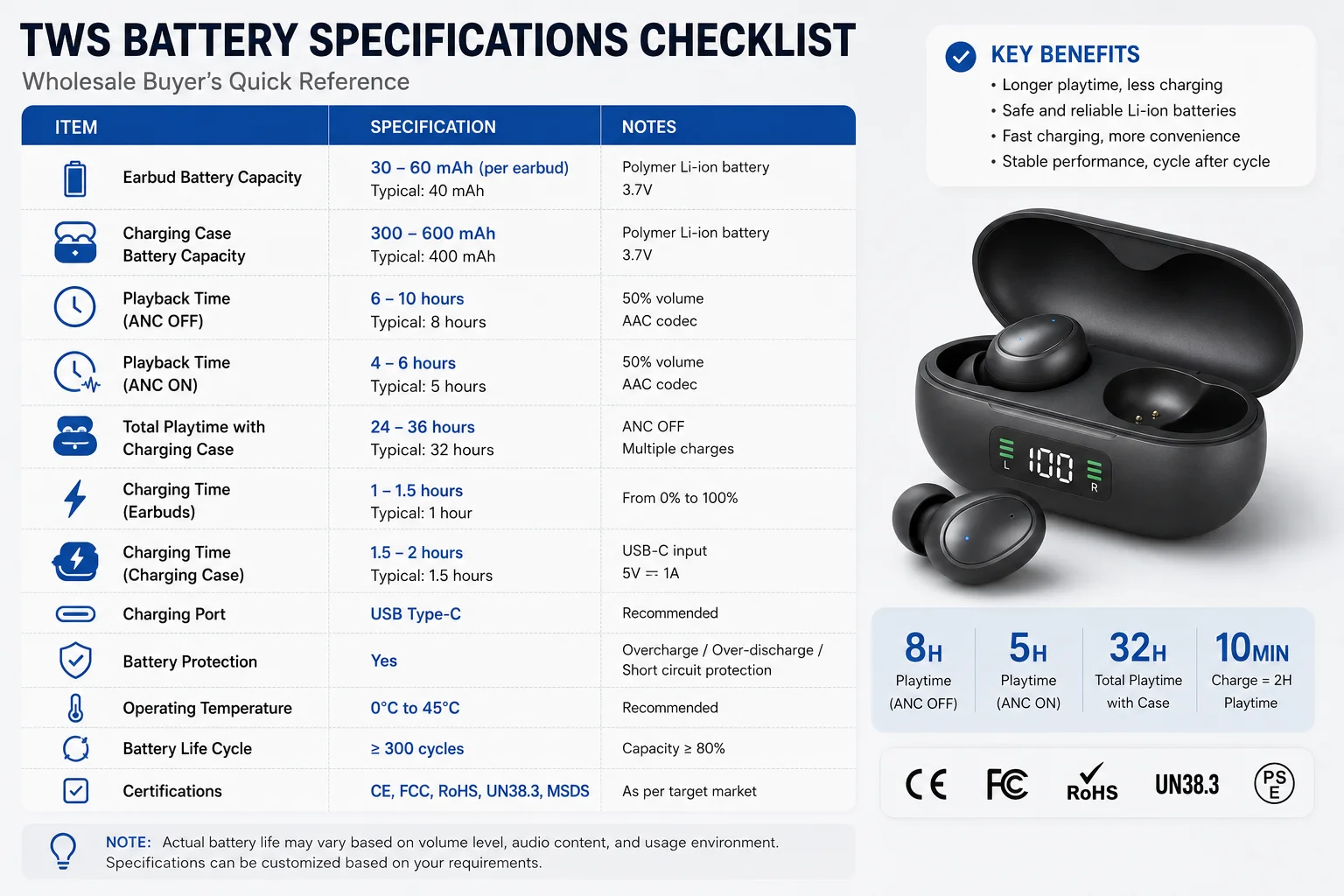
When I get a spec sheet for a new TWS earbud, my eyes immediately scan for a few key numbers. These tell me 80% of what I need to know about the product's real-world performance and the supplier's honesty. Here is the checklist I use and that you should use too. Don't move forward until you have clear answers for all of these:
| Spec to Check | Why It Matters | What to Ask |
|---|---|---|
| Earbud Battery Capacity | The fundamental source of single playtime. Usually 30mAh to 50mAh per earbud.11 | "What is the mAh capacity of each earbud battery cell?" |
| Charging Case Capacity | Determines how many recharges you get. Usually 300mAh to 500mAh.12 | "What is the mAh capacity of the charging case battery?" |
| Real Single Playtime | The MOST important spec. This is what the customer directly experiences. | "What is the tested playtime at 70% volume with ANC off? And with ANC on?" |
| Total Playtime (w/ Case) | Good for marketing, but secondary to single playtime. | "What is the combined total playtime including the case?" |
| Earbud & Case Charging Time | Tells you about convenience. Faster is better. | "How long does it take to fully charge the earbuds? And the case?" |
| Standby Power Drain | A hidden quality killer. Good products lose very little power when idle. | "If the case is left for one week, how much battery will it lose?" |
Having this information allows you to calculate if the claims make sense. If a supplier claims 6 hours of playtime from a tiny 30mAh battery, you should be very skeptical. Asking these specific questions shows you are an experienced buyer who prioritizes quality over cheap promises. It sets the right tone for a successful and profitable business relationship.
Conclusion
Forget the confusing spec sheets. Focus on real-world performance. A reliable battery is the single best indicator of a quality TWS product and a trustworthy supplier for your business.
"Perceived Risk and Fashion on the Intention to Adopt Wireless ...", https://pmc.ncbi.nlm.nih.gov/articles/PMC12199847/. Consumer surveys and market analysis reports frequently identify battery life as one of the most critical features for users when purchasing and evaluating true wireless earbuds, often ranking it alongside sound quality and comfort. Evidence role: statistic; source type: other. Supports: The source should provide data from a consumer survey or market analysis indicating that battery life is a top purchasing consideration or a major source of satisfaction/dissatisfaction for TWS earbud users.. ↩
"How is Amazon's return policy? : r/Earbuds - Reddit", https://www.reddit.com/r/Earbuds/comments/wuxoxg/how_is_amazons_return_policy/. Analysis of customer reviews and return data for consumer electronics often shows that failures to meet fundamental performance claims, such as advertised battery life, are a primary driver of customer dissatisfaction and product returns. Evidence role: general_support; source type: other. Supports: The source should show a correlation between product returns or negative reviews and failures in basic, easily understood features like battery life.. ↩
"Mobile Phone Use and Mental Health. A Review of the Research ...", https://pmc.ncbi.nlm.nih.gov/articles/PMC6314044/. The term 'battery anxiety' describes the stress and unease users feel when their device's battery is low. This psychological phenomenon, widely studied in the context of smartphones, also applies to personal audio devices and can significantly detract from the user experience, leading to negative perceptions of the product. Evidence role: definition; source type: paper. Supports: The source should define 'battery anxiety' and discuss its psychological impact on users of portable electronic devices, confirming it as a significant source of user stress.. Scope note: The source may focus on smartphones, but the principle is directly applicable to other frequently used personal electronics like TWS earbuds. ↩
"part 239—guides for the advertising of warranties and guarantees", https://www.ecfr.gov/current/title-16/chapter-I/subchapter-B/part-239. Consumer protection agencies and advertising standards bodies often scrutinize 'total playtime' claims for devices with charging cases, as emphasizing the combined figure without clearly stating the single-charge duration can be perceived as misleading by consumers. Evidence role: general_support; source type: government. Supports: The source should discuss regulations or best practices for advertising battery life, highlighting the potential for consumer confusion when total playtime is emphasized over single-use playtime.. ↩
"Self-discharge - Wikipedia", https://en.wikipedia.org/wiki/Self-discharge. The standby time of a charging case is affected by both the natural self-discharge rate of its internal lithium-ion battery and any parasitic drain from its own monitoring circuits. High-quality designs minimize this drain, allowing the case to retain a significant portion of its charge for several weeks. Evidence role: mechanism; source type: education. Supports: The source should explain the self-discharge of lithium-ion batteries and the parasitic drain from a case's electronics, providing a technical basis for why a well-engineered case should have minimal power loss.. ↩
"ANC vs ENC 🔊 What's the Difference? Best Sound ...", https://www.instagram.com/reel/DRO_V60E5gS/?hl=en. Technology journalists and consumer advocates have noted that some manufacturers use vague terms like 'Noise Reduction' or 'Noise Isolation' to imply the presence of Active Noise Cancellation (ANC), when the feature is actually Environmental Noise Cancellation (ENC) for the microphone, which does not cancel ambient sound for the listener. Evidence role: case_reference; source type: other. Supports: The source should explain the difference between ANC and ENC and provide examples of products that use ambiguous marketing terms.. ↩
"True-Wireless Earbuds and Low-Power Processing - Syntiant", https://www.syntiant.com/news/true-wireless-earbuds-and-low-power-processing. Independent testing by technology publications consistently demonstrates that activating Active Noise Cancellation (ANC) significantly increases power consumption, typically reducing an earbud's single-charge playtime by 25% to 50% depending on the model and intensity of the noise cancellation. Evidence role: statistic; source type: other. Supports: The source should provide test data from multiple TWS earbud models showing the percentage reduction in battery life when ANC is enabled.. ↩
"Is Fast Charging Killing the Battery? A 2-Year Test on 40 Phones", https://www.reddit.com/r/Android/comments/1oqya2x/is_fast_charging_killing_the_battery_a_2year_test/. Market analysis of consumer electronics shows a design trend where manufacturers balance the consumer demand for smaller, more ergonomic devices against the physical limitation of battery size by incorporating fast-charging capabilities. This feature is often marketed as a key convenience, reframing the user experience from 'long-lasting' to 'quickly available'. Evidence role: general_support; source type: other. Supports: The source should discuss the product design trend of using fast charging to mitigate the limitations of smaller batteries in compact devices and how this is positioned in marketing.. ↩
"Attentional and emotional brain response to message framing ... - PMC", https://pmc.ncbi.nlm.nih.gov/articles/PMC7519354/. Marketing communication research shows that framing product features in terms of tangible, immediate benefits (e.g., '1 hour of playtime from a 10-minute charge') is an effective strategy for managing customer expectations and mitigating potential dissatisfaction with a product's absolute limitations, such as total battery capacity. Evidence role: mechanism; source type: paper. Supports: The source should discuss marketing communication strategies, like the framing effect, and how providing specific, positive outcomes can manage customer expectations.. ↩
"'Quality Fade': China's Great Business Challenge", https://knowledge.wharton.upenn.edu/podcast/knowledge-at-wharton-podcast/quality-fade-chinas-great-business-challenge/. The practice of 'quality fade,' where a manufacturer substitutes lower-cost components in a mass production run after a higher-quality initial sample has been approved, is a well-documented risk in global supply chain management. This can lead to significant variations in performance and reliability, particularly with critical components like battery cells. Evidence role: case_reference; source type: other. Supports: The source should describe the phenomenon of 'quality fade' or 'component swapping' in international sourcing, where a supplier substitutes lower-cost components after a 'golden sample' has been approved.. ↩
"If the battery packup of earbuds is 2800mh, for how many ...", https://www.quora.com/If-the-battery-packup-of-earbuds-is-2800mh-for-how-many-hours-can-we-use-it. Technical teardowns and specification databases for a wide range of true wireless earbuds show that the battery capacity for an individual earbud typically falls within the 30mAh to 60mAh range, with variations depending on the earbud's size, features, and price point. Evidence role: statistic; source type: other. Supports: The source should provide data from teardowns or specification databases of various TWS earbud models, showing the typical range of battery capacities.. Scope note: The exact range can vary, with some premium or larger models exceeding this, but it represents a common baseline for the industry. ↩
"How does the battery life work for true wireless + case i'm confused", https://www.reddit.com/r/headphones/comments/zcv6tw/how_does_the_battery_life_work_for_true_wireless/. A review of specifications across the TWS market indicates that charging case battery capacities commonly range from 300mAh to 500mAh, a size sufficient to provide approximately three to four full recharges for the earbuds. Evidence role: statistic; source type: other. Supports: The source should provide data from teardowns or specification databases showing the typical range of battery capacities found in TWS charging cases.. ↩