Choosing a supplier is overwhelming. The wrong choice can cost you time and money, sinking your business before it starts1. The key is reframing the question to match your goals.
The best sourcing model depends entirely on your business's scale, brand ambition, technical ability, and how much risk you can handle. The right choice for a startup is often the wrong one for an established retailer.
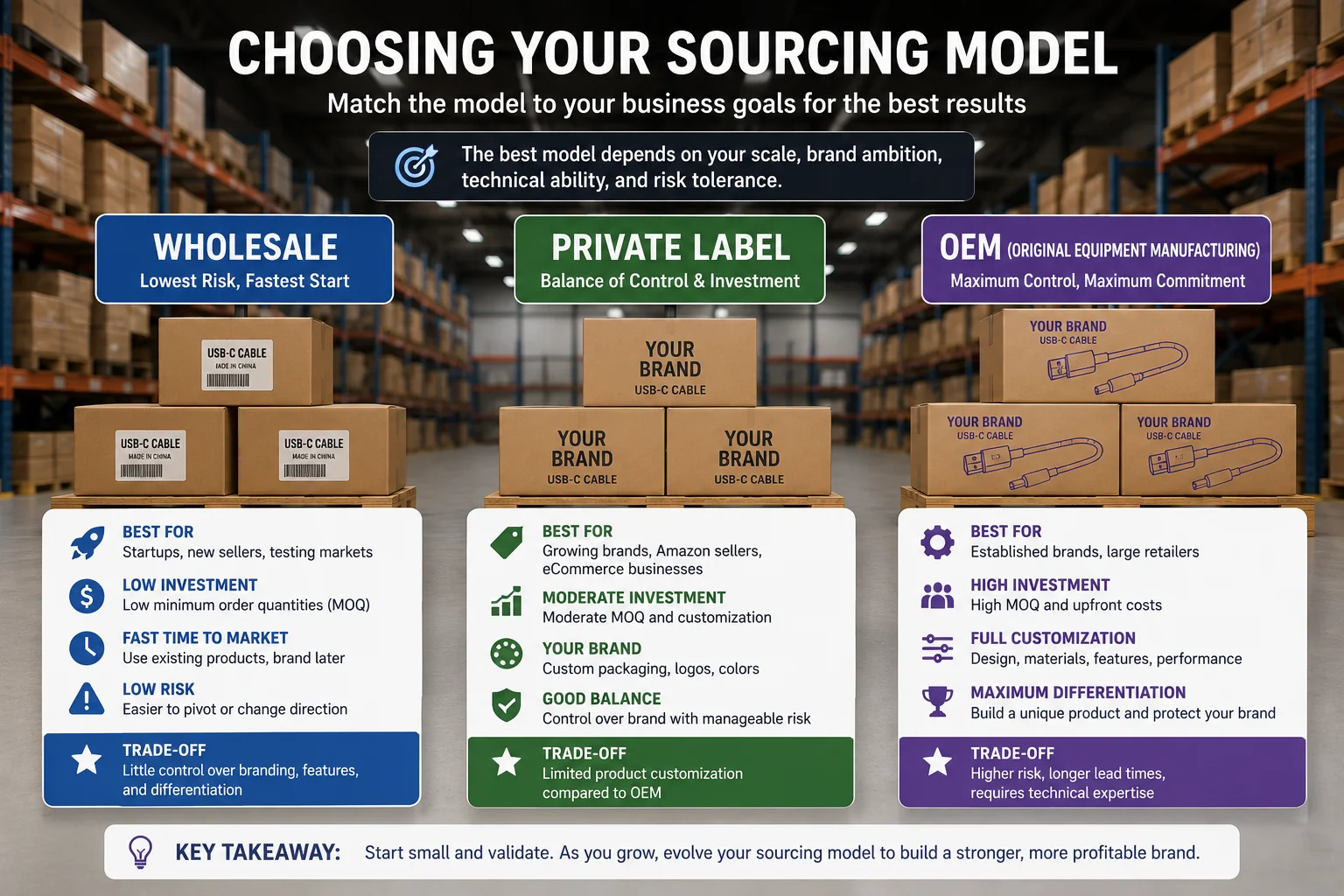
Over my 15 years in this business, I've seen countless buyers. They all want to know the "best" way to source products from China. But there is no single "best" way. A common question we get from first-time importers is about the differences between wholesale, private label, and OEM. They often think it's just a ladder of cost and customization. The reality is more complex. It's about matching a business model to your specific situation. This isn't just a guide defining terms. This is a decision framework to help you assess risk and choose the path that fits your business right now. Let's break it down so you can make a smart, informed decision that protects your capital and helps you grow.
Is Wholesale Just the 'Cheap' Option for Testing the Market?
Want to enter a new market, but worried about high MOQs and tying up your capital? You see wholesale as a low-risk entry, but wonder if it's too basic.
Wholesale is the ideal market-testing tool2. It lets you trade customization for speed and a low minimum order quantity (MOQ). This helps you validate a product's potential before committing serious capital.
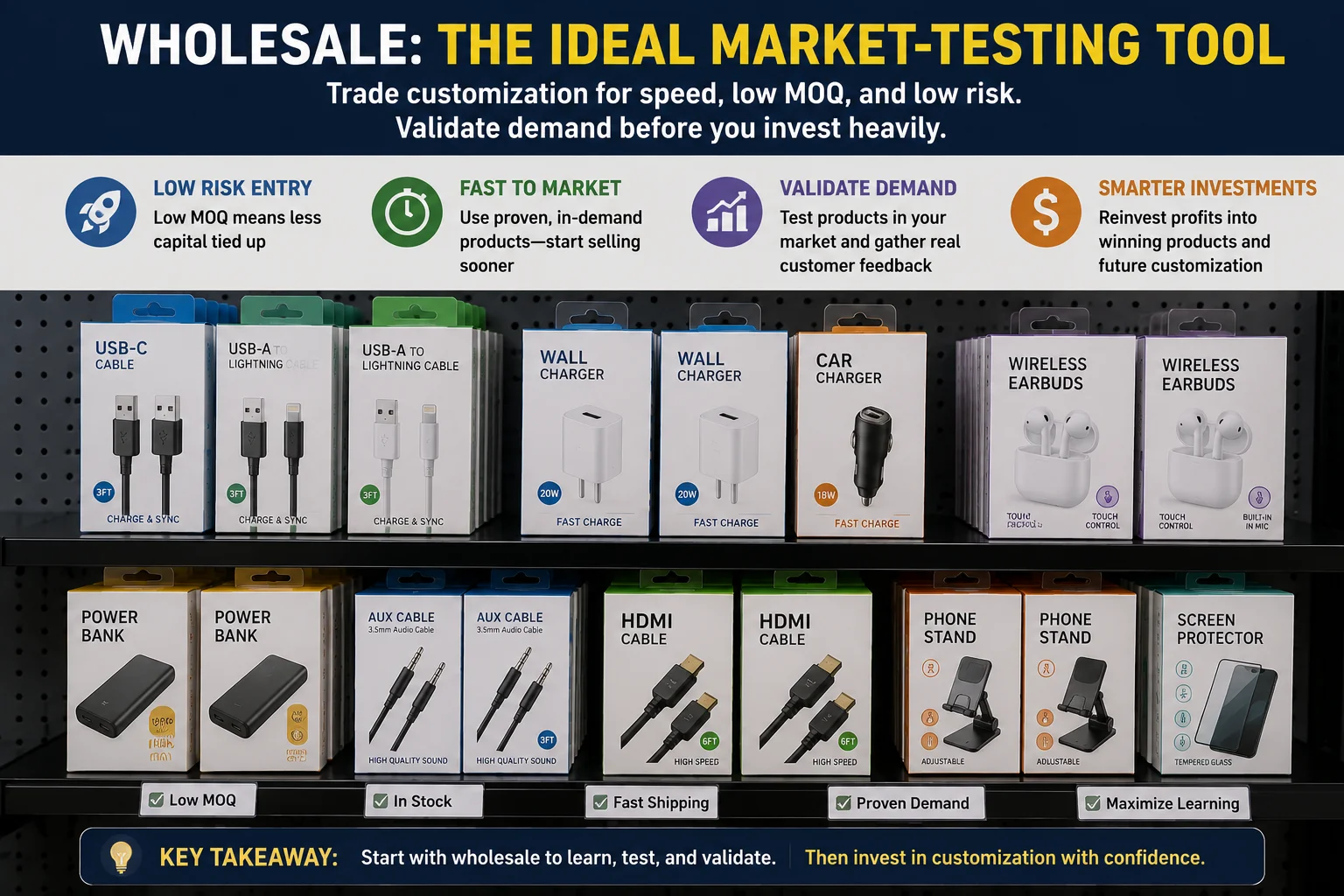
Many new buyers I talk to see wholesale as the "cheap" option, and they're not wrong, but they're not entirely right either. The real value of wholesale isn't just the lower price per unit; it's the speed and low barrier to entry. When you're just starting or testing a new product category, like TWS earbuds or smartwatches, you don't know what will sell. Your primary goal is to get data. Wholesale lets you do that. You can buy a small quantity of a standard, off-the-shelf product that we already have in stock. The MOQ is low, often just a few cartons, and we can ship it in days, not months. The trade-off is clear: you get zero customization3. The product, the packaging, everything is generic. You're selling the exact same item as dozens of other sellers. But you've invested very little capital, and you'll quickly learn if customers in your market are even interested in this type of product. Think of it as a low-cost market survey.
Is Private Label Really Just Printing a Logo on a Box?
You want to build your own brand, but a full OEM project seems too complex. You think private label is the easy middle ground. But is it really that simple?
Private label is your first step into branding4. It is far more than just logo printing. It's a real commitment to marketing, custom packaging, and differentiating a mostly standard product.
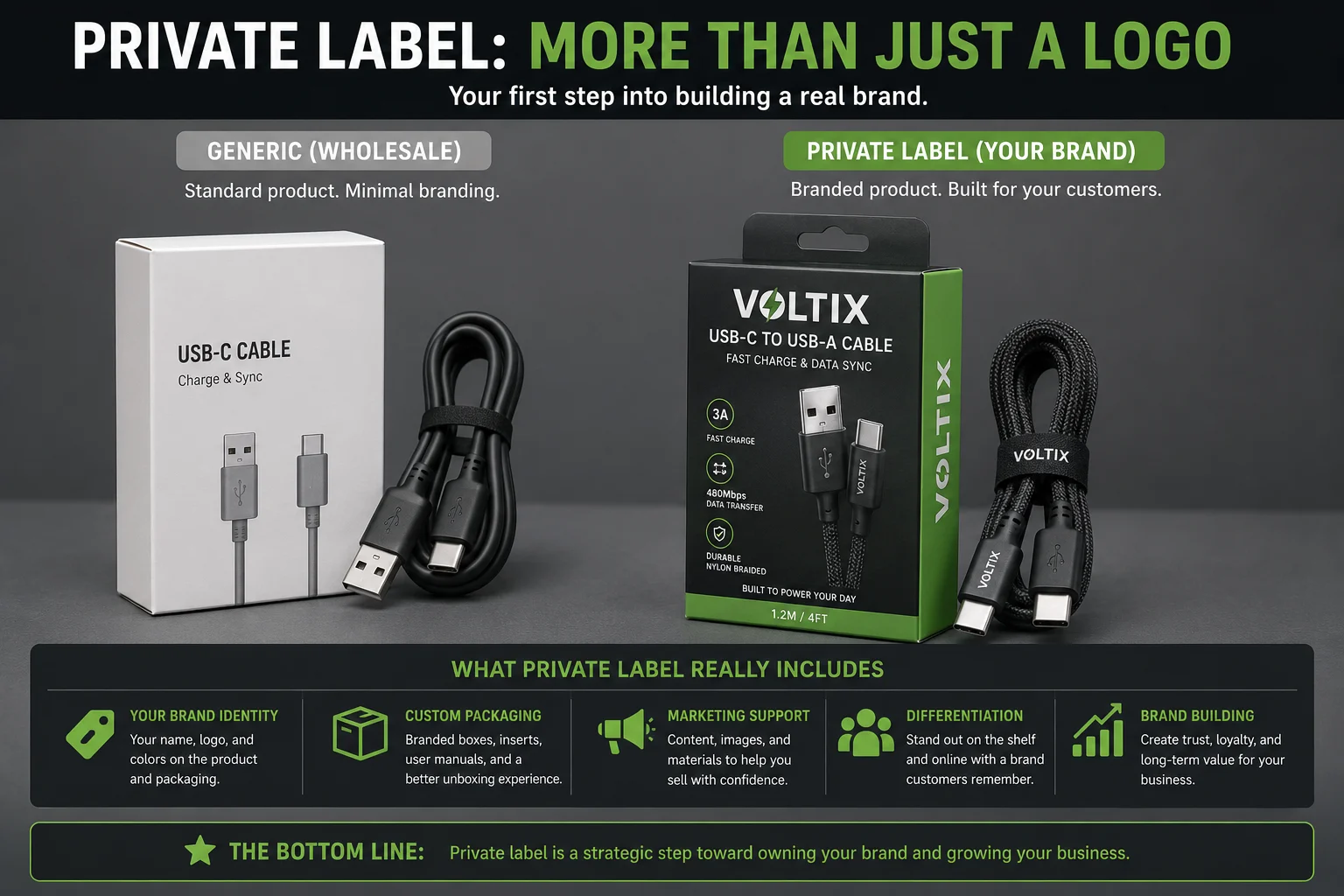
A scenario I often discuss with e-commerce sellers is the move from wholesale to private label. They've had some success with a generic product and now want to build a brand. They say, "I just want to put my logo on it." I always tell them to think bigger. Private label, or what we sometimes call white label, means taking a product that a factory like ours has already developed and making it your own. Yes, that starts with printing your logo on the product and designing your own packaging. But the real work is on your end. The core product—say, a GaN charger—is identical to what other private label sellers might source.5 Your job is to create a brand story, invest in marketing, write a better user manual, and provide excellent customer service. You're differentiating through brand, not hardware. It requires more effort than wholesale. You'll face a higher MOQ, and lead times will be longer because we have to produce your custom packaging. The key mistake is underestimating the work needed to build the brand around the product.
Does OEM Mean I Have Total Control Over My Product?
You have a unique vision for a product and want something no one else has. You believe OEM is the path to total control. But are you prepared for the deep involvement required?
OEM (Original Equipment Manufacturer) is a partnership, not a simple purchase.6 It means shared technical and financial responsibility for development, tooling, and certifications. It is not about total control; it's about co-creation.
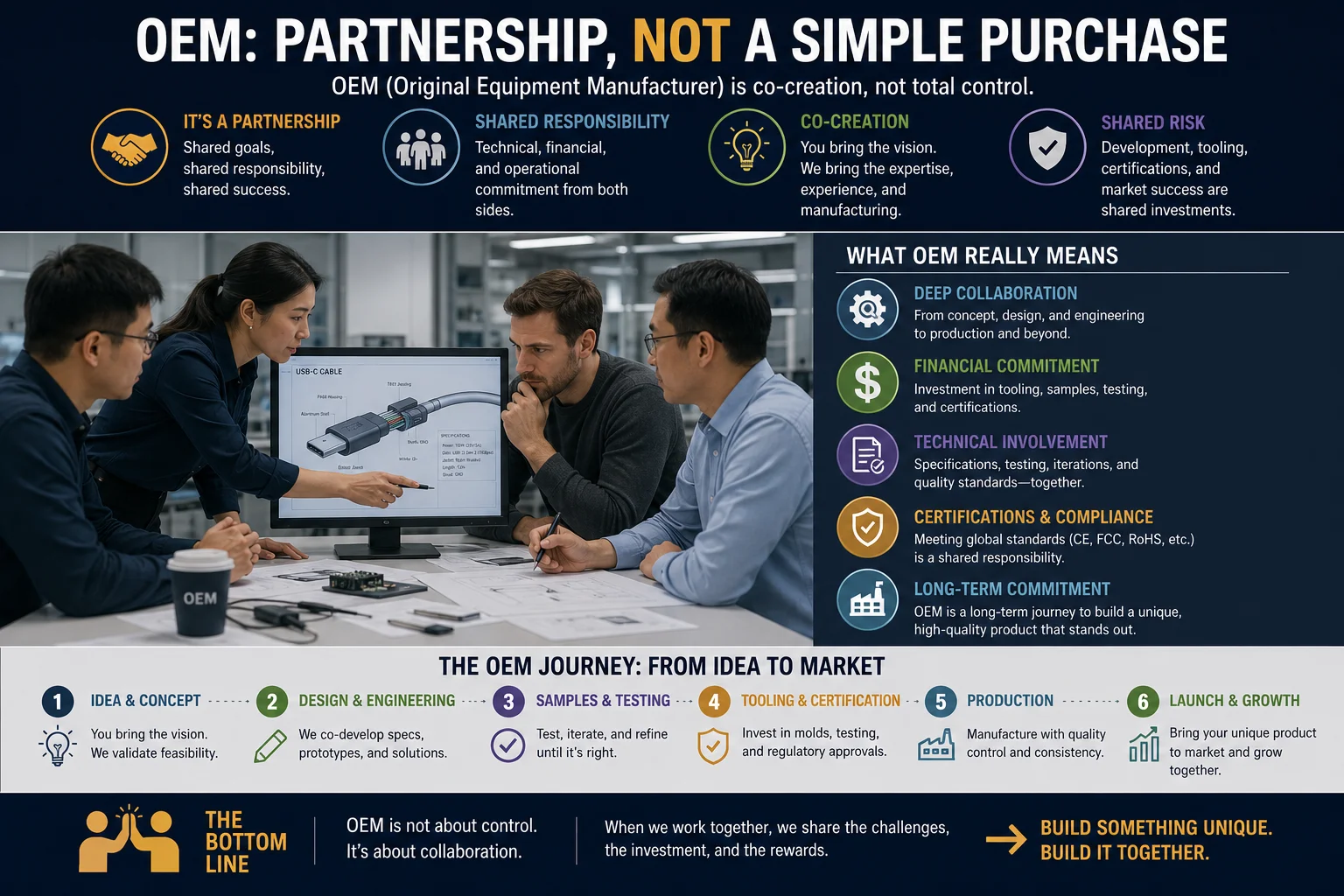
When a client asks for a full OEM project, my first question is always about their team. "Do you have technical staff?" I ask. Because OEM is a serious commitment, and it's for scaled businesses. This is where you come to us with an idea, a sketch, or a detailed specification for a product that doesn't exist yet. We work together to build it from the ground up. Buyers often think this means they have total control, but it's more of a shared responsibility. You are responsible for the vision and a significant financial investment. This includes Non-Recurring Engineering (NRE) costs for creating molds (tooling), which can be thousands of dollars7. You're also deeply involved in the R&D process, testing prototypes, and making design decisions. We are responsible for the engineering, manufacturing, and navigating the complex world of quality control and supply chains. This path is for businesses that can afford the high MOQs, the long development timelines (months, not weeks)8, and have the human capital to manage a complex technical project. It's for when a unique product is critical to your brand's success.
How Do I Choose the Right Sourcing Model for My Business?
Feeling stuck between the options? Afraid of making a mistake that costs you thousands? The key is to stop looking for the "best" model and start looking at your own business.
Don't ask "which model is best?" Ask, "which risks can my business afford?" The right answer comes from a simple self-assessment of your capital, team, brand goals, and sales channels.
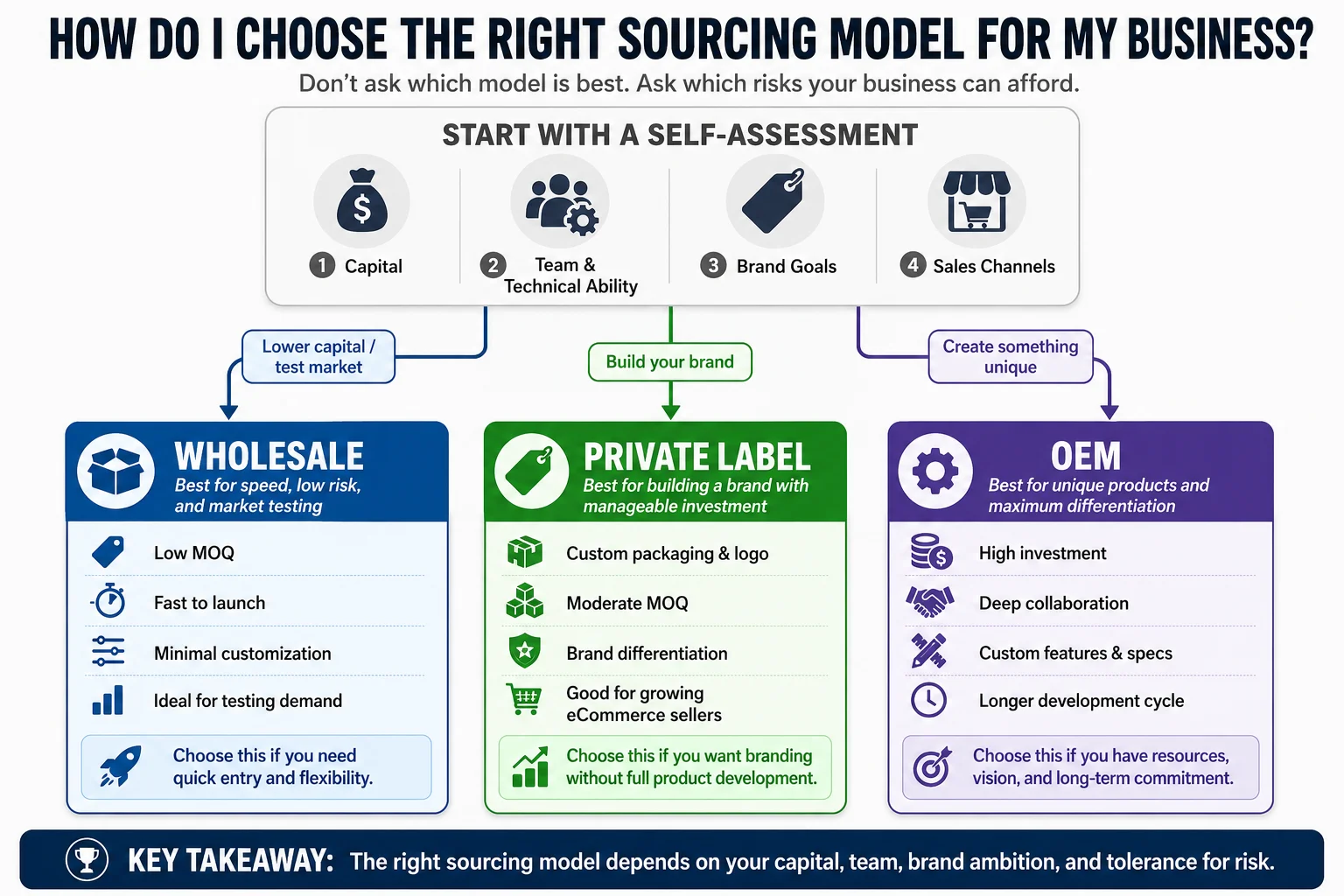
The right choice is a mirror of your own company's capabilities.9 For 15 years, I've guided clients through this decision by having them answer a few honest questions. Instead of getting lost in definitions, use this framework to diagnose your own needs. The right question isn't "Which model is best?" but "Which model is right for me, right now?"
How much capital and volume can you commit?
- Low Capital / Low Volume: You're testing the waters. Your priority is minimizing financial risk.
- Your Answer: Wholesale. Buy small, sell fast, gather data. Don't tie up cash in inventory.
- Medium Capital / Medium Volume: You've validated the market and are ready to build a brand.
- Your Answer: Private Label. Your MOQ will be higher (e.g., 1000-3000 pieces10), but you can start building brand equity.
- High Capital / High Volume: You're an established player and unique hardware is your competitive advantage.
- Your Answer: OEM. You can afford the tooling costs and high MOQs (e.g., 5000+ pieces11) to create a truly unique product.
How strong is your technical team?
- No Technical Staff: You are a marketer or salesperson, not an engineer.
- Your Answer: Wholesale or Private Label. Rely on our proven, off-the-shelf products. Focus on what you do best: selling.
- Some Technical Knowledge / A Part-Time Expert: You can understand spec sheets and quality control reports.
- Your Answer: Private Label. You can have intelligent conversations about component choices (e.g., a specific chipset in a smartwatch)12 to get a better-than-average product.
- Dedicated In-House Engineers: You have a team that can design, test, and troubleshoot.
- Your Answer: OEM. Your team can work directly with our engineers to co-develop the product, ensuring your vision is executed perfectly.
What are your brand ambitions?
| Your Ambition | Description | Best Model |
|---|---|---|
| Market Explorer | "I just want to see if this type of product sells." | Wholesale |
| Brand Builder | "I want customers to remember my name and buy from me again." | Private Label |
| Innovator | "I want to create a product that changes the market." | OEM |
Conclusion
Choosing the right sourcing model isn't about cost. It's about matching your business's current scale, capabilities, and goals with the right level of risk and commitment.
"34.7 percent of business establishments born in 2013 were still ...", https://www.bls.gov/opub/ted/2024/34-7-percent-of-business-establishments-born-in-2013-were-still-operating-in-2023.htm. Data from government bodies like the U.S. Small Business Administration (SBA) indicates that a significant percentage of new businesses fail within the first five years, often due to challenges in managing cash flow, inventory, and operational costs, which are directly impacted by sourcing decisions. Evidence role: statistic; source type: government. Supports: The high rate of failure for new businesses, with operational factors like cash flow and inventory management being significant contributors.. Scope note: While these statistics support the high stakes of operational decisions, they do not typically isolate the choice of sourcing model (wholesale vs. OEM) as a direct cause of failure. ↩
"Lean Validation: The Fundamental Guide - Bundl", https://www.bundl.com/guides/lean-validation-a-fundamental-guide. This approach is consistent with lean startup principles, which advocate for using a Minimum Viable Product (MVP) to test hypotheses about market demand and gather validated learning with the least amount of effort and capital, a role that sourcing off-the-shelf wholesale products can fulfill. Evidence role: general_support; source type: education. Supports: The strategy of using wholesale aligns with lean startup principles, which emphasize testing market demand with minimal investment before scaling.. ↩
"Wholesaling - Wikipedia", https://en.wikipedia.org/wiki/Wholesaling. In a wholesale model, a business purchases finished, standardized goods from a manufacturer or distributor for resale. The products are sold as-is, without customization of the product, branding, or packaging. Evidence role: definition; source type: encyclopedia. Supports: The definition of wholesale, which involves selling existing, standardized goods without modification.. ↩
"Private label sales set another record in 2025 | Grocery Dive", https://www.grocerydive.com/news/private-label-record-sales-volume-2025-plma-grocery/810093/. Market research from firms like NielsenIQ and the Private Label Manufacturers Association (PLMA) consistently shows that private label products represent a substantial and growing share of retail sales across North America and Europe, confirming their effectiveness as a mainstream branding strategy. Evidence role: statistic; source type: research. Supports: The significant and growing market share of private label products, which validates their role as an effective branding strategy for retailers.. ↩
"Private label - Wikipedia", https://en.wikipedia.org/wiki/Private_label. The private label model involves a manufacturer producing a standard product that is then sold by multiple retailers under their own brand names. While packaging and marketing differ, the underlying product is often functionally identical to those sold by other private label sellers. Evidence role: definition; source type: education. Supports: The definition of private labeling, where a manufacturer produces a generic product that multiple retailers can sell under their own distinct brands.. ↩
"Original equipment manufacturer - Wikipedia", https://en.wikipedia.org/wiki/Original_equipment_manufacturer. An Original Equipment Manufacturer (OEM) relationship is one where a company designs a product to its own unique specifications and then contracts a factory to produce it. This process requires a deep, collaborative partnership involving shared responsibilities in design, engineering, testing, and production. Evidence role: definition; source type: encyclopedia. Supports: The definition of an OEM relationship, which involves a buyer providing unique specifications for a product that a manufacturing partner then builds, necessitating close collaboration.. ↩
"Non-recurring engineering - Wikipedia", https://en.wikipedia.org/wiki/Non-recurring_engineering. Non-Recurring Engineering (NRE) refers to the one-time costs associated with designing and tooling up for a new product. A major component of NRE is often the creation of custom molds for processes like plastic injection molding, which can range from a few thousand to over one hundred thousand dollars depending on the part's complexity and the mold's durability. Evidence role: definition; source type: education. Supports: The definition of NRE and the typical cost range for manufacturing tooling like injection molds.. Scope note: The actual cost of tooling is highly variable and depends on factors like material, complexity, and production volume. ↩
"Timeline of electrical and electronic engineering - Wikipedia", https://en.wikipedia.org/wiki/Timeline_of_electrical_and_electronic_engineering. The new product introduction (NPI) process for hardware, from initial concept to mass production, is a multi-stage endeavor that includes design, prototyping, tooling fabrication, and pilot production runs. Industry analyses show this process typically spans from six months to well over a year. Evidence role: general_support; source type: research. Supports: The typical stages and overall duration of a new hardware product development cycle.. Scope note: Specific timelines can vary significantly based on the product's complexity, regulatory requirements, and supply chain factors. ↩
"Resource-based view - Wikipedia", https://en.wikipedia.org/wiki/Resource-based_view. This approach aligns with the Resource-Based View (RBV) of the firm, a major theory in strategic management which argues that a company's sustainable competitive advantage is determined by its unique internal resources and capabilities, and that strategic choices should be made to best leverage these assets. Evidence role: general_support; source type: paper. Supports: The business theory that a firm's strategy should be based on its unique internal resources and capabilities.. Scope note: Academic theories like RBV provide a general framework for strategic thinking and would not specifically mention sourcing models, but they support the underlying principle of internal assessment. ↩
"MOQ for Private Label : r/shopify - Reddit", https://www.reddit.com/r/shopify/comments/11xmmhh/moq_for_private_label/. Sourcing industry reports and manufacturing platforms indicate that for many consumer products, the Minimum Order Quantity (MOQ) for a private label order typically falls between 1,000 and 3,000 units, as this volume is often required to make production runs for custom packaging and branding economically viable. Evidence role: statistic; source type: other. Supports: The typical MOQ range for private label manufacturing, which requires custom packaging runs.. Scope note: MOQs are not standardized and can vary widely depending on the product's value, materials, and the specific factory's policies. ↩
"Manufacturing MOQs: 4 Steps to Determine Your Attainable MOQ", https://taikibeauty.com/skincare-manufacturing-minimum-order-quantities/. For Original Equipment Manufacturer (OEM) projects involving custom tooling and engineering, manufacturers often set high Minimum Order Quantities (MOQs), frequently at 5,000 units or more. This volume is necessary to help the buyer amortize the substantial non-recurring engineering (NRE) costs over a sufficient number of units. Evidence role: statistic; source type: other. Supports: The typical MOQ for OEM projects, which must be large enough to amortize significant NRE costs.. Scope note: This figure serves as a general guideline; actual MOQs can be higher or lower depending on the product's price point, complexity, and the factory's business model. ↩
"Original design manufacturer - Wikipedia", https://en.wikipedia.org/wiki/Original_design_manufacturer. This type of customization is characteristic of an Original Design Manufacturing (ODM) model. In an ODM arrangement, a factory provides an existing product design which the buyer can brand and, in many cases, modify by selecting from a menu of available components or requesting minor design alterations. Evidence role: definition; source type: encyclopedia. Supports: The definition of Original Design Manufacturing (ODM), where a buyer can select a factory's existing design and request modifications, such as to internal components.. Scope note: The article uses the term 'Private Label' broadly, whereas a formal source would likely classify this specific activity as ODM to distinguish it from simply branding a fixed, standard product. ↩