I often see buyers choose a charger by wattage only. That creates slow charging, bad reviews, and avoidable after-sales questions.
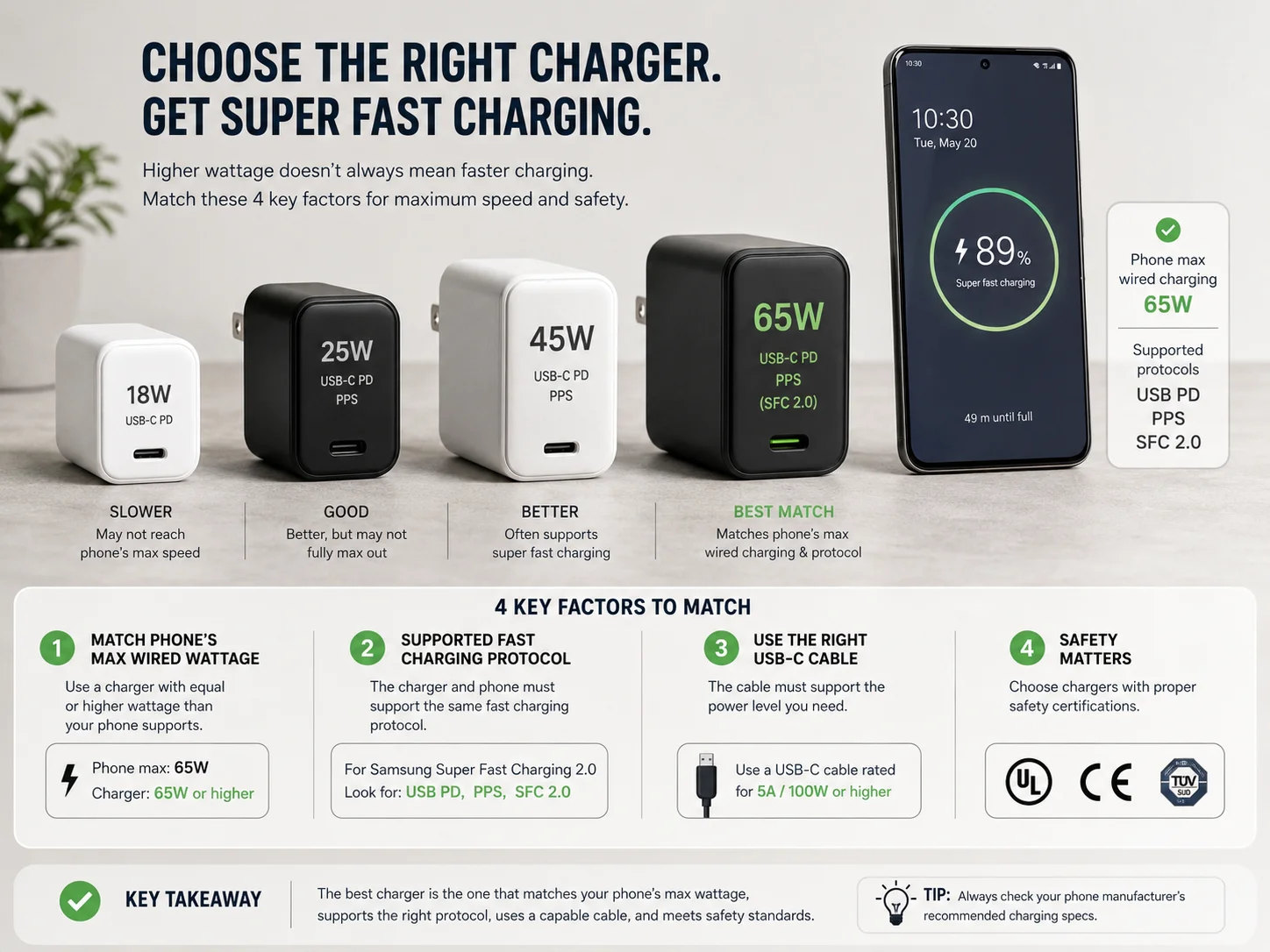
The best charger for super fast phone charging is the one that matches the phone’s maximum wired charging wattage, supported fast-charging protocol, USB-C cable rating, and safety requirements. Higher wattage alone does not always mean faster charging.1
I have sold chargers, GaN chargers, and USB cables to retailers and wholesalers for many years. I have seen one same question come back again and again: “Which wattage should I buy?” I understand why buyers ask this. Wattage is easy to see on the box. Protocol support is harder to explain to customers. Cable rating is often ignored until complaints arrive.
I do not start with the charger. I start with the phone. A phone has its own charging limit.2 It also has its own protocol support. The charger must speak the same “charging language.” The cable must carry the required current. The battery temperature and current battery level also change the real speed.3 So I treat super fast charging as a full system, not one single product.
1. What Does “Super Fast Charging” Actually Mean?
I see “super fast” used too easily. This creates confusion, because one buyer may expect 20W, and another buyer may expect 45W.
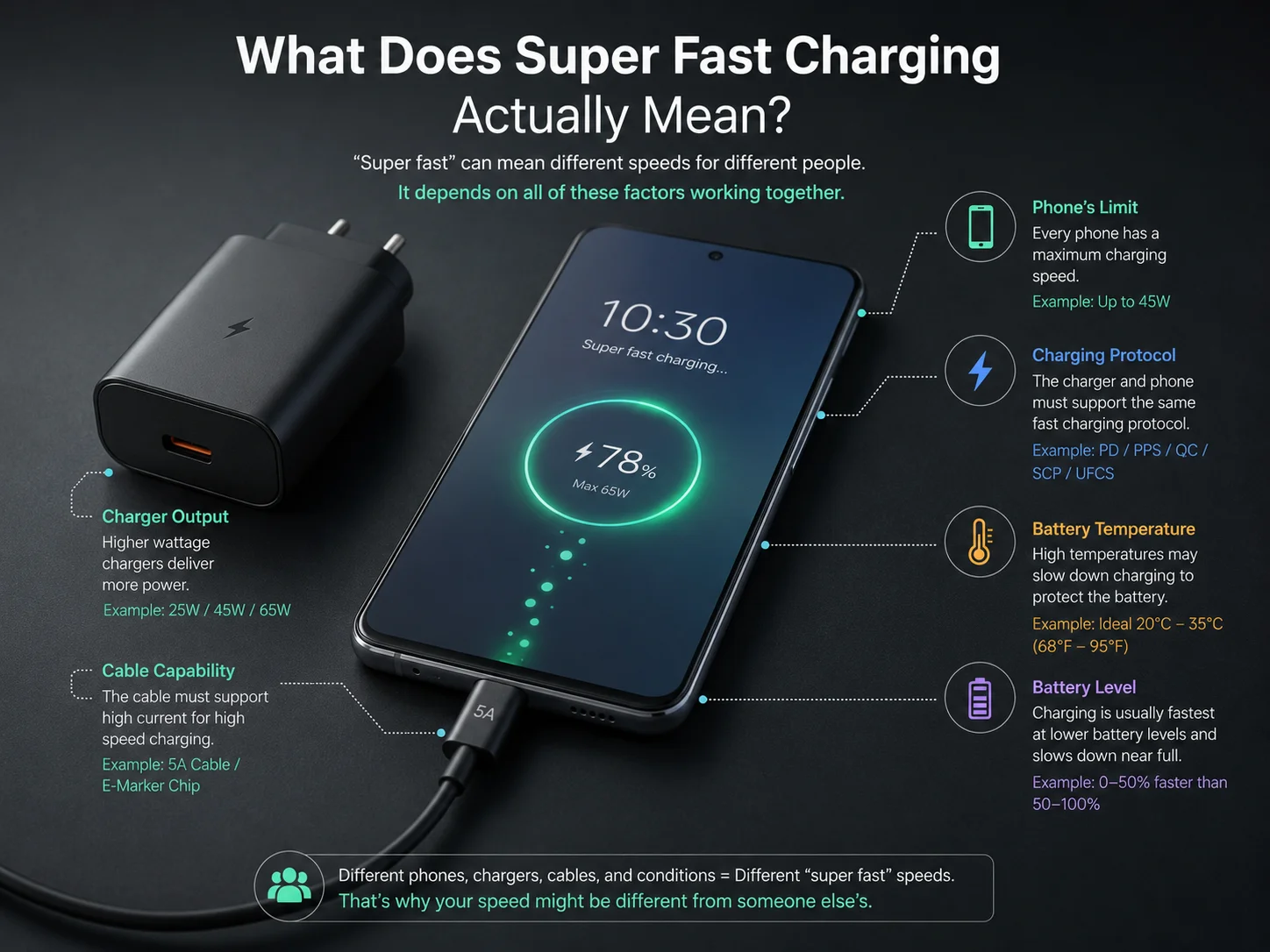
Super fast charging means the phone receives power above normal basic charging, but the real speed depends on the phone limit, protocol, charger output, cable capability, battery temperature, and battery level.
I look at the full charging system
I never explain super fast charging as charger wattage only. A 65W charger does not force 65W into every phone. The phone requests the power it can accept. The charger offers output levels. The phone and charger then negotiate. If the phone supports only 20W, it will not charge at 65W just because the charger is larger. If the cable is weak, the power may drop again. If the battery is already near full, the phone slows down to protect its own charging process.
| Factor I check | Why it matters for real speed |
|---|---|
| Phone charging limit | I use this as the top speed the phone may accept |
| Supported protocol | I need the phone and charger to use the same fast-charge method |
| Charger output | I check the real output at each port |
| USB cable capability | I make sure the cable supports the needed current and wattage |
| Battery temperature | I know hot or cold batteries may charge slower |
| Battery level | I expect charging to slow down near higher battery levels |
I do not sell wattage as a promise
For retail and e-commerce listings, I prefer clear wording. I do not write “charges all phones at maximum speed” unless the claim is checked against target models. I write supported wattage, protocol, and cable requirement. This helps customers choose correctly. It also reduces returns. In my experience, many complaints come from wrong expectations, not from a broken charger.
2. What Charger Wattage Does Your Phone Need?
I see many buyers jump to 65W because it looks powerful. That can waste cost if the customer only needs phone fast charging.
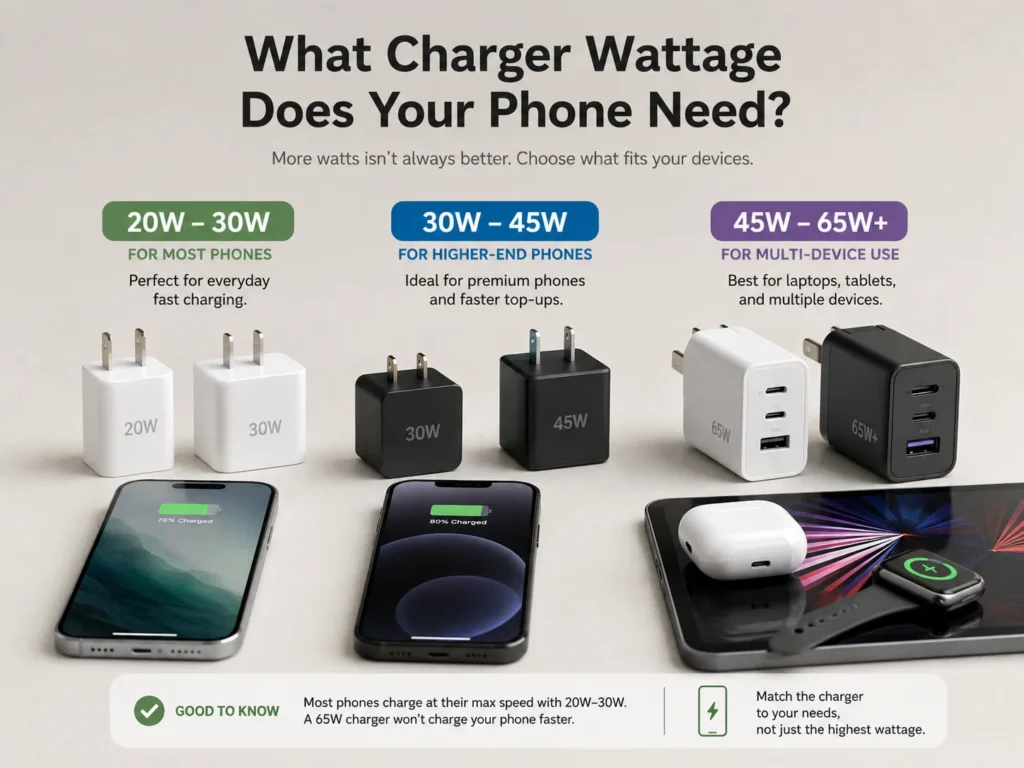
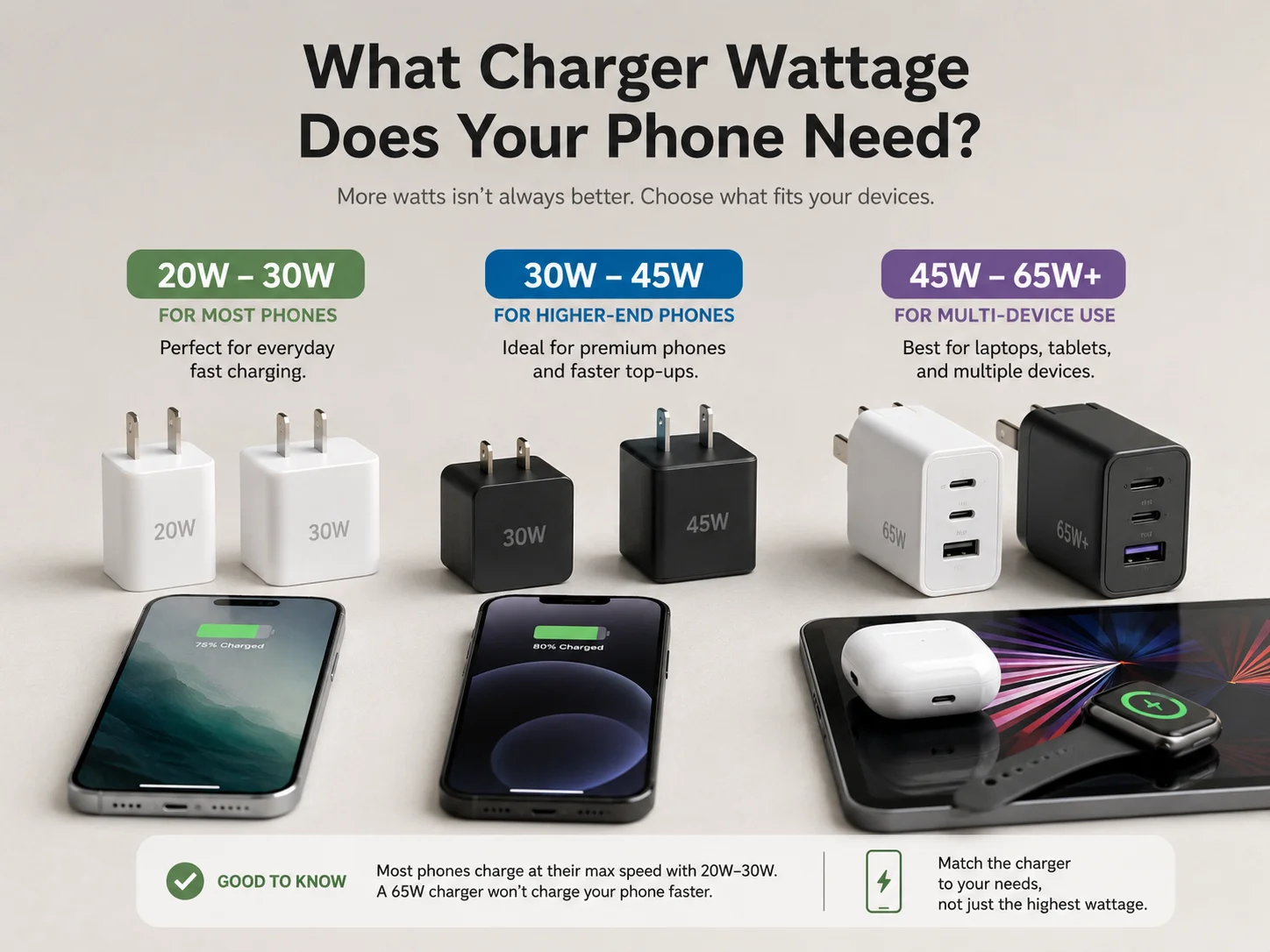
I choose charger wattage by the phone’s maximum wired charging power. I use 20W–30W for most phones, 30W–45W for higher-end phones, and 45W–65W or above for multi-device use.
I match wattage to the use case
I see wattage planning as a SKU decision. A retailer may not need ten different models. A simple range can cover most customer needs. For basic phone fast charging, I often discuss 20W or 30W USB-C chargers. They are compact, price-friendly, and easy to sell with USB-C cables. For flagship phones that support higher power, 30W to 45W can be a better fit. For some Samsung models, Android flagship phones, tablets, and multi-port charging, I often look at 45W or 65W chargers. For phone, tablet, and laptop shared use, I look above 65W.
| Wattage range | I usually position it for |
|---|---|
| 20W–30W | Most iPhone users and common fast-charge phone users |
| 30W–45W | Flagship phones that support higher charging power |
| 45W–65W | Some Samsung models, Android flagships, tablets, and multi-device charging |
| Above 65W | Phone, tablet, and laptop shared charging |
I avoid blind high-watt buying
Higher wattage can be useful. It is not always necessary. If a phone accepts only 25W, a 100W charger may still charge it around that phone limit. The larger charger may still make sense if the buyer wants one charger for a phone and laptop. It may not make sense for a budget phone accessory bundle. I advise buyers to check the phone model and the retail shelf position before choosing wattage. This makes the product easier to explain and easier to price.
3. USB-C PD vs PPS vs Proprietary Fast Charging?
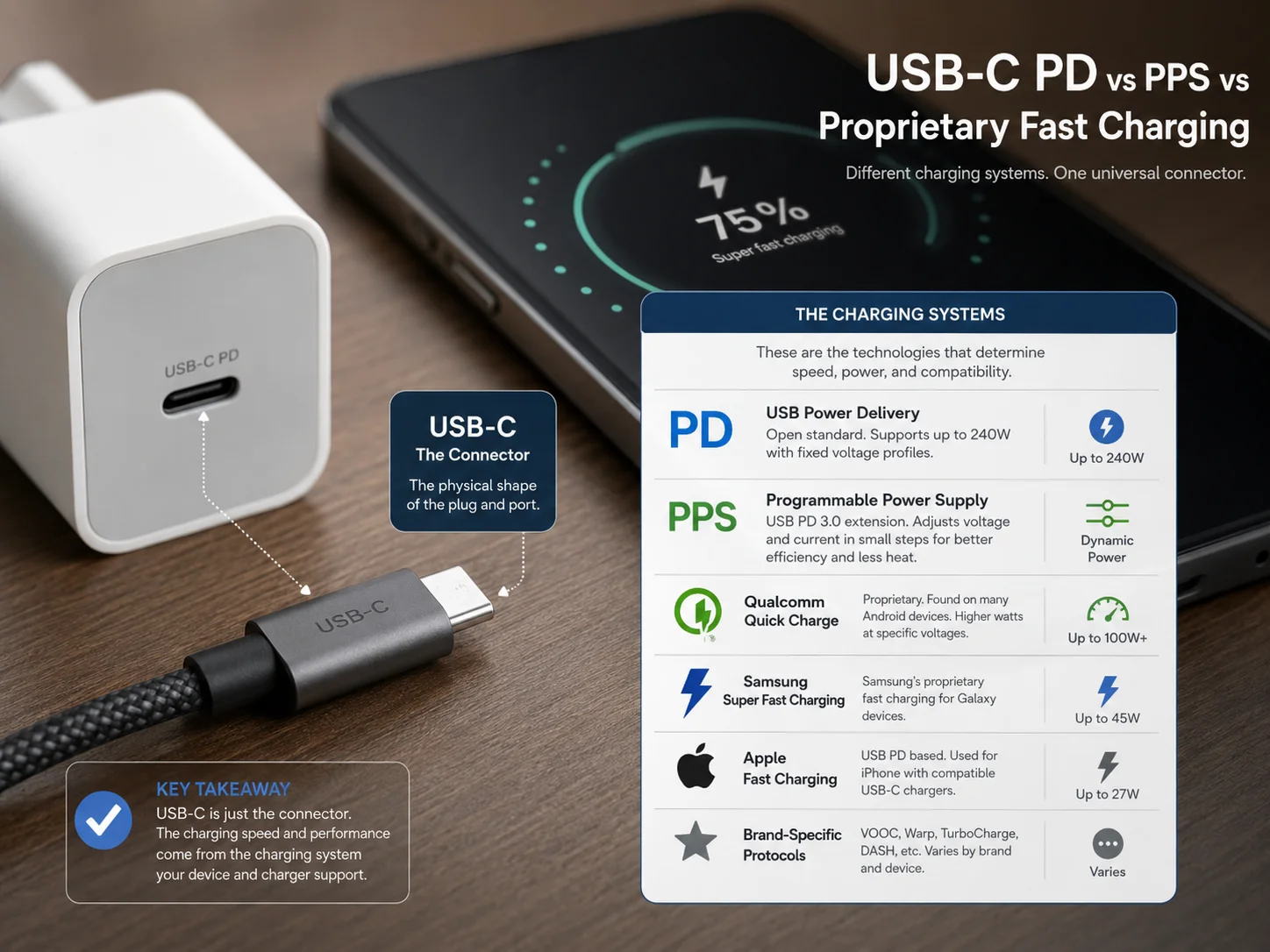
I often hear “It has USB-C, so it is fast.” That is not safe to assume. USB-C is only the connector shape.4
USB-C is the port type. PD, PPS, Quick Charge, Samsung Super Fast Charging5, Apple fast charging, and brand protocols define how fast charging works between the phone, charger, and cable.
I separate the connector from the protocol
A USB-C port does not automatically mean the same charging speed. I treat USB-C as the doorway. The fast-charging protocol is the language used behind the doorway. USB-C Power Delivery is widely used and is important for many phones, tablets, and laptops.6 USB PD PPS adds a more flexible voltage and current adjustment method7, and it is important for many Samsung Super Fast Charging cases. Qualcomm Quick Charge appears in many Android charging systems. Some brands also use their own fast-charging protocols. In those cases, a general PD charger may still charge the phone, but it may not reach the brand’s advertised highest speed.
| Protocol or system | I explain it this way to buyers |
|---|---|
| USB-C Power Delivery | A common fast-charging standard for many devices |
| USB PD PPS | A PD feature that supports more flexible power adjustment |
| Qualcomm Quick Charge | A fast-charging system used by many Android-related products |
| Samsung Super Fast Charging | Often needs USB PD PPS at the right wattage |
| Apple fast charging | Usually needs USB-C PD with a proper cable |
| Brand-specific protocols | May need the brand’s own charger or compatible chipset |
I check all three parts
I always check the charger, phone, and cable together. If one part does not support the needed protocol or current, the final speed can fall back. This is important for retailers because the product page may say “fast charger,” but the customer may test it on a phone that needs PPS or a private protocol. Then the customer says it is slow. The better method is to list the supported protocols clearly. I also suggest using careful wording like “supports USB-C PD and PPS” rather than a vague phrase like “super fast for all phones.”
4. Which Charger Is Best for iPhone, Samsung and Android Phones?
I see customers ask for one answer for every phone. I cannot give that answer without checking the phone model first.
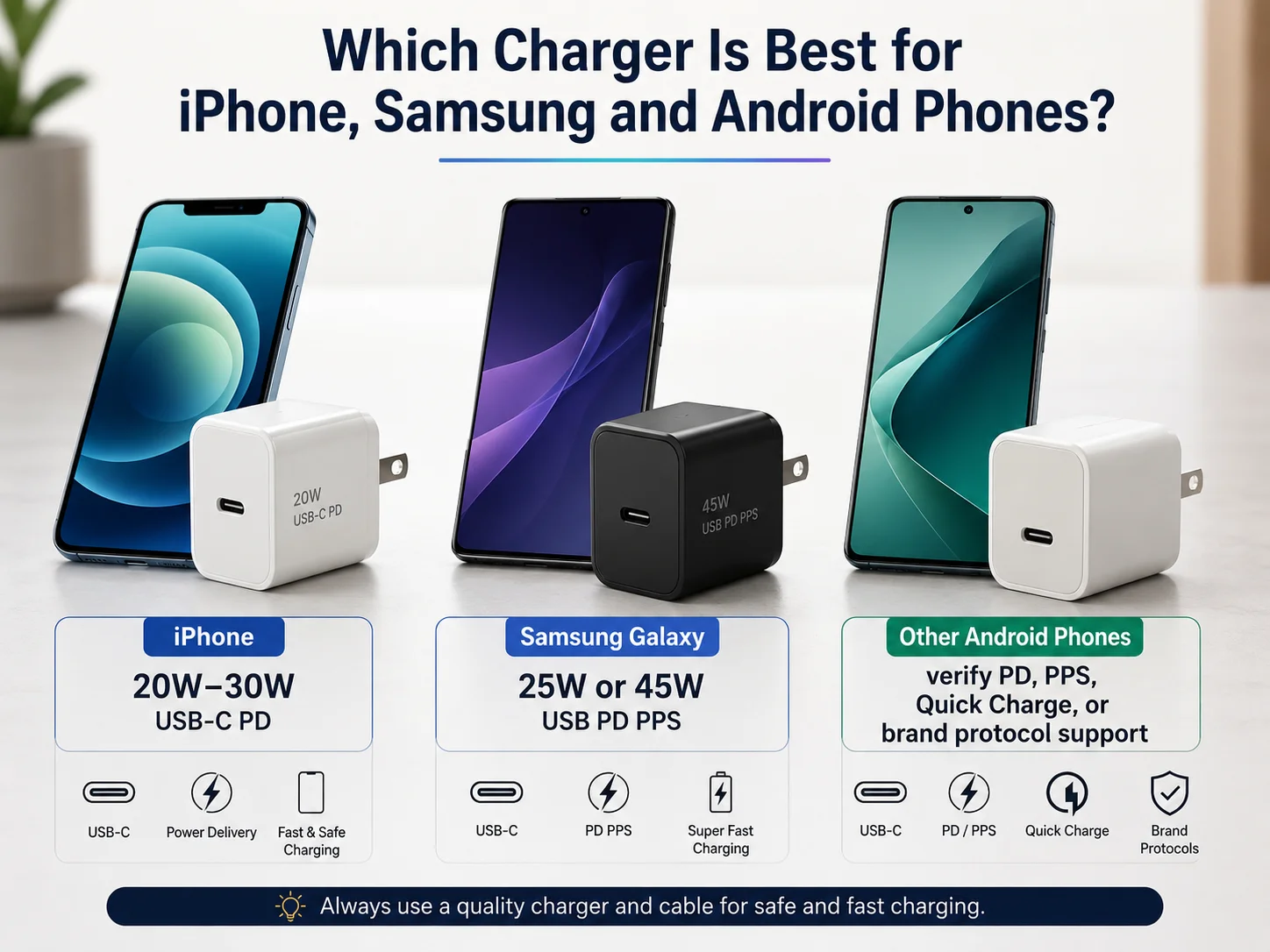
For iPhone, I choose 20W–30W USB-C PD chargers.8 For Samsung Galaxy, I choose 25W or 45W USB PD PPS chargers.9 For other Android phones, I verify PD, PPS, Quick Charge, or brand protocol support.
I choose by phone family first
For iPhone fast charging, I usually recommend a USB-C Power Delivery charger in the 20W to 30W range, plus a proper cable for the model. This is simple and easy for most retail customers to understand. For Samsung Galaxy models that support Super Fast Charging, I check whether 25W or 45W is needed, and I check PPS support. For other Android phones, I do not assume. Some support USB PD. Some support Quick Charge. Some use brand-specific fast charging for their highest advertised speed. A USB-C charger may still charge the phone, but it may not give the expected fast speed.
| Phone type | Charger direction I usually check |
|---|---|
| iPhone | 20W–30W USB-C PD charger |
| Samsung Galaxy | 25W or 45W USB PD PPS charger |
| Other Android phones | PD, PPS, QC, or brand-specific protocol support |
| Mixed phone retail shelf | 30W PD/PPS charger can be a broad option |
I do not judge by USB-C shape only
For B2B buyers, this matters because the same charger may be sold to many end users. If the product page only says “USB-C fast charger,” the customer may expect too much. I prefer to list iPhone, Samsung, and Android compatibility in a careful way. I also ask buyers which phone models their customers use most. A European retailer selling iPhone accessories may choose a different product mix than an online seller focused on Samsung and Android flagship users. This is not only a technical choice. It is also a merchandising choice.
5. Is a GaN Charger Better for Super Fast Phone Charging?
I sell many GaN chargers, so I like them. I still do not say GaN alone means faster phone charging.
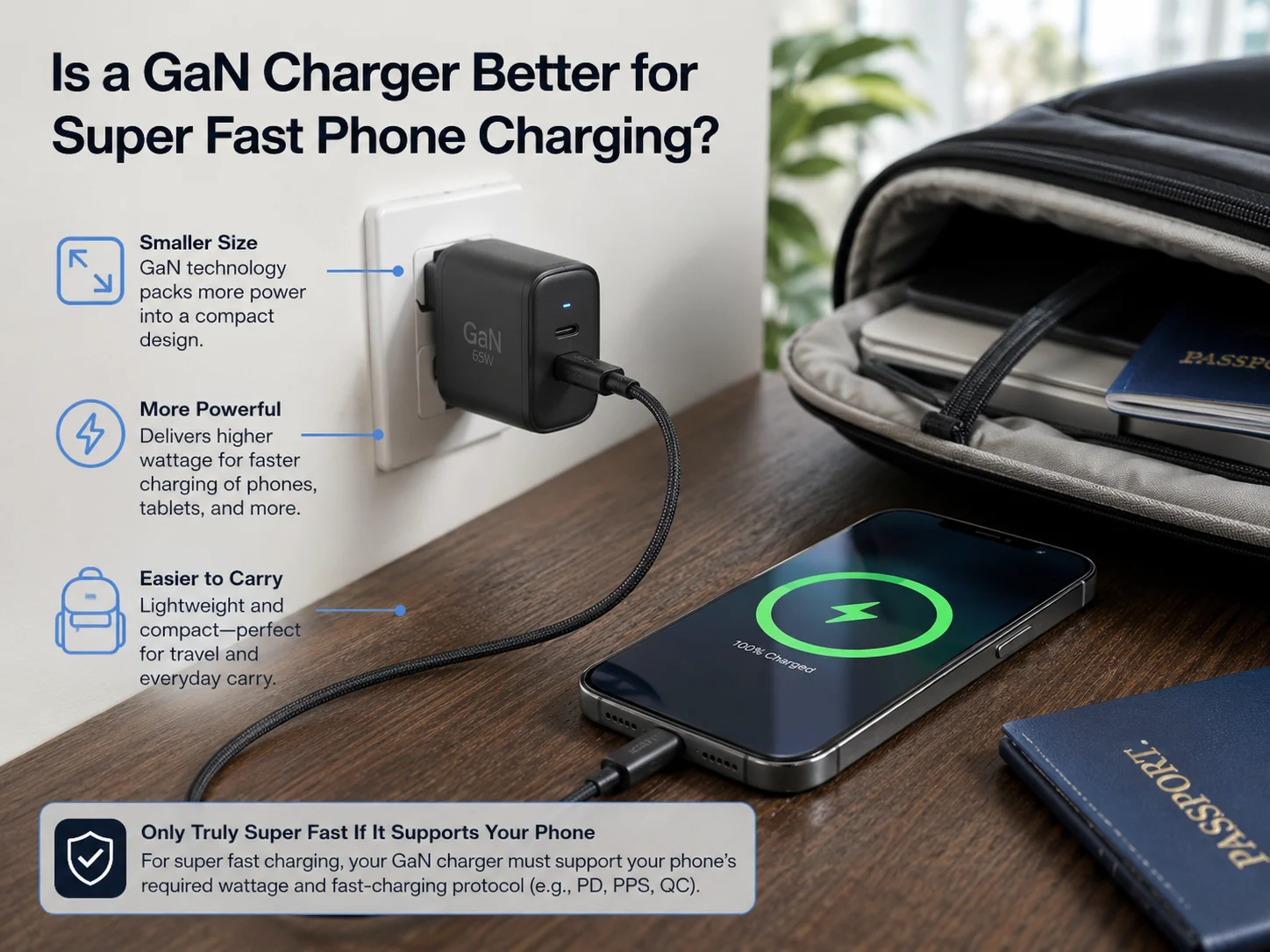
A GaN charger can be smaller, more powerful, and easier to carry, but it must still support the phone’s required wattage and fast-charging protocol to deliver super fast charging.
I use GaN for size and power density
GaN means gallium nitride technology inside the charger. For buyers, the easy point is this: GaN can help make chargers smaller while supporting higher output.10 It can also make multi-port chargers more practical for travel and office use. I often suggest GaN chargers when a retailer wants premium positioning, compact packaging, and phone-tablet-laptop compatibility. A 65W GaN charger with multiple ports can be more attractive than several separate chargers. This is useful for travel accessory sets and higher-end e-commerce bundles.
| GaN advantage | How I use it in product planning |
|---|---|
| Smaller size | I position it as a portable upgrade |
| Higher power density | I use it for 45W, 65W, and higher models |
| Multiple ports | I use it for phone, tablet, and laptop charging |
| Better portability | I suggest it for travel and office use |
| Heat management design | I still check real safety design and certification |
I still verify the protocol
GaN is a charger technology. It is not a fast-charging protocol. A GaN charger may support PD, PPS, QC, and other modes, or it may not. So I never tell a buyer to choose GaN only by size or maximum wattage. I ask for the output specification. I check single-port output and multi-port output. I also check certifications and plug type for the target market. For Europe and America, buyers often ask about CE, FCC, UKCA, ETL, UL, or other related requirements depending on the sales channel. I always advise buyers to confirm the latest certification needs with their market and platform.
6. Does the USB-C Cable Affect Charging Speed?
I have seen good chargers blamed because the cable was weak. This happens often in bundles and marketplace listings.
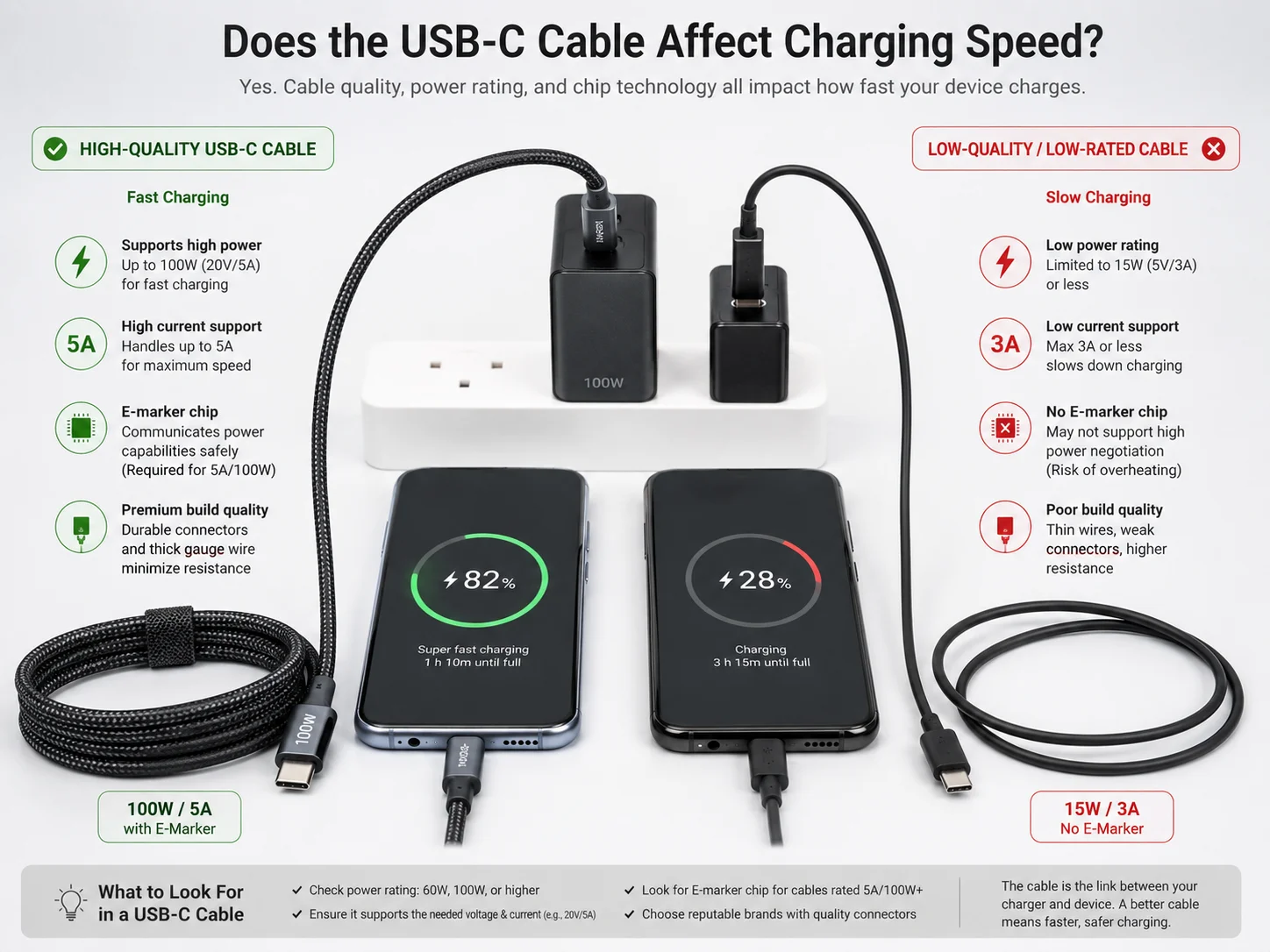
Yes, the USB-C cable affects charging speed. The cable must support the needed wattage, current, connector quality, and sometimes an E-marker chip for higher power charging.11
I treat the cable as part of the charger system
A charger and phone may support fast charging, but the cable can still limit the result. This is common when a seller bundles a high-watt charger with a low-cost cable. For many phone chargers, a normal USB-C to USB-C cable may be enough if it supports the required current. For higher power use, such as 60W or 100W, I check the cable rating. Some higher-power USB-C cables include an E-marker chip, which helps the system identify cable capability. Cable length also matters. Very long or low-quality cables may create more loss or poor user experience.12
| Cable point I check | Why I check it |
|---|---|
| USB-C to USB-C type | Many modern fast-charge systems use this cable type |
| Maximum wattage | The cable must support the charger and device need |
| Current rating | I check 3A or 5A where needed |
| E-marker chip | I check this for higher-power USB-C cables |
| Cable length | I avoid poor performance from weak long cables |
| Connector quality | I want fewer loose contacts and fewer returns |
I do not bundle random cables
For retailers, the cable is a common hidden risk. The customer buys a “super fast charger set,” but the cable does not support the needed power. Then the whole set looks bad. I prefer to match charger and cable from the start. If I sell a 65W charger for phone and laptop use, I do not pair it with a low-rating cable. If I sell a phone-only 20W or 30W kit, I still check connector fit, cable durability, and packaging claims. I also separate data cables from charging-focused cables when needed, because some low-end cables have limited data use or charging ability.
7. What Features Should a Super Fast Phone Charger Have?
I see many product boxes show only one large watt number. That number is not enough for serious buying.
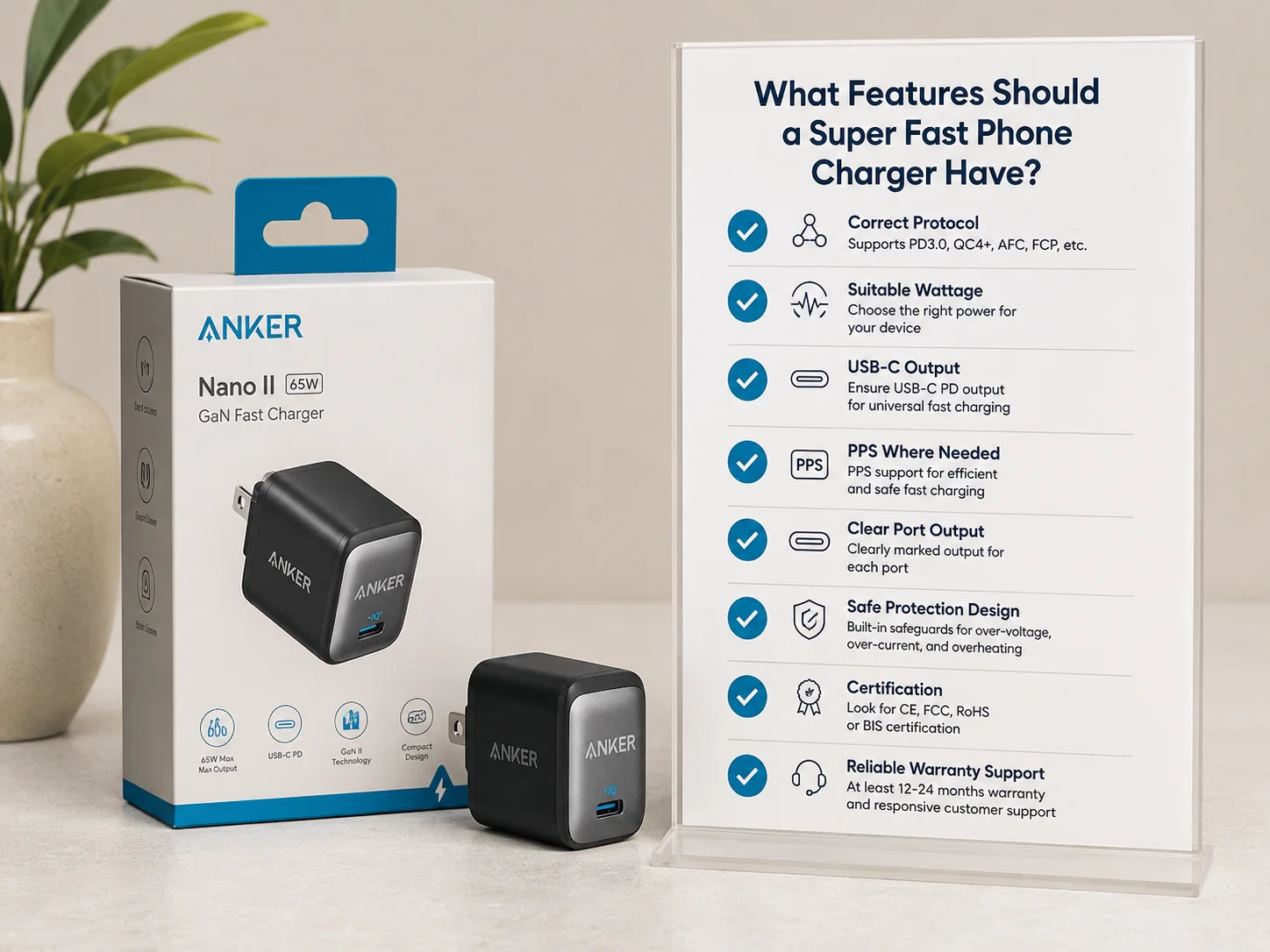
A good super fast phone charger should have the correct protocol, suitable wattage, USB-C output, PPS where needed, clear port output, safe protection design, certification, and reliable warranty support.
I read the side label, not only the front label
The front of the package may say 65W. That may be true for one port only. If two or three devices connect at the same time, the power may split. The phone may receive much less. I always check single-port output and multi-port power distribution. I also check whether the USB-C port supports PD and PPS. If the buyer wants Samsung compatibility, PPS becomes very important. I also check protection design, such as temperature protection, overcurrent protection, and overvoltage protection. These features should be backed by a responsible manufacturer and proper certifications.
| Feature I check | What I want to see |
|---|---|
| Correct charging protocol | PD, PPS, QC, or other needed support |
| Suitable output wattage | Enough for the target phone or device mix |
| USB-C port | Clear USB-C output for modern fast charging |
| PPS support | Needed for some Super Fast Charging cases |
| Single-port output | I want to know the maximum output per port |
| Multi-port distribution | I want to know output when all ports are used |
| Safety protection | Temperature, current, and voltage protection |
| Certification | Market-appropriate test and certification documents |
| Warranty | Clear after-sales responsibility |
I also check the supplier behind the charger
For B2B buyers, the product is not only a charger. It is also packaging, MOQ, lead time, certificate files, barcode, user manual, warranty policy, and after-sales handling. I have seen buyers choose a cheaper charger and then spend more time on complaints, missing documents, and unclear specifications. A reliable supplier should give real output details, protocol information, packaging options, plug choices, and certification documents. If the supplier cannot explain single-port and multi-port output, I treat that as a warning sign. Clear information helps the retailer sell with confidence.
8. Super Fast Phone Charger Buying Checklist?
I like checklists because they stop expensive mistakes. They also make supplier communication faster and clearer before an order is placed.
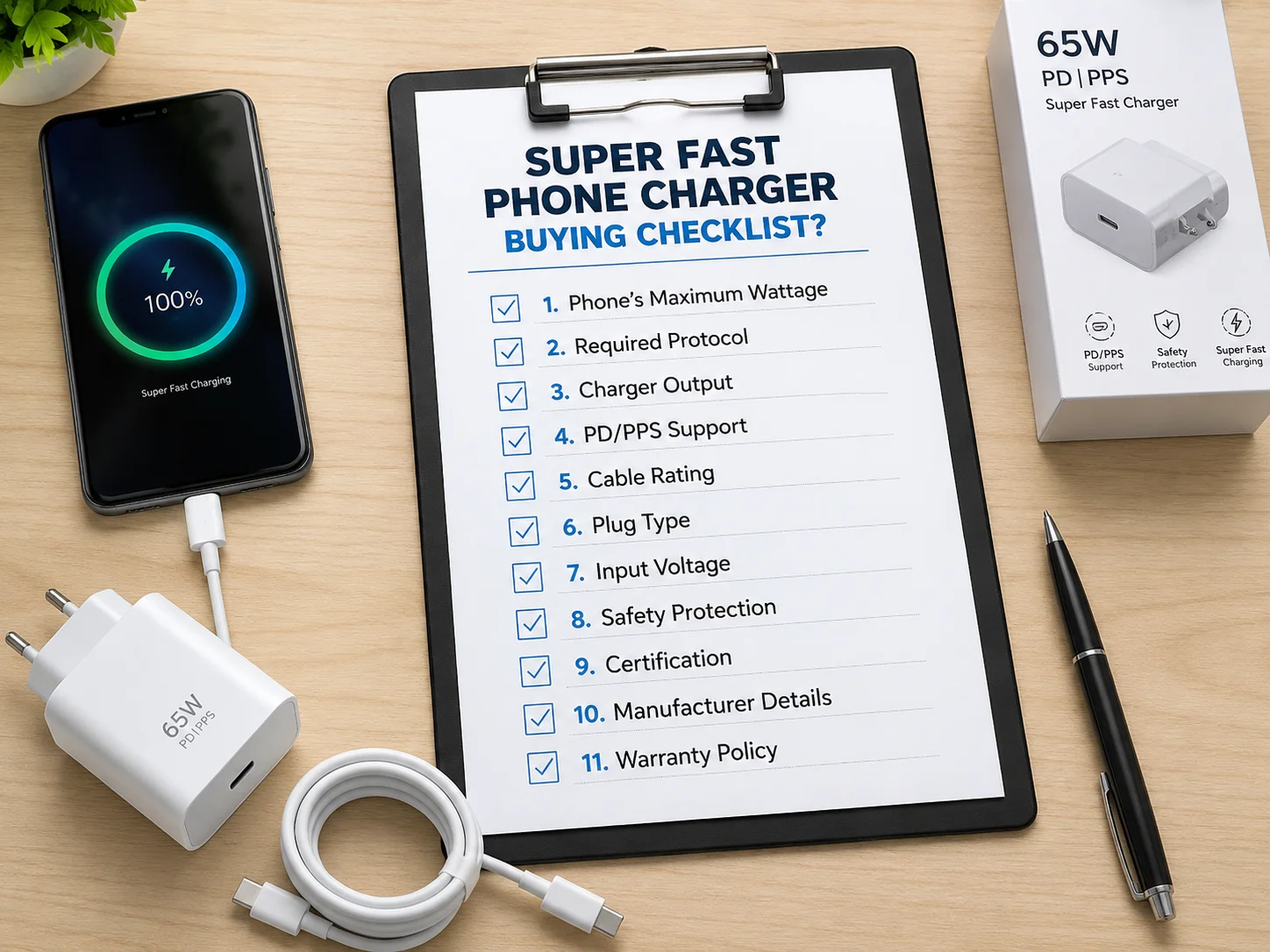
Before buying, I check the phone’s maximum wattage, required protocol, charger output, PD/PPS support, cable rating, plug type, input voltage, safety protection, certification, manufacturer details, and warranty policy.
I use this checklist before quoting or sourcing
When a buyer asks me for a fast charger, I ask target device questions first. I want to know if the charger is for iPhone users, Samsung users, mixed Android users, or customers who also charge tablets and laptops. Then I check wattage range. I check whether 20W, 30W, 45W, 65W, or higher makes sense. I also check the cable. A charger order without cable planning can create trouble later. For Europe and America, I also ask about plug type, input voltage range, packaging style, safety certification needs, and marketplace requirements.
| Checklist item | My buying question |
|---|---|
| Phone maximum wattage | What power can the target phone actually accept? |
| Required protocol | Does the phone need PD, PPS, QC, or brand fast charging? |
| Charger single-port output | What output does one port provide alone? |
| Multi-port output | What happens when two or more devices connect? |
| Cable wattage and current | Does the cable support the needed power? |
| Plug type | Is it US, EU, UK, or another plug? |
| Input voltage | Does it support the target market voltage range? |
| Safety protection | What protection design is listed? |
| Product certification | Which certificates are available and valid? |
| Manufacturer information | Who is responsible for production and support? |
| Warranty and return policy | How are after-sales issues handled? |
I ask suppliers practical questions
When I source chargers or help buyers choose SKUs, I do not ask only “How many watts?” I ask: Which phone models are the target customers using? Does the charger support USB-C PD? Does it support PPS? Does it support Quick Charge if the buyer needs Android coverage? What is the real output of each port? What is the cable rating? Is the cable 3A or 5A? Does it have an E-marker chip if needed? Which certifications can the supplier provide? Can the packaging show accurate claims? What is the MOQ? What is the lead time? What happens if customers report slow charging? These questions protect both the seller and the end user.
Conclusion
I choose super fast chargers by phone support, protocol, cable rating, safety, packaging, MOQ, certification, and after-sales needs, not by wattage alone.
"The Basics of USB Power Delivery Negotiations | Acroname", https://acroname.com/blog/basics-usb-power-delivery-negotiations?srsltid=AfmBOooK7GbJYmmfCLsuAsTKxOvp7h0dqsrJNIS5gA1fWujZR4L2LFqg. USB-IF documentation on USB Power Delivery describes power delivery as a negotiated contract between source and sink devices, supporting the point that a higher charger wattage rating does not necessarily increase charging speed for a device with lower accepted power. Evidence role: mechanism; source type: institution. Supports: A USB Power Delivery source and sink negotiate an allowable power contract, so the charger's maximum rating does not by itself determine the power delivered to a phone.. Scope note: This supports the mechanism generally; it does not provide model-by-model charging speed measurements. ↩
"[PDF] USB Power Delivery", https://www.usb.org/sites/default/files/D2T2-1%20-%20USB%20Power%20Delivery.pdf. USB Power Delivery materials describe sink devices as selecting supported power profiles, providing technical context for the statement that a phone has its own charging limit. Evidence role: mechanism; source type: institution. Supports: USB-C/USB PD devices advertise or select power capabilities, and battery charging systems regulate input current and voltage according to device limits.. Scope note: The source would establish the charging-control principle rather than the maximum wattage of any specific phone model. ↩
"Temperature and voltage effects on the charge and health of lithium ...", https://pmc.ncbi.nlm.nih.gov/articles/PMC13003025/. Research on lithium-ion battery charging and battery-management systems shows that charging current is commonly constrained by cell temperature and state of charge, supporting the article’s explanation that real charging speed changes with battery conditions. Evidence role: mechanism; source type: paper. Supports: Lithium-ion charging behavior and battery management systems adjust charging current based on temperature and state of charge, including reduced current at higher states of charge.. Scope note: The evidence applies to lithium-ion battery behavior generally and may not document the control strategy of every phone manufacturer. ↩
"USB-C - Wikipedia", https://en.wikipedia.org/wiki/USB-C. USB-IF materials distinguish the USB Type-C connector specification from the USB Power Delivery specification, supporting the statement that USB-C by itself denotes the connector rather than a guaranteed fast-charging protocol. Evidence role: definition; source type: institution. Supports: USB Type-C defines the connector and cable system, while USB Power Delivery is a separate specification for negotiated power.. ↩
"Samsung Super Fast Charger Type C 45W GaN Power USB C ...", https://www.amazon.com/Samsung-Super-Charger-Charging-Galaxy/dp/B0BW2HGHND. Samsung support documentation identifies compatible fast chargers and supported Galaxy devices for Super Fast Charging, providing source support for linking Samsung Super Fast Charging guidance to PPS-capable chargers at appropriate wattage levels. Evidence role: case_reference; source type: institution. Supports: Samsung documentation connects Super Fast Charging and Super Fast Charging 2.0 with compatible chargers and USB PD/PPS-style fast charging requirements for supported Galaxy devices.. Scope note: The documentation should be checked against the specific Galaxy model, because Samsung charging support differs by device generation and region. ↩
"USB Charger (USB Power Delivery)", https://www.usb.org/usb-charger-pd. USB-IF describes USB Power Delivery as a scalable USB-C power standard for charging and powering a range of devices, including portable electronics and computers, which supports the article’s characterization of PD as important across phones, tablets, and laptops. Evidence role: general_support; source type: institution. Supports: USB Power Delivery is presented by the USB standards body as a standard for scalable power over USB-C across multiple device categories.. Scope note: This provides standards-context support for broad relevance, not market-share statistics for PD adoption. ↩
"USB hardware - Wikipedia", https://en.wikipedia.org/wiki/USB_hardware. USB Power Delivery documentation defines Programmable Power Supply as a mode that allows the sink to request voltage and current adjustments within advertised limits, supporting the article’s description of PPS as a more flexible adjustment method. Evidence role: definition; source type: institution. Supports: PPS is a USB PD feature that permits programmable voltage and current changes within supported ranges.. ↩
"Buy 20W USB-C Power Adapter - Apple", https://www.apple.com/shop/product/mwvv3am/a/20w-usb-c-power-adapter. Apple support materials state that compatible iPhone models can fast charge with a 20W or higher USB-C power adapter, or an equivalent USB-C Power Delivery adapter, supporting the article’s use of 20W-class USB-C PD chargers for iPhone fast charging. Evidence role: case_reference; source type: institution. Supports: Apple states that compatible iPhone models can fast charge with an Apple USB-C power adapter of 20W or higher, or a comparable USB-C power adapter that supports USB Power Delivery.. Scope note: Apple’s wording supports 20W or higher for compatible models; it does not establish 30W as a universal upper requirement for all iPhones. ↩
"ATTENTION S25+ and ultra users who plan on using 45W charging", https://www.reddit.com/r/GalaxyS25/comments/1ikc5sl/attention_s25_and_ultra_users_who_plan_on_using/. Samsung support information for Galaxy fast charging distinguishes compatible 25W and 45W Super Fast Charging configurations, supporting the article’s guidance to check for 25W or 45W USB PD PPS chargers for Samsung Galaxy devices. Evidence role: case_reference; source type: institution. Supports: Samsung identifies 25W and 45W Super Fast Charging options for compatible Galaxy devices and indicates that support depends on the device and charger.. Scope note: This supports the Samsung-specific charging tiers but remains model-dependent rather than universal to all Galaxy phones. ↩
"High Density Power Conversion Using GaN devices and Machine ...", https://pemsec.ece.uh.edu/high-density-power-conversion-using-gan-devices-and-machine-learning-based-prediction-of-remaining-useful-life/. Power-electronics research on gallium nitride devices reports higher switching-frequency capability and power-density advantages over many silicon implementations, supporting the article’s statement that GaN can help make chargers smaller while supporting higher output. Evidence role: mechanism; source type: paper. Supports: GaN power devices can switch efficiently at high frequencies and support higher power-density converter designs, which can reduce charger size for a given output.. Scope note: The material advantage does not guarantee that every commercial GaN charger is smaller or better designed; implementation and thermal design still matter. ↩
"Do USB-C to USB-C cables need an emarker chip to ... - Reddit", https://www.reddit.com/r/UsbCHardware/comments/13j0gev/do_usbc_to_usbc_cables_need_an_emarker_chip_to/. USB-IF documentation on USB Type-C cables describes current-rating identification and electronically marked cable requirements for higher-current operation, supporting the article’s statement that cable capability and E-marker presence can affect high-power charging. Evidence role: definition; source type: institution. Supports: USB-C cable specifications distinguish cable current ratings and require electronically marked cables for certain higher-current capabilities.. ↩
"USB-C Cable Voltage Drop - LTT Labs : r/UsbCHardware - Reddit", https://www.reddit.com/r/UsbCHardware/comments/1r5t5es/usbc_cable_voltage_drop_ltt_labs/. Electrical engineering references on conductor resistance and voltage drop show that longer or higher-resistance cables lose more voltage and power at charging currents, supporting the article’s warning that very long or low-quality cables can impair charging performance. Evidence role: mechanism; source type: education. Supports: Longer or higher-resistance cables can produce greater voltage drop and power loss at a given current, which can reduce charging performance.. Scope note: This explains the electrical mechanism generally; actual user impact depends on cable gauge, current, charger regulation, and device tolerance. ↩