Struggling to pick winning TWS earbuds for your inventory? The market is crowded. Making the wrong choice means dead stock and lost profits.
For 2026, focus on a balanced portfolio. Prioritize core improvements like Bluetooth 5.4 and all-day battery life for mass-market appeal. Then, selectively add premium features like adaptive ANC or app control for higher-tier models to capture niche segments and maximize your return on investment.
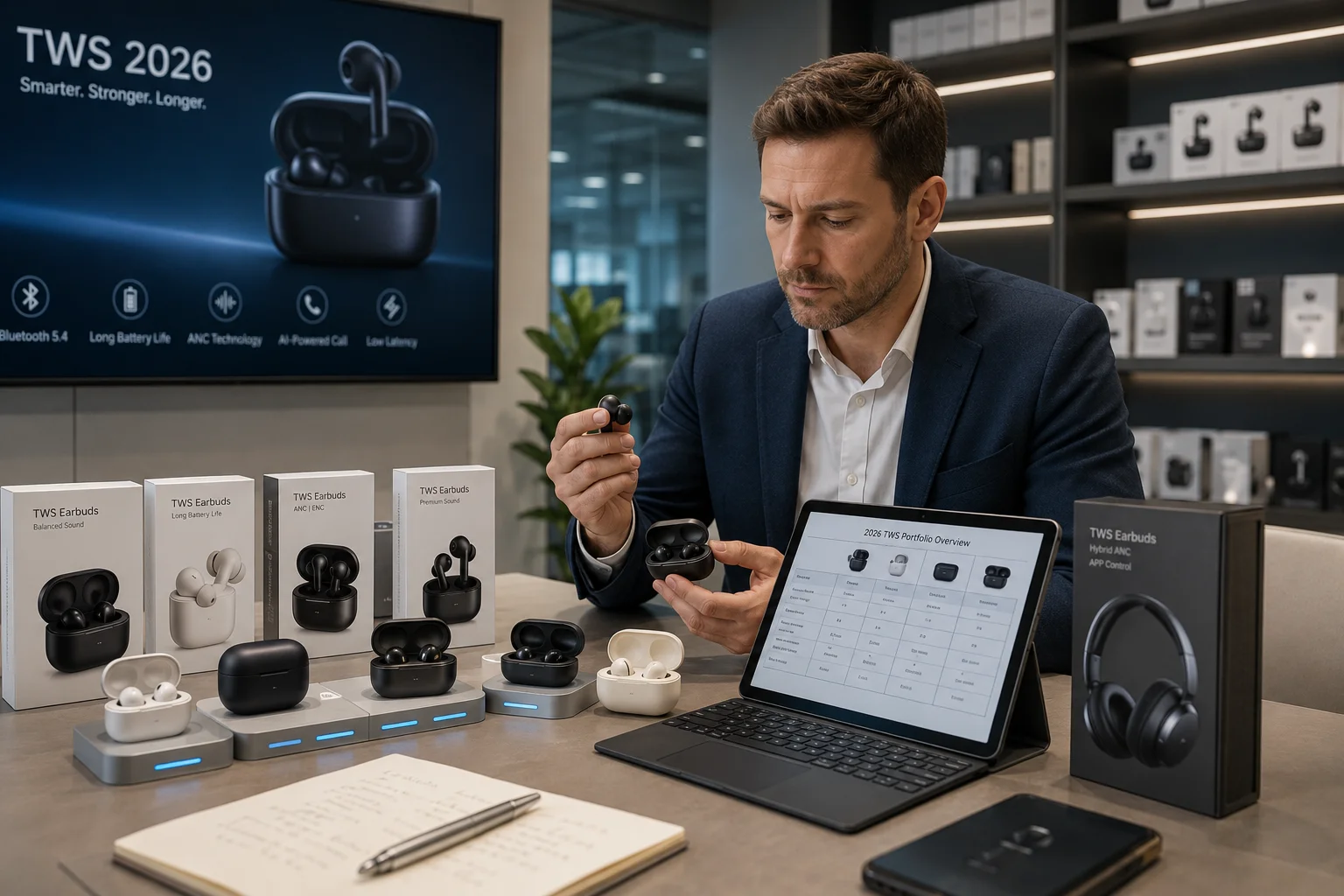
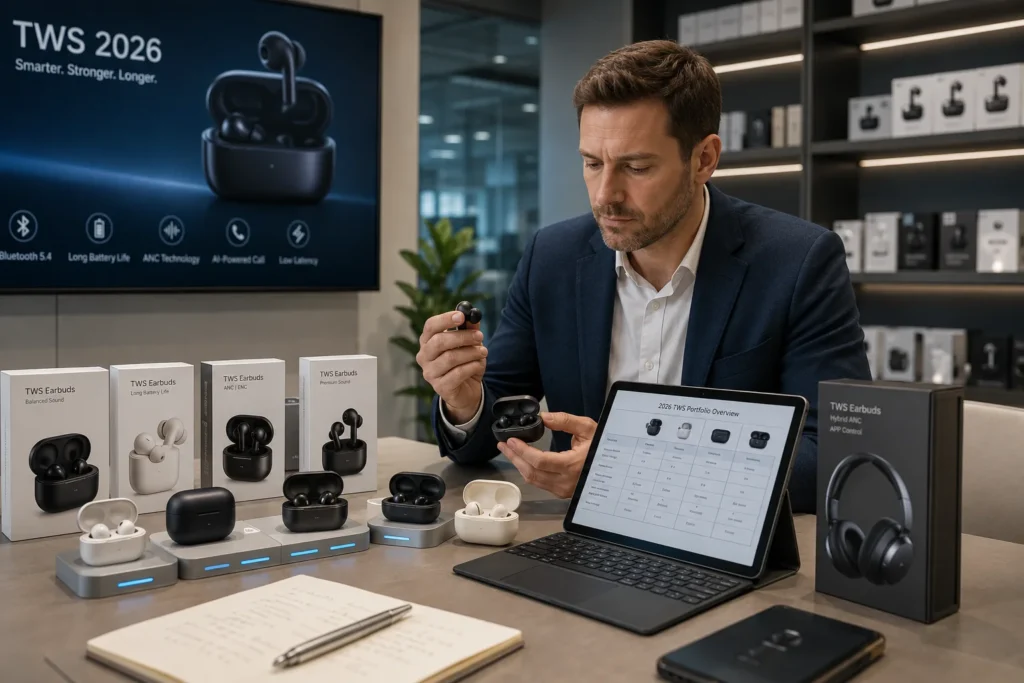
Over my 15 years in this business, I've seen countless trends come and go. Many buyers ask me for a crystal ball to predict the future. The truth is, there isn't one. But there is a smart way to think about the future. It's not about guessing the one "killer feature." It's about understanding the trade-offs and building a product lineup that minimizes your risk. Let's break down how we guide our partners to make these decisions for the coming years.
Is the TWS Earbud Market Still a Good Bet for Wholesalers in 2026?
The market seems saturated. You worry that adding another TWS earbud to your lineup is a risky move. You fear low margins and stiff competition.
Yes, it is. The opportunity has shifted from basic entry-level models to the upgrade market and specialized niches.1 Customers are now looking for better performance, specific features, and designs that fit their lifestyle, creating new pockets of demand for savvy wholesalers.
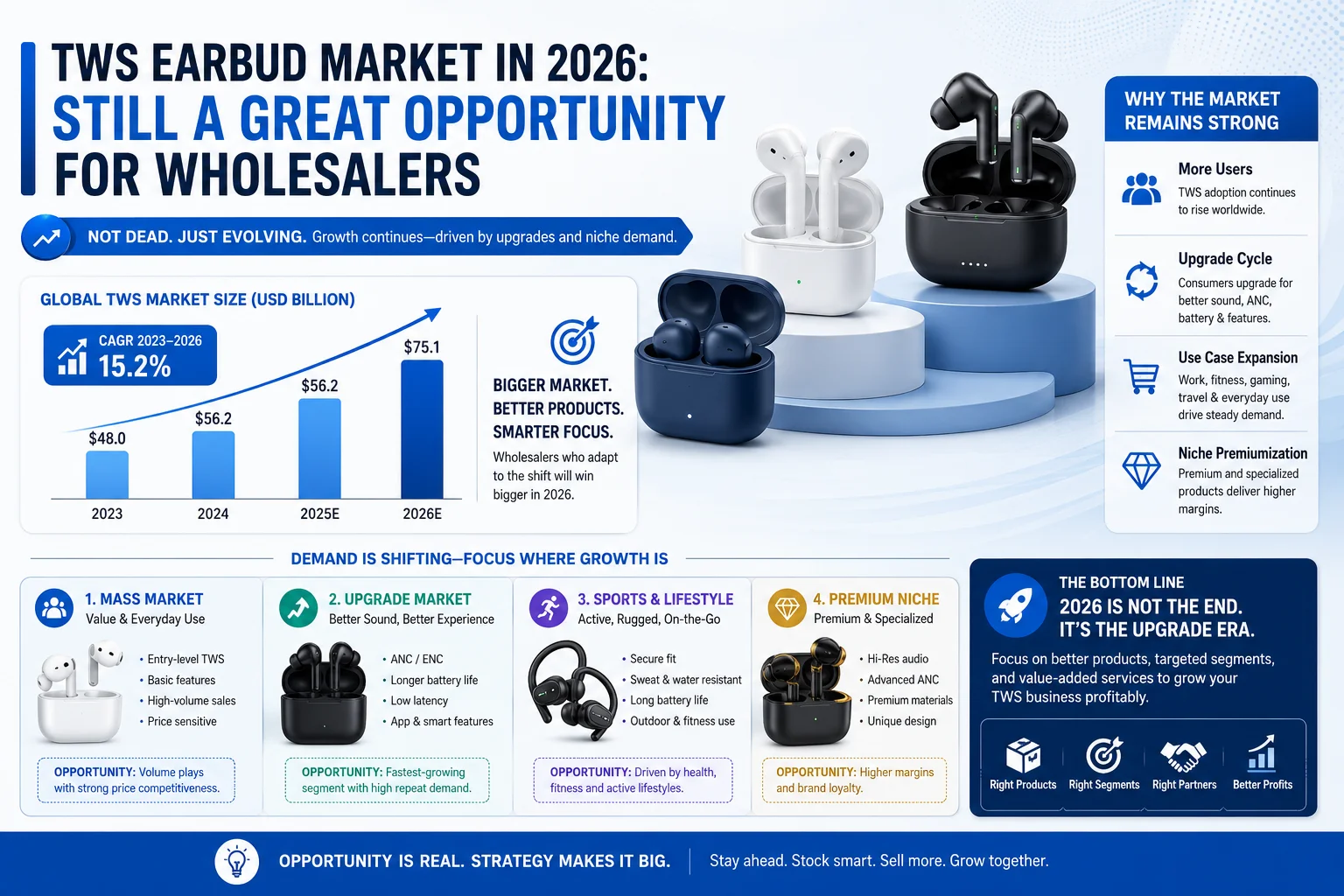
I hear this concern from clients all the time. They see the market as mature, but mature doesn't mean it's dead. The key is to see that repeat purchases and upgrades are now the main drivers. Your goal is to segment the market. Instead of looking for one "do-it-all" earbud, we advise clients to think about building a "good, better, best" portfolio. Your "good" model could be a cost-effective earbud focused on reliability and great battery life. The "better" model might add Active Noise Cancellation. And the "best" model could feature premium audio codecs and a companion app. This strategy helps you capture a wider range of customers at different price points. It moves the conversation from "Are TWS earbuds a good business?" to "Which TWS earbuds are right for my specific customers?". That’s how you de-risk your inventory and find success in a crowded market.
Is Bluetooth 5.4 a Must-Have for Your 2026 TWS Inventory?
You see "Bluetooth 5.4" on spec sheets. You wonder if it's just a marketing gimmick or a feature your customers will actually demand and pay for.
It's becoming a foundational feature, not a premium one. Bluetooth 5.4, along with LE Audio, offers better stability and efficiency.2 Not having it will make your product seem outdated, even if the user doesn't know the technical details.
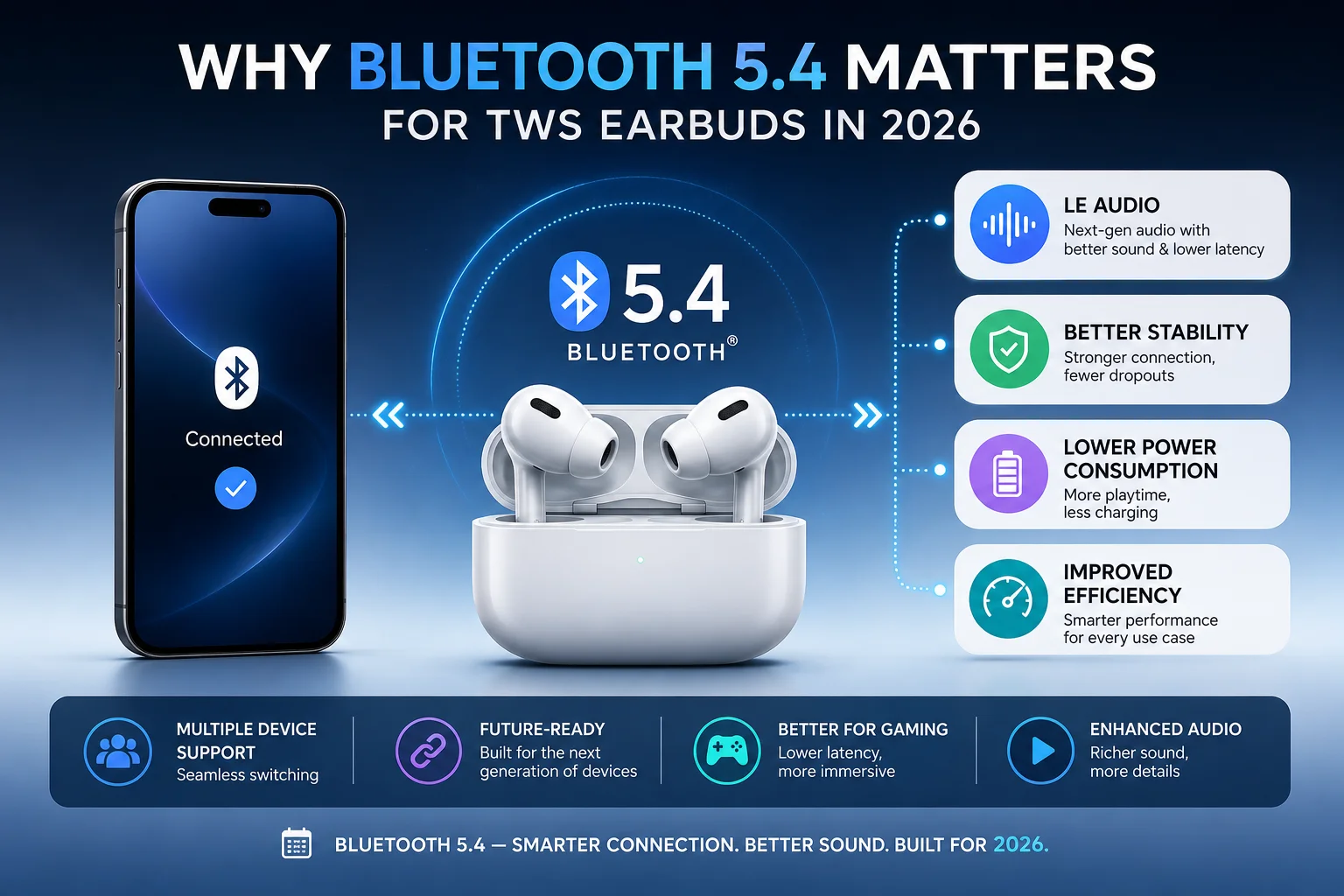
What buyers often overlook is that the version number itself isn't the selling point. The benefits are. We tell our partners to focus on marketing the results: "More stable connection," "Longer battery life," and "Share your audio with friends," which is a new feature called Auracast. From a sourcing perspective, the question for you is about supply chain maturity. Right now, chipsets with these features are becoming standard, and the cost difference is shrinking.3 By the time you're stocking for 2026, it will be the default technology. Choosing a supplier who already has experience with these chipsets is a low-risk way to future-proof your product. My advice is this: don't pay a huge premium for it, but don't accept older Bluetooth standards either. It’s becoming a basic expectation.
ANC vs. ENC: What's the Real Difference for Your Bottom Line?
ANC, ENC, Hybrid ANC... the acronyms are confusing. You're not sure which to invest in, and how it impacts your product cost and selling price.
ANC (Active Noise Cancellation) is a user-facing feature for immersive listening and justifies a higher retail price4. ENC (Environmental Noise Cancellation) improves microphone quality for calls. For many customers, good ENC is more practical than mediocre ANC, and it costs less to implement5.
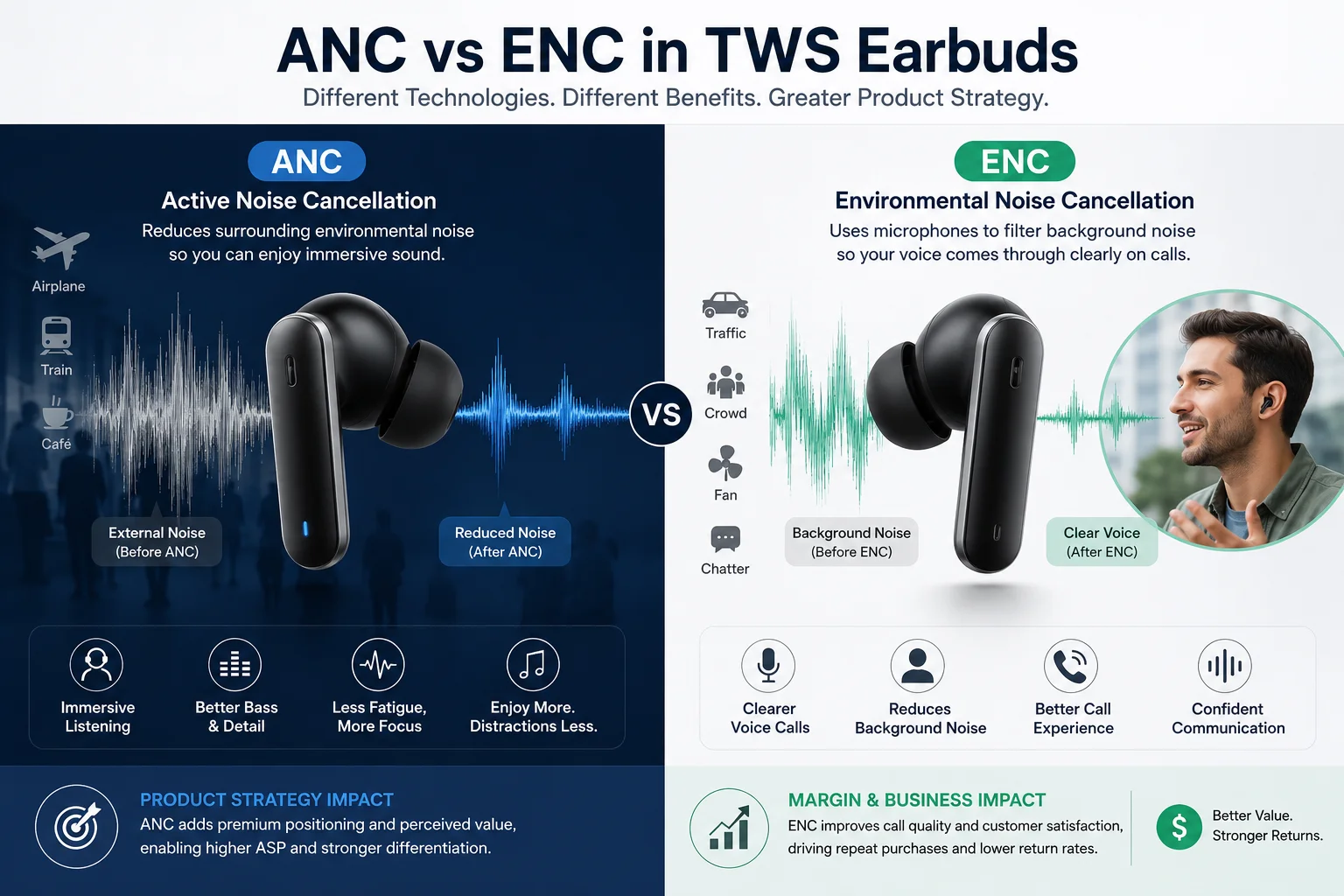
Here’s how we guide partners to think about this. It's not a question of which is "better," but who the product is for. If you're targeting commuters, travelers, or people in noisy offices, good ANC is a major selling point. But be aware, it adds significant cost to both the hardware and the R&D tuning. For a more budget-conscious audience, or one that primarily uses earbuds for phone calls, investing in excellent ENC is a smarter move. It provides a clear, tangible benefit ("crystal-clear calls") at a lower cost to you.
| Feature | Primary Benefit | Target Customer | Cost Impact |
|---|---|---|---|
| ANC | Blocks external noise for the listener | Commuters, travelers, audio-focused users | High |
| ENC | Filters out background noise for the person you're calling | Everyone, especially professionals, drivers | Low to Medium |
Your choice should always reflect your target retail price and your customer's daily life.
What Battery and Charging Specs Will Actually Impress Customers in 2026?
You see competitors listing huge battery numbers. You feel pressure to compete but worry about the rising cost and size of the product to accommodate bigger batteries.
Customers now expect all-day battery life from the earbuds themselves (8-10 hours)6 and a case that provides at least two extra charges. The game-changer isn't total time, but fast charging. A "10 minutes of charge for 2 hours of playback" feature is a powerful marketing tool.
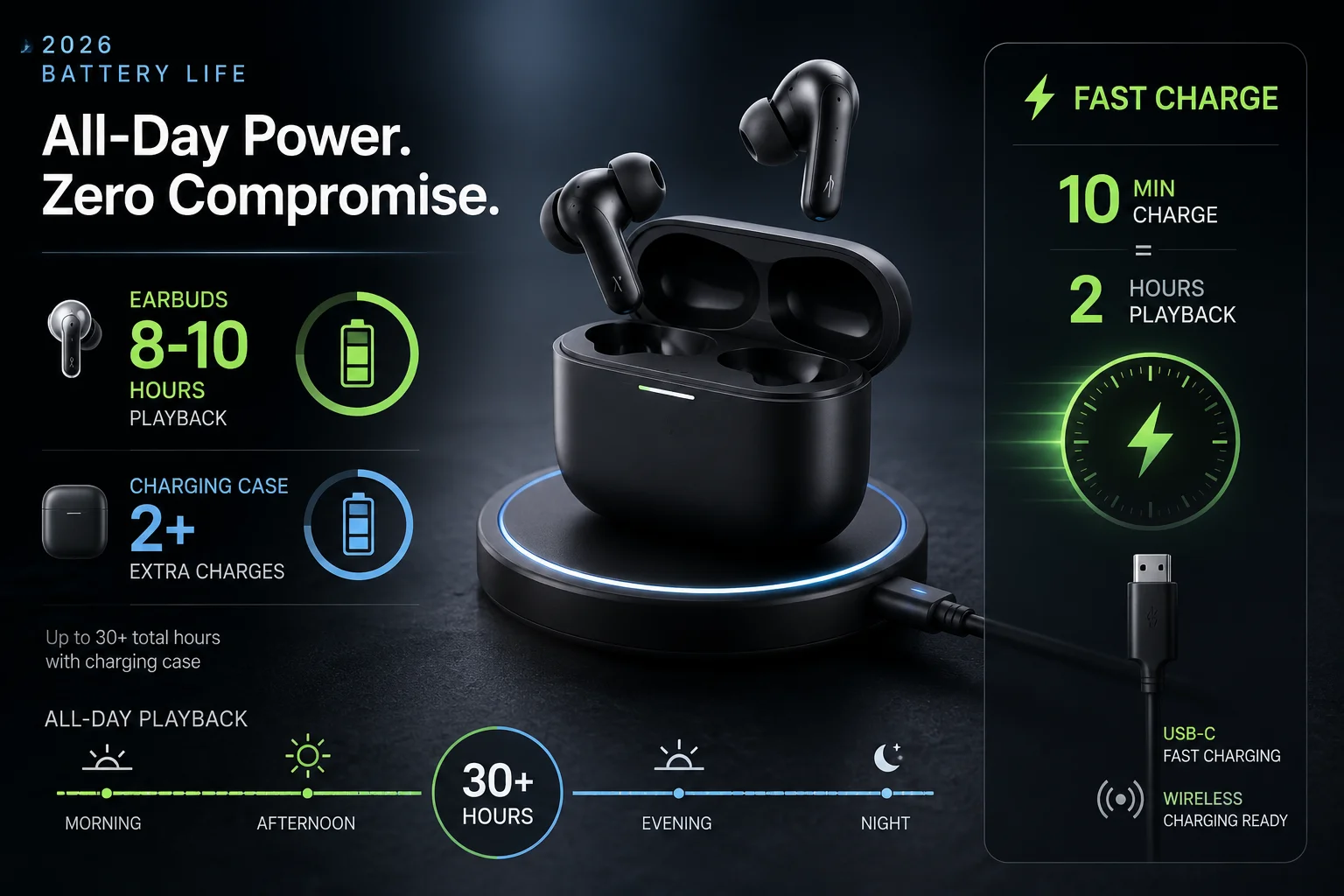
We've seen buyers get caught in a "numbers war" on total battery life. But in reality, 30 hours versus 40 hours is a small difference in real-world use. The more critical metrics are single-charge playtime and charging speed. A customer's main pain point is their earbuds dying in the middle of the workday. An 8-10 hour single charge solves that. The other pain point is forgetting to charge them overnight. A fast-charging feature that gives them a couple of hours of use from just a few minutes on the charger is a huge relief. Focus your spec sheet and marketing on these practical benefits. When sourcing, ask suppliers for the single-charge endurance at a realistic volume (e.g., 50%) with ANC on, and verify their fast-charging claims. These are the specs that reduce customer frustration and prevent negative reviews.
Can a Great Fit and Ergonomic Design Actually Boost Your Repeat Sales?
You focus on technical specs and price. You might see design and comfort as subjective "nice-to-haves" that are hard to quantify and sell to your customers.
Absolutely. Comfort and fit are the most underrated drivers of customer satisfaction and loyalty. An earbud that falls out or causes pain is an earbud that gets returned, leading to lost sales and bad reviews. A comfortable fit encourages daily use and positive word-of-mouth.
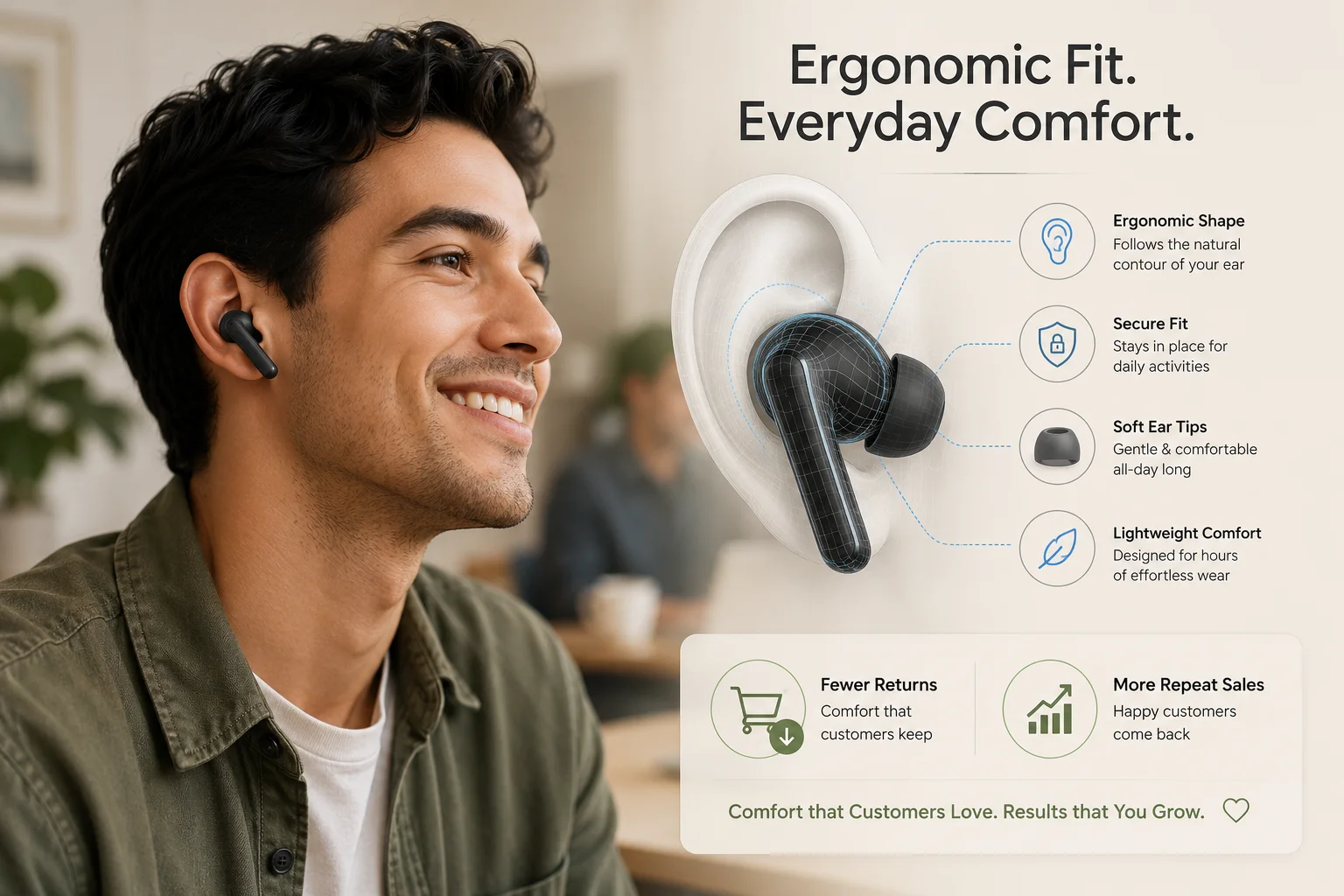
After 15 years in this business, I can tell you this with certainty: a poor fit is one of the top reasons for product returns in the TWS category7. It doesn't matter if the sound is amazing if the customer can't wear them for more than 30 minutes. Here's our simple advice to buyers:
- Test the samples yourself. Wear them for a few hours. Shake your head. Do they stay in?
- Check the ear tips. A good supplier provides multiple sizes and materials (like silicone and memory foam). This is a low-cost way to improve fit for a wider range of users.
- Consider the target use case. A sports earbud needs a secure wingtip. An earbud for sleeping needs a low-profile, comfortable design. Investing a little more in ergonomic testing and offering multiple tip options is an insurance policy against returns. It's a powerful way to build a brand known for quality.
Beyond the Basics: What Sound and Smart Features Will Define Premium TWS in 2026?
You want to offer a premium product but are unsure which features justify the price. You see terms like LDAC, spatial audio, and companion apps and wonder what's hype.
Premium is about a complete experience. It's a combination of superior sound (verified by codecs like LDAC), user customization (via a companion app for EQ), and genuinely useful smart features. Spatial audio is becoming a key differentiator for media consumption.8
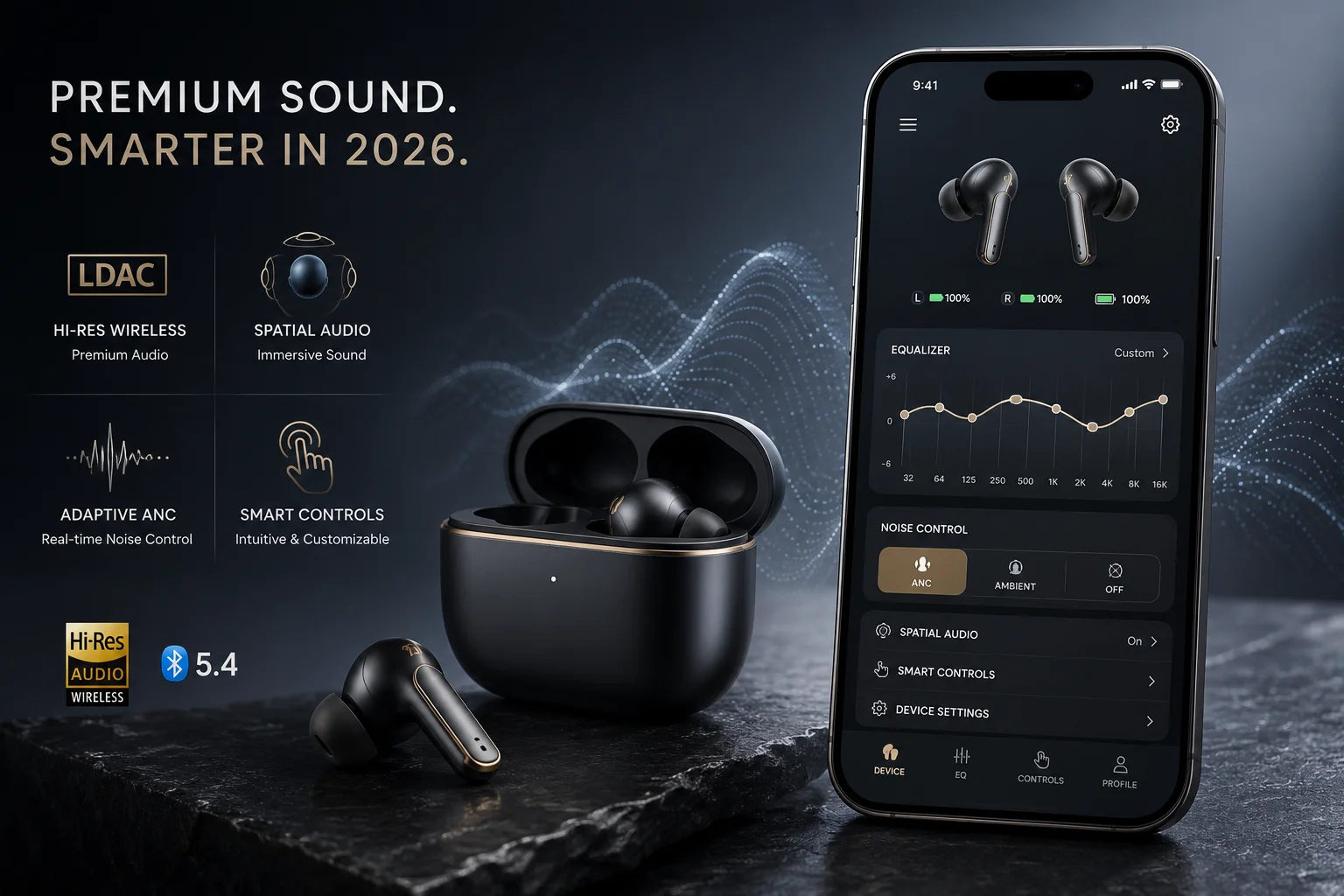
Let's break this down into a portfolio strategy. For your "best" tier product, you need to create a clear step-up in value that justifies the higher price.
- Sound Quality: Don't just say "great sound." Prove it. Supporting high-resolution codecs like LDAC or aptX HD is a clear, technical differentiator9 that tells informed customers you're serious about audio.
- Companion App: An app is no longer a gimmick. It is a platform for adding value. It allows for customizable EQ, remappable controls, and firmware updates. This transforms the product from a static device into an evolving one.
- Smart Features: This is where you can take a calculated risk. Features like head-tracking spatial audio are great for movie watchers. Pick one or two that align with your target user. The key is not to cram in features that don't work well. Ask your supplier for live demos, not just spec sheets.
How Do You Balance Customization and Cost When Sourcing OEM TWS Earbuds?
You want a unique product with your brand on it. But you're worried about high MOQs, tooling costs, and a complex process you don't understand well.
Start with a phased approach. The easiest path is white-label: branding an existing, proven product (low MOQ, low cost). For more differentiation, OEM allows custom colors and packaging. Full ODM (a custom design) has the highest cost and MOQ but offers a unique product.
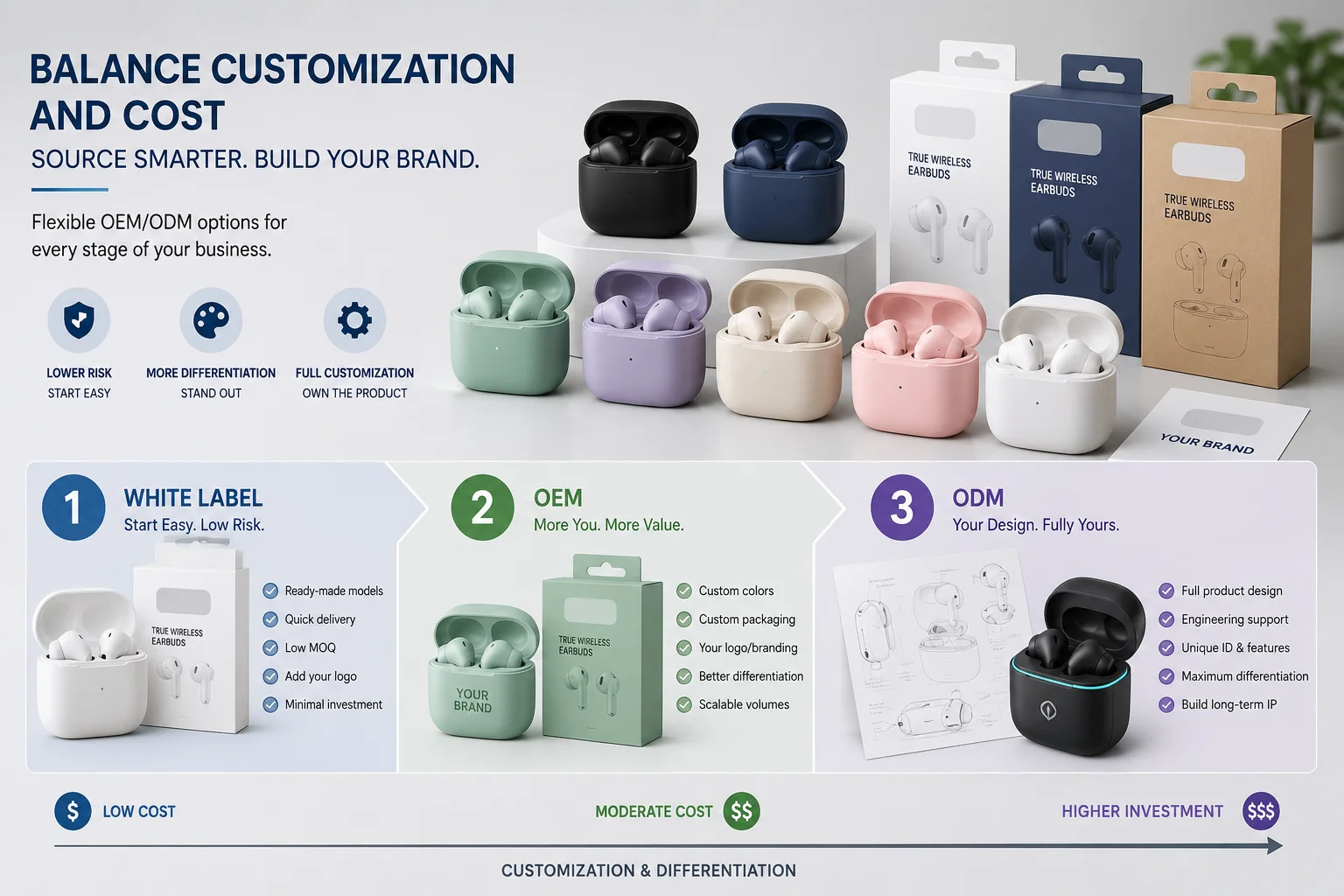
A common question we get from new buyers is how to get started with their own brand. It's a spectrum of cost and complexity. We always advise a crawl-walk-run approach.
| Customization Level | What It Is | MOQ | Cost | Best For |
|---|---|---|---|---|
| White-Label | Printing your logo on a factory's existing model. | Low | Low | New brands, testing the market. |
| OEM (Modified) | Change colors, materials, packaging on an existing model. | Medium | Medium | Brands wanting more identity. |
| ODM (Original Design) | Designing a unique product from scratch. New molds. | High | High | Established brands with volume. |
Start with a white-label product from a reliable manufacturer. Once you have sales data and understand your market, you can invest in OEM modifications for color and packaging. Only when you have significant sales volume should you consider the expense of a full ODM project. This is the safest way to build your brand and minimize your financial risk at every step.
What's the Safest Way to Find a Reliable TWS Earbuds Manufacturer in China?
You've heard horror stories of poor quality, missed deadlines, and lost money. Finding a trustworthy supplier in China feels like a huge, risky task from afar.
Look for objective proof of quality. Ask for certifications (CE, FCC, RoHS)10, quality control reports, and references. A reliable partner will be transparent about their processes and have experience exporting to your market (US/Europe). Don't just focus on the lowest price.
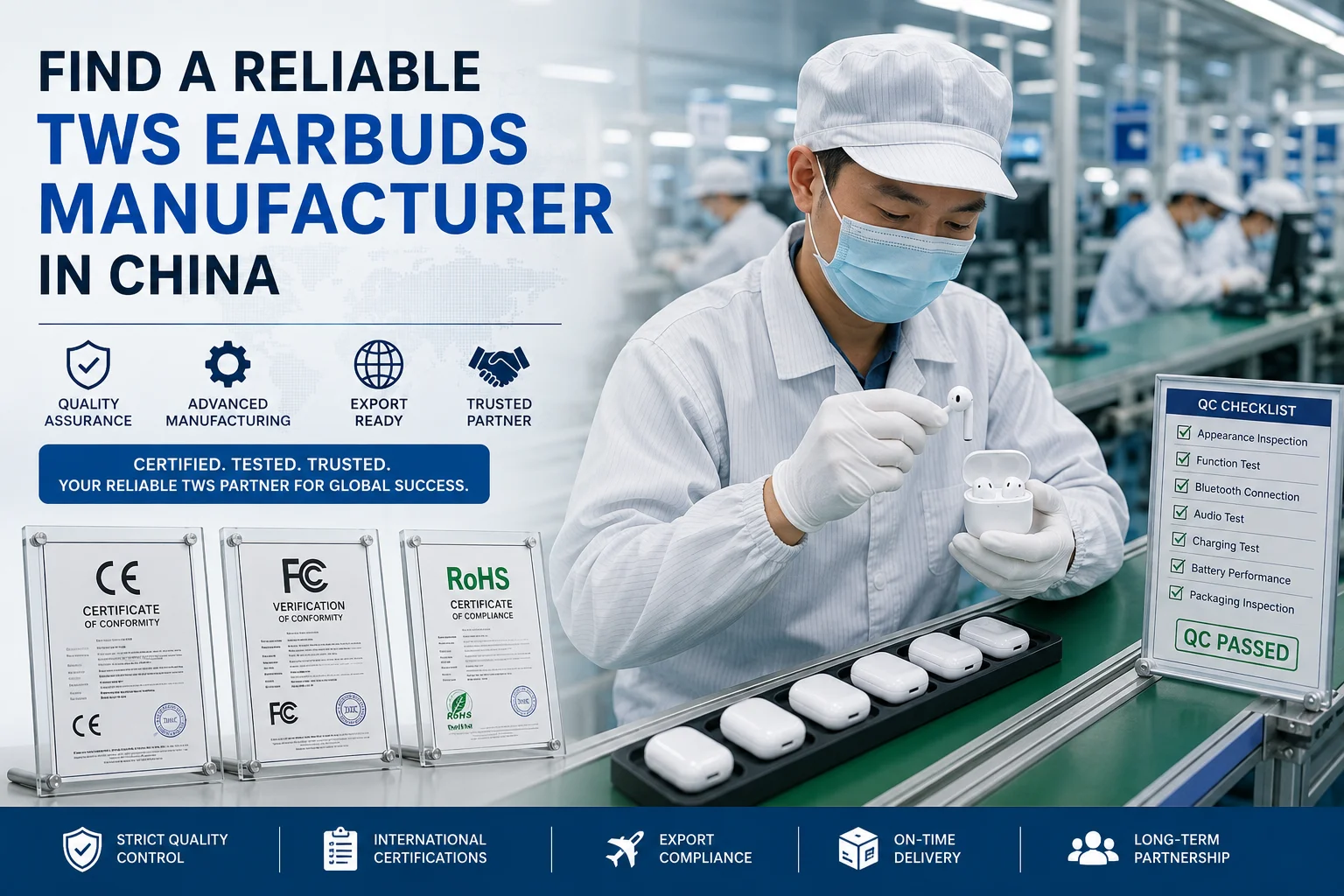
As a company that has been doing this for 15 years, we've built a checklist for vetting suppliers. Here's what you should ask for:
- Essential Certifications: Do they have CE and RoHS for Europe, and FCC for the US? This is non-negotiable for legal import.
- Factory Audits: Can they provide a BSCI or ISO 9001 report11? This shows they have standardized management and ethical practices.
- QC Process: Ask them to explain their quality control. How do they test incoming materials? What are their inspection steps during and after production?
- Market Experience: Have they shipped to your country before? They will understand the specific compliance, labeling, and packaging requirements. This process takes time and experience. This is often where working with a trusted trading partner like us comes in. We have already vetted hundreds of factories, so you can focus on building your brand, not on managing supply chain risk.
Conclusion
In 2026, winning in the TWS market isn't about one magic feature. It's about smart sourcing, building a balanced portfolio, and understanding the real-world needs of your specific customers.
"True Wireless Stereo (TWS) Earbuds Market - 2036", https://www.futuremarketinsights.com/reports/true-wireless-stereo-earbuds-market. Market analysis from firms like Canalys or Counterpoint Research often supports this, indicating that while shipment growth has slowed, the value of the market is increasing as consumers move towards higher-priced models with more advanced features, signifying a mature market driven by upgrades. Evidence role: statistic; source type: research. Supports: The claim that the TWS market's growth is now primarily driven by users upgrading from older models and seeking premium or niche features, rather than first-time purchases.. Scope note: The exact figures and growth drivers can vary between different market research reports and regions. ↩
"Bluetooth 5.3 vs 5.4: Which Version Should You Choose? - Blueiot", https://www.blueiot.com/blog/bluetooth-5.3-vs-5.4.html. The official Bluetooth Special Interest Group (SIG) website details the features of Bluetooth 5.4 and LE Audio, which include enhancements for connection reliability, power efficiency, and new capabilities like Auracast broadcast audio. Evidence role: mechanism; source type: institution. Supports: The claim that Bluetooth 5.4 and LE Audio introduce specific technical improvements.. ↩
"Bluetooth IoT chipset market: $14.2 billion expected by 2030", https://iot-analytics.com/bluetooth-iot-chipset-market/. Industry reports and component teardowns from technology analysis firms often show that as new wireless technologies mature, the cost of associated chipsets decreases due to economies of scale and competition among manufacturers, eventually becoming the new baseline standard. Evidence role: general_support; source type: research. Supports: The claim that newer Bluetooth chipsets are becoming commoditized, reducing the cost difference compared to older versions.. Scope note: Specific pricing data for chipsets is often proprietary and not publicly available; this trend is inferred from general market analysis. ↩
"Evaluating the hearing screening effectiveness of active noise ...", https://pmc.ncbi.nlm.nih.gov/articles/PMC12755674/. Market data and product catalog analysis consistently show a significant price premium for TWS earbuds that feature Active Noise Cancellation (ANC) compared to models without it, reflecting its perceived value by consumers. Evidence role: statistic; source type: research. Supports: The claim that earbuds with ANC are priced higher than those without.. Scope note: The exact price premium varies widely based on brand, implementation quality (e.g., hybrid vs. standard ANC), and other bundled features. ↩
"Noise-canceling microphone - Wikipedia", https://en.wikipedia.org/wiki/Noise-canceling_microphone. Technical explanations from audio engineering sources indicate that ENC primarily relies on signal processing algorithms using multiple microphones to isolate voice, whereas ANC requires additional hardware components like dedicated microphones inside the ear cup and sophisticated feedback/feedforward circuitry to cancel external sound waves, leading to higher hardware and tuning costs. Evidence role: mechanism; source type: other. Supports: The claim that ENC is generally less costly to implement than ANC.. ↩
"Hearing Aid Benefit and Satisfaction Results from the ... - PMC", https://pmc.ncbi.nlm.nih.gov/articles/PMC9715311/. Analysis of product reviews and tech media benchmarks for mid-to-high-tier TWS earbuds released in recent years suggests a market convergence towards a baseline of 7-8 hours of playback on a single charge (with ANC off), with premium models often exceeding this. Evidence role: expert_consensus; source type: research. Supports: The claim that 8-10 hours of single-charge battery life is the current market expectation for a quality TWS product.. Scope note: Actual battery life varies significantly with volume levels and the use of features like ANC, and consumer expectations may differ across price segments. ↩
"The association between headphones use during study and ... - PMC", https://pmc.ncbi.nlm.nih.gov/articles/PMC11856898/. Consumer surveys and analysis of user reviews frequently cite poor fit, discomfort during extended use, and earbuds falling out as primary reasons for dissatisfaction and product returns in the true wireless headphone category. Evidence role: statistic; source type: research. Supports: The claim that poor fit is a major driver of product returns for TWS earbuds.. Scope note: Specific return rate statistics are proprietary to retailers and manufacturers, so evidence is typically based on qualitative analysis of public customer feedback rather than precise, aggregated data. ↩
"True Wireless Stereo Earbuds Market Size ($30.5 Billion) ...", https://www.strategicmarketresearch.com/market-report/true-wireless-stereo-earbuds-market. Tech industry analysts and publications have identified spatial audio with head-tracking as a key feature in the premium 'hearables' segment, driven by its adoption by major content platforms and device ecosystems to create more immersive experiences for movies and gaming. Evidence role: expert_consensus; source type: research. Supports: The claim that spatial audio is a significant feature in the premium TWS market.. Scope note: The mainstream appeal and willingness to pay a premium for this feature are still evolving and may be concentrated among tech enthusiasts and users heavily invested in specific media ecosystems. ↩
"aptX - Wikipedia", https://en.wikipedia.org/wiki/AptX. Technical definitions and comparisons show that codecs like Sony's LDAC and Qualcomm's aptX HD are designed to transmit audio at higher bitrates than the standard SBC codec, preserving more detail from the original source, a feature highly valued in the audiophile community. Evidence role: definition; source type: encyclopedia. Supports: The claim that codecs like LDAC and aptX HD are technically superior and recognized as such.. Scope note: The audible benefit of these codecs depends on the quality of the source audio, the capabilities of the playback device, and the listener's hearing, and may not be apparent to all users. ↩
"CE marking - Wikipedia", https://en.wikipedia.org/wiki/CE_marking. The FCC (Federal Communications Commission) regulates radio-frequency devices sold in the US. The CE mark indicates conformity with health, safety, and environmental protection standards for products sold within the European Economic Area. The RoHS (Restriction of Hazardous Substances) directive, also from the EU, restricts the use of specific hazardous materials in electrical and electronic products. Evidence role: definition; source type: government. Supports: The claim that these certifications are required for market access in specific regions.. ↩
"What is amfori BSCI – the audit requirement, benefits and ... - Eurofins", https://www.eurofins.com/assurance/resources/articles/what-is-amfori-bsci-audit-requirement-benefits-and-process/. ISO 9001 is an international standard for a quality management system (QMS), published by the International Organization for Standardization. The amfori BSCI (Business Social Compliance Initiative) is an industry-driven movement that monitors and assesses workplace standards across the global supply chain, focusing on social and ethical compliance. Evidence role: definition; source type: institution. Supports: The claim that BSCI and ISO 9001 reports signify adherence to specific ethical and quality management standards.. Scope note: These reports certify that a system is in place or that an audit was passed at a specific time; they do not guarantee the quality of every individual product. ↩