Many buyers see 108W and think the choice is easy. Then returns, heat issues, weak packaging, or wrong plugs start to hurt profit.
A 4-port GaN charger 108W is a compact fast charger that can charge laptops, tablets, phones, earbuds, and other USB devices at the same time. It is a strong choice for retailers, wholesalers, and e-commerce sellers who need one high-value charger for travel, office, and home users.
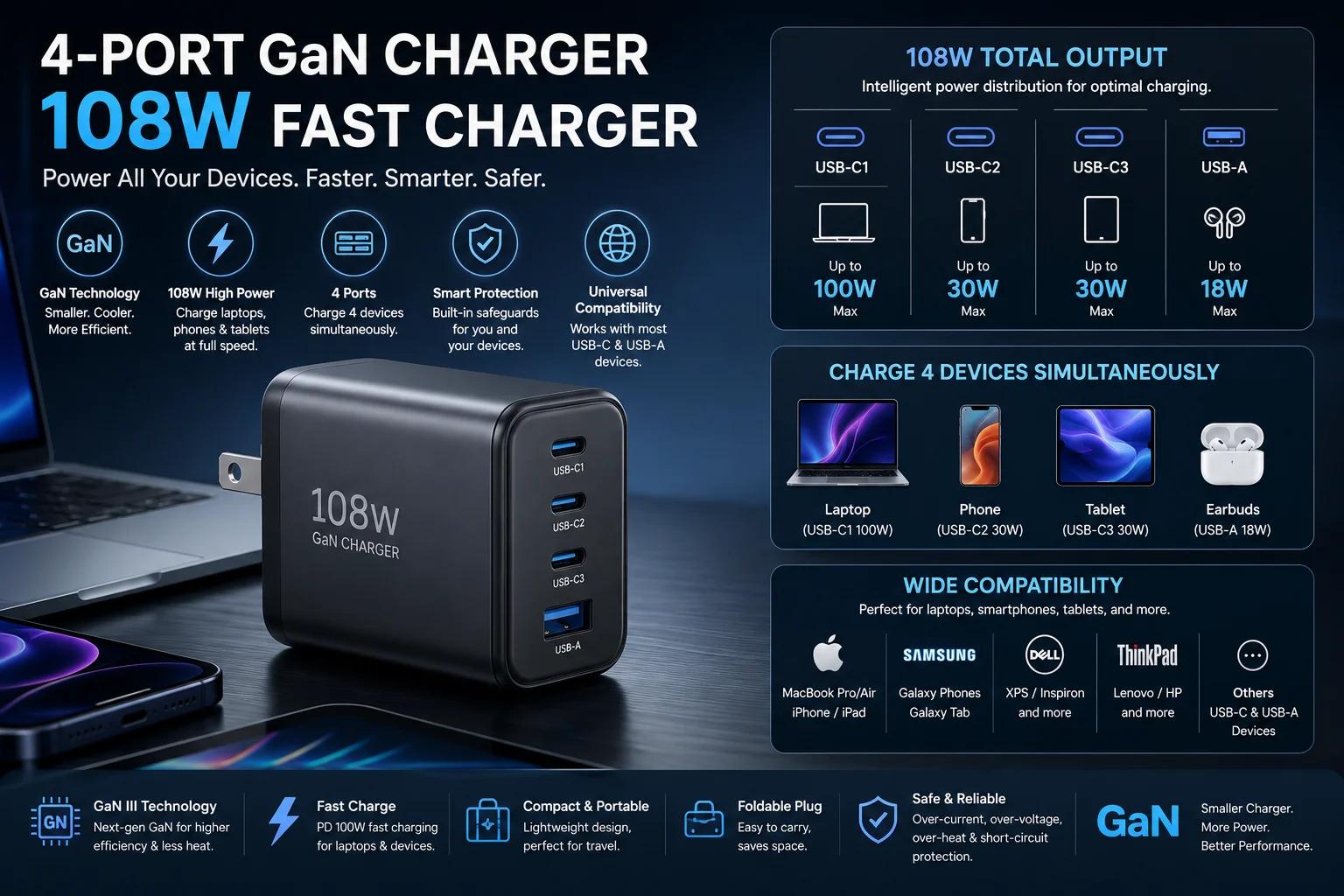
I have worked with overseas 3C buyers for many years from Shenzhen. A common question I get is not only “Can it charge a laptop?” The real question is “Can I sell it with low risk?” This is where a 4-port GaN charger becomes interesting. It is not just a charger with more ports. It is a product decision. You need to think about power, plug type, safety, package, certification, MOQ, and the exact sales channel. If you sell on Amazon, your needs are different from a supermarket buyer. If you supply corporate gifts, your needs are different again. So I usually guide buyers to look at this charger as a mix of product value and business risk.
1. What Is a 4-Port GaN Charger 108W?
Many importers compare chargers only by wattage. That can be risky. A high watt number means little if port design and safety are weak.
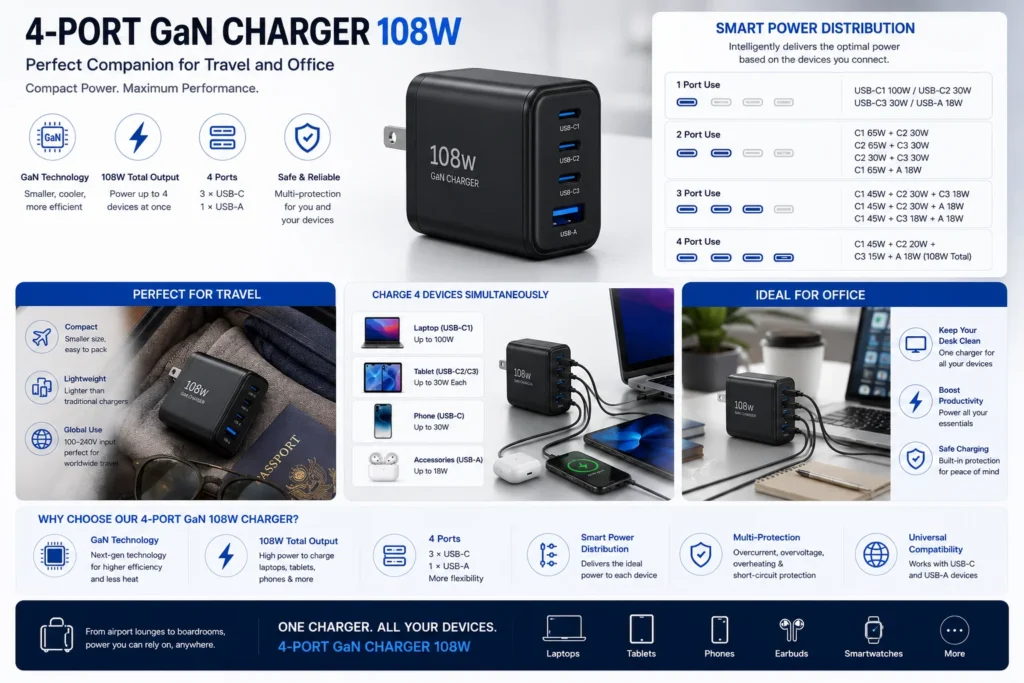
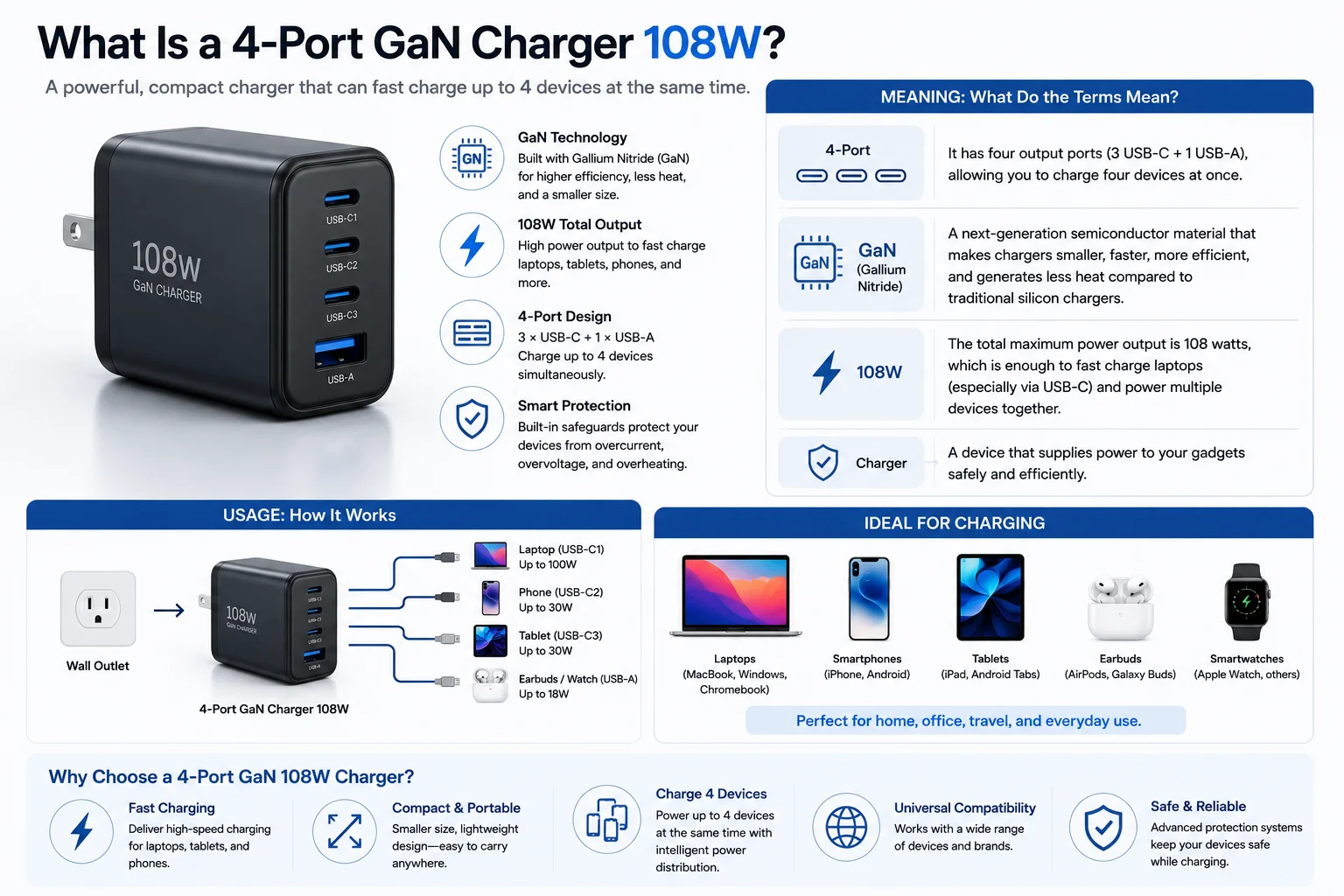
A 4-port GaN charger 108W is a multi-device fast charger that uses GaN material to deliver up to 108W total power through USB-C and USB-A ports. It can charge several devices at once, such as laptops, phones, tablets, earbuds, and smartwatches.
What the 108W number really means
I often explain this to first-time charger buyers. The 108W is usually the total output.1 It does not always mean each port gives 108W at the same time. This point is very important for product pages, retail packaging, and customer service scripts.
| Item | Simple meaning | Buyer risk if ignored |
|---|---|---|
| 108W total output | Combined power of all ports | Customers may expect full power on every port |
| 4 ports | Usually USB-C and USB-A mix | Wrong port mix may reduce user value |
| GaN technology | Smaller and more efficient design | Low-quality design may still overheat |
| Fast charging protocol | Supports common fast charge standards | Some devices may charge slowly |
How I position it to buyers
I do not tell buyers that every market needs the same 108W charger. I ask about their sales channel first. If they sell to office users, 108W makes sense because laptops and phones are charged together. If they sell in discount stores, the price point may be too high. If they sell online, the product title, photos, and test reports must be very clear. The charger is simple for users, but the sourcing decision is not simple for importers.
2. Why GaN Technology Makes Chargers Smaller and More Powerful?
Old chargers can be bulky and hot. Buyers may lose shelf appeal when the charger looks heavy, even if the technical data looks fine.
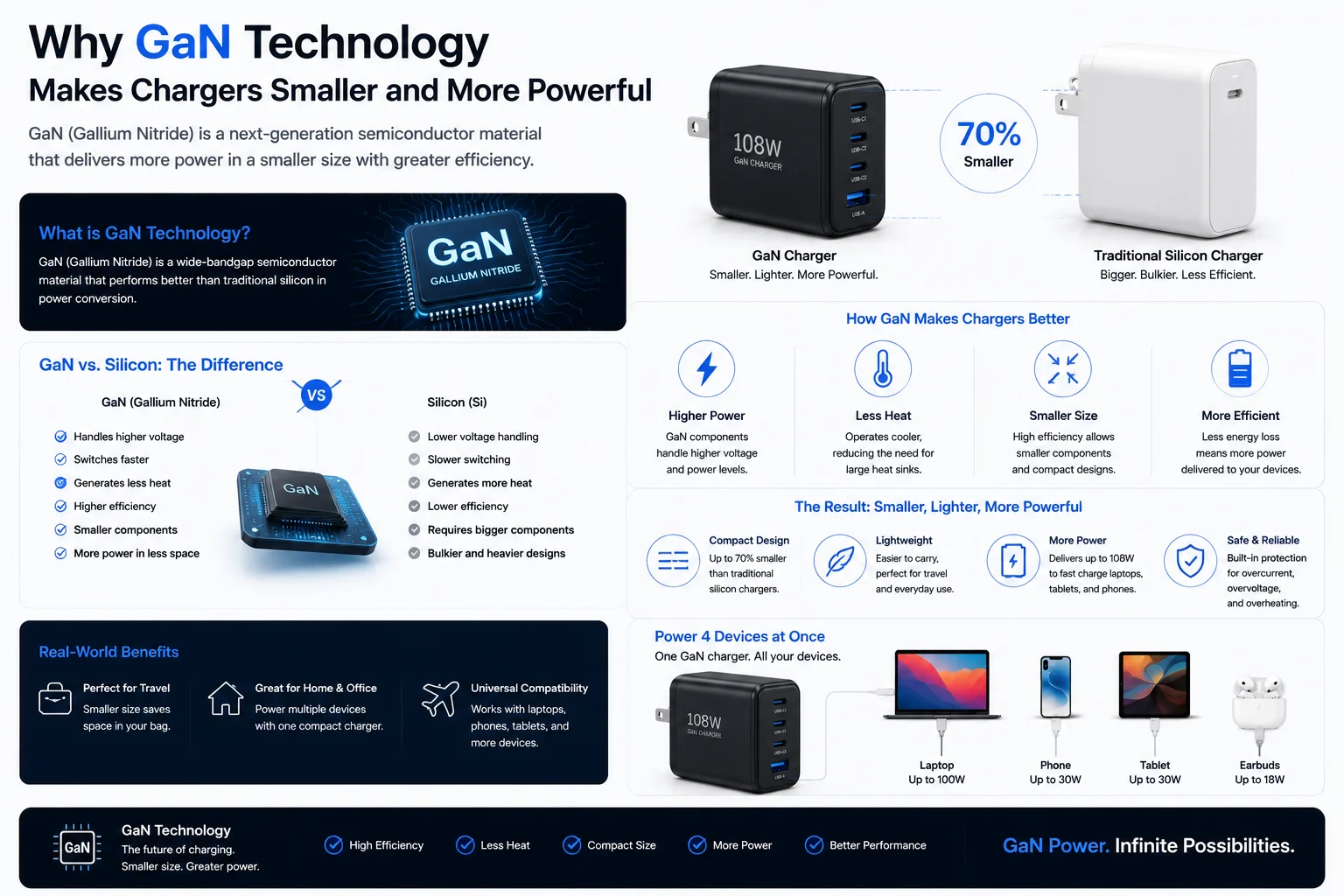
GaN technology helps chargers become smaller, lighter, and more efficient than many traditional silicon chargers2. It can handle high power in a compact body, which makes a 108W 4-port charger easier to carry and more attractive for modern users.
Why size matters in real sales
In B2B sourcing, small size is not just a nice feature. It affects shipping cost, shelf display, online photos, and customer feeling. I have seen buyers reject chargers that worked well because the body looked too big for a premium price. The user wants one small charger for a laptop, phone, and tablet. GaN helps make that promise more believable.
| Point | Traditional charger | GaN charger |
|---|---|---|
| Body size | Often larger | Often smaller |
| Heat control | Depends on design | Usually better with good design |
| Travel use | Less convenient | More convenient |
| Premium image | Average | Stronger |
| Retail value | Lower perceived value | Higher perceived value3 |
What I still check before trusting GaN
I never treat the word “GaN” as a full quality guarantee. Some suppliers use GaN as a marketing word only.4 I still ask for internal design details, aging test records, safety certificates, plug standards, and real charging tests. I also ask if the housing material can handle heat well. For importers, the trade-off is clear. GaN can help you sell a smaller and stronger charger, but you still need control over quality proof. A low-price GaN charger without proper testing can become a return problem.
3. 108W Total Output: What Devices Can It Charge?
Some buyers promise too much on their sales page. Then users complain because the charger does not power every device at full speed together.
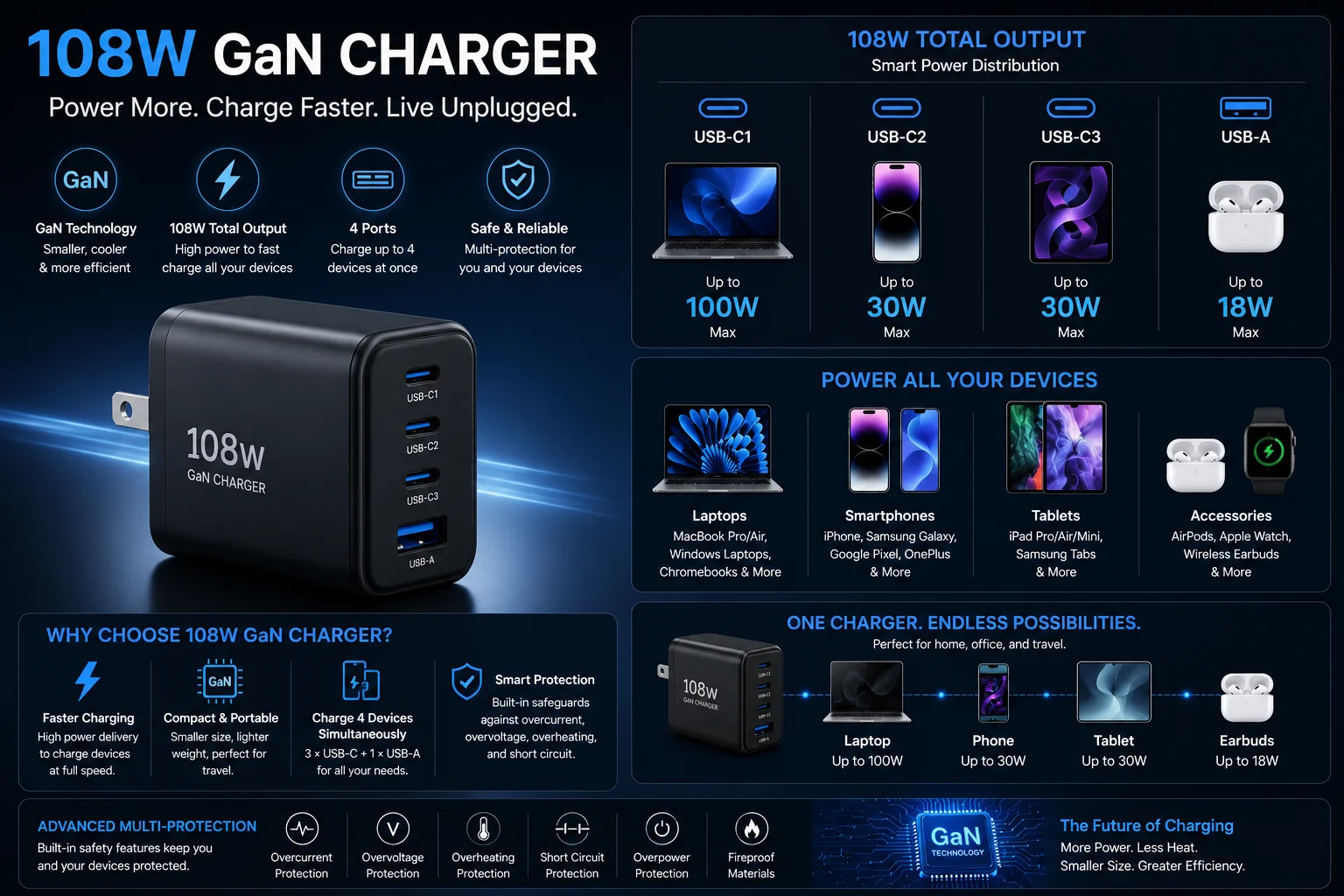
A 108W 4-port GaN charger can charge many USB-C laptops, tablets, smartphones, earbuds, smartwatches, and power banks. It works best when the power distribution matches the device needs, such as higher power for laptops and lower power for phones or accessories.
Common device matching
A common question we get is, “Can this charge a MacBook?” My answer is usually, “Which model and what else will be plugged in?” That question sounds small, but it prevents many after-sales problems. A laptop may need 45W, 65W, or more.5 A phone may need 20W to 30W. Earbuds need much less.
| Device type | Common power need | Good fit for 108W charger? |
|---|---|---|
| Smartphone | 18W-30W | Yes |
| Tablet | 20W-45W | Yes |
| Small laptop | 45W-65W | Yes |
| Larger laptop | 65W-100W | Depends on port output |
| Earbuds | 5W-10W | Yes |
| Smartwatch | 5W | Yes |
Why the port rules matter
The same charger can behave differently when one device is plugged in or four devices are plugged in. This is normal. The problem starts when the product sheet does not explain it. For e-commerce sellers, this can create bad reviews. For chain stores, this can create customer returns at the counter. I suggest buyers request a clear power table for single-port, two-port, three-port, and four-port use. This table should be used in the manual and online listing. It protects both the buyer and the end user. It also makes customer service much easier.
4. USB-C and USB-A Ports: Flexible Charging for Multiple Devices?
Many users still own old cables. If a charger only has USB-C ports, some customers may feel forced to buy new cables.
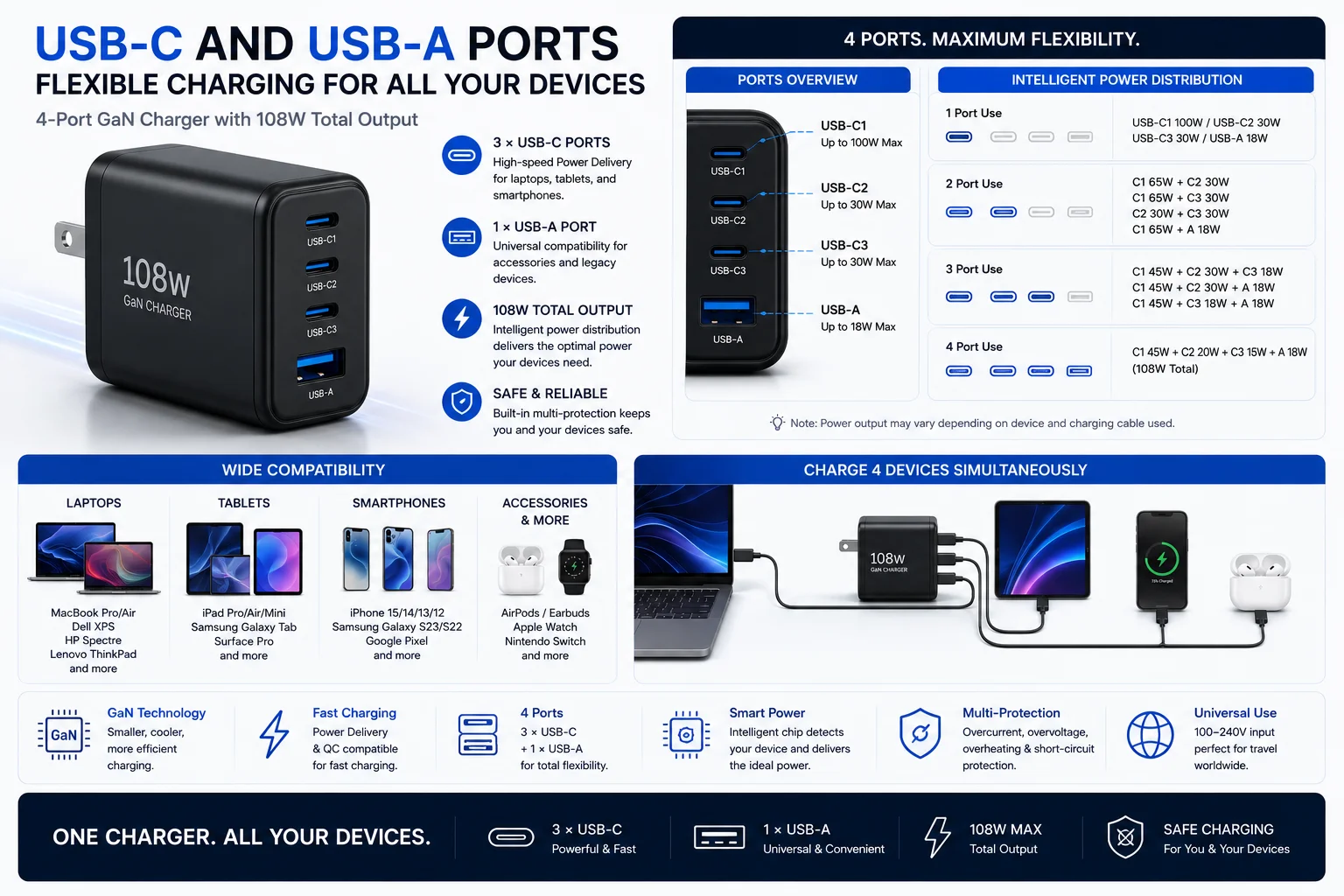
USB-C and USB-A ports make a 108W charger more flexible. USB-C supports high-power fast charging for laptops and new phones, while USB-A supports many older cables, accessories, earbuds, and daily-use devices.6
Why port mix affects your market
I often discuss port mix with wholesalers. Some buyers prefer three USB-C and one USB-A because it looks modern. Other buyers prefer two USB-C and two USB-A because their customers still use many older cables. There is no one best layout. The right answer depends on the users.
| Port layout | Best for | Possible issue |
|---|---|---|
| 3 USB-C + 1 USB-A | Premium online buyers | Less support for old cables |
| 2 USB-C + 2 USB-A | General retail users | Slightly less modern image |
| 4 USB-C | Tech-focused users | Some users need adapters |
| 1 USB-C + 3 USB-A | Low-cost markets | Weak laptop charging appeal |
How I choose for different buyers
When a client asks for the “best option,” I first ask where they sell. Amazon and Shopify sellers may benefit from more USB-C ports because product photos look newer and cleaner. Retail chains may need USB-A because walk-in customers still have mixed cables at home. Gift and promotion buyers may also prefer USB-A support because they do not control the end user’s device type. This is a trade-off between modern image and mass compatibility. I usually suggest that buyers avoid choosing port layout based only on personal preference. The end user decides whether the layout feels useful.
5. Smart Power Distribution for Phones, Tablets, and Laptops?
A charger with four ports can still disappoint users. The issue is often not the port count. The issue is how power is shared.
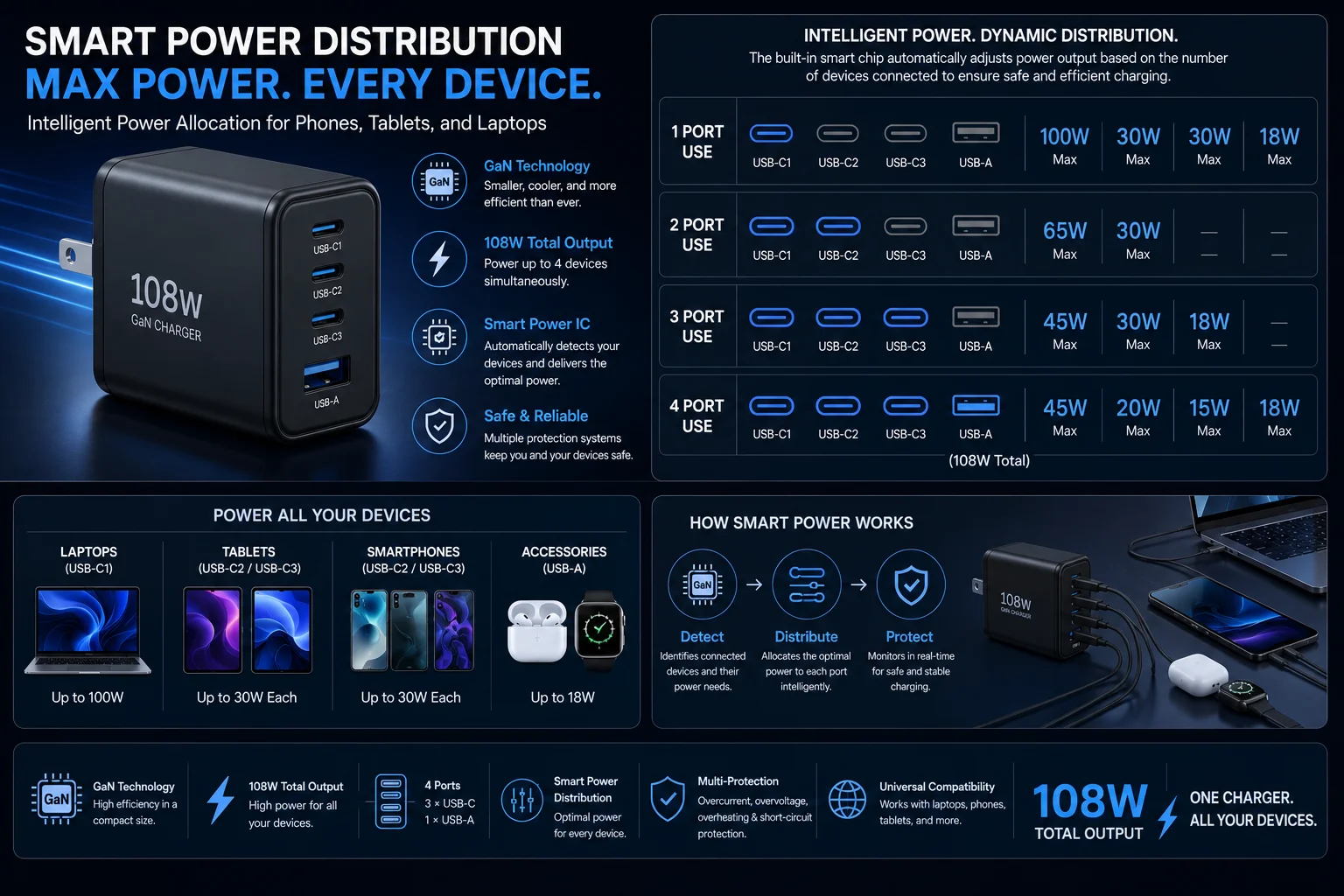
Smart power distribution means the charger can detect connected devices and share the 108W total output in a practical way.7 It gives higher power to laptops and tablets when needed, while still charging phones and accessories safely.
What smart distribution does in daily use
I like to explain this with a simple office scene. A user plugs in a laptop, a phone, wireless earbuds, and a smartwatch. The laptop should receive more power. The earbuds do not need much power. The charger should balance this without confusing the user. Good power distribution makes the charger feel smooth.
| Use case | Expected behavior | Why it matters |
|---|---|---|
| Laptop only | High power to USB-C | Fast work charging |
| Laptop + phone | Laptop gets priority | Better user experience |
| Phone + tablet | Both charge fast | Good home use |
| Four devices | Shared output | Clear expectations needed |
Why sellers need a power map
I always ask suppliers for a port power map. This map shows what each port can deliver under different use cases. Without it, the sales team may write unclear product claims. That creates risk. The buyer may think the charger supports full-speed charging for four devices at once. The end user may think the same. Then the real product feels weak, even if it is working correctly. For importers, smart power distribution is not only a technical feature. It is also a communication point. You should show it clearly in images, user manuals, and customer support answers. Clear power rules reduce returns.
6. Safety Protection: Temperature, Overcurrent, and Overvoltage Control?
Fast charging can build customer trust, but it can also create fear. If a charger feels too hot, users may stop using it.
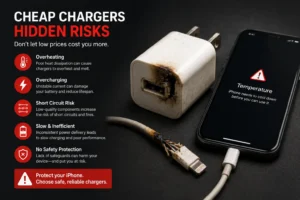
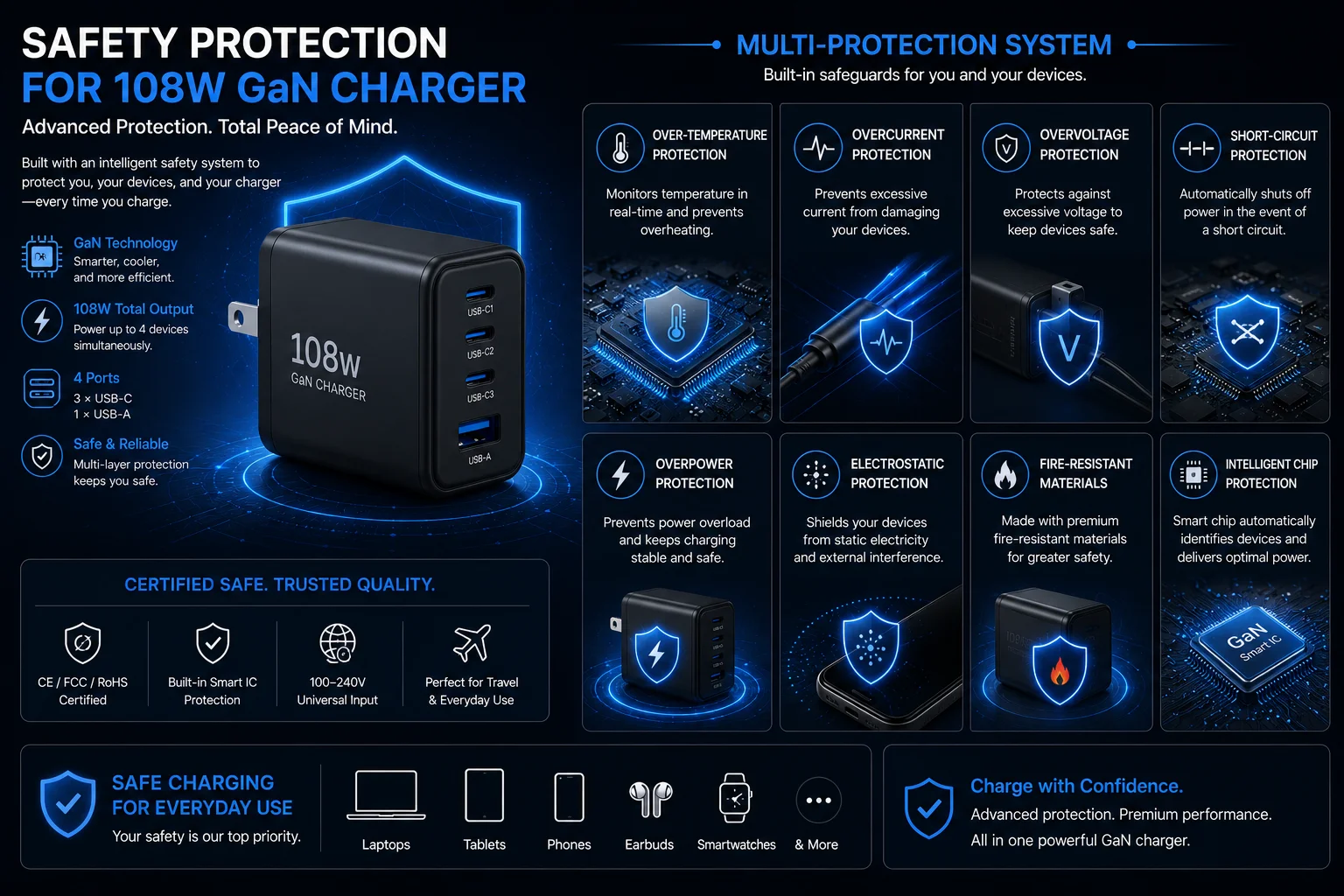
A good 108W GaN charger should include temperature control, overcurrent protection, overvoltage protection, short-circuit protection8, and safe housing design. These protections help reduce risk during high-power charging and support stable long-term use.
What buyers should not ignore
Safety is one of the first topics for European and American buyers. Many buyers ask about CE, FCC, RoHS, UKCA, ETL9, or other market needs. I always remind them that certificates are important, but they are not the whole story. Real safety also depends on materials, PCB design, transformer quality, firmware, and production control.
| Safety item | What it does | Buyer check point |
|---|---|---|
| Temperature control | Helps manage heat | Ask for aging test data |
| Overcurrent protection | Limits abnormal current | Check test reports |
| Overvoltage protection | Protects devices | Confirm protocol test |
| Short-circuit protection | Reduces failure risk | Ask for lab test proof |
| Flame-retardant housing10 | Helps protect the shell | Check material grade |
Why safety is also a business issue
A safety problem can damage more than one order. It can damage store trust, online ratings, and brand image. I have seen buyers focus heavily on saving a small amount per unit, then later spend more money on returns and customer service. This is why I treat safety as a cost control tool, not just a compliance topic. For wholesale buyers, safety protects the channel. For private label buyers, safety protects the brand. For large retailers, safety protects the whole supply chain. A charger works close to expensive devices, so buyers should not accept vague answers. Clear test proof is worth asking for before the deposit.
7. Why 4-Port GaN Chargers Are Popular for Travel and Office Use?
People carry too many chargers. This creates clutter, weight, and stress. A single strong charger solves a very real daily problem.
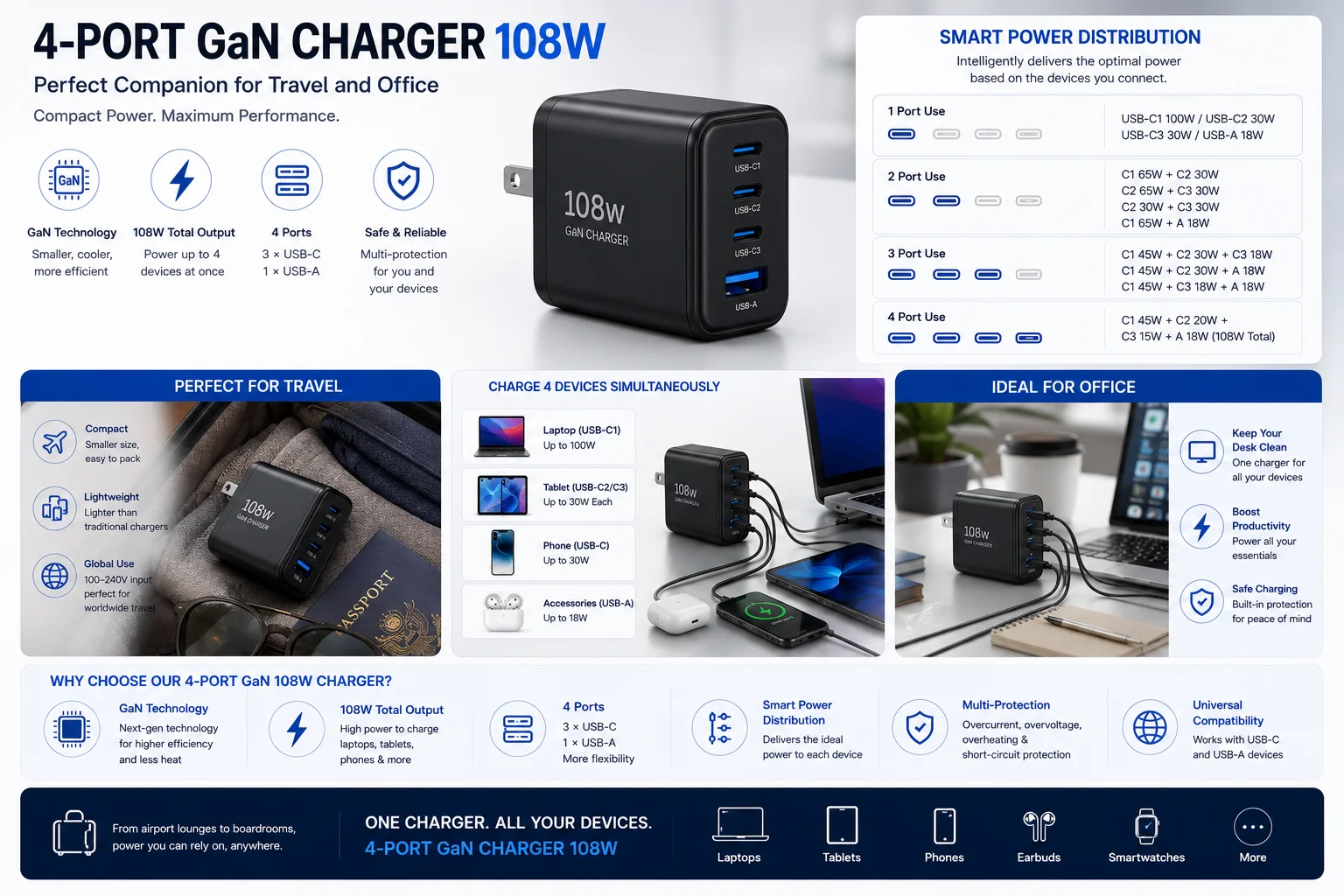
4-port GaN chargers are popular because they replace several chargers with one compact unit.11 Travelers, office workers, students, and remote workers can charge laptops, phones, tablets, and accessories from one wall socket.
Why the use case is easy to understand
Some 3C products need long education. A 4-port GaN charger does not. The user can understand the value in one second. One charger. Four devices. Less mess. This simple message helps retailers and e-commerce sellers. It also helps packaging design because the front of the box can show clear device icons.
| User group | Main need | Selling point |
|---|---|---|
| Business traveler | Less luggage | One charger for laptop and phone |
| Office worker | Cleaner desk | Four devices from one socket |
| Student | Shared charging | Laptop, phone, tablet, earbuds |
| Family user | Mixed devices | USB-C and USB-A support |
| Remote worker | Stable setup | High output and compact size |
Why this product fits modern retail
I see more buyers looking for products that are not too niche. A 108W 4-port GaN charger fits many customer groups. This helps importers reduce inventory risk. Still, the price is higher than a basic charger. So the sales message must be strong. Travel use, office use, and multi-device charging should be shown clearly. If buyers only show “108W” on the package, many users may not understand the value. If buyers show a laptop, phone, tablet, and earbuds charging together, the value becomes simple. The product succeeds when the customer can imagine using it every day.
8. What Importers Should Check Before Buying 108W GaN Chargers Wholesale?
A cheap quote can look attractive at first. Then MOQ, certificates, plug versions, packaging, and after-sales terms can change the real cost.
Importers should check output specifications, port power distribution, safety certificates, plug standards, test reports, MOQ, lead time, packaging options, warranty terms, and supplier communication before buying 108W GaN chargers wholesale.
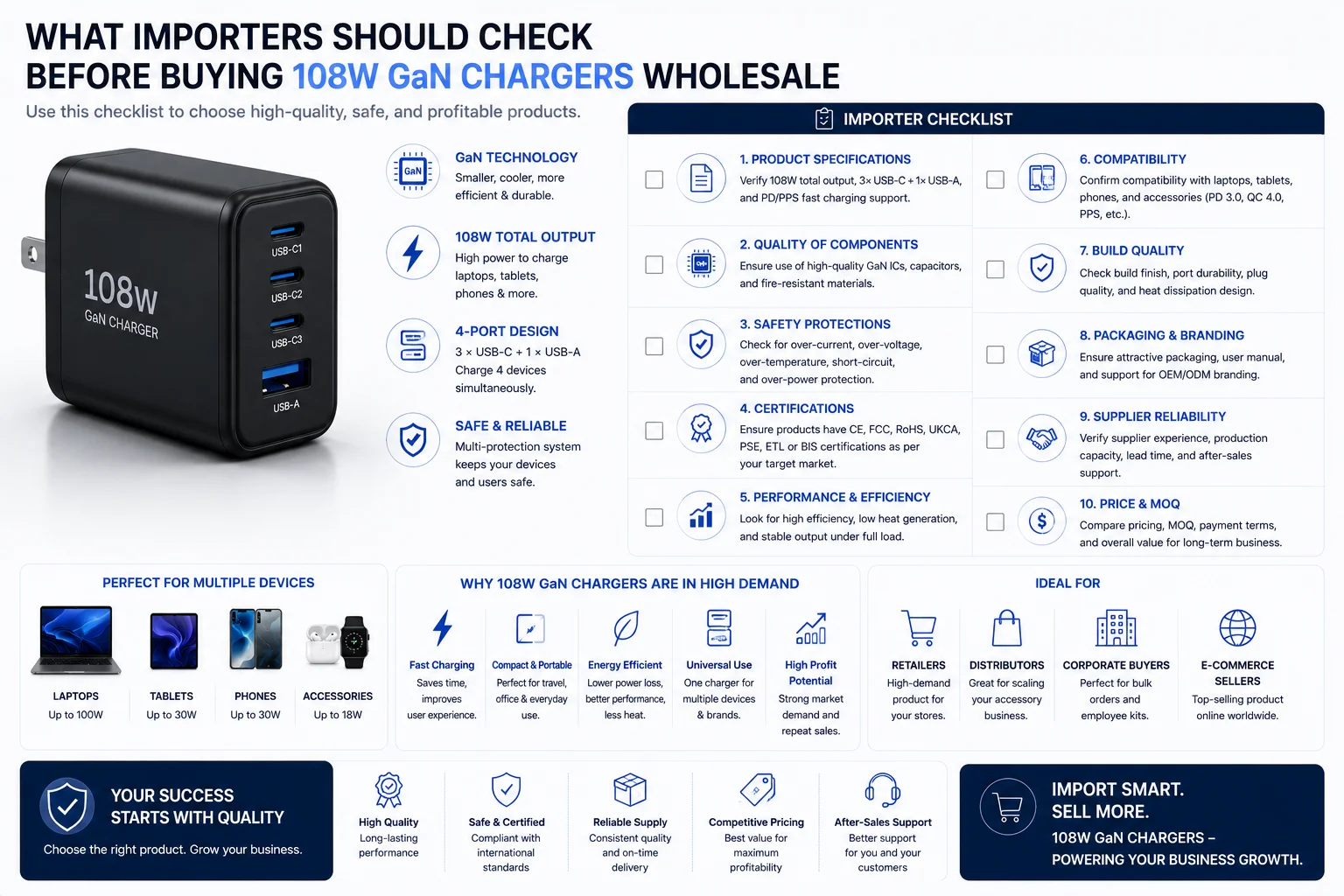
The sourcing decision is a risk decision12
When I speak with buyers, I do not ask only about target price. I ask about sales volume, channel, market, and branding plan. A wholesale buyer may need speed and low MOQ. A private label buyer may need packaging and logo control. A larger buyer may need deeper technical support and stricter testing. Each path has a trade-off.
| Buyer situation | Better focus | Main trade-off |
|---|---|---|
| Market testing | Low MOQ and fast delivery | Less customization |
| Online brand | Packaging and clear specs | More setup work |
| Retail chain | Certificates and stable supply | Longer preparation |
| Wholesaler | Price and stock speed | Less unique design |
| Premium brand | Testing and detail control | Higher cost |
My practical checklist before order
I suggest buyers check the details before they compare the final price. First, confirm the plug version, such as EU, US, UK, or AU. Second, confirm the exact port output table. Third, confirm which certifications match the selling market. Fourth, ask for real product photos, not only renderings. Fifth, check packaging size because it affects freight and shelf display. Sixth, discuss warranty terms in writing. Seventh, ask about production lead time during peak season.
| Check item | Why I check it |
|---|---|
| Output table | It prevents wrong sales claims |
| Certification | It supports customs and market access |
| MOQ | It controls first-order risk |
| Lead time | It protects launch plans |
| Packaging | It affects retail value |
| Warranty | It reduces after-sales disputes |
| Custom options | It supports brand plans |
For me, the right supplier is not only the one with the lowest price. The right supplier helps the buyer understand the risk before the order. This is especially true for high-power chargers.
Conclusion
A 4-port GaN charger 108W is a strong product when power, safety, ports, certificates, and sales channel all match the buyer’s real market.
"Would you rather carry around 1 multi port charger or 2+ single port ...", https://www.reddit.com/r/UsbCHardware/comments/1oh5fi9/would_you_rather_carry_around_1_multi_port/. A source from a reputable technology publication could confirm that for multi-port chargers, the advertised wattage (e.g., 108W) typically refers to the maximum power the charger can deliver across all ports combined, not the power of each individual port. Evidence role: general_support; source type: other. Supports: The common industry practice of advertising the maximum combined power output for multi-port chargers.. ↩
"GaN vs. Silicon in High-Frequency Power Transistors - Stanford", http://large.stanford.edu/courses/2025/ph240/jahan2/. A source could explain that GaN has a wider bandgap and higher electron mobility than silicon, allowing components to operate at higher frequencies and temperatures. This enables the use of smaller transformers and other passive components, resulting in a more compact and energy-efficient charger design. Evidence role: mechanism; source type: education. Supports: The physical properties of Gallium Nitride (GaN) that enable the creation of smaller and more efficient power electronics compared to silicon.. ↩
"consumer responses to generative adversarial network (GAN ...", https://www.sciencedirect.com/org/science/article/abs/pii/S0959055220000820. An article from a business or marketing publication could discuss how new technologies like GaN are leveraged to create premium product tiers. This strategy allows brands to command higher prices by highlighting tangible benefits like smaller size and higher efficiency, which contributes to a higher perceived value among consumers. Evidence role: general_support; source type: other. Supports: The use of new technology to create a premium product tier with higher perceived value.. Scope note: This supports the marketing strategy but does not empirically measure 'perceived value' from the consumer's perspective. ↩
"GaN Charger Teardown Reveals Value Of This New Technology", https://hackaday.com/2023/03/31/gan-charger-teardown-reveals-value-of-this-new-technology/. A source, such as a detailed technical review or teardown from an electronics expert, could demonstrate that the inclusion of a GaN component does not automatically guarantee superior performance. The analysis might show that overall circuit design, thermal management, and the quality of other components are equally critical, and that some poorly designed products marketed as 'GaN' fail to deliver significant advantages. Evidence role: case_reference; source type: other. Supports: The existence of significant performance and quality variations among products marketed as 'GaN chargers'.. Scope note: This supports the idea that 'GaN' is not a guarantee of quality, rather than proving that suppliers intentionally use it as 'only a marketing word'. ↩
"What is the Right Macbook Pro Charger Wattage? - Anker US", https://www.anker.com/blogs/chargers/charger-wattage-for-macbook-pro. A source could provide examples, noting that ultraportable laptops often use 30-45W chargers, mainstream models typically require 60-67W, and high-performance laptops can demand 96W or more, confirming the wide range of power needs. Evidence role: case_reference; source type: other. Supports: The range of power required by modern laptops that charge via USB-C.. ↩
"USB hardware - Wikipedia", https://en.wikipedia.org/wiki/USB_hardware. A source from the USB Implementers Forum (USB-IF) or a technical encyclopedia could detail how the USB Power Delivery (PD) protocol, primarily used with USB-C, is designed to support much higher power levels (up to 240W) compared to the limited power capabilities of the legacy USB-A standards. Evidence role: definition; source type: institution. Supports: The technical differences in power delivery capabilities between the USB-C and USB-A standards.. ↩
"The Basics of USB Power Delivery Negotiations - Acroname Inc", https://acroname.com/blog/basics-usb-power-delivery-negotiations?srsltid=AfmBOoqhDvk43YinRc1rhGt80IunowVVMKpAX5NeqCinOaD_gGBT-XQk. A source could explain that this feature typically relies on the USB Power Delivery (PD) protocol, which involves a communication 'handshake' between the charger and the device to determine the highest mutually supported voltage and current, ensuring safe and efficient power allocation. Evidence role: mechanism; source type: education. Supports: The technical process by which a charger and a connected device negotiate power levels.. ↩
"[PDF] PRVV0001-R1_UL 62368-1 2019.pdf", https://www.eac.gov/sites/default/files/2024-08/PRVV0001-R1_UL%2062368-1%202019.pdf. A source referencing international safety standards like IEC 62368-1 could confirm that protections against overcurrent, overvoltage, over-temperature, and short circuits are essential safeguards required for the certification and safe operation of information and communication technology equipment, including external power supplies. Evidence role: expert_consensus; source type: institution. Supports: The function and importance of key safety features in modern electronic chargers as mandated by international standards.. ↩
"CE marking - Wikipedia", https://en.wikipedia.org/wiki/CE_marking. A source from a government or standards body could define these marks. For example, the U.S. Federal Communications Commission (FCC) explains its mark certifies that a device's electromagnetic interference is within approved limits, while the European Commission defines the CE mark as a declaration of conformity with EU standards for health, safety, and environmental protection. Evidence role: definition; source type: government. Supports: The definitions and regional requirements of common electronics certifications.. ↩
"Why Are Flame Retardants in Lithium-Ion Battery Enclosures? - PMC", https://pmc.ncbi.nlm.nih.gov/articles/PMC11823442/. A source on material safety standards could explain that plastics used in electronics enclosures are often tested according to standards like UL 94. Using materials with a high flame-retardant rating (e.g., V-0) helps ensure that the casing will self-extinguish and not contribute to the spread of fire in case of an internal malfunction. Evidence role: mechanism; source type: institution. Supports: The role and importance of using flame-retardant materials for the enclosures of electronic devices.. ↩
"GaN powered Chargers Market Size, Share | Outlook 2035", https://www.marketresearchfuture.com/reports/gan-powered-chargers-market-11884. A market research report or an analysis from a major technology publication could provide data showing a growing consumer trend toward multi-port chargers, driven by the proliferation of personal electronic devices and a demand for travel convenience and workspace decluttering. Evidence role: statistic; source type: research. Supports: The growing market demand for consolidated, multi-port charging solutions, particularly those using GaN technology.. ↩
"Supply Chain Risk Management (SCRM) - NCUA", https://ncua.gov/regulation-supervision/regulatory-compliance-resources/cybersecurity-resources/supply-chain-risk-management-scrm. A source from a business publication or supply chain management guide could explain the concept of Total Cost of Ownership (TCO) in sourcing, which includes not only the purchase price but also costs related to quality failures, returns, compliance risks, and supply chain disruptions. This supports the view of sourcing as a risk management activity. Evidence role: general_support; source type: education. Supports: The principle that effective global sourcing focuses on managing risk and total cost, not just the initial unit price.. ↩