The electronics OEM process can feel confusing when you only have a product idea, a competitor photo, or a target price in mind. Many buyers rush into sampling before they confirm specifications, compliance needs, order quantity, and delivery expectations. We help buyers turn early concepts into manufacturable 3C products through a clearer feasibility-first process.
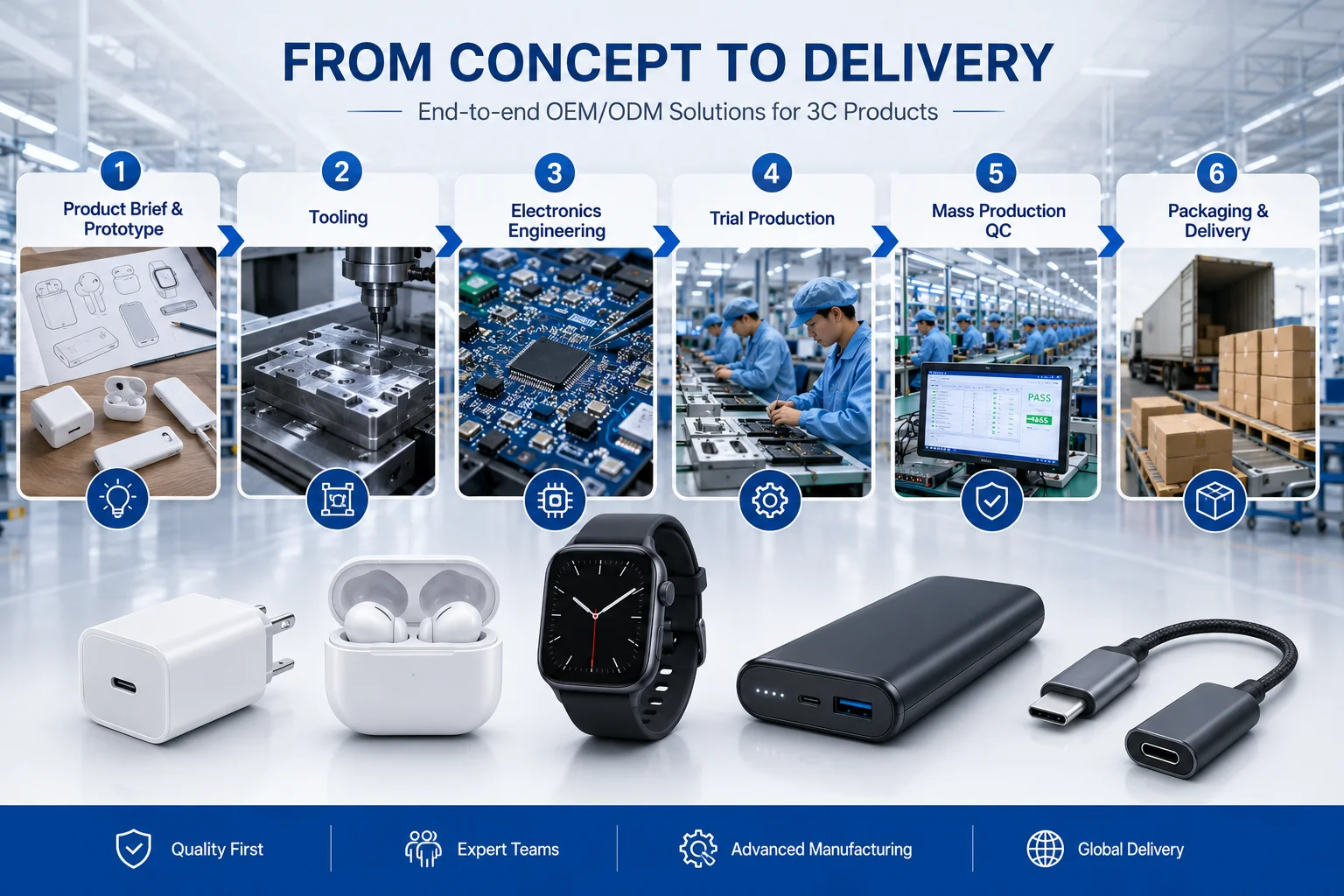
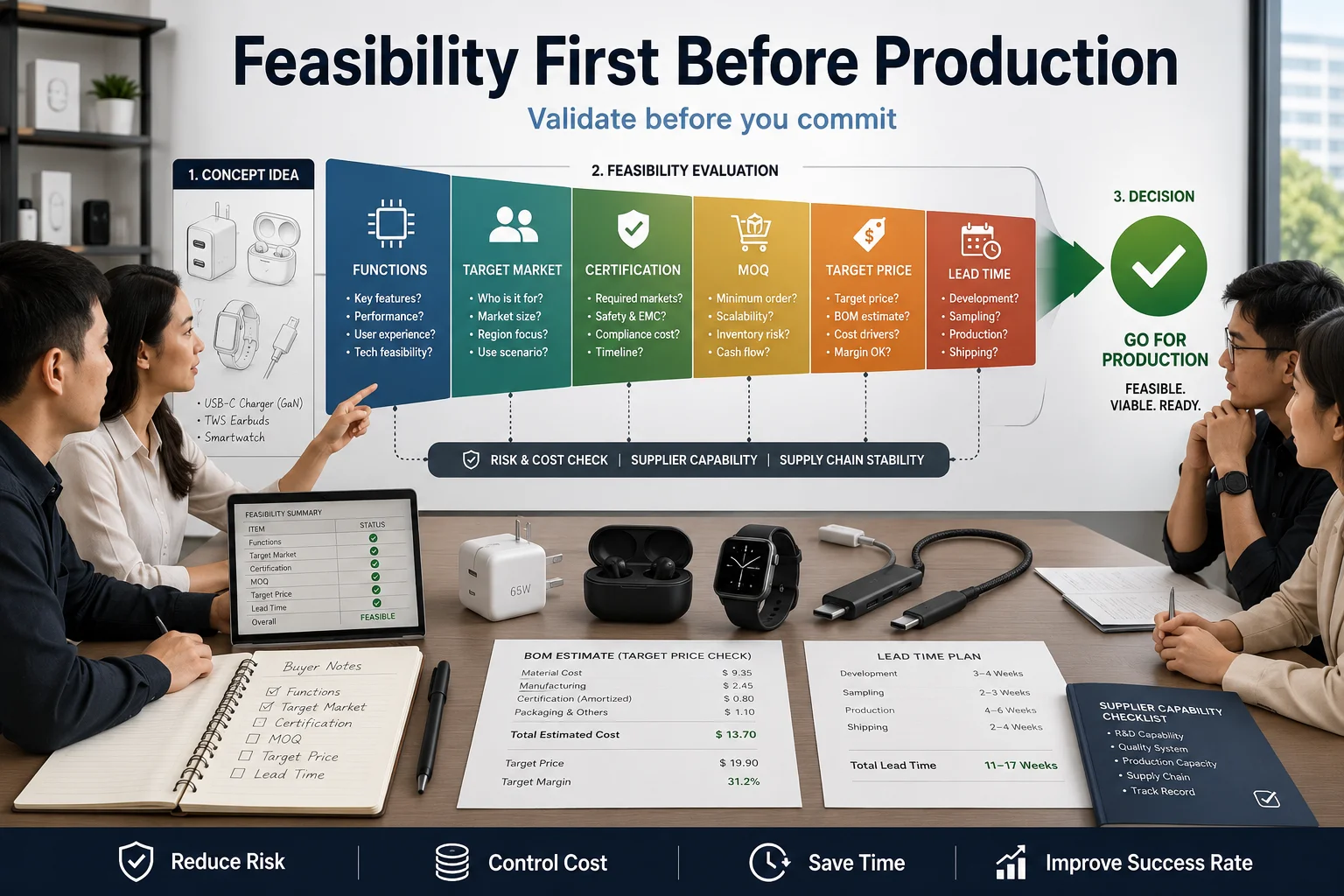
The electronics OEM process usually moves through six connected stages: product briefing and prototyping, tooling, electronics engineering, trial production, mass production quality control, and final delivery. However, a successful project is not simply linear. Buyers need to validate product functions, target market, certification needs, MOQ, target price, and lead time at every stage before committing to production.
In our 15 years of exporting 3C accessories from Shenzhen, we have seen one pattern repeatedly: the projects that move smoothly are not always the simplest products. They are the projects where buyers prepare the right information early and make trade-offs before production decisions become expensive.
Quick Answer: What Are the 6 Steps in the Electronics OEM Process?
A new electronics project often looks straightforward from the outside. Yet unclear requirements can lead to repeated samples, delayed tooling, and quotes that do not match the final product. A buyer needs a practical roadmap before requesting a final price.
The six steps in the electronics OEM process are: (1) define the product brief and build prototypes, (2) develop tooling if custom housings are needed, (3) complete PCB and electronic engineering, (4) run trial production and approve samples, (5) begin mass production with quality control, and (6) prepare packaging, shipping documents, and delivery. Each step may require revisions when cost, reliability, certification, or MOQ requirements conflict.
What Buyers Should Prepare First
Before we can assess a custom electronics OEM project properly, we normally ask for:
- Product category and intended function
- Reference images, sketches, or competitor links
- Target sales market, such as the US, EU, or UK
- Expected order quantity and reorder plan
- Target retail price or target landed cost
- Required certifications or marketplace requirements
- Packaging expectations
- Requested delivery date
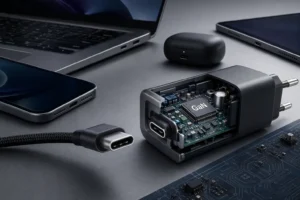
A concept image is helpful, but it is not a complete manufacturing brief. For example, two 65W GaN chargers can look almost identical while using different chipsets, safety components, shell materials, plug structures, and thermal designs.1 Those differences affect cost, testing, production yield, and product performance.
A responsible supplier should not treat a target price as an isolated number. The price needs to match the product specification, quantity, packaging, market requirements, and delivery expectation.
What Is the Electronics OEM Process?
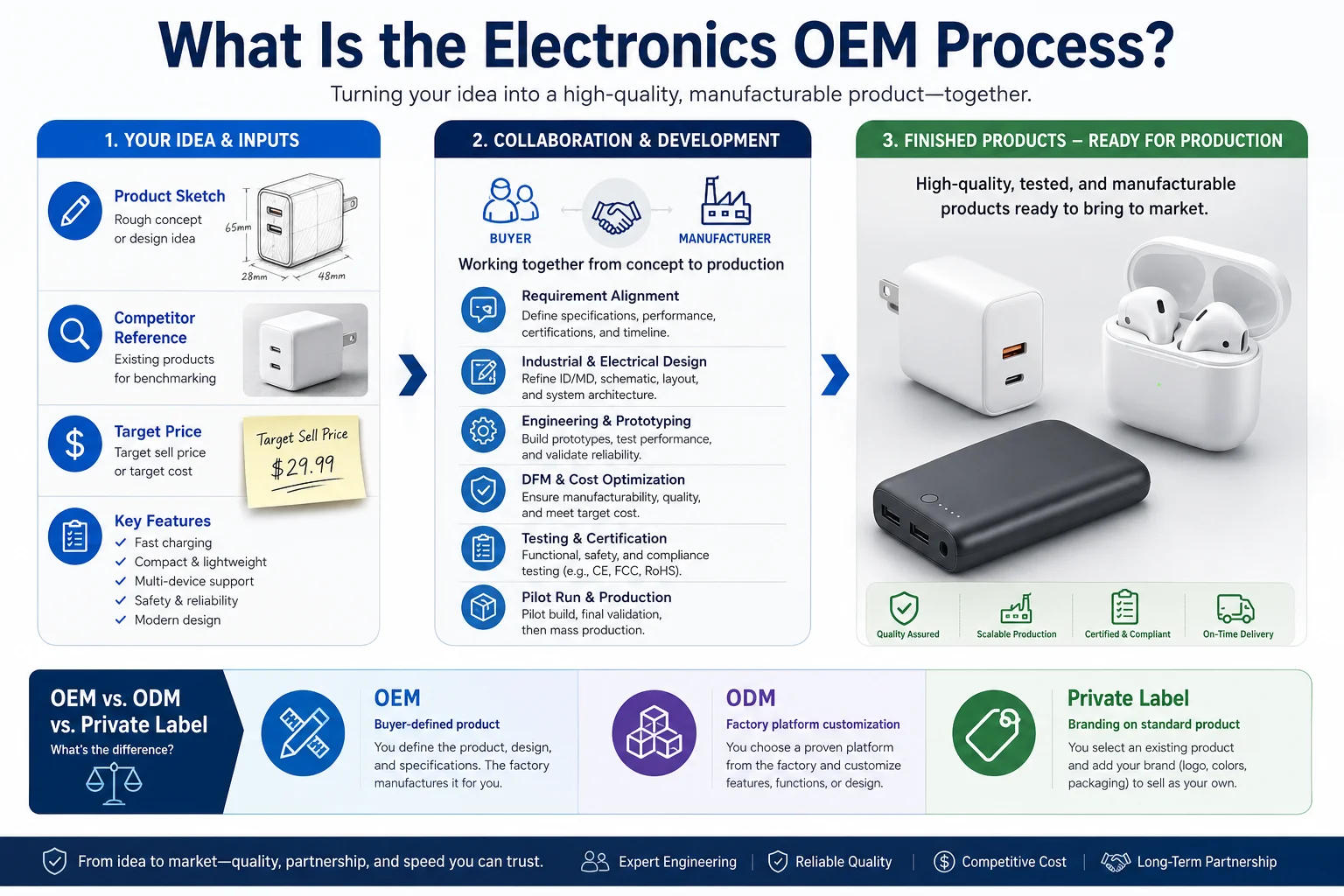
The phrase “OEM” is often used loosely in the consumer electronics industry. This creates confusion when buyers expect full custom development but request a standard private-label product. The right manufacturing model depends on how much control you need over design, functions, and intellectual property.
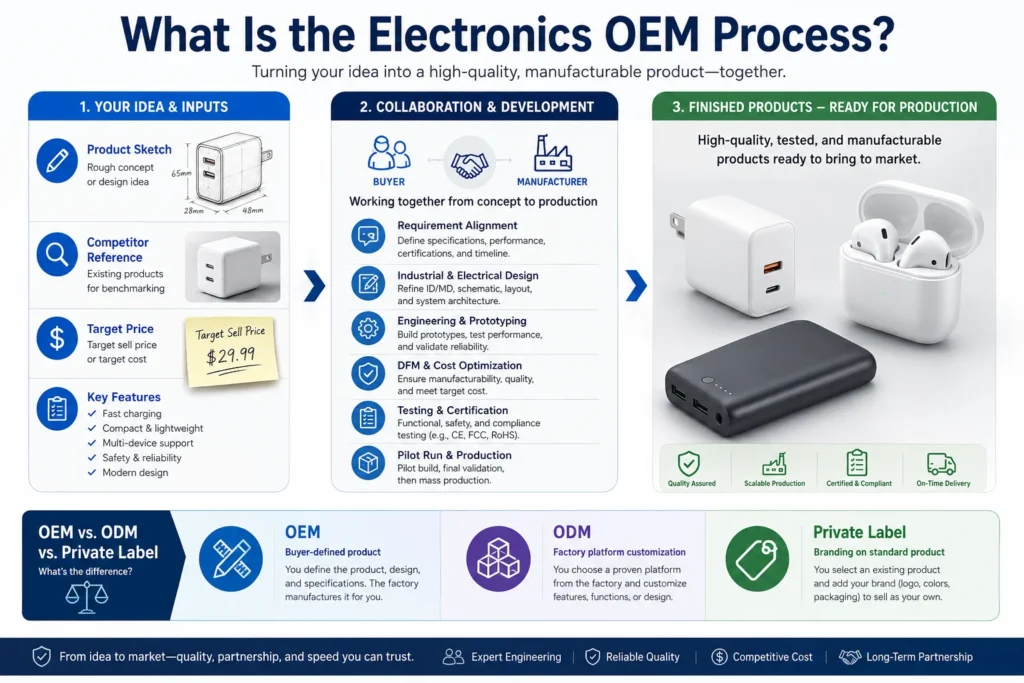
The electronics OEM process is a structured method for developing and manufacturing a buyer-defined product.2 In a true OEM project, the buyer provides or approves key specifications, while the factory supports engineering, sourcing, testing, assembly, and production. ODM and private-label models usually start from an existing factory design with different levels of customization.3
OEM, ODM, and Custom Manufacturing in Practice
In our daily communication with buyers, we find that many projects begin as an ODM opportunity and become more customized later. That is normal. A buyer may start with an existing TWS earbud platform, then customize the charging case, color, retail packaging, app features, or accessory bundle.
The electronics OEM process can apply to:
- USB-C cables and charging cables
- Wall chargers and travel adapters
- GaN chargers
- Wireless chargers and power banks
- TWS earbuds and Bluetooth accessories
- Smart watches and wearable accessories
- Phone stands, hubs, and USB-C adapters
However, each product category has different development risks. A custom USB cable may focus on connector specification, wire gauge, charging capability, and packaging. A smart watch may involve firmware, app compatibility, sensor performance, battery life, and a more complex supply chain.
We always encourage buyers to decide early whether they need a fully custom solution or a proven platform with selected customization. Full customization can create stronger differentiation, but it also requires more budget, time, validation, and volume confidence.
Step 1: How Do Product Brief, ID Design, and Prototyping Start the Electronics OEM Process?
A product idea can be exciting, but excitement does not define a manufacturable product. If the product brief leaves major questions unanswered, the supplier may quote assumptions that later change. This is one of the most common sources of confusion in electronics product development.
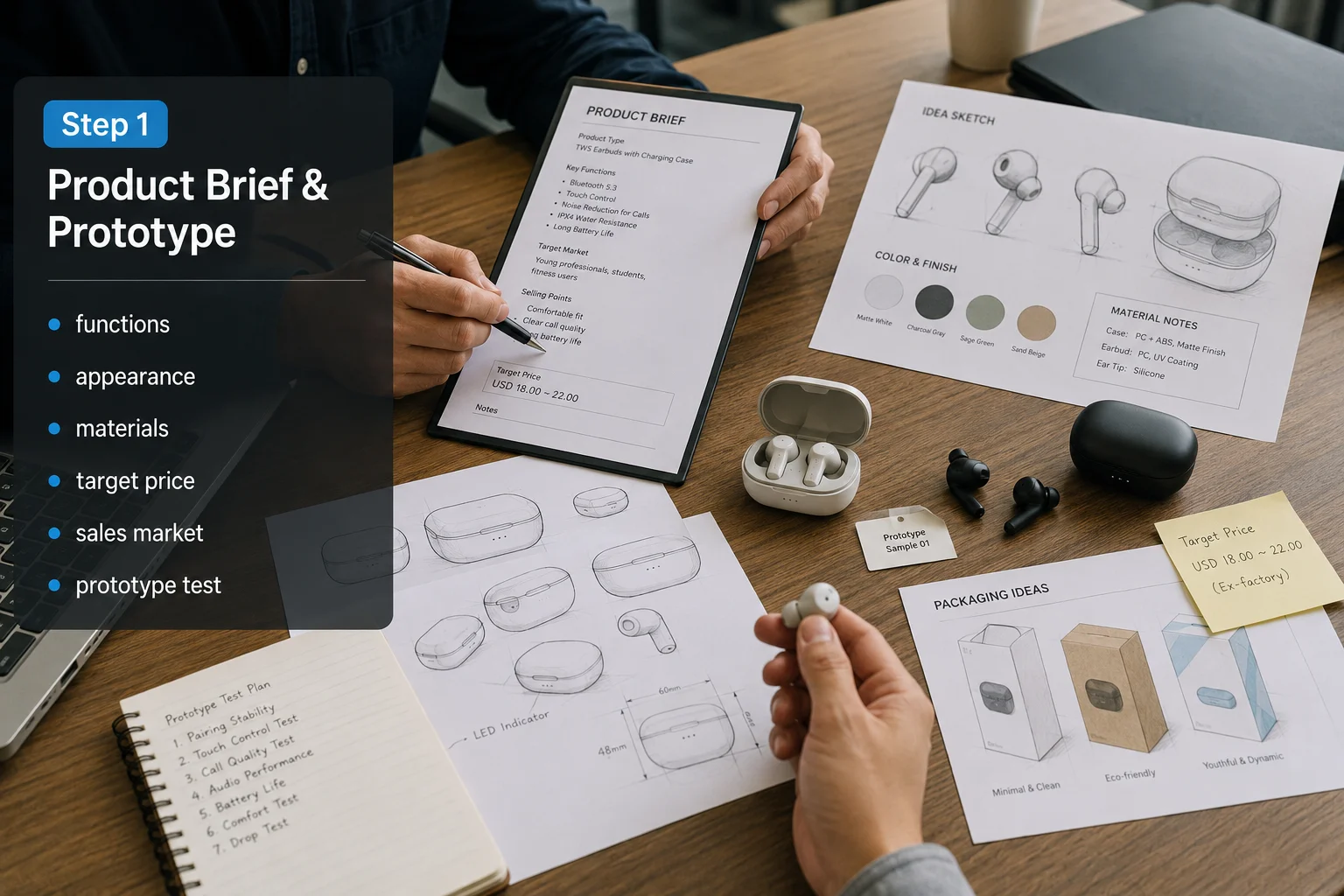
Step 1 of the electronics OEM process converts a concept into a workable product brief. The buyer and manufacturer clarify functions, appearance, materials, target price, sales market, packaging, quantity, and technical requirements. The team then develops ID design, structural concepts, and prototype samples to test whether the idea is feasible.
Build a Brief That Can Be Quoted
A useful product brief does not need to be complicated. It needs to be specific enough for a manufacturer to identify the unknowns.
For a custom charger, the brief could include:
| Item | Example Requirement |
|---|---|
| Product type | 65W GaN wall charger |
| Output ports | 2 × USB-C, 1 × USB-A |
| Target market | Germany, France, United States |
| Plug type | EU and US versions |
| Housing | Fire-resistant PC, matte black |
| Branding | Logo on housing and gift box |
| Quantity | Initial order and estimated annual volume |
| Target | Target ex-factory or landed cost range |
Prototype Samples Are Learning Tools
Prototype samples are useful because they expose assumptions.4 A first sample may show that a desired shell shape creates assembly difficulty. It may reveal that a cable feels too stiff, a charging case lid needs adjustment, or a packaging insert does not protect the product during transport.
I have seen buyers treat a prototype as a final promise. I would not recommend that approach. A prototype is a decision point. It helps the team decide what needs to change before tooling, sourcing, and production commitments begin.
Step 2: When Does the Electronics OEM Process Need Tooling and Custom Mold Development?
Custom molds can give a product a distinct shape and stronger brand identity. Yet tooling is also one of the first major investments in a custom project. If the product structure has not been validated, changing direction after molds are built can be costly.5
Step 2 of the electronics OEM process is tooling development for products with custom plastic, silicone, metal, or structural parts. The manufacturer reviews the design for manufacturability, creates the mold plan, produces trial parts, and checks fit, surface quality, assembly, and durability before using the tooling for volume production.
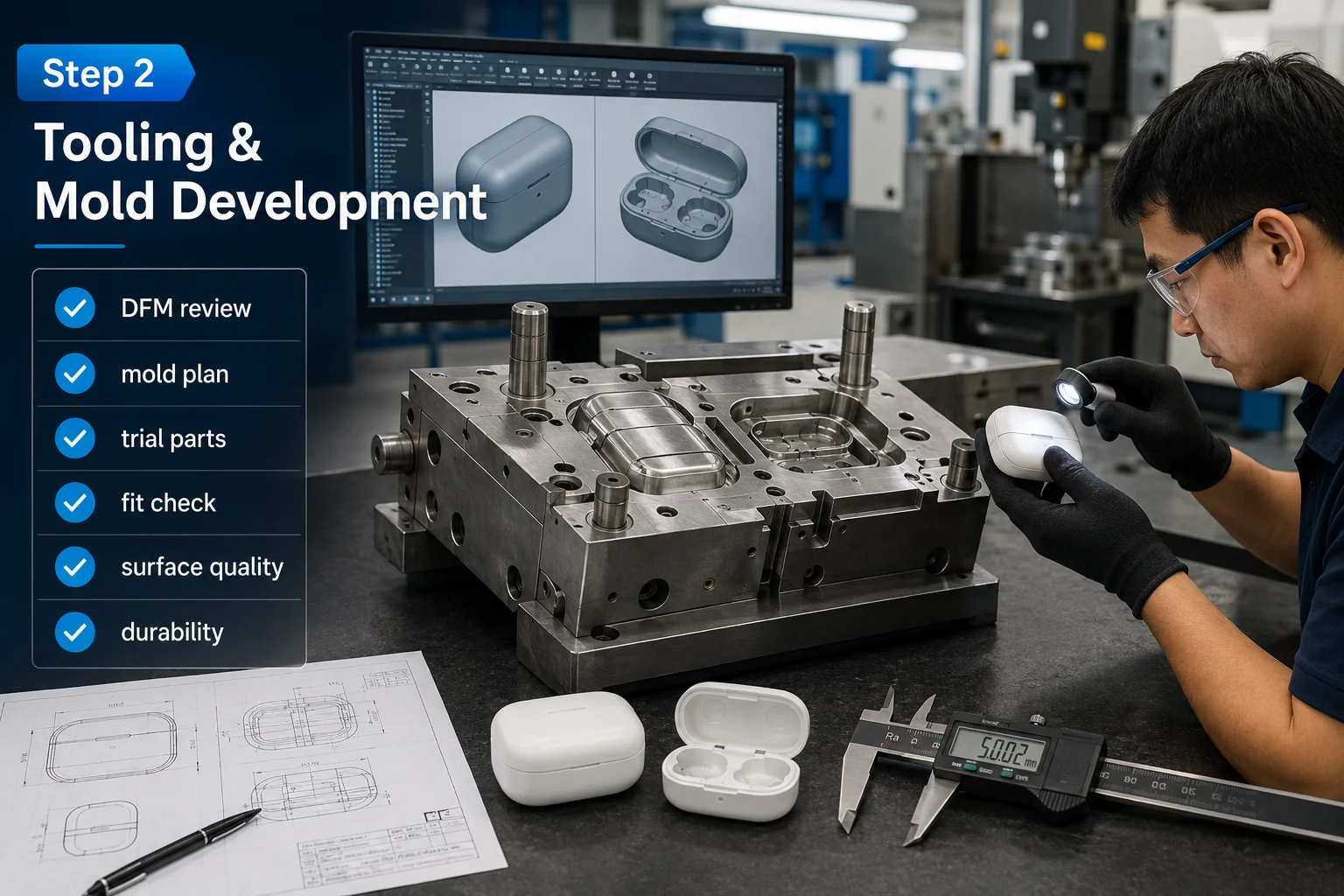
What Affects Tooling Decisions?
Not every project needs a new mold. Existing housings may be suitable for private-label chargers, cables, earbuds, or smart accessories. New tooling becomes more likely when you need:
- A unique outer housing or industrial design
- New connector shapes or port positions
- A custom charging case
- Special button, lens, strap, or bracket structures
- Different product dimensions
- A unique internal assembly layout
Tooling cost and timing depend on the number of parts, materials, surface treatment, structural complexity, and expected mold life. A simple housing and a multi-part wearable enclosure are very different projects.
Design for Manufacturing Matters
A good-looking 3D rendering may still be difficult to manufacture. During mold review, our engineering team looks for practical issues such as wall thickness, draft angles, snap-fit strength, parting lines, tolerances, and assembly sequence.6
The electronics OEM process should allow room for structural changes after trial mold samples. This is not necessarily a failure. It is how a product moves from design intent to a repeatable production process.
Step 3: How Do PCB Design and Electronics Engineering Affect the Final Product?
A sleek shell cannot compensate for poor electronics engineering. Buyers sometimes focus on outer appearance first, then discover that desired features do not fit the available space, budget, heat limits, or battery capacity. This is especially important for chargers, earbuds, wearables, and power-related accessories.
Step 3 of the electronics OEM process covers PCB design, component selection, firmware, electrical interfaces, and safety-oriented engineering. These choices determine what the product can do, how stable it performs, what it costs, and whether it can be evaluated against the requirements of its intended market.
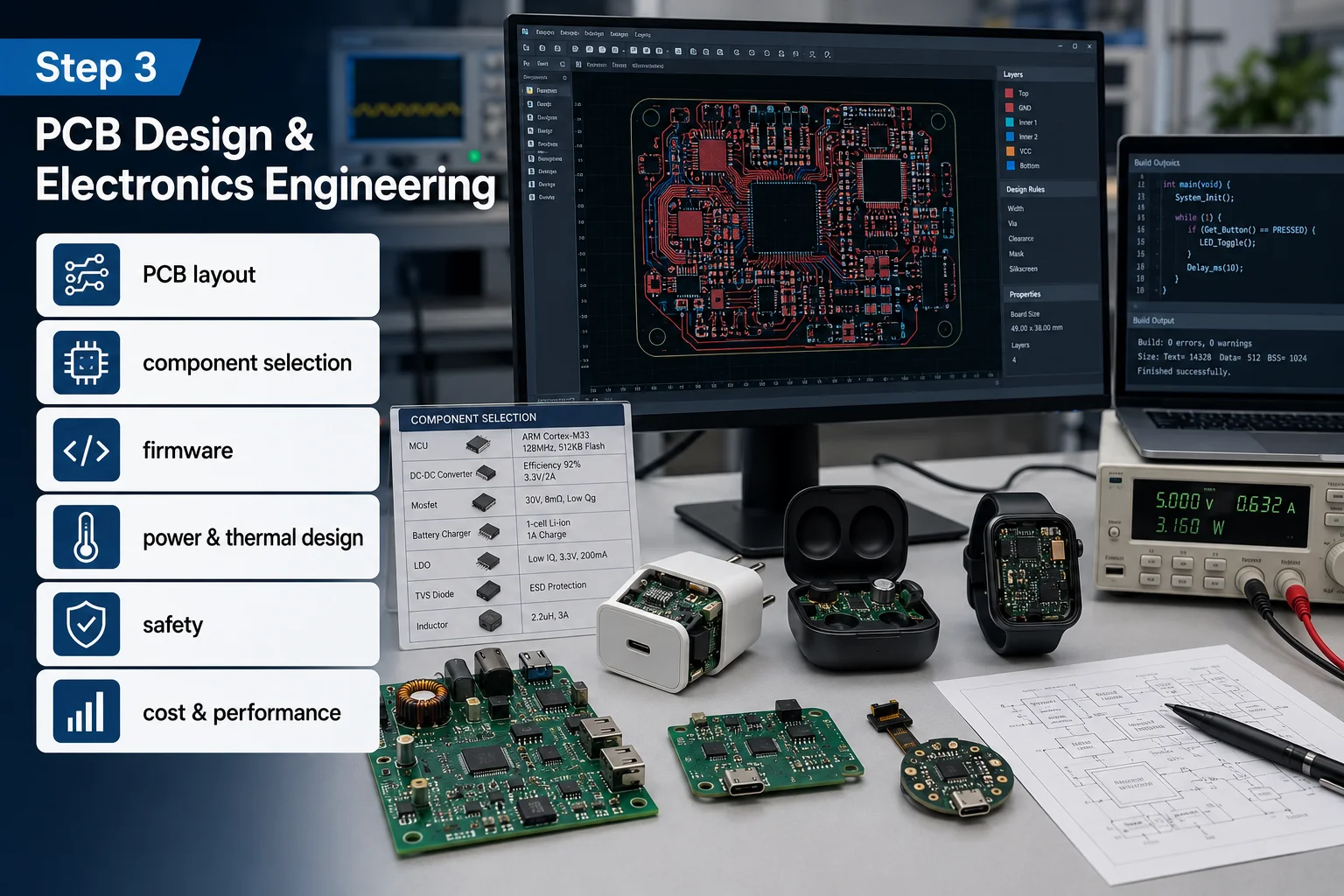
Key Engineering Questions
For electronic products, the team needs to confirm more than basic functions. We typically discuss:
- Power requirements: Input, output, charging protocols, battery capacity, and thermal limits.
- Compatibility: USB-C behavior, device compatibility, Bluetooth connectivity, operating systems, or charging standards.
- Component availability: Approved alternatives may be needed if certain ICs or components have long lead times.
- Firmware: Product behavior, user interface, upgrade method, and bug-fix responsibilities.
- Mechanical limits: PCB size, antenna location, button placement, speaker space, and heat dissipation.
Engineering Choices Change the Quote
The same product category can have very different cost structures. A low-cost charger may not support the same power profile, components, heat management, or accessories as a higher-end model. Likewise, a TWS earbud with better microphones, battery cells, and chipset options will not have the same cost or user experience as an entry-level version.
This is why we prefer to discuss the target price alongside the full product requirement. The goal is not to force a product into an unrealistic price. The goal is to identify the best workable specification for the intended sales channel.
Step 4: Why Are Trial Production and Sample Approval Necessary?
An approved engineering sample is a major milestone, but it is not proof that every future unit will be identical.7 Production introduces material batches, operator variation, assembly speed, packaging handling, and supply-chain variables.8 Trial production helps reveal these real-world risks before a full order is released.
Step 4 of the electronics OEM process uses engineering samples, pilot runs, reliability checks, and buyer approval to verify the product before mass production. The buyer should approve not only appearance and functions, but also packaging, labeling, accessories, quality standards, and any agreed product requirements.
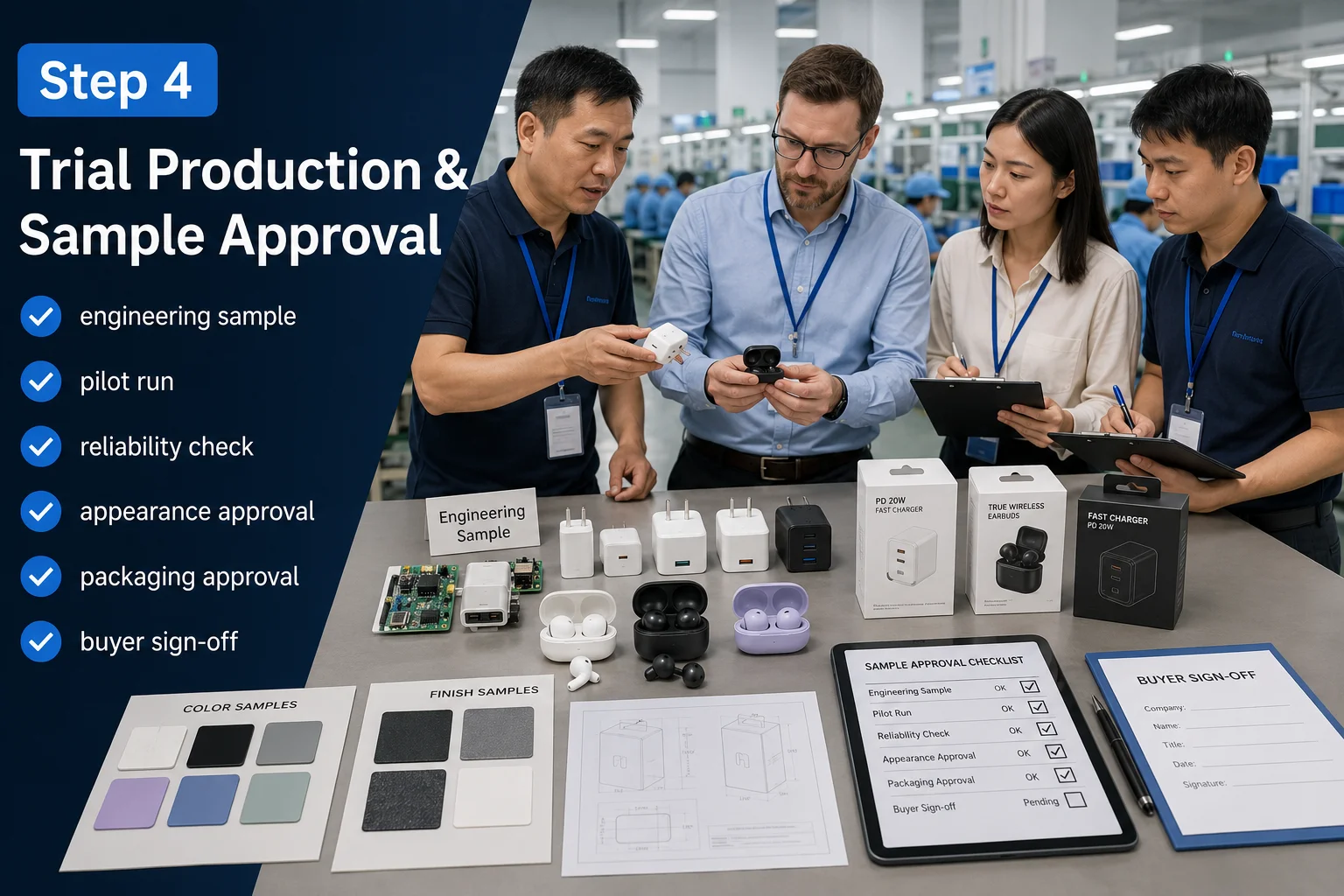
What Should Be Checked During a Pilot Run?
A small trial run gives the factory and buyer a better picture of repeatability. Depending on the product, checks may include:
- Product dimensions and appearance
- Charging and data-transfer functions
- Button, port, hinge, and connector operation
- Assembly fit and cosmetic consistency
- Battery charging and discharge behavior
- Audio, Bluetooth, or app connection performance
- Packaging drop protection
- Label and barcode accuracy
Create a Clear Approval Standard
We recommend that buyers document approval points rather than approving a sample only through informal messages. A basic approval file can include reference photos, product color, logo position, packaging artwork, inspection points, and acceptable cosmetic limits.
The electronics OEM process becomes more reliable when both sides use the same standard. If the buyer expects “premium finish,” that phrase needs to become measurable details: surface texture, color tolerance, scratch limits, printing quality, and packaging condition.
Step 5: How Does Mass Production Quality Control Work in the Electronics OEM Process?
Mass production is where a good concept faces its real test. Without defined control points, a factory may discover problems only after thousands of units have moved through the line. Quality control needs to be built into the process, not added only at final inspection.9
Step 5 of the electronics OEM process combines incoming material inspection, in-process checks, functional testing, aging tests where applicable, finished-product inspection, and packaging verification. The exact control plan should match the product category, risk level, customer standard, and agreed inspection method.
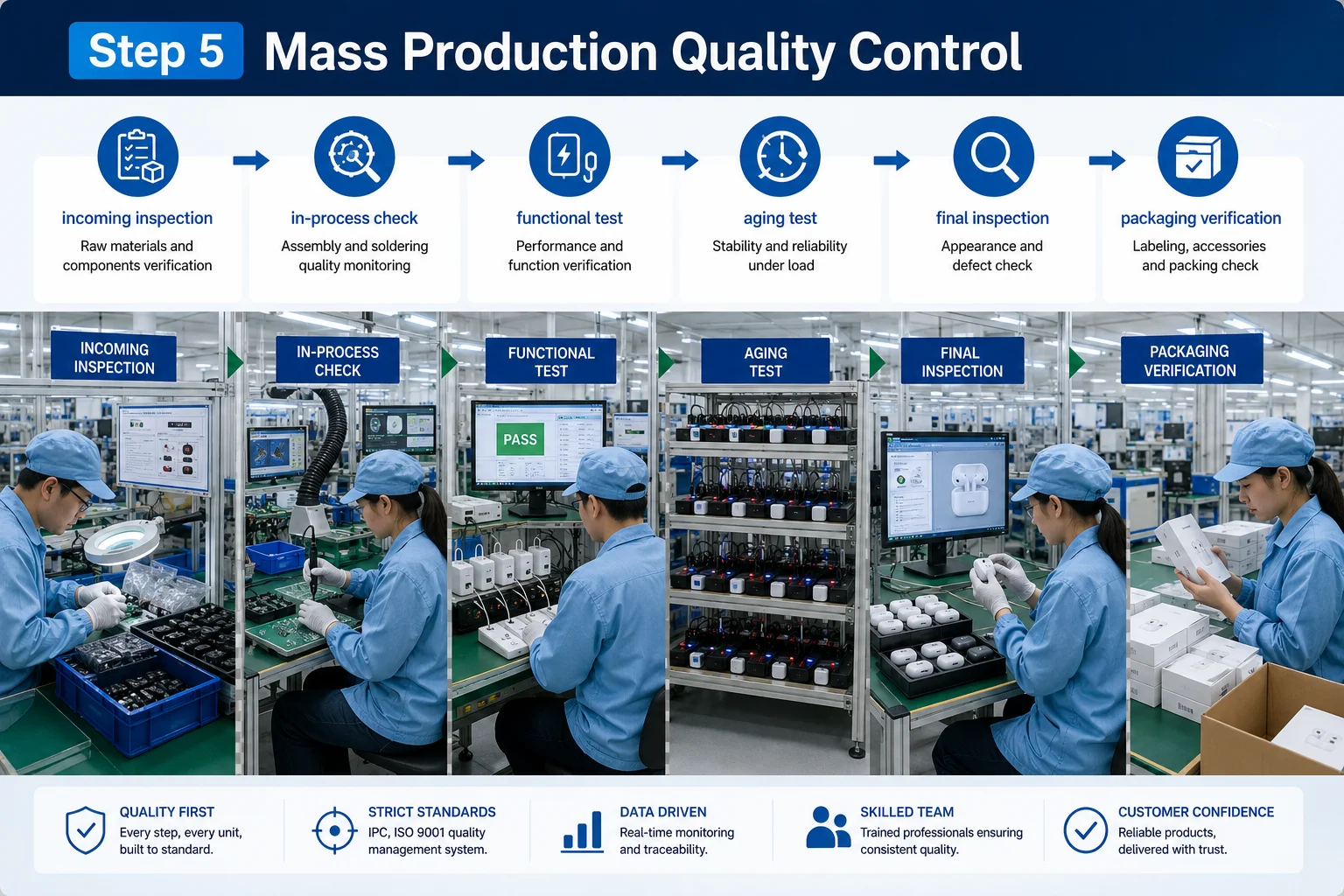
Common Quality-Control Stages
| Stage | Main Purpose |
|---|---|
| IQC10 | Check incoming components and materials |
| IPQC | Monitor key production steps and assembly quality |
| Functional testing | Confirm agreed product functions |
| Aging or burn-in11 | Identify early failures where the product process requires it |
| FQC | Inspect finished products before packing |
| OQC | Check packed goods before shipment |
For example, cable production may involve conductor, connector, soldering, continuity, charging, and cosmetic checks. Charger production may require more detailed power and functional checks. TWS earbud production can include pairing, audio, microphone, charging, battery, and appearance inspection.
Quality Records Support Better Decisions
No factory process removes all risk. Still, clear records help identify trends and corrective actions. We believe buyers should ask how quality standards are defined, what tests are performed, what sampling approach is used, and how issues are communicated.
A pre-shipment inspection by the buyer, a third-party agency, or an agreed internal inspection standard can add another layer of confidence. The important point is that the inspection scope should be agreed before production, not after goods are packed.
Step 6: How Does the Electronics OEM Process End with Packaging, Logistics, and Delivery?
A finished product is not ready for sale until it reaches the buyer’s warehouse in acceptable condition. Packaging errors, missing labels, incomplete documents, or poor carton protection can create expensive problems after production is complete.
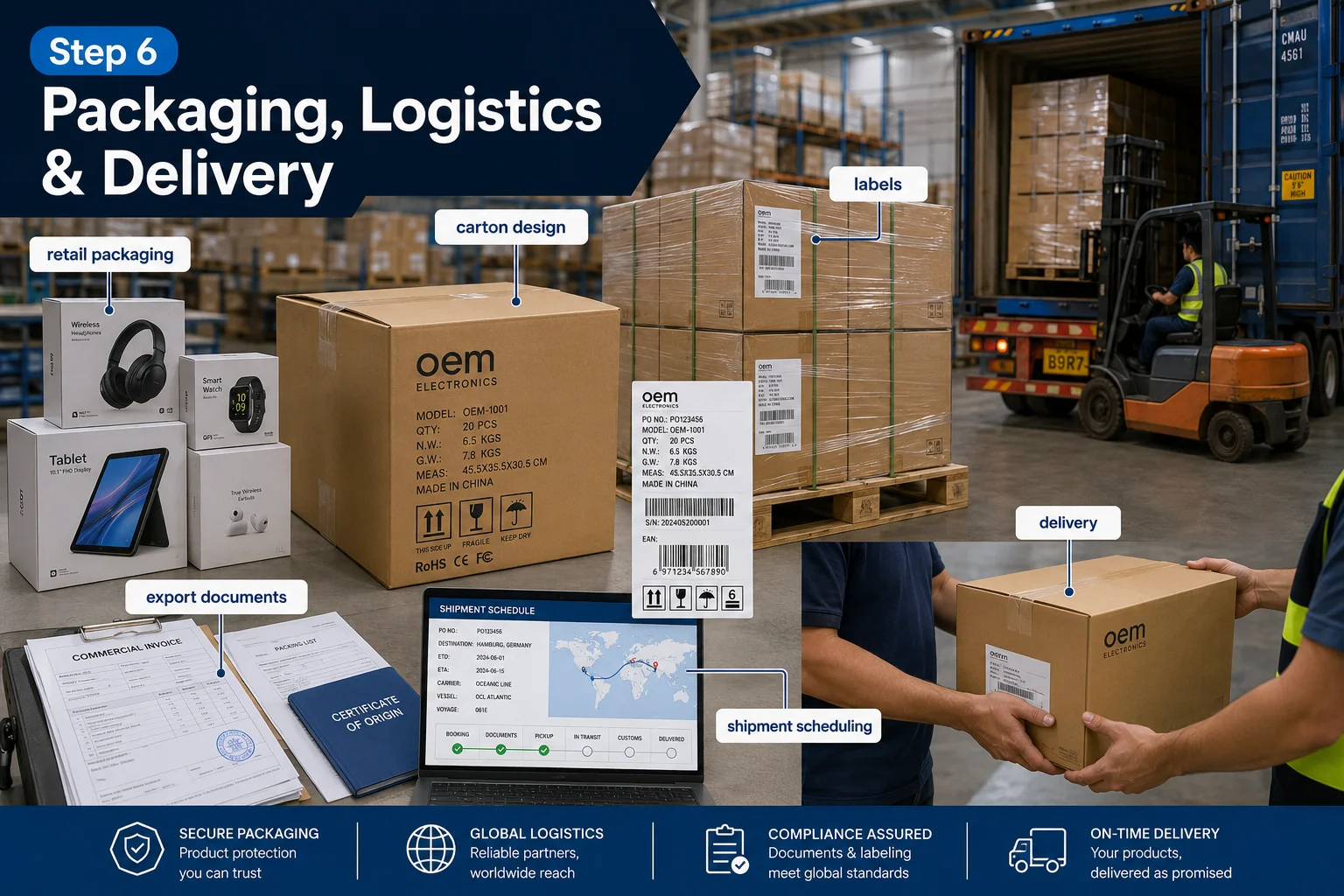
Step 6 of the electronics OEM process covers retail packaging, carton design, labeling, export documents, shipment scheduling, and cargo delivery. Buyers should confirm shipping terms, destination requirements, packaging details, and document needs early because these details can affect production planning and final delivery timing.
Packaging Is Part of the Product
For e-commerce sellers and retailers, packaging affects customer experience and return rates. Common packaging decisions include:
- Retail box size and material
- Logo, barcode, warning labels, and instructions
- Inner trays, inserts, and accessory placement
- Master carton quantity and carton markings
- Drop protection for fragile products
- Pallet requirements for warehouse delivery
Plan the Shipment Before Production Finishes
Buyers may choose sea freight, air freight, rail freight where available, courier services, or a combined logistics plan. The best option depends on cargo volume, product value, delivery urgency, battery-related transport requirements12, destination, and commercial terms.
We advise buyers to confirm the required export and import documents with their freight forwarder or compliance partner. Requirements can differ by product type and market. A factory can support production documentation, but the importer should also understand the destination market’s obligations.
OEM vs ODM vs Private Label Electronics Manufacturing?
Choosing the wrong model can waste time and development budget. Some buyers need a fully differentiated product. Others need a proven model with a fresh brand identity and fast market entry. Neither choice is automatically better.
OEM gives buyers the deepest control over product specifications but usually requires more development work, validation, and investment. ODM uses an existing factory platform with selected customization, while private label usually focuses on branding and packaging for a standard product. The right option depends on your budget, quantity, timing, and differentiation goals.
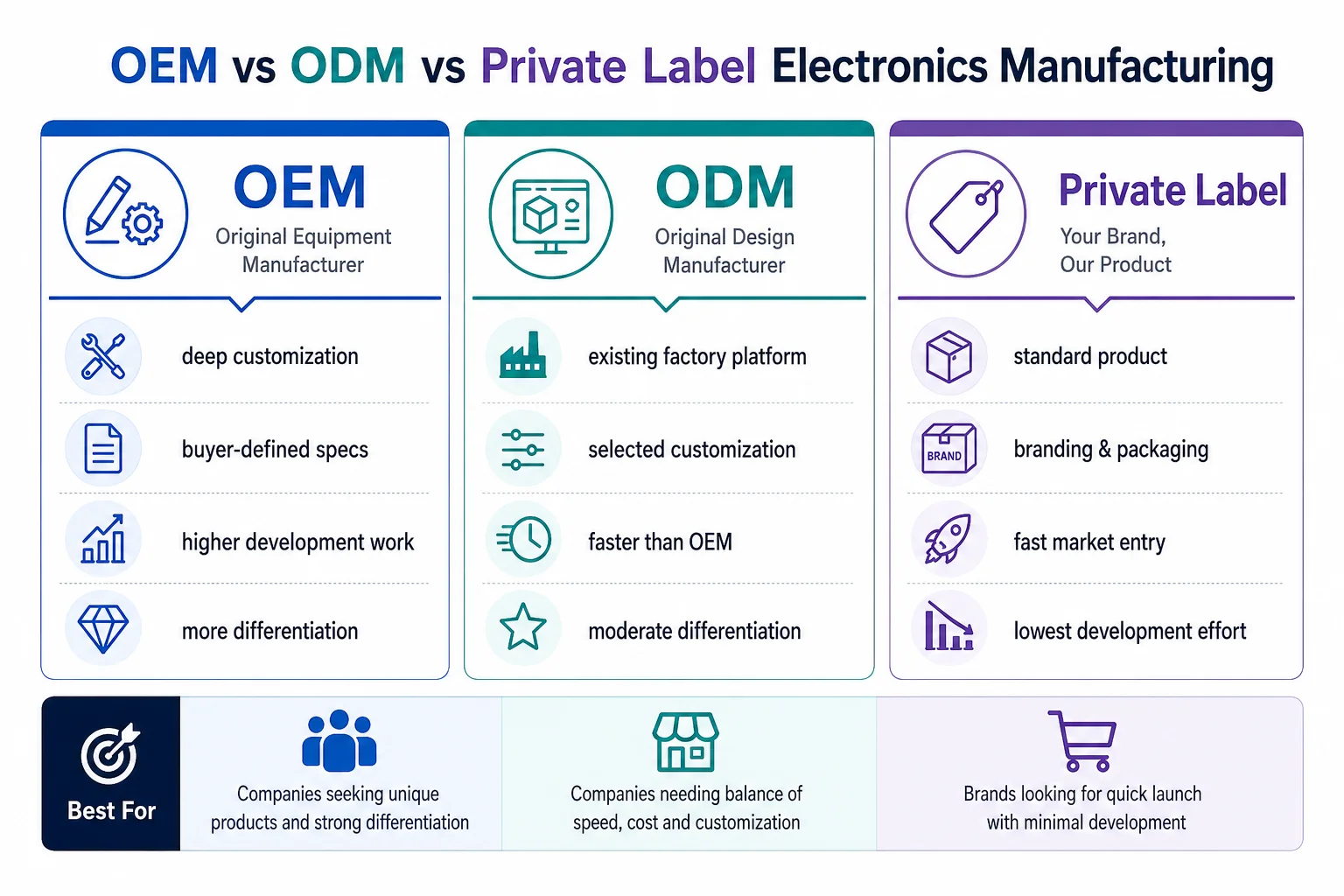
| Factor | OEM | ODM | Private Label |
|---|---|---|---|
| Product design control | High | Medium | Low |
| New tooling | Often required | Sometimes required | Usually not required |
| Development cycle | Longer | Medium | Shorter |
| MOQ | Often higher | Moderate | Often lower |
| Upfront cost | Higher | Medium | Lower |
| Customization depth | Function, structure, appearance | Appearance, features, packaging | Logo, color, packaging |
| Best for | Brands with a clear product strategy | Buyers needing speed and differentiation | Fast market testing |
How to Make the Choice
Choose OEM when your product advantage depends on unique function, form factor, or user experience. Choose ODM when you want a proven foundation but still need visible differentiation. Choose private label when you want to test demand without committing to major tooling or engineering expenses.
In many cases, buyers can begin with an ODM product and move into a deeper custom electronics OEM project after they validate market demand.
How Can You Start a Custom Electronics OEM Project with Kingfuji?
A supplier cannot responsibly evaluate a project from a single picture and a request for “best price.” Incomplete information leads to assumptions, and assumptions often create revisions later. A stronger first inquiry helps both sides move faster.
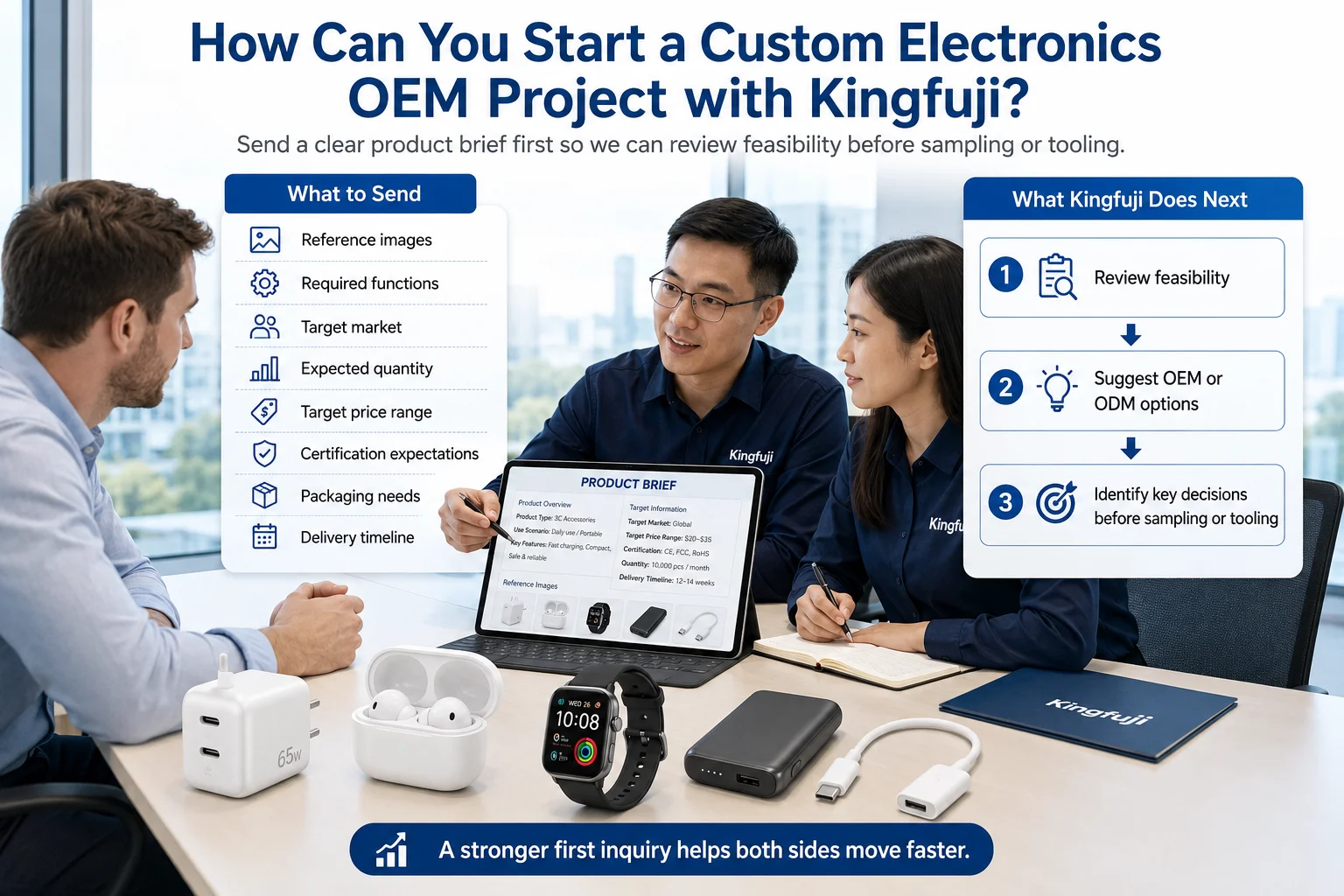
To start a custom electronics OEM project with Kingfuji, send a product brief with your reference images, required functions, target market, expected quantity, target price range, certification expectations, packaging needs, and delivery timeline. We can then review feasibility, suggest suitable OEM or ODM options, and identify the main decisions before sampling or tooling begins.
Our Recommended Inquiry Checklist
When you contact us about cables, chargers, GaN chargers, TWS earbuds, smart watches, or other 3C accessories, include:
- Product name and intended use
- Reference product links or photos
- Required features and non-negotiable specifications
- Target customer and destination market
- Estimated first order quantity
- Expected repeat quantity, if known
- Target price range
- Brand, logo, and packaging requirements
- Certification or platform requirements
- Desired sample and delivery timing
We are based in Shenzhen and have worked with export customers for more than 15 years. Our role is not to promise that every concept can meet every price and deadline. Our role is to help buyers identify a realistic manufacturing path before they commit resources.
Frequently Asked Questions
How long does the electronics OEM process take?
The timeline depends on product complexity, customization depth, tooling needs, component availability, testing, approvals, and order quantity. A private-label project can move faster than a fully custom OEM product. We recommend confirming a project-specific timeline only after reviewing the complete brief.
What is the MOQ for custom electronics OEM products?
MOQ varies by product category, customization level, components, packaging, and whether new molds are required. Standard ODM or private-label products may have lower MOQ requirements than fully custom electronics. Buyers should share their expected quantity early so the factory can recommend a suitable approach.
Do I need a new mold for a custom charger or TWS earbud?
You may need new tooling if you want a unique housing, charging case, dimensions, or structural design. You may not need a new mold if an existing platform can meet your functional and branding requirements. A design-for-manufacturing review helps determine this.
Does sample approval guarantee mass-production quality?
No. Sample approval confirms an important stage, but mass production still requires material control, process validation, inspection standards, and final quality checks. Buyers should approve documented specifications and agree on the inspection approach before full production starts.
What information should I send to an electronics OEM manufacturer?
Send product references, functions, target market, estimated quantity, target price, packaging requirements, certification expectations, and delivery timing. The more complete your brief is, the more accurately a manufacturer can assess feasibility, quote the project, and plan sampling.
Conclusion
The electronics OEM process is best understood as a series of feasibility decisions, not a frictionless path from idea to shipment. A strong brief, realistic target price, correct manufacturing model, careful sample approval, and defined quality standards all reduce avoidable risk. Whether you need custom cables, chargers, GaN chargers, TWS earbuds, smart watches, or other 3C accessories, start with the facts that shape production. Send us your product brief, and we will help you assess the most practical OEM or ODM route for your market.
SIO Tags: electronics OEM process, custom electronics OEM, electronics ODM manufacturer, 3C accessories manufacturing, custom electronics manufacturer, OEM product development, China electronics factory, Kingfuji Tech
"(PDF) GaN Fast Chargers", https://www.researchgate.net/publication/372250782_GaN_Fast_Chargers. Studies of high-density gallium-nitride power adapters show that semiconductor selection, thermal paths, circuit design, and package construction are interdependent factors in achievable power density, efficiency, and operating temperature. Evidence role: mechanism; source type: paper. Supports: Power-adapter engineering literature describing how semiconductor choice, circuit topology, thermal design, insulation, and enclosure construction affect compact charger performance and safety margins.. Scope note: Such evidence establishes the engineering relationship generally; it does not compare any two specific commercial 65 W chargers. ↩
"Original equipment manufacturer", https://en.wikipedia.org/wiki/Original_equipment_manufacturer. Original equipment manufacturing generally refers to production of goods or components for another company’s product or brand, with the precise allocation of design responsibility varying by contractual arrangement. Evidence role: definition; source type: encyclopedia. Supports: Definitions of original equipment manufacturing and the relationship between an OEM customer’s specifications and a manufacturer’s production role.. Scope note: OEM terminology is used inconsistently across industries, so the source provides a general definition rather than proof of the parties’ responsibilities in a particular project. ↩
"Original design manufacturer", https://en.wikipedia.org/wiki/Original_design_manufacturer. Original design manufacturing commonly involves a supplier-developed product that a purchasing company markets under its own brand, whereas private-label arrangements generally emphasize branding of a supplier’s established offering. Evidence role: definition; source type: research. Supports: Definitions distinguishing original design manufacturing from private-label arrangements and describing their usual reliance on supplier-developed or standard products.. Scope note: Actual customization rights, tooling ownership, and design control depend on the specific supplier agreement. ↩
"Prototype Models | www.waru.edu", https://www.waru.edu/acquipedia-article/prototype-models. Design research characterizes prototypes as artifacts used to explore and test assumptions, allowing teams to identify functional, usability, and production constraints before later development commitments. Evidence role: general_support; source type: research. Supports: Design-methods research showing that prototypes are used to test assumptions, discover constraints, and inform iterative development decisions.. Scope note: The value and type of prototype depend on the question being tested and do not guarantee that all production issues will be identified. ↩
"A Comparative analysis of rapid manufacturing versus ...", https://etd.ohiolink.edu/acprod/odb_etd/ws/send_file/send?accession=toledo1430478391&disposition=inline. Design-for-manufacturing guidance notes that changes made after production tooling is committed may require mold rework or new tooling, increasing both cost and development time. Evidence role: general_support; source type: education. Supports: Design-for-manufacturing guidance explaining that late-stage changes can require tooling modification or replacement and therefore increase development cost and schedule risk.. Scope note: The magnitude of added cost depends on mold design, materials, the extent of the change, and contractual terms. ↩
"designing snap fit joints for plastics", https://fab.cba.mit.edu/classes/S62.12/people/vernelle.noel/Plastic_Snap_fit_design.pdf. Injection-molding design guidance identifies uniform wall thickness, adequate draft, appropriate parting-line placement, tolerancing, and properly designed fastening features as key influences on manufacturability and part quality. Evidence role: mechanism; source type: education. Supports: Engineering guidance identifying draft, wall thickness, parting-line placement, tolerances, and joining features as factors affecting moldability, part quality, and assembly.. Scope note: Recommended dimensions and tolerances vary by resin, mold process, part geometry, and production equipment. ↩
"Process Validation: General Principles and Practices", https://www.fda.gov/files/drugs/published/Process-Validation--General-Principles-and-Practices.pdf. Manufacturing validation principles distinguish evaluation of individual development samples from evidence that a controlled process can repeatedly produce products meeting predetermined specifications. Evidence role: expert_consensus; source type: government. Supports: Process-validation principles requiring evidence that a controlled manufacturing process can repeatedly produce output meeting predetermined requirements.. Scope note: These principles are often articulated in regulated sectors, but they provide a general quality-management framework rather than a product-specific consumer-electronics requirement. ↩
"Manufacturing | NIST", https://www.nist.gov/manufacturing. Process-validation and quality-system guidance recognizes that variation in materials, personnel, equipment, methods, and handling conditions can affect the consistency of manufactured output. Evidence role: mechanism; source type: government. Supports: Quality-system and process-validation guidance recognizing materials, personnel, equipment, methods, and environmental or handling conditions as sources of process variation.. Scope note: The relative importance of each source of variation depends on the product and the controls implemented by the manufacturer. ↩
"NIST Quality Manual for Measurement Services, NIST-QM-I", https://www.nist.gov/document/nistqm-i-v11controlledandsigned. Quality-management frameworks emphasize controlling and monitoring production processes to prevent nonconformities, rather than relying exclusively on final inspection to detect them. Evidence role: expert_consensus; source type: institution. Supports: Quality-management principles favoring process control, monitoring, and prevention of nonconformity over dependence on end-of-line inspection alone.. Scope note: The appropriate control plan, testing frequency, and acceptance criteria must be tailored to product risk and contractual requirements. ↩
"What Does a Quality Control Inspector Do?", https://www.goodwin.edu/enews/what-does-a-quality-control-inspector-do/. Incoming quality control, also called incoming inspection, is the verification of received materials or components against specified requirements before their use in manufacturing. Evidence role: definition; source type: institution. Supports: The use of incoming quality control or incoming inspection to verify purchased materials and components against requirements before production use.. Scope note: Organizations may use different acronyms and may vary incoming-inspection intensity according to supplier qualification and product risk. ↩
"Reliability technology for cardiac pacemakers III", https://nvlpubs.nist.gov/nistpubs/Legacy/SP/nbsspecialpublication400-50.pdf. Reliability engineering literature describes burn-in and related screening as controlled stress procedures intended to expose certain early-life failures before products are released for use. Evidence role: mechanism; source type: research. Supports: Reliability literature describing burn-in or screening as a method intended to detect some early-life failures under defined stress conditions.. Scope note: Burn-in does not detect every defect, may not be appropriate for all products, and requires conditions chosen to avoid unnecessary product damage or cost. ↩
"Transporting Lithium Batteries - PHMSA", https://www.phmsa.dot.gov/lithiumbatteries. International air-transport and dangerous-goods frameworks impose conditions on the testing, packaging, marking, documentation, and carriage of lithium batteries and battery-powered products. Evidence role: general_support; source type: institution. Supports: International transport rules and guidance governing the classification, testing, packaging, marking, documentation, and carriage of lithium batteries.. Scope note: Applicable obligations vary by battery type, watt-hour rating, transport mode, packing configuration, carrier policy, and destination jurisdiction. ↩