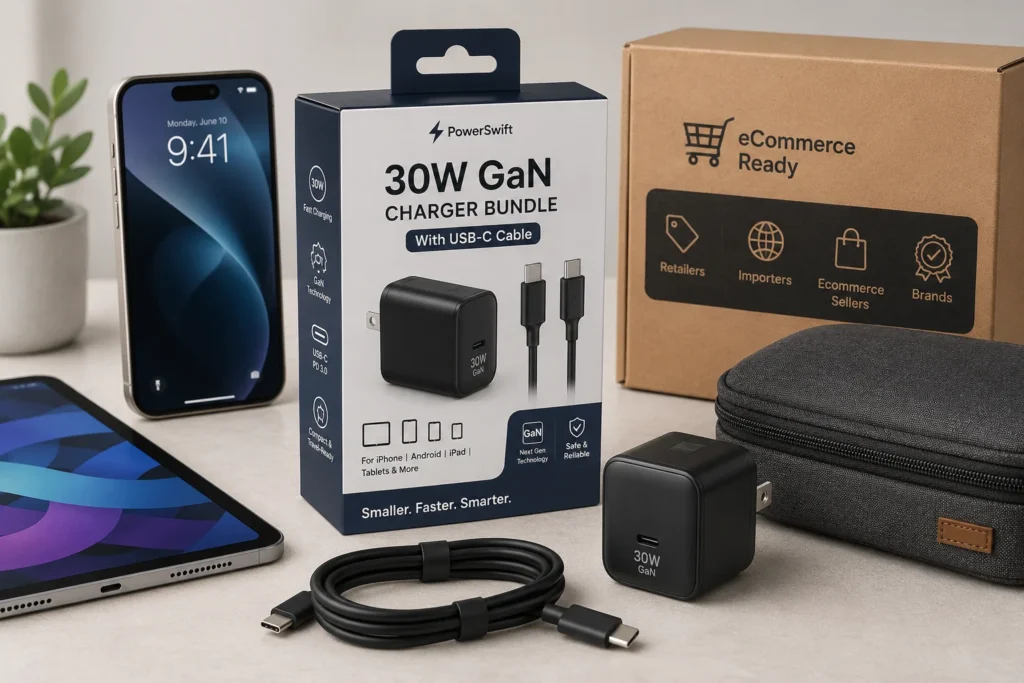
A charger looks simple. A wrong SKU creates returns, slow charging complaints, and channel trouble. I avoid that by checking the full set.
A 30W GaN PD charger with a USB-C cable is a compact fast-charging set for phones, tablets, and small USB-C devices. I only treat it as a strong SKU when the charger protocol, cable rating, safety files, plug type, and packaging match the target market.
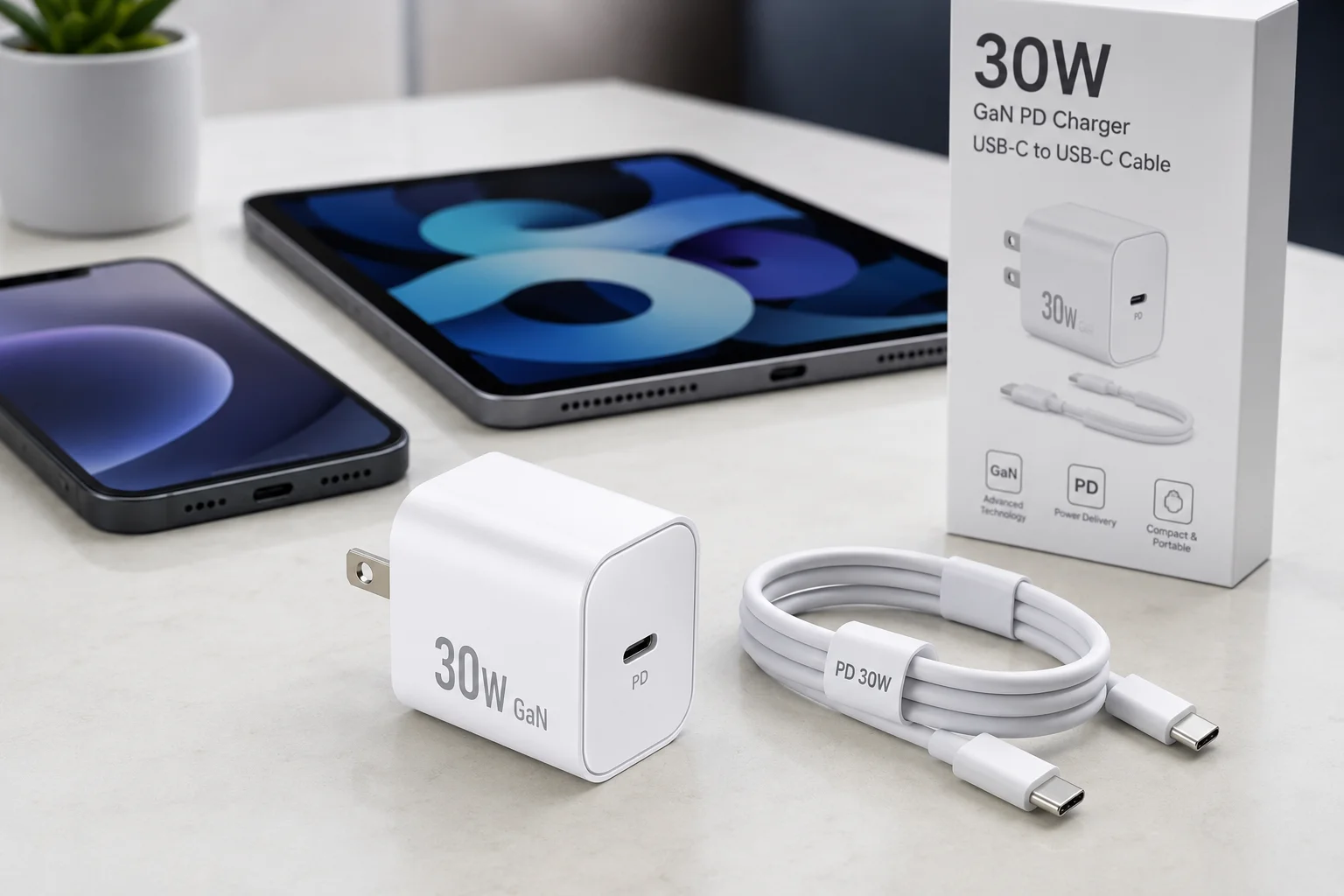
I have handled charger inquiries from Europe and North America for many years. Buyers often ask me, “Is this 30W GaN charger compatible with iPhone and Android?” I understand the question. Yet I usually ask one more question back. Which phone models, which tablet models, which plug, which package, and which sales channel do you need to cover? A 30W logo can help sales, but it does not solve all buying risks. The real value comes from the full product match.
What Is a 30W GaN PD Charger?
A buyer may see “30W” and “GaN” and feel safe. That can be risky. I always separate power, protocol, and cable first.
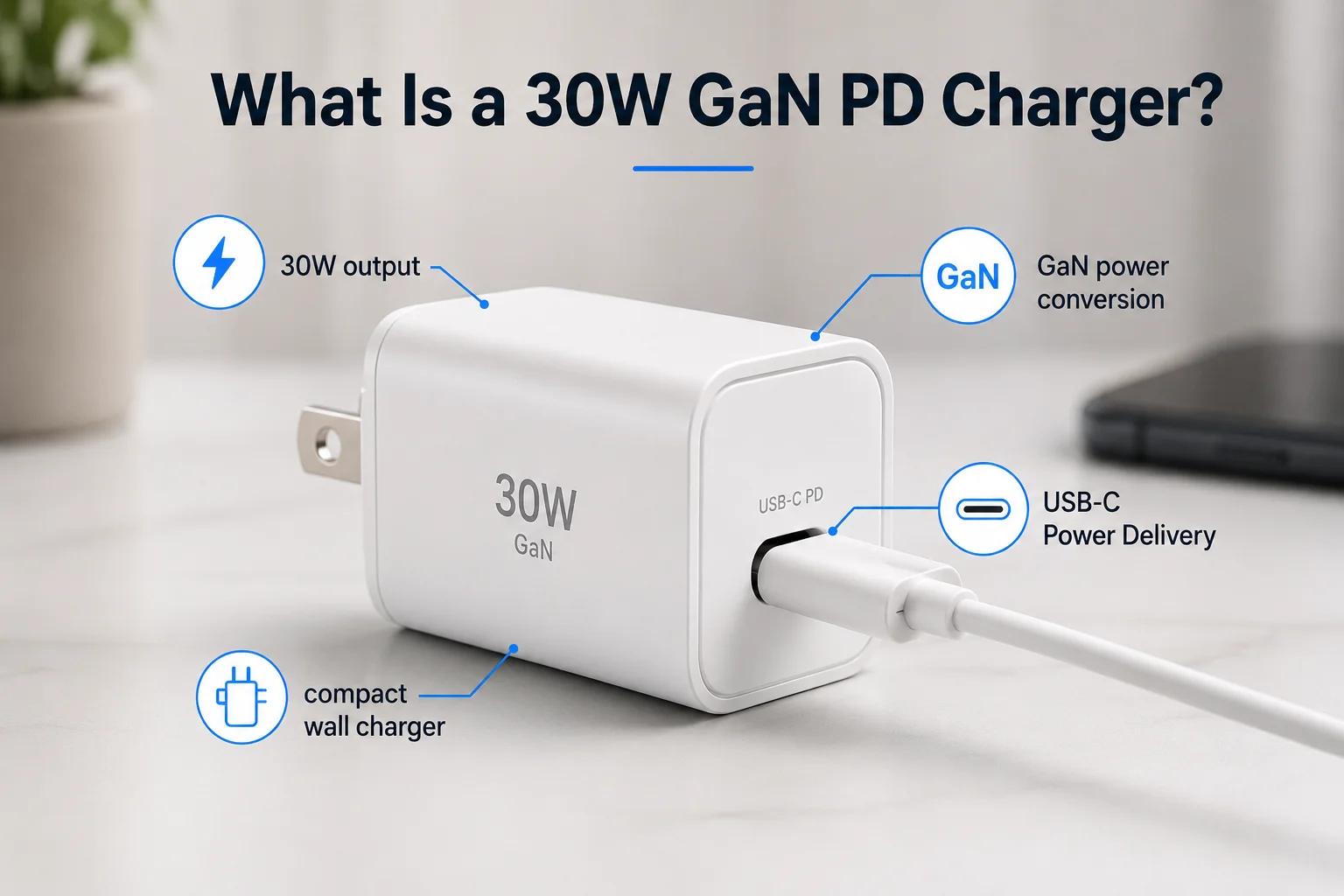
A 30W GaN PD charger is a compact wall charger with up to 30W output, GaN power conversion1, and USB-C Power Delivery support2. I see GaN as the power design, while USB-C PD decides whether many devices can use protocol fast charging.
How I explain the core parts
When I introduce a 30W GaN PD charger to a retailer or importer, I do not start with one word only. I break it into parts. The charger body provides the output. The GaN design helps the body stay small for its power level.3 The USB-C PD protocol allows many modern phones and tablets to negotiate faster charging. The USB-C cable completes the set, so the user can use it right away.
| Part I check | What it means for the buyer | Why it matters |
|---|---|---|
| 30W maximum output | The charger can deliver up to 30W under supported conditions | It gives room for phones and some tablets |
| GaN power technology | The charger uses gallium nitride power design | It can support smaller size and higher power density |
| USB-C PD | The charger supports Power Delivery | It affects fast charging for iPhone, iPad, and many USB-C products |
| Compact design | The body is smaller than many old chargers | It helps retail display and travel use |
| USB-C cable included | The buyer sells a full charging kit | It reduces end-user confusion |
| Device compatibility | Phones, tablets, earbuds, power banks, handheld devices | It affects return rate and sales claims |
I always remind buyers that GaN is not the same as PD. GaN is about power conversion inside the charger. USB-C PD is the protocol that talks to the device. If the charger has GaN but weak protocol support, the end user may not get the expected fast charge. If the cable is poor, the set may also feel cheap. So I treat the charger, protocol, and cable as one product.
Which Devices Can a 30W GaN Charger Fast-Charge?
Many buyers want one charger for many devices. That sounds simple. The problem starts when the device input limit is ignored.
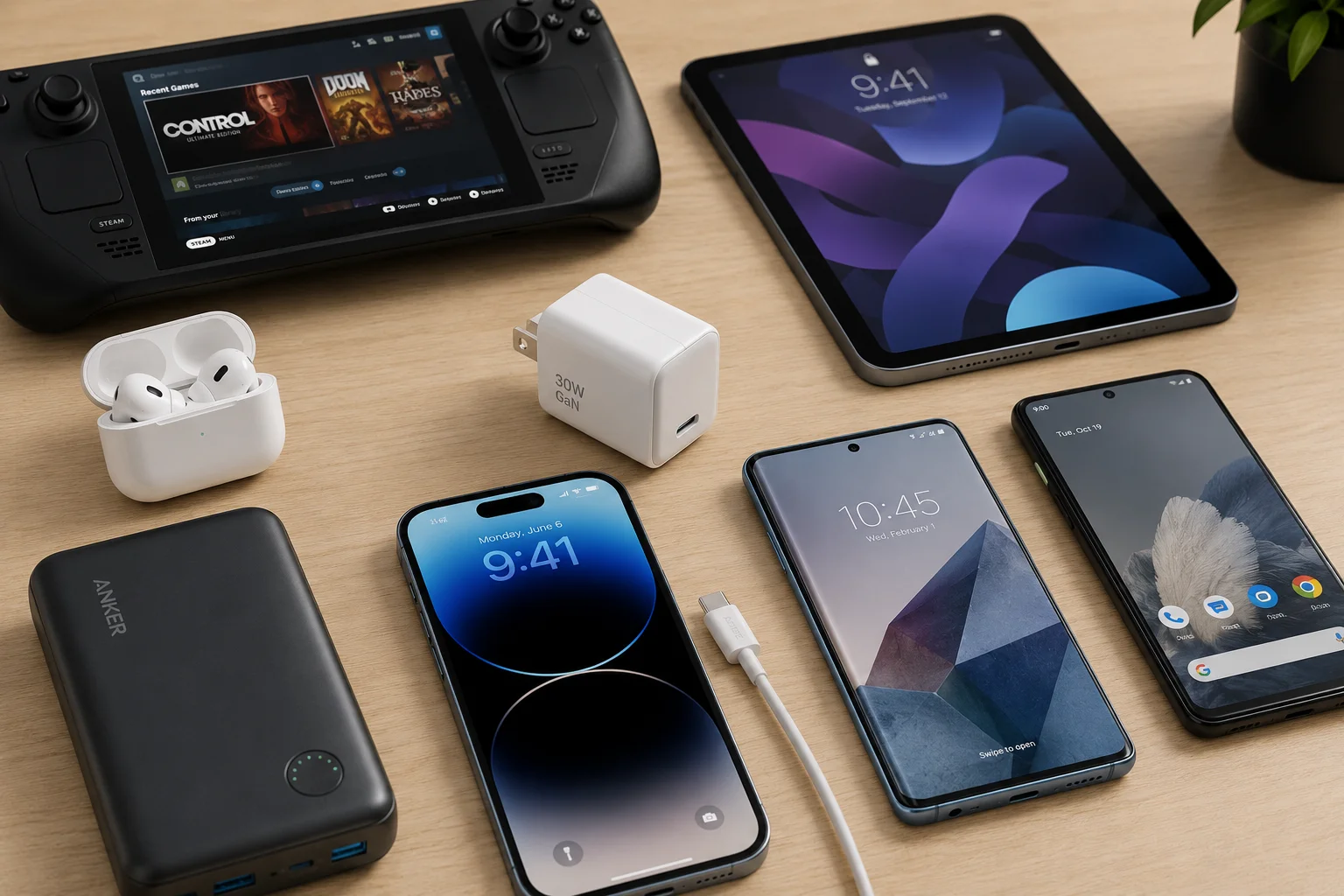
A 30W GaN charger can fast-charge many iPhone, Samsung, Google Pixel, iPad, Android tablet, earbud, power bank, and handheld devices when the device supports matching PD or PPS input. Actual speed depends on the device’s own charging limit and protocol support.
How I set the right compatibility expectation
In my daily export work, I see one common mistake. A buyer asks if a 30W charger supports “all USB-C devices.” I do not like that claim. It is too broad. A charger can be physically connected to many USB-C devices, but fast charging depends on the device and protocol4. An iPhone 15 or iPhone 16 series can use USB-C PD5. Many Samsung Galaxy models may need PPS for better fast charging behavior.6 Google Pixel phones also have their own charging rules. Some iPad models and iPad mini models can use more power than a basic phone adapter. Some lightweight USB-C laptops may charge from 30W, but I never present 30W as a main laptop charger unless the laptop model is checked.
| Device group | What I usually confirm | Buyer note |
|---|---|---|
| iPhone 15 and iPhone 16 series | USB-C PD support | Good fit for a complete USB-C set |
| Samsung Galaxy phones | PD and PPS support where needed | PPS can matter for some models |
| Google Pixel phones | PD support and input limit | Speed depends on model |
| iPad and iPad mini | PD input need | 30W can be more useful than 20W7 |
| Android tablets | Protocol and wattage | Do not assume all tablets charge the same |
| Wireless earbuds | Low power charging support | 30W charger will only supply needed power |
| Power banks | Input rating | Cable quality can matter |
| Nintendo Switch and handhelds | USB-C charging behavior | Check user expectations |
| Lightweight USB-C laptops | Exact input need | Treat as model-dependent |
I tell buyers to write product pages with care. They can say the charger is suitable for many phones and tablets with USB-C PD support. They should not say it fast-charges every device at 30W. The safer message is simple. The charger can supply up to 30W, and the device decides how much it takes.
Is 30W Better Than a 20W Charger?
A 30W charger sounds better than 20W. Yet customers may not always see a big speed change on every phone.
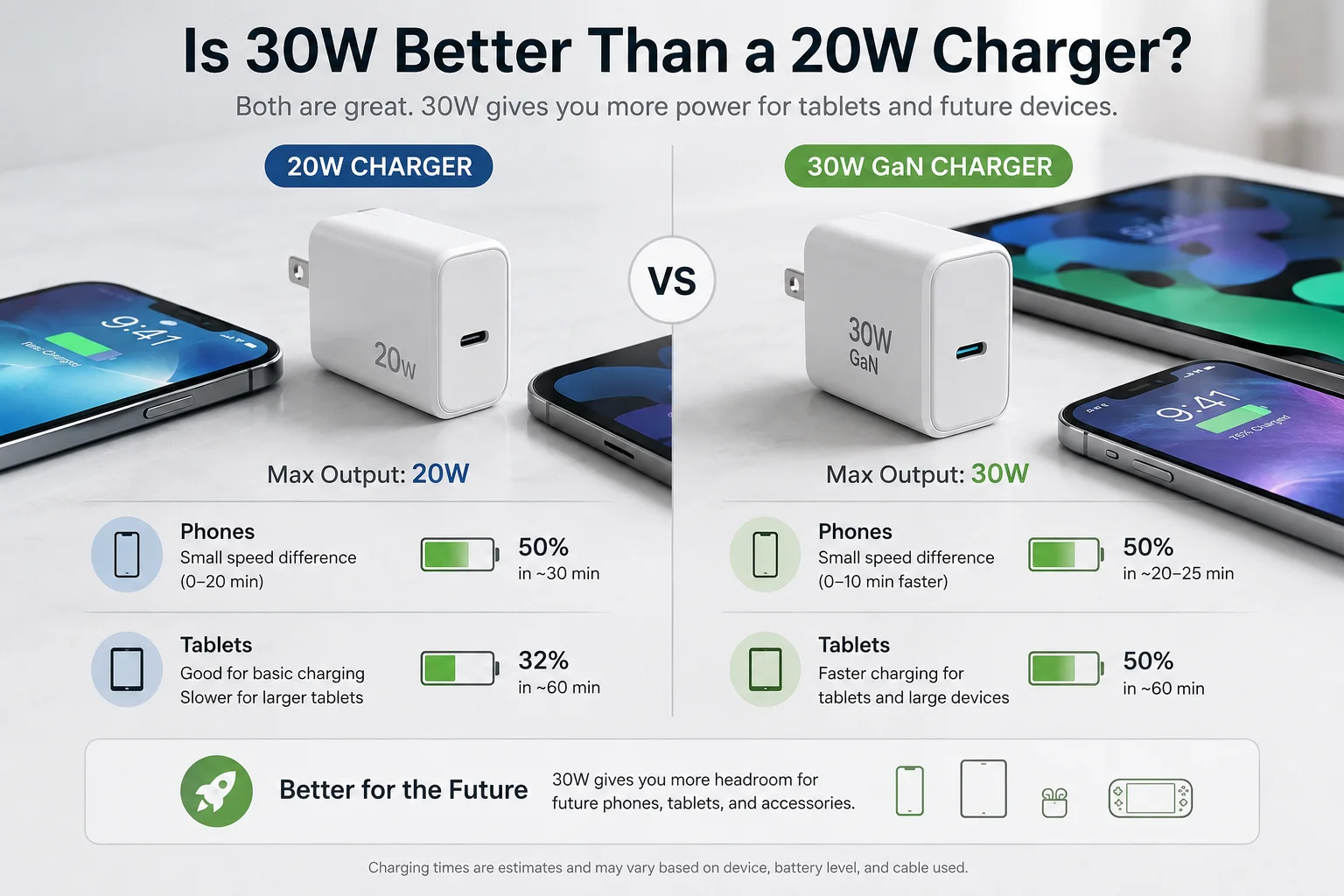
A 30W charger offers higher maximum output than a 20W charger, so it is often better for tablets and future devices. For many phones, the speed gain may be small if the phone input limit is near 20W or below8.
How I compare 20W and 30W for buyers
When a wholesale buyer asks me whether to stock 20W or 30W, I do not answer with “30W is always better.” I compare the selling scene. A 20W charger is often enough for many phone users. It can be lower cost and familiar in the market. A 30W charger gives more room. It can cover phones, some tablets, and more future USB-C devices. It can also help a retail bundle look more useful. But the buyer must know that a phone with a lower input limit will not become much faster only because the charger says 30W.
| Comparison point | 20W charger | 30W GaN charger |
|---|---|---|
| Maximum output | Lower power ceiling | Higher power ceiling |
| Phone charging | Good for many phones | Good for many phones, but not always much faster |
| Tablet charging | May feel limited | Often stronger for small tablets |
| Future devices | Less room | More room |
| Charger size | Usually compact | GaN can keep it compact |
| Heat handling | Depends on design | Depends on design and quality |
| Price value | Lower entry price | Better value if buyer needs wider use |
I also look at shelf positioning. If the buyer sells only low-cost phone accessories, 20W may still work. If the buyer sells a more complete fast-charging set with a USB-C cable, 30W often feels like a better upgrade. The key is not the number alone. The key is whether the extra 10W supports the market story, target device mix, and retail price band.
Why Choose a GaN Charger Instead of a Traditional Charger?
GaN sounds premium, and many sellers use it heavily. I stay careful because technology alone does not prove quality.
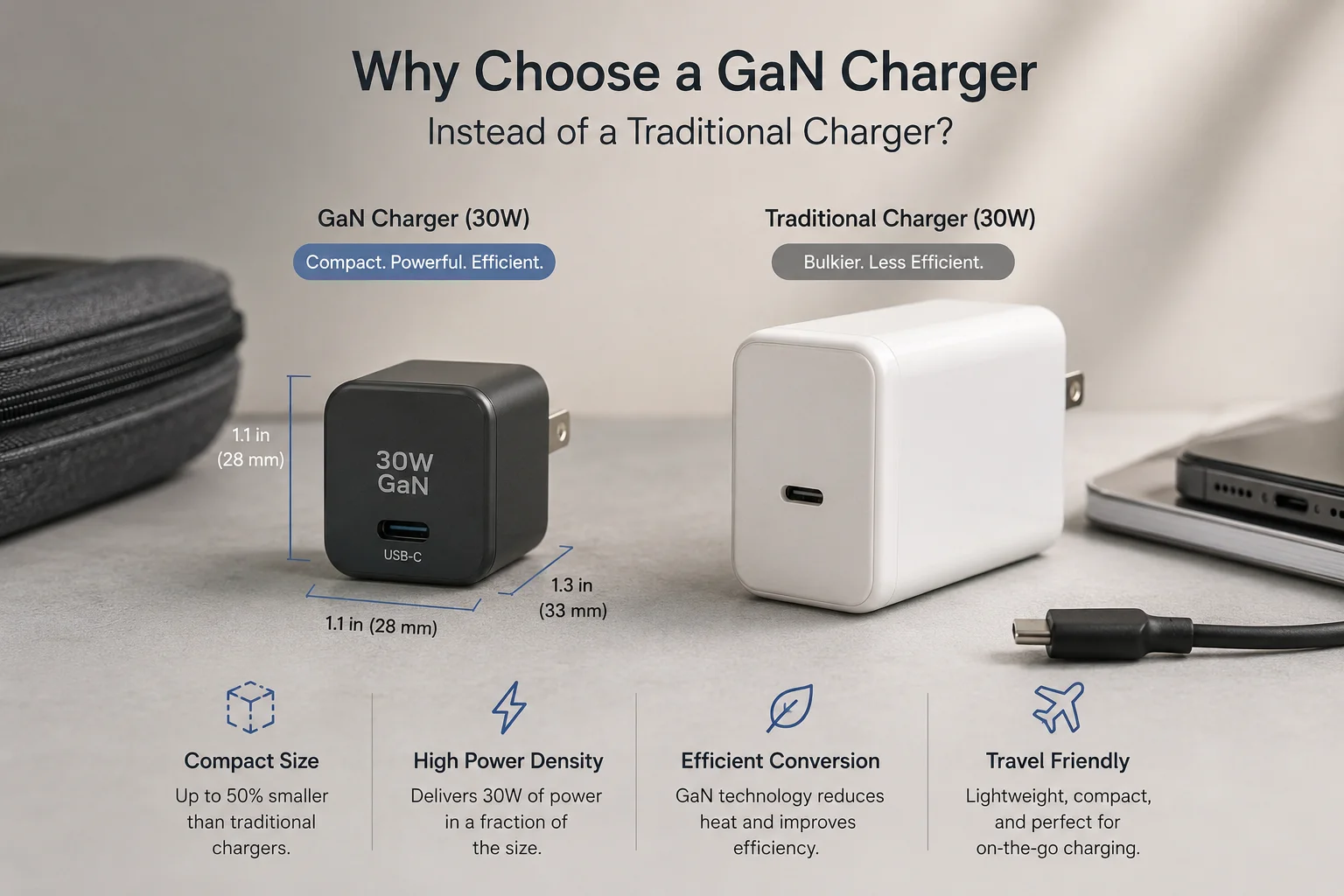
I choose a GaN charger when I need compact size, higher power density, efficient conversion, and travel-friendly design. I still check real specifications, safety design, certifications, and supplier quality control before I call it a good product.
How I treat GaN as a design advantage
GaN means gallium nitride. In charger products, it allows power parts to switch more efficiently than many older designs. This can help make a charger smaller and lighter while still offering strong output. For a 30W charger, the size benefit is clear in retail and travel use. A small charger is easier to pack, easier to display, and easier for customers to understand as a modern product.
| GaN advantage | What I tell buyers | What I do not claim |
|---|---|---|
| Smaller body | It can help create a compact 30W charger | I do not say all GaN chargers are tiny |
| Higher power density | It can deliver more power in a smaller space | I do not say power density means safety |
| Efficient conversion | It can reduce wasted energy9 | I do not say it never gets warm |
| Travel use | It is easier to carry | I do not say it fits every country without plug checks |
| Modern product image | It supports a better retail story | I do not say the word GaN alone proves premium quality |
I avoid absolute statements. A GaN charger can still get warm during use. A traditional charger can still be safe if it is well designed and certified. The better question is this: does the exact product model have clear input and output ratings, real protection design, stable production, and the right certification for the market? In B2B orders, the factory file, batch control, and warranty handling are just as important as the GaN label.
Why Does the Included USB-C Cable Matter?
Many buyers call the cable a free gift. I disagree. A weak cable can make the whole set look bad.
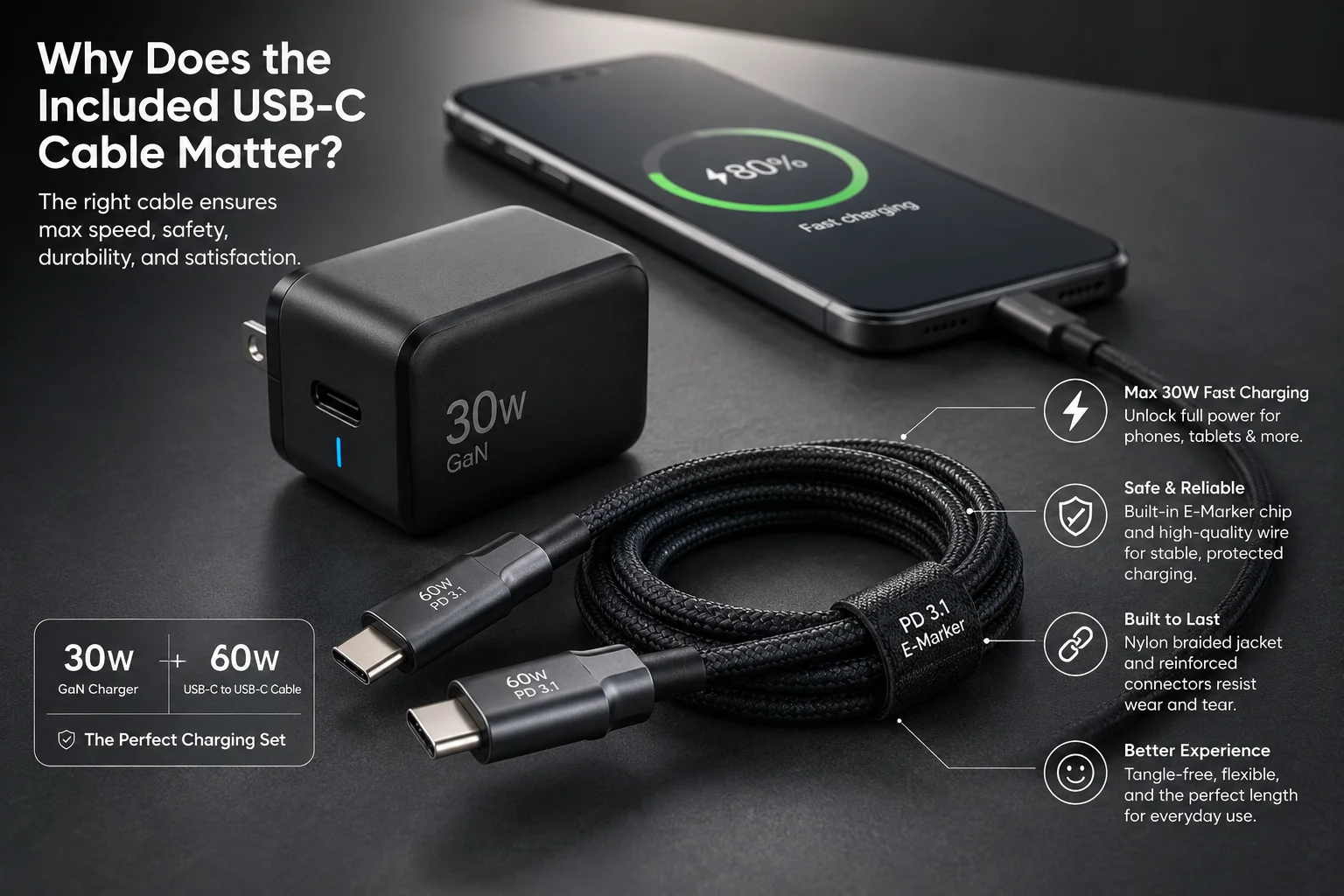
The included USB-C cable matters because it affects charging speed, safety feeling, durability, and user satisfaction. For 30W charging, I usually look for a reliable USB-C to USB-C cable with clear power support and stable connector quality.
How I check the cable before I quote the set
In many real buyer talks, the charger gets most of the attention. Then the buyer asks for the cheapest cable to keep the package price low. I understand the price pressure, but I always warn them. The end user touches the cable every day. If the connector is loose, the outer material cracks, or the cable does not support the needed current10, the customer blames the whole set. That can hurt reviews and repeat orders.
| Cable item I check | Why it matters | What the buyer should confirm |
|---|---|---|
| USB-C to USB-C connector | It must match modern PD devices | Connector type and fit |
| Supported wattage | It affects charging performance | Clear power rating |
| Current rating | It affects stable output | Rated current for the use case |
| Cable length | It affects daily comfort | 1m, 1.5m, or other market need |
| Connector durability | It affects returns | Bend and plug test standard if available |
| Data transfer | Some buyers need data use | Charge-only or data-capable |
| [E-marker | Needed for higher power cables, not always for 30W] | Confirm when required |
| Material | It affects feel and life | PVC, TPE, braided, or other material |
For a 30W set, a good cable that clearly supports the needed power is usually enough. The buyer does not need to overbuy a high-power cable if the retail price cannot support it. Yet the cable must not be vague. I like clear cable specs in the quotation, sample label, and packaging file. This lowers disputes after shipment.
Does a 30W GaN Charger Support PD and PPS?
A 30W mark does not tell the full protocol story. This is where many product pages become unclear.
A 30W GaN charger may support USB-C PD, PPS, or both, depending on the exact model. I always check output profiles and protocol support because PD helps iPhone, iPad, and many USB-C devices, while PPS helps some Samsung and Android fast charging.
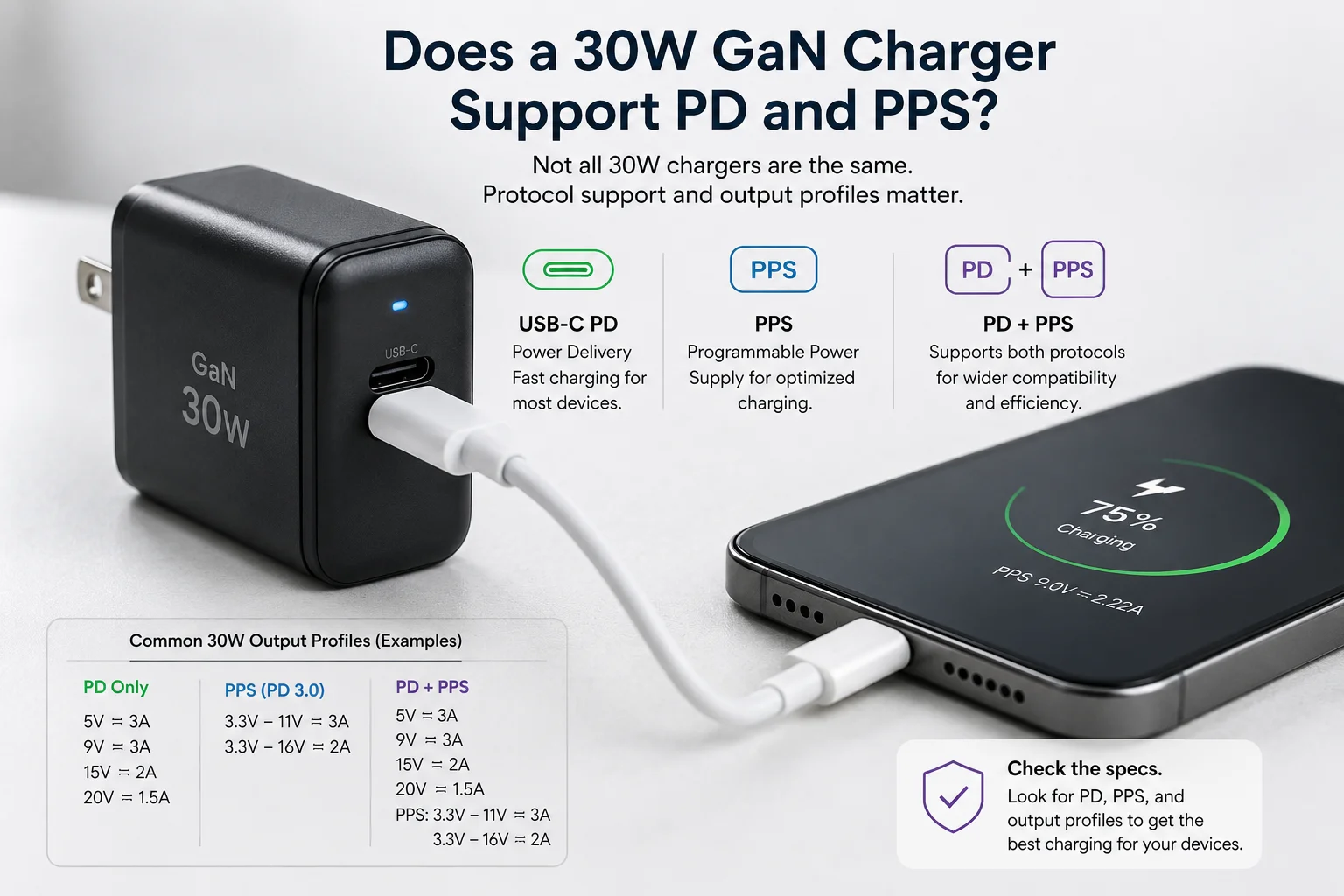
How I read protocol support for B2B buying
USB-C Power Delivery is one of the most important fast-charging protocols for modern USB-C chargers. It helps devices and chargers agree on voltage and current. iPhone, iPad, some Android devices, power banks, and other USB-C products can use PD. PPS means Programmable Power Supply. It can adjust voltage and current in smaller steps based on the device request.11 Some Samsung Galaxy and Android devices use PPS for better fast-charging results.
| Protocol item | What it means | Why I check it |
|---|---|---|
| USB-C PD | The charger supports Power Delivery negotiation | It helps many Apple and USB-C devices |
| PPS | The charger can adjust output more dynamically | It matters for some Samsung and Android models |
| Output profiles | The charger lists voltage and current levels | It shows what the charger can actually supply |
| Device match | The phone or tablet must request supported power | It controls final charging speed |
| Marketing claim | The package may say “30W fast charge” | It must match the real specification |
I do not buy based only on the front label. I ask for the exact output table. I also ask whether PPS is included if the buyer sells to Android-heavy markets. In some markets, iPhone buyers may care more about PD and cable type. In other markets, Samsung buyers may complain if PPS is missing. So I match the protocol to the device mix. That is a better buying habit than trusting the “30W” number alone.
How to Choose a Safe 30W GaN Charger and Cable Set?
A low price can look attractive on a spreadsheet. A safety complaint can destroy the margin later.
I choose a safe 30W GaN charger and cable set by checking PD/PPS support, output specs, protection functions, flame-resistant housing, certifications, cable rating, supplier identity, warranty terms, and market-specific plug and packaging needs.
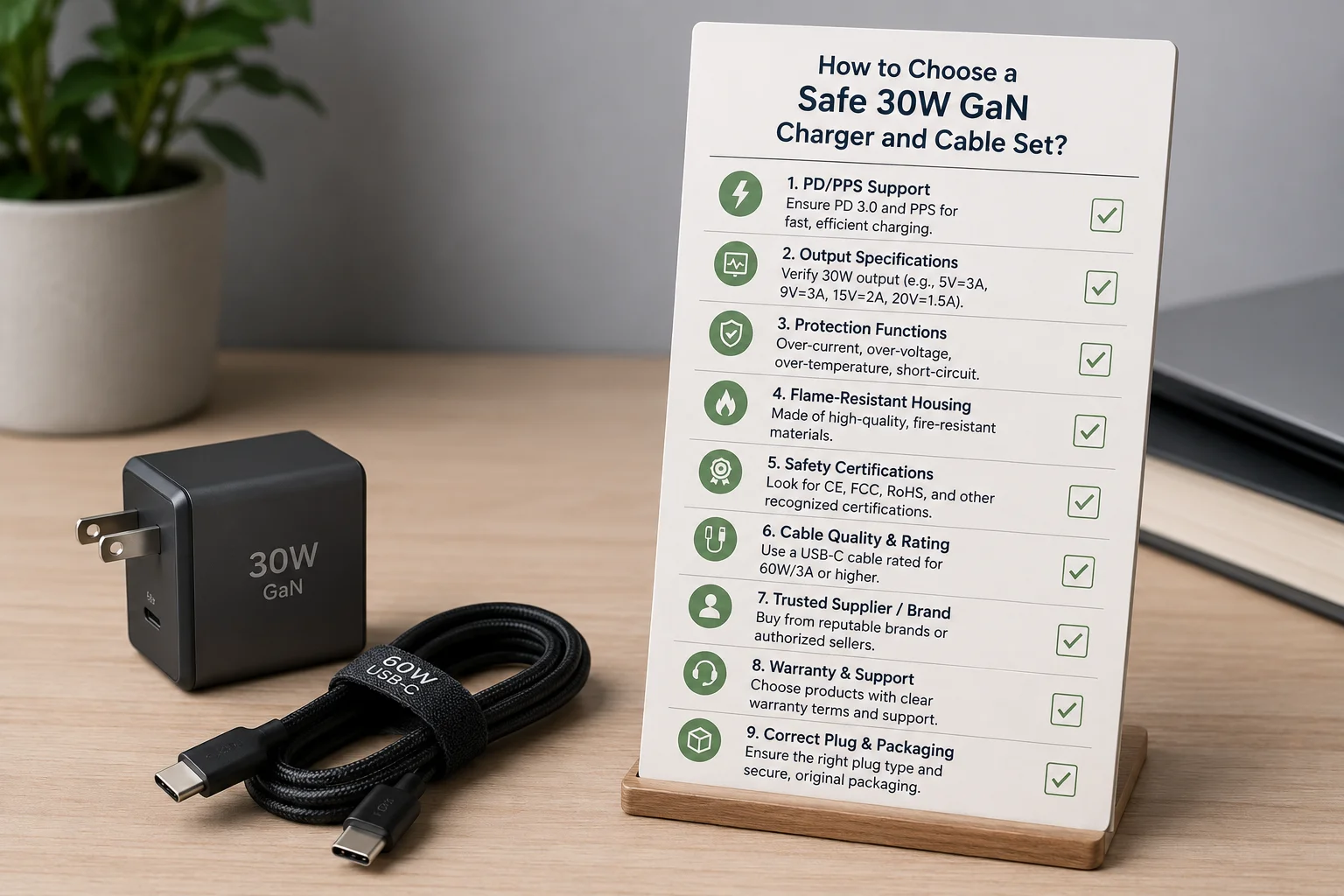
How I use a practical sourcing checklist
For B2B buyers, safety is not only a technical topic. It is also a channel topic. A retailer may need product documents before listing. A chain store may need packaging checks. An importer may need the right plug type, language label, and certification file for the local market. An Amazon seller may care about return rate and review risk. I always ask the buyer to confirm the exact market first, then confirm the charger and cable set.
| Buying item | What I confirm | Why it matters |
|---|---|---|
| USB-C PD support | Protocol support and output profiles | Fast-charge compatibility |
| PPS support | Needed where target devices require it | Android customer satisfaction |
| Input and output specs | Printed rating and datasheet match | Clear compliance and sales claims |
| Overvoltage protection | Protection against voltage issues | Basic safety design |
| Overcurrent protection | Protection against excess current | Device and charger safety |
| Short-circuit protection | Response to fault conditions | Risk control |
| Temperature control | Heat management design | Better user confidence |
| Flame-resistant housing | Housing material grade | Safety expectation |
| Certifications | Market-required files for exact model | Retail and import approval |
| Cable specs | Power, current, connector, material | Set performance |
| Manufacturer info | Real source and traceability | After-sales handling |
| Warranty policy | Return and replacement terms | Long-term margin |
For wholesale and OEM orders, I also check plug type. EU, US, and UK plugs require different product planning. I check retail box size, barcode, private label artwork, user manual language, carton marks, MOQ, lead time, and batch consistency. These points may sound less exciting than GaN, but they decide whether the product can enter the channel smoothly. I have seen buyers lose time because the charger looked good, but the package, plug, or file did not fit the market.
Who Should Buy a 30W GaN Charger With a USB-C Cable?
Not every buyer needs the same charger set. The right SKU depends on the customer and sales channel.
A 30W GaN charger with a USB-C cable suits iPhone users, USB-C Android users, travelers, tablet users, retailers, importers, ecommerce sellers, and brands that need a compact, complete, and easy-to-sell fast-charging bundle.
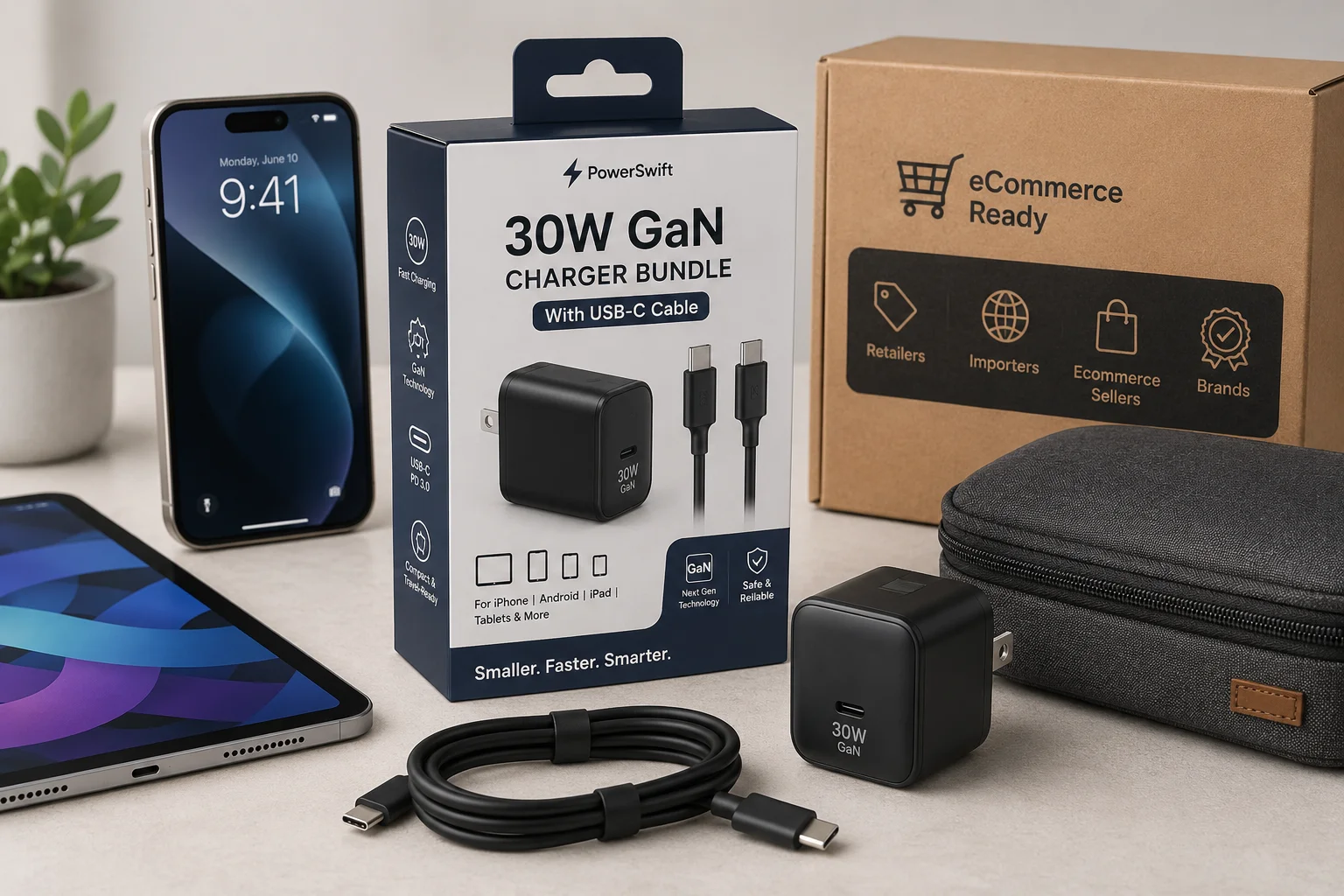
How I match this SKU to the right buyer
I see the 30W GaN charger with cable as a balanced SKU. It is not the cheapest charger. It is not the highest-power laptop charger. It sits in a useful middle area. It gives more power than many basic phone adapters. It stays small enough for travel and daily carry. It includes a cable, so the retail customer does not need to buy one more item. This makes it strong for stores, bundles, and ecommerce listings.
| Buyer or user type | Why the 30W set can fit | What I still confirm |
|---|---|---|
| iPhone users | They need a USB-C PD charger and cable | Model and cable connector |
| Android users | Many need USB-C PD or PPS | Protocol support |
| Travelers | They want a compact charger | Plug type and local voltage |
| Tablet users | They may need more than basic phone power | Tablet input limit |
| Old USB-A charger users | They want to upgrade | Cable type and device port |
| Retailers | The bundle is easy to display | Packaging and barcode |
| Importers | The set is simple to sell | Certification and batch quality |
| OEM brands | It can support private label projects | Artwork, MOQ, and lead time |
For chain stores, I pay close attention to packaging and certification files. For Amazon and ecommerce sellers, I focus on clear listing claims, cable quality, and complaint control. For wholesalers, I look at price band, carton loading, and stock rotation. For private-label buyers, I check logo, color, plug, box style, manual, and after-sales terms. A 30W GaN charger with a USB-C cable is a good SKU when the buyer wants a balanced mix of power, size, compatibility, and price. It works best when the product promise is clear and not exaggerated.
Conclusion
I see a 30W GaN charger with USB-C cable as a balanced fast-charging set when power, protocol, cable, safety files, and market needs all match.
"Indium gallium nitride - Wikipedia", https://en.wikipedia.org/wiki/Indium_gallium_nitride. A review source on gallium nitride power devices describes GaN semiconductors as materials used in high-frequency power conversion, supporting the article’s description of GaN as the charger’s power-conversion technology. Evidence role: definition; source type: paper. Supports: Gallium nitride is used in power semiconductor devices for power conversion applications, including compact power supplies and chargers.. Scope note: This supports the general technology category rather than verifying the internal design of any specific 30W charger model. ↩
"USB-C - Wikipedia", https://en.wikipedia.org/wiki/USB-C. USB-IF documentation defines USB Power Delivery as a specification for negotiated power delivery over USB connections, supporting the article’s statement that USB-C PD is central to fast-charging compatibility. Evidence role: definition; source type: institution. Supports: USB Power Delivery is a USB-IF standard that allows compatible USB-C devices and chargers to negotiate power levels.. Scope note: The standard explains the mechanism but does not prove that a particular commercial charger implements PD correctly. ↩
"High Density Power Electronics (HDPE) - SPEC", https://spec.ece.utexas.edu/hdpe. Power-electronics research on GaN devices reports higher switching-frequency operation and power-density potential compared with conventional silicon designs, which supports the article’s claim that GaN can help keep a charger compact for its power rating. Evidence role: mechanism; source type: research. Supports: GaN power devices can operate at higher switching frequencies and power densities, which can reduce the size of passive components and enable compact power supplies.. Scope note: The source would support the engineering principle; final charger size still depends on the complete circuit, thermal design, enclosure, and safety margins. ↩
"The Basics of USB Power Delivery Negotiations | Acroname", https://acroname.com/blog/basics-usb-power-delivery-negotiations?srsltid=AfmBOoqEDx8ecBTyvEF38qoZBkUk7bOSmasz2t13STIN4hrUQW4ZFmhS. USB Power Delivery technical material describes a source-and-sink negotiation process in which power levels are selected from supported capabilities, supporting the article’s point that fast charging depends on both protocol support and the device’s own charging behavior. Evidence role: mechanism; source type: institution. Supports: USB-C Power Delivery uses negotiation between a power source and sink, so delivered power depends on capabilities advertised by the charger and requested by the device.. Scope note: This explains the protocol mechanism and does not establish charging speeds for every phone or tablet model. ↩
"Fast charge your iPhone - Apple Support", https://support.apple.com/en-us/102574. Apple support documentation states that compatible iPhone models can fast charge using a USB-C power adapter of sufficient wattage, providing model-context support for the article’s statement that USB-C iPhone models can use USB-C PD charging. Evidence role: case_reference; source type: other. Supports: Apple states that compatible iPhone models can fast charge with a USB-C power adapter meeting specified wattage requirements.. Scope note: Apple’s support page establishes supported charging conditions but may not name every new iPhone generation in the same document. ↩
"Why can't I find reliable info on how the hell Samsung Super Fast ...", https://www.reddit.com/r/UsbCHardware/comments/1blmsm6/why_cant_i_find_reliable_info_on_how_the_hell/. Samsung support material for Galaxy Super Fast Charging identifies USB Power Delivery PPS compatibility as a condition for certain fast-charging modes, supporting the article’s caution that PPS can matter for Samsung Galaxy users. Evidence role: case_reference; source type: other. Supports: Samsung documentation for Super Fast Charging identifies compatible USB Power Delivery PPS chargers as required or recommended for certain Galaxy fast-charging modes.. Scope note: This supports Samsung-specific charging behavior and should not be generalized to all Android phones. ↩
"30w charger on ipad pro, is it really worth it? : r/iPadPro - Reddit", https://www.reddit.com/r/iPadPro/comments/1fd4s51/30w_charger_on_ipad_pro_is_it_really_worth_it/. Apple documentation on iPad charging and USB-C power adapters lists higher-wattage USB-C adapters as compatible with iPad models, providing contextual support for the article’s claim that 30W may be more useful than 20W for some tablets. Evidence role: case_reference; source type: other. Supports: Apple documentation lists USB-C power adapters above 20W, including 30W-class adapters, as compatible with iPad charging.. Scope note: Compatibility with a 30W adapter does not prove that every iPad model continuously draws 30W or charges proportionally faster. ↩
"USB Charger (USB Power Delivery)", https://www.usb.org/usb-charger-pd. USB Power Delivery materials describe device-requested power negotiation, supporting the article’s claim that a phone limited to about 20W will not necessarily gain much speed from a 30W charger. Evidence role: mechanism; source type: institution. Supports: In USB PD charging, the sink device requests power within its supported limits, so a higher-capacity charger does not force a device to draw more than it is designed to accept.. Scope note: The source supports the mechanism; actual speed differences require model-specific charging curves and battery-management data. ↩
"GaN Enables Energy-Efficient Power Conversion - Stanford University", http://large.stanford.edu/courses/2024/ph240/chen-h1/. Peer-reviewed power-electronics literature reports that GaN devices can achieve lower switching losses and efficient high-frequency operation, supporting the article’s statement that GaN conversion can reduce wasted energy. Evidence role: mechanism; source type: paper. Supports: GaN power devices can reduce switching losses and support efficient high-frequency power conversion.. Scope note: Efficiency depends on the full charger design, so GaN components alone do not guarantee high efficiency in a finished product. ↩
"Identifying USB-C E-Mark Cables - Satechi", https://satechi.com/blogs/news/identifying-usb-c-e-mark-cables?srsltid=AfmBOooFOsRWz2s12pGKqeOV16Vp1k-0J_AcgzlOdBk6mlgBOVomJ1at. USB-IF Type-C and Power Delivery materials specify cable current capabilities and identification requirements, supporting the article’s claim that a cable must support the current needed for the charging set. Evidence role: mechanism; source type: institution. Supports: USB-C cable specifications distinguish current capabilities, commonly including 3A and electronically marked higher-current cables, affecting supported power delivery.. Scope note: Standards documentation supports the requirement category but does not assess the durability or quality of any individual cable. ↩
"What is Programmable Power Supply (PPS) Fast Charging? - Belkin", https://www.belkin.com/support-article/?articleNum=318878. USB Power Delivery documentation defines Programmable Power Supply as a mode that enables adjustable voltage and current supply under device control, supporting the article’s explanation of PPS behavior. Evidence role: definition; source type: institution. Supports: Programmable Power Supply is a USB PD feature that permits finer-grained voltage and current adjustment between a charger and compatible device.. Scope note: This supports the protocol definition but does not show that every PPS-labeled charger implements all expected profiles. ↩