The right USB connector type can determine whether an industrial device installs smoothly or creates recurring returns, compatibility problems, and service calls. Buyers often focus on price first, but the wrong connector shape, cable construction, or retention method can make a reliable device difficult to deploy. I use a structured evaluation process to reduce these risks.
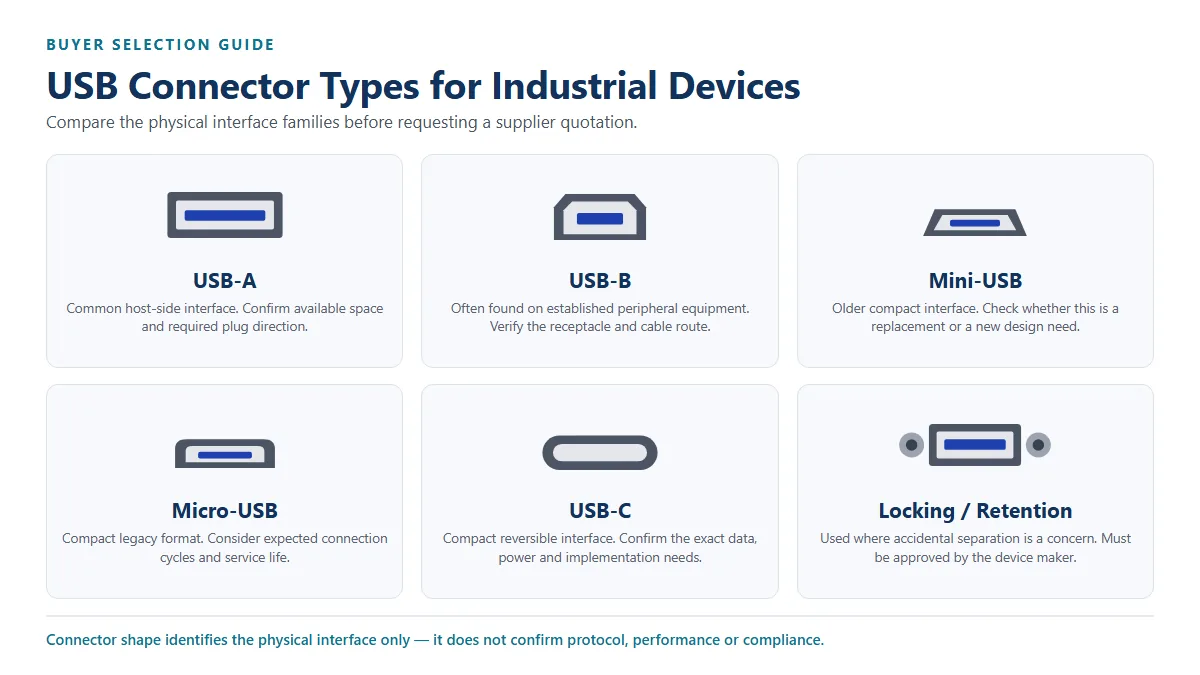
The right USB connector type depends on the device’s physical interface, expected environmental exposure, data requirements, power requirements, cable routing, and retention needs. Buyers should compare USB-A, USB-B, Micro-USB, Mini-USB, USB-C, and specialized locking or panel-mount designs against the device maker’s confirmed requirements. The connector shape alone does not confirm protocol, performance, or compliance.1
A connector decision becomes more important when an importer is buying for factories, kiosks, measurement equipment, controllers, warehouse systems, or other commercial installations. I recommend separating confirmed device specifications from assumptions. The sections below explain how I evaluate connector families, mechanical fit, environment, cable quality, and supplier documentation.
Quick Answer: Which USB connector type should industrial buyers choose?
A low-cost connector may look acceptable during a sample review, yet fail after repeated plugging, vibration, dust exposure, or poor cable routing. Industrial buyers need more than a familiar connector name. I first confirm what the device manufacturer requires, then I evaluate the complete cable-and-connector assembly.
For most new industrial-device designs, buyers commonly investigate USB-C because of its compact, reversible form factor2, while USB-A and USB-B may remain suitable for established equipment and specific host or peripheral layouts. Micro-USB and Mini-USB can fit legacy products. The final USB connector type should be selected only after verifying interface, environment, cable, retention, and supplier quality requirements.
What does the connector shape tell buyers?
The connector shape identifies the physical mating interface. It does not, by itself, prove:
- The supported USB generation or data capability.
- The permitted power input or output.
- Whether the connector supports a particular alternate function.
- Whether a cable is suitable for high-use industrial service.
- Whether the assembly has the required environmental protection.
- Whether the product has passed a buyer’s required testing or compliance review.
I treat the connector as one part of a larger interface system. The receptacle, plug, cable, strain relief, housing, mounting method, and internal design must work together.
Which USB connector families fit industrial devices?
Choosing between connector families can be confusing because several physical interfaces remain in commercial use. A buyer may also encounter different versions within one family, such as standard and smaller formats or straight and angled cable designs. I begin by mapping the connector to the device’s role rather than choosing the newest-looking option.
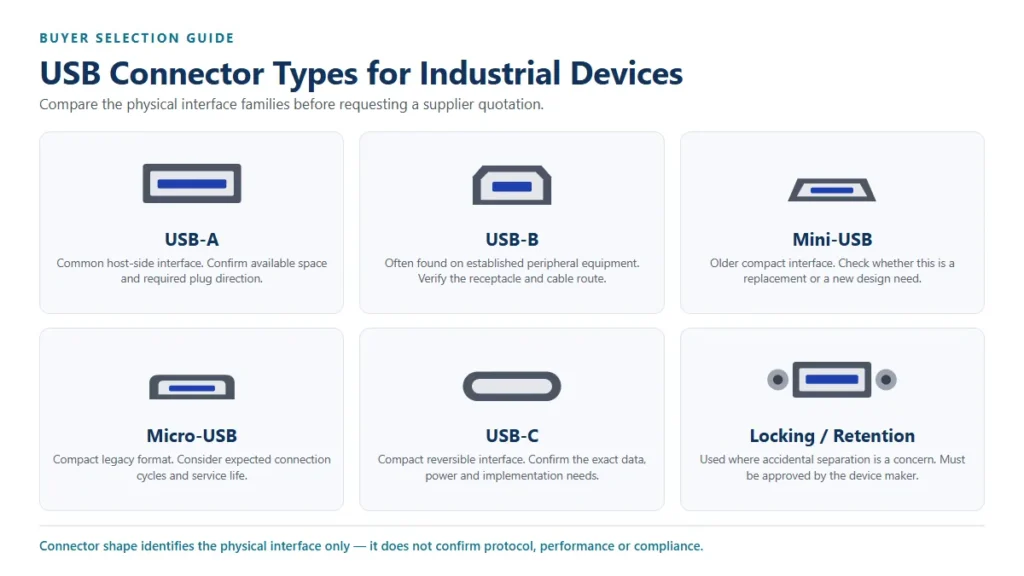
USB-A, USB-B, Micro-USB, Mini-USB, and USB-C each serve different physical and product-design needs.3 USB-A is common on host-side equipment, USB-B is often associated with peripheral-side connections4, smaller connectors support compact designs, and USB-C offers a compact reversible interface. Buyers must verify the device maker’s exact receptacle and cable requirements before ordering.
Common connector families
| Connector family | Typical buyer consideration | Questions to verify |
|---|---|---|
| USB-A | Familiar host-side interface and broad accessory availability | Does the device require USB-A, and is the available space sufficient? |
| USB-B | Often used on established peripheral equipment | Does the receptacle match the equipment and intended cable route? |
| Micro-USB | Compact format found in some existing products | Is the device a legacy design, and will repeated handling affect service life? |
| Mini-USB | Older compact interface used in some equipment | Is this a replacement requirement or a new-design decision? |
| USB-C | Compact, reversible connector used in many newer products | Which exact data, power, orientation, and implementation requirements apply? |
| Locking or retention USB design | Useful where accidental separation is a concern | What retention method does the device maker accept? |
I do not present one connector family as universally better. A connector that works well in a controlled retail accessory may not suit a device installed near moving equipment. Likewise, an older interface may be the correct choice when a replacement cable must match an existing installed base.
USB-C requires careful verification
USB-C deserves special attention because its physical shape can create false confidence. Many buyers assume that every USB-C cable or port provides the same functions.5 That assumption can cause compatibility problems.
I ask the supplier and device maker to confirm:
- Whether the port is intended for charging, data, or both.
- Which cable orientation and plug arrangement the design supports.
- Whether the device needs a particular data capability.
- Whether the connector is intended for service access or permanent installation.
- Whether the device requires a specific internal implementation.
- Whether the cable must meet a defined mechanical or electrical test plan.
I also ask for product drawings and a sample-matching process. A USB-C plug that physically enters a port may still be unsuitable for the device’s intended operation.6
Legacy connectors can remain commercially relevant
I often see buyers replace a legacy connector simply because a newer connector appears more marketable. That decision can create unnecessary tooling, redesign, and compatibility work. If an industrial customer already owns equipment with a particular receptacle, the replacement cable should normally preserve that interface unless the device maker approves a change.
For importers and distributors, installed-base compatibility can matter more than fashion. I recommend reviewing:
- The current device model and revision.
- The existing cable supplied with the device.
- The customer’s replacement expectations.
- The available space around the port.
- The expected number of connection cycles.
- The cost and risk of changing the receptacle.
How should mechanical fit and environmental exposure guide USB connector type selection?
A connector can meet a basic fit check and still be unsuitable for an industrial installation.7 Tight spaces, side loading, vibration, dust, moisture, and frequent maintenance can all change the selection. I therefore evaluate the connector in its actual mounting position, not only on a sample board or loose cable.
Mechanical fit should be assessed through dimensions, insertion direction, clearance, strain relief, mounting method, and mating stability. Environmental suitability should be confirmed through the device maker’s application requirements and relevant supplier documentation. Buyers should not assume that a connector is sealed, ruggedized, or vibration-resistant without evidence.
Mechanical fit includes more than plug insertion
I ask the buyer and device maker to review:
- Receptacle location on the enclosure.
- Available clearance around the plug.
- Cable bend direction.
- Whether the cable exits straight or at an angle.
- The force applied during insertion and removal.
- The risk of side loading from nearby surfaces.
- Access for maintenance personnel.
- Whether the receptacle is board-mounted, panel-mounted, or attached through another structure.
- The space needed for a retention feature or protective cover.
A plug may fit the port but still interfere with the enclosure, door, bracket, or neighboring connector. I have seen sampling projects delayed because a cable head was physically too large for the final installation, even though the electrical connection itself was correct.
Environmental questions should be application-specific
“Industrial grade” is not a complete specification.8 I prefer direct questions about the installation:
- Will the connector be exposed to dust?
- Could water, condensation, cleaning fluid, oil, or other substances reach the interface?
- Will the equipment operate near vibration or movement?
- Will workers connect and disconnect the cable frequently?
- Will the cable hang from the port?
- Will the product sit indoors, outdoors, or in a controlled cabinet?
- Does the customer require a cover when the connector is unused?
- Does the enclosure design depend on a particular sealing arrangement?
The supplier should provide documents that match the actual component and revision. I tell buyers to verify any stated ingress protection, material, temperature, durability, or environmental claim against the technical file and application conditions. A general product brochure may not describe the exact cable assembly being quoted.
Mechanical evaluation checklist
I use a sample review that includes both the plug and the installed device:
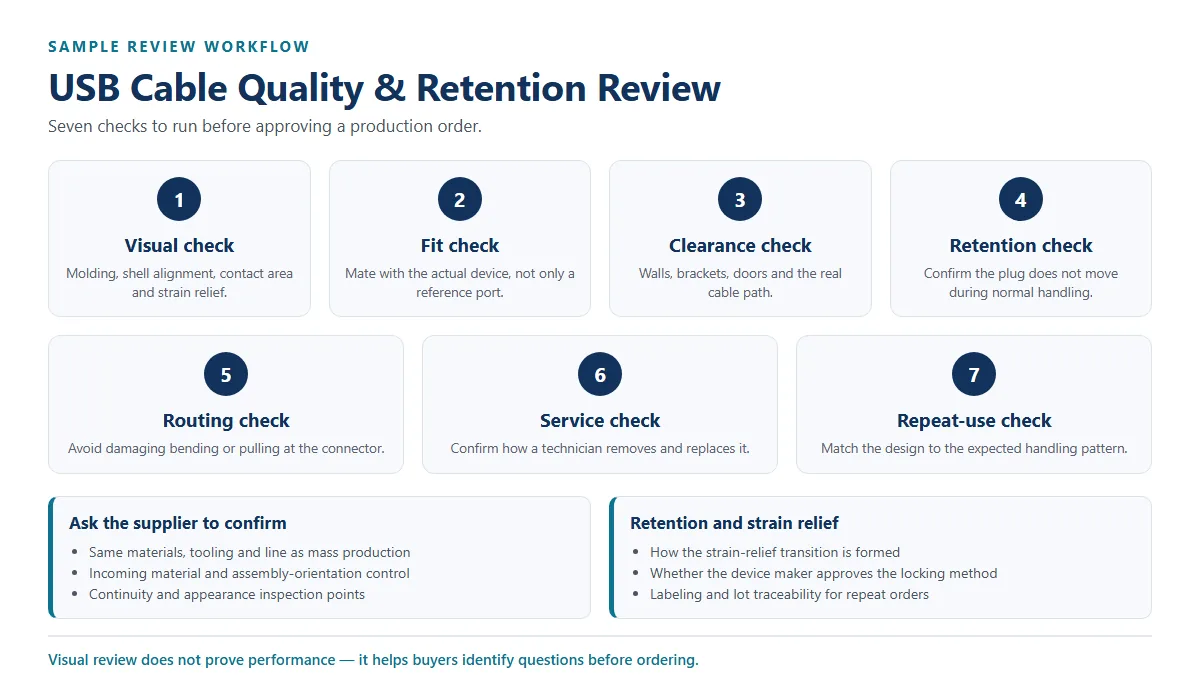
- Visual check: I inspect molding, shell alignment, contact area, and strain relief.
- Fit check: I mate the connector with the actual device, not only a reference port.
- Clearance check: I examine nearby walls, brackets, doors, and cable paths.
- Retention check: I observe whether the plug moves during normal handling.
- Routing check: I confirm that the cable does not create damaging bending or pulling.
- Service check: I consider how a technician will remove and replace it.
- Repeat-use check: I ask whether the design suits the customer’s expected handling pattern.
These checks do not replace qualified engineering evaluation. They help buyers identify questions before placing a production order.
What data and power needs must buyers verify for a USB connector type?
Many connector disputes begin when buyers treat the physical interface as the entire specification. The same connector family can appear in products with different data and power implementations. I always ask the device maker to define the required function before I request a supplier quotation.
Buyers should verify the required data function, power input or output, cable construction, device-side implementation, and any related negotiation or control requirements with the device maker. A USB connector type alone does not establish data speed, charging behavior, power capability, or compatibility with every cable.
Separate physical, electrical, and functional requirements
I divide the evaluation into three layers:
| Evaluation layer | What I confirm |
|---|---|
| Physical interface | Plug and receptacle family, dimensions, orientation, mounting, and clearance |
| Electrical requirements | Required voltage, current, signal integrity, grounding, and protection expectations as defined by the device maker |
| Functional requirements | Data transfer, charging, communication, control, or service function required by the complete device |
This separation helps avoid vague purchase requests such as “USB-C cable, fast charging.” That phrase may not give a factory enough information to select the correct construction. The device maker should define the actual requirements, and the supplier should confirm how its cable or connector assembly meets them.
Data requirements need a complete description
I ask whether the cable is used for:
- File transfer.
- Device configuration.
- Firmware or software service.
- Connection to a host computer.
- Communication between industrial modules.
- Charging only.
- Combined power and data operation.
A cable that works for charging may not support the data function needed for programming or diagnostics. A cable that works during a short sample test may also perform differently when it is longer, routed near sources of interference, or built with different internal materials.
I recommend requesting a written cable description that covers the intended function. Buyers should avoid accepting a generic statement such as “supports data” unless the supplier explains what was tested and how the result relates to the device.
Power requirements should come from the device maker
I do not infer power capability from connector appearance. The buyer should provide the device’s approved power requirements and ask the supplier to confirm the cable and connector assembly accordingly.
Important questions include:
- Is the cable intended for input, output, or both?
- Does the device require charging, fixed power, or intermittent power?
- Is the cable length controlled?
- Does the equipment have a defined current requirement?
- Does the design require a particular cable construction?
- Does the customer require temperature-rise or continuity checks?
- Does the device maker approve the proposed cable for production use?
The exact answers depend on the device design. I recommend qualified professional evaluation when power, heat, safety, or system reliability could affect the application.
Test the complete system
A supplier may test a cable with a reference device, while the importer’s customer uses a different enclosure, port, power source, or operating condition. Those differences matter. I encourage buyers to perform a system-level sample test with:
- The actual device model.
- The intended adapter or host.
- The final cable length and construction.
- The planned installation position.
- The expected service procedure.
- The customer’s operating sequence.
This approach creates a clearer record for purchasing, quality control, and after-sales support.
How do cable quality and retention affect USB connector type selection?
A connector is only as reliable as the assembly around it. Buyers sometimes compare quotations by connector name and cable length while overlooking conductor construction, shielding, molding, strain relief, and retention. I consider those details essential because many field failures begin where the cable meets the plug.
Cable quality should be evaluated through construction, strain relief, contact consistency, insulation, shielding where required, labeling, and repeatable production control. Retention should match the application’s vibration, movement, and service needs. A locking or retention feature should be approved by the device maker rather than added without checking the mating interface.
What I review in a cable sample
I request a representative production-intent sample and inspect:
- Plug shell alignment.
- Molding consistency.
- Strain-relief transition.
- Cable flexibility.
- Outer jacket condition.
- Markings and traceability.
- Connector insertion and removal feel.
- Contact alignment.
- Any visible gaps, burrs, or deformation.
- Packaging protection during shipment.
Visual review does not prove performance, but it can identify inconsistent manufacturing. I also ask whether the sample uses the same materials, tooling, assembly line, and inspection plan intended for mass production.
Strain relief deserves special attention
When a cable is pulled, bent, or moved, the transition between the cable jacket and connector housing receives stress. A weak transition can lead to intermittent operation or exposed internal conductors. I ask the supplier how the strain relief is formed and what process checks are used.
The buyer should also describe the real cable route. A cable that lies flat on a desk may hang vertically in a cabinet or bend sharply behind a machine. The supplier needs that information to recommend a suitable assembly. I avoid making broad claims about flexibility or durability unless the supplier provides relevant evidence.
Retention options vary by device
A standard friction-fit connector may be sufficient for equipment that remains stationary and is serviced occasionally. Other applications may need a screw-lock arrangement, latch, bracket, protective cover, or another approved retention method. The correct choice depends on the mating receptacle and enclosure design.
I use these selection questions:
- Can vibration or movement pull the plug out?
- Will an operator frequently touch or move the cable?
- Does the device maker provide an approved locking interface?
- Will a retention part obstruct nearby connectors?
- Can technicians release the connector without special difficulty?
- Does the retention design change the required cable route?
- Does the customer need replacement cables to match the installed system?
A locking cable is not automatically better. An incompatible retention feature can prevent mating, damage the receptacle, or increase service time.
Supplier quality controls
For B2B procurement, I ask suppliers to explain how they control:
- Incoming connector and cable materials.
- Assembly orientation.
- Continuity and basic electrical checks.
- Appearance inspection.
- Plug and receptacle fit.
- Labeling and lot traceability.
- Change control.
- Defect handling and replacement procedures.
Our Shenzhen trading business has worked with export customers for many years, and I have learned that stable quality depends on process communication as much as on the first sample. I tell customers to document the approved sample, packaging, label, cable construction, and inspection points before mass production.
What practical buyer checklist supports USB connector type selection?
A purchasing team can lose time when engineering, quality, and sales use different descriptions for the same cable. I use a written checklist to connect the device requirement with the supplier quotation. The checklist also helps importers compare suppliers on more than unit price.
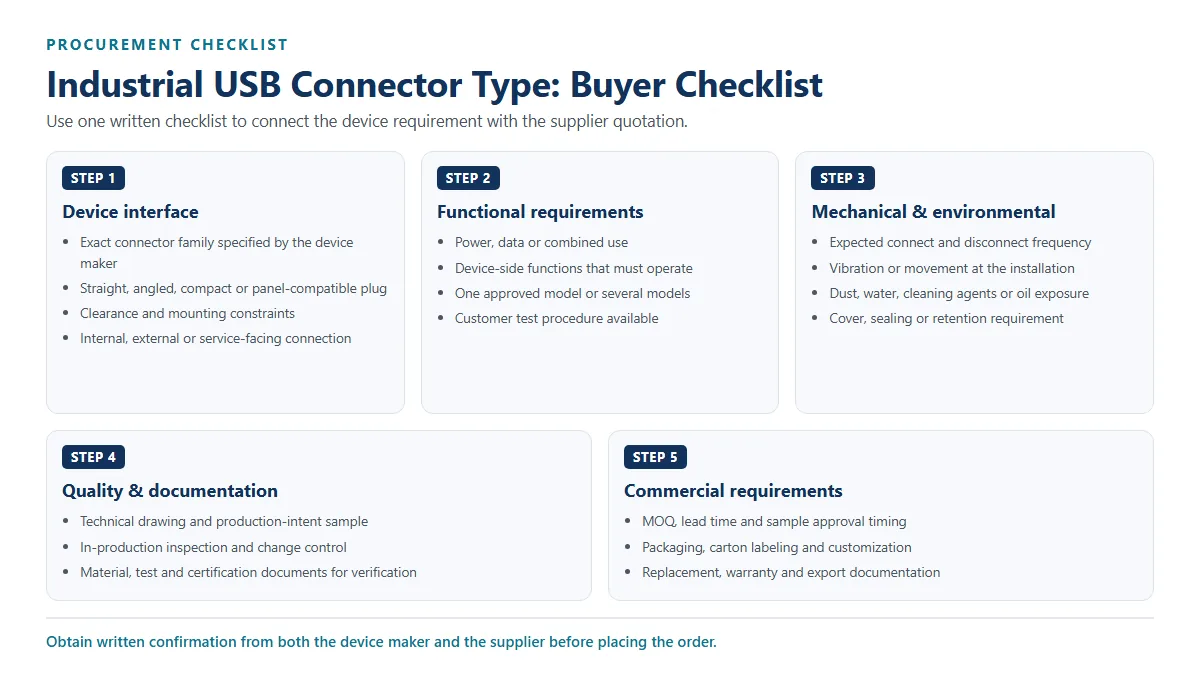
A practical USB connector type checklist should cover the connector family, exact plug and receptacle, device function, data and power requirements, dimensions, environment, retention, cable construction, testing, documentation, MOQ, lead time, customization, packaging, and after-sales terms. Buyers should obtain written confirmation from both the device maker and supplier.
Buyer checklist
1. Device interface
- What exact connector family does the device maker specify?
- Does the plug need to be straight, angled, compact, or panel-compatible?
- What are the clearance and mounting constraints?
- Is the connection internal, external, or service-facing?
2. Functional requirements
- Is the cable for power, data, or combined use?
- What device-side functions must operate?
- Is the cable intended for one approved device or several models?
- Does the customer have a test procedure?
3. Mechanical and environmental requirements
- How often will users connect and disconnect the cable?
- Will the equipment experience vibration or movement?
- Could dust, water, cleaning agents, or oil reach the connector?
- Does the interface need a cover or retention system?
- What cable route and bend direction will the installation use?
4. Quality and documentation
- Can the supplier provide a technical drawing?
- Does the sample match the proposed production construction?
- What inspections are performed during production?
- How does the supplier control changes?
- Can the supplier provide applicable material, test, and certification documents for verification?
I advise buyers to treat certifications as documents to verify, not as general marketing statements. The document should relate to the correct product, factory, model, and revision. The buyer should also confirm whether the destination market or end customer has additional requirements.
5. Commercial requirements
For our typical European and North American customers, I also discuss:
- MOQ and whether mixed models are possible.
- Production lead time.
- Sample approval timing.
- Packaging and carton labeling.
- Custom color, logo, or cable length.
- Replacement and warranty handling.
- Shipping terms and export documentation.
- Forecast planning for repeat orders.
Price remains important, but a lower unit cost may not be economical if the cable causes compatibility complaints or replacement work. I prefer a total procurement view that includes inspection, shipping, returns, and customer support.
Supplier comparison table
| Evaluation area | Supplier A | Supplier B | Supplier C |
|---|---|---|---|
| Exact connector confirmed in writing | Yes/No | Yes/No | Yes/No |
| Device sample tested | Yes/No | Yes/No | Yes/No |
| Drawing and construction details provided | Yes/No | Yes/No | Yes/No |
| Retention option available | Yes/No | Yes/No | Yes/No |
| Production inspection described | Yes/No | Yes/No | Yes/No |
| MOQ accepted | Yes/No | Yes/No | Yes/No |
| Lead time suitable | Yes/No | Yes/No | Yes/No |
| Custom packaging or labeling | Yes/No | Yes/No | Yes/No |
| After-sales process documented | Yes/No | Yes/No | Yes/No |
I use this table as a discussion tool rather than a technical qualification by itself. A qualified engineer or test laboratory should evaluate application-specific performance when the device has demanding operating conditions.
Questions to send with an inquiry
A clear inquiry may include:
“Please quote the specified connector assembly for the attached device. Confirm the exact plug and receptacle family, cable construction, intended data and power function, dimensions, retention option, available customization, MOQ, lead time, inspection process, and applicable documents. Please identify any requirement that needs confirmation from the device maker.”
This wording helps prevent a supplier from quoting a visually similar but functionally different product.
Frequently Asked Questions
Is USB-C always the best USB connector type for industrial devices?
No. USB-C may suit a new compact design, but an established device may require USB-A, USB-B, Micro-USB, Mini-USB, or a specialized retention arrangement. I recommend choosing according to the device maker’s confirmed interface, installation environment, service method, and functional requirements.
Can I identify data capability from the connector shape?
No. The connector shape does not confirm data capability. I ask the device maker and supplier to document the intended data function and test the complete cable-and-device system. Buyers should not rely on the connector name alone when approving a cable for industrial equipment.
Do industrial devices need locking USB connectors?
Not always. A standard connection may be adequate in a stable installation, while vibration, movement, or frequent handling may justify an approved retention feature. I recommend checking the receptacle design, cable route, technician access, and device maker’s instructions before selecting a locking option.
What documents should a buyer request from the supplier?
I normally request a product drawing, sample details, cable construction information, inspection description, traceability approach, applicable test reports, and certification documents where relevant. Buyers should verify that each document matches the quoted model, production site, revision, and intended market.
How can importers reduce USB cable quality problems?
Importers can reduce risk by approving a production-intent sample, defining inspection points, testing the cable with the actual device, documenting changes, and checking the first production lot. I also recommend agreeing on MOQ, lead time, packaging, replacement handling, and after-sales responsibilities before ordering.
Conclusion
The right USB connector type is not selected by appearance or unit price alone. I recommend verifying the connector family, mechanical fit, environmental exposure, data and power function, cable construction, retention method, documentation, and supplier controls. USB-C may suit many newer designs, but legacy and specialized interfaces can remain the correct choice. I help European and North American importers compare 3C suppliers, confirm samples, manage customization, and coordinate export orders. Contact me with your device requirements so I can help organize a practical supplier evaluation.
"[PDF] Universal Serial Bus Type-C Cable and Connector Specification", https://www.usb.org/sites/default/files/USB%20Type-C%20Spec%20R2.0%20-%20August%202019.pdf. USB-IF specifications distinguish the USB Type-C connector and receptacle from the protocols, signaling capabilities, and power features implemented by a device; consequently, the connector shape alone is not sufficient evidence of a product's complete USB functionality. Evidence role: mechanism; source type: institution. Supports: USB-IF documentation should support the distinction between the USB Type-C physical interface and the separate protocol, data-rate, power-delivery, and implementation requirements associated with a product.. Scope note: The specification establishes the technical distinction but does not determine the capabilities of an unspecified commercial device without its implementation documentation. ↩
"[PDF] Universal Serial Bus Type-C Cable and Connector Specification", https://www.usb.org/sites/default/files/USB%20Type-C%20Spec%20R2.0%20-%20August%202019_0.pdf. The USB Type-C specification defines a compact connector system whose plug is designed to mate in either orientation, providing reversible insertion at the physical interface. Evidence role: definition; source type: institution. Supports: USB-IF technical documentation should support the defined geometry and reversible mating orientation of the USB Type-C plug and receptacle.. Scope note: These physical properties do not demonstrate that a particular USB-C implementation provides any specific data rate, power level, or environmental durability. ↩
"USB 2.0 Specification", https://www.usb.org/document-library/usb-20-specification. USB connector families use distinct mechanical formats and mating interfaces, including standard, Mini, Micro, and Type-C designs, which create different enclosure, cable-routing, and product-integration constraints. Evidence role: definition; source type: institution. Supports: USB-IF specifications or a neutral technical reference should document the distinct physical formats and design characteristics of the named connector families.. Scope note: A family-level description does not identify which connector is appropriate for a particular device or prove suitability for industrial service. ↩
"The History of USB Standards from 1.0 to USB4 | Same Sky®", https://www.sameskydevices.com/blog/the-history-of-usb-standards-from-1-to-usb4?srsltid=AfmBOorYP5xJV9YNs9g8zF7u2HH0M-MD9vp1yec3mF6mCZDccUNd_Sck. Technical descriptions of the original USB connector system commonly associate Type-A interfaces with host-side ports and Type-B interfaces with peripheral-side ports, reflecting the topology defined in early USB implementations. Evidence role: historical_context; source type: encyclopedia. Supports: A reliable technical history should document the conventional association of Type-A receptacles with hosts and Type-B receptacles with peripheral devices.. Scope note: This describes common historical roles and does not establish the role or capabilities of every modern product using either connector family. ↩
"USB Standards Explained – Don't Judge by the Connector ...", https://www.facebook.com/zakiinfodz/posts/usb-standards-explained-dont-judge-by-the-connectormany-people-assume-that-if-a-/1041079375185046/. USB-IF documentation describes USB Type-C as a physical interface that may be paired with different USB data capabilities, Power Delivery configurations, and alternate modes; therefore, a shared connector shape does not imply identical functionality. Evidence role: mechanism; source type: institution. Supports: USB-IF materials should support the fact that USB Type-C products may implement different USB generations, Power Delivery features, transfer rates, and alternate modes.. Scope note: The standard explains the range of possible implementations but cannot classify an individual cable or port without product-specific markings or documentation. ↩
"[PDF] A Primer on USB Type-C and Power Delivery Applications and ...", https://www.ti.com/lit/slyy109. USB Type-C operation depends on configuration-channel signaling and the capabilities implemented by the connected devices and cable, so successful physical insertion alone does not establish functional compatibility. Evidence role: mechanism; source type: institution. Supports: USB-IF specifications should support the role of configuration-channel signaling, power negotiation, supported data modes, and device implementation in determining whether a USB-C connection functions as intended.. Scope note: This is a standards-level explanation and does not diagnose a specific compatibility failure without testing the actual device, cable, and power source. ↩
"[PDF] Evaluation Report for the Amphenol-Bendix 453 Miniature Circular ...", https://nepp.nasa.gov/docuploads/E2FE17F1-DE59-4CCB-ABBFB9C25B4B8B22/ptr.pdf. Connector qualification practices evaluate environmental and mechanical stresses, including vibration, temperature, contamination, and repeated mating, in addition to basic dimensional compatibility; thus, a fit check alone is not a complete industrial suitability assessment. Evidence role: general_support; source type: research. Supports: Connector qualification literature and standards should support evaluating vibration, environmental exposure, mechanical loading, and durability in addition to dimensional fit.. Scope note: The general qualification principle does not specify the test severity or acceptance criteria for a particular installation. ↩
"[PDF] Review on Sustainability Characterization for Manufacturing ...", https://nvlpubs.nist.gov/nistpubs/ir/2013/nist.ir.7913.pdf. Formal equipment specifications express environmental and performance characteristics through defined ratings and test conditions rather than through the unqualified descriptor “industrial grade”; the descriptor therefore lacks sufficient technical meaning without supporting criteria. Evidence role: definition; source type: government. Supports: A standards or government source should support the use of measurable environmental and performance criteria, such as ingress protection, temperature range, and vibration testing, rather than relying on an undefined marketing label.. Scope note: The absence of a complete definition does not mean that a supplier using the term lacks relevant testing or documentation. ↩