A USB cable buying guide helps importers and distributors avoid common bulk-purchasing problems, including unstable quality, unclear specifications, delayed delivery, and packaging errors. These issues can increase returns and damage customer trust. This guide uses a structured supplier, product, sample, and documentation review so buyers can compare offers with greater confidence before placing a commercial order.
Quick Answer
For importers and distributors, the best USB cable buying process combines supplier screening, construction comparison, sample testing, batch-control checks, and shipping-document review. Buyers should confirm connector type, intended use, charging and data claims, packaging details, MOQ, lead time, warranty terms, and applicable compliance documents directly with the supplier before ordering.
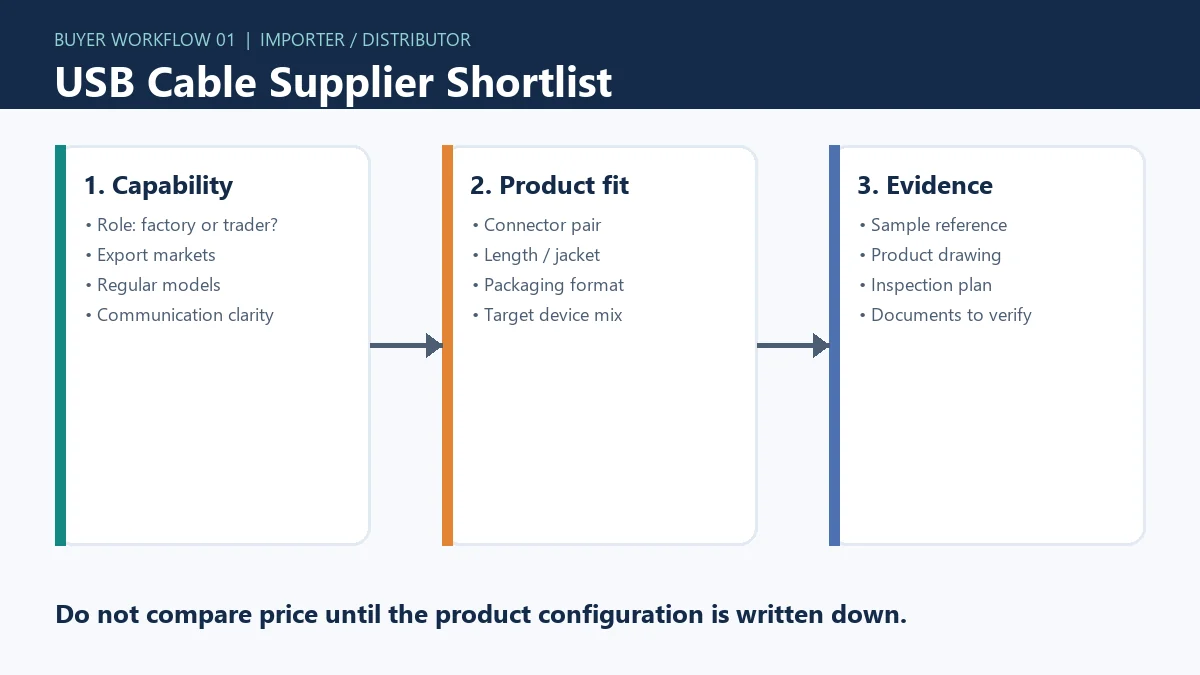
A low unit price can look attractive, but I have learned that the lowest quotation does not always represent the lowest total cost1. Cable construction, production consistency, retail presentation, and after-sales support all affect the final result. In the sections below, I explain how I evaluate these areas when I work with overseas buyers.
How should I shortlist USB cable suppliers?
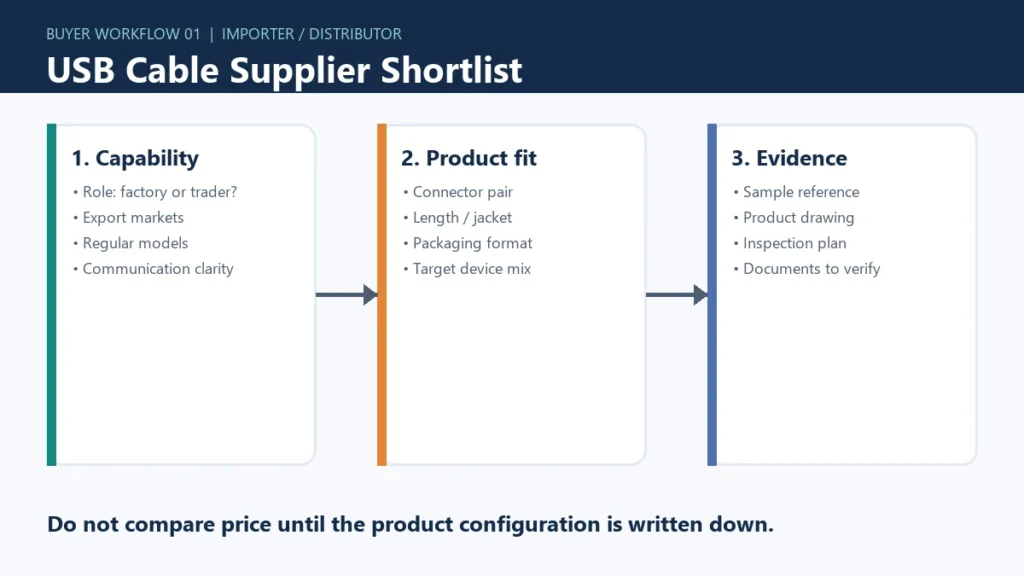
Many suppliers can offer similar-looking cables, but their manufacturing control and export experience may differ considerably. I first reduce the list by examining commercial reliability, product clarity, and documentation. This process helps me spend sample and testing resources on suppliers that appear capable of supporting repeat orders.
Importers can shortlist USB cable suppliers by checking export experience, product range, factory or trading-company role, quality procedures, communication, certifications, MOQ, lead time, customization ability, and after-sales policy. They should also ask for product-specific documents instead of relying only on general company introductions or catalog statements.
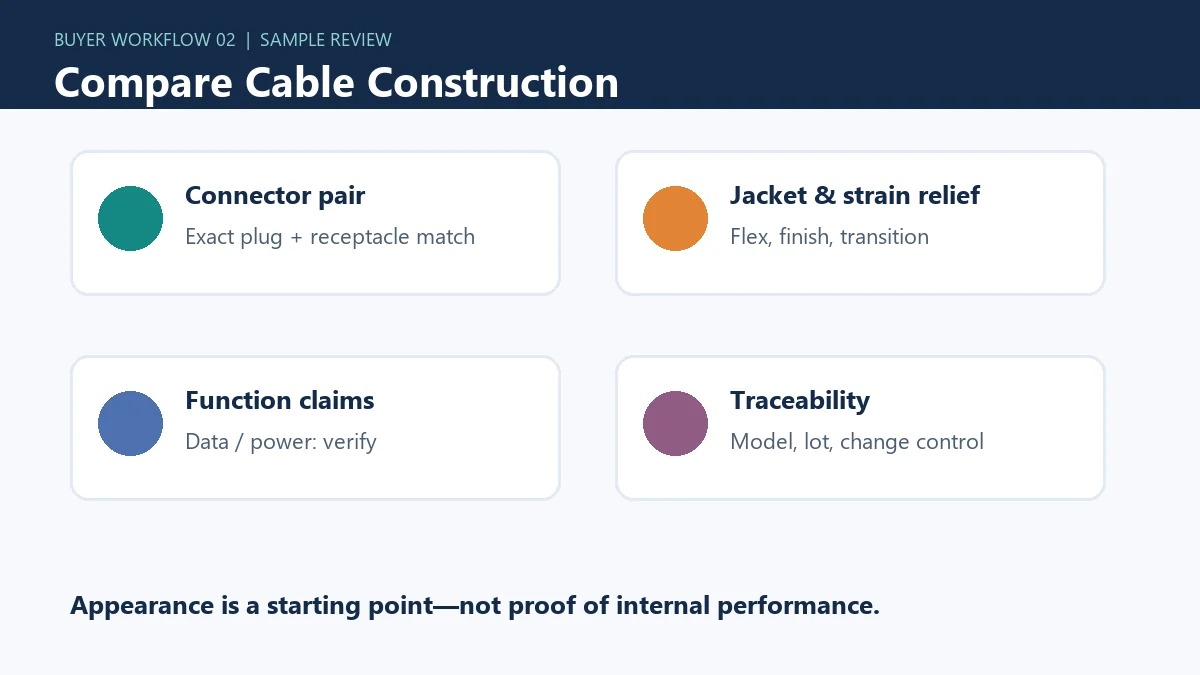
When I communicate with a potential supplier, I try to separate confirmed information from claims that still require verification. A supplier profile may show useful information, but it does not automatically prove that every listed cable has the same performance or documentation.
What I confirm during the first supplier review
I normally request the following information:
- Company name, registered address, and main contact person
- Whether the company is a manufacturer, trading company, or both
- Main export markets and experience with the buyer’s destination country
- Product catalog and current model list
- Available connector combinations
- Cable lengths, colors, jacket materials, and packaging choices
- MOQ for standard products and customized products
- Sample cost and sample preparation time
- Mass-production lead time
- Warranty and replacement policy
- Payment terms and shipping options
- Available compliance and test documents
I do not treat a long product list as proof of production capability. I ask the supplier which products are made regularly and which products are sourced from another factory. A trading company can still be useful, especially when it provides product coordination and export support, but I need to understand who controls the production and quality process.
Questions I ask the supplier to answer in writing
A written quotation should answer more than “How much is one cable?” I ask the supplier to describe the exact product configuration. I want the quotation to identify:
- Connector types on both ends
- Cable length and permitted tolerance
- Outer material and color
- Connector housing material
- Intended charging and data functions
- Packaging format
- MOQ and price breaks
- Sample-to-production approval process
- Lead time after artwork and payment approval
- Inspection and replacement terms
I also ask the supplier to identify which specifications are standard and which are optional. For example, a cable may be available with different jacket materials, connector housings, internal structures, or packaging formats. A price comparison is unreliable if two quotations describe different configurations.
How I assess supplier communication
Communication is part of supplier quality. If a supplier gives unclear answers before an order, I expect more difficulty during production. I look for direct responses, consistent terminology, and a willingness to provide reasonable evidence.
I pay attention to whether the supplier:
- Repeats the same specifications across quotation, sample, and invoice
- Clearly explains what the supplier can and cannot guarantee
- Provides document names and dates
- Reports limitations instead of making broad promises
- Answers questions about defects and corrective action
- Understands the buyer’s destination market and packaging needs
My company has worked with overseas 3C buyers for 15 years, and I have seen how small communication gaps can create large commercial problems. A cable can be technically acceptable but still unsuitable if the packaging, label, connector orientation, or delivery schedule does not match the buyer’s sales plan.
Confirmed facts versus supplier verification
I usually create a simple evaluation sheet:
| Evaluation area | Information I can record | What I still verify |
|---|---|---|
| Export experience | Company-reported markets and years | Whether references or records support the claim |
| Product range | Listed cable models | Whether the exact model is produced regularly |
| Quality system | Supplier-provided procedures | Whether the procedures apply to this product |
| Certifications | Copies supplied by the company | Scope, validity, issuing body, and product relevance |
| Delivery | Quoted lead time | Actual production capacity during the order period |
| Customization | Available colors and packaging | MOQ, tooling, artwork, and approval requirements |
| Warranty | Written warranty terms | Defect definition and replacement process |
I recommend that importers retain this sheet with the quotation and sample records. It creates a traceable basis for supplier comparison and makes later discussions more objective.
Which USB cable construction and connector options should I compare?
A cable can look identical to another model while having different internal materials, connector details, flexibility, and expected service life.2 I compare construction according to the product’s intended use rather than choosing only by appearance. Retail price, user environment, and expected failure points all affect the right specification.
Buyers can compare USB cable construction by reviewing connector combinations, jacket material, internal conductor description, shielding, strain relief, flexibility, length, finish, and intended application. They should confirm every charging, data, compatibility, and durability claim with the supplier because visual inspection alone cannot prove internal performance3.
I often begin with the buyer’s sales channel. A grocery wholesaler may need an easy-to-understand, competitively priced cable for general consumer use. A specialist electronics retailer may need clearer technical positioning and more detailed packaging. An online seller may place greater emphasis on photography, compatibility information, and low return rates.
Connector selection
The connector combination must match the buyer’s intended devices and market demand. I ask the supplier to specify the connector on each end rather than using a general description such as “universal cable.”
I confirm:
- Connector type on end one
- Connector type on end two
- Connector orientation or reversible design, where relevant
- Housing color and finish
- Plug fit and insertion quality
- Compatibility claims used on the packaging
- Whether the same external design contains different internal configurations
I also check whether the buyer wants one fixed connector combination or a product family with several variants. A mixed assortment can increase sales coverage, but it also creates more SKUs, labels, cartons, and inventory records.
Outer jacket and mechanical design
The outer jacket affects appearance, flexibility, handling, and resistance to normal use.4 Common options may include different plastic or textile-covered constructions, but I do not assume that one material is automatically better. I ask the supplier to state the material and explain its intended benefits.
I compare:
- Flexibility at normal room temperature
- Surface texture and resistance to visible wear
- Cable memory after coiling
- Resistance around the connector ends
- Strain-relief design
- Color consistency between samples and production
- Ease of cleaning and retail presentation
The connector-to-cable transition deserves special attention. Many cable failures happen near this flexing area.5 I examine whether the strain relief appears long enough for the intended use and whether the transition bends smoothly. I cannot confirm service life by appearance alone, so I request the supplier’s applicable internal test method or third-party evidence where available.
Internal construction and performance claims
A supplier may describe the cable as suitable for charging, data transfer, synchronization, or other functions. I record these claims exactly as provided, but I do not add technical promises that the supplier has not documented.
I ask for confirmation of:
- Conductor material and structure
- Internal wire arrangement
- Shielding design
- Charging capability under defined conditions
- Data-transfer capability under defined conditions
- Compatibility with intended devices
- Any required electronic components inside the cable
- Applicable test reports for the exact model
I avoid inserting unsupported technical details into product listings. I also ask whether the test report refers to the same connector combination, cable length, and internal construction. A report for one model may not automatically apply to another model that looks similar.
Comparing cable options for different sales positions
| Buyer position | Product priorities | Supplier questions |
|---|---|---|
| Value retail | Competitive cost, clean packaging, acceptable everyday use | Which specifications are fixed, and what changes at the lowest price? |
| Mid-range retail | Better finish, stronger presentation, consistent quality | What construction controls support repeat production? |
| Online sales | Clear compatibility, accurate images, low return risk | Which claims can the buyer substantiate in product content? |
| Business distribution | SKU stability, documentation, replenishment | Can the supplier maintain the approved model over repeat orders? |
| Customized program | Branding, colors, packaging, labels | What are the artwork, tooling, MOQ, and approval conditions? |
I once reviewed a cable sample that looked attractive but had a connector housing finish different from the buyer’s approved packaging image. The issue was easy to correct at the sample stage. It would have been much more expensive after printing and shipment. This experience is why I connect product specifications with marketing materials before mass production.
How can I verify USB cable quality and batch consistency?
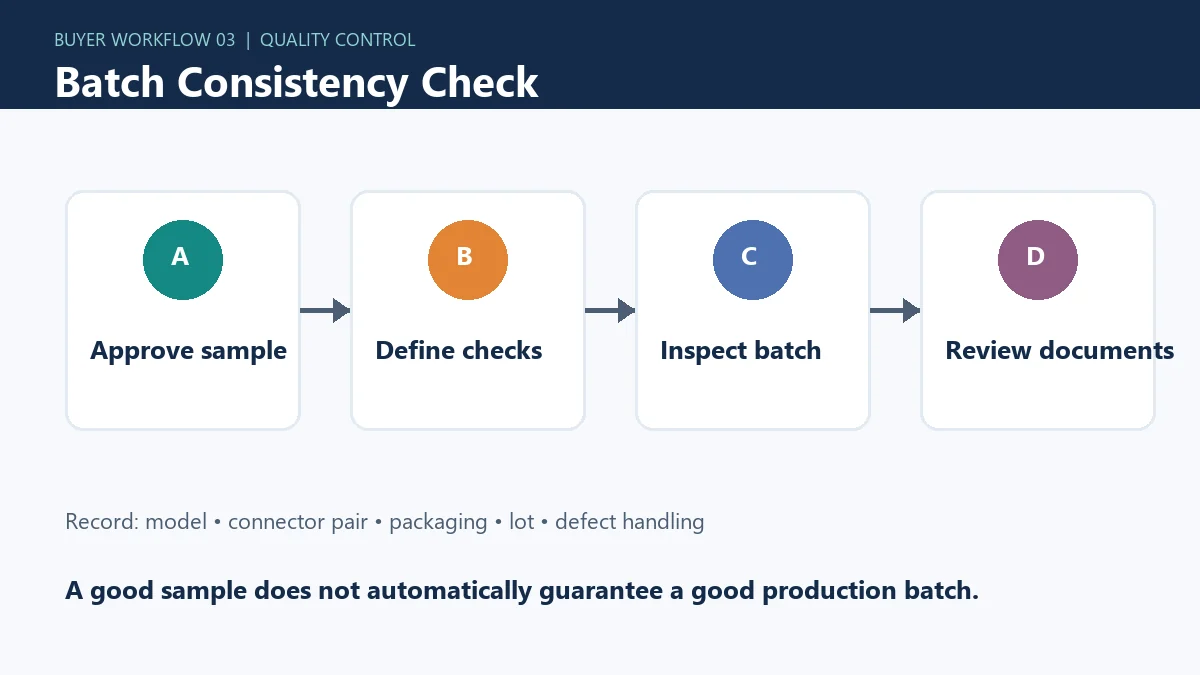
A satisfactory sample does not automatically guarantee a satisfactory production batch.6 I treat the sample as an approval reference and then ask how the supplier will control mass production against that reference. I also define what happens when inspection identifies a defect or variation.
Importers can verify USB cable quality through documented specifications, sample approval, production inspections, appearance checks, functional testing, packaging checks, and batch records. They should compare production samples with the approved reference and ask the supplier to explain sampling methods, defect classifications, corrective action, and replacement responsibilities.
Quality control must match the buyer’s risk. A cable sold as a basic accessory may have different inspection priorities from a cable positioned for demanding users. I recommend that importers define acceptance requirements before production, not after receiving the goods.
What I inspect during sample approval
I keep the approved sample or a clearly documented sample set. I record:
- Exact connector combination
- Cable length and measurement method
- Color and surface appearance
- Connector fit and finish
- Markings and logos
- Packaging dimensions
- Label information
- Functional observations
- Photos from multiple angles
- Any approved deviations
I label the sample with the supplier name, model number, date, and buyer reference. If several variations are approved, I label each one separately. This step prevents confusion when the buyer orders multiple lengths or connector combinations.
Practical quality checkpoints
I divide inspection into four stages.
1. Incoming material control
I ask whether the supplier checks incoming connectors, jacket materials, conductors, labels, and packaging components. I also ask how the supplier handles materials from different vendors. Consistency may become difficult if the supplier changes a material source without notifying the buyer.
2. In-process control
I ask how workers or inspectors check assembly, connector attachment, jacket appearance, strain relief, and marking during production. In-process checks can identify problems before a full batch is completed.7
3. Finished-product inspection
I request information about finished-product checks, including appearance, dimensions, connector fit, and any relevant functional tests. I do not invent a test result or assume that a test was performed because the supplier uses the word “quality checked.”
4. Pre-shipment inspection
I recommend a final inspection before shipment when order value or customer risk justifies it. The inspection can cover quantity, model mix, packaging, carton marks, labels, and selected functional checks. The buyer should agree on the inspection scope and acceptance criteria in advance.
Batch consistency questions
I ask the supplier:
- Does the production batch use the same approved materials as the sample?
- Will the supplier notify me before changing materials or subcontractors?
- How does the supplier identify production lots?
- How does the supplier retain inspection records?
- What defect categories does the supplier use?
- How does the supplier handle rework?
- Can the supplier provide photos or reports before shipment?
- What is the process for handling confirmed defects after delivery?
I distinguish between cosmetic variation, functional failure, and documentation error. Each issue may require a different remedy. A small color variation may require buyer approval, while an incompatible connector or incorrect label may require sorting, rework, or replacement.
Certifications and reports
Certifications and test reports can support a procurement decision, but I treat them as documents that require verification. I ask for copies that show the document title, product scope, company name, issue date, validity period where applicable, and issuing organization. I also check whether the document applies to the exact cable model.
I do not use a general company certificate as proof that every cable complies with every market requirement.8 I recommend that buyers ask a qualified compliance professional or testing laboratory to evaluate requirements for the destination market and product claims.
Building a quality agreement
A basic quality agreement can include:
- Approved product specification
- Approved sample reference
- Permitted visual tolerances
- Required functional checks
- Packaging and labeling requirements
- Inspection timing
- Defect classification
- Corrective-action process
- Replacement or credit terms
- Change-notification requirement
This document does not need to be complicated. It needs to be clear enough for both sides to understand what constitutes an acceptable shipment.
How should I plan samples, orders, MOQ, and lead time?
Poor order planning can create excess inventory, rushed production, or missed seasonal sales. I use samples to reduce technical uncertainty, then use a controlled first order to test the supplier’s commercial performance. I avoid treating the sample price or sample lead time as proof of mass-production conditions.
Importers can plan USB cable orders by defining the target market, testing representative samples, confirming the approved specification, checking MOQ and price breaks, allowing time for artwork approval, and building a realistic production and shipping schedule. They should also confirm how the supplier handles changes between sample approval and mass production.
A buyer may want a low MOQ, several colors, multiple lengths, and custom packaging at the same time. These requirements can be commercially possible, but each added variation can affect purchasing quantities and production efficiency. I discuss these trade-offs early.
My recommended sample process
I use a staged sample process:
- Catalog review: I select models that appear to match the market need.
- Specification confirmation: I request written details for each selected model.
- Initial samples: I review construction, appearance, connector fit, packaging, and stated functions.
- Functional evaluation: I arrange suitable testing for the buyer’s application.
- Commercial sample approval: I approve the exact model and packaging direction.
- Pre-production confirmation: I confirm that the factory will use the approved reference.
- Mass-production inspection: I compare the batch against the approved information.
I do not recommend testing only one sample when the order includes several connector combinations or lengths. The buyer should select samples that represent the actual SKU mix.
MOQ and price comparison
MOQ can apply at several levels:
- Per connector combination
- Per color
- Per cable length
- Per packaging design
- Per printed artwork
- Per carton configuration
I ask the supplier to state the MOQ for each level. A supplier may quote a low MOQ for a standard cable but require a higher quantity for custom colors or packaging.
| Commercial item | Why I verify it |
|---|---|
| Unit price | Different specifications may be included |
| Sample fee | It may or may not be refundable |
| Packaging fee | Printing and setup may be separate |
| Tooling fee | Custom molds or fixtures may add cost |
| MOQ | It may vary by SKU and packaging |
| Lead time | Artwork approval and material preparation may be excluded |
| Payment terms | The timing affects production release |
| Replacement terms | The buyer needs a practical remedy for defects |
I compare the total landed cost rather than only the factory price. Freight, duties, inspection, packaging, storage, payment fees, and potential returns can change the commercial result.
Lead-time planning
I ask the supplier to divide lead time into stages:
- Artwork confirmation
- Material preparation
- Production
- Inspection
- Rework, if needed
- Packing
- Booking and shipment handover
I also ask which events start the lead-time calculation. Some suppliers count from deposit receipt. Others count from artwork approval or final specification confirmation. I record the agreed starting point in the purchase documents.
My company works with buyers in Europe and North America, where seasonal launches and promotional programs can create strict deadlines. I recommend adding reasonable time for inspection, port procedures, customs documentation, and possible transport disruption. A supplier’s production estimate is not the same as the complete door-to-door schedule.
How should I manage USB cable packaging, labeling, and shipping documents?
Packaging and documentation can determine whether goods clear smoothly and reach retail shelves in sellable condition. A technically acceptable cable can still create problems if the carton quantity is wrong, labels are incomplete, or documents do not match the shipment. I manage these details as part of product quality.
Importers can manage USB cable packaging and shipping by approving artwork, verifying labels and carton marks, confirming inner and outer quantities, checking shipping documents, and matching all details to the purchase order. They should also confirm destination-market requirements with the customs broker or qualified compliance adviser.
I start packaging discussions before the order is released. Packaging changes can affect MOQ, cost, production time, and carton dimensions. Early approval gives the supplier time to identify conflicts between the product, artwork, and shipping marks.
Packaging details I review
I check:
- Retail box, bag, blister, or other selected format
- Product name and model number
- Connector description
- Cable length
- Supported functions stated on the package
- Brand name and logo placement
- Barcode or internal SKU
- Country-of-origin marking where required
- Warnings and instructions
- Language requirements
- Inner carton quantity
- Master carton quantity
- Carton dimensions and gross weight
- Protective materials for transport
I ask the buyer to provide final artwork in an editable or supplier-approved format. I request a digital proof and, where practical, a physical packaging sample. I compare the printed packaging with the approved cable because model mix-ups can happen when several visually similar items are produced together.
Labeling and legal review
I do not decide destination-market labeling requirements by assumption. I ask the importer to confirm them with the relevant customs broker, retailer, marketplace, or compliance professional. The correct requirements may depend on the product claims, sales channel, destination, and local regulations.
I recommend confirming:
- Product identification
- Importer or responsible business information, where required
- Country-of-origin information
- Safety or disposal information, where applicable
- Required language
- Barcode format
- Retailer-specific label rules
- Marketplace listing and packaging rules
Certifications and marks should appear on packaging only when the buyer has verified that they are applicable and permitted. I do not recommend adding a mark simply because it appears on another product or supplier template.
Shipping-document checklist
Before shipment, I compare the following documents with the purchase order:
- Commercial invoice
- Packing list
- Bill of lading or air waybill
- Purchase order
- Product description
- Model numbers
- Quantities
- Carton counts
- Gross and net weights
- Dimensions
- Consignee and shipper details
- Origin information
- Any required certificates or declarations
The product description should be clear and consistent across documents. I also check whether the carton marks match the packing list. A discrepancy may delay customs processing or create receiving problems for the distributor.
Shipment planning for distributors
I ask the buyer to decide whether the shipment will move by sea, air, or another method. The choice depends on order size, urgency, cost, and inventory position. I also discuss whether the buyer needs palletization, mixed-SKU cartons, drop shipping, or retailer-specific carton marks.
I recommend taking carton and product photos before shipment. These photos provide a basic visual record and can help resolve questions during receiving. They do not replace inspection, but they improve communication between the supplier, freight forwarder, and importer.
Frequently Asked Questions
What should I ask a USB cable supplier before requesting a quotation?
I ask for the exact connector combination, cable length, jacket and connector materials, intended charging and data functions, packaging format, MOQ, sample cost, lead time, warranty terms, customization options, and available product-specific documents. I also ask whether the supplier manufactures the item or sources it from another factory.
How many USB cable samples should I order?
I select samples that represent the actual planned order. If I will purchase several lengths, colors, connector combinations, or packaging versions, I request representative samples from each important variation. I also keep an approved reference sample for later production comparison.
Can I rely on a supplier’s certification as proof of product quality?
I treat certification documents as evidence that requires verification. I check the company name, product scope, issue date, validity, issuing organization, and relevance to the exact cable model. I recommend qualified professional review when destination-market compliance or product claims create significant risk.
What is more important: a low price or stronger cable construction?
I compare total value rather than choosing solely by price. A lower-cost cable may be suitable for a value segment, while another market may require better finish, packaging, or durability. I match construction and documented performance with the buyer’s target customer, return-risk tolerance, and retail position.
How can I reduce USB cable quality problems after placing a bulk order?
I reduce risk by approving a detailed specification, keeping reference samples, defining inspection criteria, checking production and packaging, reviewing documents, and requiring notification of material or design changes. I also agree on defect handling and replacement terms before the supplier starts production.
Conclusion
A reliable USB cable buying guide should help me evaluate more than unit price. I need to compare supplier capability, connector options, construction, documented performance, sample quality, batch consistency, MOQ, lead time, packaging, labeling, and shipping paperwork. I also need to separate confirmed facts from claims that I must verify with the supplier or a qualified professional. With 15 years of export experience in Shenzhen’s 3C market, Our Shenzhen sourcing team helps European and North American importers source USB cables and related accessories with clear specifications, competitive options, and practical order support. Contact me to discuss your target market, SKU requirements, packaging, MOQ, and customization plan.
"Implementing the OECD Recommendation on Public ...", https://www.oecd.org/en/publications/implementing-the-oecd-recommendation-on-public-procurement-in-oecd-and-partner-countries_02a46a58-en/full-report/implementation-of-the-oecd-recommendation-in-member-and-partner-countries_2305bb1b.html. A total-cost-of-ownership approach evaluates procurement alternatives using costs incurred beyond the initial purchase price, although the specific cost categories and their relative importance depend on the product and purchasing context. Evidence role: general_support; source type: research. Supports: The source should support evaluating procurement options using costs beyond the initial purchase price, including quality, logistics, and lifecycle-related costs.. Scope note: General procurement evidence may not quantify the cost differences associated with USB cables specifically. ↩
"Mechanical Properties and Fatigue Life Analysis of Motion Cables in ...", https://pmc.ncbi.nlm.nih.gov/articles/PMC10893113/. Cable durability is influenced by internal conductor, insulation, connector, and strain-relief construction, so external appearance alone is not a reliable indicator of mechanical performance. Evidence role: mechanism; source type: paper. Supports: The source should explain how conductor arrangement, insulation, shielding, connector assembly, or strain relief can affect cable flexibility and durability independently of external appearance.. Scope note: Evidence from general flexible cables may not apply quantitatively to every USB cable design. ↩
"Research Progress of Automated Visual Surface Defect ... - PMC", https://pmc.ncbi.nlm.nih.gov/articles/PMC7570919/. Visual inspection can identify observable defects but does not substitute for electrical and functional testing of concealed cable properties. Evidence role: general_support; source type: research. Supports: The source should distinguish appearance inspection from electrical, mechanical, and functional tests needed to evaluate concealed or performance-related properties.. Scope note: The precise tests required depend on the claimed function, applicable standard, and cable design. ↩
"Effects of Mechanical Stress on Insulation Structure and ... - PMC", https://pmc.ncbi.nlm.nih.gov/articles/PMC9317511/. The material and construction of a cable jacket contribute to its flexibility, surface durability, and resistance to mechanical wear during handling. Evidence role: mechanism; source type: paper. Supports: The source should support the relationship between cable-jacket material or construction and mechanical flexibility, abrasion resistance, and handling behavior.. Scope note: The source may concern industrial or power cables rather than consumer USB cables and may not establish a universal ranking of jacket materials. ↩
"Bending Strain and Bending Fatigue Lifetime of Flexible Metal ... - PMC", https://pmc.ncbi.nlm.nih.gov/articles/PMC6696189/. Repeated bending can concentrate strain at cable terminations, making the connector-to-cable transition a mechanically vulnerable region in flexible cable assemblies. Evidence role: mechanism; source type: paper. Supports: The source should document stress concentration and fatigue damage at cable terminations or connector transitions under repeated bending.. Scope note: Failure location depends on cable geometry, materials, bend radius, loading, and test conditions; the evidence does not prove that most failures occur there for all USB cables. ↩
"Documentation and Records: Harmonized GMP Requirements", https://pmc.ncbi.nlm.nih.gov/articles/PMC3122044/. A retained or approved sample establishes a reference condition, whereas batch conformity depends on production-process control and representative inspection of subsequent output. Evidence role: general_support; source type: research. Supports: The source should support the distinction between a reference sample and evidence that a continuing production process remains stable and conforms to requirements.. Scope note: The level of inspection needed varies with product risk, process capability, lot size, and contractual acceptance criteria. ↩
"Real-Time Monitoring and Control of Additive ...", https://www.nist.gov/programs-projects/real-time-monitoring-and-control-additive-manufacturing-processes. In-process monitoring and inspection can reveal process deviations before production is complete, allowing corrective action before defects propagate through an entire lot. Evidence role: mechanism; source type: government. Supports: The source should explain how monitoring and inspection during manufacturing can identify process deviations before final production or shipment.. Scope note: Early detection depends on selecting suitable checkpoints, measurements, sampling frequency, and response procedures. ↩
"Conformity Assessment Considerations for Federal Agencies", https://tsapps.nist.gov/publication/get_pdf.cfm?pub_id=926758. Conformity documents support compliance only within their stated product, standard, and jurisdictional scope; a company-level certificate does not by itself demonstrate compliance for every individual product or market. Evidence role: expert_consensus; source type: government. Supports: The source should explain that conformity documents apply only to specified products, requirements, and assessment scopes, and that market obligations vary by jurisdiction.. Scope note: The exact documentation required depends on the destination jurisdiction, product claims, and applicable regulatory framework. ↩