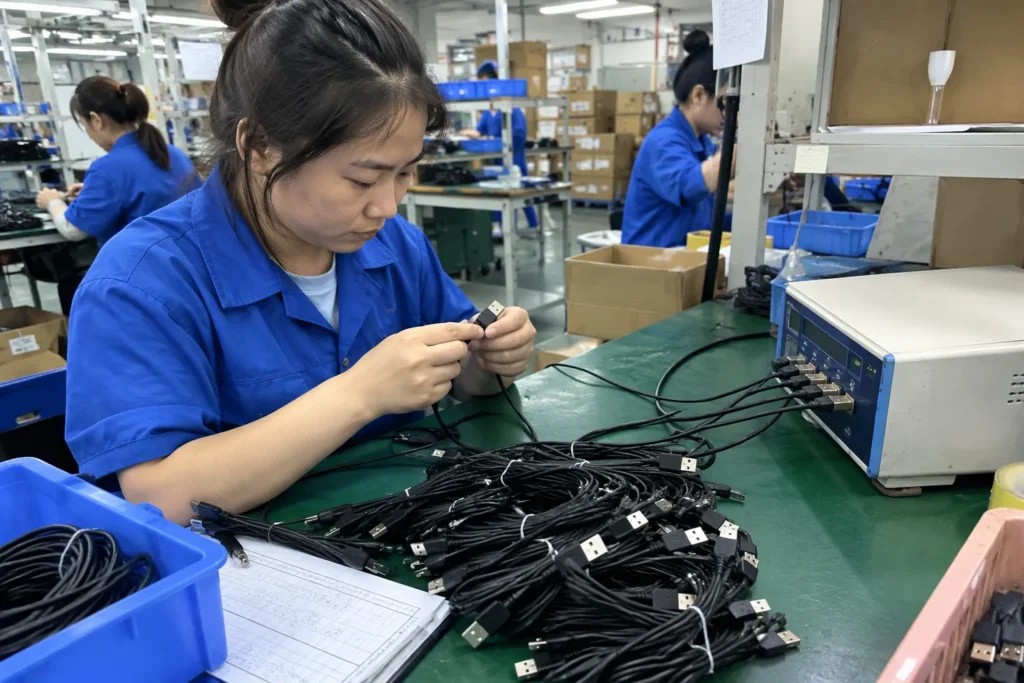
OEM USB cable manufacturing becomes difficult when buyers begin with only a connector type and cable length. I often see incomplete inquiries create changing quotations, unclear samples, and avoidable compatibility risks. A task-based product brief gives suppliers the information they need to quote accurately and helps retailers, wholesalers, and e-commerce sellers control quality, lead time, and after-sales exposure.
Quick Answer
Buyers should prepare a complete OEM USB cable brief before requesting quotations. The brief should identify the devices and use case, charging and data requirements, connector combination, length, construction, materials, branding, packaging, MOQ, sample approval process, target delivery date, and quality documentation. This preparation makes supplier quotations more comparable and reduces compatibility, rework, and delivery risks.
- Define the devices, charging tasks, data tasks, and operating environment.
- Convert “fast charging” into specific power, protocol, and testing requirements.
- Confirm the connectors, length, cable construction, materials, color, and logo method.
- Prepare packaging, labeling, MOQ, sampling, inspection, and delivery requirements.
- Ask suppliers to identify which claims and documents require product-specific verification.
A good inquiry brief does more than help a supplier calculate a unit price. It creates a common reference for sampling, production, inspection, packaging, and future reorders. In my experience with OEM USB cable inquiries for European and American customers, the most useful discussions usually start with the customer’s intended task rather than with a cable format.
Why Should Buyers Start with the Use Case in OEM USB Cable Manufacturing?
Many buyers know that they need a USB-A to USB-C or USB-C to USB-C cable, but that information does not define the product. The same connector combination can serve different charging and data applications.[1] If the task remains unclear, a low quotation may describe a product that cannot meet the buyer’s actual expectations.
Buyers should first explain which devices the cable will connect, what charging or data-transfer task it must perform, how often it will be used, and where it will be sold. The supplier can then recommend a suitable construction and identify requirements that need confirmation before sampling.
Device combinations matter
A cable for a wall charger and smartphone has a different commercial purpose from a cable for a laptop, monitor, docking station, power bank, or gaming accessory. The buyer should list representative device combinations instead of describing the product only as “a charging cable.”
| Buyer description | Why it may be incomplete | Better inquiry detail |
|---|---|---|
| USB-C fast charging cable | “Fast” has no defined power or protocol | Intended charger output, device types, required power level, and confirmation method |
| Data sync cable | Data performance can vary widely | Devices, transfer purpose, expected data capability, and any required testing |
| Durable retail cable | Durability has several meanings | Bending expectation, connector strain relief, jacket material, appearance, and inspection criteria |
| Universal phone cable | Compatibility depends on the actual devices | Main device models, connector types, and known compatibility limitations |
A buyer does not need to know every engineering detail before contacting a supplier. However, the buyer should provide enough information for the supplier to ask focused questions. A product intended for occasional household charging may not need the same construction, packaging, or testing approach as a cable sold in a high-volume retail chain.
Operating conditions affect the brief
- Indoor household use or commercial use.
- Frequent daily connection and disconnection.
- Use in travel kits or vehicle environments.
- Exposure to bending, pulling, twisting, or storage pressure.
- Individual retail packaging or bulk shipment.
- A price-sensitive promotion or a long-term branded range.
I have found that a short device list can prevent long quotation discussions. When a buyer names the charger, device category, intended market, and main use, I can ask the factory more relevant questions. When the buyer provides only “USB-C cable, one meter,” the quotation usually remains provisional.
Use case information reduces downstream risk
The use case affects more than technical compatibility. It also affects inventory planning and customer service. A retailer may need a simple cable with broad consumer appeal. A business selling laptop accessories may need a more carefully defined product with clear limits and supporting documents.
For application-specific decisions, I recommend evaluation by a qualified technical professional. A trading company can organize specifications and supplier communication, but it should not replace product-specific engineering or laboratory evaluation.
Which Power and Data Requirements Should Buyers Specify?
Terms such as “high speed,” “fast charging,” and “full function” sound useful in marketing, but they are not complete manufacturing requirements.[4] Buyers should translate these phrases into measurable or verifiable expectations. This step prevents a common disagreement: the buyer expects a premium feature, while the supplier quoted a basic version.
Buyers should specify the intended power level, relevant charging protocols, data-transfer purpose, connector arrangement, device combinations, and required verification documents. They should ask the supplier to confirm which features are supported by the exact product configuration rather than relying on a general catalog statement.
Define charging expectations carefully
- The charger or power source.
- The receiving device or device group.
- The intended power level.
- Whether the cable is for charging only or charging and data.
- The charging protocols that the buyer expects the cable to support.
- Whether the supplier must provide a test report, specification sheet, or sample verification.
- Whether the claim will appear on packaging or online product pages.
Power performance depends on the complete charging system.[2] The cable, charger, device, connector design, protocol behavior, and other conditions can all influence the result. A cable specification alone cannot guarantee the same charging outcome with every device.
The buyer should therefore use wording such as “for confirmation with the listed charger and device combination” when the application requires it. The supplier should identify the exact configuration being quoted. Any stated power or protocol claim should be checked against product-specific evidence.
Define data requirements separately
Charging and data transfer are related but different requirements.[3] Some cables are designed primarily for charging. Other cables are intended for file transfer, computer accessories, displays, or more demanding applications. The buyer should explain the actual data task.
- The source device.
- The receiving device.
- The expected type of data transfer.
- Whether the cable must support synchronization.
- Whether the product will be marketed with a specific data claim.
- What testing or documentation the supplier can provide.
Understand the role of USB-IF information
The USB Implementers Forum publishes official information about USB specifications, logos, and compliance programs.[5] Buyers can review the USB-IF USB Type-C Cable and Connector Specification and the USB-IF compliance program when a project involves USB technology claims.
- What exact product model does the document cover?
- Does the document identify the same connector and cable configuration?
- Is the document current?
- Does the product use the same components as the sample?
- Is the document a test result, a declaration, or marketing material?
- Does the buyer’s intended market require additional review?
I do not present supplier documents as independent laboratory results. I treat them as documents for buyers to examine and verify. A qualified professional or approved testing laboratory should evaluate any application where compliance, safety, or performance has significant commercial consequences.
Turn claims into a requirement table
| Marketing phrase | More useful buyer requirement |
|---|---|
| Fast charging | Intended charger, device, power expectation, protocol, and verification method |
| High-speed data | Data purpose, device combination, expected performance, and test evidence |
| Strong cable | Construction, jacket material, strain relief, inspection method, and sample approval |
| Premium connector | Housing material, plating or finish requirement, appearance standard, and fit testing |
| Universal compatibility | Defined device list and clear limitations |
What Should an OEM USB Cable Manufacturing Brief Include?
An OEM inquiry brief should connect technical requirements with commercial requirements. A supplier needs both sets of information to prepare a realistic quotation. A buyer that provides only a logo and a target price may receive a fast answer, but the answer may not be stable after the details are clarified.
A complete OEM USB cable manufacturing brief should include the use case, connector types, length, cable construction, materials, color, branding method, packaging, labeling, quality expectations, documentation, MOQ, sample process, target price, and delivery schedule.
Technical specifications
- Connector combination, such as USB-A to USB-C or USB-C to USB-C.
- Cable length and any tolerance requirement.
- Round, flat, braided, or other cable construction.
- Jacket material and preferred appearance.
- Connector housing material and color.
- Strain-relief design.
- Logo location and maximum artwork area.
- Charging and data requirements.
- Packaging dimensions if shelf space matters.
- Any requested color matching or visual standard.
Branding and customization
- Will the logo be printed, laser marked, molded, or placed on packaging?
- Does the buyer have vector artwork?
- Does the buyer require a specific logo color?
- Will every cable have the same artwork?
- Does the buyer need a custom retail box, paper card, bag, or sleeve?
- Who approves the artwork and packaging proof?
- Does the buyer need barcodes, country-of-origin marking, warnings, or recycling information?
Artwork approval should happen before bulk production. I have seen quotation discussions become longer when packaging artwork, cable branding, and labeling are treated as afterthoughts. A supplier may quote the cable correctly but still need to revise the cost because of packaging materials, printing colors, tooling, or manual assembly.
Quality and documentation
- Incoming material control.
- In-process assembly inspection.
- Connector appearance and fit checks.
- Continuity or functional testing.
- Finished-goods inspection.
- Sampling level or inspection standard.
- Defect classification.
- Carton condition and packing method.
- Batch identification and traceability.
- Available product documentation.
If the buyer references AQL or another inspection approach, both parties should agree on the specific standard and sampling plan.[6] The buyer should also define what counts as a critical, major, or minor defect for the project. A supplier’s general quality statement is not a substitute for a written product-specific inspection agreement.
Certification and market documents
For example, buyers can consult official sources such as the European Commission RoHS policy page and the European Commission common charger information. These pages help buyers understand the regulatory context, but they do not determine whether a specific cable meets every requirement.[7]
- The document title and issuing organization.
- The covered model or product family.
- The test date and applicable standard.
- The sample description.
- The laboratory identity, where relevant.
- The relationship between the document and the quoted product.
- Any limitations or exclusions.
How Should Buyers Compare OEM USB Cable Manufacturing Quotations?
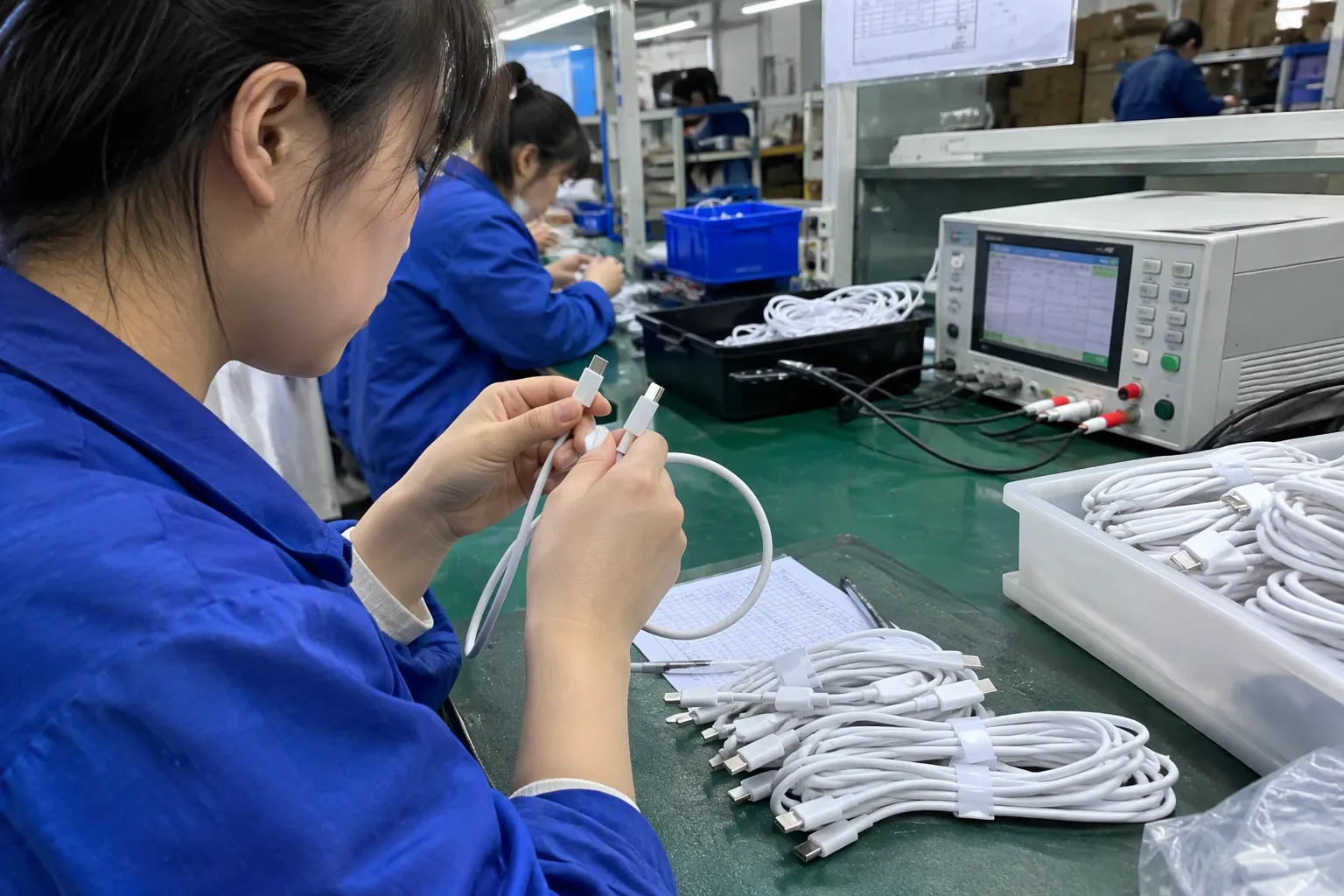
Two quotations can look similar while carrying different commercial risks. One supplier may include packaging, testing, and a realistic lead time. Another may quote a lower cable-only price and add costs after the buyer confirms the details. Unit price is important, but it should not be the only comparison point.
Buyers should compare the complete procurement package: product configuration, included packaging, sample cost, MOQ, tooling, lead time, payment terms, inspection arrangements, documentation, replacement policy, and shipping assumptions. A lower unit price may not represent the lower total cost or lower business risk.[8]
Compare quotations on the same basis
| Comparison point | Supplier A | Supplier B | Buyer’s review question |
|---|---|---|---|
| Cable configuration | Does the quoted version match the brief? | ||
| Charging and data claims | Are the claims specific and supported? | ||
| Materials and construction | Are the jacket, housing, and strain relief comparable? | ||
| Packaging | Is packaging included or charged separately? | ||
| MOQ | Does the MOQ suit the sales forecast? | ||
| Sample timing | Does the sample represent bulk production? | ||
| Bulk lead time | Does it include materials and packaging? | ||
| Inspection | What testing or inspection is included? | ||
| Documents | Do documents cover the exact model? | ||
| After-sales handling | How are verified defects handled? |
Consider MOQ and forecast risk
- Initial order value.
- Packaging and tooling charges.
- Sample and courier costs.
- Expected sell-through period.
- Storage cost.
- Reorder timing.
- Potential write-off if the specification changes.
- Cost of customer returns caused by compatibility confusion.
I usually ask customers whether they are launching a new SKU or replenishing an established product. The answer changes how I discuss MOQ and packaging. A launch order may need a controlled first batch, while an established item may justify a larger production run.
Check lead time in stages
The buyer should ask whether the quoted lead time begins after deposit, artwork approval, sample approval, or material confirmation. The buyer should also ask which events could extend the schedule. Custom packaging often has a different timeline from standard cable assembly.
Review after-sales exposure
- How does the supplier define a product defect?
- What evidence does the supplier need?
- Does the supplier review samples from the reported batch?
- What remedy is available for verified production defects?
- How does the supplier handle repeated issues?
- Can the supplier identify the production batch?
- Who pays for replacement goods or transport under the agreed terms?
How Do Sampling and Approval Control OEM USB Cable Manufacturing Risk?
A sample is not merely a visual preview. It is the buyer’s opportunity to confirm the product configuration, branding, packaging, and stated use before bulk production. However, the sample only reduces risk when the buyer records what has been approved.
Buyers should request a representative sample, test it with the intended device combinations, review its construction and packaging, and issue written approval that identifies the exact version. Bulk production should not begin until open differences are resolved.
Define the sample type
A catalog sample may show general workmanship but may not represent the final cable, logo process, packaging, or component combination. A pre-production sample gives the buyer more relevant information, although the buyer should still confirm how bulk production will be controlled.
Use a written approval record
- Supplier name and product code.
- Connector combination.
- Cable length.
- Color and visible materials.
- Branding artwork and location.
- Packaging version.
- Charging and data requirements.
- Tested device combinations.
- Date and approver.
- Any approved deviations.
- Documents still pending.
Test the buyer’s real use case
- Whether the connector fits correctly.
- Whether charging begins consistently.
- Whether the cable meets the intended physical length.
- Whether data transfer works for the stated task.
- Whether the cable bends and stores as expected.
- Whether the package communicates the product accurately.
- Whether the logo and color meet the approved artwork.
Manage sample changes
This point is especially important for repeat orders. The buyer should request confirmation that the supplier will use the approved version. The buyer should also understand how the supplier manages equivalent substitutions, if substitutions are permitted at all.
What Manufacturing and Supplier Questions Should Buyers Ask?
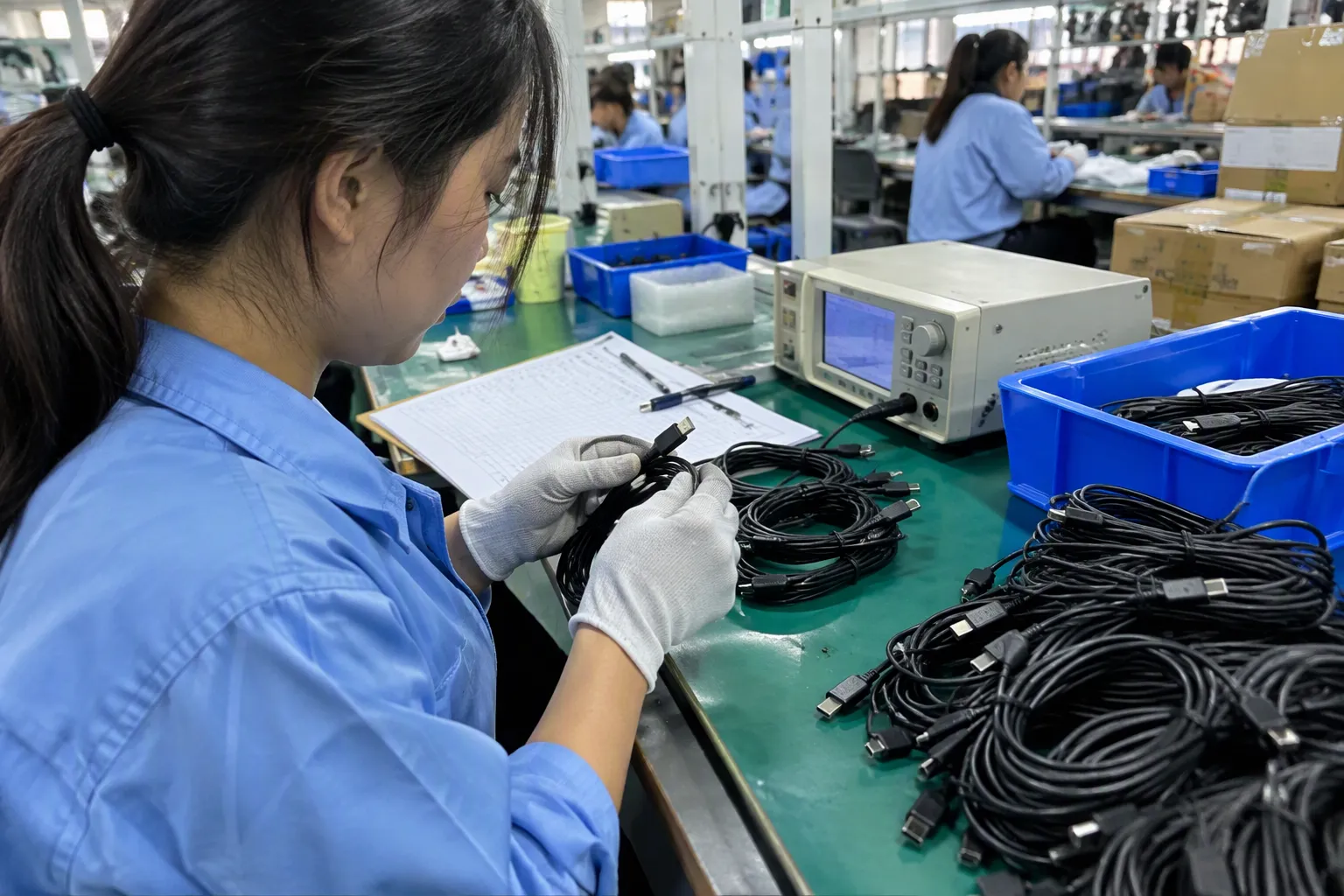
Supplier selection involves more than checking whether a company can provide a product photograph. Buyers should evaluate communication quality, quotation clarity, production control, customization ability, and willingness to document assumptions.
Buyers should ask suppliers to explain the quoted configuration, production process, quality controls, customization limits, lead time assumptions, and handling of changes. Clear answers are useful evidence of procurement readiness, although buyers should still verify important claims through documents, samples, inspections, and professional evaluation.
Ask about production control
- Which processes are performed in-house and which are subcontracted?
- How are incoming connectors, conductors, jackets, and packaging materials checked?
- How does the supplier control cable length and connector assembly?
- What functional checks are performed on finished cables?
- How are defects recorded?
- How does the supplier separate approved and rejected goods?
- How are batch records maintained?
- How does the supplier control changes between orders?
Ask about customization capability
- Minimum order quantity for custom colors.
- Tooling or setup costs.
- Artwork format.
- Printing durability expectations.
- Packaging minimums.
- Color matching process.
- Sample charges.
- Reorder conditions.
- Whether old artwork can be reused.
- Whether the supplier stores approved specifications.
Review communication as part of supplier evaluation
- Answers each question directly.
- Identifies assumptions.
- Separates confirmed information from estimates.
- Sends revised quotations with version control.
- Raises compatibility concerns instead of ignoring them.
- Explains document limitations.
- Confirms sample and bulk timelines in writing.
Verify relevant documents
- Does the document name the same supplier or manufacturer?
- Does it identify the same product model or configuration?
- Is the document current?
- Is the issuer identifiable?
- Does the scope match the destination market?
- Does the sample or production version match the documented version?
- Does an independent professional need to review it?
The U.S. Consumer Product Safety Commission provides general information about testing and certification responsibilities for products within its scope. Buyers should consult the relevant authority or compliance adviser for their specific product and market.
How Can Buyers Prepare for Packaging, Shipping, and Reorders?
Packaging and logistics can change the commercial result of an OEM project. A cable that meets the technical brief can still create problems if the retail package damages easily, misses required labeling, or occupies more shelf and carton space than planned.
Buyers should define the packaging format, dimensions, labeling, barcode requirements, carton configuration, shipping marks, and delivery milestones before bulk production. They should also plan how the approved specification will be reused for future orders.
Packaging should support the sales channel
- Individual packaging type.
- Product and package dimensions.
- Front-of-pack claims.
- User instructions or warnings.
- Barcode and SKU information.
- Language requirements.
- Carton quantity.
- Carton dimensions and weight.
- Pallet or stacking requirements.
- Protection against connector and cable damage.
Coordinate production with shipping
The buyer should also allow time for sample approval and artwork changes. A very short requested delivery date can force the supplier to use standard packaging or reduce customization options. Early planning gives the supplier more realistic options.
Build a reorder system
Link to wider procurement planning
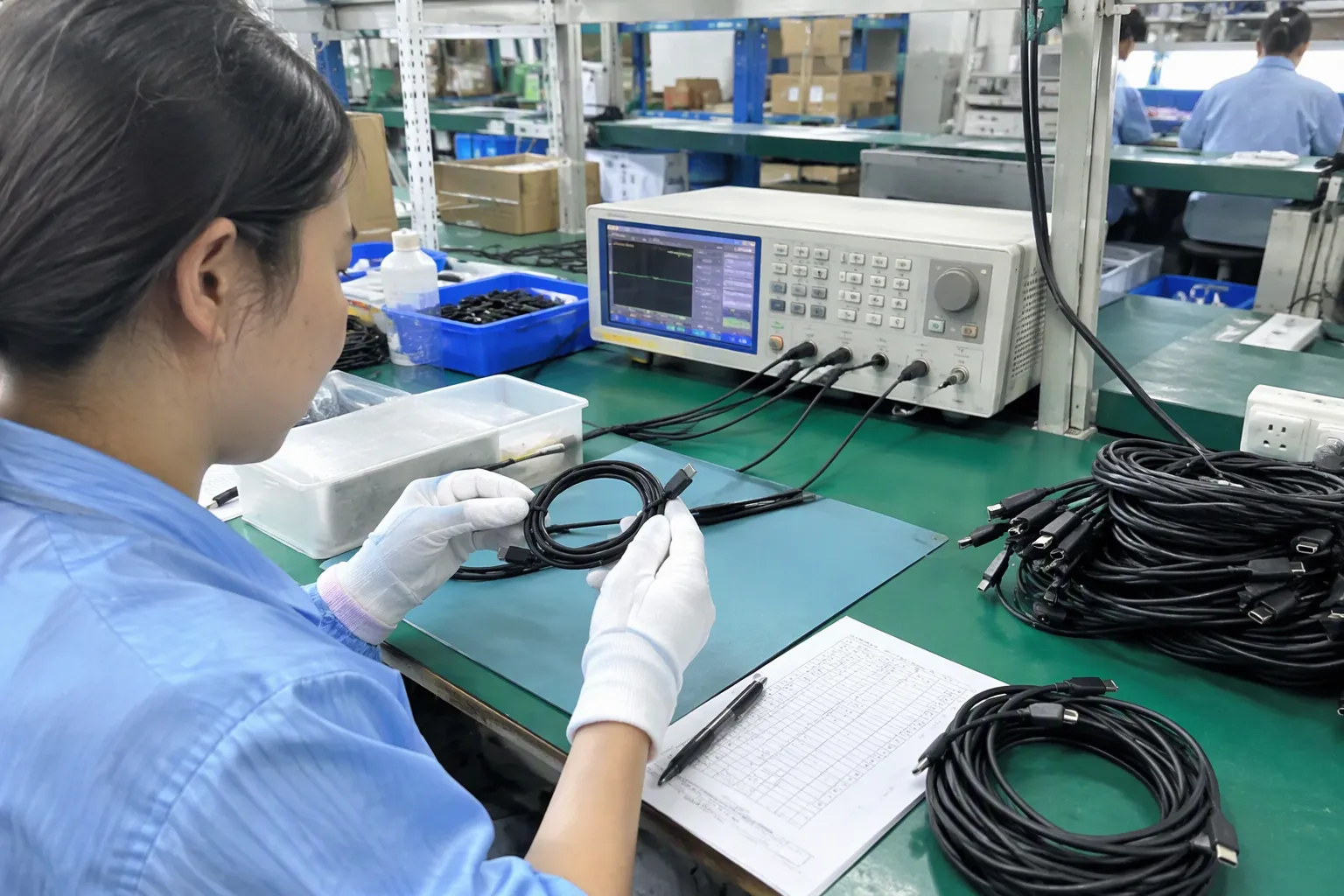
Buyers who manage several 3C categories may also benefit from a structured USB charger supplier evaluation or a private-label charging accessory checklist. These related reviews can help align cable specifications with chargers, power banks, TWS accessories, and retail packaging.
Frequently Asked Questions
Is OEM USB cable manufacturing only about adding a logo?
No. OEM USB cable manufacturing can include connector selection, cable construction, materials, color, strain relief, branding, packaging, labeling, testing expectations, and documentation. A logo is only one part of customization. The buyer should define the complete product and commercial brief.
What information should I send when requesting an OEM USB cable quotation?
I recommend sending the device use case, connector types, length, charging and data requirements, materials, appearance, logo and packaging needs, target quantity, MOQ expectations, sample requirements, destination market, target delivery date, and requested documents. A device list is especially useful when compatibility matters.
Can a USB-C cable support every fast-charging device?
No. Performance depends on the cable, charger, device, protocol, connector configuration, and other system conditions. Buyers should define the intended device and charger combinations and ask the supplier to confirm the exact product configuration. A qualified professional should review application-specific claims.
How many samples should I order before bulk production?
The number depends on product complexity, branding, packaging, order value, and risk. At minimum, I recommend reviewing a representative product sample and packaging proof. Buyers with important performance claims or large orders should consider additional testing or a pilot batch.
How should I compare two OEM cable suppliers?
I recommend comparing equivalent specifications rather than unit price alone. Review the product configuration, power and data claims, materials, packaging, MOQ, sample process, lead time, inspection, documents, payment terms, and after-sales process. A comparison table makes missing or different assumptions easier to identify.
Conclusion
OEM USB cable manufacturing works best when the buyer prepares a task-based brief before requesting quotations. The brief should connect device use, power and data requirements, physical construction, customization, packaging, sampling, quality control, documents, MOQ, and delivery. I use this structure to clarify customer inquiries and reduce avoidable quotation changes. Buyers can send their requirements to our Shenzhen 3C trading team for a practical review, comparable supplier quotation, and customization discussion.
Sources
- Understanding USB Type-C Features and Benefits", The USB Implementers Forum specifications describe USB Type-C as a connector and cable system whose supported power, data rates, and alternate modes depend on the applicable USB protocols and product implementation
- USB PD Power Negotiations", USB Power Delivery documentation describes charging capability as a negotiated interaction among the power source, sink device, and cable, with supported operating conditions constrained by the capabilities of the participating components
- How to easily tell whether a USB-C cable is data-only, ...", USB specifications treat power delivery and data communication as related but distinct functions, so a cable configuration can provide charging without supporting the data rate or alternate mode required by a particular application
- USB Charger (USB Power Delivery)", USB technical documentation specifies power profiles, signaling rates, and supported functions through defined protocols and performance categories; generic expressions such as fast charging or high speed do not by themselves identify one such category
- Compliance", The USB Implementers Forum identifies itself as the industry organization responsible for developing and maintaining USB specifications and for administering associated compliance and logo programs
- 6.2.3.1. Choosing a Sampling Plan: MIL Standard 105D", ISO 2859-1 and related acceptance-sampling guidance treat an AQL value as one element of a defined sampling plan that also requires a lot basis, inspection level, sample size, and acceptance criteria
- RoHS Directive - Environment - European Commission", European Commission conformity-assessment guidance indicates that regulatory requirements are demonstrated through product-specific technical documentation and applicable conformity procedures rather than by reference to a general policy webpage alone
- A Supply Chain Strategy for the Aviation Industry - ScholarWorks", Procurement cost models commonly distinguish the purchase price from total cost of ownership, which may include inspection, transportation, inventory, quality failure, warranty, and return-related costs