A USB-C to Lightning cable factory may offer an attractive price, but a low quotation does not solve the problems that matter after shipment[1]. I have seen buyers focus on factory photos and unit cost, then worry about returns, complaints, delayed replenishment, and unclear certification documents. A structured supplier check helps me reduce those risks before approval.
The best USB-C to Lightning cable factory is not necessarily the largest or cheapest supplier. I should verify product samples, batch consistency, compliance documents, quality-control procedures, MOQ, lead time, packaging options, and after-sales support. I should also compare the total cost of defects and delays, not only the quoted unit price, before placing a commercial order.
Quick Answer
- I should request samples before discussing a large production order.
- I should verify certification and compliance documents independently where possible.
- I should compare cable construction, packaging, MOQ, lead time, and warranty terms.
- I should ask how the supplier controls consistency between production batches.
- I should calculate the cost of returns, complaints, and delayed replenishment.
- I should approve a written product specification and inspection standard before production.
A supplier presentation can help me create an initial shortlist, but it cannot prove stable commercial performance by itself. I need to connect every claim with evidence that applies to the actual cable, packaging, and order quantity.
In my work with European and North American 3C buyers, the recurring questions are practical. Buyers ask whether the supplier can repeat the approved sample, meet the required delivery date, support custom packaging, and respond when a customer reports a charging problem. Those questions deserve more attention than a polished factory photograph.
USB-C to Lightning Cable Factory: What Should I Verify First
Many buyers start with a search for a USB-C to Lightning cable factory and immediately compare prices. That approach feels efficient, but it can hide important differences in materials, inspection, documentation, and order handling. I start with a supplier-screening process that separates marketing claims from evidence.
A suitable supplier should be able to explain the product specification, sample process, quality checks, production schedule, documentation, and complaint procedure. I would not treat “factory direct,” a large building, or a low MOQ as proof of quality. I use those points only as questions for further verification.
What does factory capability really mean?
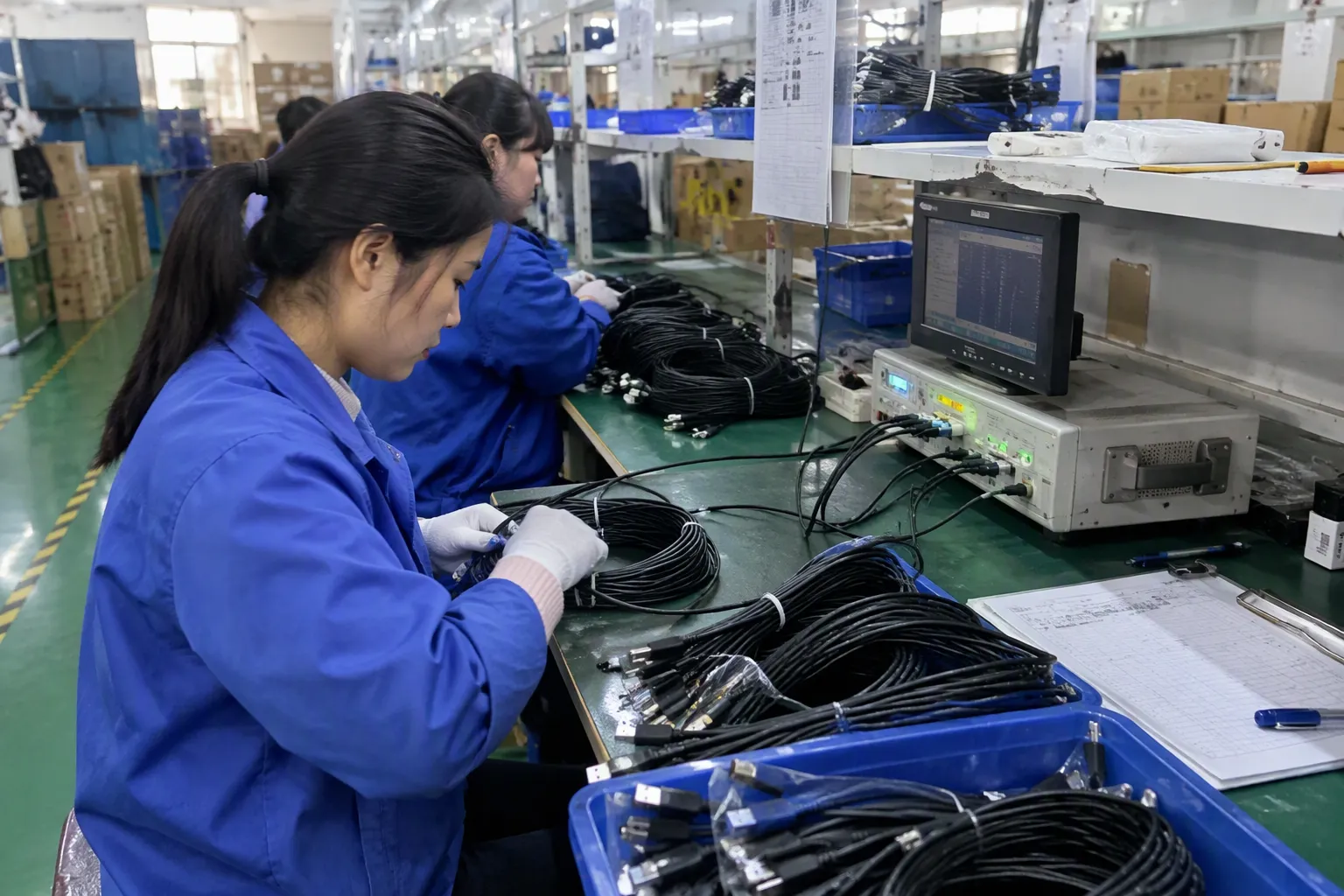
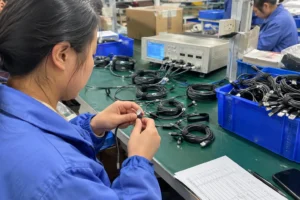
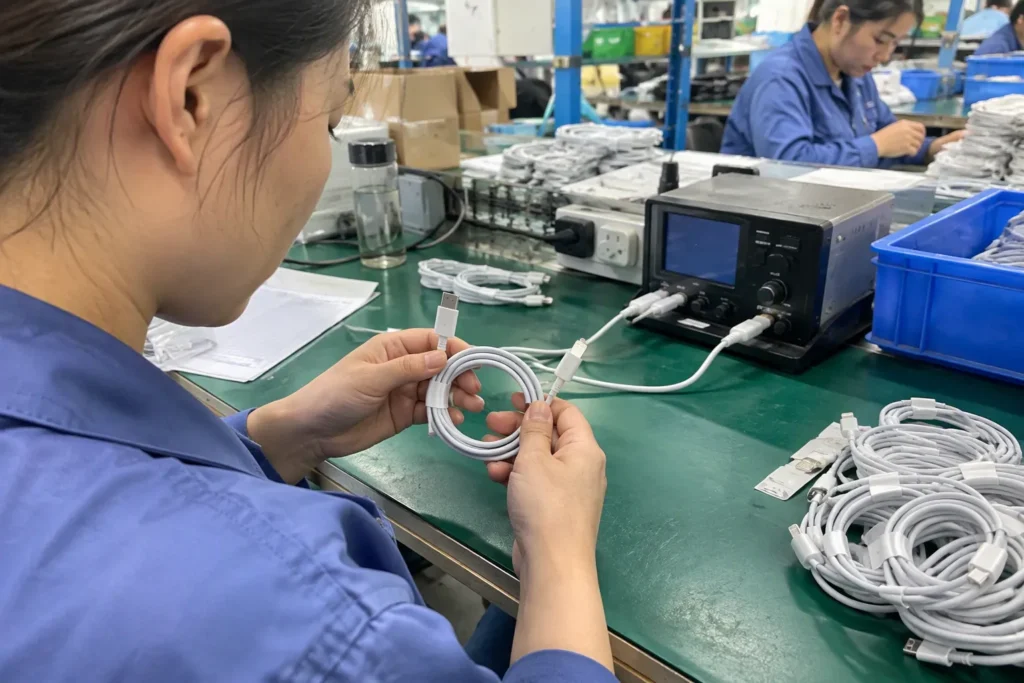
Factory capability means more than having assembly equipment or a large product catalogue. For me, it means the supplier can produce a commercially acceptable batch repeatedly and communicate clearly when something changes.
| Evaluation area | What I ask the supplier | Evidence I want to review |
|---|---|---|
| Product identity | Which exact cable, connector, length, and finish will I receive? | Written specification and approved sample |
| Production control | How does the supplier check materials and assembly? | QC process, inspection records, or inspection plan |
| Batch consistency | How will the next order match the approved sample? | Retained sample policy and batch inspection method |
| Compliance | Which claims apply to this exact model? | Relevant documents, report numbers, and issuing bodies |
| Delivery | What is the normal production lead time at my quantity? | Production schedule and order confirmation |
| After-sales | How are defects and complaints handled? | Written warranty or claim procedure |
I have learned that a supplier’s ability to answer specific questions is itself useful information. A vague answer does not automatically mean the supplier is unsuitable, but it tells me that I need more evidence before approval.
Why do samples matter?
A sample allows me to check the actual buying decision rather than an abstract catalogue item. I can review connector fit, cable flexibility, printing, packaging, charging behavior, data performance where relevant, and general workmanship. I can also ask the supplier to identify the sample by model number and revision.
I should remember that one sample cannot prove long-term batch stability[2]. A sample only gives me an initial reference point. I need to confirm that the production order will use the same specification, materials, and approved packaging. If a buyer needs formal technical testing, I recommend using a qualified laboratory or professional evaluator rather than relying on a visual inspection alone.
How should I screen a new supplier?
- Shortlist suppliers that can meet the target market, product type, MOQ, and packaging needs.
- Request a complete quotation with model details, length, connector type, packaging, lead time, and commercial terms.
- Ask for documents related to the exact product, while treating supplier-provided documents as claims requiring verification.
- Order samples and record the sample specification.
- Agree on acceptance criteria before production.
- Confirm pre-shipment inspection or arrange an independent inspection when the order value justifies it.
- Review the first shipment and record defects, complaints, and replenishment performance.
USB-C to Lightning Cable Factory: How Do I Compare Supplier Quotations
A quotation can look competitive while excluding the costs that affect my margin. I have received or reviewed inquiries where buyers compared only the cable price, even though packaging, testing, shipping preparation, replacement goods, and minimum order quantities changed the final commercial result.
I compare quotations on a landed-cost and risk basis[4]. I also ask whether two suppliers are quoting the same product. A cable with a different outer material, internal construction, connector finish, packaging, or compliance status should not be compared as if it were identical[3].
What is included in the real cost?
- Unit price at the quoted quantity
- Custom packaging and artwork setup
- Sample and tooling charges, if applicable
- Inspection or laboratory testing
- Freight, insurance, and import-related charges
- Rework, replacement, or sorting costs
- Inventory held to protect against late replenishment
- Customer returns and marketplace deductions
- Sales time spent handling complaints
I do not assume that every cost applies to every order. I use the list to ask better questions. A supplier offering a slightly higher unit price may create a better commercial result if the product is more consistent and the claim process is clearer.
Why can the lowest price become expensive?
A low price can reflect a legitimate efficiency, but it can also reflect a thinner specification or a different quality-control approach. If the product does not perform consistently, I may face costs that never appeared on the quotation.
For example, a retailer may need to replace units, issue refunds, or remove stock from a shelf. A wholesaler may lose time sorting mixed packaging or handling complaints from several downstream customers. An e-commerce seller may face negative reviews, platform-related costs, and weaker repeat sales. I do not assign invented percentages to these risks because the impact depends on the channel and product agreement. I still include them in the purchasing discussion.
How can I compare two quotations fairly?
| Point | Supplier A | Supplier B |
|---|---|---|
| Exact model and length | Confirm | Confirm |
| Sample approved | Yes/No | Yes/No |
| MOQ | ||
| Unit price at target quantity | ||
| Custom packaging cost | ||
| Estimated lead time | ||
| Inspection arrangement | ||
| Compliance documents available | ||
| Warranty and claim process | ||
| Replenishment communication | ||
| Main unresolved risk |
I mark unresolved points instead of assuming they are included. This habit helps me avoid accepting an attractive price that later changes when I request retail packaging, documentation, or a specific delivery schedule.
What commercial questions should I ask?
- Is the quotation based on a standard package or my custom package?
- Does the MOQ apply per color, length, model, or total order?
- How long will artwork approval take?
- Does the lead time begin after deposit, sample approval, or packaging confirmation?
- Can the supplier support a repeat order with the same specification?
- What happens if the delivered quantity contains defects?
- Can the supplier provide replacement goods, credit, or another agreed remedy?
Can Certification Prove USB-C to Lightning Cable Quality?
Certification and compliance documents can support a procurement decision, but they do not prove every aspect of cable quality[7]. I treat certification as one evidence category. I assess durability, compatibility, appearance, packaging accuracy, and batch stability separately.
For Apple-related products, buyers may encounter MFi-related claims. I do not treat the phrase “MFi certified” in a quotation as sufficient evidence. I ask which exact product and supplier entity the claim covers, whether the documents are current, and whether the documents can be verified through an appropriate official or professional channel. Apple’s MFi Program provides the relevant official context for buyers investigating MFi participation and accessories.
What can a document support?
A valid document may support a specific claim about a product, component, factory, or test condition. I need to identify the scope. A certificate for a company does not necessarily cover every cable in its catalogue[5]. A test report for one model does not automatically cover a revised model, a different length, or a different connector assembly[6].
- Product model and revision
- Applicant or manufacturer name
- Report or certificate number
- Test date and validity, where relevant
- Testing body or issuing organization
- Rated input and output information
- Whether the document covers the supplied configuration
- Whether the document appears altered, incomplete, or inconsistent
What does certification not prove?
- That every future batch will match the tested sample
- That the cable will survive every bending or pulling condition
- That the cable suits every charger, device, or operating environment
- That retail packaging makes accurate claims
- That the supplier will meet the agreed delivery date
- That the supplier will handle complaints quickly
This separation is important. A buyer can have a legitimate compliance document and still receive a batch with poor appearance, inconsistent assembly, incorrect packaging, or a different specification. The opposite can also create risk: a cable may look acceptable but lack the documentation needed for a particular market or sales channel.
How should I verify compliance claims?
I first ask the supplier for the exact document and the product reference. I then compare the document with the quotation, sample label, packaging artwork, and purchase order. If the commercial risk is significant, I recommend independent document verification or professional testing.
I also check the destination market’s requirements. European Union buyers can consult the European Commission’s product safety information and relevant national guidance. The exact obligations depend on the product, importer role, claims, and sales channel. I do not present a general document list as a substitute for legal or technical advice.
How Do I Assess Cable Quality and Batch Consistency?
A product sample helps me inspect the first impression, but procurement quality depends on repeatability. I focus on whether the supplier has a controlled way to keep the production batch close to the approved sample.
I do not claim to perform laboratory engineering tests during ordinary sourcing work. I check visible and commercial factors, ask how the supplier controls production, and recommend qualified inspection when the application or order value requires it.
Which sample points should I record?
- Cable length and color
- Connector appearance and alignment
- Markings and logo placement
- Outer jacket material and finish
- Strain relief design
- Packaging dimensions and barcode
- Stated charging or data claims
- Sample date and supplier model number
I keep the approved sample or a documented reference. If the supplier later proposes a change, I ask for written notice and a new sample where appropriate. A change in material, connector supplier, internal component, packaging, or production location can affect the commercial result.
What quality-control questions are useful?
I ask how the factory handles incoming materials, assembly checks, finished-goods inspection, and nonconforming products. I also ask whether the supplier retains production samples and records defect findings.
- Which defects are classified as critical, major, or minor?
- Does the supplier inspect every unit or use a sampling plan?
- Which tests are performed before packing?
- How does the supplier trace a batch to materials and production dates?
- How does the supplier prevent rejected goods from entering normal inventory?
- What inspection report can the buyer receive?
What does a pre-shipment inspection add?
A pre-shipment inspection can identify visible defects, quantity problems, packaging errors, and selected product checks before the goods leave China[8]. It cannot guarantee that no issue will occur later, and it may not replace specialized laboratory testing.
I recommend that the inspection scope match the purchase order. The inspector should know the approved sample, packaging standard, quantities, labeling, and agreed acceptance criteria. If the order involves a large retail program or sensitive compliance requirement, I suggest discussing a suitable inspection plan with a qualified inspection company.
Which quality indicators are commercial rather than laboratory-based?
- Percentage of complaints reported by the buyer
- Speed of supplier responses
- Number of repeated packaging errors
- Frequency of unannounced specification changes
- Accuracy of carton quantities and labels
- Ability to replenish the same model
- Willingness to investigate root causes
What Should I Ask About MOQ, Lead Time, and Custom Packaging?
A supplier can offer an acceptable cable and still be unsuitable for the buyer’s sales plan. MOQ, delivery timing, packaging, and replenishment often determine whether the product works commercially. I discuss these points before sample approval, not after the first large quotation.
How should I evaluate MOQ?
I ask whether the MOQ applies to the total order or to each variation. A supplier may quote a low total MOQ but require a separate minimum quantity for each length, color, packaging design, or private-label version.
I also consider inventory risk. A lower unit price may require an order larger than the buyer can sell within a reasonable period. Excess inventory can become a problem if packaging, connector requirements, market demand, or device trends change.
- Minimum quantity per SKU
- Minimum quantity per package design
- Mixed-model ordering rules
- Sample order quantity
- Reorder MOQ
- Price breaks at different quantities
- Extra charge for small repeat orders
How should I calculate lead time?
| Stage | Question |
|---|---|
| Sample preparation | How many working days are needed? |
| Artwork confirmation | When must I approve packaging files? |
| Material preparation | Are materials in stock or newly purchased? |
| Production | How long does the confirmed quantity take? |
| Inspection | When can inspection occur? |
| Packing and dispatch | How long does export preparation take? |
What should custom packaging include?
- Retail box, blister, pouch, or another format
- Material and dimensions
- Language requirements
- Barcode and SKU information
- Warning statements and product claims
- Logo placement and print colors
- Inner-box and master-carton quantities
- Carton marks and shipping labels
Can a supplier support replenishment?
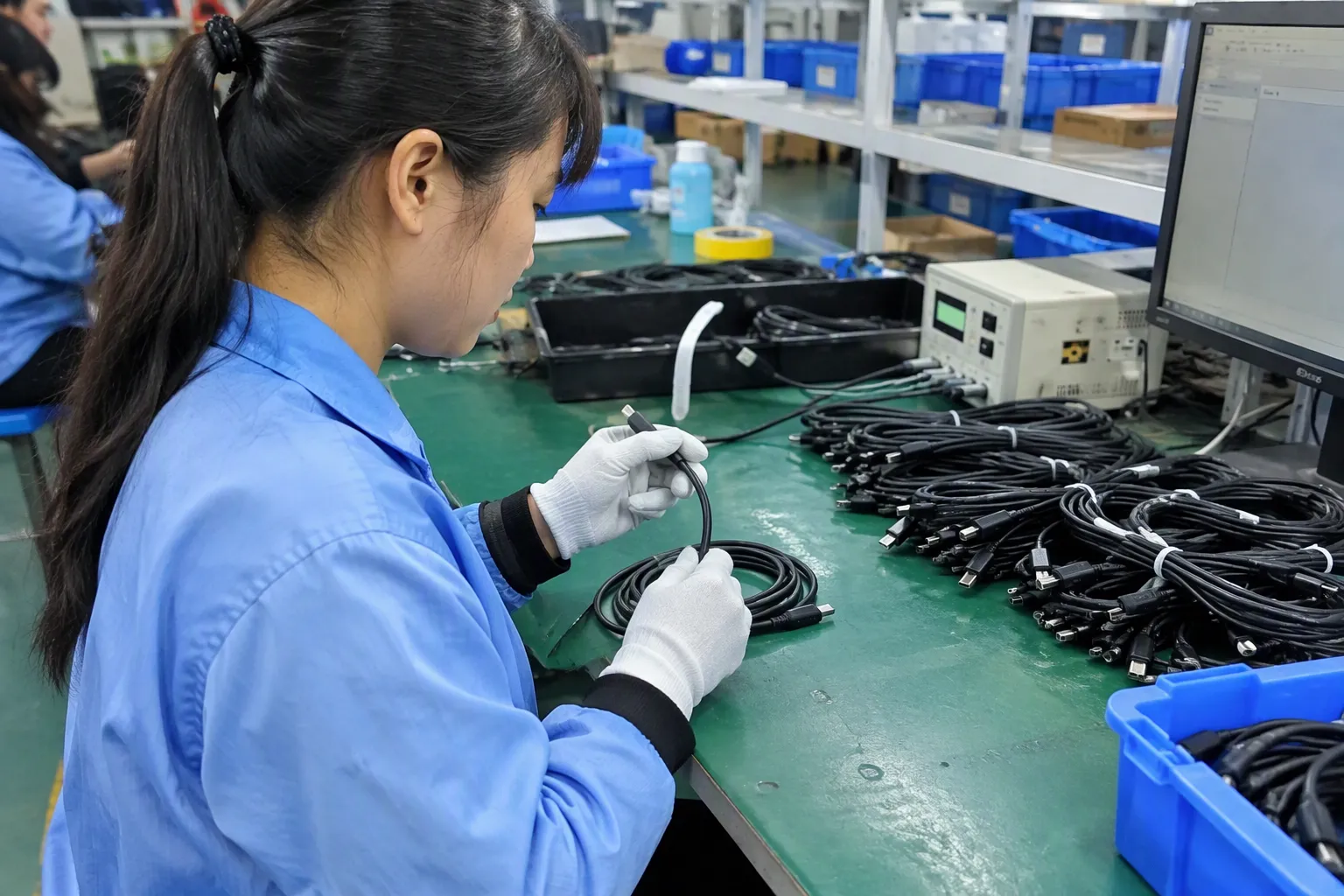
I ask how the supplier will reserve or repeat the approved materials. I also ask whether a later order may use a different connector, jacket material, or packaging source. A supplier does not need to promise that nothing will ever change. The supplier should explain how changes will be communicated and approved.
For many of my overseas buyers, replenishment is more important than a one-time order. I prefer a supplier that gives realistic schedules and early warnings over one that promises an aggressive date and explains the delay only after the buyer asks.
How Do I Manage Warranty and Supplier Risk?
Even after careful sampling and inspection, I need a plan for defects. A practical supplier relationship includes a clear claim process, evidence requirements, response times, and an agreed remedy. I do not rely on a general promise such as “we guarantee quality.”
I also distinguish between a product defect, shipping damage, misuse, compatibility uncertainty, and a customer expectation that was not stated in the purchase order. Clear records help both sides investigate fairly.
What should a warranty discussion cover?
- Warranty period and starting date
- Defect definition
- Evidence required for a claim
- Time allowed for reporting visible defects
- Process for hidden or recurring defects
- Replacement, credit, or refund options
- Responsibility for inspection and return freight
- Response time for an initial investigation
- Procedure for urgent retail or marketplace complaints
How do I investigate a complaint?
- Product model and order number
- Production or shipping batch
- Quantity affected
- Description of the failure or complaint
- Photos or videos where useful
- Charging device and usage context, if relevant
- Packaging and label information
I then ask the supplier for a written response. The response should identify whether the supplier needs samples returned, whether the problem appears isolated or repeated, and what corrective action is proposed.
I avoid assuming that every charging complaint proves a cable defect. A complaint may involve a charger, device port, user handling, packaging claim, or compatibility condition. I still treat repeated complaints seriously and request qualified technical evaluation when the cause is unclear.
Which supplier risks should I record?
| Risk | Early warning sign | Buyer response |
|---|---|---|
| Inconsistent batch | Sample and production goods differ | Written approval standard and inspection |
| Document uncertainty | Generic or mismatched certificate | Request verification or professional review |
| Late delivery | Supplier gives only a best-case date | Confirm production milestones and buffer |
| Packaging error | Artwork changes informally | Approve final proof and carton marks |
| Weak after-sales | Supplier avoids claim details | Put remedy and response terms in writing |
| Reorder disruption | Materials are not reserved | Ask about change notification and capacity |
How Can I Build a Practical Supplier Shortlist?
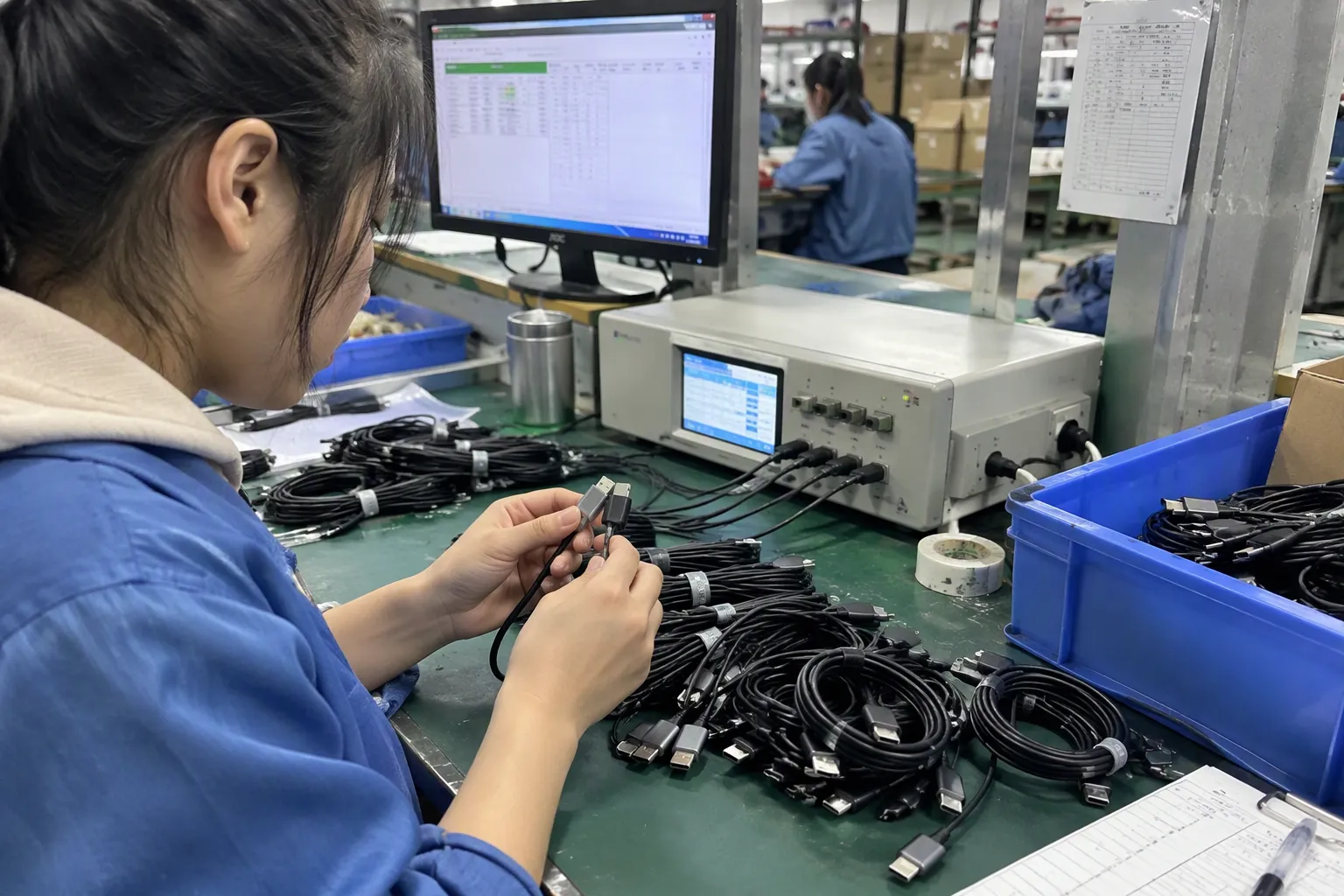
I do not need to contact every supplier in the market. I need a shortlist that reflects my target channel and risk level. A chain-store buyer may need stronger packaging control and documentation. An e-commerce seller may prioritize flexible MOQ, fast replenishment, and clear product claims. A wholesaler may focus on carton efficiency, price tiers, and repeat supply.
Which criteria should I score?
| Criterion | Weight I may consider |
|---|---|
| Sample and workmanship | High |
| Compliance documentation | High |
| Batch-control explanation | High |
| Price and landed cost | Medium |
| MOQ flexibility | Medium |
| Lead-time reliability | High |
| Packaging customization | Medium |
| Replenishment capacity | High |
| After-sales clarity | High |
| Communication quality | Medium |
What should I include in a supplier inquiry?
- Target cable type and length
- Intended market
- Expected order quantity
- Packaging requirement
- Logo or private-label requirement
- Desired delivery window
- Documentation needed for review
- Sample request
- Questions about MOQ and reorder quantity
- Requested warranty and claim terms
When should I reject a supplier?
I consider rejection when the supplier repeatedly avoids specific questions, refuses to identify the quoted model, provides documents that do not match the product, changes key terms without notice, or cannot explain how complaints are handled.
I do not reject a supplier solely because its factory is small. I also do not approve a supplier solely because it appears large. A smaller manufacturer with clear controls may suit a buyer better than a large trading organization with weak product communication. I focus on evidence, fit, and manageable risk.
Frequently Asked Questions
Is a factory-direct USB-C to Lightning cable always better?
No. “Factory direct” may reduce one layer of communication, but it does not automatically prove quality, compliance, or delivery reliability. I still verify samples, documents, production controls, MOQ, packaging, and after-sales terms. I also confirm whether I am dealing with the actual manufacturer or a trading company representing several factories.
What documents should I request from a USB-C to Lightning supplier?
I request documents relevant to the exact model and target market, such as product specifications, applicable test reports, and certification or compliance materials supplied by the supplier. I check the model, company name, date, scope, and issuing body. I treat the documents as claims for verification, not as automatic proof of total product quality.
How many samples should I order?
The number depends on the product risk, order value, and required evaluation. I usually begin with representative samples and record the approved version. For a larger retail program, I may request samples from different batches or arrange independent inspection. A single sample cannot prove that every future batch will be identical.
Can I request a low MOQ and custom packaging?
I can request both, but the supplier may apply separate minimums for printing, packaging materials, or each SKU. I ask whether the MOQ applies per model, color, length, or package design. I also compare the cost of custom packaging against the expected sales volume and reorder plan.
How can I reduce USB-C to Lightning cable returns?
I reduce returns by matching the product to the intended use, checking samples, controlling product claims, verifying relevant documents, inspecting the shipment, and giving accurate retail information. I also establish a complaint process with the supplier. If a compatibility or technical issue remains uncertain, I recommend professional testing before broad distribution.
Conclusion
Choosing a USB-C to Lightning cable factory requires more than comparing factory photos or the lowest unit price. I look for evidence of repeatable batches, suitable documentation, realistic MOQ and lead time, accurate packaging, replenishment capacity, and clear after-sales handling. I treat certification as one part of the review, not a complete quality guarantee. If I am sourcing for a retailer, wholesaler, chain store, or e-commerce business, I should approve the sample and purchasing terms before committing to volume. I can contact our Shenzhen 3C trading team to discuss product matching, samples, packaging customization, MOQ, lead time, and export orders for European and North American markets.
Sources
- Subpart 46.7 - Warranties", Research on total cost of quality treats purchase price as only one component of procurement cost and identifies downstream effects such as defects, rework, warranty handling, and customer returns as relevant economic consequences
- Monitoring Quality Control: Can We Get Better Data? - PMC", Quality-control guidance distinguishes inspection of an individual item from statistical or process-based evidence of continuing production consistency, which requires observations across production output or controlled process data
- Seeking Competition in Procurement", Procurement guidance generally requires competing offers to be assessed against comparable specifications and commercial conditions; differences in product configuration or required compliance can therefore make nominal unit prices non-equivalent
- PART 470—COMMODITY ACQUISITIONS", Supply-chain and procurement literature defines landed cost as the aggregate cost of acquiring goods and bringing them to the buyer, commonly including purchase price, transportation, insurance, duties, and related handling charges
- General Use Products: Certification and Testing", Conformity-assessment guidance distinguishes certification of an organization or management system from evidence covering a specified product, model, configuration, or test scope; a company certificate therefore does not by itself certify every catalogue item
- General Use Products: Certification and Testing", Conformity-assessment practice ties the evidentiary value of a test report to the tested product configuration and the applicable rules for variants or design changes; changes in construction or configuration may therefore require a scope review or additional testing
- Conformity Assessment Basics | NIST", Conformity-assessment documents provide evidence that a product or organization was assessed against specified requirements and conditions; they do not, without additional evidence, establish every aspect of durability, workmanship, future-batch consistency, or commercial performance
- Import Guidance | Food Safety and Inspection Service - USDA", Pre-shipment inspection procedures commonly use defined sampling and acceptance criteria to examine finished-goods quantity, visual condition, packaging, labeling, and selected specified characteristics before dispatch
Related reading: