Semi-in-ear TWS design often creates a difficult retail question: will customers enjoy the comfort without complaining about sound leakage, weak bass, or an unstable fit? I hear this concern regularly when I discuss TWS products with European and American buyers. The solution is not a universal promise. Buyers should match the design, acoustic approach, and fit expectations to the actual listening environment.
Quick Answer
Semi-in-ear TWS design can offer a comfortable, less occluding wearing experience, but it cannot guarantee zero leakage, strong isolation, or identical sound for every user. Leakage depends on the earbud’s position, ear shape, listening level, surrounding noise, and acoustic tuning. I recommend that buyers evaluate samples in realistic settings, request documented test conditions, and select models according to the target customer’s use case rather than isolated specifications.
- Choose semi-in-ear TWS for buyers who prioritize comfort and a more open-feeling fit.
- Treat leakage as a use-case risk, especially in quiet offices, libraries, and public transport.
- Use acoustic compensation to improve perceived balance, not to promise elimination of structural leakage.
- Test fit across several users because ear shape changes stability, bass perception, and audibility.
- Ask suppliers for sample-based evidence, tuning information, quality-control records, and clear after-sales support.
The important point is that semi-in-ear TWS design is a system rather than a single specification. The housing, nozzle position, driver, venting, firmware, ear shape, and environment all influence the customer experience. In the sections below, I will explain how I approach this evaluation when helping buyers select products for retail, wholesale, and e-commerce channels.
Why Does Semi-In-Ear TWS Design Create Leakage Concerns?
Many buyers begin with a simple question: “Will people nearby hear the music?” The question sounds straightforward, but the answer changes from one user and environment to another. A semi-in-ear product usually sits at the entrance of the ear canal rather than forming the same type of seal as a deeper-fitting earbud.[1] That design can improve comfort, but it can also allow more sound to escape.
Semi-in-ear TWS design may produce more audible leakage than a well-sealed earbud in some conditions[2], but the result depends on fit, volume, housing geometry, driver behavior, and background noise. A buyer should not judge leakage from driver diameter or maximum volume alone. The correct method is controlled sample testing in quiet and noisy environments with several users.
Leakage is a combined product and user issue
- Physical placement: A loose or shallow position can allow more outward sound.
- Ear shape: The same shell may sit securely in one ear and move away from the ideal acoustic position in another.
- Listening level: Higher volume usually increases the chance that nearby people can hear the content.[3]
- Open surroundings: Quiet rooms make small amounts of leakage more noticeable.
- Content: Speech, high-frequency detail, and sharp transients may be easier for nearby listeners to notice than some bass-heavy material.
- Product tuning: The acoustic balance can influence how loudly users set the earbuds to hear vocals or bass.
- Movement: Walking, commuting, and facial movement can change the position of the earbuds.
The environment changes the commercial risk
A customer wearing earbuds while walking outdoors may not care about the same leakage level as a customer working beside colleagues in a silent office. Public transport creates another mixed environment. A train or bus may be noisy enough to mask some leakage, but passengers may sit close together, and users may increase volume to hear their content.
| Target environment | Main customer priority | Leakage concern | Retail evaluation |
|---|---|---|---|
| Quiet office | Comfort, clear speech, low disturbance | High | Test at normal listening levels with a nearby listener |
| Public transport | Stable fit, understandable audio, convenience | Medium to high | Test during movement and with realistic background noise |
| Outdoor walking | Awareness, comfort, secure placement | Usually lower | Check stability and wind-related listening behavior |
| Home use | Long-wearing comfort, natural sound | Low to medium | Compare comfort over extended use |
| Fitness or active use | Retention and sweat resistance | Secondary | Verify product suitability and documented protection claims |
I once received a buyer question that sounded like a technical request but was really a positioning question: “Can we sell this as an office-friendly model?” Before discussing leakage, I would ask what the buyer means by office-friendly. Does it mean comfortable for eight hours? Does it mean colleagues should not hear music? Does it mean the user needs awareness of conversations? Each interpretation leads to a different product review.
How to evaluate leakage without overclaiming
- Use several music tracks and spoken content.
- Test at low, normal, and higher listening levels.
- Include at least three or four listeners with different ear shapes.
- Test in a quiet room and a typical background-noise environment.
- Place another listener at a consistent distance.
- Record the earbud position and volume setting.
- Repeat the test after walking or head movement.
- Document the result as an observation, not a universal specification.
For broader background on hearing and safe listening, I recommend reviewing the World Health Organization’s information on safe listening rather than presenting a product’s maximum output as a selling point: WHO safe listening guidance.
How Does Fit Influence Leakage and Sound Quality?
Fit is not only a comfort detail. In semi-in-ear TWS design, fit can become a commercial risk because it affects retention, perceived bass, channel balance, and leakage at the same time. A product that sounds excellent on one person may seem thin or unstable on another person because the housing sits at a different angle.
Fit influences semi-in-ear TWS performance by changing the relationship between the speaker outlet and the ear.[4] A stable position can make sound more consistent and reduce unnecessary volume increases[5], while a poor position may create weak bass, channel imbalance, movement, or more noticeable leakage. Retailers should test multiple ear shapes instead of approving a model from one person’s experience.
Why one sample can give a misleading result
When I review a TWS sample, I pay attention to whether my first impression comes from the product or from my own ear shape. This distinction matters. A product may feel comfortable because it places little pressure on the canal, but the same shallow fit may not hold equally well for every customer.
- The earbud moves away from the preferred position.
- Bass and vocal presence may seem weaker.
- The user raises the volume.
- Higher volume may increase perceived leakage.
- Movement may cause intermittent sound or customer complaints.
- The retailer may receive returns even though the product passes a basic function test.
This is why I encourage buyers to separate initial comfort from long-duration comfort. A shell that feels comfortable for ten minutes may become irritating after several hours. A shell that feels secure at a desk may move during walking. Both observations belong in the evaluation record.
Fit questions for supplier discussions
- What ear sizes or user groups influenced the housing design?
- Does the product use different shell sizes or only one universal shell?
- Does the speaker outlet have a defined orientation?
- Does the product rely on an open fit or partial contact with the ear?
- What happens to sound balance when the earbud shifts?
- Has the model been checked by multiple testers?
- Are fit-related customer returns tracked after launch?
- Can the supplier provide product drawings or wearing instructions?
Comparing fit expectations
| Evaluation point | Semi-in-ear TWS | Sealed in-ear TWS | Open-ear style |
|---|---|---|---|
| Ear-canal pressure | Often lower, depending on shell | Can be higher because of the tip and seal | Usually low inside the canal |
| Retention | Strongly dependent on outer-ear shape | Often supported by the ear tip seal | Depends on the hook or external structure |
| Bass consistency | More sensitive to position | Often more consistent when the seal is reliable | Can vary with placement and surroundings |
| Awareness of surroundings | May feel relatively open | Often reduced by the seal | Usually a central design objective |
| Leakage expectation | Must be tested carefully | Seal may reduce outward sound, but no design guarantees zero leakage | Can be noticeable in quiet settings |
| Customer education | Wearing angle and position matter | Correct tip selection matters | Placement and environment matter |
Can Acoustic Compensation Reduce the Effects of an Open Fit?
Acoustic compensation is useful, but buyers should describe it accurately. A supplier may adjust the equalization, driver behavior, venting, or firmware processing to improve the perceived balance of a semi-in-ear product. This approach can help address some effects of an open fit. It cannot guarantee that every user will hear identical bass, and it cannot physically seal sound that the housing allows to escape.
Acoustic compensation can improve perceived tonal balance and help a semi-in-ear TWS product sound fuller or clearer for a target group. However, compensation does not remove structural leakage, correct every ear-shape difference, or guarantee strong bass for every listener. Buyers should evaluate the tuned product with real users and request documented test conditions for technical claims.
What compensation can reasonably address
These adjustments can make the product feel more satisfying without changing its physical fit. For example, if an open fit makes low frequencies seem less present, the tuning may increase the perceived low-frequency balance. The result still depends on the individual ear and the way the housing sits.
Why compensation cannot replace physical design
A software or tuning adjustment cannot perform the same function as a physical seal. If the product sits away from the ear, sound transmission and leakage remain affected by the open path.[6] More amplification may also create new problems. It can increase total output, reduce battery efficiency, or make the sound less comfortable for some listeners.[7]
| Factor | What compensation may improve | What it cannot guarantee |
|---|---|---|
| Weak perceived bass | A more balanced tonal impression | Identical bass for every ear |
| Vocal clarity | Better intelligibility at a normal level | Clear speech in every noisy environment |
| Treble harshness | Smoother perceived presentation | No listener fatigue for every user |
| Position changes | Some tolerance in the tuning | Stable sound after major movement |
| Open fit | A more satisfying overall balance | Zero outward leakage |
| User volume behavior | Less need to raise volume for some listeners | Safe or comfortable volume for every user |
Questions about tuning evidence
- Which parts of the product were changed: hardware, firmware, or both?
- Was the tuning created for one target curve or for a specific user group?
- Was the result checked on multiple users?
- Were left and right channel differences measured?
- Were tests performed with the earbuds in the intended wearing position?
- Is the claimed response based on a measured unit or a design target?
- Does the tuning remain consistent across production batches?
I would treat frequency-response charts as useful but incomplete. A chart can show a measurement under specific conditions. It does not automatically describe comfort, leakage, retention, microphone quality, or customer satisfaction. Buyers should connect every acoustic document to the practical question they are trying to answer.
For technical measurement terminology, buyers may consult the standards information published by the Audio Engineering Society and request that suppliers identify the relevant method used. A standards reference is valuable only when the supplier provides enough detail for the buyer to understand the test.
Which Use Cases Suit Semi-In-Ear TWS Design?
The best use case is not determined by the product category alone. I look at the customer’s surroundings, wearing time, need for awareness, expected movement, and tolerance for leakage. A semi-in-ear model may be attractive for long periods of casual listening, but a buyer should not automatically position it as suitable for every office, commute, or professional setting.
Semi-in-ear TWS design is often most suitable when customers value a lighter, less occluding wearing experience and can accept some variation in isolation and leakage. Buyers should be cautious when the main promise is discreet listening in very quiet spaces, strong noise blocking, or uniform bass for users with different ear shapes.
Quiet offices
A semi-in-ear fit may support awareness, but the retailer should not assume that awareness means low leakage. In a quiet room, even modest leakage may be noticeable to a nearby colleague. The product page should therefore avoid absolute phrases such as “no sound leakage” unless the business has a narrowly defined, documented test basis.
Public transport
Public transport introduces noise, movement, and close seating.[8] Customers may value comfort and awareness, but they may also want enough perceived volume to understand content. If a semi-in-ear product does not provide sufficient clarity in that environment, some users may raise the volume. That can increase the chance of leakage and may create hearing-safety concerns.
- Retention during walking and boarding.
- Sound clarity against ordinary background noise.
- Ease of controlling volume.
- Whether the housing shifts when the user moves.
- Battery and charging behavior according to verified specifications.
- Whether the product message explains its level of environmental awareness honestly.
The retailer should also avoid claiming that the model provides a particular level of noise cancellation unless the supplier supplies suitable documentation. Semi-in-ear products can use microphones and signal processing, but the effect depends on the complete design and test conditions.
Home and casual use
This segment may tolerate more variation in isolation. It still requires basic product quality, including stable Bluetooth behavior, reliable charging, acceptable microphone performance, and consistent assembly. I would connect these points to the intended price level rather than make unsupported performance promises.
Fitness and active use
I treat active use carefully. A semi-in-ear shell can feel comfortable, but movement may reveal retention limitations that are not obvious at a desk. Sweat, repeated handling, and outdoor conditions may also affect durability. Retailers should request the supplier’s documented protection rating and understand the test scope rather than infer protection from marketing language.
- Whether the product is intended for sports use.
- Whether the charging case and earbuds have the same protection status.
- Whether the warranty covers moisture-related failures.
- Whether the earbud controls are easy to operate while moving.
- Whether the shell remains stable across several users.
Use-case selection table
| Customer positioning | Suitable emphasis | Caution |
|---|---|---|
| Comfort-first daily earbuds | Light wearing feel and casual listening | Do not imply universal fit |
| Office and study accessory | Long-wearing comfort and awareness | Leakage must be tested in quiet rooms |
| Commuter model | Convenience, retention, and speech clarity | Test volume behavior in background noise |
| Fashion-led retail item | Shell design, packaging, and lifestyle appeal | Confirm that performance matches the message |
| Fitness accessory | Stability and documented durability | Do not assume a protection rating |
How Should Retail Buyers Compare Semi-In-Ear TWS Suppliers?

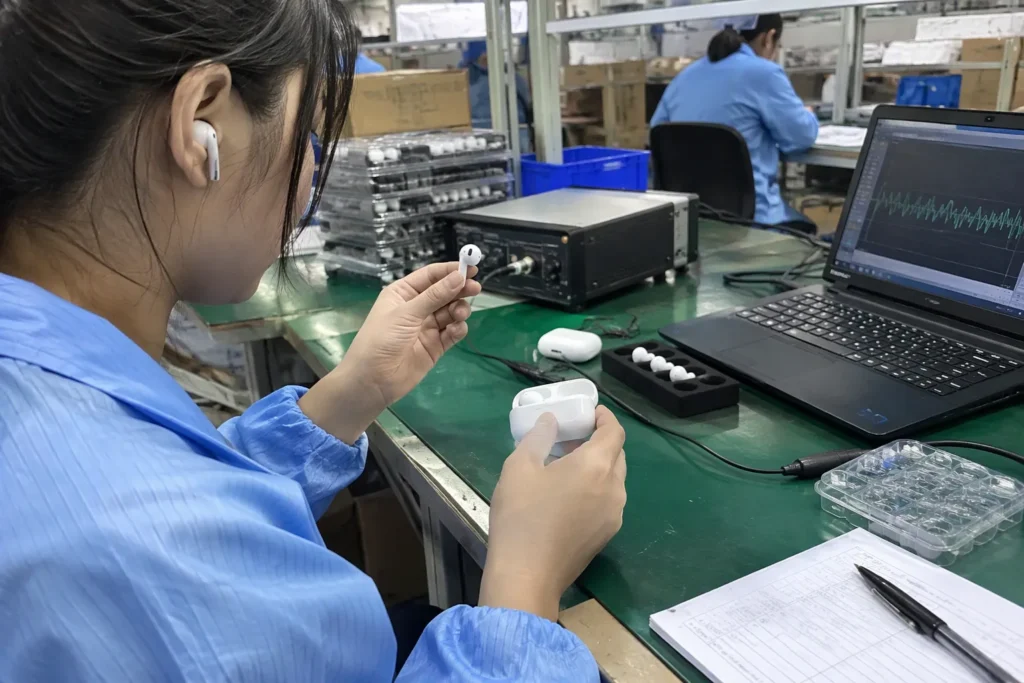
Retail buyers should compare semi-in-ear TWS suppliers through both product evidence and operational evidence. A useful review includes sample consistency, documented specifications, production controls, packaging accuracy, certification documents for verification, lead-time capability, MOQ, spare-part support, and a clear process for handling defects and returns.
Begin with a written product brief
- Main sales region.
- Target retail price.
- Intended environments.
- Comfort and retention expectations.
- Acceptable leakage position.
- Required customization.
- Forecast quantity and MOQ.
- Packaging and language requirements.
- Delivery schedule.
- Warranty and after-sales expectations.
Review evidence, not only marketing language
| Claim type | Buyer response |
|---|---|
| Basic specification | Request the final datasheet and confirm production control |
| Performance claim | Request test conditions, sample identity, and measurement method |
| Certification claim | Request the certificate or declaration and verify scope and validity |
| Customization promise | Confirm tooling, firmware, packaging, MOQ, and approval stages |
| Quality statement | Ask for inspection records, defect criteria, and corrective-action process |
Certifications are important for market access, but buyers should verify the actual documents. A logo on a presentation is not the same as a certificate that covers the correct product, factory, model, and market. European and American buyers should obtain professional compliance advice for their specific product and distribution model.
Useful official references include the European Commission’s CE marking information and the U.S. Consumer Product Safety Commission for relevant consumer-product safety information. These resources do not replace legal or technical review, but they help buyers ask better questions.
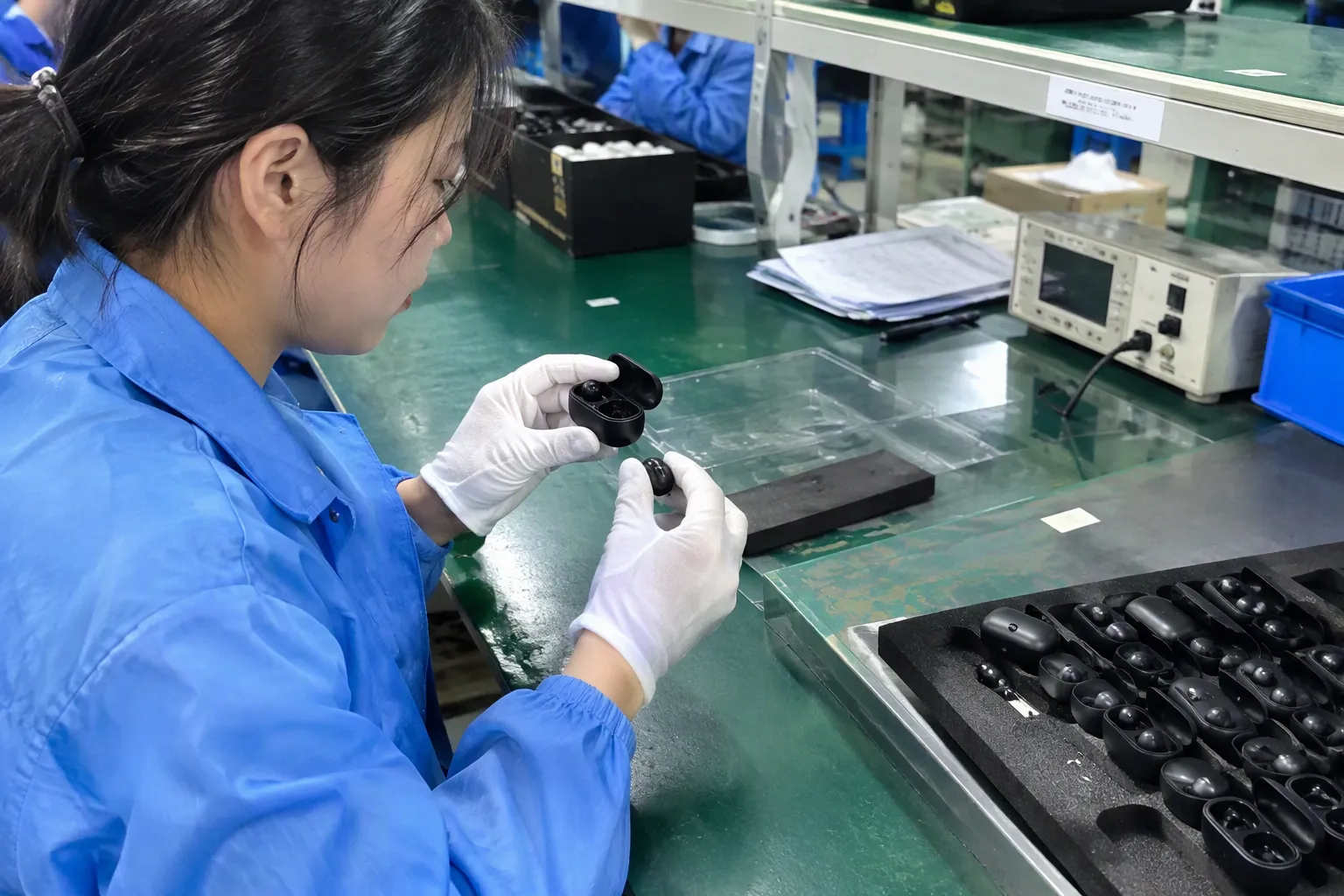
Check production consistency
- A small sample set from the same production process.
- Confirmation of component changes.
- Functional test criteria for both earbuds and the case.
- Charging and pairing checks.
- Cosmetic inspection standards.
- Audio channel and basic output checks.
- Packaging and labeling inspection.
- Final random inspection before shipment.
For customized products, the buyer should approve a reference sample or golden sample. The supplier and buyer should agree on which differences are acceptable. This process is especially important when a tuning change, shell change, or firmware update may alter the wearing experience.
Consider commercial risk
As a Shenzhen-based 3C exporter with long-term experience communicating with overseas buyers, I understand why MOQ and lead time remain central concerns. A good product still needs a workable replenishment plan. I recommend confirming the first order timeline, repeat-order timeline, peak-season capacity, and response process for unexpected defects before signing off.
What Should a Buyer Ask Before Approving a Model?
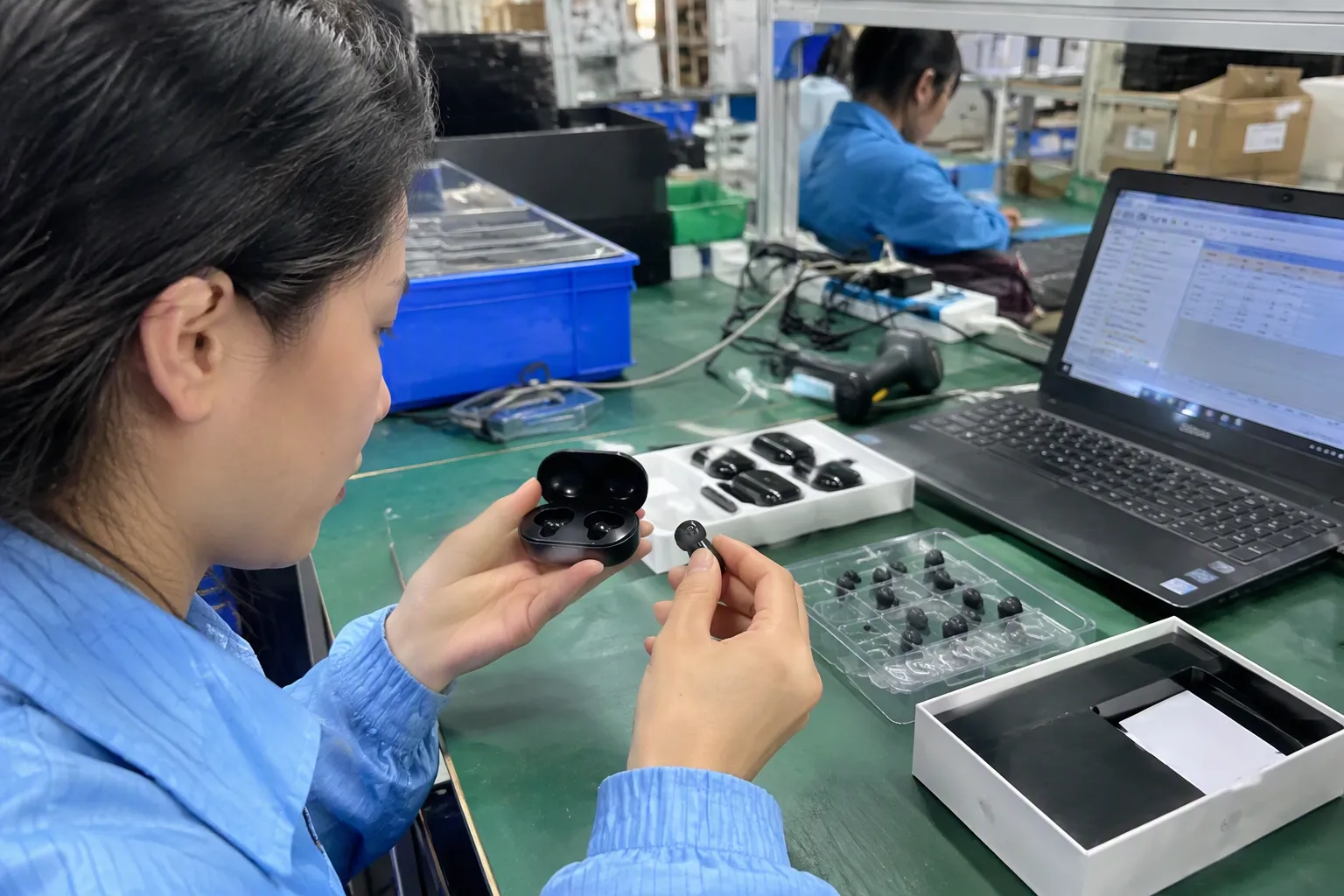
Before approving a semi-in-ear TWS model, a buyer should ask about the target environment, fit variation, leakage testing, acoustic tuning, production consistency, compliance documents, MOQ, lead time, warranty, and change-control process. The buyer should record the answers and verify important claims through samples or qualified testing.
Product and acoustic questions
- What is the intended wearing position?
- What user environments does the supplier recommend?
- How does the supplier define “low leakage” or “clear sound”?
- What test method supports each performance statement?
- Were multiple ear shapes included in the evaluation?
- Does the tuning use hardware, firmware, or both?
- Can the supplier provide a sample before and after customization?
- Are the specifications measured on production units?
Quality and reliability questions
- What are the inspection points during assembly?
- How does the factory check charging contact reliability?
- How are left-right pairing and channel issues identified?
- What is the agreed cosmetic defect standard?
- How does the supplier manage component substitutions?
- What happens if firmware or acoustic parts change?
- Is a pre-shipment inspection available?
- What information will accompany a defect report?
Commercial and service questions
- What is the MOQ for standard and customized versions?
- What is the sample charge and sample lead time?
- What is the expected mass-production lead time?
- Can the supplier support different packaging languages?
- What is the warranty period and remedy process?
- Are replacement earbuds or charging cases available?
- How does the supplier handle repeat orders?
- Can the supplier support retailer-specific labeling?
A practical approval sequence
- Define the customer and environment.
- Shortlist several semi-in-ear models.
- Review basic specifications and available documents.
- Test fit, leakage, clarity, and stability with several users.
- Request clarification on acoustic compensation and tuning evidence.
- Review sample quality and packaging.
- Confirm MOQ, lead time, customization, and after-sales terms.
- Verify relevant compliance documents with qualified professionals.
- Approve a reference sample.
- Inspect production before shipment.
Frequently Asked Questions
Does semi-in-ear TWS design always have more leakage?
No. Leakage depends on the housing, ear position, volume, content, and surroundings. A semi-in-ear model may be more noticeable in a quiet room than in a noisy outdoor environment, but buyers should not make a universal comparison without testing specific products under defined conditions.
Can acoustic compensation eliminate sound leakage?
Is semi-in-ear TWS more comfortable than in-ear TWS?
What is the best environment for semi-in-ear TWS earbuds?
The best environment depends on the product and its target users. Semi-in-ear models may suit casual home use, walking, and comfort-focused daily listening. Quiet offices and close public-transport seating require careful leakage testing because nearby people may notice escaped sound.
What documents should a TWS buyer request from a supplier?
The buyer should request a final datasheet, applicable test reports, relevant certification or declaration documents, inspection criteria, warranty terms, and change-control information. Buyers should verify that documents match the actual model and market. Application-specific compliance review should be completed by qualified professionals.
Conclusion
Semi-in-ear TWS design should be evaluated as a balance between comfort, fit, leakage, acoustic tuning, and customer expectations. I do not recommend choosing a model because it promises “maximum comfort” and “zero leakage” at the same time. I recommend scenario-based testing, multi-user fit checks, documented supplier claims, and careful review of MOQ, lead time, quality control, and after-sales support. If you are selecting TWS products for European or American retail, wholesale, or e-commerce channels, contact me to discuss suitable samples and a practical sourcing checklist.
Sources
- Accounting for the Occlusion Effect with Insert Earphones", The cited acoustics literature distinguishes earbuds that couple loosely at or near the ear entrance from insert-style devices that use a deeper ear-canal seal; this supports the design distinction stated here
- Air-Leak Effects on Ear-Canal Acoustic Absorbance - PMC", Measurements of earphone coupling indicate that less-sealed configurations can produce greater external sound radiation than well-sealed configurations under comparable conditions, supporting the qualified comparison made here
- Headphone Audio in Training Systems or Systems That ... - PMC", Acoustic measurements show that external sound pressure from an earphone generally rises as playback level increases, providing a physical basis for greater audibility to nearby listeners
- HOW THE EAR WORKS - NATURE'S SOLUTIONS FOR ...", Earphone measurement studies demonstrate that placement and coupling geometry modify the acoustic transfer function between the transducer and the ear, supporting the stated relationship between fit and performance
- Association between environmental and headphone noise ...", Research on earphone fit indicates that positional changes can alter measured response and perceived sound, providing contextual support for the possibility that stable placement reduces compensatory volume adjustments
- Designing an Open-Back Enclosure to Mitigate Sound ...", Open-ear and earphone acoustics research indicates that reduced coupling and an unobstructed radiation path affect both the sound delivered to the listener and the sound radiated externally
- Deafness and hearing loss: Safe listening", Electroacoustic and hearing-science literature supports that higher output levels can require greater transducer power and can reduce listening comfort for some users
- Noise Levels Associated With New York City's Mass Transit ...", Transport-noise assessments document that buses and trains can expose passengers to substantial and variable background sound while placing users in close shared spaces, supporting this use-case characterization