Schitec OEM USB Cables can look like a simple purchasing category, but the wrong specification can create charging complaints, data-transfer disputes, returns, and avoidable service costs. I have seen many quotation requests begin with a target price and logo requirement. After we discuss devices, power needs, packaging, MOQ, and delivery, the real product requirement often becomes much more specific.
Schitec OEM USB Cables should be evaluated by matching the cable’s connector configuration, charging capability, data speed, device compatibility, construction, documentation, and order terms to the buyer’s use case. Buyers should confirm these details before approving logos, packaging, or price, because a USB-C connector alone does not define the cable’s performance[1].
Quick Answer
- Start with the use case, including the devices, charging power, data-transfer needs, and retail market.
- Confirm the complete specification, not only whether the cable has a USB-C connector.
- Separate appearance from performance because similar-looking cables can support very different power and data functions.
- Review samples, inspection documents, packaging, MOQ, lead time, and after-sales terms before placing a larger order.
- Treat certifications and performance claims as documents to verify, rather than automatic proof of suitability.
- Use an OEM supplier that can clearly translate your requirements into a controlled product specification.
The most reliable buying process moves from application to specification, then from specification to sample approval and production control. In this article, I explain how I approach Schitec Cables discussions with European and U.S. retailers, wholesalers, chain stores, and e-commerce sellers.
What Should Buyers Understand About Schitec Cables?
A supplier conversation can become confusing when “USB-C cable” is used as if it describes one standard product. The connector shape is only one part of the item. Buyers need a clearer definition before comparing prices or approving a private-label design.
Schitec Cables should be assessed as a configurable OEM product rather than as one universal cable. The buyer should define both ends of the cable, intended devices, charging requirements, data function, length, materials, packaging, order quantity, and documentation. The supplier can then recommend a specification that fits the commercial application.
USB-C is a connector configuration, not a complete performance promise
- Whether the cable supports charging only or charging plus data transfer.
- The maximum power level that the complete cable and connected equipment can support[2].
- The available data-transfer performance.
- Whether video output is supported[4].
- Whether the cable works appropriately with a particular phone, tablet, laptop, charger, hub, or accessory.
- Which safety, environmental, or market documents apply.
The USB Implementers Forum USB Type-C overview is a useful starting point for understanding the connector ecosystem. It should not replace product-specific documentation or professional testing.
Why the first quotation is often incomplete
- Which devices will the cable serve?
- Is the cable intended for charging, synchronization, or both?
- What charger and power range will the customer use?
- Does the buyer need a USB-C plug on both ends?
- Does the cable need to support a defined data-transfer class?
- Which market and sales channel will receive the goods?
- What packaging, labeling, warranty, and inspection requirements apply?
A practical product-definition checklist
| Requirement | Questions for the buyer | Why it matters |
|---|---|---|
| Connector ends | USB-A, USB-C, or another configuration? | Different devices and use cases need different cable designs. |
| Length | What length will be sold? | Length can affect convenience, packaging, and electrical performance[5]. |
| Charging | What devices and charging scenarios are expected? | The cable must be matched to the intended charging application. |
| Data | Is synchronization required? At what stated level? | Charge-only and data-capable products are not interchangeable. |
| Materials | PVC, braided textile, recycled material, or another finish? | Materials affect appearance, flexibility, durability, and cost. |
| Branding | Logo, color, molding, label, or printed package? | Customization needs artwork approval and production controls. |
| Order terms | MOQ, lead time, inspection, and replenishment plan? | Commercial planning affects total purchasing risk. |
| Documents | Which test reports or declarations are required? | Buyers need to verify documentation for the target market. |
How Do Schitec OEM USB Cables Differ in Performance?
Many buyers compare cables by appearance because the products look similar in photographs. That comparison can be misleading. A cable’s actual function depends on its internal design, connectors, conductors, identification components where applicable, and verified production specification.
Schitec OEM USB Cables may differ in charging, data, and device support even when they use the same external USB-C connector. Buyers should compare the complete technical specification and supporting evidence, not just the connector shape, braid color, or advertised wattage.
Charging capability requires careful wording
- The intended power application.
- The cable length and construction.
- Any required electronic identification component.
- The relevant test method and test report.
- The conditions under which the stated performance was measured.
- Whether the claim applies to the cable itself or to a complete charging system.
A buyer should also avoid using broad phrases such as “supports all fast charging.” Different devices and charging systems can use different protocols and requirements. The supplier should state the supported application precisely, and the buyer should confirm it with qualified technical personnel when the product claim is important to the sale.
Data transfer is a separate buying decision
Some consumers assume that every USB-C cable transfers data at the same speed[3]. That assumption can lead to product complaints. A charge-focused cable may not be suitable for a customer who expects high-speed file transfers, external storage, a docking station, or another demanding application.
Connector combinations change the use case
| Cable type | Common commercial use | Points to confirm |
|---|---|---|
| USB-A to USB-C | Existing USB-A chargers, computers, and older power accessories | Charging and data function, connector construction, target devices |
| USB-C to USB-C | Newer chargers, phones, tablets, laptops, and power accessories | Power application, data function, device compatibility, identification requirements |
| USB-C to a proprietary or other connector | Specific device ecosystems | Device fit, market demand, and compatibility claims |
| Short cable | Power banks, travel kits, and bundled accessories | Flexibility, strain relief, and package presentation |
| Long cable | Desk, bedside, vehicle, or retail convenience use | Cable management, voltage drop considerations, and durability |
What the buyer should request before approval
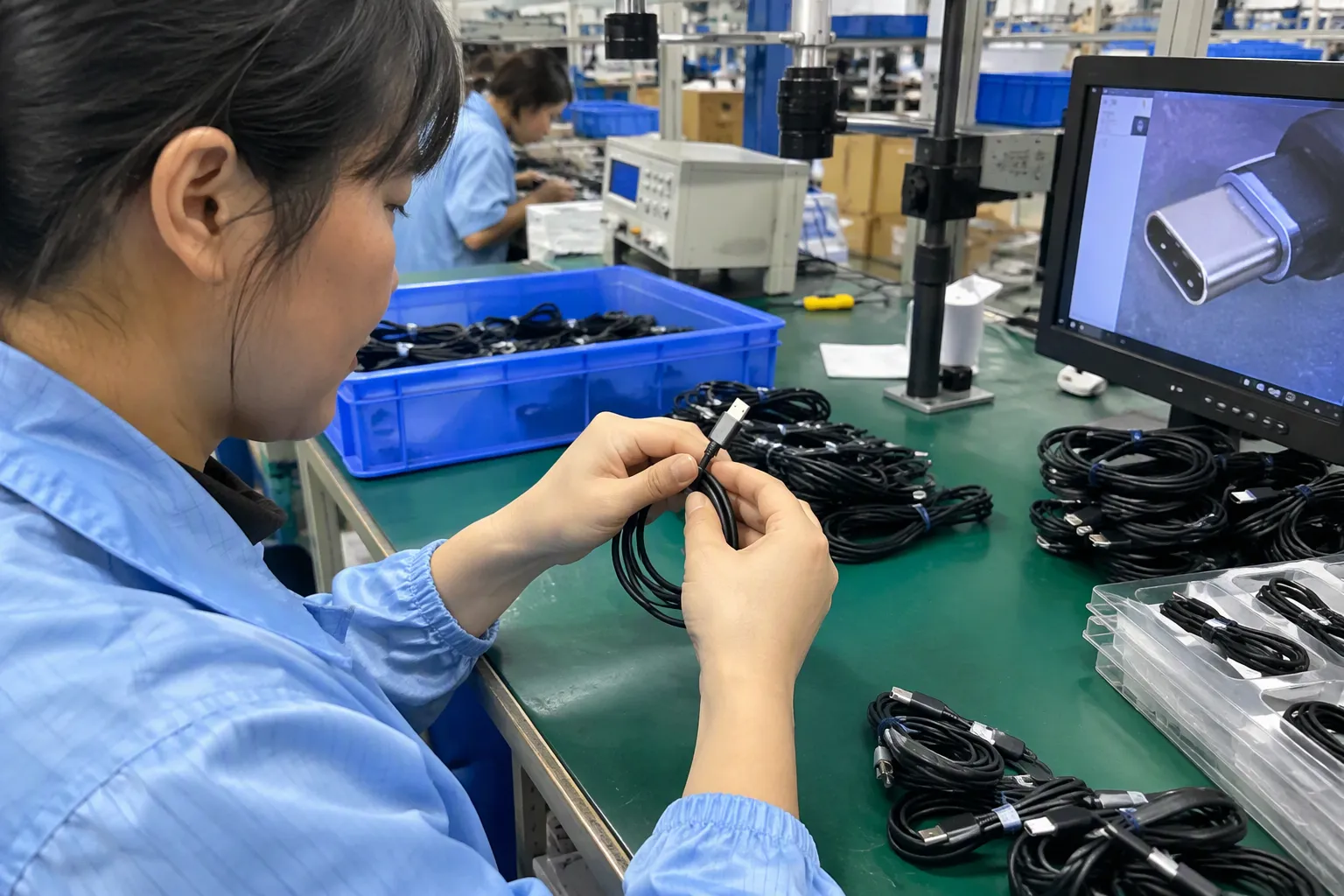
- Visual inspection of connectors, molding, strain relief, jacket, and printing.
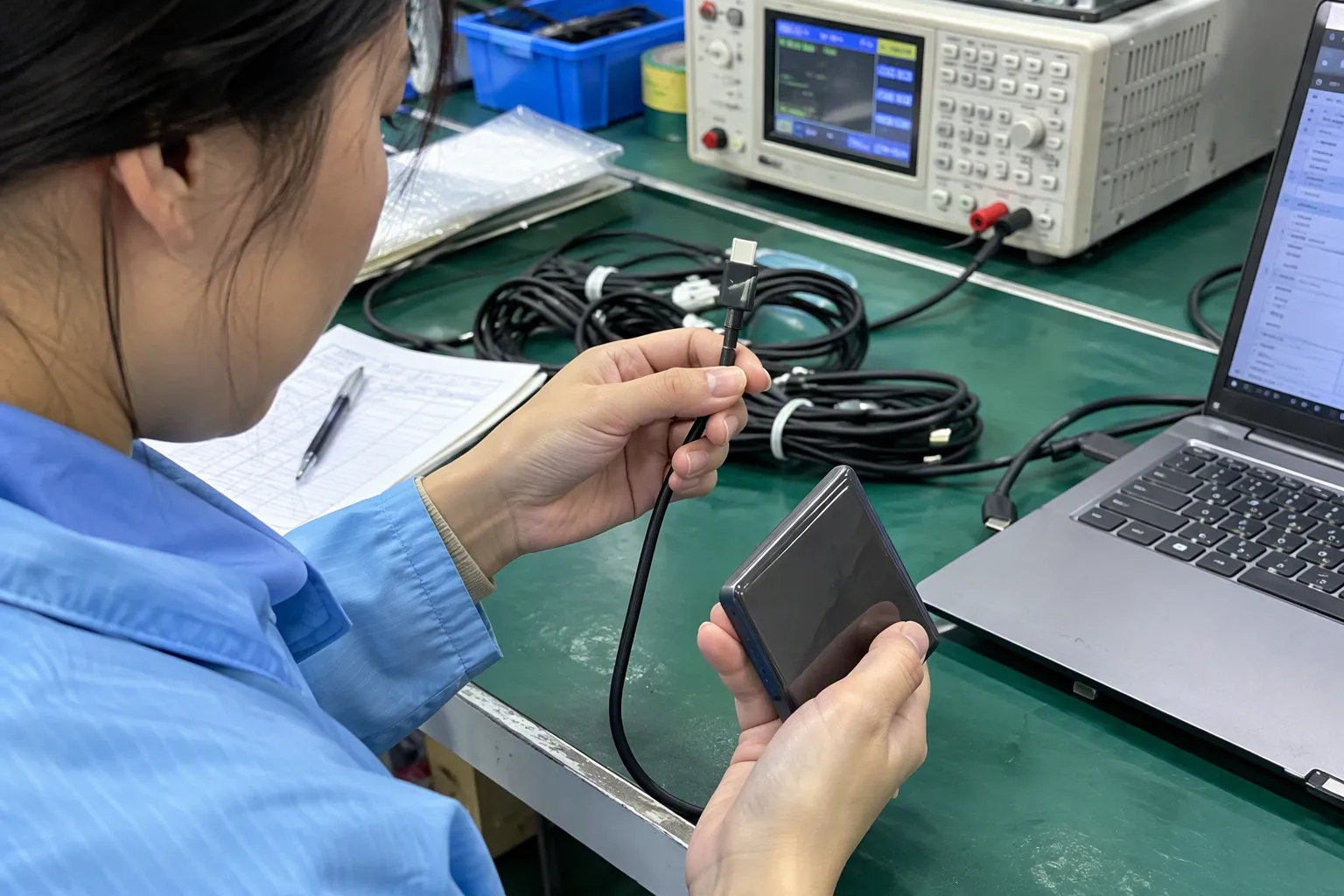
- Charging checks using the intended charger and representative devices.
- Data checks when the product is sold as data-capable.
- Fit and insertion checks for the target devices.
- Length and labeling verification.
- Packaging and barcode review.
- Document review by the buyer’s technical or compliance team.
The exact test plan depends on the product claim. I do not present a supplier quotation as laboratory evidence. Buyers should use independent testing or qualified professional evaluation when the application, customer contract, or regulatory requirement demands it.
Which Quality Checks Matter Before Ordering Schitec OEM USB Cables?
A polished sample does not guarantee that every production batch will be identical[6]. Retail buyers need a quality-control process that connects the approved sample with the mass-production order. This connection is especially important when the product carries a private label.
Before ordering Schitec OEM USB Cables, buyers should approve a controlled sample, define measurable inspection points, review relevant documents, and agree on how nonconforming goods will be handled. Quality checks should cover function, appearance, packaging, labeling, and production consistency.
Sample approval should be specific
- The exact cable length.
- Connector configuration.
- Outer material and color.
- Logo artwork and position.
- Packaging version.
- Stated technical functions.
- Approved photos or physical reference sample.
- Date and approval contact.
- Any open points that production must resolve.
Inspection categories for retail orders
| Inspection category | Example checks | Buyer’s purpose |
|---|---|---|
| Appearance | Color, braid, molding, logo, scratches, stains | Protects shelf presentation and brand consistency |
| Dimensions | Cable length, connector size, package dimensions | Supports product listing and packing calculations |
| Mechanical condition | Strain relief, connector fit, jacket condition | Reduces early failures and handling complaints |
| Function | Charging and data checks based on the approved claim | Confirms the product matches the intended use |
| Packaging | Artwork, language, barcode, labels, quantity | Supports warehouse and retail operations |
| Documents | Test reports, declarations, material information | Supports compliance review and customer inquiries |
| Quantity | Carton count, inner pack, shipping marks | Reduces receiving and logistics disputes |
The final inspection level should reflect order size, sales risk, product claims, and the buyer’s internal quality policy[7]. A chain-store program may need a more formal inspection procedure than a small trial order. The supplier can support the process, but the buyer remains responsible for deciding what evidence is sufficient for its market and customers.
Certification is not a substitute for product matching[8]
- The document identifies the correct product or product family.
- The manufacturer and model information are consistent.
- The testing organization is appropriate for the claimed test.
- The document is current and applicable to the target market.
- The product supplied will remain within the tested configuration.
- Any required declarations, labeling, or technical files are available.
Useful primary sources include the European Commission page on the common charger initiative and the U.S. Consumer Product Safety Commission business guidance. These resources do not provide a complete product approval for a specific cable. They help buyers identify topics that need professional compliance review.
Production consistency and incoming quality
- Which defects are critical, major, or minor.
- Who performs the inspection.
- What sample size or inspection method will be used.
- How the supplier will respond to a failed inspection.
- Whether replacement, credit, rework, or sorting is available.
- How recurring defects will be documented.
This matters because a defect is more expensive after goods reach a retailer or end customer. A cable that fails at incoming inspection may be corrected before distribution. The same cable can create returns, poor reviews, and customer-service work if it reaches consumers.
How Should Buyers Compare Schitec OEM USB Cables Suppliers?
The best supplier for Schitec OEM USB Cables is the one that can convert the buyer’s use case into a clear specification, provide suitable samples and documents, communicate realistic MOQ and lead times, and manage quality and after-sales issues. Buyers should compare total procurement risk, not only unit price.
Questions that reveal supplier capability
- Which cable configurations are already available?
- Which parts of the product can be customized?
- What information is required before a firm quotation?
- What is the MOQ for standard and customized versions?
- What is the sample lead time?
- What is the production lead time after artwork and sample approval?
- Which documents can the supplier provide for review?
- How does the supplier control changes between sample and production?
- What inspection support is available?
- How are defects, shortages, and warranty claims handled?
A supplier does not need to answer every question with the same standard option. The important point is that the answer should be precise and traceable. If a feature is not confirmed, the buyer should treat it as open rather than assume it is included.
Price comparison should include the complete offer
| Cost or risk factor | Low-price comparison | Better procurement question |
|---|---|---|
| Unit price | What is the quoted price? | What exact specification and packaging does the price include? |
| MOQ | How many units must I buy? | Is the MOQ different for color, logo, or package customization? |
| Sample | Is a free sample available? | Does the sample represent the proposed production specification? |
| Lead time | How quickly can goods ship? | When does lead time begin, and what approvals are required first? |
| Quality | Is inspection included? | What inspection standard and corrective process will apply? |
| Documents | Is certification available? | Which documents identify this exact product configuration? |
| After-sales | Is there a warranty? | What defects are covered, and how will claims be resolved? |
| Reorders | Can I repeat the order? | Will the same components and specifications be controlled for replenishment? |
MOQ, lead time, and customization
Our customers often include retailers, wholesalers, e-commerce sellers, chain stores, and grocery importers that need different order structures. A small online seller may prioritize a low trial MOQ. A chain buyer may need strict packaging, barcode, carton, and replenishment controls. A wholesale importer may prioritize stable supply and competitive landed cost.
- Cable color and outer finish.
- Logo method and artwork.
- Connector molding.
- Retail box, paper card, pouch, or bulk packaging.
- Language and warning information.
- Barcode and shipping marks.
- Inner-carton and master-carton quantities.
Each change can affect MOQ, tooling, sample time, and production scheduling. I encourage buyers to separate “must have” requirements from “nice to have” features. This approach helps the supplier offer practical choices without hiding important trade-offs.
Communication is part of quality control
I have found that clear communication reduces mistakes more effectively than a long general product description. A buyer can send a one-page requirement sheet with a table of confirmed and unconfirmed points. The supplier can reply against the same table.
- Confirmed: supported by an agreed specification or document.
- Sample required: cannot be accepted from a written promise alone.
- Buyer approval required: artwork, packaging, or market wording is still open.
- Professional review required: application-specific technical or compliance decision.
- Not included: the quoted product does not provide the requested feature.
How Can Buyers Reduce Retail Risk With Schitec OEM USB Cables?
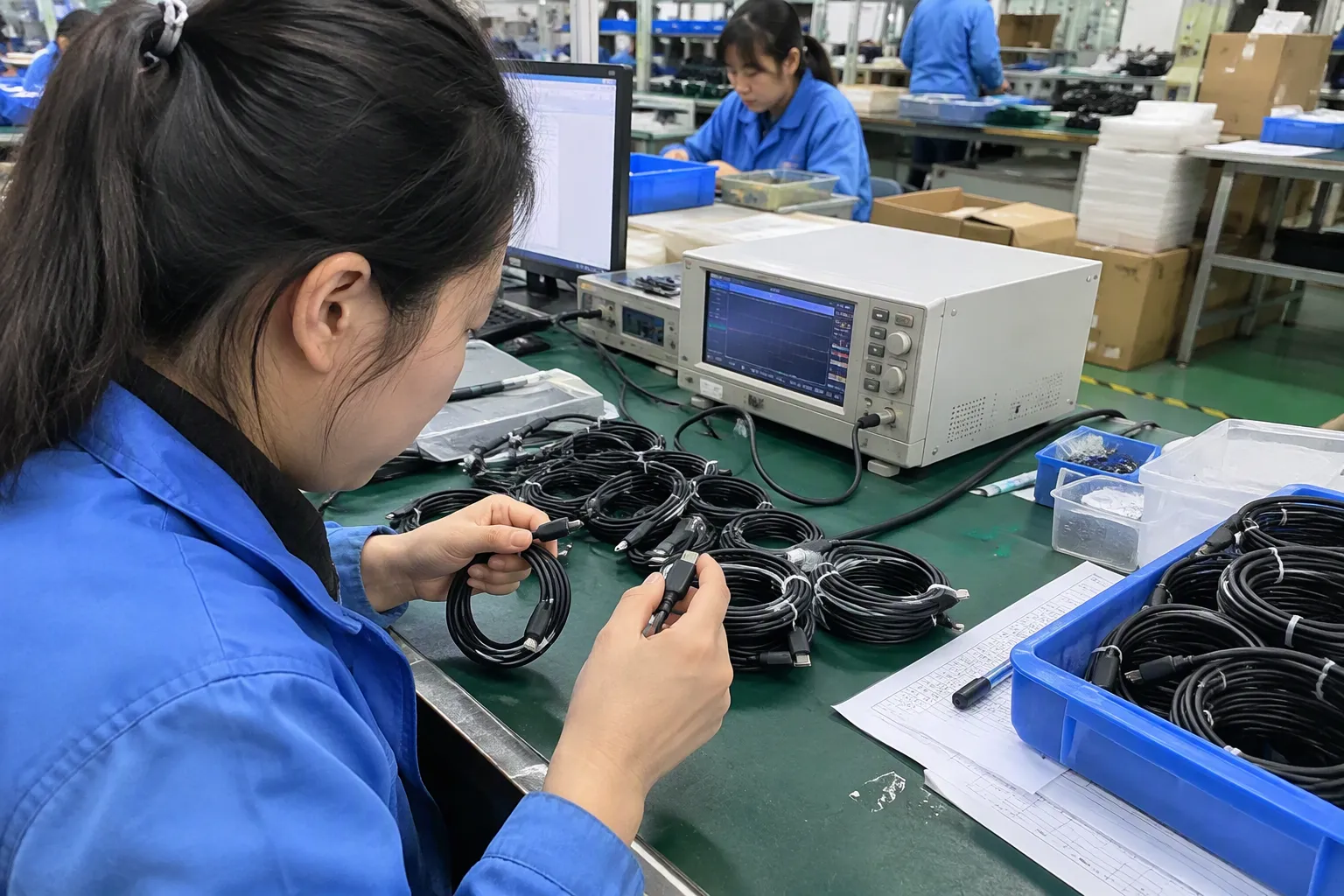
Buyers can reduce Schitec OEM USB Cables retail risk by matching claims to verified capabilities, using clear packaging language, testing representative devices, controlling SKU specifications, and preparing after-sales procedures. The buyer should never rely on “universal” wording when the product has defined limits.
Common mismatch patterns
- A USB-C to USB-C cable is ordered, but the buyer has not defined its power application.
- A cable is sold as a data cable even though data performance was never included in the specification.
- The package claims compatibility with a broad group of devices without a controlled review.
- The buyer approves a cable sample but changes the internal or external construction later to reduce cost.
- The retail photograph shows a braided product while production supplies a different finish.
- The cable works with one charger and phone but does not meet the customer’s expectation with another combination.
- The online listing uses a high charging number without explaining system conditions.
- The seller does not keep the final specification for future replenishment.
Create a claim-control table
| Retail claim | Evidence to review | Safer approach |
|---|---|---|
| Fast charging | Product specification and relevant test evidence | State the intended application and conditions |
| High-speed data | Confirmed data function and test result | Use a specific, supported description |
| Broad compatibility | Representative device review | List compatible device categories carefully |
| Durable construction | Material and quality-control evidence | Avoid unsupported lifetime promises |
| Certified product | Applicable documents for the exact configuration | Identify documents internally and verify validity |
| Eco-friendly material | Material declaration or supplier evidence | Use precise, supportable environmental wording |
Packaging and after-sales preparation
A clear package can prevent avoidable questions. It should identify the connector configuration, length, supported function, and any meaningful limitations. The package should not imply that all devices or chargers will produce the same result.
- Record the customer’s device, charger, cable, and reported behavior.
- Check whether the complaint concerns charging, data, fit, or physical damage.
- Compare the case with the approved use case.
- Ask for photographs or a short video when appropriate.
- Escalate repeated or unusual cases to the supplier.
- Track complaint patterns by SKU and batch.
Why SKU discipline matters
A retailer may carry a standard cable, a customized cable, and a higher-function cable that look similar. Each should have a separate SKU and product record. The record should include the approved sample, packaging artwork, specification, supplier, order date, and relevant documents.
When the buyer later asks for a lower price, the supplier should not silently substitute a different internal construction or remove a function. Any change should be reviewed and approved as a product change. This discipline protects the brand and reduces disputes.
What OEM Process Works Best for Schitec OEM USB Cables?
A practical Schitec OEM USB Cables process includes requirement collection, quotation comparison, sample development, technical and compliance review, artwork approval, production inspection, and after-sales follow-up. Each stage should have a written approval point before the next stage begins.
Stage 1: Define the application
I first ask the buyer to identify the intended sales environment. The product may be for travel kits, mobile-phone accessories, laptop users, power banks, supermarket shelves, chain stores, or an e-commerce bundle. The application influences the connector combination, length, packaging, price level, and expected customer questions.
The buyer should also identify the target countries and channels. European and U.S. buyers may have different internal documentation, labeling, packaging, and retailer requirements. The supplier can provide available information, while the buyer’s compliance team should confirm what is required for the specific sale.
Stage 2: Build the requirement sheet
- Product name and internal SKU.
- Connector configuration.
- Length and color.
- Charging use case.
- Data use case.
- Material and appearance.
- Branding method.
- Packaging format.
- Target quantity and MOQ.
- Required delivery window.
- Inspection expectations.
- Documents to be reviewed.
- Warranty and claim process.
Stage 3: Review the quotation
The buyer should compare quotations line by line. If one supplier includes retail packaging and another includes only bulk packing, the unit prices are not directly comparable. The same problem occurs when one quotation includes a different cable function or connector configuration.
I recommend requesting a written list of exclusions. For example, artwork, tooling, special packaging, inspection, or additional documentation may not be included in the initial price. Transparent exclusions are more useful than an attractive quote that changes later.
Stage 4: Approve samples and evidence
The buyer should test or professionally evaluate the sample according to its intended claims. The buyer should approve both physical product and packaging. If the product is for a demanding application, independent testing may be appropriate.
Stage 5: Control production and shipment
Stage 6: Review the first sales cycle
After launch, the buyer should collect customer feedback and return reasons. The results may show that the product performs well but the package creates confusion. They may also show that a different length or connector configuration has stronger demand.
Frequently Asked Questions
Are all USB-C cables compatible with the same devices?
No. USB-C is a connector type, not a guarantee of identical charging, data, video, or device compatibility. Buyers should match the cable specification to the intended devices and use case. They should avoid broad compatibility claims unless those claims have been properly reviewed and supported.
Should I choose a USB-A to USB-C or USB-C to USB-C cable?
The correct choice depends on the charger, computer, power bank, and devices used by the target customer. USB-A to USB-C can suit existing USB-A accessories, while USB-C to USB-C may suit newer charging equipment. Buyers should confirm the complete system rather than select by appearance.
Can I request my own logo and packaging?
OEM buyers can usually discuss logo, color, molding, and packaging customization with the supplier. However, each option may affect MOQ, lead time, tooling, artwork approval, and price. The buyer should confirm which customizations are available for the exact cable specification before approving the order.
Do certifications prove that a cable is high quality?
No. Certifications and test documents can support a product review, but buyers must verify that the documents apply to the exact product configuration and target market. Certification status does not replace sample testing, production inspection, correct labeling, or application-specific professional evaluation.
What should I ask for before placing a bulk order?
Ask for a complete specification, representative sample, packaging artwork, MOQ, lead time, inspection arrangement, relevant documents, and after-sales terms. You should also confirm how the supplier will control changes between the approved sample and mass production.
Conclusion
Schitec OEM USB Cables should be selected as a complete product solution, not as a connector and logo alone. I recommend that buyers begin with the intended devices and charging or data use case, then confirm the connector configuration, construction, claims, documents, packaging, MOQ, lead time, and quality process. This approach helps European and U.S. 3C buyers reduce compatibility complaints and total retail risk. Contact us with your target devices, order quantity, packaging needs, and delivery plan, and I can help organize a practical OEM specification for quotation and review.
Sources
- USB Charger (USB Power Delivery)", USB Implementers Forum specifications distinguish the physical USB Type-C connector and cable requirements from the power, data-transfer, and alternate-mode capabilities implemented by particular products
- USB Charger (USB Power Delivery)", USB Power Delivery specifications describe power negotiation between source and sink devices and define cable-related current capabilities that constrain the power available to the connected system
- USB 3.2 Specification", USB-IF technical materials identify multiple USB data-transfer performance classes that may be implemented through products using the USB Type-C connector, so connector shape alone does not establish a common transfer speed
- VESA – DisplayPort TM Alternate Mode on USB-C®", USB Type-C video output commonly relies on an approved alternate mode, such as DisplayPort Alternate Mode, together with compatible source and display equipment rather than on the connector form alone
- Modeling an ESD Gun Discharge to a USB Cable", Electrical engineering analyses associate increased conductor length and resistance with greater voltage drop and identify cable geometry and loss as factors affecting high-speed signal integrity
- Real-Time Monitoring and Control of Additive ...", Quality-control guidance treats production conformity as a process-monitoring issue and uses inspection or statistical controls to detect variation between an approved reference and subsequently manufactured units
- 6.2.2. What kinds of Lot Acceptance Sampling Plans (LASPs ...", International quality-management guidance frames monitoring and control as activities that should be planned in relation to process risks, applicable requirements, and the potential consequences of nonconformity
- List of Example Federal Agency Conformity Assessment ...", European conformity-assessment guidance requires technical documentation and declarations to substantiate conformity for the relevant product and applicable requirements, rather than treating a generic certificate as universal proof of suitability