Quick Answer
Single-coil vs multi-coil chargers can look like a simple specification choice, but the wrong layout can create poor phone placement experiences, pricing pressure, or avoidable after-sales issues. Buyers may focus on coil count because it is easy to compare. I recommend starting with product shape, user behavior, and commercial risk instead.
Single-coil vs multi-coil chargers should be selected according to the charging surface, expected phone-placement behavior, target devices, retail price, and validation budget. A multi-coil layout may improve placement tolerance in some formats[1], while a single-coil layout may offer a more controlled and cost-effective solution. Neither option is automatically faster, cooler, or better without supplier documentation and sample testing under defined conditions.[2]
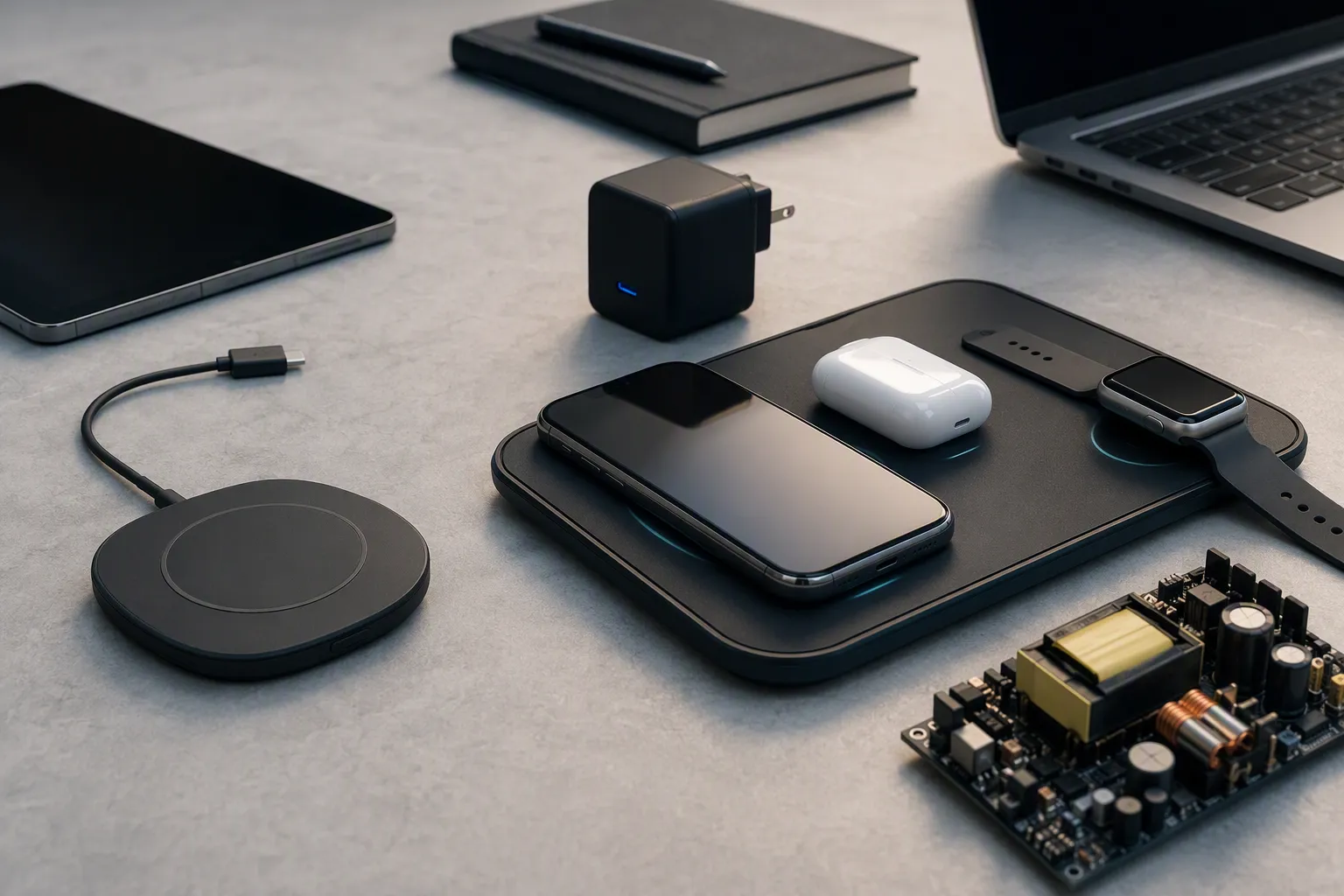
When I discuss wireless charger quotations with European and U.S. buyers, I usually see the same question: “How many coils does it have?” That is a useful starting point, but it is not the final buying criterion. The stronger question is whether the coil layout supports the product’s intended use while protecting margin, quality consistency, and after-sales performance.
Single-coil vs. multi-coil is not a “more coils is better” comparison
Buyers often worry that a single-coil charger may feel limited or that a multi-coil charger must be more premium. That assumption can lead to unnecessary cost or a product that does not match the customer’s actual charging habits. I look first at the physical design and the intended user experience.
Single-coil vs multi-coil chargers should be compared by effective charging area, alignment tolerance, thermal control, product structure, and total commercial cost. A single coil can be appropriate for a compact pad or stand with clear phone positioning. A multi-coil design can be useful when users need more placement freedom, but it may also require more tuning, validation, and quality control.
Start with how the customer will place the phone
The most practical difference between a single-coil and multi-coil charger is often placement behavior. A customer does not think about electromagnetic design when placing a phone on a bedside charger. The customer simply expects charging to start reliably.
For a compact wireless charging pad, a stand, or a fixed-position dock, a single-coil design may be suitable because the product structure can guide the phone into an expected position. A raised cradle, anti-slip ring, alignment mark, or stand angle can reduce placement uncertainty. In this format, adding coils may not create enough extra user value to justify higher cost.
A multi-coil layout can make more sense when the charging surface is wider or when the product is designed for flexible placement. Examples may include:
- A larger desktop charging pad
- A charging tray integrated into furniture or office accessories
- A flat surface intended to support different phone sizes
- A shared charging area where users may place a phone quickly
- A retail product positioned around “drop and charge” convenience
However, I would not treat a supplier statement such as “full-area charging” as a universal promise. Actual coverage can vary with phone model, receiver-coil location, case thickness, phone orientation, charger structure, power input, and control design.[3] Buyers should request a clear definition of the usable charging area and test samples with representative devices.
Coverage is not the same as coil count
A multi-coil wireless charger may use several coils to create a larger or more flexible effective charging zone. Yet the number of coils alone does not tell a buyer how well a phone will charge across the surface.
I recommend that buyers ask suppliers practical questions rather than accept broad marketing language:
-
What is the stated active charging area?
The supplier should show dimensions, not only a coil count. -
Which phone models were used for evaluation?
Buyers should ask whether the supplier tested common Apple and Android models relevant to the target market. -
Were phones tested with cases?
A charger may behave differently with common protective cases, especially thicker cases or cases with magnets, metal elements, wallets, or stands.[4] -
What placement positions were checked?
Buyers should request a simple placement map or test method. The supplier should explain where charging starts, stops, or becomes unstable. -
Does the design support portrait and landscape placement?
This matters more for charging stands, desk products, and wide pads. -
What happens when a phone is shifted during charging?
The answer should be supported by sample testing, not only a sales statement.
In my sourcing conversations, I would normally ask the buyer to describe the intended retail scenario before recommending a coil configuration. A low-cost bedside pad and a premium desk accessory may both charge a phone, but they do not need the same placement tolerance.
Compare product format before comparing coil layouts
The table below shows how I would frame the single-coil vs multi-coil chargers decision during early product selection. It is not an engineering specification. It is a commercial evaluation guide that helps purchasing teams ask better questions.
| Product format | Typical user behavior | Coil layout that may fit | Main buyer concern | Validation focus |
|---|---|---|---|---|
| Compact charging pad | User places phone near the center | Single coil may be suitable | Clear alignment and stable charging | Positioning, case compatibility, heat |
| Vertical charging stand | Structure guides the phone | Single coil may be suitable | Receiver-coil alignment at different phone sizes | Stand geometry, portrait and landscape use |
| Wide flat charging pad | User expects flexible placement | Multi-coil may be considered | Effective usable area | Placement map, device compatibility |
| Desk organizer or tray | User drops phone into a broad area | Multi-coil may be considered | Convenience versus added cost | Surface materials, placement tolerance |
| Promotional low-price charger | Buyer needs controlled cost | Single coil is often easier to position | Margin and production consistency | Basic reliability and appearance control |
| Premium retail charger | Buyer needs a stronger user story | Either layout may fit | Whether experience supports price point | Full sample validation and packaging claims |
A buyer should not assume that a multi-coil charger automatically belongs in a premium range. Premium positioning depends on the total experience: industrial design, materials, charging behavior, compatibility, packaging, warranty handling, and retail presentation. A poorly validated multi-coil product can create more customer complaints than a well-designed single-coil charger.
Heat and charging speed require controlled testing
Heat is one of the most misunderstood parts of single-coil vs multi-coil chargers. I do not recommend making broad claims that one coil layout is always cooler, faster, or more efficient. Those outcomes depend on the complete product design.
Wireless charging thermal behavior can be influenced by:
- Power input and adapter specification
- Charging protocol and control strategy
- Alignment between transmitter and receiver coils
- Coil design and coil switching approach
- PCB layout and component selection
- Product enclosure materials and ventilation
- Magnet arrangement, where applicable
- Phone model and receiver-coil location
- Case material and thickness
- Ambient temperature
- Charging duration and battery state
A phone that is slightly misaligned may generate a different charging result from a phone placed in the ideal position. A multi-coil surface may improve placement flexibility in a suitable design, but the system may also need more complex control, coil selection, and tuning.[5] That does not mean the product will be hotter or cooler in every case. It means the buyer needs evidence.
I advise buyers to treat heat, efficiency, and charging-speed claims as sample-validation questions. Suppliers should provide test conditions, device list, input power details, and applicable reports where available. A buyer should then confirm performance through its own qualified testing process or a suitable third-party evaluation arrangement.
For retail and e-commerce buyers, the wording on packaging also matters. A statement such as “fast charging” can create customer expectations that differ by phone model, adapter, cable, case, and regional configuration.[6] I would keep product claims specific, supportable, and aligned with the supplied documentation.
Ask for a defined sample test plan
A good sample process reduces arguments later. I have seen buyers spend too much time comparing unit prices before they agree on what the sample should prove. For a wireless charger, the test plan should reflect the retail use case.
A practical buyer-side sample checklist may include:
| Evaluation item | What the buyer should confirm | Why it matters |
|---|---|---|
| Phone placement | Charging starts in expected positions | Supports the advertised user experience |
| Device range | Representative target phone models work as expected | Reduces compatibility surprises |
| Case use | Common cases are checked where relevant | Reflects normal consumer use |
| Charging stability | Charging does not repeatedly start and stop in normal placement | Helps reduce user complaints |
| Surface temperature | Test under defined conditions | Supports thermal-risk assessment |
| Foreign object behavior[7] | Verify relevant safety behavior and documentation | Important for user safety and compliance review |
| Input configuration | Confirm cable and adapter requirements | Prevents underpowered retail bundles |
| Long-duration use | Check overnight or extended-use scenarios as applicable | Identifies practical stability issues |
| Cosmetic durability | Review surface finish, logo, and anti-slip parts | Protects retail presentation |
| Packaging claims | Match claims to evidence and included accessories | Reduces return and compliance risk |
I would not present this checklist as a substitute for engineering validation. Application-specific decisions should involve qualified professionals and appropriate test methods. Still, it gives a procurement team a structured way to compare suppliers before committing to mass production.
BOM cost is wider than the price of extra coils
When buyers discuss multi-coil charging pads, the conversation often starts with the extra hardware cost. That cost matters, but I encourage buyers to look at the wider bill of materials and total commercial impact.
A multi-coil layout may involve additional coils, more complex electronics, different PCB requirements, control logic, shielding considerations, or mechanical changes.[8] The exact impact depends on the design. It is not responsible to assume a fixed cost increase across all products.
More importantly, the visible BOM is only part of the cost. I recommend evaluating the following areas:
- Component cost: coils, PCB, ICs, shielding, thermal materials, connectors, and power-related components
- Development and tuning: supplier effort needed to optimize the design for intended devices and product structure
- Sample iterations: cost and time for revisions after placement or thermal observations
- Manufacturing yield: risk that a more complex assembly creates consistency challenges
- Quality control: inspection points, functional testing, and production test fixtures
- Certification review: applicable documentation and market requirements that buyers should verify for the intended sales region
- Compatibility validation: testing across selected phone models, cases, and charging accessories
- After-sales exposure: returns, negative reviews, and support costs if users report inconsistent charging
- Packaging and accessory choices: adapter, cable, instructions, and claim management can affect the final retail offer
For a retailer, a charger with a slightly higher purchase price may still be the better commercial choice if it reduces returns and supports a higher retail price. On the other hand, a simple, well-controlled single-coil charger may be the stronger option when the target price is tight and the design naturally guides phone placement.
Build the quotation around the retail price band
Before I request or compare quotations, I would ask five basic questions:
-
What is the intended product shape?
Is it a small pad, stand, foldable travel charger, desk accessory, or a larger charging surface? -
How much placement freedom does the end user expect?
Does the customer need a clear sweet spot, or is “place it anywhere within this area” part of the product promise? -
Which devices are most important?
The buyer should define representative phone models and any other intended device categories. -
What retail price band is planned?
The target shelf price influences the acceptable BOM, packaging level, warranty expectation, and margin structure. -
What is the expected usage scenario?
Bedside use, office use, travel, gift sales, and premium electronics retail all create different requirements.
These questions are often more useful than asking for “the best multi-coil charger.” There is no universal best option. There is only a better fit for a defined market position.
For example, a value-focused importer may prefer a compact single-coil charging pad with a clear alignment mark, stable production, suitable documentation, and competitive MOQ. A design-led retailer may accept a higher total cost for a wide charging surface if the placement experience supports a stronger retail story. Both decisions can be sensible when the buyer understands the trade-offs.
Supplier selection should include process control
In single-coil vs multi-coil chargers, the supplier’s process can matter as much as the advertised layout. Buyers should ask how the supplier controls production consistency, especially when a product has a more complex coil arrangement or a larger charging surface.
I would ask suppliers for information such as:
- Product drawings and the stated charging-area definition
- Sample test records or internal test summaries, with conditions clearly described
- Production functional-test approach
- Incoming inspection controls for critical components
- Traceability method for key production batches
- Change-control process for components or firmware
- Applicable certification documents for buyer review
- Warranty terms and after-sales handling procedure
- MOQ, lead time, and sample revision process
- Packaging options, branding method, and instruction manual support
Buyers should verify certifications and reports rather than rely on a general statement that a product is “certified.” Documentation must match the actual model, target market, product configuration, and applicable requirements. If the buyer plans to bundle a specific adapter or cable, that bundle should also be reviewed as part of the final product offer.
I also recommend that buyers clarify whether the supplier can keep the same key materials and configuration after sample approval. A sample that performs well is useful only if mass production follows the approved specification.
Choose the risk budget, not just the coil count

Every product has a risk budget. A buyer may accept a smaller effective charging area in exchange for lower cost and a clearer user instruction. Another buyer may invest more in placement tolerance because the retail concept depends on convenience.
The key is to make that trade-off deliberately.
A single-coil charger can be commercially strong when:
- The product design guides placement
- The target retail price is sensitive
- The buyer wants a straightforward product range
- The expected use is predictable
- The supplier can demonstrate stable sample performance
- The packaging clearly explains proper placement
A multi-coil charger can be commercially strong when:
- The product has a broad charging surface
- Placement convenience is a real selling point
- The target customer may place phones casually
- The buyer has budget for deeper validation
- The supplier can provide clear coverage information
- The retail price and margin can support the added complexity
Neither list is a guarantee of performance. I use these points to shape the sourcing conversation and identify where the buyer needs more evidence.
Frequently Asked Questions About Single-Coil vs Multi-Coil Chargers
Are multi-coil wireless chargers better than single-coil models?
Multi-coil wireless chargers are not automatically better. They may offer improved placement tolerance for larger or more flexible charging surfaces. A single-coil model may be more suitable for compact pads and stands with guided alignment. Buyers should compare actual use case, sample performance, total cost, and supplier documentation.
Do multi-coil chargers charge phones faster?
Coil count alone does not determine charging speed. Charging performance can depend on power design, phone compatibility, alignment, input adapter, control strategy, thermal conditions, and test setup. Buyers should request defined test conditions and verify charging behavior with representative sample devices.
Are multi-coil chargers hotter than single-coil chargers?
I would not make a general claim that either configuration is always hotter. Thermal behavior depends on the complete charger design and the way a phone is placed. Buyers should request supplier test information and conduct sample testing under conditions that reflect expected customer use.
What should buyers include in a wireless charger BOM comparison?
A meaningful BOM comparison should include more than coils and PCB components. Buyers should consider development work, sample revisions, production yield, quality control, testing, certification documentation, packaging, compatibility checks, warranty exposure, and expected after-sales cost. Total commercial cost matters more than a headline unit price.
How can I verify wireless charging coverage claims?
Buyers should ask suppliers to define the active charging area, provide a placement map where possible, identify tested phone models, and state test conditions. The buyer should then test samples with representative phones, cases, power inputs, and typical placement positions before confirming a production order.
Conclusion
Single-coil vs multi-coil chargers is a product-selection decision, not a coil-count competition. I recommend that buyers begin with product format, customer placement behavior, target retail price, and acceptable risk level. Multi-coil designs may support greater placement freedom, while single-coil designs can offer a focused and cost-controlled solution. Before placing an order, buyers should verify supplier documents, define sample tests, and compare total commercial cost. If you are sourcing wireless chargers for European or U.S. retail channels, I can help you structure a clearer quotation and product-selection discussion.
Sources
- Wireless Power Transfer: Systems, Circuits, Standards, and ...", Studies of wireless-power transmitter arrays report that multiple transmitting coils can extend or reposition the effective coupling region for a receiver, although the resulting placement tolerance depends on the coil geometry, control method, receiver position, and operating conditions
- Alignment-Free Wireless Charging of Smart Garments with ...", Wireless-power-transfer research identifies coil coupling and alignment, resonant-compensation design, load conditions, and control parameters as material determinants of transferred power, efficiency, and losses; coil count by itself is therefore not a sufficient predictor of charging speed or temperature
- Alignment-Free Wireless Charging of Smart Garments with ...", Technical research on inductive wireless power transfer shows that coil separation, lateral and angular misalignment, receiver geometry, and operating conditions affect coupling and transferred power; accessories that alter spacing or alignment can therefore change observed charging behavior
- Wireless Power Transfer: Systems, Circuits, Standards, and ...", Wireless-power safety and technical guidance recognizes that increased spacing can reduce coupling and that conductive foreign objects in the charging field can absorb energy and heat, making case material, thickness, and embedded accessories relevant compatibility variables
- Multi-mode joint modulation of array wireless power transfer", Research on multi-transmitter wireless-power systems describes coil-selection and control strategies used to identify or energize suitable transmitter coils and maintain effective power transfer as receiver position changes
- Wireless Power Transfer: Systems, Circuits, Standards, and ...", Wireless-charging standards describe power transfer as an interaction between compatible transmitter and receiver systems operating within defined power profiles; the transmitter's available input power and product configuration can constrain the charging power delivered to a device
- A review of foreign object detection (FOD) for inductive power ...", Wireless-power technical literature identifies heating of conductive foreign objects as a safety concern and describes foreign-object detection as a means of limiting energy transfer when such objects are present
- Single-Sided Near-Field Wireless Power Transfer by A Three ...", Engineering studies of transmitter-coil arrays describe the use of additional coil-driving or switching arrangements, control logic, and electromagnetic-design measures to select coils and manage coupling across a charging surface