Wholesale USB cable purchasing can look simple because the products often share familiar connector shapes. However, I have seen buyers focus on unit price first and discover later that charging limits, data performance, device compatibility, packaging, or batch consistency create avoidable problems. I recommend starting with the use case and supplier verification process before comparing quotations.
For wholesale USB cable purchasing, I recommend matching the cable to the intended devices, charging requirements, data-transfer needs, length, packaging, and sales channel. Buyers should then verify samples, specifications, MOQ, lead time, documentation, batch consistency, and after-sales terms. A low unit price is not necessarily the lowest total cost if the cable causes returns, complaints, or compatibility issues.
Quick Answer
- Define the use case first: Identify the devices, charging products, data needs, cable length, and target customer.
- Do not treat USB-C as one performance category: Connector shape does not confirm charging power, data speed, or other capabilities.
- Request clear specifications and samples: Compare tested or documented details instead of relying only on catalog images.
- Check commercial terms: Review MOQ, packaging, lead time, replacement policy, and batch consistency.
- Evaluate total cost: Include returns, customer service, replacement shipments, and stock risk in the purchasing decision.
Many buyers begin with a product image or a very low quotation. That approach can work for a basic, clearly defined product, but it becomes risky when the same connector is used across different devices and performance levels. In the following sections, I will explain how I evaluate wholesale USB cable options for retailers, wholesalers, and importers serving European and American markets.
How Should I Define a Wholesale USB Cable Use Case?
A wholesale USB cable inquiry becomes useful only when I know what the cable must do. A retailer selling replacement phone accessories may need a different product from an importer supplying charging bundles, TWS earbuds, smartwatches, or power banks. The connector alone does not provide enough information.
I define a wholesale USB cable use case by listing the target devices, charging source, expected charging function, data requirement, length, appearance, packaging, sales channel, and expected price position. This process helps me compare suitable products rather than comparing visually similar cables that may have different internal construction and performance.
Start with the device and task
- Which devices will customers connect?
- Will the cable be used mainly for charging, data transfer, or both?
- Which connector is required at each end?
- Will customers use wall chargers, car chargers, laptops, power banks, or charging stations?
- Does the product need to support a specific charging system or data application?
- What cable length suits the retail display and end-user environment?
A cable for a TWS charging case may have a different commercial purpose from a cable intended for a laptop, tablet, phone, or high-performance charger. A charging-only product may suit one sales channel, while a buyer who advertises data transfer needs a specification that supports that function.
USB-C requires closer specification review
USB-C describes a connector format, not one complete performance level.[1] Two USB-C cables can look almost identical while differing in charging capability, data-transfer support, construction, marking, and intended use.[2] I therefore avoid describing every USB-C cable as “fast” unless the supplier provides a clear, relevant specification and the buyer has decided how that claim will be verified.
The USB Implementers Forum provides technical and compliance information for the USB ecosystem. Buyers can review the official USB-IF resources when they need to understand USB terminology, product identification, or program information. Supplier claims still need to be matched to the exact product and order.
Define the commercial position
| Position | Typical buyer priority | Important review points |
|---|---|---|
| Entry-level retail | Competitive shelf price | Basic compatibility, appearance, packaging, acceptable failure rate |
| Standard retail | Balanced value | Construction, labeling, sample performance, stable repeat supply |
| Premium accessory | Better presentation and user experience | Materials, finish, claims, packaging, documentation, warranty approach |
| Bundle or promotional item | Low landed cost and fast availability | MOQ, packaging flexibility, delivery schedule, replacement handling |
| Commercial or institutional supply | Consistency and documented requirements | Specification control, inspection, traceability, and application review |
My practical inquiry checklist
- Connector combination, such as USB-A to USB-C or USB-C to USB-C
- Intended device categories
- Charging purpose and required compatibility
- Data-transfer purpose, if any
- Length and preferred outer material
- Color and branding requirements
- Retail or bulk packaging
- Target market and sales channel
- Estimated order quantity and repeat-order expectations
- Required documents or compliance information
- Target delivery date and destination
This list prevents a common problem I see in customer discussions: several suppliers quote different products against the same short phrase, such as “USB-C fast cable.” The prices may look comparable, but the products may not be equivalent.
Which Wholesale USB Cable Specifications Should I Compare?
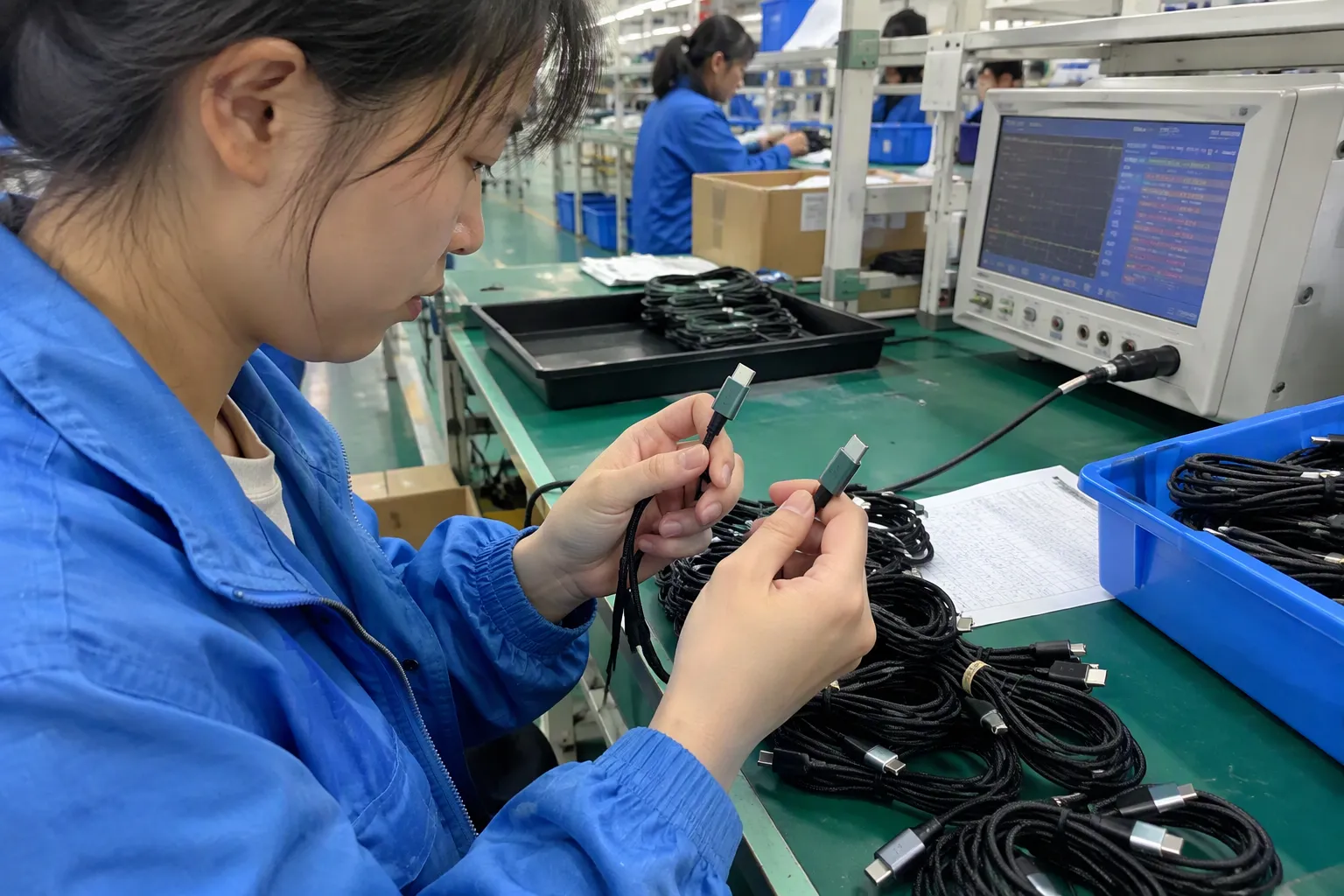
The right comparison includes more than connector type, color, and length. I compare the cable’s intended function, declared capability, construction, packaging, and evidence supporting the supplier’s description. I also separate confirmed information from marketing language.
I compare a wholesale USB cable by connector configuration, charging and data requirements, conductor and construction details, length, outer materials, packaging, and available documentation. I treat supplier-provided figures as information to verify through samples, documents, inspection, or qualified technical evaluation rather than as independent test results.
Connector configuration is only the starting point
I ask the supplier to identify both ends clearly. I also ask whether the cable is intended for charging only or for charging and data use. I avoid allowing a product title to carry more meaning than the written specification supports.
Charging claims need context
- What source and device combination was used for the claim?
- Does the cable support the intended charging protocol or system?
- Is the claim a cable limitation, a charger limitation, or a complete system result?
- Does the cable include any identification component required for the intended application?[4]
- Has the supplier provided a test report, technical sheet, or sample basis?
A cable cannot create charging performance that the charger, device, or charging protocol does not support.[3] The complete charging system matters. Buyers should also avoid printing a broad “fast charging” claim on packaging when the exact scope has not been established.
Data transfer is a separate purchasing issue
Some buyers need only charging.[5] Others expect customers to synchronize devices, transfer files, connect storage, or use the cable with computers and other equipment. Those applications may require a different product specification.[6]
I recommend that buyers state the required data function in the inquiry. “USB-C cable” is not enough. The buyer should ask the supplier to explain the intended data capability and provide suitable documentation or samples. If data performance is important to the product claim, the buyer should arrange appropriate verification before mass production.
Construction and durability
- Conductor and wire arrangement
- Insulation and shielding information, when relevant
- Strain relief at both connectors
- Connector housing fit and finish
- Outer jacket material
- Flexibility and resistance to ordinary bending
- Braided, PVC, silicone, or other material claims
- Mold quality and visible assembly consistency
I do not assume that a braided jacket automatically means a durable cable.[7] I also do not assume that a thicker cable always provides better performance. The product must match the application, price position, and expected handling.
A comparison framework for quotations
| Review area | Question I ask the supplier | Why it matters |
|---|---|---|
| Function | Is the cable for charging, data, or both? | Prevents incorrect product positioning |
| Compatibility | Which device categories and connectors are intended? | Reduces avoidable customer complaints |
| Charging | What charging-related capability is declared, and under what conditions? | Keeps packaging claims controlled |
| Data | What data function is supported? | Avoids treating all USB-C products alike |
| Materials | What construction and jacket materials are used? | Helps compare durability and appearance |
| Sample | Is the quoted item identical to the sample? | Protects against specification drift |
| Packaging | What retail or bulk packaging is included? | Affects shelf readiness and landed cost |
| Documentation | Which specifications and certificates are available? | Supports procurement review and market requirements |
Is the Cheapest Wholesale USB Cable Really the Lowest-Cost Choice?
The cheapest wholesale USB cable can become expensive when the product creates returns, customer complaints, replacement shipments, or lost shelf space. I evaluate landed cost and operational risk together, especially when a buyer plans to sell through retail stores, e-commerce platforms, or a chain distribution network.
The lowest unit price is not always the lowest total procurement cost.[8] I calculate product cost, freight, duty or tax where relevant, packaging, inspection, expected replacement stock, after-sales labor, and return exposure. I then compare those costs with the cable’s expected selling price and channel requirements.
The hidden cost of a mismatch
- The end customer reports that the cable does not work as expected.
- The retailer spends time answering the complaint.
- The seller issues a refund or replacement.
- The importer arranges additional stock or a replacement shipment.
- Online reviews or retailer feedback affect future sales.
- The buyer may need to discount slow-moving inventory.
Total cost categories
| Cost category | Examples |
|---|---|
| Purchase cost | Unit price multiplied by order quantity |
| Import and logistics | Freight, insurance, duties, taxes, and destination handling |
| Preparation | Packaging, labels, barcodes, inspection, and customization |
| Inventory | Storage, slow-moving stock, and replacement units |
| After-sales | Customer service, refunds, replacements, and reverse logistics |
| Opportunity cost | Lost sales or shelf space caused by delayed or unsuitable stock |
I ask the buyer to estimate realistic complaint and replacement exposure rather than assume that every unit will sell without support. I cannot predict a failure rate without reliable product data and appropriate testing, but I can help the buyer identify where risk may appear.
Price segmentation can be more useful than one universal cable
A retailer may need more than one cable tier. For example, an entry product may suit price-sensitive customers, while a standard or premium product may fit customers who care about construction, packaging, and clearer capability claims. The buyer should avoid confusing the tiers on the shelf.
When a lower price is reasonable
- The use case is narrow and clearly stated.
- The buyer does not make unsupported performance claims.
- The product passes the buyer’s sample review.
- Packaging and labeling match the intended channel.
- The supplier can maintain consistent production.
- The buyer has a practical replacement and complaint process.
How Can I Evaluate a Wholesale USB Cable Supplier?
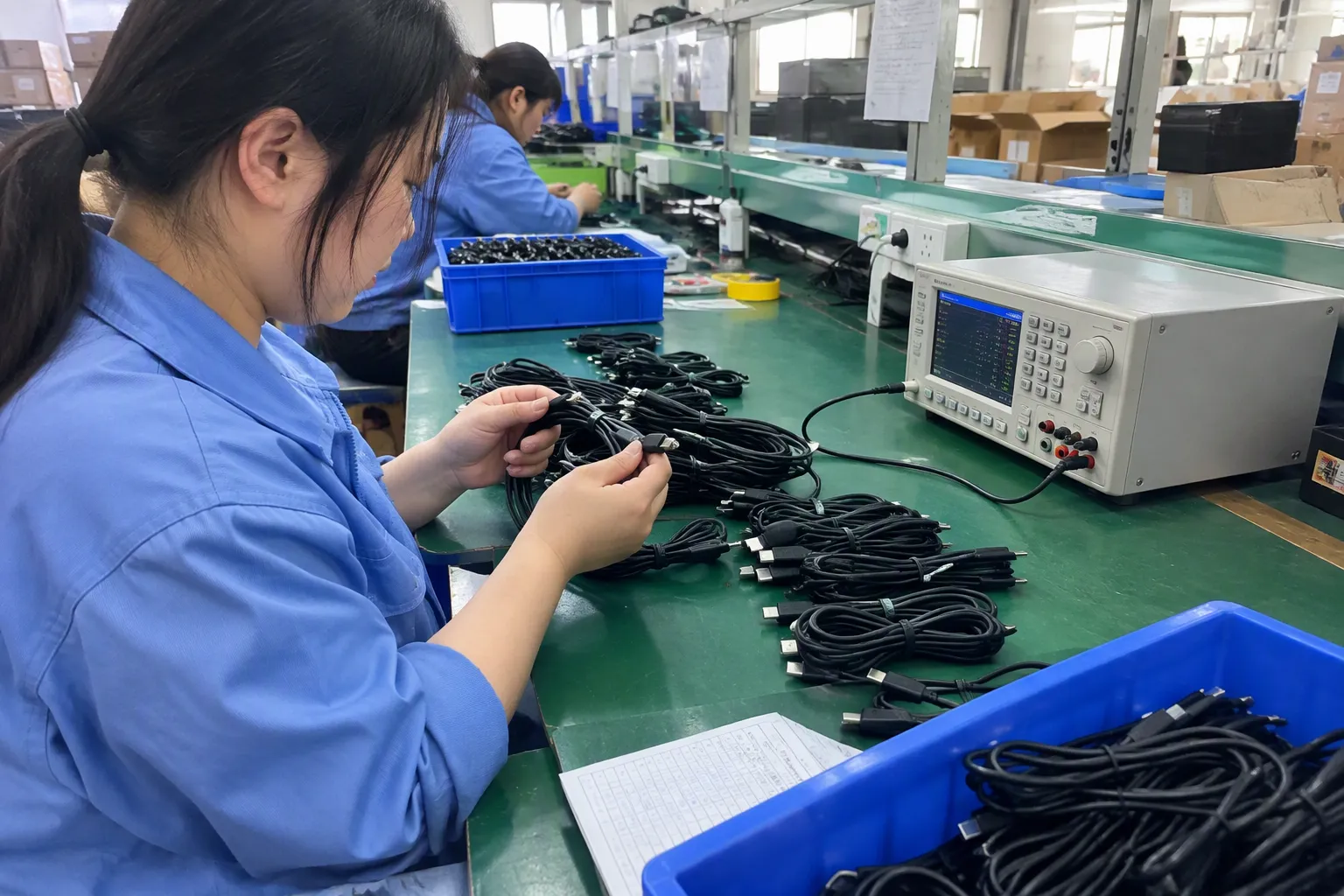
Supplier selection is as important as product selection. I review how clearly a supplier answers technical and commercial questions, whether the sample matches the quotation, and whether the company can manage repeat orders. I also examine documents carefully instead of treating a certificate logo as proof of every product claim.
I evaluate a wholesale USB cable supplier through specification clarity, sample quality, production consistency, documentation, MOQ, lead time, packaging control, communication, inspection options, and after-sales terms. Certifications and test reports should identify the relevant product and scope, and buyers should verify documents before relying on them.
Questions I ask during supplier communication
- Which factory or production location will make the product?
- Is the sample from normal production or a special development sample?
- Can the supplier keep the same materials and construction in repeat orders?
- What is the MOQ for standard packaging and customized packaging?
- What is the normal lead time after artwork and payment confirmation?
- Which quality-control steps are used before shipment?
- Can the supplier provide a pre-shipment inspection or accept a third-party inspection?
- How does the supplier handle confirmed defects or specification deviations?
- Which documents apply to the exact product and market?
Review certifications and reports with care
My company has experience exporting 3C products to European and American customers, and buyers often ask about certifications. I explain that a document must be checked for its issuer, product identity, model, date, scope, and applicable market. A general company certificate may not prove that a specific cable meets every requirement a buyer has in mind.
For European sales, buyers can consult official EU information, including the European Commission’s product safety and compliance resources. For USB-related terminology and program information, buyers can also use USB-IF’s official website. These resources do not replace product-specific professional evaluation, but they help buyers ask better questions.
Sample approval should be written, not informal
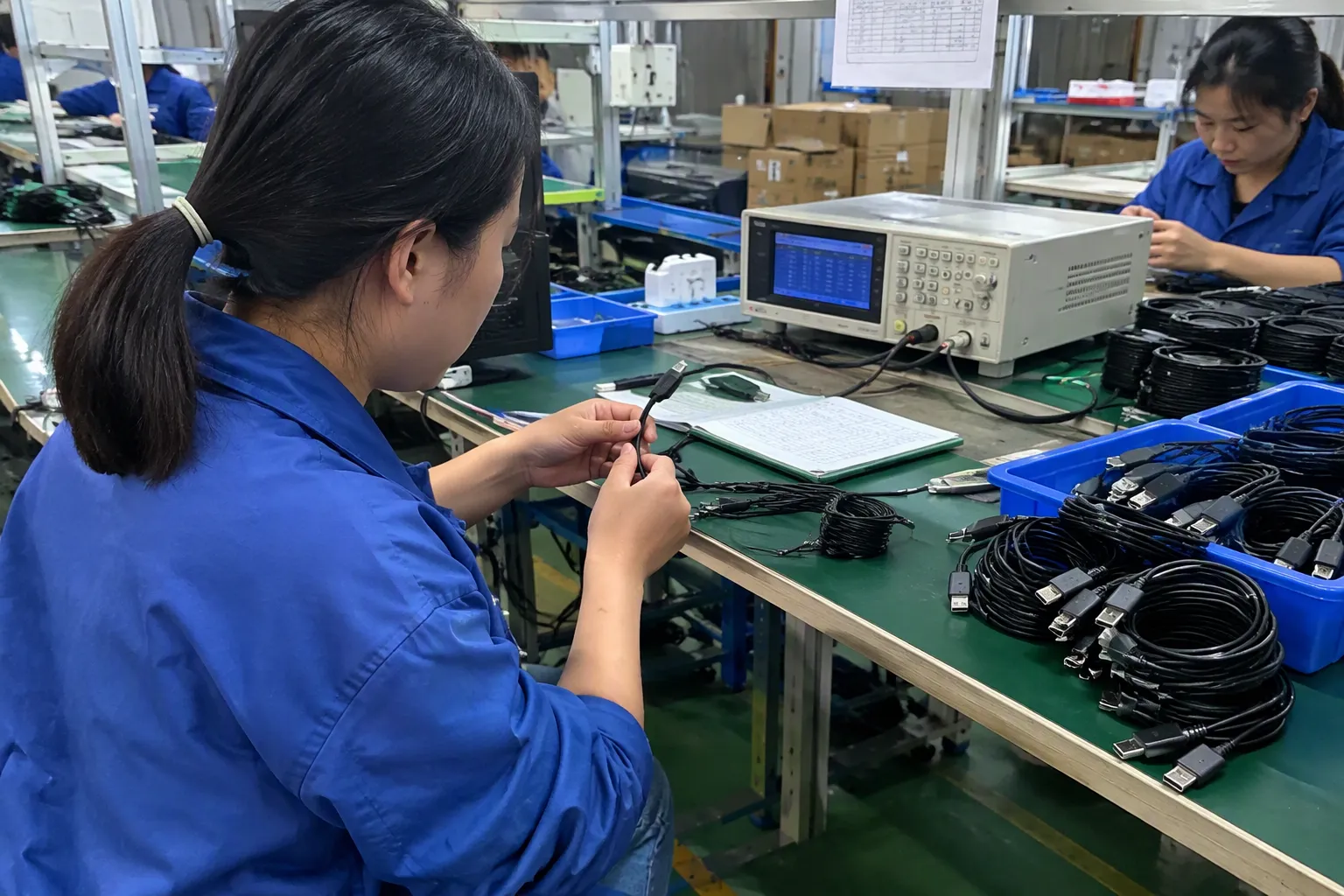
A sample is useful only when both sides know what it represents. I record the connector type, length, color, visible materials, packaging, label, and declared function. If the buyer tests charging or data use, I record the test setup and result in a practical way.
I also state that mass production should follow the approved sample and written specification. This reduces disagreement later. A photograph alone is not enough because it cannot show internal construction or confirm every performance characteristic.
Supplier evaluation table
| Supplier factor | Strong indication | Warning sign |
|---|---|---|
| Communication | Answers are specific and consistent | Repeatedly avoids basic questions |
| Specification | Written details match the sample | Uses only broad marketing terms |
| Documentation | Documents identify the relevant model and scope | Sends unrelated or unclear certificates |
| MOQ | Terms are stated for standard and custom packaging | MOQ changes without explanation |
| Lead time | Supplier separates production and shipping time | Gives an unrealistic universal promise |
| Quality control | Offers defined checks or inspection cooperation | Says quality is guaranteed without details |
| After-sales | Defect handling is written and practical | Refuses to discuss replacement terms |
| Repeat supply | Explains material and process control | Cannot confirm product consistency |
My 15 years in export trade have taught me that a supplier’s response style is part of the evaluation. Clear communication does not prove technical quality, but unclear communication makes technical and commercial risk harder to control.
What Should I Confirm Before Placing a Wholesale USB Cable Order?
A purchase order should convert the buyer’s expectations into clear, reviewable details. Many problems begin because the buyer and supplier remember the product differently. I confirm the specification, approved sample, packaging, quantity, delivery schedule, and after-sales process before releasing a bulk order.
Before placing a wholesale USB cable order, I confirm the exact model, connector configuration, length, declared function, materials, packaging, artwork, quantity, MOQ, lead time, inspection arrangement, documents, payment terms, and defect-handling process. I keep the approved information with the purchase record.
Commercial details
- Product model or internal SKU
- Quantity and acceptable quantity tolerance
- Unit price and included packaging
- Carton dimensions and packing quantity
- Delivery term and destination
- Production lead time
- Sample or tooling charges
- Payment schedule
- Required shipping documents
- Inspection timing and responsibility
- Defect or shortage resolution
Product details
- Connector combination
- Cable length and measurement method
- Color
- Jacket material
- Connector housing appearance
- Intended charging use
- Intended data use, if applicable
- Markings and logo placement
- Packaging format
- Approved sample reference
Inspection and testing
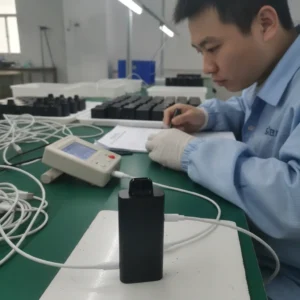
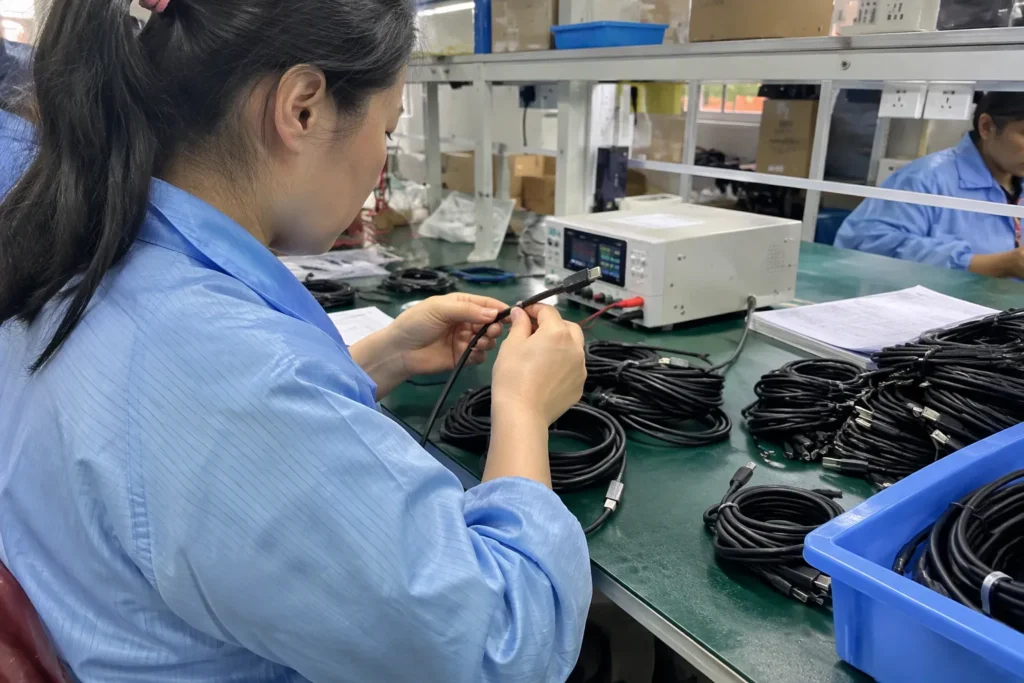
Inspection depth should match the product, order value, channel risk, and buyer’s technical requirements. A visual inspection may identify wrong colors, damaged connectors, poor printing, or packaging mistakes. It may not confirm every internal or performance characteristic.
- Pre-production sample approval
- First-article or pilot review
- In-process quality checks
- Pre-shipment inspection
- Independent laboratory or qualified technical evaluation
- Retention samples from the production batch
I recommend professional evaluation when the cable will be used in an application with specific electrical, safety, regulatory, or system requirements. My role as a sourcing professional is to help organize the commercial and product questions, not to replace an accredited laboratory or qualified engineer.
Managing repeat orders
Repeat orders deserve their own controls. I ask whether the supplier will notify the buyer before changing materials, molds, connectors, packaging, or production location. A small visible change may indicate a larger specification change, so I retain a reference sample and compare future batches.
I also track customer feedback by model. If a particular cable generates repeated complaints, I investigate the pattern instead of assuming that every complaint has the same cause. The problem could relate to the cable, the charger, the device, customer expectations, packaging language, or storage conditions.
How Should I Build a Wholesale USB Cable Product Mix?
A good product mix balances customer demand, technical clarity, price levels, and inventory risk. I do not recommend offering every connector and length at once. Too many similar SKUs can make purchasing, forecasting, packaging, and after-sales support more difficult.
I build a wholesale USB cable product mix around the buyer’s device categories and sales channels. I usually begin with a small number of clearly differentiated SKUs, then expand when sales data, customer requests, and supplier performance justify the additional inventory.
Separate SKUs by customer purpose
Channel-specific considerations
A retail chain may need consistent packaging, barcodes, carton labeling, and replenishment. An e-commerce seller may care more about product photography, listing accuracy, review risk, and return handling. A wholesaler may prefer bulk packaging and flexible mixed quantities. A grocery importer may require simple packaging and a competitive price point for impulse purchases.
| Channel | Main concern | Practical product response |
|---|---|---|
| Retail chain | Consistent presentation and replenishment | Standardized packaging, SKU control, reliable lead time |
| E-commerce | Listing accuracy and return reduction | Clear claims, good images, compatibility information |
| 3C wholesaler | Margin and assortment | Multiple price tiers and manageable MOQ |
| Grocery or general importer | Fast-moving simplicity | Limited SKUs, clear packaging, competitive landed cost |
| Promotional bundle | Cost and schedule | Agreed packaging, quantity planning, delivery control |
Customization and private label
- Artwork format and color expectations
- Printing method and position
- Packaging material
- Barcode and regulatory information
- Proof approval
- Tooling or setup charges
- MOQ and production lead time
- Ownership and storage of packaging materials
Customization can strengthen brand presentation, but it can also increase leftover inventory if the product mix is not validated first. I often suggest testing a standard product or smaller pilot order before making a large commitment to specialized packaging.
Frequently Asked Questions
Does every USB-C cable support the same charging power?
No. USB-C identifies the connector shape, not one universal charging capability. Cable construction, identification features, device requirements, charger capability, and charging protocol can all affect the result. I recommend confirming the intended system and verifying supplier claims before using a specific power statement in marketing.
Are charging-only USB cables suitable for data transfer?
Not necessarily. Some cables are designed mainly for charging and may not support the data function a customer expects. I ask suppliers to state whether the product supports data transfer and what documentation or sample verification applies. Buyers should label the product according to confirmed capability.
What should I include in a wholesale USB cable inquiry?
I include connector configuration, device use, charging purpose, data requirement, length, materials, color, packaging, target quantity, market, MOQ, delivery date, customization, documentation, and after-sales expectations. A detailed inquiry helps suppliers quote comparable products and reduces misunderstandings.
How can I reduce USB cable returns?
I reduce returns by matching the cable to the intended device use, controlling packaging claims, providing clear compatibility information, approving a defined sample, and checking batch consistency. I also review complaints by SKU so that I can identify whether the issue concerns the cable, the customer’s equipment, or an unclear product description.
Should I use an independent inspection company?
An independent inspection can be useful for larger orders, higher-risk channels, customized products, or products with important technical claims. The appropriate inspection scope depends on the order and application. I recommend discussing specific electrical, safety, and regulatory requirements with a qualified professional rather than relying on a generic visual check.
Conclusion
Wholesale USB cable purchasing requires more than comparing connector images and unit prices. I recommend starting with the use case, then matching charging needs, data requirements, device compatibility, construction, packaging, and sales-channel expectations. Buyers should verify samples, documents, MOQ, lead time, batch consistency, and after-sales arrangements. My Shenzhen-based 3C export team has 15 years of experience handling inquiries, sampling, orders, and customer communication. Contact me with your target devices, quantity, packaging, and market requirements so I can help you compare suitable options.
Sources
- Cables and Connectors", USB Implementers Forum documentation distinguishes the USB Type-C connector and receptacle from the USB protocols and power-delivery capabilities that may be implemented through them
- Are All USB-C Cables the Same? Types, Speeds, Safety", USB Type-C technical documentation indicates that cables using the same connector form may be specified for different signaling rates, current or power levels, and identification requirements
- USB Charger (USB Power Delivery)", USB Power Delivery specifications describe charging as a negotiated interaction among the power source, cable, and sink device, with the resulting operating point constrained by the capabilities of those components
- Overview of E-Marker in a USB Type-C Cable", USB Type-C specifications define electronically marked cable assemblies that can communicate cable characteristics, including information relevant to supported current or signaling capabilities
- How to easily tell whether a USB-C cable is data-only, ...", USB wiring references describe separate power and data conductors, allowing cable assemblies to provide power connectivity without providing a functional data path
- USB Type-C Connectors and Cable Assemblies ...", USB transmission guidance describes data communication as dependent on dedicated conductors and signal-integrity requirements that are separate from the cable's ability to carry electrical power
- A Cold-Bend Test for Thermoplastic Cable Jackets", Cable-flexing and abrasion studies show that durability is determined by interacting material and construction variables, including bend radius, strain relief, conductor design, and jacket properties, rather than by a braid designation alone
- Total Landed Cost Model", Total-cost-of-ownership research treats acquisition price as one component of procurement cost and includes associated logistics, quality, inventory, warranty, and administrative expenditures