Fast-charging earbud cases can look attractive in a crowded 3C product range, but the phrase often creates more questions than answers. I have seen buyers focus on the charger’s maximum current while overlooking the case charging controller, battery acceptance rate, protection design, and heat behavior. A better procurement decision starts with the complete charging system.
Quick Answer
Fast-charging earbud cases should be evaluated as complete charging systems, not by charger current alone. Buyers should confirm the case input profile, charging controller, battery specifications, protection functions, protocol compatibility, charging-time test conditions, and thermal-validation evidence. Supplier documents support an initial review, but they do not replace product-specific testing under realistic fast-charging conditions.
- Request the actual input voltage and current profile of the case.
- Confirm the battery cell rating and supported charge rate.
- Ask whether the case negotiates a charging protocol or uses a fixed input path.
- Review thermal test conditions, including ambient temperature, cable, charger, and charging stage.
- Verify certification documents and match them to the exact model, battery, and factory version.
- Treat “fast charging” as a claim that requires evidence, not as a specification by itself.
The main issue is simple: a high-output wall charger does not force an earbud case to accept more power. The case controls its own charging path.[1] In the sections below, I will explain how I would review the claim with a supplier, what documents I would request, and where thermal validation fits into a responsible buying decision.
Fast-Charging Earbud Cases: What Do Current Limits and Thermal Validation Mean
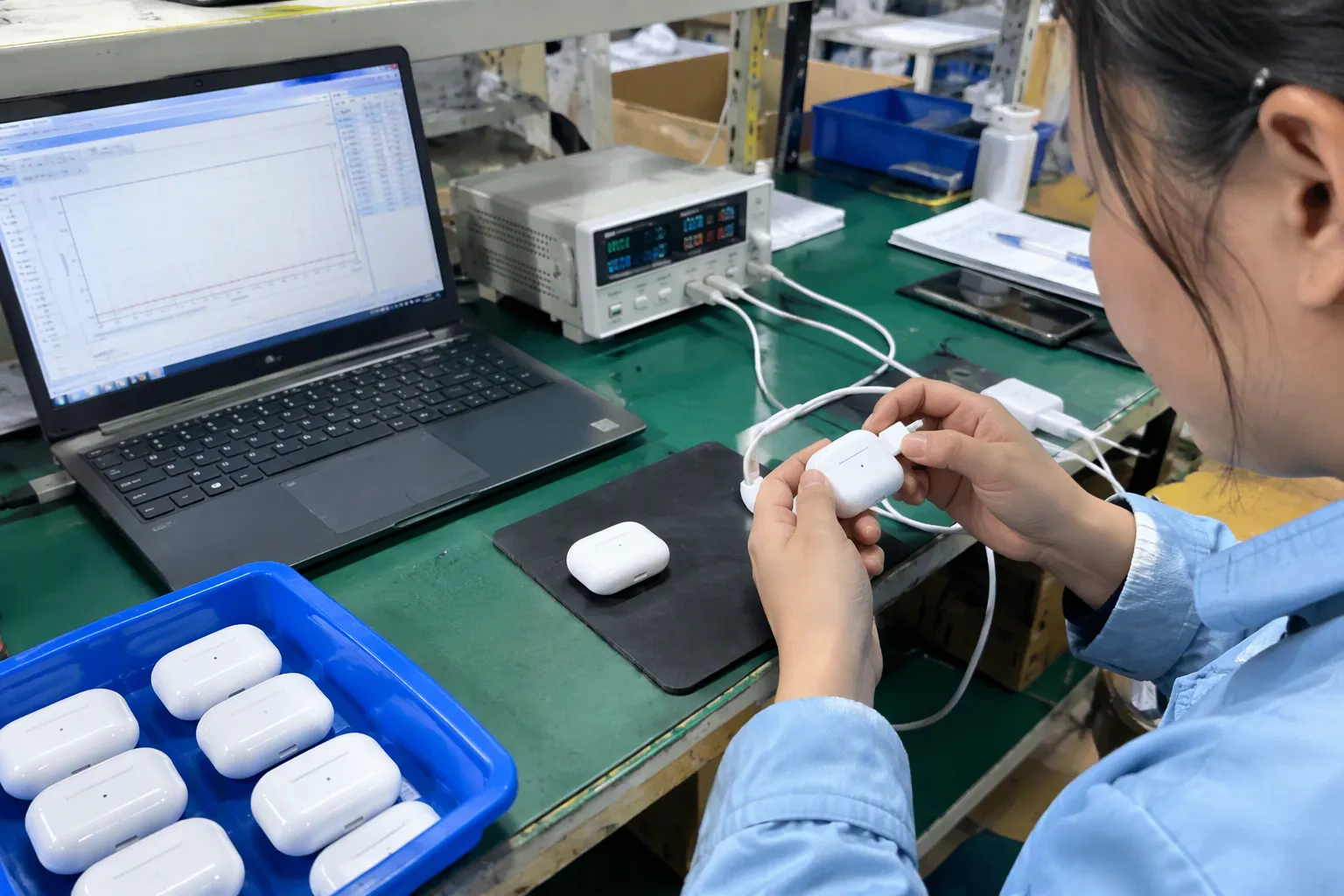
Many product listings use “fast charging” as a headline benefit, yet they may not define the charging time, input profile, or test method. That creates a procurement risk because a retailer may promise a performance level that the hardware does not consistently deliver.
Fast-charging earbud cases are charging cases designed to accept power through a defined input path at a higher or more efficient rate than a basic reference design. Current limits and thermal validation determine whether that performance is sustainable, safe, and suitable for the intended product range.
“Fast” needs a measurable definition
- Charging percentage achieved within a stated time.
- Whether the test covers the case only or the case with earbuds installed.
- Starting battery state of charge.
- Charger and cable used.
- Ambient temperature and airflow.
- Whether the test measures input power or actual battery charging.
- Whether the result applies to one sample or a production batch.
For example, “10 minutes provides 2 hours of listening” is not equivalent to “the case accepts 5 V at 2 A.” The first statement describes an end-user result, while the second describes an electrical input condition. Both may be useful, but neither tells the full story by itself.
Current is only one part of power
A case accepting 5 V at 1 A receives a nominal 5 W input before conversion losses.[2] A case accepting 5 V at 2 A has a higher possible input power, but the battery may not receive the entire amount. The charging controller, protection components, conversion efficiency, battery state, and temperature all influence the actual result.
A USB-C charger rated at 20 W can supply much more power than a small earbud case needs. The case still determines how much current it draws. This is why I do not treat the charger label as proof of fast case charging.
Why the claim matters to procurement
- Can the case deliver the stated result under repeatable conditions?
- Does the charging path protect the battery and electronics?
- Can the supplier document the design and test conditions?
- Will the claim remain accurate on packaging and sales pages?
What Determines the Real Charging Speed of Fast-Charging Earbud Cases?
A buyer may see a high-current adapter in a product package and assume that the case charges quickly. That assumption can be wrong because the case may use a low-current charging IC, a small battery, or a fixed input design that does not support the charger’s full output.
The real charging speed of fast-charging earbud cases depends on the case charging controller, battery charge-acceptance capability, input architecture, protocol behavior, power conversion losses, battery state, and thermal control. The charger’s maximum current is only the upper capability of the external power source.
The charging path
- Power source: wall charger, laptop, power bank, or vehicle adapter.
- Cable and connector: USB-C, Lightning, magnetic contact, or another input.
- Input protection: overvoltage, overcurrent, ESD, reverse-current, and related functions.
- Charging controller: the IC that regulates current and voltage into the battery.
- Battery and system load: the cell, earbuds, LEDs, wireless functions, and control circuit.
The weakest stage can limit the complete system. A charger may support a high current, but the charging IC may select a lower current. The cable may have poor quality or high resistance. The battery may reduce current near full charge.[4] The case may also lower the charging rate when its internal temperature rises.
Fixed input versus negotiated charging
A protocol-supported design may identify a suitable voltage or current profile.[5] However, protocol support alone does not guarantee fast charging. The product still needs a compatible charging controller, battery, firmware, and protection design.
- Which input voltages are accepted?
- What is the maximum continuous input current?
- Is the current negotiated or fixed?
- Which protocols are supported?
- What happens with a standard 5 V charger?
- What happens with a higher-power USB-C charger?
- Does the case draw the same current with earbuds installed?
- Does the case reduce current during high temperature or low battery conditions?
Battery acceptance is not the same as battery capacity
Battery capacity is commonly stated in milliampere-hours, or mAh. Capacity indicates how much charge the cell can store under specified conditions. It does not, by itself, define how quickly the cell can safely accept charge.
A smaller battery may reach a high percentage quickly if the charging system is designed for it.[3] A larger battery may take longer because its controller uses a lower current or because the constant-voltage stage is longer. The supplier should provide the battery model, nominal voltage, rated capacity, charge voltage, and recommended charging conditions.
Earbuds change the load
The case may charge while it is also charging the earbuds. This can affect input power, temperature, and time to full charge. Some cases prioritize the internal battery. Others distribute power between the case and earbuds.
| Test condition | Why it matters |
|---|---|
| Empty case with no earbuds | Shows the case charging path in isolation |
| Empty case with earbuds installed | Shows combined system behavior |
| Partially charged case | May produce a different current profile |
| Case charging while earbuds are used or connected | Adds system load and heat |
| Case inside retail packaging or a closed space | May reduce heat dissipation |
Which Current Limits Should Buyers Request?
Current limits are useful only when the supplier explains where they apply. “2 A input” could refer to a maximum adapter recommendation, a short peak, a measured input value, or a charging IC limit. These are different facts and should not appear as interchangeable specifications.
Buyers should request the rated input voltage, maximum continuous current, peak or transient current if relevant, charging-controller limit, battery charging current, and conditions under which the limits apply. Buyers should also ask how the case behaves when a charger offers more current than the product requires.
Separate the main electrical limits
| Parameter | What I would verify |
|---|---|
| Input voltage | Nominal and allowed operating range |
| Maximum input current | Continuous value, not only a short peak |
| Battery charge current | Current entering the cell under stated conditions |
| Charge voltage | Battery-specific regulation value |
| Adapter recommendation | Required, optional, or merely supplied |
| Protocol support | Exact protocol and compatible profiles |
| Protection limits | Overvoltage, overcurrent, short circuit, and temperature response |
| Thermal reduction | Whether current decreases as temperature rises |
| Test duration | Whether the limit is sustainable throughout charging |
The supplier may not be able to share every circuit detail. That is understandable for confidential designs. However, the supplier should still provide enough information for a buyer to evaluate the product responsibly.
Do not confuse supply capability with product draw
This distinction matters for packaging and marketing. A listing that says “works with a 3 A charger” is not the same as “charges at 3 A.” I would ask the supplier to review proposed wording before final artwork. Clear wording reduces the risk of customer misunderstanding.
Request current-versus-time data
- Starts with a higher current at low battery level.
- Holds that current for a defined period.
- Reduces current as voltage rises.
- Enters a constant-voltage stage.
- Stops or tapers near full charge.
- Reduces current because of temperature.
Questions for supplier comparison
- What is the input rating printed on the specification sheet?
- What is the measured current at the beginning, middle, and end of charging?
- What battery cell and charging IC does the design use?
- Does the case support charging with the earbuds installed?
- What happens when the input source exceeds the case rating?
- Which samples were used for the test?
- Can the supplier identify the production version tested?
- Are the documents from the current factory and component list?
How Should Thermal Validation for Fast-Charging Earbud Cases Be Conducted?
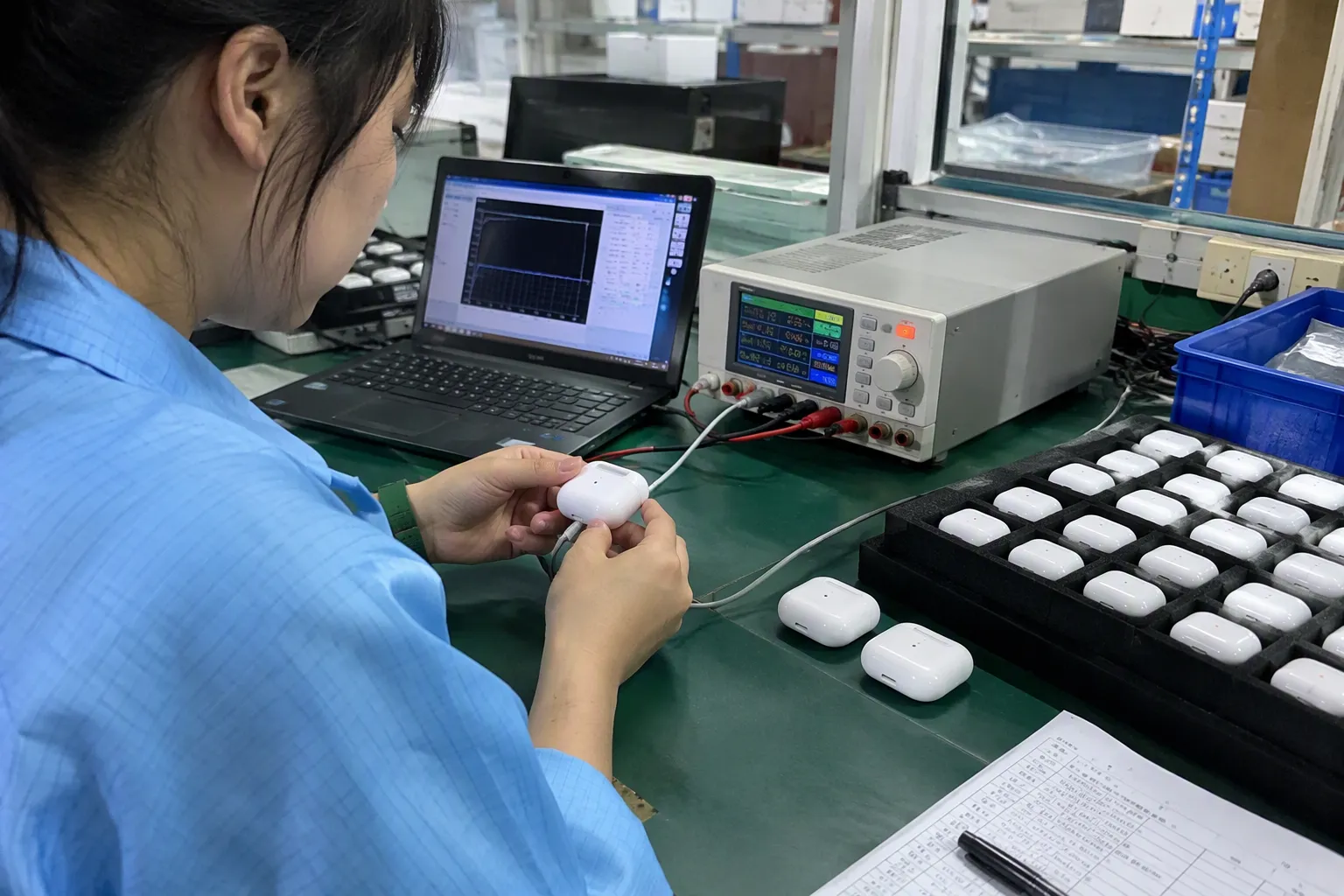
Fast charging can increase heat in the input circuit, charging controller, battery, connector, and nearby components. Heat does not automatically mean a product is unsafe, but unexplained or poorly controlled heat deserves investigation before a buyer accepts the claim.
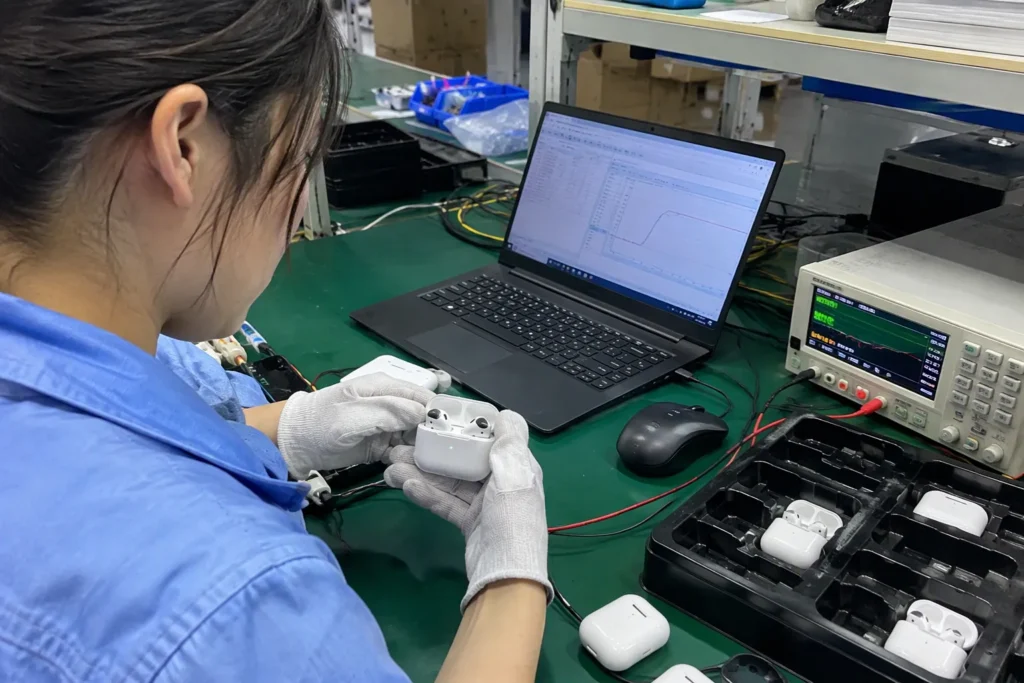
Thermal validation for fast-charging earbud cases should measure relevant temperatures throughout the charging cycle under defined conditions. The review should identify sensor locations, ambient conditions, charger and cable, battery state, product configuration, and any current-reduction or shutdown behavior.
I do not present supplier documents as my own thermal-test results. In my work reviewing earbud specifications and supplier materials, I treat those documents as evidence for initial screening. I would still recommend qualified laboratory or engineering evaluation when the claim, market, or risk level justifies it.
What a useful thermal test records
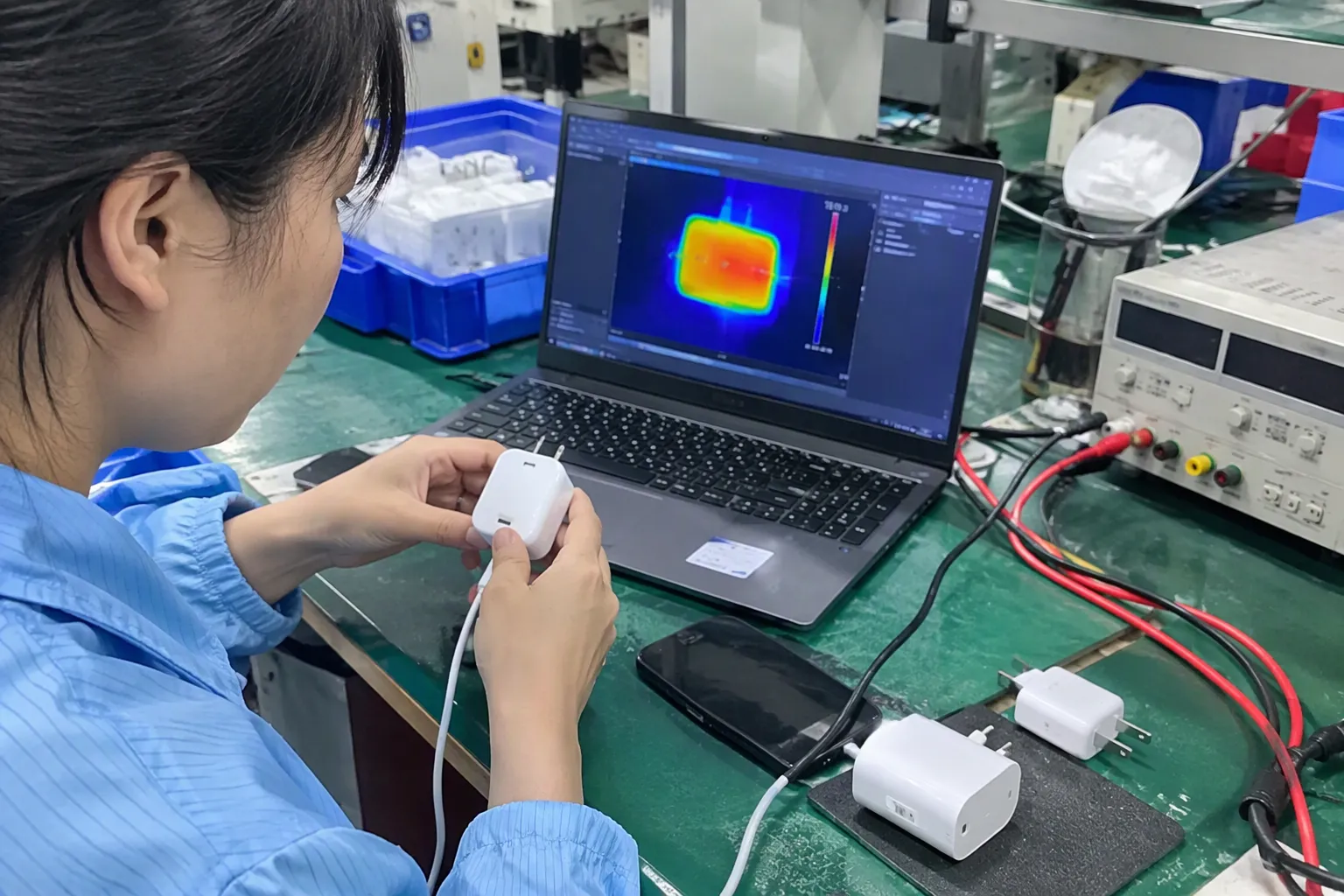
- Product model and hardware revision.
- Battery model, capacity, and initial state of charge.
- Charger model and output profile.
- Cable type and length.
- Ambient temperature and humidity.
- Position of the case during testing.
- Whether the case is open, closed, or inside packaging.
- Earbuds installed or removed.
- Measurement instruments and sensor locations.
- Sampling interval and total test duration.
- Maximum recorded temperatures.
- Charging current and voltage during the same period.
- Any throttling, warning, or shutdown event.
A thermal image can be useful, but it is not enough on its own.[6] A camera may show the outside surface while missing a hotter internal component. A qualified evaluator should select suitable measurement points and interpret the result according to the product design and applicable requirements.
Measure more than the outer shell
- Battery surface.
- Charging IC.
- Power-management components.
- USB-C connector and nearby solder joints.
- Wireless charging coil.
- Flexible cable connections.
- Internal plastic near heat sources.
- Earbud charging contacts.
The applicable temperature assessment depends on the component, material, use condition, and test method.[8] I avoid giving a universal “safe temperature” number because a limit must be tied to the specific design and applicable standard or engineering requirement.
Thermal behavior changes during charging
A case may behave differently at different battery levels. The initial constant-current stage may produce one heat pattern. The later constant-voltage stage may produce another. Charging with the earbuds installed can add a second heat source.
| Scenario | Procurement value |
|---|---|
| Case at low battery level | Shows the highest-power part of the cycle |
| Case near full charge | Shows tapering and termination behavior |
| Earbuds installed | Represents common customer use |
| Higher ambient temperature | Tests reduced heat-dissipation margin |
| Standard and higher-power chargers | Shows source compatibility |
| Repeated charging cycles | Helps identify heat accumulation or drift |
| Wireless charging, if supported | Covers a different thermal path |
Thermal validation is not only about safety
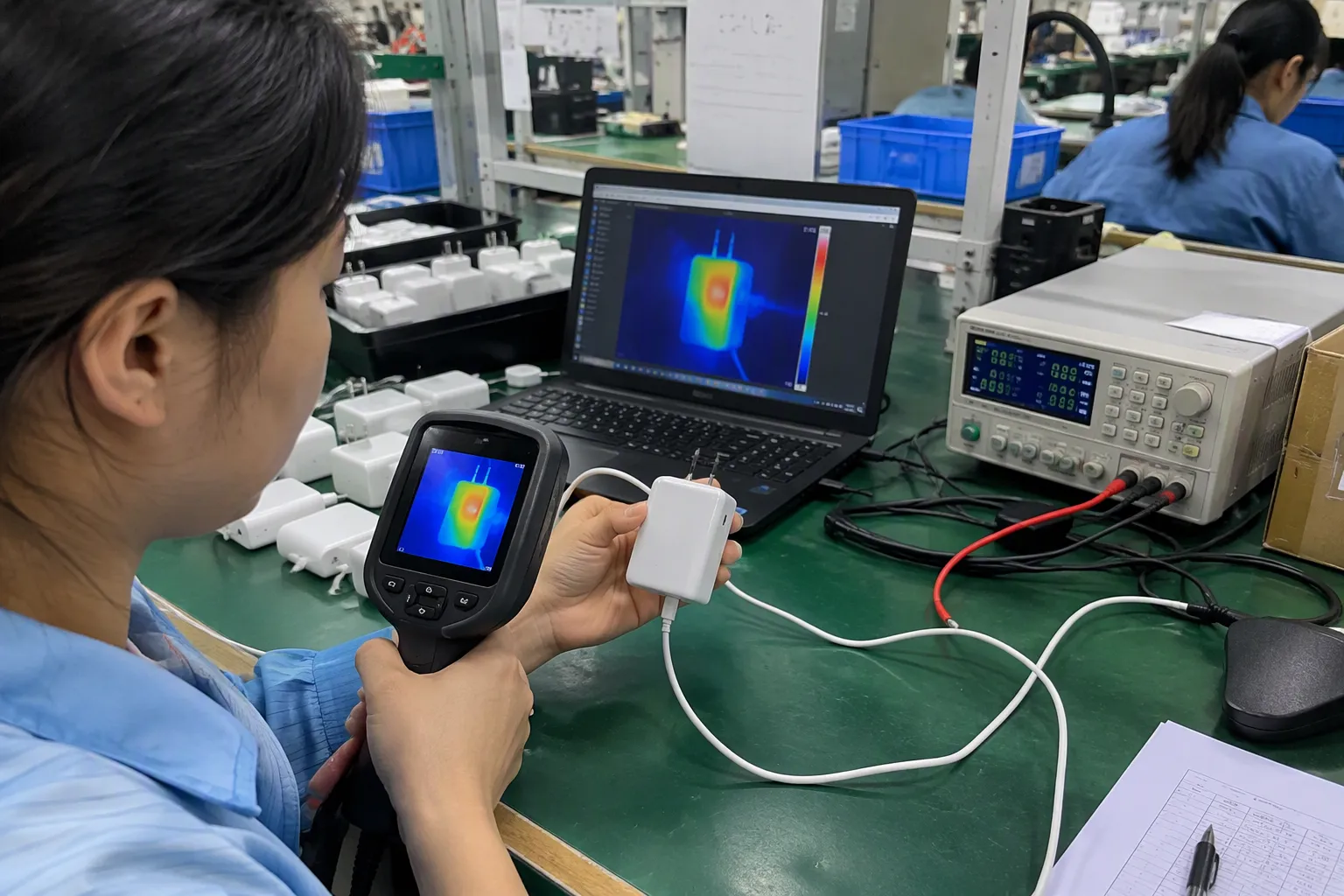
I also view thermal data as a reliability indicator. Repeated high temperature can affect battery aging, adhesive performance, connector durability, plastic deformation, and long-term charging behavior.[7] A product may pass a short functional test and still perform poorly after repeated use.
- Battery cycle testing.
- Charging-port durability.
- Drop and vibration evaluation.
- Overcharge and short-circuit protection checks.
- Cable compatibility.
- Firmware behavior during abnormal charging.
- Storage and transport conditions.
Which Documents Help Verify a Fast-Charging Earbud Case?
Supplier declarations, battery documents, test reports, and certification files can make a procurement review faster. They can also create false confidence when the documents are incomplete, outdated, or linked to a different model.
Useful documents for fast-charging earbud cases include a controlled specification sheet, battery datasheet, charging-controller information, protection description, charging-time record, thermal test report, and applicable conformity or certification files. Buyers should verify the product identity, test scope, issuing organization, and document validity.
Build a document hierarchy
1. Supplier declarations
2. Certification and conformity documents
For USB-related claims, I would review relevant information from the USB Implementers Forum rather than relying only on a supplier’s use of the term “USB fast charging.” For lithium battery transport questions, buyers can consult the International Air Transport Association battery guidance. These sources do not approve a particular earbud case, but they help buyers understand why documentation and product identity matter.
3. Independent test evidence
- The exact sample.
- The exact test standard or method.
- The laboratory or qualified evaluator.
- The test date.
- The measured parameters.
- The pass or fail criteria.
- The environmental conditions.
- Any limitations or deviations.
Check document consistency
- The specification sheet lists one battery capacity, while the test report lists another.
- The model number differs by one character.
- The report names an older factory.
- The charger shown in the test differs from the retail package.
- The product photographs show a different connector.
- The certification file covers wireless functions but not the charging claim.
- The report date predates a major hardware change.
Certifications do not prove every marketing claim
A product can hold relevant certifications and still have an unclear fast-charging statement. Certifications normally address defined requirements and test conditions. They do not necessarily verify every phrase used in a product listing.
| Question | Evidence to request |
|---|---|
| Is the product suitable for the target market? | Applicable conformity documents |
| Does the battery meet relevant requirements? | Battery test and transport documentation |
| Does the case support the stated charging input? | Electrical specification and charging test |
| Does fast charging remain stable? | Charging profile and thermal validation |
| Is the marketing wording accurate? | Claim review against test conditions |
How Can Buyers Compare Suppliers and Approve Samples?
A sample that charges quickly once may not represent production performance. Procurement teams need a repeatable approval process that connects technical evidence with MOQ, lead time, customization, after-sales support, and cost.
Buyers can compare suppliers by using the same technical questionnaire, approving a clearly identified sample, checking charging and thermal evidence, and adding measurable requirements to the purchase agreement. The final decision should balance performance, documentation quality, production control, and commercial risk.
Use a weighted evaluation model
| Evaluation area | Example questions |
|---|---|
| Charging performance | Is the charging time measured and repeatable? |
| Electrical design | Are current limits and protection functions documented? |
| Thermal behavior | Is there product-specific thermal evidence? |
| Battery quality | Is the cell source stable and traceable? |
| Production control | Does the factory inspect charging current and final function? |
| Compliance file | Do documents match the exact product version? |
| Commercial terms | Are MOQ, price, lead time, and payment terms workable? |
| Customization | Can the supplier support logo, packaging, color, or firmware needs? |
| After-sales | Are replacement and defect procedures clear? |
Approve the right sample
- Model number and revision.
- Battery capacity and supplier.
- Charging port and case color.
- Firmware version, if applicable.
- Included charger and cable.
- Packaging wording.
- Logo and labeling.
- Earbud compatibility.
- Sample date and supplier contact.
Add test conditions to the purchase agreement
- The input rating.
- Compatible charging sources.
- The advertised charging-time method.
- Required protection functions.
- Packaging and labeling language.
- Sample approval requirements.
- Notification of critical component changes.
- Inspection rights or pre-shipment testing.
- Defect handling and replacement terms.
Review production quality control
- Visual inspection of the port and PCB.
- Input-current testing.
- Charging-function testing.
- Battery voltage verification.
- Earbud contact testing.
- LED and display checks.
- Protection-function sampling.
- Burn-in or repeated charging checks.
- Final appearance and packaging inspection.
Consider the customer’s real environment
European and North American customers may use chargers from many brands. They may use laptop ports, travel adapters, power banks, multiport chargers, and third-party cables. The case should not be described more broadly than the evidence supports.
- A standard low-power USB source.
- A modern USB-C charger.
- A power bank.
- A longer or lower-cost cable.
- Charging while the earbuds are installed.
- Charging after the case has been stored in a warm vehicle or cold warehouse.
What Are the Most Common Fast-Charging Earbud Case Procurement Mistakes?
The product category moves quickly, and buyers often work under launch deadlines. Those pressures can make a short specification sheet look sufficient. In my view, the most expensive mistakes usually come from unclear definitions rather than from one isolated component.
The most common mistakes are equating charger output with case charging speed, accepting a peak current as a continuous rating, ignoring heat during combined charging, relying on unmatched certification files, and approving marketing claims before the test conditions are fixed.
Mistake 1: Comparing only the charger label
Mistake 2: Using “fast charging” without a time claim
Mistake 3: Testing only one ideal sample
Mistake 4: Treating a certificate as a thermal report
Mistake 5: Ignoring charging with earbuds installed
Mistake 6: Promising universal compatibility
Mistake 7: Failing to control component changes
A practical red-flag table
| Supplier response | Why I would ask more questions |
|---|---|
| “The charger supports 3 A, so the case is fast charging.” | This describes the source, not the case |
| “The case is certified, so it is thermally safe.” | The document scope may not cover the claim |
| “The charging time depends on the customer.” | The supplier should still define controlled test conditions |
| “We use the same battery as another model.” | Cell chemistry, capacity, and controller settings may differ |
| “The current is 2 A maximum.” | The supplier should clarify peak versus continuous current |
| “The sample is unchanged.” | I would still verify the BOM and production revision |
Frequently Asked Questions
Do Fast-Charging Earbud Cases need a high-current charger?
Not necessarily. The case controls the current it accepts. A higher-power charger can provide more available capacity, but it does not prove that the case will draw more power or charge faster. I would confirm the case input specification, protocol behavior, and tested charger compatibility before making a buying decision.
Is a higher charging current always better?
No. Higher current can shorten charging time in a suitable design, but it can also increase heat and stress on the charging path. The battery, controller, PCB, connector, firmware, and protection system must support the selected conditions. I would evaluate the complete system rather than selecting the highest current number.
What thermal documents should a supplier provide?
I would request a report that identifies the exact product, battery, charger, cable, ambient conditions, measurement points, test duration, and maximum recorded temperatures. The report should also show whether current reduction or shutdown occurred. A qualified professional should determine whether the method is suitable for the product and market.
Can a certification document prove a fast-charging claim?
Usually, a certification document proves only the requirements and conditions within its scope. It may support compliance for a product or function, but it does not automatically verify every marketing claim. I would match the document to the model and request separate charging-performance and thermal evidence where appropriate.
Should buyers test every production batch?
The right inspection frequency depends on product risk, order size, factory controls, and the importance of the claim. I would at least establish a pre-shipment charging check and a process for reviewing critical component changes. Qualified laboratories or engineers should define any formal validation or compliance program.
Conclusion
Fast-Charging Earbud Cases can offer a useful retail benefit, but the charger’s maximum current does not establish real charging performance. I would review the complete input path, battery, controller, protection design, charging profile, thermal behavior, and document consistency. I would also match the approved sample to production and keep marketing wording within the evidence. If you are comparing earbud suppliers, I can help organize specifications, MOQ, lead time, customization, certification files, and validation questions before you place an order.
Sources
- voltage - Powering a device by USB?", The cited USB and charging documentation describes source capability as distinct from the current selected or regulated by the connected device; this supports the article's distinction between charger rating and case charging behavior
- 1.2 Efficiency of Conversion | EME 812 - EMS Online Courses", Basic circuit theory defines electrical input power as the product of voltage and current and distinguishes that input from useful output power after conversion losses
- Battery Data | Center for Advanced Life Cycle Engineering", Research on lithium-ion charging shows that charging duration depends on cell capacity, allowable charging current, and the applied charge profile rather than on capacity alone
- Optimized Multi-Stepped constant current constant voltage fast ...", Lithium-ion charging literature describes a constant-voltage phase in which charging current decreases as the cell approaches the prescribed voltage limit
- USB Charger (USB Power Delivery)", USB Power Delivery documentation describes communication between the power source and sink for selecting an available voltage and current contract
- Infrared Thermography for Temperature Measurement ... - PMC", Infrared thermography guidance identifies surface emissivity, reflected radiation, and line-of-sight constraints as factors that can make camera readings unsuitable as a direct measurement of internal component temperature
- A Comparative Study of Thermal Aging Effect on the ... - PMC", Battery-aging and electronics-reliability research associates elevated or repeated thermal exposure with accelerated electrochemical degradation and thermally driven changes in component or material performance
- IEC TEST REPORT FORM TEMPLATE", Product-safety and thermal-design literature evaluates temperature limits in relation to component ratings, material characteristics, operating conditions, and the specified test method rather than applying one universal threshold
Related reading: