USB Type C Cable Wholesale purchasing can become expensive when the connector looks right but the cable does not match the customer’s device or intended use. I have seen buyers compare quotations before defining charging, data, or video requirements. That approach creates confusion. A clear specification-first process helps retailers reduce returns, delays, and after-sales disputes.
USB Type C Cable Wholesale is best approached as a task-matching and risk-control decision, not simply a connector purchase. Buyers should first identify the connected devices, connector types, required charging performance, data-transfer needs, video function, length, packaging, and compliance documents. They should then compare samples, supplier evidence, MOQ, lead time, and after-sales support before placing a bulk order.
Quick Answer
- USB Type-C describes the connector shape, not the complete cable performance.[1]
- Ask which devices the cable will connect and whether the main task is charging, data transfer, video output, or a combination.
- Replace vague terms such as “fast charging” and “high speed” with documented requirements that suppliers can support.
- Request samples and check packaging, construction, performance claims, and available test materials before bulk purchasing.
- Compare total wholesale risk, including MOQ, lead time, quality consistency, customization, and after-sales support—not only the unit price.
I have handled many USB cable quotation discussions with European and American buyers. The same issue appears repeatedly: a buyer asks for a “Type-C fast cable,” while the supplier needs more information before preparing an accurate offer. The sections below explain how I turn that unclear request into a practical purchasing specification.
Why Should USB Type C Cable Wholesale Start With the Use Case?
A product name can make a quotation appear simple while hiding important differences. If a retailer orders a cable based only on the Type-C connector, the stock may look correct but fail to satisfy the customer’s actual need. I start with the connected devices and intended task before discussing price.
USB Type C Cable Wholesale should begin with the use case because different cables can use the same Type-C connector while offering different charging, data-transfer, or video capabilities.[2] A buyer should define the devices, both connector ends, required function, cable length, construction, and documentation before comparing supplier quotations.
Connector shape is only one part of the specification
USB Type-C refers mainly to the physical connector and its reversible orientation. It does not automatically prove that a cable supports a particular power level, data rate, display function, or device combination. The USB Implementers Forum provides official information about USB Type-C and USB technologies, but buyers still need to match a specific product with a specific application. I recommend reviewing USB-IF information on USB Type-C as a starting point rather than treating the connector as a performance guarantee.
- Type-C on both ends.
- Type-A on one end and Type-C on the other.
- A Type-C connector on one end with a different connector or integrated product on the other.
- A standard construction for charging.
- A construction intended to support defined data functions.
- Additional design features that require supplier verification.
Questions I ask before preparing a quotation
- What devices will the cable connect?
- What connector is installed on each device?
- Will the cable mainly charge, transfer data, support video, or perform more than one task?
- What cable length and exterior design does the sales channel require?
- Does the buyer need a standard retail pack, bulk packing, or private-label packaging?
- What sales market and documentation requirements apply?
- What quantity, target price, delivery window, and reorder plan does the buyer have?
This process may seem slower than sending an immediate quotation. In practice, it saves time. A supplier cannot responsibly confirm an application from the connector name alone. I would rather ask several clear questions at the beginning than manage repeated corrections after the buyer receives samples.
Different retail customers may need different cable positions
A grocery wholesaler may want a simple, clearly packaged charging cable for impulse purchases. A 3C chain store may need consistent packaging, barcode control, stable replenishment, and a documented product range. An online seller may care more about product photography, length options, compatibility wording, and return reduction.
| Buyer situation | Likely priority | Information to define |
|---|---|---|
| General charging accessory | Easy customer understanding | Device use, connector ends, length, package wording |
| Phone and tablet retailer | Stable everyday performance | Intended devices, construction, sample approval, reorder consistency |
| Laptop accessory range | Higher application sensitivity | Charging task, device compatibility, cable design, supplier evidence |
| Data cable assortment | Transfer-related customer expectations | Supported data function, test method or documentation, labeling |
| Video-related accessory | Application-specific matching | Device ports, display use, supplier confirmation, sample evaluation |
| Private-label product | Brand and compliance control | Packaging, artwork, QC standard, documents, batch consistency |
Which USB Type C Cable Wholesale Specifications Should Buyers Verify?
Unclear terms create unclear orders. Words such as “fast charging,” “high speed,” and “full compatibility” may sound attractive, but they do not give a purchasing team enough information to approve a product. I convert these phrases into measurable or documentable requirements and ask the supplier to confirm what the product is designed to support.
For USB Type C Cable Wholesale, buyers should verify connector configuration, intended function, charging claims, data claims, video claims, length, construction, labeling, packaging, and available test materials. The buyer should record each requirement in the purchase specification and confirm it against samples and supplier documents before mass production.
Charging claims need careful wording
- The intended device categories.
- The charger and cable connector arrangement.
- The supplier’s stated charging capability.
- Any conditions attached to the claim.
- The sample or test material used for confirmation.
- The wording permitted on the package and product page.
Data-transfer language should identify the actual expectation
“High speed” is too broad for a purchase order. A retailer may use this phrase to mean that a phone can transfer photos, while a professional customer may expect a much more demanding data application. Those expectations can lead to different products and different customer complaints.
- Whether the cable is intended primarily for charging or data.
- What data function the supplier claims.
- Whether the claim applies to the complete cable or only a related product family.
- What supporting specification, sample, or test material is available.
- How the claim should appear in packaging and online listings.
Video output requires a separate review
Some buyers assume that any Type-C connector can carry a display signal. That assumption is unsafe. Video output depends on the devices, their ports, supported functions, cable design, and the complete connection path.[5] I treat video-related cable requests as application-specific and recommend qualified technical evaluation where the use case is important.
- The source device and display device.
- The connector on each end.
- The intended resolution or display requirement, if relevant.
- Whether an adapter, hub, or special protocol is involved.
- The supplier’s documented position on the application.
- Sample verification under the buyer’s own equipment.
Mechanical specifications also affect wholesale success
A useful specification table
| Specification area | Buyer requirement | Supplier confirmation |
|---|---|---|
| Connector ends | For example, Type-C to Type-C or Type-A to Type-C | Written configuration |
| Main task | Charging, data, video, or combined use | Intended function |
| Device group | Phone, tablet, laptop, power bank, or other | Compatible application to verify |
| Length | Required retail options | Actual sample measurement |
| Exterior | Color, jacket, housing, logo | Approved sample and artwork |
| Performance wording | Specific documented claim | Supplier specification or test material |
| Packaging | Retail box, polybag, bulk, private label | Artwork and packing details |
| Quality control | Inspection points and defect standard | QC plan or inspection record |
| Documents | Applicable declarations or reports | Copies for buyer review |
How Can Buyers Compare USB Type C Cable Wholesale Suppliers?
The lowest quotation can look attractive until a buyer calculates the cost of unsuitable stock, delayed delivery, customer returns, and repeated technical discussions. I compare suppliers through a wider risk-control process. Price matters, but it comes after specification fit and supply reliability.
Buyers can compare USB Type C Cable Wholesale suppliers by reviewing specification accuracy, sample quality, documentation, quality-control procedures, MOQ, lead time, customization ability, communication, and after-sales support. A supplier that gives a clear and consistent answer is often more valuable than one that offers the lowest initial unit price.
Ask for a structured quotation
- Model number.
- Connector configuration.
- Length and color.
- Material and visible construction.
- Packing method.
- Unit price and price basis.
- MOQ.
- Sample cost and sample lead time.
- Production lead time.
- Available customization.
- Payment terms.
- Shipping information.
- Warranty or after-sales process.
- Available product documents.
If two quotations use different descriptions, the prices are not directly comparable. One supplier may quote a basic charging cable while another quotes a cable with a different construction or documented function. I ask suppliers to clarify differences before I recommend a purchase.
Evaluate the supplier’s questions
A supplier’s questions reveal how carefully the company manages product matching. A supplier that immediately promises every function may appear helpful, but overconfident wording can create risk. A supplier that asks about the devices, task, connector ends, packaging, and market may be taking a more responsible approach.
- Product understanding: Can the supplier explain what the model is designed to do?
- Specification discipline: Does the supplier separate confirmed information from items requiring verification?
- Sample control: Can the supplier provide a sample that matches the quoted model?
- Production consistency: Does the supplier describe incoming, in-process, and final inspection?
- Communication: Does the supplier answer the same question consistently?
- Commercial reliability: Can the supplier meet the target quantity and delivery plan?
- After-sales handling: Does the supplier have a process for defects, claims, and replacement decisions?
Compare total cost, not only unit cost
| Cost or risk | Low-price but unclear product | Better-controlled product |
|---|---|---|
| Initial unit price | Often lower | May be higher |
| Sample and verification effort | May increase later | Planned earlier |
| Return risk | Potentially higher | Reduced through matching |
| Reorder consistency | Needs investigation | Included in supplier review |
| Packaging corrections | Possible after production | Approved before production |
| Customer-service time | Can increase | More predictable |
| Delivery risk | Depends on supplier control | Reviewed before order |
I do not claim that a higher price automatically means better quality. I compare what the price includes and what evidence supports the product. A buyer should not pay for features that the sales channel does not need, but the buyer should also avoid removing important controls just to reach a target price.
Supplier location and export experience
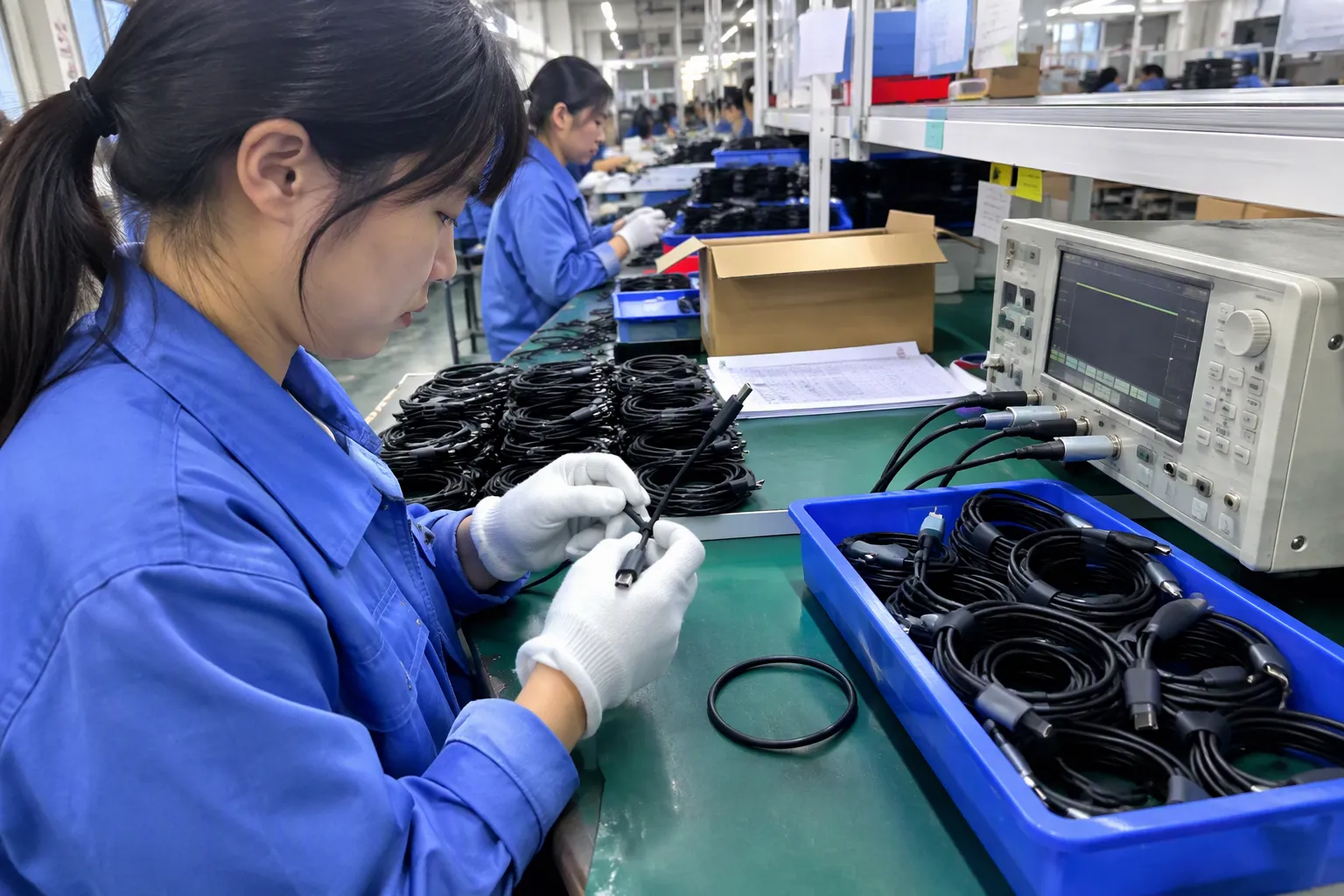
Our company is based in Shenzhen, and I have worked with European and American 3C buyers for many years. Export experience does not automatically prove that a supplier’s product is right for every application. It can, however, improve communication around packing, shipping documents, labeling, production schedules, and after-sales procedures.
- Whether the supplier exports the relevant product category.
- Whether the supplier can communicate in clear written specifications.
- Whether the supplier understands the buyer’s destination market.
- Whether the supplier can provide consistent packaging and carton information.
- Whether the supplier can support repeat orders.
- Whether the supplier separates different models and batches in its records.
Buyers should treat certifications and reports as documents to review, not as universal proof that every cable works in every device.[7] The European Commission provides information on CE marking and manufacturer responsibilities, while the European Chemicals Agency provides information about REACH obligations. The exact obligations depend on the product, market, and importer responsibilities[8], so buyers should obtain qualified compliance advice for their situation.
How Should Buyers Use Samples and Quality Control for USB Type C Cable Wholesale?
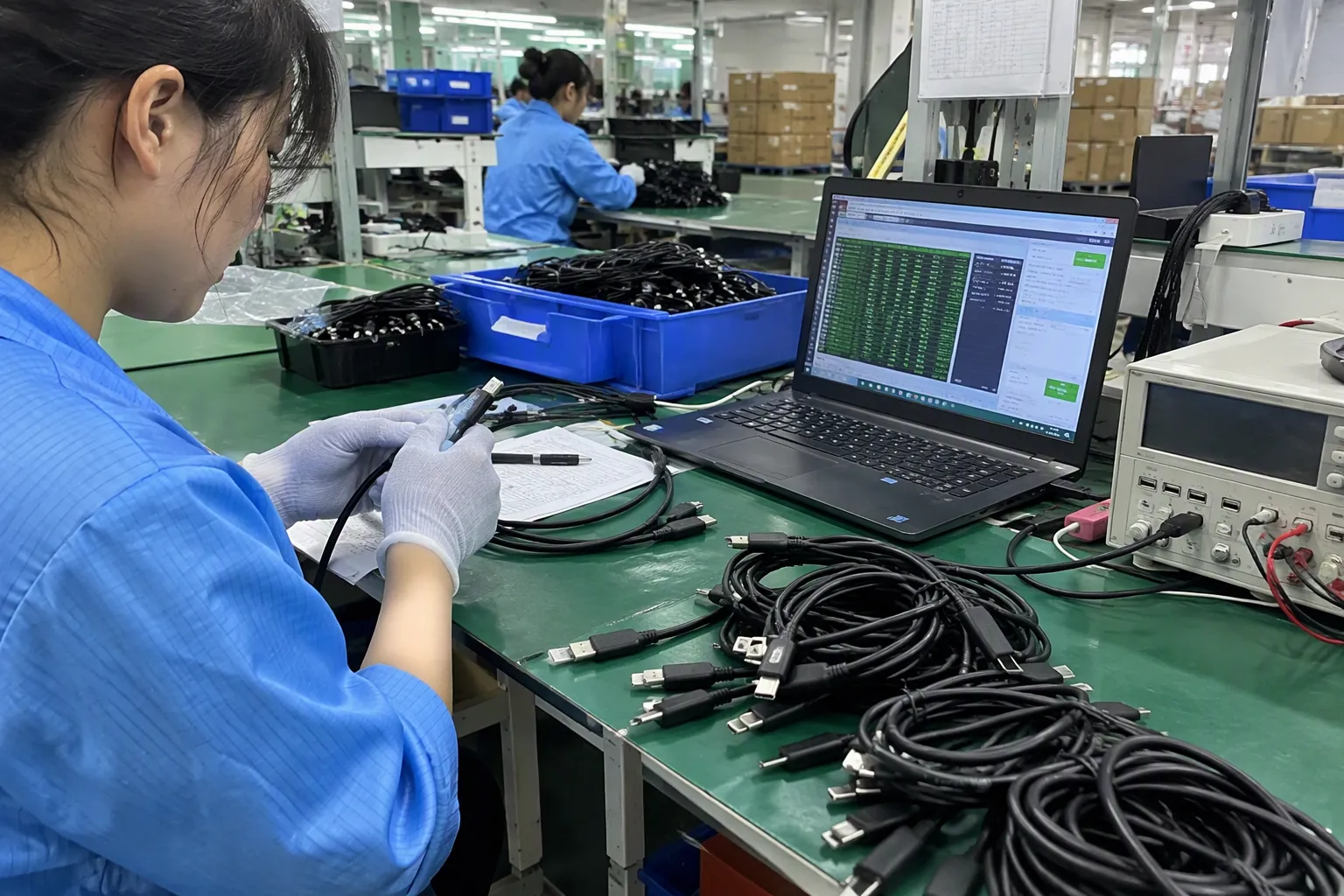
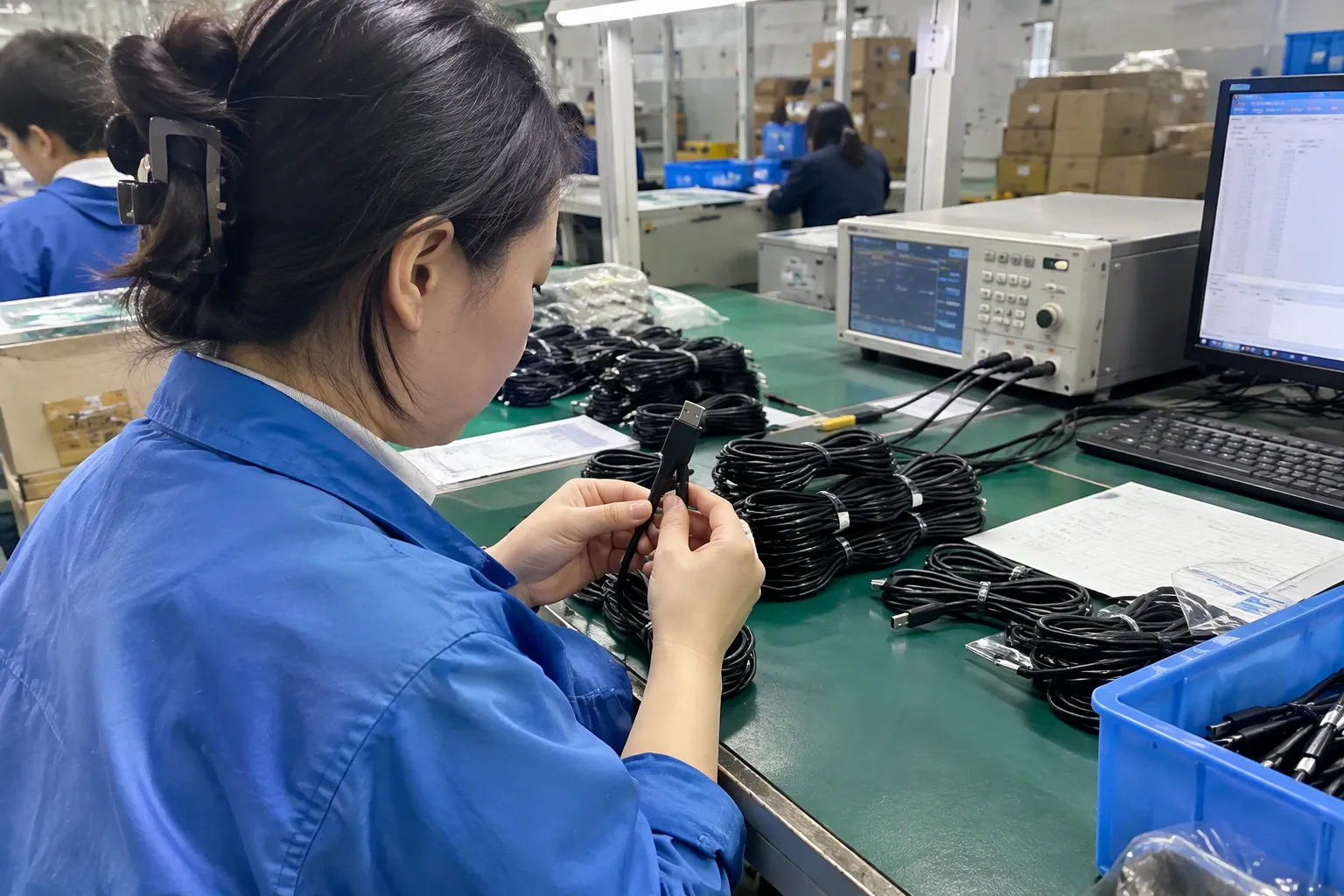
A catalog image cannot show every detail that affects a cable order. A sample gives the buyer an opportunity to review construction, labeling, packaging, and practical fit before committing to production. I treat sample approval as a purchasing control, not as a formality.
Before placing a USB Type C Cable Wholesale order, buyers should compare the approved sample with the quotation, inspect visible construction and packaging, confirm the intended use with relevant equipment, and record the acceptance standard. Production inspection should then check whether the delivered batch matches the approved sample and agreed specification.
What I check during a sample review
1. Identity and configuration
I confirm the model number, connector ends, length, color, logo, and packaging. I check that the sample is the same model described in the quotation. This point sounds basic, but it prevents a common problem: the buyer approves one sample while production follows a similar-looking model.
2. Physical construction
I inspect the connector housing, strain relief, cable jacket, printing, and overall finish. I look for visible gaps, loose parts, inconsistent color, damaged packaging, and sharp edges. I also compare samples from different production batches when repeat orders become important.
3. Intended function
I use the buyer’s stated use case as the basis for practical checking. A charging-focused cable should be reviewed in the intended charging setup. A data-focused product should be evaluated with the buyer’s relevant equipment or a qualified test process. A video-related application requires particularly careful confirmation.
4. Packaging and customer communication
Create a golden sample and inspection record
For repeat wholesale orders, I recommend keeping an approved reference sample, sometimes called a golden sample, together with the final specification. The record can include photographs, packaging artwork, dimensions, material descriptions, and agreed inspection points.
- Correct quantity and carton marking.
- Correct model and connector configuration.
- Cable length and appearance.
- Connector assembly and housing condition.
- Printing and logo position.
- Packaging and barcode.
- Visible defects.
- Sample-based functional checks.
- Defect classification and decision process.
The exact inspection method should match the product and buyer’s quality plan. Buyers with demanding applications should engage an appropriate qualified testing organization or technical professional. I can help coordinate supplier communication, but I do not present commercial sample inspection as laboratory certification.
Why batch consistency matters
A first sample may be acceptable while later production changes. A factory might change a material, connector source, assembly process, or packaging component without explaining the effect. Buyers should agree that significant specification changes require notification and, where appropriate, reapproval.
How Do MOQ, Lead Time, Packaging, and After-Sales Affect USB Type C Cable Wholesale?
A technically suitable cable can still create commercial problems if the MOQ is too high, the delivery schedule is unclear, or the supplier cannot support a defect claim. I discuss these points before the purchase order because they directly affect inventory planning and customer service.
USB Type C Cable Wholesale decisions should include MOQ, sample timing, production lead time, shipping preparation, packaging customization, reorder conditions, and after-sales handling. Buyers should confirm these terms in writing and connect them to the approved model and specification.
MOQ should match the buyer’s sales plan
Lead time includes more than factory production
I avoid promising an exact arrival date without confirmed shipping details. Weather, port conditions, carrier schedules, and customs processes can affect the final delivery. A responsible quotation distinguishes factory lead time from transportation time.
Packaging can reduce or create returns
The packaging should match the product’s real function. When a package uses broad promises, customers may purchase the cable for a task that the model was not designed to support. That problem can appear as a quality complaint even when the cable performs according to its actual specification.
- Confirm model and connector wording.
- Confirm length and color.
- Review all performance claims.
- Check translations for the destination market.
- Confirm barcode and carton marks.
- Check required importer or responsible-party information.
- Approve artwork before production.
Build a clear after-sales process
I find that many after-sales arguments begin because the original specification was incomplete. If the buyer and supplier never defined the intended function, they may disagree about whether the product is defective. A written use case and approved sample give both parties a stronger reference.
For related procurement planning, buyers may also review an internal 3C accessories supplier checklist and a USB charger wholesale evaluation guide. These topics involve different products, but the same principles apply: define the application, verify the documents, approve the sample, and plan the reorder.
What Should a USB Type C Cable Wholesale RFQ Include?
A USB Type C Cable Wholesale RFQ should identify the connector ends, intended use, required length, appearance, packaging, quantity, destination market, documentation needs, target schedule, and customization requirements. The buyer should ask suppliers to separate confirmed specifications from capabilities that require sample or technical verification.
A practical RFQ structure
| RFQ item | Example information to provide |
|---|---|
| Product category | USB Type-C cable |
| Connector configuration | Type-C to Type-C or Type-A to Type-C |
| Intended task | Charging, data transfer, video-related use, or combined use |
| Device group | Phones, tablets, laptops, power banks, or specified models |
| Length | Required lengths and acceptable tolerance |
| Appearance | Color, material preference, housing style |
| Branding | Logo method, position, and artwork status |
| Packaging | Retail box, blister, polybag, or bulk packing |
| Quantity | Trial order and expected annual volume |
| Destination | Country or sales region |
| Documents | Applicable declarations, reports, or supplier records |
| Delivery | Sample deadline and production target |
| Commercial terms | MOQ, payment, quotation validity, shipping basis |
Ask suppliers to show exclusions
Use a supplier scoring table
| Evaluation factor | Suggested buyer question | Result |
|---|---|---|
| Specification fit | Does the product match the defined task? | Confirmed / pending |
| Sample quality | Does the sample match the quotation? | Pass / revise |
| Documentation | Are relevant documents available for review? | Available / pending |
| MOQ | Does the MOQ fit the sales plan? | Suitable / unsuitable |
| Lead time | Can the supplier meet the target schedule? | Confirmed / risk |
| Packaging | Can the supplier support required labeling? | Yes / no |
| Communication | Are answers clear and consistent? | Strong / weak |
| After-sales | Is the claim process defined? | Clear / unclear |
| Price | Is the total value competitive? | Compare after fit |
Frequently Asked Questions
Is USB Type-C the same as fast charging?
No. USB Type-C identifies a connector design, not a universal charging result. Charging performance depends on the cable, charger, device, connection, and applicable power-management features.[3] Buyers should request a specific supplier claim and verify the exact product rather than using the connector shape as proof.
Can every USB Type-C cable transfer data?
No. Type-C cables can differ in their intended functions and documented data capabilities.[4] A buyer should ask whether data transfer is supported, what level is claimed, and what evidence or sample evaluation is available. Packaging should use precise wording that matches the approved specification.
Can every USB Type-C cable support video output?
No. Video use depends on the connected devices, ports, supported functions, cable design, and complete setup. Buyers should treat video-related requests as application-specific. They should obtain supplier confirmation and evaluate the exact cable with relevant equipment before making a broad retail claim.
What should I request from a USB Type-C cable supplier?
I recommend requesting a model-specific quotation, connector configuration, intended function, length, materials, packaging details, MOQ, lead time, sample, quality-control information, and applicable documents. Buyers should also ask the supplier to identify any unverified claims or application limitations.
Is the cheapest USB Type-C cable quotation the best choice?
Not necessarily. A low unit price can become expensive if the cable does not match the customer’s use, arrives late, varies between batches, or creates returns. I compare specification fit, samples, documentation, supply stability, packaging, total cost, and after-sales support before selecting a supplier.
Conclusion
USB Type C Cable Wholesale purchasing works best when I treat it as a product-matching and risk-control process. The Type-C connector shape does not confirm charging, data, or video performance.[6] Buyers should define the connected devices and intended task, turn vague claims into verifiable specifications, approve samples, review supplier documents, and compare MOQ, lead time, packaging, and after-sales support. My Shenzhen-based team has 15 years of 3C export experience, and I can help European and American retailers, wholesalers, chain stores, and e-commerce sellers clarify requirements and request suitable USB cable samples and quotations.
Sources
- Universal Serial Bus Type-C Cable and Connector ...", The USB Implementers Forum specifies USB Type-C primarily as a connector and cable interface, while supported power, data, and alternate-mode functions depend on the applicable USB specifications and product implementation
- Universal Serial Bus Type-C Cable and Connector ...", USB Type-C documentation describes a common connector family in which cable assemblies may differ in supported signaling, power-delivery features, and alternate modes; connector appearance alone therefore does not identify all functional characteristics
- USB Power Delivery", USB Power Delivery documentation describes charging as a negotiated interaction among the power source, sink device, cable, and applicable protocol capabilities rather than as a property determined solely by the connector
- USB 3.2 Specification", USB technical specifications define multiple data-transfer capabilities for Type-C cable assemblies, with supported rates depending on the applicable USB generation and cable implementation
- Connecting Your Laptop to Classroom AV: USB-C vs. HDMI", DisplayPort and USB Type-C technical documentation indicates that video transmission requires compatible source and sink functions, port support, and an appropriate signaling path; a Type-C connector alone does not establish display compatibility
- USB Type-C® Cable Logo Usage Guidelines", USB Type-C standards and related technical guidance treat connector geometry as distinct from supported power, data, and alternate-mode functions, so visual connector identification is not sufficient to establish performance
- General Use Products: Certification and Testing", European conformity-assessment guidance describes CE marking as a manufacturer's declaration that applicable requirements have been met; it is not a universal guarantee of compatibility across all devices and use conditions
- CE marking - Internal Market, Industry, Entrepreneurship and ...", European product-compliance guidance assigns distinct obligations to manufacturers, importers, and distributors and applies requirements according to the product legislation and market concerned