When I speak with buyers searching for an OEM USB Cable Manufacturer in China, I often see the same problem: they compare unit prices before defining the cable they actually need. That approach creates confusion around charging, data performance, MOQ, and delivery. I recommend starting with the product task, then qualifying suppliers against clear technical and commercial requirements.
Quick Answer
The best OEM USB Cable Manufacturer in China is not automatically the supplier offering the lowest quotation. Buyers should first confirm connector types, power and data requirements, materials, packaging, MOQ, lead time, sample details, and quality-control documents. A suitable supplier should explain which specifications are supported, identify what requires verification, and show how the approved sample will be controlled during mass production.
I have handled USB cable quotations and customization discussions for European and North American customers for many years. In my experience, a good inquiry makes supplier comparison much easier. The sections below explain how I would evaluate an OEM cable partner before sampling or placing a purchase order.
What Should Buyers Ask an OEM USB Cable Manufacturer in China First?
Many buyers begin with a short message such as “Please quote a fast-charging Type-C cable.” The supplier still has to guess the connector combination, cable length, packaging, target market, and expected performance. A better first inquiry gives both sides enough information to discuss the same product.
The first questions should cover the cable’s use case, physical construction, electrical requirements, customization scope, and commercial conditions. Buyers can then compare quotations on a like-for-like basis instead of treating different products as equivalent.
Start with the device and sales channel
I usually suggest that buyers describe the devices and sales channel before discussing price. A cable for smartphone retail packaging may have different requirements from a cable sold as a low-cost accessory in a supermarket or included with a charging kit.
- Connector combination: USB-A to USB-C, USB-C to USB-C, USB-A to Lightning-compatible product where applicable, or another configuration.
- Length: Common retail lengths may differ from the length needed for a desk, vehicle, travel kit, or charging station.
- Power requirement: The buyer should state the intended charging use and the required power level, subject to technical verification.
- Data requirement: The buyer should specify whether the cable is for charging only or for data transfer as well.
- Device compatibility: The buyer should list representative phones, tablets, laptops, power banks, or other equipment.
- Outer material: PVC, TPE, braided textile, or another requested construction.
- Connector housing: Standard, compact, reinforced, transparent, aluminum-look, or custom housing.
- Packaging: Polybag, paper box, hanging card, retail box, or private-label packaging.
- Target market: The buyer should identify whether the product is intended for Europe, North America, or another market.
- Forecast and MOQ: The buyer should provide an expected order range if possible, even when the first order is small.
Why “fast charging” needs more detail
“Fast charging” is not one universal cable specification.[1] The final result can depend on the cable design, connector type, device, charger, charging protocol, power requirement, and available technical documentation.[2] A supplier should not treat the phrase as a complete technical description.
- Which charger or charging system will the cable work with?
- Which devices will customers connect?
- Is the cable intended for charging only, or charging plus data?
- What performance information can the supplier document?
- Does the requested performance depend on a particular protocol or compatible equipment?
- What information will appear on the packaging and product listing?
The USB Implementers Forum provides official information about USB specifications and compliance programs. Buyers should use official technical sources and product-specific documentation rather than relying only on a marketplace title or a supplier’s general statement.
A practical first-inquiry table
| Information | Why I ask for it | What I want the supplier to confirm |
|---|---|---|
| Connector type | Different connectors create different construction and compatibility requirements | Proposed connector combination and availability |
| Cable length | Length can affect handling, packaging, and design choices | Available lengths and price differences |
| Charging use | “Fast charging” alone is incomplete | Supported application and documentation |
| Data use | Charging-only and data cables are not the same product task | Whether data function is included and how it is verified |
| Jacket and braid | Materials affect appearance, flexibility, and cost | Material options, color, and construction |
| Packaging | Packaging changes artwork, MOQ, and lead time | Packaging method, template, and customization conditions |
| Order quantity | Quantity affects production planning and unit cost | MOQ, price breaks, and sample policy |
| Target market | Documentation and labeling needs may vary | Available compliance documents and buyer responsibilities |
How Can Buyers Compare an OEM USB Cable Manufacturer in China on Technical Fit?
A low quotation can look attractive until the buyer discovers that the cable does not match the intended devices or sales claims. I have seen many quotation discussions become longer because the product name was clear but the technical purpose was not. Technical fit should come before detailed price comparison.
Connector design is only the starting point
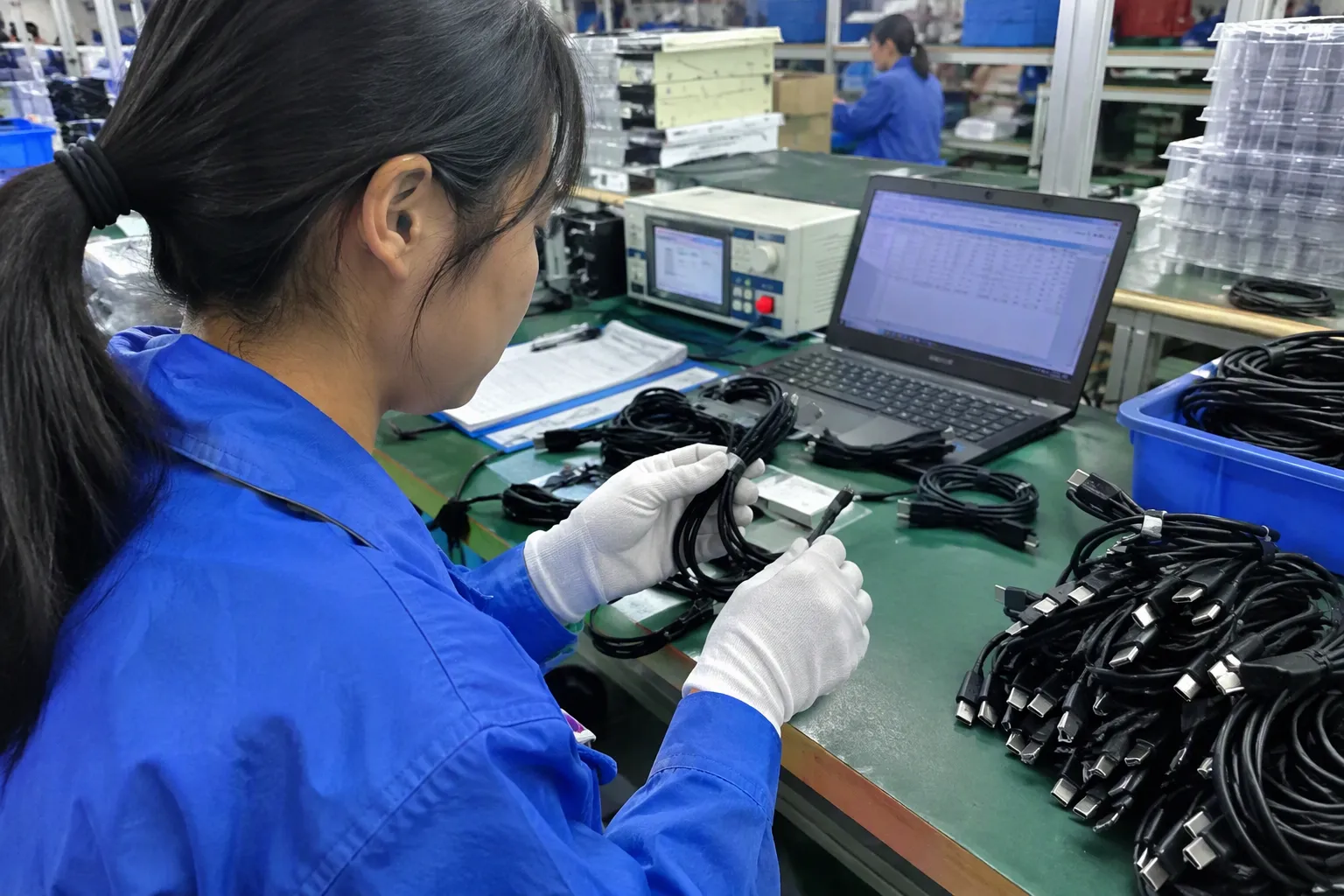
USB-C has become common in many products[3], but a USB-C connector does not by itself describe the complete capability of a cable. The other connector, internal construction, intended charging use, data function, and device compatibility still matter.
- Every USB-C cable supports the same charging power.[4]
- Every USB-C cable supports the same data performance.[5]
- A cable with a similar appearance has the same internal construction.
- A charging cable automatically supports a required laptop or tablet application.
- A product listing’s “high speed” wording is a substitute for a defined specification.
Consider the complete charging system
The cable is only one part of the charging chain.[6] The charger, cable, device, connector condition, software or protocol behavior, and operating environment can all affect the customer experience. A supplier can provide a cable designed for a stated use, but the buyer should still evaluate the complete system.
- The charger model or relevant charger requirements.
- The device models used for sample evaluation.
- The intended charging claim.
- The cable length and construction.
- Any required data function.
- The tests performed, test conditions, and test evidence.
- The wording approved for packaging and online listings.
Separate product claims from documents
A supplier may say that certifications are available. I treat that statement as an invitation to review documents, not as proof that all products automatically meet every market requirement. Buyers should check the exact model, report holder, manufacturer information, date, scope, and applicable market.
For European sales, buyers may need to review relevant requirements such as RoHS information from the European Commission, depending on the product and applicable rules. For North American sales, the buyer should assess the requirements connected with the product category, claims, packaging, and destination market.
I do not present myself as a testing laboratory or certification authority. My role is to help buyers organize supplier documents and identify questions. A qualified compliance professional should review application-specific requirements before commercial launch.
Technical comparison example
| Evaluation point | Basic charging cable request | Better procurement description |
|---|---|---|
| Product name | Fast-charging USB-C cable | USB-C to USB-C cable for defined devices and charging application |
| Performance | Fast charging | Required performance to be confirmed with specified charger and devices |
| Data | Not mentioned | Charging-only or required data function clearly stated |
| Materials | Nylon cable | Braided outer jacket, requested flexibility, color, and housing details |
| Quality | Good quality | Inspection criteria, sample reference, packaging checks, and document review |
| Marketing | Universal compatibility | Compatibility wording limited to verified use cases |
What Does OEM Customization Change for USB Cable Purchasing?
OEM customization is more than printing a logo on a standard cable.[7] A private-label cable can involve the outer jacket, color, connector housing, mold, logo method, packaging, labels, barcode, accessories, and product variations. Each choice can affect MOQ, sample time, lead time, tooling, and unit cost.[8]
Common levels of OEM customization
| Customization level | Typical changes | Main purchasing effect |
|---|---|---|
| Standard product with branding | Logo on cable or packaging | Usually simpler, but MOQ and artwork approval still apply |
| Color and material adjustment | Cable color, braid, jacket, connector appearance | May require material planning and a higher minimum quantity |
| Custom packaging | Retail box, insert, label, barcode, language | Adds artwork approval, packaging MOQ, and packing checks |
| Structural customization | New housing, mold, strain relief, or shape | May involve tooling, sampling, and longer development |
| Product family customization | Several lengths, colors, connector types, and packages | Increases SKU complexity and inventory planning |
Logo printing is not always a small change
Logo placement can affect the connector housing, printing method, production process, and appearance inspection. A buyer should provide vector artwork and confirm the logo size, position, color, and acceptable variation. The supplier should provide a pre-production sample or digital approval method before bulk work begins.
- Approved logo artwork.
- Approved cable and connector color.
- Position and approximate dimensions.
- Packaging artwork and language.
- Barcode and label information.
- Reference photos or a signed sample.
- Inspection points and acceptable appearance standards.
Packaging can change the business case
Retail packaging may improve shelf presentation, but it can also increase material cost, packing labor, carton size, and shipping volume. A buyer selling through e-commerce should consider whether the packaging protects the cable during fulfillment and whether the dimensions affect warehouse or courier charges.
Customization and SKU control
A brand may request three lengths, four colors, two connector combinations, and two packaging versions. That creates many SKUs even when the cable construction is similar. The buyer should calculate expected demand by SKU instead of looking only at the total order quantity.
- Does the MOQ apply per color, length, connector type, or packaging design?
- Can several SKUs share one production plan?
- Does each package require separate artwork approval?
- What is the sample charge for each variation?
- Which components are standard and which are custom?
- What happens if a material becomes unavailable?
How Should Buyers Evaluate Samples from an OEM USB Cable Manufacturer in China?
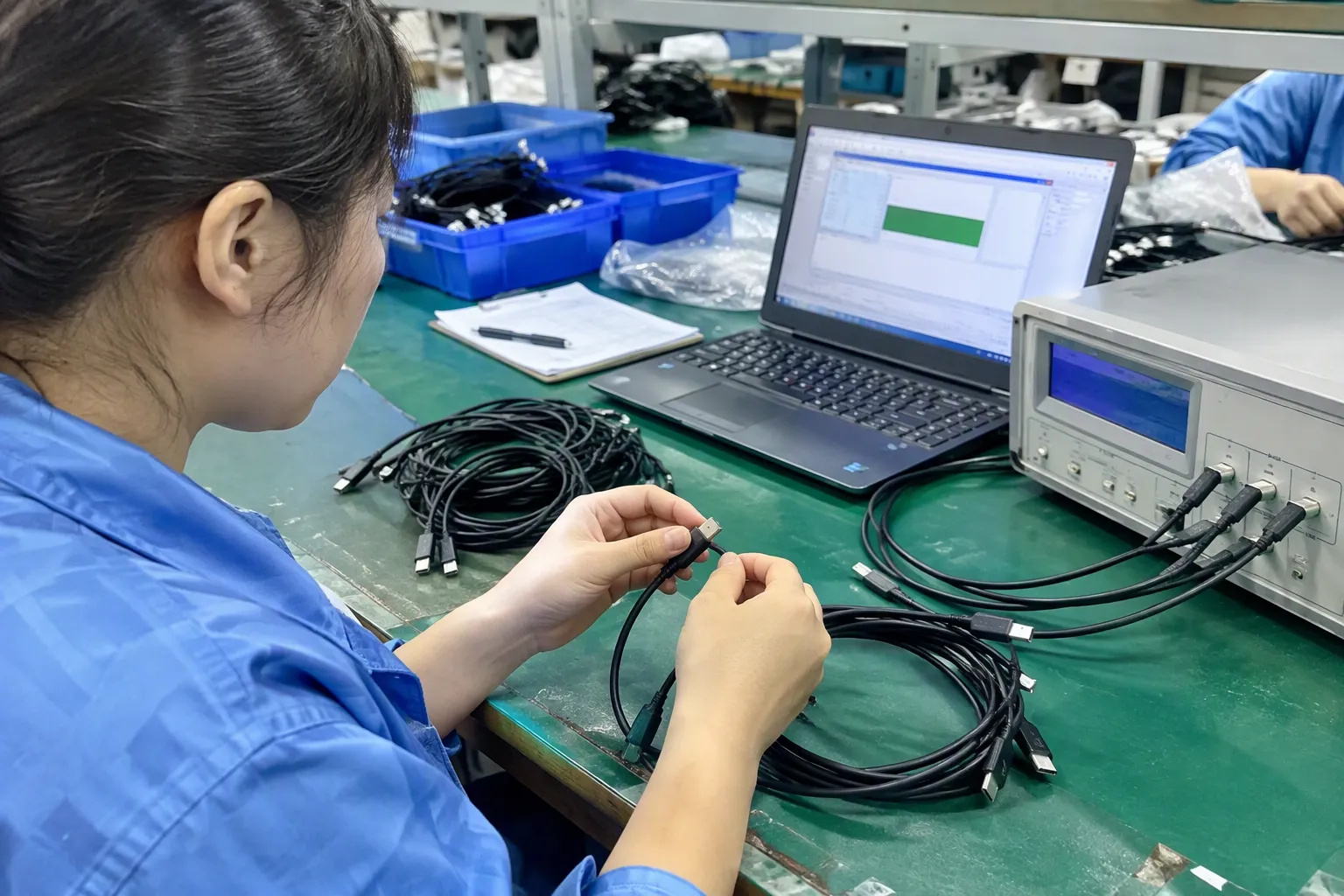
A sample is essential, but a satisfactory sample does not prove that every bulk unit will be identical. I treat the sample as one stage in supplier qualification. Buyers should preserve the approved sample, record its details, and connect it to the production and inspection requirements.
Build a sample record
- Supplier name and factory or trading-company information.
- Supplier model number or internal reference.
- Connector combination and cable length.
- Outer material, color, braid, and housing details.
- Markings and logo position.
- Packaging version.
- Stated technical function.
- Date received and sample quantity.
- Buyer’s test notes.
- Photos of the approved sample.
- Open questions and agreed changes.
Test the sample for the real sales use
The buyer should test the sample with representative devices and chargers. A cable that works in one simple charging situation may not meet a more demanding use case. The buyer should also check physical handling, connector fit, jacket appearance, flexibility, and packaging.
- Visual appearance and logo quality.
- Connector fit and insertion feel.
- Cable length and jacket condition.
- Braid consistency or surface finish.
- Strain-relief appearance.
- Charging behavior with intended equipment.
- Data behavior if data function is advertised.
- Packaging dimensions and protection.
- Label accuracy and customer-facing claims.
Ask how production will match the sample
A supplier should be able to discuss how it will control materials, assembly, appearance, testing, and packing. I do not expect every supplier to use the same internal process, but I do expect clear answers about the controls relevant to the order.
- Which materials and components will match the approved sample?
- Will the supplier use a production reference sample?
- Which inspections happen during assembly?
- Which final checks happen before shipment?
- How will cable length, connector appearance, and packaging be checked?
- How will nonconforming goods be handled?
- Can the supplier provide an inspection record or shipment quality report?
Sample approval versus bulk qualification
| Stage | Main purpose | Buyer’s decision |
|---|---|---|
| Quotation review | Understand product and commercial assumptions | Is the offer worth further discussion? |
| Initial sample | Check physical product and basic use | Does the product fit the application? |
| Revised sample | Confirm requested changes | Are specifications and appearance acceptable? |
| Pre-production approval | Lock the production reference | Is the supplier ready to manufacture this version? |
| Bulk inspection | Check the manufactured order | Can the shipment be accepted or corrected? |
| Post-delivery review | Monitor market performance | Should the supplier or specification change? |
Which Commercial Factors Matter When Selecting an OEM USB Cable Manufacturer in China?
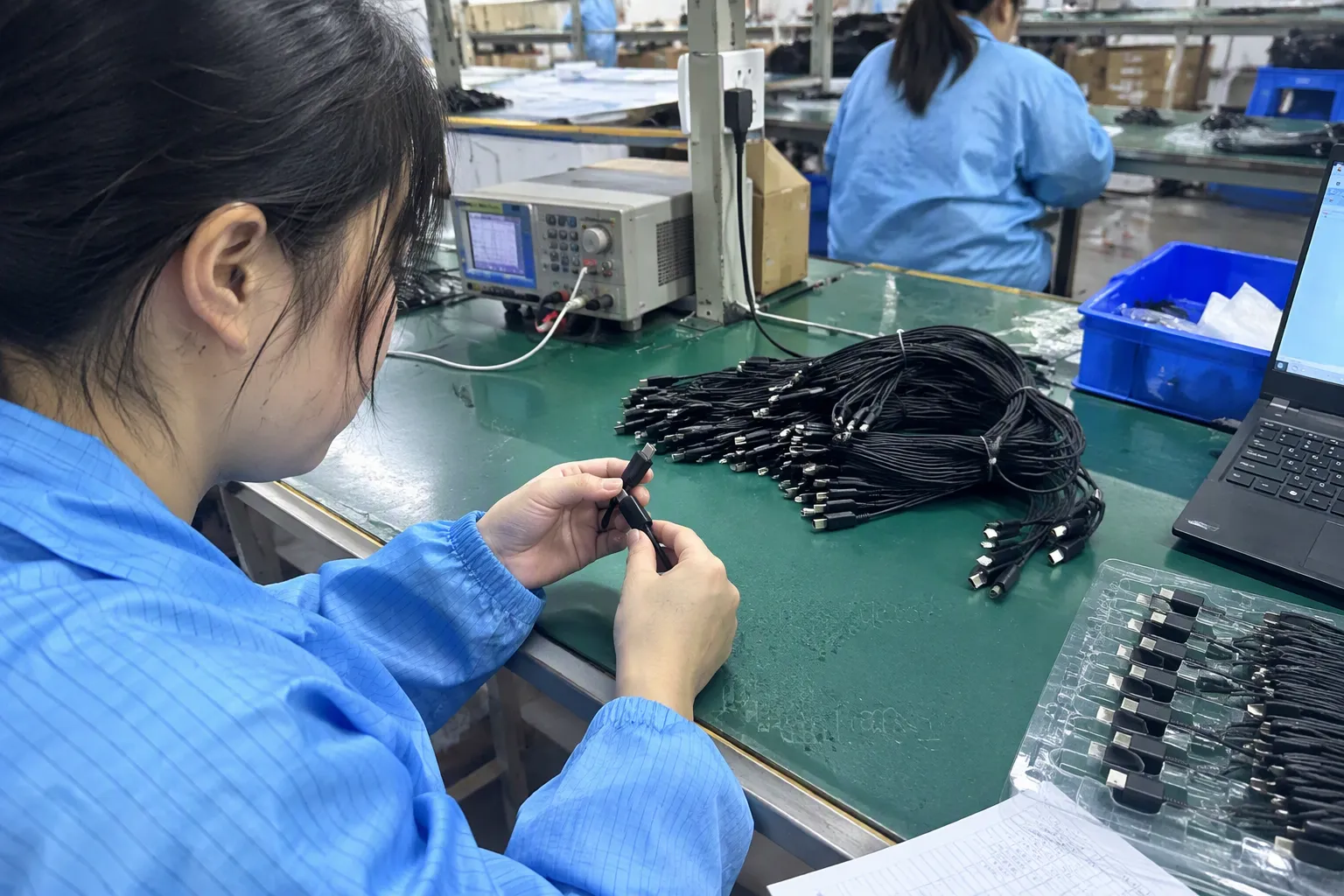
Price matters, but it is only one part of landed cost and supplier suitability. A low unit price may be linked to a simpler material, fewer packaging services, a different specification, a larger MOQ, or an assumption that the buyer will accept a broad product description.
MOQ should match the customization level
- Is the MOQ calculated per SKU?
- Is the MOQ different for standard and custom packaging?
- Is there a separate minimum for custom color or material?
- Can the buyer combine related models?
- Is the sample quantity included in the MOQ?
- Does the supplier offer a pilot order with different conditions?
Lead time includes more than assembly
| Stage | Buyer should confirm |
|---|---|
| Artwork | Who prepares the file and who gives final approval? |
| Sampling | How many revisions are included and how long does each take? |
| Materials | Are all custom materials available before production starts? |
| Assembly | When does the manufacturing clock begin? |
| Inspection | Is inspection performed before packing or after packing? |
| Packing | Are printed materials ready on time? |
| Shipment | When will cartons be ready for the buyer’s forwarder? |
Compare the quotation line by line
- Product model and connector type.
- Length and color.
- Materials and construction.
- Logo method and position.
- Packaging method.
- MOQ and price breaks.
- Sample cost.
- Tooling cost, if applicable.
- Production lead time.
- Trade terms and payment conditions.
- Document availability.
- Inspection arrangements.
A line-by-line quotation helps buyers see why two apparently similar offers differ. It also gives the buyer a stronger basis for negotiation because the discussion concerns a specific change rather than an unexplained request for a lower price.
After-sales support is part of supplier selection
- The contact person for technical and order questions.
- The information required for a complaint.
- The review process and response timing.
- Responsibility for confirmed nonconforming goods.
- Whether replacement, credit, or another remedy applies.
- How corrective actions will be recorded.
How Can Buyers Qualify a Chinese OEM USB Cable Supplier?
Supplier qualification should combine product fit, document review, communication quality, production capability, and commercial reliability. I do not consider “factory-direct,” “certifications available,” or “best price” to be sufficient evidence on their own.
As a Shenzhen 3C export professional, I often help customers organize this first review. I am not an independent factory auditor, so I distinguish between information supplied by the vendor and evidence that requires third-party or professional verification.
Review the supplier’s basic information
- Registered company information.
- Export experience and main destination markets.
- Product categories and current production scope.
- Factory address or manufacturing arrangement.
- Contact details for sales and quality issues.
- Product catalog and model references.
- Available inspection or compliance documents.
- Standard sample and OEM sample procedures.
If a trading company is involved, the buyer should ask which factory will produce the order and who controls the quality process. A trading company can be useful, but the manufacturing and communication responsibilities should be clear.
Treat certificates as documents to verify
- Product model and description.
- Manufacturer or applicant name.
- Report or certificate number.
- Testing organization.
- Test date and scope.
- Standard or regulation referenced.
- Whether the document covers the exact configuration.
- Whether the document is current and authentic.
The European Commission’s Access2Markets portal can help buyers research market access information, duties, and product-related requirements. It does not replace professional compliance advice, but it is a useful starting point for import planning.
For USB-related technical claims, buyers can consult the USB-IF compliance information and then ask the supplier whether the specific product is covered by the relevant program or documentation. Buyers should not assume that a general supplier certificate covers every cable variation.
Evaluate communication as operational evidence
- Asks for device and application details.
- Separates confirmed facts from points requiring verification.
- Explains MOQ and lead-time conditions.
- Sends consistent information across quotation and sample stages.
- Records requested changes accurately.
- Responds clearly to document questions.
- Identifies risks instead of promising everything immediately.
A supplier qualification scorecard
| Category | Suggested review question |
|---|---|
| Product fit | Can the supplier match the connector, construction, and intended use? |
| Technical clarity | Does the supplier explain what is confirmed and what requires testing? |
| Customization | Can it manage artwork, packaging, materials, and SKU variation? |
| Quality control | Is there a documented process for sample and bulk inspection? |
| Documents | Are product-specific documents available for review? |
| MOQ and price | Do commercial terms fit the buyer’s sales plan? |
| Lead time | Does the schedule include sampling, packaging, and inspection? |
| Communication | Does the supplier record requirements accurately? |
| After-sales | Are complaint and corrective-action procedures clear? |
What Should a Buyer Put in an OEM USB Cable Purchase Order?
Include a clear product specification
- Supplier model number.
- Connector combination.
- Cable length and measurement method.
- Intended charging and data use.
- Materials and color.
- Connector housing and strain relief.
- Logo artwork and position.
- Packaging specification.
- Label and barcode information.
- Carton quantity and carton markings.
- Approved sample reference.
- Documents required before shipment.
- Inspection and acceptance expectations.
Define change control
Plan inspection before shipment
- Quantity and SKU mix.
- Connector type and cable length.
- Logo and color appearance.
- Packaging and labels.
- Physical damage.
- Basic functional checks under defined conditions.
- Carton condition and markings.
- Required documents.
Frequently Asked Questions
Is an OEM USB Cable Manufacturer in China suitable for small businesses?
An OEM supplier may support small businesses, but the commercial conditions depend on the level of customization. Standard products with simple branding usually require less planning than custom materials, molds, or multiple retail packages. I recommend asking about pilot-order options, per-SKU MOQ, sample costs, and packaging alternatives before committing.
Can every USB-C cable support fast charging?
No. USB-C describes a connector format, not one universal charging performance level. Charging results can depend on the cable design, charger, device, protocol, and technical requirements. I recommend asking the supplier for product-specific documentation and testing the sample with the actual devices and chargers intended for sale.
Does OEM only mean adding a logo?
No. OEM can include logo printing, color, materials, connector housing, cable construction, packaging, labels, barcodes, and product variations. These changes can affect MOQ, sampling, tooling, production lead time, and price. I advise buyers to define each customization item separately.
Do certifications guarantee that a USB cable is high quality?
No. Certifications and test reports can provide useful evidence, but buyers should verify the exact product, document scope, issuer, date, and applicable market. A document does not replace sample testing, production controls, or inspection. A qualified compliance professional should review requirements for the buyer’s specific market.
Does a good sample guarantee consistent bulk production?
No. A good sample shows that the supplier can provide an acceptable sample at that stage. Consistency requires an approved reference sample, clear specifications, material control, production checks, and suitable bulk inspection. I recommend confirming these controls before placing a larger OEM order.
Conclusion
Choosing an OEM USB Cable Manufacturer in China involves more than comparing unit prices. I recommend that buyers define the device use case, connector combination, charging and data requirements, materials, packaging, MOQ, and delivery plan before requesting final quotations. Buyers should treat fast-charging claims and certification statements as points to verify. They should also remember that OEM customization can change cost, lead time, and production complexity. With 15 years of Shenzhen 3C export experience, I can help retailers, wholesalers, importers, and e-commerce sellers review USB cable options, samples, customization requirements, and commercial terms. Contact me to discuss your specification and request a structured quotation.
Sources
- USB Charger (USB Power Delivery)", USB Implementers Forum documentation distinguishes the USB-C connector from the electrical and power-delivery capabilities defined by applicable USB specifications and cable requirements
- USB-C power delivery for military portable systems", USB charging standards and related engineering literature describe charging as an interaction among the power source, cable, and receiving device, with negotiated or otherwise constrained power levels determined by the applicable protocol
- The EU common charger", European Union common-charger materials identify USB-C as the standardized charging interface required or increasingly used for several categories of portable electronic equipment
- USB Type-C® Cable Logo Usage Guidelines", USB Implementers Forum materials specify that USB-C cables can have different current and power capabilities, so the presence of a USB-C connector alone does not establish a uniform charging rating
- USB-C vs Type-C: Are They the Same? Clear Explanation Inside", USB technical references distinguish the reversible USB-C connector from the underlying USB data-transfer standards, which include products with materially different signaling rates and functional capabilities
- Wireless charger provides efficient cord-free charging - News", USB power-delivery standards model charging as an interaction between source, cable, and sink components, with negotiated power and operating behavior constrained by the capabilities of the complete system
- amazon private label Archives | sourcing company", Manufacturing references generally use OEM to describe production to a buyer's specified design or requirements, which may encompass components, construction, labeling, and packaging rather than logo application alone
- Manufacturing Engineering (MFE)", Operations-management research describes customization and product variety as factors that can increase setup, tooling, coordination, inventory, and production costs and can lengthen development or manufacturing lead times