TWS ANC architecture affects how a wireless earbud reacts to outside sound, but many buyers still receive only a marketing label. That creates a practical problem: a low-cost model may promise strong noise cancellation without showing test conditions, sample consistency, or microphone details. I use architecture as a starting point, not a final buying decision.
Feedforward, feedback, and hybrid ANC each have different strengths. Feedforward ANC uses an outside microphone, feedback ANC uses an inside microphone, and hybrid ANC uses both.[1] I recommend choosing the architecture according to the noise environment, earbud design, tuning quality, target price, validation evidence, and supplier reliability rather than assuming that hybrid ANC is always the best option.
Quick Answer
- Feedforward ANC can suit products that need to react quickly to external, predictable noise while keeping hardware and development costs controlled.
- Feedback ANC measures sound inside the ear and can help correct the sound that the user actually hears, but it depends heavily on fit and tuning.
- Hybrid ANC combines outside and inside microphones. It can offer broader control, but it normally adds hardware, software, tuning, and production complexity.
- I would compare samples in the real target environments, such as aircraft cabins, subways, offices, cafés, and homes.
- I would ask the supplier for defined test conditions, production sample evidence, battery results, call performance information, and an after-sales plan before selecting a model.
The architecture label helps me understand the product design, but it does not tell me the whole customer experience. I still need to review ear-tip sealing, microphone placement, firmware behavior, sound tuning, charging performance, and factory consistency. The next sections explain how I connect those details with procurement decisions.
Feedforward, Feedback, or Hybrid ANC Architecture: Which One Does What
Many buyers need a simple technical explanation before they can compare suppliers. The problem starts when sellers use “ANC” as if it describes one fixed technology. The term only indicates active noise control. The microphone arrangement and signal path create important differences between products.
Feedforward ANC uses one or more microphones on the outside of the earbud to detect environmental sound before it reaches the ear.[2] Feedback ANC uses a microphone inside the ear canal area to monitor the sound that the user receives. Hybrid ANC combines external and internal microphone inputs. Each design can work well, but each design also creates different engineering and procurement trade-offs.
How does feedforward ANC work?
Feedforward ANC places a microphone on the outside of the earbud. The microphone listens to external sound, and the control system generates an opposing signal through the speaker driver. In simple terms, the system tries to react before outside noise reaches the listener’s ear.
This approach can be attractive in products where the manufacturer wants to control BOM cost, size, and power consumption. However, the outside microphone can also pick up wind and handling noise.[3] The product needs suitable filtering and tuning to prevent the user from hearing an unpleasant hiss or unstable effect.
How does feedback ANC work?
Feedback ANC uses an internal microphone near the ear canal. The microphone measures the acoustic result inside the earbud, so the system can respond to the sound that remains after the earbud seal and speaker output are considered.
This design can help the product account for differences between the intended signal and the actual in-ear result. The ear-tip seal matters greatly.[4] If the earbud moves or the user selects an unsuitable ear tip, the internal microphone may receive a different acoustic condition from the one used during tuning.
- Products with carefully controlled earbud geometry.
- Users who value an in-ear monitoring approach.
- Models where the supplier has strong acoustic tuning capability.
- Applications where the fit remains relatively stable during use.
How does hybrid ANC work?
Hybrid ANC combines at least one outside microphone with at least one inside microphone.[5] The system receives information about the external environment and the sound inside the earbud. This arrangement gives the designer more inputs, but it also creates more opportunities for poor tuning, microphone mismatch, wind sensitivity, or production variation.
Hybrid ANC can support a premium product position when the supplier can demonstrate consistent results. It does not automatically create better cancellation.[6] I treat it as a platform with more control possibilities, not as proof of superior performance.
| Architecture | Main microphone position | Potential strength | Main procurement concern |
|---|---|---|---|
| Feedforward ANC | Outside the earbud | Simple external-noise detection and potentially controlled BOM | Wind noise, external microphone exposure, tuning limits |
| Feedback ANC | Inside the earbud | Measures sound close to the user’s ear | Strong dependence on fit, seal, and internal tuning |
| Hybrid ANC | Outside and inside | More acoustic information for control | Higher complexity, cost, power, and validation requirements |
I would ask a supplier to identify the actual architecture in writing. I would also ask whether the product uses one or more microphones for playback ANC, environmental noise reduction, and voice calls. A product may use different microphones and algorithms for different functions. I would not accept “AI noise cancellation” as a substitute for a clear architecture description.
Does Hybrid ANC Always Perform Better Than Feedforward or Feedback ANC?
The word “hybrid” sounds advanced, so many buyers assume that it guarantees the best result. That assumption can lead to the wrong product selection. A well-tuned feedforward model can provide a more stable customer experience than a poorly tuned hybrid model.
Hybrid ANC can provide more information to the control system, but the final result depends on implementation. The earbud needs appropriate microphone placement, speaker performance, acoustic sealing, firmware, and production control. I therefore compare verified samples and test conditions instead of ranking architecture labels alone.
Why implementation changes the result
I often see product discussions move too quickly from architecture to performance claims. Buyers may ask for a certain architecture because a competitor lists it on a product page. However, the same architecture can produce different results across two factories.
Ear-tip seal
Passive isolation comes from the physical fit of the earbud and ear tip.[7] A good seal can reduce outside sound before ANC starts working. A poor seal can make the ANC function appear weak, unstable, or uncomfortable.
Microphone implementation
The microphone component is only one part of the design. The position, acoustic opening, protective mesh, wind protection, and assembly tolerance also matter. A small change in position can affect the sound captured by the microphone.
I would request photos or drawings of the microphone locations when the design review allows it. I would also check whether the supplier plans to change the shell, mesh, or internal layout between the approved sample and mass production.
Speaker and acoustic chamber
The driver, chamber, nozzle, and venting affect both music and noise control. A supplier may change a driver to reduce cost, but that change can alter ANC tuning. I would therefore treat the driver specification and acoustic structure as part of the approval record.
Firmware and algorithm settings
The firmware controls ANC strength, transparency mode, switching behavior, wind filtering, and sometimes adaptive changes. A supplier may update firmware after sampling. I would ask how the supplier controls firmware versions and how I can verify the production version.
Why the test environment matters
Noise is not one category.[8] Aircraft cabin noise, subway rumble, traffic, keyboard sounds, voices, and wind have different characteristics. A supplier claim that does not define the noise source, measurement position, playback level, equipment, and operating mode has limited value.
- What noise source did the supplier use?
- Did the supplier test the left and right earbuds separately?
- Did the test use a sealed artificial ear, a coupler, or a human listening panel?
- Which ANC mode and firmware version did the test use?
- Did the test include music playback?
- Did the test measure battery life with ANC on and off?
- Does the result represent an engineering sample or a production sample?
I do not present one supplier’s decibel figure as an independent laboratory result. If a buyer needs a regulated, contractual, or application-specific acoustic claim, I recommend qualified professional testing under defined conditions.
Which TWS ANC Architecture Fits Different Noise Environments?
A product that works well in an office may not work equally well on an aircraft or subway. The noise environment, wearing time, movement, and fit all change the buyer’s priorities. I first define the main use case and then compare architecture, passive isolation, comfort, and verified sample behavior.
Feedforward ANC can suit general commuting and office products. Feedback ANC can suit a well-fitting design with controlled in-ear acoustics. Hybrid ANC may be suitable for a premium travel or lifestyle model when the supplier can prove consistent implementation. No architecture should be selected without testing the complete product.
Aircraft and long-distance travel
Aircraft cabins create continuous background noise, and users may wear earbuds for several hours. Buyers should consider low-frequency noise control, comfort, battery performance, charging speed, and pressure sensation.
A hybrid design may be considered for a travel-focused product because the external and internal microphones can give the system more information. However, I would not promise better aircraft performance based on the label alone. I would compare samples using a repeatable cabin-noise recording or a qualified test setup.
- Comfortable ear tips in multiple sizes.
- Stable ANC behavior during long wear.
- Clear battery specifications with ANC enabled.
- A case that supports practical travel charging.
- A transparent explanation of the test method.
Subway and bus commuting
Feedforward, feedback, or hybrid ANC can all be considered. I would focus on whether the product remains stable when the user walks, turns the head, and changes location. I would also check whether the transparency mode creates a natural sound when the user needs to hear announcements.
Offices and cafés
Office and café environments include voices, air-conditioning, keyboard sounds, dishes, and intermittent conversation. ANC may reduce some continuous background noise, but it should not be marketed as a guarantee that all speech disappears.
For these products, comfort and transparency mode may matter as much as maximum cancellation. A compact feedforward model may meet the retail need if the target price is competitive and the sample experience is consistent. A more expensive hybrid model may be unnecessary if it adds cost without a clearly noticeable benefit.
Home use
| Use environment | Buyer priority | Architecture question | Other checks |
|---|---|---|---|
| Aircraft | Continuous background reduction and comfort | Can the sample maintain stable ANC for long wear? | Battery, ear tips, pressure sensation |
| Subway | Rumble, movement, and changing noise | Does ANC remain stable during movement? | Wind handling, transparency mode |
| Office | Comfort and moderate background control | Is advanced architecture necessary for the target price? | Voice awareness, idle hiss |
| Café | Mixed background noise | Does the product handle changing conditions naturally? | Fit, controls, call performance |
| Home | Low fatigue and reliable daily use | Does the architecture improve the actual use case? | Reconnection, charging, firmware |
I also remind buyers that passive isolation can change the result. A well-designed ear tip and stable fit may contribute more to perceived quietness than a more expensive architecture with poor sealing. I would ask the supplier to compare the complete earbud, not only the ANC chip or microphone count.
How Do ANC Architecture and Call Performance Differ?
Many product listings place playback ANC and call-noise reduction next to each other. That presentation can confuse customers and buyers. Playback ANC reduces environmental sound that the user hears. Call-noise reduction tries to improve the voice transmitted from the user’s microphones to another person or application.
These functions may use related hardware, but they are not the same performance claim. I evaluate them separately because a product can provide acceptable playback ANC and still produce weak calls in wind or crowded environments.
What playback ANC controls
Playback ANC affects the sound delivered to the wearer. The system uses microphones, signal processing, and the speaker driver to reduce selected external noise. Ear-tip fit and passive isolation also influence the result.
- Noise reduction with no music.
- Noise reduction during music playback.
- Transparency mode.
- Switching speed between modes.
- Background hiss or electronic artifacts.
- Stability when the earbud moves.
- Behavior near wind or ventilation.
What call noise reduction controls
Call performance depends on voice pickup, microphone spacing, beamforming, wind filtering, echo control, Bluetooth processing, and the communication application. The earbud may use multiple microphones for these tasks even when its playback ANC architecture is feedforward or feedback.
How I record supplier claims
| Evaluation area | Evidence I request |
|---|---|
| Playback ANC | Architecture description, mode behavior, defined test information |
| Transparency | Sample listening, switching behavior, voice awareness |
| Call quality | Recordings or live-call tests in defined environments |
| Wind handling | Sample test with stated wind or movement conditions |
| Firmware | Version number and planned production-control process |
| Battery | ANC-on and ANC-off results under stated playback conditions |
What Does ANC Architecture Mean for Cost, MOQ, and Delivery?
Architecture is not only an acoustic choice. It affects procurement planning. A more complex design may require additional microphones, a different PCB layout, more firmware work, stricter assembly control, and more sample rounds. Those factors can influence unit cost, MOQ, tooling, lead time, and after-sales exposure.
BOM and development considerations
A feedforward design may use fewer components than a hybrid design, but the final cost depends on the chipset, microphones, driver, battery, shell, case, app support, and packaging. A feedback design can also require careful tuning and fit control.
- More microphones and related acoustic parts.
- More PCB space or layout constraints.
- Additional tuning and validation work.
- More potential component variation.
- Higher repair or replacement complexity.
- Greater dependence on firmware configuration.
I ask the supplier for a commercial quotation that separates the standard product from optional changes. A buyer should know whether a requested logo, color, app function, ear-tip change, or firmware feature affects the lead time.
MOQ and customization
- What is the MOQ for the standard model?
- What is the MOQ for custom color?
- What is the MOQ for custom packaging?
- Does a new shell require tooling?
- Does a shell change require new acoustic tuning?
- Can the supplier provide a pre-production sample?
- Which sample becomes the approved reference?
Delivery reliability
My sourcing experience has taught me that a realistic schedule is more useful than an aggressive promise. I would rather plan around a verified sample and a clear production process than accept a short quotation that later moves.
After-sales risk

Customers may return TWS Earbuds because of pairing problems, charging faults, uneven battery behavior, uncomfortable fit, weak calls, or disappointing ANC. Architecture may contribute to repair complexity, but it is not the only cause.
How Should Buyers Verify Feedforward, Feedback, or Hybrid ANC With a Supplier?
A specification sheet can start the conversation, but I would not approve a TWS product from a sheet alone. I ask for evidence that connects the architecture claim with the physical sample, firmware version, production plan, and intended selling position.
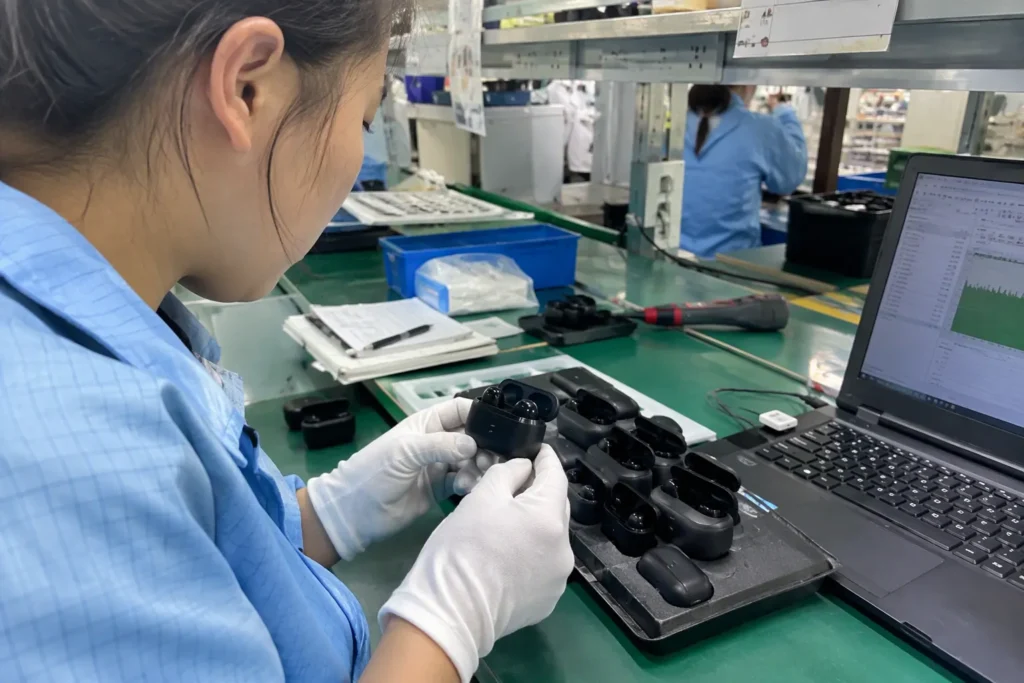
The strongest evaluation process uses written questions, sample comparisons, defined listening tests, and documented production controls. I also separate supplier-provided information from independent verification.
Questions for the first supplier review
- Which ANC architecture does this model use?
- How many microphones support playback ANC?
- Which microphones support calls?
- Does the product use the same architecture in every color and shell version?
- Which chipset and firmware platform does it use?
- What is the battery result with ANC enabled?
- What test conditions support any noise-reduction claim?
- Can the supplier provide a sample for comparison?
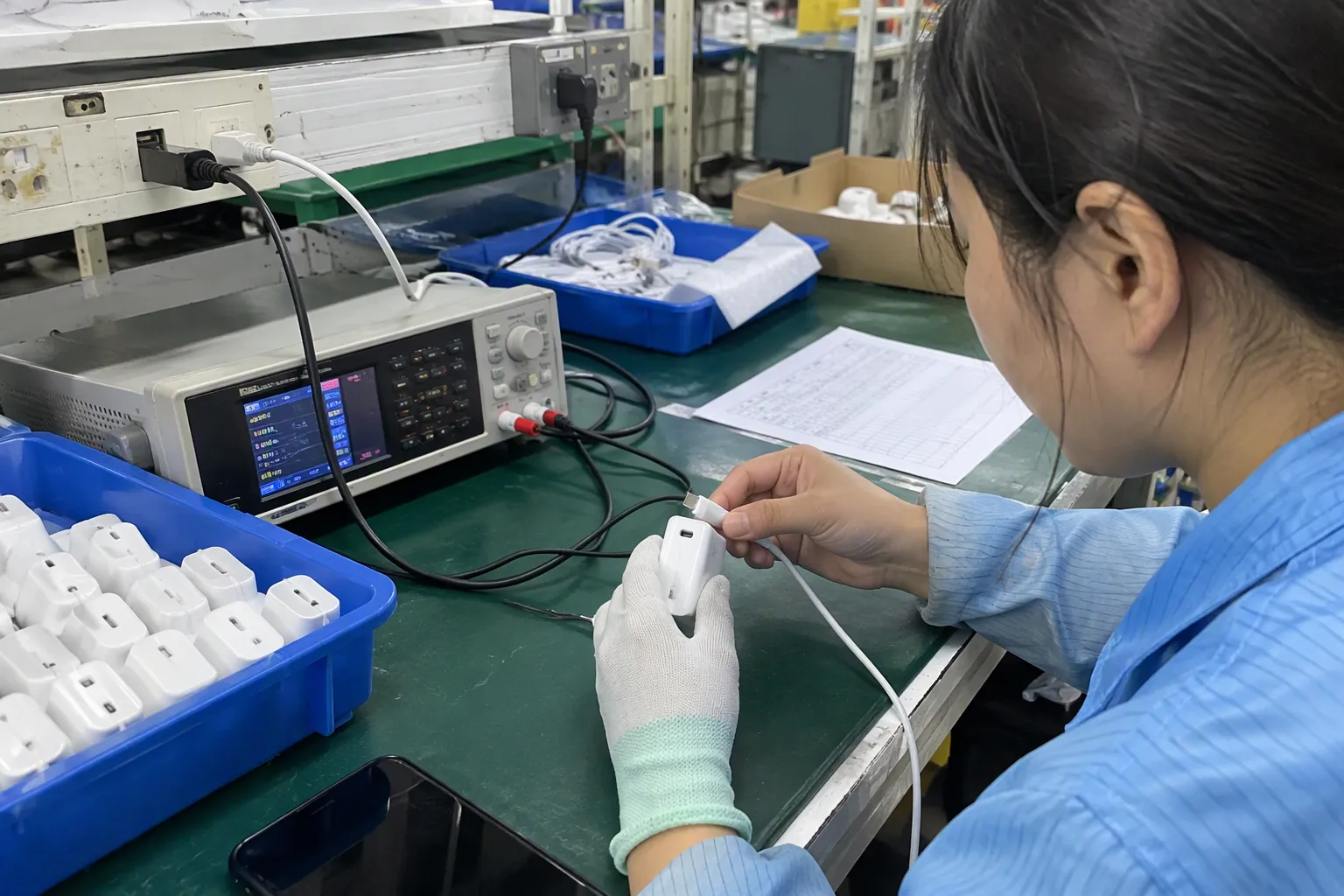
- Can the supplier explain production calibration or testing?
- What happens if the production sample differs from the approved sample?
Sample comparison method
- Fit: I would check comfort, seal, movement, and left-right balance.
- ANC stability: I would switch ANC on and off in the same noise environment.
- Transparency: I would listen for natural voices and abrupt artifacts.
- Music playback: I would check whether ANC changes the tonal balance.
- Call quality: I would make recordings in quiet and noisy environments.
- Battery behavior: I would record the test duration and operating conditions.
- Controls: I would check mode switching, accidental touches, and reconnection.
- Charging: I would inspect case contact, indicators, and repeated charging behavior.
Production consistency
- Approved golden sample.
- Firmware version record.
- Incoming component inspection.
- Microphone and speaker checks.
- Charging and pairing tests.
- Sampling inspection records.
- Final functional testing.
- Change-control procedure.
Compliance and documentation
Compliance documents should match the actual product, model, manufacturer, and market. For European sales, buyers can review the Radio Equipment Directive on EUR-Lex and the European Commission RoHS information. Buyers should verify the relevant obligations with qualified compliance professionals.
For Bluetooth products, I would also ask the supplier to provide evidence of the relevant Bluetooth SIG qualification process. I do not treat a logo or general certificate statement as proof that every product claim is correct.
I would keep a document folder containing the quotation, specification, sample photos, test notes, certifications, packaging files, and approved changes. This record helps the buyer manage repeat orders and resolve disputes.
How Can Buyers Position Each ANC Architecture in Retail?
A buyer may select the right product technically and still position it incorrectly. Retail customers often understand terms such as “hybrid ANC,” but they may not understand the limits of the technology. Clear product language reduces complaints and protects the retailer’s reputation.
I would match the product message with the verified use case. I would not describe a feedforward model as a poor product simply because it does not use hybrid ANC. I would also avoid describing hybrid ANC as universal silence.
Entry and value products
Mid-range products
A mid-range product may justify a stronger ANC message if the buyer has verified the sample in relevant environments. The product may offer improved controls, app support, better transparency, more ear-tip options, and stronger call performance.
Premium products
A hybrid design may support a premium position when it is combined with reliable hardware, mature firmware, strong comfort, consistent battery performance, and documented validation. The premium message should describe the complete experience rather than only the microphone count.
| Retail factor | Value ANC product | Premium ANC product |
|---|---|---|
| Main customer need | Affordable daily noise control | Broader feature set and refined experience |
| Architecture expectation | Feedforward, feedback, or platform-based hybrid | Often hybrid, but evidence remains important |
| Key proof | Sample consistency and reliability | Test evidence, tuning, comfort, calls, support |
| Buyer risk | Price pressure and return rate | Higher expectation and warranty exposure |
| Sales message | Practical daily use | Verified features without universal claims |
Avoiding misleading promises
Frequently Asked Questions
Is hybrid ANC better than feedforward ANC?
Hybrid ANC can provide more microphone information, but it is not automatically better. I compare the complete design, including fit, microphone placement, tuning, firmware, battery behavior, and sample consistency. A well-executed feedforward product can provide a more reliable result than a poorly tuned hybrid product.
What is the main difference between feedback and feedforward ANC?
Feedforward ANC uses an outside microphone to detect external sound before it reaches the ear. Feedback ANC uses an inside microphone to monitor sound near the ear canal. The two designs have different tuning and fit requirements, so I ask suppliers to explain the actual microphone arrangement and provide a sample.
Does ANC architecture affect TWS earbud battery life?
Architecture can affect power consumption because microphones and signal processing remain active during ANC use. However, battery life also depends on the chipset, driver, Bluetooth mode, volume, battery capacity, firmware, and case. I request battery results with defined conditions instead of relying on an architecture label.
Is ANC the same as ENC for calls?
No. ANC usually refers to reducing external sound that the wearer hears during playback. ENC or call-noise reduction refers to processing the user’s voice for the other person. I test playback ANC and call performance separately because one does not prove the other.
What should I ask a TWS supplier before placing an order?
I ask for the exact ANC architecture, microphone roles, chipset and firmware information, test conditions, sample evidence, battery results, production controls, MOQ, lead time, warranty terms, and compliance documents. I also ask how the supplier will ensure that mass production matches the approved sample.
Conclusion
TWS ANC architecture should support a clear product and procurement decision, not replace one. Feedforward, feedback, and hybrid designs can all work when the supplier matches the hardware, tuning, fit, firmware, and production controls to the intended use. I recommend testing samples in realistic environments, separating playback ANC from call performance, verifying technical and compliance documents, and documenting the approved configuration. My Shenzhen-based sourcing team can help retailers, wholesalers, and e-commerce sellers compare suitable TWS products, clarify MOQ and customization options, and request qualified supplier evidence before ordering.
Sources
- (PDF) Hybrid Feedforward-Feedback Active Noise Control ...", A technical treatment of active noise control distinguishes feedforward systems, which use an external reference microphone, from feedback systems, which measure residual sound near the controlled acoustic field; hybrid systems combine both sensing arrangements
- Adaptive feedforward control for active noise cancellation ...", Research on feedforward active noise control describes an external reference sensor that measures incoming disturbance noise so that an inverse signal can be generated before the disturbance reaches the control point
- Effects of wind noise on hybrid active noise cancellation ...", Studies of wearable active-noise-control systems report that wind-induced pressure fluctuations and mechanical handling can contaminate microphone reference signals, producing artifacts or reducing cancellation stability
- Effects of an Active Noise Control Technology Applied to ...", Research on in-ear active noise control indicates that ear-tip fit and acoustic leakage change the transfer function between the loudspeaker, ear canal, and error microphone, thereby affecting achievable attenuation and controller behavior
- Hybrid Feedforward-Feedback Noise Control Using Virtual ...", Active-noise-control literature defines a hybrid arrangement as one that combines a feedforward reference microphone with a feedback or error microphone to control the acoustic field using both disturbance and residual-sound information
- Effect of Microphone Configuration and Sound Source ... - PMC", Comparative active-noise-control research shows that hybrid sensing can provide additional control information, but achieved attenuation remains dependent on acoustic transfer functions, controller design, sensor placement, stability, and tuning
- The Effect of Stimulation Position and Ear Canal Occlusion on ...", Studies of insert earphones and hearing protectors show that physical occlusion and the quality of the ear-canal seal provide passive attenuation, with leakage and fit strongly influencing the resulting sound level at the ear
- Spectral Content (colour) of Noise Exposure Affects Work ...", Environmental-acoustics studies characterize aircraft, rail, traffic, office, speech, and wind noise as distinct acoustic environments with differing spectra and temporal patterns, making source-specific evaluation relevant to noise-control performance
Related reading: