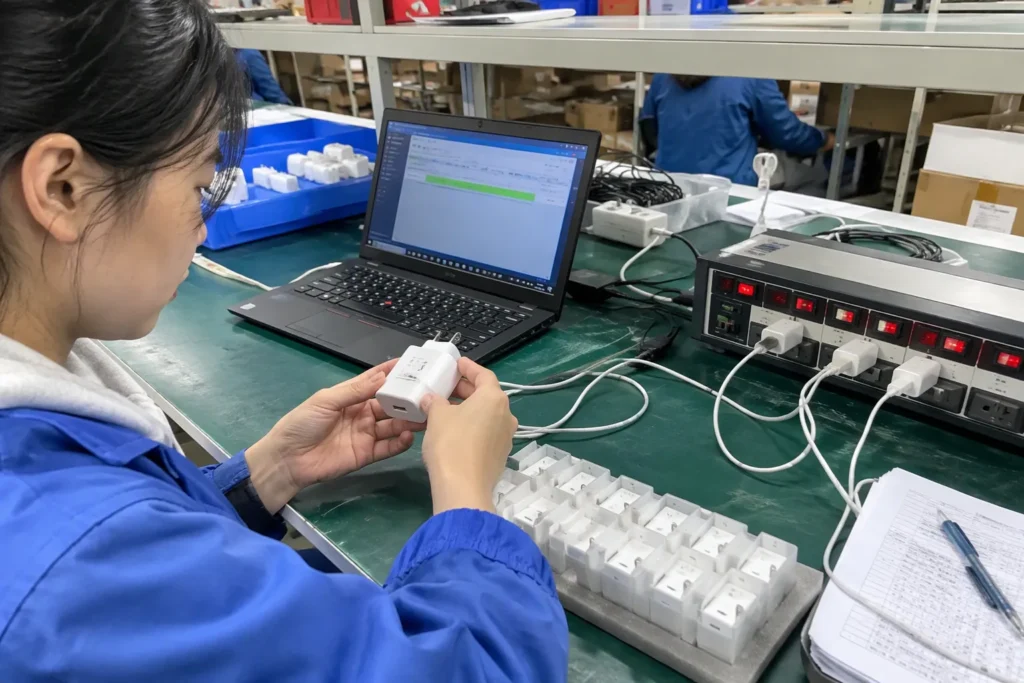
Charger sample approval is a critical purchasing decision, but many buyers face the same problem: a sample can look correct while its electrical performance, heat behavior, or production consistency remains uncertain. That uncertainty can become expensive after launch. I use a risk-based test plan to connect engineering evidence with a clear decision: approve, correct, retest, or hold.
Quick Answer
Charger sample approval should combine document review, physical inspection, electrical testing, safety checks, compatibility testing, and production-readiness verification. I recommend using 25 checks as a practical framework, not as a universal standard.[1] The final decision should depend on the charger design, target market, intended devices, applicable requirements, and qualified technical evaluation.
- Confirm that the sample matches the approved specification and intended market.
- Test output, charging protocols, efficiency, standby behavior, and abnormal conditions.
- Inspect insulation, temperature rise, mechanical construction, plug quality, and protection functions.
- Check real-device compatibility instead of relying only on the product label.
- Record every result and link each failure to an action: approve, correct, retest, or hold.
In my work with European and US 3C buyers, I have found that the most useful test plan is not the longest one. It is the plan that identifies the failures most likely to create safety incidents, product damage, returns, or delayed shipments. The sections below show how I organize that review before a buyer considers production.
What Does Charger Sample Approval Actually Decide?
A charger sample approval decides whether a specific physical sample is suitable to move to the next purchasing stage. It does not automatically prove that every production unit will be identical[2], and it does not replace formal testing, certification, or market-specific compliance review.
| Decision | Meaning | Typical next action |
|---|---|---|
| Approve | The sample meets the agreed requirements and no critical unresolved risk remains | Confirm production conditions |
| Approve with conditions | Minor issues remain, but they do not affect the agreed release scope | Record conditions and verify before shipment |
| Correct and retest | A failure is identifiable and potentially fixable | Request corrective action and a new sample |
| Hold or reject | The risk is serious, unclear, or outside the agreed specification | Stop release until qualified evaluation is complete |
Certification review is not sample validation
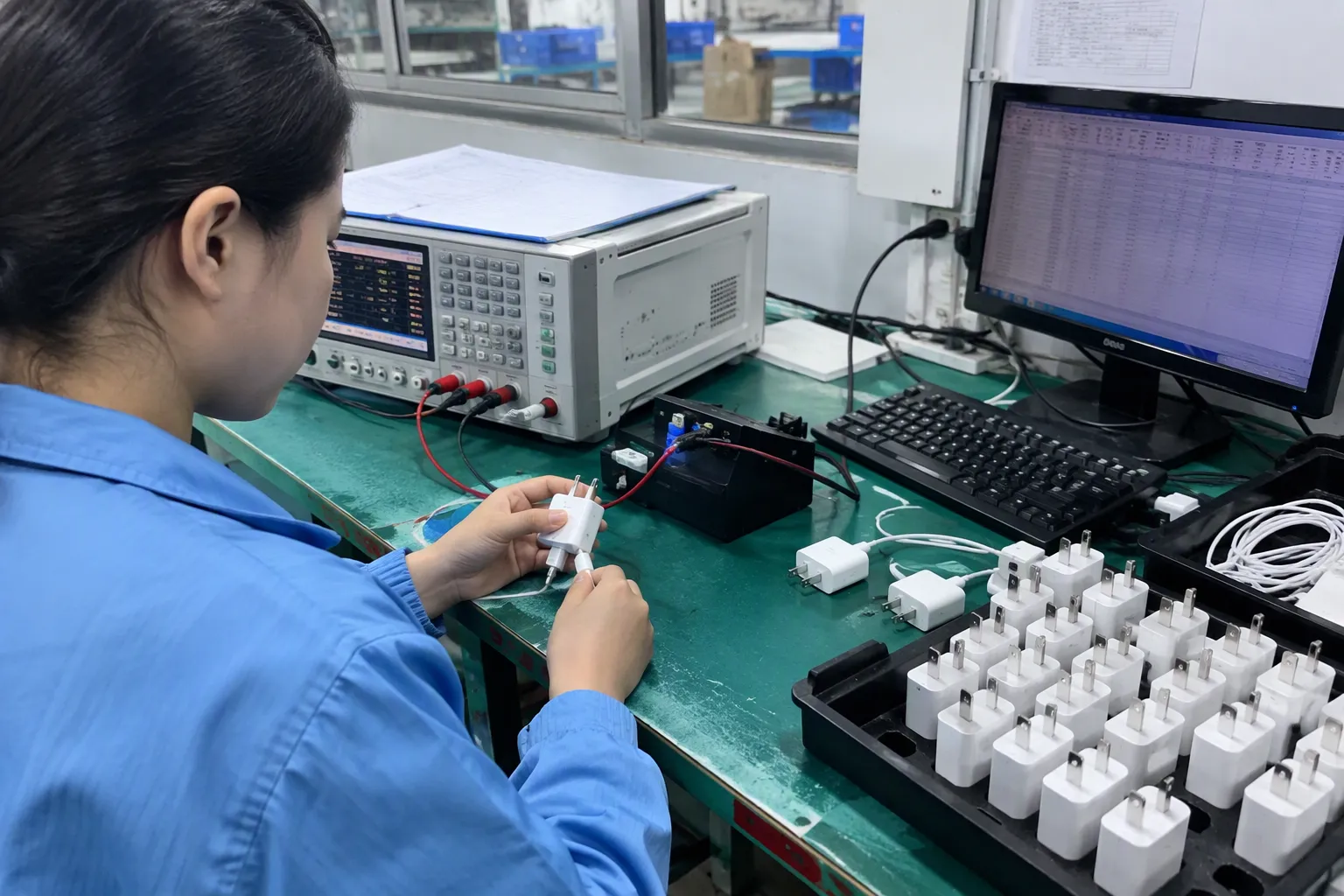
A certificate, declaration, test report, or factory document can be important evidence.[3] However, the document may apply to a model family, an earlier construction, a different factory, or a different component set. I always compare the document with the physical sample.
- Does the model number match exactly?
- Does the rated input and output match?
- Does the enclosure use the same material and construction?
- Does the sample contain the same power supply components?
- Does the document cover the destination market and intended use?
- Has the design changed since the report was issued?
Why a checklist alone is not enough
A checklist can show that someone performed 25 actions. It cannot show whether the actions were relevant[4], whether the equipment was suitable, or whether the acceptance criteria were correct. The buyer needs a traceable connection between each check and a purchasing risk.
How Should You Organize the 25 Charger Sample Approval Checks?
I organize the plan by purchasing risk rather than by laboratory vocabulary. The first group confirms what the item is. The next groups examine whether it operates safely, works with intended devices, survives normal use, and can be controlled in production.
| Risk group | Checks | Main purchasing question |
|---|---|---|
| Product identity and specification | 1–5 | Is this the product the buyer requested? |
| Electrical performance | 6–10 | Does it deliver the promised power in normal conditions? |
| Safety and abnormal behavior | 11–16 | Does it remain safe when conditions are difficult? |
| Compatibility and user experience | 17–20 | Does it work correctly with intended devices? |
| Durability and production control | 21–25 | Can the supplier repeat the approved result? |
A useful approval file contains the sample identity, photographs, specification sheet, test equipment, test conditions, measured results, deviations, corrective actions, and final decision. I also record the sample’s hardware version and firmware version when the charger contains programmable control.
The 25 checks at a glance
- Model and sample identity
- Rated input and output
- Port configuration and labeling
- Dimensions, weight, and construction
- Bill of materials and critical components
- No-load input behavior
- Output voltage
- Output current and power
- Regulation and ripple
- Efficiency and standby consumption
- Over-current protection
- Short-circuit protection
- Over-voltage protection
- Over-temperature behavior
- Insulation and dielectric performance
- Leakage or touch-current evaluation
- Charging protocol negotiation
- Device compatibility
- Multi-port load sharing
- Start-up, restart, and fault recovery
- Temperature rise in normal use
- Mechanical strength and plug retention
- Cable, connector, and port endurance
- Packaging and user instructions
- Production control and golden-sample management
I do not expect a buyer to perform every technical measurement personally. The buyer’s role is to define the intended use, request objective evidence, compare the sample with the approved specification, and make sure qualified personnel assess safety-critical results.
Which Electrical Performance Tests Should a Charger Sample Pass?
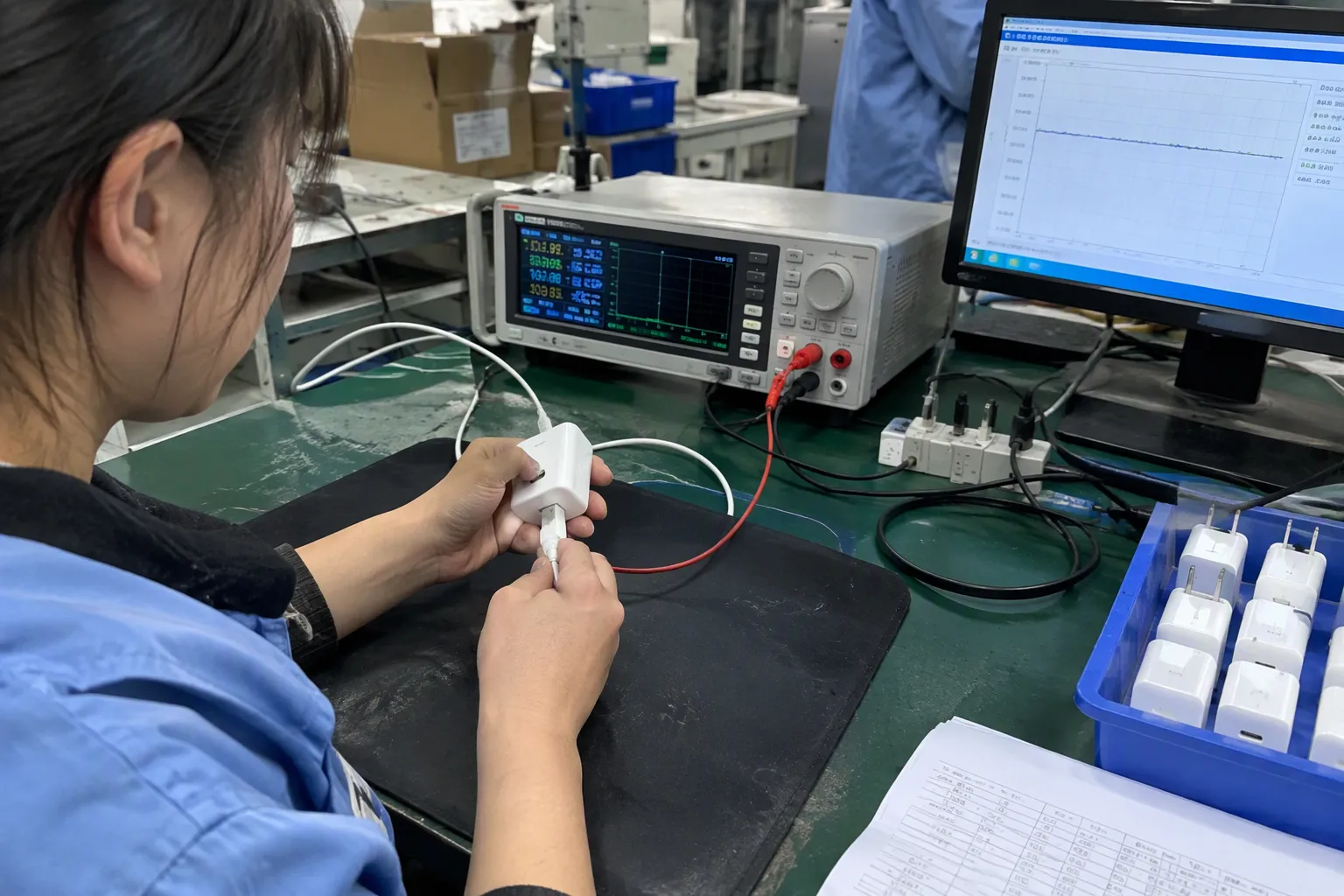
Electrical performance testing checks whether a charger delivers the promised output under defined conditions. The key checks include output voltage, current, power, regulation, ripple, efficiency, standby behavior, and operation across the declared input range.
Checks 1–5: identity and specification
4. Dimensions, weight, and construction. I measure the sample and inspect the enclosure, pins, seams, vents, strain relief, and finish. A weight change can sometimes indicate a component or construction change, although weight alone does not prove quality.
5. Bill of materials and critical components. I request the approved component list for safety-critical parts, such as the fuse, transformer, optocoupler, capacitor types, protection devices, and primary switching components. The exact list depends on the design.
Checks 6–10: output and energy behavior
10. Efficiency and standby consumption. I measure energy behavior at relevant load points. Retail buyers may care about energy claims, heat generation, and market requirements. I verify any claim against the applicable rules before using it in packaging or online listings.
A practical output test record
| Test condition | Information to record |
|---|---|
| Input voltage and frequency | The exact supply condition |
| Port used | USB-C, USB-A, or simultaneous ports |
| Load type | Electronic load, device, or defined test fixture |
| Output voltage | Measured result |
| Output current | Measured result |
| Output power | Calculated or instrument reading |
| Temperature | Ambient and sample condition |
| Protocol state | Negotiated mode, if applicable |
| Pass criteria | Agreed technical requirement |
| Action | Approve, correct, retest, or hold |
I once reviewed a charger sample where the printed output specification looked acceptable, but the negotiated charging mode did not remain stable with the buyer’s intended device. The issue appeared during repeated connection and disconnection rather than during a single bench reading. We did not approve the sample for production. The supplier had to correct the control behavior and provide a new sample for retesting. This example is why I connect measurements to real purchasing use.
How Do You Test Charger Safety and Abnormal Conditions?
Safety testing asks how the charger behaves when something goes wrong. Important checks include over-current, short circuit, over-voltage, over-temperature, insulation, dielectric performance, and leakage or touch-current evaluation. These tests require suitable equipment and qualified technical judgment.
A charger that works normally can still create a serious risk during a blocked port, damaged cable, overloaded output, high ambient temperature, or internal component fault.[5] I give these checks higher approval priority than cosmetic discrepancies.
Checks 11–16: protection and electrical safety
16. Leakage or touch-current evaluation. The result depends on the product construction, market, test method, and applicable requirements. I request qualified evaluation instead of treating a casual meter reading as a compliance result.
What counts as a critical failure?
| Finding | Likely priority | Suggested action |
|---|---|---|
| Unsafe abnormal heating or enclosure damage | Critical | Hold and investigate |
| Uncontrolled output during a fault | Critical | Hold and qualified evaluation |
| Wrong output mode that may affect a device | High | Correct and retest |
| Missing required label information | Medium to high | Correct before approval |
| Minor cosmetic mark | Low or medium | Correct according to buyer standard |
| Packaging color variation | Low | Decide commercially, not as a safety pass |
The buyer should not assign an exact temperature, current, or insulation limit without identifying the applicable product requirements. Standards and market rules can differ according to the charger type, construction, voltage, plug system, and intended market.
Useful starting points include the European Commission product safety and compliance information, the US Consumer Product Safety Commission business guidance, and relevant standards or conformity information from recognized technical organizations. These sources do not replace a product-specific assessment.
Abnormal testing needs controlled conditions
- Input condition and ambient temperature.
- Load condition and duration.
- Instrument model and calibration status.
- Starting sample condition.
- Visible, audible, or thermal changes.
- Whether the charger recovered after the fault.
- Whether the sample remained safe after testing.
How Do Charging Protocols and Device Compatibility Affect Approval?
Charging protocol testing confirms that the charger and intended devices communicate correctly.[6] A charger may have the correct connector and headline wattage but still fail to provide the expected charging mode, fall back to a lower output, or behave inconsistently across devices.
Checks 17–20: practical compatibility
17. Charging protocol negotiation. I identify the protocols the supplier claims to support and confirm the negotiated result with suitable analyzers or test fixtures. For USB products, the USB-IF certification and compliance information is a useful reference point, but buyers should verify the specific product and claim.
19. Multi-port load sharing. For a multi-port charger, I test every relevant combination. The buyer should understand whether the total power is shared, whether one port has priority, and whether connecting a second device causes a reset.
20. Start-up, restart, and fault recovery. I disconnect and reconnect the input and output, remove the load, change ports, and repeat charging cycles. I look for delayed charging, repeated resets, or a failure to recover after a temporary fault.
Compatibility matrix
| Test item | Example question | Procurement implication |
|---|---|---|
| Protocol support | Does the claimed mode negotiate? | Confirm product listing and packaging |
| Device range | Do intended devices charge normally? | Reduce return and complaint risk |
| Port combination | Does a second device change output? | Publish accurate multi-port claims |
| Reconnection | Does charging restart reliably? | Assess daily user experience |
| Low-power devices | Does the charger support the intended small devices? | Avoid compatibility gaps |
| Cable dependency | Does performance require a specific cable? | Define included and recommended cables |
The buyer should also review the cable as part of the charging system. A charger and cable can each meet separate expectations while the combination fails to deliver the intended result.[7] USB-C products may involve additional requirements relating to ports, cables, power claims, and protocol behavior. I ask a qualified specialist to confirm the exact scope for the target market.
Do not confuse charging speed with product quality
- Stability during continuous use.
- Heat behavior at high output.
- Device recognition.
- Performance when multiple ports are active.
- Compatibility with lower-power accessories.
- Accuracy of the online and retail claim.
- Whether the buyer can explain the required cable or device conditions.
How Should You Check Charger Construction, Temperature, and Durability?
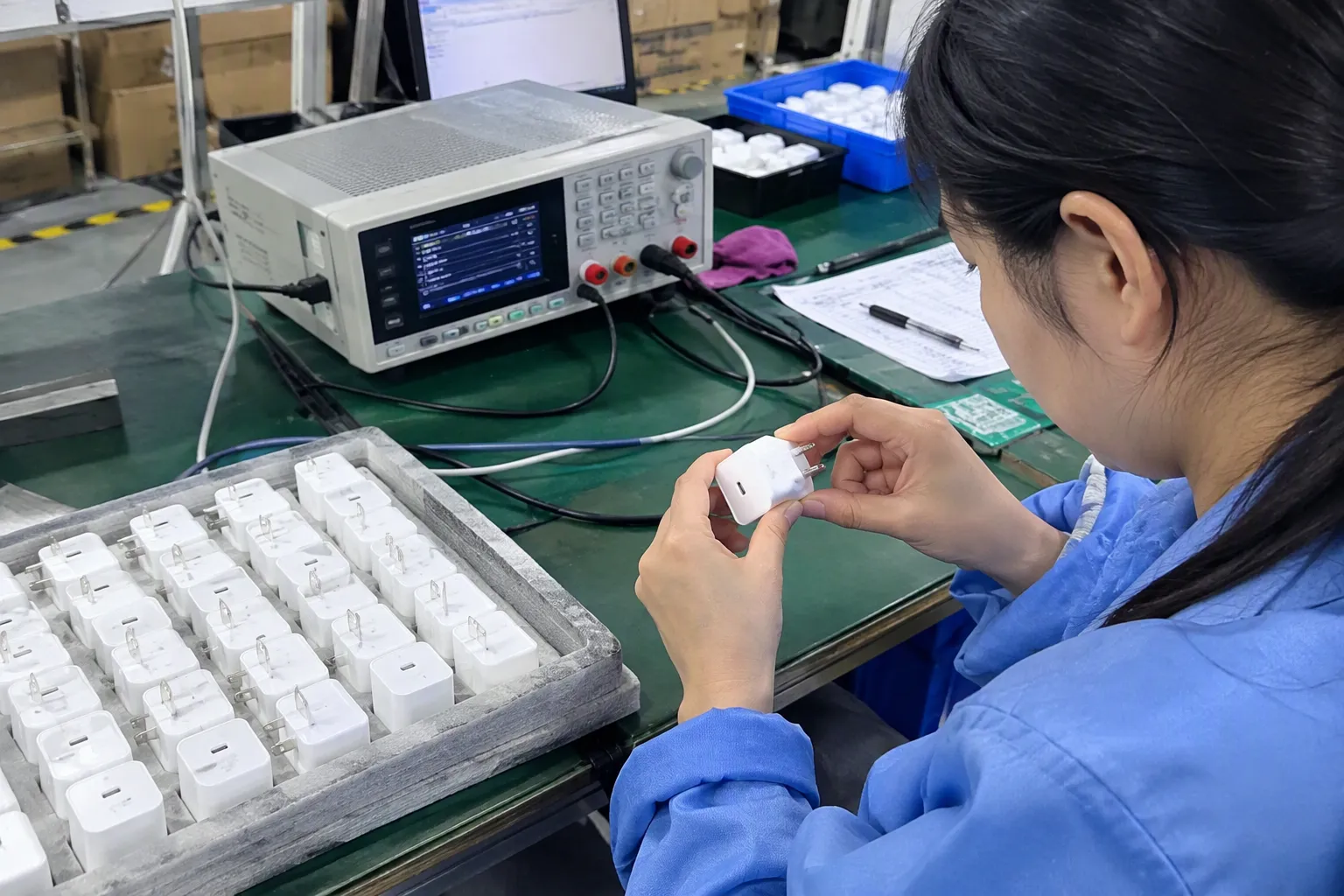
Construction and durability checks show whether the sample can withstand normal handling. They also help identify quality risks that may not appear in a short electrical test. I inspect the enclosure, pins, ports, strain relief, cable interface, labels, and packaging as a complete retail product.
Checks 21–24: physical and user-facing quality
21. Temperature rise in normal use. I measure the charger under relevant loads and record ambient conditions, test duration, surface locations, and behavior over time. I compare the results with the applicable technical requirements and buyer specification.
23. Cable, connector, and port endurance. If the product includes a cable, I check connector fit, bending areas, jacket quality, and repeated insertion where relevant. For a charger with ports, I check whether repeated connection creates looseness or visible damage.
24. Packaging and user instructions. I verify the model, output information, warnings, plug type, included accessories, language, markings, and instructions. I compare the retail artwork with the approved sample, because a technically correct product can still create claims or usage problems through inaccurate packaging.
Physical inspection table
| Area | What I inspect | Why it matters |
|---|---|---|
| Enclosure | Gaps, cracks, sharp edges, deformation | User safety and perceived quality |
| Plug | Alignment, finish, rigidity, fit | Repeated insertion and outlet compatibility |
| USB port | Centering, retention, damage | Cable fit and charging reliability |
| Strain relief | Movement and transition area | Resistance to cable stress |
| Labels | Legibility and accuracy | Product identification and customer use |
| Packaging | Protection and consistency | Transit damage and retail presentation |
I pay special attention to unusual sound, smell, discoloration, or adhesive movement during testing. These observations do not prove a failure by themselves, but they justify investigation. I also compare the sample with photographs from earlier rounds. A change in enclosure texture, vent shape, screw position, or port alignment can indicate an unapproved revision.
A note about GaN charger samples
GaN chargers often compete on compact size, high power, and attractive design.[8] Those benefits make thermal management, component quality, and mechanical construction especially important during evaluation. I do not assume that a smaller charger is better or worse. I ask how the design maintains safe operation at its declared load and how the supplier controls the relevant components.
How Can a Buyer Confirm Production Readiness After Sample Approval?
Check 25: production control and golden-sample management
25. Production control and golden sample management. I ask the supplier to identify the approved sample clearly and keep a controlled reference unit. I also request a production inspection plan that covers critical functions and appearance.
- Approved bill of materials and revision number.
- Approved artwork and label files.
- Critical component supplier information.
- Incoming inspection for safety-relevant parts.
- In-process assembly checks.
- Electrical function testing on production units.
- Final visual and packaging inspection.
- Lot identification and traceability.
- Change-approval procedure.
- Retention of production test records.
What changes require buyer approval?
- Power supply or transformer change.
- Protection component change.
- PCB layout or safety spacing change.
- Firmware or charging-control change.
- Plug, enclosure, or insulation material change.
- Port configuration change.
- Factory or production-line transfer.
- New packaging claim or output specification.
- Change to a supplied cable that affects charging performance.
The exact change-control process belongs in the purchase agreement or quality agreement. A golden sample is useful, but it cannot detect every internal change. The buyer may need periodic inspections, production testing, or third-party laboratory evaluation based on risk and order volume.
Supplier questions I ask before release
| Question | Evidence to request |
|---|---|
| How does the factory identify the approved version? | Revision-controlled sample and documents |
| Which components are safety-critical? | BOM or controlled component list |
| What does every unit receive during production? | In-line and final test records |
| How are failures handled? | Nonconformance and corrective-action records |
| How does the factory control changes? | Written change-notification process |
| Can the factory trace a shipment to a production lot? | Lot coding and records |
| What happens after a customer complaint? | Corrective-action and replacement process |
In my Shenzhen export work, I have learned that a clear production instruction often prevents more disputes than a long email. I prefer to convert the approved result into measurable requirements, photographs, test steps, and a signed revision record.
How Should Buyers Document a Charger Sample Approval Decision?
A strong approval record lets the buyer explain why the sample was released and what remains controlled. It also gives the supplier a clear target for correction. I use one file for the sample, test results, deviations, evidence, and decision.
Recommended approval record
- Product name and exact model.
- Supplier and factory identity.
- Sample quantity and date.
- Hardware and firmware revision.
- Intended market and device use.
- Agreed input and output specification.
- Applicable technical documents.
- Test conditions and instruments.
- Photographs of the sample and labels.
- Results for the 25-point plan.
- Open issues and responsible person.
- Corrective-action deadline.
- Final decision and approval signature.
Use a risk-weighted action log
| Issue | Risk | Evidence | Required action | Status |
|---|---|---|---|---|
| Output resets during multi-port use | High | Protocol analyzer record | Correct firmware and retest | Open |
| Label omits port-sharing detail | Medium | Artwork comparison | Revise packaging | Open |
| Minor molding mark | Low | Inspection photo | Improve cosmetic control | Conditional |
| Abnormal heating under defined load | Critical | Temperature record | Hold and investigate | Open |
Link approval to inspection and after-sales work
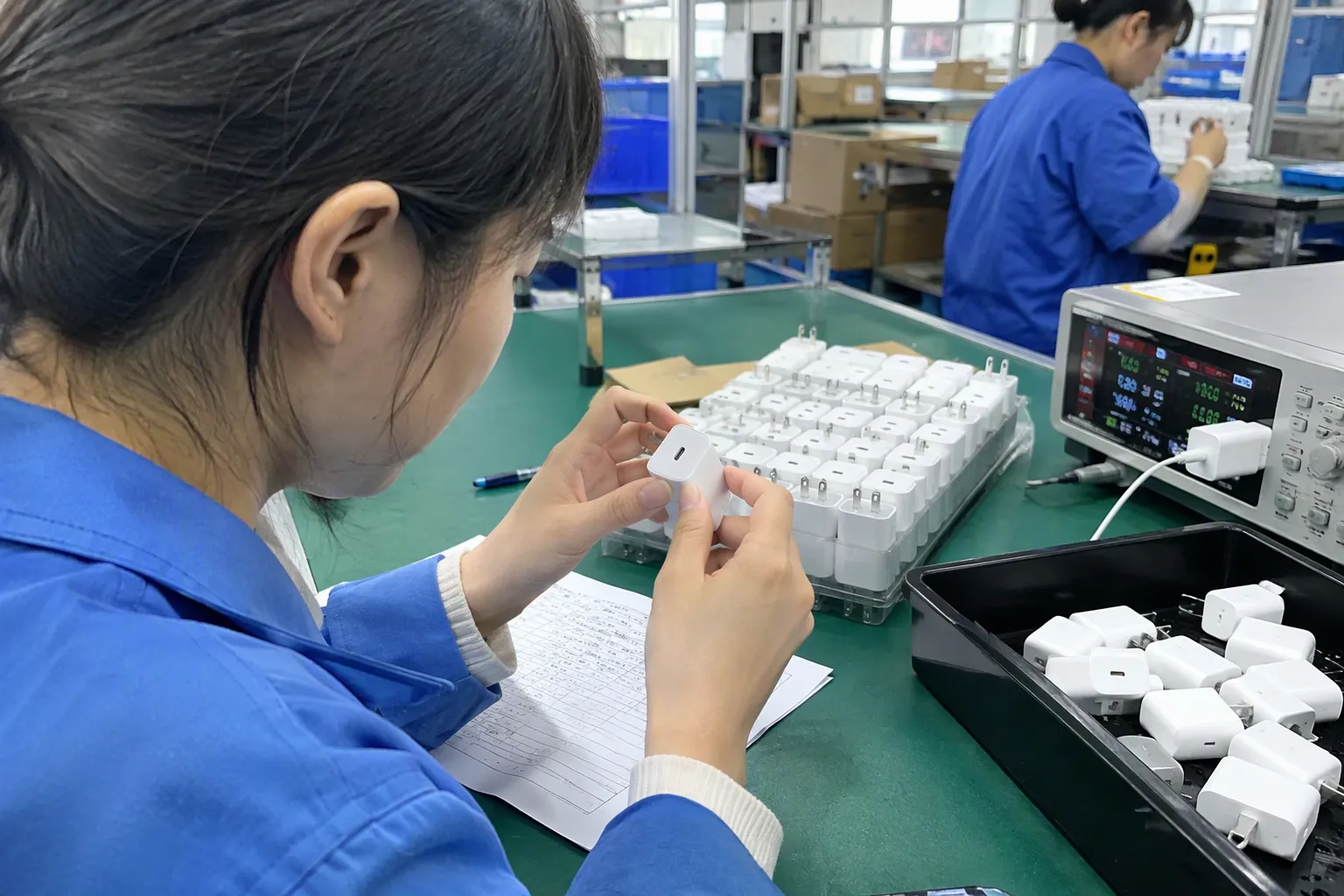
A buyer’s quality plan should continue after approval. Pre-shipment inspection can confirm appearance, labels, basic function, quantity, packaging, and selected electrical checks. A complaint review can compare returned units with the approved sample and production records.
- Confirm the stated MOQ and lead time.
- Define replacement or warranty handling.
- Confirm spare-unit or after-sales arrangements.
- Agree on packaging and private-label responsibilities.
- Confirm whether factory audits or third-party inspections are required.
- Keep a process for reviewing repeated field failures.
I supply USB cables, chargers, GaN charging heads, TWS earbuds, and smartwatches to buyers in Europe and the United States. In those projects, I find that early agreement on sample approval, MOQ, delivery timing, customization, and after-sales terms reduces pressure at the shipment stage. A low unit price does not compensate for unclear release conditions.
What Common Mistakes Delay Charger Sample Approval?
Many approval delays come from unclear scope rather than difficult engineering. Buyers may ask for a “safe charger” without defining the model, market, intended devices, power-sharing behavior, or evidence required. Suppliers may send documents without confirming that the sample matches the documented construction.
Mistake 1: treating a certificate as proof of the sample
Mistake 2: testing only one load condition
Mistake 3: approving the headline wattage
Mistake 4: ignoring the included cable
Mistake 5: relying on appearance inspection for internal quality
Mistake 6: failing to control design changes
Mistake 7: using universal limits
Frequently Asked Questions
Is charger sample approval the same as certification?
No. Certification or conformity documents address defined requirements and product configurations. Charger sample approval checks whether the specific physical sample matches the buyer’s specification and performs as expected. A buyer should review both areas and obtain qualified advice for market-specific conclusions.
How many samples should a buyer test?
The number depends on design complexity, order size, risk, supplier history, and the purpose of the test. One sample may support an initial review, but it cannot demonstrate production consistency. Buyers should consider multiple samples, production-line inspection, and third-party testing for higher-risk or higher-volume projects.
Should a buyer test every charging protocol?
The buyer should test every protocol that appears in the product claim or matters to the intended devices. The exact method depends on the charger design and market. I also test representative devices because protocol negotiation alone may not reveal all practical compatibility problems.
Can a passed sample guarantee mass-production quality?
No. A passed sample establishes a reference point. It does not guarantee that later units use the same components, firmware, assembly process, or packaging. Buyers should use change control, a golden sample, production testing, and risk-based inspection to protect consistency.
What should happen when a charger sample fails?
The buyer should document the failed condition, evidence, severity, and required correction. A critical safety or performance failure should normally lead to a hold. The supplier should provide corrective action and a new sample or qualified retest before approval continues.
Conclusion
Charger sample approval works best as a risk-based release decision, not as a paperwork exercise. I recommend checking identity, electrical performance, protection behavior, compatibility, construction, packaging, and production controls. I also separate certification review from validation of the physical sample. Buyers should record clear evidence and decide whether to approve, correct, retest, or hold. For your next charger, GaN adapter, or private-label 3C project, contact my Shenzhen export team to discuss specifications, sample testing requirements, MOQ, lead time, customization, and after-sales support.
Sources
- General Use Products: Certification and Testing", Institutional conformity-assessment guidance generally distinguishes voluntary or purchaser-defined inspection activities from evaluations against applicable product standards and legal requirements
- Conformity Assessment Basics | NIST", Manufacturing-quality research describes production variation and process-control evidence as necessary to assess whether later units conform to a reference design or specification
- Conformity Assessment Basics | NIST", Government conformity-assessment guidance identifies declarations, certificates, and test reports as forms of documented evidence whose significance depends on the applicable requirements and assessment procedure
- The Development of a Thorough Test Plan in the Analysis ...", Engineering validation literature treats the adequacy of a test plan as dependent on its objectives, test conditions, measurement methods, and acceptance criteria, not merely on completion of listed procedures
- Appliance and Electrical Fire Safety - USFA.FEMA.gov", Electrical-safety standards address abnormal operating conditions because faults, overloads, and impaired cooling can alter temperatures, currents, insulation stresses, or enclosure hazards
- USB Charger (USB Power Delivery)", USB Power Delivery documentation describes a communication procedure through which connected source and sink devices exchange capabilities and negotiate an operating power contract
- Do manufacturers consciously break specification with ...", USB charging specifications and engineering studies indicate that cable resistance, current capability, signaling, and identification can influence the power contract and delivered charging performance of a charger–device system
- High Density Power Electronics (HDPE) - SPEC", Power-electronics research reports that gallium-nitride devices can support high-frequency, high-power-density converter designs, which can reduce passive-component size in some charger architectures
Related reading: