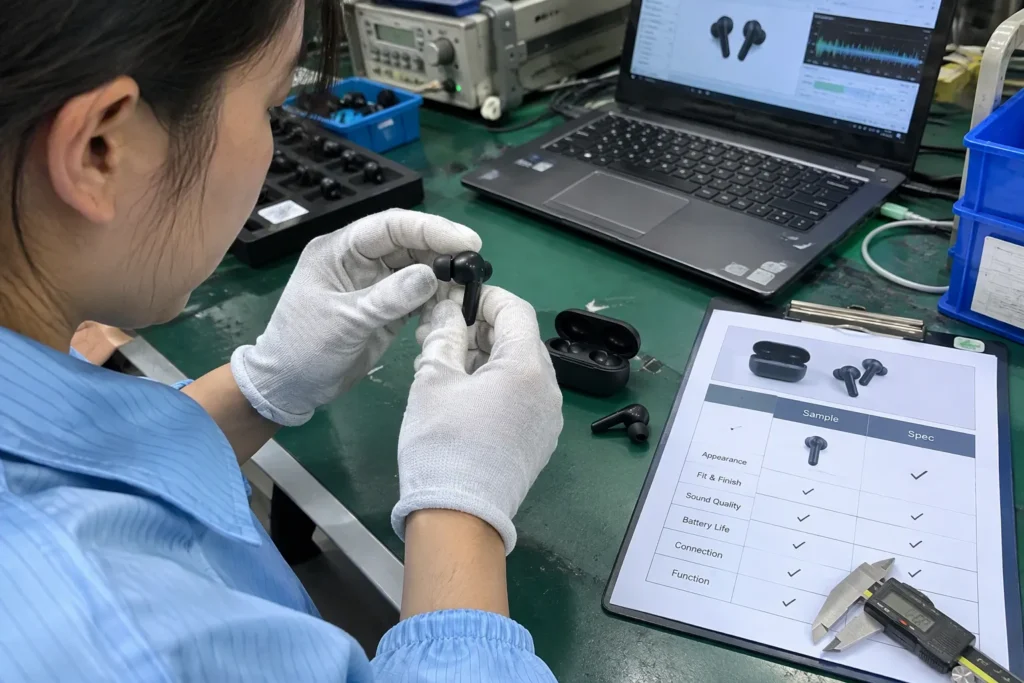
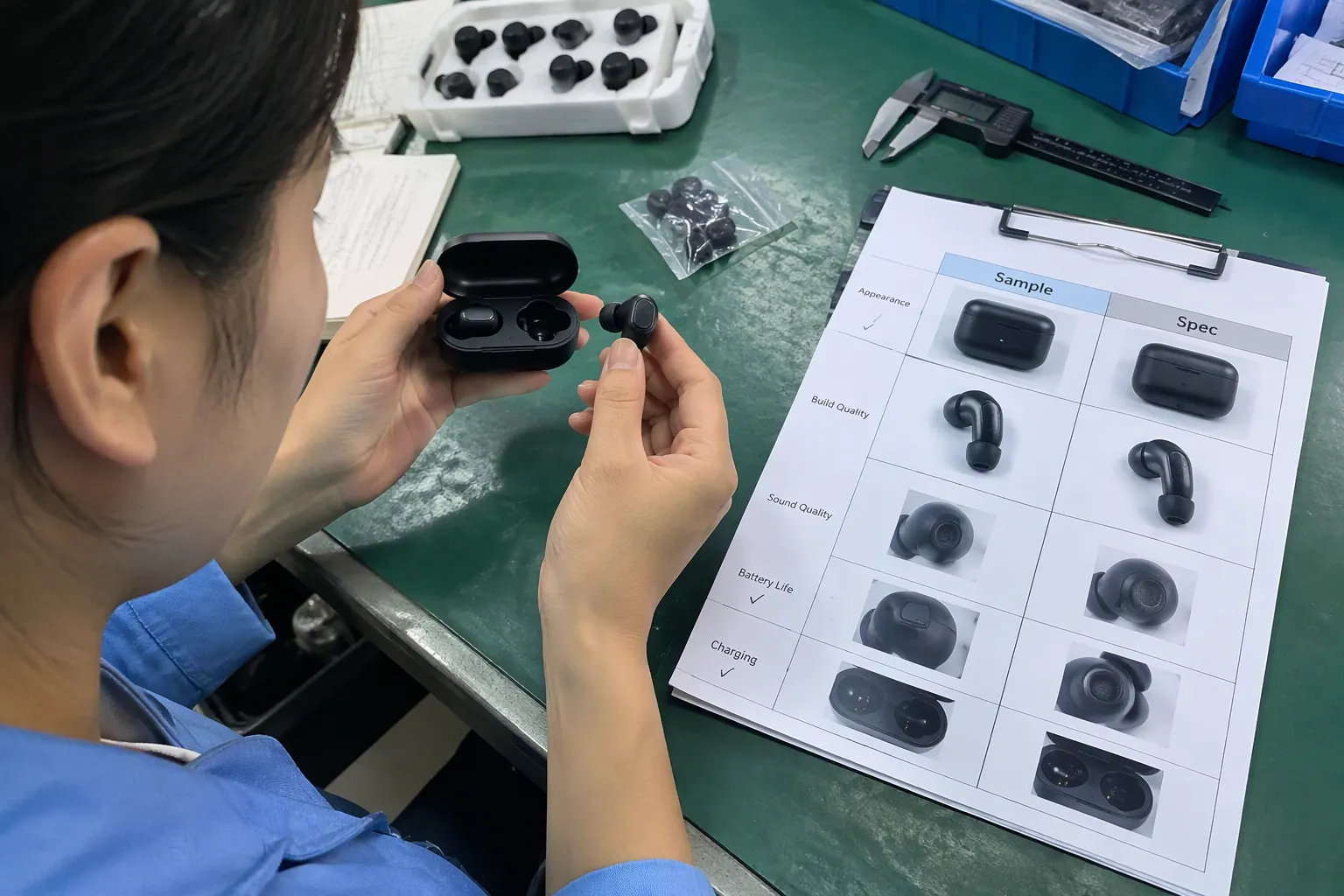
A TWS sample scorecard helps me avoid one expensive mistake: judging a true wireless sample by sound alone. In real buyer reviews, a sample can sound impressive and still fail on calls, RF stability, battery consistency, or build quality.[2] That is why I use a go/no-go scorecard before I decide whether a sample deserves another development round.
A TWS sample scorecard is a buyer-side evaluation tool that checks whether a sample is good enough to continue development.[1] It should cover sound, call quality, RF stability, battery behavior, and build quality, because a polished demo can hide risks that appear later in customer use, returns, or mass production.
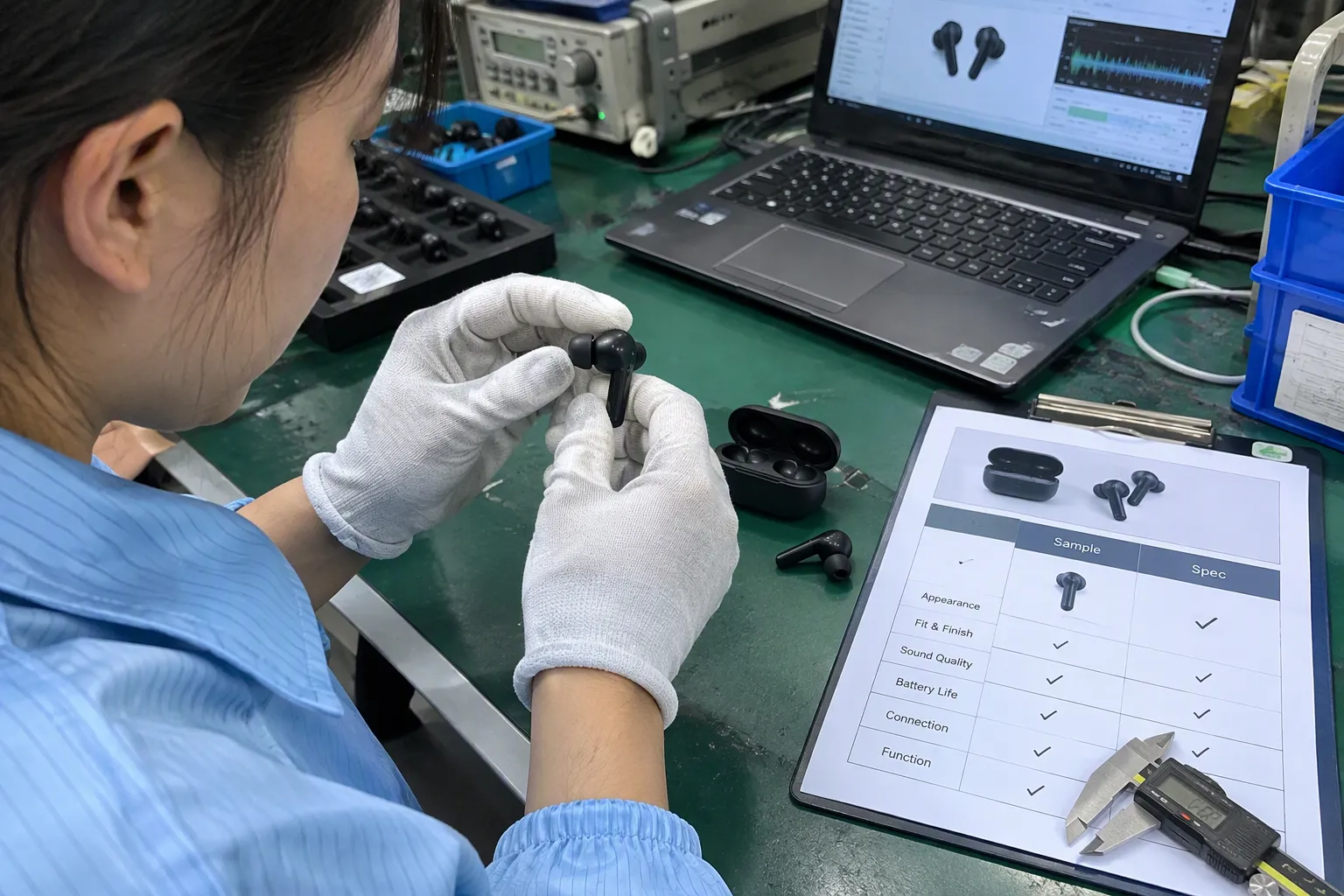
I have seen this happen many times in sample review conversations. A team likes the sound, but the mic breaks up in a noisy room. Or the housing feels premium, but the connection drops in real use. The real question is not “Is this sample exciting?” The real question is “Is this sample strong enough to justify the next round?”
Quick Answer
- A TWS sample scorecard should decide whether to continue development, not whether the sample “sounds nice.”
- I rank sound, calls, RF, battery, and build as separate risk checks.
- A weak score in call quality, RF stability, or build integrity can block the next round even if the sound is good.
- A strong sample should show balanced performance, not one standout feature and several hidden failures.
- Buyers should compare demo impressions vs. product risks before approving another prototype or sample revision.
If you want a practical rule, I use this: continue only when the sample is acceptable in every core area and clearly promising in at least one or two areas. That simple filter saves time, MOQ risk, and back-and-forth with suppliers.
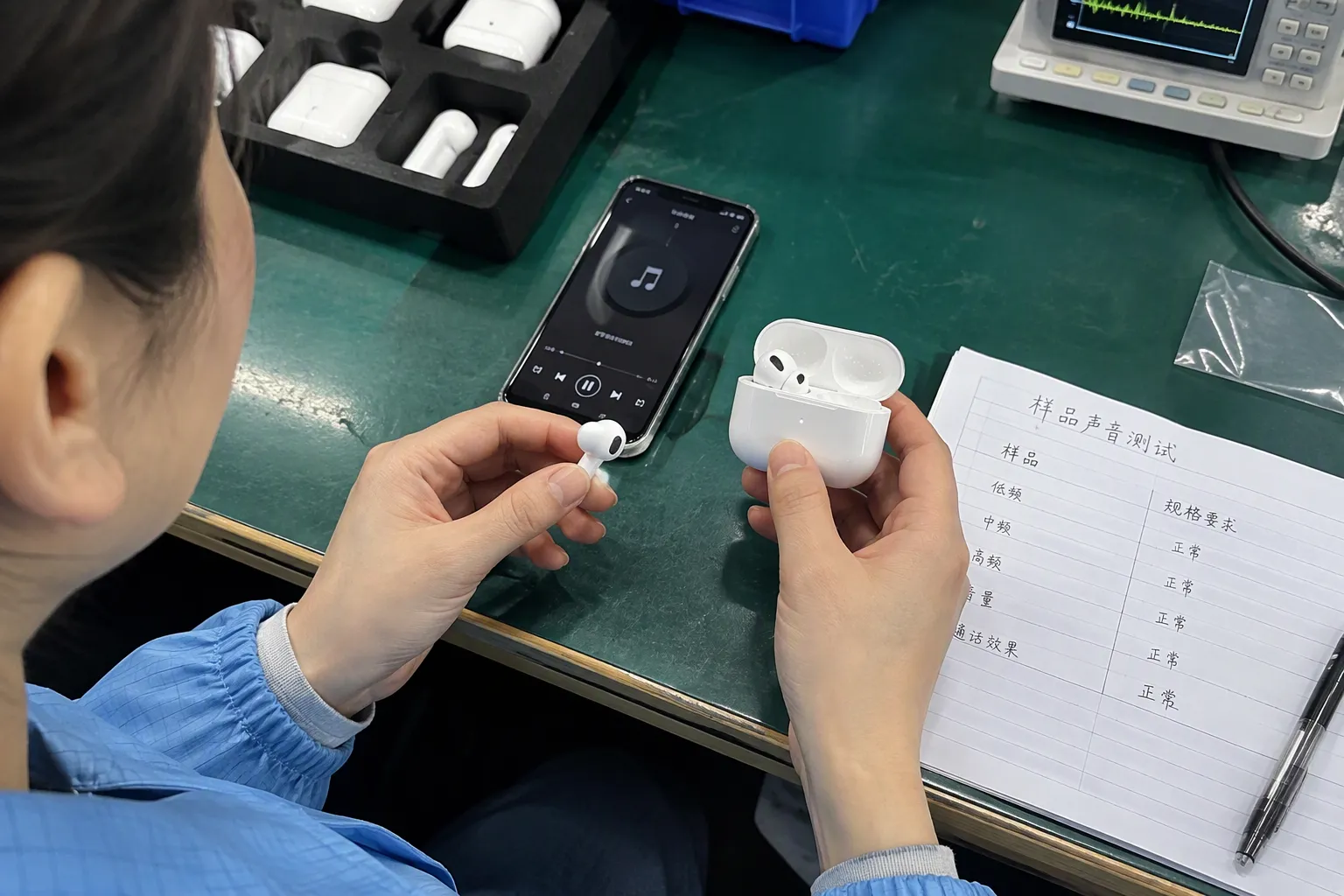
The rest of this article breaks the scorecard into the five checks that matter most in sample continuation decisions. I will keep it practical and buyer-focused, because that is how I review TWS samples in real procurement conversations.
Why does a TWS sample scorecard need to cover more than sound?
A TWS sample can create a false sense of progress when audio is strong but the product still has hidden risks. That problem gets worse when the sample looks polished and the first listen feels good. In buyer reviews, that can delay the real decision and waste another development round.
A TWS sample scorecard needs to cover more than sound because sound alone does not predict field performance. Call quality, wireless stability, battery consistency, and physical durability all affect returns, complaints, and repeat orders.[3] If I ignore any one of them, I may approve a sample that is easy to demo but hard to sell.
What usually goes wrong in sample review?
I have seen sample review discussions drift in a predictable way:
- The team listens to music first.
- Everyone reacts to bass, clarity, and loudness.
- The sample feels “close enough.”
- Only later do they notice call issues, short runtime, or sloppy build details.
That order is risky. It treats the sample like a showroom demo instead of a product candidate.
How I separate demo value from product risk
I use a simple filter:
- Demo value: What impresses people in a short test?
- Product risk: What fails after normal use, daily charging, movement, or packaging handling?
A glossy sample can score high on demo value and still fail product risk checks. That is why I treat the scorecard as a continuation tool, not a beauty contest.
In my own sample discussions, I usually ask one blunt question: “Would I still want this sample after a week of normal use?” That question exposes weak points faster than a quick listening test.
For related buyer evaluation methods, I often compare this process with how to check OEM sample readiness and how to evaluate wireless accessory suppliers. Those topics sit well next to a TWS scorecard because the decision is never only technical. It is also commercial.
How should I score sound in a TWS sample?
Sound still matters because it is the first reason many buyers become interested in a sample. But I do not let the sound score dominate the whole decision. Good tuning can attract attention, yet it cannot compensate for call failure, unstable RF, or weak assembly.
A TWS sample scorecard should treat sound as one risk dimension, not the final verdict. I look at tonal balance, volume headroom, distortion, and whether the tuning fits the target market. A sample that sounds exciting for 30 seconds may still be too aggressive, too thin, or too inconsistent across tracks.
What I check in sound
I usually listen for:
- Bass control: Not just quantity, but whether it stays tight at higher volume.
- Midrange clarity: Vocals should not disappear.
- Treble balance: Harsh highs can hurt long listening sessions.
- Volume behavior: The sound should not collapse or distort too early.
- Channel consistency: Left and right units should feel matched.
What sound can and cannot tell me
Sound can tell me a lot about tuning direction. It can also show me whether the team understands target user preference. For example, some retail markets prefer a more consumer-friendly, bass-forward presentation, while others respond better to balanced tuning. But sound does not tell me:
- whether the mic path is stable,
- whether RF holds in crowded environments,
- whether battery performance stays consistent after repeated charging,
- whether the shell and hinge area can survive normal handling.
Simple sound scorecard view
| Sound factor | What I look for | Risk if weak |
|---|---|---|
| Bass | Tight, controlled, not bloated | Fatigue, poor clarity |
| Mids | Clean vocals and speech | Thin or recessed presentation |
| Treble | Smooth, not sharp | Listener discomfort |
| Volume | Usable headroom without collapse | Distortion, complaints |
| Matching | L/R balance and unit consistency | Quality variation |
If I need a second round, I would rather improve sound after I know the product is stable in other areas. That sequence is much safer than polishing audio while ignoring weak fundamentals. For buyers, the real decision is not “Is this the best-sounding sample?” It is “Is the sound good enough to support a commercial product?” That is the key difference in a TWS sample scorecard.
Why are calls and RF stability make-or-break checks?
A sample with decent sound can still fail in the one area many users notice most: communication. If calls are weak, customers do not care that the music tuning is attractive. They experience the product as unreliable. In a TWS sample scorecard, calls and RF stability should sit near the top because they affect daily trust.
A poor call path creates immediate frustration. A weak RF design creates random disconnects, lag, pairing confusion, or one-side dropouts.[4] Those problems are not cosmetic. They turn into support tickets, returns, and poor reviews.
What I check in call quality
I usually test:
- voice clarity in a quiet room,
- voice clarity in a noisy room,
- wind sensitivity if possible,
- background noise handling,
- voice pickup consistency when the head moves.
I do not call this engineering proof. I call it field judgment. It tells me whether the sample is likely to pass normal buyer expectations.
Why RF matters even when the sample looks fine
RF problems can stay hidden in a short bench test. The sample may pair quickly and play well on the first day. Then issues show up in real environments with interference, body movement, multiple devices, or busy retail spaces.
A buyer should watch for:
- pairing delay,
- one earbud lag,
- sync drift,
- signal drop when the phone is in a pocket,
- unstable reconnection after storage.
Call and RF risk table
| Area | Good sample behavior | Warning sign |
|---|---|---|
| Calls | Clear voice, stable pickup | Hollow, chopped, or distant voice |
| Noise handling | Background noise does not dominate | User voice gets buried |
| RF stability | Smooth pairing and playback | Random disconnects |
| Sync | No noticeable delay between buds | L/R latency or dropouts |
| Reconnect | Fast and predictable | Confusing or inconsistent recovery |
When I review these points with customers, I often say the same thing: a good call experience protects the whole product story. A buyer may forgive a minor sound tuning issue, but they will not forgive a product that sounds bad on calls. That is why calls and RF stability are go/no-go items in my scorecard.
For readers who also evaluate related wireless products, my notes on Bluetooth accessory sampling can help frame the same risk logic.
How should I judge battery performance in a sample?
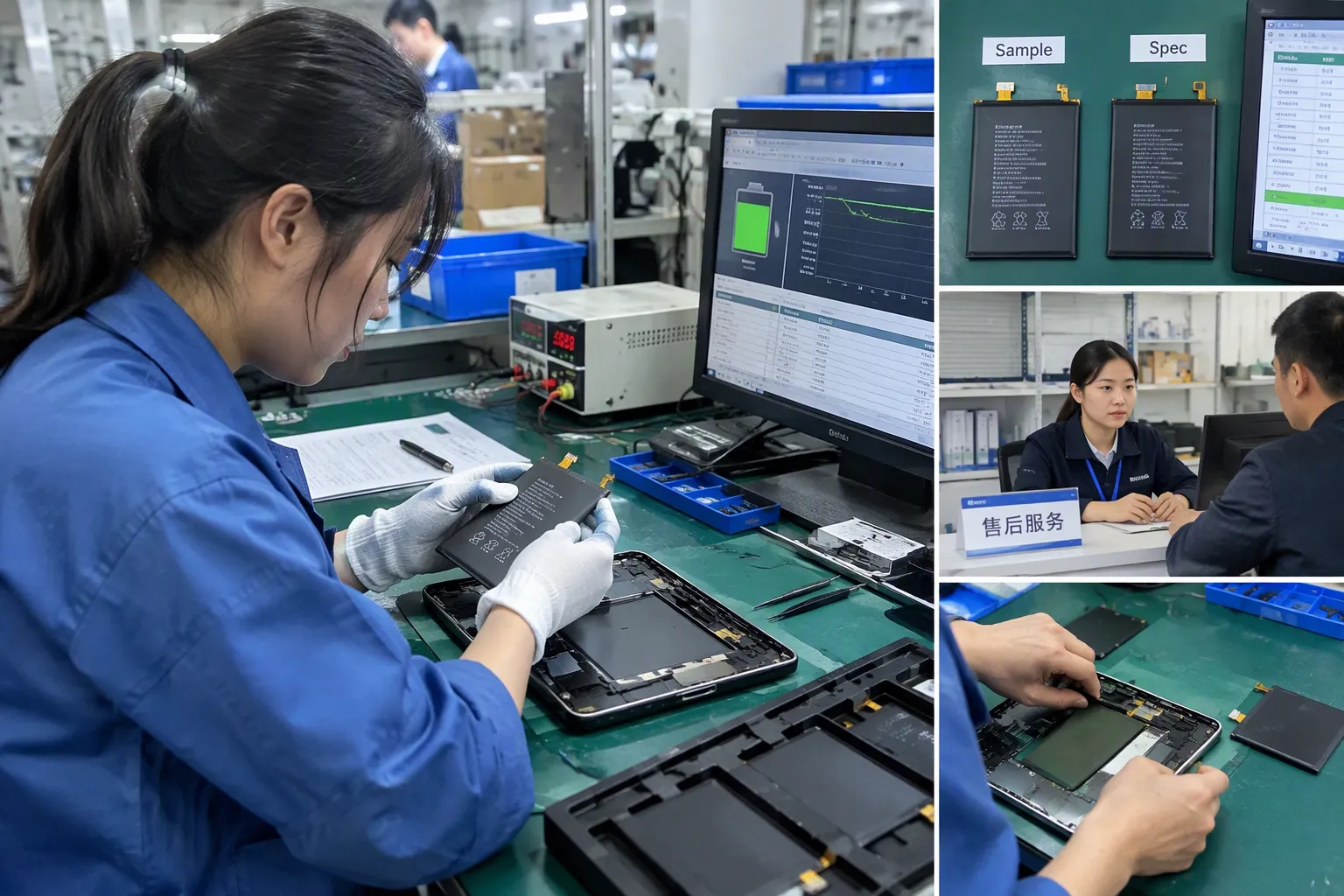
Battery performance is one of the easiest areas to overestimate in early sampling.[5] A product may power on, charge normally, and play well for a short session. That does not prove it will behave consistently across repeated use. In a TWS sample scorecard, battery is a continuation check because runtime, charging behavior, and case consistency all affect product credibility.
I do not treat battery as just a spec on paper. I treat it as a user experience risk. If the sample behaves unpredictably, the buyer inherits that risk later.
What I look for in battery evaluation
I focus on:
- realistic runtime, not just a claimed number,
- balance between left and right buds,
- charging consistency in the case,
- case recharge behavior,
- battery indication stability.
What can go wrong
A sample can show one or more of these problems:
- runtime drops faster than expected,
- one earbud drains differently from the other,
- charging contact is inconsistent,
- the case report is confusing,
- the product recovers poorly after repeated charge cycles.
These are not always final product failures, but they are strong warning signs. If I see them in a sample, I usually ask for another revision before moving forward.
Battery evaluation in buyer terms
| Battery aspect | Why it matters | Buyer risk |
|---|---|---|
| Runtime consistency | Users expect repeatable use time | Return risk, bad reviews |
| Left/right balance | Both buds should behave evenly | One-side complaints |
| Case charging | The product must be easy to maintain | Support issues |
| Indicator behavior | Users need clear status feedback | Confusion, misuse |
| Recovery after cycles | Stability matters over time | Early deterioration concerns |
I once heard a buyer say, “The battery is fine because it turned on.” That is not enough. A product can turn on and still be unreliable in daily use. My practical standard is simple: if battery behavior is unclear in the sample stage, I do not assume it will improve later. I ask for verification.
For teams comparing multiple development paths, battery is often the tie-breaker between two otherwise acceptable samples. That is why the TWS sample scorecard should treat it as a real continuation risk, not a background detail.
Why does build quality matter if the sample already works?
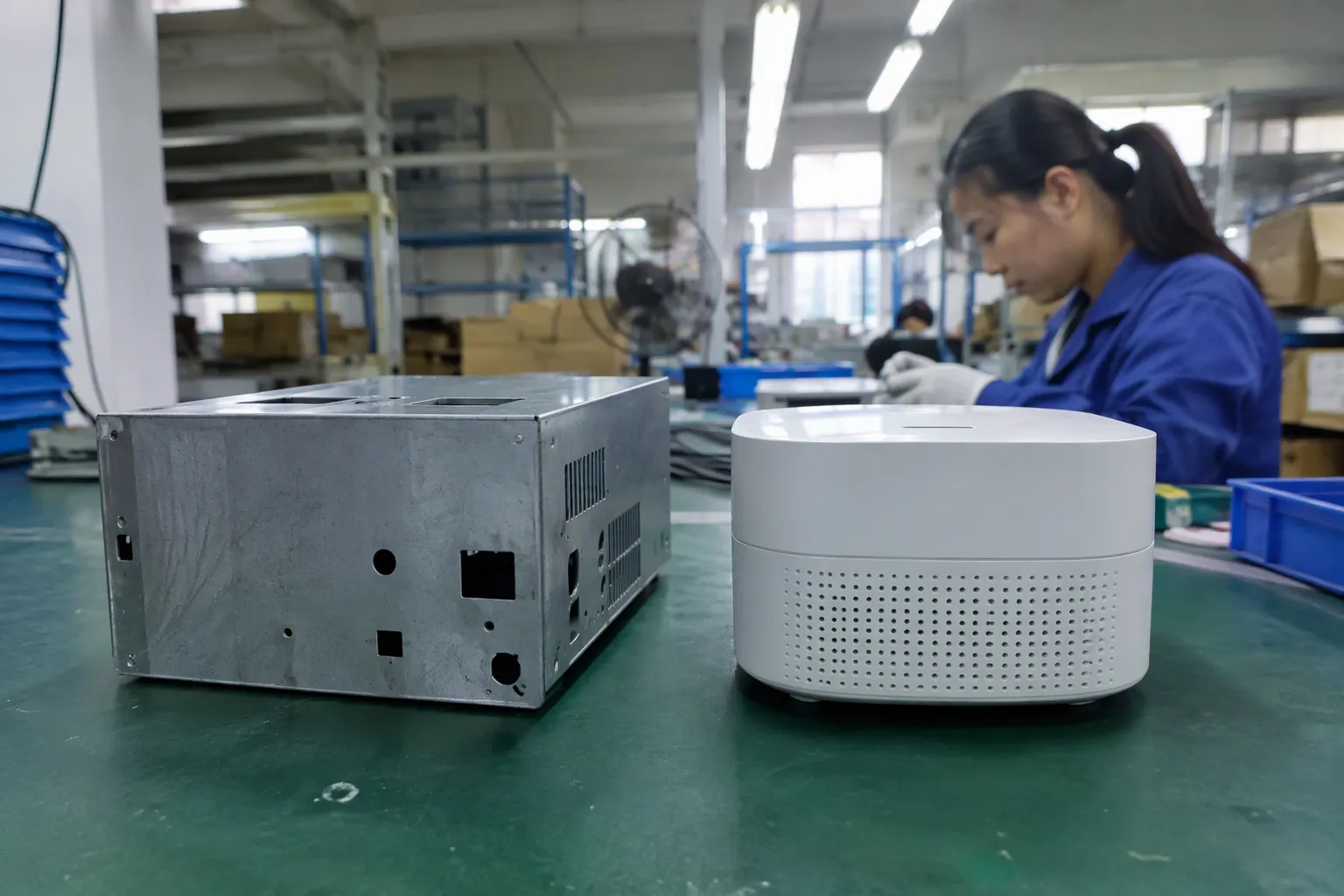
Build quality matters because the sample is not only a device. It is also a signal of manufacturing control. A sample can work today and still look risky if the hinge area, shell fit, buttons, seams, or finish suggest weak process control. In a TWS sample scorecard, build quality tells me whether the product feels ready for another round of development or whether it still looks fragile.
A good-looking sample is not the same as a robust sample.[6] Buyers often focus on surface finish first, but I look at how the product will survive handling, packing, shipping, and daily use.
What I inspect in build quality
I look at:
- seam alignment,
- plastic gap consistency,
- surface finish uniformity,
- button or touch area response,
- hinge or lid feel,
- charging case closure,
- resistance to light handling stress.
Why build quality is a risk signal
Build issues often point to process issues:
- uneven seams can suggest tooling variation,
- loose parts can signal poor assembly control,
- inconsistent finish can show weak incoming material stability,
- fragile closure feel can hint at long-term wear risk.
I do not claim lab certainty from these signs. I use them as practical warnings. If the sample already feels inconsistent, mass production may create more variation, not less.
Build vs. product risk
| Build factor | What I want to see | Why it matters |
|---|---|---|
| Fit and gap | Clean, even assembly | Perceived quality and process control |
| Finish | Consistent texture and color | Brand presentation |
| Hinges/lid | Smooth but not loose | Daily durability |
| Buttons/touch areas | Clear, repeatable response | User confidence |
| Case closure | Secure and aligned | Shipping and handling resilience |
I have seen customers choose between two samples with similar sound. The final decision often comes down to build confidence. That is not because the product needs luxury cosmetics. It is because weak build quality tends to show up later in complaints, especially in e-commerce and retail environments.
If you want a deeper supplier-side perspective, I recommend pairing this section with how I review OEM product samples. The sample is the signal. The build is often the loudest part of that signal.
How do I turn the scorecard into a go/no-go decision?
A TWS sample scorecard works best when it forces a clear decision. I do not want a vague “looks good” result. I want to know whether the sample is strong enough to continue, weak enough to stop, or promising enough to revise once more.
The simplest way is to separate must-pass items from improvement items.
My practical decision logic
Go
I continue when:
- sound is acceptable for the target market,
- calls are stable enough for normal use,
- RF behavior does not create daily frustration,
- battery performance is credible,
- build quality looks consistent.
No-go
I stop when:
- calls are clearly weak,
- RF is unstable,
- battery behavior is unreliable,
- build quality suggests poor control,
- the sample only impresses in short demo use.
Revise and retest
I request another round when:
- sound is close,
- one or two issues are correctable,
- the supplier response is fast and organized,
- the sample still shows development potential.
A simple weighted view
| Category | Suggested decision weight | Why |
|---|---|---|
| Calls | High | Direct user pain point |
| RF | High | Daily reliability issue |
| Battery | High | Core use-time expectation |
| Build | Medium to high | Quality and durability signal |
| Sound | Medium | Important, but not alone decisive |
My buyer-side rule of thumb
If a sample is beautiful but unstable, I do not call it “almost ready.” I call it “not ready yet.” That wording matters because it keeps the team focused on continuation risk, not emotional attachment.
When I work through sample feedback with customers, I like to write comments in one line per category:
- Sound: acceptable / promising / weak
- Calls: acceptable / risky / fail
- RF: acceptable / risky / fail
- Battery: acceptable / risky / fail
- Build: acceptable / risky / fail
That format is fast, clear, and useful in supplier discussions. It also makes the next action obvious. A strong TWS sample scorecard does not just rate the sample. It tells the buyer what to do next.
What should buyers ask suppliers after the scorecard review?
The scorecard is only useful if it leads to the right supplier conversation. After I finish sample review, I ask questions that connect directly to risk reduction. A polite “Can you improve it?” is too vague. A precise follow-up saves time.
Questions I usually ask
- Which issue is easiest to correct in the next round?
- Which issue needs tooling, component, or layout change?
- Which result is already stable enough to keep?
- What changed from the previous sample?
- What test evidence can the supplier share next time?
Why this matters for procurement
Buyers in retail, wholesale, and e-commerce do not just need a nice sample. They need a supplier who can move from sample to stable repeatability. That means the supplier should understand not only product appearance, but also the development path.
For business readers, I also suggest checking:
- supplier MOQ and lead time planning
- quality inspection basics for consumer electronics
- how to compare OEM and ODM options
These topics connect well because the sample decision is part of the broader sourcing decision.
I usually trust suppliers more when they answer sample feedback with specific actions, not general promises.
External references buyers may find useful
For authoritative background on wireless and battery-related product frameworks, buyers can review:
- Bluetooth SIG documentation for Bluetooth technology basics: https://www.bluetooth.com/
- IEC battery safety standards overview: https://www.iec.ch/
- FCC equipment authorization resources for the U.S. market: https://www.fcc.gov/engineering-technology/laboratory-division/general/equipment-authorization
These sources do not replace supplier testing, but they help buyers understand the compliance environment and the need to verify documentation.
Frequently Asked Questions
What is the purpose of a TWS sample scorecard?
A TWS sample scorecard helps buyers decide whether a sample is good enough to continue development. It compares sound, calls, RF, battery, and build quality so the buyer can see product risk clearly instead of reacting only to first impressions.
Should I approve a sample if the sound is excellent?
Not by itself. Excellent sound is useful, but it does not fix weak calls, unstable RF, short battery life, or poor build quality. I treat sound as one part of the decision, not the entire decision.
Which sample issue is most likely to block the next round?
In my experience, weak call quality and RF instability are the fastest blockers because they affect daily use and customer satisfaction. Battery inconsistency and poor build quality can also stop progress if they look serious or repeated.
Can a sample with minor flaws still move forward?
Yes, if the flaws are clearly fixable and the sample is otherwise balanced. I usually continue only when the supplier shows a realistic improvement path and the weak points do not threaten user trust or production stability.
How do I avoid being fooled by a pretty sample?
I separate demo impression from product risk. A pretty sample may look and sound good for a short test, but I still check calls, RF, battery, and build. That habit helps me avoid approving a sample that is difficult to scale.
Conclusion
A strong TWS sample scorecard gives buyers a practical way to decide whether a sample deserves another development round. I do not rely on sound alone. I look at calls, RF stability, battery behavior, and build quality as separate go/no-go risks. That approach helps me separate a good demo from a product that can actually move forward. If you are comparing TWS samples for OEM, ODM, wholesale, or e-commerce use, I can help you review the next round with a buyer-focused eye and practical sourcing guidance.
Sources
- Section 3: Product Evaluation Process", Research on product development and prototype screening supports the use of structured evaluation tools to decide whether a sample advances to the next stage of development, although the exact scorecard format varies by industry
- Epidemiological exploration of the impact of bluetooth headset ...", Studies of wireless audio devices support the idea that sound quality, call performance, connectivity, battery behavior, and mechanical quality are distinct evaluation dimensions and may not correlate closely in a single sample
- Order book regulatory impact on stock market quality", Research on product quality and customer satisfaction generally finds that reliability problems and defects increase complaints and returns and can reduce repeat purchasing, although the exact magnitude varies by category
- Epidemiological exploration of the impact of bluetooth headset ...", Technical literature on Bluetooth and short-range wireless links supports that interference, attenuation, and connection-management problems can produce disconnects, latency, and audio dropouts in earbuds and similar devices
- AI tool predicts battery cycle life with just a few days' data", Battery-testing literature supports the need for repeated, realistic-use validation because early prototype measurements can differ from sustained in-use performance
- Effects of Design Aesthetics on the Perceived Value of a Product", Quality research supports the distinction between visual presentation and functional robustness; a polished appearance does not guarantee durable construction or reliable long-term use Related KingFuji products: LX10 Touchscreen Bluetooth Earbuds · M111 Open-Ear Bluetooth Earbuds · M97 Clip-On Bluetooth Earbuds · N75 Wireless Headphones (Over-Ear) · M166 Dual-Style Bluetooth Earbuds · T29 Bluetooth 5.5 directional stereo clip-on earphones