Quick Answer
Low-material USB-C packaging can look like an easy cost-saving decision until damaged cables, unclear labels, or weak shelf presentation create problems after delivery. A pack that uses less board, plastic, or ink still has to survive handling, communicate the product clearly, and support the way the item will actually be sold. **Low-material USB-C packaging works best when it is designed around the sales channel, transport journey, product protection needs, required labeling, and retail display expectations.
The goal is not simply to use the least material possible. The practical goal is to remove unnecessary material while keeping USB-C cables protected, information readable, barcodes scannable, and products easy for shoppers and staff to identify.**
In our USB-C packaging discussions with European and US buyers, the first questions are usually not about carton thickness or insert size. We normally start with two practical questions: Where will this sell? and How will it travel? Those answers shape every later packaging decision.
Low-material USB-C packaging is not a “use the thinnest possible pack” exercise
Low-material USB-C packaging can fail when buyers focus only on reducing visible materials. A thinner card, smaller bag, or simplified sleeve may lower unit cost, but it can also expose connector ends, weaken barcode scanning, or create a messy retail fixture. These problems often appear later, when changes are more expensive.
The right low-material USB-C packaging approach is a channel-specific balance. Buyers should define the transport route, retail handling, product format, label requirements, and display method before removing material. A package is successful when it uses only the material needed to protect the product, carry readable information, and support the intended customer experience.
Start with the channel, not the packaging structure
A USB-C cable sold through a chain store does not face the same demands as a cable shipped in a bulk carton to a distributor. It also does not face the same risks as a cable picked individually for e-commerce orders.
This point sounds obvious, but it is where many packaging projects become inefficient. A buyer may ask for a “simple eco-style pack” before deciding whether the product will hang on peg hooks, sit in a counter display, ship in a master carton, or move through several warehouse systems.
In our experience, packaging development becomes clearer when the buyer describes the journey first. We need to understand:
-
The sales channel
Is the product intended for a chain-store shelf, an independent retailer, an online marketplace, a wholesale distributor, or a promotional bundle? -
The retail presentation
Will the cable hang from a peg, sit in a tray, stack in a display box, or be stored behind a counter? -
The transport path
Will the goods move directly from factory to importer, from importer to retail distribution center, or through multiple fulfillment locations? -
The handling level
Will store staff handle each individual pack often? Will customers pick up the item, compare it, and return it to the shelf? -
The product configuration
Is it a single USB-C cable, a cable with a charging adapter, a multi-piece travel kit, or a private-label accessory set?
A compact paper sleeve may be suitable for some cable programs. Yet the same sleeve may not provide enough structure for a higher-value cable with metal connector housings, a bundled accessory, or a premium retail presentation.
Different channels create different packaging risks
We do not treat low-material USB-C packaging as a universal format. The correct solution depends on what the product must do after it leaves the factory.
| Sales channel | Main packaging task | Common risk if material is reduced too far | Practical evaluation point |
|---|---|---|---|
| Chain-store retail | Hang straight, communicate quickly, remain tidy | Bent hang tab, unclear front panel, loose cable | Check peg fit, shelf visibility, and repeat handling |
| Independent retail | Flexible display and easy product identification | Mixed products become difficult to sort | Use clear SKU, length, color, and charging information |
| E-commerce | Protect the item through picking and parcel handling | Connector scratches, crushed card, missing accessories | Review mailer and outer-carton system together |
| Bulk wholesale | Efficient packing and warehouse identification | SKU mix-ups or weak carton labeling | Confirm inner-pack and master-carton labeling |
| Promotional bundles | Present multiple items as one offer | Parts shift, pack becomes confusing | Define component layout and bundle identification |
A lighter package may reduce the amount of material used per unit, but it can add cost elsewhere if it creates confusion in a store or damage during distribution. We encourage buyers to review the whole chain rather than comparing only the packaging purchase price.
A packaging concept should be judged by its total retail risk: protection, handling, label clarity, display performance, damage exposure, and return risk.
Define what the USB-C product still needs to protect

USB-C cables are flexible products, but flexibility does not mean they need no packaging support. Cable shape, connector finish, connector strain-relief areas, bundled accessories, and retail handling all affect the pack design.
A cable can arrive at a warehouse in good condition but still look poor at retail if it has been tightly compressed, tangled, or repeatedly handled. A visible cable may also need protection from dirt, scratches, or loose movement inside the pack. The required level depends on the item and the channel.
For example, a basic short charging cable sold in a value-focused bulk program may need a different pack than a braided high-wattage cable positioned as a premium accessory. The retail buyer may need shoppers to see the braid, connector shape, or color. That presentation requirement can influence how much of the product remains visible and what kind of restraint is needed.
When we review a packaging sample, we usually look at the product as a system:
- Cable coil or fold: Does it stay neat after normal handling?
- Connector ends: Are they exposed, rubbing against other parts, or likely to shift?
- Fastening method: Does the tie, paper band, insert, or sleeve hold the cable without damaging its appearance?
- Accessories: Are adapters, clips, manuals, or warranty cards controlled inside the pack?
- Opening behavior: Can a shopper or retailer open the pack without making the product impossible to re-display?
- Outer protection: Does the individual pack work with the inner box and master carton?
These are sampling questions, not proof of certified transit performance. If a buyer needs formal drop testing, compression testing, transit simulation, or retailer-specific packaging validation, those requirements should be defined separately with qualified testing and the relevant parties.
Material reduction should remove waste, not function
The phrase “low-material” can mean different things to different buyers. One customer may mean less plastic. Another may mean less total packaging weight. A third may want fewer components for easier packing and lower handling time. We recommend defining the target clearly before the factory starts redesign work.
Possible material-reduction actions can include:
- Replacing an oversized box with a right-sized sleeve or card format.
- Removing a redundant internal insert where the cable can remain stable without it.
- Combining product information panels rather than adding separate printed leaflets.
- Using one retail-ready structure instead of several decorative layers.
- Reducing unused empty space in individual packs and inner cartons.
- Simplifying artwork coverage where full-surface printing does not add sales value.
- Designing a pack that nests or packs efficiently in the master carton.
However, none of these changes should be treated as automatically better in every application. A smaller package may improve cube efficiency, but it may also make product information harder to read. A paper-based structure may be suitable for one sales program but insufficient for a product that needs moisture resistance, tamper evidence, or greater display durability.
We also avoid treating lower material use as a guaranteed environmental claim. Environmental performance depends on many factors beyond material quantity, including material type, sourcing, manufacturing, transport, recyclability in the destination market, consumer disposal behavior, and the rate of damaged or returned products.[1] Buyers should make environmental claims only after reviewing the relevant evidence and local requirements.[2]
Labels are functional packaging, not decoration
Labels often receive attention late in a project, after the packaging shape and artwork have already been approved. That sequence can create avoidable problems. If the pack is too small, the barcode may have limited space. If the front panel is crowded, shoppers may not understand cable length, connector type, or the main selling point quickly.
For low-material USB-C packaging, the label area is part of the functional design. It is not an empty surface waiting for artwork.
At a practical level, buyers often need space for:
- Product name and SKU
- USB-C connector configuration
- Cable length
- Color or finish
- Key product features that have been verified for the SKU
- Barcode and supporting identification
- Brand name and private-label artwork
- Country-of-origin or importer details where required
- Warnings, symbols, or instructions where applicable
- Batch, lot, or traceability information if the buyer’s system needs it
- Market-specific information requested by the retailer or importer
The exact labeling requirements can vary by destination market, product category, importer role, retailer policy, and sales channel. We do not treat a previous label file as universal proof that a new program is compliant. Buyers should verify local rules, retailer manuals, barcode standards, and applicable product documentation market by market.
Barcode space needs real planning
A barcode that is technically printed but difficult to scan does not help store operations. Packaging designers should consider barcode size, print quality, quiet zones, surface flatness, contrast, and placement.[3] A barcode placed over a fold, curve, hang hole, seam, or textured surface can become less practical for retail scanning.[4]
We suggest that buyers ask a few basic questions during artwork review:
- Is the barcode in a clear, flat area?
- Is there enough contrast between the code and the background?
- Is the code separated from visual clutter?
- Will a retail worker be able to find it quickly?
- Does the pack design leave room for required retailer stickers or price labels?
- Does the barcode remain visible if the product is stacked, hung, or packed in an inner box?
A clean back panel often works better than a crowded design. This does not mean every product needs a large package. It means the available surface must be planned around operational use, not only visual style.
Make product identification easy at a glance
USB-C accessories can look very similar in a retail fixture.[5] A 1-meter cable may sit beside a 2-meter cable. A standard cable may sit beside a higher-power model. Black, white, braided, silicone, and recycled-material-look products may all share the same display area.
If the pack does not communicate clear differences, shoppers can select the wrong product and staff can struggle to maintain shelf order.[6] That can lead to customer dissatisfaction, returns, or reduced confidence in the product range.
For this reason, we encourage clear hierarchy on the front of low-material USB-C packaging:
| Information level | What the shopper should understand | Typical placement |
|---|---|---|
| First glance | Product type and brand | Front panel, largest text |
| Quick comparison | Connector type, length, color, main feature | Front panel or visible side panel |
| Purchase confirmation | SKU, barcode, detailed information | Back panel |
| Operational details | Warnings, importer details, traceability | Back or side panel |
A minimal design can still be clear. In fact, a restrained design often helps if it gives the most important information enough space. The mistake is not using fewer words. The mistake is removing information that shoppers, warehouse teams, and retailers need.
Retail display is part of product protection
Retail display is sometimes treated as a separate topic from packaging protection. In reality, the two are closely connected. A pack that hangs poorly can become bent.[7] A pack that slides off a hook can become damaged. A cable that shifts inside the package can look used or disorganized even when it is technically functional.
For chain-store and large retail programs, buyers should confirm the intended fixture early. A package may need a hang hole, reinforced header, or defined width to sit correctly on a peg. A display tray may need consistent pack dimensions to keep the range orderly. A counter display may require the package to stand without support.
We have seen that a packaging sample can look good on a desk and still create issues when several units are placed together. Buyers should review samples in conditions that resemble the planned retail use as closely as possible.
Useful review points include:
- Does the pack hang straight when several units are on one hook?
- Does the header remain stable after repeated handling?
- Can shoppers see the key information from normal viewing distance?
- Does the product remain aligned after staff restock the fixture?
- Can multiple color or length variants be distinguished quickly?
- Does the package look acceptable after standard warehouse and store handling?
- Can staff remove the unit from an inner carton without damaging the display face?
Retailer requirements should be checked separately. Some retailers have fixture, barcode, artwork, packaging, or carton-label guidelines that go beyond general market expectations. We recommend obtaining those requirements before artwork approval and production booking.
Evaluate total cost, not only packaging unit price
A lower-cost pack is not necessarily a lower-cost retail program. Packaging savings can disappear if the product generates more damage, higher return rates, extra store labor, slower receiving, or reduced sell-through because shoppers cannot understand the product.[8]
We encourage buyers to consider the following total-risk view:
| Decision factor | Low initial cost approach | Balanced evaluation approach |
|---|---|---|
| Pack material | Select the least expensive structure | Use only the structure needed for the route and channel |
| Protection | Assume cable flexibility solves all risks | Review connectors, coil retention, accessories, and outer-carton support |
| Artwork | Reduce panel space aggressively | Preserve readable product and operational information |
| Display | Use a generic hanging format | Match the pack to the actual fixture and retail plan |
| Testing | Approve from appearance only | Define any required drop, transit, or retailer checks separately |
| Returns | Treat as a sales issue only | Consider packaging clarity and presentation as contributing factors |
This approach does not mean every USB-C cable needs premium packaging. Many buyers need straightforward, competitively priced packaging for high-volume accessory programs. The key is to identify where simplicity is safe and where it creates avoidable risk.
For example, a bulk wholesale customer may prioritize compact inner packs, clear carton labels, and efficient pallet loading. A retail chain may prioritize shelf consistency, barcode readability, and a package that hangs correctly. An e-commerce seller may prioritize a compact format that works with its fulfillment process while still keeping connector ends and bundled items secure.
Use sampling to make trade-offs visible
Packaging discussions are easier when buyers can compare physical samples instead of reviewing only flat artwork files. A sample can reveal issues that a screen cannot show: whether the cable shifts, whether the card bends, whether the label feels crowded, or whether the product looks clear from a normal retail distance.
In our work as a Shenzhen 3C export trading company, we use sampling and supplier communication to help buyers discuss these trade-offs before mass production. We do not present sampling as certified test evidence. Instead, it is a practical decision tool.
A useful sample review can include several formats:
- A current packaging reference
- A lower-material alternative
- A more protective alternative
- A version with revised label hierarchy
- A version sized for the planned retail fixture
- A packed inner carton showing how units sit during transport
The buyer can then compare more than appearance. They can consider handling, stacking, shelf visibility, pack size, and the information available to the end customer.
A practical approval checklist for buyers
Before approving low-material USB-C packaging, we suggest asking the supplier, design team, and internal retail stakeholders to review the same checklist.
Product and protection
- Is the USB-C cable held in a stable, neat position?
- Are connector ends protected to the level needed for the product and route?
- Are accessories controlled inside the pack?
- Does the pack still look acceptable after normal handling?
- Does the individual pack work with the intended inner and master carton?
Label and artwork
- Is the product type immediately clear?
- Can shoppers identify length, color, and connector configuration?
- Is the barcode in a practical scannable location?
- Is the SKU easy for warehouse and retail staff to find?
- Have destination-market and retailer-specific requirements been verified?
Retail display
- Does the pack suit the actual fixture?
- Does it hang, stand, or stack consistently?
- Is the key selling information visible at a glance?
- Can the range remain organized when several SKUs are displayed together?
- Is there room for retailer price labels or promotional stickers if needed?
Supplier and quality-control process
- Has the supplier confirmed the approved packaging material and dimensions?
- Is the artwork revision controlled and signed off?
- Are barcode files and label data checked before production?
- Are packing quantities and carton markings aligned with the buyer’s receiving process?
- Has the buyer defined whether independent inspection or application-specific testing is needed?
A structured review does not eliminate every risk. It does help buyers avoid approving a package based only on a visual mockup or a low unit quotation.
Frequently Asked Questions About Low-Material USB-C Packaging
Can low-material USB-C packaging still look premium?

Yes. Low-material USB-C packaging can look premium when the structure is neat, the product is well organized, and the information hierarchy is clear. Premium presentation does not always require multiple layers. Buyers should still confirm that reduced materials do not weaken product protection or retail display performance.
Is a paper sleeve always better than a plastic package for USB-C cables?
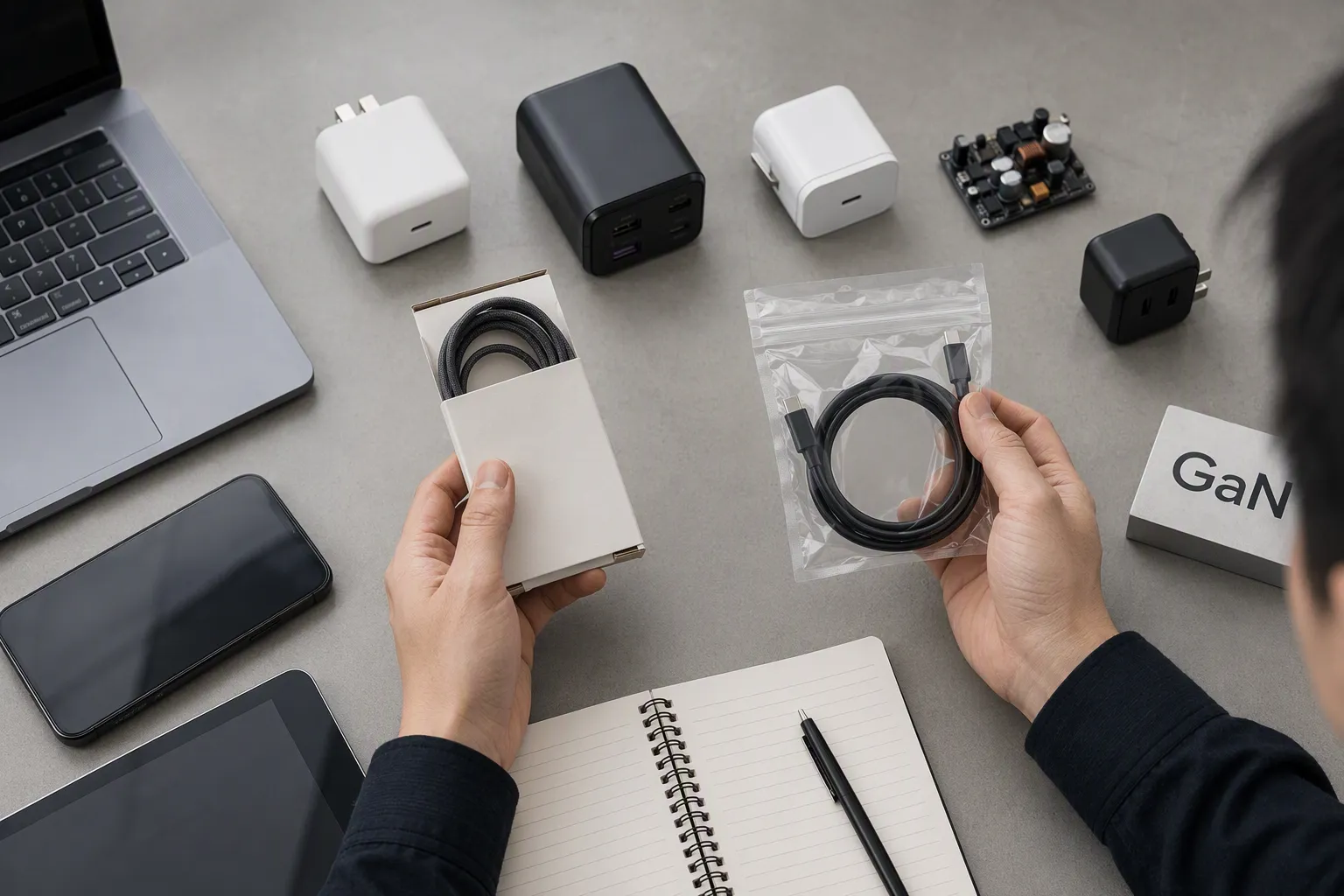
No. A paper sleeve may suit some USB-C cable programs, but it is not automatically the best option for every route or retail channel. Buyers should review protection, cable visibility, handling, labeling needs, fixture requirements, and destination-market expectations before selecting a structure.
What information should be shown on USB-C cable packaging?
USB-C cable packaging usually needs clear product identification, connector configuration, length, brand or SKU information, and a scannable barcode. Other information may be needed depending on the market, retailer, importer, and product claims. Buyers should verify applicable labeling requirements for each destination.
Should buyers request drop testing for USB-C packaging?
Buyers should request testing when their transport route, retailer, internal quality process, or product risk profile requires it. Sampling alone is not a substitute for formal testing. The appropriate method, pass criteria, laboratory, and applicable standards should be defined by qualified professionals and relevant stakeholders.
How can retailers reduce packaging-related returns?
Retailers can reduce avoidable packaging-related returns by making product type, cable length, connector configuration, and key verified features easy to understand. They should also choose packaging that protects the product through its actual route and keeps the retail fixture organized.
Conclusion: Choosing Low-Material USB-C Packaging
Low-material USB-C packaging is a balancing decision, not a race to use the smallest or thinnest pack. Buyers should start with the sales channel, transport path, product risks, label needs, and retail display plan. A well-designed package can reduce unnecessary material while still protecting USB-C cables, supporting readable information, and helping products sell clearly on the shelf. If you are sourcing USB-C cables or private-label accessories for Europe or the US, we can help you review packaging options, sampling priorities, and supplier communication before production.
Sources
- in packaging for - food & beverage applications", Life-cycle assessment frameworks evaluate packaging impacts across production, transport, use, and end-of-life stages; reduced material mass alone does not establish lower overall environmental impact
- Green Guides", Consumer-protection guidance requires environmental claims to be truthful, non-misleading, and supported by a reasonable basis before they are made
- Barcode Placement & Printing Guidelines", GS1 barcode specifications identify adequate quiet zones, suitable symbol size and print quality, contrast, and appropriate placement as conditions for reliable scanning
- Guidelines for Bar Code Symbol Placement", Barcode-placement guidance advises locating symbols on accessible, undistorted areas and avoiding package features that can obscure or deform the printed code
- Package design as a branding tool in the cosmetic industry", Studies of shelf-based consumer choice indicate that visual differentiation and salient package cues can affect how readily shoppers locate and distinguish similar products
- The Impact of Interpretive Packaged Food Labels on ... - PMC", Research on information design and consumer choice supports the principle that clear, differentiating labels can improve product identification and reduce selection confusion
- How Much Weight Can Hang Tabs Hold in Retail?", Retail-packaging evaluation methods assess whether hanging headers and card structures withstand fixture loading and repeated handling without unacceptable deformation
- Impacts of COVID-19 on Global Supply Chains - PMC - NIH", Supply-chain research treats packaging as a system-level cost factor because its design can affect damage, handling effort, returns, and distribution efficiency in addition to material cost