Quick Answer
A 240W USB-C PD cable can support high-power USB-C devices, but many buyers assume the label means every connected product will charge at 240W. That misunderstanding can create returns, weak product positioning, and unnecessary inventory cost. I help buyers compare USB cable specifications, and I see the best results when they match cable capability with the device, charger, and sales channel.
A 240W USB-C PD cable is useful when the connected laptop, monitor, dock, or other USB-C equipment can accept high-power USB Power Delivery and the charger can provide it[1]. The cable only supports the rated power; it does not force a device to draw 240W[2]. Buyers should verify the device input limit, charger output, supported PD profile, cable specifications, E-marker details, safety documents, and intended use before choosing it over a 100W cable.
The practical question is not whether 240W sounds better than 100W. The better question is whether the higher rating solves a real customer need. I normally begin with the target devices and expected selling environment, then review the cable construction, packaging claims, documents, MOQ, lead time, and after-sales plan.
What Benefits Can a 240W USB-C PD Cable Offer?
A 240W USB-C PD cable can give buyers more high-power compatibility, better future readiness, and a clearer premium product position. However, I only treat those as real benefits when the cable rating is supported by appropriate documentation and matches the power requirements of the target equipment.
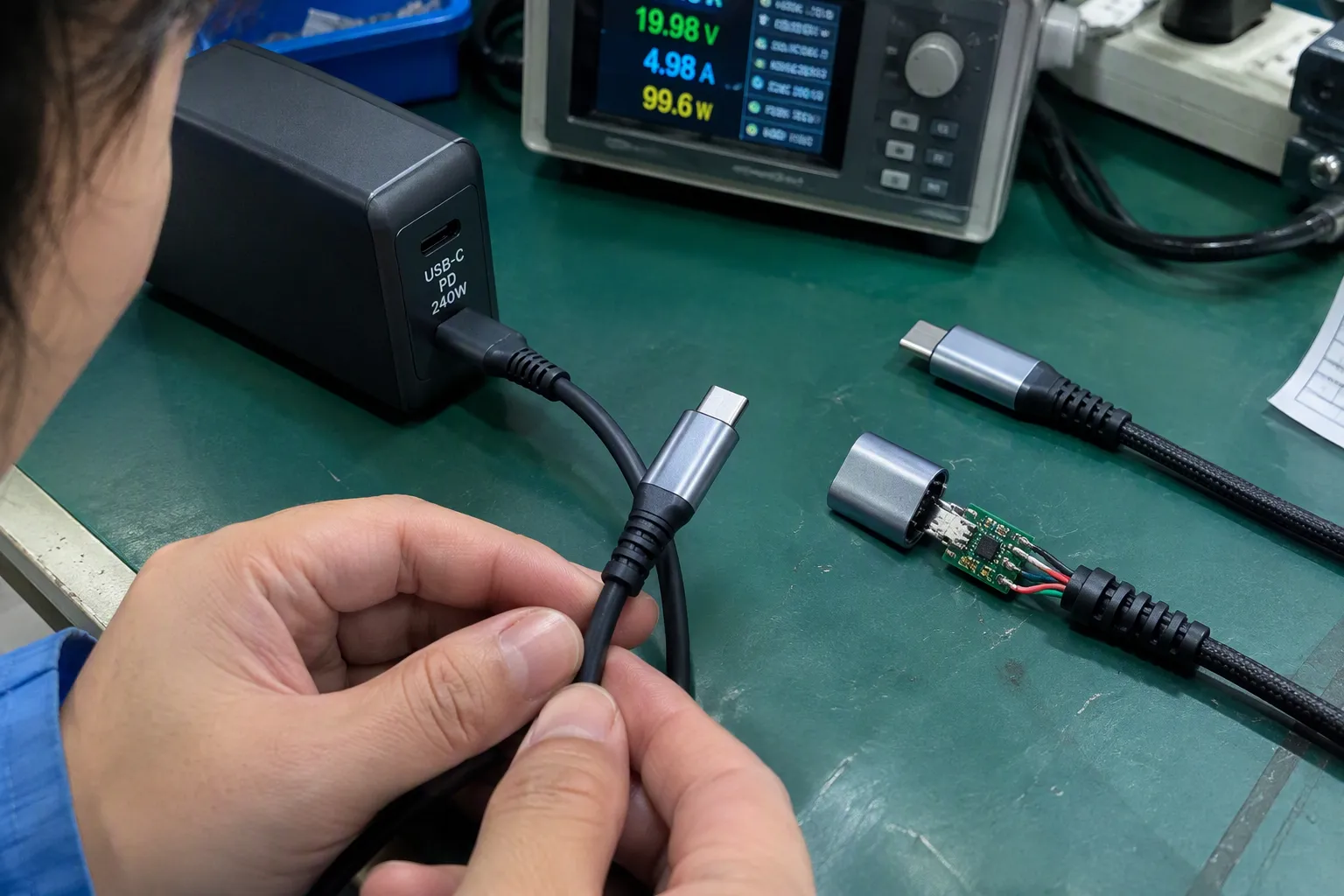
Why does the 240W label matter?
When I compare 240W and 100W USB-C cables with customers, I explain one point first: the number describes the cable’s rated power capacity, not the power that every device will receive.
A complete charging setup has at least four parts:
- The device, such as a laptop, monitor, dock, or tablet.
- The charger, including its maximum output and supported Power Delivery profiles.
- The cable, including its current and power rating.
- The negotiation between the devices, charger, and cable.
The lowest relevant limit generally controls the practical result[3]. If a laptop accepts only 100W, a 240W cable will not make it accept 240W. If the charger provides only 65W, the cable cannot create additional power. If the device uses a proprietary charging system[4], the buyer also needs to confirm whether ordinary USB-C PD is supported.
This distinction matters for retailers and online sellers. A product page that says “charges every laptop at 240W” can create customer confusion and support tickets. A more accurate message might say that the cable is rated for up to 240W when used with compatible equipment.
Which devices may benefit from 240W USB-C charging?
I see the strongest commercial relevance in products with a high USB-C input requirement, including:
- High-performance laptops that support USB-C PD above 100W[5].
- Professional laptops used for demanding office, design, or engineering work.
- USB-C monitors with substantial power delivery to a connected computer.
- Docking stations that pass power to a laptop while supporting peripherals.
- Certain high-power USB-C equipment specified for 140W, 180W, 200W, or 240W input.
- Retail bundles aimed at customers who want one cable for current and future high-power devices.
The actual opportunity depends on the device market in each sales territory. A retailer serving business laptop users may find a premium high-power cable easier to position than a general mobile-accessory seller. A grocery wholesaler or discount channel may have stronger demand for lower-priced 60W or 100W cables.
I would not describe 240W as a universal upgrade. Phones, earbuds, many tablets, and numerous standard notebooks do not need that capacity. They may charge normally with a 240W cable, but the higher rating alone may not produce a visible charging benefit.
Does a 240W USB-C PD cable charge faster than a 100W cable?
It can support faster charging only when the device and charger both require and support more than 100W. Otherwise, I would expect the charging result to remain limited by the equipment with the lower rating.
For example, consider this simplified comparison:
| Device input limit | Charger output | Cable rating | Practical expectation |
|---|---|---|---|
| 65W | 100W | 240W | The device may receive up to its supported limit, subject to negotiation |
| 100W | 100W | 240W | The 240W cable does not automatically increase charging power |
| 140W | 140W or higher | 100W | The cable may be unsuitable for the target power |
| 140W | 140W or higher | 240W | The cable may be suitable if documentation confirms compatibility |
| 240W | 240W | 240W | The complete system may support the intended high-power level |
This table is a product-selection guide, not a test result. I would still ask the supplier for the exact cable specification, supported current, connector details, test evidence, and compatibility notes.
The charger also matters. A 240W-rated cable connected to a 100W charger cannot deliver 240W. The device may also reduce its power intake because of battery condition, temperature, operating load, firmware, or its own charging design[6]. Sellers should avoid promising a fixed charging time unless they have verified the complete setup.
What is the value for product buyers and sellers?
For a B2B buyer, the main benefits usually fall into four categories.
1. Access to high-power applications
A verified 240W cable gives a seller a product option for customers who own compatible high-power USB-C equipment. It may help a retailer serve professional laptop users, workstation users, and customers who prefer one cable for a desk setup.
2. More future-ready positioning
USB-C products continue to cover more device categories[7]. A buyer may choose a 240W cable to reduce the chance that a cable becomes unsuitable after a customer upgrades to a more demanding laptop or dock. This is a planning benefit, not a guarantee about future compatibility.
3. Premium assortment structure
A 240W cable can sit above 60W and 100W products in a product range. I often recommend clear tiering rather than replacing every lower-power SKU:
| Product tier | Suitable positioning | Buyer question |
|---|---|---|
| 60W or below | Phones, tablets, basic accessories | Does the target device need more power? |
| 100W | Many laptops and general USB-C charging | Is 100W enough for the main customer devices? |
| 240W | High-power laptops, monitors, docks, future-ready users | Can the target setup use more than 100W? |
A tiered range lets customers choose by application instead of assuming that the most expensive cable is always the correct one.
4. Potential reduction in cable replacement
A customer with several USB-C devices may prefer a cable with a higher power rating if the price difference is reasonable. The customer may use it for multiple compatible products over time. Still, the cable must also have suitable length, flexibility, connector durability, data performance, and packaging. Power capacity alone does not determine service life.
What technical details should I verify before buying?
I do not treat a printed 240W claim as sufficient evidence. I ask the supplier to confirm several points in writing.
Power and USB PD capability
The product documents should state the rated power, maximum current, voltage range, and relevant USB Power Delivery capability. If the supplier refers to USB PD 3.1 or another standard, I ask for supporting technical documentation rather than relying only on a marketplace listing.
A buyer should also check whether the cable supports the power profiles needed by the target devices. A cable may carry high power but have different data-transfer performance from another cable with the same power label.
E-marker information
High-power USB-C cables may require an electronic marker, commonly called an E-marker, so connected equipment can identify cable capability. Buyers should ask whether the product includes the required identification and whether the supplier can provide evidence from a qualified test or product document.
I would not claim that every cable with a 240W label has been independently verified. I would also avoid treating an E-marker statement as proof of overall quality. It is one part of the evaluation.
Data-transfer performance
Some charging cables are designed mainly for power. They may not provide the same data speed as a full-featured USB-C cable. A customer connecting a laptop to a monitor, dock, storage device, or phone may care about data and video performance.
I recommend showing these features separately:
- Charging power rating.
- USB data speed.
- Video capability, if applicable.
- Cable length.
- Connector type and construction.
- Operating or compatibility notes supplied by the manufacturer.
A product title that combines “240W,” “fast data,” and “8K video” needs documentary support for each claim. One specification does not prove the others.
Heat, materials, and durability
Higher-power operation can make construction quality more important. I ask about conductor material, wire gauge, connector design, insulation, strain relief, and any relevant test conditions. I do not convert a supplier’s material description into a guaranteed temperature or lifespan claim.
For example, a braided outer jacket may improve abrasion resistance, but it does not automatically prove that the connector will survive a specific number of bends. A thicker cable may support higher current, but it may be less convenient to carry. I recommend comparing the intended use:
- Desk cable: A thicker, longer cable may be acceptable.
- Travel cable: Flexibility, weight, and storage may matter more.
- Retail premium cable: Packaging and visible construction influence the customer’s perception.
- Bulk commercial cable: Cost, consistency, carton packing, and replacement handling may be more important.
Certifications and compliance documents
My company works with products for European and American export markets, and I know that buyers often ask for a list of certification marks before they have reviewed the documents. I treat certifications as records to verify, not as automatic proof of product performance.
Before placing an order, I would request:
- The applicable declaration or test report.
- The product model covered by the document.
- The manufacturer or responsible company named in the document.
- The test date and issuing organization.
- Whether the document covers the exact cable version, length, connector, and packaging claim.
- Any regional labeling or importer requirements relevant to the destination market.
A document for one cable model may not cover another model with a different connector, material, or internal design. The buyer should use qualified compliance support when the destination market or product claim requires it.
How should I compare a 240W cable with a 100W cable?
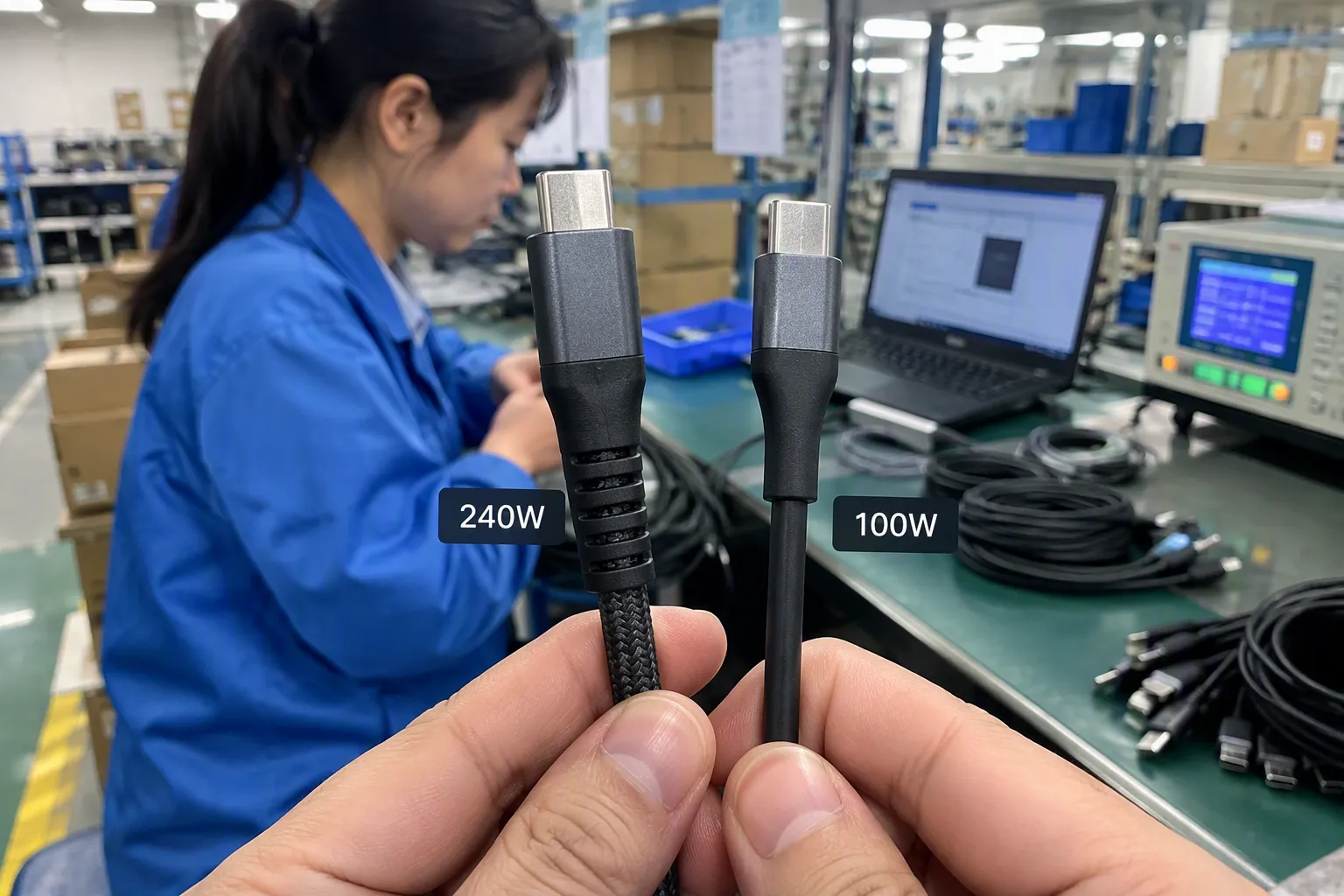
I use a simple suitability matrix when a customer is unsure which version to stock.
| Evaluation point | 100W cable | 240W cable |
|---|---|---|
| General laptop and tablet demand | Often sufficient | May exceed common needs |
| High-power laptop support | May be limited | More relevant when verified |
| Retail price | Usually easier to control | May be higher |
| Customer understanding | Familiar and simple | Needs clearer education |
| Future-readiness | Moderate | Potentially stronger |
| Inventory risk | Lower for broad demand | Higher if target devices do not need it |
| Product differentiation | Common | Can support a premium tier |
| Documentation needs | Important | Especially important for high-power claims |
The correct choice depends on the retailer’s customer base. I would ask:
- Which devices do customers commonly use?
- What charging power do those devices accept?
- Do customers buy cables separately or as replacements?
- Does the sales channel support premium education?
- Can the business manage separate SKUs by power level?
- Does the expected margin justify the additional cost?
- What return reasons would arise if customers misunderstand the rating?
I remember many buyer discussions where the first question was, “Can we replace our 100W cable with 240W?” I usually reframe it as, “Which customer devices are currently limited by the cable?” If the answer is none, the switch may add cost without adding meaningful value.
What inventory and marketing risks should B2B buyers consider?
A high-power cable can create risk when the headline specification is stronger than the customer’s actual need. That risk appears in several ways.
Weak differentiation: Customers may not understand why a 240W cable costs more if their laptop charges at 65W.
Returns: A customer may expect faster charging because of the 240W label. The customer may return the product when the device still charges at its original limit.
Support workload: Customer service teams may need to explain charger output, device input, PD negotiation, and cable capability.
Inventory exposure: A higher-cost SKU may sell slowly if the local device mix does not include enough high-power USB-C equipment.
Claim risk: Unsupported statements about charging speed, universal compatibility, temperature, or lifespan can create marketplace and compliance problems.
I recommend using precise retail copy. For example:
“Supports up to 240W USB-C Power Delivery with compatible devices and chargers. Actual charging power depends on the device, charger, PD profile, and cable configuration.”
This wording does not promise that every device receives 240W. It gives the customer a useful expectation and gives the seller a clearer support position.
How can I select a reliable 240W USB-C cable supplier?
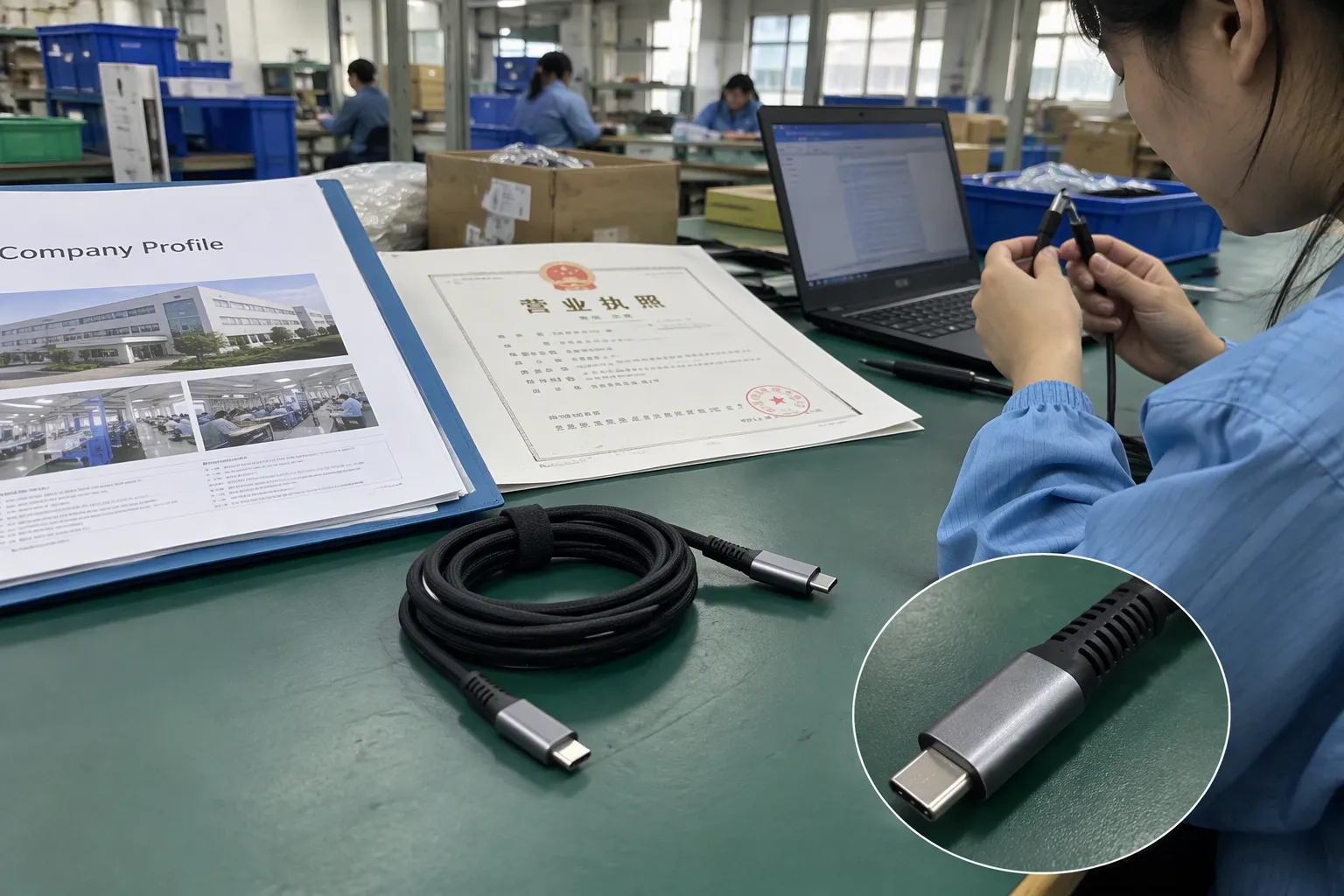
I look for a supplier that can discuss the complete product rather than only repeat the number on the packaging. A practical supplier review can include the following steps:
- Define the target application. State whether the cable is for laptops, monitors, docks, retail replacement, travel, or another use.
- Request a full specification sheet. Ask for power, current, voltage, data, video, length, materials, connector details, and E-marker information.
- Match documents to the exact SKU. Confirm the model, version, cable length, and packaging.
- Review samples. Check labeling, connector fit, strain relief, flexibility, and packaging consistency.
- Confirm quality-control procedures. Ask how incoming materials, assembly, finished cables, and carton quantities are checked.
- Clarify order terms. Review MOQ, sample charges, production lead time, packaging customization, payment terms, and replacement policy.
- Plan pre-shipment inspection. Use an agreed inspection standard or an independent inspection service when order value justifies it.
- Test the intended setup. A qualified technician or test laboratory should evaluate application-specific compatibility when the use case is critical.
I can help buyers compare USB cable options based on target devices, export requirements, MOQ, lead time, and customization. However, I would still ask a qualified professional to evaluate any application where electrical safety, system performance, or regulatory compliance is critical.
FAQs About 240W USB-C PD Cables
Does a 240W USB-C PD cable make every device charge at 240W?
No. The device and charger control the practical charging level through their supported limits and power negotiation. A 240W cable provides the capacity for compatible high-power use, but it does not force a phone, tablet, laptop, or other device to draw 240W.
Is a 240W USB-C cable better than a 100W cable?
Not automatically. A 240W cable may be a better fit for a compatible high-power laptop, monitor, or dock[8]. A 100W cable may offer better value for customers whose devices do not exceed 100W. I recommend choosing according to the application rather than the larger number.
Can I use a 240W cable with a 100W charger?
Yes, the cable can be used in that setup if the connectors and product design are compatible. The charger remains the limiting factor, so the system will not provide 240W. The device may draw less depending on its own charging requirements.
Do all 240W USB-C cables support high-speed data or video?
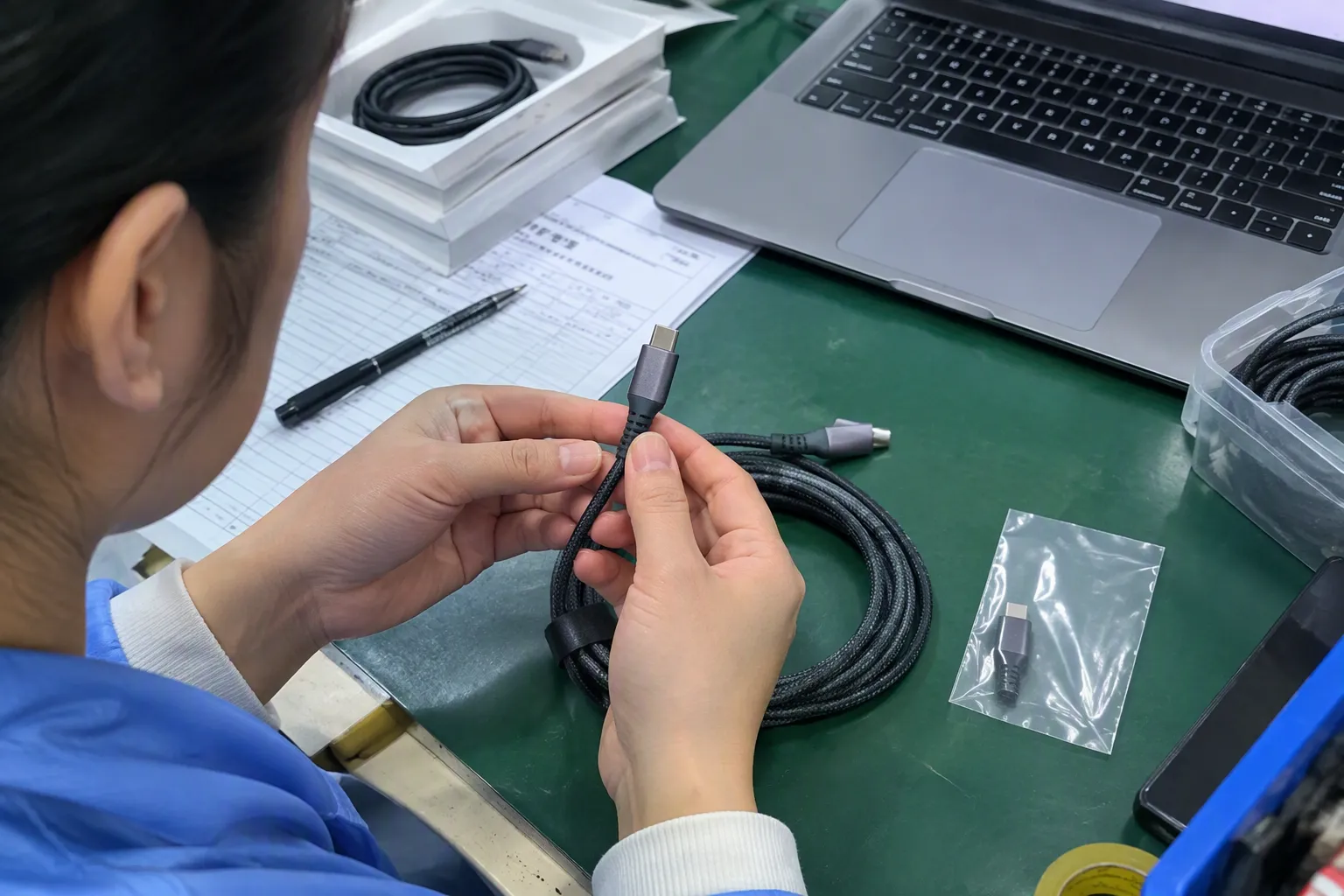
No. Power rating, data speed, and video capability are separate specifications. I advise buyers to request confirmation for each function and to avoid advertising high-speed data or video unless the exact cable model has appropriate supporting documentation.
What should retailers check before stocking 240W USB-C cables?
Retailers should check the target device mix, charger compatibility, cable specifications, E-marker information, quality documents, applicable compliance records, sample performance, MOQ, lead time, and return risks. Retail copy should clearly state that actual power depends on the complete charging system.
Conclusion
The main benefit of a 240W USB-C PD cable is not universal faster charging. It is the ability to support compatible high-power USB-C equipment while giving buyers another premium and potentially future-ready option. I recommend comparing the device input limit, charger output, PD profile, cable construction, data features, documents, price, and expected demand before replacing a 100W product. If you are selecting USB cables for European or American retail, wholesale, or e-commerce sales, contact me to discuss suitable specifications, MOQ, customization, lead time, and supplier documentation.
Sources
- USB Charger (USB Power Delivery)", The USB Implementers Forum specification defines USB Power Delivery as a negotiated power system and describes Extended Power Range levels that can extend USB-C power delivery to 240W when the connected equipment supports the relevant profile
- The Basics of USB Power Delivery Negotiations", USB Power Delivery documentation describes power as established through negotiation between the power source and sink, so a cable's maximum rating does not by itself compel the sink device to draw that amount
- USB Power Delivery", Technical descriptions of USB-C Power Delivery indicate that delivered power is bounded by the capabilities and limits of the source, sink, cable, and negotiated power contract rather than by the cable rating alone
- USB-C Power Delivery: Fast Charging Up to 240W", USB-C technical guidance distinguishes the physical connector from supported protocols, meaning that products using a USB-C receptacle may not necessarily implement the USB Power Delivery features required for a given charging setup
- USB Charger (USB Power Delivery) | USB-IF", Published product specifications and USB-C technical documentation provide examples of laptops designed to accept USB Power Delivery levels above 100W, illustrating why higher-power cables can be relevant to some laptop applications
- Research on fast-charging battery thermal management ...", Battery-management literature explains that charging current is regulated in response to factors such as state of charge and temperature, while device power-management systems can further modify charging behavior under operating or thermal constraints
- The EU common charger", European Union common-charger rules document the expanding regulatory use of USB-C across specified categories of portable electronic equipment, providing contextual evidence of broader USB-C adoption
- Monitor that can output 140W ? : r/mac", USB-C Power Delivery technical materials and documented device specifications show that selected laptops, monitors, and docking systems support power levels above 100W, making higher-rated cables potentially relevant to those configurations