Quick Answer
End-of-line USB-C cable testing can look simple on a supplier checklist, yet a basic “pass” result may leave important risks unanswered. Buyers can face charging complaints, data-transfer failures, or claim disputes when the test scope does not match the cable being sold. We recommend reviewing continuity, E-Marker, and power-load evidence as separate, layered checks.
End-of-line USB-C cable testing should include continuity checks, E-Marker communication verification where applicable, and power-load screening matched to the cable’s stated use. These tests are not interchangeable proof of overall quality. Buyers should define the claimed power, data function, cable length, sample plan, test thresholds, and pass/fail criteria before shipment release.
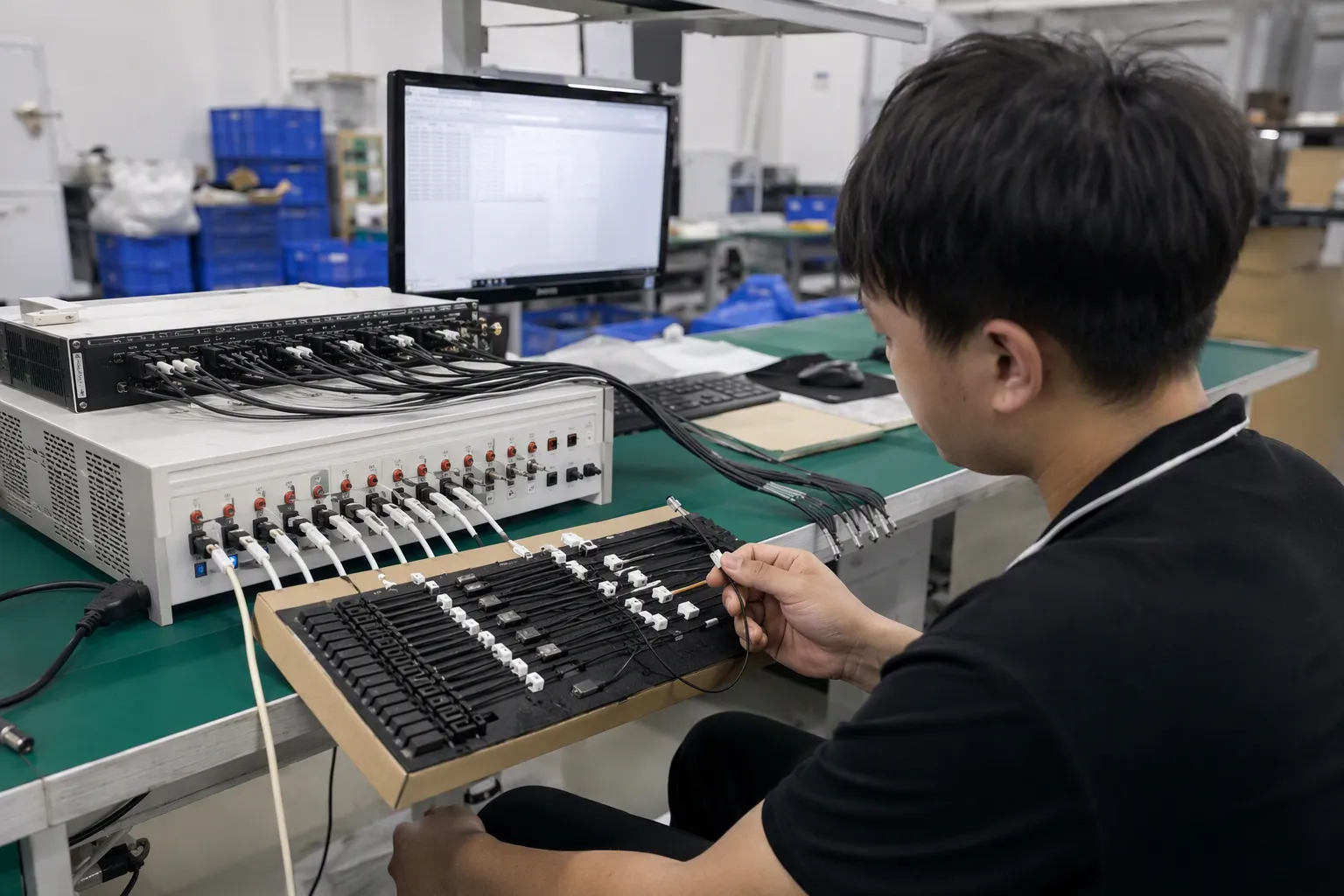
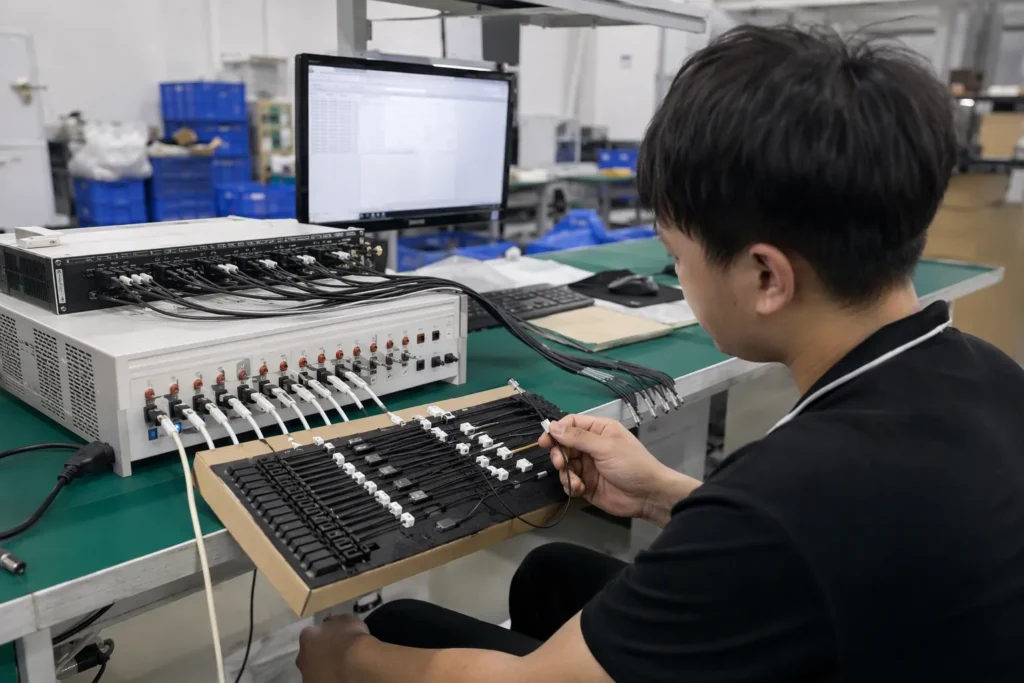
A cable can look identical on the outside while carrying very different internal designs, chip configurations, conductor sizes, and intended performance claims.[1] In our role coordinating factories and reviewing QC information for export shipments, we focus less on a generic test label and more on whether the acceptance package actually supports the product listing and real retail use.
Continuity, E-Marker, and power-load tests are layered shipment-screening tools
Buyers often receive a test report or a factory statement saying that a USB-C cable has “passed testing.” That wording can create false confidence when the report does not show what was tested, how it was tested, or whether the test was relevant to the retail claim. A continuity result alone cannot answer every quality question.[3]
Continuity, E-Marker, and power-load tests should be treated as three different shipment-screening tools. Continuity checks basic electrical paths, E-Marker verification checks chip communication and declared information, and power-load testing screens for immediate current-delivery issues.[2] A useful buyer acceptance plan combines the applicable tests rather than treating any one result as a complete quality certificate.

Why one “passed test” does not settle the buying decision
A USB-C cable is not one uniform product category. A short charging cable for low-power accessories, a 60W charging cable, a 100W or higher-power cable, a data-capable cable, and a cable sold for display or advanced protocol use may require very different acceptance evidence.[4]
This is why we encourage buyers to begin with the intended product claim, not with the test machine available on the factory floor.
For example, a retailer may plan to market a cable as:
- A basic charging cable for phones and small accessories
- A fast-charging cable for compatible USB-C devices
- A cable rated for a stated power level
- A USB-C data cable with a stated transfer capability
- A cable intended for laptops, tablets, power banks, or vehicle use
- A braided or long-length cable positioned as a premium product
Each claim creates a different level of risk. If the product is sold as a high-power cable, the buyer should not rely only on a basic continuity pass. If the product is sold for data transfer, the buyer should not assume that charging behavior proves data performance. If the cable includes an E-Marker, the buyer should verify what the chip communicates and whether that information aligns with the product claim.
In shipment review, we sometimes see results that are incomplete, inconsistent, or difficult to connect to the buyer’s specification. In those cases, our practical response is to ask for clarification, request re-testing where appropriate, or place the batch on hold until the scope is clear. That is not a laboratory certification decision. It is a supplier-management and shipment-release decision.
A useful question for a sourcing team is not, “Did the cable pass?”
It is, “Did this shipment pass the right tests for the claim we will make?”
What continuity testing can tell buyers
Continuity testing checks whether intended electrical connections are present from one connector end to the other.[5] It can help identify obvious assembly faults, broken conductors, missing paths, poor solder joints, or certain pin-to-pin connection problems.
For end-of-line USB-C cable testing, continuity is often a practical first screen because it is relatively fast and can help factories identify basic defects before packing. It is especially relevant when a supplier is reviewing a large production lot and needs a repeatable way to separate clearly defective pieces.
However, continuity has clear limits.
A cable can pass a continuity check and still have problems involving:[6]
- Voltage drop under load
- Inadequate performance for a stated charging claim
- Unstable behavior with specific chargers or devices
- Data-transfer limitations
- High-speed signal integrity concerns
- Poor connector retention or mechanical durability
- Thermal behavior during extended use
- Inconsistent E-Marker communication
- Incorrect retail labeling or unsupported product claims
A continuity tester confirms that a connection exists under the conditions of that test. It does not automatically demonstrate how well the cable performs when current, charging negotiation, data traffic, connector movement, heat, or real device combinations are involved.
Continuity questions buyers should include in an RFQ
We recommend asking suppliers to document the test scope in plain language. A buyer does not need to prescribe every engineering detail, but the buyer should be able to understand the acceptance logic.
Useful questions include:
-
Which connection paths are checked?
The supplier should explain whether the inspection covers the relevant conductors and signal paths for the cable type. -
Is the test applied to every unit or to a defined sample plan?
“100% tested” may sound reassuring, but buyers should still ask what the test actually detects and how the factory handles failures. -
What happens when a cable fails?
Buyers should ask whether failed units are segregated, reworked, retested, or scrapped. -
How is traceability managed?
A batch number, production date, test record, or inspection report can support later review if complaints arise. -
Does the continuity method match the cable configuration?
The test fixture and criteria should be suitable for the connector type and the product’s claimed function.
For a basic charging cable, continuity may be an important part of release inspection. For a cable carrying stronger charging or data claims, it is only one layer in the acceptance package.
What an E-Marker check can—and cannot—confirm
An E-Marker is an electronic marker chip used in certain USB-C cable designs.[7] At a practical procurement level, buyers should understand that the presence of an E-Marker does not automatically mean that every high-wattage, high-speed, or advanced-use claim is supported.
An E-Marker verification process can help show that a chip is present, responds to communication, and reports declared cable information.[8] This can be relevant for cables intended to support particular power or data capabilities. It may also help identify missing chips, communication failures, or mismatches between what the cable reports and what the supplier says it is selling.
That said, an E-Marker check is not the same as testing the whole cable in every possible use case.
A cable may communicate information through its chip, but buyers still need to consider whether the rest of the cable construction supports the commercial claim. The conductor design, length, assembly quality, connector build, shielding approach, and production consistency all matter. The charger, device, and charging environment also affect real-world results.
That is also why a 240W claim should be read at cable level, not chip level. Our 240W USB-C to USB-C braided cable page lists the conductor, jacket and OD data next to the power class, and notes that E-marker and PD 3.1 / EPR support are confirmed at quotation.
| Buyer question | What E-Marker verification may help show | What it does not prove by itself |
|---|---|---|
| Is a chip present and communicating? | Basic chip presence and readable communication | Overall cable durability or lifetime reliability |
| Does the cable report expected information? | Declared information can be reviewed against the order specification | That every device will interpret or use the cable identically |
| Does the cable support the advertised power claim? | It may support review of the cable’s declared capability | Sustained safe performance in every charger-device combination |
| Does the cable support data use? | It may provide relevant declared information in applicable designs | Real high-speed signal performance across all use conditions |
| Is the cable correctly built? | It can identify certain marker-related errors | Complete internal construction quality |
How we review E-Marker evidence for shipment decisions
For export buyers, we suggest connecting E-Marker review to the purchase order and retail listing. If the cable is marketed with a stated power capability or a particular data function, the supplier’s evidence should be consistent with that claim.
In practical shipment review, we look for questions such as:
- Does the test record identify the cable model or production lot?
- Is the reported information consistent with the ordered version?
- Does the cable length match the version being tested?
- Is the chip check performed on representative production units or only on an early sample?
- Are there different internal versions under the same external appearance?
- Does the retail packaging make claims that exceed the documented test scope?
This last point matters. A supplier may provide acceptable evidence for one construction, while a retailer’s package artwork makes a wider claim. If the package says “high-speed,” “laptop charging,” or a specific power level, the buyer should make sure the test plan and product version support that wording.
We do not treat E-Marker presence as a shortcut to universal compatibility. USB-C ecosystems include many devices, chargers, ports, and usage conditions. Buyers should also avoid presenting an E-Marker as proof that a cable will deliver the same outcome with every device on the market.
What power-load testing adds to end-of-line USB-C cable testing
Power-load testing can add a useful screening layer because it moves beyond a basic connection check. Depending on the agreed method, it can help evaluate whether a cable can carry a defined load in the immediate test condition without obvious delivery-current problems.
For a buyer, this can be particularly relevant when a cable is sold for higher charging demand, longer cable length, or laptop-related use. It can help uncover issues that a continuity test may not reveal, such as excessive performance variation between units under the selected load condition.
Still, power-load testing must be described carefully.
A short power-load test does not prove lifetime safety, no overheating, long-term thermal durability, universal protocol behavior, or performance in every charging environment. It is a controlled screen performed for a defined period, with a defined setup, at a defined load. The test is only as meaningful as its method and its match to the product claim.
The buyer should define the load-test context
Instead of asking for “power tested,” we recommend asking for the following information:
- Target product claim: What charging or power-related claim will appear on the listing and packaging?
- Cable length: Longer cables may have different performance considerations than shorter versions.
- Test configuration: Which charger, load device, fixture, and cable model were used?
- Load condition: What load was selected, and why is it relevant to the claimed use?
- Duration: How long was the cable evaluated under the selected condition?
- Measurements and observations: What information was recorded during the test?
- Pass/fail criteria: What result triggers rejection, rework, or further review?
- Sample plan: Were units selected from different points in production, or was only one sample checked?
- Retest process: What happens when results vary or a unit fails?
The right thresholds should be verified against the applicable cable specification, stated claim, and agreed test method. We do not recommend using one universal number for every USB-C cable. A suitable method for one product may not be enough for another.
A layered acceptance package for retailers and importers
A useful procurement process converts marketing claims into checkable release requirements. This reduces ambiguity between the buyer, trading company, factory, QC team, and packaging team.
Below is a practical framework we use when discussing end-of-line USB-C cable testing with suppliers. It is not a substitute for qualified engineering evaluation, product compliance review, or application-specific validation. It is a commercial quality-control structure that helps buyers ask more precise questions.
| Cable selling position | Core screening evidence | Additional buyer review |
|---|---|---|
| Basic USB-C charging cable | Continuity testing, visual inspection, packaging review | Confirm connector fit, length, color, and claim accuracy |
| Cable with stated fast-charging use | Continuity plus relevant power-load screening | Confirm test setup reflects the stated use and cable version |
| Cable with a stated high-power claim | Continuity, E-Marker review where applicable, power-load test evidence | Review cable construction, labeling, lot consistency, and claim wording |
| USB-C charging and data cable | Continuity and function checks matched to the data claim | Ask for evidence relevant to the stated data capability |
| Premium retail cable | Layered electrical screening plus cosmetic, packaging, and traceability checks | Consider independent or qualified third-party evaluation for the intended market |
Build the acceptance package before mass production
The best time to settle test expectations is before production, not after cartons are ready for loading. A clear pre-production agreement helps prevent a common sourcing problem: the factory tests one interpretation of the product, while the buyer markets another.
We recommend including these points in the product specification or purchase order:
-
Exact cable model and length
A 1-meter and 2-meter version should not automatically be treated as identical for all performance claims. -
Connector configuration
Record whether the product is USB-C to USB-C, USB-A to USB-C, or another configuration. -
Intended use and retail claim
State whether the product is for basic charging, stated power delivery, data transfer, or another defined purpose. -
Applicable E-Marker requirement
Where relevant, define what the buyer expects to be checked and documented. -
Power-load test method
Agree on the relevant setup, sample plan, duration, observations, and pass/fail criteria. -
Inspection level and release authority
Clarify who reviews the results and who can approve shipment release. -
Nonconformance process
Define whether failures require sorting, rework, re-testing, replacement, price discussion, or shipment hold.
In our export coordination work, a questionable result does not always mean a batch must be rejected immediately. The correct action depends on the issue, its frequency, the product claim, and the available corrective action. However, unclear evidence should not be quietly converted into a shipment approval.
How to use test records without overclaiming product quality

Test documents are valuable when they are specific. A one-line statement such as “cables passed QC” gives limited protection to a retailer dealing with returns months later. A more useful record identifies the model, date, lot, test type, sample basis, result, and disposition of failures.
Buyers should also separate three different ideas:
- Factory quality control: Internal checks used to manage production consistency.
- Shipment inspection: Review performed before goods are released or loaded.
- Certification or formal conformity assessment: Documentation that may be required or useful for particular markets, claims, or product categories.
These are not interchangeable. A factory’s end-of-line USB-C cable testing record does not automatically replace the documents or assessments a buyer may need for market entry, safety, environmental, or retailer compliance requirements. Buyers should verify relevant documents and seek qualified professional guidance for their specific product and destination market.
A careful supplier should welcome clear questions because they reduce disputes. The goal is not to create unnecessary testing paperwork. The goal is to make sure that the evidence is proportionate to the risk and supports the product the buyer intends to sell.
USB-C Cable Testing FAQs
Is continuity testing enough for USB-C cables?
No. Continuity testing helps confirm basic electrical connection integrity, but it does not by itself prove charging performance, data capability, high-power suitability, thermal durability, or compatibility with every charger and device. We recommend using continuity as one part of a test package matched to the cable’s retail claim.
Does an E-Marker guarantee a USB-C cable supports high wattage?
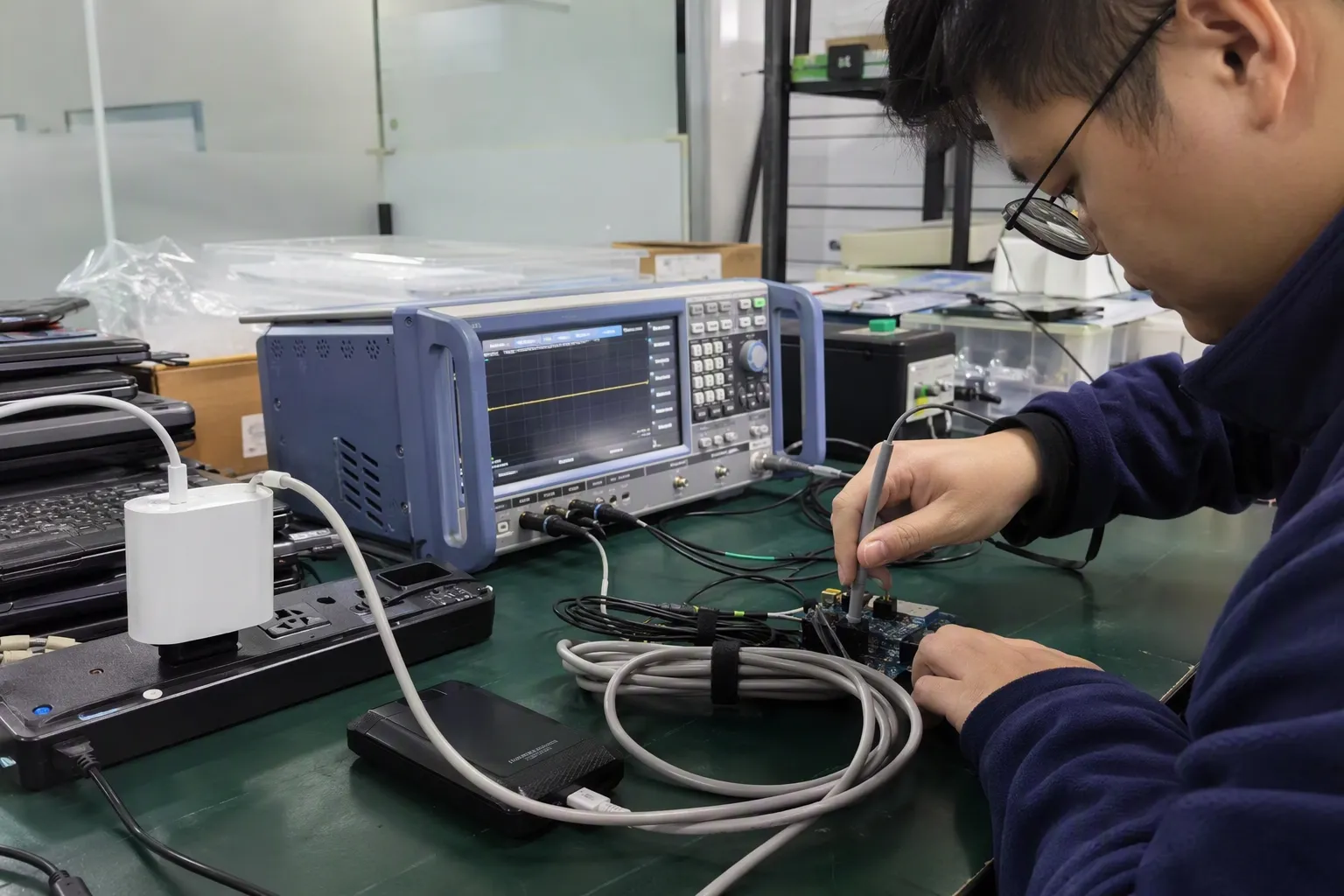
No. An E-Marker can indicate that a chip is present and communicates declared cable information. It does not independently prove that the complete cable can safely and reliably support every high-power claim, every data claim, or every USB-C device combination. Buyers should review the full cable specification and supporting test scope.
Can a power-load test prove that a cable will never overheat?
No. A power-load test can screen for immediate issues under the defined test setup and duration. It does not prove lifetime reliability, long-term thermal behavior, connector durability, or performance in all charging environments. Buyers should ask what conditions were used and what the test was designed to evaluate.
What should importers ask for before approving a USB-C cable shipment?
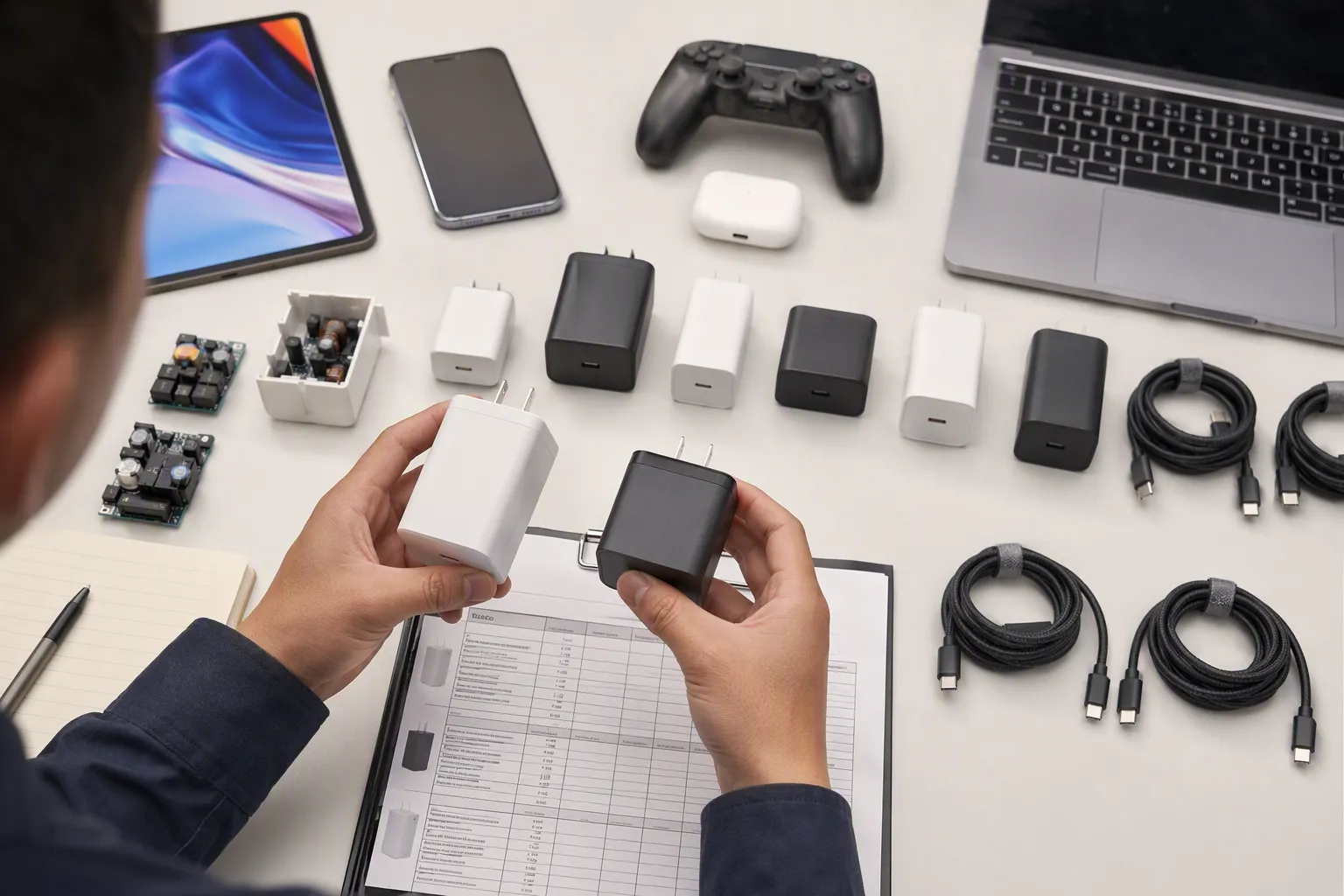
Importers should ask for the cable model, length, intended claim, test types, sample plan, pass/fail criteria, test records, failure handling process, and packaging confirmation. For cables with stated power or data performance, buyers should request evidence that directly relates to those claims rather than relying on a generic QC pass statement.
Should every USB-C cable be independently tested?
The answer depends on the claim, market, sales channel, order volume, and risk level. Basic factory QC can be useful for routine production screening, while higher-risk applications or stronger commercial claims may justify independent inspection or qualified professional evaluation. Buyers should make this decision based on the specific product and market requirements.
Conclusion
End-of-line USB-C cable testing is most useful when buyers treat continuity, E-Marker checks, and power-load testing as layered tools with clear limits. Continuity can screen basic connection faults. E-Marker review can check chip communication and declared information. Power-load testing can screen immediate delivery-current issues under defined conditions. None of these checks alone proves complete cable quality or universal compatibility. We help retailers, wholesalers, and importers translate their USB-C cable claims into practical supplier specifications, QC checkpoints, and shipment-release evidence. Contact us to discuss your next cable sourcing project, MOQ, customization, and quality-control requirements.
Sources
- [PDF] Universal Serial Bus Type-C Cable and Connector Specification", USB Type-C specifications distinguish cable types and electronically marked capabilities, showing that a common connector appearance does not by itself establish identical power or data performance
- How to Test and Analyze USB Type-C Cable Functions ...", USB Type-C technical documentation separates conductor connectivity, cable identification through configuration-channel communication, and electrical behavior under load as distinct matters of assessment
- What tests are required for continuity on electrical circuits?", Electrical-test guidance describes continuity testing as verification of a conductive path; additional tests are required to assess properties such as resistance under operating conditions, insulation, or functional performance
- [PDF] Universal Serial Bus Type-C Cable and Connector Specification", USB Type-C and USB Power Delivery documentation specifies distinct power, data, and alternate-mode capabilities for different cable designs, supporting claim-specific verification rather than a single generic test result
- [PDF] Array Based Test Structure for Optical-Electrical Overlay Calibration", Electrical metrology and test guidance defines continuity testing as checking whether an intended conductive path exists between test points
- Voltage Drop Test: What It Is and How To Do It | UTI", Interconnect research distinguishes basic connectivity from conductor-resistance, voltage-drop, high-frequency signal-integrity, and reliability characteristics, each of which requires assessment beyond a continuity check
- [PDF] Universal Serial Bus Type-C Cable and Connector Specification", USB Type-C documentation defines electronically marked cable assemblies as cables that provide identification information through the prescribed cable communication interface
- [PDF] End Product Cable Test Plan - USB-IF", USB Power Delivery specifications provide cable-discovery mechanisms through which a host can obtain identification and capability information from an electronically marked cable assembly