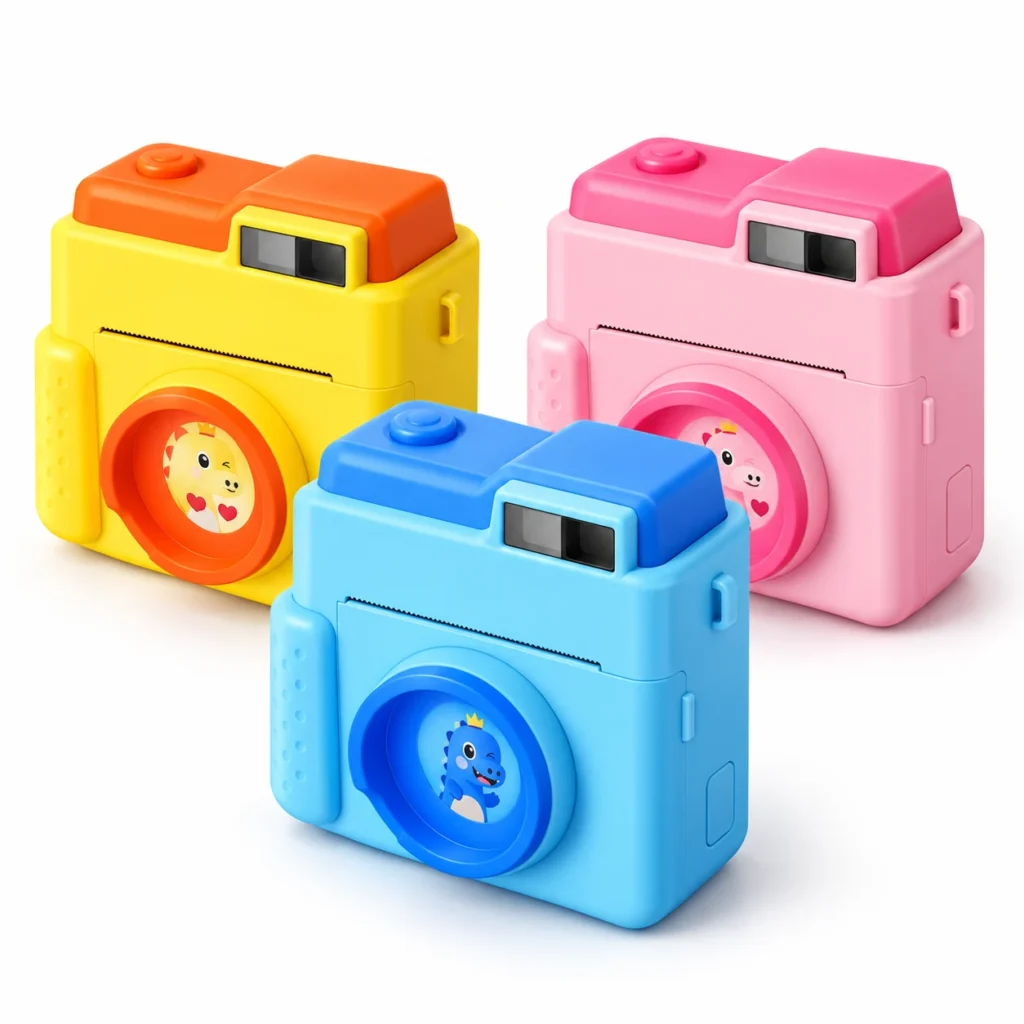
Quick Answer: Importers should evaluate kids instant print cameras as a combination of children’s product, rechargeable electronics and wireless or USB device, not simply as a low-cost toy. Compare print technology, battery safety, camera performance, consumable availability, compliance documents, MOQ, tooling and landed cost before selecting a China supplier. Request a production sample, verify test reports against the exact model, and agree on QC standards and Incoterms in writing.
Kids instant print cameras remain attractive to wholesalers because they combine a visible product benefit with repeat sales of thermal paper, stickers and accessories. However, the sourcing risk is higher than for a basic plastic toy: the product includes a camera module, lithium battery in many configurations, charging electronics, print hardware, memory storage and potentially wireless functions.
For importers, the objective is not to find the cheapest camera quotation. It is to select a stable product that can pass destination-market compliance checks, produce consistent prints, survive children’s use and support a profitable replenishment program.
1. Define the Product Before Requesting Quotes
“Kids instant print camera” can describe several different products. A supplier quotation is only useful when the specification is clear. Start with the commercial positioning: entry-level impulse product, mid-range birthday gift, educational camera, or branded e-commerce product.
Core specifications to confirm
- Print method: Most children’s print cameras use direct thermal printing, which avoids ink cartridges but requires compatible thermal paper. Confirm print width, resolution, print speed, paper-roll size and whether the cutter is automatic or manual.
- Camera performance: Ask for actual photo and video resolution, image format, lens angle, screen size and menu language. Interpolated resolution should not be presented as native sensor resolution in your listing.
- Storage: Confirm built-in memory, microSD card capacity and whether a card is included. Check card compatibility and file-transfer method.
- Battery: Request rated capacity, charging time, operating time, connector type and protection functions. Ask whether the battery is removable or built in.
- Body and controls: Check drop resistance, button size, grip, lanyard attachment, child-safe edges and the durability of the paper compartment.
- Accessories: List the exact contents: paper rolls, USB cable, memory card, lanyard, stickers, carrying pouch and retail packaging. Accessories can materially change the final cost.
Ask the factory to send a complete specification sheet and a sample made with the proposed production components. A catalogue photograph is not enough: screen color, print contrast, button feel and battery performance can vary between samples and mass production.
2. Compare Product Configurations and Commercial Trade-Offs
| Configuration | Buyer advantage | Points to verify | Best fit |
|---|---|---|---|
| Basic thermal camera | Lower unit cost, simple operation and no ink supply | Print contrast, paper availability, battery capacity and image quality | Promotional retail and price-sensitive wholesale |
| Camera with front and rear lenses | More engaging for children and stronger gift appeal | Actual resolution, switching reliability, software stability and added BOM cost | Mid-range retail and online bundles |
| Camera with games and effects | Higher perceived value and longer use time | Menu language, firmware bugs, content appropriateness and testing workload | Branded e-commerce products |
| Customized OEM version | Private-label differentiation and better listing control | MOQ, tooling, artwork approval, firmware scope and ownership of molds or files | Importers planning repeat orders |
Do not assume more features automatically improve sell-through. Extra games, filters, lights or higher quoted megapixels can increase failure points without improving the product’s core value. For a first order, a stable standard platform with packaging and logo customization is often lower risk than a heavily modified design.
3. Compliance and Documentation for Importers
Compliance depends on the destination country, product design, radio functions, battery configuration, claims and age grading. The supplier should support the process, but the importer remains responsible for confirming that the goods can legally enter and be sold in the target market.
European Union
For EU sales, determine which directives and regulations apply. A camera may involve electrical safety, electromagnetic compatibility, RoHS substance restrictions, battery obligations and, depending on its intended use and marketing, toy-product requirements. CE marking is supported by a Declaration of Conformity and technical documentation; it is not simply a universal “CE certificate” that covers every model.
Request the EU Declaration of Conformity, test reports, product and packaging photographs, materials information and the identity of the responsible economic operator where required. Make sure the reports identify the exact model, PCB revision, battery and charger included in your shipment.
United States and other markets
For the United States, check FCC requirements if the product contains radio transmitters or other applicable digital electronics. Children’s products may also trigger Consumer Product Safety Commission requirements, including testing and certification obligations based on the product’s design and intended age range. If the product uses a lithium battery, request battery test documentation and confirm the transport paperwork required by your freight provider.
For Canada, Australia, the United Kingdom and other destinations, requirements differ. A supplier’s existing report can be useful evidence, but it should not be treated as automatic approval in every jurisdiction. Ask a qualified compliance laboratory or local regulatory adviser to review the final product and labeling.
Documents to request before placing a deposit
- Declaration of Conformity or equivalent market-specific compliance declaration.
- EMC, safety, RoHS and radio test reports where applicable.
- Battery specification, UN 38.3 transport test summary and applicable safety documentation.
- Material declarations for plastics, cable insulation, paper and packaging.
- Label artwork showing required importer details, warnings, ratings and recycling marks.
- Packaging drop-test or transport-test records if available.
4. MOQ, OEM/ODM and Cost Planning
Ask suppliers to quote at several quantities rather than only one MOQ. A standard product may have a lower MOQ for neutral packaging, while logo printing, custom color, retail boxes and firmware changes may each require separate minimums. Confirm whether the quoted MOQ is per color, per model or per order.
OEM and ODM are not the same. OEM usually means applying your branding and agreed packaging to an existing platform. ODM may involve changes to the enclosure, PCB, software, accessories or tooling. Before approving ODM work, define who owns custom molds, artwork, firmware, source files and test results. Record the revision number of every approved sample.
Build a landed-cost model that includes more than the factory price:
- Product, accessories and spare parts.
- Custom packaging, logo printing and tooling amortization.
- Pre-shipment inspection and laboratory testing.
- Export packing, inland transport and freight.
- Insurance, customs duty, VAT or sales tax, brokerage and destination charges.
- Battery-related handling fees and marketplace compliance costs.
- Warranty replacements, paper replenishment and expected defect allowance.
For payment terms, a deposit and balance structure is common, but the balance should be tied to approved inspection results and shipping documents where commercially practical. Clarify whether the supplier’s quotation is EXW, FOB, CIF, DDP or another Incoterm. Incoterms allocate specific responsibilities, but they do not replace a full contract covering quality, compliance and remedies.
5. Sampling, Testing and Production Quality Control
Order samples before negotiating a large private-label run. Ideally, compare a reference sample from the supplier with a sample produced using the exact battery, print head, paper specification and packaging intended for production. Keep an approved “golden sample” and a signed specification sheet.
Recommended sample checks
- Print the same test image repeatedly and compare alignment, contrast, paper feed and cutting performance.
- Record charging time, operating time and shutdown behavior under normal use.
- Test buttons, menus, screen, camera switching, video recording and file transfer.
- Check the paper compartment for misfeeds, loose hinges and unsafe access to hot or moving parts.
- Inspect lanyard anchors, seams, corners and small detachable accessories.
- Verify labels, warnings, manuals, charger markings and carton quantities.
- Drop-test packaging and, where appropriate, conduct controlled product durability testing.
For mass production, use a written inspection plan covering appearance, dimensions, functionality, print quality, battery charging, accessories, carton marks and barcode data. Define acceptable quality limits with the factory before production. A third-party pre-shipment inspection can identify visible defects, missing accessories and packaging errors, but it does not replace compliance testing or a reliable supplier process.
Also consider an inline inspection for a new OEM project. It can catch enclosure color, logo placement, PCB or battery substitutions and assembly issues before the entire order is packed.
6. Lead Time, Shipping and Replenishment
Request a production schedule that separates sample time, artwork approval, tooling, material purchasing, assembly, testing and export preparation. Standard products may move faster than custom projects, but actual lead time depends on component availability, factory capacity, battery handling and the season. Get the supplier to state whether lead time starts after deposit, after artwork approval or after all materials are confirmed.
Plan replenishment around thermal paper, not only cameras. Confirm paper dimensions, core size, coating, print life and approved suppliers. If the paper is proprietary or difficult to source in your market, ask for a compatibility sample and consider ordering replenishment stock with the first shipment.
When shipping products with lithium batteries, provide accurate battery data to the forwarder and confirm whether air or sea transport documentation is required. Carton dimensions and battery classification can change freight cost substantially. Your purchase order should state the agreed Incoterm, port or delivery point, carton labels, pallet requirements and document package.
7. Questions to Ask a China Supplier
- Is this an existing standard model, or will any tooling or firmware modification be required?
- What is the MOQ for neutral, logo-printed and fully customized packaging?
- Which components are fixed, and can the battery, camera module, paper mechanism or charger be substituted?
- Can you provide a sample from current production rather than an old showroom sample?
- Which compliance reports match the exact model and battery configuration?
- What is the warranty policy, spare-parts policy and response time for defects?
- What are the sample, tooling, production and packaging lead times?
- What QC inspection is included, and can the buyer appoint an independent inspector?
- What are the available Incoterms and what export documents will be supplied?
A supplier that answers these questions clearly is easier to manage than one that only offers a low initial price. Check factory experience, communication quality, production photos, sample consistency and willingness to document changes. For larger programs, consider a factory audit before signing a long-term supply agreement.
8. Choosing a Suitable Supplier
KingFuji supports OEM/ODM sourcing for consumer electronics and can be evaluated alongside other China suppliers based on product fit, customization scope, communication and quality controls. Review the LK-002 instant print camera as a starting point, then request the current specification, available colors, MOQ, sample terms and compliance documentation for your destination market.
If your assortment includes family entertainment products, you can also compare complementary categories such as the M15 4K HDMI retro game stick. Keep each product’s compliance, packaging and commercial assumptions separate when calculating your assortment margin.
Importer’s Final Checklist
- Define the target age range, sales channel and destination markets.
- Approve a complete specification, accessories list and packaging artwork.
- Confirm MOQ, price breaks, OEM/ODM scope and ownership of custom work.
- Review applicable CE, FCC, RoHS, battery and children’s-product requirements.
- Test a production-representative sample and retain a signed reference sample.
- Agree on QC standards, inspection timing, defect remedies and warranty handling.
- Calculate landed cost using the correct Incoterm and realistic freight assumptions.
- Plan thermal-paper replenishment and replacement accessories before launch.
- Obtain a written production schedule and shipping-document list.
Ready to evaluate a model for your market? View the LK-002 product page or contact KingFuji to request a specification review and quotation for your target quantity, branding and destination.
Explore more options for your sourcing plan in our Digital Cameras collection.