Clip-On Open-Ear Earbuds can look attractive in a retail catalogue, but I know that appearance alone does not predict a low-return product. Buyers may worry about loose fitting, audible leakage, or poor calls in wind and traffic. I recommend evaluating these risks through samples, user scenarios, and documented evidence before making listing claims.
Quick Answer
Clip-On Open-Ear Earbuds should be evaluated as a balance between fit security, listening privacy, and call performance. A suitable product should remain comfortable during expected movement, control leakage at practical listening levels, and deliver acceptable calls in the environments that match the target customer. I recommend testing samples on different ear shapes, checking microphone behavior outdoors, and verifying every performance claim before publication.
- Fit security: Check stability without assuming that stronger clamping force is always better.
- Sound leakage: Test at realistic volume levels and in quiet and noisy environments.
- Call quality: Evaluate microphone placement, wind handling, background noise, and voice clarity together.
- Retail risk: Connect test findings with returns, complaints, product reviews, and after-sales support.
- Supplier selection: Ask for repeatable test conditions instead of relying only on microphone counts or marketing labels.
I have seen these questions appear during product sampling and supplier communication because buyers are not only choosing a listening device. They are choosing a product experience that must work for enough users to support a retail price, warranty policy, and customer promise. The sections below explain how I would assess the main risks before placing a larger order.
Why Should Buyers Evaluate Clip-On Open-Ear Earbuds by Scenario?
A specification sheet can make a product look complete while leaving the most important questions unanswered. “Open-ear,” “secure fit,” and “ENC microphones” can mean different things across suppliers. I therefore start with the intended user and environment rather than with a single headline specification.
The product must match the selling situation
A chain store may need a product that feels comfortable during commuting and casual use. An e-commerce seller may receive questions about leakage, glasses compatibility, and call performance. A wholesale importer may focus more on consistency between batches, packaging, MOQ, lead time, and replacement support.
| Target situation | Main evaluation priority | Possible retail risk |
|---|---|---|
| Office or home listening | Comfort and moderate leakage | Discomfort or complaints from nearby people |
| Walking and commuting | Stability and awareness of surroundings | Earbud loss or dissatisfaction with sound |
| Outdoor calling | Wind handling and voice clarity | Poor reviews and refund requests |
| Fitness or active use | Movement stability and sweat-related documentation | Fit complaints and warranty questions |
| Budget online listing | Value, consistency, and honest claims | High return rate if expectations are overstated |
I do not treat one successful demonstration as proof of universal performance. A sample may fit one person very well and another person poorly.[1] A call may sound clear in a quiet showroom but become difficult beside traffic. A product may seem private at moderate volume but become audible when the user increases volume in a noisy environment.
Why the commercial context matters
- What does “low leakage” mean under the supplier’s test conditions?
- At what volume was the product assessed?
- Was the listener wearing glasses, a helmet, or other accessories?
- Was the call test performed indoors or outside?
- Did the test include wind from different directions?
- Are the components and acoustic structure stable across production batches?
- Which documents support the stated certifications and wireless specifications?
How Secure Is the Fit of Clip-On Open-Ear Earbuds?
A secure fit is not the same as maximum clamping force.[2] I look at how the earbud distributes pressure, how much it weighs, how it follows different ear shapes, and how it behaves during movement. A product that stays in place but creates pain may still generate returns.
Fit security depends on the relationship between ear shape, clip geometry, product weight, contact materials, and movement. I would test the earbuds on several users and during realistic activities instead of treating tightness as the only measure of stability.
Clamping force is only one part of stability
A clip-on structure usually sits around part of the outer ear. Its stability may depend on the angle of the ear, the thickness of the cartilage, and the shape of the contact surfaces. A stronger clamp can improve retention for some users, but it can also create pressure points for others.
Testing different ear shapes
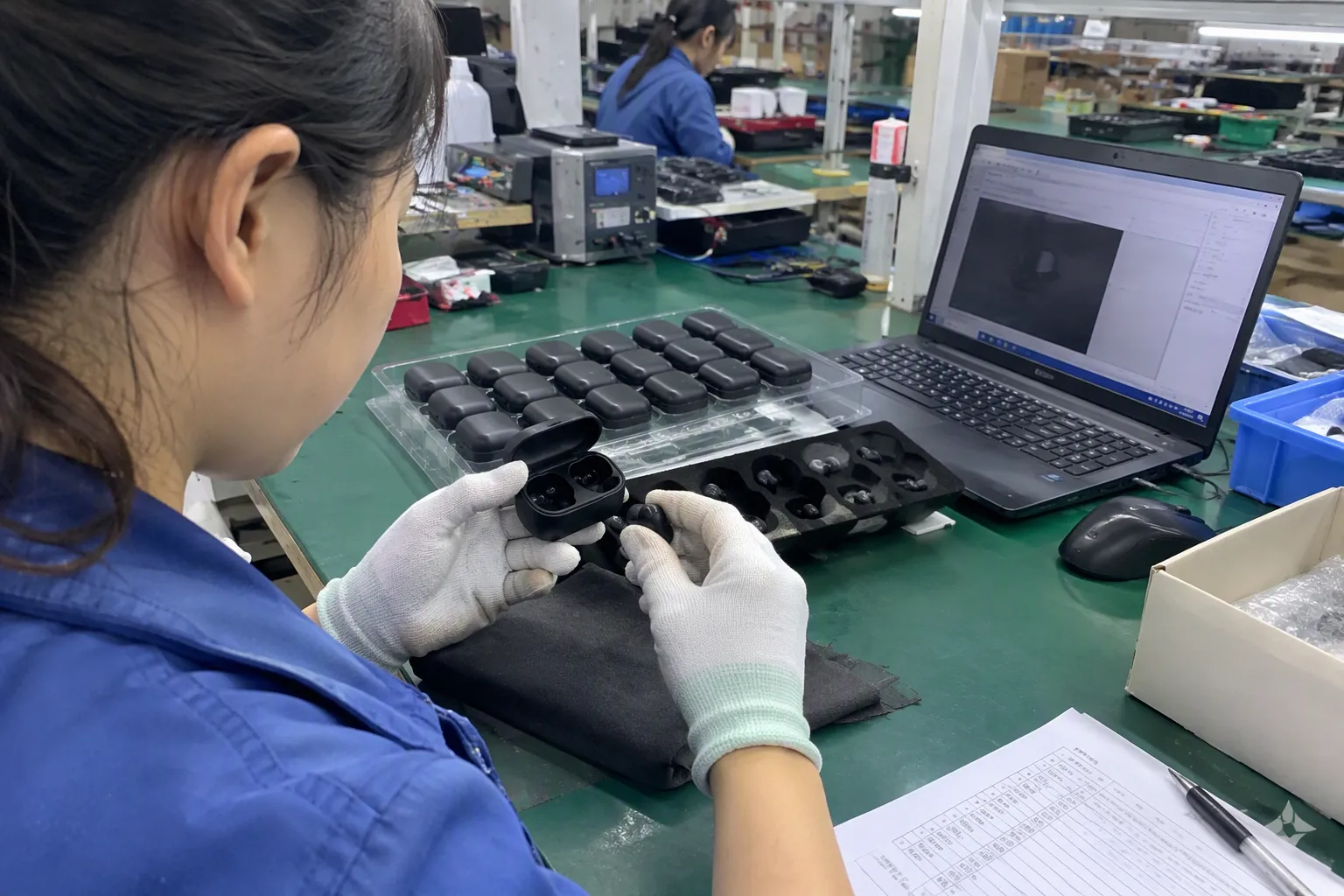
I would not rely on my own fit experience. During sampling, I would create a small internal test group with different ear sizes and shapes. This is not a laboratory ergonomic study, but it can reveal obvious compatibility issues before a buyer commits to inventory.
- Initial comfort after five minutes
- Comfort after thirty to sixty minutes
- Movement during walking and head turning
- Stability during light exercise, if the product is marketed for that use
- Compatibility with glasses or other common accessories
- Whether the earbud needs repeated repositioning
- Whether the left and right sides feel equally balanced
I would use a simple rating scale and record comments in the same format. I would also photograph the wearing position only with consent. These notes help me discuss design changes with a supplier more clearly than a general statement such as “the fit is not good.”
A practical buyer checklist
| Fit question | What I would check | Evidence to request or record |
|---|---|---|
| Does the clip hold the earbud in place? | Walking, head turning, light movement | User notes and sample comparison |
| Does the product create pressure? | Five-minute and extended wear | Comfort ratings and comments |
| Does it fit different users? | Several ear sizes and shapes | Number of testers and outcomes |
| Does it work with glasses? | Normal glasses frames | Compatibility observations |
| Does the product shift over time? | Extended listening | Repositioning frequency |
| Is the design consistent? | Multiple samples from the same batch | Sample-to-sample observations |
I would avoid promising that one model fits every ear. A more responsible product description might explain that the clip-on design is intended for a range of users, while advising customers to consider personal ear shape and comfort. Any specific retention or comfort claim should be supported by a defined test method.
Do Clip-On Open-Ear Earbuds Leak Sound?
Open-ear earbuds do not seal the ear canal in the same way as many in-ear products. That design can support environmental awareness, but it also means some sound may be audible to people nearby. I treat leakage as a listening-scenario issue, not as a simple yes-or-no feature.
Clip-On Open-Ear Earbuds may produce less perceived isolation than sealed earbuds[3], and they may still leak audible sound. Leakage depends on volume, acoustic tuning, fit position, surrounding noise, and the distance of nearby listeners. I recommend testing at realistic volume levels and describing the result carefully.
Why “open-ear” does not mean “zero leakage”
The speaker directs sound toward the ear rather than sealing the canal. The user may hear outside sounds more easily, but some acoustic energy can travel into the surrounding space[4]. If the user raises the volume to overcome traffic, office noise, or public transport noise, nearby people may notice more sound.[5]
Fit position also matters.[6] A small change in the distance or angle between the speaker and the ear can affect perceived loudness and leakage. The same product can sound private to one user and clearly audible to another. The surrounding environment changes the judgment as well. In a quiet room, even modest leakage can be noticeable. Outdoors, Environmental Noise may mask it.
A repeatable leakage check
- Device used as the audio source
- Music or speech content used for comparison
- Volume setting or measured listening level, if available
- Distance between the wearer and the listener
- Quiet indoor and typical outdoor conditions
- Earbud position on each tester
- Listener comments at several volume levels
I would also distinguish sound leakage from sound isolation. Sound isolation describes how much outside sound reaches the wearer. Leakage describes how much the wearer’s audio reaches other people. An open-ear product can provide limited isolation by design, while leakage may vary significantly with volume and placement.
How I would write a safer product claim
- “Open-ear listening design for greater awareness of surrounding sounds”
- “Leakage performance should be considered in relation to volume and environment”
- “Designed for everyday listening; buyers should assess privacy expectations in their target market”
Listening safety and responsible communication
I would also encourage buyers to review credible listening-safety guidance, including the World Health Organization’s information on safe listening at who.int. I would not use a product’s open-ear structure as a guarantee that listening is always safe. Listening level, duration, and user behavior still matter.[7]
How Should Buyers Assess Call Quality?
Microphone count and “ENC” printed on a specification sheet do not prove that calls will sound clear. I evaluate the complete voice path: microphone location, wind exposure, background-noise processing, speaker output, Bluetooth connection, and the receiving caller’s impression.
Call quality depends on microphone placement, acoustic algorithms, wind conditions, network and device compatibility, and the calling environment. I would test indoor speech, outdoor speech, traffic noise, and light wind, then record both the wearer’s and the receiver’s feedback.
Microphone count is not a complete answer
A product with several microphones may have more input data for noise processing[8], but the result still depends on microphone position and software tuning. A microphone that faces wind directly may capture turbulence. A microphone placed close to clothing or hair may pick up rubbing sounds. An algorithm may reduce steady noise but struggle with irregular voices or sudden sounds.
- Microphone locations
- Whether the microphones are used for voice pickup, noise reduction, or both
- Supported call profiles and device compatibility
- Firmware version used in the sample
- Whether wind testing has been performed
- Whether call performance changes between the left and right earbud
A call-quality test matrix
| Test condition | What I listen for | Commercial question |
|---|---|---|
| Quiet indoor room | Natural voice and consistent volume | Is the basic call experience acceptable? |
| Moderate office noise | Voice separation and pumping artifacts | Can the product suit workplace users? |
| Outdoor traffic area | Background reduction and speech clarity | Are outdoor claims realistic? |
| Light wind | Wind rumble and sudden distortion | Is a wind-related warning needed? |
| Walking while calling | Stability of voice pickup | Does movement affect microphone position? |
| Different smartphones | Connection and call behavior | Is compatibility sufficiently broad? |
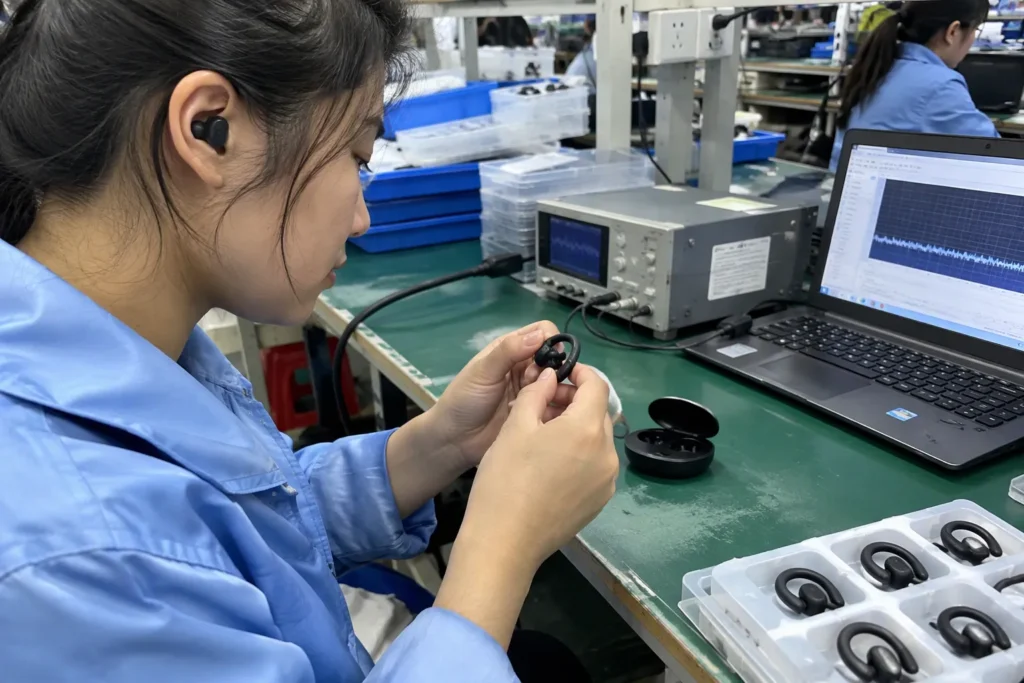
I would ask the receiving caller to rate the voice without seeing which sample is being used. That reduces the risk that the wearer’s positive impression becomes the only conclusion. I would record specific comments such as “voice sounds distant,” “wind dominates,” or “speech remains understandable but compressed.”
Calls and music require different evaluation
A product can sound pleasant for music while producing weak voice calls. Music playback benefits from tuning choices that do not automatically improve speech pickup. Similarly, a listener may hear the caller clearly while the caller hears background noise. I would test both directions separately.
I would also check whether the open-ear speaker output is strong enough for calls in the target environment. Because the ear is not sealed, the user may increase volume in noisy places. That action can affect comfort, leakage, and perceived call quality at the same time.
I would keep performance claims narrow unless the supplier provides repeatable evidence. A statement such as “supports clearer calls in everyday conditions” is still a commercial claim that should match available documentation and sample results. I would avoid universal wording such as “crystal-clear calls everywhere.”
How Can Retailers Test Clip-On Open-Ear Earbuds Before Ordering?
A short sample review can reveal design problems, but a structured pre-listing check gives me better purchasing confidence. I would test the product against the buyer’s real risks: poor fit, exaggerated privacy claims, weak outdoor calls, inconsistent samples, and unclear after-sales responsibility.
Retailers should test samples with multiple users, devices, listening environments, and movement levels before placing a larger order. They should document results, separate verified facts from supplier claims, and confirm which production specifications and support terms will apply to the shipped batch.
Step 1: Define the intended customer
- Main age and lifestyle group
- Expected price range
- Indoor, commuting, fitness, or mixed use
- Importance of calls
- Sensitivity to leakage
- Expected accessories, such as glasses
- Retail market and language requirements
- Target MOQ and acceptable lead time
Step 2: Build a sample test sheet
| Category | Rating or record |
|---|---|
| Comfort after five minutes | 1–5 rating plus comments |
| Comfort after extended use | 1–5 rating plus pressure location |
| Stability during walking | Stable, shifts, or falls |
| Fit across users | Number comfortable and number unsuitable |
| Leakage at normal volume | Not noticeable, noticeable, or high |
| Leakage at higher volume | Record test condition |
| Indoor call quality | Receiver rating and comments |
| Outdoor call quality | Receiver rating and comments |
| Wind behavior | Mild, moderate, or severe disturbance |
| Sample consistency | Differences between units |
| Packaging and accessories | Confirm contents |
| Supplier response | Speed, clarity, and documents provided |
Step 3: Test more than one sample
Step 4: Confirm the claim and document package
For consumer electronics sold in Europe or North America, I would ask the supplier for applicable declarations, test reports, and certification documents. I would verify that the documents identify the correct model and manufacturer rather than treating a logo on a product page as sufficient evidence.
For EU-bound products, buyers can review official guidance through the European Commission’s CE marking page. For Bluetooth-related information, the Bluetooth SIG qualification information is a useful reference point. These resources do not replace application-specific legal advice or buyer due diligence.
- Exact model number
- Applicable market documentation
- Wireless and charging test documents
- Battery-related documentation where relevant
- User manual and warning information
- Warranty process
- Replacement-part or DOA policy
- Inspection procedure before shipment
Which Supplier Questions Reduce Fit, Leakage and Call Risks?
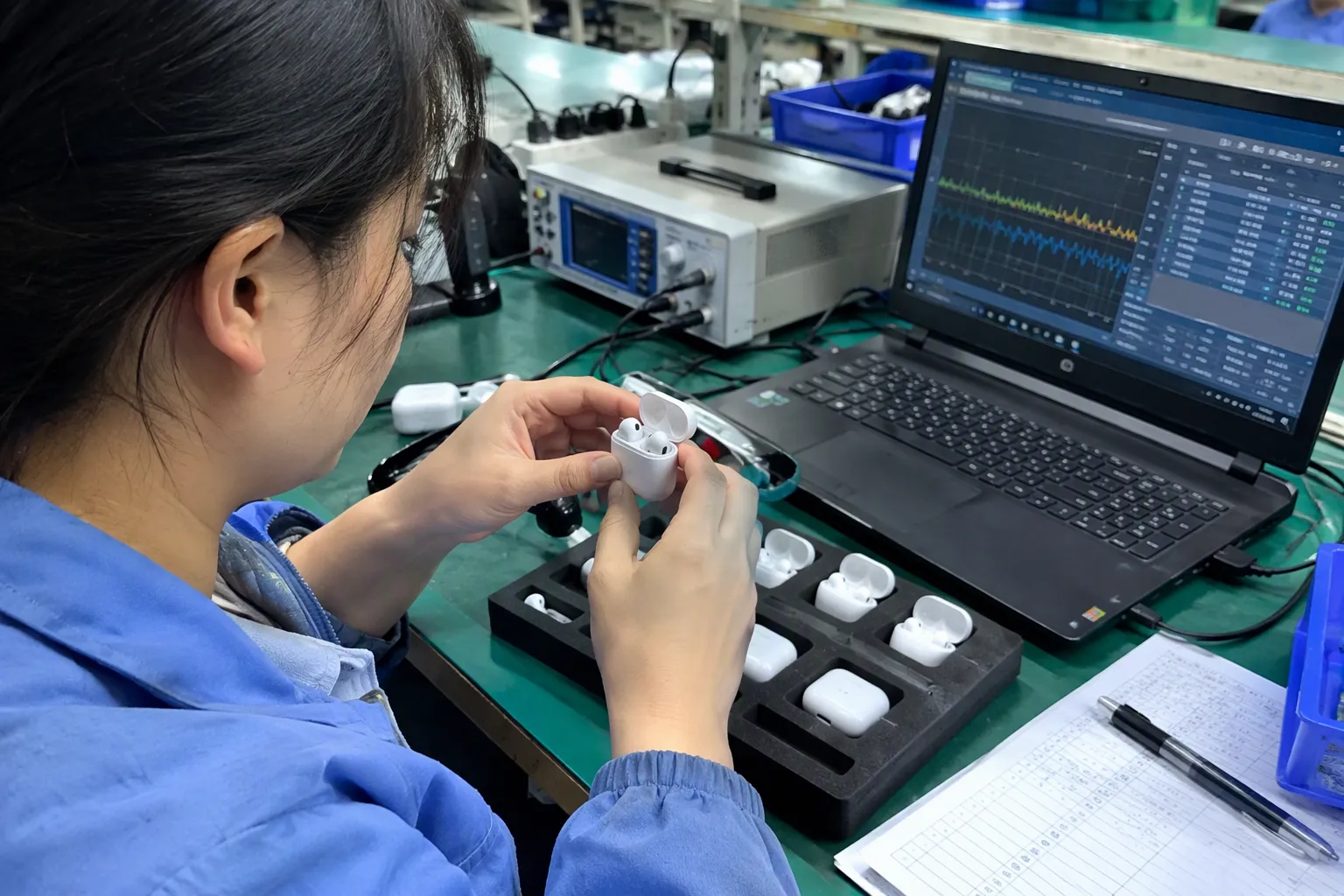
Supplier communication can save time when the questions are specific. I avoid asking only, “Is the quality good?” That question usually produces a general answer. I ask for the method, conditions, version, and responsibility connected with each claim.
The best supplier questions identify how a performance claim was measured, whether the approved sample matches mass production, and what support is available if users report fit, leakage, or call problems. Buyers should request evidence and define acceptance criteria before ordering.
Questions about fit
- What ear sizes or user groups influenced the design?
- What materials contact the ear?
- What is the product weight?
- Has the design been tested with glasses or other common accessories?
- Is the clip geometry fixed or available in different versions?
- What fit complaints have appeared in previous markets?
- Can the supplier provide a sample set for internal user testing?
Questions about leakage
- How was leakage assessed?
- What volume and audio content were used?
- What distance separated the wearer and listener?
- Was the test performed in a quiet room?
- Does the result apply to both music and speech?
- Which product position was used during the test?
- Can the supplier provide a written report or repeat the test with the buyer?
Questions about calls
- Where are the microphones located?
- Which microphone mode is active during calls?
- What does the ENC function target?
- Was wind included in testing?
- Which phone models and operating systems were used?
- Can the supplier provide a call recording or live demonstration under defined conditions?
- Is firmware adjustable if voice pickup needs improvement?
Questions about production and after-sales
- Approved sample reference
- Pilot production process
- Pre-shipment inspection options
- Defect classification
- DOA replacement terms
- Warranty period and process
- Spare-unit or replacement strategy
- Lead time after order confirmation
- MOQ for standard and customized versions
My role as a Shenzhen-based 3C exporter often involves translating these questions between a buyer and a factory. Clear specifications reduce misunderstandings, especially when the buyer needs private labeling, customized packaging, or a different firmware and accessory set.
How Should Buyers Balance Product Performance and Retail Cost?
A lower unit price does not always create a lower total cost. If a model generates fit complaints, poor reviews, or high replacement requests, the initial saving can disappear. I compare price with expected return risk, support workload, and the cost of making accurate claims.
Buyers should compare Clip-On Open-Ear Earbuds by total commercial suitability, not unit price alone. Fit coverage, call performance, sample consistency, documentation, MOQ, lead time, and warranty support all influence the product’s effective cost.
A simple weighted comparison
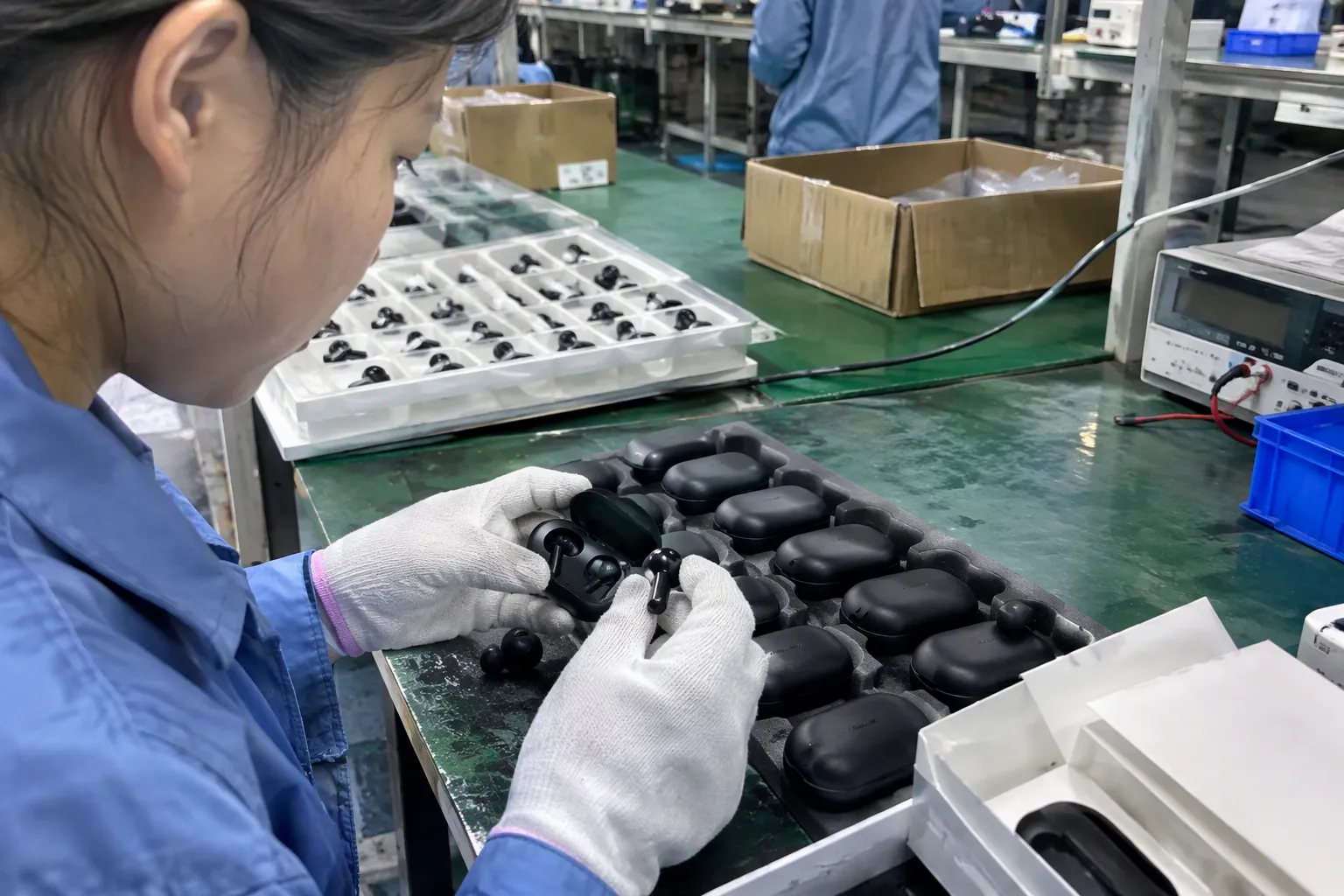
I would assign weights based on the target channel. An online seller that promotes calling may give call quality a high weight. A discount retailer may focus on landed cost and packaging. A commuter-focused product may give more weight to comfort and stability.
| Evaluation area | Example importance | Why it matters |
|---|---|---|
| Fit and comfort | High | Influences returns and reviews |
| Call quality | Medium or high | Important for work and commuting users |
| Leakage behavior | Medium | Affects privacy expectations |
| Audio experience | High | Supports repeat purchase and reviews |
| Consistency | High | Protects the retail promise |
| Documentation | High | Supports market and platform requirements |
| MOQ and price | High | Affects inventory risk |
| Lead time | Medium or high | Affects launch planning |
| After-sales support | High | Limits replacement cost |
The cost of an unclear promise
Suppose a listing says that a product is suitable for quiet offices and private calls. Customers may interpret that promise more strongly than the seller intended. If nearby colleagues can hear the audio or the receiver struggles with outdoor noise, the seller may face negative reviews even if the product is functional.
- If the fit works for most internal testers but not all, avoid “universal fit.”
- If leakage is acceptable at moderate volume, state the design purpose without promising silence.
- If calls are good indoors but variable outdoors, describe the tested environment.
- If performance has not been independently verified, do not use precise thresholds.
The U.S. Federal Trade Commission guidance on advertising and marketing provides a useful general reference for substantiating commercial claims. Buyers should still obtain professional legal advice for their specific market and product claims.
When a higher-priced model may be justified
A more expensive model may offer better materials, more consistent assembly, improved microphone placement, or stronger supplier support. I would not assume that higher price guarantees these benefits. I would ask the supplier to demonstrate the difference through samples, documents, and defined specifications.
I would also consider customization. A buyer may request packaging, colours, logo printing, or firmware changes. Each change can affect MOQ, tooling, lead time, and quality control. I would confirm which features are standard and which require a new approval sample.
Frequently Asked Questions
Are Clip-On Open-Ear Earbuds suitable for every ear shape?
No product should be presented as suitable for every ear shape without strong supporting evidence. Clip geometry, ear size, cartilage shape, glasses, and personal comfort preferences can affect the result. I recommend testing samples with several users and describing fit expectations honestly.
Do open-ear earbuds eliminate sound leakage?
No. Open-ear earbuds can allow some sound to be heard by nearby people, especially at higher volume or in quiet environments. Leakage depends on fit, speaker position, volume, tuning, and surrounding noise. I recommend documenting the test conditions before using any leakage-related claim.
Does ENC guarantee clear calls?
No. ENC is a processing feature, not a universal guarantee. Microphone placement, wind, background noise, software tuning, phone compatibility, and the calling environment all affect voice quality. I would test calls with a receiving listener in quiet and outdoor conditions.
What should I test before placing a wholesale order?
I would test comfort, movement stability, leakage, music playback, indoor calls, outdoor calls, wind response, Bluetooth pairing, charging, packaging, and sample consistency. I would also confirm applicable documents, inspection arrangements, warranty terms, MOQ, lead time, and replacement support.
What evidence should a supplier provide for product claims?
I would request the exact model number, test conditions, technical specifications, applicable declarations, and relevant reports. I would verify that the documents match the product being purchased. Supplier documents are valuable, but buyers should not treat them as independent proof of every ergonomic or acoustic claim.
Conclusion
Clip-On Open-Ear Earbuds should not be judged by clamping force, microphone count, or an “open-ear” label alone. I evaluate the balance between comfort, movement stability, leakage, call clarity, documentation, production consistency, and after-sales risk. I recommend testing several samples with different users and in realistic environments before listing the product. As a Shenzhen-based 3C exporter with experience in sampling and supplier communication, I can help buyers compare suitable models, confirm customization details, and prepare a practical pre-order evaluation.
Sources
- Anthropometric Study of the Human Ear Among Patients ...", Anthropometric and ergonomic studies of ear-worn devices report that variation in external-ear morphology can affect contact, positioning, retention, and perceived comfort
- Critical Design Considerations for Longer-Term Wear and ...", Ergonomic research on wearable interfaces indicates that retention must be balanced against pressure distribution and duration of contact, because greater force can increase stability while also producing localized discomfort
- The Effect of Stimulation Position and Ear Canal Occlusion on ...", Studies of open and occluding ear-worn audio systems show that designs that leave the ear canal unsealed generally provide less passive attenuation of environmental sound than sealed in-ear designs
- Designing an Open-Back Enclosure to Mitigate Sound ...", Measurements of open-ear and near-ear loudspeaker systems show that sound is radiated both toward the listener and into the surrounding field, making nearby audibility possible
- Effects of an Active Noise Control Technology Applied to ...", Acoustic measurements generally show that increasing playback level increases the sound field outside an open ear-worn device, while background noise can encourage listeners to select higher levels
- Air-Leak Effects on Ear-Canal Acoustic Absorbance - PMC", Near-ear acoustic studies indicate that changes in transducer position and orientation can alter the sound level delivered to the ear and the amount of energy radiated away from the intended listening direction
- Deafness and hearing loss: Safe listening", Public-health exposure guidance treats potential noise-related hearing harm as a function of sound level and exposure duration, rather than as a consequence determined solely by headphone architecture
- Advances in Microphone Array Processing and ...", Microphone-array research shows that multiple spatially separated microphones can provide information used for beamforming and speech enhancement in noise
Related reading: