Durable USB C Cables Bulk and Wholesale orders can look simple until I ask what each cable must actually do. A low-priced cable may fit the connector but fail on power, data, packaging, or consistency. I help buyers reduce that risk by matching the specification to the device, sales channel, and supplier process before comparing unit prices.
For durable USB C cables bulk and wholesale purchasing, I recommend checking the use case, connector combination, charging power, data speed, construction, testing documents, sample quality, MOQ, lead time, and after-sales process together. A braided or thick cable may improve resistance in some applications, but it does not guarantee universal compatibility or a long service life.
Quick Answer
- Start with the application: office charging, retail replacement, travel, laptops, gaming, or high-frequency commercial use may require different specifications.
- Separate the USB-C connector from performance: USB-C describes the form factor, not automatically the charging power, data speed, or protocol.
- Request a clear product specification: confirm cable length, connector combination, power rating, data capability, jacket, strain relief, packaging, and applicable testing documents.
- Approve a production sample before placing a larger order: I use the sample to compare the actual cable, labeling, package, and test information against the quotation.
- Compare total procurement risk: MOQ, batch consistency, lead time, defect handling, and communication can matter more than the lowest unit price.
I have seen European and American buyers begin with a short request such as “strong USB-C cable, good price.” That description is not enough for a reliable quotation. The next sections explain which questions I ask, which claims I treat carefully, and how I compare suppliers without confusing appearance with performance.
Durable USB C Cables Bulk and Wholesale: What Does “Durable” Actually Mean
A cable can look strong and still be unsuitable for its intended job. The problem becomes more serious in wholesale because one unclear specification can affect hundreds or thousands of units. I therefore treat durability as a purchasing-risk question, not as a visual feature alone.
A durable USB-C cable should be evaluated against its expected use, bending and handling conditions, electrical requirements, connector quality, and production consistency. Buyers should verify these points through specifications, samples, inspection, and relevant supplier documents rather than relying only on braid, thickness, or marketing language.
Durability has several different meanings
-
Mechanical durability
This includes resistance to bending, pulling, twisting, abrasion, and repeated insertion near the connector. The jacket, internal conductors, shielding, connector housing, and strain relief all contribute. -
Electrical reliability
The cable must deliver the required power or data performance under the specified conditions. A cable that charges a phone acceptably may not be suitable for a higher-power laptop application. -
Commercial durability
A product also needs stable packaging, manageable returns, clear replacement procedures, and dependable delivery. A technically suitable cable can still create losses if the supplier cannot handle a quality complaint.
This is why I avoid promising a universal lifespan. Actual service life depends on how users bend the cable, whether they pull the connector, how often they insert it, and whether the cable operates within its intended rating.
Why a braided jacket is not enough
A braided exterior can improve abrasion resistance[7] or create a premium retail appearance. It can also make a product easier to position at a higher price point. However, the braid does not tell me whether the internal conductor, soldering, connector, or strain relief is suitable.
A thicker cable also needs careful interpretation. More material may support certain power or mechanical requirements, but thickness can reduce flexibility[8] and increase packaging volume. I ask the supplier to identify what the thickness represents:
I also inspect the transition between the cable and connector. That area often receives concentrated bending during use. A visually attractive housing does not automatically prove that the internal connection is secure.
A practical durability checklist
| Evaluation point | What I ask the supplier to confirm |
|---|---|
| Use case | Which devices and environments is the cable designed for? |
| Connector combination | USB-C to USB-C, USB-A to USB-C, or another combination? |
| Power capability | What power level is specified, and under what conditions? |
| Data capability | Is the cable charging-only, USB 2.0, or a higher data specification? |
| Construction | What are the jacket, conductor, shielding, and strain-relief details? |
| Sample consistency | Does the sample match the quotation, photos, label, and package? |
| Production control | How are materials, assembly, and finished products checked? |
| Documents | Which test reports or certifications are available for verification? |
| Complaint handling | What evidence and response timeline apply to a quality issue? |
For a detailed procurement workflow, I usually connect this review with a broader USB-C accessory buying checklist. The important point is that I do not approve durability from one feature. I approve a defined product for a defined use.
What USB-C Specifications Should I Confirm Before a Wholesale Order?
Many compatibility problems begin when buyers treat USB-C as a complete performance specification. I explain that USB-C mainly identifies a connector and interface family.[1] The final product still needs separate confirmation for power, data, connector arrangement, and device compatibility.
Before buying wholesale USB-C cables, confirm the cable-to-cable connector combination, supported charging requirements, data speed, cable length, device group, and any active components such as an electronic marker. I also ask the supplier to state what the cable does not support, because limitations are as important as headline features.
Charging power is not the same as connector type
A USB-C plug may connect to a phone, tablet, power bank, monitor, or laptop. That fact alone does not tell me how much power the cable can carry. The charger, device, cable, and charging protocol must work together.[2]
- Is the cable intended for basic phone charging or higher-power equipment?
- What power rating appears on the product specification?
- Does the cable require an e-marker for the intended application?[3]
- Does the supplier have supporting test information?
- Is the stated power based on a specific cable length and construction?
- Does the product support the protocols that the target devices commonly use?
I avoid writing “supports all fast charging” unless the claim is supported by clear evidence and a defined list of protocols. Fast charging is not one universal function.[4] A cable may work with one charger and device combination but not deliver the same result with another.
The USB Implementers Forum provides technical and compliance information through its official resources at usb.org. I recommend using that source when a buyer needs to understand official USB terminology and program requirements. I still ask the individual supplier for product-specific evidence because a general standard page does not prove that every offered cable meets every requirement.
Data speed needs an explicit description
A cable may charge a device while offering limited or no data transfer.[5] A buyer selling cables for phones may accept that result. A buyer targeting monitors, storage devices, docking stations, or professional workstations may not.
| Requirement | Example question |
|---|---|
| Charging only | Is data transfer unavailable or limited? |
| Basic data | Is the cable specified for USB 2.0-level transfer? |
| Higher-speed data | Which exact speed or standard is claimed? |
| Video use | Is video support part of the intended application? |
| Cable length | Does the stated performance apply to the offered length? |
| Testing | What product-specific report supports the claim? |
Connector combinations affect the product position
Length and flexibility also matter
Longer cables can be useful for bedside, office, vehicle, or retail display applications. At the same time, length can affect voltage drop, handling, package size, and performance claims.[6] I ask the supplier to quote each length separately rather than assuming that a two-meter version will behave exactly like a one-meter version.
I also consider how the cable will sit on a shelf. A highly rigid cable may look substantial but may be inconvenient for travel or compact packaging. For an online seller, product photos and listing claims must match the actual cable. Otherwise, the seller may face customer complaints even when the cable is technically functional.
How Should I Select Durable USB C Cables Bulk and Wholesale for Different Buyers?
A retailer, e-commerce seller, office supplier, and electronics wholesaler may all ask for USB-C cables, but they do not have the same risk profile. I start with the sales channel and end-user behavior before choosing a construction or price level.
I select wholesale USB-C cables by matching the cable’s performance and construction to the buyer’s customers. Retail buyers often need clear packaging and shelf appeal, e-commerce sellers need accurate listings and controlled returns, and commercial users may place greater importance on repeatability, documentation, and replacement availability.
Retail and chain-store requirements
- Peg-hook or shelf packaging
- Barcode and carton labeling
- Color and length assortment
- Retail price positioning
- Language requirements
- Private-label artwork
- Display-ready master cartons
- Replenishment expectations
A chain store may also require a formal vendor onboarding process. The buyer may request factory information, testing documents, packaging approvals, social compliance materials, or a defined corrective-action process. I treat each requirement as a document and workflow question. I do not assume that a general certificate automatically covers the exact model or shipment.
E-commerce requirements
E-commerce sellers face a different form of durability risk. The customer may buy from a product image and a short title. If the listing says “100W fast charging” or “high-speed data” without precise conditions, the seller may receive complaints from customers with unsupported devices.
- Connector-to-connector description
- Cable length
- Intended charging use
- Data capability
- Compatibility limitations
- Included packaging
- Warranty or replacement terms
- Any required charger or device conditions
I have found that accurate limitations often protect a product better than broad claims. A listing that says “USB-C to USB-C, charging focused, data capability as specified in the table” gives the buyer a clearer expectation than “works with everything.”
Wholesale and import distribution
Importers and wholesalers often need several lengths or price tiers. I discuss the assortment early because an apparently small change can affect MOQ, packaging, production scheduling, and carton dimensions.
| Product position | Typical commercial purpose | Main verification need |
|---|---|---|
| Entry model | Price-sensitive replacement sales | Basic function and honest labeling |
| Mid-range model | General retail and e-commerce | Balanced construction and packaging |
| Premium model | Higher price or demanding users | Verified power/data claims and stronger presentation |
| Custom model | Private label or contract program | Artwork, BOM control, inspection, and repeatability |
I do not recommend selecting the premium version for every buyer. A cable designed for a demanding laptop application may be unnecessary for a basic replacement market. It may also create a higher cost and a more complex listing.
High-frequency and commercial use
- Daily insertion frequency
- User handling habits
- Exposure to pulling or twisting
- Required replacement stock
- Cable management conditions
- Cleaning or environmental conditions
- Expected support period
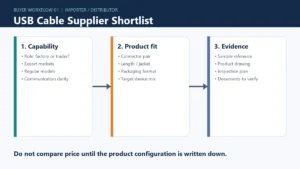
How Can I Compare USB-C Cable Suppliers Beyond Unit Price?
The lowest quotation can be attractive, especially when a buyer is testing a new product. However, a low unit price does not show the total cost of inconsistent materials, delayed delivery, rework, returns, or marketplace complaints. I compare the full procurement package.
I compare USB-C cable suppliers by reviewing product fit, sample quality, MOQ, lead time, batch consistency, packaging control, inspection evidence, communication, and after-sales response. I calculate landed risk alongside unit cost so that a small price difference does not hide a much larger operational problem.
The quotation should be specific
- Model or internal item number
- Connector combination
- Length and color
- Power and data description
- Jacket and construction notes
- Package type
- Logo or customization status
- MOQ by model and color
- Sample fee and sample lead time
- Production lead time
- Carton details
- Payment and shipping terms
- Applicable documents available for review
Sample approval is a control point
- Confirming connector fit with representative devices.
- Checking cable length and visible construction.
- Reviewing the plug housing and strain relief.
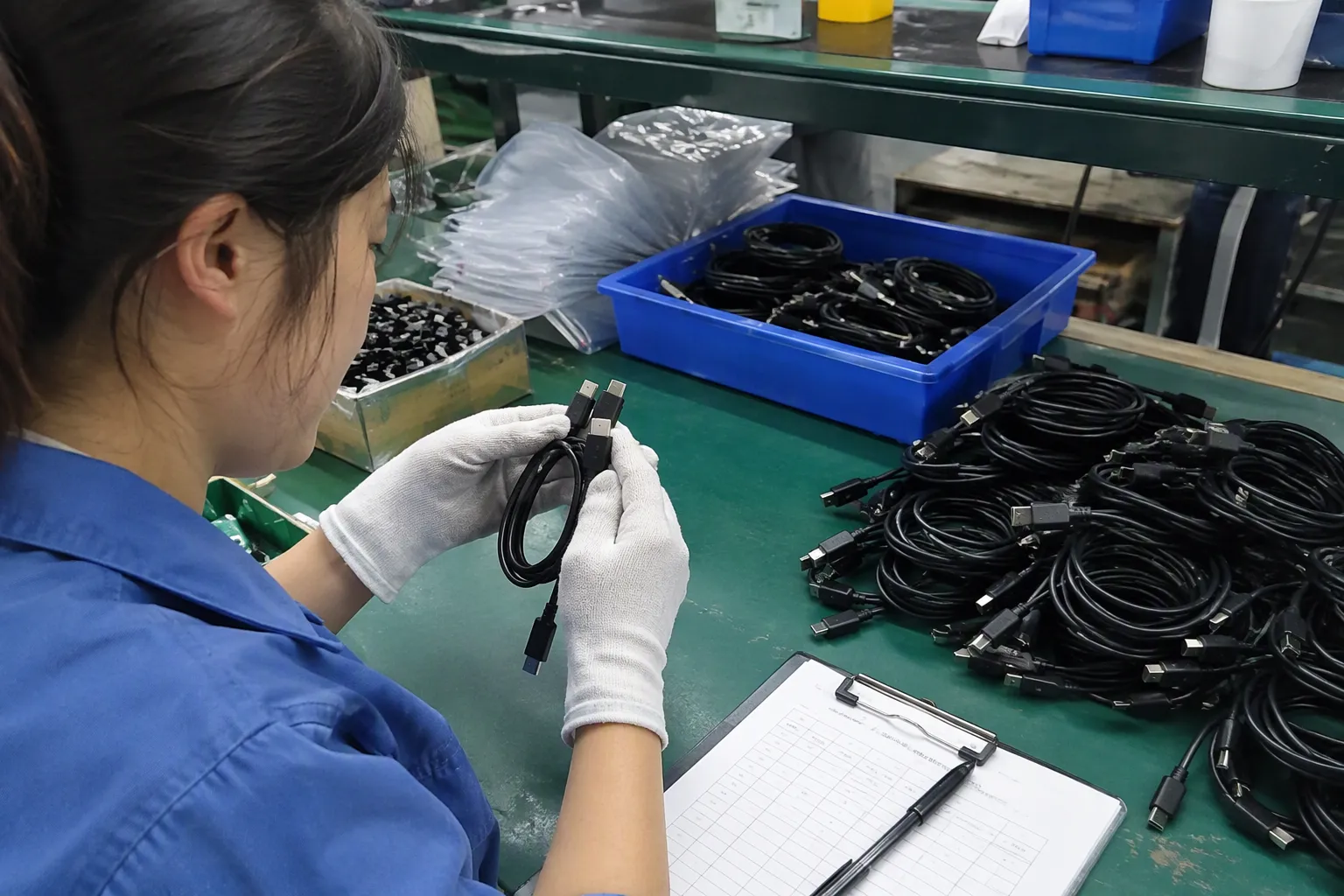
- Testing the stated basic charging or data function with suitable equipment.
- Checking label information and package details.
- Recording photos, measurements, and approval notes.
- Asking how the factory will control changes after approval.
For higher-risk claims, I recommend qualified testing by an appropriate professional laboratory or inspection organization. I do not invent test results, and I do not treat a supplier declaration as independent proof.
MOQ, lead time, and batch control
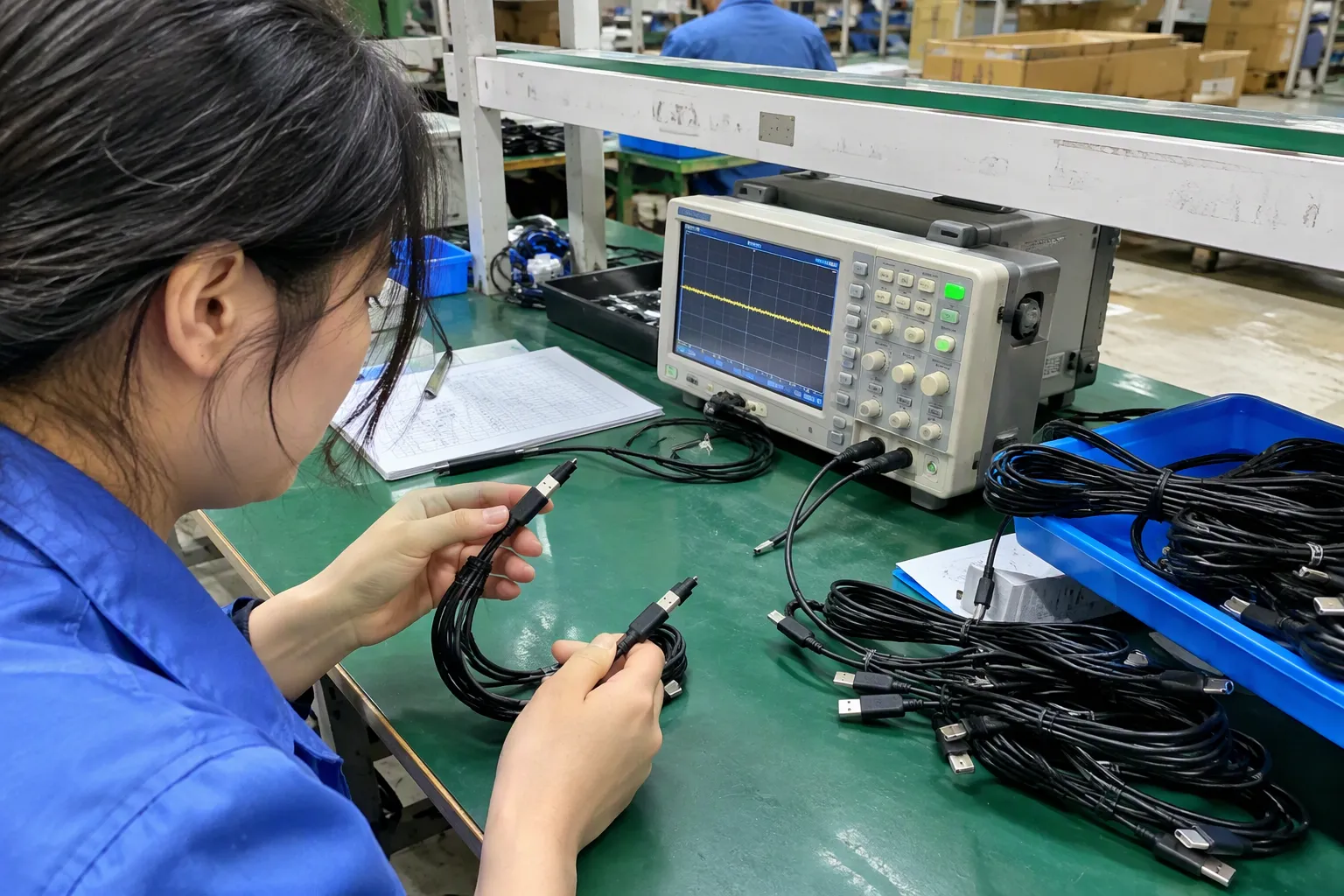
A buyer may focus on the price per piece while overlooking an MOQ that creates excess stock. I ask whether MOQ applies per color, length, package, or logo version. I also ask whether mixed assortments are possible.
| Stage | Question |
|---|---|
| Sample | How many working days after specification confirmation? |
| Artwork | How long for packaging approval? |
| Material preparation | Are key materials in stock or made to order? |
| Production | What is the planned manufacturing time? |
| Inspection | When can inspection occur? |
| Dispatch | How soon after approval can goods ship? |
I also discuss what happens if the buyer repeats the order. A supplier may quote a short lead time for a standard item but need more time for custom packaging or a new color. Clear planning helps an importer avoid stockouts.
A simple total-cost view
The final term is difficult to calculate precisely, but I still discuss it. If a product has unclear specifications, the expected complaint cost is higher even when the quoted unit price is lower. I do not assign an invented defect rate. I simply identify the risk and ask what evidence can reduce it.
What Documents and Quality Checks Should I Request for Wholesale USB-C Cables?
Buyers often ask whether a cable is “certified.” I explain that the word needs context. A document may apply to a factory, a product family, a specific model, a shipment, or a management system. The buyer should verify the scope, validity, issuer, and model details.
For wholesale USB-C cables, I request product specifications, applicable test reports, declarations, labeling information, and quality-control records that match the exact model and market. I verify documents independently where practical and use professional compliance advice when the product, destination, or claim creates a significant regulatory obligation.
Documents are evidence, not a substitute for evaluation
Product and technical documents
Supplier and production documents
Market and shipment documents
- Destination-market labeling information
- Customs or shipping documents
- Declarations required for the product
- Buyer-specific packaging or compliance forms
- Records required by a retailer or marketplace
Verification depends on the sales market
European and American buyers may have different customer, retailer, marketplace, and legal requirements. Requirements can also vary according to the product configuration and claims. I recommend that importers confirm current obligations with a qualified compliance professional or the relevant authority.
For European products, buyers can review official information from the European Commission and check whether the product falls within requirements such as packaging, electrical equipment, chemicals, or common-charger rules. The EU’s common charger information is useful for understanding the policy context, but it does not replace product-specific legal advice.
For the United States, I recommend checking relevant information from agencies such as the U.S. Consumer Product Safety Commission and confirming any applicable state, federal, retailer, or marketplace requirements. The correct obligation may depend on the complete product and the claim being made.
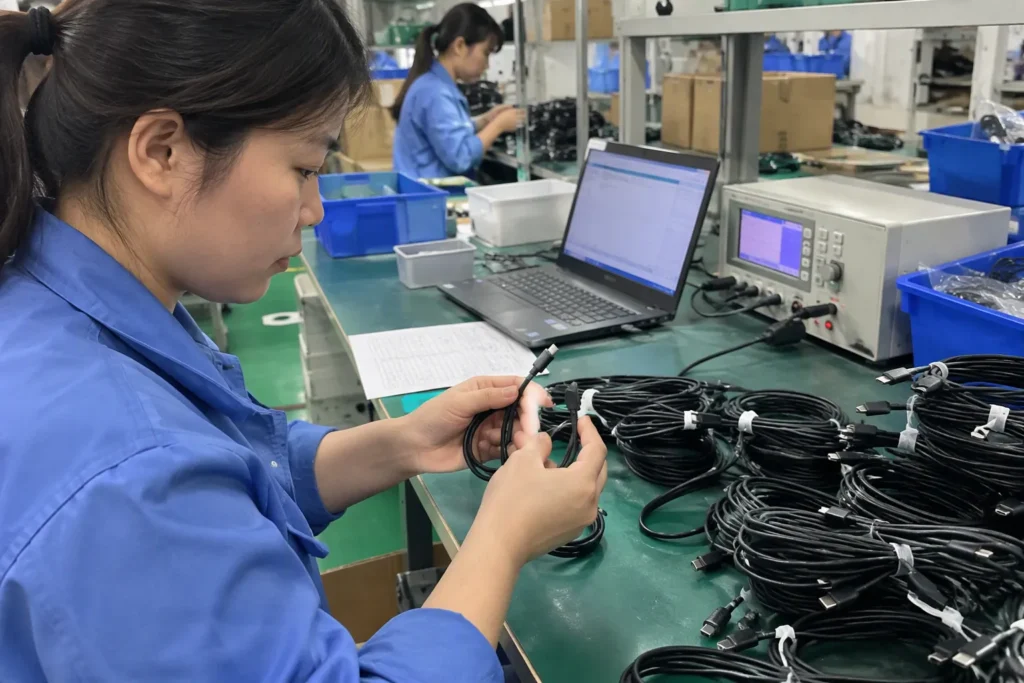
Incoming and final inspection
A professional inspection company can execute a more formal plan when the order value or risk justifies it. I recommend that the buyer and supplier agree on the inspection standard before production, rather than arguing about acceptance after the goods arrive.
How Should I Manage Custom Packaging, MOQ, and Repeat Orders?
Customization can help a retailer or e-commerce seller build a recognizable product line. It can also increase the number of things that can go wrong. I manage customization as a controlled project instead of treating it as a simple logo request.
For custom USB-C cable orders, confirm the approved sample, artwork, packaging materials, model specifications, MOQ, production schedule, and change-control process in writing. Repeat orders should be checked against the approved reference so that a lower-cost material or packaging change does not enter production without approval.
Customization changes the purchasing calculation
- Printed cable markings
- Logo on the connector housing
- Color matching
- Retail box or blister packaging
- Multilingual instructions
- Barcode and compliance icons
- Inner boxes and master cartons
- Retail display requirements
Each item can affect MOQ and lead time. A buyer who needs three lengths and four colors may have a much higher effective MOQ than a buyer ordering one standard model. I ask the buyer to decide which features actually support sales before adding complexity.
Approve artwork and physical samples separately
Repeat orders need a change-control question
The answer does not eliminate all risk, but it establishes a useful purchasing expectation. If the supplier changes a connector housing or conductor material, the buyer needs a chance to assess the effect on performance, appearance, and listing information.
How Can I Build a Lower-Risk Durable USB C Cables Bulk and Wholesale Order?
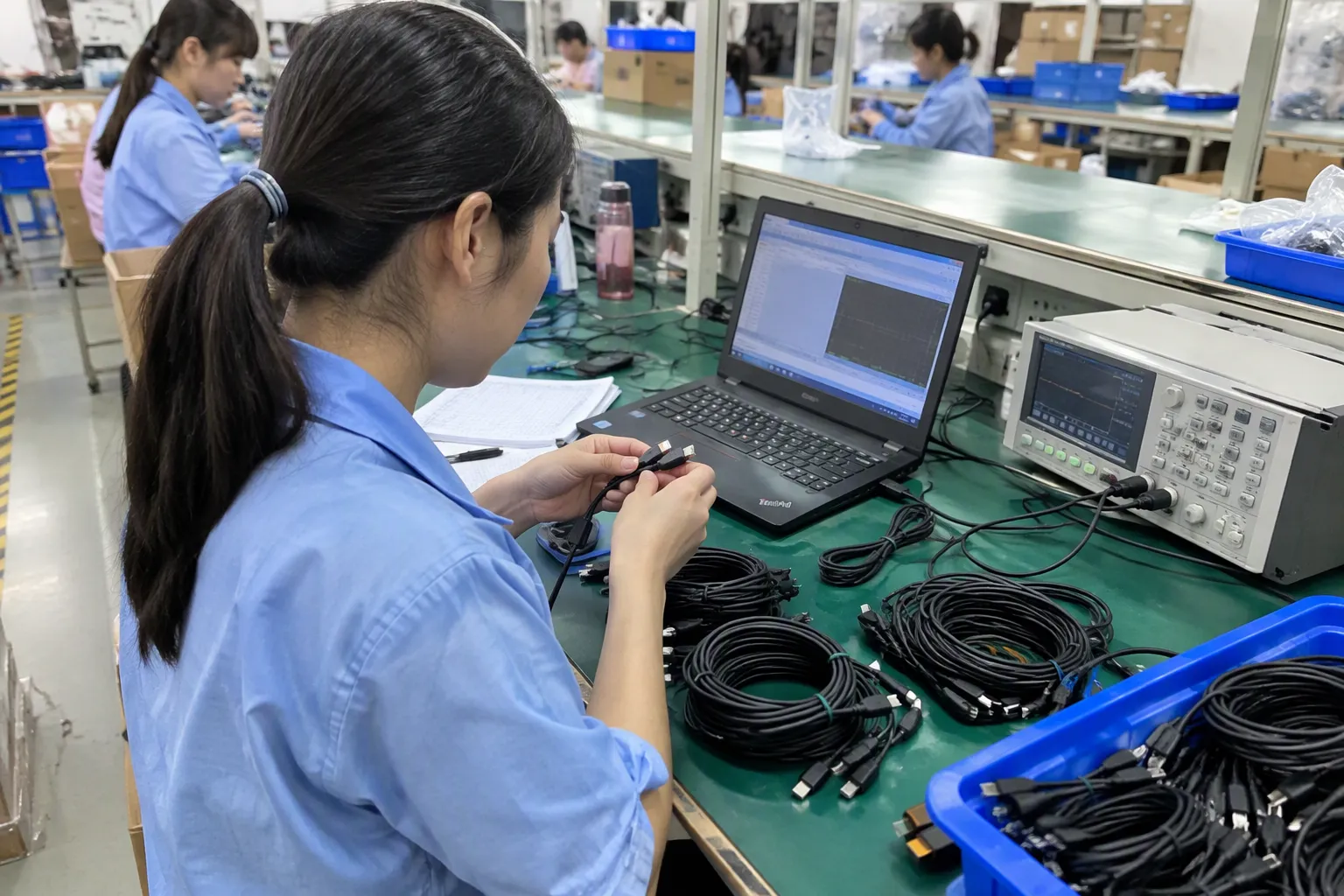
A buyer can reduce risk by making the decision process simple and documented. I usually begin with a short specification brief, then request samples, compare suppliers, and confirm the production controls before discussing a larger order.
A lower-risk durable USB C cables bulk and wholesale order starts with a written requirement, a comparable quotation, a tested and documented sample, an agreed inspection plan, and clear after-sales terms. The buyer should launch with the specification that fits the market instead of paying for unverified features that customers may not need.
My recommended procurement sequence
1. Define the customer and device group
2. Define the minimum performance
3. Ask several suppliers the same questions
4. Review documents before making broad claims
5. Test and approve samples
6. Confirm order controls
7. Inspect the finished goods
Questions I ask before choosing a supplier
| Question | Why it matters |
|---|---|
| Can the supplier quote the exact model and package? | It prevents false price comparisons. |
| Can the supplier provide a matching sample? | It links the quotation to a physical product. |
| What is the MOQ by length, color, and package? | It reveals the real inventory commitment. |
| How does the supplier control repeat batches? | It addresses consistency risk. |
| What happens after a quality complaint? | It shows operational responsiveness. |
| Can the supplier support customization? | It tests project and packaging capability. |
| Which documents are available for verification? | It helps the buyer plan compliance review. |
| What is the realistic production lead time? | It protects inventory planning. |
I have worked with inquiries where the first discussion centered on price, but the final discussion centered on connector type, packaging, or delivery timing. That change is normal. The more clearly I define the product at the start, the fewer surprises appear during sampling and production.
Frequently Asked Questions
Are braided USB-C cables always more durable?
No. A braided jacket may improve abrasion resistance and create a premium appearance, but it does not prove that the internal conductors, connector joints, or strain relief are suitable. I evaluate the complete construction, intended use, sample performance, and supplier quality controls.
Does every USB-C cable support fast charging?
No. USB-C identifies a connector family, not one universal charging capability. I confirm the cable’s stated power rating, the charging protocol requirements, the charger, and the device. I also check whether the claim is supported by product-specific technical evidence.
Should I buy USB-C cables based on thickness?
No. Thickness can relate to conductors, shielding, insulation, braid, or decorative design. A thicker cable may be appropriate for one application and inconvenient for another. I compare the actual specification, flexibility, connector construction, and intended use instead of using thickness as a quality shortcut.
What should I put in a wholesale USB-C cable inquiry?
I include connector combination, length, color, charging and data requirements, intended devices, package type, logo needs, target market, quantity, MOQ expectation, delivery date, and document requirements. Clear information helps suppliers quote comparable products.
How can I reduce quality problems in a repeat order?
I keep an approved sample, written specification, artwork files, inspection criteria, and change-control agreement. I compare each repeat batch with the approved reference and request notice before material, factory, component, or packaging changes.
Conclusion
Durable USB C cables bulk and wholesale purchasing requires more than choosing a braided jacket or the lowest quotation. I recommend matching the cable to the actual device and sales channel, confirming power and data requirements separately, reviewing documents carefully, and approving a physical sample before production. MOQ, lead time, packaging, batch consistency, and after-sales support also affect the real cost. If you are planning a new USB-C cable range, I can help you prepare a clear specification and compare suitable options for your European or American market.
Sources
- Cables and Connectors", The USB Implementers Forum defines USB Type-C as a connector and cable interface specification whose supported power and data functions depend on the applicable USB specifications and product implementation
- USB PD Power Negotiations", USB Power Delivery documentation describes charging as a negotiated interaction among power sources, sinks, cables, and supported power profiles rather than as a property of the connector alone
- Do USB-C to USB-C cables need an emarker chip ...", USB Type-C and USB Power Delivery specifications describe electronically marked cables as devices that communicate cable characteristics, including information relevant to supported current and power operation
- Electric Vehicle Charging Infrastructure Standards and ...", Technical reviews of USB charging describe fast charging as a category encompassing multiple protocols and negotiated power conditions, with performance depending on the charger, device, and cable combination
- Plugable USB-C Cables, Data Blocker Charge Only, 240W ...", USB Type-C technical documentation recognizes that cable implementations may provide power without the full range of USB data functions, so charging capability does not by itself establish data-transfer capability
- Voltage Drop | AE 868: Commercial Solar Electric Systems", Electrical engineering references establish that voltage drop across a cable increases with conductor resistance and current; because resistance generally increases with conductor length, longer cables can impose greater voltage-drop constraints
- Abrasion resistance of two types of nonabsorbable braided ...", Materials studies of braided protective coverings report that textile braid construction can improve resistance to surface abrasion by adding a sacrificial protective layer around the underlying cable
- Comprehensive database of diameter-based biomass ...", Mechanical studies of cables and flexible conductors show that bending stiffness is influenced by cross-sectional geometry and material structure, so increasing overall thickness can reduce flexibility when other design variables are held comparable