Charger Surface Temperature Testing becomes a procurement concern when a buyer receives a report with one alarming—or reassuring—number. A charger may feel warm during normal operation[1], yet incomplete test conditions make the result difficult to trust. I recommend evaluating the test setup, intended use, and documentation together before approving a supplier or product.
Charger surface temperature should not be judged by one universal “safe” number.[2] I recommend checking the input and output load, ambient conditions, test duration, measurement location, device orientation, charging status, and stabilization method. A temperature report supports a purchasing decision only when its conditions are clear, relevant to the intended application, and comparable with other products.[3]
Quick Answer
- Ask the supplier to identify the input voltage, frequency, output mode, load, and charging condition used during testing.
- Confirm the ambient temperature, test duration, device orientation, measurement location, and instrument method.
- Treat a report without load conditions or duration as incomplete evidence.
- Do not assume that a lower surface temperature automatically means better quality.
- Compare the result with the applicable product category, current standards, and qualified laboratory or engineering advice.
- Keep the report with the product specification, inspection records, and corrective-action history.
When I communicate with European and North American customers about chargers, heating is one of the questions that appears repeatedly. Buyers want a simple answer, but a useful answer depends on the test design. The following sections explain what I would request from a supplier, how I would review the result, and when I would ask for further professional evaluation.
What Does Charger Surface Temperature Testing Actually Measure?
A charger surface temperature test measures the temperature at selected external points while the product operates under defined conditions. It does not automatically prove overall safety, long-term reliability, or compliance with every applicable requirement.
Why the number needs context
- Input voltage and frequency
- Output voltage and current
- Total power delivered
- Charging protocol and negotiation
- Battery state or electronic load behavior
- Internal design and component selection
- Housing material, size, and ventilation
- Ambient temperature
- Product orientation
- Test duration
For example, a compact GaN charger may operate at a different temperature profile from a larger conventional charger even when both deliver similar power. A charger that is tested at a light load may show a lower surface temperature than the same model at its rated continuous output.[6] Neither result is meaningful without the load information.
Surface temperature is not internal temperature
The external housing temperature is only one part of the thermal picture.[5] Internal components may experience different temperatures. A surface measurement may also vary across the plug area, top cover, side wall, USB port area, and label surface.[4]
- The hottest measured location
- All predefined measurement locations
- The measurement instrument or method
- Whether the value is a peak, average, or stabilized reading
- Whether the product was damaged, altered, or opened for the test
- Whether the test was repeated
What the test cannot establish by itself
- Full electrical safety
- Fire resistance of materials
- Protection against abnormal operating conditions
- Insulation performance
- Mechanical safety
- Electromagnetic compatibility
- Long-term component reliability
- Compliance with a particular market’s current requirements
I use temperature data as one element in a wider supplier and product review. I also check the technical file, applicable reports, product markings, inspection results, and the supplier’s corrective-action process. Buyers should ask a qualified laboratory or professional engineer to interpret application-specific requirements.
How Should a Charger Temperature Test Be Set Up?
A credible setup defines the operating condition before anyone records a value. I recommend writing the setup as a short test protocol rather than relying on a photograph or a verbal statement such as “tested at full load.”
Define the product and operating mode
The report should identify the model, hardware version, rated output, sample quantity, and firmware or protocol version where relevant. This information matters because a product name may cover different revisions or regional versions.
- With one output active
- With several outputs active
- At the rated continuous output
- At a negotiated fast-charging mode
- With a real device
- With an electronic load
- At a mixed or changing load
A multi-port charger can produce different thermal results depending on how its total output is allocated. A report that says “full load” without explaining port distribution does not give me enough information to compare it with another model.
Control the environment
| Test factor | Information I would request | Why it matters |
|---|---|---|
| Ambient temperature | Measured value or defined range | A warmer room can raise the external reading |
| Humidity | Recorded value where relevant | It supports test traceability and repeatability |
| Air movement | Still air, forced air, or laboratory condition | Airflow changes heat removal |
| Surface | Bench material and position | Contact surfaces can affect heat transfer |
| Orientation | Upright, horizontal, plug up, or other | Natural convection changes with position |
| Nearby objects | Clearance around the charger | Enclosed or crowded conditions may restrict heat release |
I do not expect every commercial inspection report to include laboratory-level environmental detail. I do expect the report to provide enough information for a buyer to understand whether the test resembles the intended use.
Select and document measurement locations
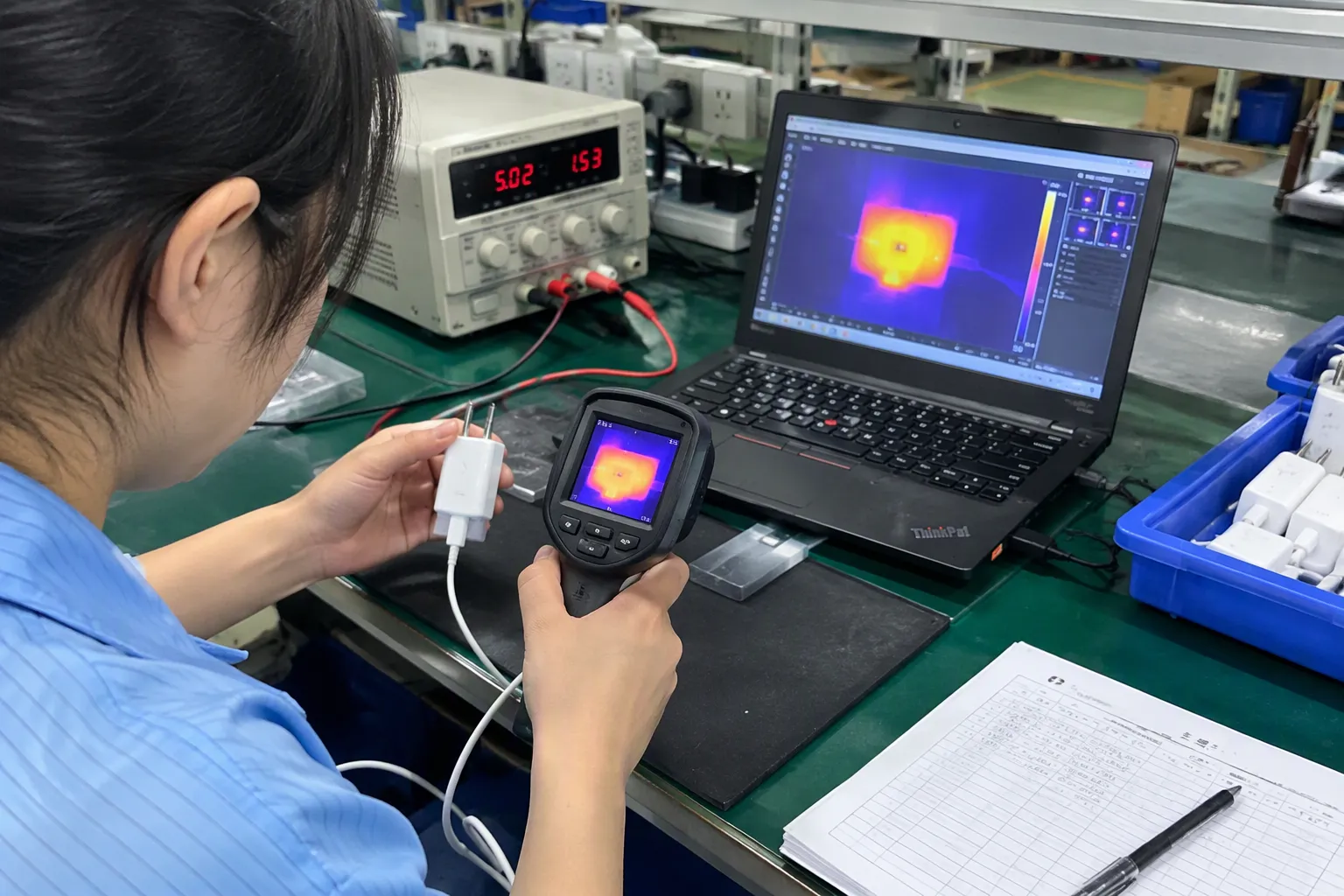
A technician should mark the measurement points or include a clear diagram. Common points may include the center of the main housing, the area near the output ports, the plug region, and any location that appears to be the highest-temperature area.
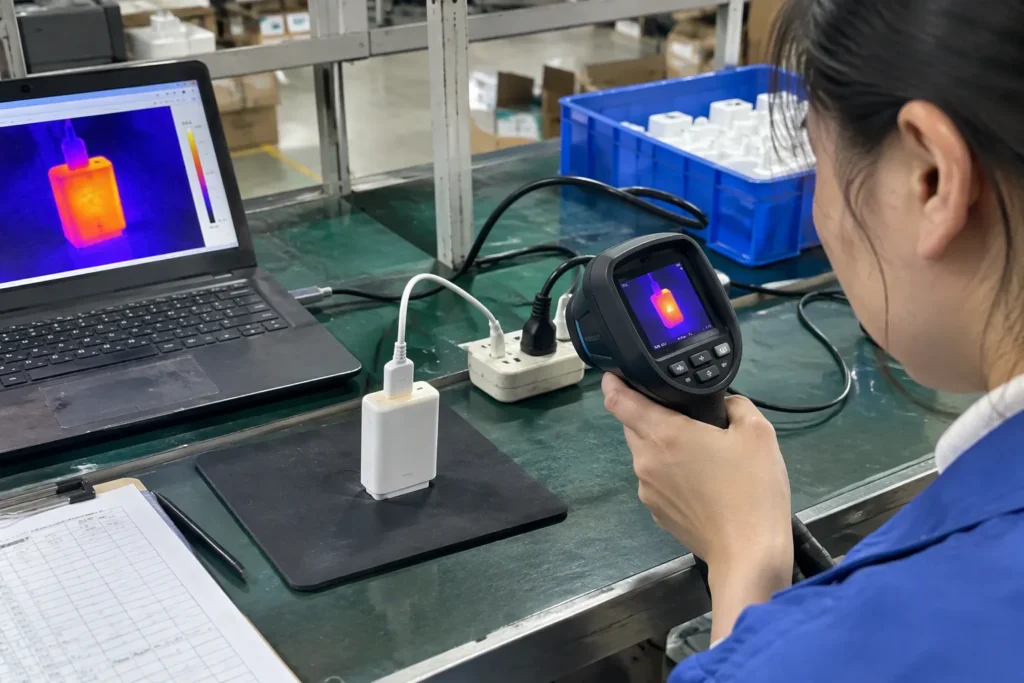
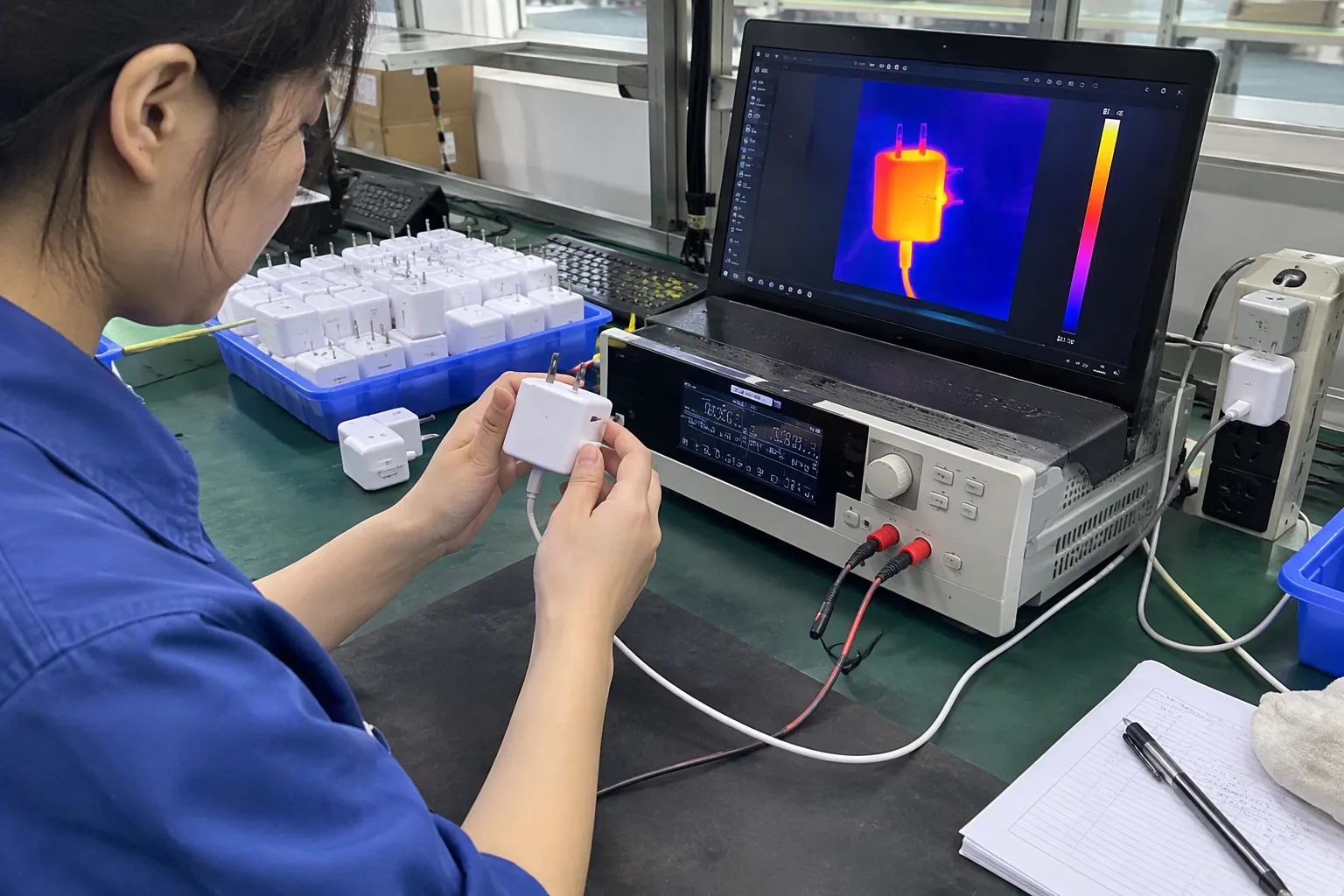
The measurement method also matters.[7] A contact probe, thermal camera, and infrared thermometer can produce different results if the operator does not control contact, emissivity, focus, angle, or calibration. I would ask for the instrument type, identification number if available, and calibration status according to the laboratory or inspection company’s procedure.
Which Conditions Can Change the Reported Temperature?
Load, time, and charging status usually have a greater influence on the result than buyers first expect. A charger may warm slowly, reach a plateau, or change behavior when the connected device changes its demand.
Input conditions
The supplier should record the input voltage and frequency used during the test. A charger intended for several markets may be evaluated at more than one input condition, depending on the applicable product requirements and test plan.
I would not assume that a result at one nominal input condition represents every market. European and North American products may have different supply environments, and the buyer should confirm the relevant conditions for the exact product and destination.
Output load and protocol
Fast-charging products deserve particular attention because the charger may negotiate different voltage and current combinations. A test at a basic charging mode may not represent the highest-power mode advertised to customers.
I would compare the test condition with the product listing. If the product is marketed as a high-power charger, testing only at a low phone-charging load may not support the marketing claim or the buyer’s risk assessment.
Charging status and real devices
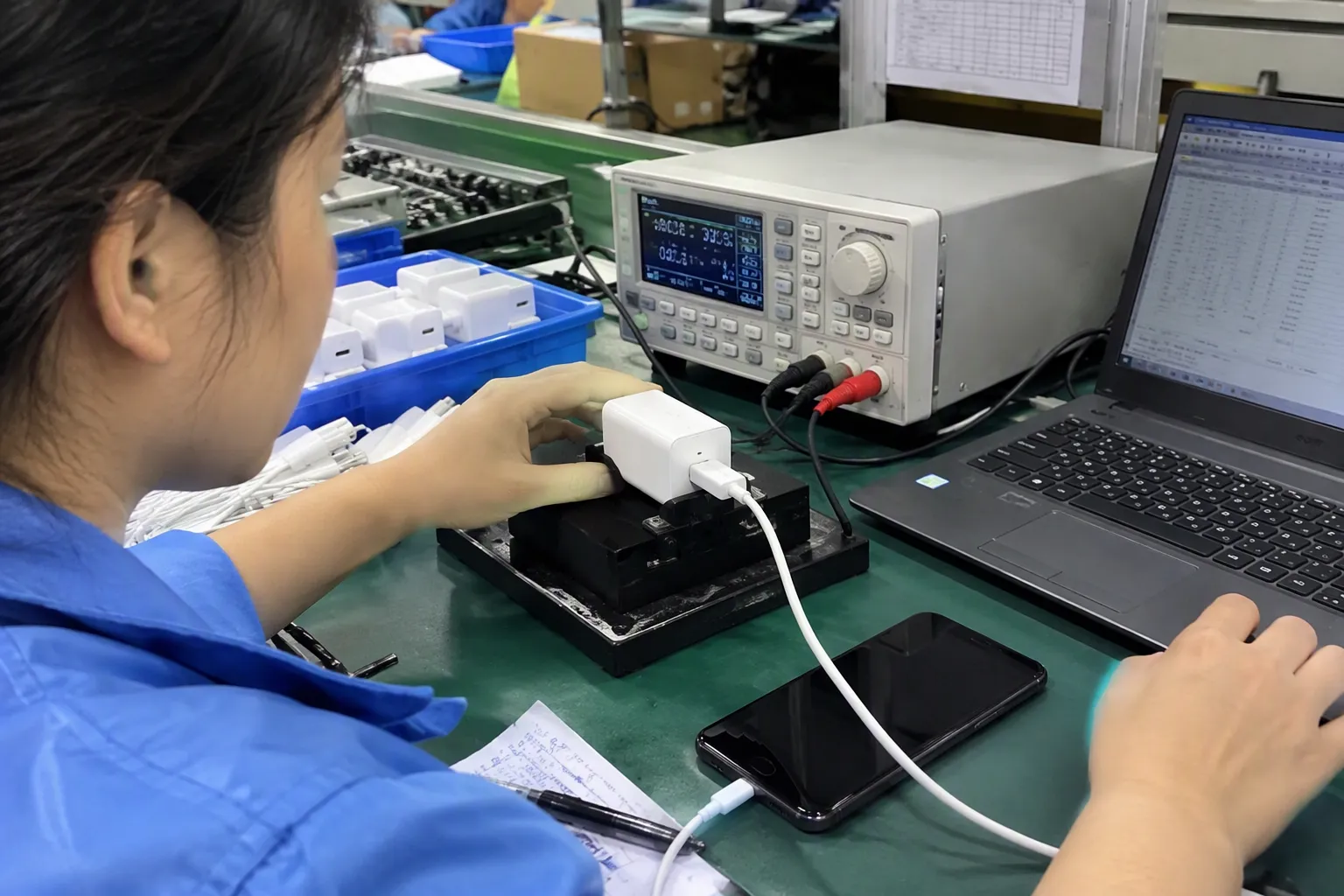
A real battery-powered device does not always draw a constant load.[8] Its power demand can change during charging. It may draw more power at one stage and less power later. A phone may also communicate with the charger differently from a tablet, laptop, or power bank.
An electronic load provides repeatability, but it may not reproduce every behavior of a real device. A real device provides application relevance, but it may be harder to repeat precisely. I prefer a report that clearly explains the choice and, where the application is important, considers both controlled load testing and representative device testing.
Test duration and stabilization
“Stable” should not be used without some explanation. The laboratory or supplier should define its stabilization criterion in the test procedure. A buyer may not need the full internal procedure, but the report should identify the duration or endpoint used.
Orientation and installation
A charger used directly in a wall socket may have a different orientation from a charger connected through an extension lead. A power adapter placed on a desk may have more exposed surface area than one installed behind furniture.
I ask customers to describe the intended installation. I then ask suppliers to test a condition that reasonably represents it. If the end use is uncertain, I would assess more than one orientation and clearly label the results.
Are There Universal Charger Surface Temperature Limits?
There is no single temperature value that I can responsibly present as a universal limit for every charger, housing material, product category, operating condition, and market. Applicable requirements can depend on the product’s construction, use, accessible surfaces, materials, and intended environment.
Why simple online limits can mislead buyers
Buyers often search for a maximum charger temperature and find a single number. That number may come from a different product type, a different standard edition, a different surface classification, or a different test method. It may also describe a recommendation rather than a formal requirement.
I recommend checking the current, applicable standard for the specific product. IEC standards may be researched through the IEC Webstore, while regional compliance information should be reviewed with the responsible conformity professional or test laboratory. Buyers should also verify whether national deviations, market rules, or product-specific requirements apply.
Accessible surfaces and user contact
The relevant evaluation may depend on which surfaces a user can touch during normal operation and foreseeable use. The external housing, plug, cable connection, and nearby surfaces may not have identical requirements or risk profiles.
The product’s instructions and intended use also matter. A charger designed for direct wall connection is evaluated differently from a desktop power supply with a separate cable. The assessment may consider normal operation and abnormal conditions, not only a steady-state surface reading.
I would therefore avoid writing “the charger is safe because the outside measured X degrees.” I would write that the sample recorded a certain result under stated conditions and that the result must be assessed against the applicable requirements.
Temperature, comfort, and safety are different questions
A customer may describe a charger as “too hot” because it feels uncomfortable. That feedback deserves attention, but it does not replace a technical assessment. A warmer surface may reflect high power conversion, limited housing area, or a particular load. A cooler surface may result from a lower test load or a different product design.
| Question | What it addresses |
|---|---|
| Does the result meet the applicable technical requirement? | Compliance and product safety assessment |
| Does the result suit the intended installation? | Procurement and application risk |
| Does the user perceive the product as acceptable? | Customer experience and returns |
How Can Buyers Review a Charger Temperature Report?
I review a report as a document, not only as a result. The document should let me identify the sample, understand the setup, follow the measurements, and connect the conclusion to a defined requirement.
Minimum information I would expect
- Product model and sample identification
- Rated input and output
- Test date
- Test location or responsible organization
- Input voltage and frequency
- Output load and active ports
- Charging protocol or operating mode
- Ambient conditions
- Product orientation and clearance
- Measurement locations
- Instrument or measurement method
- Start time and test duration
- Maximum, stabilized, or recorded values
- Photographs or diagrams where useful
- Applicable test procedure or standard reference
- Reviewer or approval information
Red flags in incomplete documentation
- “Tested at full load”
- “Normal temperature”
- “Passed temperature test”
- “Maximum temperature is safe”
- “Tested for a long time”
- “Used a professional instrument”
- “Compliant with all standards”
A practical scoring approach
| Review level | Evidence | Procurement interpretation |
|---|---|---|
| Preliminary | One reading with limited conditions | Useful for initial discussion only |
| Basic | Load, ambient condition, duration, and location stated | Supports supplier comparison with caution |
| Strong | Repeatable method, instrument details, multiple conditions, clear conclusion | Better support for approval and customer communication |
| Application-specific | Qualified laboratory assessment for the exact product and use | Most appropriate where risk or market requirements are significant |
Questions I would send to a supplier
- What input voltage and frequency did you use?
- What output power and port combination did you apply?
- Did the product operate in a fast-charging mode?
- How long did the test run?
- Did you record the value after stabilization?
- Where did you measure the surface?
- What instrument and method did you use?
- What was the ambient temperature?
- Was the charger tested in its intended orientation?
- Which requirement or internal specification supports the conclusion?
Is a Warmer Charger Automatically a Quality Problem?
A warmer charger is not automatically defective, and a cooler charger is not automatically superior. I evaluate temperature together with delivered power, efficiency, load, construction, reliability evidence, and intended use.
Normal operating warmth versus a documentation problem
- The product temperature rises continuously without a defined endpoint.
- Different samples show large unexplained differences.
- The housing, plug, cable, or port shows discoloration or deformation.
- The charger repeatedly stops, restarts, or reduces output unexpectedly.
- The reported test load does not match the product’s advertised output.
- The supplier cannot explain the measurement method.
- Production units differ from the approved sample.
- Customer complaints appear under a use condition that the supplier never tested.
Why cooler is not always better
- Lower output load
- Shorter test duration
- Lower ambient temperature
- More airflow
- Different orientation
- A different charging protocol
- Lower delivered power
- A design that transfers heat to another area
- Measurement error
I also consider the commercial product promise. A compact charger with a high rated output may have different trade-offs from a larger, lower-powered adapter. The comparison should include performance and use case, not only the outside temperature.
Linking temperature to quality control
- Approved sample photographs
- Model and component information
- Agreed output test
- Visual and dimensional checks
- Functional charging checks
- Temperature verification where appropriate
- Packaging and labeling requirements
- Defect classification
- Corrective-action procedure
The factory’s quality team may use a different sampling plan from the buyer’s inspection company. I ask both sides to record the conditions so that a dispute does not become an argument about subjective words.
How Should Suppliers Report Charger Surface Temperature?
A supplier’s report should help a buyer make a decision without requiring the buyer to guess what happened during the test. I prefer a concise report with a clear test matrix, photographs, and a conclusion that stays within the evidence.
Recommended report structure
1. Product identification
2. Test purpose
3. Test conditions
4. Results
5. Observations
6. Assessment
Explain whether the result meets the defined internal criterion or requires review against an applicable standard. The writer should avoid a broad certification statement unless an authorized body made that determination.
Example of a useful result table
| Condition | Input | Output/load | Duration | Measurement point | Result type |
|---|---|---|---|---|---|
| A | Stated value | Single-port stated load | Stated time | Housing center | Stabilized value |
| B | Stated value | Maximum relevant port combination | Stated time | Highest observed point | Maximum value |
| C | Stated value | Representative device or protocol | Charging cycle or defined period | Housing and port area | Recorded range |
Avoid overclaiming in customer documents
The product was evaluated under the conditions described in the supplier’s test report. Surface temperature varies with input, load, charging mode, ambient conditions, and installation. Users should follow the product instructions and avoid covering the charger during operation.
Keep records across revisions
- Supplier declaration and technical documents
- Test reports
- Approved sample records
- Batch or lot information
- Inspection reports
- Customer complaints
- Corrective actions
- Revised reports after design changes
A change in IC, transformer, housing, firmware, plug, or power allocation may justify a new review. I ask the supplier to notify the buyer before making changes that could affect performance or compliance.
How Does Temperature Testing Fit into Charger Supplier Selection?
Temperature evidence is one part of a broader sourcing decision. I also assess whether the supplier can control production, explain deviations, provide consistent documents, and support the buyer after shipment.
Compare suppliers on evidence, not promises
| Supplier factor | Questions for the buyer |
|---|---|
| Product consistency | Does the production sample match the approved sample? |
| Test transparency | Are load, duration, and measurement points stated? |
| Certification documents | Are documents current, traceable, and relevant to the exact model? |
| Manufacturing control | Does the supplier control incoming parts and final inspection? |
| Customization | Can the supplier document changes to plug, label, housing, or output? |
| Delivery reliability | Can the supplier meet the required lead time at the agreed MOQ? |
| After-sales support | Does the supplier investigate heating complaints with evidence? |
| Communication | Can the supplier answer technical questions precisely? |
Certifications and laboratory reports are important documents, but I ask buyers to verify their scope, validity, issuing organization, model coverage, and applicable market. I do not treat a logo or a certificate copied into a product listing as a substitute for document review.
Build temperature questions into the RFQ
- Rated input and output information
- Typical and maximum operating modes
- Available temperature reports
- Test conditions and duration
- Applicable standard references
- Sample availability
- Production lead time
- MOQ and customization options
- Warranty and complaint procedure
- Notification process for design changes
When I would request independent testing
- The product has a high power rating.
- The charger will be sold under a private label.
- The product will be used in demanding environments.
- The supplier’s documents are incomplete or inconsistent.
- A design has changed materially.
- The buyer has received repeated heating complaints.
- The target market or retailer requires third-party evidence.
- The product will be bundled with another device or system.
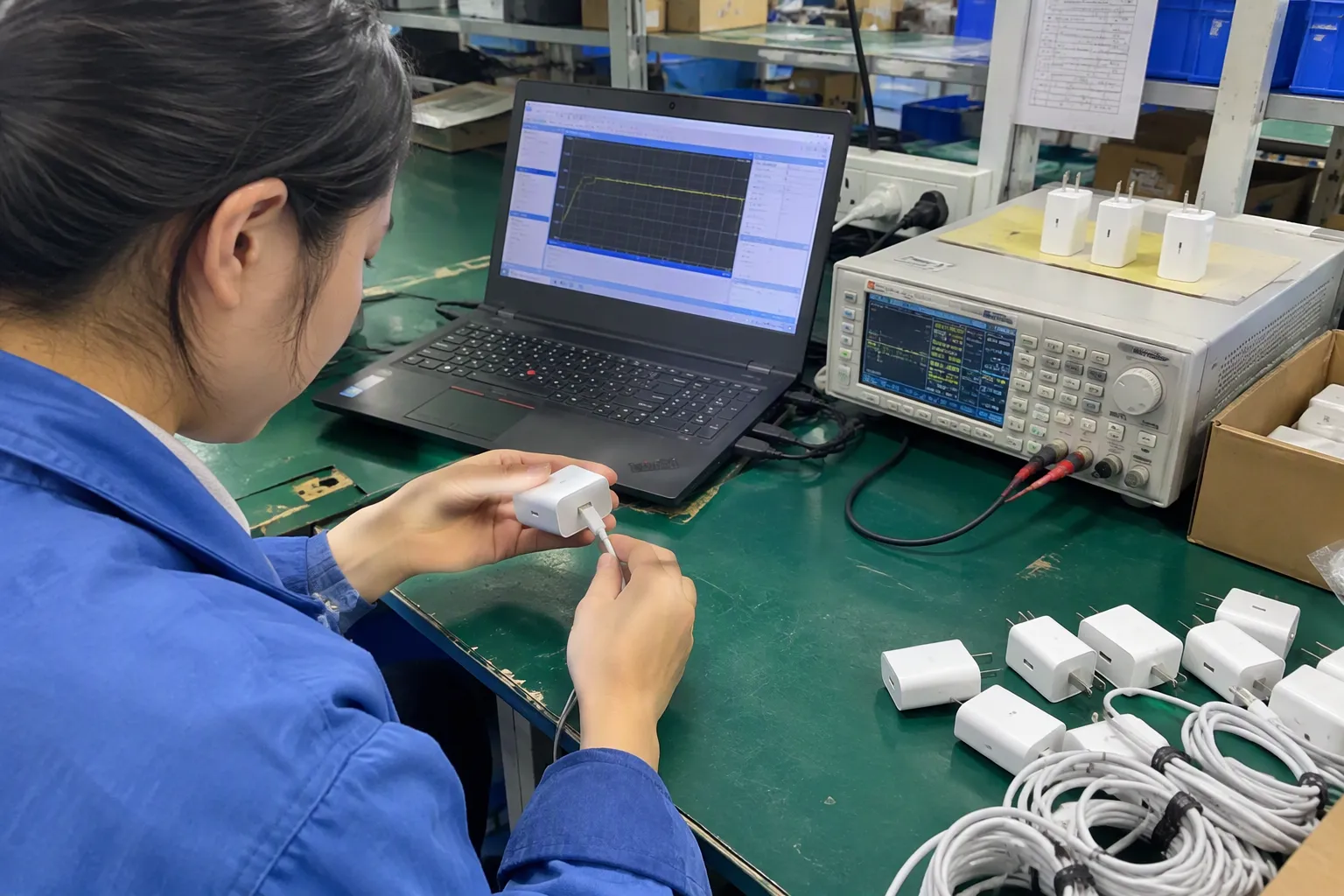
The appropriate scope should come from a qualified laboratory or professional evaluator. I can help organize supplier documents and questions, but I do not present sourcing experience as a substitute for laboratory testing or certification authority.
Frequently Asked Questions
What is the most important information in a charger temperature report?
I first look for the input condition, output load, charging mode, test duration, ambient temperature, measurement location, and measurement method. I also check whether the tested model and hardware version match the product being purchased. Without those details, I treat the reported temperature as preliminary evidence.
Is it normal for a USB charger to become warm?
A charger may become warm while delivering power, but the observation should be assessed against the applicable product requirements and intended use. I do not use “warm” or “hot” as technical conclusions. I ask for controlled measurements and investigate unusual behavior such as continuous temperature rise, interruption, damage, or inconsistent samples.
Should buyers test a charger at full load?
Buyers should consider the highest relevant intended load, but the exact test plan depends on the product, rated output, charging modes, and applicable requirements. I recommend documenting the load and port combination rather than using the phrase “full load” without explanation.
Can an infrared thermometer provide a reliable charger temperature reading?
An infrared thermometer can be useful when the operator controls distance, angle, focus, emissivity, and measurement location. Different surfaces may produce different readings. I recommend following the instrument and laboratory procedure and using a qualified evaluator when the result supports a formal compliance or safety decision.
What should I do if the supplier refuses to provide test conditions?
I would ask the supplier to provide a basic test matrix and explain that the buyer needs comparable evidence for procurement and customer support. If the supplier still provides only a single unsupported number, I would treat the documentation as insufficient and consider an independent test or another supplier.
Conclusion
Charger Surface Temperature Testing is most useful when it explains the conditions behind the result. I recommend checking load, input, charging mode, duration, ambient environment, orientation, measurement location, and instrument method before comparing suppliers or answering customer concerns. I also remind buyers that a lower number does not automatically prove higher quality. For reliable sourcing, I can help international retailers, wholesalers, and e-commerce sellers organize charger specifications, supplier documents, sampling questions, MOQ, customization, and after-sales requirements before they place an order.
Sources
- Next-Generation Power Electronics: Reducing ...", Technical literature on power converters describes heat generation as a consequence of conversion losses during operation, supporting the distinction between ordinary operating warmth and evidence of a defect
- household appliances", International product-safety frameworks assess accessible temperatures in relation to the equipment category, intended use, and relevant construction requirements rather than applying one temperature value to all chargers
- Metrological Traceability: Frequently Asked Questions and ...", Metrology guidance emphasizes that measurements must be associated with defined procedures, conditions, and uncertainty information before results can be meaningfully compared or used for technical decisions
- Measurement Uncertainty of Surface Temperature ...", Studies of electronic enclosures show that component heat sources, enclosure geometry, and local heat-transfer conditions produce nonuniform external temperature fields, making measurement location material to the reported result
- 7.0 Thermal Control", Thermal-design literature distinguishes internal semiconductor or component temperatures from case and ambient temperatures, supporting the conclusion that an enclosure reading alone cannot characterize all internal thermal stresses
- Test Facility for Determining the Seasonal Performance of ...", Research on power-converter thermal behavior reports that operating losses and component temperatures vary with delivered load, supporting the need to state load conditions when interpreting surface-temperature results
- Uncertainty of temperature measurements by infrared ...", Thermometry guidance identifies emissivity, viewing geometry, calibration, and probe contact as factors that can affect measured temperature, supporting the requirement to document the instrument and method
- Introduction Defining Continuous Use Products Containing ...", Battery-charging research describes changing current and power demand across charging stages, supporting the observation that a real device may not impose a constant load on its charger