USB cables can look simple, but a wrong specification can create compatibility complaints, returns, and delayed sales. I have found that buyers reduce these risks when they first define the device, charging or data task, required performance, verification documents, and delivery expectations before comparing supplier prices.
Quick Answer
- Confirm the devices, ports, use case, and required protocol before requesting quotations.
- Do not treat “USB-C” as a complete specification for charging power, data speed, or compatibility.
- Ask for clear details about cable construction, length, connectors, rated performance, packaging, and testing.
- Review certificates and test reports as supporting documents, then validate samples with representative devices.
- Compare suppliers by total commercial risk, including consistency, MOQ, lead time, claims handling, and after-sales support.
Before ordering USB cables, B2B buyers should confirm the intended devices, charging and data requirements, connector configuration, rated performance, compliance documents, sample results, production consistency, MOQ, lead time, and after-sales terms. A USB-C connector alone does not prove fast charging, high-speed data transfer, or universal compatibility.
I often see the same issue during pre-sales communication: a buyer asks for “a USB-C cable” and expects a useful quotation immediately. That request describes the connector, but not the product’s complete function. The questions below show how I would turn a short product request into a clearer sourcing brief. Our USB cable manufacturer overview and our review of 7 things buyers overlook when ordering USB cables show how that brief feeds into a production-ready specification.
Why Do USB Cables Require More Questions Before Ordering?
A cable may pass a basic connection check and still fail the buyer’s commercial purpose. A retailer may need a dependable charging cable, while an e-commerce seller may need a cable that also supports data transfer. If I quote before understanding that difference, the lowest unit price can become the most expensive option after returns and complaints.
What is the first question I should ask?
I start by asking which devices the cable will connect and what the customer expects it to do. I then separate charging, data transfer, video-related use, durability, packaging, and delivery requirements. This simple process helps me avoid treating the connector name as the whole product specification.
- Which device is on each end?
- Which port does each device use?
- Is the cable for charging, data, or both?
- What charger, power source, computer, or accessory will be used?
- Does the customer need a named charging or data protocol?
- What cable length, jacket material, color, and packaging are required?
- What quantity, target market, MOQ, and delivery date apply?
The answer does not need to be highly technical at the beginning. A product link, device model, existing cable photo, or basic use description can help me understand the request. For example, “a cable for charging our branded power bank from a wall charger” gives me more useful information than “one USB-C cable.”
Why does the device matter?
USB-C describes a connector shape and connection system.[1] It does not automatically state the power capability, data capability, construction, or performance of a particular cable.[2] The connected devices, charger, cable, and relevant protocol all influence the final result.[3]
A cable can have USB-C connectors on both ends but still be unsuitable for a buyer’s intended application. Another cable may have a USB-A connector on one end and USB-C on the other because the target charger or computer still uses USB-A. I therefore avoid recommending a cable based only on the newer-looking connector.
A practical information request
| Requirement | Buyer’s information |
|---|---|
| Source device | Phone, tablet, laptop, power bank, earbud case, or other product |
| Destination device | Charger, computer, car charger, hub, or accessory |
| Main use | Charging, data transfer, synchronization, or mixed use |
| Connector combination | USB-A to USB-C, USB-C to USB-C, or another combination |
| Length | Required and acceptable range |
| Target performance | Confirmed power, data, or protocol requirement |
| Market | Country or sales region |
| Commercial needs | MOQ, packaging, branding, target price, and delivery date |
Which USB Cable Specifications Should Buyers Confirm?
Buyers should confirm the connector combination, electrical rating, data capability, length, materials, and intended protocol separately. I recommend writing these items into the quotation request and purchase order instead of relying on a general term such as “fast cable” or “premium cable.”
Connector configuration
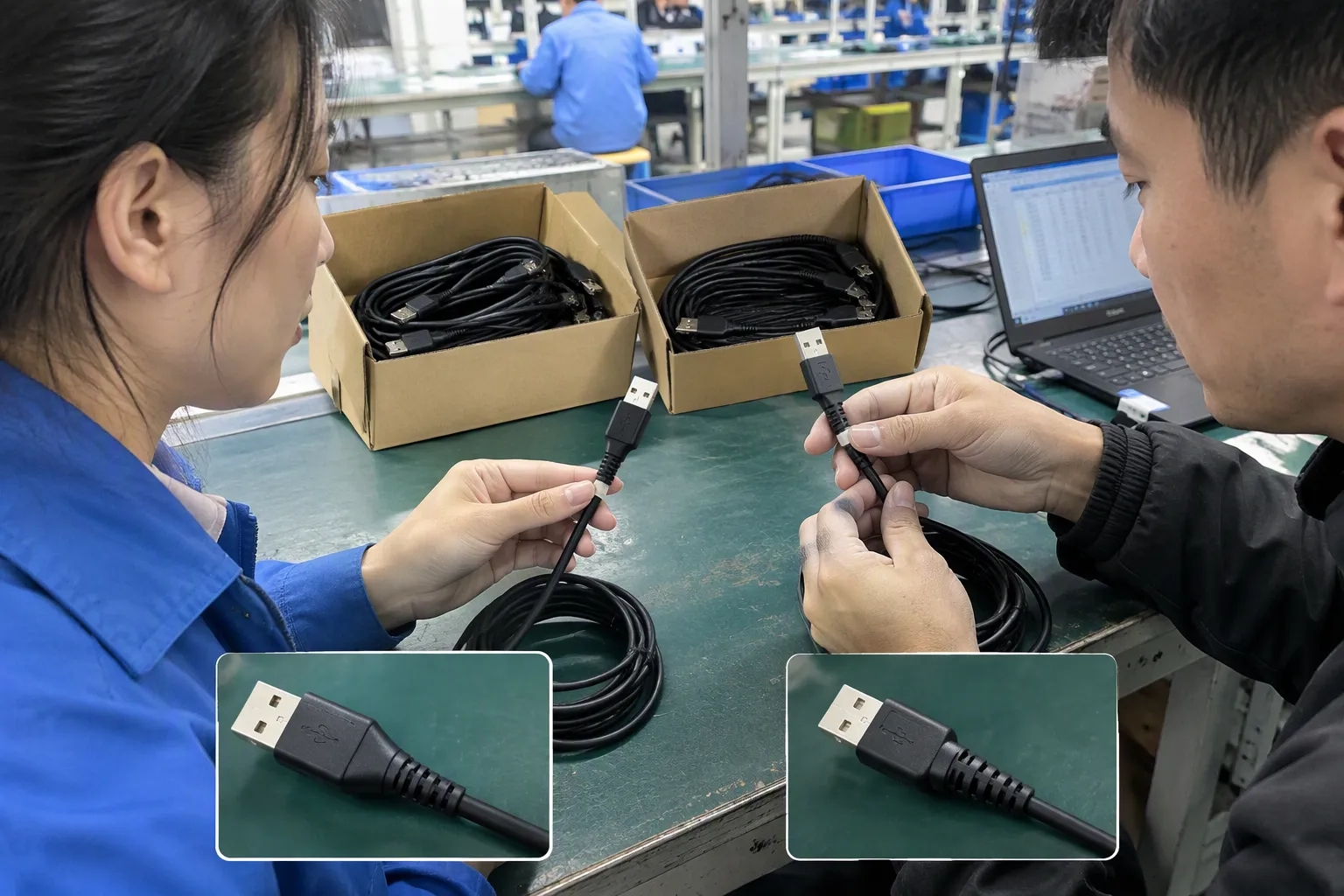
The buyer should also clarify whether either end is a plug, adapter, or special connector. A USB-C to USB-C cable may be appropriate for one charging setup, but a USB-A to USB-C cable may be necessary for another.
Charging requirements
I ask buyers to state the required charging application rather than only using “fast charging.” They should identify the charger, target device, expected power range, and any relevant charging protocol. The cable’s stated capability must be considered together with the charger and device. A high-rated charger cannot make every cable deliver the same result.[5]
The buyer should request the supplier’s claimed limits in writing and verify whether the claim applies to the complete cable model, not just a similar item in a catalogue. I also treat marketing terms carefully. “High power” and “quick charge” are not enough for a technical purchase order[6] unless the parties define them.
Data transfer requirements
Some buyers only need charging. Others need file transfer, synchronization, connection to a computer, or use with a peripheral. These applications can require different data performance. A cable that charges a device may not provide the data capability that the customer expects.[4]
- Will the end user transfer files through the cable?
- Will the cable connect a phone to a computer?
- Will the buyer market the cable for a specific data speed?
- Does the target device require a particular USB generation or function?
- Does the supplier have documentation for the claimed data performance?
Construction and physical design
- Cable length and tolerance
- Conductor and insulation construction
- Outer jacket material
- Strain relief design
- Connector housing
- Plug insertion and removal feel
- Bending expectations
- Color and surface finish
- Logo printing or laser marking
- Retail or bulk packaging
I do not use a material label alone as proof of durability. For example, braided fabric can affect appearance and handling, but it does not independently prove the life of the finished cable.[7] Buyers should connect material claims with sample inspection and an agreed quality standard.
A comparison I use during quotation discussions
| Buyer phrase | What I still need to clarify |
|---|---|
| “Fast charging cable” | Target device, charger, power requirement, and relevant protocol |
| “High-speed USB-C cable” | Required data performance and intended devices |
| “Durable braided cable” | Jacket, strain relief, sample standard, and inspection method |
| “Universal cable” | The exact device list and limitations |
| “One-meter cable” | Length tolerance, connector dimensions, and packaging |
| “Same as our current item” | Current sample, drawings, photos, and measurable requirements |
This clarification may take a few extra messages, but it usually saves time later. I have seen quotation discussions become much easier when the buyer sends a sample or a clear product link. The supplier can then distinguish a replacement request from a new technical design.
How Can Buyers Check USB Cable Compatibility?
Buyers can check compatibility by mapping the complete connection, confirming the intended charging or data function, reviewing supplier documents, and testing samples with representative devices. I recommend checking both normal operation and the limitations that should appear in the product description.
1. Mechanical compatibility
The plug must fit the device port correctly. The housing should not interfere with a phone case, recessed port, protective cover, or nearby connector. Buyers should inspect the plug dimensions and use the cable with the accessories that end users will actually use.
2. Functional compatibility
The cable must perform the intended task. Charging, data transfer, synchronization, and connection to accessories are not automatically identical functions. I ask buyers to identify the task for each product listing and each sales channel.
A cable can be mechanically compatible while failing to meet the expected data function. It can also connect two devices while delivering a result that falls below the buyer’s advertised performance. This is why I advise buyers to align product titles, packaging, specifications, and actual sample behavior.
3. System compatibility
The cable operates within a system that includes the source, charger, device, software, and sometimes an adapter or hub. A buyer should consider the complete chain rather than testing the cable in only one convenient setup.
- The most common charger used by the target customer.
- The target phone, tablet, laptop, earbud case, or power bank.
- The intended computer or data source, if data transfer matters.
- A second device from the same sales category.
- The customer’s preferred protective case or accessory.
I would document what was tested, which result was observed, and what was not tested. A sample test does not prove that every possible device will work.[8] It gives the buyer evidence within a defined boundary.
What should I request from a supplier?
I would request a written specification sheet, sample, packaging information, and available compliance or testing documents. If the supplier claims a specific protocol or performance level, I would ask the supplier to identify the relevant model and supporting document.
- Is the sample from the same model and material planned for mass production?
- Does the stated performance apply to the full length and connector combination?
- Are there design variants under the same catalogue name?
- What changes require buyer approval?
- How does the supplier control material and batch consistency?
- What inspection records can the supplier provide for the order?
Certification is not the same as universal compatibility
A certificate or test report can support a compliance assessment, but it does not prove that a cable works with every device. Buyers should review the document’s scope, model reference, issuing organization, date, and applicable requirements. They should also verify whether the document belongs to the offered product rather than a visually similar item. For a fuller checklist of the documents to request, see what certifications and specifications matter for USB cable buyers.
The USB Implementers Forum provides information about USB specifications and the USB-IF compliance program at usb.org. Buyers can also review relevant safety and market requirements through official government or standards sources, such as the European Commission’s product safety information and the U.S. Consumer Product Safety Commission. I treat these sources as reference points, not as substitutes for product-specific legal advice.
What Quality Questions Should Buyers Ask USB Cable Suppliers?
Buyers should ask how the supplier controls incoming materials, assembly, testing, inspection, packaging, and batch changes. I also recommend asking for an agreed sample standard and a clear process for handling nonconforming goods.
Incoming materials
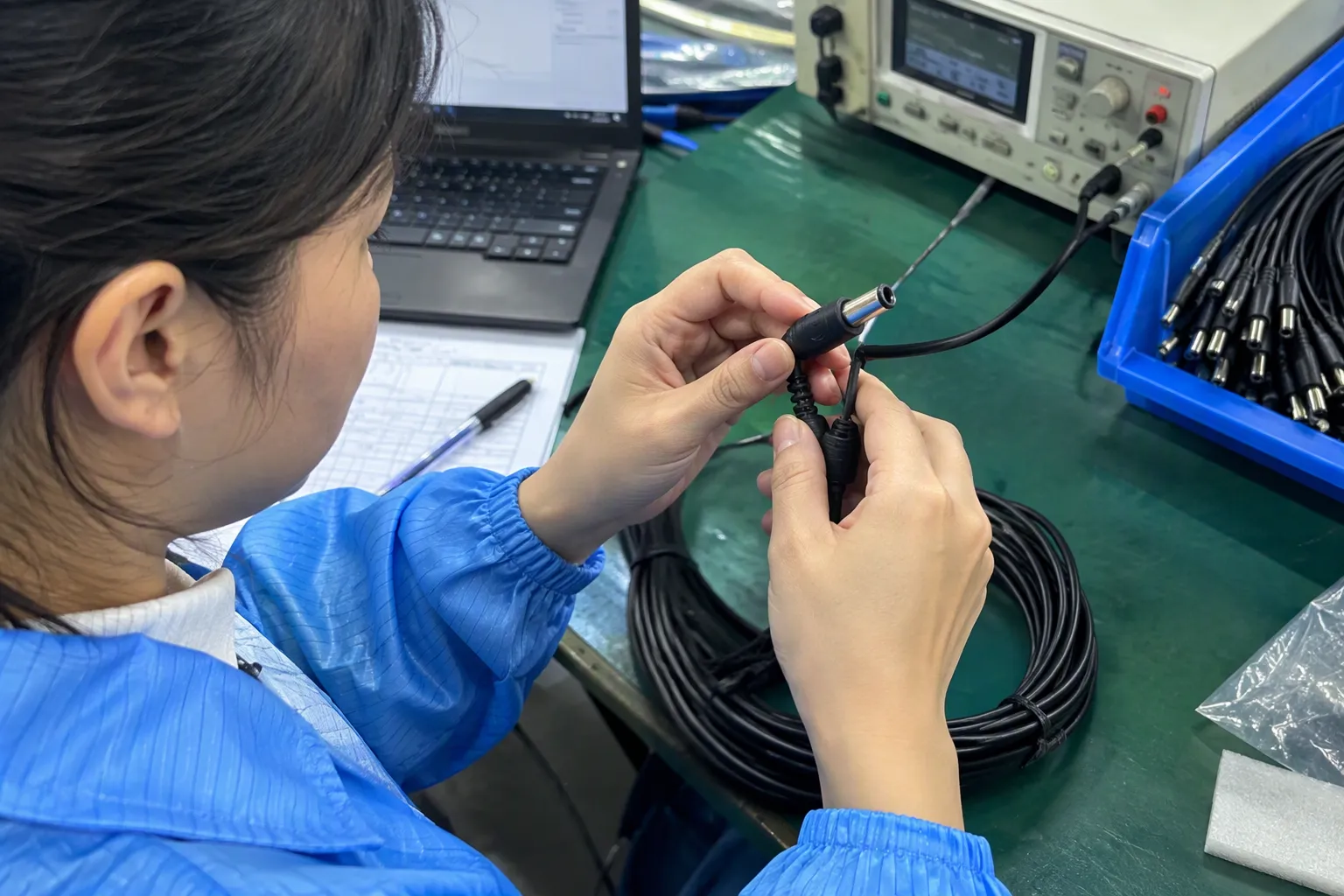
The supplier should be able to explain how it identifies important materials and components. The buyer can ask about connector parts, conductors, insulation, jacket materials, terminals, and packaging components. The buyer does not always need a confidential bill of materials, but the supplier should provide enough information to confirm that the offered product matches the approved sample.
Assembly controls
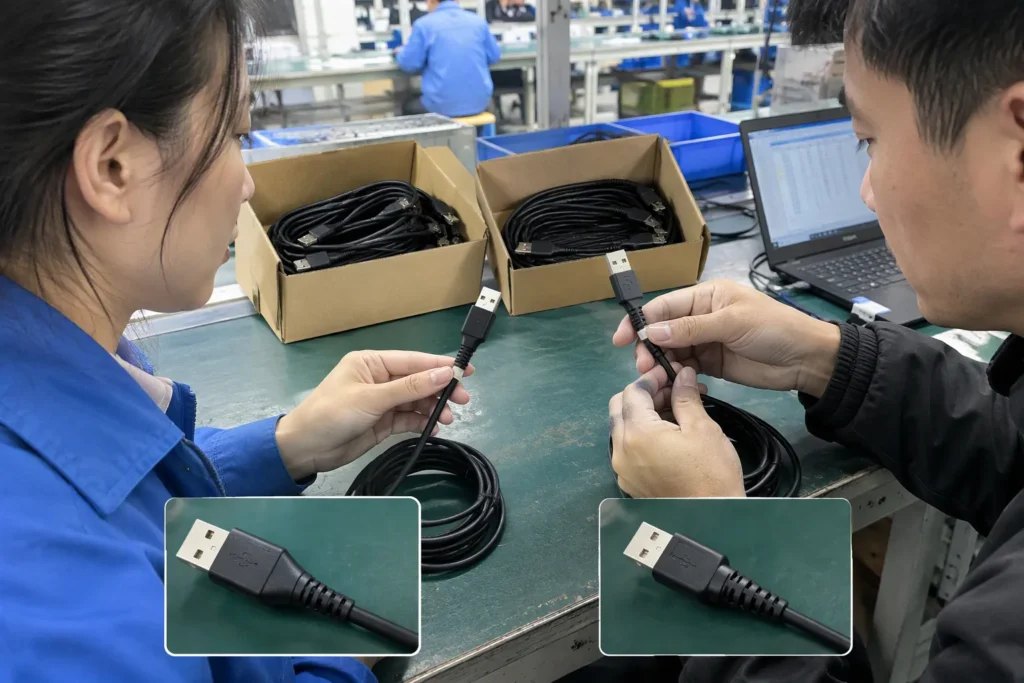
Cable quality can depend on crimping, soldering, molding, welding, assembly alignment, and strain relief. A buyer can ask which stages receive inspection and what defects are checked. The buyer can also ask how the supplier separates approved goods from rework or rejected goods.
Testing and inspection
I ask suppliers to distinguish between 100% checks, sampling inspections, and tests performed only during development. The distinction matters. A design validation report does not necessarily describe every production batch.
- Continuity and open-short checks
- Connector appearance and fit
- Charging or data function, where applicable
- Cable length and labeling
- Pull or bending evaluation according to an agreed method
- Packaging quantity and barcode accuracy
- Cosmetic defects and printing quality
Batch consistency
A buyer may receive a good sample and a different mass-production result if the supplier changes materials, subcontractors, tooling, or production lines without approval. I recommend adding a change-notification expectation to the purchase discussion.
- Approved sample and reference photos
- Key dimensions and tolerances
- Required performance claims
- Acceptable cosmetic limits
- Packaging and labeling
- Inspection timing
- Defect classification
- Remedy or replacement process
- Approval rules for material or design changes
A supplier quality comparison
| Evaluation area | Basic supplier question | Buyer’s useful evidence |
|---|---|---|
| Materials | What materials and components are used? | Specification sheet or approved sample |
| Production | Which factory and line will produce the order? | Factory information and production confirmation |
| Testing | What does the supplier test, and when? | Test records or inspection plan |
| Consistency | How are batch changes controlled? | Change-notification process |
| Documents | Which reports apply to this exact model? | Verifiable product-specific documents |
| Claims | What are the performance boundaries? | Written specification and sample validation |
| Complaints | How are defects handled? | Written after-sales terms |
In my sales communication, I try to answer these questions without overstating what a document proves. Buyers should independently verify important certificates, reports, and factory claims before using them in customer-facing marketing.
How Should Buyers Compare USB Cable Quotes?
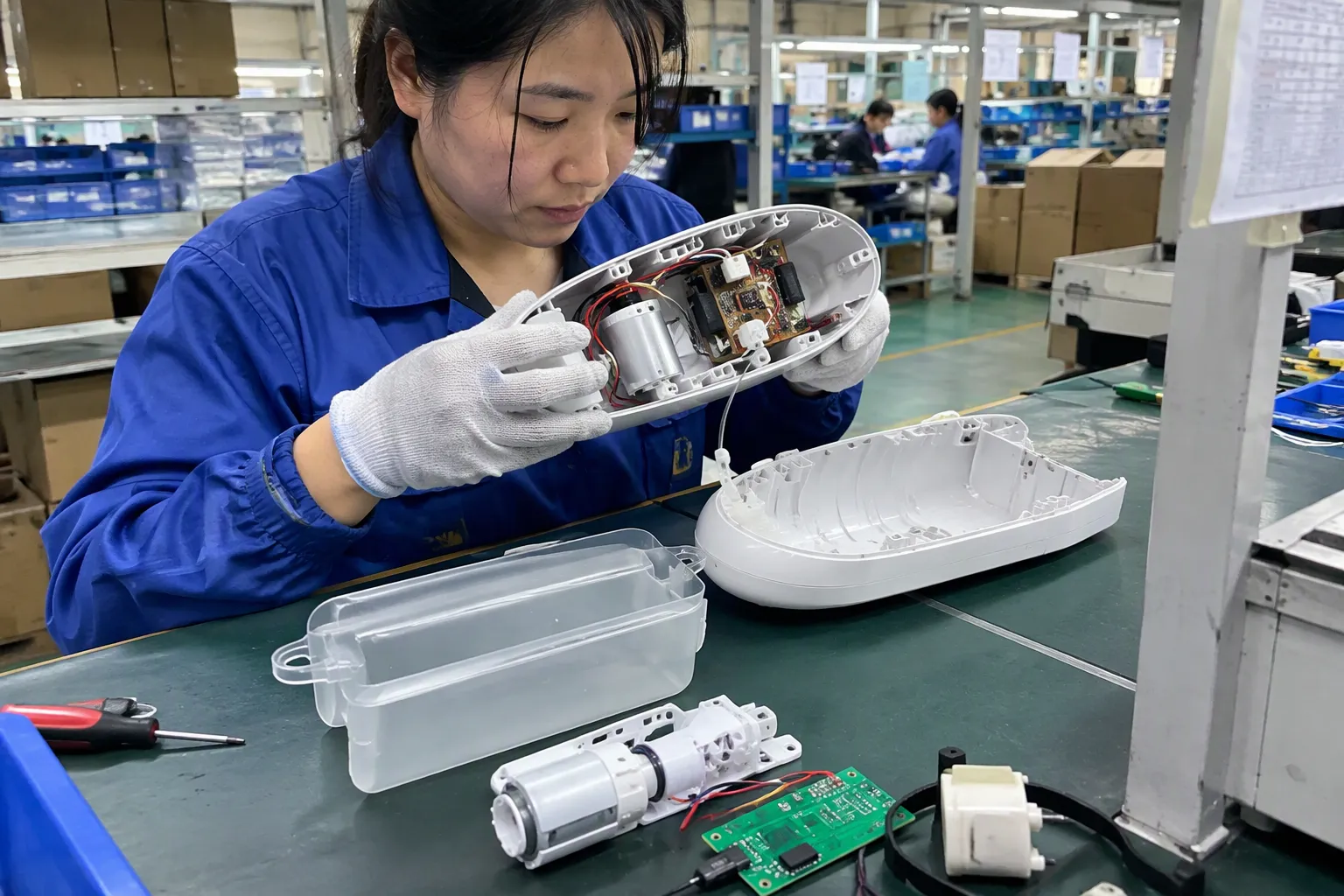
Buyers should compare equivalent specifications and calculate total procurement risk rather than selecting the lowest unit price. I recommend comparing product performance, sample quality, MOQ, lead time, packaging, payment terms, inspection, and after-sales support in one table.
A low quotation can be useful, but it is meaningful only when the quoted products are genuinely comparable. One supplier may quote a basic charging cable while another includes a different construction, packaging method, or data function.
Build a like-for-like quotation sheet
| Item | Supplier A | Supplier B | Supplier C |
|---|---|---|---|
| Exact model and connector combination | |||
| Confirmed charging or data requirement | |||
| Length and tolerance | |||
| Materials and appearance | |||
| Sample status | |||
| MOQ | |||
| Unit price and price basis | |||
| Packaging and branding cost | |||
| Production lead time | |||
| Inspection option | |||
| Warranty or claim process |
This table often exposes hidden differences. A supplier may offer a lower unit price but require a higher MOQ. Another supplier may have a longer lead time but offer more stable packaging support. A third may provide a better sample while needing clarification on documentation.
Think about total cost
- Freight and customs-related costs
- Packaging or artwork fees
- Sample and tooling charges
- Inspection costs
- Warehouse handling
- Replacements
- Refunds and customer service
- Lost marketplace ranking or retail shelf confidence
- Delayed launch or replenishment
I would not assign invented percentages to these risks because the impact differs by channel. A small defect rate can be serious for a high-volume retailer, while a niche e-commerce seller may care more about packaging and product reviews.
Delivery and forecasting
USB cables are often replenishment products. A buyer should ask about production lead time, material availability, holiday capacity, inspection timing, and shipping plan. The buyer should also clarify whether the stated lead time begins after deposit, artwork approval, sample approval, or another milestone.
How Do MOQ, Customization, and After-Sales Terms Affect USB Cable Orders?
MOQ, customization, and after-sales terms affect the real suitability of a cable supplier because they determine how easily the buyer can test, launch, replenish, and resolve problems. I recommend discussing these commercial terms at the same time as the technical specification.
MOQ and market testing
A retailer or online seller may want a small first order to test customer response. A wholesaler or chain store may need a larger volume and stricter packaging control. I therefore ask about the buyer’s sales plan before recommending an MOQ.
- Minimum quantity per model
- Minimum quantity per color
- Minimum quantity per logo or package
- Mixed-model ordering options
- Reorder quantity
- Price breaks
- Sample availability
- Small-batch production conditions
Customization
Customization can include logo printing, cable color, connector housing, braided pattern, retail box, label, barcode, insert, and outer carton. The buyer should define which elements are essential for the first order. Buyers who need private-label options can review our custom USB cables capabilities before finalising the brief.
- Logo file format and color requirements
- Printing method and position
- Artwork approval process
- Pantone or color reference, if relevant
- Packaging dimensions
- Barcode ownership and verification
- Language requirements
- Master carton marks
- Sample approval before production
After-sales and claims
A supplier should explain how the buyer reports defects, what evidence is required, and how the parties decide whether a claim is valid. A good process may include photos, videos, batch information, sample returns, and an agreed response time.
- What is the warranty or claim period?
- Does it begin at shipment, delivery, or customer sale?
- Which defects are covered?
- How are shipping costs handled?
- Will the supplier replace, credit, repair, or refund?
- How does the supplier investigate repeated complaints?
- What happens if packaging or labeling is incorrect?
Supplier communication as a selection factor
I consider communication quality part of supplier evaluation. If a supplier cannot clearly answer basic questions about the exact model, I become cautious about more complex claims. Clear communication does not replace factory verification, but it helps identify misunderstandings before payment.
I also recommend that buyers keep one approved specification file. The file should include the quotation, sample photos, technical sheet, packaging artwork, inspection requirements, and change approvals. This record helps both sides discuss the same product during repeat orders.
What Should a Buyer Include in a USB Cable Purchase Order?
A buyer should include measurable product requirements, approved references, packaging details, inspection terms, delivery milestones, and claim procedures in the purchase order. I do not recommend relying only on a catalogue title or a message that says “same as sample.”
Product identity
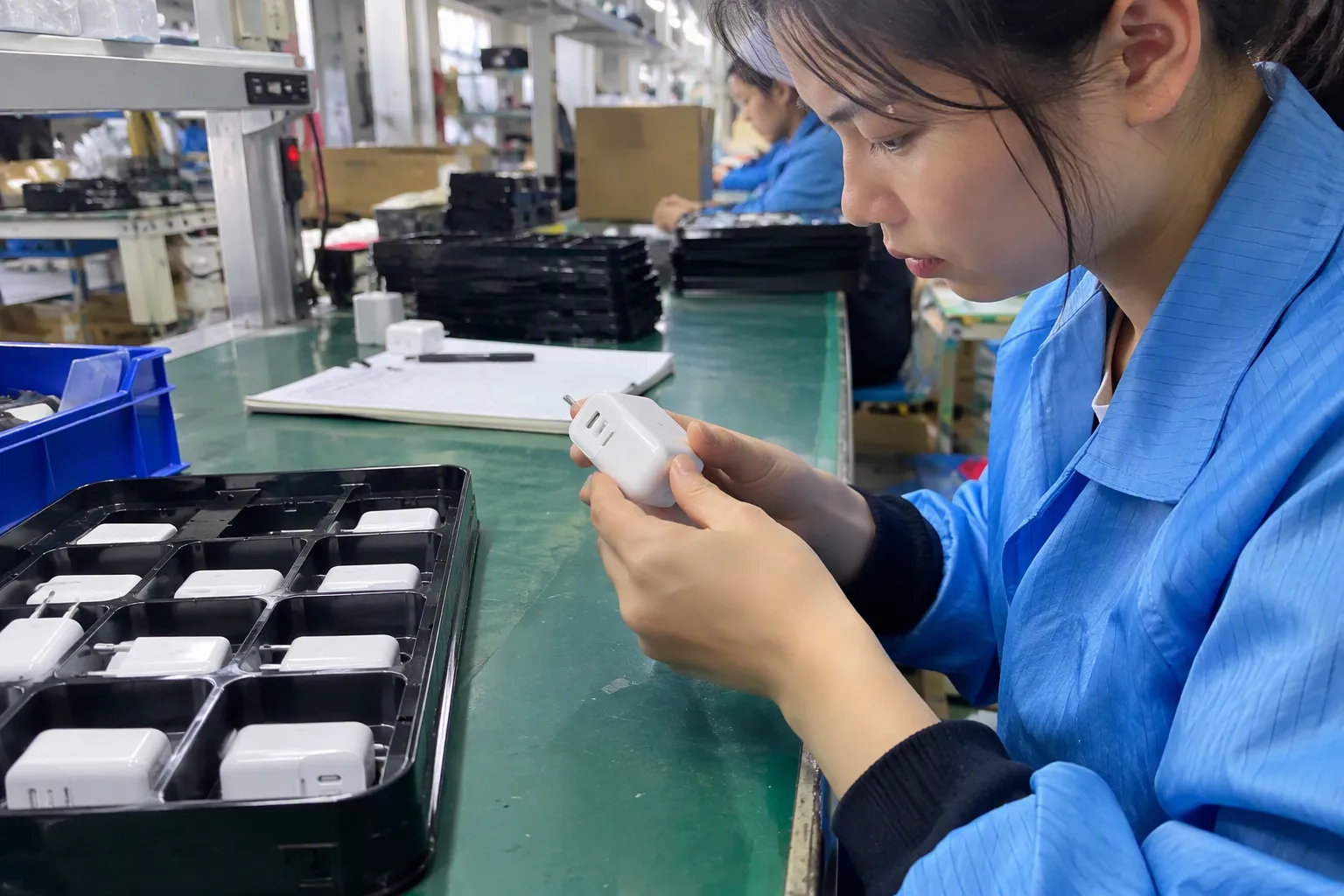
The order should state the model number, connector combination, color, length, quantity, and packaging. If the supplier uses several similar models, the buyer should identify the exact version and attach photos or a sample reference.
Performance and limitations
The order should state the agreed charging or data claims and any important limitations. The wording should remain accurate. If a buyer does not require data transfer, the order should not accidentally advertise a data capability that was never confirmed.
Quality reference
The buyer can reference an approved sample, drawing, specification sheet, golden sample, or inspection standard. The buyer should distinguish critical defects from minor cosmetic variation. The parties should agree how inspection will occur and who will perform it.
Packaging and labeling
Retail buyers should specify packaging language, barcode, country-of-origin information where applicable, warning text, carton quantity, and shipping marks. The buyer should verify market-specific obligations with qualified compliance professionals. I do not treat a supplier’s general statement about compliance as a complete legal assessment.
Delivery and remedies
The order should identify the required delivery date, shipment method, destination, payment milestones, and response process for nonconforming goods. Clear terms protect both sides because each party understands what happens when the goods differ from the approved requirements.
Frequently Asked Questions
Is USB-C enough information to order USB cables?
No. USB-C identifies a connector type, but it does not by itself define charging power, data speed, cable length, construction, protocol support, or compatibility with every device. I recommend confirming both ends, the application, connected equipment, performance requirement, and exact product model before ordering.
Are USB-C to USB-C cables always faster than USB-A to USB-C cables?
Not automatically. The connector combination can support different product designs, but actual charging and data performance depends on the cable, connected devices, charger, protocol, and applicable specification. I ask buyers to verify the claimed performance for the exact model instead of assuming that USB-C on both ends guarantees a result.
Should buyers request certificates for USB cables?
Buyers should request relevant certificates and test reports, but they should verify the document scope and product reference. A certificate may support compliance for a defined product or requirement. It does not prove universal compatibility or guarantee that every production batch performs identically.
How can a buyer test a USB cable sample?
The buyer should test the sample with representative chargers, target devices, computers, cases, and accessories. The buyer should record whether the cable performs the intended charging or data function and note the tested conditions. Sample testing provides useful evidence, but it does not replace production inspection or professional technical evaluation.
What is more important: USB cable price or supplier quality?
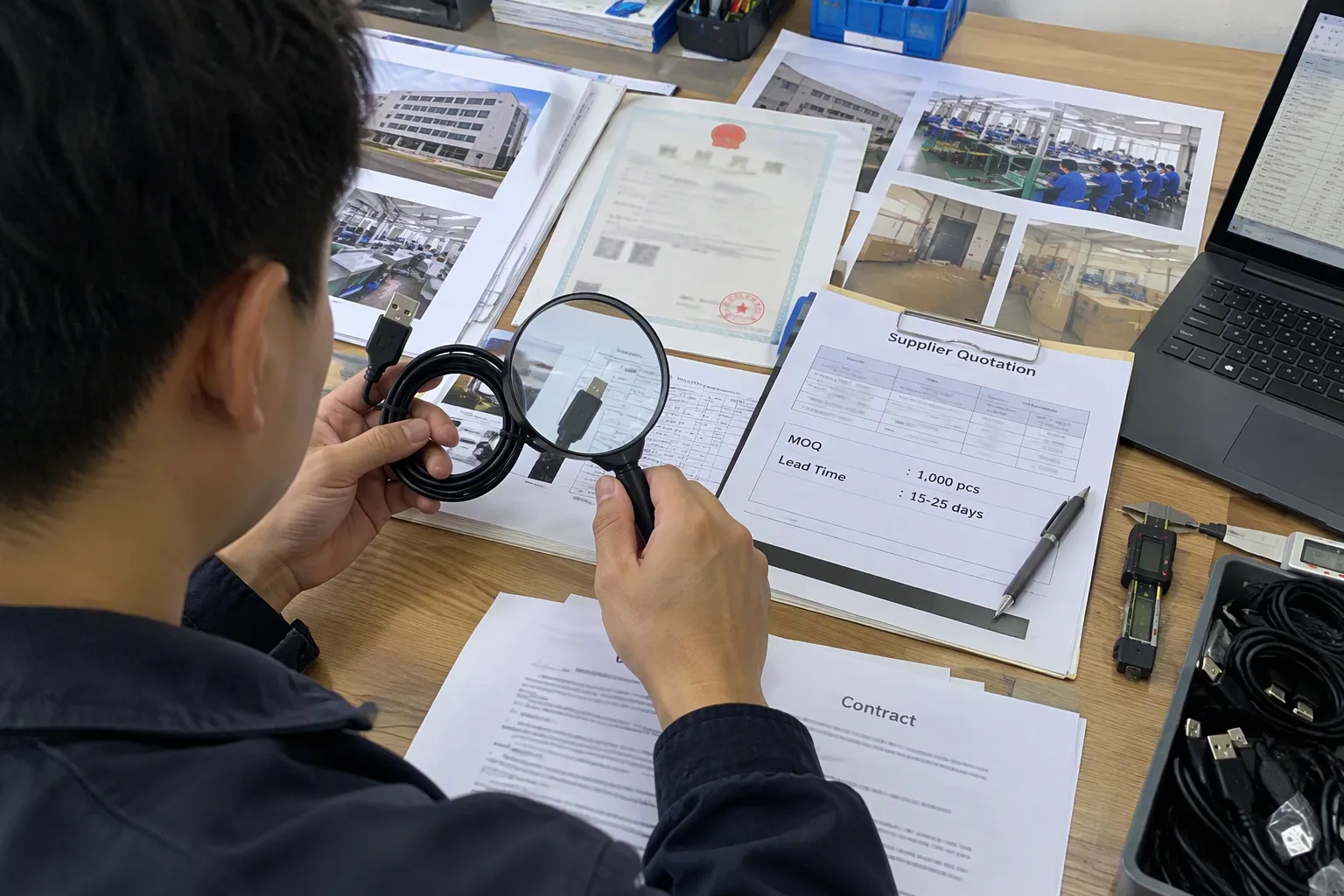
Both matter, but price should be compared only after the technical requirements are equivalent. A cheaper cable can create extra costs through returns, complaints, inconsistent batches, replacement shipments, or missed delivery dates. I evaluate price together with sample quality, documentation, MOQ, lead time, inspection, and after-sales terms.
Conclusion
Before ordering USB cables, I recommend starting with the device and use case, then confirming connector configuration, charging or data requirements, physical construction, documentation, sample results, and production controls. I also compare MOQ, customization, delivery, and after-sales support instead of focusing only on unit price. If you are sourcing USB cables for a European or American retail, wholesale, import, or e-commerce business, you can request a quote or contact us to discuss your target devices, specification, packaging, quantity, and delivery plan. Send us your drawing, sample, or target market and our Shenzhen 3C export team will reply with a like-for-like quotation.
Sources
- Universal Serial Bus Type-C Cable and Connector ...", The USB Implementers Forum describes USB Type-C as a connector and cable interface whose capabilities depend on the applicable USB specification and power-delivery requirements
- Universal Serial Bus Type-C Cable and Connector ...", USB-IF guidance indicates that USB Type-C identification does not by itself communicate a cable's maximum power, data rate, or other performance characteristics
- USB Power Delivery", USB Power Delivery documentation describes power delivery as a negotiated interaction among the source, sink, and cable, so the observed charging result is a property of the connected system rather than the cable in isolation
- USB Charger (USB Power Delivery)", USB technical documentation distinguishes power-only cables from cables that include the conductors and signaling requirements needed for data communication
- USB Charger (USB Power Delivery)", USB Power Delivery specifications describe charging as limited by the capabilities negotiated among the charger, cable, and device; a charger’s nominal rating therefore does not determine the result for every combination
- USB Type-C® Cable Logo Usage Guidelines", Government product-information guidance generally requires performance representations to be sufficiently clear and substantiated, supporting the use of defined power, protocol, and test conditions instead of ambiguous charging language
- Fatigue Behavior of 3D Braided Composites Containing an ...", Cable durability studies evaluate fatigue, bending, strain relief, and electrical continuity through defined tests, indicating that an outer braided covering alone is not a direct measure of finished-cable service life
- Medical Device Interoperability", Interoperability-testing research treats compatibility results as configuration-specific evidence and recommends representative test coverage rather than assuming universal compatibility from a limited sample